
Luke 8:45

Greek (Tischendorf 8th ed.) Luke 8:45 appears in the Greek New Testament. The text above is from the Tischendorf 8th edition. Each word links to its Strong’s number and a concise gloss. Click any word for its full Thayer’s Greek Lexicon entry.
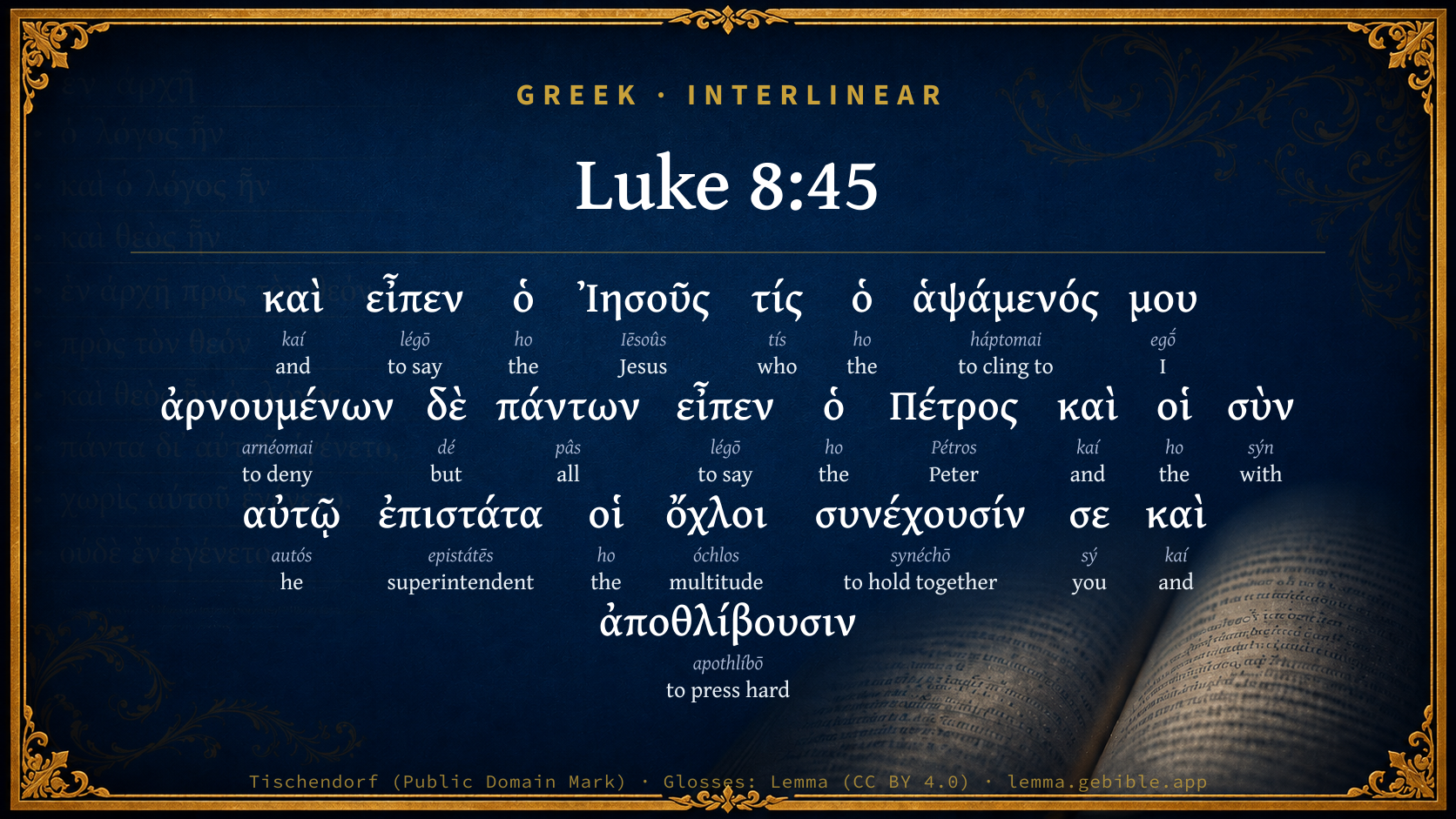
Download image
Cite this verse

Luke 8:45 (World English Bible). Public Domain. Lemma interlinear Bible study tool, https://lemma.gebible.app/v/luke/8/45.

Show BibTeX & RIS
BibTeX
RIS
English Translation
Jesus said, "Who touched me?" When all denied it, Peter and those with him said, "Master, the multitudes press and jostle you, and you say, 'Who touched me?'"
World English Bible · Public Domain
Highlights
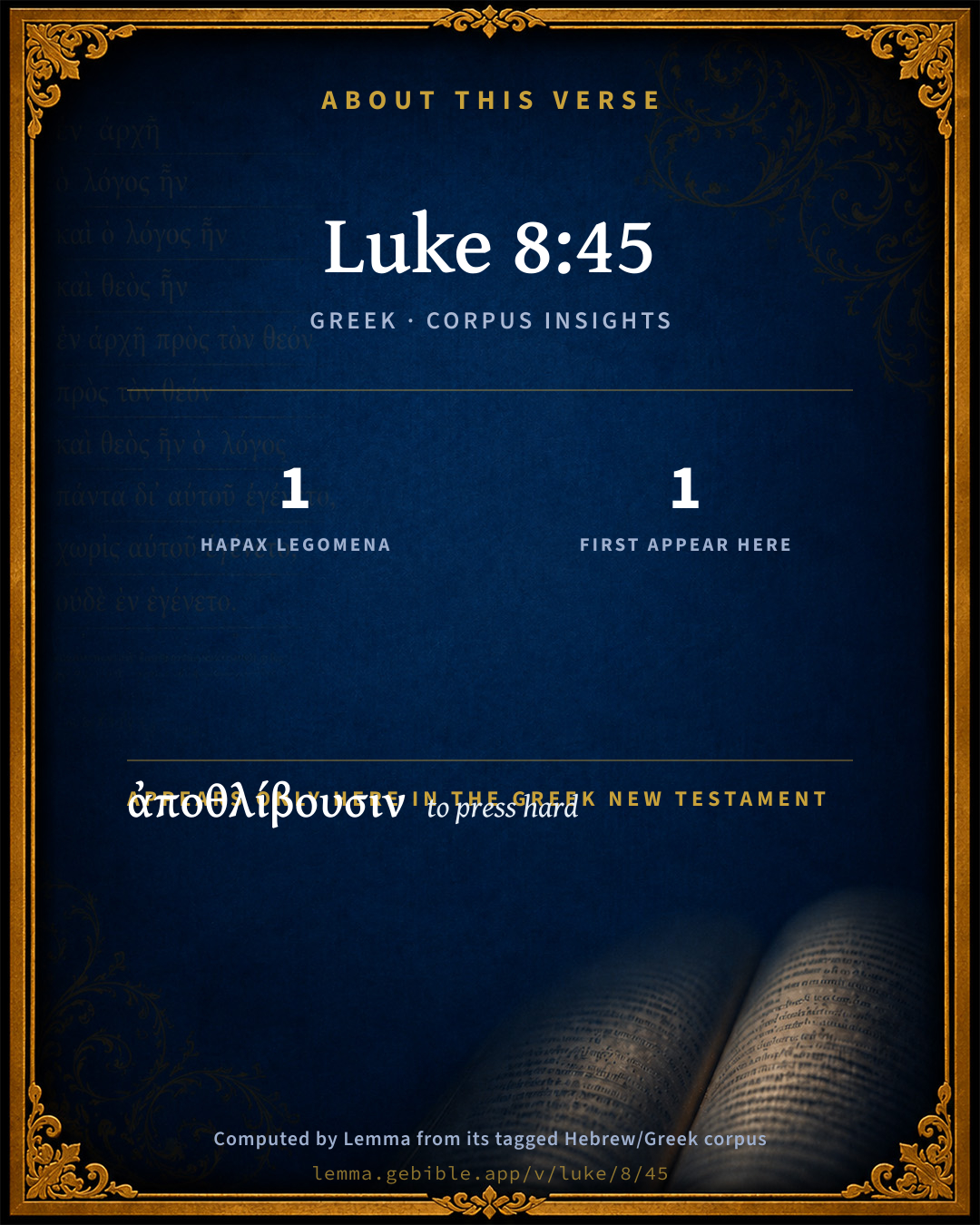
  • 1 hapax legomenon — only here in the Greek New Testament
  • 1 first appearance in the Greek New Testament
Full analysis ↓
Download a study sheet

One document with this verse’s original text, its word-by-word gloss line, the meaning frame, cross-references with their text, attributed commentary, and full source and license credits — printable, and it pastes into notes with its structure intact.

This verse Autodidact and up

Study sheet (.html) Plain text (.txt)

A passage Seminary Student

Up to 50 verses in one chapter. A passage sheet keeps up to 6 commentary sources and 12 cross-references per verse, in the order this page ranks them, and says so on the sheet whenever that leaves anything out. Ask for a single verse and you get the Autodidact verse sheet above.

Everything on this page stays free to read, with no account — the sheet is a download of what is already on screen, not access to it.

Want to remove ads? Support Godless Engineer
Compare translations 3

The same verse in 3 English versions, stacked beneath the original-language interlinear above. Click any original word for its lexicon entry.

Each is an independent rendering of the whole verse — the interlinear is not word-aligned to these translations.

Highlighted words mark where these versions differ — a whole-verse word diff, not a word-by-word alignment.

  • World English Bible Public Domain
    Jesus said, "Who touched me?" When all denied it, Peter and those with him said, "Master, the multitudes press and jostle you, and you say, 'Who touched me?'"
  • King James Version Public Domain
    And Jesus said, Who touched me? When all denied, Peter and they that were with him said, Master, the multitude throng thee and press thee, and sayest thou, Who touched me?
  • unfoldingWord Literal Text CC BY-SA 4.0
    And Jesus said, “Who the one having touched me?” But all denied it, Peter said, “Master, the crowds are crowding around and pressing against you.”

unfoldingWord Literal Text — © unfoldingWord, licensed CC BY-SA 4.0. Word-aligned USFM3 via Door43 (git.door43.org/unfoldingWord/en_ult).

Versions to compare (up to 4)

3 of 4 selected

Show all 19 translations

Every available English version of this verse, each an independent rendering of the whole verse.

  • World English Bible Public Domain
    Jesus said, "Who touched me?" When all denied it, Peter and those with him said, "Master, the multitudes press and jostle you, and you say, 'Who touched me?'"
  • Berean Standard Bible Public Domain
    “Who touched Me?” Jesus asked. But they all denied it. “Master,” said Peter, “the people are crowding and pressing against You.”
  • Majority Standard Bible Public Domain
    “Who touched Me?” Jesus asked. But they all denied it. “Master,” said Peter and those with him, “the people are crowding and pressing against You, and You say, ‘Who touched Me?’”
  • King James Version Public Domain
    And Jesus said, Who touched me? When all denied, Peter and they that were with him said, Master, the multitude throng thee and press thee, and sayest thou, Who touched me?
  • American Standard Version (1901) Public Domain
    And Jesus said, Who is it that touched me? And when all denied, Peter said, and they that were with him, Master, the multitudes press thee and crush `thee'.
  • Revised Version (1885) Public Domain
    And Jesus said, Who is it that touched me? And when all denied, Peter said, and they that were with him, Master, the multitudes press thee and crush thee.
  • Geneva Bible (1599) Public Domain
    Then Iesus sayd, Who is it that hath touched me? When euery man denied, Peter sayd and they that were with him, Master, the multitude thrust thee, and tread on thee, and sayest thou, Who hath touched me?
  • Douay-Rheims (1899) Public Domain
    And Jesus said: Who is it that touched me And all denying, Peter and they that were with him said: Master, the multitudes throng and press thee, and dost thou say, Who touched me
  • Young's Literal Translation Public Domain
    And Jesus said, `Who `is' it that touched me?' and all denying, Peter and those with him said, `Master, the multitudes press thee, and throng `thee', and thou dost say, Who `is' it that touched me!'
  • Literal Standard Version CC BY-SA 4.0
    And Jesus said, “Who [is] it that touched Me?” And all denying, Peter and those with him said, “Master, the multitudes press You, and throng [You], and You say, Who [is] it that touched Me?”
  • Unlocked Literal Bible CC BY-SA 4.0
    Jesus said, “Who was it who touched me?” When all denied it, Peter said, “Master, the crowds of people are all around you and they are pressing in against you.”
  • unfoldingWord Literal Text CC BY-SA 4.0
    And Jesus said, “Who the one having touched me?” But all denied it, Peter said, “Master, the crowds are crowding around and pressing against you.”
  • Darby Bible Public Domain
    And Jesus said, Who has touched me? But all denying, Peter and those with him said, Master, the crowds close thee in and press upon thee, and sayest thou, Who has touched me?
  • World Messianic Bible Public Domain
    Yeshua said, “Who touched me?” When all denied it, Peter and those with him said, “Master, the multitudes press and jostle you, and you say, ‘Who touched me?’ ”
  • Webster's Bible Public Domain
    And Jesus said, Who touched me? When all denied, Peter, and they that were with him, said, Master, the multitude throng thee, and press thee, and sayest thou, Who touched me?
  • Free Bible Version CC BY-SA 4.0
    “Who touched me?” Jesus asked. Everybody around denied doing so. “But Master,” said Peter, “there are people crowding around you, and they keep pushing up against you.”
  • Bible in Basic English Public Domain
    And Jesus said, Who was touching me? And when they all said, It is not I, Peter and those who were with him said, Master, the people are pushing round you on every side.
  • Text-Critical English NT CC BY 4.0
    Then Jesus said, “Who touched me?” When everyone denied it, Peter and those who were with him said, “Master, the crowds are surrounding yoʋ and pressing against yoʋ, and yet yoʋ say, ‘Who touched me?’ ”
  • Tyndale New Testament (1534) Public Domain
    And Iesus sayde: Who is it that touched me? when every man denyed Peter and they that were with him sayde: Master the people thrust the and vexe the: and sayest thou who touched me?

Literal Standard Version (2020), Covenant Press — licensed CC BY-SA 4.0. Text via the HelloAO Bible API (eBible.org). Unlocked Literal Bible (unfoldingWord) — licensed CC BY-SA 4.0. Text via the HelloAO Bible API (eBible.org). unfoldingWord Literal Text — © unfoldingWord, licensed CC BY-SA 4.0. Word-aligned USFM3 via Door43 (git.door43.org/unfoldingWord/en_ult). Free Bible Version, Dr. Jonathan Gallagher — licensed CC BY-SA 4.0. Text via the HelloAO Bible API (eBible.org).

Word by word

More ways to search: Search by grammar → Find every occurrence → Compare this word →

Practice this passage: Drill this verse → Learn its vocabulary →

ἀποθλίβουσιν
apothlíbō
G598
“to press hard”
Verb, Present, Active, Indicative, 3rd person, Plural
Part of Speech
Verb
Tense
Present
Voice
Active
Mood
Indicative
Person
3rd person
Number
Plural
Full Thayer's Definition

Origin: from G575 and G2346

TDNT: None

1. to press on all sides, squeeze, press hard a. of pressing out grapes and olives
  1. καὶ kaí G2532 “and” Conjunction
  2. εἶπεν légō G3004 “to say” Verb, Aorist, Active, Indicative, 3rd person, Singular
  3. ὁ ho G3588 “the” Article, Nominative, Singular, Masculine
  4. Ἰησοῦς Iēsoûs G2424 “Jesus” Noun, Nominative, Singular, Masculine
  5. τίς tís G5101 “who” Interrogative pronoun, Nominative, Singular, Masculine
  6. ὁ ho G3588 “the” Article, Nominative, Singular, Masculine
  7. ἁψάμενός háptomai G680 “to cling to” Verb, Aorist, Middle, Participle, Nominative, Singular, Masculine
  8. μου egṓ G1473 “I” Personal pronoun, 1st person, Genitive, Singular
  9. ἀρνουμένων arnéomai G720 “to deny” Verb, Present, Middle or Passive deponent, Participle, Genitive, Plural, Masculine
  10. δὲ dé G1161 “but” Conjunction
  11. πάντων pâs G3956 “all” Adjective, Genitive, Plural, Masculine
  12. εἶπεν légō G3004 “to say” Verb, Aorist, Active, Indicative, 3rd person, Singular
  13. ὁ ho G3588 “the” Article, Nominative, Singular, Masculine
  14. Πέτρος Pétros G4074 “Peter” Noun, Nominative, Singular, Masculine
  15. καὶ kaí G2532 “and” Conjunction
  16. οἱ ho G3588 “the” Article, Nominative, Plural, Masculine
  17. σὺν sýn G4862 “with” Preposition
  18. αὐτῷ autós G846 “he” Personal pronoun, Dative, Singular, Masculine
  19. ἐπιστάτα epistátēs G1988 “superintendent” Noun, Vocative, Singular, Masculine
  20. οἱ ho G3588 “the” Article, Nominative, Plural, Masculine
  21. ὄχλοι óchlos G3793 “multitude” Noun, Nominative, Plural, Masculine
  22. συνέχουσίν synéchō G4912 “to hold together” Verb, Present, Active, Indicative, 3rd person, Plural
  23. σε sý G4771 “you” Personal pronoun, 2nd person, Accusative, Singular
  24. καὶ kaí G2532 “and” Conjunction

About this verse

These counts appear in no published source. They are computed here, from the morphology-tagged text and Lemma’s own curated glosses. What Lemma adds →

25
words
18
distinct lemmas
Gospels
section

Notable vocabulary

1 hapax legomenon — a word that appears only here in the entire Greek New Testament:

  • ἀποθλίβουσιν to press hard G598

First appearance in Scripture

This word makes its first canonical appearance in the Greek New Testament here:

  • ἀποθλίβουσιν to press hard G598

Shared distinctive vocabulary

ἐπιστάτα superintendent G1988 occurs in 6 verses of the Greek New Testament. Also found in:
Repetition

Words recur within this verse:

Cross-references

3

Topical passages linked to Luke 8:45 in the Treasury of Scripture Knowledge — connected by theme and wording, ordered by reader-vote popularity; previews shown in the World English Bible.

  • Luke 9:13 But he said to them, "You give them something to eat." They said, "We have no more than five loaves and two fish, unless we should go and buy food for all these people."
  • Mark 5:30–32 Immediately Jesus, perceiving in himself that the power had gone out from him, turned around in the crowd, and asked, "Who touched my clothes?"
  • Luke 5:5 Simon answered him, "Master, we worked all night, and took nothing; but at your word I will let down the net."

Cross-references courtesy of OpenBible.info (CC BY 4.0).

Where the printed editions differ

2 variants

Places in this verse where the major printed Greek editions disagree on the wording in a way that affects the translation — a comparison of editions, not a manuscript-by-manuscript collation. The editions are the modern critical texts (Nestlé-Aland 28/27, SBL, Westcott-Hort, Tregelles, Tyndale House) and the traditional texts behind the KJV (the Textus Receptus and the Byzantine/Majority text). It is not a claim about which reading is original.

  1. Extra text
    καὶ οἱ

    “and those”

    In TynTregTRByz Not in NA28NA27SBLWH
  2. Extra text
    καὶ λέγεις τίς ὁ ἁψάμενός μου.

    “and say which one having touched me.”

    In TregTRByz Not in NA28NA27TynSBLWH

    καὶ λέγεις τίς ὁ ἁψάμενός μου. (kai legeis tis ho hapsamenos mou) 'and say which one having touched me.' is only in traditional manuscripts (Treg+TR+Byz)

Textual data: Translators Amalgamated Greek New Testament (STEPBible TAGNT) · CC BY 4.0.

Commentary

Notes on Luke 8:45 from classic Christian and Jewish commentators (each source and its license shown beneath its notes). The classic Christian expositions comment on the surrounding passage and are grouped to its opening verse, so a note may address several verses; the Jewish commentaries on the Tanakh (Rashi and others) are per-verse, so they appear only where the commentator wrote on this verse.

Lemma curates 59 commentaries, every one of them public domain or Creative Commons licensed, each selected and text-cleaned for this edition rather than reprinted as found. About our sources →

Tyndale Open Study Notes

Tyndale Open Resources

8:45 Who touched me? Jesus recognized the touch of faith by a needy person.

Tyndale Open Study Notes — © Tyndale Open Resources, licensed CC BY-SA 4.0. Text via the HelloAO Bible API.

Expositor's Greek Testament

ed. W. Robertson Nicoll

Luk 8:45 . ὁ Πέτρος : Mk. says “the disciples,” but one would speak for the rest, and Lk. naturally makes Peter the spokesman. συνέχουσί σε , hem thee in. ἀποθλίβουσιν , squeeze, like grapes (Joseph., Ant. , ii., Luk 8:2 ).

The Expositor's Greek Testament, edited by W. Robertson Nicoll (1897–1910) — public domain. Text from a community e-Sword module.

Jamieson, Fausset & Brown

Robert Jamieson, A. R. Fausset & David Brown

Who touched me?--"Askest Thou, Lord, who touched Thee? Rather ask who touched Thee not in such a throng."

Jamieson, Fausset & Brown — Commentary Critical and Explanatory on the Whole Bible (1871) — public domain (CC PDM 1.0). Text via the HelloAO Bible API.

Ellicott's Commentary for English Readers

(45) Master.—The same word as in Luk_8:24, where see Note.

A Bible Commentary for English Readers, edited by Charles John Ellicott (1878–1897) — public domain. Text from a community e-Sword module.

The Cambridge Bible for Schools and Colleges

gen. ed. J. J. S. Perowne

45. Peter and they that were with him] St Mark merely says His disciples, but the question is in exact accordance with that presumptuous impetuosity which marked the as yet imperfect stage of Peter’s character.

The Cambridge Bible for Schools and Colleges (gen. ed. J. J. S. Perowne; Cambridge University Press, 1878–1918) — public domain. Text from a community e-Sword module.

John Gill's Exposition

And Jesus said, somebody hath touched me,.... Not in a common and accidental way, but with design, and in the strength of faith:

for I perceive that virtue is gone out of me: for the cure of the person that had touched him, and that not without his knowledge and will; See Gill on Luk 6:19.

John Gill's Exposition of the Whole Bible (1746–1763) — public domain (CC PDM 1.0). Text via the HelloAO Bible API.

Haydock's Catholic Bible Commentary

All denied that they had designedly touched him, though, on account of the pressure of the crowd, many unwillingly touched him. (Menochius’ Commentaria.)

George Leo Haydock (1774–1849), Haydock's Catholic Family Bible and Commentary, 1859 edition — public domain. Excludes Psalms (Douay-Rheims chapter numbering differs from Protestant) and Deuterocanonical books (Catholic canon only).

The Pulpit Commentary

Who touched me? The Master"s words here and the statement of ver. 46, "For I perceive that virtue is gone out of me," tell us something of the earnestness and faith of the suppliant. Many, as Peter said, in that crowd were touching Jesus as they pressed round him to look on his face or to listen to his words, but of them all none save this poor sufferer "touched" him in the true deep sense of touching, with the fixed idea that contact with his blessed Person would benefit or heal them.

Vers. 45, 46. Christ"s discriminating notice.

Who can help being interested in the woman who is the subject of this sacred story? She has suffered long; she has wasted her substance in vain endeavours to be healed. Now a new hope springs up in her heart; though excited by this hope she shrinks from the publicity which she fears is necessary for its fulfilment. At last faith and hope triumph over timidity, and she comes into the presence of Christ. We are sympathetically present in that crowd; we see her stealing into it, pushing her way nearer and nearer to the Master, at length timidly stretching out her hand and touching the sacred fringe of his garment. We almost pity this trembling woman, albeit we know that she is healed, as Jesus turns and says, "Who touched me?" We know that it is only by a great spiritual effort that she tells her story to the Master in the presence of the people, and our hearts draw yet nearer in trust and love to that Divine Healer, to our Divine Lord, as we hear him say, "Daughter, be of good comfort: thy faith hath made thee whole; go in peace." The incident may speak to us of

I THE DIFFERENCE BETWEEN BODILY AND REAL SPIRITUAL CONTACT, "There are times when hands touch ours, but only send an icy chill of unsympathizing indifference to the heart; when eyes gaze into ours, but with a glazed look that cannot read our souls; when the multitude throng and press us, but we cannot say, " Somebody hath touched me," for the contact has not been between soul and soul, but only between form and form." We are very much thronged in this modern life we live, but we are not very often touched to newness of thought and feeling; and except we live a life of prayer and genuine human sympathy, we must not expect to "touch" other souls so as to quicken and inspire them.

II THE USELESSNESS OF ANY REMEDY BUT THE GOSPEL FOR OUR SPIRITUAL NEED. This woman in her helplessness is a picture of humanity. It is sick with the worst of all maladies sin. It is suffering all the wretched consequences of guilt weariness, restlessness, misery, remorse. It often spends its resources on things which have no healing virtue, and which leave it ill as ever. At length it repairs unto him in whom is no disappointment, in the shelter of whose cross, and in the shadow of whose love, and in the sunshine of whose service is pardon for every sin, comfort for every sorrow, rest for every soul.

III THE DUTY OF DECLARING WHAT GOD HAS DONE FOR US. That sensitive heart, trying to screen herself from the observation of the crowd, and wishing to come and go unnoticed, was not rejected. Nevertheless, the Lord, by his repeated questioning, constrained her to come forward and acknowledge the blessing she had received. Christ does not wish for an ostentatious piety; he hates all pretence; but he approves and desires a suitable and grateful avowal of our indebtedness to him. Though we come with a trembling heart, yet we are to come and tell our friends what great things the Lord has done for us.

IV THE DISTINGUISHING NOTICE CHRIST TAKES OF US. "Who touched me?" asked the Lord. "Master, the multitude throng thee; is it wonderful that somebody should touch thee? Anybody might chance to touch thee in such a crowd; can it matter who it was?" urges Peter. "Ah! but that is not enough. Somebody, some one, hath touched me; there is one individual, whom I distinguish from the others, that has laid an appealing hand upon me. You see nothing in that touch but an accidental encounter. I see much more than that the approach of a human mind, the appeal of a human heart, the contact of a human soul with mine." This is the spirit of our Lord"s reply. And it conveys to us the important truth that we are not lost in the crowd. It is not so true to say, "God loves man," as to say, "God loves men." "He tasted death for every man;" "He loved me, and gave himself for me." There are no limitations in the Infinite One. The fact that he controls the universe is no reason why he should not watch the workings of each humblest human soul The vastness of the range of his observation does not diminish the fulness of his knowledge of every member of his family. Disciples see only a pressing, pushing throng; but the Master singles out the woman who has come to see whether her last chance will fail her. The crowd may hide us from one another, but not from our Lord. God sees us, every one; follows us; pursues us with his watchful and redeeming love; guides us with his hand; leads us into his kingdom. But we must see that our touch is one that will call forth such a response as this. Christ discriminates between the touch of this woman and that of the unmannerly crowd. It is not necessary for us to have a full and perfect understanding of his nature, or even a perfect, unwavering assurance of the success of our appeal. This woman had neither of these. It is necessary that we should have what she had earnestness of spirit, and a measure of genuine faith in him. Then will he say to us, as to her, "Be of good comfort... go in peace. C.

The Pulpit Commentary (1880–1919), ed. H.D.M. Spence-Jones & Joseph S. Exell — public domain. Text from a community e-Sword module.

unfoldingWord translationNotes

Door43 World Missions Community

the crowds of people ... are pressing in against you

By saying this, Peter was implying that anyone could have touched Jesus. This implicit information can be made explicit if necessary. AT: "there are many people crowding around you and pressing in against you, so any one of them might have touched you" (See: Assumed Knowledge and Implicit Information)

Someone did touch me

It may be helpful to distinguish this intentional "touch" from the accidental touches of the crowd. AT: "Someone deliberately touched me" (See: Assumed Knowledge and Implicit Information)

I know that power has gone out from me

Jesus did not lose power or become weak, but his power healed the woman. AT: "I know that healing power went out from me" or "I felt my power heal someone" (See: Assumed Knowledge and Implicit Information)

translationWords

Jesus

lord

Peter

lord

power

unfoldingWord translationNotes — © Distant Shores Media and the Door43 World Missions Community, licensed CC BY-SA 4.0. Source: git.door43.org/Door43/en_tn.

Cambridge Greek Testament for Schools and Colleges

45. ὁ Πέτρος καὶ οἱ σὺν αὐτῷ. St Mark merely says ‘His disciples’; but the question is in exact accordance with that presumptuous impetuosity which marked the as yet imperfect stage of Peter’s character.

Cambridge Greek Testament for Schools and Colleges (Cambridge University Press, 1896; 21 vols, various authors incl. Carr, Maclear, Plummer, Farrar, Lumby, Moule, M. R. James, Simcox) — public domain. Text from a community e-Sword module.

Alford’s Greek Testament

Henry Alford

45.] We are not to imagine that our Lord was ignorant of the woman, or any of the circumstances. The question is asked to draw out what followed.

See, on the part of Jesus Himself, an undeniable instance of this, in ch. 24:19—and note there. The healing took place by His will, and owing to His recognition of her faith: see similar questions, Gen 3:9, and 2Ki 5:25.

ὁ Πέτ. κ. οἱ σ. αὐ.] A detail contained only here.

On the latter part of this verse many instructive remarks have been made in sermons—see Trench, Mir. p. 192, note (edn. 2)—to the effect that many press round Christ, but few touch Him, only the faithful. Thus Augustine, ‘Sic etiam nunc est corpus ejus, id est, Ecclesia ejus. Tangit eam fides paucorum, premit turba multorum’ (Serm. lxii. 3 (5), vol. v.). And Chrysostom, ὁ πιστεύων εἰς τὸν σωτῆρα ἅπτεται αὐτοῦ· ὁ δὲ ἀπιστῶν θλίβει αὐτὸν καὶ λυπεῖ. It is difficult to imagine how the miracle should be, as Bp. Wordsw., “a solemn warning to all who crowd on Christ:” or how such a forbidding to come to Him should be reconciled with δεῦτε πρός με πάντες.… Rather should we say, seeing it was one of those that thus crowded on Him who obtained grace from Him, that it is a blessed encouragement to us not only to crowd on Him, but even to touch Him: so to crowd on Him as never to be content till we have grasped if it be but His garment for ourselves: not to despise or discourage any of the least of those who “make familiar addresses to Him in (so called) religious hymns,” seeing that thus some of them may touch Him to the healing of their souls. I much fear that if my excellent friend had been keeping order among the multitude on the way to the house of Jaeirus, this poor woman would never have been allowed to get near to Jesus. But I hope and trust that he and I shall rejoice together one day in His presence amidst a greater crowd, whom no man can number, of all nations, and kindreds, and people, and tongues.

Henry Alford, The Greek Testament (1849–1861) — public domain. Text from a community e-Sword module.

International Critical Commentary

45. There is no reason for supposing that the miracle wrought without the will of Jesus. He knew that someone had been healed by touching His garment; and we may believe that He read the woman’s heart as she approached Him in the belief that He could heal her. Lk. evidently dates the cure from her touching His garment; Mt. seems to place it in Christ’s words to her; Mk. in both places.

τίς ὁ ἀψάμενός μου; This does not seem to be one of those cases in which Christ asked for information. He knew that He had been touched with a purpose, and He probably knew who had done it. Mk.’s περιεβλέπετο ἰδεῖν τὴν τοῦτο ποιήσασαν rather implies that He knew where to look. For the woman’s sake she must be induced to avow her act. Note the masc., which makes the question all the more general: Mk. has τίς μου ἥψατο τῶν ἱματίων. The verb implies more than touching, “laying hold of.” For other cases in which Jesus asked questions of which He knew the answer comp. 24:17; Mar 9:33. See some good remarks in the S. P. C. K. Comm. on Luk 8:46.

ἀρνουμένων δὲ πάντων. This explains, and to some extent excuses, Peter’s characteristic interference. Lk. alone tells us that Peter took the lead in this. See on 9:20, and comp. Mar 1:36. Note the πάντων, and see on 9:43 and 11:4. For ἐπιστάτα see on 5:5.

συνέχουσίν σε. “Hold Thee in, keep Thee a prisoner”; 19:43, 22:63; comp. 4:38. Here only in N. T. does ἀποθλίβειν occur: Lat. affligere (Vulg.), comprimere (f), contribulare (d); om. a b ff.2

International Critical Commentary — older volumes (1896–1929), various authors — public domain. Text from a community e-Sword module.

Vincent's Word Studies in the New Testament

Marvin R. Vincent

Who touched [τις ο αψαμενος] . Lit., who is he that touched? Rev., who is it that.

Throng and press [συνεχουσιναποθλιβουσιν] . On the former word, see ver. 37, and ch. 4 38. Rev. renders the latter, which occurs here only, more literally, crush. It means to squeeze out, as wine from grapes. See on tribulation, Mt 13:21.

Marvin R. Vincent, Word Studies in the New Testament (1887–1900) — public domain. Text from a community e-Sword/MySword module.

Lesson kit

Teaching starters — assembled from the data on this page, not authored interpretation. Every prompt links to the verse data it draws on. Edit before teaching.

Luke, in the Gospels, opens this verse with 25 words (18 distinct Greek lemmas). Its most distinctive word is apothlíbō (“to press hard”). A historical commentator’s framing appears above. Read the whole chapter for the surrounding context.

Discussion questions

  1. The word apothlíbō carries the sense “to press hard.” How does it shape the verse?
  2. This verse holds 1 word here found nowhere else in the Greek New Testament. What might the rare word draw attention to?
  3. The word “to press hard” first appears here in Scripture. What is being introduced at this debut?
  4. Luke 5:5 shares the word «superintendent» with this verse. How do the two illuminate each other?
  5. “to say” occurs 2× in this one verse. What is the effect of the repetition?
  6. These translations render this verse differently; the difference is in the English rendering, not the original. What questions does that raise?
  7. Reading how Tyndale Open Study Notes and Expositor's Greek Testament read this verse, where do the two commentators agree and where do they part?

Things to notice

  • 1 word in this verse appears nowhere else in the Greek New Testament.
  • 1 word makes its first canonical appearance in Scripture here.
  • These translations choose different wording for 17 words in this verse.
  • “to say” occurs 2× in this single verse.
  • 18 distinct Greek lemmas span 25 words in this verse.

Reading settings

Reading text

Shown beneath each verse's original-language words.

Old Testament
Old Testament edition

Read the OT as the Masoretic Hebrew (MT) or the Greek Septuagint (LXX).

English shown for the Greek Septuagint (in the Hebrew ↔ Greek comparison).

Comparing translations? Open the Compare panel on any verse page to stack up to four side by side.