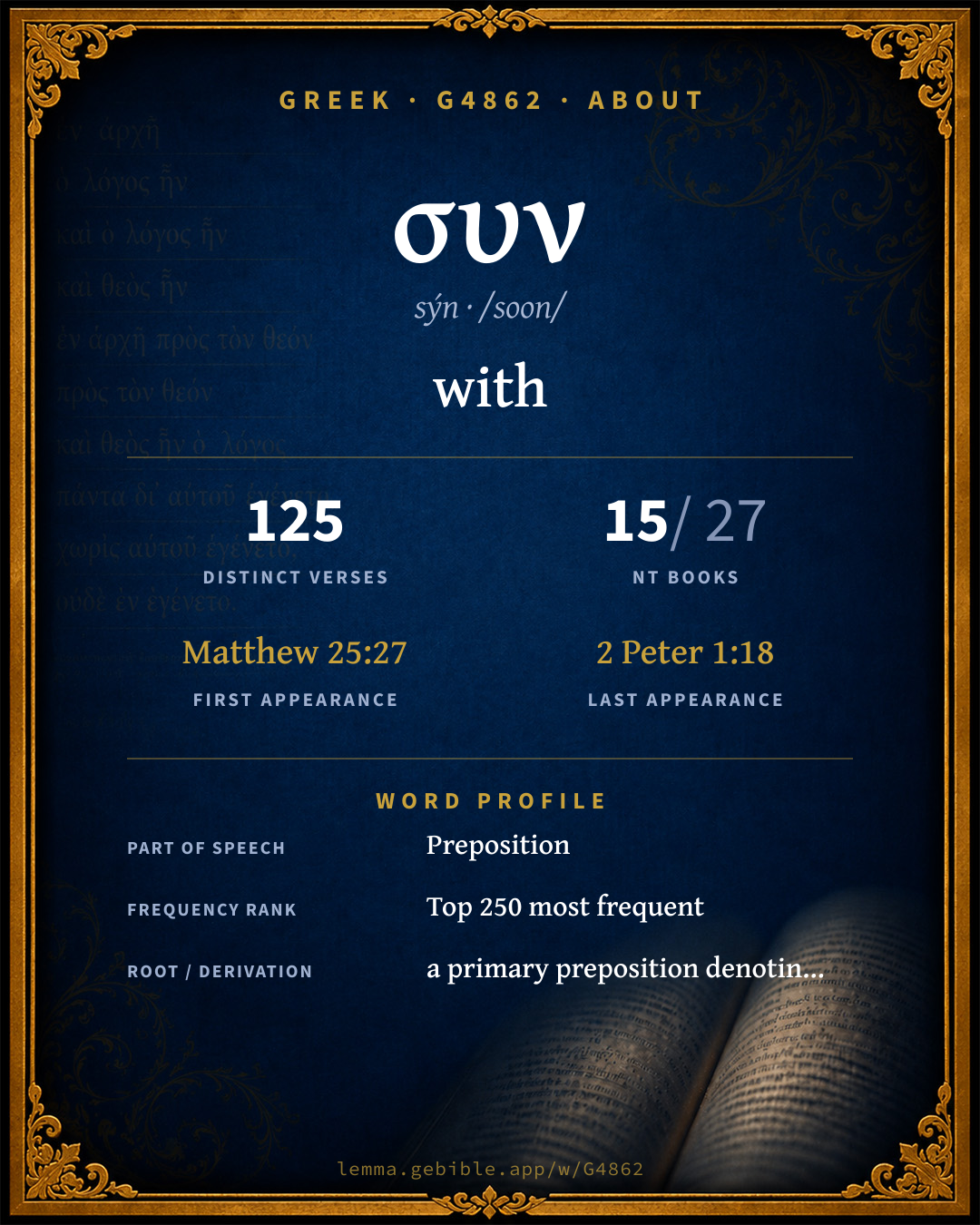
σύν
with
Full lexicon entry — Thayer's Greek Lexicon
From Thayer's Greek Lexicon
Where this word appears
Grammar key — what these labels mean
Part of speech
- Preposition
- A relational word governing a noun in a particular case.
Every verse where G4862 appears in the Book of 2 Corinthians — 6 distinct verses. Click any verse to open its interlinear word-by-word view. Verse text shown in the World English Bible for context — . Each verse’s Greek form is shown with its reference; the English is not keyword-highlighted, since the data carries no word-level English alignment. Use “Compare translations” on any verse to read it across multiple English versions. This concordance covers the Greek New Testament; Septuagint (Greek Old Testament) occurrences of this word are not indexed here.
2 Corinthians
- 2 Corinthians 1:1 σὺν prep Paul, an apostle of Christ Jesus through the will of God, and Timothy our brother, to the assembly of God which is at Corinth, with all the saints who are in the whole of Achaia:
- 2 Corinthians 1:21 σὺν prep Now he who establishes us with you in Christ, and anointed us, is God;
- 2 Corinthians 4:14 σὺν σὺν prep prep knowing that he who raised the Lord Jesus will raise us also with Jesus, and will present us with you.
- 2 Corinthians 8:19 σὺν prep Not only so, but who was also appointed by the assemblies to travel with us in this grace, which is served by us to the glory of the Lord himself, and to show our readiness.
- 2 Corinthians 9:4 σὺν prep so that I won't by any means, if there come with me any of Macedonia and find you unprepared, we (to say nothing of you) should be disappointed in this confident boasting.
- 2 Corinthians 13:4 σὺν prep For he was crucified through weakness, yet he lives through the power of God. For we also are weak in him, but we will live with him through the power of God toward you.
About this entry
At a glance — auto-summarized from this page’s data, not written by a person. Every figure links to its source below. This summary describes the numbers; it doesn’t interpret them.
The Greek preposition συν centers on the idea of “with.” Debuting at Matthew 25:27, it then recurs through the corpus. It appears 125 verses across 15 books of the Greek New Testament, among its common vocabulary. The word gravitates to Acts (39%), then Luke and 1 Corinthians. It shares a root with κοινος, συγγενης and συγγνωμη. Dig into 125-verse concordance and the renderings breakdown below.
Gloss history
Strong's 1890 vs modern scholarship

About this word
Strong's G4862 catalogs a Greek word from the Greek New Testament.
These counts are not copied from any lexicon or concordance. They are computed here, from the morphology-tagged Greek New Testament. What Lemma adds →
- 125
- distinct verses
- The word appears in 125 distinct verses.
- 15 / 27
- NT books
- The word appears in 15 of 27 New Testament books.
- #129
- by frequency
- Top 250 most frequent Greek words (rank 129 of 5,347 Greek words by occurrence).
View all 125 occurrences in the concordance →
Most concentrated in
- Acts 49 verses 39%
- Luke 24 verses 19%
- 1 Corinthians 7 verses 6%
By section of the New Testament
By traditional corpus
Conventional, traditional groupings — biblical authorship is debated, so this is a traditional corpus grouping, not an authorship claim. Some books belong to more than one corpus (Luke is in both the Gospels and the Lukan corpus, and so on), so these shares overlap and need not total 100%. Each figure is a share of the word’s 125 distinct verses.
- Lukan (Luke–Acts) 73 verses · 58%
- Gospels 37 verses · 30%
- Pauline corpus 37 verses · 30%
- Johannine 3 verses · 2%
- General (Catholic) Epistles 2 verses · 2%
How translations render this word
Counts come from each version’s own published word-to-Strong’s tagging or interlinear alignment — an approximate guide to how each version renders this word, not a word-level alignment the data otherwise carries. Because each total is that version’s own tagged count, the per-version totals vary from one another and need not match the appearance or distinct-verse counts above. These counts may also differ from a printed concordance because Lemma counts each distinctly tagged rendering and does not collapse phrase taggings into a single head-word total. This is a fixed set of word-tagged versions (KJV, ASV, BSB, ULT) and does not change with the reading translation you choose elsewhere. Each version’s license is shown beside its name below (and on Sources).
- King James Version: With 106×, Are with 5×, Were with 4×
- American Standard Version: With 102×, Are with 2×
- Berean Standard Bible: With 82×, Along with 11×, Together with 6×
- unfoldingWord Literal Text: With 117×, Along with 6×, Together with 2×
King James Version Public Domain
Renders G4862 across 124 tagged occurrences — most commonly:
Plus 5 renderings that appear only once — usually multi-word phrases or single function words the recovered tagging swept in, not distinct renderings. Not rendered by a distinct English word in 1 further occurrence.
American Standard Version Public Domain
Renders G4862 across 121 tagged occurrences — most commonly:
Plus 17 renderings that appear only once — usually multi-word phrases or single function words the recovered tagging swept in, not distinct renderings.
Berean Standard Bible Public Domain
Renders G4862 across 114 tagged occurrences — most commonly:
Plus 10 renderings that appear only once — usually multi-word phrases or single function words the recovered tagging swept in, not distinct renderings. Not rendered by a distinct English word in 14 further occurrences.
unfoldingWord Literal Text CC BY-SA 4.0
Renders G4862 across 129 tagged occurrences — most commonly:
Plus 4 renderings that appear only once — usually multi-word phrases or single function words the recovered tagging swept in, not distinct renderings.
Senses in Thayer's
The 1 sense Thayer's distinguishes for this word, in lexicon order (not ranked by frequency or importance). The full entry — with sub-senses — is in the Lexicon Entry tab.
- with
Word origin
Origin: a primary preposition denoting union
A primary preposition denoting union ; with or together (but much closer than G3326 or G3844 ) that is by association companionship process resemblance possession instrumentality addition etc.i : - beside with. In compounds it has similar applications including completeness .
— Strong’s Exhaustive Concordance (1890), public domain.
Forms in the corpus
The 2 distinct written forms G4862 takes in the Greek New Testament, most frequent first — each parse links to that case’s occurrences in the concordance.
| Form | Parsing | Example | Uses |
|---|---|---|---|
| σὺν sỳn | Preposition | Matthew 25:27 | 128 |
| σύν sýn | Preposition | Acts 25:23 | 1 |
Same root — word family
Other Thayer's entries built from the same root as G4862, grouped by Strong’s listed origin. These share a root / origin per the lexicon — not necessarily a shared meaning. Each links to that word’s own entry.
Derived from this word
- κοινος koinós G2839 common
- συγγενης syngenḗs G4773 related by blood
- συγγνωμη syngnṓmē G4774 pardon
- συγκαθημαι synkáthēmai G4775 to sit together
- συγκαθιζω synkathízō G4776 to sit together
- συγκακοπαθεω synkakopathéō G4777 to suffer together
- συγκακουχεω synkakouchéō G4778 to be ill-treated together
- συγκαλεω synkaléō G4779 to call together
- συγκαλυπτω synkalýptō G4780 to cover completely
- συγκαμπτω synkámptō G4781 to bend together
- συγκαταβαινω synkatabaínō G4782 to go down with
- συγκατατιθεμαι synkatatíthemai G4784 to deposit together
- συγκαταψηφιζω synkatapsēphízō G4785 to vote against
- συγκεραννυμι synkeránnymi G4786 to mix together
- συγκλειω synkleíō G4788 to shut up
- συγκληρονομος synklēronómos G4789 joint heir
- συγκοινωνεω synkoinōnéō G4790 to share together
- συγκοινωνος synkoinōnós G4791 joint partner
- συγκομιζω synkomízō G4792 to collect together
- συγκρινω synkrínō G4793 to join together
- συγκυπτω synkýptō G4794 to bend together
- συγκυρια synkyría G4795 by chance
- συγχαιρω synchaírō G4796 to rejoice with
- συγχεω synchéō G4797 to disturb
+126 more words derive from G4862 (not shown).
Compare all same-root words → Showing 4 of 151 — not the complete family. They share a root, not necessarily a meaning.
Septuagint usage
The same Greek word συν appears 223 times in the Greek Old Testament (Septuagint), across 205 verses in 26 books.
- 223
- LXX occurrences
- Tagged occurrences of this Greek word in the Septuagint.
- 205
- verses
- Distinct Septuagint verses containing this word.
- 26 / 39
- OT books
- The word appears in 26 of the 39 Old Testament books.
Sample Septuagint occurrences
- Genesis 12:20 συν
- Exodus 6:26 σύν
- Leviticus 1:16 σύν
- Numbers 1:3 σύν
- Deuteronomy 1:30 συν
- Joshua 6:24 σύν
- Judges 3:27 σύν
- 1 Samuel 7:9 σύν
- 2 Samuel 6:4 σύν
- 1 Chronicles 16:32 σύν
- 2 Chronicles 10:8 συν
- Ezra 4:7 σύν
Septuagint occurrences (same lexeme)
Every verse where the same Strong’s number (G4862) appears in the Greek Septuagint — showing the first 50 of 205. Verse text shown in the World English Bible for context; the Greek form is the matched word — the English is not keyword-highlighted.
- Genesis 12:20 συν Pharaoh gave men charge concerning him: and they brought him on the way, and his wife, and all that he had.
- Genesis 15:11 συν The birds of prey came down on the carcasses, and Abram drove them away.
- Genesis 18:16 συν The men rose up from there, and looked toward Sodom. Abraham went with them to see them on their way.
- Genesis 18:23 συν Abraham drew near, and said, "Will you consume the righteous with the wicked?
- Genesis 19:15 συν When the morning arose, then the angels hurried Lot, saying, "Arise, take your wife, and your two daughters who are here, lest you be consumed in the iniquity of the city."
- Genesis 19:17 συν It came to pass, when they had taken them out, that he said, "Escape for your life! Don't look behind you, neither stay anywhere in the plain. Escape to the mountain, lest you be consumed!"
- Genesis 30:8 συν Rachel said, "With mighty wrestlings have I wrestled with my sister, and have prevailed." She named him Naphtali.
- Genesis 50:7 συν Joseph went up to bury his father; and with him went up all the servants of Pharaoh, the elders of his house, all the elders of the land of Egypt,
- Genesis 50:9 συν There went up with him both chariots and horsemen. It was a very great company.
- Genesis 50:14 συν Joseph returned into Egypt--he, and his brothers, and all that went up with him to bury his father, after he had buried his father.
- Genesis 50:25 συν Joseph took an oath of the children of Israel, saying, "God will surely visit you, and you shall carry up my bones from here."
- Exodus 6:26 σύν These are that Aaron and Moses, to whom Yahweh said, "Bring out the children of Israel from the land of Egypt according to their hosts."
- Exodus 7:4 σύν But Pharaoh will not listen to you, and I will lay my hand on Egypt, and bring forth my hosts, my people the children of Israel, out of the land of Egypt by great judgments.
- Exodus 7:15 συν Go to Pharaoh in the morning. Behold, he goes out to the water; and you shall stand by the river's bank to meet him; and the rod which was turned to a serpent you shall take in your hand.
- Exodus 10:9 σύν Moses said, "We will go with our young and with our old; with our sons and with our daughters, with our flocks and with our herds will we go; for we must hold a feast to Yahweh."
- Exodus 11:1 σύν Yahweh said to Moses, "Yet one plague more will I bring on Pharaoh, and on Egypt; afterwards he will let you go. When he lets you go, he will surely thrust you out altogether.
- Exodus 12:9 σύν Don't eat it raw, nor boiled at all with water, but roasted with fire; with its head, its legs and its inner parts.
- Exodus 12:38 συν A mixed multitude went up also with them, with flocks, herds, and even very much cattle.
- Exodus 12:51 σύν It happened the same day, that Yahweh brought the children of Israel out of the land of Egypt by their hosts.
- Exodus 13:19 συν Moses took the bones of Joseph with him, for he had made the children of Israel swear, saying, "God will surely visit you, and you shall carry up my bones away from here with you."
- Exodus 14:6 συν He made ready his chariot, and took his army with him;
- Exodus 15:19 σύν For the horses of Pharaoh went in with his chariots and with his horsemen into the sea, and Yahweh brought back the waters of the sea on them; but the children of Israel walked on dry land in the midst of the sea.
- Exodus 16:16 σύν This is the thing which Yahweh has commanded: "Gather of it everyone according to his eating; an omer a head, according to the number of your persons, shall you take it, every man for those who are in his tent."
- Exodus 18:13 συν It happened on the next day, that Moses sat to judge the people, and the people stood around Moses from the morning to the evening.
- Exodus 18:22 συν Let them judge the people at all times. It shall be that every great matter they shall bring to you, but every small matter they shall judge themselves. So shall it be easier for you, and they shall share the load with you.
- Exodus 21:3 συν If he comes in by himself, he shall go out by himself. If he is married, then his wife shall go out with him.
- Exodus 23:1 συν "You shall not spread a false report. Don't join your hand with the wicked to be a malicious witness.
- Exodus 23:32 συν You shall make no covenant with them, nor with their gods.
- Exodus 24:2 συν Moses alone shall come near to Yahweh, but they shall not come near, neither shall the people go up with him."
- Exodus 29:17 σύν You shall cut the ram into its pieces, and wash its innards, and its legs, and put them with its pieces, and with its head.
- Exodus 33:2 συν I will send an angel before you; and I will drive out the Canaanite, the Amorite, and the Hittite, and the Perizzite, the Hivite, and the Jebusite:
- Exodus 33:3 συν to a land flowing with milk and honey: for I will not go up in the midst of you, for you are a stiff-necked people, lest I consume you in the way."
- Exodus 33:12 συν Moses said to Yahweh, "Behold, you tell me, 'Bring up this people:' and you haven't let me know whom you will send with me. Yet you have said, 'I know you by name, and you have also found favor in my sight.'
- Exodus 36:10 σύν He coupled five curtains to one another, and the other five curtains he coupled one to another.
- Exodus 40:33 σύν He raised up the court around the tent and the altar, and set up the screen of the gate of the court. So Moses finished the work.
- Leviticus 1:16 σύν and he shall take away its crop with its filth, and cast it beside the altar on the east part, in the place of the ashes.
- Leviticus 2:2 σύν He shall bring it to Aaron's sons the priests; and he shall take his handful of its fine flour, and of its oil, with all its frankincense; and the priest shall burn the memorial of it on the altar, an offering made by fire, of a sweet savor to Yahweh.
- Leviticus 2:16 σύν The priest shall burn as its memorial, part of its bruised grain, and part of its oil, along with all its frankincense: it is an offering made by fire to Yahweh.
- Leviticus 3:4 σύν and the two kidneys, and the fat that is on them, which is by the loins, and the cover on the liver, with the kidneys, he shall take away.
- Leviticus 3:9 σύν He shall offer from the sacrifice of peace offerings an offering made by fire to Yahweh; its fat, the entire tail fat, he shall take away close to the backbone; and the fat that covers the inwards, and all the fat that is on the inwards,
- Leviticus 3:10 σύν and the two kidneys, and the fat that is on them, which is by the loins, and the cover on the liver, with the kidneys, he shall take away.
- Leviticus 3:15 σύν and the two kidneys, and the fat that is on them, which is by the loins, and the cover on the liver, with the kidneys, he shall take away.
- Leviticus 4:9 σύν and the two kidneys, and the fat that is on them, which is by the loins, and the cover on the liver, with the kidneys, he shall take away,
- Leviticus 4:11 σύν The bull's skin, all its flesh, with its head, and with its legs, its innards, and its dung,
- Leviticus 6:8 σύν Yahweh spoke to Moses, saying,
- Leviticus 7:4 σύν and the two kidneys, and the fat that is on them, which is by the loins, and the cover on the liver, with the kidneys, shall he take away;
- Leviticus 14:31 σύν even such as he is able to afford, the one for a sin offering, and the other for a burnt offering, with the meal offering. The priest shall make atonement for him who is to be cleansed before Yahweh."
- Numbers 1:3 σύν from twenty years old and upward, all who are able to go out to war in Israel. You and Aaron shall number them by their divisions.
- Numbers 1:45 σύν So all those who were numbered of the children of Israel by their fathers' houses, from twenty years old and upward, all who were able to go out to war in Israel;
- Numbers 1:49 συν "Only the tribe of Levi you shall not number, neither shall you take a census of them among the children of Israel;
These are occurrences of the same Greek lexeme (G4862) in the Septuagint — not a translation of any one Hebrew word. The store carries no word-level Hebrew↔Greek alignment, so no Hebrew original is asserted here. Counts come from the recovered LXX Strong's tagging — high-frequency vocabulary is well covered, while rare or late forms may be untagged — so they reflect tagged occurrences and may slightly undercount.