Acts 7:19

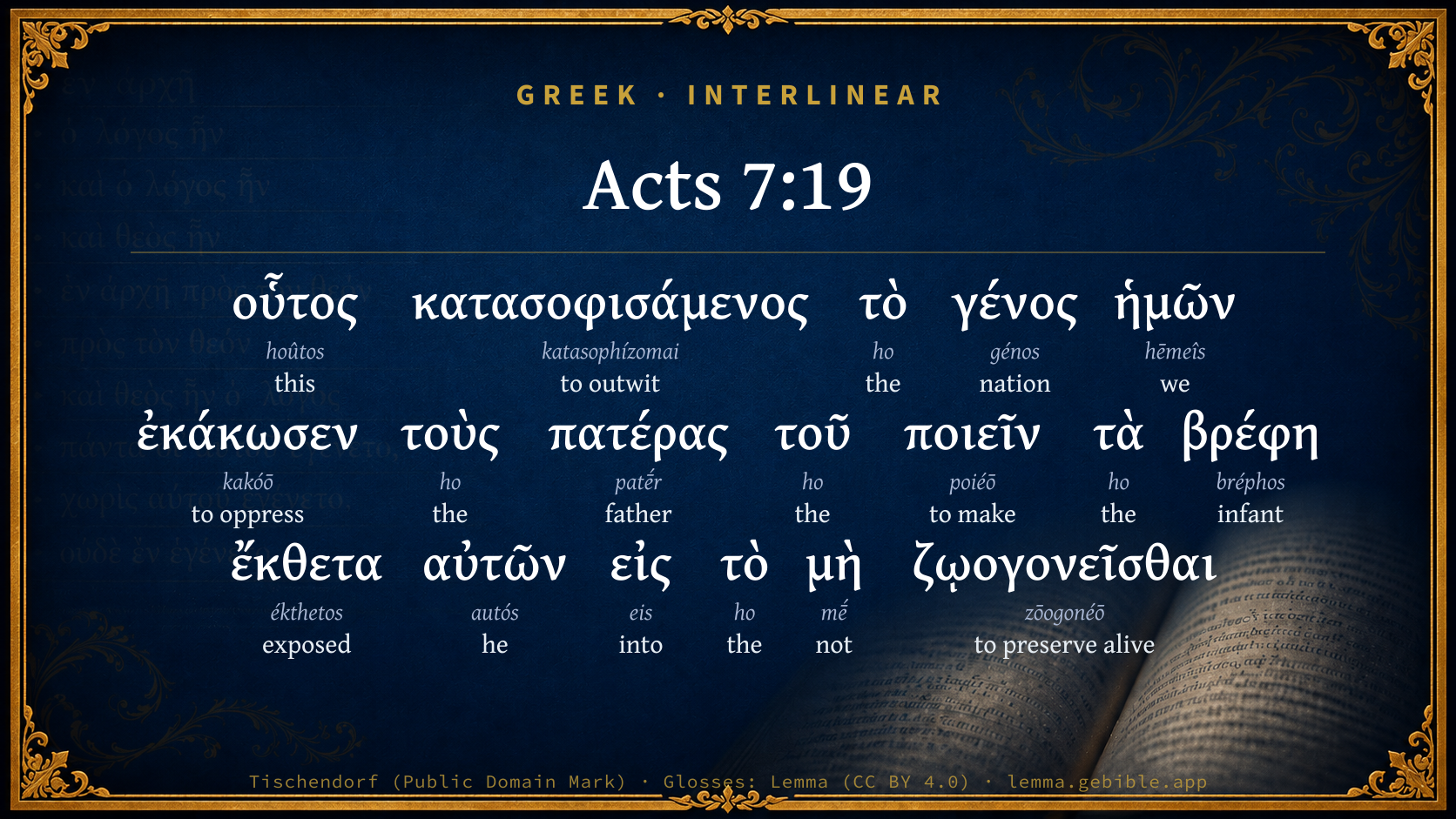
Greek (Tischendorf 8th ed.) Acts 7:19 appears in the Greek New Testament. The text above is from the Tischendorf 8th edition. Each word links to its Strong’s number and a concise gloss. Click any word for its full Thayer’s Greek Lexicon entry.
Download image
Cite this verse

Acts 7:19 (World English Bible). Public Domain. Lemma interlinear Bible study tool, https://lemma.gebible.app/v/acts/7/19.

Show BibTeX & RIS
BibTeX
RIS
English Translation
The same took advantage of our race, and mistreated our fathers, and forced them to throw out their babies, so that they wouldn't stay alive.
World English Bible · Public Domain
Highlights
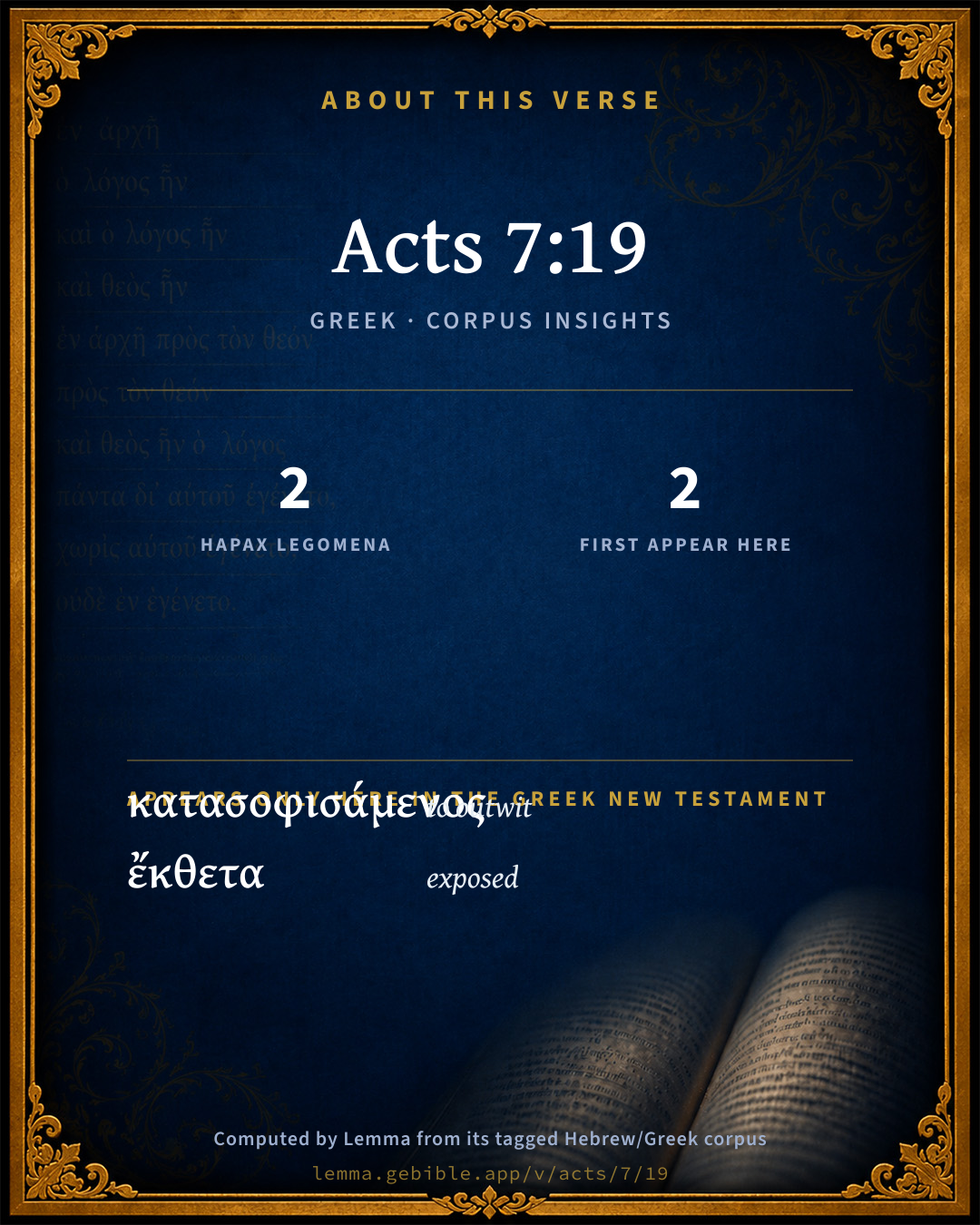
  • 2 hapax legomena — only here in the Greek New Testament
  • 2 first appearances in the Greek New Testament
Full analysis ↓
Download a study sheet

One document with this verse’s original text, its word-by-word gloss line, the meaning frame, cross-references with their text, attributed commentary, and full source and license credits — printable, and it pastes into notes with its structure intact.

This verse Autodidact and up

Study sheet (.html) Plain text (.txt)

A passage Seminary Student

Up to 50 verses in one chapter. A passage sheet keeps up to 6 commentary sources and 12 cross-references per verse, in the order this page ranks them, and says so on the sheet whenever that leaves anything out. Ask for a single verse and you get the Autodidact verse sheet above.

Everything on this page stays free to read, with no account — the sheet is a download of what is already on screen, not access to it.

Want to remove ads? Support Godless Engineer
Compare translations 3

The same verse in 3 English versions, stacked beneath the original-language interlinear above. Click any original word for its lexicon entry.

Each is an independent rendering of the whole verse — the interlinear is not word-aligned to these translations.

Highlighted words mark where these versions differ — a whole-verse word diff, not a word-by-word alignment.

  • World English Bible Public Domain
    The same took advantage of our race, and mistreated our fathers, and forced them to throw out their babies, so that they wouldn't stay alive.
  • King James Version Public Domain
    The same dealt subtilly with our kindred, and evil entreated our fathers, so that they cast out their young children, to the end they might not live.
  • unfoldingWord Literal Text CC BY-SA 4.0
    He, exploiting our people, mistreated fathers, to make their babies exposed, in order not to keep them alive.

unfoldingWord Literal Text — © unfoldingWord, licensed CC BY-SA 4.0. Word-aligned USFM3 via Door43 (git.door43.org/unfoldingWord/en_ult).

Versions to compare (up to 4)

3 of 4 selected

Show all 19 translations

Every available English version of this verse, each an independent rendering of the whole verse.

  • World English Bible Public Domain
    The same took advantage of our race, and mistreated our fathers, and forced them to throw out their babies, so that they wouldn't stay alive.
  • Berean Standard Bible Public Domain
    He exploited our people and oppressed our fathers, forcing them to abandon their infants so they would die.
  • Majority Standard Bible Public Domain
    He exploited our people and oppressed our fathers, forcing them to abandon their infants so they would die.
  • King James Version Public Domain
    The same dealt subtilly with our kindred, and evil entreated our fathers, so that they cast out their young children, to the end they might not live.
  • American Standard Version (1901) Public Domain
    The same dealt craftily with our race, and ill-treated our fathers, that they should cast out their babes to the end they might not live.
  • Revised Version (1885) Public Domain
    The same dealt subtilly with our race, and evil entreated our fathers, that they should cast out their babes to the end they might not live.
  • Geneva Bible (1599) Public Domain
    The same dealt subtilly with our kindred, and euill entreated our fathers, and made them to cast out their yong children, that they should not remaine aliue.
  • Douay-Rheims (1899) Public Domain
    This same dealing craftily with our race, afflicted our fathers, that they should expose their children, to the end they might not be kept alive.
  • Young's Literal Translation Public Domain
    this one, having dealt subtilely with our kindred, did evil to our fathers, causing to expose their babes, that they might not live;
  • Literal Standard Version CC BY-SA 4.0
    this one, having dealt subtly with our family, did evil to our fathers, causing to expose their babies, that they might not live;
  • Unlocked Literal Bible CC BY-SA 4.0
    He deceived our people and forced our fathers to expose their newborn infants so they would not be kept alive.
  • unfoldingWord Literal Text CC BY-SA 4.0
    He, exploiting our people, mistreated fathers, to make their babies exposed, in order not to keep them alive.
  • Darby Bible Public Domain
    *He* dealt subtilly with our race, and evil entreated the fathers, casting out their infants that they might not live.
  • World Messianic Bible Public Domain
    The same took advantage of our race and mistreated our fathers, and forced them to abandon their babies, so that they wouldn’t stay alive.
  • Webster's Bible Public Domain
    The same dealt subtilly with our kindred, and ill-treated our fathers, so that they cast out their young children, to the end they might not live.
  • Free Bible Version CC BY-SA 4.0
    He took advantage of our people and treated our ancestors badly, forcing them to abandon their babies so they would die.
  • Bible in Basic English Public Domain
    He, having evil designs against our nation, was cruel to our fathers, and they were forced to put out their young children, so that they might not go on living.
  • Text-Critical English NT CC BY 4.0
    This king dealt shrewdly with our people and mistreated our fathers, making them abandon their newborn babies so that they would not survive.
  • Tyndale New Testament (1534) Public Domain
    The same dealte suttelly with oure kynred and evyll intreated oure fathers and made them to cast oute their younge chyldren that they shuld not remayne alyve.

Literal Standard Version (2020), Covenant Press — licensed CC BY-SA 4.0. Text via the HelloAO Bible API (eBible.org). Unlocked Literal Bible (unfoldingWord) — licensed CC BY-SA 4.0. Text via the HelloAO Bible API (eBible.org). unfoldingWord Literal Text — © unfoldingWord, licensed CC BY-SA 4.0. Word-aligned USFM3 via Door43 (git.door43.org/unfoldingWord/en_ult). Free Bible Version, Dr. Jonathan Gallagher — licensed CC BY-SA 4.0. Text via the HelloAO Bible API (eBible.org).

Word by word

More ways to search: Search by grammar → Find every occurrence → Compare this word →

Practice this passage: Drill this verse → Learn its vocabulary →

κατασοφισάμενος
katasophízomai
G2686
“to outwit”
Verb, Aorist, Middle deponent, Participle, Nominative, Singular, Masculine
Part of Speech
Verb
Tense
Aorist
Voice
Middle deponent
Mood
Participle
Case
Nominative
Number
Singular
Gender
Masculine
Full Thayer's Definition

Origin: middle voice from G2596 and G4679

TDNT: None

1. to circumvent by artifice or fraud, conquer by subtle devices 2. to outwit 3. overreach 4. to deal craftily with
  1. οὗτος hoûtos G3778 “this” Demonstrative pronoun, Nominative, Singular, Masculine
  2. τὸ ho G3588 “the” Article, Accusative, Singular, Neuter
  3. γένος génos G1085 “nation” Noun, Accusative, Singular, Neuter
  4. ἡμῶν hēmeîs G2249 “we” Personal pronoun, 1st person, Genitive, Plural
  5. ἐκάκωσεν kakóō G2559 “to oppress” Verb, Aorist, Active, Indicative, 3rd person, Singular
  6. τοὺς ho G3588 “the” Article, Accusative, Plural, Masculine
  7. πατέρας patḗr G3962 “father” Noun, Accusative, Plural, Masculine
  8. τοῦ ho G3588 “the” Article, Genitive, Singular, Neuter
  9. ποιεῖν poiéō G4160 “to make” Verb, Present, Active, Infinitive
  10. τὰ ho G3588 “the” Article, Accusative, Plural, Neuter
  11. βρέφη bréphos G1025 “infant” Noun, Accusative, Plural, Neuter
  12. ἔκθετα ékthetos G1570 “exposed” Adjective, Accusative, Plural, Neuter
  13. αὐτῶν autós G846 “he” Personal pronoun, Genitive, Plural, Masculine
  14. εἰς eis G1519 “into” Preposition
  15. τὸ ho G3588 “the” Article, Accusative, Singular, Neuter
  16. μὴ mḗ G3361 “not” Particle, Negative
  17. ζῳογονεῖσθαι zōogonéō G2225 “to preserve alive” Verb, Present, Passive, Infinitive

About this verse

These counts appear in no published source. They are computed here, from the morphology-tagged text and Lemma’s own curated glosses. What Lemma adds →

18
words
14
distinct lemmas
Acts
section

Notable vocabulary

2 hapax legomena — words that appear only here in the entire Greek New Testament:

  • κατασοφισάμενος to outwit G2686
  • ἔκθετα exposed G1570

First appearance in Scripture

These words make their first canonical appearance in the Greek New Testament here:

  • κατασοφισάμενος to outwit G2686
  • ἔκθετα exposed G1570

Shared distinctive vocabulary

ζῳογονεῖσθαι to preserve alive G2225 occurs in 3 verses of the Greek New Testament. Also found in:

Repetition

A word recurs within this verse:

Cross-references

5

Topical passages linked to Acts 7:19 in the Treasury of Scripture Knowledge — connected by theme and wording, ordered by reader-vote popularity; previews shown in the World English Bible.

  • Psalms 105:25 He turned their heart to hate his people, To conspire against his servants.
  • Exodus 1:9–22 He said to his people, "Behold, the people of the children of Israel are more and mightier than we.
  • Psalms 83:4–5 "Come," they say, "and let's destroy them as a nation, That the name of Israel may be remembered no more."
  • Revelation 12:4–5 His tail drew one third of the stars of the sky, and threw them to the earth. The dragon stood before the woman who was about to give birth, so that when she gave birth he might devour her child.
  • Psalms 129:1–3 Many times they have afflicted me from my youth up. Let Israel now say,

Cross-references courtesy of OpenBible.info (CC BY 4.0).

Commentary

Notes on Acts 7:19 from classic Christian and Jewish commentators (each source and its license shown beneath its notes). The classic Christian expositions comment on the surrounding passage and are grouped to its opening verse, so a note may address several verses; the Jewish commentaries on the Tanakh (Rashi and others) are per-verse, so they appear only where the commentator wrote on this verse.

Lemma curates 59 commentaries, every one of them public domain or Creative Commons licensed, each selected and text-cleaned for this edition rather than reprinted as found. About our sources →

Bengel's Gnomon

Johann Albrecht Bengel

Act 7:19. Μὴ ζωογονεῖσθαι) viz. τὰ βρέφη. A word of the Septuagint: Exo 1:17-18, and elsewhere frequently.

Bengel's Gnomon of the New Testament — English translation (T&T Clark, Edinburgh, 1860) — public domain. Text from a community e-Sword module.

Meyer's Critical & Exegetical Commentary

Heinrich August Wilhelm Meyer

Act_7:19. Κατασοφίζεσθαι] to employ cunning against any one, to beguile, LXX. Exo_1:10. Only here in the N. T. But see Kypke, II. p. 37; and from Philo, Loesner, p. 186. Aorist participle, as in Act_1:24.

τοῦ ποιεῖν ἔκθετα τὰ βρέφη αὐτῶν] a construction purely indicative of design; comp. on Act_3:12. But it cannot belong to κατασοφισ. (so Fritzsche, ad Matth. p. 846), but only to ἐκάκ. Comp. 1Ki_17:20. He maltreated them, in order that they should expose their children, i.e. to force upon them the exposure of their children. On ποιεῖν ἔκθετα = ἐκθεῖναι, comp. ποιεῖν ἔκδοτον = ἐκδιδόναι, Herod. iii. 1; on ἔκθετος, Eur. Andr. 70.

εἰς τὸ μὴ ζωογ.] ne vivi conservarentur, the object of ποιεῖν ἔκθετα τ. βρ. αὐτ. Comp. LXX. Exo_1:17; Luk_17:33. See on 2Co_8:6; Rom_1:20.

Meyer — Critical and Exegetical Commentary on the New Testament — English translation by Peter Christie, edited by Frederick Crombie (T&T Clark, 1880) — public domain. Text from a community e-Sword module.

Expositor's Greek Testament

ed. W. Robertson Nicoll

Act 7:19 . κατασοφισάμενος : in Exo 1:10 we have the same verb “let us deal wisely with them” here translated “deal subtilly”; Vulgate, “circumveniens,” cf. Rhemish version: “circumventing our stock” ( γένος , as in Act 4:36 ); cf. Jdt 5:11 ; Jdt 10:19 , in both passages the same verb is used, translated (R.V.), Act 5:11 , “dealt subtilly” the Syriac, probably nearest to the Hebrew, “ dealt wisely with them,” i.e. , the Egyptians dealt so with the Hebrews. In the second passage, R.V., word is rendered “might deceive”; same verb in Syriac as in Exo 1:10 , Heb.; Speaker’s Commentary , “Apocrypha,” i., p. 290. Josephus and Philo use verb in same sense as in text; see for the force and meaning of κατά here, Page and Rendall. ἐκάκωσε , cf. Exo 1:11 , where the same word is used of task-masters afflicting the people with burdens. For other ways in which Pharaoh is said to have afflicted the people, see Jos., Ant. , ii., 9, 1. τοῦ ποιεῖν κ . τ . λ ., “that they [ or he, margin ] should cast out their babes,” R.V. But a comparison with Exo 1:22 (LXX) justifies us in taking these words, as in R.V. margin, as describing the tyranny of Pharaoh, not as declaring that the parents themselves exposed their children. For the construction see Blass, Grammatik , p. 231; cf. 1Ki 17:20 , etc., genitive of result, see Page on Act 3:12 , and in loco , and Burton, N. T. Moods and Tenses , p. 157. ἔκθετα : only here in N.T. and not in LXX, but used with γόνος in Eur., Andr. , 70. εἰς τὸ : expressing the purpose, cf. Luk 5:17 . ζωογονεῖσθαι : in the active the verb is used three times, in Exo 1 , of the midwives saving the Hebrew children alive, Act 7:17-18 ; Act 7:22 ( cf. Jdg 8:19 , etc.), vivum conservare . In the N.T. the word is only used by St. Luke here and in his Gospel, chap. Act 17:33 , and once by St. Paul, 1Ti 6:13 (see R.V. margin). St. Chrysostom comments on the thought that where man’s help was despaired of, and the child was cast forth, then God’s benefit did shine forth conspicuous, Hom. , xvi.

The Expositor's Greek Testament, edited by W. Robertson Nicoll (1897–1910) — public domain. Text from a community e-Sword module.

Geneva Bible (1599)

Geneva Bible translators

He devised a subtle invention against our stock, in that he commanded all the males to be cast out.

Geneva Bible (1599) marginal notes — public domain. Text via Bolls.life.

Adam Clarke's Commentary

Verse 19. The same dealt subtilty] ουτος κατασοφισαμενος, A word borrowed from the Septuagint, who thus translate the Hebrew נהחכמה לו nithchokmah lo, let us deal wisely with it, i.e. with cunning and deceit, as the Greek word implies; and which is evidently intended by the Hebrew. See Ge 27:35, Thy brother came with subtilty, which the Targumist explains by בחוכמא be-chokma, with wisdom, that is, cunning and deceit. For this the Egyptians were so remarkable that αιγυπτιαζειν, to Egyptize, signified to act cunningly, and to use wicked devices. Hence the Jews compared them to foxes; and it is of them that Canticles, So 2:15, is understood by the rabbins: Take us the little foxes which spoil our vines; destroy the Egyptians, who, having slain our male children, sought to destroy the name of Israel from the face of the earth.

To the end they might not live.] Might not grow up and propagate, and thus build up the Hebrew nation.

Adam Clarke's Commentary on the Bible (1810–1826) — public domain. Text from a community e-Sword/MySword module.

John Calvin's Commentaries

19. Dealt subtilely. The old interpreter did not translate this amiss, to deceive. For Stephen meaneth that the king of Egypt did craftily invent new shifts and wicked pretenses, that he might every now and then lay heavier burdens upon the people, like as almost all tyrants do; for how unjustly soever they vex their subjects, they are [but] too witty to invent excuses. And it is not to be doubted but that Pharaoh abused this honest color, that it was not meet that the Jews, who were sojourners, should have a place of abode in his realm for nought, and that they should be free from all burthens, seeing they did enjoy great commodities. Therefore, he deceitfully made them vile bondslaves of free-men. When Stephen saith that this tyrant knew not Joseph, hereby it appeareth how soon the remembrance of benefits passeth away among men, For although we do all with one consent detest unthankfulness, yet is there no vice more common amongst us.

Lest they should be increased. Erasmus translateth this improperly, in my judgment. For [Ζωογονεισθαι] expresseth more than lest their children should live. For the word is fet [fetched] thence, because the people doth all always remain alive in the offspring. And, furthermore Stephen doth not reckon up all the parts of their evil-entreating, but putteth down one example of extreme cruelty. Whence we may easily gather how near the whole seed of Abraham was to destruction. For Pharaoh seemed to have murdered them all with that commandment as with one stroke of a sword. But such violent barbarism did the more set forth the unlooked-for and incredible power of God; because when Pharaoh hath, by all means possible, striven against God, yet all is in vain.

John Calvin's Commentaries (1540-1563) — public domain. Text from the Calvin Translation Society English edition (1840s-50s) via the Christian Classics Ethereal Library (ccel.org). Calvin's coverage is partial (roughly two-thirds of the Bible); uncommented books and verses are honest gaps, never fabricated. The 19th-century editor's footnotes and remarks are omitted so the notes are faithfully Calvin's own voice.

Ellicott's Commentary for English Readers

(19) So that they cast out their young children.—Literally, to make their children cast out so that they should not be brought forth alive. The latter verb is used in the LXX. narrative (Exo_1:17).

A Bible Commentary for English Readers, edited by Charles John Ellicott (1878–1897) — public domain. Text from a community e-Sword module.

The Cambridge Bible for Schools and Colleges

gen. ed. J. J. S. Perowne

19. The same dealt subtilly with our kindred [race] The word is from the LXX. (Exo_1:10), “Let us deal wisely (i.e. craftily) with them” are the words of the new king.

and evil entreated our fathers] Beside the hard tasks put upon the people according to the record in Exodus, Josephus adds (Antiq. ii. 9. 1) that the Egyptians “made them to cut a great many channels for the river, and set them to build pyramids, forced them to learn all sorts of mechanical arts and to accustom themselves to hard labour.”

so that they cast out their young children, to the end they might not live] Better, in causing their young children to be cast out, &c. The words are rather a description of what the Egyptian king did in his tyranny (Exo_1:22), than (as A. V.) of what the Israelites were driven to by their despair.

The Cambridge Bible for Schools and Colleges (gen. ed. J. J. S. Perowne; Cambridge University Press, 1878–1918) — public domain. Text from a community e-Sword module.

John Gill's Exposition

The same dealt subtilly with our kindred,.... See Exo 1:10 he took crafty, and yet cruel methods, to diminish the children of Israel, and to humble them; weakening their strength by labour, that they might not be able to beget children; ordering the Hebrew midwives to kill all the males that were born; and charging all his people to drown such male children that should escape the hands of the midwives;

and evil entreated our fathers; keeping them to hard labour, in mortar and brick, and all rural service; in which he made them to serve with rigour, and thereby made their lives bitter to them; employing them in building cities, pyramids, walls, and towers; making ditches, throwing up trenches, cutting watercourses, and turning rivers, with other things; which he added, setting taskmasters over them, to afflict them with burdens:

so that they cast out their young children, or "by making their children cast outs": or as the Arabic version renders it, "by making that their children should be cast out": that is, by ordering his people to expose them to ruin, and to cast them in the rivers; and so the Syriac version, "and he commanded that their children be cast out"; for this refers to Pharaoh, and his orders to his officers and people, to cast out the male children of the Israelites; and not to the parents of the children, which our version and the Vulgate Latin incline to: for though Moses's mother, after she had hid him three months, put him into an ark of bulrushes, and laid him among the flags by the river's side, yet that was in order to save his life: whereas the end of the casting out of these young children was as follows,

to the end they might not live: for this has not respect unto the parents of the children, that they might not increase or multiply their offspring, but to the young children, that they being cast into the waters, might perish, and not live and become men; the Ethiopic version is rather a paraphrase, "and he commanded that they should kill every male that was born".

John Gill's Exposition of the Whole Bible (1746–1763) — public domain (CC PDM 1.0). Text via the HelloAO Bible API.

Trapp's Complete Commentary

John Trapp

9 And the patriarchs, moved with envy, sold Joseph into Egypt: but God was with him,

10 And delivered him out of all his afflictions, and gave him favour and wisdom in the sight of Pharaoh king of Egypt; and he made him governor over Egypt and all his house.

11 Now there came a dearth over all the land of Egypt and Chanaan, and great affliction: and our fathers found no sustenance.

12 But when Jacob heard that there was corn in Egypt, he sent out our fathers first.

13 And at the second time Joseph was made known to his brethren; and Joseph’s kindred was made known unto Pharaoh.

14 Then sent Joseph, and called his father Jacob to him, and all his kindred, threescore and fifteen souls.

15 So Jacob went down into Egypt, and died, he, and our fathers,

16 And were carried over into Sychem, and laid in the sepulchre that Abraham bought for a sum of money of the sons of Emmor the father of Sychem.

17 But when the time of the promise drew nigh, which God had sworn to Abraham, the people grew and multiplied in Egypt,

18 Till another king arose, which knew not Joseph.

19 The same dealt subtilly with our kindred, and evil entreated our fathers, so that they cast out their young children, to the end they might not live.

Ver. 19. Dealt subtilly] "Let us deal wisely," saith he, Exo 1:10; "subtilly," saith this text, κατασοφισαμενος. The world’s wisdom is but subtilty, sophistry, fallacy. And God took this wizard in his own craftiness, 1Co 3:19; for your labouring men have the lustiest children.

John Trapp, A Commentary or Exposition upon All the Books of the Old and New Testament (1647–1656) — public domain. Text from a community e-Sword module.

Albert Barnes' Notes on the Bible

Dealt subtilly - He acted deceitfully; he used fraud. The cunning or deceitful attempt which is referred to, is his endeavour to weaken and destroy the Jewish people by causing their male children to be put to death, Exo 1:22.

Our kindred - Our nation, or our ancestors.

And evil-entreated - Was unjust and cruel toward them.

So that ... - For that purpose, or to “cause” them to cast them out. He dealt with them in this cruel manner, hoping that the Israelites themselves would destroy their own sons, that they might not grow up to experience the same sufferings as their fathers had. The cunning or subtilty of Pharaoh extended to everything that he did to oppress, to keep under, and to destroy the children of Israel.

Albert Barnes' Notes on the Bible (1834–1885) — public domain. Text from a community e-Sword/MySword module.

Haydock's Catholic Bible Commentary

Dealing craftily, circumventing craftily, afflicting, and endeavouring to extirpate the race of the Israelites. (Witham)

George Leo Haydock (1774–1849), Haydock's Catholic Family Bible and Commentary, 1859 edition — public domain. Excludes Psalms (Douay-Rheims chapter numbering differs from Protestant) and Deuterocanonical books (Catholic canon only).

Matthew Poole's English Annotations

Pharaoh resolves to deal (as he thought) wisely, Exo 1:10, and it is acknowledged that the Egyptians dealt subtilly with them, Psa 105:25. For they do not at once destroy them, which might have been hazardous, the Israelites being so numerous; neither could Egypt well spare at once so many inhabitants; (too great and sudden evacuations cause swoonings); but they endeavour their ruin by degrees:

1. Wasting them by hard labours.

2. Commanding the midwives privately to kill their males.

3. Casting out, or exposing, any whom they found spared.

Yet this people, attempted upon by so many secret and open means to bring them to destruction, God did preserve; and so he will his church, (which they did typify), maugre all the endeavours the most potent malice can use against it.

Matthew Poole's English Annotations on the Holy Bible (1683–1685) — public domain. Text from a community e-Sword/MySword module.

Whedon's Commentary on the Bible

Daniel D. Whedon

19. Give me—As we have noted of Judas’s What will ye give me? (Mat_26:15,) “This is a true huckster’s proposition.” Judas sold the SON; Simon would have bought the HOLY GHOST!

Daniel D. Whedon (gen. ed.), Commentary on the Old and New Testaments (1874–1909) — public domain. Text from a community e-Sword module.

The Pulpit Commentary

Race for kindred, A.V., as in ver. 13; that they should cast out for so that they east out, A.V.; babes for young children, A.V.

The Pulpit Commentary (1880–1919), ed. H.D.M. Spence-Jones & Joseph S. Exell — public domain. Text from a community e-Sword module.

John Wesley's Explanatory Notes

Exposed - Cast out to perish by hunger or wild beasts.

John Wesley, Explanatory Notes Upon the Whole Bible (1754–1765) — public domain. Text via the GEBible commentary corpus.

McGarvey & Pendleton's Commentaries

J. W. McGarvey

See notes on verse 17

J. W. McGarvey (with Philip Y. Pendleton), Commentaries on the New Testament (The Fourfold Gospel, 1914; Acts; and the epistles) — public domain. Text from a community e-Sword/MySword module.

Cambridge Greek Testament for Schools and Colleges

19. Omit ἡμῶν after πατέρας with אBD.

τὰ βρέφη ἔκθετα with אABC.

19. κατασοφισάμενος τὸ γένος ἡμῶν, dealt subtilly with our race and, &c. The expression is from the LXX. (Exo 1:10), κατασοφισώμεθα αὐτούς are the words of the new king.

ἐκάκωσεν τοὺς πατέρας, he evil entreated our fathers. In the account of the taskmasters, the LXX. says they were appointed ἴνα κακώσωσιν αὐτοὺς ἐν τοῖς ἔργοις. Beside the hard tasks put upon the people according to the record in Exodus, Josephus adds (Ant. II. 9. 1) that the Egyptians ‘made them to cut a great many channels for the river, and set them to build pyramids; forced them to learn all sorts of mechanical arts and to accustom themselves to hard labour.’

τοῦ ποιεῖν τὰ βρέφη ἔκθετα αὐτῶν, in causing their young children to be cast out. The words are rather a description of what the Egyptian king did in his tyranny (Exo 1:22), than (as A.V.) of what the Israelites were driven to by their despair.

With the genitival infinitive in this clause, expressive of that wherein the κάκωσις consisted, of. 1Ki 16:33, καὶ προσέθηκεν Ἀχαὰβ τοῦ ποιῆσαι παροργίσματα τοῦ παροργίσαι τὸν κύριον θεὸν τοῦ Ἰσραήλ.

εἰς τὸ μὴ ζωογονεῖσθαι, to the end that they might not live. The verb is used, in the active voice, three times (Exo 1:17-18; Exo 1:22) of the conduct of the midwives in saving the children alive. Cf. also the remarkable use of the word in Luk 17:33.

Cambridge Greek Testament for Schools and Colleges (Cambridge University Press, 1896; 21 vols, various authors incl. Carr, Maclear, Plummer, Farrar, Lumby, Moule, M. R. James, Simcox) — public domain. Text from a community e-Sword module.

Alford’s Greek Testament

Henry Alford

19. τοῦ ποιεῖν] so that they exposed, see ref. Meyer maintains that the inf. of the purpose is not to be departed from,—‘in order that they might expose:’ but I do not see that this meaning would express the fact. The purpose is afterwards expressed, εἰς τὸ κ.τ.λ.

Henry Alford, The Greek Testament (1849–1861) — public domain. Text from a community e-Sword module.

Vincent's Word Studies in the New Testament

Marvin R. Vincent

Dealt subtilely [κατασοφισαμενος] . Only here in New Testament. Lit., to employ cunning against. See on sofov, wise, Jas 3:13.

So that they cast out [του ποιειν εκθετα] . Lit., make exposed. The verb ejktiqhmi, to set out, or place outside, is not uncommon in classical Greek for the exposure of a new - born child. Thus Herodotus, of Cyrus, exposed in infancy : "The herdsman's wife entreated him not to expose [εκθειναι] the babe" (1, 112). The rendering of the A. V., "so that they cast out," is correct, expressing the result, and not Pharaoh 's design.

Young children [βρεφη] . Incorrect. See on 1Pe 2:2. Rev., rightly babes.

Live [ζωογονεισθαι] Or, be preserved alive. See on Luk 17:33.

Marvin R. Vincent, Word Studies in the New Testament (1887–1900) — public domain. Text from a community e-Sword/MySword module.

Lesson kit

Teaching starters — assembled from the data on this page, not authored interpretation. Every prompt links to the verse data it draws on. Edit before teaching.

Acts, in the Acts, opens this verse with 18 words (14 distinct Greek lemmas). Its most distinctive word is katasophízomai (“to outwit”). A historical commentator’s framing appears above. Read the whole chapter for the surrounding context.

Discussion questions

  1. How does “to outwit” (katasophízomai) shape what this verse is saying?
  2. This verse holds 2 words here found nowhere else in the Greek New Testament. What might the rare words draw attention to?
  3. 2 words here appear for the first time in Scripture. What is being introduced at this debut?
  4. Luke 17:33 shares the word «to preserve alive» with this verse. How do the two illuminate each other?
  5. “the” occurs 5× in this one verse. What is the effect of the repetition?
  6. These translations render this verse differently. What is at stake in choosing one wording over another?
  7. Reading how Bengel's Gnomon and Meyer's Critical & Exegetical Commentary read this verse, where do the two commentators agree and where do they part?

Things to notice

  • 2 words in this verse appear nowhere else in the Greek New Testament.
  • 2 words make their first canonical appearance in Scripture here.
  • These translations choose different wording for 29 words in this verse.
  • “the” occurs 5× in this single verse.
  • 14 distinct Greek lemmas span 18 words in this verse.

Reading settings

Reading text

Shown beneath each verse's original-language words.

Old Testament
Old Testament edition

Read the OT as the Masoretic Hebrew (MT) or the Greek Septuagint (LXX).

English shown for the Greek Septuagint (in the Hebrew ↔ Greek comparison).

Comparing translations? Open the Compare panel on any verse page to stack up to four side by side.