
Acts 27:18

Greek (Tischendorf 8th ed.) Acts 27:18 appears in the Greek New Testament. The text above is from the Tischendorf 8th edition. Each word links to its Strong’s number and a concise gloss. Click any word for its full Thayer’s Greek Lexicon entry.
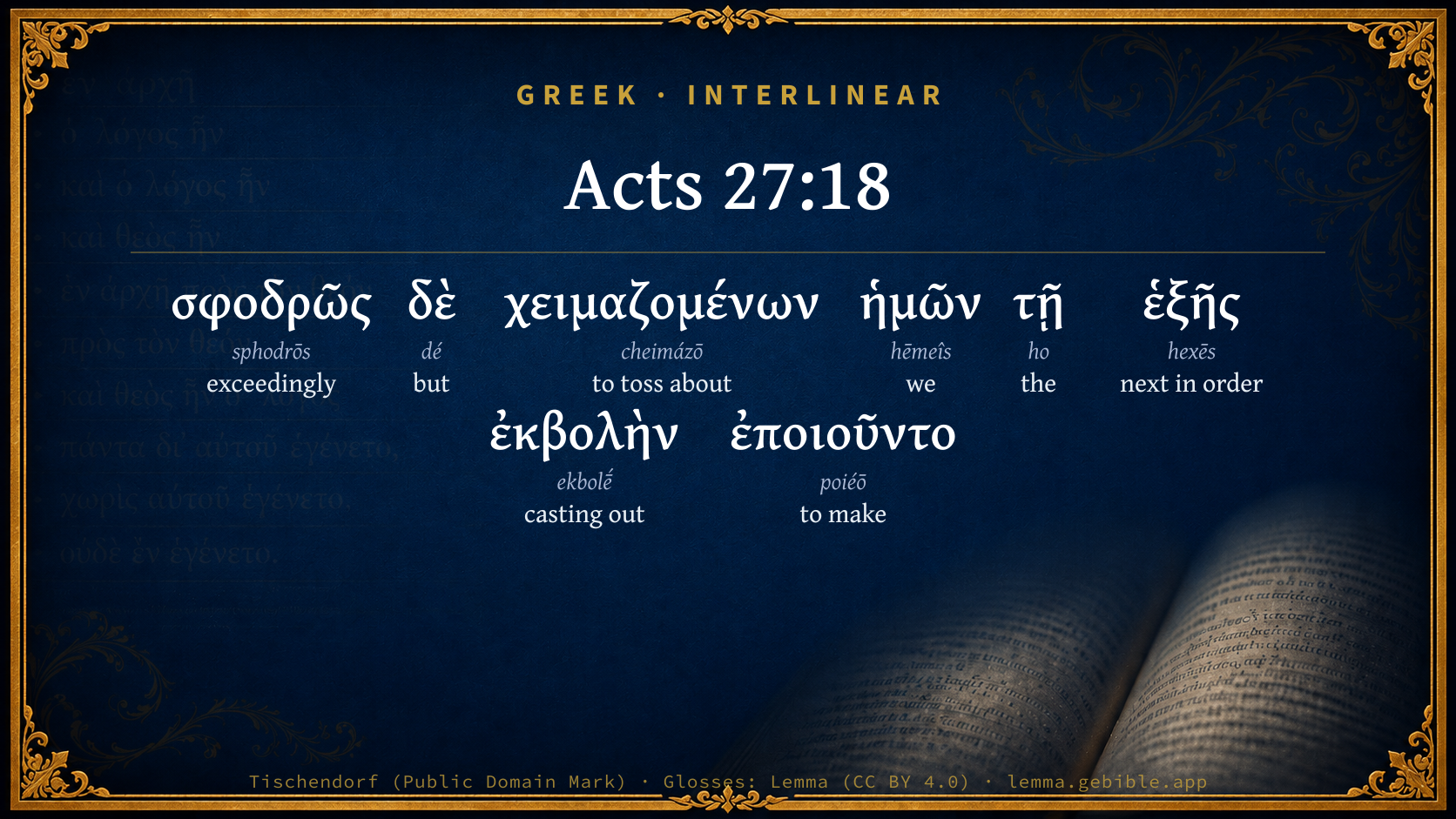
Download image
Cite this verse

Acts 27:18 (World English Bible). Public Domain. Lemma interlinear Bible study tool, https://lemma.gebible.app/v/acts/27/18.

Show BibTeX & RIS
BibTeX
RIS
English Translation
As we labored exceedingly with the storm, the next day they began to throw things overboard.
World English Bible · Public Domain
Highlights
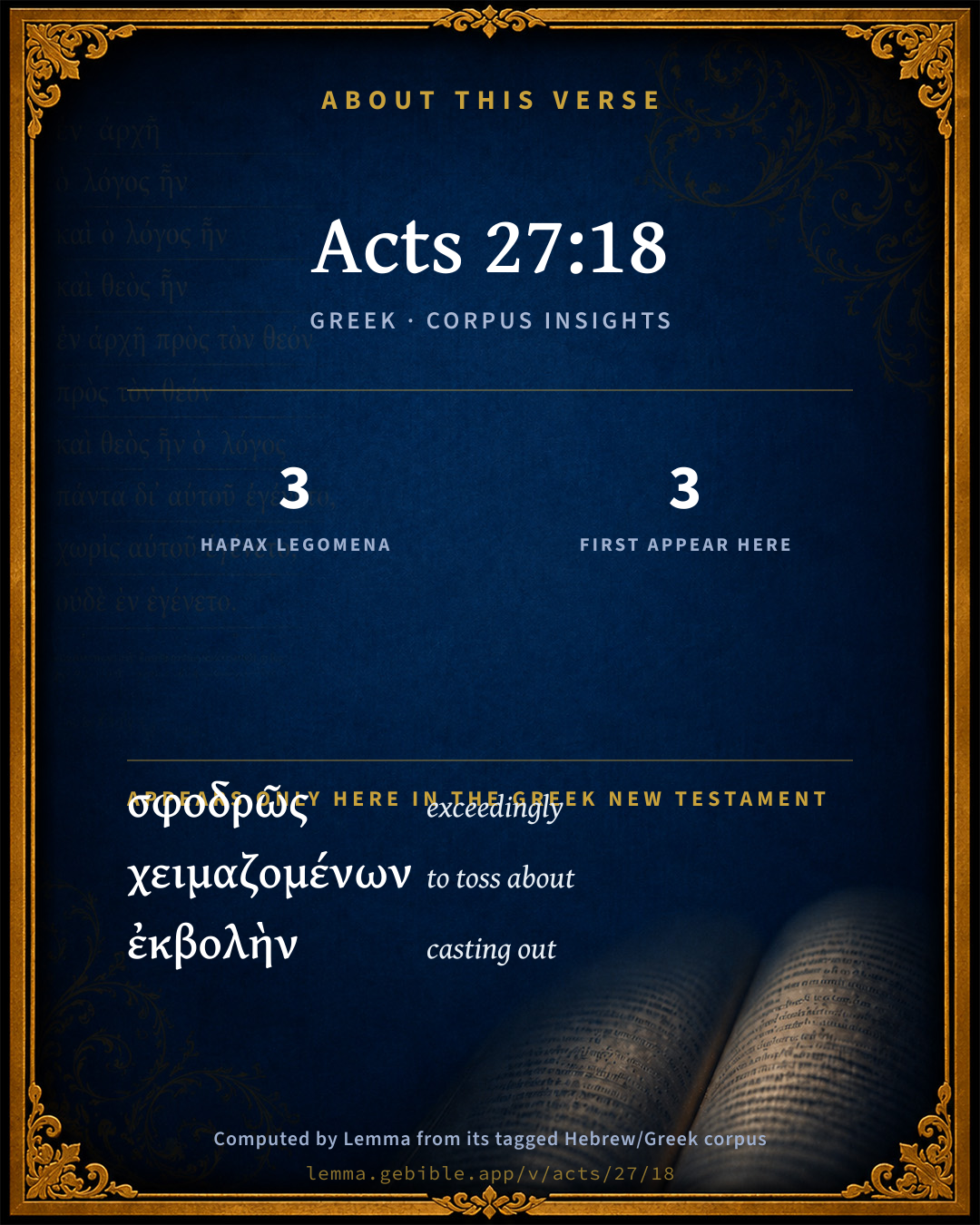
  • 3 hapax legomena — only here in the Greek New Testament
  • 3 first appearances in the Greek New Testament
Full analysis ↓
Download a study sheet

One document with this verse’s original text, its word-by-word gloss line, the meaning frame, cross-references with their text, attributed commentary, and full source and license credits — printable, and it pastes into notes with its structure intact.

This verse Autodidact and up

Study sheet (.html) Plain text (.txt)

A passage Seminary Student

Up to 50 verses in one chapter. A passage sheet keeps up to 6 commentary sources and 12 cross-references per verse, in the order this page ranks them, and says so on the sheet whenever that leaves anything out. Ask for a single verse and you get the Autodidact verse sheet above.

Everything on this page stays free to read, with no account — the sheet is a download of what is already on screen, not access to it.

Want to remove ads? Support Godless Engineer
Compare translations 3

The same verse in 3 English versions, stacked beneath the original-language interlinear above. Click any original word for its lexicon entry.

Each is an independent rendering of the whole verse — the interlinear is not word-aligned to these translations.

Highlighted words mark where these versions differ — a whole-verse word diff, not a word-by-word alignment.

  • World English Bible Public Domain
    As we labored exceedingly with the storm, the next day they began to throw things overboard.
  • King James Version Public Domain
    And we being exceedingly tossed with a tempest, the next day they lightened the ship;
  • unfoldingWord Literal Text CC BY-SA 4.0
    But we being exceedingly storm-tossed, on the next day they were doing a jettison.

unfoldingWord Literal Text — © unfoldingWord, licensed CC BY-SA 4.0. Word-aligned USFM3 via Door43 (git.door43.org/unfoldingWord/en_ult).

Versions to compare (up to 4)

3 of 4 selected

Show all 19 translations

Every available English version of this verse, each an independent rendering of the whole verse.

  • World English Bible Public Domain
    As we labored exceedingly with the storm, the next day they began to throw things overboard.
  • Berean Standard Bible Public Domain
    We were tossed so violently that the next day the men began to jettison the cargo.
  • Majority Standard Bible Public Domain
    We were tossed so violently that the next day the men began to jettison the cargo.
  • King James Version Public Domain
    And we being exceedingly tossed with a tempest, the next day they lightened the ship;
  • American Standard Version (1901) Public Domain
    And as we labored exceedingly with the storm, the next day they began to throw the `the freight' overboard;
  • Revised Version (1885) Public Domain
    And as we laboured exceedingly with the storm, the next day they began to throw the freight overboard;
  • Geneva Bible (1599) Public Domain
    The next day when we were tossed with an exceeding tempest, they lightened the ship.
  • Douay-Rheims (1899) Public Domain
    And we being mightily tossed with the tempest, the next day they lightened the ship.
  • Young's Literal Translation Public Domain
    And we, being exceedingly tempest-tossed, the succeeding `day' they were making a clearing,
  • Literal Standard Version CC BY-SA 4.0
    And we, being exceedingly storm-tossed, the succeeding [day] they were making a clearing,
  • Unlocked Literal Bible CC BY-SA 4.0
    We took such a violent battering by the storm that the next day they began throwing the cargo overboard.
  • unfoldingWord Literal Text CC BY-SA 4.0
    But we being exceedingly storm-tossed, on the next day they were doing a jettison.
  • Darby Bible Public Domain
    But the storm being extremely violent on us, on the next day they threw cargo overboard,
  • World Messianic Bible Public Domain
    As we labored exceedingly with the storm, the next day they began to throw things overboard.
  • Webster's Bible Public Domain
    And we being exceedingly tossed with a tempest, the next day they lightened the ship;
  • Free Bible Version CC BY-SA 4.0
    The following day as we were violently thrown about by the storm, the crew started throwing the cargo overboard.
  • Bible in Basic English Public Domain
    And, still fighting the storm with all our strength, the day after they made a start at getting the goods out of the ship;
  • Text-Critical English NT CC BY 4.0
    The next day, because we were being severely battered by the storm, the sailors began throwing the cargo overboard.
  • Tyndale New Testament (1534) Public Domain
    The nexte daye when we were tossed with an exceadynge tempest they lyghtened the ship

Literal Standard Version (2020), Covenant Press — licensed CC BY-SA 4.0. Text via the HelloAO Bible API (eBible.org). Unlocked Literal Bible (unfoldingWord) — licensed CC BY-SA 4.0. Text via the HelloAO Bible API (eBible.org). unfoldingWord Literal Text — © unfoldingWord, licensed CC BY-SA 4.0. Word-aligned USFM3 via Door43 (git.door43.org/unfoldingWord/en_ult). Free Bible Version, Dr. Jonathan Gallagher — licensed CC BY-SA 4.0. Text via the HelloAO Bible API (eBible.org).

Word by word

More ways to search: Search by grammar → Find every occurrence → Compare this word →

Practice this passage: Drill this verse → Learn its vocabulary →

About this verse

These counts appear in no published source. They are computed here, from the morphology-tagged text and Lemma’s own curated glosses. What Lemma adds →

8
words
8
distinct lemmas
Acts
section

Notable vocabulary

3 hapax legomena — words that appear only here in the entire Greek New Testament:

  • σφοδρῶς exceedingly G4971
  • χειμαζομένων to toss about G5492
  • ἐκβολὴν casting out G1546

First appearance in Scripture

These words make their first canonical appearance in the Greek New Testament here:

  • σφοδρῶς exceedingly G4971
  • χειμαζομένων to toss about G5492
  • ἐκβολὴν casting out G1546

Shared distinctive vocabulary

ἑξῆς next in order G1836 occurs in 5 verses of the Greek New Testament. Also found in:
Cross-references

8

Topical passages linked to Acts 27:18 in the Treasury of Scripture Knowledge — connected by theme and wording, ordered by reader-vote popularity; previews shown in the World English Bible.

  • Jonah 1:5 Then the mariners were afraid, and cried every man to his god. They threw the cargo that was in the ship into the sea, to lighten it. But Jonah had gone down into the innermost parts of the ship, and he was laying down, and was fast asleep.
  • Acts 27:38 When they had eaten enough, they lightened the ship, throwing out the wheat into the sea.
  • Matthew 16:26 For what will it profit a man, if he gains the whole world, and forfeits his life? Or what will a man give in exchange for his life?
  • Hebrews 12:1 Therefore let us also, seeing we are surrounded by so great a cloud of witnesses, lay aside every weight and the sin which so easily entangles us, and let us run with patience the race that is set before us,
  • Acts 27:19 On the third day, they threw out the ship's tackle with their own hands.
  • Luke 16:8 "His lord commended the dishonest manager because he had done wisely, for the children of this world are, in their own generation, wiser than the children of the light.
  • Philippians 3:7–8 However, what things were gain to me, these have I counted loss for Christ.
  • Psalms 107:27 They reel back and forth, and stagger like a drunken man, And are at their wits' end.

Cross-references courtesy of OpenBible.info (CC BY 4.0).

Commentary

Notes on Acts 27:18 from classic Christian and Jewish commentators (each source and its license shown beneath its notes). The classic Christian expositions comment on the surrounding passage and are grouped to its opening verse, so a note may address several verses; the Jewish commentaries on the Tanakh (Rashi and others) are per-verse, so they appear only where the commentator wrote on this verse.

Lemma curates 59 commentaries, every one of them public domain or Creative Commons licensed, each selected and text-cleaned for this edition rather than reprinted as found. About our sources →

Tyndale Open Study Notes

Tyndale Open Resources

27:18-20 The violence and persistence of the storm led to throwing the cargo overboard (cp. Jon 1:5) and the crew’s abandoning hope.

Tyndale Open Study Notes — © Tyndale Open Resources, licensed CC BY-SA 4.0. Text via the HelloAO Bible API.

Bengel's Gnomon

Johann Albrecht Bengel

Act 27:18. Ἐκβολὴν) a casting out of the merchandise.

Bengel's Gnomon of the New Testament — English translation (T&T Clark, Edinburgh, 1860) — public domain. Text from a community e-Sword module.

Meyer's Critical & Exegetical Commentary

Heinrich August Wilhelm Meyer

Act_27:18-19. Ἐκβολὴν ἐποιοῦντο] they made a casting out, i.e. they threw overboard the cargo.[173] Dem. 926. 17; Aesch. Sept. 769; Arist. Eth. iii. 1; Pollux, i. 99; LXX. Jon_1:5. For the lightening of the vessel in distress, in order to make it go less deep and to keep it from grounding, they got rid in the first instance of what could, in the circumstances, be most fitly dispensed with, namely, the cargo; but on the day after they laid hands even on the σκευὴ τοῦ πλοίου (Diod. Sic. xiv. 79), i.e. the ships apparatus,the utensils belonging to the ship, as furniture, beds, cooking vessels, and the like. The same collective idea, but expressed in the plural, occurs in Jon_1:5. Others (Wetstein, Kypke, Rosenmüller, Kuinoel) understand the baggage of the passengers, but this is at variance with τοῦ πλοίου; instead of it we should expect ἡμῶν, especially as αὐτόχειρες precedes. Following the Vulgate, Erasmus, Grotius, and many others, including Olshausen and Ewald, understand the arma navis, that is, ropes, beams, and the like belonging to the equipment of the ship. But the tackling is elsewhere called τὰ ὅπλα, or τὰ σκεύη (from σκεῦος), and just amidst the danger this was most indispensable of all.

αὐτόχειρες] with our own hands (Hermann, ad Soph. Ant. 1160), gives to the description a sad vividness, and does not present a contrast to the conduct of Jonah (who lay asleep, Jon_1:5), as Baumgarten in his morbid quest of types imagines.

[173] Had the ship been loaded with ballast, and this been thrown out (Laurent), we should have expected a more precise designation (ἕρμα). The σκευή, too, would not have been included in the category of things thrown out at once on the following day, but after the ballast would have come, in the first instance, the cargo. The ship was without doubt a merchant-vessel, and doubtless had no ballast at all. Otherwise they certainly would have commenced with throwing the latter out, but would not thereupon have at once passed to the σκευή.

Meyer — Critical and Exegetical Commentary on the New Testament — English translation by Peter Christie, edited by Frederick Crombie (T&T Clark, 1880) — public domain. Text from a community e-Sword module.

Expositor's Greek Testament

ed. W. Robertson Nicoll

Act 27:18 . σφοδρῶς δὴ χειμαζ . ἡμῶν : “and as we laboured exceedingly with the storm,” R.V., Ramsay, Rendall, a regular nautical and classical term; cf. Thuc., ii., 25; iii., 69; viii., 99; Plato, Ion , 540 B. In Attic Greek usually σφόδρα , but cf. LXX, Jos 3:16 , Sir 13:13 , 4Ma 6:11 ; only here in N.T. Weiss thinks that it is used to express how severely they were distressed by the storm. τῇ ἑξῆς … καὶ τῇ τρίτῃ , cf. Luk 13:32 , connected with the words which follow in R.V. and by Ramsay. For τῇ ἑξ . cf. Luk 7:11 (but see W.H [417] ), Act 9:37 , and above on Act 21:1 , Act 25:17 ; nowhere else in N.T. ἐκβολὴν ἐποιοῦντο : “they began to throw the freight overboard,” R.V., Ramsay, Felten, a technical term, so in classical Greek, for throwing out cargo to lighten a ship; Latin jactura , LXX, Jon 1:5 , with τῶν σκευῶν , and Julius Pollux, i., 99, who also has the phrase κουφίσαι τὴν ναῦν , cf. Act 27:38 below. The imperfect marks that they began by throwing away the cargo, probably what was on deck, so that the vessel would ship less water; and in Act 27:19 they cast out ( ἔῤῥιψαν , aorist) the furniture of the ship, its fittings and equipment, anything movable lying on the deck upon which the passengers could lay their hands ( αὐτόχειρες only here in N.T. representing the haste, Weiss). Others include under the word the actual baggage of the passengers, but we should have expected ἡμῶν instead of τοῦ πλοίου , whilst others explain of beds and crockery, tables, etc., furniture in this sense (Zöckler and Felten, exclusive of beds which were not in use). Breusing rejects this interpretation as “too silly,” and he thinks that the expression really means that by thus throwing overboard the poles and tackling, room was found for the crowd of passengers on the deck, as the hatchways could not be kept open, since the heavy sea would have swamped the ship, p. 186. J. Smith takes σκεύη to mean the mainyard, but the word is here apparently used in a more general sense, as above, R.V., margin, “furniture of the ship”.

[417] Westcott and Hort’s The New Testament in Greek: Critical Text and Notes.

The Expositor's Greek Testament, edited by W. Robertson Nicoll (1897–1910) — public domain. Text from a community e-Sword module.

Geneva Bible (1599)

Geneva Bible translators

The end proveth that none provide worse for themselves, than they which commit themselves to be governed only by their own wisdom.

Geneva Bible (1599) marginal notes — public domain. Text via Bolls.life.

Adam Clarke's Commentary

Verse 18. Lightened the ship] Of what, we know not; but it was probably cumbrous wares, by which the deck was thronged, and which were prejudicial to the due trim of the vessel.

Adam Clarke's Commentary on the Bible (1810–1826) — public domain. Text from a community e-Sword/MySword module.

Ellicott's Commentary for English Readers

(18) The next day they lightened the ship.—St. Luke uses the technical term for throwing the bulk of the cargo overboard. They effected, in this way, the relief of the ship from the imminent danger of sinking. The act shows that, in spite of the undergirding, leakage was still going on. The cargo, as coming from Alexandria, probably consisted largely of corn; but see Note on Act_27:38.

A Bible Commentary for English Readers, edited by Charles John Ellicott (1878–1897) — public domain. Text from a community e-Sword module.

The Cambridge Bible for Schools and Colleges

gen. ed. J. J. S. Perowne

18. And we being exceedingly tossed with a tempest] Better, with R. V. “and as we laboured exceedingly with the storm.” The storm waxed in violence.

the next day they lightened the ship] This is not as precise as the original. Read “they set about throwing the cargo overboard.” The verb is an imperfect, and the noun is used in classical Greek for “a cargo cast forth.” The ship was probably carrying corn from Alexandria to Italy, and if so the load would be a heavy one and its removal a great relief to the struggling vessel. On the African supply of corn to Italy cp. Juv. Sat. v. 118 seqq.

The Cambridge Bible for Schools and Colleges (gen. ed. J. J. S. Perowne; Cambridge University Press, 1878–1918) — public domain. Text from a community e-Sword module.

John Gill's Exposition

And we being exceedingly tossed with a tempest,.... Sometimes being lifted up as it were to the heavens, and then presently sinking down, as if they were going into the bottom of the sea; such a condition at sea is described to the life by the Psalmist, in Psa 107:25.

the next day they lightened the ship; of its burden, its lading, the goods and merchandise that were in it; as the mariners did in the ship in which Jonah was, Jon 1:5 the Ethiopic version renders it, "they cast the goods into the sea"; the Arabic version, the "merchandise".

John Gill's Exposition of the Whole Bible (1746–1763) — public domain (CC PDM 1.0). Text via the HelloAO Bible API.

Trapp's Complete Commentary

John Trapp

18 And we being exceedingly tossed with a tempest, the next day they lightened the ship;

Ver. 18. And being exceedingly tossed] Seneca speaking of such as have lived long to little purpose, not improving their time and their talents, he saith that their lives are like ships in a storm, mullam iactati sunt, non navigarunt, tossed much, but have sailed nothing; or like a mill stone, that is ever moving, but removes not at all; or as when men make imperfect dashes, they are said to scribble, but do not write.

John Trapp, A Commentary or Exposition upon All the Books of the Old and New Testament (1647–1656) — public domain. Text from a community e-Sword module.

Albert Barnes' Notes on the Bible

They lightened the ship - By throwing out a part of the cargo.

Albert Barnes' Notes on the Bible (1834–1885) — public domain. Text from a community e-Sword/MySword module.

Haydock's Catholic Bible Commentary

The lightened the ship by throwing overboard part of their loading and goods. Some call it, they made the jetsam. (Witham)

George Leo Haydock (1774–1849), Haydock's Catholic Family Bible and Commentary, 1859 edition — public domain. Excludes Psalms (Douay-Rheims chapter numbering differs from Protestant) and Deuterocanonical books (Catholic canon only).

Matthew Poole's English Annotations

Casting out the merchandise or lading which was in it, that the ship, being so much lighter, might not so readily strike upon a rock, or be swallowed up of the quicksands, it drawing so much the less water.

Matthew Poole's English Annotations on the Holy Bible (1683–1685) — public domain. Text from a community e-Sword/MySword module.

Whedon's Commentary on the Bible

Daniel D. Whedon

18. Lightened the ship—Casting over whatever could be spared, but saving the ship’s rigging and wheat cargo.

Daniel D. Whedon (gen. ed.), Commentary on the Old and New Testaments (1874–1909) — public domain. Text from a community e-Sword module.

The Pulpit Commentary

As we labored exceedingly for being exceedingly tossed, A.V.; the storm for a tempest, A.V.; began to throw the freight overboard for lightened the ship, A.V. Labored; ceimazoumenwn, only here in the New Testament; but used by Plato, Thucydides, Diodorus Siculus, Josephus, and others, and especially by medical writers. It is the passive voice, and this is best expressed by the A.V. "tossed." They began to throw, etc. The phrase ejkbolhn ejpoiounto is one of the technical phrases for taking a cargo out of a ship, given by Julius Pollux; ejkbolhsasqai twn fortiwn (Alford, from Smith). It is also the phrase of the LXX in Jon_1:5, jEkbolhsanto twn skeuwn twn ejn tw ploi. They began to expresses the imperfect. It is inferred from this, and the subsequent statement (ver. 19) as to throwing overboard the tackling of the ship, that, in spite of the undergirding, the ship was leaking, and therefore heavy with water, and in danger of going down. (comp. Jon_1:5) The freight here mentioned may have been heavy packages of merchandise other than the main cargo of wheat (see ver. 6, note).

Vers. 18-44. The escape from shipwreck.

The particular feature in this part of the narrative of the shipwreck to which attention is now invited is the sacrifices by which the final escape was effected. The eighteenth verse finds the whole party on board the ship in an encounter with a furious tempest. We can easily picture to ourselves the sea running high, the vessel crouching as it were before the wind, the waves breaking over the side of the ship, and the water beginning to fill her. At this moment the relative value of things in the mind of the master and crew undergoes a great change. The freight of the ship so precious in the owner"s eyes, acquired at great cost, put on board with much labor, and on which was set the hope of great gains when the vessel should reach the Italian shore now loses all its value in his eyes. Something more precious is at stake the ship itself, and the lives of those on board; and so the sacrifice must be made. They throw the freight overboard in order to lighten the ship, that it and all that are in it may not go down to the bottom of the deep. Some relief from the pressing danger seems to have followed this step. For a time the vessel was relieved, and rode more buoyantly upon the troubled waves. But the relief was only temporary. The ship began again to fill with water, and the danger was greater than ever. Some fresh sacrifice must be made if she was to be kept afloat. And so with their own bands they cast all the tackling into the sea (note on ver. 19). Things which once seemed necessary to their comfort, things without which the ship could never have started on her way, are now ruthlessly destroyed. They stand in the way of saving something more precious than themselves the ship and its freight of human life and so they are cast into the sea. But the needful sacrifices are not yet complete. For eleven more days the ship keeps afloat, though every hour might seem to be her last. But on the fourteenth night a new element of danger appeared. They were close upon a lee shore, and so their only chance of safety was to run her upon the soft beach. But how could this be done? There still remained in her the precious cargo of wheat which she was carrying from Alexandria to Italy. Lightened of this heavy load, there was a hope that she might run upon the beach, so that they might jump out and be saved. And so this sacrifice was made too. They threw out the wheat into the sea, for their lives were more precious than even the golden grain; and they escaped all safe to the land. This account exactly illustrates the Christian"s career. There is a time when the things of this world wealth, or reputation, or the world"s friendship, or certain habits and opinions are of supreme importance in his eyes. By-and-by some conjuncture arises in which he has to choose between them and the salvation of his soul. There is a struggle at first, and an unwillingness to part with them. But as the things of God rise in their immensity before his eyes, and it becomes clear that the sacrifice must be made if he would enter into life, his mind is made up. What things were gain to him, those he counts but loss for Christ, for whom he suffers loss of all things, and counts them but dung that he may win Christ. He makes the calculation, "What shall it profit me, if I gain the whole world and lose my own soul?" and the decision is not uncertain. Thus the Hebrew Christians took joyfully the spoiling of their goods, knowing that they had in heaven a better and enduring substance. Thus Levi at the receipt of custom, at the call of Jesus, left all, and rose up and followed him. But it often happens that the whole sacrifice is not made at once, nor does the necessity for it become apparent at once. Some lighter loss is sustained at first, and the lightened soul moves easier on her spiritual way for a while. But then some new danger arises. This time it is the sacrifice of the man"s self, some part as it were of his very being, that has to be made. The right hand has to be cut off, or the right eye plucked out, if he would enter into life. But still the decision is the same. There is nothing that he can give or take in exchange for his soul. The sufferings and losses of this present time are not worthy to be compared with the glory that shall be revealed; and even in those extreme eases where the choice has to be made between life itself on the one hand, and faithfulness to Christ on the other, the true believer falters not. He well knows that the things that are seen are temporal, but the things that are not seen are eternal; and so he cheerfully lays down his life on earth that he may not make shipwreck of eternity. So the blessed Paul himself was led on from loss to loss, but through loss to eternal gain His legal privileges, his blameless righteousness, his high standing as a Pharisee among Pharisees, his consideration among his equals, his rabbinical learning, his boasted superiority, all fell one by one before the excellency of Christ. Desiring to be the honored benefactor of his race, he found himself the off-scouring of all things, hunted down and persecuted as one not worthy to live. But still his views of Christ"s gospel kept enlarging; his conceptions of the blessedness of being in Christ kept brightening; the righteousness of Christ, and the glory of Christ, kept growing in the intensity of their all-absorbing interest, and so he was led on to suffer loss upon loss, and to heap labor upon labor, and to endure affliction upon affliction; till from being the prisoner of the Lord he became the faithful martyr of Jesus Christ, and laid down his very life in sure anticipation of receiving the crown of righteousness at the hand of the righteous Judge, when he should plant his foot in triumph upon the shore of eternal life.

The Pulpit Commentary (1880–1919), ed. H.D.M. Spence-Jones & Joseph S. Exell — public domain. Text from a community e-Sword module.

John Wesley's Explanatory Notes

They lightened the ship - Casting the heavy goods into the sea.

John Wesley, Explanatory Notes Upon the Whole Bible (1754–1765) — public domain. Text via the GEBible commentary corpus.

Godbey's Commentary on the New Testament

William B. Godbey

18. “And we being violently tossed by the tempest, forthwith they were making the casting-out,

William B. Godbey, Commentary on the New Testament (1896–1900) — public domain. Text from a community e-Sword module.

McGarvey & Pendleton's Commentaries

J. W. McGarvey

18-20. (18) " And being exceedingly tempest-tossed, the next day we lightened the vessel, (19) and on the third day, with our own hands we cast out the tackling of the ship. (20) And as neither the sun nor the stars appeared for many days, and no small tempest lay on us, at last all hope that we should be saved was taken away. " The sailors now began to realize the truth of Paul's prediction about the character of the voyage, and they were prepared to listen to him with more respect when he addressed to them the following speech:

J. W. McGarvey (with Philip Y. Pendleton), Commentaries on the New Testament (The Fourfold Gospel, 1914; Acts; and the epistles) — public domain. Text from a community e-Sword/MySword module.

Cambridge Greek Testament for Schools and Colleges

18. σφοδρῶς δὲ χειμαζομένων ἡμῶν, and as we laboured exceedingly with the storm, i.e. because it continually increased in violence.

ἐκβολὴν ἐποιοῦντο, they lightened the ship. Literally ‘they made a casting overboard.’

For the expression see LXX. Jon 1:5 ἐκβολὴν ἐποιήσαντο τῶν σκευῶν τῶν ἐν τῷ πλοίῳ.

The verb ἐποιοῦντο, being imperfect, probably has the force of ‘they set about lightening.’ The Latin phrase for the operation is very similar, jacturum facere. The ship was probably carrying corn from Alexandria to Italy, and if so the load would be a heavy one and its removal a great relief to the struggling vessel. On the African supply of corn to Italy cp. Juv. Sat. v. 118 seqq.

Cambridge Greek Testament for Schools and Colleges (Cambridge University Press, 1896; 21 vols, various authors incl. Carr, Maclear, Plummer, Farrar, Lumby, Moule, M. R. James, Simcox) — public domain. Text from a community e-Sword module.

Alford’s Greek Testament

Henry Alford

18. ἐκβολ. ἐποι.] “The technical terms for taking cargo out of a ship, given by Julius Pollux, are ἐκθέσθαι, ἀποφορτίσασθαι, κουφίσαι τὴν ναῦν, ἐπελάφρυναι, ἐκβολὴν ποιήσασθαι τῶν φορτίων. So that both here, and afterwards in ver. 38 (ἐκούφιζον τ. πλοῖον), St. Luke uses appropriate technical phrases.” Smith, ib.

Of what the freight consisted, we have no intimation. Perhaps not of wheat, on account of the separate statement of ver. 38. See ref.

Henry Alford, The Greek Testament (1849–1861) — public domain. Text from a community e-Sword module.

Vincent's Word Studies in the New Testament

Marvin R. Vincent

Lightened [εκβολην εποιουντο] . Lit., made a casting out. Rev., began to throw the freight overboard. Note the imperfect, began to throw. The whole cargo was not cast overboard : the wheat was reserved to the last extremity (ver. 38).

Marvin R. Vincent, Word Studies in the New Testament (1887–1900) — public domain. Text from a community e-Sword/MySword module.

Lesson kit

Teaching starters — assembled from the data on this page, not authored interpretation. Every prompt links to the verse data it draws on. Edit before teaching.

Acts, in the Acts, opens this verse with 8 words (8 distinct Greek lemmas). Its most distinctive word is sphodrōs (“exceedingly”). A historical commentator’s framing appears above. Read the whole chapter for the surrounding context.

Discussion questions

  1. What does “exceedingly” (sphodrōs) contribute to the verse as a whole?
  2. 3 words here appear nowhere else in the Greek New Testament. Why might the author reach for such rare wording?
  3. 3 words make their first appearance in Scripture here. What does this debut establish?
  4. How does Luke 7:11, which shares the word «next in order», read alongside this verse?
  5. These translations render this verse differently; the difference is in the English rendering, not the original. What questions does that raise?
  6. Compare how Tyndale Open Study Notes and Bengel's Gnomon read this verse. Where do they agree or differ?

Things to notice

  • 3 words in this verse appear nowhere else in the Greek New Testament.
  • 3 words make their first canonical appearance in Scripture here.
  • These translations choose different wording for 14 words in this verse.
  • 8 distinct Greek lemmas span 8 words in this verse.

Reading settings

Reading text

Shown beneath each verse's original-language words.

Old Testament
Old Testament edition

Read the OT as the Masoretic Hebrew (MT) or the Greek Septuagint (LXX).

English shown for the Greek Septuagint (in the Hebrew ↔ Greek comparison).

Comparing translations? Open the Compare panel on any verse page to stack up to four side by side.