

1 Corinthians 13:4
Greek (Tischendorf 8th ed.) 1 Corinthians 13:4 appears in the Greek New Testament. The text above is from the Tischendorf 8th edition. Each word links to its Strong’s number and a concise gloss. Click any word for its full Thayer’s Greek Lexicon entry.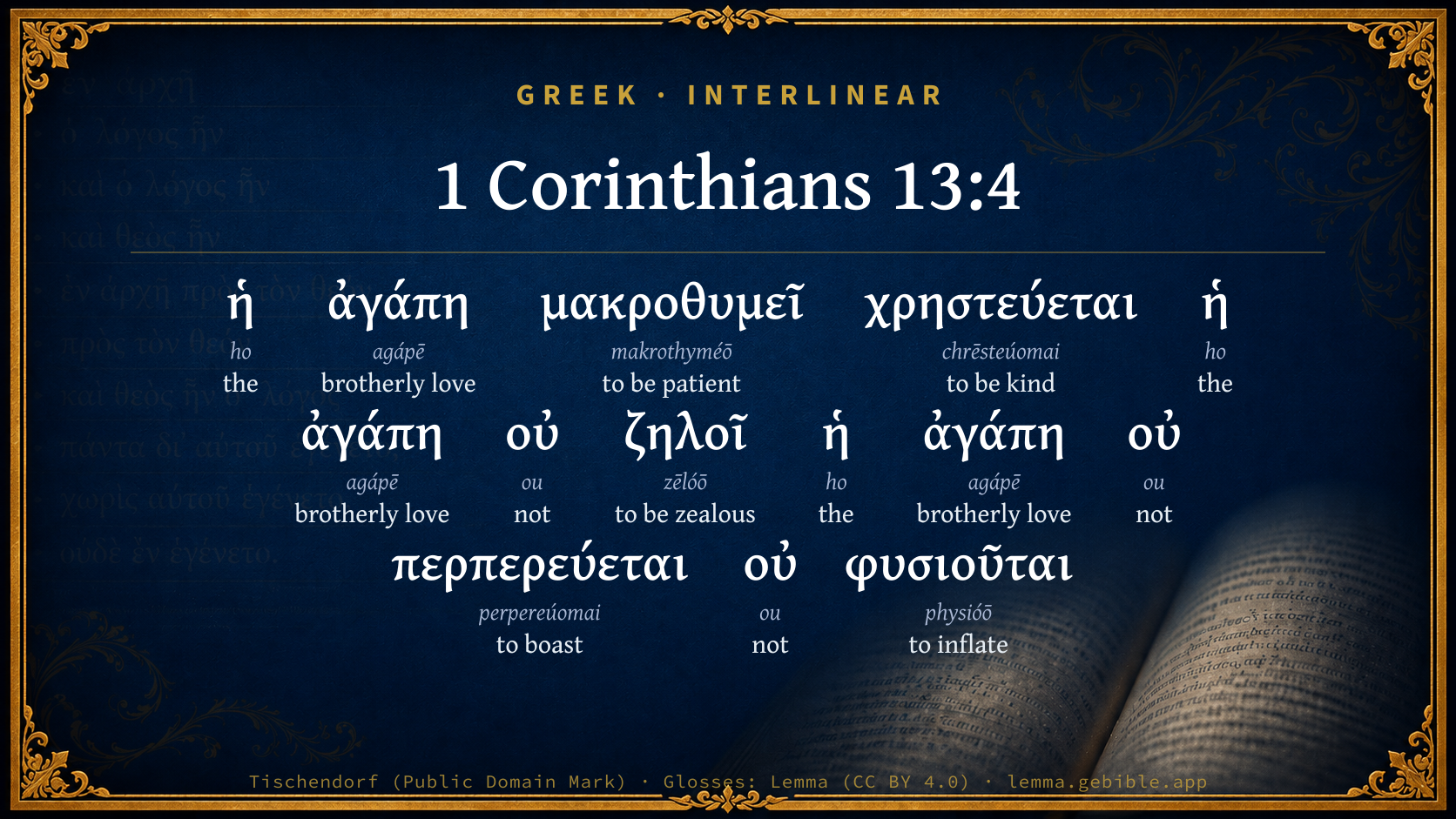
Love is patient and is kind; love doesn't envy. Love doesn't brag, is not proud,
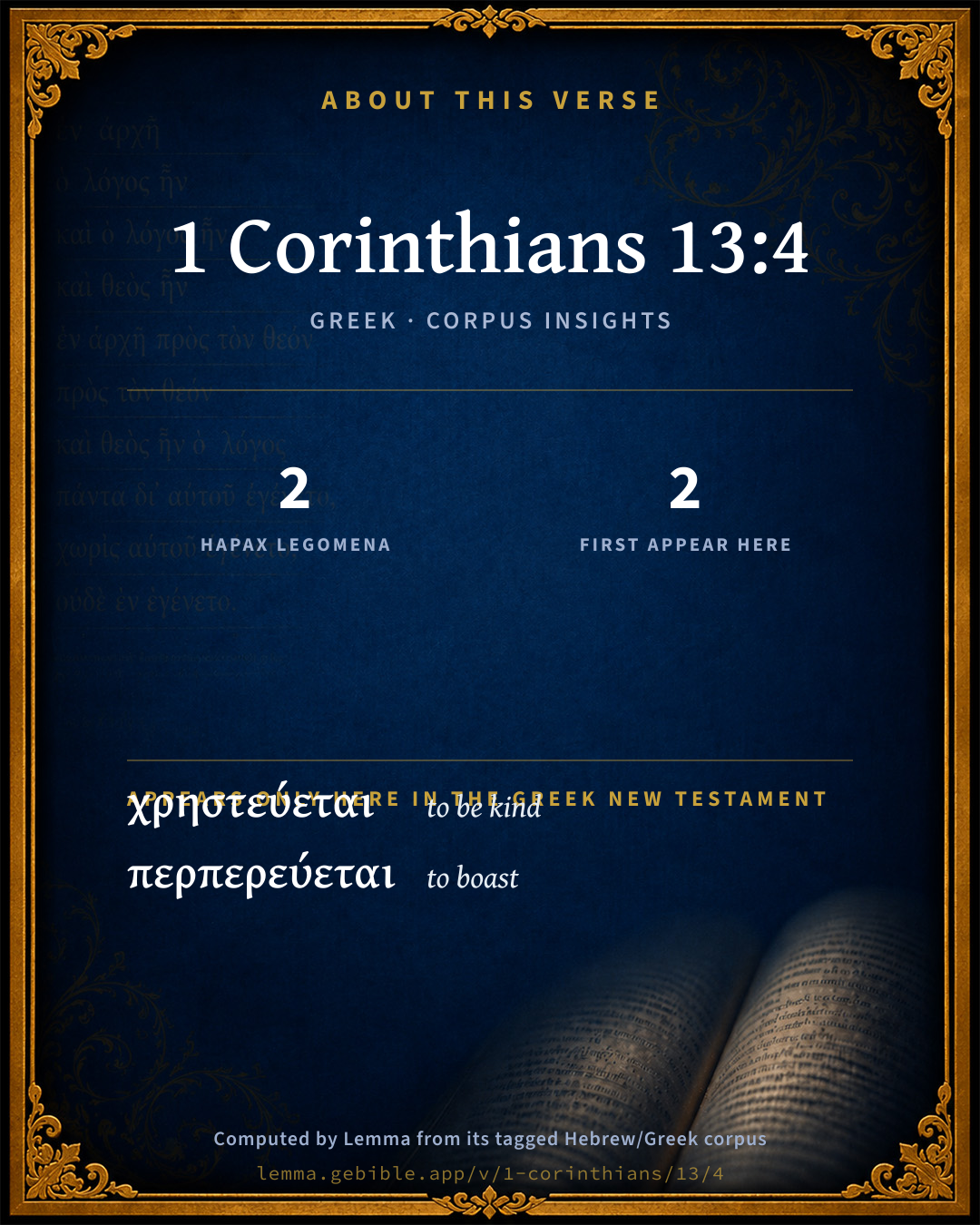
- 2 hapax legomena — only here in the Greek New Testament
- 2 first appearances in the Greek New Testament
Download a study sheet
One document with this verse’s original text, its word-by-word gloss line, the meaning frame, cross-references with their text, attributed commentary, and full source and license credits — printable, and it pastes into notes with its structure intact.
This verse Autodidact and up
A passage Seminary Student
Up to 50 verses in one chapter. A passage sheet keeps up to 6 commentary sources and 12 cross-references per verse, in the order this page ranks them, and says so on the sheet whenever that leaves anything out. Ask for a single verse and you get the Autodidact verse sheet above.
Everything on this page stays free to read, with no account — the sheet is a download of what is already on screen, not access to it.
Compare translations 3
The same verse in 3 English versions, stacked beneath the original-language interlinear above. Click any original word for its lexicon entry.
Each is an independent rendering of the whole verse — the interlinear is not word-aligned to these translations.
Highlighted words mark where these versions differ — a whole-verse word diff, not a word-by-word alignment.
-
World English Bible Public Domain
Love is patient and is kind; love doesn't envy. Love doesn't brag, is not proud,
-
King James Version Public Domain
Charity suffereth long, and is kind; charity envieth not; charity vaunteth not itself, is not puffed up,
-
unfoldingWord Literal Text CC BY-SA 4.0
Love is patient is kind; love does not envy; love does not boast; it is not puffed up.
unfoldingWord Literal Text — © unfoldingWord, licensed CC BY-SA 4.0. Word-aligned USFM3 via Door43 (git.door43.org/unfoldingWord/en_ult).
Show all 19 translations
Every available English version of this verse, each an independent rendering of the whole verse.
-
World English Bible Public Domain
Love is patient and is kind; love doesn't envy. Love doesn't brag, is not proud,
-
Berean Standard Bible Public Domain
Love is patient, love is kind. It does not envy, it does not boast, it is not proud.
-
Majority Standard Bible Public Domain
Love is patient, love is kind. It does not envy, it does not boast, it is not proud.
-
King James Version Public Domain
Charity suffereth long, and is kind; charity envieth not; charity vaunteth not itself, is not puffed up,
-
American Standard Version (1901) Public Domain
Love suffereth long, `and' is kind; love envieth not; love vaunteth not itself, is not puffed up,
-
Revised Version (1885) Public Domain
Love suffereth long, and is kind; love envieth not; love vaunteth not itself, is not puffed up,
-
Geneva Bible (1599) Public Domain
Loue suffreth long: it is bountifull: loue enuieth not: loue doeth not boast it selfe: it is not puffed vp:
-
Douay-Rheims (1899) Public Domain
Charity is patient, is kind: charity envieth not, dealeth not perversely; is not puffed up;
-
Young's Literal Translation Public Domain
The love is long-suffering, it is kind, the love doth not envy, the love doth not vaunt itself, is not puffed up,
-
Literal Standard Version CC BY-SA 4.0
Love is long-suffering, it is kind, love does not envy, love does not vaunt itself, is not puffed up,
-
Unlocked Literal Bible CC BY-SA 4.0
Love is patient and kind. Love does not envy or boast. It is not arrogant
-
unfoldingWord Literal Text CC BY-SA 4.0
Love is patient is kind; love does not envy; love does not boast; it is not puffed up.
-
Darby Bible Public Domain
Love has long patience, is kind; love is not emulous [of others]; love is not insolent and rash, is not puffed up,
-
World Messianic Bible Public Domain
Love is patient and is kind. Love doesn’t envy. Love doesn’t brag, is not proud,
-
Webster's Bible Public Domain
Charity suffereth long, and is kind; charity envieth not; charity vaunteth not itself, is not puffed up,
-
Free Bible Version CC BY-SA 4.0
Love is patient and kind. Love is not jealous. Love is not boastful. Love is not proud.
-
Bible in Basic English Public Domain
Love is never tired of waiting; love is kind; love has no envy; love has no high opinion of itself, love has no pride;
-
Text-Critical English NT CC BY 4.0
Love is patient and kind. Love does not envy or boast. It is not puffed up
-
Tyndale New Testament (1534) Public Domain
Love suffreth longe and is corteous. Love envieth not. Love doth not frowardly swelleth not
Literal Standard Version (2020), Covenant Press — licensed CC BY-SA 4.0. Text via the HelloAO Bible API (eBible.org). Unlocked Literal Bible (unfoldingWord) — licensed CC BY-SA 4.0. Text via the HelloAO Bible API (eBible.org). unfoldingWord Literal Text — © unfoldingWord, licensed CC BY-SA 4.0. Word-aligned USFM3 via Door43 (git.door43.org/unfoldingWord/en_ult). Free Bible Version, Dr. Jonathan Gallagher — licensed CC BY-SA 4.0. Text via the HelloAO Bible API (eBible.org).
Word by word
More ways to search: Search by grammar → Find every occurrence → Compare this word →
Practice this passage: Drill this verse → Learn its vocabulary →
- Appears 1× in the Greek New Testament
- First appears here
- Part of Speech
- Verb
- Tense
- Present
- Voice
- Middle or Passive deponent
- Mood
- Indicative
- Person
- 3rd person
- Number
- Singular
Full Thayer's Definition
- ἡ ho G3588 “the” Article, Nominative, Singular, Feminine
- ἀγάπη agápē G26 “brotherly love” Noun, Nominative, Singular, Feminine
- μακροθυμεῖ makrothyméō G3114 “to be patient” Verb, Present, Active, Indicative, 3rd person, Singular
- χρηστεύεται chrēsteúomai G5541 “to be kind” Verb, Present, Middle or Passive deponent, Indicative, 3rd person, Singular
- ἡ ho G3588 “the” Article, Nominative, Singular, Feminine
- ἀγάπη agápē G26 “brotherly love” Noun, Nominative, Singular, Feminine
- οὐ ou G3756 “not” Particle, Negative
- ζηλοῖ zēlóō G2206 “to be zealous” Verb, Present, Active, Indicative, 3rd person, Singular
- ἡ ho G3588 “the” Article, Nominative, Singular, Feminine
- ἀγάπη agápē G26 “brotherly love” Noun, Nominative, Singular, Feminine
- οὐ ou G3756 “not” Particle, Negative
- περπερεύεται perpereúomai G4068 “to boast” Verb, Present, Middle or Passive deponent, Indicative, 3rd person, Singular
- οὐ ou G3756 “not” Particle, Negative
- φυσιοῦται physióō G5448 “to inflate” Verb, Present, Passive, Indicative, 3rd person, Singular
About this verse
These counts appear in no published source. They are computed here, from the morphology-tagged text and Lemma’s own curated glosses. What Lemma adds →
- 14
- words
- 8
- distinct lemmas
- Pauline Epistles
- section
Notable vocabulary
2 hapax legomena — words that appear only here in the entire Greek New Testament:
First appearance in Scripture
These words make their first canonical appearance in the Greek New Testament here:
Shared distinctive vocabulary
φυσιοῦται to inflate G5448 occurs in 7 verses of the Greek New Testament. Also found in:
Cross-references
52Topical passages linked to 1 Corinthians 13:4 in the Treasury of Scripture Knowledge — connected by theme and wording, ordered by reader-vote popularity; previews shown in the World English Bible.
- 1 Peter 4:8 And above all things be earnest in your love among yourselves, for love covers a multitude of sins.
- Ephesians 4:32 And be kind to one another, tenderhearted, forgiving each other, just as God also in Christ forgave you.
- Galatians 5:21–22 envyings, murders, drunkenness, orgies, and things like these; of which I forewarn you, even as I also forewarned you, that those who practice such things will not inherit the Kingdom of God.
- Proverbs 10:12 Hatred stirs up strife, But love covers all wrongs.
- Colossians 3:12 Put on therefore, as God's chosen ones, holy and beloved, a heart of compassion, kindness, lowliness, humility, and perseverance;
- 1 John 4:11 Beloved, if God loved us in this way, we also ought to love one another.
- Proverbs 17:9 He who covers an offense promotes love; But he who repeats a matter separates best friends.
- James 3:14–17 But if you have bitter jealousy and selfish ambition in your heart, don't boast and don't lie against the truth.
- 1 John 3:16–18 By this we know love, because he laid down his life for us. And we ought to lay down our lives for the brothers.
- 1 Peter 3:8 Finally, be all like-minded, compassionate, loving as brothers, tenderhearted, courteous,
- 2 Peter 1:7 and in godliness brotherly affection; and in brotherly affection, love.
- Luke 6:35–36 But love your enemies, and do good, and lend, expecting nothing back; and your reward will be great, and you will be children of the Most High; for he is kind toward the unthankful and evil.
- 1 Thessalonians 5:14 We exhort you, brothers, admonish the disorderly, encourage the fainthearted, support the weak, be patient toward all.
- 2 Corinthians 6:6 in pureness, in knowledge, in patience, in kindness, in the Holy Spirit, in sincere love,
- Ephesians 4:2 with all lowliness and humility, with patience, bearing with one another in love;
- Proverbs 19:22 That which makes a man to be desired is his kindness. A poor man is better than a liar.
- Ecclesiastes 7:8–9 Better is the end of a thing than its beginning. The patient in spirit is better than the proud in spirit.
- Galatians 5:26 Let's not become conceited, provoking one another, and envying one another.
- Colossians 1:11 strengthened with all power, according to the might of his glory, for all endurance and perseverance with joy;
- 2 Timothy 4:2 preach the word; be urgent in season and out of season; reprove, rebuke, and exhort, with all patience and teaching.
- Proverbs 31:20 She opens her arms to the poor; Yes, she extends her hands to the needy.
- 1 Corinthians 4:6 Now these things, brothers, I have in a figure transferred to myself and Apollos for your sakes, that in us you might learn not to think beyond the things which are written, that none of you be puffed up against one another.
- 2 Timothy 3:10 But you did follow my teaching, conduct, purpose, faith, patience, love, steadfastness,
- 1 Peter 2:1 Putting away therefore all wickedness, all deceit, hypocrisies, envies, and all evil speaking,
- Nehemiah 9:17 and refused to obey, neither were mindful of your wonders that you did among them, but hardened their neck, and in their rebellion appointed a captain to return to their bondage. But you are a God ready to pardon, gracious and merciful, slow to anger, and abundant in loving kindness, and didn't forsake them.
- Proverbs 13:10 Pride only breeds quarrels, But with ones who take advice is wisdom.
- Proverbs 17:14 The beginning of strife is like breaching a dam, Therefore stop contention before quarreling breaks out.
- Proverbs 31:26 She opens her mouth with wisdom. Faithful instruction is on her tongue.
- Philippians 2:1–5 If there is therefore any exhortation in Christ, if any consolation of love, if any fellowship of the Spirit, if any tender mercies and compassion,
- Acts 7:9 "The patriarchs, moved with jealousy against Joseph, sold him into Egypt. God was with him,
- 1 Corinthians 3:3 for you are still fleshly. For insofar as there is jealousy, strife, and factions among you, aren't you fleshly, and don't you walk in the ways of men?
- Titus 3:3 For we were also once foolish, disobedient, deceived, serving various lusts and pleasures, living in malice and envy, hateful, and hating one another.
- Psalms 10:5 His ways are prosperous at all times; He is haughty, and your laws are far from his sight: As for all his adversaries, he sneers at them.
- Ecclesiastes 10:4 If the spirit of the ruler rises up against you, don't leave your place; for gentleness lays great offenses to rest.
- 2 Timothy 2:25 in gentleness correcting those who oppose him: perhaps God may give them repentance leading to a full knowledge of the truth,
- 1 Timothy 6:4 he is conceited, knowing nothing, but obsessed with arguments, disputes, and word battles, from which come envy, strife, reviling, evil suspicions,
- 1 Corinthians 4:18 Now some are puffed up, as though I were not coming to you.
- 1 Corinthians 8:1 Now concerning things sacrificed to idols: We know that we all have knowledge. Knowledge puffs up, but love builds up.
- Genesis 37:11 His brothers envied him; but his father kept this saying in mind.
- 1 Kings 20:10–11 Ben Hadad sent to him, and said, The gods do so to me, and more also, if the dust of Samaria shall suffice for handfuls for all the people who follow me.
- Proverbs 25:8–10 Don't be hasty in bringing charges to court. What will you do in the end when your neighbor shames you?
- Daniel 3:19–22 Then was Nebuchadnezzar full of fury, and the form of his visage was changed against Shadrach, Meshach, and Abednego: [therefore] he spoke, and commanded that they should heat the furnace seven times more than it was wont to be heated.
- Romans 1:29 being filled with all unrighteousness, sexual immorality, wickedness, covetousness, maliciousness; full of envy, murder, strife, deceit, evil habits, secret slanderers,
- Romans 13:13 Let us walk properly, as in the day; not in reveling and drunkenness, not in sexual promiscuity and lustful acts, and not in strife and jealousy.
- 1 Samuel 25:21–22 Now David had said, Surely in vain have I kept all that this fellow has in the wilderness, so that nothing was missed of all that pertained to him: and he has returned me evil for good.
- 1 Samuel 25:33–34 and blessed be your discretion, and blessed be you, that have kept me this day from blood guiltiness, and from avenging myself with my own hand.
- Matthew 27:18 For he knew that because of envy they had delivered him up.
- 1 Corinthians 5:2 You are puffed up, and didn't rather mourn, that he who had done this deed might be removed from among you.
- 2 Corinthians 12:20 For I am afraid that by any means, when I come, I might find you not the way I want to, and that I might be found by you as you don't desire; that by any means there would be strife, jealousy, outbursts of anger, factions, slander, whisperings, proud thoughts, riots;
- Philippians 1:15 Some indeed preach Christ even out of envy and strife, and some also out of good will.
- Colossians 2:18 Let no one rob you of your prize by a voluntary humility and worshipping of the angels, dwelling in the things which he has not seen, vainly puffed up by his fleshly mind,
- James 4:5 Or do you think that the Scripture says in vain, "The Spirit who lives in us yearns jealously"?
Cross-references courtesy of OpenBible.info (CC BY 4.0).
Lesson kit
Teaching starters — assembled from the data on this page, not authored interpretation. Every prompt links to the verse data it draws on. Edit before teaching.
1 Corinthians, in the Pauline Epistles, opens this verse with 14 words (8 distinct Greek lemmas). Its most distinctive word is chrēsteúomai (“to be kind”). A historical commentator’s framing appears above. Read the whole chapter for the surrounding context.
Discussion questions
- How does “to be kind” (chrēsteúomai) shape what this verse is saying?
- 2 words here appear nowhere else in the Greek New Testament. Why might the author reach for such rare wording?
- 2 words make their first appearance in Scripture here. What does this debut establish?
- How does 1 Corinthians 4:6, which shares the word «to inflate», read alongside this verse?
- What does the repetition of “brotherly love” (3× in this one verse) do in this verse?
- The translations on this page render this verse differently — a whole-verse word diff, not a word-by-word alignment. What might account for the different wordings?
- Compare how The Biblical Illustrator and Joseph Benson's Commentary read this verse. Where do they agree or differ?
Things to notice
- 2 words in this verse appear nowhere else in the Greek New Testament.
- 2 words make their first canonical appearance in Scripture here.
- These translations choose different wording for 16 words in this verse.
- “brotherly love” occurs 3× in this single verse.
- 8 distinct Greek lemmas span 14 words in this verse.
Commentary
Notes on 1 Corinthians 13:4 from classic Christian and Jewish commentators (each source and its license shown beneath its notes). The classic Christian expositions comment on the surrounding passage and are grouped to its opening verse, so a note may address several verses; the Jewish commentaries on the Tanakh (Rashi and others) are per-verse, so they appear only where the commentator wrote on this verse.
Lemma curates 59 commentaries, every one of them public domain or Creative Commons licensed, each selected and text-cleaned for this edition rather than reprinted as found. About our sources →
The Biblical Illustrator
Joseph S. Exell
The Biblical Illustrator, edited by Joseph S. Exell (c. 1880s–1900s) — public domain. Text from a community e-Sword module.
Joseph Benson's Commentary
Joseph Benson's Commentary on the Old and New Testaments (1811–1818) — public domain. Text from a community e-Sword module.
Whedon's Commentary on the Bible
Daniel D. Whedon
Daniel D. Whedon (gen. ed.), Commentary on the Old and New Testaments (1874–1909) — public domain. Text from a community e-Sword module.
Scofield Reference Notes
C. I. Scofield
The Scofield Reference Bible (1917 edition), notes by C. I. Scofield — public domain. Text from a community e-Sword module.
Tyndale Open Study Notes
Tyndale Open Resources
Tyndale Open Study Notes — © Tyndale Open Resources, licensed CC BY-SA 4.0. Text via the HelloAO Bible API.
Bengel's Gnomon
Johann Albrecht Bengel
Bengel's Gnomon of the New Testament — English translation (T&T Clark, Edinburgh, 1860) — public domain. Text from a community e-Sword module.
Meyer's Critical & Exegetical Commentary
Heinrich August Wilhelm Meyer
Meyer — Critical and Exegetical Commentary on the New Testament — English translation by Peter Christie, edited by Frederick Crombie (T&T Clark, 1880) — public domain. Text from a community e-Sword module.
Expositor's Greek Testament
ed. W. Robertson Nicoll
The Expositor's Greek Testament, edited by W. Robertson Nicoll (1897–1910) — public domain. Text from a community e-Sword module.
Hodge's Commentary on Romans, Ephesians & First Corinthians
Charles Hodge
Charles Hodge — Commentary on Romans (1835), First Corinthians (1857), and Ephesians (1856) — public domain. Text from a community e-Sword module.
Geneva Bible (1599)
Geneva Bible translators
Geneva Bible (1599) marginal notes — public domain. Text via Bolls.life.
Matthew Henry's Commentary
Matthew Henry's Commentary on the Whole Bible (1708–1710) — public domain (CC PDM 1.0). Text via the HelloAO Bible API.
Jamieson, Fausset & Brown
Robert Jamieson, A. R. Fausset & David Brown
Jamieson, Fausset & Brown — Commentary Critical and Explanatory on the Whole Bible (1871) — public domain (CC PDM 1.0). Text via the HelloAO Bible API.
Adam Clarke's Commentary
Adam Clarke's Commentary on the Bible (1810–1826) — public domain. Text from a community e-Sword/MySword module.
John Calvin's Commentaries
John Calvin's Commentaries (1540-1563) — public domain. Text from the Calvin Translation Society English edition (1840s-50s) via the Christian Classics Ethereal Library (ccel.org). Calvin's coverage is partial (roughly two-thirds of the Bible); uncommented books and verses are honest gaps, never fabricated. The 19th-century editor's footnotes and remarks are omitted so the notes are faithfully Calvin's own voice.
Ellicott's Commentary for English Readers
A Bible Commentary for English Readers, edited by Charles John Ellicott (1878–1897) — public domain. Text from a community e-Sword module.
The Cambridge Bible for Schools and Colleges
gen. ed. J. J. S. Perowne
The Cambridge Bible for Schools and Colleges (gen. ed. J. J. S. Perowne; Cambridge University Press, 1878–1918) — public domain. Text from a community e-Sword module.
John Gill's Exposition
John Gill's Exposition of the Whole Bible (1746–1763) — public domain (CC PDM 1.0). Text via the HelloAO Bible API.
Trapp's Complete Commentary
John Trapp
John Trapp, A Commentary or Exposition upon All the Books of the Old and New Testament (1647–1656) — public domain. Text from a community e-Sword module.
Albert Barnes' Notes on the Bible
Albert Barnes' Notes on the Bible (1834–1885) — public domain. Text from a community e-Sword/MySword module.
Haydock's Catholic Bible Commentary
George Leo Haydock (1774–1849), Haydock's Catholic Family Bible and Commentary, 1859 edition — public domain. Excludes Psalms (Douay-Rheims chapter numbering differs from Protestant) and Deuterocanonical books (Catholic canon only).
Matthew Poole's English Annotations
Matthew Poole's English Annotations on the Holy Bible (1683–1685) — public domain. Text from a community e-Sword/MySword module.
The Pulpit Commentary
The Pulpit Commentary (1880–1919), ed. H.D.M. Spence-Jones & Joseph S. Exell — public domain. Text from a community e-Sword module.
John Wesley's Explanatory Notes
John Wesley, Explanatory Notes Upon the Whole Bible (1754–1765) — public domain. Text via the GEBible commentary corpus.
Kretzmann's Popular Commentary
Paul E. Kretzmann
Paul E. Kretzmann, Popular Commentary of the Bible (1921–1924) — public domain. Text from a community e-Sword module.
Burkitt's Expository Notes on the New Testament
William Burkitt
William Burkitt's Expository Notes on the New Testament (1700–1703) — public domain. Text from a community e-Sword module.
Godbey's Commentary on the New Testament
William B. Godbey
William B. Godbey, Commentary on the New Testament (1896–1900) — public domain. Text from a community e-Sword module.
McGarvey & Pendleton's Commentaries
J. W. McGarvey
J. W. McGarvey (with Philip Y. Pendleton), Commentaries on the New Testament (The Fourfold Gospel, 1914; Acts; and the epistles) — public domain. Text from a community e-Sword/MySword module.
The People's New Testament
B. W. Johnson
B. W. Johnson's The People's New Testament with Notes (1889–1891) — public domain. Electronic text from the Christian Classics Ethereal Library (CCEL) ThML edition.
unfoldingWord translationNotes
Door43 World Missions Community
unfoldingWord translationNotes — © Distant Shores Media and the Door43 World Missions Community, licensed CC BY-SA 4.0. Source: git.door43.org/Door43/en_tn.
Cambridge Greek Testament for Schools and Colleges
Cambridge Greek Testament for Schools and Colleges (Cambridge University Press, 1896; 21 vols, various authors incl. Carr, Maclear, Plummer, Farrar, Lumby, Moule, M. R. James, Simcox) — public domain. Text from a community e-Sword module.
Alford’s Greek Testament
Henry Alford
Henry Alford, The Greek Testament (1849–1861) — public domain. Text from a community e-Sword module.
International Critical Commentary
International Critical Commentary — older volumes (1896–1929), various authors — public domain. Text from a community e-Sword module.
Vincent's Word Studies in the New Testament
Marvin R. Vincent
Marvin R. Vincent, Word Studies in the New Testament (1887–1900) — public domain. Text from a community e-Sword/MySword module.
Godet's Commentaries
Frédéric Louis Godet
Frédéric Louis Godet — Commentaries on Luke, John, Romans, and 1 Corinthians — English translation (T&T Clark, Edinburgh, 1870s–1890s) — public domain. Text from a community e-Sword module.