
1 Corinthians 11:20

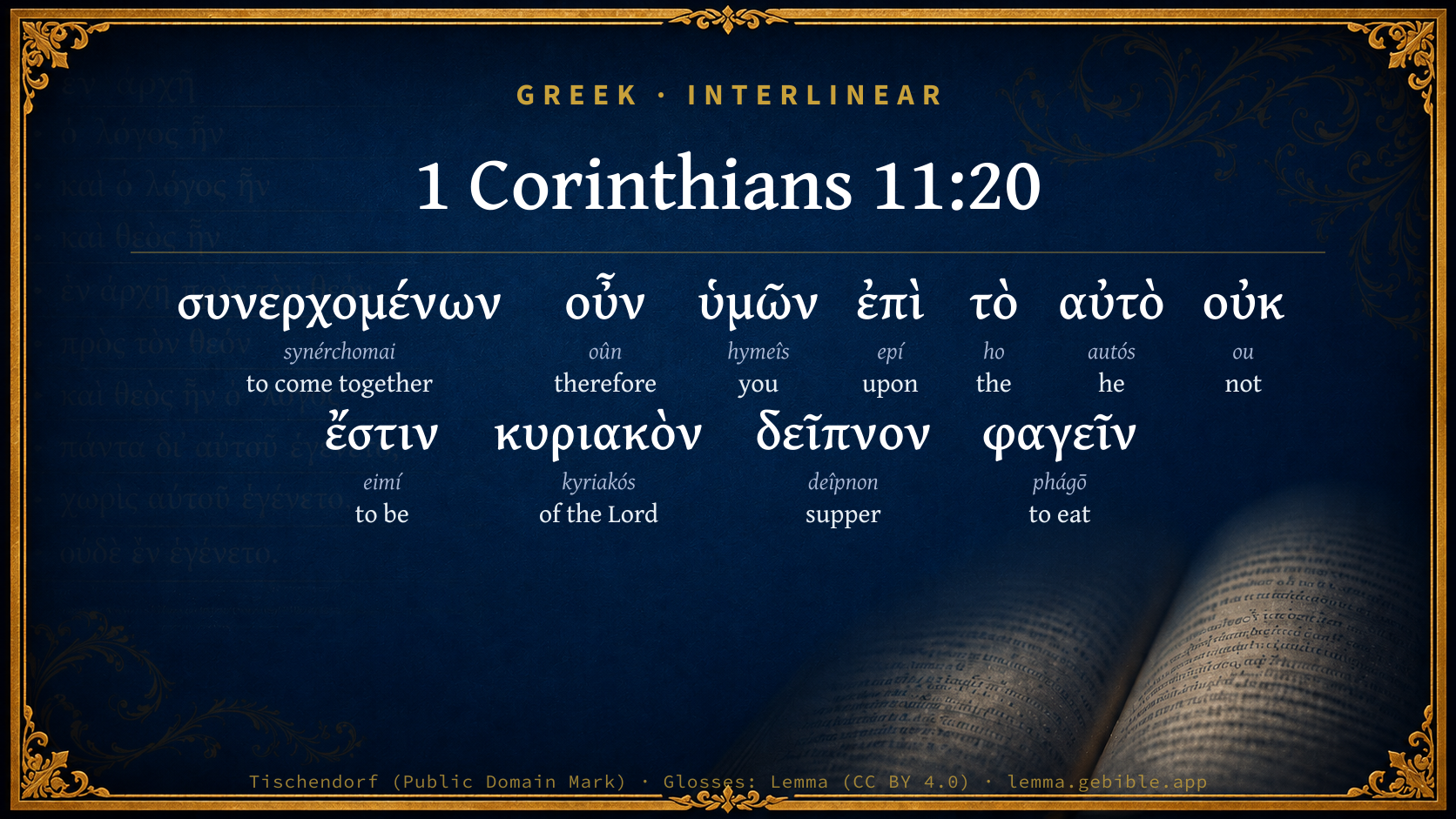
Greek (Tischendorf 8th ed.) 1 Corinthians 11:20 appears in the Greek New Testament. The text above is from the Tischendorf 8th edition. Each word links to its Strong’s number and a concise gloss. Click any word for its full Thayer’s Greek Lexicon entry.
Download image
Cite this verse

1 Corinthians 11:20 (World English Bible). Public Domain. Lemma interlinear Bible study tool, https://lemma.gebible.app/v/1-corinthians/11/20.

Show BibTeX & RIS
BibTeX
RIS
English Translation
When therefore you assemble yourselves together, it is not possible to eat the Lord's supper.
World English Bible · Public Domain
Highlights
  • 1 first appearance in the Greek New Testament
Full analysis ↓
Download a study sheet

One document with this verse’s original text, its word-by-word gloss line, the meaning frame, cross-references with their text, attributed commentary, and full source and license credits — printable, and it pastes into notes with its structure intact.

This verse Autodidact and up

Study sheet (.html) Plain text (.txt)

A passage Seminary Student

Up to 50 verses in one chapter. A passage sheet keeps up to 6 commentary sources and 12 cross-references per verse, in the order this page ranks them, and says so on the sheet whenever that leaves anything out. Ask for a single verse and you get the Autodidact verse sheet above.

Everything on this page stays free to read, with no account — the sheet is a download of what is already on screen, not access to it.

Want to remove ads? Support Godless Engineer
Compare translations 3

The same verse in 3 English versions, stacked beneath the original-language interlinear above. Click any original word for its lexicon entry.

Each is an independent rendering of the whole verse — the interlinear is not word-aligned to these translations.

Highlighted words mark where these versions differ — a whole-verse word diff, not a word-by-word alignment.

  • World English Bible Public Domain
    When therefore you assemble yourselves together, it is not possible to eat the Lord's supper.
  • King James Version Public Domain
    When ye come together therefore into one place, this is not to eat the Lord's supper.
  • unfoldingWord Literal Text CC BY-SA 4.0
    So then, your coming together in one place, it is not to eat the Lord’s Supper.

unfoldingWord Literal Text — © unfoldingWord, licensed CC BY-SA 4.0. Word-aligned USFM3 via Door43 (git.door43.org/unfoldingWord/en_ult).

Versions to compare (up to 4)

3 of 4 selected

Show all 19 translations

Every available English version of this verse, each an independent rendering of the whole verse.

  • World English Bible Public Domain
    When therefore you assemble yourselves together, it is not possible to eat the Lord's supper.
  • Berean Standard Bible Public Domain
    Now then, when you come together, it is not the Lord’s Supper you eat.
  • Majority Standard Bible Public Domain
    Now then, when you come together, it is not the Lord’s Supper you eat.
  • King James Version Public Domain
    When ye come together therefore into one place, this is not to eat the Lord's supper.
  • American Standard Version (1901) Public Domain
    When therefore ye assemble yourselves together, it is not possible to eat the Lord's supper:
  • Revised Version (1885) Public Domain
    When therefore ye assemble yourselves together, it is not possible to eat the Lord’s supper:
  • Geneva Bible (1599) Public Domain
    When ye come together therefore into one place, this is not to eate the Lords Supper.
  • Douay-Rheims (1899) Public Domain
    When you come therefore together into one place, it is not now to eat the Lord's supper.
  • Young's Literal Translation Public Domain
    ye, then, coming together at the same place -- it is not to eat the Lord's supper;
  • Literal Standard Version CC BY-SA 4.0
    you, then, coming together at the same place—it is not to eat the LORD’s Dinner;
  • Unlocked Literal Bible CC BY-SA 4.0
    For when you come together, it is not the Lord's Supper that you eat.
  • unfoldingWord Literal Text CC BY-SA 4.0
    So then, your coming together in one place, it is not to eat the Lord’s Supper.
  • Darby Bible Public Domain
    When ye come therefore together into one place, it is not to eat [the] Lord's supper.
  • World Messianic Bible Public Domain
    When therefore you assemble yourselves together, it is not the Lord’s supper that you eat.
  • Webster's Bible Public Domain
    When therefore ye come together in one place, this is not to eat the Lord's supper.
  • Free Bible Version CC BY-SA 4.0
    When you meet together you're not really celebrating the Lord's Supper at all.
  • Bible in Basic English Public Domain
    But now, when you come together, it is not possible to take the holy meal of the Lord:
  • Text-Critical English NT CC BY 4.0
    Now when you come together, it is not to eat the Lord's supper.
  • Tyndale New Testament (1534) Public Domain
    When ye come to gedder a man cannot eate the lordes supper.

Literal Standard Version (2020), Covenant Press — licensed CC BY-SA 4.0. Text via the HelloAO Bible API (eBible.org). Unlocked Literal Bible (unfoldingWord) — licensed CC BY-SA 4.0. Text via the HelloAO Bible API (eBible.org). unfoldingWord Literal Text — © unfoldingWord, licensed CC BY-SA 4.0. Word-aligned USFM3 via Door43 (git.door43.org/unfoldingWord/en_ult). Free Bible Version, Dr. Jonathan Gallagher — licensed CC BY-SA 4.0. Text via the HelloAO Bible API (eBible.org).

Word by word

More ways to search: Search by grammar → Find every occurrence → Compare this word →

Practice this passage: Drill this verse → Learn its vocabulary →

About this verse

These counts appear in no published source. They are computed here, from the morphology-tagged text and Lemma’s own curated glosses. What Lemma adds →

11
words
11
distinct lemmas
Pauline Epistles
section

Notable vocabulary

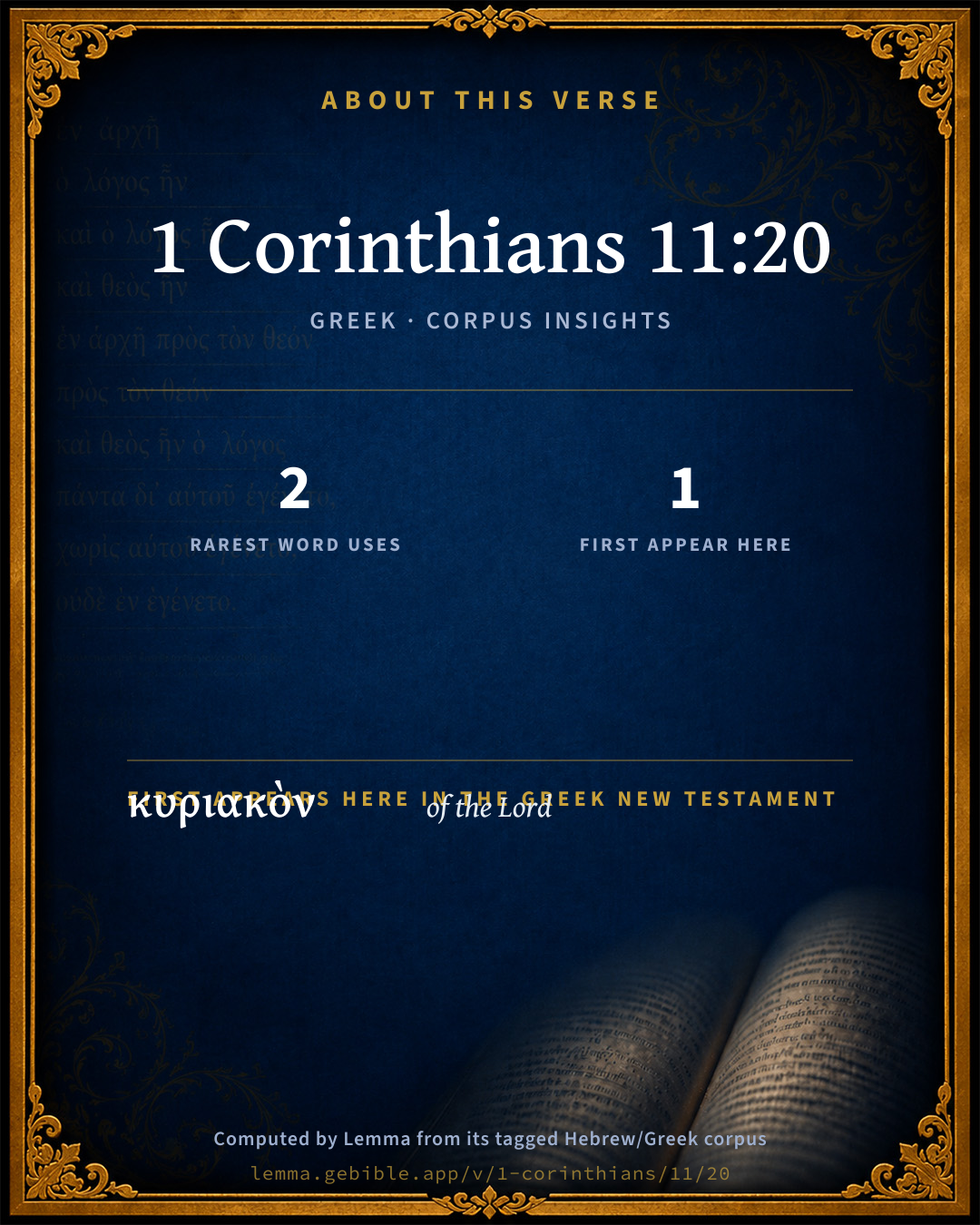
The rarest word here is κυριακὸν of the Lord G2960 — appearing just 2 times in the whole Greek New Testament.

First appearance in Scripture

This word makes its first canonical appearance in the Greek New Testament here:

  • κυριακὸν of the Lord G2960

Shared distinctive vocabulary

κυριακὸν of the Lord G2960 occurs in 2 verses of the Greek New Testament. Also found in:
Commentary

Notes on 1 Corinthians 11:20 from classic Christian and Jewish commentators (each source and its license shown beneath its notes). The classic Christian expositions comment on the surrounding passage and are grouped to its opening verse, so a note may address several verses; the Jewish commentaries on the Tanakh (Rashi and others) are per-verse, so they appear only where the commentator wrote on this verse.

Lemma curates 59 commentaries, every one of them public domain or Creative Commons licensed, each selected and text-cleaned for this edition rather than reprinted as found. About our sources →

Joseph Benson's Commentary

1Co 11:20-22. When ye come together therefore — In such a manner as you do; into one place — Under pretence of celebrating the holy ordinance of the eucharist, and have such strife and contention among you, and act in the disorderly manner which I shall now mention; this is not to eat the Lord’s supper — That solemn memorial of his death; nor does it deserve to be called by that name, unless ye eat it in fellowship together, and in mutual love, as the disciples of one master. Instead of regarding it in a holy and religious point of view, you seem to confound it with a common meal; and do not indeed behave in the manner that decency would require, if it were no more than a common meal. For in eating it — Or when you eat it; every one taketh before other his own supper — Or, as Macknight renders εκαστος το ιδιον δειπνον προλαμβανει, every one taketh first his own supper; observing, that “what follows shows the apostle did not mean,” as in our translation, “that every one took before another his own supper; but that every one took his own supper before he ate the Lord’s supper. Christ having instituted his supper after he had eaten the passover, the disciples very early made it a rule to feast together before they ate the Lord’s supper. These feasts were called αγαπαι, charitates, love-feasts. They are mentioned, Jude, 1Co 11:12, as also by some of the ancient Christian writers. From Xenophon, (see Memorab., lib. 3. cap. 14,) we learn that the Greeks, when they supped together, brought each his own provisions ready dressed, which they ate in company together. Probably the Corinthians followed the same practice, in their feasts previous to the Lord’s supper.” And one is hungry, and another is drunken — Or rather, is filled, or plentifully fed, “as μεθυειν signifies here, being opposed to one is hungry. The word is used in this sense by the LXX., Psa 35:9; Jer 38:14; Joh 2:10; where it is rendered by our translators, when men have well drunk, drunk plentifully. According to the grammarians, μεθυειν literally signifies to eat and drink, μετα το θυειν, after sacrificing; on which occasions the heathen often drank to excess.” What? have ye not houses to eat and drink in — With your friends? Or despise ye the church of God — Which ye thus expose to contempt, and which you must greatly offend and grieve by such a conduct as this? That church of which the poor are both the larger and the better part; and shame — Expose to shame; them that have not — A supper to eat, while ye feast luxuriously? Do you act thus in designed contempt of them? What shall I say to you — On this occasion? Shall I praise you in this? — I wish I could fairly and honourably do it; but at present I praise you not — I must rather blame you, and exhort you to amend what is so grossly amiss.

Joseph Benson's Commentary on the Old and New Testaments (1811–1818) — public domain. Text from a community e-Sword module.

Tyndale Open Study Notes

Tyndale Open Resources

11:20-22 Some people were more concerned about eating their own supper than with the Lord’s Supper.

Tyndale Open Study Notes — © Tyndale Open Resources, licensed CC BY-SA 4.0. Text via the HelloAO Bible API.

Bengel's Gnomon

Johann Albrecht Bengel

1Co 11:20. Συνερχομένων οὖν ὑμῶν, when ye come together therefore) The therefore has the effect of resuming the discourse, 1Co 11:18.—οὐκ ἔστι φαγεῖν) there is not aught to eat, i.e. it does not fall to you to eat; eating is prevented, viz. because the bread is withdrawn;[98] he therefore pointedly says, to eat. It is an indefinite expression. [Man kommt nicht dazu, wegen Abgang des Brots und Weins, “we come not for that purpose, on account of the want of bread and wine.”—Not. crit.] Sometimes they came in for the privilege of eating the Lord’s Supper itself, 1Co 11:26. Sometimes, they were excluded, some at least, who came too late, and had not been waited for, 1Co 11:33. So ἐστὶ with the infinitive, Heb 9:5. So not merely on one occasion Chrysostom.—See 1. 2 de Sacerd., p. 388. There is a similar use of the verb γίνεται, Act 20:16. So אין לשמור, 2Ch 5:11; אין לבוא, Est 4:2; οὐκ ἔστιν ἆραι, LXX., 1Ch 15:2; οὐκ ἔστι πρός σε ἀντιστῆναι, 2Ch 20:6, and decidedly Gen 6:21, καὶ ἔσται σοὶ καὶ ἐκείνοις φαγεῖν.—Κυριακὸν, the Lord’s) An antithesis to his own, (ἴδιον) supper, next verse.

[98] Those who came first consumed it all, and left none for those who came late.—ED.

Bengel's Gnomon of the New Testament — English translation (T&T Clark, Edinburgh, 1860) — public domain. Text from a community e-Sword module.

Meyer's Critical & Exegetical Commentary

Heinrich August Wilhelm Meyer

1Co_11:20. Οὖν] resuming after the parenthesis; see on 1Co_11:18.

ἐπὶ τὸ αὐτό] to the same place. See on Act_1:15.

οὐκ ἔστι κυριακ. δεῖπν. φαγ.] there does not take place an eating of a Lords Supper, i.e. one cannot eat a Lords Supper in that way; it is morally impossible, since things go on in such fashion as 1Co_11:21 thereupon specifies by way of proof. We have here the very common and familiar use of ἔστι with the infinitive, in the sense of: it is possible, one can, as in Heb_9:5. So e.g. the passages from Plato given by Ast, Lex. I. p. 622; Hom. Il. xxi. 193, al[1832]; Thuc. viii. 53; Soph. Phil. 69; Aesch. Pers. 414; Polyb. i. 12. 9, v. 98. 4. It occurs in the classics also for the most part with the negative. See generally, Valckenaer on Eurip. Hippol. 1326. Beza, Estius, Zachariae, de Wette, Ewald, Maier, Winer, al[1833], render it otherwise, as if there were a ΤΟῦΤΟ in the text: this is not, etc. And even if there were such a τοῦτο, it would have nothing here to connect itself with.

ΚΥΡΙΑΚῸΝ ΔΕῖΠΝΟΝ] a meal belonging to the Lord, consecrated to Christ; comp 1Co_11:27; 1Co_10:21. The name was given to the love-feasts (Agapae, Jud_1:12), at which the Christians ate and drank together what they severally brought with them, and with which was conjoined the Lords Supper properly so called (1Co_10:16; 1Co_10:21; comp on Act_2:42), so that the bread was distributed and partaken of during the meal and the cup after it, according to the precedent of the original institution. Comp Tertullian, Apol. 30. Chrysostom, indeed, and Pelagius held that the Lords Supper came first; but this is contrary to the model of the first institution, came into vogue only at a later date, and rests purely upon the ascetic idea that it was unbefitting to take the Eucharist after other food. To understand here, as Hofmann does, not the whole meal, but merely the celebration of the Lords Supper, which was conjoined with it, is not in keeping with the phrase δεῖπνον, the precise scope of which is determined by the meal so originally instituted (Joh_13:2) to which it points.

[1832] l. and others; and other passages; and other editions.

[1833] l. and others; and other passages; and other editions.

Meyer — Critical and Exegetical Commentary on the New Testament — English translation by Peter Christie, edited by Frederick Crombie (T&T Clark, 1880) — public domain. Text from a community e-Sword module.

Expositor's Greek Testament

ed. W. Robertson Nicoll

1Co 11:20-21 resume with emphasis the circumstantial clause of 1Co 11:18 and draw out, by οὖν , the disastrous issue of the σχίσματα : they produce a visible separation at the common meal of the Church, destroying the reality of the Lord’s Supper . Ch. 1Co 1:12 , 1Co 3:3 f., 1Co 4:6 , showed that the Cor [1697] divisions were of a partisan character, and 1Co 1:19 that intellectual differences entered into them ( cf. 1Co 8:1-7 ); but distinctions of wealth contributed to the same effect. The two latter influences conspired, the richer and more cultivated Cor [1698] Christians leaning to a self-indulgence which they justified on the ground of enlightenment; the αἱρέσεις sloped down toward κραιράλη καὶ μέθη . ἐπὶ τὸ αὐτό , “to the same (spot)”. οὐκ ἔστιν κ . τ . λ . can hardly mean, “it is not to eat the Lord’s Supper” (so Al [1699] and others) for the Cor [1700] intended this, but by unworthy behaviour (1Co 11:26 f.) neutralised their purpose: P. says either “it ( sc . your feast) is not an eating of the Lord’s Supper” (A.V., Bz [1701] , Est., D.W [1702] , Bt [1703] , Hn [1704] , EL [1705] , Gd [1706] : “ce n’est pas là manger, etc.”); or, “it is not (possible) to eat the Lord’s Supper” (R.V., Bg [1707] , Mr [1708] , Hf [1709] , Ed [1710] , Ev [1711] ) such eating is out of the question . 1Co 11:21 bears out the last interpretation, since it.describes a state of things not merely nullifying but repugnant to any true κυριακὸν δεῖπνον ; οὐκ ἔστιν carries this strong sense, negativing the idea as well as fact, in Heb 9:5 , and often in cl [1712] Gr [1713] The adj [1714] κυριακὸν (= τοῦ Κυρίου ) stands in emphatic contrast with ἴδιον , the termination - κὸς signifying kind or nature : “It is impossible to eat a supper of the Lord , for each man is in haste to get ( προλαμβάνει prœoccupat , Bz [1715] ) his own supper when he eats,” or “during the meal” (Ev [1716] ; ἐν τῷ φαγεῖν , in edendo , Bz [1717] ; not ad manducandum , as in Vg [1718] ). Instead of waiting for one another (1Co 11:33 ), the Cor [1719] , as they entered the assemblyroom bringing their provisions, sat down at once to consume each his own supply, like private diners at a restaurant; προ - suggests, in view of 1Co 11:22 , that the rich even hurried to do this, so as to avoid sharing with slaves and low people at a common dish (1Co 11:22 ). The κυρ . δεῖπνον was a kind of club-supper, with which the evening meeting of the Church commenced (18 a , 20 a ), taking place at least once a week on the Lord’s Day ( cf. Act 20:7 ff.). This Church-supper, afterwards called the Agapé (see Dict. of Christian Antiq. s.v .; also Ed [1720] ad loc [1721] ) was analogous to the συσσίτια and ἔρανοι held by the guilds and friendly societies then rife amongst the Greeks. Originating as a kind of enlarged family meal in the Church of Jerus. (Act 2:46 ), the practice of the common supper accorded so well with social custom that it was universal amongst Christians in the first century (see Weizsäcker’s Apost. Age , vol. ii., pp. 279 286). Gradually the Eucharist was separated from the Agapé for greater decorum, and the latter degenerated and became extinct; here they are one, as in the Last Supper itself. The table was provisioned at Cor [1722] not from a general fund (as was usual in the ἔρανοι or collegia ), but by each guest bringing his contribution in kind, a practice not uncommon in private parties, which had the disadvantage of accentuating social differences. While the poor brought little or nothing to the feast and might be ashamed to show his fare, the rich man exhibited a loaded basket out of which he could feed to repletion. All κοινωνία was destroyed; such vulgarity would have disgraced a heathen guild-feast. The Lord , the common Host, was forgotten at His table. ὅς μὲν πεινᾷ sc . the poor man, whose small store was insufficient, or who arriving late (for his time was not his own) found the table cleared ( cf. προλαμβάνει ). ὃς δὲ μεθύει , “but another is drunk!” or in the lighter sense suggested by πεινῷ , plus satis bibit (Gr [1723] , Hn [1724] ), “drinks to the full” ( cf. Joh 2:10 ); the scene of sensual greed and pride might well culminate in drunkenness. Of all imaginable schisms the most shocking: hunger and intoxication side by side, at what is supposed to be the Table of the Lord! This is indeed “meeting for the worse”. For the demonstr. use of the rel [1725] pron [1726] with μὲν and δέ , see Wr [1727] , p. 130.

[1697] Corinth, Corinthian or Corinthians.

[1698] Corinth, Corinthian or Corinthians.

[1699] Alford’s Greek Testament .

[1700] Corinth, Corinthian or Corinthians.

[1701] Beza’s Nov. Testamentum: Interpretatio et Annotationes (Cantab., 1642).

[1702].W. De Wette’s Handbuch z. N. T.

[1703] J. A. Beet’s St. Paul’s Epp. to the Corinthians (1882).

[1704] C. F. G. Heinrici’s Erklärung der Korintherbriefe (1880), or 1 Korinther in Meyer’s krit.-exegetisches Kommentar (1896).

[1705] C. J. Ellicott’s St. Paul’s First Epistle to the Corinthians .

[1706] F. Godet’s Commentaire sur la prem. Ép. aux Corinthiens (Eng. Trans.).

[1707] Bengel’s Gnomon Novi Testamenti.

[1708] Meyer’s Critical and Exegetical Commentary (Eng. Trans.).

[1709] J. C. K. von Hofmann’s Die heilige Schrift N.T. untersucht , ii. 2 (2te Auflage, 1874).

[1710] T. C. Edwards’ Commentary on the First Ep. to the Corinthians . 2

[1711] T. S. Evans in Speaker’s Commentary .

[1712] classical.

[1713] Greek, or Grotius’ Annotationes in N.T.

[1714] adjective.

[1715] Beza’s Nov. Testamentum: Interpretatio et Annotationes (Cantab., 1642).

[1716] T. S. Evans in Speaker’s Commentary .

[1717] Beza’s Nov. Testamentum: Interpretatio et Annotationes (Cantab., 1642).

[1718] Latin Vulgate Translation.

[1719] Corinth, Corinthian or Corinthians.

[1720] T. C. Edwards’ Commentary on the First Ep. to the Corinthians . 2

[1721] ad locum , on this passage.

[1722] Corinth, Corinthian or Corinthians.

[1723] Greek, or Grotius’ Annotationes in N.T.

[1724] C. F. G. Heinrici’s Erklärung der Korintherbriefe (1880), or 1 Korinther in Meyer’s krit.-exegetisches Kommentar (1896).

[1725] relative pronoun.

[1726]ron. pronoun.

[1727] Winer-Moulton’s Grammar of N.T. Greek (8th ed., 1877).

The Expositor's Greek Testament, edited by W. Robertson Nicoll (1897–1910) — public domain. Text from a community e-Sword module.

Godet's Commentaries

Frédéric Louis Godet

Vv. 20, 21. “When ye come together therefore into one place, this is not to eat the Lord’s Supper. 21. For in eating every one taketh before other his own supper: and one is hungry, while the other is full.”

On the connection with what precedes, see on 1Co 11:18. Here would stand the ἔπειτα δέ, but next, if Paul had expressed it. This preamble, 1Co 11:20, is not without solemnity. The very first words make us feel that we are coming to a grave matter.

The term ἐπὶ τὸ αὐτό, into the same place, denotes, like the words ἐν ἐκκλησίᾳ, in Church (1Co 11:18), a meeting of the whole Church gathered together in the same place; comp. 1Co 14:23. So it assembled to celebrate the Supper. This rite was preceded by a feast in common, called δεῖπνον, supper, a term from which it follows that the celebration took place in the evening. It was thus wished to reproduce, as faithfully as possible, that feast of the Lord at which He instituted the Supper, and which took place on the last evening of His life. Those feasts, of which the Holy Supper formed the close, were called agapoe, that is to say, love-feasts (Jude, 1Co 11:12). Each one brought his quota. And certainly, according to the idea of this institution, all the provisions should have been put together and eaten in common by the whole Church. But selfishness, vanity, sensuality had prevailed in this usage, and deeply corrupted it. These agapae had degenerated at Corinth into something like those feasts of friends in use among the Greeks, where men gave themselves up to drinking excesses, such as we find sketched in the Symposium of Plato. And what was still graver, and which had certainly not been witnessed even at heathen banquets, each was careful to reserve for himself and his friends the meats which he had provided; hence it was inevitable that an offensive inequality should appear between the guests, becoming to many of them a source of humiliation, and contrasting absolutely with the spirit of love of which such a feast should have been the symbol, as well as with the rite of the Supper which formed its close. Chrysostom supposes that the agape took place after the Holy Supper; evidently a mistake. It was not till later that this different order was introduced, till at length the meal itself was totally abolished.

This is not to eat the Lord’s Supper, says Paul. We need not here take ἐστί, as many have done, in the sense of ἔξεστι, it is allowed, it is possible, as if Paul meant that in these circumstances it is no longer morally possible to celebrate the communion rightly. It is simpler to understand the words in this sense: “To act as you do (1Co 11:21), can no more be called celebrating the Supper; it is indeed to partake of a feast, but not that of the Lord.” The adj. κυριακόν, the Lord’s, reminds us that it was He who founded the feast, who gives it, who invites to it, who presides over it.

The following verse explains the severe judgment which has just been expressed regarding this way of celebrating the agape.

Frédéric Louis Godet — Commentaries on Luke, John, Romans, and 1 Corinthians — English translation (T&T Clark, Edinburgh, 1870s–1890s) — public domain. Text from a community e-Sword module.

Hodge's Commentary on Romans, Ephesians & First Corinthians

Charles Hodge

1Co_11:20

When ye come together therefore into one place, (this) is not to eat the Lords supper.

Ye coming together then into one place. 1Co_11:19 is an interruption. The connection with 1Co_11:18 is resumed by the particle (οὖν) then. When you assemble it is not to eat the Lords supper. This is not the real, though it is your professed purpose. You come together for a common, and that too, a disorderly, unbrotherly meal. The words, however, admit of two other interpretations. We may supply, as our translators have done, the word this; This is not to eat the Lords supper; your meal does not deserve that sacred character. Or, Ye cannot eat the Lords supper. The substantive verb (ἔστι) followed by an infinitive often means can; οὐκ ἔστιν εἰπεῖν, one cannot say; οὐκ ἔστι φαγεῖν, one cannot eat. Coming together as you do it is impossible to celebrate the Lords supper. This gives a very pertinent sense. The Lords supper is the supper instituted by the Lord, one to which he invites the guests, and which is celebrated in commemoration of his death. That was a very different service from the Agapae, or love feasts to which each one brought his contributions, during and after which (the bread them, were subsequently prohibited by the Council of Carthage. These Agapae were feasts to which each one brought his contributions, during and after which (the bread during, and the cup after) the consecrated elements were distributed. See Augustis Antiquities of the Christian Church, 1. p. 299; and Pools Synopsis on Mat_26:26. Colemans Ancient Christianity, p. 443.

Charles Hodge — Commentary on Romans (1835), First Corinthians (1857), and Ephesians (1856) — public domain. Text from a community e-Sword module.

Geneva Bible (1599)

Geneva Bible translators

This is an usual kind of speech, whereby the Apostle denieth that flatly, which many did not well.

Geneva Bible (1599) marginal notes — public domain. Text via Bolls.life.

Jamieson, Fausset & Brown

Robert Jamieson, A. R. Fausset & David Brown

When . . . therefore--Resuming the thread of discourse from Co1 11:18.

this is not to--rather, "there is no such thing as eating the LORD'S Supper"; it is not possible where each is greedily intent only on devouring "HIS OWN supper," and some are excluded altogether, not having been waited for (Co1 11:33), where some are "drunken," while others are "hungry" (Co1 11:21). The love-feast usually preceded the Lord's Supper (as eating the Passover came before the Lord's Supper at the first institution of the latter). It was a club-feast, where each brought his portion, and the rich, extra portions for the poor; from it the bread and wine were taken for the Eucharist; and it was at it that the excesses took place, which made a true celebration of the Lord's Supper during or after it, with true discernment of its solemnity, out of the question.

Jamieson, Fausset & Brown — Commentary Critical and Explanatory on the Whole Bible (1871) — public domain (CC PDM 1.0). Text via the HelloAO Bible API.

Adam Clarke's Commentary

Verse 20. This is not to eat the Lord's Supper.] They did not come together to eat the Lord's Supper exclusively, which they should have done, and not have made it a part of an ordinary meal.

Adam Clarke's Commentary on the Bible (1810–1826) — public domain. Text from a community e-Sword/MySword module.

John Calvin's Commentaries

20. This is not to eat the Lord’s supper He now reproves the abuse that had crept in among the Corinthians as to the Lord’s Supper, in respect of their mixing up profane banquets with the sacred and spiritual feast, and that too with contempt of the poor. Paul says, that in this way it is not the Lord’s supper that is partaken of — not that a single abuse altogether set aside the sacred institution of Christ, and reduced it to nothing, but that they polluted the sacrament by observing it in a wrong way. For we are accustomed to say, in common conversation, that a thing is not done at all, if it is not done aright. Now this was no trivial abuse, as we shall afterwards see. If you understand the words is not as meaning, is not allowable, the meaning will amount to the same thing — that the Corinthians were not in a state of preparation for partaking of the Lord’s supper, as being in so divided a state. What I stated a little ago, however, is more simple — that he condemns that profane admixture, which had nothing in it akin to the Lord’s Supper.

John Calvin's Commentaries (1540-1563) — public domain. Text from the Calvin Translation Society English edition (1840s-50s) via the Christian Classics Ethereal Library (ccel.org). Calvin's coverage is partial (roughly two-thirds of the Bible); uncommented books and verses are honest gaps, never fabricated. The 19th-century editor's footnotes and remarks are omitted so the notes are faithfully Calvin's own voice.

Ellicott's Commentary for English Readers

(20) When ye come together therefore into one place, this is not to eat the Lord’s supper.—Better, Therefore, when you assemble in the same place, it is not to eat the supper dedicated to the Lord. Regarding 1Co_11:19 as a parenthesis, the word “therefore” connects this with 1Co_11:18. There being divisions among you, it is not possible for you when you assemble as a Church body (“in the same place” being equivalent to “in church” of 1Co_11:18) to partake of that supper which is dedicated to the Lord. The whole meal, or “charity-feast” (Jud_1:12), was distinguished from other meals by being united with the Lord’s Supper. To these charity-feasts the Christians brought contributions of food—the rich of their abundance, the poor whatever they could afford—and the food thus provided was partaken of in common by all. The Greek words in this verse for “Lord’s Supper” are more general (kuriakon deipnon) than those used in 1Co_11:27 and in 1Co_10:16; 1Co_10:21 (kuriou). The whole meal was dedicated to the Lord by virtue of its union with the sacramental Supper of the Lord.

A Bible Commentary for English Readers, edited by Charles John Ellicott (1878–1897) — public domain. Text from a community e-Sword module.

The Cambridge Bible for Schools and Colleges

gen. ed. J. J. S. Perowne

20. into one place] Literally, to (or at) the same place. See Act_1:15; Act_2:1; Act_3:1, and ch. 1Co_7:5 of this Epistle. It is the only phrase which we find applied to the place of the Christian assembly. See note on 1Co_11:18.

this is not to eat the Lord’s supper] Better, perhaps, it is not to eat a supper of the Lord’s Institution. The absence of the article, the apparent antithesis between a supper of Christ’s and a supper of one’s own devising, and the presence of the article in Rev_1:10 (the Lord’s Day), confirm this rendering. It is not merely that the conduct of the Corinthian Christians was inconsistent with taking’ part in the Sacrament of Christ’s Body and Blood, but that it was in no sense a supper of Christ’s institution of which they partook. “The question arose,” says Dean Stanley, “whether the majesty, the tenderness, the awe of the feast should be lost in a senseless orgy.”

The Cambridge Bible for Schools and Colleges (gen. ed. J. J. S. Perowne; Cambridge University Press, 1878–1918) — public domain. Text from a community e-Sword module.

John Gill's Exposition

For in eating,.... Not at the Lord's table, but at tables spread for them in the place of divine worship, where everyone brought his own food, under a pretence that others, particularly the poor, should eat with him; but instead of that, he sat down and ate it himself, and would not stay till the rest came, to eat together:

but everyone taketh before other his own supper; that is, without tarrying till all came together, in order to eat a friendly meal with each other, to encourage and increase brotherly love, one would sit down and fill himself before another came; so that some went without, whilst others had too much; and thus the designed end was not answered, and the whole was a piece of confusion and disorder:

and one is hungry, and another drunken; he that came late had nothing to eat, and so was hungry; when he that was first either eat and drank to excess, or at least very plentifully, so that he was very cheerful, and more disposed to carnal mirth, than in a serious and solemn manner to partake of the Lord's supper; and who is thought to be the rich man, who brought his own provisions, and ate them himself when he had done; as the poor may be meant by the hungry, who having no food to bring with them, and none being communicated to them by the rich, were in want, and starving; so that here were many abuses justly chargeable on them. Dr. Lightfoot is of opinion, that by him that was "drunken" meant the Jew that ate the paschal supper, of which he ate and drank freely; and by him that was "hungry", the Gentile, who was so not out of poverty and necessity, but because he refused and avoided eating of the ante-supper, as savouring of Judaism; and so here was a schism and division among them.

John Gill's Exposition of the Whole Bible (1746–1763) — public domain (CC PDM 1.0). Text via the HelloAO Bible API.

Trapp's Complete Commentary

John Trapp

20 When ye come together therefore into one place, this is not to eat the Lord’s supper.

Ver. 20. This is not to eat, &c.] When the Lord’s supper therefore is not rightly administered, it is no longer his; especially if the substantials thereof be omitted. As in those sacrifices, Hos 9:4; "Their bread for their soul shall not come into the house of the Lord;" that is, the bread for their natural sustenance. He speaks of that meat offering, Lev 2:4, appointed for a spiritual use, yet called the "bread for their life or livelihood;" because God esteemed it no other than common meat. So Jer 7:21, in scorn he calls their sacrifice, flesh, &c.

John Trapp, A Commentary or Exposition upon All the Books of the Old and New Testament (1647–1656) — public domain. Text from a community e-Sword module.

Albert Barnes' Notes on the Bible

When ye come together therefore ... - When you are assembled as a church, compare Heb 10:25, and see the note on Act 2:1. Christians were constantly in the habit of assembling for public worship. It is probable that at this early period all the Christians in Corinth were accustomed to meet in the same place. The apostle here particularly refers to their “assembling” to observe the ordinance of the Lord’s Supper. At that early period it is probable that this was done on every Lord’s Day.

This is not ... - Margin, “Ye cannot eat.” The meaning of this expression seems to be this. “Though you come together professedly to worship God, and to partake of the Lord’s Supper, yet this cannot be the real design which you have in view. It cannot be that such practices as are allowed among you can be a part of the celebration of that supper, or consistent with it. Your greediness 1Co 11:21; your intemperance 1Co 11:21; your partaking of the food separately and not in common, cannot be a celebration of the Lord’s Supper. Whatever, therefore, you may profess to be engaged in, yet really and truly you are not celebrating the Lord’s Supper.”

The Lord’s supper - That which the Lord Jesus instituted to commemorate his death. It is called “the Lord’s,” because it is his appointment, and is in honor of him; it is called “supper” (δεῖπνον deipnon), because the word denotes the evening repast; it was instituted in the evening; and it is evidently most proper that it should be observed in the after part of the day. With most churches the time is improperly changed to the morning - a custom which has no sanction in the New Testament; and which is a departure from the very idea of a supper.

Albert Barnes' Notes on the Bible (1834–1885) — public domain. Text from a community e-Sword/MySword module.

Haydock's Catholic Bible Commentary

The Lord’s supper. So the apostle here calls the charity [Agape] feasts observed by the primitive Christians; and reprehends the abuses of the Corinthians on these occasions: which were the more criminal, because these feasts were accompanied with the celebrating the eucharistic sacrifice and sacrament. (Challoner)

George Leo Haydock (1774–1849), Haydock's Catholic Family Bible and Commentary, 1859 edition — public domain. Excludes Psalms (Douay-Rheims chapter numbering differs from Protestant) and Deuterocanonical books (Catholic canon only).

Matthew Poole's English Annotations

The Greek words do not necessarily signify into one place, they may as well be translated, for the same thing, and possibly that were the better translation of them in this place; divisions appearing the worse amongst persons that met as one and the same body, and for one and the same grave action, and that such an action as declared them one body, and laid upon them the highest obligation to brotherly love imaginable.

This is not to eat the Lord’s supper: some words must be here supplied to complete the sense.

This is not to eat; that is, as you do it is indeed not to do it; to eat the Lord’s supper in an unlawful manner, is not to eat it. It is called the Lord’s supper, either because he ordained and instituted it, or because it was instituted for the remembrance of his death, 1Co 11:26; Luk 22:19. Some think that the sacrament of the Lord’s supper is here meant, and so one would think, by comparing what is here with 1Co 11:23,24. Others say, that the love feast is here intended, which ordinarily preceded the Lord’s supper; the reason they give is, because the abuses here mentioned, viz. not staying one for another till the whole church were met, one eating plentifully, another sparingly, some being hungry while others had ate and drank enough, could not be at the Lord’s supper, where the minister beginneth not till the whole church be assembled, and where there is no such liberal eating and drinking. To this purpose we are told, that by an ancient custom in Greece (within which Corinth was) the rich men offered some things to their idols, (which after that action the poor had for their relief), and made feasts in the idol’s temples, of which all had a liberty to eat. That the Christians imitated this practice of theirs, and the rich amongst them upon the Lord’s days made feasts, at which both poor and rich Christians might be, and the poor carried away what was left. But this church growing corrupt every way, and having got teachers to their humours, they at these feasts neglected the poor, inviting only the rich to them, and also exceeding in their provision for their rich guests. These feasts were called feasts of love, or love feasts, either because:

1. Love to God was that which (pretendedly at least) caused them.

2. Or because they were representations of our Lord’s last supper, in which he first ate the paschal lamb, then instituted what we call the Lord’s supper; or because they immediately preceded or followed the administration of the Lord’s supper, from whence the love feast, being immediately before or after it, had also the same name. But if we allow this, we must make the love feasts also Christ’s institution, and instituted in remembrance of him, neither of which can be proved. The meaning must be: You cannot rightly communicate at the Lord’s table, when immediately before or after that table, at your love feast, you are guilty of such disorderly actions. In the mean time, only what Christ instituted for remembrance of his death is what the apostle calls the Lord’s supper.

Matthew Poole's English Annotations on the Holy Bible (1683–1685) — public domain. Text from a community e-Sword/MySword module.

Whedon's Commentary on the Bible

Daniel D. Whedon

20. Not… supper—The performances they came to enact were truly no Lord’s supper at all, but a burlesque and dishonour upon it, being only their own supper. The possessive, Lord’s, is in the Greek an adjective for which we have no proper English word, as Lordic. So the Lordic supper and the Lordic day (Rev_1:10) are parallel terms. And the word Church is generally derived from a similar Greek phrase, which might similarly be Lordic house. The Lord’s supper, though primitively associated with, was distinct from, the agape. It usually, but probably not always, succeeded the agape.

Daniel D. Whedon (gen. ed.), Commentary on the Old and New Testaments (1874–1909) — public domain. Text from a community e-Sword module.

The Pulpit Commentary

Into one place. There were as yet no churches. The Lord"s Supper was held in private houses. This is not; or perhaps, it is not possible. The Lord"s Supper. The fact that there is no article in the Greek shows the early prevalence of this name for the Eucharist.

The Lord"s Supper.

The abuses and disorders which prevailed in the Corinthian Church served as an occasion for an apostolic exhibition and inculcation of a more excellent way. Incidentally, we are indebted to them for the account given by the apostle of the original institution, and for instructions as to the proper observance of the ordinance. The designation here applied to the distinctive observance of the Christian Church is one of beautiful simplicity, and suggests an exposition of the acknowledged nature and benefit of the ordinance.

I THE DIVINE AUTHORITY OF THE LORD"S SURFER.

1. It is an ordinance of Christ, and its observance is consequently an act of obedience on the part of his people. It is not a service of man"s device; the Lord himself has said, "Do this.

2. It is a tradition of apostolic times. Paul professed to have "received from the Lord that which he delivered." The sacrament was accordingly celebrated within a generation of Christ"s own lifetime, and has been celebrated in unbroken continuity from that time to our own.

3. It was in the first century a regular observance of the Christian societies. This is apparent from the way in which it is mentioned in this Epistle; it is treated as something actually existing, although in some cases misunderstood and abused. And as Paul writes, "As oft as ye," etc., it is presumed that the observance took place regularly and frequently.

II THE DOCTRINAL SIGNIFICANCE OF THE LORD"S SUPPER.

1. It is a memorial of Christ, and especially of his death. He himself appointed that it should be observed "in remembrance of" himself and of his sufferings whose body was broken and whose blood was shed for his people.

2. It is an Eucharist, or service of thanksgiving. The Institutor of the ordinance "gave thanks," or "blessed," probably upon the suggestion of the cup of which the Jews partook during the Paschal meal. The sacrament is a reminder of all the benefits which we have received from God, and especially of the "unspeakable gift.

3. It is a symbol and means of spiritual nourishment. Spiritually, the communicants eat the body and drink the blood of their Saviour, partaking and feeding upon Christ by faith. The real presence of the Redeemer is experienced in the heart of the faithful recipient.

4. It is a bond of fellowship and brotherhood. Hence called a communion, or the communion, as the appointed means and manifestation of a true spiritual unity. The brethren of the family are seated at one table, they join in one meal or sacred feast, they eat of one loaf and drink of one cup.

III THE SPIRITUAL PROFIT OF THE LORD"S SUPPER.

1. It is a divinely appointed means of increased and more vivid fellowship with the unseen Redeemer, who in this service draws near to those who draw near to him.

2. It is a profession of faith, attachment, and loyalty, the admitted and enjoined method of declaring aport which side we stand in the moral conflict which rages, under whose banner we have enlisted, and whom we purpose loyally to serve.

3. It is a testimony to the unbelieving world around. The death of Christ is proclaimed, not only to those within, but to those without. More effectively than by words, men are reminded that the grace of God and the salvation of Christ have come very nigh unto them. T.

The Lord"s Supper a showing forth.

Considering how much has been made of the sacrament of the Lord"s Supper by the Christian Church it is remarkable that the passage connected with this text should be the only apostolic teaching we have respecting its observance. We have in the Gospels the records of the incident from which it takes its origin, but though we should have expected St. Peter or St. John to give us complete counsels for its observance, neither of them refers to it. St. Paul alone deals with it, and it is a singular thing that he makes no allusion to it when writing to Timothy and Titus, and seeking to fit them, and others through them, for their pastoral work. It even seems that, but for the accident of an abuse creeping into the Corinthian Church, we should have been left entirely without apostolic precedent or instruction concerning it. Our text, and the verses connected with it, contain hints of the way in which the Lord"s Supper was then observed; indications of the kind of abuses likely to creep in; and teachings concerning those great principles which were to regulate its management. We can clearly see that it was then a meal, not a service; a feast, not a fast; a communion, not an administration; a means of remembrance, and not a mystical presence. Our Lord kept the ordinary Passover meal, and into one of the customary incidents of it he put a new and spiritual significance. Now, see what actually occurred in the early Church. Those having a common faith naturally sought fellowship together. The Eastern idea of fellowship is partaking of the same food together. In this way grew up the agapae, or love feasts, and these seem to have been observed in all the Churches that were founded. These agapae could easily be connected in thought with our Lord"s last meal with his disciples, and on the closing part of them a special significance was probably made to rest. When Christianity touched Western life, the old Eastern agapae naturally dropped away. Feeding together is not so familiar a sign of fellowship in the West as in the East. So in the West a part of the meal was retained and became a sacrament, a service, and a mystery. St. Paul helps us to understand the special significance put into a part of the meal. It was a showing forth; but we ask

I A SHOWING FORTH OF WHAT?

1. Of a fact of history: the "Lord"s death." Remember that St. Paul usually goes on to the Resurrection, as revealing the significance of the death. The Lord"s death is shown forth in

(1) the substance of the sacrament bread, which is crushed in the mill before it can become food; wine, which is trodden in the wine press before it can become drink;

(2) the form of the food in the sacrament it is broken, and poured out. Impress the importance of keeping up the remembrance of this fact,

(a) as affirming the actual historical character of the Gospel records;

(b) as keeping for the death of Christ its central place in Christian doctrine;

(c) as renewing, on men"s souls, the special moral influence of Christ, the life persuasion, the "constraining" of his cross.

2. Of a fact of faith: "Till he come." That is "shown forth" in keeping up the observance, and in the manifest fact that he is now sensibly absent. We declare that the only president of the feast is Christ, as spiritually present. The importance of showing forth this fact is seen in its

(1) testifying to the resurrection and present life of Christ;

(2) in its affirming the foundation of the Church to be faith, not doctrine, or knowledge, or experience; and

(3) in its renewing the Church"s great hope, and witnessing to the reality and value of things unseen, future, and eternal.

II A SHOWING FORTH TO WHOM?

1. To God; as assuring him that we value his great Gift.

2. To ourselves; as quickening our own feeling, remembrance, and spiritual life;

3. To our fellow Christians; as bidding them rejoice with us in the common salvation which we all share.

4. To the world; as testifying that the despised "spiritual" is nevertheless the "true" and the "eternal." In conclusion, show the value of symbolic helps in religious life, and the claim that rests on us to show forth Christ"s death, if we have faith in him and the hope of his coming again. R.T.

The Pulpit Commentary (1880–1919), ed. H.D.M. Spence-Jones & Joseph S. Exell — public domain. Text from a community e-Sword module.

John Wesley's Explanatory Notes

Therefore - That is, in consequence of those schisms. It is not eating the Lord's supper - That solemn memorial of his death; but quite another thing.

John Wesley, Explanatory Notes Upon the Whole Bible (1754–1765) — public domain. Text via the GEBible commentary corpus.

Burkitt's Expository Notes on the New Testament

William Burkitt

As if he had said, "True, ye Corinthians, when ye come together to one place, ye pretend to eat the Lord’s supper, but though you eat it, yet ye do not eat it as ye ought to do; you perform the material part of the action, but you do not partake of it solemnly and religiously, according to the divine institution; this therefore is not to eat the Lord’s supper."

Learn thence, That a duty not done as it ought to be done, is not done at all in the account of Christ. Sermons may be heard, and yet accounted no sermons; prayers made, yet not made; sacraments received, yet not received; alms given, yet not given; because not done in manner and form as God required.

A gracious heart will look not barely at the matter of the duty, but also at the manner of performance, and take care not only that he hears, but how he hears.

William Burkitt's Expository Notes on the New Testament (1700–1703) — public domain. Text from a community e-Sword module.

McGarvey & Pendleton's Commentaries

J. W. McGarvey

When therefore ye assemble yourselves together, it is not possible to eat the Lord's supper [The Lord's Supper is a spiritual feast. It is a feast of love, union and communion in and with Christ, and so can not be eaten by those who have already glutted themselves with hatred, factiousness and partyism]:

J. W. McGarvey (with Philip Y. Pendleton), Commentaries on the New Testament (The Fourfold Gospel, 1914; Acts; and the epistles) — public domain. Text from a community e-Sword/MySword module.

The People's New Testament

B. W. Johnson

20. When ye come together, therefore. When they assembled these heresies and divisions were manifest. There was a Paulite group, an Apolloite group, and a Petrine group, who sat apart from each other. It is not to eat the Lord's supper. Coming in such a spirit they were in no fit mind to eat the Lord's supper.

B. W. Johnson's The People's New Testament with Notes (1889–1891) — public domain. Electronic text from the Christian Classics Ethereal Library (CCEL) ThML edition.

unfoldingWord translationNotes

Door43 World Missions Community

come together

"gather together"

it is not the Lord's Supper that you eat

"you may believe you are eating the Lord's Supper, but you do not treat it with respect"

to eat and to drink in

"in which to gather for a meal"

despise

hate or treat with dishonor and disrespect

humiliate

embarrass or cause to feel shame

What should I say to you? Should I praise you?

Paul is rebuking the Corinthians. AT: "I can say nothing good about this. I cannot praise you." (See: Rhetorical Question)

translationWords

Lord's Supper

church

God

praise

unfoldingWord translationNotes — © Distant Shores Media and the Door43 World Missions Community, licensed CC BY-SA 4.0. Source: git.door43.org/Door43/en_tn.

Cambridge Greek Testament for Schools and Colleges

20. οὖν. Meyer points out that this word, coupled with the marked repetition of συνερχομένων, proves that the πρῶτον μέν of 1Co 11:18 refers to the disorders in the Christian assembly.

ἐπὶ τὸ αὐτό. Literally, to (or at) the same place. See Act 1:15; Act 2:1, and ch. 1Co 7:5 of this Epistle. It is the only phrase which we find applied to the place of the Christian assembly. See note on 1Co 11:18.

οὐκ ἔστιν κυριακὸν δεῖπνον φαγεῖν. This is not to eat a supper of the Lord’s institution. That the intention of the worshippers was to celebrate the Eucharist is incontrovertible from what follows. But that the Corinthians violated the whole spirit of Christ’s institution is no less evident. As Chrysostom forcibly says τὸ γὰρ κυριακὸν ἰδιωτικὸν ποιοῦσι. ‘Every one takes his own supper,’ and thus the intent of the common meal which was to draw men together in mutual love and self-forgetfulness, was frustrated. See note on 1Co 11:22. The absence of the article here, compared with its presence in Rev 1:10, confirms the rendering here. ‘The question arose,’ says Dean Stanley, ‘whether the majesty, the tenderness, the awe of the feast should be lost in a senseless orgy.’

Cambridge Greek Testament for Schools and Colleges (Cambridge University Press, 1896; 21 vols, various authors incl. Carr, Maclear, Plummer, Farrar, Lumby, Moule, M. R. James, Simcox) — public domain. Text from a community e-Sword module.

Alford’s Greek Testament

Henry Alford

20.] The same subject—resumed from the συνερχ. of ver. 18: see notes on πρῶτον. When then ye come together (are assembling, pres. and perhaps here, where he deals with particulars, to be pressed,—as their intention in thus assembling is blamed) to one place (reff. Acts) it is not to eat (with any idea of eating [or, there is no eating]. But Meyer, Bengel, and many others, render οὐκ ἔστιν here, ‘non licet,’ as in οὐκ ἔστιν εἰπεῖν and the like: De Wette, after Estius, al., as E. V., ‘this is not,’ ‘cannot be called,’—‘id quod agitis, non est.’ But the greediness which is blamed, seems to refer οὐκ ἔστιν to the συνέρχεσθαι, and φαγεῖν to the motive = ἵνα φαγῆτε) the Supper of the Lord (emphasis on κυριακόν, as opposed to ἴδιον below).

κυρ. δεῖπν.] ‘the Supper instituted by the Lord.’ This was an inseparable adjunct, in the apostolic times, to their agapæ or feasts of love. Chrys. on ver. 17, and Tertull. Apol. § 39, vol. i. pp. 474 ff., give an ample description of these feasts, which were of the nature of ἔρανοι, or mutual contributions, where each who was able brought his own portion,—and the rich, additional portions for the poor. See Xen. Mem. iii. 14, in which the circumstances bear a remarkable similarity to those in the Corinthian church. Not before this feast, as Chrys. (μετὰ τὴν τῶν μυστηρίων κοινωνίαν ἐπὶ κοινὴν πάντες ᾔεσαν εὐωχίαν, p. 240), al.,—but during and after it, as shewn by the institution, by the custom at the Passover, by the context here, and by the remnants of the ancient custom and its abuse until forbidden by the council of Carthage,—the ancient Christians partook of the Supper of the Lord. The best account of this matter is to be found in the note in Pool’s Synopsis on Mat 26:26. It was necessary for the celebration of the Lord’s Supper that all should eat of the same bread and drink of the same cup; and in all probability, that a prayer should be offered, and words of consecration said, by the appointed ministers. Hence cessation of the feast itself, and solemn order and silence, would be necessitated even by the outward requirements of the ordinance. These could not be obtained, where each man was greedily devouring that which he had brought with him: where the extremes were seen, of one craving, and another being drunken. This being their practice, there could be [no possibility, and at the same time] no intention of celebrating the Lord’s Supper,—no [provision for it, nor] discernment of the solemnity of it. On the whole subject, see Stanley’s note.

Henry Alford, The Greek Testament (1849–1861) — public domain. Text from a community e-Sword module.

International Critical Commentary

20. Συνερχομένων οὖν ὑμῶν ἐπὶ τὸ αὐτό. ‘When therefore you come together to one place’ (Act 1:15, Act 2:1. Act 2:44, Act 3:1), ‘when you are assembled ἐν ἐκκλησίᾳ, i.e. for a religious purpose.’ Or ἐπὶ τὸ αὐτό might (less probably) mean ‘for the same object.’ The place is not yet a building set apart. In any case, ἐπὶ τὸ αὐτό emphasizes the contrast between the external union and the internal dissension. Compare 7:5, 14:23.

οὐκ ἔστιν κυριακὸν δεῖπνον φαλεῖν. The adjective is emphatic by position: ‘there is no eating a Lord’s supper.’ A supper they may eat, but it is not the Lord’s: οὐκ ἔστιν, ‘there is no such thing,’ for such conduct as theirs excludes it. Hence οὐκ ἔστιν may be rendered ‘it is not possible,’ non licet (Ecclus. 14:16); but this is not necessary. At first, the Eucharist proper seems to have followed the Agape or Love-feast, being a continuation of it. Later the Eucharist preceded and was transferred from evening to morning. Here, κυριακὸν δεῖπνον probably includes both, the whole re-enactment of the Last Supper including the Eucharist. Placuit Spiritui Sancto ut in honorem tanti sacraments in os Christians prius Dominicum corpus intraret quam exteri cibi (Aug. Ep. cxviii. 6, 7, ad Januar.). See Hastings, DB. III. P. 157; Smith, D. Chr. Ant. 1. P. 40; Ency. bibl ii. 1424. We cannot be sure from the use of κυριακόν instead of τοῦ κυρίου that the name κυριακὸν δεῖπνον was already in use. The expression must have had a beginning, and this may be the first use of it. Inscriptions and papyri show that, as early as a.d. 68, κυριακός was in use in the sense of ‘pertaining to the Emperor,’ ‘imperial’ (Deissmann, New Light on the N.T. p. 82, Bible Studies, p. 217, Light, p. 361). The word δεῖπνον occurs only here and Rev 19:9, Rev 19:17, outside the Gospels; in LXX, only in Daniel and 4 Macc.

International Critical Commentary — older volumes (1896–1929), various authors — public domain. Text from a community e-Sword module.

Vincent's Word Studies in the New Testament

Marvin R. Vincent

This is not [ουκ εστιν] . Rev., correctly, it is not possible. The Lord 's Supper [κυριακον δειπνον] . The emphasis is on Lord 's. Deipnon supper, represented the principal meal of the day, answering to the late dinner. The Eucharist proper was originally celebrated as a private expression of devotion, and in connection with a common, daily meal, an agape or love - feast. In the apostolic period it was celebrated daily. The social and festive character of the meal grew largely out of the gentile institution of clubs or fraternities, which served as savings - banks, mutual - help societies, insurance offices, and which expressed and fostered the spirit of good - fellowship by common festive meals, usually in gardens, round an altar of sacrifice. The communion - meal of the first and second centuries exhibited this character in being a feast of contribution, to which each brought his own provision. It also perpetuated the Jewish practice of the college of priests for the temple - service dining at a common table on festivals or Sabbaths, and of the schools of the Pharisees in their ordinary life.

Indications of the blending of the eucharistic celebration with a common meal are found here, Act 2:42; Act 20:7, and more obscurely, Act 27:35. 118

Marvin R. Vincent, Word Studies in the New Testament (1887–1900) — public domain. Text from a community e-Sword/MySword module.

Lesson kit

Teaching starters — assembled from the data on this page, not authored interpretation. Every prompt links to the verse data it draws on. Edit before teaching.

1 Corinthians, in the Pauline Epistles, opens this verse with 11 words (11 distinct Greek lemmas). Its most distinctive word is kyriakós (“of the Lord”). A historical commentator’s framing appears above. Read the whole chapter for the surrounding context.

Discussion questions

  1. How does “of the Lord” (kyriakós) shape what this verse is saying?
  2. This is the first place “of the Lord” appears in Scripture (first appears here). What does its debut here establish?
  3. How does Revelation 1:10, which shares the word «of the Lord», read alongside this verse?
  4. These translations render this verse differently; the difference is in the English rendering, not the original. What questions does that raise?
  5. Compare how Joseph Benson's Commentary and Tyndale Open Study Notes read this verse. Where do they agree or differ?

Things to notice

  • 1 word makes its first canonical appearance in Scripture here.
  • These translations choose different wording for 13 words in this verse.
  • 11 distinct Greek lemmas span 11 words in this verse.

Reading settings

Reading text

Shown beneath each verse's original-language words.

Old Testament
Old Testament edition

Read the OT as the Masoretic Hebrew (MT) or the Greek Septuagint (LXX).

English shown for the Greek Septuagint (in the Hebrew ↔ Greek comparison).

Comparing translations? Open the Compare panel on any verse page to stack up to four side by side.