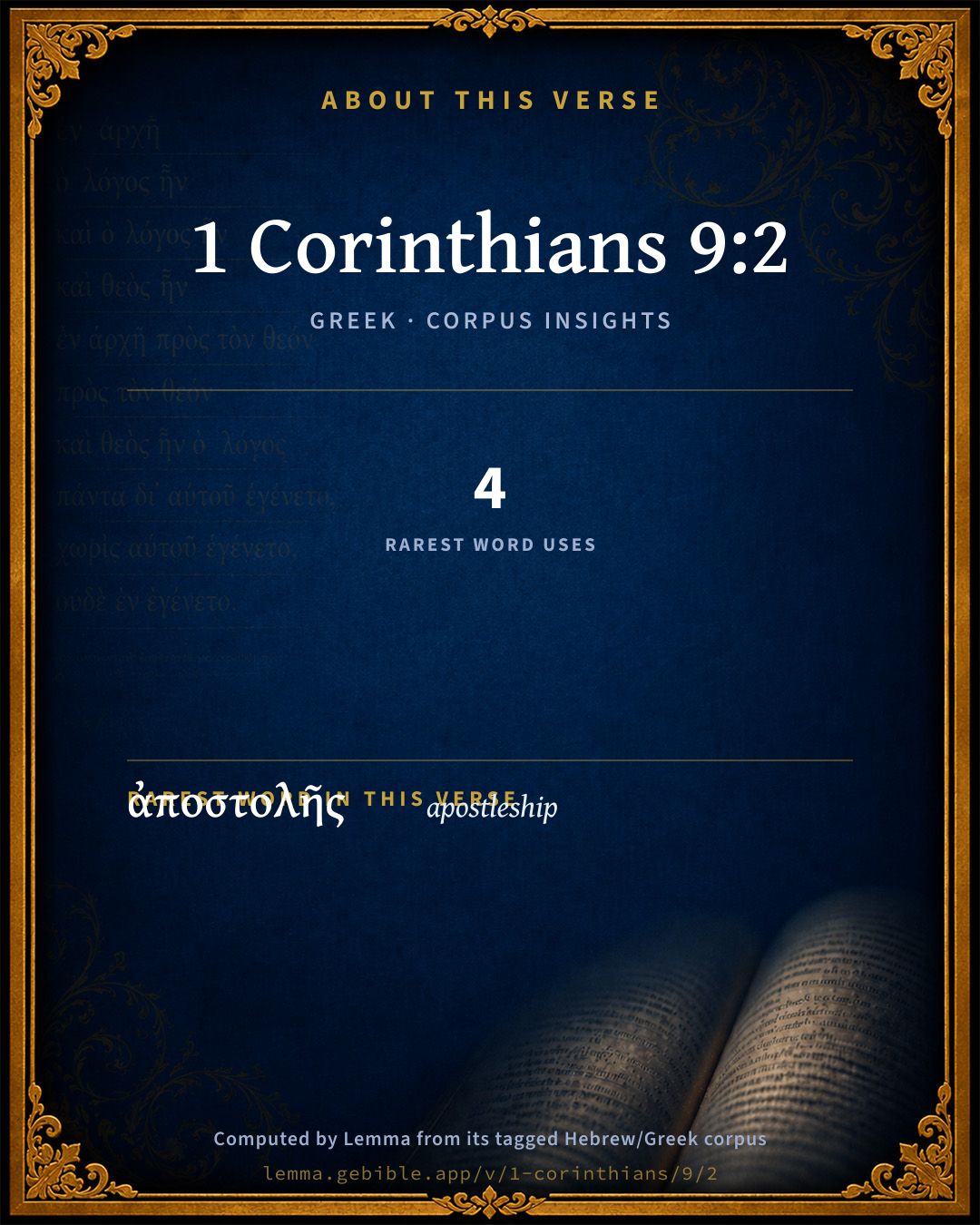
1 Corinthians 9:2

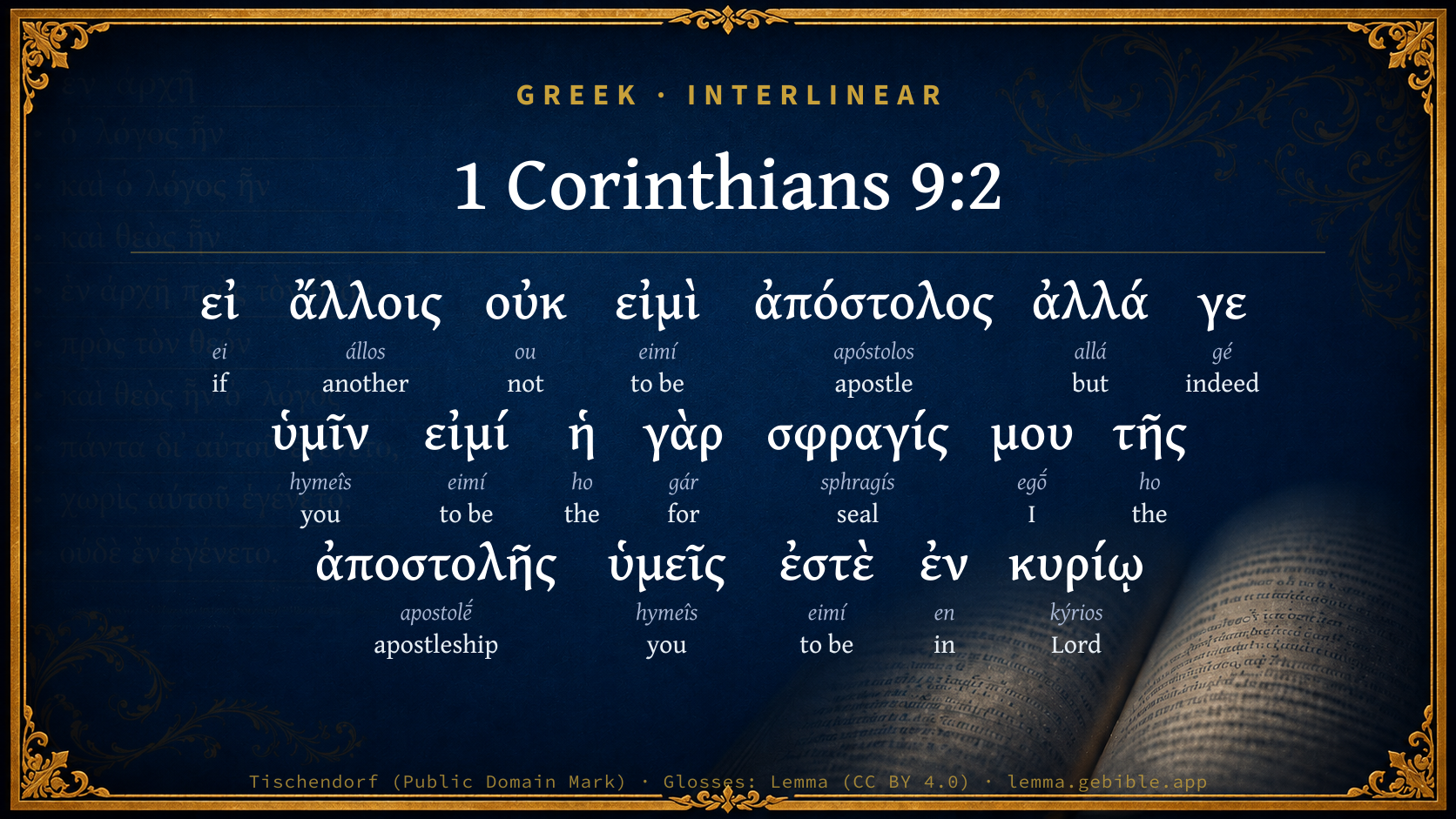
Greek (Tischendorf 8th ed.) 1 Corinthians 9:2 appears in the Greek New Testament. The text above is from the Tischendorf 8th edition. Each word links to its Strong’s number and a concise gloss. Click any word for its full Thayer’s Greek Lexicon entry.
Download image
Cite this verse

1 Corinthians 9:2 (World English Bible). Public Domain. Lemma interlinear Bible study tool, https://lemma.gebible.app/v/1-corinthians/9/2.

Show BibTeX & RIS
BibTeX
RIS
English Translation
If to others I am not an apostle, yet at least I am to you; for you are the seal of my apostleship in the Lord.
World English Bible · Public Domain
Download a study sheet

One document with this verse’s original text, its word-by-word gloss line, the meaning frame, cross-references with their text, attributed commentary, and full source and license credits — printable, and it pastes into notes with its structure intact.

This verse Autodidact and up

Study sheet (.html) Plain text (.txt)

A passage Seminary Student

Up to 50 verses in one chapter. A passage sheet keeps up to 6 commentary sources and 12 cross-references per verse, in the order this page ranks them, and says so on the sheet whenever that leaves anything out. Ask for a single verse and you get the Autodidact verse sheet above.

Everything on this page stays free to read, with no account — the sheet is a download of what is already on screen, not access to it.

Want to remove ads? Support Godless Engineer
Compare translations 3

The same verse in 3 English versions, stacked beneath the original-language interlinear above. Click any original word for its lexicon entry.

Each is an independent rendering of the whole verse — the interlinear is not word-aligned to these translations.

Highlighted words mark where these versions differ — a whole-verse word diff, not a word-by-word alignment.

  • World English Bible Public Domain
    If to others I am not an apostle, yet at least I am to you; for you are the seal of my apostleship in the Lord.
  • King James Version Public Domain
    If I be not an apostle unto others, yet doubtless I am to you: for the seal of mine apostleship are ye in the Lord.
  • unfoldingWord Literal Text CC BY-SA 4.0
    If I am not an apostle to others, at least I am to you. For you are the proof of my apostleship in the Lord.

unfoldingWord Literal Text — © unfoldingWord, licensed CC BY-SA 4.0. Word-aligned USFM3 via Door43 (git.door43.org/unfoldingWord/en_ult).

Versions to compare (up to 4)

3 of 4 selected

Show all 19 translations

Every available English version of this verse, each an independent rendering of the whole verse.

  • World English Bible Public Domain
    If to others I am not an apostle, yet at least I am to you; for you are the seal of my apostleship in the Lord.
  • Berean Standard Bible Public Domain
    Even if I am not an apostle to others, surely I am to you. For you are the seal of my apostleship in the Lord.
  • Majority Standard Bible Public Domain
    Even if I am not an apostle to others, surely I am to you. For you are the seal of my apostleship in the Lord.
  • King James Version Public Domain
    If I be not an apostle unto others, yet doubtless I am to you: for the seal of mine apostleship are ye in the Lord.
  • American Standard Version (1901) Public Domain
    If to others I am not an apostle, yet at least I am to you; for the seal of mine apostleship are ye in the Lord.
  • Revised Version (1885) Public Domain
    If to others I am not an apostle, yet at least I am to you; for the seal of mine apostleship are ye in the Lord.
  • Geneva Bible (1599) Public Domain
    If I be not an Apostle vnto other, yet doutlesse I am vnto you: for ye are the seale of mine Apostleship in the Lord.
  • Douay-Rheims (1899) Public Domain
    And if unto others I be not an apostle, but yet to you I am. For you are the seal of my apostleship in the Lord.
  • Young's Literal Translation Public Domain
    if to others I am not an apostle -- yet doubtless to you I am; for the seal of my apostleship are ye in the Lord.
  • Literal Standard Version CC BY-SA 4.0
    If I am not an apostle to others—yet doubtless I am to you; for you are the seal of my apostleship in the LORD.
  • Unlocked Literal Bible CC BY-SA 4.0
    If I am not an apostle to others, at least I am to you. For you are the proof of my apostleship in the Lord.
  • unfoldingWord Literal Text CC BY-SA 4.0
    If I am not an apostle to others, at least I am to you. For you are the proof of my apostleship in the Lord.
  • Darby Bible Public Domain
    If I am not an apostle to others, yet at any rate I am to you: for the seal of mine apostleship are *ye* in [the] Lord.
  • World Messianic Bible Public Domain
    If to others I am not an emissary, yet at least I am to you; for you are the seal of my office of emissary in the Lord.
  • Webster's Bible Public Domain
    If I am not an apostle to others, yet doubtless I am to you: for ye are the seal of my apostleship in the Lord.
  • Free Bible Version CC BY-SA 4.0
    Even if I'm not an apostle to others, at least I am one to you. The proof of my being an apostle of the Lord is you!
  • Bible in Basic English Public Domain
    If to others I am not an Apostle, at least I am one to you: for the fact that you are Christians is the sign that I am an Apostle.
  • Text-Critical English NT CC BY 4.0
    If to others I am not an apostle, at least I am to you, for you are the seal of my apostleship in the Lord.
  • Tyndale New Testament (1534) Public Domain
    Yf I be not an Apostle vnto other yet am I vnto you. For the seale of myne Apostleshippe are ye in the lorde.

Literal Standard Version (2020), Covenant Press — licensed CC BY-SA 4.0. Text via the HelloAO Bible API (eBible.org). Unlocked Literal Bible (unfoldingWord) — licensed CC BY-SA 4.0. Text via the HelloAO Bible API (eBible.org). unfoldingWord Literal Text — © unfoldingWord, licensed CC BY-SA 4.0. Word-aligned USFM3 via Door43 (git.door43.org/unfoldingWord/en_ult). Free Bible Version, Dr. Jonathan Gallagher — licensed CC BY-SA 4.0. Text via the HelloAO Bible API (eBible.org).

Word by word

More ways to search: Search by grammar → Find every occurrence → Compare this word →

Practice this passage: Drill this verse → Learn its vocabulary →

ἀποστολῆς
apostolḗ
G651
“apostleship”
Noun, Genitive, Singular, Feminine
Part of Speech
Noun
Case
Genitive
Number
Singular
Gender
Feminine
Full Thayer's Definition

Origin: from G649

TDNT: 08:26,7

1. a sending away a. of the sending off of a fleet b. of consuls with an army, i.e. of an expedition 2. a sending away, i.e. a dismissal, release 3. a thing sent, esp. of gifts 4. in the NT, the office and dignity of the apostles of Christ, apostleship
  1. εἰ ei G1487 “if” Conditional
  2. ἄλλοις állos G243 “another” Adjective, Dative, Plural, Masculine
  3. οὐκ ou G3756 “not” Particle, Negative
  4. εἰμὶ eimí G1510 “to be” Verb, Present, Active, Indicative, 1st person, Singular
  5. ἀπόστολος apóstolos G652 “apostle” Noun, Nominative, Singular, Masculine
  6. ἀλλά allá G235 “but” Conjunction
  7. γε gé G1065 “indeed” Particle
  8. ὑμῖν hymeîs G5210 “you” Personal pronoun, 2nd person, Dative, Plural
  9. εἰμί eimí G1510 “to be” Verb, Present, Active, Indicative, 1st person, Singular
  10. ἡ ho G3588 “the” Article, Nominative, Singular, Feminine
  11. γὰρ gár G1063 “for” Conjunction
  12. σφραγίς sphragís G4973 “seal” Noun, Nominative, Singular, Feminine
  13. μου egṓ G1473 “I” Personal pronoun, 1st person, Genitive, Singular
  14. τῆς ho G3588 “the” Article, Genitive, Singular, Feminine
  15. ὑμεῖς hymeîs G5210 “you” Personal pronoun, 2nd person, Nominative, Plural
  16. ἐστὲ eimí G1510 “to be” Verb, Present, Active, Indicative, 2nd person, Plural
  17. ἐν en G1722 “in” Preposition
  18. κυρίῳ kýrios G2962 “Lord” Noun, Dative, Singular, Masculine

About this verse

These counts appear in no published source. They are computed here, from the morphology-tagged text and Lemma’s own curated glosses. What Lemma adds →

19
words
15
distinct lemmas
Pauline Epistles
section

Notable vocabulary

The rarest word here is ἀποστολῆς apostleship G651 — appearing just 4 times in the whole Greek New Testament.

Shared distinctive vocabulary

ἀποστολῆς apostleship G651 occurs in 4 verses of the Greek New Testament. Also found in:

Repetition

Words recur within this verse:

Cross-references

3

Topical passages linked to 1 Corinthians 9:2 in the Treasury of Scripture Knowledge — connected by theme and wording, ordered by reader-vote popularity; previews shown in the World English Bible.

  • 2 Corinthians 12:12 Truly the signs of an apostle were worked among you in all patience, in signs and wonders and mighty works.
  • John 6:27 Don't work for the food which perishes, but for the food which remains to eternal life, which the Son of Man will give to you. For God the Father has sealed him."
  • 2 Corinthians 3:1–3 Are we beginning again to commend ourselves? Or do we need, as do some, letters of commendation to you or from you?

Cross-references courtesy of OpenBible.info (CC BY 4.0).

Commentary

Notes on 1 Corinthians 9:2 from classic Christian and Jewish commentators (each source and its license shown beneath its notes). The classic Christian expositions comment on the surrounding passage and are grouped to its opening verse, so a note may address several verses; the Jewish commentaries on the Tanakh (Rashi and others) are per-verse, so they appear only where the commentator wrote on this verse.

Lemma curates 59 commentaries, every one of them public domain or Creative Commons licensed, each selected and text-cleaned for this edition rather than reprinted as found. About our sources →

Bengel's Gnomon

Johann Albrecht Bengel

1Co 9:2. Ὑμῖν, to you) to whom I came; who have received the Gospel; you cannot deny it: ὑμῖν, as far as you are concerned. Similar datives are found at 1Co 9:21.—ἡ γὰρ σφραγὶς, for the seal) From the Church of believers an argument may be derived for the truth of the Gospel, and of the Christian religion.—ἀποστολῆς, of apostleship) A person even, who was not an apostle, might bring men by means of the Gospel to the faith, as Philip, Epaphras, and others; but Paul calls the Corinthians the seal not of calling of whatsoever kind, but of his apostolic calling: because he had the signs of an apostle, 2Co 12:12; Rom 15:18-19; nor did the Corinthians merely receive faith, but also a singular abundance of gifts, 1Co 1:7.

Bengel's Gnomon of the New Testament — English translation (T&T Clark, Edinburgh, 1860) — public domain. Text from a community e-Sword module.

Meyer's Critical & Exegetical Commentary

Heinrich August Wilhelm Meyer

1Co_9:2-3. Not a parenthesis, but a statement interposed in his own defence, occasioned by οὐ τὸ ἔργον κ.τ.λ[1397], and flowing from a heart deeply moved.

ἌΛΛΟΙς] i.e. in relation to others, who, not belonging to your community, do not own my apostleship as valid for them.[1398] We have no Apostle Paul, say they! Comp as to the relation of the dative, 1Co_8:6.

οὐκ εἰμί] See Winer, p. 446 [E. T. 601].

ἀλλάγε] still at least. See Hermann, a[1400] Viger. p. 826. The γε intensifies the ἀλλά of the apodosis (see on 1Co_4:15, 1Co_8:6): see Klotz, a[1401] Devar. p. 24 f. It cannot be said with any critical certainty that ἀλλάγε ever occurs in the classics undivided (without one or more words put between the two particles). See Klotz, l.c[1402] p. 15, and Heind. a[1403] Plat. Phaed. p. 86 E; Stallbaum, a[1404] Rep. p. 331 B.

Taking the reading ἡ γὰρ σφραγ. μου τ. ἀποστ. (see the critical remarks), the meaning is: my seal of apostleship, with the emphasis on σφραγ. As to the word itself, see Rom_4:11. Theodoret well remarks: ἀπόδειξιν γὰρ τῶν ἀποστολικῶν κατορθωμάτων τὴν ὑμετέραν ἔχω μεταβολήν.

ἐν Κυρίῳ] as in 1Co_9:1; it belongs to the whole preceding clause: ἡ σφραγὶς τ. ἐμ. ἀπ. ὑμ. ἐστε. For out of Christ the Corinthians were no seal of Pauls apostleship. See on 1Co_9:1. They were this seal to him, inasmuch as they had become Christians through his agency (in general, not through his miracles in particular, as Flatt holds with older expositors).

ἡ ἐμὴ ἀπολογ. κ.τ.λ[1405]] statement of what the foregoing comes to, added without any connective particle, and so all the more emphatic; not merely a repetition of the last clause in other words (Hofmann), which would be an admissible interpretation only if αὕτη ἐστι were absent, or if ἘΣΤΈ occurred again.

ΤΟῖς ἙΜῈ ἈΝΑΚΡ.] to those who institute an inquiry regarding me (comp Act_19:33; 2Co_12:19), who question my apostleship. Both ἈΠΟΛ. and ἈΝΑΚΡ. are purposely-chosen forensic expressions. Comp as to the latter, Luk_23:14; Act_4:9; Act_12:19; Act_24:8; Act_28:18.

ΑὝΤΗ] this, namely, this fact, that you are the seal of mine ἀποστολή. It does not refer to what follows (Chrysostom, Ambrosiaster, Grotius, Calovius), for 1Co_9:4 continues the series of questions begun in 1Co_9:1, and what follows does not contain any further defence of his apostleship (which, moreover, would be quite unsuitable here).

Observe, lastly, the emphasis of ἐμή and ἘΜΈ, expressive of a well-grounded sense of his own position.

[1397] .τ.λ. καὶ τὰ λοιπά.

[1398] It was unquestionably by stranger Petrine Christians that the anti-Pauline influence had been exerted upon the Corinthian church. So much is clear, but nothing more. Räbiger thinks that they were the instigators of the Petrine party in Corinth. Schenkel makes them of the Christ-party. Hofmann explains the expression from the difference between the ἀποστολὴ τῆς περιτομῆς and that τῆς ἀκροβυστίας. But that is going too far; for all circumcised Christians were not anti-Pauline, and the express contrast here is with the ὑμεῖς, among whom must be included the Jewish-Christians who were in Corinth.

[1400] d refers to the note of the commentator or editor named on the particular passage.

[1401] d refers to the note of the commentator or editor named on the particular passage.

[1402] .c. loco citato or laudato.

[1403] d refers to the note of the commentator or editor named on the particular passage.

[1404] d refers to the note of the commentator or editor named on the particular passage.

[1405] .τ.λ. καὶ τὰ λοιπά.

Meyer — Critical and Exegetical Commentary on the New Testament — English translation by Peter Christie, edited by Frederick Crombie (T&T Clark, 1880) — public domain. Text from a community e-Sword module.

Expositor's Greek Testament

ed. W. Robertson Nicoll

1Co 9:2-3 . If not at Corinth amongst those who cried “I am of Cephas,” elsewhere Paul’s apostleship was denied by the Judaistic party, against whom he had afterwards to write 2 Corinthians 10. ff. In this trial he counts on the Cor [1278] standing by him: “If to others I am no apostle, at any rate ( ἀλλά γε , at certe, Bz [1279] ) I am to you ”. He does not say “of others,” as though distinguishing two fields of jurisdiction in the sense of Gal 2:8 , rather “ in the eyes of others”; cf. the dat [1280] of 1Co 8:6 For ἀλλά γε , cf. Plato, Gorg. , 470 D., εἰ δὲ μὴ ( δρῶ ), ἀλλʼ ἀκούω γε . γε throws its emphasis on ὑμῖν ; so P. continues: “The seal of my apostleship you are , in the Lord”; cf. Rom 4:11 , 2Co 1:22 . This seal came from the hand of the Lord, affixed by the Master to His servant’s work ( cf. 2Co 3:1 ff.). Despite its, imperfections, the Cor [1281] Church was a shining evidence of Paul’s commission; it was probably the largest Church as yet raised in his independent ministry. For ἐν Κυρίῳ , see note on 1Co 4:15 , and 1Co 7:22 . “ This ” referring to 1Co 9:1-2 “is my answer to those that put me on my defence”: I point them to you! ἀπολογία (see parls.) is a self-exculpation . For ἀνακρίνω , cf. notes on 1Co 2:14 f., 1Co 4:4 . It is Paul’s ἀποστολή , not the ἐξουσία of 1Co 9:4 ff., that is called in question; hence the vein of self-defence pervading the Epp. of this period. Granted the apostleship (and this the readers cannot deny), the right followed as a matter of course: this needed no “apology”.

[1278] Corinth, Corinthian or Corinthians.

[1279] Beza’s Nov. Testamentum: Interpretatio et Annotationes (Cantab., 1642).

[1280] dative case.

[1281] Corinth, Corinthian or Corinthians.

The Expositor's Greek Testament, edited by W. Robertson Nicoll (1897–1910) — public domain. Text from a community e-Sword module.

Godet's Commentaries

Frédéric Louis Godet

Vv. 2, 3. “If I be not an apostle unto others, yet doubtless I am to you: for the seal of mine apostleship are ye in the Lord; this is my answer to them that do examine me.”

The datives unto others and to you are not only datives of appreciation (in the judgment of), but also datives of relation, as Rückert observes. Though Paul had not been related as an apostle to any other Church, yet as truly as the Church of Corinth was a Church founded by him, he possessed in his relation to it this title of apostle. It was the seal officially put by the Lord Himself on his apostolic mission, and it would have been somewhat strange if those who were themselves the living proof of his apostleship should put Paul in the position of proving it to them.

The asyndeton between 1Co 9:2-3 announces a reaffirmation under strong feeling of the idea of 1Co 9:2. The emotion is explained by the last words: them that examine. Paul’s apostleship is the subject of an examination at Corinth! At Corinth a discussion is raised regarding the nature of the appearance whereby Christ conferred on him the apostleship! There is a tendency, perhaps, to represent him, even as in Galatia, as a disciple of the apostles who has revolted against his masters! It is allowable to suppose that these words do not apply to the members of the Church themselves, those of whom Paul has just said that they are his living defence, but to the foreign emissaries who have arrived at Corinth. Comp. Galatians 1, where Paul replies to similar accusations.

The pronoun αὕτη brings into bold relief this idea of defence: “As to this defence, it is yourselves, you, the work of the Lord by me.” After having thus established the reality of his apostleship, at least in relation to this Church, he draws the inference from it: his right is to be maintained by the Church of Corinth and the others which he has founded.

Frédéric Louis Godet — Commentaries on Luke, John, Romans, and 1 Corinthians — English translation (T&T Clark, Edinburgh, 1870s–1890s) — public domain. Text from a community e-Sword module.

Hodge's Commentary on Romans, Ephesians & First Corinthians

Charles Hodge

1Co_9:2

If I be not an apostle unto others, yet doubtless I am to you: for the seal of mine apostleship are ye in the Lord.

If to others, i.e. in the estimation of others, I be not an apostle, surely I am to you. Whatever pretense others may have to question my apostleship, you certainly can have none; for the seal of my apostleship are ye in the Lord. Your conversion is the seal of God to my commission. The conversion of men is a divine work, and those by whom it is accomplished are thereby authenticated as divine messengers. It is as much the work of God as a miracle, and therefore, when duly authenticated, has the same effect as an evidence of a divine commission. This, although valid evidence, and as such adduced by the apostle, is nevertheless very liable to be abused. First, because much which passes for conversion is spurious; and secondly, because the evidence of success is often urged in behalf of the errors of preachers, when that success is due to the truth which they preach. Still there are cases when the success is of such a character, so undeniable and so great, as to supersede the necessity of any other evidence of a divine call. Such was the case with the apostles, with the reformers, and with many of our modern missionaries.

Charles Hodge — Commentary on Romans (1835), First Corinthians (1857), and Ephesians (1856) — public domain. Text from a community e-Sword module.

Geneva Bible (1599)

Geneva Bible translators

As a seal whereby it appeareth sufficiently that God is the author of my Apostleship.

Geneva Bible (1599) marginal notes — public domain. Text via Bolls.life.

Jamieson, Fausset & Brown

Robert Jamieson, A. R. Fausset & David Brown

yet doubtless--yet at least I am such to you.

seal of mine apostleship--Your conversion by my preaching, accompanied with miracles ("the signs of an apostle," Rom 15:18-19; Co2 12:12), and your gifts conferred by me (Co1 1:7), vouch for the reality of my apostleship, just as a seal set to a document attests its genuineness (Joh 3:33; Rom 4:11).

Jamieson, Fausset & Brown — Commentary Critical and Explanatory on the Whole Bible (1871) — public domain (CC PDM 1.0). Text via the HelloAO Bible API.

Adam Clarke's Commentary

Verse 2. If I be not an apostle unto others] If there be other Churches which have been founded by other apostles; yet it is not so with you.

The seal of mine apostleship are ye] Your conversion to Christianity is God's seal to my apostleship. Had not God sent me, I could not have profited your souls.

The σφραγις or seal, was a figure cut in a stone, and that set in a ring, by which letters of credence and authority were stamped. The ancients, particularly the Greeks, excelled in this kind of engraving. The cabinets of the curious give ample proof of this; and the moderns contend in vain to rival the perfection of those ancient masters.

In the Lord.] The apostle shows that it was by the grace and influence of God alone that he was an apostle, and that they were converted to Christianity.

Adam Clarke's Commentary on the Bible (1810–1826) — public domain. Text from a community e-Sword/MySword module.

John Calvin's Commentaries

2. If I am not an Apostle to others The sum of this tends to the establishing of his authority among the Corinthians, so as to place it beyond all dispute. “If there are those,” says he, “who have doubts as to my Apostleship, to you, at least, it ought to be beyond all doubt, for, as I planted your Church by my ministry, you are either not believers, or you must necessarily recognize me as an Apostle. And that he may not seem to rest in mere words, he states that the reality itself was to be seen, because God had sealed his Apostleship by the faith of the Corinthians. Should any one, however, object, that this suits the false Apostles too, who gather disciples to themselves, I answer, that pure doctrine is above all things required, in order that any one may have a confirmation of his ministry in the sight of God from its effect. There is nothing, therefore, here to furnish impostors with matter of congratulation, if they have deceived any of the populace, nay, even nations and kingdoms, by their falsehoods. Although in some cases persons are the occasion of spreading the kingdom of Christ, who, nevertheless, do not preach the gospel sincerely, as is said in Philippians 1:16, it is not without good reason that Paul infers from the fruit of his labor, that he is divinely commissioned: for the structure of the Corinthian Church was such, that the blessing of God could easily be seen shining forth in it, which ought to have served as a confirmation of Paul’s office.

John Calvin's Commentaries (1540-1563) — public domain. Text from the Calvin Translation Society English edition (1840s-50s) via the Christian Classics Ethereal Library (ccel.org). Calvin's coverage is partial (roughly two-thirds of the Bible); uncommented books and verses are honest gaps, never fabricated. The 19th-century editor's footnotes and remarks are omitted so the notes are faithfully Calvin's own voice.

Ellicott's Commentary for English Readers

(2) If I be not an apostle unto others.—The allusion here is probably to some who may have arrived at Corinth subsequent to St. Paul’s departure, and who, not recognising his Apostleship in relation to themselves, stirred up some of the Corinthians to repudiate it also. So the Apostle says, “Even if I am not an Apostle to these others, I am, at all events, to you; for you are yourselves the very proof and witness—the seal affixed to my appointment to the Apostolate.” The repetition of the words “in the Lord” in both these verses expresses the strong conviction, which is characteristic of the Apostle, that the source of all power and of all success is Christ Himself.

A Bible Commentary for English Readers, edited by Charles John Ellicott (1878–1897) — public domain. Text from a community e-Sword module.

The Cambridge Bible for Schools and Colleges

gen. ed. J. J. S. Perowne

2. for the seal of mine apostleship are ye in the Lord] If any Church had less right than another to question his Apostolic authority, it was the Church of Corinth, which he had founded (ch. 1Co_4:15), and on which so many spiritual gifts had been poured forth (ch. 1Co_1:5; 1Co_1:7, ch. 14). The Corinthians at least needed no other proof of the genuineness of his mission. “If any one wishes to know whether I am an Apostle, I will shew him yourselves; among whom are manifest and indubitable signs and proofs of my Apostolate; first the faith of Christ, which you have received at my preaching; then many and various gifts of the Holy Ghost.” Estius. For the word seal see St Joh_3:33; Joh_6:27; Rom_4:11. A seal is used as the attestation of the genuineness of any document. Thus the existence of the Corinthian Church was the attestation of the genuineness of St Paul’s Apostolic authority.

The Cambridge Bible for Schools and Colleges (gen. ed. J. J. S. Perowne; Cambridge University Press, 1878–1918) — public domain. Text from a community e-Sword module.

John Gill's Exposition

If I be not an apostle unto others,.... This is said by way of supposition, not concession; for he was an apostle to many others; he was an apostle of the Gentiles in general; as the apostleship of the circumcision belonged to Peter, that of the uncircumcision fell to his share: but however, as if he should say, be that as it will,

yet doubtless I am to you; all the signs of apostleship were wrought among them; not only the grace of God was implanted in them under his ministry, but the extraordinary gifts of the Spirit were received by them through it; and many signs, wonders, and mighty deeds, were done in the midst of them by him: see Co2 12:12 which were sufficient to put the matter quite out of doubt with them:

for the seal of mine apostleship, are ye in the Lord; alluding to the sealing of deeds and writings, which render them authentic; or to the sealing of letters, confirming the truth of what is therein expressed; and the sense is, that their being converted persons, and so openly in the Lord, in union with him; or being made new creatures by the power of his grace, through his preaching, was an authentic proof of his apostleship, and served him instead of a letter testimonial and recommendatory; see Co2 3:1. Some copies read, "the seal of my epistle", and so the Ethiopic version.

John Gill's Exposition of the Whole Bible (1746–1763) — public domain (CC PDM 1.0). Text via the HelloAO Bible API.

Trapp's Complete Commentary

John Trapp

2 If I be not an apostle unto others, yet doubtless I am to you: for the seal of mine apostleship are ye in the Lord.

Ver. 2. The seal of mine apostleship] See the like, Jer 23:21; Mat 21:27, where our Saviour proveth John Baptist’s ministry to be from heaven, by the success.

John Trapp, A Commentary or Exposition upon All the Books of the Old and New Testament (1647–1656) — public domain. Text from a community e-Sword module.

Albert Barnes' Notes on the Bible

If I be not an apostle unto others - “If I have not given evidence to others of my apostolic mission; of my being sent by the Lord Jesus, yet I have to you. Assuredly you, among whom I have labored so long and so successfully, should not doubt that I am sent from the Lord. You have been well acquainted with me; you have witnessed my endowments, you have seen my success, and you have had abundant evidence that I have been sent on this great work. It is therefore strange in you to doubt my apostolic commission; and it is unkind in you so to construe my declining to accept your contributions and aid for my support, as if I were conscious that I was not entitled to that.”

For the seal of mine apostleship. - Your conversion is the demonstration that I am an apostle. Paul uses strong language. He does not mean to say that their conversion furnished some evidence that he was an apostle; but that it was absolute proof, and unbreakable demonstration, that he was an apostle. A “seal” is that which is affixed to a deed, or other instrument, to make it firm, secure, and indisputable. It is the proof or demonstration of the validity of the conveyance, or of the writing; see the notes at Joh 3:33; Joh 6:27. The sense here is, therefore, that the conversion of the Corinthians was a certain demonstration that he was an apostle, and should be so regarded by them, and treated by them. It was such a proof:

Because Paul claimed to be an apostle while among them, and God blessed and owned this claim; Their conversion could not have been accomplished by man. It was the work of God. It was the evidence then which God gave to Paul and to them, that he was with him, and had sent him.

(3)They knew him, had seen him, heard him, were acquainted with his doctrines and manner of life, and could bear testimony to what he was, and what he taught.

We may remark, that the conversion of sinners is the best evidence to a minister that he is sent of God. The divine blessing on his labors should cheer his heart, and lead him to believe that God has sent and that he approves him. And every minister should so live and labor, should so deny himself, that he may be able to appeal to the people among whom he labors that he is a minister of the Lord Jesus.

Albert Barnes' Notes on the Bible (1834–1885) — public domain. Text from a community e-Sword/MySword module.

Matthew Poole's English Annotations

He had, 1Co 9:1, told them they were his work in the Lord, from whence he concludes here, that he was an apostle, that is, one sent of Christ to them for the good of their souls, whatever he was to others. You, saith he, as to yourselves at least, are

the seal of my apostolical office; it hath a confirmation in you by the effect, as the writing is confirmed by the seal. For how can you think, that the blessing of the Lord should go along with my preaching, to turn you from pagan idolatry, and your lewd courses of life, to the true Christian religion, and to a holy life and conversation, if God had not send me. There is no such argument to prove a minister sent of Christ, as the success of his ministry in the conversion of souls unto God. It is true, we cannot conclude, that a minister is no true minister if he be able to produce no such seals of his calling; for the spiritual seed may for a time lie under the clods, and changes may be wrought in hearts, which are not published to the world; and even Isaiah may be sent to make the hearts of people fat. But where those seals can be produced, it is a most certain sign that the minister is a true minister, that is, one sent of God; for he could be no instrument to do such works if God were not with him; and if God had not sent him, he would not be with him so blessing his ministry. Yet it is possible the man may have his personal errors; for though some men doubt, whether an instance can be given of one openly and scandalously wicked, whom God ever honoured to be his instrument to convert souls, yet it would be rashly affirmed by any to say, that Judas (though a son of perdition, but not scandalous till the last) was an instrument to convert none.

Matthew Poole's English Annotations on the Holy Bible (1683–1685) — public domain. Text from a community e-Sword/MySword module.

Whedon's Commentary on the Bible

Daniel D. Whedon

2. I am to you—A direct argumentum ad homines. Whoever else could gracefully question his apostleship the Corinthians could not. If they were true Christians, he was a true apostle.

Seal—A seal on a document is a voucher for its genuineness and validity. The Corinthians converted by Paul, and their Church by him founded, were as a confirmatory seal upon his apostolic diploma.

In the Lord—Note on Rom_9:1. Christ is the very embodiment of spiritual Christianity, and whoever is deeply centred in that is centred in Christ.

Daniel D. Whedon (gen. ed.), Commentary on the Old and New Testaments (1874–1909) — public domain. Text from a community e-Sword module.

The Pulpit Commentary

Unto others. If the emissaries from Jerusalem or the Petrine party do not choose to regard me as their apostle or an apostle at all, yet at any rate I am yours. Doubtless; rather, at least, at any rate. The seal of mine apostleship. Your conversion attests the genuineness of my claim, as a seal attests a document. Thus baptism is the seal of conversion. (Eph_4:30; comp. Rom_4:11; Joh_3:33)

The Pulpit Commentary (1880–1919), ed. H.D.M. Spence-Jones & Joseph S. Exell — public domain. Text from a community e-Sword module.

John Wesley's Explanatory Notes

Ye are the seal of my apostleship - Who have received not only faith by my mouth, but all the gifts of the Spirit by my hands.

John Wesley, Explanatory Notes Upon the Whole Bible (1754–1765) — public domain. Text via the GEBible commentary corpus.

Burkitt's Expository Notes on the New Testament

William Burkitt

As if he had said, "Whatever others do, you of all men should not question my apostleship, for you were converted by it. You confirm and ratify my ministry, that it is of God, and that God is in it of a truth: the conversion of sinners, and the building up of saints, is God’s seal to our ministry."

Learn hence, That there is no such argument to prove a minister sent of Christ, as the success of his ministry in the conversion of souls unto God. This is God’s seal to his office, that he is a minister called of God, and sent by God. Happy those ministers who can say unto their people, Ye are our work, and the seal of our apostleship are ye in the Lord.

Yet must it not be concluded from hence, that a person is not a true minister of Christ, because he cannot produce this seal: the good of our ministry is not always known to ourselves, much less published to the world; more good is done many times by the ministry of the word than the minister knows of; the seed sometimes lies long under the clods before it fructifies; what is sown in one minister’s time, comes up in another’s; so one soweth, and another reapeth, but both he that reapeth and he that soweth shall rejoice together. But where this seal can be produced, it is a certain sign that such a minister is sent from God, and that God is with him, and owns him; yet it must be added, that though the success of our ministry to others is a seal of our office, and assures us that we are true ministers, yet it is the efficacy of the word we preach, upon our own hearts and lives, that is the witness of our sanctification, and the seal of our salvation.

Lord, how sad will it be for any of us to have been instruments for the helping of others to heaven by the soundness of our doctrine, and go to hell ourselves for the badness of our example, and the wickedness of our lives?

William Burkitt's Expository Notes on the New Testament (1700–1703) — public domain. Text from a community e-Sword module.

McGarvey & Pendleton's Commentaries

J. W. McGarvey

If to others I am not an apostle, yet at least I am to you; for the seal of mine apostleship are ye in the Lord . [An argumentum ad hominem. Whatever Paul might be in the estimation of Judaizers and enemies, he must still be held as an apostle by those who owed their spiritual life to him, for if he were no apostle, they were no Christians, and vice versa. As the seal vouched for the genuineness and validity of the document to which it was attached, so these Corinthian converts by their existence vouched for Paul's apostleship.]

J. W. McGarvey (with Philip Y. Pendleton), Commentaries on the New Testament (The Fourfold Gospel, 1914; Acts; and the epistles) — public domain. Text from a community e-Sword/MySword module.

The People's New Testament

B. W. Johnson

2. The seal of mine apostleship ye are. The existence of the church at Corinth, founded by his labors, proved that he was their apostle, at least.

B. W. Johnson's The People's New Testament with Notes (1889–1891) — public domain. Electronic text from the Christian Classics Ethereal Library (CCEL) ThML edition.

Cambridge Greek Testament for Schools and Colleges

2. ἀλλά γε. In the classics these two particles are separated by another word.

σφραγίς μου τῆς ἀποστολῆς. If any Church had less right than another to question his Apostolic authority, it was the Church of Corinth, which he had founded (ch. 1Co 4:15), and on which so many spiritual gifts had been poured forth (ch. 1Co 1:5; 1Co 1:7, ch. 14). The Corinthians at least needed no other proof of the genuineness of his mission. ‘If anyone wishes to know whether I am an Apostle, I will shew him yourselves; among whom are manifest and indubitable signs and proofs of my Apostolate; first the faith of Christ, which you have received at my preaching; then many and various gifts of the Holy Ghost.’ Estius. For σφραγίς see Joh 3:33; Joh 6:27; Rom 4:11. A seal is used as the attestation of the genuineness of any document. Thus the existence of the Corinthian Church was the attestation of the genuineness of St Paul’s Apostolic authority.

Cambridge Greek Testament for Schools and Colleges (Cambridge University Press, 1896; 21 vols, various authors incl. Carr, Maclear, Plummer, Farrar, Lumby, Moule, M. R. James, Simcox) — public domain. Text from a community e-Sword module.

Alford’s Greek Testament

Henry Alford

2.] At least my apostleship cannot be denied by you of all men, who are its seal and proof.

εἰ.… οὐκ εἰμί] οὐκ, because it belongs closely to the hypothesis: ‘if I am no-Apostle,’ see ch. 7:9.

ἄλλοις, to others, i.e. in the estimation of others.

ἀλλά γε, yet at least, is stronger than ἀλλά alone. The particle shews that the sentiment which it introduces has more weight than the other to which the ἀλλά is a reply. See Hartung, Partikellehre, i. 385. Meyer (after Klotz) remarks that “in the classics ἀλλά γε is never found without one or more words intervening:” those words being emphatic: e.g. Aristoph. Nub. 399, πῶς οὐχὶ Σίμωνʼ ἐνέπρησεν.… ἀλλὰ τὸν αὑτοῦ γε νεὼν βάλλει;

σφραγίς] as being the proof of his apostolic calling and energy, by their conversion; better than,—by the signs and wonders which he wrought among them, as Chrys. (al.) from 2Co 12:11-13, and perhaps misled by the similarity of σημεῖον and σφραγίς. Their conversion was the great proof: so Theodoret, ἀπόδειξιν γὰρ τῶν ἀποστολικῶν κατορθωμάτων τὴν ὑμετέραν ἔχω μεταβολήν.

ἐν κυρ.] belongs to the whole sentence, see above, on ver. 1.

Henry Alford, The Greek Testament (1849–1861) — public domain. Text from a community e-Sword module.

International Critical Commentary

2. εἰ ἄλλοις οὐκ εἰμὶ ἀπόστολος. The emphatic ὑμεῖς of the previous clause leads to an argumentum ad hominem. The Corinthians are the very last people who could reasonably question his claim to be an Apostle: at any rate to them he must be one.*. ‘For my certificate of Apostleship are ye’ (2Co 3:2). They themselves are a certificate of the fact, a certificate the validity of which lies in the same sphere as the success of his work; it is ‘in the Lord.’ Authentication is the idea which is specially indicated by the figurative σφραγίς. Nowhere in N.T. does σφραγίς seem to be used, as often in later writings, with reference to baptism. See notes on Rom 4:11, p. 107; Lightfoot, Epp. of Clem. ii. p. 226; Hastings, DB. Art. ‘Seal.’ Preachers who were not Apostles might convert many, but the remarkable spiritual gifts which Corinthians possessed were a guarantee that one who was more than a mere preacher had been sent to them. Paulus a fructu colligit se divinitus missum esse (Calv.). The ἄλλοις may allude to the Galatians.

μου τῆς ἀποστολῆς with א B P 17, Orig., rather than τῆς ἐμῆς ἀπ. with D E F G K L. A few inferior witnesses have ἐπιστολῆς.

International Critical Commentary — older volumes (1896–1929), various authors — public domain. Text from a community e-Sword module.

Vincent's Word Studies in the New Testament

Marvin R. Vincent

Seal [σφραγις] . See on Rom 4:11; Joh 3:33; Rev 22:10.

Marvin R. Vincent, Word Studies in the New Testament (1887–1900) — public domain. Text from a community e-Sword/MySword module.

Lesson kit

Teaching starters — assembled from the data on this page, not authored interpretation. Every prompt links to the verse data it draws on. Edit before teaching.

1 Corinthians, in the Pauline Epistles, opens this verse with 19 words (15 distinct Greek lemmas). Its most distinctive word is apostolḗ (“apostleship”). A historical commentator’s framing appears above. Read the whole chapter for the surrounding context.

Discussion questions

  1. The word apostolḗ carries the sense “apostleship.” How does it shape the verse?
  2. Acts 1:25 shares the word «apostleship» with this verse. How do the two illuminate each other?
  3. “to be” occurs 3× in this one verse. What is the effect of the repetition?
  4. The translations on this page render this verse differently — a whole-verse word diff, not a word-by-word alignment. What might account for the different wordings?
  5. Reading how Bengel's Gnomon and Meyer's Critical & Exegetical Commentary read this verse, where do the two commentators agree and where do they part?

Things to notice

  • These translations choose different wording for 5 words in this verse.
  • “to be” occurs 3× in this single verse.
  • 15 distinct Greek lemmas span 19 words in this verse.

Reading settings

Reading text

Shown beneath each verse's original-language words.

Old Testament
Old Testament edition

Read the OT as the Masoretic Hebrew (MT) or the Greek Septuagint (LXX).

English shown for the Greek Septuagint (in the Hebrew ↔ Greek comparison).

Comparing translations? Open the Compare panel on any verse page to stack up to four side by side.