1 Corinthians 14:16

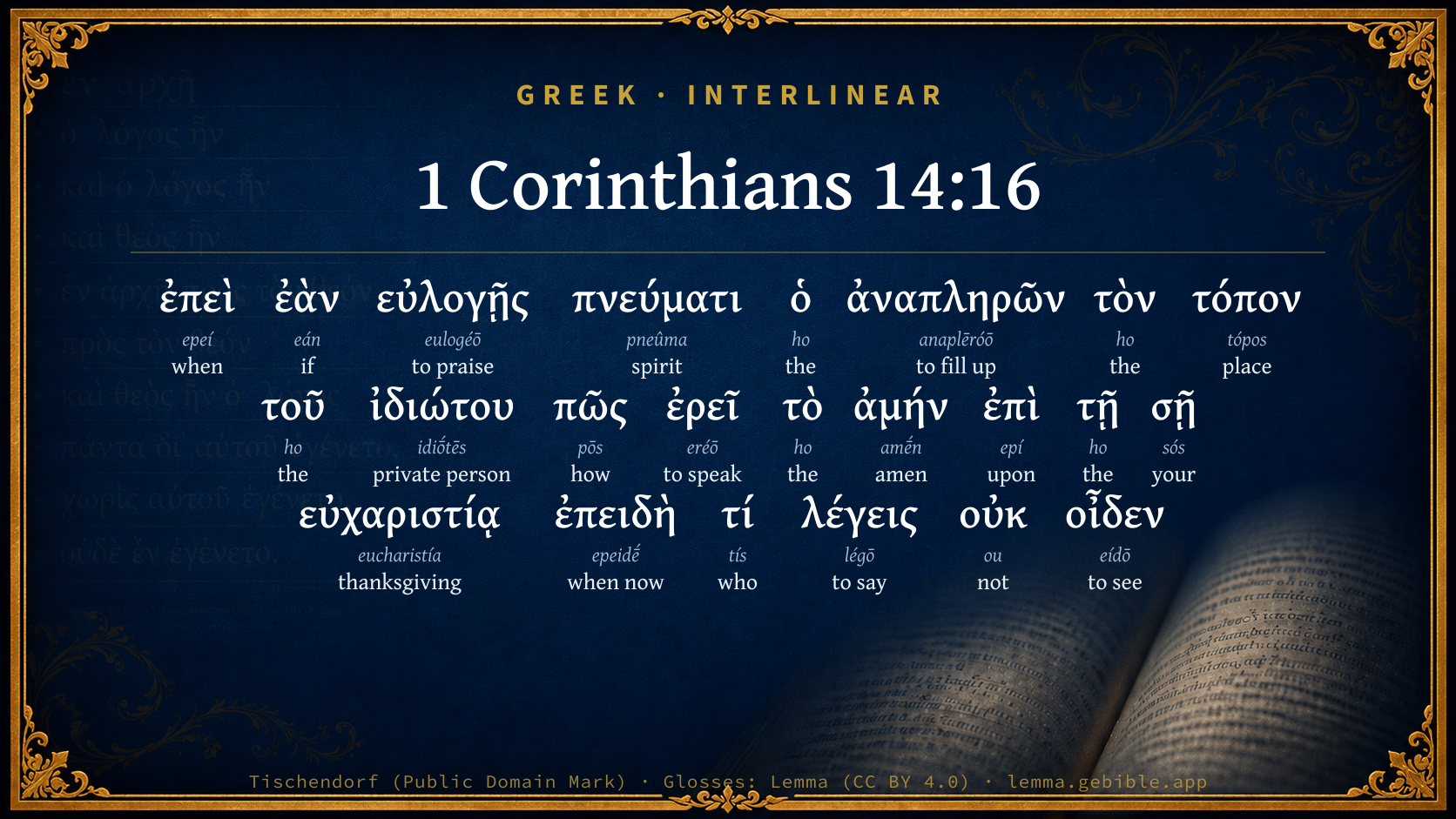
Greek (Tischendorf 8th ed.) 1 Corinthians 14:16 appears in the Greek New Testament. The text above is from the Tischendorf 8th edition. Each word links to its Strong’s number and a concise gloss. Click any word for its full Thayer’s Greek Lexicon entry.
Download image
Cite this verse

1 Corinthians 14:16 (World English Bible). Public Domain. Lemma interlinear Bible study tool, https://lemma.gebible.app/v/1-corinthians/14/16.

Show BibTeX & RIS
BibTeX
RIS
English Translation
Otherwise if you bless with the spirit, how will he who fills the place of the unlearned say the "Amen" at your giving of thanks, seeing he doesn't know what you say?
World English Bible · Public Domain
Download a study sheet

One document with this verse’s original text, its word-by-word gloss line, the meaning frame, cross-references with their text, attributed commentary, and full source and license credits — printable, and it pastes into notes with its structure intact.

This verse Autodidact and up

Study sheet (.html) Plain text (.txt)

A passage Seminary Student

Up to 50 verses in one chapter. A passage sheet keeps up to 6 commentary sources and 12 cross-references per verse, in the order this page ranks them, and says so on the sheet whenever that leaves anything out. Ask for a single verse and you get the Autodidact verse sheet above.

Everything on this page stays free to read, with no account — the sheet is a download of what is already on screen, not access to it.

Want to remove ads? Support Godless Engineer
Compare translations 3

The same verse in 3 English versions, stacked beneath the original-language interlinear above. Click any original word for its lexicon entry.

Each is an independent rendering of the whole verse — the interlinear is not word-aligned to these translations.

Highlighted words mark where these versions differ — a whole-verse word diff, not a word-by-word alignment.

  • World English Bible Public Domain
    Otherwise if you bless with the spirit, how will he who fills the place of the unlearned say the "Amen" at your giving of thanks, seeing he doesn't know what you say?
  • King James Version Public Domain
    Else when thou shalt bless with the spirit, how shall he that occupieth the room of the unlearned say Amen at thy giving of thanks, seeing he understandeth not what thou sayest?
  • unfoldingWord Literal Text CC BY-SA 4.0
    Otherwise, if you bless with the spirit, how will the one filling the place of the ungifted say the “Amen” at your thanksgiving, since he does not know what you are saying?

unfoldingWord Literal Text — © unfoldingWord, licensed CC BY-SA 4.0. Word-aligned USFM3 via Door43 (git.door43.org/unfoldingWord/en_ult).

Versions to compare (up to 4)

3 of 4 selected

Show all 19 translations

Every available English version of this verse, each an independent rendering of the whole verse.

  • World English Bible Public Domain
    Otherwise if you bless with the spirit, how will he who fills the place of the unlearned say the "Amen" at your giving of thanks, seeing he doesn't know what you say?
  • Berean Standard Bible Public Domain
    Otherwise, if you speak a blessing in spirit, how can someone who is uninstructed say “Amen” to your thanksgiving, since he does not know what you are saying?
  • Majority Standard Bible Public Domain
    Otherwise, if you speak a blessing in spirit, how can someone who is uninstructed say “Amen” to your thanksgiving, since he does not know what you are saying?
  • King James Version Public Domain
    Else when thou shalt bless with the spirit, how shall he that occupieth the room of the unlearned say Amen at thy giving of thanks, seeing he understandeth not what thou sayest?
  • American Standard Version (1901) Public Domain
    Else if thou bless with the spirit, how shall he that filleth the place of the unlearned say the Amen at thy giving of thanks, seeing he knoweth not what thou sayest?
  • Revised Version (1885) Public Domain
    Else if thou bless with the spirit, how shall he that filleth the place of the unlearned say the Amen at thy giving of thanks, seeing he knoweth not what thou sayest?
  • Geneva Bible (1599) Public Domain
    Else, when thou blessest with the spirit, howe shall hee that occupieth the roome of the vnlearned, say Amen, at thy giuing of thankes, seeing he knoweth not what thou sayest?
  • Douay-Rheims (1899) Public Domain
    Else if thou shalt bless with the spirit, how shall he that holdeth the place of the unlearned say, Amen, to thy blessing? because he knoweth not what thou sayest.
  • Young's Literal Translation Public Domain
    since, if thou mayest bless with the spirit, he who is filling the place of the unlearned, how shall he say the Amen at thy giving of thanks, since what thou dost say he hath not known?
  • Literal Standard Version CC BY-SA 4.0
    since, if you may bless in spirit, he who is filling the place of the commoner, how will he say the Amen at your giving of thanks, since he has not known what you say?
  • Unlocked Literal Bible CC BY-SA 4.0
    Otherwise, if you praise God with the spirit, how will the outsider say “Amen” when you are giving thanks if he does not know what you are saying?
  • unfoldingWord Literal Text CC BY-SA 4.0
    Otherwise, if you bless with the spirit, how will the one filling the place of the ungifted say the “Amen” at your thanksgiving, since he does not know what you are saying?
  • Darby Bible Public Domain
    Since otherwise, if thou blessest with [the] spirit, how shall he who fills the place of the simple [Christian] say Amen, at thy giving of thanks, since he does not know what thou sayest?
  • World Messianic Bible Public Domain
    Otherwise, if you bless with the spirit, how will he who fills the place of the unlearned say the “Amen” at your giving of thanks, seeing he doesn’t know what you say?
  • Webster's Bible Public Domain
    Else, when thou shalt bless with the spirit, how shall he that occupieth the room of the unlearned say Amen at thy giving of thanks, seeing he understandeth not what thou sayest?
  • Free Bible Version CC BY-SA 4.0
    For if you only pray “in the Spirit,” how can ordinary people that don't have understanding say “Amen” after your prayer of thanks, since they haven't a clue what you said?
  • Bible in Basic English Public Domain
    For if you give a blessing with the spirit, how will the man who has no knowledge say, So be it, after your prayer, seeing that he has not taken in what you are saying?
  • Text-Critical English NT CC BY 4.0
    Otherwise, if yoʋ bless with yoʋr spirit, how will anyone in the position of an outsider say “Amen” when yoʋ give thanks, since he does not know what yoʋ are saying?
  • Tyndale New Testament (1534) Public Domain
    For els when thou blessest with the sprete how shall he that occupieth the roume of the vnlearned saye amen at thy gevinge of thankes seynge he vnderstondeth not what thou sayest.

Literal Standard Version (2020), Covenant Press — licensed CC BY-SA 4.0. Text via the HelloAO Bible API (eBible.org). Unlocked Literal Bible (unfoldingWord) — licensed CC BY-SA 4.0. Text via the HelloAO Bible API (eBible.org). unfoldingWord Literal Text — © unfoldingWord, licensed CC BY-SA 4.0. Word-aligned USFM3 via Door43 (git.door43.org/unfoldingWord/en_ult). Free Bible Version, Dr. Jonathan Gallagher — licensed CC BY-SA 4.0. Text via the HelloAO Bible API (eBible.org).

Word by word

More ways to search: Search by grammar → Find every occurrence → Compare this word →

Practice this passage: Drill this verse → Learn its vocabulary →

ἰδιώτου
idiṓtēs
G2399
“private person”
Noun, Genitive, Singular, Masculine
Part of Speech
Noun
Case
Genitive
Number
Singular
Gender
Masculine
Full Thayer's Definition

Origin: from G2398

TDNT: 06:35,3

1. a private person as opposed to a magistrate, ruler, king 2. a common soldier, as opposed to a military officer 3. a writer of prose as opposed to a poet 4. in the NT, an unlearned, illiterate, man as opposed to the learned and educated: one who is unskilled in any art
  1. ἐπεὶ epeí G1893 “when” Conjunction
  2. ἐὰν eán G1437 “if” Conditional
  3. εὐλογῇς eulogéō G2127 “to praise” Verb, Present, Active, Subjunctive, 2nd person, Singular
  4. πνεύματι pneûma G4151 “spirit” Noun, Dative, Singular, Neuter
  5. ὁ ho G3588 “the” Article, Nominative, Singular, Masculine
  6. ἀναπληρῶν anaplēróō G378 “to fill up” Verb, Present, Active, Participle, Nominative, Singular, Masculine
  7. τὸν ho G3588 “the” Article, Accusative, Singular, Masculine
  8. τόπον tópos G5117 “place” Noun, Accusative, Singular, Masculine
  9. τοῦ ho G3588 “the” Article, Genitive, Singular, Masculine
  10. πῶς pōs G4459 “how” Adverb, Interrogative
  11. ἐρεῖ eréō G2046 “to speak” Verb, Future, Active, Indicative, 3rd person, Singular
  12. τὸ ho G3588 “the” Article, Accusative, Singular, Neuter
  13. ἀμήν amḗn G281 “amen” Hebrew transliteration
  14. ἐπὶ epí G1909 “upon” Preposition
  15. τῇ ho G3588 “the” Article, Dative, Singular, Feminine
  16. σῇ sós G4674 “your” Possessive pronoun, 2nd person, Dative, Singular, Feminine
  17. εὐχαριστίᾳ eucharistía G2169 “thanksgiving” Noun, Dative, Singular, Feminine
  18. ἐπειδὴ epeidḗ G1894 “when now” Conjunction
  19. τί tís G5101 “who” Interrogative pronoun, Accusative, Singular, Neuter
  20. λέγεις légō G3004 “to say” Verb, Present, Active, Indicative, 2nd person, Singular
  21. οὐκ ou G3756 “not” Particle, Negative
  22. οἶδεν eídō G1492 “to see” Verb, Perfect, Active, Indicative, 3rd person, Singular

About this verse

These counts appear in no published source. They are computed here, from the morphology-tagged text and Lemma’s own curated glosses. What Lemma adds →

23
words
19
distinct lemmas
Pauline Epistles
section

Notable vocabulary

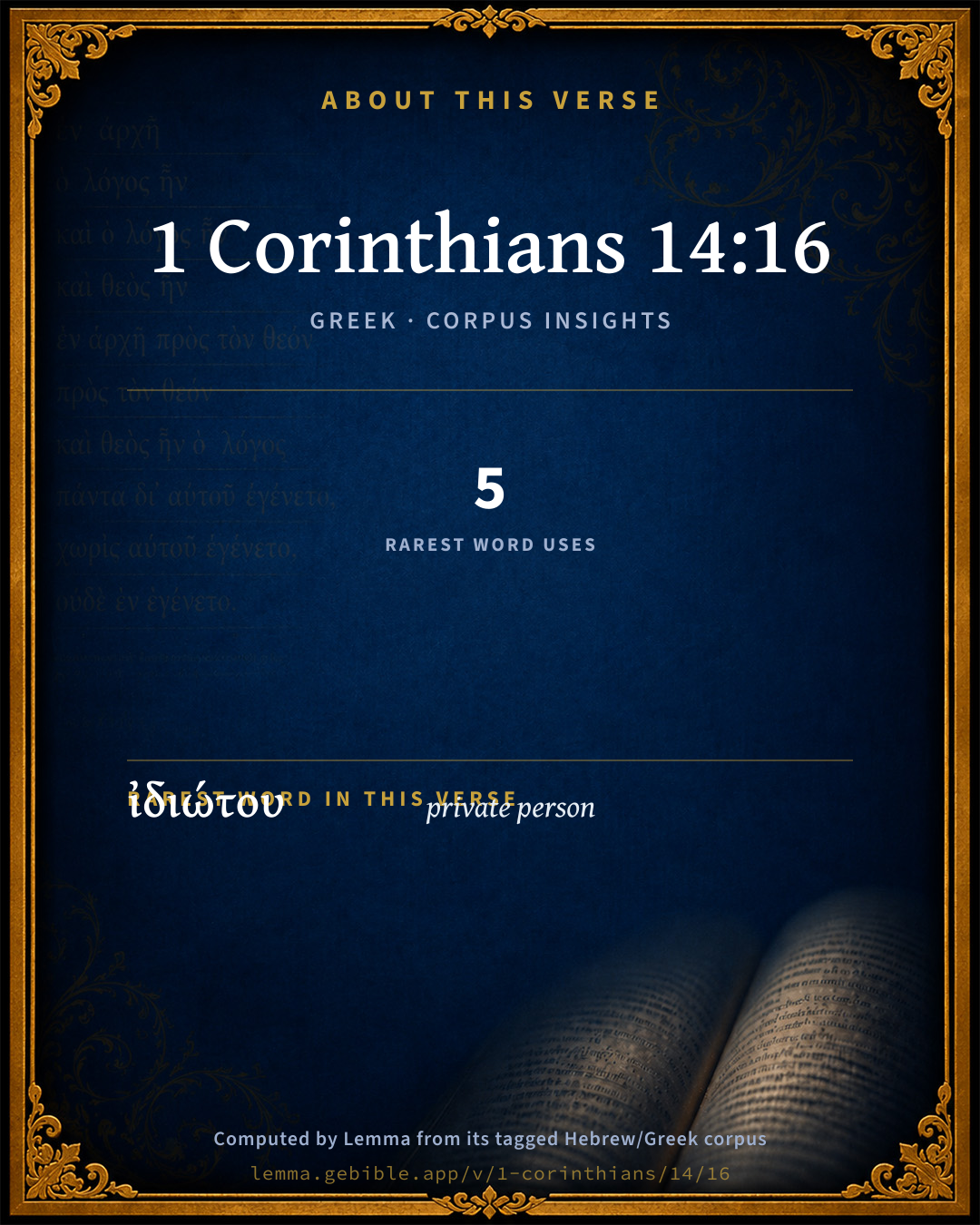
The rarest word here is ἰδιώτου private person G2399 — appearing just 5 times in the whole Greek New Testament.

Shared distinctive vocabulary

ἰδιώτου private person G2399 occurs in 5 verses of the Greek New Testament. Also found in:

Repetition

A word recurs within this verse:

Cross-references

28

Topical passages linked to 1 Corinthians 14:16 in the Treasury of Scripture Knowledge — connected by theme and wording, ordered by reader-vote popularity; previews shown in the World English Bible.

  • 1 Chronicles 16:36 Blessed be Yahweh, the God of Israel, From everlasting even to everlasting. All the people said, Amen, and praised Yahweh.
  • Psalms 106:48 Blessed be Yahweh, the God of Israel, From everlasting even to everlasting! Let all the people say, "Amen." Praise Yah!
  • Revelation 5:14 The four living creatures said, "Amen!" The elders fell down and worshiped.
  • Deuteronomy 27:15–26 Cursed be the man who makes an engraved or molten image, an abomination to Yahweh, the work of the hands of the craftsman, and sets it up in secret. All the people shall answer and say, Amen.
  • Nehemiah 8:6 and Ezra blessed Yahweh, the great God. All the people answered, Amen, Amen, with the lifting up of their hands: and they bowed their heads, and worshiped Yahweh with their faces to the ground.
  • Jeremiah 28:6 even the prophet Jeremiah said, Amen: Yahweh do so; Yahweh perform your words which you have prophesied, to bring again the vessels of Yahweh's house, and all them of the captivity, from Babylon to this place.
  • 1 Corinthians 11:24 When he had given thanks, he broke it, and said, "Take, eat. This is my body, which is broken for you. Do this in memory of me."
  • Numbers 5:22 and this water that brings a curse will go into your bowels, and make your body swell, and your thigh fall away.' The woman shall say, 'Amen, Amen.'
  • Revelation 7:12 saying, "Amen! Blessing, glory, wisdom, thanksgiving, honor, power, and might, be to our God forever and ever! Amen."
  • 1 Kings 1:36 Benaiah the son of Jehoiada answered the king, and said, Amen: Yahweh, the God of my lord the king, say so [too].
  • Nehemiah 5:13 Also I shook out my lap, and said, So God shake out every man from his house, and from his labor, that doesn't perform this promise; even thus be he shaken out, and emptied. All the assembly said, Amen, and praised Yahweh. The people did according to this promise.
  • Psalms 41:13 Blessed be Yahweh, the God of Israel, From everlasting and to everlasting! Amen and amen.
  • Psalms 72:19 Blessed be his glorious name forever! Let the whole earth be filled with his glory! Amen and amen.
  • Psalms 89:52 Blessed be Yahweh forevermore. Amen, and Amen.
  • Isaiah 29:11–12 All vision is become to you as the words of a book that is sealed, which men deliver to one who is learned, saying, Read this, I pray you; and he says, I can't, for it is sealed:
  • Jeremiah 11:5 that I may establish the oath which I swore to your fathers, to give them a land flowing with milk and honey, as at this day. Then answered I, and said, Amen, Yahweh.
  • Matthew 6:13 Bring us not into temptation, but deliver us from the evil one. For yours is the Kingdom, the power, and the glory forever. Amen.'
  • Matthew 28:20 teaching them to observe all things that I commanded you. Behold, I am with you always, even to the end of the age." Amen.
  • Mark 16:20 They went out, and preached everywhere, the Lord working with them, and confirming the word by the signs that followed. Amen.
  • John 7:15 The Jews therefore marveled, saying, "How does this man know letters, having never been educated?"
  • John 21:25 There are also many other things which Jesus did, which if they would all be written, I suppose that even the world itself wouldn't have room for the books that would be written.
  • Acts 4:13 Now when they saw the boldness of Peter and John, and had perceived that they were unlearned and ignorant men, they marveled. They recognized that they had been with Jesus.
  • 1 Corinthians 1:4–8 I always thank my God concerning you, for the grace of God which was given you in Christ Jesus;
  • 1 Corinthians 14:2 For he who speaks in another language speaks not to men, but to God; for no one understands; but in the Spirit he speaks mysteries.
  • 1 Corinthians 14:14 For if I pray in another language, my spirit prays, but my understanding is unfruitful.
  • 1 Corinthians 14:23–24 If therefore the whole assembly is assembled together and all speak with other languages, and unlearned or unbelieving people come in, won't they say that you are crazy?
  • 1 Corinthians 16:24 My love to all of you in Christ Jesus. Amen.
  • Revelation 22:20 He who testifies these things says, "Yes, I come quickly." Amen! Yes, come, Lord Jesus.

Cross-references courtesy of OpenBible.info (CC BY 4.0).

Commentary

Notes on 1 Corinthians 14:16 from classic Christian and Jewish commentators (each source and its license shown beneath its notes). The classic Christian expositions comment on the surrounding passage and are grouped to its opening verse, so a note may address several verses; the Jewish commentaries on the Tanakh (Rashi and others) are per-verse, so they appear only where the commentator wrote on this verse.

Lemma curates 59 commentaries, every one of them public domain or Creative Commons licensed, each selected and text-cleaned for this edition rather than reprinted as found. About our sources →

The Biblical Illustrator

Joseph S. Exell

1Co_14:16-19

Else when thou shalt bless with the spirit how shall … the unlearned say Amen.

Public prayer should be

I. Earnest--with the spirit.

II. Intelligent--So that all can understand.

III. United--all should say Amen. (J. Lyth, D. D.)

Responses in prayer

1. Are not only permissible but proper.

2. Should be said, not shouted.

3. Should be simple, appropriate, intelligent, and heartfelt. (J. Lyth, D. D.)

Public devotion

In this we must keep in view--

1. The glory of God.

2. The edification of others.

3. Our own responsibility. (J. Lyth, D. D.)

Directions for profitably joining in public prayer

I. Public prayer must be diligently attended to.

II. It must be seriously and heartily concurred in.

1. Saying amen, or joining in public prayer, includes our assent to the truths declared and acknowledged; and this with all suitable affections of mind. The Hebrew word amen signifies truth; and so expresseth an acknowledgment that what he had said was true. Thus Christ styleth Himself the Amen, the faithful and true witness, and the promises of God are said to be yea and amen; all true, and certainly to be accomplished. Now this is applicable to the several parts of prayer which are not properly petitions; and you will best understand my meaning by a few illustrations. Suppose a minister to be adoring the perfections of God, acknowledging that He is the greatest and the best of beings, that He is perfectly good, long-suffering, merciful, and gracious, to this you are to say amen, that is, your hearts are to acknowledge with the highest veneration that it is true. Doth the minister acknowledge and celebrate the wonderful works of God, His creation and government of the world, and that glory is due to Him for these? You are to join in such acknowledgments; to confess and adore Him as the Creator, Governor, and Father of the universe. Again, is a minister expressing a thankful sense of Gods favour and mercy to those whose devotion he leads? Is he praising God for our creation, preservation; for health, and peace, and comfort; for our temporal or spiritual blessings? You are to add amen to this.

2. Saying amen, or joining in prayer, includes our hearty consent to the several desires and requests which are expressed before God. Amen signifies, So be it! let it be so! this is what I earnestly desire. Doth the minister pray that God would be merciful to us and forgive us? You are to say amen; that is, God be merciful to me, a sinner.

3. Through the whole of every public and social prayer we are to consider it as our own prayer.

Reflections:

1. This condemns the practice of the Church of Rome in appointing that their public prayers should be in Latin, a language unknown to almost every one that attends upon them. It is impossible that the unlearned should join in such prayers and say amen to them with any devout concurrence.

2. How few are there in our assemblies that properly join in prayer? As Protestants, we have prayers in our native language. What careless airs, what lazy postures are seen in many! How few are there who show the proper marks of seriousness and reverence! and may we not fear that some of those few do not heartily join? Are they not like the statues, or images on monuments, in our ancient churches--in a praying posture indeed, with eyes and hands lifted up to heaven, but with hearts hard as stone, cold as marble?

3. How much do we need the assistance of the Holy Spirit, that our devotion may be pleasing to God and comfortable and edifying to ourselves! (J. Orton.)

I thank God I speak with tongues more than ye all: Yet in the Church I had rather speak five words with my understanding … than ten thousand words in an unknown tongue.--

Five words better than ten thousand

1. When more intelligible.

2. When wisely spoken.

3. When calculated to benefit others.

4. When uttered in the spirit of love. (J. Orton.)

Gifts and learning

I. Are matters of thankfulness to God.

II. Should be wisely used--not for display, but edification.

III. Should be subservient to love. (J. Orton.)

Intelligent piety

I. Seeks--not to astonish, but teach.

II. Accomplishes its object--not by learned disquisitions, but by making truth easy by means of a few and plain words.

III. Finds greater satisfaction--in the profit of others, than in self display. (J. Orton.)

The Biblical Illustrator, edited by Joseph S. Exell (c. 1880s–1900s) — public domain. Text from a community e-Sword module.

Bengel's Gnomon

Johann Albrecht Bengel

1Co 14:16. Ἐπεὶ) if that be done with the spirit only.—εὐλογήσῃς, thou shalt bless) The most noble kind of prayer.—ὁ ἀναπληρῶν τὸν τόπον τοῦ ἰδιώτου, he that filleth the place of the unlearned) This expression is not a mere paraphrase of the word unlearned, but comprehends all, who, how much soever they may excel in gifts, did not at least understand the tongue, in which the person was speaking, any more than an unlearned man; and therefore Paul puts him more to shame, whom he here shows to be wrong. It is a common phrase among the Hebrews, he fills the place of his fathers, i.e., he shows himself worthy of his ancestors.—πῶς ἐρεῖ τὸ ἀμὴν, how shall he say amen) This was their usual practice even at that time; not only the unlearned, but all the hearers spoke, giving their assent to him who blessed. And so also, those who could not speak much adopted the words of others, and declared, that they with their understanding assented to it.—Τί λέγεις, what thou sayest) Not only ought he to know, that thou hast said nothing evil, but also what good thou hast spoken.

Bengel's Gnomon of the New Testament — English translation (T&T Clark, Edinburgh, 1860) — public domain. Text from a community e-Sword module.

Meyer's Critical & Exegetical Commentary

Heinrich August Wilhelm Meyer

1Co_14:16. Ἐπεί] for, without this ψάλλειν καὶ τῷ νοΐ, i.e. otherwise (1Co_15:29; Rom_3:6, al.), the layman, in fact, when thou praisest with the spirit, cannot say the Amen, et.

εὐλογεῖν and εὐχαριστεῖν denote substantially one and the same thing, the thanksgiving prayer, the former word referring more to the form of praise to God (ברכה), the latter more to its contents. Comp. on 1Co_10:16; Mat_14:19.

ἀναπληροῦν τ. τόπον τινός, to fill the place of any one, is not a Hebraism (מָלֵא מְקוֹם פ׳), in the sense of in statu et conditione alicujus esse (see Buxtorf, Lex. Talm. p. 2001), but corresponds to the Greek expressions: πληροῦν τὴν χώραν, to occupy the place, ἀναπληροῦν τὴν ἕδραν (Plat. Tim. p. 79 B), and the like, so that τόπος is not to be taken in the abstract sense of position (in opposition to de Wette, Hofmann), but applies quite literally to the place[9] in the assembly. With this is improperly compared Josephus, Bell. v. 2.5, where we have not τόπον, but ΤΆΞΙΝ. And he who occupies the place of the layman is, according to the connection, every one in the assembly who is not endowed with glossolalia or its interpretation. Where he sits is, in this particular relation (be he himself even a prophet or teacher), the place of the layman. Paul speaks vividly, as if he saw the assembly before his minds eye. Regarding ἰδιώτης (comp. 2Co_11:6), which, like our layman, obtains its definition from the context in each case, see on Act_4:13.

πῶς ἐρεῖ] how is it (reasonably) possible that he shall say.

The custom, arising out of the time-hallowed usage in connection with oaths, imprecations, vows, prayers, etc. (Num_5:22; Deu_27:15 ff.; Neh_8:6, al.), that the audience at the close of a public prayer should express their assent, and their faith in its being heard, by amen, was introduced among the Christians from the synagogues (Buxt. Lex. Talm., sub voce אמן; Vitringa, de Synag. p. 1093; Schoettgen, Hor. p. 654 ff.; Wetstein), and has in this passage apostolic confirmation.[10]

τὸ ἀμήν] the amen to be pronounced by hi.

ἐπί] to thy prayer, to which the amen is added. Observe the σῇ bringing the matter into prominence.

[9] Even in passages like Clem. ad Cor. I. 40. 44, τόπος is not the abstract position, but the post, the place which a man has in the hierarchy or polity of the church.

[10] Vult Deus consensum esse ecclesiae in doctrina, fide, invocatione et petitione, etc.Melanchthon.

Meyer — Critical and Exegetical Commentary on the New Testament — English translation by Peter Christie, edited by Frederick Crombie (T&T Clark, 1880) — public domain. Text from a community e-Sword module.

Expositor's Greek Testament

ed. W. Robertson Nicoll

1Co 14:16 . “Since if thou bless (God) in spirit”: πνευματι , anarthrous “in spirit ” only without understanding; cf. ἐὰν προσεύχ . γλώσσῃ , 1Co 14:14 . Εὐλογέω ( cf. 1Co 10:16 , Mat 14:19 ) is used elliptically, of praise to God , like εὐχαριστέω (1Co 14:17 , 1Co 11:24 ); it bears ref [2088] to the form , as εὐχ . to the matter of thanksgiving; possibly P. alludes to the solemn act of praise at the Eucharist, this ellipsis being peculiar to blessing at meals . ἐπεί ( cf. 1Co 5:10 , 1Co 7:14 ) has its “usual causal and retrospective force, introducing the alternative” (El [2089] ; so quandoquidem , Bz [2090] ; alioqui , Cv [2091] ). ὁ ἀναπληρῶν τὸν τόπον τοῦ ἰδιώτου , πῶς ἐρεῖ κ . τ . λ .; “he who fills the position of the unlearned, how will he say the Amen at thy thanksgiving?” P. does not here speak of ὁ ἰδιώτης simply ( cf. 1Co 14:24 ), as meaning one unversed in Christianity; nor can this word, at so early a date, signify the lay Christian specifically (as the Ff [2092] mostly read it); the man supposed “ holds the place of one unversed” in the matter in question being an ἰδιώτης γλώσσῃ ( cf. 2Co 11:6 ): Thd [2093] rightly paraphrases by ἀμύητος , uninitiated . In cl [2094] Gr [2095] , ἰδιώτης means a private person in distinction from the State and its officers, then a layman as distinguished from the expert or professional man. The ptp [2096] ἀναπληρῶν , filling up (see parls.), represents the ἰδιώτης as a necessary complement of the γλωσσολαλῶν (1Co 12:30 ). Hn [2097] and others insist on the literal (local) sense of τόπος , as equivalent to ἕδρα not τάξις , supposing that the ἰδιώται occupied a separate part of the assembly room; but this is surely to pre-date later usage. The united “Amen” seals the thanksgiving pronounced by a single voice, making it the act of the Church “ the Amen,” since this was the familiar formula taken over from Synagogue worship; cf. 2Co 1:18 ff. On its ecclesiastical use, see El [2098] ad loc [2099] , and Dict., of Christian Antiq s.v . ἐπειδή τί λέγεις οὐκ οἶδεν = the οὐδεὶς ἀκούει of 1Co 14:2 . El [2100] observes, “From this ver. it would seem to follow that at least some portions of early Christian worship were extempore”. indeed, it is plain that extempore utterance prevailed in the Cor [2101] Church ( cf. 14 f.).

[2088] reference.

[2089] C. J. Ellicott’s St. Paul’s First Epistle to the Corinthians .

[2090] Beza’s Nov. Testamentum: Interpretatio et Annotationes (Cantab., 1642).

[2091] Calvin’s In Nov. Testamentum Commentarii .

[2092] Fathers.

[2093] Theodoret, Greek Commentator.

[2094] classical.

[2095] Greek, or Grotius’ Annotationes in N.T.

[2096] participle

[2097] C. F. G. Heinrici’s Erklärung der Korintherbriefe (1880), or 1 Korinther in Meyer’s krit.-exegetisches Kommentar (1896).

[2098] C. J. Ellicott’s St. Paul’s First Epistle to the Corinthians .

[2099] ad locum , on this passage.

[2100] C. J. Ellicott’s St. Paul’s First Epistle to the Corinthians .

[2101] Corinth, Corinthian or Corinthians.

The Expositor's Greek Testament, edited by W. Robertson Nicoll (1897–1910) — public domain. Text from a community e-Sword module.

Godet's Commentaries

Frédéric Louis Godet

Vv. 16, 17. “Since, if thou blessest in spirit, how shall he that occupieth the room of the stranger say Amen at thy giving of thanks, seeing he understandeth not what thou sayest? 17. For thou verily givest thanks well, but the other is not edified.”

The ἐπεί, since, relates to this thought understood: “And indeed we must act thus (add interpretation to speaking in a tongue), since if...” Paul here substitutes the second person (thou) for the first, because in 1Co 14:15 he states what he thinks he ought to do himself, whereas in 1Co 14:16 he supposes an interlocutor acting in an opposite way whom he wishes to convince of his mistake.

It was customary in the synagogue, at the close of a prayer, for all the audience to appropriate the contents of it, solemnly adhering to it by the Amen (Deu 27:15 seq.; Neh 8:6). Justin (1 st Apol.) affirms the continuance of this usage in the Church: “After the president has closed the prayers and thanksgivings, all the people present express their assent by saying: Amen! Now the Amen in Hebrew signifies: So let it be!” See in Edwards the similar passages from Tertullian, Cyril, Jerome, etc. This form of worship became an empty formality when the congregation had not understood the meaning of the benediction pronounced.

On benediction, as the matter of ecstatic discourses, compare the expressions in the Acts: “speaking the wonderful works of God” (1Co 2:11); “magnifying God” (Act 10:46).

The expression: he that occupieth the room of, ὁ ἀναπληρῶν τὸν τόπον, must not be referred, as several interpreters have done, to this or that special portion of the audience, whether heathen who had come out of curiosity or from religious interest, or immature Christians, catechumens (Heinrici). Paul thus designates all the members of the Church, because in this situation they play the part of unintelligent hearers in relation to the glossolalete. The word ἰδιωτής strictly designates the purely private individual, in opposition to the man in office; hence, in all domains, the man who is unacquainted with the business on hand, the apprentice, the private soldier, the ignorant man. Heinrici mentions the fact that it was used in the language of the religious corporations of Greece to denote one who was not yet a member of the society. Paul therefore means that the glossolalete who speaks without interpreting, makes the congregation play a part similar to that of the strangers or semi-strangers who were sometimes present at their assemblies, and did not understand the ordinary Christian addresses. Now this, according to him, is to be wanting in courtesy (ἀσχημονεῖν, 1Co 13:5). The word τόπος, room, place, does not point to a fixed place occupied by non-Christians in the assemblies. It is here taken figuratively: to fill the function, to play the part of; comp. Act 1:25 (λαβεῖν τὸν τόπον); and in Clement’s Epistle to the Corinthians, c. 63: τὸν ὑπακοὴς τόπον ἀναπληροῦν, to fill a position of dependence (Edwards). Such is also the meaning of the corresponding Hebrew expression (male mekom). Josephus (Bell. Jud. 5:2, 5) says, in speaking of Titus, who, in a surprise, had required to draw his sword and do the part of a private soldier, that his friends begged him “not στρατιώτου τάξιν ἀποπληροῦν, him, their commander and the lord of the earth.” The military term τάξις, rank, naturally takes the place in this passage of the ordinary word τόπος. The impropriety of which the glossolalete is thus guilty toward the Church (1Co 13:5) comes out clearly from the question at the close of the verse. The article τό should be remarked before ἀμήν: “the Amen,” the Amen by which the whole assembly is accustomed to appropriate the prayer of one of its members. If the Church is thus to give its assent to the thanksgiving uttered, it must understand it. The term εὐχαριστία, thanksgiving, is the equivalent of εὐλογία, benediction. If there is a shade of difference in their meaning, it is this, the first refers rather to Divine benefits personally received; the second, to the Divine perfections considered in themselves and celebrated for their own sublimity.

Vv. 17 The σύ, thou, and the καλῶς, well, are slightly ironical. The expression the other denotes all the members of the congregation taken individually.

The apostle, in 1Co 14:6, put his own case to prove the uselessness of tongues without prophecy; here he alleges it again in proof of the uselessness of tongues unaccompanied with interpretation.

Frédéric Louis Godet — Commentaries on Luke, John, Romans, and 1 Corinthians — English translation (T&T Clark, Edinburgh, 1870s–1890s) — public domain. Text from a community e-Sword module.

Hodge's Commentary on Romans, Ephesians & First Corinthians

Charles Hodge

1Co_14:16, 1Co_14:17

Else, when thou shalt bless with the spirit, how shall he that occupieth the room of the unlearned say Amen at thy giving of thanks, seeing he understandeth not what thou sayest? For thou verily givest thanks well, but the other is not edified.

Else, i.e. since in that case. That is, in case you do not speak intelligibly (τῷ νοΐ́ as well as τῷ πνεύματι). If thou shalt bless with the spirit. That is, bless God, including praise and thanksgiving. The word translated to give thanks, in the last clause of the verse expresses the same idea. By the Spirit, i.e. under the influence of the Spirit, or in the exercise of your spiritual gift, as in the preceding verse. How shall he that occupieth the place of the unlearned, i.e. (ἰδιώτου) of a private person. The word is used to designate one out of office in opposition to officers; and in general, one who does not possess the distinguishing characteristic of the class to which it is opposed. It here designates the ungifted in opposition to those who had the gift of tongues; or rather, it is applicable to any one who was ignorant of the language used by the speaker. Comp. 1Co_14:23, 1Co_14:24. Act_4:13; 2Co_11:6. The context shows that Paul does not refer to laymen in opposition to church officers; for the officers were just as likely to be (ἰδιώται) unlearned as to the language used as others. To fill the place means to occupy the position; not a particular part of the place of assembly assigned to laymen, but to sustain the relation to the speaker of one unacquainted with the tongue which he uses. Say Amen at thy giving of thanks, i.e. assent or respond to it. Amen is a Hebrew adjective signifying true or faithful, often used adverbially at the end of a sentence to express assent to what is said, in the sense of so let it be. In the Jewish synagogue it was the custom for the people to respond to the prayers by audibly saying Amen, by which they signified their assent and participation in the petitions which had been offered. Buxtorfs Talm. Lexicon, Vitringa de Synag. Great importance was attached by the Jews to saying Amen. Schoettgen quotes numerous passages to show to what a superstitious extreme this was carried. He who says Amen is greater than he that blesses. Whoever says Amen, to him the gates of Paradise are opened. Whoever says Amen shortly, his days shall be shortened, whoever answers Amen distinctly and at length, his days shall be lengthened. According to Justin Martyr, Apolog. 2. 97, the custom passed over to the Christian church. This seems also intimated in this passage; the expression is, Say the Amen. i.e. utter the familiar formula of assent. The unlearned cannot thus assent, since he knows not what thou sayest. Men cannot assent to what they do not understand, because assent implies the affirmation of the truth of that to which we assent. It is impossible, therefore, to join in prayers uttered in an unknown tongue. The Romish church persists in the use of the Latin language in her public services not only in opposition to the very idea and intent of worship, but also to the express prohibition of the Scriptures. For the very thing here prohibited is praying in public in a language which the people do not understand. It is indeed said that words may touch the feelings which do not convey any distinct notions to the mind. But we cannot say Amen to such words, any more than we can to a flute. Such blind, emotional worship, if such it can be called, stands at a great remove from the intelligent service demanded by the apostle. Thou verily givest thanks well, i.e. in a way acceptable to God and profitable to yourself. This proves that the speaker must have understood what he said. For if the unintelligible is useless, it must be so to the speaker as well as to the hearer. If it was necessary that they should understand in order to be edified, it was no less necessary that he should understand what he did in order to be benefited. This verse is therefore decisive against all theories of the gift of tongues which assume that those who used them did not understand their own words. The Scriptures recognize no unintelligent worship of God, or any spiritual edification (in the case of adults) disconnected from the truth; whether that edification be sought by sounds or signs, whether by prayers or sacraments.

Charles Hodge — Commentary on Romans (1835), First Corinthians (1857), and Ephesians (1856) — public domain. Text from a community e-Sword module.

Geneva Bible (1599)

Geneva Bible translators

He that sitteth as a private man.

Another reason: Seeing that the whole Congregation must agree to him that speaketh, and also witness this agreement, how shall they give their assent or agreement which know not what is spoken?

Only without all consideration of the hearers.

So then one uttered the prayers, and all the company answered, Amen.

Geneva Bible (1599) marginal notes — public domain. Text via Bolls.life.

Jamieson, Fausset & Brown

Robert Jamieson, A. R. Fausset & David Brown

Else . . . thou--He changes from the first person, as he had just expressed his own resolution, "I will pray with the understanding," whatever "thou" doest.

bless--the highest kind of prayer.

occupieth the room of the unlearned--one who, whatever other gifts he may possess, yet, as wanting the gift of interpretation, is reduced by the speaking in an unknown tongue to the position of one unlearned, or "a private person."

say Amen--Prayer is not a vicarious duty done by others for us; as in Rome's liturgies and masses. We must join with the leader of the prayers and praises of the congregation, and say aloud our responsive "Amen" in assent, as was the usage of the Jewish (Deu 27:15-26; Neh 8:6) and Christian primitive churches [JUSTIN MARTYR, Apology, 2. 97].

Jamieson, Fausset & Brown — Commentary Critical and Explanatory on the Whole Bible (1871) — public domain (CC PDM 1.0). Text via the HelloAO Bible API.

Adam Clarke's Commentary

Verse 16. He that occupieth the room of the unlearned] One who is not acquainted with the language in which you speak, sing, or pray.

Say Amen] Give his assent and ratification to what he does not understand. It was very frequent in primitive times to express their approbation in the public assemblies by Amen. This practice, soberly and piously conducted, might still be of great use in the Church of Christ.

This response was of the highest authority and merit among the Jews; they even promised the remission of all sins, the annihilation of the sentence of damnation, and the opening of the gates of paradise, to those who fervently say Amen. And it is one of their maxims that "greater is he who says Amen than he who prays." See many testimonies of this kind in Schoettgen. Now, allowing that this was of so much consequence in tho time of St. Paul, it was a very serious matter for a person to be in a congregation where prayer was offered, who could not say Amen, because the prayers were in a language which he did not understand.

Adam Clarke's Commentary on the Bible (1810–1826) — public domain. Text from a community e-Sword/MySword module.

John Calvin's Commentaries

16 Else, if thou wilt bless with the spirit. Hitherto he has been showing, that the prayers of every one of us will be vain and unfruitful, if the understanding does not go along with the voice. He now comes to speak of public prayers also. “If he that frames or utters forth prayers in the name of the people is not understood by the assembly, how will the common people add an expression of their desires in the close, so as to take part in them? For there is no fellowship in prayer, unless when all with one mind unite in the same desires. The same remark applies to blessing, or giving thanks to God.”

Paul’s expression, however, intimates, that some one of the ministers uttered or pronounced prayers in a distinct voice, and that the whole assembly followed in their minds the words of that one person, until he had come to a close, and then they all said Amen — to intimate, that the prayer offered up by that one person was that of all of them in common. It is known, that Amen is a Hebrew word, derived from the same term from which comes the word that signifies faithfulness or truth. It is, accordingly, a token of confirmation, both in alarming, and in desiring. Farther, as the word was, from long use, familiar among the Jews, it made its way from them to the Gentiles, and the Greeks made use of it as if it had belonged originally to their own language. Hence it came to be a term in common use among all nations. Now Paul says — “If in public prayer thou makest use of a foreign tongue, that is not understood by the unlearned and the common people among whom thou speakest, there will be no fellowship, and thy prayer or blessing will be no longer a public one.” “Why?” “No one,” says he, “can add his Amen to thy prayer or psalm, if he does not understand it.”

Papists, on the other hand, reckon that to be a sacred and legitimate observance, which Paul so decidedly rejects. In this they discover an amazing impudence. Nay more, this is a clear token from which we learn how grievously, and with what unbridled liberty, Satan rages in the dogmas of Popery. For what can be clearer than those words of Paul — than an unlearned person cannot take any part in public prayer if he does not understand what is said? What can be plainer than this prohibition — “let not prayers or thanksgivings be offered up in public, except in the vernacular tongue.” In doing every day, what Paul says should not, or even cannot, be done, do they not reckon him to be illiterate? In observing with the utmost strictness what he forbids, do they not deliberately contemn God? We see, then, how Satan sports among them with impunity. Their diabolical obstinacy shows itself in this — that, when admonished, they are so far from repenting, that they defend this gross abuse by fire and sword.

John Calvin's Commentaries (1540-1563) — public domain. Text from the Calvin Translation Society English edition (1840s-50s) via the Christian Classics Ethereal Library (ccel.org). Calvin's coverage is partial (roughly two-thirds of the Bible); uncommented books and verses are honest gaps, never fabricated. The 19th-century editor's footnotes and remarks are omitted so the notes are faithfully Calvin's own voice.

Ellicott's Commentary for English Readers

(16) Else when thou shalt bless with the spirit.—In this and the following verse the Apostle speaks in the second person, for they refer, not to his practice, but to that of some in Corinth. Their conduct and its results are introduced parenthetically here, in contrast with what he is laying down as his own earnest desire and practice.

He that occupieth the room of the unlearned.—Better, he that is in the position of a private individual; as we should say, a “layman”—the one who comes as a private person to the assembly, and does not lead the prayer and thanksgiving. How can he say “Amen” when he does not know what is being said? and he cannot know if you speak in a tongue, without interpreting. It would seem from this verse that from the earliest apostolic times the practice has been for the congregation to join in the thanksgiving by uttering “Amen” (the Hebrew “So be it”) at the conclusion.

A Bible Commentary for English Readers, edited by Charles John Ellicott (1878–1897) — public domain. Text from a community e-Sword module.

The Cambridge Bible for Schools and Colleges

gen. ed. J. J. S. Perowne

16. Else when thou shalt bless] A further argument Even your prayers and thanksgivings are useless, for none can respond to them. Some commentators, e.g. Dean Stanley, have supposed the Eucharistic blessing to be meant (see ch. 1Co_10:16). This, though probable, is by no means certain. That it was some well-known form of blessing or thanksgiving is however clear from what follows.

with the spirit] i.e. in an unknown tongue. See note on 1Co_14:12,

he that occupieth the room of the unlearned] Room (τόπος), as in St Mat_23:6; St Luk_14:7-8, &c., stands for place. Wiclif renders it here by place. Cf. “office and roome,” Hollinshead’s Scotland. The word rendered here unlearned signifies (1) a private person, layman, one who holds no office. Hence (2) it comes to signify a man who has no special or technical knowledge of any particular art or science, as in Act_4:13; 2Co_11:6, just as a lawyer calls those laymen who are not versed in law. Therefore the meaning here most probably is (with Meyer and Bp. Wordsworth) “those who have no special gift such as that of prophecy, or tongues.” Some would render ‘the layman’s place,’ and regard it as referring to the seats set apart for the laity in the assembly. But the majority of commentators would render he who fills the situation of the not specially endowed. St Clement of Rome uses τόπος in this latter sense in his Epistle, ch. 40.

Amen] Literally, the Amen, the well-known response, either optative, “So be it,” or affirmative, “So it is,” as common in the synagogue as in the Christian Church to any prayer or thanksgiving. See Neh_5:13; Rev_5:14. Justin Martyr (circa 150) uses the same language concerning the response to the Eucharistic prayer in his day.

The Cambridge Bible for Schools and Colleges (gen. ed. J. J. S. Perowne; Cambridge University Press, 1878–1918) — public domain. Text from a community e-Sword module.

John Gill's Exposition

Else when thou shall bless with the spirit,.... Which must be understood of giving thanks to God, not in a private way, in the family and at meals, but in a public manner before the whole congregation, for mercies temporal and spiritual, especially the latter; and that not with the breath, or voice only; nor with the affections of the heart, with the soul, and all that is within it, though that is what should be; nor with the common assistance of the Spirit, and under the influence of his grace, which excites to true gratitude; but with the extraordinary gift of the Spirit, pronouncing the blessing, or expressing the thanksgiving with divers tongues, or in an unknown language: when this part of divine service, which by the way is distinct from singing, is performed in this manner,

how shall he that occupieth the room of the unlearned; "idiot". The word "idiot", is often used by the Jewish writers, and signifies a plebeian, one of the common people; and is sometimes indeed distinguished from a wise man, or a learned man; but frequently signifies a private person, whether learned or unlearned, that is not in so high a post as others; hence we read (c) , "of private judges", which were not of the great sanhedrim, and of private men, as distinguished from kings (d);

"there are three kings, and four "private men", (the Jews say,) that have no part in the world to come; the three kings are Jeroboam, Ahab, and Manasseh; the four private persons are Balsam, Doeg, Ahithophel, and Gehazi:''

here a private man is distinguished from the public minister that blesses, or gives thanks in the name of the people; and not to be understood of a single person, whose place and office it was to say "Amen", at the minister's giving of thanks, and who stood in some particular place for that purpose; but of the whole body of the people, who, in distinction from the minister, were in the condition of private men, and all joined, as will be seen hereafter, in saying "Amen"; now the apostle's question is, that if thou who art a public minister, givest blessing and praise, or returnest thanks to God in an unknown tongue, how shall the common people, or anyone that is in a private capacity,

say Amen at thy giving of thanks, seeing he understandeth not what thou sayest? It was usual to say "Amen" at blessing, or giving of thanks privately at meals, by those that were present, concerning which are the following rules (e);

"he that breaks the bread, might not break it until the "Amen" was finished out of the mouth of those that answered; Rab Chasdai says out of the mouth of the major part of those that answer:''

and elsewhere (f) it is said,

"they answer "Amen" after an Israelite has blessed, but they do not answer "Amen" after a Cuthite (a Samaritan, or any Gentile, or Christian) hath blessed, unless the whole blessing is heard:''

but of this kind of blessing the apostle speaks not, but of blessing in public: upon which all the people, and not a single person only, as with one united voice, said Amen; see Ch1 16:36 to this practice the apostle refers; concerning which the rule (g) is;

"that the congregation may not answer "Amen", until the blessing is finished out of the mouth of the priests; and the priests may not begin the other blessing, until the "Amen" is finished out of the mouth of the congregation.''

There were different sorts of "Amen", or rather different pronunciations of it; of which the Jews say (h),

"they may not answer with a fatherless "Amen"; nor with a sudden or violent "Amen"; (pronounced quick and in haste;) nor with an "Amen" cut off, or asunder (the last letter of it not pronounced): says Ben Azzai, whoever answers with a fatherless "Amen", his children shall be fatherless; with a quick "Amen", his days will be short; with an "Amen" cut off, his days shall be cut off; and whoever prolongs "Amen", his days and years shall be prolonged.''

Now, , "a fatherless Amen", was when a person answered, and he did not know what he answered (i) to; and such an "Amen", in the case here, must a private man answer with, at the giving of thanks in an unknown tongue; and to answer "Amen" to what was said in a language not understood, was not allowed of; so the woman suspected of adultery was to be sworn and examined by the priest in a language she understood; and was to say "Amen, Amen", to what was said, in a language known to her (k); for if she did not understand it, how could she say "Amen?" which is the apostle's reasoning here: but was this an affair of such importance, to be instanced in and argued upon in this manner? with the Jews it was, who say (l),

"that greater is he that answers "Amen", than he that blesses:''

and indeed they bestow very extravagant encomiums on those who say it in a proper manner;

"there is nothing greater (they say (m)) in the sight of the blessed God, than the "Amen" the Israelite answers with; says R. Joden, whoever answers "Amen" in this world, is worthy to answer "Amen" in the world to come;''

again (n),

"says R. Joshua ben Levi, whoever answers "Amen", his hame shall be great and blessed for ever and ever; says R. Simeon ben Lakish, whoever answers "Amen" with all his strength, the gates of paradise will be opened for him, according to Isa 26:2.''

Moreover, it was a practice of the primitive Christians at the Lord's supper, at the close of it, to say with a loud voice "Amen"; the account Justin Martyr gives of it is this (o); that

"when the minister had finished the prayers, and the thanksgiving, all the people present, with a joyful acclamation, said "Amen"; which word, he observes, in the Hebrew tongue, signifies "so be it":''

and this custom might obtain in the Corinthian church at this time, to which the apostle is thought by some learned men to refer.

(c) Misn. Yebamot, c. 12. sect. 1. (d) T. Bab. Sanhedrin, fol. 90. 1. (e) T. Bab. Beracot, fol. 47. 1. (f) Misn. Beracot, c. 8. sect. 8. (g) T. Bab. Sota, fol. 39. 2. (h) T. Bab. Beracot, fol. 47. 1. Moses Kotsensis Mitzvot Tora, pr. affirm. 27. (i) T. Hieros. Beracot, fol. 12. 3. Succa, fol. 54. 1. & Megilla, fol. 72. 1. (k) Maimon. Hilch. Sota, c. 3. sect. 7. (l) T. Bab. Beracot, fol. 53. 2. & Nazir, fol. 66. 2. Zohar in Gen. fol. 19. 2. & Baal Hatturim in Deut. xxvii. 15. (m) Debarim Rabba, sect. 7. fol. 242. 2. (n) T. Bab. Sabbat, fol. 119. 2. Shaare Zion, fol. 99. 2. 100. 2. 101. 1. (o) Apolog. 2. p. 97.

John Gill's Exposition of the Whole Bible (1746–1763) — public domain (CC PDM 1.0). Text via the HelloAO Bible API.

Trapp's Complete Commentary

John Trapp

16 Else when thou shalt bless with the spirit, how shall he that occupieth the room of the unlearned say Amen at thy giving of thanks, seeing he understandeth not what thou sayest?

Ver. 16. Say Amen] This the apostle reckons for a great loss. The poor misled and muzzled Papists are enjoined not to join so far with a Protestant in any holy action, as to say Amen. But in that there is no so great loss. (Specul. Europ.)

John Trapp, A Commentary or Exposition upon All the Books of the Old and New Testament (1647–1656) — public domain. Text from a community e-Sword module.

Albert Barnes' Notes on the Bible

Else - (Ἐπεί Epei). Since; if this is not done; if what is said is not intelligible, how shall the unlearned be able appropriately to express his assent, and join in your devotions?

When thou shalt bless - When thou shalt bless God, or give thanks to him. If thou shalt lead the devotions of the people in expressing thanksgiving for mercies and favors. This may refer to a part of public worship, or to the thanks which should be expressed at table, and the invocation of the divine blessing to attend the bounties of his providence. Paul had illustrated his subject by prayer and by singing; be now does it by a reference to the important part of public worship expressed in giving thanks.

With the spirit - In the manner referred to above; that is, in an unknown tongue, in such a way that your own “heart” may be engaged in it, but which would be unintelligible to others.

He that occupieth the room - Is in the place, or the seat of the unlearned; that is, he who is unlearned. On the meaning of the word “room,” see the note at Luk 14:8. To “fill” a place means to occupy a station, or to be found in a slate or condition.

Of the unlearned - (τοῦ ἰδιώτου tou idiōtou. On the meaning of this word, see the note at Act 4:13. Here it means one who was unacquainted with the foreign language spoken by him who gave thanks. It properly denotes a man in “private,” in contradistinction from a man in “public” life; and hence, a man who is ignorant and unlettered, as such people generally were.

Say Amen - This word means “truly, verily;” and is an expression of affirmation Joh 3:5 or of assent. Here it means assent. How can he pronounce “the” Amen; how can he express his assent; how can he join in the act of devotion? This “might” have been, and probably “was,” expressed aloud; and there is no impropriety in it. It “may,” however, be “mental” - a silent assent to what is said, and a silent uniting in the act of thanksgiving. In one way or the other, or in both, the assent should always be expressed by those who join in acts of public worship.

Albert Barnes' Notes on the Bible (1834–1885) — public domain. Text from a community e-Sword/MySword module.

Haydock's Catholic Bible Commentary

How shall he that holdeth the place of the unlearned (literally, an idiot) say Amen to thy blessing? When persons speak, or pray, and the ignorant have had no instruction concerning such prayers, they cannot know when to say Amen: and when infidels come into such meetings, where they hear many persons at once speaking many tongues, which are understood by no body, will they not be apt to say, you are mad? The like in a manner happened on the day of Pentecost, when the disciples having received this gift, and speaking with tongues, the people hearing them, cried out, they were drunk. (Acts ii. 13.) Yet St. John Chrysostom takes notice, that the fault and madness was in the hearers, not in those who spoke tongues. (hom. xxxvi.) (Witham) --- Amen. The unlearned not knowing that you are then blessing, will not be qualified to join with you by saying Amen to your blessing. The use or abuse of strange tongues, of which the apostle here speaks, does not regard the public liturgy of the Church, (in which strange tongues were never used) but certain conferences of the faithful, (ver. 26. &c.) in which, meeting together, the discovered to one another their various miraculous gifts of the Spirit, common in those primitive times; amongst which the apostle prefers that of prophesying before that of speaking strange tongues, because it was more to the public edification. Where also note, that the Latin, used in our Liturgy, is so far from being a strange or unknown tongue, that it is perhaps the best known tongue in the world. (Challoner)

George Leo Haydock (1774–1849), Haydock's Catholic Family Bible and Commentary, 1859 edition — public domain. Excludes Psalms (Douay-Rheims chapter numbering differs from Protestant) and Deuterocanonical books (Catholic canon only).

Matthew Poole's English Annotations

Else when thou shalt bless with the spirit: blessing is expounded in the latter part of the verse, giving of thanks to God, which is either in prayer, (for thanksgiving is a part of prayer), or in singing of psalms. Blessing with the spirit either signifieth giving of thanks with the inward man, or giving of thanks in an unknown tongue, by the extraordinary influence of the Spirit of God.

How shall he that occupieth the room of the unlearned say Amen at thy giving of thanks? It is plain from hence:

1. That the teachers had in the apostolical churches distinct places and seats from the common hearers, for their better convenience in speaking, that they might so speak as all might hear, understand, and be profited.

2. That in those churches there was one only who used to speak audibly, and the work of the others was only from a devout heart to say Amen, wishing or praying that God would do what, in the name of all, he that ministered had asked of God for them. So 1Ch 16:36; Neh 5:13,8:6; Psa 106:48.

Seeing he understandeth not what thou sayest: people ought not to say Amen to any thing, unless they understand that petition, or those petitions, to which, in the worship of God, they add their Amen, which word makes the petitions theirs, being a particle of wishing, as well as affirming.

Matthew Poole's English Annotations on the Holy Bible (1683–1685) — public domain. Text from a community e-Sword/MySword module.

Whedon's Commentary on the Bible

Daniel D. Whedon

16. Bless—The explanation given by Stanley is here apposite: “The ‘thanksgiving’ or ‘blessing’ of which Paul speaks seems to be that which accompanied the Lord’s supper, and whence it derived its name of the ‘eucharist.’ In answer to this thanksgiving the congregation utter their ‘amen.’ ‘After the prayers,’ says Justin, (Ap., c. 65, 67,) ‘bread is offered, and wine and water, and the president offers, according to his power, prayers and thanksgivings at once, and the people shout the amen.’ The president offers praise and glory to the Father of all, through the name of his Son and of the Holy Spirit, and at length returns thanks to God for having vouchsafed us to partake of these things. When he has finished the prayers and thanksgivings, all the people present shout, saying, ‘Amen,’ which is the Hebrew for ‘So be it.’”

The unlearned—The Greek word here (same as in Act_4:13, where see note) signifies an unofficial or non-professional man, in antithesis with the official officiating, or professional man. In reference to a priest or clergyman, it signifies a layman; a private man instead of a public man, or a philosopher. Here it signifies the ungifted, in opposition to the gifted. But even the gifted might, while listening to another’s charismatic performance, be said to occupy the room of the ungifted.

Amen—In the Greek with an article, the Amen. “The ‘amen’ thus used was borrowed from the worship of the synagogue, and hence, probably, the article is prefixed as to a well-known form. It was then regarded as the necessary ratification of the prayer or blessing. ‘He who says amen is greater than he that blesses,’ (Barashoth, 1Co_8:8.) ‘Whoever says amen, to him the gates of paradise are open,’ according to Isa_26:2, whence they read, ‘Open ye the gates, that the righteous nation which keepeth the amen may enter in.’—WETSTEIN, ad loc. An ‘amen’ if not well considered was called an ‘orphan amen.’—(LIGHTFOOT, ad loc.)

‘Whoever says an orphan amen, his children shall be orphans; whoever answers amen hastily or shortly, his days shall be shortened; whoever answers amen distinctly and at length, his days shall be lengthened.’— (Barashoth, 47:1; SCHOTTGEN, ad loc.) Compare the use of the word as uttered by the vast assembly of pilgrims at Mecca, to express their assent to the great sermon at the Kaaba.—(BURTON’S Pilgrimage, iii, p. 314.)

“So in the early Christian liturgies, it was regarded as a marked point in the service, and with this agrees the great solemnity with which Justin speaks of it, as though it were on a level with the thanksgiving; ‘the president having given thanks, and the whole people having shouted their approbation.’ And in later times, the amen was only repeated once by the congregation, and always after the great thanksgiving, and with a shout like a peal of thunder.”— Stanley, p. 263.

Daniel D. Whedon (gen. ed.), Commentary on the Old and New Testaments (1874–1909) — public domain. Text from a community e-Sword module.

The Pulpit Commentary

That occupieth the room of the unlearned; that is, "one in the position of an ordinary worshipper, who has no spiritual gifts." An idiotes is a private person; one who does not possess the skill or the knowledge which is immediately in question. Say Amen; rather, say the Amen. The custom of ratifying prayer and praises with the "Amen" of hearty assent and participation existed in the Jewish (Deuteronomy Neh_5:13; Rev_5:14; Philo, "Fragm.," p. 630) as well as in the Christian Church (Justin Martyr, "Apol.," 2:97). The sound of the loud unanimous "Amen" of early Christian congregations is compared to the echo of distant thunder. Et resonaturum ferit aethera vocibus Amen.

Being the answer of the congregation, the "Amen" was regarded as no less important than the prayer itself.

The Pulpit Commentary (1880–1919), ed. H.D.M. Spence-Jones & Joseph S. Exell — public domain. Text from a community e-Sword module.

John Wesley's Explanatory Notes

Otherwise how shall he that filleth the place of a private person - That is, any private hearer. Say Amen - Assenting and confirming your words, as it was even then usual for the whole congregation to do.

John Wesley, Explanatory Notes Upon the Whole Bible (1754–1765) — public domain. Text via the GEBible commentary corpus.

Burkitt's Expository Notes on the New Testament

William Burkitt

Our apostle still goes on, arguing, that public prayers ought to be made in a language understood by them that pray.

His argument is this: The heart ought to consent to, and agree with, the supplications and prayers presented unto God, and to testify its consent by saying Amen; but, says the apostle, no man can say Amen to that which he doth not understand, nor be edified by that which cannot be understood.

For a close, he tells them, that Almighty God had given him the gift of speaking more languages than all of them, put together, that so as an apostle he might plant and propagate the Christian faith in and throughout all nations; yet he declares he had rather speak a few words to the instruction and edification of his hearers, than a multitude in a language not understood.

The faithful ministers of Christ have such a regard to the end of their ministry, which is the communicating of the divine knowledge to the understandings of their people, that they had much rather they should be edified and profited, than their own parts and gifts applauded and admired.

William Burkitt's Expository Notes on the New Testament (1700–1703) — public domain. Text from a community e-Sword module.

Godbey's Commentary on the New Testament

William B. Godbey

16. “Since if you bless in spirit, how will the one occupying the place of the idiot say amen to your blessing, since he does not know what you say?”

This dead Greek language is more edifying to my spirit than the living language of my congregation; yet I have no right to speak in it, from the simple fact that they would not understand it. Here we find the Greek word “idiot,” which in E.V. is “unlearned.” It has a profound significance, as Paul here uses it repeatedly. In this sentence it would mean the utter destitution of the knowledge of the Greek language on the part of the person who had never studied it. Hence such an one is utterly idiotic with reference to this mysterious and complicated, though indescribably beautiful, forceful and vivacious, language, so eminently honored by God’s Providence and the inspiration of the Holy Ghost. This word “idiot” is applied to an alien from the kingdom and the grace of God. The force of the application recognizes the fact that an unregenerated person is absolutely idiotic with reference to the mysteries of God’s kingdom, as ignorant of God’s saving grace as a Hottentot is of geometry. It is equally true in reference to the experience of sanctification, of which all are destined to remain utterly idiotic till initiated by the Holy Ghost. God’s salvation is an experience and not a doctrine. Hence the most cultured theologian without the experience is as destitute of a knowledge of sanctification or regeneration as the worst ignoramus whose unshod foot ever trod the burning sand.

William B. Godbey, Commentary on the New Testament (1896–1900) — public domain. Text from a community e-Sword module.

McGarvey & Pendleton's Commentaries

J. W. McGarvey

Else if thou bless with the spirit, how shall he that filleth the place of the unlearned say the Amen at thy giving of thanks, seeing he knoweth not what thou sayest?

J. W. McGarvey (with Philip Y. Pendleton), Commentaries on the New Testament (The Fourfold Gospel, 1914; Acts; and the epistles) — public domain. Text from a community e-Sword/MySword module.

The People's New Testament

B. W. Johnson

16. Else, when thou shalt bless the Spirit, etc. If an unknown tongue is used, how can one who does not understand it say the Amen to the blessing at the proper place? Note here, (1) This shows that audible responses to the praises and thanksgivings were the custom of the church. (2) The unlearned means a private person, the private members of the church, those not possessed of the spiritual gifts.

B. W. Johnson's The People's New Testament with Notes (1889–1891) — public domain. Electronic text from the Christian Classics Ethereal Library (CCEL) ThML edition.

Cambridge Greek Testament for Schools and Colleges

16. εὐλογῆς אABDE. Rec. εὐλογήσῃς FG Vulg. and most copies of the Vetus Lat.

16. ἐπεὶ ἐάν. Not ‘else when,’ as A.V., but ‘since if,’ a further extension of the argument. ‘If what I have urged be carried out, the result will be the edification of those who are uninstructed in Christian doctrine.’

εὐλογῇς. ‘If thou art in the act of blessing.’ This is the force of the present. The rec. ‘when thou shalt bless’ refers to the response at the end of the prayer of blessing.

πνεύματι. Under the spiritual influence, i. e. in an unknown tongue. See 1Co 14:12, note.

τόπον. The A.V. room here, as in Mat 23:6; Luk 14:7-8, &c., stands for place. Wiclif renders it here by place. Cf. ‘office and roome,’ Hollinshed’s Scotland.

ἰδιώτου. This word signifies (1) a private person, layman, one who holds no office. Hence (2) it comes to signify a man who has no special or technical knowledge of any particular art or science, as in Act 4:13; 2Co 11:6, just as a lawyer calls those laymen who are not versed in law. So Aristotle opposes it (Nic. Eth. III. 8) to ἀθληταί, and Xenophon (Oec. III. 9) uses it of one unskilled in managing horses. Epictetus, Ench. c. 16, opposes it to philosopher, and in ch. 17 to ruler. In his fragments it seems to be opposed to ἀγαθός. Marcus Aurelius (Medit. IV. 3) uses ἰδιωτικώτατος of the extreme of uninstructed folly. τόπος may be used either (1) of place, or (2) of rank or condition. See Clement of Rome to the Corinthians c. 40, καὶ τοῖς ἱερεῦσιν ἴδιος ὁ τόπος προστέτακται, ‘and to the priests their own proper position is ordained.’ He is giving a paraphrase of this passage, and thus fixes the meaning St Paul’s language here conveyed to his mind. ὁ τόπος τοῦ ἰδιώτου here therefore will be best explained of the condition of those who are unacquainted with Christian doctrine and practice.

τὸ ἀμήν. Literally, the Amen, the well-known response, either optative, ‘So be it,’ or affirmative, ‘So it is,’ as common in the synagogue as in the Christian Church at the end of any prayer or thanksgiving. See Neh 5:13; Rev 5:14. Justin Martyr (circa 150) uses the same language concerning the response to the Eucharistic prayer in his day.

εὐχαριστίᾳ. Thanksgiving. The translation Eucharist, suggested by some, is inadmissible, from the fact that the term Eucharist applies to the whole rite, and not to the Consecration Prayer. And it is a question whether the word εὐχαριστία had as yet acquired its technical theological signification. See note on ch. 1Co 1:10, 1Co 4:1, 1Co 11:18-19.

Cambridge Greek Testament for Schools and Colleges (Cambridge University Press, 1896; 21 vols, various authors incl. Carr, Maclear, Plummer, Farrar, Lumby, Moule, M. R. James, Simcox) — public domain. Text from a community e-Sword module.

Alford’s Greek Testament

Henry Alford

16.] The discourse changes from the first person to the second, as De W. observes, because the hypothesis contains an imputation of folly or error.

ἐὰν εὐλ] if thou Shalt have blessed in spirit (no art. now: the dat. is now merely of the manner in which, the element; not of the specific instrument, as in the last verse), how shall he that fills (i.e. is in) the situation of a private man (ἰδιώτης in speaking of any business or trade, signifies a lay person, i.e. one unacquainted with it as his employment. Thus in state matters, it is one out of office—Δημοσθένει ὄντι ἰδιώτῃ, Thuc. iv. 2; in philosophy, one uneducated and rude—ἡμεῖς μὴν οἱ ἰδιῶται οὐ δεδοίκαμεν, ὑμεῖς δὲ οἱ φιλόσοφοι δειλιᾶτε, Diog. Laert. Aristipp. ii. 71, &c. &c. See examples in Wetst. So here it is, one who has not the gift of speaking and interpreting.

The word τόπον is not to be taken literally, as if the ἰδιῶται had any Separate seats in the congregation: the expression, as in ref. is figurative) say the Amen (the Amen always said: see Deu 27:15-26 Heb. and E. V. (LXX, γένοιτο); Neh 8:6. From the synagogue,—on which see Wetst., Schöttg. in loc., Winer, Realw., art. Synagogen, and Philo, Fragm. vol. ii. p. 630—συνεδρεύουσι … οἱ μὲν πολλοὶ σιωπῇ, πλὴν εἴ τι προσεπιφημίσαι τοῖς ἀναγινωσκομένοις νομίζεται,—it passed into the Christian church; so Justin Mart. Apol. i. 65, p. 82, οὗ (scil. τοῦ προεστῶτος) συντελέσαντος τὰς εὐχὰς καὶ τὴν εὐχαριστίαν, πᾶς ὁ παρὼν λαὸς πανευφημεῖ λέγων, ἀμήν. See Suicer, sub voc. and Stanley’s note here) to (at the end of) thy thanksgiving, since what thou sayest he knows not? This is, as Doddridge has remarked, decisive against the practice of praying and praising in an unknown tongue, as ridiculously practised in the church of Rome.

Henry Alford, The Greek Testament (1849–1861) — public domain. Text from a community e-Sword module.

International Critical Commentary

16. Second argument. Tongues are a stumbling-block to the ungifted, for ineffable emotion is a hindrance rather than a help to those who witness it.

‘For else, if ever thou art blessing God in spirit,’ i.e. thanking Him in ecstasy, ‘how shall he who occupies the place of the ungifted say the (usual) Amen after thy giving of thanks, seeing that he knows not what thou art saying?’ You may be engaged in the highest kind of devotion, nobilissima species orandi (Beng.), but it conveys no meaning to those who cannot interpret the language used. It is obvious that εὐχαριστία here cannot mean the Eucharist. The minister at that service would not speak in a Tongue. Nor is it probable that in ‘the Amen’ there is indirect reference to the Eucharist. The use of the responsive Amen at the end of the prayers, and especially of the reader’s doxology, had long been common in the synagogues (Neh 5:13, Neh 5:8:6; 1Ch 16:36; Psa 106:48), and had thence passed into the Christian Church, where it at once became a prominent feature (Justin M. Apol. 1. 65; Tertul. De Spectac. 25; Cornelius Bishop of Rome in Eus. H.E. vi. xliii. 19; Chrys. ad loc.), especially at the end of the consecration prayer in the Eucharist. So common did it become at the end of every prayer in Christian worship that the Jews, it is said, began to abandon it; Jerome says that it was like thunder. The Rabbis gave similar instructions about the ἰδιώτης: the language should be such as he can understand. Hastings, DCG. 1. p. 51, DB. 1. p. 80; Dalman, The Words of Jesus, p. 226. In the LXX the Hebrew word is retained in the responsive passages (Neh 5:13, Neh 5:8:6; 1Ch 16:36; 1Ch_1 Esdr. 9:47; Tobit 8:8), but in the Psalms and elsewhere it is translated γένοιτο. The Vulgate has fiat in the Psalms, elsewhere ‘Amen.’ It is evident from this passage that a great deal of the service was extempore, and both the Didache and Justin show that this continued for some time. Apparently the prophets had more freedom in this respect than others. For ἐπί see Php 1:3; 1Th 3:7.

The precise meaning of both τόπος and ἰδιώτης is uncertain. But it is unlikely that at this early period, when the Christians in each town met for common worship in private houses, there was a portion of the room set apart for the ἰδιῶται, or that these were laymen as distinct from officials. No clearly marked distinctions had as yet been drawn between ministers and laity. In Act 4:13 (see Knowling’s note), ‘without special training,’ ‘uneducated,’ seems to be the meaning, and in 2Co 11:6 the Apostle probably means that he was not a trained orator or professional speaker. Here ‘unlearned’ or ‘inexperienced’ may be the meaning; but RV. margin is probably right; ‘without gifts,’ i.e. having no gift of Tongues, or of interpretation, or of prophesying. It would therefore be somewhat like ἀμύητος, ‘uninitiated.’ Tyndale and Coverdale have ‘laye people’ in Acts and ‘unlearned’ here. In any case the Apostle’s argument is clear. It would be ἄτοπον that one who has a place in public worship should be prevented from joining in it, owing to the language used being unintelligible. Tongues were not given to encourage vanity, or to hinder the devotions of others. Wetstein gives abundant illustrations of the different meanings of ἰδιώτης: see also Suicer on both ἰδιώτης and Ἀμήν. Conybeare, and Howson explain ἰδιώτης as one “who takes no part in the particular matter in hand”—an outsider, unbetheiligt.

εὐλογῇς (א A B D E P) rather than εὐλογήσῃς (F G K L, Latt. benedixeris), and πνεύματι (א* A F G 17, Vulg. Syrr. Arm. rather than ἐν πνεύματι (B D) or τῷ πν. (K L, Chrys.), or ἐν τῷ πν. (P).

International Critical Commentary — older volumes (1896–1929), various authors — public domain. Text from a community e-Sword module.

Vincent's Word Studies in the New Testament

Marvin R. Vincent

The place [τον τοπον] . Some explain of a particular seat in the assembly. Rather it expresses the condition of those who are unintelligent as regards the utterance in an unknown tongue.

The unlearned [ιδιωτου] . Only once outside of the Corinthian Epistles : Act 4:13 (see note). In the Septuagint it does not occur, but its kindred words are limited to the sense of private, personal. Trench (" Synonyms ") illustrates the fact that in classical Greek there lies habitually in the word "a negative of the particular skill, knowledge, profession, or standing, over against which it is antithetically set; and not of any other except that alone." As over against the physician, for instance, he is ijdiwthv in being unskilled in medicine. This is plainly the case here - the man who is unlearned as respects the gift of tongues. From the original meaning of a private individual, the word came to denote one who was unfit for public life, and therefore uneducated, and finally, one whose mental powers were deficient. Hence our idiot. Idiot, however, in earlier English, was used in the milder sense of an uneducated person. Thus "Christ was received of idiots, of the vulgar people, and of the simpler sort" (Blount). "What, wenest thou make an idiot of our dame?" (Chaucer, 5893). "This plain and idiotical style of Scripture." " Pictures are the scripture of idiots and simple persons " (Jeremy Taylor).

Amen. Rev., correctly, the Amen. The customary response of the congregation, adopted from the synagogue worship. See Deu 27:15 sqq.; Neh 8:6. The Rabbins have numerous sayings about the Amen. "Greater is he who responds Amen than he who blesses."

"Whoever answers Amen, his name shall be great and blessed, and the decree of his damnation is utterly done away." " To him who answers Amen the gates of Paradise are open. "An ill - considered Amen was styled" an orphan Amen. "" Whoever says an orphan Amen, his children shall be orphans." The custom was perpetuated in Christian worship, and this response enters into all the ancient liturgies. Jerome says that the united voice of the people in the Amen sounded like the fall of water or the sound of thunder.

Marvin R. Vincent, Word Studies in the New Testament (1887–1900) — public domain. Text from a community e-Sword/MySword module.

Lesson kit

Teaching starters — assembled from the data on this page, not authored interpretation. Every prompt links to the verse data it draws on. Edit before teaching.

1 Corinthians, in the Pauline Epistles, opens this verse with 23 words (19 distinct Greek lemmas). Its most distinctive word is idiṓtēs (“private person”). A historical commentator’s framing appears above. Read the whole chapter for the surrounding context.

Discussion questions

  1. The word idiṓtēs carries the sense “private person.” How does it shape the verse?
  2. How does Acts 4:13, which shares the word «private person», read alongside this verse?
  3. What does the repetition of “the” (5× in this one verse) do in this verse?
  4. These translations render this verse differently; the difference is in the English rendering, not the original. What questions does that raise?
  5. Compare how The Biblical Illustrator and Bengel's Gnomon read this verse. Where do they agree or differ?

Things to notice

Reading settings

Reading text

Shown beneath each verse's original-language words.

Old Testament
Old Testament edition

Read the OT as the Masoretic Hebrew (MT) or the Greek Septuagint (LXX).

English shown for the Greek Septuagint (in the Hebrew ↔ Greek comparison).

Comparing translations? Open the Compare panel on any verse page to stack up to four side by side.