
1 Corinthians 9:13

Greek (Tischendorf 8th ed.) 1 Corinthians 9:13 appears in the Greek New Testament. The text above is from the Tischendorf 8th edition. Each word links to its Strong’s number and a concise gloss. Click any word for its full Thayer’s Greek Lexicon entry.
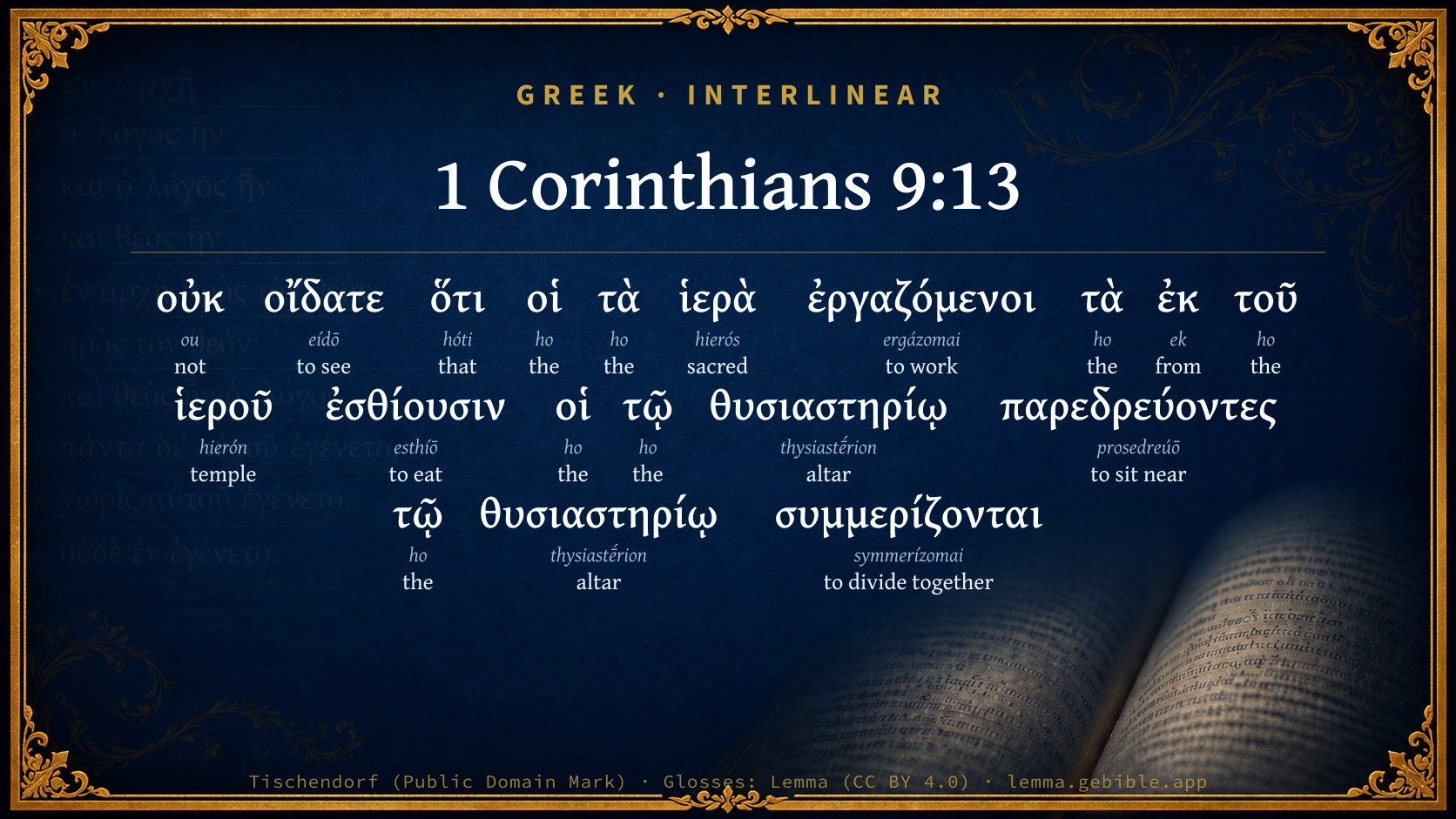
Download image
Cite this verse

1 Corinthians 9:13 (World English Bible). Public Domain. Lemma interlinear Bible study tool, https://lemma.gebible.app/v/1-corinthians/9/13.

Show BibTeX & RIS
BibTeX
RIS
English Translation
Don't you know that those who serve around sacred things eat from the things of the temple, and those who wait on the altar have their portion with the altar?
World English Bible · Public Domain
Highlights
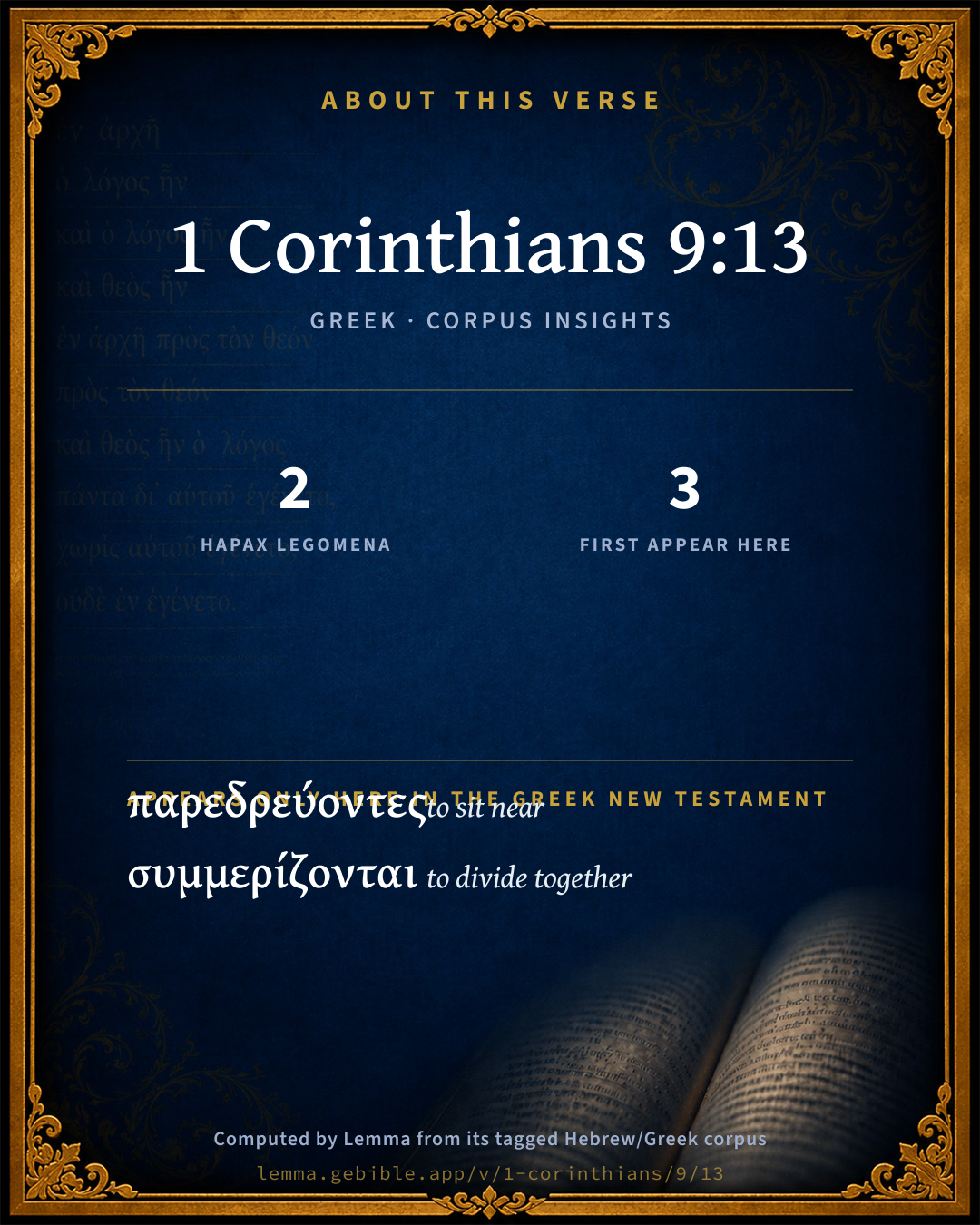
  • 2 hapax legomena — only here in the Greek New Testament
  • 3 first appearances in the Greek New Testament
Full analysis ↓
Download a study sheet

One document with this verse’s original text, its word-by-word gloss line, the meaning frame, cross-references with their text, attributed commentary, and full source and license credits — printable, and it pastes into notes with its structure intact.

This verse Autodidact and up

Study sheet (.html) Plain text (.txt)

A passage Seminary Student

Up to 50 verses in one chapter. A passage sheet keeps up to 6 commentary sources and 12 cross-references per verse, in the order this page ranks them, and says so on the sheet whenever that leaves anything out. Ask for a single verse and you get the Autodidact verse sheet above.

Everything on this page stays free to read, with no account — the sheet is a download of what is already on screen, not access to it.

Want to remove ads? Support Godless Engineer
Compare translations 3

The same verse in 3 English versions, stacked beneath the original-language interlinear above. Click any original word for its lexicon entry.

Each is an independent rendering of the whole verse — the interlinear is not word-aligned to these translations.

Highlighted words mark where these versions differ — a whole-verse word diff, not a word-by-word alignment.

  • World English Bible Public Domain
    Don't you know that those who serve around sacred things eat from the things of the temple, and those who wait on the altar have their portion with the altar?
  • King James Version Public Domain
    Do ye not know that they which minister about holy things live of the things of the temple? and they which wait at the altar are partakers with the altar?
  • unfoldingWord Literal Text CC BY-SA 4.0
    Do you not know that the ones working in the temple eat from the things of the temple; the ones serving at the altar partake from the altar?

unfoldingWord Literal Text — © unfoldingWord, licensed CC BY-SA 4.0. Word-aligned USFM3 via Door43 (git.door43.org/unfoldingWord/en_ult).

Versions to compare (up to 4)

3 of 4 selected

Show all 19 translations

Every available English version of this verse, each an independent rendering of the whole verse.

  • World English Bible Public Domain
    Don't you know that those who serve around sacred things eat from the things of the temple, and those who wait on the altar have their portion with the altar?
  • Berean Standard Bible Public Domain
    Do you not know that those who work in the temple eat of its food, and those who serve at the altar partake of its offerings?
  • Majority Standard Bible Public Domain
    Do you not know that those who work in the temple eat of its food, and those who serve at the altar partake of its offerings?
  • King James Version Public Domain
    Do ye not know that they which minister about holy things live of the things of the temple? and they which wait at the altar are partakers with the altar?
  • American Standard Version (1901) Public Domain
    Know ye not that they that minister about sacred things eat `of' the things of the temple, `and' they that wait upon the altar have their portion with the altar?
  • Revised Version (1885) Public Domain
    Know ye not that they which minister about sacred things eat of the things of the temple, and they which wait upon the altar have their portion with the altar?
  • Geneva Bible (1599) Public Domain
    Doe ye not knowe, that they which minister about the holy things, eate of the things of the Temple? and they which waite at the altar, are partakers with the altar?
  • Douay-Rheims (1899) Public Domain
    Know you not, that they who work in the holy place, eat the things that are of the holy place; and they that serve the altar, partake with the altar?
  • Young's Literal Translation Public Domain
    Have ye not known that those working about the things of the temple -- of the temple do eat, and those waiting at the altar -- with the altar are partakers?
  • Literal Standard Version CC BY-SA 4.0
    Have you not known that those working about the things of the temple eat of the temple, and those waiting at the altar are partakers with the altar?
  • Unlocked Literal Bible CC BY-SA 4.0
    Do you not know that those who serve in the temple get their food from the temple? Do you not know that those who serve at the altar share in what is offered on the altar?
  • unfoldingWord Literal Text CC BY-SA 4.0
    Do you not know that the ones working in the temple eat from the things of the temple; the ones serving at the altar partake from the altar?
  • Darby Bible Public Domain
    Do ye not know that they who labour [at] sacred things eat of the [offerings offered in the] temple; they that attend at the altar partake with the altar?
  • World Messianic Bible Public Domain
    Don’t you know that those who serve around sacred things eat from the things of the temple, and those who wait on the altar have their portion with the altar?
  • Webster's Bible Public Domain
    Do ye not know that they who minister about holy things live from the things of the temple, and they who wait at the altar are partakers with the altar?
  • Free Bible Version CC BY-SA 4.0
    Don't you know that those who work in temples receive their meals from temple offerings, and those who serve at the altar receive their portion of the sacrifice on the altar?
  • Bible in Basic English Public Domain
    Do you not see that the servants of the holy things get their living from the Temple, and the servants of the altar have their part in the food which is offered on the altar?
  • Text-Critical English NT CC BY 4.0
    Do you not know that those who perform sacred services eat of the temple sacrifices, and those who attend to the altar have a share in the altar sacrifices?
  • Tyndale New Testament (1534) Public Domain
    Do ye not vnderstoder how that they which minister in the temple have their fyndynge of the temple? And they which wayte at the aulter are partakers with the aultre?

Literal Standard Version (2020), Covenant Press — licensed CC BY-SA 4.0. Text via the HelloAO Bible API (eBible.org). Unlocked Literal Bible (unfoldingWord) — licensed CC BY-SA 4.0. Text via the HelloAO Bible API (eBible.org). unfoldingWord Literal Text — © unfoldingWord, licensed CC BY-SA 4.0. Word-aligned USFM3 via Door43 (git.door43.org/unfoldingWord/en_ult). Free Bible Version, Dr. Jonathan Gallagher — licensed CC BY-SA 4.0. Text via the HelloAO Bible API (eBible.org).

Word by word

More ways to search: Search by grammar → Find every occurrence → Compare this word →

Practice this passage: Drill this verse → Learn its vocabulary →

παρεδρεύοντες
prosedreúō
G4332
“to sit near”
Verb, Present, Active, Participle, Nominative, Plural, Masculine
Part of Speech
Verb
Tense
Present
Voice
Active
Mood
Participle
Case
Nominative
Number
Plural
Gender
Masculine
Full Thayer's Definition

Origin: from a compound of G4314 and the base of G1476

TDNT: None

1. to sit near 2. to attend assiduously 3. to be in attendance upon, not to quit one's side
  1. οὐκ ou G3756 “not” Particle, Negative
  2. οἴδατε eídō G1492 “to see” Verb, Perfect, Active, Indicative, 2nd person, Plural
  3. ὅτι hóti G3754 “that” Conjunction
  4. οἱ ho G3588 “the” Article, Nominative, Plural, Masculine
  5. τὰ ho G3588 “the” Article, Accusative, Plural, Neuter
  6. ἱερὰ hierós G2413 “sacred” Adjective, Accusative, Plural, Neuter
  7. ἐργαζόμενοι ergázomai G2038 “to work” Verb, Present, Middle or Passive deponent, Participle, Nominative, Plural, Masculine
  8. τὰ ho G3588 “the” Article, Accusative, Plural, Neuter
  9. ἐκ ek G1537 “from” Preposition
  10. τοῦ ho G3588 “the” Article, Genitive, Singular, Neuter
  11. ἱεροῦ hierón G2411 “temple” Noun, Genitive, Singular, Neuter
  12. ἐσθίουσιν esthíō G2068 “to eat” Verb, Present, Active, Indicative, 3rd person, Plural
  13. οἱ ho G3588 “the” Article, Nominative, Plural, Masculine
  14. τῷ ho G3588 “the” Article, Dative, Singular, Neuter
  15. θυσιαστηρίῳ thysiastḗrion G2379 “altar” Noun, Dative, Singular, Neuter
  16. τῷ ho G3588 “the” Article, Dative, Singular, Neuter
  17. θυσιαστηρίῳ thysiastḗrion G2379 “altar” Noun, Dative, Singular, Neuter
  18. συμμερίζονται symmerízomai G4829 “to divide together” Verb, Present, Middle or Passive deponent, Indicative, 3rd person, Plural

About this verse

These counts appear in no published source. They are computed here, from the morphology-tagged text and Lemma’s own curated glosses. What Lemma adds →

19
words
12
distinct lemmas
Pauline Epistles
section

Notable vocabulary

2 hapax legomena — words that appear only here in the entire Greek New Testament:

  • παρεδρεύοντες to sit near G4332
  • συμμερίζονται to divide together G4829

First appearance in Scripture

These words make their first canonical appearance in the Greek New Testament here:

  • ἱερὰ sacred G2413
  • παρεδρεύοντες to sit near G4332
  • συμμερίζονται to divide together G4829

Shared distinctive vocabulary

ἱερὰ sacred G2413 occurs in 2 verses of the Greek New Testament. Also found in:
Repetition

Words recur within this verse:

  • θυσιαστηρίῳ altar G2379 ×2
  • οἱ the G3588 ×7

Cross-references

9

Topical passages linked to 1 Corinthians 9:13 in the Treasury of Scripture Knowledge — connected by theme and wording, ordered by reader-vote popularity; previews shown in the World English Bible.

  • Leviticus 6:26 The priest who offers it for sin shall eat it. It shall be eaten in a holy place, in the court of the Tent of Meeting.
  • Numbers 5:9–10 Every heave offering of all the holy things of the children of Israel, which they present to the priest, shall be his.
  • Numbers 18:8–20 Yahweh spoke to Aaron, I, behold, I have given you the charge of my heave-offerings, even all the holy things of the children of Israel; to you have I given them by reason of the anointing, and to your sons, as a portion forever.
  • Deuteronomy 18:1–5 The priests the Levites, [even] all the tribe of Levi, shall have no portion nor inheritance with Israel: they shall eat the offerings of Yahweh made by fire, and his inheritance.
  • 1 Samuel 2:28 and did I choose him out of all the tribes of Israel to be my priest, to go up to my altar, to burn incense, to wear an ephod before me? and did I give to the house of your father all the offerings of the children of Israel made by fire?
  • 1 Corinthians 10:18 Consider Israel after the flesh. Don't those who eat the sacrifices have communion with the altar?
  • Leviticus 6:16–18 That which is left of it Aaron and his sons shall eat. It shall be eaten without yeast in a holy place. They shall eat it in the court of the Tent of Meeting
  • Leviticus 7:6–8 Every male among the priests may eat of it. It shall be eaten in a holy place. It is most holy.
  • Deuteronomy 10:9 Therefore Levi has no portion nor inheritance with his brothers; Yahweh is his inheritance, according as Yahweh your God spoke to him.)

Cross-references courtesy of OpenBible.info (CC BY 4.0).

Commentary

Notes on 1 Corinthians 9:13 from classic Christian and Jewish commentators (each source and its license shown beneath its notes). The classic Christian expositions comment on the surrounding passage and are grouped to its opening verse, so a note may address several verses; the Jewish commentaries on the Tanakh (Rashi and others) are per-verse, so they appear only where the commentator wrote on this verse.

Lemma curates 59 commentaries, every one of them public domain or Creative Commons licensed, each selected and text-cleaned for this edition rather than reprinted as found. About our sources →

Joseph Benson's Commentary

1Co 9:13-14. Do ye not know, &c. — In further support of the justice of the claim in question, I might remind you of the provision which God made for the priests and Levites under the Mosaic law; that they which minister about holy things — As, 1st, the Levites, who perform the various servile offices relating to the temple service; live — Are supported by; the things of the temple — Have their maintenance, in a great measure, from the offerings, tithes, &c., brought thither; And, 2d, they which wait at the altar — The priests, who are chiefly employed in offering the sacrifices at the altar; are partakers with the altar — Have a portion allotted them of the sacrifices offered upon it. Even so — According to the equity of that law; hath the Lord Christ ordained — Namely, Luk 10:7-8; Mat 10:11; that they which preach the gospel should live by the gospel — Should be supported by those to whom they preach it.

Joseph Benson's Commentary on the Old and New Testaments (1811–1818) — public domain. Text from a community e-Sword module.

Tyndale Open Study Notes

Tyndale Open Resources

9:13 Paul might be referring to Levites and priests at God’s temple in Jerusalem (see Deut 18:1-4; cp. Lev 6:16-17, 26; Num 18:8-32), but the pagan priests in temples around Corinth would have done similarly.

Tyndale Open Study Notes — © Tyndale Open Resources, licensed CC BY-SA 4.0. Text via the HelloAO Bible API.

Bengel's Gnomon

Johann Albrecht Bengel

1Co 9:13. Τὰ ιἑρὰ) sacred things.—ἐκ τοῦ ιἑροῦ, of the temple)—θυσιαστηρίῳ, at the altar) If the Mass were a sacrifice, Paul would have undoubtedly accommodated to it the apodosis in the following verse.

Bengel's Gnomon of the New Testament — English translation (T&T Clark, Edinburgh, 1860) — public domain. Text from a community e-Sword module.

Meyer's Critical & Exegetical Commentary

Heinrich August Wilhelm Meyer

1Co_9:13-14. An additional proof of the above right on the part of the teachers, drawn now from the sphere of the Israelitish theocracy, namely, from the example of the priests and the corresponding command of Christ Himself. Then, in 1Co_9:15, ἐγὼ δὲ … τούτων repeats the contrast to this.

The first of the two parallel halves of 1Co_9:13,[1447] which together describe the ἱερατεύειν (Luk_1:7), characterizes the priests generally: οἱ τὰ ἱερὰ ἐργαζ., who do the holy things, i.e. whose work is to perform divine service; the second clause again is more specific: who are constantly busied at the altar of sacrifice (προσεδρ. and ΠΑΡΕΔΡ., of an official, and especially of a priestly, assidere, Diod. Sic. i. 40; Josephus, cont. Ap. i. 7; Lucian, Asin. 5; Kypke, II. p. 213). As regards τὰ ἱερά, res sacrae, i.e. what belongs to the divine cultus, comp 3Ma_3:21 (according to the true reading); Demosth. 1300. 6; and often elsewhere in the classics. They eat from the sanctuary, inasmuch as they have their support from what is brought into the temple (sacrifices, shewbread, first-fruits, etc.); they have their share with the altar of sacrifice, inasmuch as they take to themselves their part of the offerings which belong to the altar. See Num_18:8 ff. Beza puts it well: altaris esse socios in dividenda victima. It is incorrect to explain the first clause as referring to the Levites and the second to the priests (so Chrysostom, Theophylact, Vitringa, Wolf), for the Levites were not τὰ ἱερὰ ἐργαζόμενοι, but only ἹΕΡΌΔΟΥΛΟΙ (3 Esdr. 1:3), and therefore, in respect of their occupations, are no fitting analogues to the preachers of the gospel; see rather Rom_15:16; Php_2:17. On this ground we must refuse even to include the Levites here (against de Wette, Osiander, Maier, al[1449]). Rückert understands both clauses to refer to the Jewish and heathen cultus and its ministers. But in the mind of the apostle, looking at things from the theocratic point of view of his nation, the ἱερόν and the ΘΥΣΙΑΣΤ. are simply ΚΑΤʼ ἘΞΟΧΉΝ, those of Israel (Rom_9:4); and how could he otherwise have said οὕτω καὶ Κ.Τ.Λ[1450], 1Co_9:14, seeing that the heathen priestly institute was by no means of divine appointment? For these reasons we cannot even say, with Ewald, that the words refer primarily indeed to Numbers 18, but are couched in such a general form as to apply also to the priests in the heathen temples. The mention of τῷ θυσιαστηρ. is especially opposed to this interpretation, since for Paul there can be but the one altar; comp 1Co_10:18.

οὕτω καὶ ὁ Κύριος κ.τ.λ[1452]] so, i.e. in accordance with the relation of things stated in 1Co_9:13, hath the Lord also, etc. Ὁ Κύριος is Christ; the allusion is to such sayings of His as Mat_10:10, Luk_10:8, here referred to as handed down by living tradition. By the καί, again, the command of Christ is linked to the foregoing relations under the O. T. economy, with which it corresponds (comp Chrysostom). The order of the words is enough of itself to show that the reference is not to God, for in that case we must have had: οὕτω καὶ τοῖς τὸ εὐαγγ. καταγγ. ὁ Κύριος διέταξε.

For examples of the idiom ΖῆΝ ἘΚ, see Kypke.

[1447] The paraphrastic description of the priests from their employments serves to make the representation uniform with that in ver. 14. The double designation, however, brings out the analogy with the Christian teachers in a more clear and telling way for the purposes of the argument. The holy thing at which they labour is the gospel (Rom_15:16), and the offering which they present is the faith of their converts (Php_2:17), and, consequently, those converts themselves (Rom. l.c.).

[1449] l. and others; and other passages; and other editions.

[1450] .τ.λ. καὶ τὰ λοιπά.

[1452] .τ.λ. καὶ τὰ λοιπά.

Meyer — Critical and Exegetical Commentary on the New Testament — English translation by Peter Christie, edited by Frederick Crombie (T&T Clark, 1880) — public domain. Text from a community e-Sword module.

Expositor's Greek Testament

ed. W. Robertson Nicoll

1Co 9:13-14 . After the personal “aside” of 1Co 9:11 f., Paul returns to his main proof, deriving a further reason for the disputed ἐξουσία from the Temple service. “Do you not know” you men of knowledge ( cf. 1Co 3:16 ) ὅτι οἱ τὰ ἱερὰ ἐργαζόμενοι ἐκ τοῦ ἱεροῦ ἐσθίουσιν ; “that those employed in the sacred offices eat what comes from the sacred place (the Temple)?” “qui sacris operantur, ex sacrario edunt” (Cv [1326] ): see the rules ad hoc in Lev 6:8 to Lev 7:38 and Num 18:8-19 . For ἐργάζομαι (of business, employment ), cf. 1Co 4:12 , Act 18:3 , etc. “Those that are assiduous at the altar,” qui altari assident (Bz [1327] ) i.e. , the priests engaged in the higher ritual functions are distinguished from other Temple ministers; the position of Paul and his colleagues is analogous to that of these chief dignitaries. παρεδρεύω , to have one’s seat beside; cf . εὐπάρεδρον , 1Co 7:35 . P. argues by analogy from the Jewish priest to the Christian minister in respect of the claim to maintenance ; we cannot infer from this an identity of function , any more than in the previous comparison with “the threshing ox”. τ . θυσιαστηρίῳ συνμερίζονται , “have their portion with the altar,” i.e. , share with it in the sacrifices “altaris esse socios in dividendo victimas” (Bz [1328] ); parts of these were consumed in the altar-fire, and parts reserved for the priests (Lev 10:12-15 ). Some refer the first half of 1Co 9:13 to Gentile and the last to Israelite practice; but “with the Ap., τὸ ἱερὸν is only the sanctuary of the God of Israel, τὸ θυσιαστήριον only the altar on which sacrifice is made to Him” (Hf [1329] ): cf. Act 22:17 , etc., and the Gospels passim , as to ἱερόν ; 1Co 10:18 , as to θυσιαστήριον ; cf. 1Co 10:1-12 , for the use in this Ep. of O.T. analogies. “So also (in accordance with this precedent) did the Lord appoint for those that preach the good tidings to live of the good tidings.” ἐκ τ εὐαγγ in 1Co 9:14 matches ἐκ τ ἱεροῦ , 1Co 9:13 ; τοῖς … καταγγέλλουσιν , τοῖς … ἐργαζομένοις : cf. ἱερουργοῦντα τ . εὐαγγ τ . Θεοῦ , Rom 15:16 . For the “ordinance” of “the Lord” ( sc . Jesus), see parls.; the allusion speaks for detailed knowledge of the sayings of Jesus, on the part of writer and readers; cf. 1Co 7:10 , 1Co 11:23 ff., and notes. διατάσσω , act [1330] , as in 1Co 7:17 , 1Co 11:34 ; mid [1331] in 1Co 16:1 . ζῇν ἐκ , of source of livelihood ( ex quo quod evangelium prœdicant , Bz [1332] ), in cl [1333] Gr [1334] often ζῇν ἀπὸ (see parls.). For καταγγέλλω , see note on 1Co 2:1

[1326] Calvin’s In Nov. Testamentum Commentarii .

[1327] Beza’s Nov. Testamentum: Interpretatio et Annotationes (Cantab., 1642).

[1328] Beza’s Nov. Testamentum: Interpretatio et Annotationes (Cantab., 1642).

[1329] J. C. K. von Hofmann’s Die heilige Schrift N.T. untersucht , ii. 2 (2te Auflage, 1874).

[1330] active voice.

[1331] middle voice.

[1332] Beza’s Nov. Testamentum: Interpretatio et Annotationes (Cantab., 1642).

[1333] classical.

[1334] Greek, or Grotius’ Annotationes in N.T.

The Expositor's Greek Testament, edited by W. Robertson Nicoll (1897–1910) — public domain. Text from a community e-Sword module.

Godet's Commentaries

Frédéric Louis Godet

Vv. 13. “Do ye not know that they which minister about holy things live of the temple? and they which wait at the altar are partakers with the altar?”

In heathen as well as in Jewish worship, it was customary for those who were employed in the sacred ceremonies, to live on the product of these rites. This was a matter so thoroughly received, that Rückert thinks he can apply the two terms used in 1Co 9:13 (minister, wait upon) to those heathen and Jewish worships, and that Hilary (Ambrosiaster) has applied the first to heathen and the second to Jewish worship. But by the expression: Do ye not know? Paul seems to appeal to a Divine authority; he means probably, therefore, to speak only of Jewish worship. The term temple, also, can hardly refer to any other edifice than the only one which in Paul’s eyes deserved the name, the temple of Jerusalem; see on 1Co 8:10. Finally, in this sense the expression: even so, 1Co 9:14, would become somewhat unsuitable; for the apostle could not put on the same level the authority of heathen customs and that of the Lord. It is therefore with reason that most commentators refer these two examples to Jewish worship, with this difference only, that according to Meyer and others, the two propositions refer to the priests, while according to others,

Chrysostom, for example,—the first refers to the Levites, the second to the priests; or finally, according to a third class, the first denotes the Levitical order as a whole (Levites and priests together), and the second, the priests only. This last meaning seems to me the only admissible one. To minister about holy things, in the first proposition, is a very general expression comprehending all the acts and all the individuals devoted to the temple service; whereas serving at the altar applies to none but to priests, who alone offered the victims on the altar. It is well known that the Levites lived by their employment by means of the tithes and offerings paid by the people, and that in like manner the priests lived by the altar, first by means of the tithe which the Levites paid to them, and then specially by the portion of the victims which was reserved for them. It is this last custom which explains the term συμμερίζεσθαι, to partake with the altar. Finally, the apostle reaches the unanswerable argument: the positive order of the Lord Himself.

Frédéric Louis Godet — Commentaries on Luke, John, Romans, and 1 Corinthians — English translation (T&T Clark, Edinburgh, 1870s–1890s) — public domain. Text from a community e-Sword module.

Hodge's Commentary on Romans, Ephesians & First Corinthians

Charles Hodge

1Co_9:13

Do ye not know that they which minister about holy things live (of the things) of the temple? and they which wait at the altar are partakers with the altar?

What Paul here says is true of all religions, though his reference is probably only to the Jewish. Those which minister about holy things (οἱ τὰ ἱερὰ εργαζόμενοι); those who perform the sacred services, i.e. those who offer sacrifices. Eat of the temple, i.e. they derive their support from the temple. Those attending the altar share with the altar, i.e. the priests receive a portion of the sacrifices offered on the altar. If this was an institution ordained by God himself, under the old dispensation, it has the sanction of divine authority. The apostles concluding and conclusive argument on this subject is contained in the following verse.

Charles Hodge — Commentary on Romans (1835), First Corinthians (1857), and Ephesians (1856) — public domain. Text from a community e-Sword module.

Geneva Bible (1599)

Geneva Bible translators

Last of all he bringeth forth the express Law concerning the nourishing of the Levites, which privilege notwithstanding he will not use.

This is spoken by the figure Metonymy, for, of those things that are offered in the temple.

Are partakers with the altar in dividing the sacrifice.

Geneva Bible (1599) marginal notes — public domain. Text via Bolls.life.

Jamieson, Fausset & Brown

Robert Jamieson, A. R. Fausset & David Brown

minister about holy things--the Jewish priests and Levites. The Greek especially applies to the former, the priests offering sacrifices.

partakers with the altar--a part of the victims going to the service of the altar, and the rest being shared by the priests (Lev 7:6; Num 18:6, &c.; Deu 18:1, &c.).

Jamieson, Fausset & Brown — Commentary Critical and Explanatory on the Whole Bible (1871) — public domain (CC PDM 1.0). Text via the HelloAO Bible API.

Adam Clarke's Commentary

Verse 13. They which minister about holy things] All the officers about the temple, whether priests, Levites, Nethinim, c., had a right to their support while employed in its service. The priests partook of the sacrifices the others had their maintenance from tithes, first fruits, and offerings made to the temple; for it was not lawful for them to live on the sacrifices. Hence the apostle makes the distinction between those who minister about holy things and those who wait at the altar.

Adam Clarke's Commentary on the Bible (1810–1826) — public domain. Text from a community e-Sword/MySword module.

John Calvin's Commentaries

13. Know ye not, Apart from the question that he discusses, he appears to have dwelt the longer in taking notice of this point, with the view of reproaching the Corinthians indirectly for their malignity in allowing the ministers of Christ to be reviled in a matter that was so justifiable. For if Paul had not of his own accord refrained from using his liberty, there was a risk of the progress of the gospel being obstructed. Never would the false Apostles have gained that point, had not ingratitude, to which the Corinthians were already prone, opened up the way for their calumnies. For they ought to have repelled them sharply; but instead of this they showed themselves excessively credulous, so that they would have been prepared to reject the gospel, if Paul had used his right. Such contempt of the gospel, and such cruelty towards their Apostle, deserved to be more severely reproved; but Paul, having found another occasion, touches upon it indirectly and mildly, with his usual modesty, that he may admonish them without affronting them.

Again he makes use of a new comparison, to prove that he had not used the power that he had from the Lord. Nor does he any longer borrow examples from any other source, but shows that this has been appointed by the Lord — that the Churches should provide for the support of their ministers. There are some that think that there are two comparisons in this passage, and they refer the former to the Lord’s priests, and the latter to those that acted as priests to the heathen gods. I am, however, rather of opinion that Paul expresses, as he is accustomed, the same thing by different terms. And, truly, it would have been a weak argument that was derived from the practice of the heathens, among whom the revenues of the priesthood were not devoted to food and clothing, but to magnificent dresses, royal splendor, and profuse luxury. These would, therefore, have been things too remote. I do not call it in question, however, that he has pointed out different kinds of ministerial offices; for there were priests of a higher order, and there were afterwards Levites, who were inferior to them, as is well known; but that is not much to the point.

The sum is this — “The Levitical priests were ministers of the Israelitish Church; the Lord appointed them sustenance from their ministry; hence in ministers of the Christian Church the same equity must be observed at the present day. Now the ministers of the Christian Church are those that preach the gospel.” This passage is quoted by Canonists, when they wish to prove that idle bellies must be fattened up, in order that they may perform their masses; but how absurdly, I leave it to children themselves to judge. Whatever is stated in the Scriptures as to the support to be given to ministers, or the honor that is to be put upon them, they immediately seize hold of it, and twist it to their own advantage. For my part, however, I simply admonish my readers to consider attentively Paul’s words. He argues that pastors, who labor in the preaching of the gospel, ought to be supported, because the Lord in ancient times appointed sustenance for the priests, on the ground of their serving the Church. Hence a distinction must be made between the ancient priesthood and that of the present day. Priests under the law were set apart to preside over the sacrifices, to serve the altar, and to take care of the tabernacle and temple. Those at the present day are set apart to preach the word and to dispense the sacraments. The Lord has appointed no sacrifices for his sacred ministers to be engaged in; there are no altars for them to stand at to offer sacrifices.

Hence appears the absurdity of those who apply this comparison, taken from sacrifices, to anything else than to the preaching of the gospel. Nay farther, it may be readily inferred from this passage, that all Popish priests, from the head himself to the lowest member, are guilty of sacrilege, who devour the revenues appointed for true ministers, while they do not in any way discharge their duty. For what ministers does the Apostle order to be maintained? Those that apply themselves to the preaching of the gospel. What right then have they to claim for themselves the revenues of the priesthood? “Because they hum a tune and perform mass.” But God has enjoined upon them nothing of that sort. Hence it is evident that they seize upon the reward due to others. When, however, he says that the Levitical priests were partakers with the altar, and that they ate of the things of the Temple, he marks out (μετωνυμικῶς) by metonymy, the offerings that were presented to God. For they claimed to themselves the sacred victims entire, and of smaller animals they took the right shoulder, and kidneys and tail, and, besides this, tithes, oblations, and first-fruits. The word ἱερόν, therefore, in the second instance, is taken to mean the Temple.

John Calvin's Commentaries (1540-1563) — public domain. Text from the Calvin Translation Society English edition (1840s-50s) via the Christian Classics Ethereal Library (ccel.org). Calvin's coverage is partial (roughly two-thirds of the Bible); uncommented books and verses are honest gaps, never fabricated. The 19th-century editor's footnotes and remarks are omitted so the notes are faithfully Calvin's own voice.

Ellicott's Commentary for English Readers

(13) Do ye not know.—The Apostle now turns to appeal to an argument which would have weight with them as Christians. The rights of the ministry to be supported by the Church have already been established by an appeal to ordinary life and to the Jewish law; and the statement has been made that the Apostle having that right, did not, for wise reasons, use it. There is one higher step in the argument. It was not only a principle of Jewish law which Christ might have abrogated, but it was a provision of the Jewish economy which Christ Himself formally perpetuated.

They which minister. . . .—Better, They which minister about the holy things eat from the temple, and they which serve at the altar have their share with the altar. The first part of this passage refers to the general principle that the priests who were engaged in the Temple services were supported from the various offerings which were brought there, and the second clause more definitely alludes to the particular fact that when a sacrifice was offered on the altar, the sacrificing priests, as well as the altar, had a share of the animal. (See Lev_6:16; Lev_6:26; Lev_7:6; Numbers 5; Numbers 18; Deuteronomy 10, 18) A suggestion that the allusion might be to the custom of the heathen priests is wholly inadmissible, for such would have no force for Christians, and would entirely destroy the sequence of the next verse.

A Bible Commentary for English Readers, edited by Charles John Ellicott (1878–1897) — public domain. Text from a community e-Sword module.

The Cambridge Bible for Schools and Colleges

gen. ed. J. J. S. Perowne

13. Do ye not know that they which minister about holy things] Fifth argument. The Jewish priests are maintained by the sacrifices of the worshippers. See Lev_6:17; Num_5:8-10, and especially Num_18:8-20. So also Deu_10:9; Deu_18:1. This was an argument of which in dealing with Jews it would not have been well to lose sight. Whether an Apostle or not St Paul was at least occupied with sacred things, and so had a claim to live, or rather eat, the literal translation (see margin feed) by means of the work he was doing.

partakers with the altar] The sacrifices were apportioned out according to rule. Part was consumed on the altar; part was given to the priest; part was consumed by the worshipper. See passages cited in the last note.

The Cambridge Bible for Schools and Colleges (gen. ed. J. J. S. Perowne; Cambridge University Press, 1878–1918) — public domain. Text from a community e-Sword module.

John Gill's Exposition

Even so hath the Lord ordained,.... That is, the Lord Jesus Christ, in Mat 10:10 it is an order and appointment of his that his ministering servants, who labour in preaching his Gospel, should be sufficiently taken care of, as to a comfortable livelihood; he has not indeed fixed it in the same way as the priests and Levites had theirs under the law; but as the one was just and right, that they should be maintained out of the things belonging to the temple and altar, and live on them, so it is his will and pleasure,

that they which preach the Gospel; that continue to do so, that labour, and not loiter in the word and doctrine, who do the work of the ministry fully and faithfully, and not bear the name only of Gospel preachers: should live of the Gospel; not the Gospel itself, which is spiritual, and not corporeal food; but the sense is, that in consideration and because of their preaching the Gospel, they should be supplied with the proper necessaries of life: the learned Mr. Mede has proved, by various instances, that the word here rendered "Gospel", and which signifies good news and glad tidings, is in other writers used for a reward, given to such that bring good tidings; and has rightly observed, that the Hebrew word which signifies the same, is used in a like sense in Sa2 4:10 and accordingly the sense here will be, that it is the ordination of Christ, that such who faithfully bring the news and glad tidings of salvation to sinners, should, as a reward for such good news, be provided for with a comfortable maintenance, on which they should live.

John Gill's Exposition of the Whole Bible (1746–1763) — public domain (CC PDM 1.0). Text via the HelloAO Bible API.

Trapp's Complete Commentary

John Trapp

13 Do ye not know that they which minister about holy things live of the things of the temple? and they which wait at the altar are partakers with the altar?

Ver. 13. Live of the things of, &c.] Yea, they lived plentifully and richly, as appears by the liberal gifts of those Levites for Passover Offerings, 2Ch 35:9.

John Trapp, A Commentary or Exposition upon All the Books of the Old and New Testament (1647–1656) — public domain. Text from a community e-Sword module.

Albert Barnes' Notes on the Bible

Do ye not know ... - In this verse Paul illustrates the doctrine that the ministers of religion were, entitled to a support from the fact that those who were appointed to offer sacrifice receive a maintenance in their work.

They which minister about holy things - Probably the “Levites.” Their office was to render assistance to the priests, to keep guard around the tabernacle, and subsequently around the temple. It was also their duty to see that the temple was kept clean, and to prepare supplies for the sanctuary, such as oil, wine, incense, etc. They had the care of the revenues, and after the time of David were required to sing in the temple, and to play upon instruments. Num. 3:1-36; Num 4:1, Num 4:30, Num 4:35, Num 4:42; 8:5-22; 1Ch 23:3-5, 1Ch 23:24, 1Ch 23:27; 1Ch 24:20-31.

Live of the things of the temple - Margin, “Feed;” that is, are supported in their work by the offerings of the people, and by the provisions which were made for the temple service; see Num 18:24-32.

And they which wait at the altar - Probably the priests who were employed in offering sacrifice.

Are partakers with the altar - That is, a part of the animal offered in sacrifice is burned as an offering to God, and a part becomes the property of the priest for his support; and thus the altar and the priest become joint participators of the sacrifice. From these offerings the priest derived their maintenance; see Num 18:8-19; Deu 18:1, etc. The argument of the apostle here is this: “As the ministers of religion under the Jewish dispensation were entitled to support by the authority and the law of God, that fact settles a general principle which is applicable also to the gospel, that he intends that the ministers of religion should derive their support in their work. If it was reasonable then, it is reasonable now. If God commanded it then, it is to be presumed that he intends to require it now.

Albert Barnes' Notes on the Bible (1834–1885) — public domain. Text from a community e-Sword/MySword module.

Matthew Poole's English Annotations

You may understand what is the mind and will of God under the New Testament, by reflecting upon what appeareth to you to have been his mind and will under the Old Testament: God had a ministry under the Old Testament, the tribe of Levi was it; and God there ordained and appointed a livelihood for them, Num 18:20; Deu 10:9; 18:1, so as they needed not (as other men) to labour with their hands to get bread to eat.

Matthew Poole's English Annotations on the Holy Bible (1683–1685) — public domain. Text from a community e-Sword/MySword module.

Whedon's Commentary on the Bible

Daniel D. Whedon

13. They which minister—Alluding to the Levites.

Wait at the altar— The priests.

Daniel D. Whedon (gen. ed.), Commentary on the Old and New Testaments (1874–1909) — public domain. Text from a community e-Sword module.

The Pulpit Commentary

They which minister about holy things. Jewish priests. He adds his two final arguments since the right which he is pleading has its own intrinsic importance before proceeding to the example which he set in order to prevail on the strong to give up their rights and their liberty, when need was, for the sake of the weak. Live; literally, eat, or feed. The Zealots used this excuse for themselves when they broke open the temple stores in the siege of Jerusalem (Josephus, "Bell. Jud:," 5:13, Of the things of the temple. They shared in the victims offered. (see Num_18:8-13; Deu_18:1) Partakers with the altar. Only certain portions of certain victims were allowed them.

The Pulpit Commentary (1880–1919), ed. H.D.M. Spence-Jones & Joseph S. Exell — public domain. Text from a community e-Sword module.

Kretzmann's Popular Commentary

Paul E. Kretzmann

The duty of hearers:

v. 13. Do ye not know that they which minister about holy things live of the things of the Temple, and they which wait at the altar are partakers with the altar?

v. 14. Even so hath the Lord ordained that they which preach the Gospel should live of the Gospel.

v. 15. But I have used none of these things, neither have I written these things that it should be so done unto me; for it were better for me to die than that any man should make my glorying void.

Lest any member of the Corinthian congregation misunderstand him and make it a point to harp upon the necessity of unselfishness in preachers, Paul again refers them to the fundamental rule which should always be observed, namely, that under normal conditions the congregations should supply all the bodily needs of their pastors. He derives a further reason for his argument from the Temple service: Do you not know that those employed in the sacred offices, those that are busy with the holy things in the Temple, eat what comes from the sacred place? The apostle speaks of the Temple service, especially that connected with the offering of sacrifices. The men engaged in this work everywhere, not only among the Jews, but among the Gentiles as well, obtained their support from the temple, from the gifts and offerings of the people. See Num 18:8 ff. ; Deu 18:1 ff. And those that wait at the altar, that are actually engaged in performing the sacrificial rites, have their portion with the altar, a part of the sacrifice being reserved for the use of the priests, Lev 10:12-15. According to this precedent the rule holds true also in the New Testament: So also did the Lord determine for them that preach the Gospel that they should live of the Gospel. Mark: This is a command of the Lord, and may not be set aside with impunity. Since all things in the world are really His own, merely entrusted to the users for the time being, therefore it is His function and privilege to decide in what way the goods of this world should be used. The pastors being exclusively engaged in the business of preaching the Gospel, devoting all their time to the study of the glorious message of salvation and to the application of its comforting truths, the Lord wants their physical wants supplied by the people that are served with the Gospel; the means, not of a mere existence or subsistence, but of a decent livelihood, should be forthcoming from the rich store of God’s blessings, as given to His children.

Paul hastens to add that his own case is an exception: But so far as I am concerned, I have not used any of these things. He had the right and authority to expect from the Corinthian congregation a maintenance in accordance with his outline above, vv. 4-6. These privileges he has deliberately foregone; he had settled upon this policy for some definite reasons of his own, chief of which was the desire to serve the Gospel all the more efficiently. And so he explains further: Not, however, have I written this that this should happen, should be done, in my case. He is not speaking for himself, in his own interest. He emphatically declares: For it is well, honorable, advantageous, for me rather to die than—my boasting shall no one make void! In his excitement the apostle forgets even the grammatical construction. Strong feeling, impatience, indignation, often influenced Paul in that way. He had set his heart upon preaching the Gospel without remuneration from the congregations, and his wish was rather to be dead than to have this glory taken from him. Any temporal loss or want he deemed unimportant beside the loss of his special boast, which he intended to take along beyond the grave. Not that Paul wanted to stand out prominently before the other apostles, but his humility was such that he would have called ingratitude in himself what he demanded for them as their right.

Paul E. Kretzmann, Popular Commentary of the Bible (1921–1924) — public domain. Text from a community e-Sword module.

Burkitt's Expository Notes on the New Testament

William Burkitt

A fifth argument is here produced for the ministers’ maintenance, which is taken from the example of the Levites, who lived upon the things that were offered in the temple, and at the altar, and had a considerable part of the sacrifice allowed them by God himself for their ministration, under the law.

In like manner, says the apostle, "It is the Lord’s pleasure and appointment now under the gospel, Mat 10:10; Luk 10:7 that they who preach the word should be maintained for it, and not diverted from their work by the cares and business of the world, but have a livelihood from their labour.

Hence it clearly appears, that a maintenance for the ministry under the gospel; for so, says the apostle, God has ordained. God’s will in this matter is the same under the New Testament as it was under the old; and and as a maintenance in general is of divine right, so tithes may make thus far a claim to be of that nature, that it is believed the wisdom of man cannot find out any better expedient, than by them to support a ministerial maintenance for the preachers of the gospel to the end of the world.

William Burkitt's Expository Notes on the New Testament (1700–1703) — public domain. Text from a community e-Sword module.

Godbey's Commentary on the New Testament

William B. Godbey

13. “Do you not know that those who work in sacrifices eat of the temple?” The very fact that the Levitical priests serving in the temple subsisted on the sacrifices brought thither, is an irrefutable argument in favor of temporal support. “Do not those ministering at the altar partake of the altar?” These arguments are clear, explicit and unanswerable in favor of ministerial support.

William B. Godbey, Commentary on the New Testament (1896–1900) — public domain. Text from a community e-Sword module.

McGarvey & Pendleton's Commentaries

J. W. McGarvey

Know ye not that they that minister about sacred things eat of the things of the temple [the offerings, etc.], and they that wait upon the altar have their portion with the altar? [ Num_18:8-13 ; Deu_8:1 . Sixth argument: Christ himself ordained that ministers should be supported by those whom they serve.]

J. W. McGarvey (with Philip Y. Pendleton), Commentaries on the New Testament (The Fourfold Gospel, 1914; Acts; and the epistles) — public domain. Text from a community e-Sword/MySword module.

The People's New Testament

B. W. Johnson

13. They which minister about holy things. He now shows that the temple teaches the same lesson. The priests and Levites are sustained by the temple offerings. Partakers with the altar. A part of the sacrifice was consumed on the altar and a part was awarded to the priests.

B. W. Johnson's The People's New Testament with Notes (1889–1891) — public domain. Electronic text from the Christian Classics Ethereal Library (CCEL) ThML edition.

Cambridge Greek Testament for Schools and Colleges

13. τὰ ἐκ τοῦ ἱεροῦ אBDFG Vulg. Rec. omits τά with ACE Peshito. The MSS. of the Vetus Lat. differ.

παρεδρεύοντες אABCDEFG. Rec. προσεδρεύοντες.

13. οὐκ οἴδατε ὅτι οἱ τὰ ἱερα ἐργαζόμενοι. Fifth argument. The Jewish priests are maintained by the sacrifices of the worshippers. See Lev 6:17; Num 5:8-10, and especially Num 18:8-20. So also Deu 10:9; Deu 18:1. This was an argument of which in dealing with Jews it would not have been well to lose sight. Whether an Apostle or not St Paul was at least occupied with sacred things, and so had a claim to live, or rather eat (the literal translation), by means of the work he was doing.

παρεδρεύοντες. Literally sit beside, i.e. are continually engaged in attending to the altar. Compare our word assiduous.

συμμερίζονται. The sacrifices, the burnt offering excepted, were portioned out according to rule. Part was consumed on the altar; part was given to the priest; part, in some cases, was eaten by the worshipper. See passages cited in the last note but one.

Cambridge Greek Testament for Schools and Colleges (Cambridge University Press, 1896; 21 vols, various authors incl. Carr, Maclear, Plummer, Farrar, Lumby, Moule, M. R. James, Simcox) — public domain. Text from a community e-Sword module.

International Critical Commentary

13. He has reminded them that he has never in the past taken maintenance. Before stating what he means to do in the future, he strengthens the proof that he has a right to it. There is a higher and closer analogy than that of the soldier or of the different kinds of husbandmen. The other analogies may have escaped their notice, but surely they must be aware of the usages of the Temple, which in this matter did not differ from heathen usage. See Gray on Num 28:8-20.

οὐκ οἲδατε; ‘Do you not know that those who perform the temple-rites eat the food that comes out of the temple, those who constantly attend on the altar share with the altar’ what is offered thereon? The second half is not an additional fact; it repeats the first half in a more definite form. See Num 18:8-20 of the priest’s portions, and 21-24 of the Levite’s tithe, and contrast Deu 14:23 (see Driver, p. 169). Nowhere else in N.T. does συνμερίζομαι occur.

τὰ ἐκ τοῦ ἱεροῦ (א B D* F G, Copt.) is preferable to ἐκ τοῦ ἱεροῦ, without τά (A C D 3 E K L P, Syrr. Arm.): and παρεδρεύοντες (א* A B C D E F G P) to προσεδρεύοντες (א 3 K L). Neither verb occurs elsewhere in N.T., and there is little difference of meaning between them. See LXX of Pro 1:21, Pro 8:3.

International Critical Commentary — older volumes (1896–1929), various authors — public domain. Text from a community e-Sword module.

Vincent's Word Studies in the New Testament

Marvin R. Vincent

Minister [εργαζομενοι] . Lit, work or perform. Never in classical Greek of being engaged in sacred rites.

Wait [παρεδρευοντες] . Etymologically akin to paredrov sitting beside. See on ch. 1Co 7:35. Ony here in the New Testament.

Altar [θυσιαστηριω] . See on Act 17:23

Marvin R. Vincent, Word Studies in the New Testament (1887–1900) — public domain. Text from a community e-Sword/MySword module.

Lesson kit

Teaching starters — assembled from the data on this page, not authored interpretation. Every prompt links to the verse data it draws on. Edit before teaching.

1 Corinthians, in the Pauline Epistles, opens this verse with 19 words (12 distinct Greek lemmas). Its most distinctive word is prosedreúō (“to sit near”). A historical commentator’s framing appears above. Read the whole chapter for the surrounding context.

Discussion questions

  1. What does “to sit near” (prosedreúō) contribute to the verse as a whole?
  2. This verse holds 2 words here found nowhere else in the Greek New Testament. What might the rare words draw attention to?
  3. 3 words here appear for the first time in Scripture. What is being introduced at this debut?
  4. 2 Timothy 3:15 shares the word «sacred» with this verse. How do the two illuminate each other?
  5. “altar” occurs 2× in this one verse. What is the effect of the repetition?
  6. The translations on this page render this verse differently — a whole-verse word diff, not a word-by-word alignment. What might account for the different wordings?
  7. Reading how Joseph Benson's Commentary and Tyndale Open Study Notes read this verse, where do the two commentators agree and where do they part?

Things to notice

  • 2 words in this verse appear nowhere else in the Greek New Testament.
  • 3 words make their first canonical appearance in Scripture here.
  • These translations choose different wording for 21 words in this verse.
  • “altar” occurs 2× in this single verse.
  • 12 distinct Greek lemmas span 19 words in this verse.

Reading settings

Reading text

Shown beneath each verse's original-language words.

Old Testament
Old Testament edition

Read the OT as the Masoretic Hebrew (MT) or the Greek Septuagint (LXX).

English shown for the Greek Septuagint (in the Hebrew ↔ Greek comparison).

Comparing translations? Open the Compare panel on any verse page to stack up to four side by side.