
1 Corinthians 10:5

Greek (Tischendorf 8th ed.) 1 Corinthians 10:5 appears in the Greek New Testament. The text above is from the Tischendorf 8th edition. Each word links to its Strong’s number and a concise gloss. Click any word for its full Thayer’s Greek Lexicon entry.
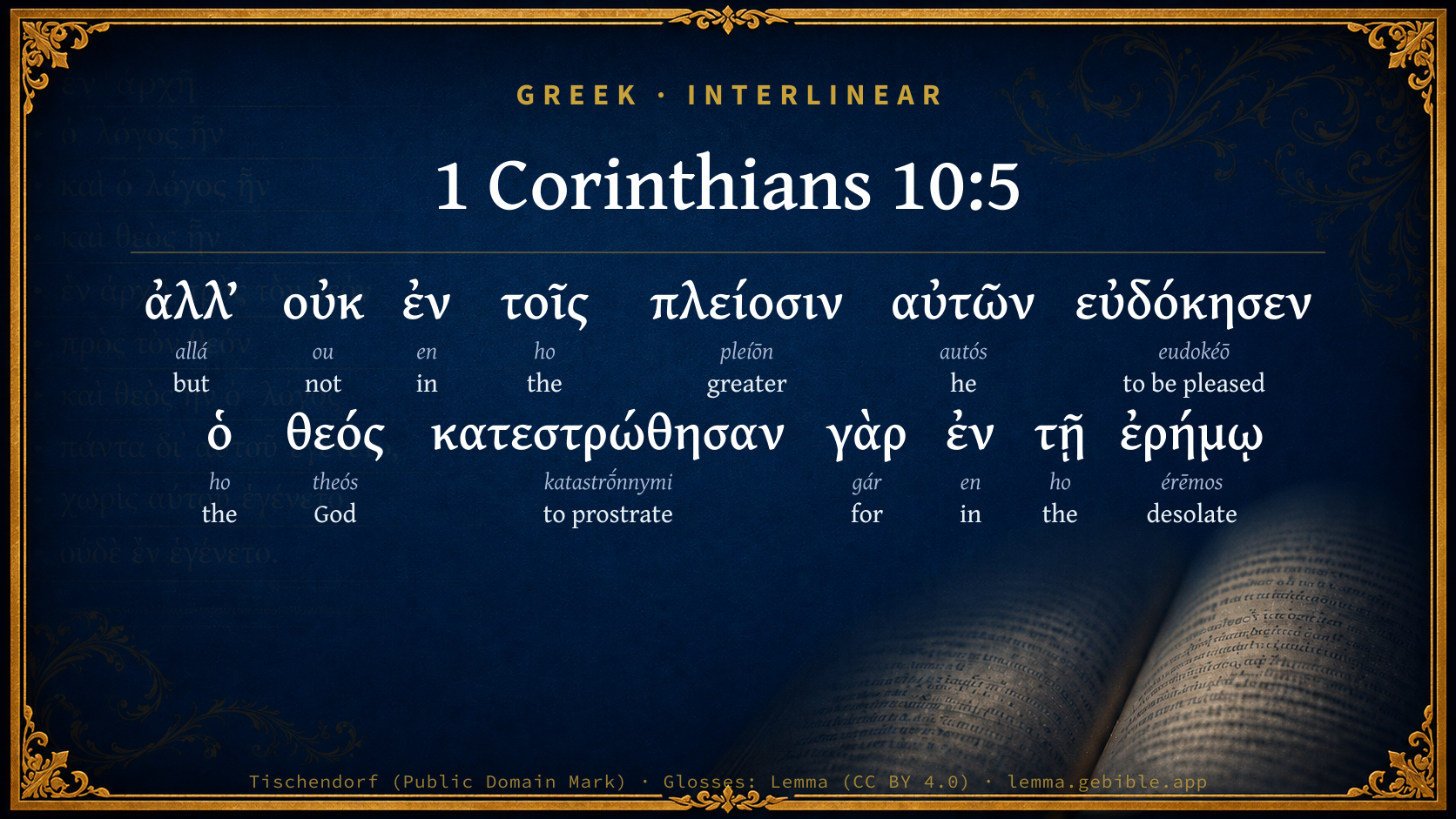
Download image
Cite this verse

1 Corinthians 10:5 (World English Bible). Public Domain. Lemma interlinear Bible study tool, https://lemma.gebible.app/v/1-corinthians/10/5.

Show BibTeX & RIS
BibTeX
RIS
English Translation
However with most of them, God was not well pleased, for they were overthrown in the wilderness.
World English Bible · Public Domain
Highlights
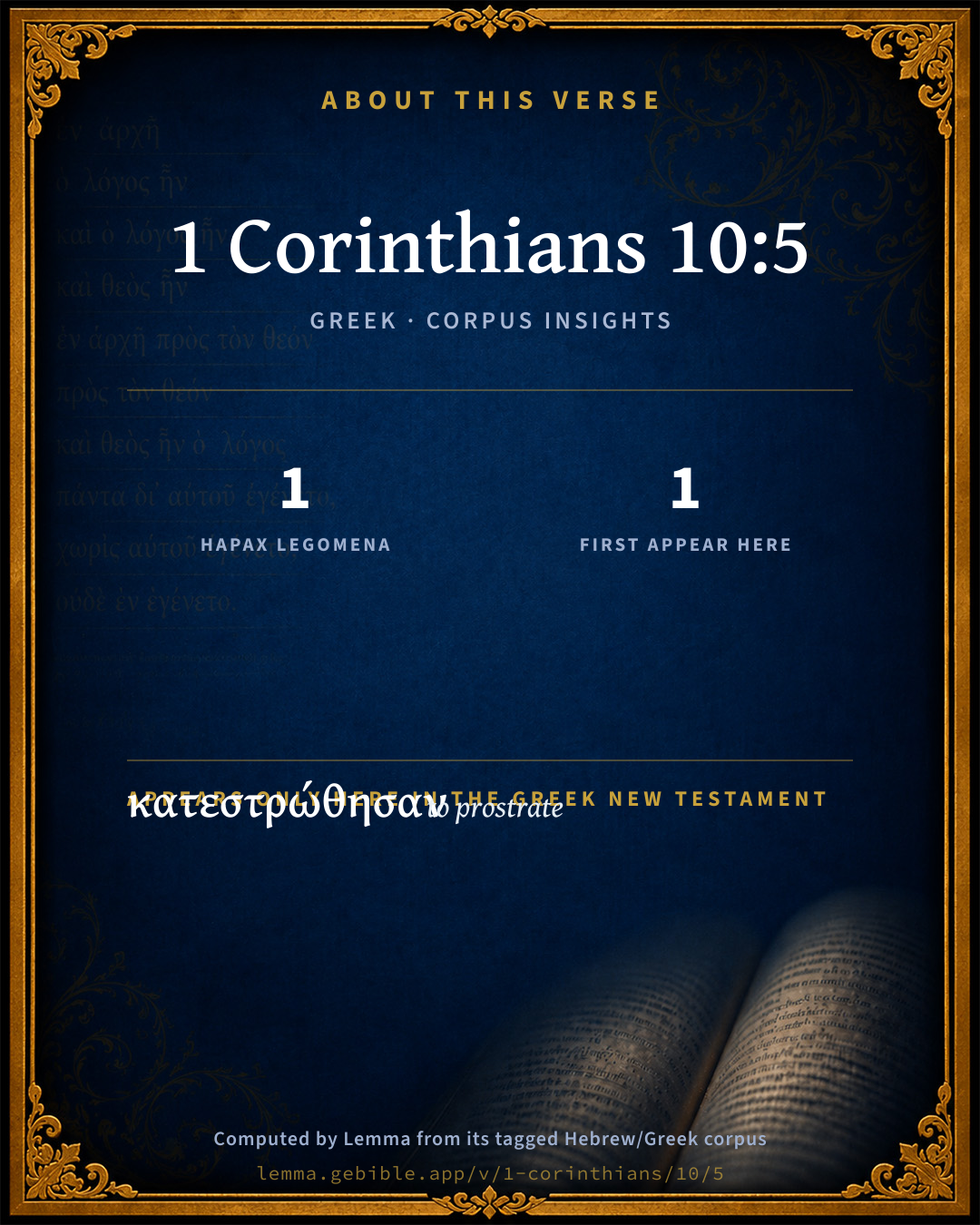
  • 1 hapax legomenon — only here in the Greek New Testament
  • 1 first appearance in the Greek New Testament
Full analysis ↓
Download a study sheet

One document with this verse’s original text, its word-by-word gloss line, the meaning frame, cross-references with their text, attributed commentary, and full source and license credits — printable, and it pastes into notes with its structure intact.

This verse Autodidact and up

Study sheet (.html) Plain text (.txt)

A passage Seminary Student

Up to 50 verses in one chapter. A passage sheet keeps up to 6 commentary sources and 12 cross-references per verse, in the order this page ranks them, and says so on the sheet whenever that leaves anything out. Ask for a single verse and you get the Autodidact verse sheet above.

Everything on this page stays free to read, with no account — the sheet is a download of what is already on screen, not access to it.

Want to remove ads? Support Godless Engineer
Compare translations 3

The same verse in 3 English versions, stacked beneath the original-language interlinear above. Click any original word for its lexicon entry.

Each is an independent rendering of the whole verse — the interlinear is not word-aligned to these translations.

Highlighted words mark where these versions differ — a whole-verse word diff, not a word-by-word alignment.

  • World English Bible Public Domain
    However with most of them, God was not well pleased, for they were overthrown in the wilderness.
  • King James Version Public Domain
    But with many of them God was not well pleased: for they were overthrown in the wilderness.
  • unfoldingWord Literal Text CC BY-SA 4.0
    But God was not well pleased with most of them, for they were scattered about in the wilderness.

unfoldingWord Literal Text — © unfoldingWord, licensed CC BY-SA 4.0. Word-aligned USFM3 via Door43 (git.door43.org/unfoldingWord/en_ult).

Versions to compare (up to 4)

3 of 4 selected

Show all 19 translations

Every available English version of this verse, each an independent rendering of the whole verse.

  • World English Bible Public Domain
    However with most of them, God was not well pleased, for they were overthrown in the wilderness.
  • Berean Standard Bible Public Domain
    Nevertheless, God was not pleased with most of them, for they were struck down in the wilderness.
  • Majority Standard Bible Public Domain
    Nevertheless, God was not pleased with most of them, for they were struck down in the wilderness.
  • King James Version Public Domain
    But with many of them God was not well pleased: for they were overthrown in the wilderness.
  • American Standard Version (1901) Public Domain
    Howbeit with most of them God was not well pleased: for they were overthrown in the wilderness.
  • Revised Version (1885) Public Domain
    Howbeit with most of them God was not well pleased: for they were overthrown in the wilderness.
  • Geneva Bible (1599) Public Domain
    But with many of them God was not pleased: for they were ouerthrowen in ye wildernes.
  • Douay-Rheims (1899) Public Domain
    But with most of them God was not well pleased: for they were overthrown in the desert.
  • Young's Literal Translation Public Domain
    but in the most of them God was not well pleased, for they were strewn in the wilderness,
  • Literal Standard Version CC BY-SA 4.0
    but in the most of them God was not well pleased, for they were strewn in the wilderness,
  • Unlocked Literal Bible CC BY-SA 4.0
    But God was not well pleased with most of them, and their corpses were scattered about in the wilderness.
  • unfoldingWord Literal Text CC BY-SA 4.0
    But God was not well pleased with most of them, for they were scattered about in the wilderness.
  • Darby Bible Public Domain
    yet God was not pleased with the most of them, for they were strewed in the desert.
  • World Messianic Bible Public Domain
    However with most of them, God was not well pleased, for they were overthrown in the wilderness.
  • Webster's Bible Public Domain
    But with many of them God was not well pleased: for they were overthrown in the wilderness.
  • Free Bible Version CC BY-SA 4.0
    However, God wasn't happy with most of them, and they perished in the desert.
  • Bible in Basic English Public Domain
    But with most of them God was not pleased: for they came to their end in the waste land.
  • Text-Critical English NT CC BY 4.0
    Nevertheless, God was not pleased with most of them, for their bodies were scattered in the wilderness.
  • Tyndale New Testament (1534) Public Domain
    But in many of them had god no delite. For they were overthrowen in the wildernes.

Literal Standard Version (2020), Covenant Press — licensed CC BY-SA 4.0. Text via the HelloAO Bible API (eBible.org). Unlocked Literal Bible (unfoldingWord) — licensed CC BY-SA 4.0. Text via the HelloAO Bible API (eBible.org). unfoldingWord Literal Text — © unfoldingWord, licensed CC BY-SA 4.0. Word-aligned USFM3 via Door43 (git.door43.org/unfoldingWord/en_ult). Free Bible Version, Dr. Jonathan Gallagher — licensed CC BY-SA 4.0. Text via the HelloAO Bible API (eBible.org).

Word by word

More ways to search: Search by grammar → Find every occurrence → Compare this word →

Practice this passage: Drill this verse → Learn its vocabulary →

κατεστρώθησαν
katastrṓnnymi
G2693
“to prostrate”
Verb, Aorist, Passive, Indicative, 3rd person, Plural
Part of Speech
Verb
Tense
Aorist
Voice
Passive
Mood
Indicative
Person
3rd person
Number
Plural
Full Thayer's Definition

Origin: from G2596 and G4766

TDNT: None

1. to strew over (the ground) 2. to prostrate, slay, (cf to lay low)
  1. ἀλλ’ allá G235 “but” Conjunction
  2. οὐκ ou G3756 “not” Particle, Negative
  3. ἐν en G1722 “in” Preposition
  4. τοῖς ho G3588 “the” Article, Dative, Plural, Masculine
  5. πλείοσιν pleíōn G4119 “greater” Adjective, Dative, Plural, Masculine, Comparative
  6. αὐτῶν autós G846 “he” Personal pronoun, Genitive, Plural, Masculine
  7. εὐδόκησεν eudokéō G2106 “to be pleased” Verb, Aorist, Active, Indicative, 3rd person, Singular
  8. ὁ ho G3588 “the” Article, Nominative, Singular, Masculine
  9. θεός theós G2316 “God” Noun, Nominative, Singular, Masculine
  10. γὰρ gár G1063 “for” Conjunction
  11. ἐν en G1722 “in” Preposition
  12. τῇ ho G3588 “the” Article, Dative, Singular, Feminine
  13. ἐρήμῳ érēmos G2048 “desolate” Adjective, Dative, Singular, Feminine

About this verse

These counts appear in no published source. They are computed here, from the morphology-tagged text and Lemma’s own curated glosses. What Lemma adds →

14
words
11
distinct lemmas
Pauline Epistles
section

Notable vocabulary

1 hapax legomenon — a word that appears only here in the entire Greek New Testament:

  • κατεστρώθησαν to prostrate G2693

First appearance in Scripture

This word makes its first canonical appearance in the Greek New Testament here:

  • κατεστρώθησαν to prostrate G2693

Shared distinctive vocabulary

εὐδόκησεν to be pleased G2106 occurs in 21 verses of the Greek New Testament. Also found in:
Repetition

Words recur within this verse:

Cross-references

13

Topical passages linked to 1 Corinthians 10:5 in the Treasury of Scripture Knowledge — connected by theme and wording, ordered by reader-vote popularity; previews shown in the World English Bible.

  • Hebrews 3:17 With whom was he displeased forty years? Wasn't it with those who sinned, whose bodies fell in the wilderness?
  • Jude 1:5 Now I desire to remind you, though you already know this, that the Lord, having saved a people out of the land of Egypt, afterward destroyed those who didn't believe.
  • Numbers 26:64–65 But among these there was not a man of them who were numbered by Moses and Aaron the priest, who numbered the children of Israel in the wilderness of Sinai.
  • Numbers 14:37 even those men who did bring up an evil report of the land, died by the plague before Yahweh.
  • Numbers 14:11–12 Yahweh said to Moses, How long will this people despise me? and how long will they not believe in me, for all the signs which I have worked among them?
  • Numbers 14:28–35 Tell them, As I live, says Yahweh, surely as you have spoken in my ears, so will I do to you:
  • Psalms 78:32–34 For all this they still sinned, And didn't believe in his wondrous works.
  • Psalms 106:26 Therefore he swore to them That he would overthrow them in the wilderness,
  • Deuteronomy 1:34–35 Yahweh heard the voice of your words, and was angry, and swore, saying,
  • Psalms 95:11 Therefore I swore in my wrath, "They won't enter into my rest."
  • Deuteronomy 2:15–16 Moreover the hand of Yahweh was against them, to destroy them from the midst of the camp, until they were consumed.
  • Psalms 90:1 Lord, you have been our dwelling place for all generations.
  • Psalms 90:7–8 For we are consumed in your anger. We are troubled in your wrath.

Cross-references courtesy of OpenBible.info (CC BY 4.0).

Commentary

Notes on 1 Corinthians 10:5 from classic Christian and Jewish commentators (each source and its license shown beneath its notes). The classic Christian expositions comment on the surrounding passage and are grouped to its opening verse, so a note may address several verses; the Jewish commentaries on the Tanakh (Rashi and others) are per-verse, so they appear only where the commentator wrote on this verse.

Lemma curates 59 commentaries, every one of them public domain or Creative Commons licensed, each selected and text-cleaned for this edition rather than reprinted as found. About our sources →

Joseph Benson's Commentary

1Co 10:5-6. But with many of them — Although they had so many tokens of the divine presence with them, and enjoyed such singular favours; God was not well pleased — So far from it, that he swore in his wrath they should not enter into the rest he had provided for them; and therefore they were overthrown in the wilderness — With the most terrible marks of his wrath. Even the whole generation that came adult out of Egypt died there, and sometimes in such multitudes, that the ground was overspread with carcasses, as a field is in which a battle has been fought. Now these things — These punishments; were our examples — Showing what we are to expect, notwithstanding our profession of Christianity, if we act like them; if, enjoying the like benefits, we commit the like sins. The benefits are here set down in the same order as by Moses in Exodus; the sins and punishments in a different order: evil desire first, as being the foundation of all; next idolatry, 1Co 10:7; 1Co 10:14; then fornication, which usually accompanied it, 1Co 10:8; tempting and murmuring against God in the following verses. To the intent we should not lust after evil things — Should not indulge irregular and luxurious desires; as they also lusted — After flesh, in contempt of the manna, and thereby brought the wrath of God upon themselves, and were consumed with pestilential distempers, while the meat was yet between their teeth, Psa 78:30-31. Learn, therefore, as if he had said, by what they suffered, to cultivate that temperance and self-denial which I have just been recommending to you.

Joseph Benson's Commentary on the Old and New Testaments (1811–1818) — public domain. Text from a community e-Sword module.

Bengel's Gnomon

Johann Albrecht Bengel

1Co 10:5. Ἀλλ, but) although they had so many signs of the Divine presence.—οὐκ ἐν τοῖς πλειόσιν αὐτῶν, not with the most of them) The position of the particle not should be noticed. Reason might suggest, that God certainly was well pleased ἐν τοῖς πλειόσιν, with the most of them. This the apostle denies. He not only points out those, who are particularly described presently afterwards, but at the same time many others.—ὁ Θεὸς, God) whose judgment alone is valid.—κατεστρώθησαν, were overthrown) in great heaps, and with great force. The LXX. have used this word in Num 14:16.—γὰρ, for) The event showed, that they had not pleased God.—ἐν τῇ ἐρήμῳ, in the wilderness) far from the land of promise.

Bengel's Gnomon of the New Testament — English translation (T&T Clark, Edinburgh, 1860) — public domain. Text from a community e-Sword module.

Meyer's Critical & Exegetical Commentary

Heinrich August Wilhelm Meyer

1Co_10:5. Οὐκ ἐν τοῖς πλείοσιν] not with the greater part of them. A tragical litotes. Caleb and Joshua alone reached the land of promise. Num_14:30.

κατεστρώθησαν] were struck down. Comp Num_14:16; Num_14:29. Their dying in the wilderness (some by a violent, some by a natural death) is here vividly portrayed, in accordance with Numbers 14, as death by the hand of God (Herod. viii. 53, ix. 76; Xen. Cyr. iii. 3. 64; Jdt_7:14; 2Ma_5:26). Comp also Heb_3:17.

Meyer — Critical and Exegetical Commentary on the New Testament — English translation by Peter Christie, edited by Frederick Crombie (T&T Clark, 1880) — public domain. Text from a community e-Sword module.

Expositor's Greek Testament

ed. W. Robertson Nicoll

1Co 10:5 . “But not with the greater part (of them)” a “tragic litotes : only Joshua and Caleb reached the Promised Land” (Num 14:30 : Mr [1419] ). The result negatives what one expects from the antecedents; hence the strong adversative ἀλλʼ οὐκ . τοῖς πλείοσιν “the majority” of the πάντες so highly favoured; cf. 1Co 15:6 . ηὐδόκησεν ἐν (after the LXX), Heb. chaphets b; the ἐν resembles that of 1Co 9:15 ; see Wr [1420] , p. 291. κατεστρώθησαν γὰρ κ . τ . λ ., “For they (their bodies) were laid prostrate in the wilderness,” gives graphic proof, in words borrowed from the O.T. narrative, of God’s displeasure; sooner or later this doom overtook nearly all the witnesses of the Exodus ( cf. Heb 3:17 ). “What a spectacle for the eyes of the self-satisfied Cor [1421] : all these bodies, full-fed with miraculous nourishment, strewing the soil of the desert!” (Gd [1422] ).

[1419] Meyer’s Critical and Exegetical Commentary (Eng. Trans.).

[1420] Winer-Moulton’s Grammar of N.T. Greek (8th ed., 1877).

[1421] Corinth, Corinthian or Corinthians.

[1422] F. Godet’s Commentaire sur la prem. Ép. aux Corinthiens (Eng. Trans.).

The Expositor's Greek Testament, edited by W. Robertson Nicoll (1897–1910) — public domain. Text from a community e-Sword module.

Hodge's Commentary on Romans, Ephesians & First Corinthians

Charles Hodge

1Co_10:5

But with many of them God was not well pleased: for they were overthrown in the wilderness.

But, i.e. notwithstanding they had been thus highly favored. With many; literally, with the greater number. God was not well pleased, that is, he was displeased. The proof of his displeasure was that they were overthrown in the wilderness. Literally, they were strewed as corpses in the wilderness. Their pain through the desert could be traced by the bones of those who perished through the judgments of God.

Charles Hodge — Commentary on Romans (1835), First Corinthians (1857), and Ephesians (1856) — public domain. Text from a community e-Sword module.

Jamieson, Fausset & Brown

Robert Jamieson, A. R. Fausset & David Brown

But--though they had so many tokens of God's presence.

many of them--rather, "the majority of them"; "the whole part." All except Joshua and Caleb of the first generation.

not--in the Greek emphatically standing in the beginning of the sentence: "Not," as one might have naturally expected, "with the more part of them was," &c.

God--whose judgment alone is valid.

for--the event showed, they had not pleased God.

overthrown--literally, "strewn in heaps."

in the wilderness--far from the land of promise.

Jamieson, Fausset & Brown — Commentary Critical and Explanatory on the Whole Bible (1871) — public domain (CC PDM 1.0). Text via the HelloAO Bible API.

Adam Clarke's Commentary

Verse 5. They were overthrown in the wilderness.] And yet ALL these persons were under the cloud - ALL passed through the sea - ALL were baptized into Moses in the cloud and in the sea - ALL ate the same spiritual meat - ALL drank the same spiritual drink, for they were made partakers of the spiritual Rock, CHRIST. Nothing can be a more decisive proof than this that people, who have every outward ordinance, and are made partakers of the grace of our Lord Jesus, may so abuse their privileges and grieve the Spirit of God as to fall from their state of grace, and perish ever lastingly. Let those who are continually asserting that this is impossible, beware lest they themselves, if in a state of grace, become, through their overmuch security, proofs in point of the possibility of ending in the flesh, though they began in the Spirit. Reader, remember who said, Ye shall not surely die; and remember the mischiefs produced by a belief of his doctrine.

Adam Clarke's Commentary on the Bible (1810–1826) — public domain. Text from a community e-Sword/MySword module.

John Calvin's Commentaries

5. But many of them. We have now the reason why the Apostle has premised these things — that we might not claim for ourselves any dignity or excellence above them, but might walk in humility and fear, for thus only shall we secure, that we have not been favored in vain with the light of truth, and with such an abundance of gracious benefits. “God,” says he, “had chosen them all as his people, but many of them fell from grace. Let us, therefore, take heed, lest the same thing should happen to us, being admonished by so many examples, for God will not suffer that to go unpunished in us, which he punished so severely in them.”

Here again it is objected: “If it is true, that hypocrites and wicked persons in that age ate spiritual meat, do unbelievers in the present day partake of the reality in the sacraments?” Some, afraid lest the unbelief of men should seem to detract from the truth of God, teach that the reality is received by the wicked along with the sign. This fear, however, is needless, for the Lord offers, it is true, to the worthy and to the unworthy what he represents, but all are not capable of receiving it. In the meantime, the sacrament does not change its nature, nor does it lose anything of its efficacy. Hence the manna, in relation to God, was spiritual meat even to unbelievers, but because the mouth of unbelievers was but carnal, they did not eat what was given them. The fuller discussion, however, of this question I reserve for the 11th Chapter.

For they were overthrown. Proof is here furnished, by adducing a token, that they did not please God — inasmuch as he exercised his wrath upon them with severity, and took vengeance on their ingratitude. Some understand this as referring to the whole of the people that died in the desert, with the exception of only two — Caleb and Joshua. (Numbers 14:29.) I understand him, however, as referring merely to those, whom he immediately afterwards makes mention of in different classes.

John Calvin's Commentaries (1540-1563) — public domain. Text from the Calvin Translation Society English edition (1840s-50s) via the Christian Classics Ethereal Library (ccel.org). Calvin's coverage is partial (roughly two-thirds of the Bible); uncommented books and verses are honest gaps, never fabricated. The 19th-century editor's footnotes and remarks are omitted so the notes are faithfully Calvin's own voice.

Ellicott's Commentary for English Readers

(5) But with many of them.—Better, Nevertheless not with the greater part of them was God pleased. This introduces the point from which the Apostle seeks to draw the great lesson of self-distrust. All had all these privileges—privileges of a baptism and a spiritual meat and drink which correspond with the sacramental ordinances which are proofs and pledges of all the privileges of us Christians—and yet with the greater part—in fact, with all except two—of that vast multitude God was not pleased, as is proved by the fact that (Num_14:16) all except Caleb and Joshua perished in the wilderness.

A Bible Commentary for English Readers, edited by Charles John Ellicott (1878–1897) — public domain. Text from a community e-Sword module.

The Cambridge Bible for Schools and Colleges

gen. ed. J. J. S. Perowne

5. with many of them] Rather, most. The point aimed at is, that in spite of their high privileges and great opportunities, the majority of them were destroyed. Cf. Heb_3:17. Joshua and Caleb only, Num_14:38, were permitted to enter the promised land. See also Num_26:64-65.

The Cambridge Bible for Schools and Colleges (gen. ed. J. J. S. Perowne; Cambridge University Press, 1878–1918) — public domain. Text from a community e-Sword module.

John Gill's Exposition

But with many of them God was not well pleased,.... As he is with none but those that are in Christ; and with none of the services of men, but what are done in faith, which become acceptable to him through Jesus Christ; for in him only persons and services are accepted with God; and this was the way of acceptance in the Old, as in the New Testament dispensation: how many of the Jewish fathers God was not well pleased with, or took no delight in, but hated and abhorred, which is the sense of the phrase here, whether they were the greatest part or not, is not certain; however, they were not all, excepting Joshua and Caleb, as some interpreters understand it; for not all that died in the wilderness were out of the special grace and favour of God, witness Moses, Aaron, Miriam, and, it is to be supposed and hoped, hundreds and thousands more; but the apostle has respect to such who were the instances of God's direful vengeance and displeasure, as appears from the reason given;

for they were overthrown in the wilderness: he does not say merely that they died there, for many with whom God was well pleased died there; but these, their carcasses fell in the wilderness, being stricken, thrown down, and overthrown by the immediate hand of God; they did not die a common death, according to the ordinary course of nature; but by the plague, or by the sword, or by fire from heaven, or by fiery serpents, or by a destroying angel, or by one judgment or another, as hereafter mentioned.

John Gill's Exposition of the Whole Bible (1746–1763) — public domain (CC PDM 1.0). Text via the HelloAO Bible API.

Trapp's Complete Commentary

John Trapp

5 But with many of them God was not well pleased: for they were overthrown in the wilderness.

Ver. 5. They were overthrown] They died with the sacramental meat in their mouths. Our privileges excuse us not, but aggravate our enormities.

John Trapp, A Commentary or Exposition upon All the Books of the Old and New Testament (1647–1656) — public domain. Text from a community e-Sword module.

Albert Barnes' Notes on the Bible

But with many of them ... - That is, with their conduct. They rebelled and sinned, and were destroyed. The design of the apostle here is, to remind them that although they enjoyed so many privileges, yet they were destroyed; and thus to admonish the Corinthians that their privileges did not constitute an absolute security from danger, and that they should be cautious against the indulgence of sin. The phrase rendered here “with many” ἐν τοῖς πλείων en tois pleiōn should have been rendered “with most of them,” literally” with the many; and it means that with the greater part of them God was not well pleased; that is, he was pleased with but few of them.

Was not well pleased - Was offended with their ingratitude and rebellion.

For they were overthrown ... - That is, by the pestilence, by wars, or died by natural and usual diseases, so that they did not reach the land of Canaan. But two men of that generation, Caleb and Joshua, were permitted to enter the land of promise; Num 14:29-30.

Albert Barnes' Notes on the Bible (1834–1885) — public domain. Text from a community e-Sword/MySword module.

Haydock's Catholic Bible Commentary

God was not well pleased, &c. Of 600,000, only Josue and Caleb entered the land of promise; the rest were destroyed, and perished in the wilderness. Their punishment ought to be an admonition to all to avoid such sins of idolatry, fornication, murmuring, &c.

George Leo Haydock (1774–1849), Haydock's Catholic Family Bible and Commentary, 1859 edition — public domain. Excludes Psalms (Douay-Rheims chapter numbering differs from Protestant) and Deuterocanonical books (Catholic canon only).

Matthew Poole's English Annotations

But with many of them God was not well pleased; these many were no less than that whole generation, which were at that time twenty years old and upward, according to the threatening, Num 14:28,29; of the acccomplishment of which we read, Num 26:64,65.

For they were over thrown in the wilderness; as an instance of God’s being displeased with them, he giveth their falling in the wilderness. It is very possible, that many of these were the objects of God’s eternal and special love, and eternally saved, notwithstanding their joining with worse men in their rebellion and murmuring; but that signal judgment of God upon them was enough to prove, that their being baptized unto Moses in the cloud and in the sea, and being made partakers of those great privileges of eating spiritual meat, and drinking spiritual drink, typifying Christ, did not set them out of the danger of God’s judgments, which is the use the apostle maketh of it.

Matthew Poole's English Annotations on the Holy Bible (1683–1685) — public domain. Text from a community e-Sword/MySword module.

Whedon's Commentary on the Bible

Daniel D. Whedon

5. Many—All ate and drank sacramentally of Christ, but many apostatized.

Overthrown—Rather, strown; their carcasses lying on the desert surface. This refers not to the myriads who died a natural death, but to the numbers that were slain by divine sentence for sin.

Daniel D. Whedon (gen. ed.), Commentary on the Old and New Testaments (1874–1909) — public domain. Text from a community e-Sword module.

The Pulpit Commentary

With many of them; rather, with most of them. They were overthrown in the wilderness. A quotation from the LXX of Num_14:16. All but Caleb and Joshua perished. (Num_26:64, Num_26:65; comp. Jud_1:5) In Heb_3:17 the word used is "they fell."

The Pulpit Commentary (1880–1919), ed. H.D.M. Spence-Jones & Joseph S. Exell — public domain. Text from a community e-Sword module.

John Wesley's Explanatory Notes

Yet - Although they had so many tokens of the divine presence. They were overthrown - With the most terrible marks of his displeasure.

John Wesley, Explanatory Notes Upon the Whole Bible (1754–1765) — public domain. Text via the GEBible commentary corpus.

Burkitt's Expository Notes on the New Testament

William Burkitt

Although the Israelites were made partakers of the before-mentioned privileges and spiritual favours; though they were baptized unto Moses in the cloud and in the sea, and did eat sacramental meat, and drink sacramental drink; yet it did not set them out of danger of God’s displeasure, for they were overthrown, their carcasses fell in the wilderness.

Learn hence, That no external privileges or prerogatives whatsoever can exempt persons from God’s judgments, if they return not suitably to him for the favours and benefits received from him.

The bare outward receiving of a sacrament is not saving to the soul of a person: and the unworthy receiving of sacraments, and unsuitable walking after them, do enkindle God’s anger and provoke his heavy displeasure against persons, even to the cutting them off by untimely death here in this world: With many of them God was displeased, and they were overthrown in the wilderness.

William Burkitt's Expository Notes on the New Testament (1700–1703) — public domain. Text from a community e-Sword module.

Godbey's Commentary on the New Testament

William B. Godbey

5. Awful retributions overtook Israel in the wilderness, because they sinned.

William B. Godbey, Commentary on the New Testament (1896–1900) — public domain. Text from a community e-Sword module.

McGarvey & Pendleton's Commentaries

J. W. McGarvey

Howbeit with most of them God was not well pleased: for they were overthrown [literally, strewn in heaps] in the wilderness . [In 1Co_10:24 of the preceding chapter Paul enforces the lesson of self-control by showing that though all run, yet but one receives the prize. This law, which the Greeks applied to a mere handful of racers, was applied of God with like rigor and stringency to the millions of Israel, a fact which Paul emphasizes by the repeated use of the word "all." Though all were under the cloud and all passed through the sea and all were baptized and all ate and drank of spiritual provision, yet only two, Caleb and Joshua, entered the promised land ( Deu_1:34-38 ; Num_26:64-65 ). What was true of racers and true of Israel may also be true of Christians if they fail to exercise self-control.]

J. W. McGarvey (with Philip Y. Pendleton), Commentaries on the New Testament (The Fourfold Gospel, 1914; Acts; and the epistles) — public domain. Text from a community e-Sword/MySword module.

The People's New Testament

B. W. Johnson

5. But with many of them God was not well pleased. “All” were baptized, “all” were fed, “all” did drink, but notwithstanding God had done so much for them “all” without exception, many fell in the wilderness because of their sins; a startling warning to Christians on the journey.

B. W. Johnson's The People's New Testament with Notes (1889–1891) — public domain. Electronic text from the Christian Classics Ethereal Library (CCEL) ThML edition.

unfoldingWord translationNotes

Door43 World Missions Community

not well pleased

"displeased" or "angry" (See: Litotes)

most of them

the Israelite fathers

their corpses were scattered about

"God scattered their dead bodies around" or "God killed them and scattered their bodies"

in the wilderness

the desert land between Egypt and Israel through which the Israelites wandered for 40 years

translationWords

desert

evil

unfoldingWord translationNotes — © Distant Shores Media and the Door43 World Missions Community, licensed CC BY-SA 4.0. Source: git.door43.org/Door43/en_tn.

Cambridge Greek Testament for Schools and Colleges

5. ἐν τοῖς πλείοσιν. The point aimed at is, that in spite of their high privileges and great opportunities, the majority of them was destroyed. Cf. Heb 3:16. Joshua and Caleb only, Num 14:38, were permitted to enter the promised land. See also Num 26:64-65.

κατεστρώθησαν. Compare our strewn. The expression is graphic and forcible.

Cambridge Greek Testament for Schools and Colleges (Cambridge University Press, 1896; 21 vols, various authors incl. Carr, Maclear, Plummer, Farrar, Lumby, Moule, M. R. James, Simcox) — public domain. Text from a community e-Sword module.

Alford’s Greek Testament

Henry Alford

5.] Howbeit with the more part of them (in fact the exceptions were Joshua and Caleb only) God was not well pleased.

κατεστρ. γὰρ …] The very words of the LXX, see ref.

Henry Alford, The Greek Testament (1849–1861) — public domain. Text from a community e-Sword module.

International Critical Commentary

5. ἀλλʼ οὐκ ἐν τοῖς πλείοσιν αὐτῶν ηὐδόκησεν ὁ Θεός. ‘Howbeit, not with most of them was God well pleased.’ Although all of them had great blessings (and, in particular, those which resembled the two sacraments which the Corinthian Church enjoyed), there were very few in whom God’s gracious purpose respecting them could be fulfilled. In οὐκ ἐν τοῖς πλείοσιν we have a mournful understatement: only two, Caleb and Joshua, entered the Promised Land (Num 14:30-32). All the rest, thousands in number, though they entered the lists, were disqualified, ἀδόκιμοι ἐγένοντο (9:27), by their misconduct.

In the Epistles, the evidence as to the augment of εὐδοκέω varies greatly; in 1:21, εὐδόκησεν is undisputed; here the balance favours ηύδ. (A B* C): see WH. 11. Notes p. 162.

The construction εὐδ. ἔν τινι is characteristic of LXX and N.T., while Polybius and others write εὐδ. τινι: but exceptions both ways are found (2Th 2:12; 2Th_1 Mac. 1:43). In Mat 12:18 and Heb 10:6 we have the accusative.

κατεστρώθησαν γὰρ ἐν τῇ ἐρήμῳ. The γάρ introduces a justification of the previous statement. God cannot have been well pleased with them, for κατέστρωσεν αὐτοὺς ἐν τῇ ἐρήμῳ (Num 14:16). They did not die a natural death; their death was a judicial overthrow. The verb is frequent in judges and 2 Maccabees; cf. Eur. Her. Fur. 1000: nowhere else in N.T. It gives a graphic picture, the desert strewn with dead (Heb 3:17).

International Critical Commentary — older volumes (1896–1929), various authors — public domain. Text from a community e-Sword module.

Vincent's Word Studies in the New Testament

Marvin R. Vincent

Many [τοις πλειοσιν] . The A. V. misses the force of the article, the many. Hence Rev., correctly, most of them. All perished save Caleb and Joshua.

Overthrown [κατεστρωθησαν] . Only here in the New Testament. Lit., were strewn down along (the ground). The word belongs mostly to later Greek, though found in Herodotos in the general sense of slaying. So Euripides : "He laid low his wife and child with one dart" (" Hercules Furens, " 1000). It is used of spreading a couch.

Marvin R. Vincent, Word Studies in the New Testament (1887–1900) — public domain. Text from a community e-Sword/MySword module.

Godet's Commentaries

Frédéric Louis Godet

Vv. 5. “But with most of them God was not well pleased: for they were overthrown in the wilderness.”—᾿Αλλά: notwithstanding so great favours. — They were overthrown..., an allusion to Num 14:29 : “Your carcases shall fall in the wilderness.” What a spectacle is that which is called up by the apostle before the eyes of the self-satisfied Corinthians: all those bodies, sated with miraculous food and drink, strewing the soil of the desert!

Frédéric Louis Godet — Commentaries on Luke, John, Romans, and 1 Corinthians — English translation (T&T Clark, Edinburgh, 1870s–1890s) — public domain. Text from a community e-Sword module.

Lesson kit

Teaching starters — assembled from the data on this page, not authored interpretation. Every prompt links to the verse data it draws on. Edit before teaching.

1 Corinthians, in the Pauline Epistles, opens this verse with 14 words (11 distinct Greek lemmas). Its most distinctive word is katastrṓnnymi (“to prostrate”). A historical commentator’s framing appears above. Read the whole chapter for the surrounding context.

Discussion questions

  1. What does “to prostrate” (katastrṓnnymi) contribute to the verse as a whole?
  2. 1 word here appears nowhere else in the Greek New Testament. Why might the author reach for such rare wording?
  3. This is the first place “to prostrate” appears in Scripture (first appears here). What does its debut here establish?
  4. How does Matthew 3:17, which shares the word «to be pleased», read alongside this verse?
  5. What does the repetition of “the” (3× in this one verse) do in this verse?
  6. These translations render this verse differently; the difference is in the English rendering, not the original. What questions does that raise?
  7. Compare how Joseph Benson's Commentary and Bengel's Gnomon read this verse. Where do they agree or differ?

Things to notice

  • 1 word in this verse appears nowhere else in the Greek New Testament.
  • 1 word makes its first canonical appearance in Scripture here.
  • These translations choose different wording for 6 words in this verse.
  • “the” occurs 3× in this single verse.
  • 11 distinct Greek lemmas span 14 words in this verse.

Reading settings

Reading text

Shown beneath each verse's original-language words.

Old Testament
Old Testament edition

Read the OT as the Masoretic Hebrew (MT) or the Greek Septuagint (LXX).

English shown for the Greek Septuagint (in the Hebrew ↔ Greek comparison).

Comparing translations? Open the Compare panel on any verse page to stack up to four side by side.