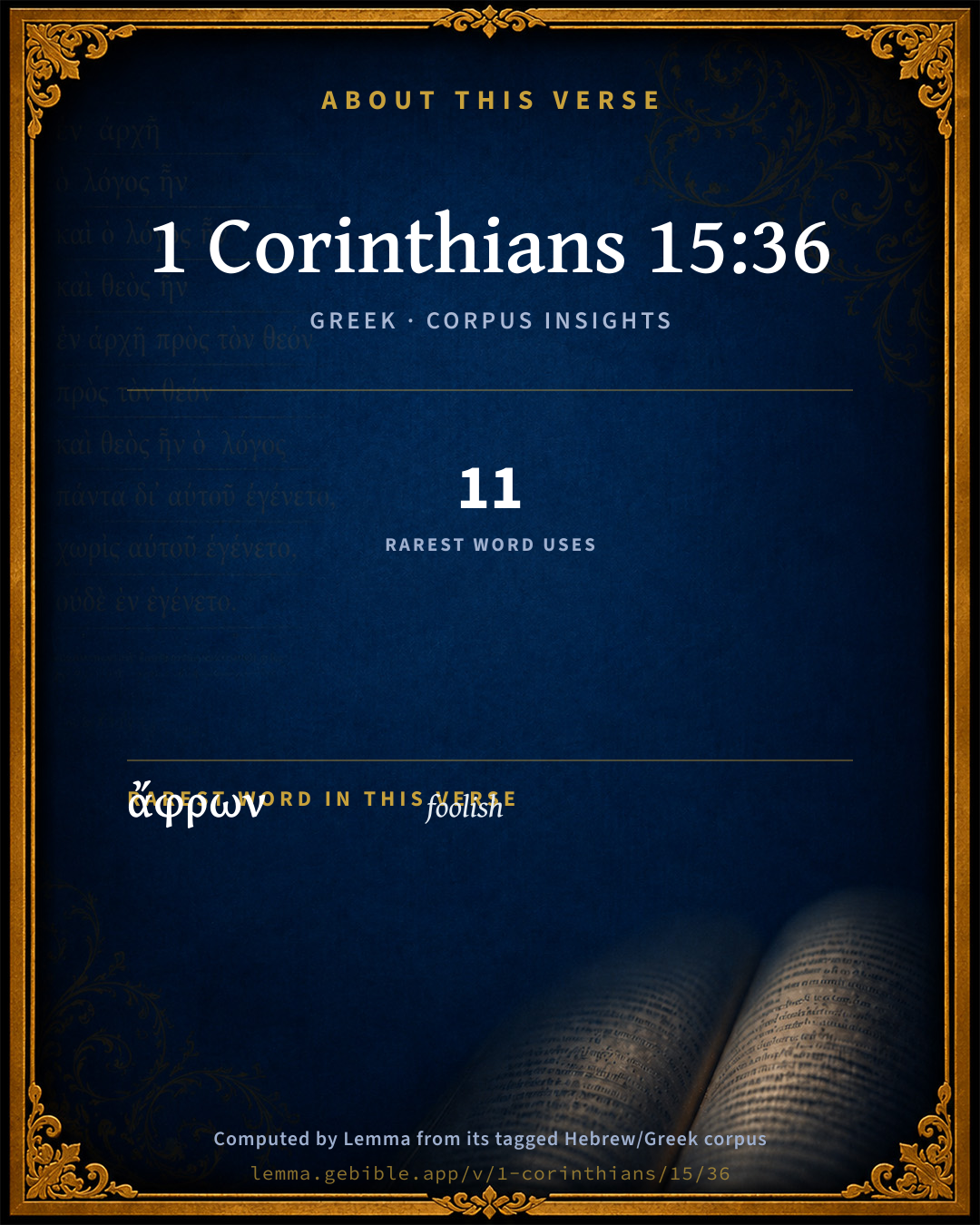
1 Corinthians 15:36

Greek (Tischendorf 8th ed.) 1 Corinthians 15:36 appears in the Greek New Testament. The text above is from the Tischendorf 8th edition. Each word links to its Strong’s number and a concise gloss. Click any word for its full Thayer’s Greek Lexicon entry.
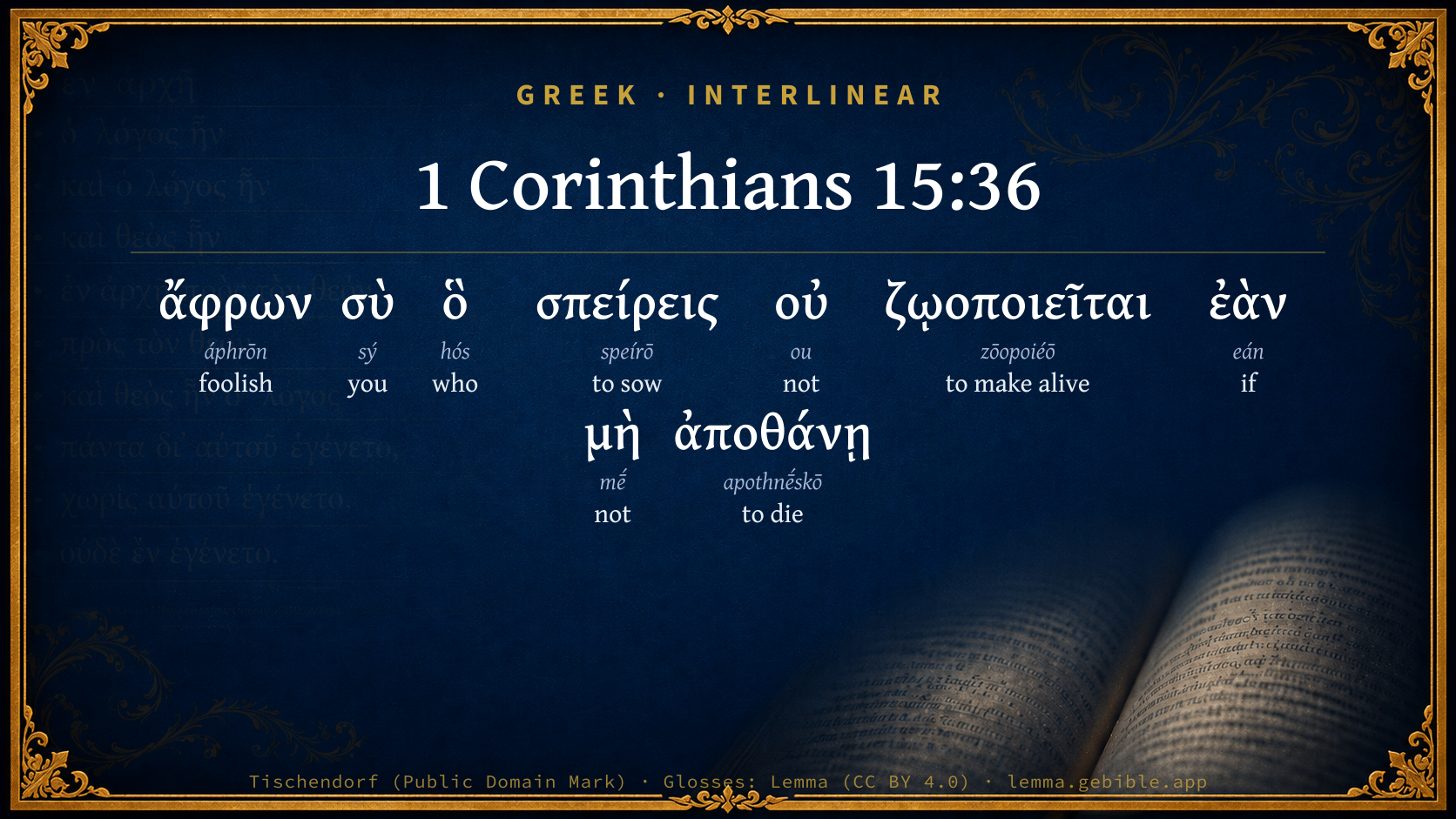
Download image
Cite this verse

1 Corinthians 15:36 (World English Bible). Public Domain. Lemma interlinear Bible study tool, https://lemma.gebible.app/v/1-corinthians/15/36.

Show BibTeX & RIS
BibTeX
RIS
English Translation
You foolish one, that which you yourself sow is not made alive unless it dies.
World English Bible · Public Domain
Download a study sheet

One document with this verse’s original text, its word-by-word gloss line, the meaning frame, cross-references with their text, attributed commentary, and full source and license credits — printable, and it pastes into notes with its structure intact.

This verse Autodidact and up

Study sheet (.html) Plain text (.txt)

A passage Seminary Student

Up to 50 verses in one chapter. A passage sheet keeps up to 6 commentary sources and 12 cross-references per verse, in the order this page ranks them, and says so on the sheet whenever that leaves anything out. Ask for a single verse and you get the Autodidact verse sheet above.

Everything on this page stays free to read, with no account — the sheet is a download of what is already on screen, not access to it.

Want to remove ads? Support Godless Engineer
Compare translations 3

The same verse in 3 English versions, stacked beneath the original-language interlinear above. Click any original word for its lexicon entry.

Each is an independent rendering of the whole verse — the interlinear is not word-aligned to these translations.

Highlighted words mark where these versions differ — a whole-verse word diff, not a word-by-word alignment.

  • World English Bible Public Domain
    You foolish one, that which you yourself sow is not made alive unless it dies.
  • King James Version Public Domain
    Thou fool, that which thou sowest is not quickened, except it die:
  • unfoldingWord Literal Text CC BY-SA 4.0
    You foolish one! What you sow is not caused to live unless it dies.

unfoldingWord Literal Text — © unfoldingWord, licensed CC BY-SA 4.0. Word-aligned USFM3 via Door43 (git.door43.org/unfoldingWord/en_ult).

Versions to compare (up to 4)

3 of 4 selected

Show all 19 translations

Every available English version of this verse, each an independent rendering of the whole verse.

  • World English Bible Public Domain
    You foolish one, that which you yourself sow is not made alive unless it dies.
  • Berean Standard Bible Public Domain
    You fool! What you sow does not come to life unless it dies.
  • Majority Standard Bible Public Domain
    You fool! What you sow does not come to life unless it dies.
  • King James Version Public Domain
    Thou fool, that which thou sowest is not quickened, except it die:
  • American Standard Version (1901) Public Domain
    Thou foolish one, that which thou thyself sowest is not quickened except it die:
  • Revised Version (1885) Public Domain
    Thou foolish one, that which thou thyself sowest is not quickened, except it die:
  • Geneva Bible (1599) Public Domain
    O foole, that which thou sowest, is not quickened, except it die.
  • Douay-Rheims (1899) Public Domain
    Senseless man, that which thou sowest is not quickened, except it die first.
  • Young's Literal Translation Public Domain
    unwise! thou -- what thou dost sow is not quickened except it may die;
  • Literal Standard Version CC BY-SA 4.0
    Unwise! You—what you sow is not quickened except it may die;
  • Unlocked Literal Bible CC BY-SA 4.0
    You are so ignorant! What you sow will not start to grow unless it dies.
  • unfoldingWord Literal Text CC BY-SA 4.0
    You foolish one! What you sow is not caused to live unless it dies.
  • Darby Bible Public Domain
    Fool; what *thou* sowest is not quickened unless it die.
  • World Messianic Bible Public Domain
    You foolish one, that which you yourself sow is not made alive unless it dies.
  • Webster's Bible Public Domain
    Thou fool, that which thou sowest is not vivified except it die:
  • Free Bible Version CC BY-SA 4.0
    What a foolish question! What you sow doesn't sprout into life unless it dies.
  • Bible in Basic English Public Domain
    Foolish man, it is necessary for the seed which you put into the earth to undergo death in order that it may come to life again:
  • Text-Critical English NT CC BY 4.0
    Fool! What yoʋ sow does not come to life unless it dies.
  • Tyndale New Testament (1534) Public Domain
    Thou fole that which thou sowest is not quickened except it dye.

Literal Standard Version (2020), Covenant Press — licensed CC BY-SA 4.0. Text via the HelloAO Bible API (eBible.org). Unlocked Literal Bible (unfoldingWord) — licensed CC BY-SA 4.0. Text via the HelloAO Bible API (eBible.org). unfoldingWord Literal Text — © unfoldingWord, licensed CC BY-SA 4.0. Word-aligned USFM3 via Door43 (git.door43.org/unfoldingWord/en_ult). Free Bible Version, Dr. Jonathan Gallagher — licensed CC BY-SA 4.0. Text via the HelloAO Bible API (eBible.org).

Word by word

More ways to search: Search by grammar → Find every occurrence → Compare this word →

Practice this passage: Drill this verse → Learn its vocabulary →

About this verse

These counts appear in no published source. They are computed here, from the morphology-tagged text and Lemma’s own curated glosses. What Lemma adds →

9
words
9
distinct lemmas
Pauline Epistles
section

Notable vocabulary

The rarest word here is ἄφρων foolish G878 — appearing just 11 times in the whole Greek New Testament.

Shared distinctive vocabulary

ἄφρων foolish G878 occurs in 10 verses of the Greek New Testament. Also found in:

Cross-references

6

Topical passages linked to 1 Corinthians 15:36 in the Treasury of Scripture Knowledge — connected by theme and wording, ordered by reader-vote popularity; previews shown in the World English Bible.

  • John 12:24 Most assuredly I tell you, unless a grain of wheat falls into the earth and dies, it remains by itself alone. But if it dies, it bears much fruit.
  • Luke 11:40 You foolish ones, didn't he who made the outside make the inside also?
  • Luke 12:20 "But God said to him, 'You foolish one, tonight your soul is required of you. The things which you have prepared--whose will they be?'
  • Luke 24:25 He said to them, "Foolish men, and slow of heart to believe in all that the prophets have spoken!
  • Romans 1:22 Professing themselves to be wise, they became fools,
  • Ephesians 5:15 Therefore watch carefully how you walk, not as unwise, but as wise;

Cross-references courtesy of OpenBible.info (CC BY 4.0).

Commentary

Notes on 1 Corinthians 15:36 from classic Christian and Jewish commentators (each source and its license shown beneath its notes). The classic Christian expositions comment on the surrounding passage and are grouped to its opening verse, so a note may address several verses; the Jewish commentaries on the Tanakh (Rashi and others) are per-verse, so they appear only where the commentator wrote on this verse.

Lemma curates 59 commentaries, every one of them public domain or Creative Commons licensed, each selected and text-cleaned for this edition rather than reprinted as found. About our sources →

The Biblical Illustrator

Joseph S. Exell

1Co_15:36-40

Thou fool, that which thou sowest is not quickened, except it die.

The reproof of scepticism

I. Justly severe. Thou fool. Because--

1. It is opposed to God and Divine truth.

2. Is based in ignorance and self-conceit.

II. Severely just. Because--

1. It ignores the analogy between natural facts, and the higher purposes of God.

2. Cannot realise anything beyond the domain of natural sense.

3. Denies everything it cannot realise. (J. Lyth, D.D.)

From death to life

The text may be applied to--

I. The facts of nature as here.

II. The events of history.

1. In general. Note the fate of empires. They are born, grow, decay, die or are killed, and out of their ruins, phoenix like, the new emerge: evolution succeeds revolution. So with the dynasties who rule these empires.

2. In particular rulers and statesmen die to give birth to their successors. Moses dies, but Joshua rises. John must decrease that Christ must increase. Saul holds the mantle of martyred Stephen and then wears it.

III. The phenomena of providence. The old order changeth, giving birth to new, etc. Our little systems have their day, etc. Each age has its own mission, and having accomplished it, it dies only, however, to hand on the results of its mission which are embodied in the work of the next.

IV. The development of the Church. This is marked by a series of burials and resurrections, beginning with the burial and resurrection of its great Head. The blood of the martyrs was the seed of the Church. What was more completely dead than Christendom before the reformers awoke it into life! What was deader than religion in England before the great evangelists of the last century aroused it into activity! What are revivals but resurrections of dead churches?

V. The progress of the soul. True manhood is ever mounting on its dead self to nobler things. This is true--

1. Mentally. What intellectual revolutions a thoughtful man passes through! How dead are the dreams of childhood, the ideals of youth, the purposes of later years! How opinions, principles, beliefs change, and how necessary for the minds growth that they should!

2. Spiritually. From the moment when a man passes from death to life to the moment the mortal puts on immortality moral growth consists of a perpetual dying to sin that righteousness may live. (J. W. Burn.)

And … thou sowest not that body that shall be.--

The present and future of the body

1. Christianity does not teach us to despise even the mortal body. We are taught that Christ Himself--without whom was not anything made that was made--formed man of the dust of the earth. The body, therefore, is a sacred thing; the very handiwork of Christ, though sadly marred and spoiled. By His incarnation a new sacredness has been added to it. God was made flesh, and dwelt among us. The instrument whose strings could be made to express the harmonies of a Divine perfection, cannot be too feeble for the lowlier music of the holiness proper to humanity.

2. Although we are taught to expect that this mortal body must be transfigured before our feet can stand on the pavement of the city of God, yet how wonderful a thing it is even now! I do not refer to the marvels of its mere physical structure, the miracles of skill which the anatomist delights to celebrate. I refer to the relationship which exists between every part of your physical nature and your thoughts, your affections, your conscience and your will. It is the necessary servant, and sometimes the imperial master of an immortal nature which sprang direct from God, and is still capable of intercourse with Him. Take the eye, and dissect it as skilfully as you please; but for that the soul would be a stranger to the splendid pageantry of nature, and to the more affecting beauty which irradiates the faces that we love. And, what is, if possible, more wonderful still, the body is gradually moulded and transformed by the energy or feebleness, the purity or the wickedness of the soul within. The inward kindness makes the eye gentle--the inward fury makes it burn with a terrible fire. The very lines of the face are gradually determined by the thoughts which occupy the most secret sanctuary of the soul, and the passions by which the depths of the heart are agitated.

3. But yet, mighty as are the susceptibilities of our physical being, it is not yet equal to the high claims of its spiritual alliance. We are hindered and enfeebled by it continually. Hardly have we plunged into our work before fatigue compels us to lay it aside; hardly has the day begun before the night returns, and with it the necessity of sleep. By the most trifling physical accidents the very mightiest are made powerless. No brilliance of genius, no heroism of moral nature can wholly defy the tyranny of weakness and suffering. The richest wisdom, the noblest moral energy, may all be made nearly useless by physical infirmity, and must at last be driven away from the world altogether by physical death.

4. Let us be thankful that we sow not that body that shall be. Bare grain is cast into the ground, but after a few months the hidden life reappears in the slender and graceful stalk, and the richly laden ear. So shall it be in the resurrection of the just. The body will rise again; but, thank God, not the same body (verse 34). As yet we cannot imagine the nature or the results of that transforming process which our flesh and blood must undergo before they can inherit the kingdom of God; but the unsuspected capabilities of human nature, even on its inferior side, have already been most wonderfully illustrated in the resurrection of Christ, and His enthronement at Gods right hand. He reigns not as God merely, but as man. His entire nature has been received into glory. The body in which He endured the feebleness, and suffering, which made up His earthly history, He wears still. Think, then, of the vast and tremendous duties to which the Redeemer of man has been appointed. And yet, in the discharge of the duties of His high government, His brain knows no weariness, His strength no exhaustion. A few hours of public teaching, when He was on earth, made it necessary that He should lay His head on a pillow and seek repose, though the night was dark, and the winds were loud, and the billows rough. But there is no danger now when the tempest is raging of finding Him asleep. And our vile bodies are to be made like to His glorious body. (R. W. Dale, D.D.)

Four important principles bearing upon the doctrine of the resurrection

I. Change of form--thou sowest not, etc.

II. Identity of body--to every seed his own body.

III. Identity of species--wheat cannot produce tares or tares wheat--neither can the sinner be raised a glorified saint nor the saint a reprobate sinner.

IV. Difference in the degree of development in the same species--one stalk of wheat is more fairly developed than another, God giveth, etc.

so also in the resurrection of the dead. (J. Lyth, D.D.)

But bare grain.--

Bare grain

During the last week we have had a second edition of our summer, which seemed almost gone--a second edition, abridged, condensed into a few days, but charming, because unexpected. No wonder the poor Indian, with untutored mind, lonely in his narrow thought, feeling after God, if haply he might find Him, dreamed that he saw in the haze illumined sky of October some glimpse of the happy hunting-fields where his fathers roamed. Work-people in Europe, besides their regular wages, expect some little extra gift, which they call, in Italian, buono-mano. And they seem to take more pleasure in their buono-mano than in their regular wages. These warm days in September are Natures buono-mano. God has left this margin of the unexpected, the casual, around all the majestic machinery of law, in order to give us the joy of feeling the gift, to give Himself the joy of being loved as the Giver. Let us be thankful that there are some surprises in the world, some things which elude mathematics, some Indian summer days which come when no one has predicted them, to warm the heart through and through; because being unlooked for, they seem more like a direct gift from God. This return of summer in the form of Indian summer has suggested to me the subject of returning events, of recurrence in human affairs, of the circular and spiral movement in history and life. Things come back, but when they come back they are seldom exactly what they were before. Summer returns as Indian summer; history is always repeating itself, but on a higher plane. The difference between two men, one having Christian faith and the other not having it, is this: both commit the same faults, and repeat the same experience, but the one repeats it always high up. He has more faith, more hope, more love to God and man. Thus he takes the past with him, as precious seed of a better future. His youth departs, with its golden summer days, but returns again an Indian summer with mellower warmth, and a more enchanting peace. The Christian army marches ever to the east, with the dawn shining on its white shields of expectation. But just in proportion as this faith is wanting, life goes round and round, in a mere mill-horse circle of routine. If we look only at this, life grows very tiresome. The despair of the Book of Ecclesiastes comes over us, and we say, What profit has a man of all his labour that he takes under the sun? For all things return, according to their circuit. But the New Testament teaches another lesson than the Book of Ecclesiastes. It is a proof of the Divine origin of these gospels and epistles--that they are full, through and through, of the spirit of hope. Throughout they cry to us: The life we sow to-day is seed of something better to come to-morrow. We do not plant that which is to be, but only its seed. Our present life, which we are leading now, compared to that which is to come to us, is only as naked seed is to the green and graceful plant which springs from it. The Old World of Pagan religion and philosophy was very much ennuyed. It expected nothing, it had little hope left in its heart. Now, the new life of Christianity consisted very much in giving hope to the world. As when a glacier pours its enormous river of ice through Alpine ravines, descending into the valleys, it wastes away imperceptibly, and turns to moist vapours, filling the valley with masses of foliage--so this glacier of despair melted in the warm breath of the new Christian life. The letters of Paul and Peter are full of expectation of Christs coming to reign on earth. That great expectation of Christs coming was the seed that the New Testament planted in civilisation; and it has borne its fruits in all human progress. The one thing needful, the only essential in Christianity, is to have Christ formed within us, the hope of glory; hope of glory here, in all forms of growing goodness, generosity, honour; and of glory, honour, immortality hereafter. Christ Himself was the seed planted in Palestine, which has come up in Christianity in that new body which pleased God. When in the world Jesus worked outward, physical miracles. He works miracles still, but in a new way. The blind receive their sight, the lame walk, the deaf hear, the dead are raised, but not now by a mere touch or word. We have blind asylums, and deaf and dumb asylums, and sanitary associations. These all proceed from the Christian spirit of humanity, and so come from the seed which Christs miracles planted. Those miracles were bare grain, to which God gave the body which pleased Him. Visitors to Rome, looking out from its lofty walls over the Campagna, see with delight the long line of arches which cross the plain, converging towards the city from the distant mountains. They are the remains of the ancient aqueducts, which formerly brought supplies of water to the immense population of ancient Rome. Visitors to Chicago are carried down to see a tunnel running two miles under the lake, which brings pure water in inexhaustible supplies to that new-born metropolis of the prairies. The methods differ, the water is the same. Forms change, but the needs of men remain. So the soul of man needs always to drink the same living water of faith and hope. The water is the same, whether it is drawn up from Jacobs spring, or brought through a Roman aqueduct, or spouts from an artesian well, or is pumped up through a Chicago tunnel. So, if we have love to God and man, and have faith in the great and blessed future, if we believe good stronger than evil, and life more permanent than death, it is no matter by what Jewish or Roman aqueduct or modern creed that pure water comes. God gives it the body which has pleased Him, and to every seed its own body. (James Freeman Clarke.)

But God giveth it a body as it hath pleased Him, and to every seed his own body.--

The permanence of human identity

I. Natural life preecedes spiritual life--in the sinner.

II. Natural life is combined with spiritual life--in the believer.

III. Spiritual life is consummated in the glorified natural life--in the risen saint, yet the man loses nothing essential to his identity. (J. Lyth, D.D.)

All flesh is not the same flesh.--

The wealth of Divine power displayed

I. In the visible creation.

1. Variety of living forms.

2. Adaptation to different spheres.

3. Degrees of glory and beauty.

II. In the resurrection.

1. The same body yet wonderfully changed.

2. Adapted to heaven and hell.

3. Differing in glory. (J. Lyth, D.D.)

The falsity of the development theory

I. All flesh is not the same flesh.

1. Man differs from a beast in the very constitution of his flesh, blood, nervous system--as also other genera of animal life.

2. Modification is possible, but change is a pure assumption unsustained by facts, and contradicted by revelation.

II. Much less is all spirit the same spirit.

1. The spirit of the beast goeth downward.

2. The spirit of man returns to God.

III. The folly of such assumptions is manifest--they contradict.

1. Fact.

2. Reason.

3. Eternal and infallible truth.

4. And incur a terrible responsibility. (J. Lyth, D.D.)

The resurrection body will be wonderfully changed

I. In its tissues. Though its elements be substantially the same, the variety of flesh proves the possibility (verse 39), the Word of God asserts its certainty (verse 50).

II. In its adaptations--to a new and heavenly sphere--there are bodies celestial and terrestrial.

III. In its appearance--all glorious--yet one glory of the sun, etc. The first shall be last, etc. (J. Lyth, D.D.)

The Biblical Illustrator, edited by Joseph S. Exell (c. 1880s–1900s) — public domain. Text from a community e-Sword module.

Joseph Benson's Commentary

1Co 15:36-38. Thou fool — Greek, αφρον, without mind, or understanding. Or, thou inconsiderate and thoughtless creature, who thinkest a matter impossible, of the possibility of which thou hast an example in the very seed thou sowest. Macknight thinks the apostle here addresses the false teacher at Corinth, “giving him the appellation of fool in the same sense, and for the same reason, that our Lord himself called the Pharisees fools, namely, on account of their ignorance and wickedness, Mat 22:17.” What thou sowest is not quickened except it die — “To illustrate the possibility of the resurrection, the apostle appeals to a thing which men every day behold, and which is little less wonderful than the resurrection itself, the reproduction of grain from seed sown, which does not grow unless it be rotted in the ground. But after its body is destroyed something springs out of it, which, by a wonderful process, the effect of the power of God, ends in the reproduction of the same kind of grain, not bare as it was sown, but richly adorned with blades, stalk, and ear.” Thomas Paine, in his “Age of Reason,” and some other modern infidels, have maintained, against the apostle, “that the seed does not die in vegetation, because the germe lives and expands itself, and only the extraneous matter corrupts. But in fact the seed, as such, doth die: it ceases to be a grain of corn; though a part of it springs, as it were, into new life, by a process which we can no more comprehend than we can the manner of the resurrection. Even Lucretius, the Epicurean atheist, says, ‘Whatever change transfers a body into a new class of beings, may be justly called the death of the original substance: for what is changed from what it was, that dies.’” — Scott. And that which thou sowest is not the body that shall be — Produced from the seed committed to the ground; but bare, naked, grain — Widely different from that which will afterward rise out of the earth. But God — Not thou, O man, nor the grain itself; giveth it a body — In the course of his natural operations, by certain laws of vegetation, with which thou art entirely unacquainted; as it hath pleased him — With such a variety of parts as he hath thought fit to determine for that particular species; and to each of the seeds — Not only of the fruits and plants, but animals also, to which the apostle rises in the following verse; its own body — Not only a body of the same sort, but that which, by virtue of some connection it had with this or that individual grain, may properly be called its own, though in its form much different, and much more beautiful. It is justly observed by Dr. Macknight here, that, “having such an example of the divine power before our eyes, we cannot think the reproduction of the body impossible, though its parts be utterly dissipated. And although the very numerical body be not raised, which the apostle intimates when he affirms that the grain produced from the seed sown is not the very body which is sown, yet the body is truly raised; because what is raised being united to the soul, there will arise in the man, thus completed, a consciousness of identity, by which he will be sensible of the justice of the retribution which is made to him for his deeds. Besides, this new body will more than supply the place of the old, by serving every purpose necessary to the perfection and happiness of the man in his new state. According to this view of the subject, the objection taken from the scattering of the particles of the body that die, has no place, because it does not seem necessary that the body to be raised should be composed of them; for the Scripture nowhere affirms that the same numerical body is to be raised. In the opinion of some, indeed, the example of the grain which first dies, and then revives, is mentioned to intimate, that in the human body there is a seminal principle, which is not destroyed by death; and which, at the appointed season, will reproduce the body in a more excellent form than before, through the quickening influence of his power. But is a seminal principle any thing different from that power? What occasion then have we to carry our thoughts in this matter beyond God’s power? Besides, as there is no inextinguishable principle in plants, the analogy doth not hold. I therefore suppose this wonderful, though common instance, is mentioned, to show that the resurrection of the body is not beyond the power of God to accomplish; and that it may certainly be expected according to Christ’s promise.”

Joseph Benson's Commentary on the Old and New Testaments (1811–1818) — public domain. Text from a community e-Sword module.

Tyndale Open Study Notes

Tyndale Open Resources

15:36 What a foolish question! Paul’s strong response suggests that the question is skeptical. It might also imply that the answer is unknowable.

Tyndale Open Study Notes — © Tyndale Open Resources, licensed CC BY-SA 4.0. Text via the HelloAO Bible API.

Bengel's Gnomon

Johann Albrecht Bengel

1Co 15:36. Ἄφρον, Thou fool) The apostle wonders, that any one could have any difficulty on this subject, he considered it as a thing so certain. This also appertains to the shame [which their ignorance of God reflected on them], 1Co 15:34. To that man inquiring about the way [how are the dead raised?] of the resurrection, and the quality of the bodies rising [with what body do they come?] he answers first by a similitude, 36–42, at the middle; then, without a similitude, 1Co 15:42, etc. In the similitude, the protasis and apodosis admirably correspond to each other: and the question is concerning the way of the resurrection in the protasis, 1Co 15:36; in the apodosis, 1Co 15:42, it is sown, etc.: then concerning the quality of the bodies, in the protasis, 1Co 15:37-41: in the apodosis, 1Co 15:43.—σὺ) thou thyself, silly fellow.—σπείρεις, sowest) in the field. A copious allegory follows.—οὐ ζωοποιεῖται, is not quickened) to a new sprout.—εἂν μὴ ἀποθάνῃ, unless it die) Paul completely retorts the objection [converts the very objection into an argument]: death does not prevent quickening, but goes before it, as the prelude and prognostication, as sowing precedes the harvest.

Bengel's Gnomon of the New Testament — English translation (T&T Clark, Edinburgh, 1860) — public domain. Text from a community e-Sword module.

Meyer's Critical & Exegetical Commentary

Heinrich August Wilhelm Meyer

1Co_15:36-41. In the first place, analogies from the experience of nature,[72] by way of preparation for the instruction, which then follows at 1Co_15:42 ff., regarding the ποιότης of the resurrection-body inquired abou.

ἄφρων] The deniers have thus, on the assumption of the identity of the resurrection-body with the body which is buried, found the ποιότης of the former to be inconceivable; but how foolish is this assumption! The nominative is not address, because without the article, but exclamation; so that to explain it grammatically we must supply εἶ. Comp. Luk_12:20 (Lachmann, Tischendorf), and see, generally, Bernhardy, p. 67; Winer, p. 172 [E. T. 228]; Kühner, II. § 507 c, remar.

σὺ ὃ σπείρεις] What thou sowest, is not made alive, etc. The σύ has the emphasis of the subsequent contrast with the divine agency in 1Co_15:38 : Thou on thy part; hence we must not take ἄφρων σύ togethe.

ζωοποιεῖται] description (suggested by the thing typified) of the springing up of the seed, which must first of all die; inasmuch, namely, as the living principle in it, the germ, grows out thereof, and the grain containing it becomes subject to decomposition. Comp. Joh_12:24. The ἀποθανεῖν is therefore, in the case of the seed sown, the analogue of the decay of the body buried. As the seed-corn in the earth must die by decomposition, in order to become alive in the springing germ, so must the body decay in the earth in order to become alive in the resurrection-body arising out of it at the resurrection of the dead. That it is not simply the necessity of dying to attain the resurrection-life (van Hengel; comp. Rückert and Holsten, z. Ev. d. Paul. u. Petr. p. 374) which is depicted, is clear from this, that in the explanation of the resurrection the being sown necessarily represents the burial, and consequently the ἀποθανεῖν of the seed-corn, because it follows after the being sown, must correspond to the decay of the body.

[72] Comp. Clement, 1 Cor. 24.

Meyer — Critical and Exegetical Commentary on the New Testament — English translation by Peter Christie, edited by Frederick Crombie (T&T Clark, 1880) — public domain. Text from a community e-Sword module.

Expositor's Greek Testament

ed. W. Robertson Nicoll

1Co 15:36 . ἄφρων (opposite of φρόνιμοι , 1Co 4:10 , 1Co 10:15 ) taxes the propounder of these questions not with moral obliquity, but with mental stupidity (see parls.). Wanting the art [2481] ( cf. Luk 12:20 ), the word is an assertion rather than an exclamation: “Insensé que tu es, toi qui te crois si sage!” (Gd [2482] ). Some attach σὺ as subject to ἄφρων , but this weakens the adj [2483] , and the pron [2484] is required to give due emphasis to ὃ σπείρεις following. With a little sense, the questioner might answer himself; every time he sows his garden-plot, he assumes the principle denied in regard to man’s material form, viz ., that death is the transition to a further life “that which thou thyself sowest, is not made alive except it die”.This answers πῶς ἐγείρονται ; by ref [2485] to the analogy of nature. P. does not explain, any more than Jesus, the modus operandi of the Resurrection; what he shows is that the mystery raises no prejudice against the reality, for the same mystery is wrapped up in every vegetating seed. ἐγείρονται in the question is substituted by ζωοποιεῖται in the answer (see note on 1Co 15:22 ; cf. other parls.), since it is life that rises out of the dying seed, and the Resurrection is an evolution, not a reinstatement. Our Lord uses the same figure with the like implication, but another application, in Joh 12:23 f.

[2481] grammatical article.

[2482] F. Godet’s Commentaire sur la prem. Ép. aux Corinthiens (Eng. Trans.).

[2483] adjective.

[2484]ron. pronoun.

[2485] reference.

The Expositor's Greek Testament, edited by W. Robertson Nicoll (1897–1910) — public domain. Text from a community e-Sword module.

Hodge's Commentary on Romans, Ephesians & First Corinthians

Charles Hodge

1Co_15:36

(Thou) fool, that which thou sowest is not quickened, except it die.

It is not, Thou fool, but simply, Fool! an exclamation both of disapprobation and contempt. Luk_12:20. Rom_1:22. Eph_5:15. It does not, however, necessarily express any bitterness of feeling; for our blessed Lord said to his doubting disciples, O fools, and slow of heart to believe all that the prophets have spoken! Luk_24:25. It was the senselessness of the objection that roused the apostles indignation. The body cannot live again because it dies. Fool! says Paul, a seed cannot live unless it does die. Disorganization is the necessary condition of reorganization. If the seed remain a seed there is an end of it. But if it die, it bringeth forth much fruit, Joh_12:24. The seed is as much disorganized, it as really ceases to be a seed when sown in the ground, as the body when laid in the grave. If the one dies, the other dies. Death is not annihilation, but disorganization; the passing from one form or mode of existence to another. How then can the disorganization of the body in the grave be an objection to the doctrine of a resurrection? It may be said that the apostle does not pursue the objection; that the body is not only disorganized but dispersed; its elements scattered over the earth, and embraced in new combinations; whereas in the seed the germ remains, so that there is no interruption of the organic life of the plant. To those who make this objection our Saviors answer is, that they err, not knowing the power of God. Who knows where the principle of the organic life of the body is? It may be in the soul, which when the time comes may unfold itself into a new body, gathering or regathering its materials according to its own law; just as the principle of vegetable life in the seed unfolds itself into some gorgeous flower, gathering from surrounding nature the materials for its new organization. The identity between the present and future body is implied in the apostles illustration. But it is his object neither to assert that identity, nor to explain its nature. The latter is a very subordinate point. The Bible clearly teaches that our bodies hereafter are to be the same as those which we now have; but it nowhere teaches us wherein that sameness consists. In what sense is a sprouting acorn the same with the full-grown oak? Not in substance, not in form, not in appearance. It is, however, the same individual organism. The same is true of the human body. It is the same in old age that it was in infancy. But in what sense? The materials of which the body is composed change many times in the course of an ordinary life, yet the body remains the same. We may rest assured that our future bodies will be the same with those which we now have in a high and satisfying sense, though until the time comes we may be as little able to explain the nature of that identity as we are to tell what constitutes the identity of the body in this life. The same body which is sown in tears, shall be reaped in joy. To doubt the fact of the resurrection, because we cannot understand the process, is, as the apostle says, a proof of folly.

Charles Hodge — Commentary on Romans (1835), First Corinthians (1857), and Ephesians (1856) — public domain. Text from a community e-Sword module.

Geneva Bible (1599)

Geneva Bible translators

Thou mightest have learned either of these, saith Paul, by daily experience: for seeds are sown, and rot, and yet notwithstanding so far it is off, that they perish, that contrarywise they grow up far more beautiful: and whereas they are sown naked and dry, they spring up green from death by the virtue of God: and doth it seem incredible to thee that our bodies should rise from corruption, and that endued with a far more excellent quality?

Geneva Bible (1599) marginal notes — public domain. Text via Bolls.life.

Jamieson, Fausset & Brown

Robert Jamieson, A. R. Fausset & David Brown

fool--with all thy boasted philosophy (Psa 14:1).

that which thou--"thou," emphatical: appeal to the objector's own experience: "The seed which thou thyself sowest." Paul, in this verse and in Co1 15:42, answers the question of Co1 15:35, "How?" and in Co1 15:37-41, Co1 15:43, the question, "With what kind of body?" He converts the very objection (the death of the natural body) into an argument. Death, so far from preventing quickening, is the necessary prelude and prognostication of it, just as the seed "is not quickened" into a new sprout with increased produce, "except it die" (except a dissolution of its previous organization takes place). Christ by His death for us has not given us a reprieve from death as to the life which we have from Adam; nay, He permits the law to take its course on our fleshly nature; but He brings from Himself new spiritual and heavenly life out of death (Co1 15:37).

Jamieson, Fausset & Brown — Commentary Critical and Explanatory on the Whole Bible (1871) — public domain (CC PDM 1.0). Text via the HelloAO Bible API.

Adam Clarke's Commentary

Verse 36. Thou fool] αφρον. If this be addressed, as it probably is, to the false apostle, there is a peculiar propriety in it; as this man seems to have magnified his own wisdom, and set it up against both God and man; and none but a fool could act so. At the same time, it is folly in any to assert the impossibility of a thing because he cannot comprehend it.

That which thou sowest is not quickened, except it die] I have shown the propriety of this simile of the apostle in the note on Joh 12:24, to which I must refer the reader. A grain of wheat, c., is composed of the body or lobes, and the germ. The latter forms an inconsiderable part of the mass of the grain the body, lobes, or farinaceous part, forms nearly the whole. This body dies-becomes decomposed, and forms a fine earth, from which the germ derives its first nourishment; by the nourishment thus derived the germ is quickened, receives its first vegetable life, and through this means is rendered capable of deriving the rest of its nourishment and support from the grosser earth in which the grain was deposited. Whether the apostle would intimate here that there is a certain germ in the present body, which shall become the seed of the resurrection body, this is not the place to inquire; and on this point I can with pleasure refer to Mr. Drew's work on the "Resurrection of the Human Body;" where this subject, as well as every other subject connected with this momentous question, is considered in a very luminous and cogently argumentative point of view.

Adam Clarke's Commentary on the Bible (1810–1826) — public domain. Text from a community e-Sword/MySword module.

Ellicott's Commentary for English Readers

(36) Thou fool.—Better, Fool, or more literally, Senseless one. The word in the Greek has not the sense of opprobrium conveyed in the word translated “fool” in Mat_5:22; Mat_23:17; Mat_23:19. You who with your own hand sow seed, ask such a question as that! The Apostle now proceeds to show, by the analogies in Nature, how a resurrection of a body is possible, how substantial identity may be preserved under variation of form. The Apostle does not here prove anything. Analogy cannot ever be regarded as logically conclusive as an argument. The object of analogy is to show how a difficulty is not insuperable. The doctrine of the resurrection has been logically established. A difficulty is suggested as to how it is possible. Analogy shows that the same difficulty exists in theory in other directions where we actually see it surmounted in fact. It is most important to bear this in mind, as some writers, forgetful of the difference between a logical argument and an illustration from analogy, have regarded some of the Apostle’s “arguments” in these verses as inconclusive. The fact of a buried seed rising into flower does not and cannot prove that man will rise; but it does show that the objection suggested in the question, “How are the dead raised up?” is not a practical difficulty.

We have in these verses three illustrations of the preservation of identity under change of form:—(1) Seeds growing into flowers and fruit; (2) flesh in the variety of men, beasts, fishes, and birds; (3) heavenly and earthly bodies in infinite variety of form and of glory.

A Bible Commentary for English Readers, edited by Charles John Ellicott (1878–1897) — public domain. Text from a community e-Sword module.

The Cambridge Bible for Schools and Colleges

gen. ed. J. J. S. Perowne

36. Thou fool] Literally, O man without understanding. Insipiens, Vulg. Unwise man, Wiclif. The stronger term fool (μωρός) (except in ch. 1Co_3:18, 1Co_4:10) seems in the Scriptures to imply moral as well as intellectual error.

that which thou sowest] The word thou is emphatic in the original: “Thou who art mortal and perishing.’ Chrysostom. “The force or emphasis may be gathered thus. If God doth give a body unto that seed which thou sowest for thine own use and benefit, much more will the same God give a body unto the seed which He himself doth sow.” Dr J. Jackson.

is not quickened, except it die] “Thus what they made a sure sign of our not rising again he makes a proof of our rising.” Chrysostom. Cf. St Joh_12:24. It is a law of the spiritual as well as the natural world that decay is the parent of life. From the Fall came corruption, from ‘the likeness of sinful flesh’ a new and higher life. Humanity died to sin in Christ: it arose again to righteousness in Him.

The Cambridge Bible for Schools and Colleges (gen. ed. J. J. S. Perowne; Cambridge University Press, 1878–1918) — public domain. Text from a community e-Sword module.

John Gill's Exposition

All flesh is not the same flesh,.... Or "equal", as the Syriac version renders it; though all flesh is flesh, as to the nature and substance of it; agrees in its original, being by generation; and is supported by food, and is alike frail and mortal; all flesh is grass, rises out of it, or is maintained by it, or withers like that, yet not of equal worth, value, and excellency: "but" there is "one" kind "of flesh of men"; which is superior to, and more excellent than any other; being animated by a rational soul, and is set in the first place; so we read of , "the flesh of man", for mankind, Job 12:10 see Exo 30:32.

Another flesh of beasts; as sheep and oxen, and other beasts of the field;

another of fishes: which may be observed against the Papists, who distinguish between flesh and fish, as if there was no flesh of fishes; and on their fast days prohibit flesh, but allow the eating of fish; thus flesh is attributed to fishes, as here, in Lev 11:11 upon which text Aben Ezra observes, lo, fish is called flesh; but as our doctors say, according to the custom of those times; and so it is by the Jews, who say (t),

"all flesh is forbidden to boil in milk, , "except the flesh of fishes", and locusts; and it is forbidden to set it on a table along with cheese, except "the flesh of fishes", and locusts:''

and another of birds; the fowls of the air. This is another similitude, illustrating the resurrection of the dead; and is not designed to point out the difference between the raised bodies of the righteous, and the wicked; as if the former were signified by the flesh of men, and the other by the flesh of beasts, fishes, and birds; nor among the wicked themselves, with whom there will be degrees of punishment; nor among the saints, as if the flesh of one should differ from that of another. The intent of this simile is only to show, that the resurrection of the dead will be in real flesh, in their own flesh, in the selfsame flesh, as to substance, with which they were clothed when on earth; but that it will, as to its qualities, be different from it, as one sort of flesh is now from another; and that if God can, as he does, make different sorts of flesh, and yet all for kind are flesh, there is no difficulty in conceiving, that God is able to raise the dead in their own flesh, and yet different from what it now is; being free from all weakness, frailty, corruption, and mortality.

(t) Misn. Cholin, c. 8. sect. 1.

John Gill's Exposition of the Whole Bible (1746–1763) — public domain (CC PDM 1.0). Text via the HelloAO Bible API.

Trapp's Complete Commentary

John Trapp

36 Thou fool, that which thou sowest is not quickened, except it die:

Ver. 36. Thou fool] A hard knot must have a hard wedge, a dead heart a rousing reproof. He confutes atheists from the course of nature, which they ascribe so much unto.

John Trapp, A Commentary or Exposition upon All the Books of the Old and New Testament (1647–1656) — public domain. Text from a community e-Sword module.

Albert Barnes' Notes on the Bible

Thou fool - Foolish, inconsiderate man! The meaning is, that it was foolish to make this objection, when the same difficulty existed in an undeniable fact which fell under daily observation. A man was a fool to urge that as an objection to religion which must exist in the undeniable and everyday facts which they witnessed. The idea is, “The same difficulty may be started about the growth of grain. Suppose a man who had never seen it, were to be told that it was to be put into the earth; that it was to die; to be decomposed; and that from the decayed kernel there should be seen to start up first a slender, green, and tender spire of grass, and that this was to send up a strong stalk, and was to produce hundreds of similar kernels at some distant period. These facts would be as improbable to him as the doctrine of the resurrection of the dead. When he saw the kernel laid in the ground; when he saw it decay; when apparently it was returning to dust, he would ask, How can these be connected with the production of similar grain? Are not all the indications that it will be totally corrupted and destroyed?”

Yet, says Paul, this is connected with the hope of the harvest, and this fact should remove all the objection which is derived from the fact that the body returns to its native dust. The idea is, that there is an analogy, and that the main objection in the one case would lie equally well against the acknowledged and indisputable fact in the other. It is evident, however, that this argument is of a popular character, and is not to be pressed to the quick; nor are we to suppose that the resemblance will be in all respects the same. It is to be used as Paul used it. The objection was, that the body died, and returned to dust, and could not, therefore, rise again. The reply of Paul is, “You may make the same objection to grain that is sown. That dies also. The main body of the kernel decays. In itself there is no prospect that it will spring up. Should it stop here, and had you never seen a grain of wheat grow; had you only seen it in the earth, as you have seen the body in the grave, there would be the same difficulty as to how it would produce other grains, which there is about the resurrection of the body.”

Is not quickened - Does not become alive; does not grow.

Except it die - See the note on Joh 12:24. The main body of the grain decays that it may become food and nourishment to the tender germ. Perhaps it is implied here also that there was a fitness that people should die in order to obtain the glorious body of the resurrection, in the same way as it is fit that the kernel should die, in order that there may be a new and beautiful harvest.

Albert Barnes' Notes on the Bible (1834–1885) — public domain. Text from a community e-Sword/MySword module.

Haydock's Catholic Bible Commentary

This chapter is addressed to some among the Corinthians who denied the resurrection: St. Paul, therefore, in order to cure this philosophical opinion, gives them his counsel and advice in this chapter; and lest he might be thought to preach up a new doctrine, in the beginning of his admonitions he informs them that he is preaching no other gospel than what he has always taught, and wherein they believe. (Estius)

George Leo Haydock (1774–1849), Haydock's Catholic Family Bible and Commentary, 1859 edition — public domain. Excludes Psalms (Douay-Rheims chapter numbering differs from Protestant) and Deuterocanonical books (Catholic canon only).

Matthew Poole's English Annotations

He saith not: Thou fool, in anger, (which is that using of this term which our Saviour saith, Mat 5:22 brings a man under the danger of hell fire), but in the way of a grave and authoritative reproof, calling them fools for their want of a due understanding of the things and ways of God. He lets them know, that they might as well ask, how the grain of wheat, which they ordinarily sowed in their field, did rise again; for that grain also rotteth under the clods of the earth, under which it is buried, before it again riseth.

Matthew Poole's English Annotations on the Holy Bible (1683–1685) — public domain. Text from a community e-Sword/MySword module.

Whedon's Commentary on the Bible

Daniel D. Whedon

36. Thou fool—The italic thou is furnished by the translators. Similar was Solomon’s fool, who said in his heart, There is no God.

Thou—Yet here, as in Romans 9, the apostle has a conceptual opponent face to face. This thou would be more emphatic in Paul’s Greek than in our English, for the Greek can omit the pronoun, and inserts it only for the keen point. As Dr. Poor (in Lange) pertinently says, “It is the pointed finger aiming at the objector present to the author’s mind—thou.” And fool belongs to this thou, just because his own planting a seed refutes him. When you yourself put a seed in the ground, you know what follows.

Quickened—Made alive in the future plant.

Paul here, be it noted, is not dealing in the secrecies of science, but with the bare facts presented to the eye of the seed planter. The three patent ocular facts are, a burial, a death, and a reappearance. The seed goes into the ground, dies, and is “resurrected” in a plant above ground. To Paul’s conception the plant is the same seed reappearing; the same matter in a new form. Yet this sameness is not what he is now illustrating; he is now only showing the Gnostic that as matter is not necessarily inglorious, so the materiality of our present body is no reason for objecting to its future remodelling in glory. Paul’s view is, that the same materiality rises re-organized, and endowed with new properties. It is idem et alter; the same in substance, but different in phenomena; just as the same carbon may be first a charcoal and then a diamond.

Except it die—Is it strange to you that corruption, decay, and death should be the antecedent of immortal life? Lo, the seed you plant cannot live until it die. Death is the necessary condition to future life.

Daniel D. Whedon (gen. ed.), Commentary on the Old and New Testaments (1874–1909) — public domain. Text from a community e-Sword module.

The Pulpit Commentary

Thou fool. The expression is too strong, and it is unfortunate that in English it seems to run contrary to the distinct censure of such language by our Lord. But here the Greek word is aphron, "O unreasonable!" (the nominative is used for the vocative); Vulgate, insipiens; Wickliffe, "unwise man." It is merely a reproach for neglecting to exercise the understanding. The word "fool!" (more) forbidden by our (Mat_5:22) has quite a different meaning, and implies quite a different tone. It involves moral depravity or obstinacy. (Mat_7:26 Mat_23:17, etc.) The milder aphron is used in 2Co_11:16, 19 Eph_5:17; and by our Lord himself. That which thou sowest. The "thou" is emphatic. It merely means "Even the analogy of human sowing ought to remove thy difficulty." The growth of the seed shows that there may be personal identity under a complete change of material conditions. Is not quickened, except it die. The metaphor is used by our Lord. (Joh_12:24, "Except a grain of wheat fall into the earthand die, it abideth by itself alone; but if it die, it beareth much fruit It is also found in the Talmud.

Man: his birth, death, and resurrection.

fool, that which thou sowest is not quickened, except it die." I shall take the verso as suggesting three great facts in man"s existence.

I MAN"S BIRTH. The text suggests I do not say it was intended to teach that man"s birth is a sowing of his existence in the earth. The sowing of the grain of which the apostle speaks is not, I think, so analogous to the burial of his body as to the birth of his existence. The sowing of the grain takes place before its death. It dies after it is sown. But in the burial of the body the man has previously died. Birth, and not burial, then, must be considered as sown. Man, at birth, is sown into the earth like seed, in two respects.

(1) The seed existed before it was sown; man existed before he was born.

(2) The seed required sowing in order for its development. Man required birth into this world in order for the development of his powers. What the soil is to the seed the external universe is to the soul the developing agent. As a seed, however, man differs from all other germinant existences on this earth in several respects.

1. He has a self-formative power. The germs of all other life run into forms by the necessity of their nature. The grain has no power of determining what shape it shall take in its growth; man has. Man has the power of determining whether he shall grow into a beast, a fiend, or an angel.

2. He has boundless possibilities. All other germinant existences on earth exhaust themselves in their growth. The time comes when they reach their culmination and decay sets in. Not so with man. He is a seed that shall grow forever. At birth, then, we are sown into this world immortal seeds we all are which the hand of the great Husbandman scatters over the earth.

II MAN"S DEATH. His death is here represented as a reduction of the body to earth, not the reduction of himself. "That which thou sowest is not quickened, except it die. In the grain it is not the germ, but the husk, the shell, which dies. The wrappage of the germ was made to rot. Nothing was necessary to the development of the life which it contained. The human body is the mere shell and wrappage of the man. It was made to die. Death is an essential element in the constitution of the world. It is in all material existences. It has been said that one-seventh of our earth"s crust is comprised of limestone, and limestone contains the sepulchres of departed existences. We feed on death, and by our own death become food for future existences. The husk is not the germ, the body is not the man. It is his house that must crumble, it is his garment that must wear out.

III MAN"S RESURRECTION. What is his resurrection? A springing up of his being from the earth. After the death of the grain there is a resurrection of the seed that comes forth into new forms of life and beauty. It is not the husk that rises, but the germ. After the burial of the body the man comes forth into new life. The body rots, the man rises. Whether Paul refers here to the resurrection of the body from the grave or not, one thing is clear, that at death there is a real resurrection of the soul. As when the husks of the seed rot in the earth the seed itself is quickened, so when the body falls into the dust the soul springs forth into new life a life of woe or bliss, according to its moral character. There is a resurrection, a standing up of every soul at death. "The dust returns to dust., the soul to God who gave it." Will the body itself rise from the grave after it has gone to dust? It may, and we see some evidence to enable us to cherish the cheering hope. Whether this be a delusion or not, one thing is certain the soul rises up at the fall of the body to its dust, and this is a most real and solemn resurrection. We "know that when the earthly house of this our tabernacle is dissolved, we have a building of God above, a house not made with hands, eternal in the heavens.

Vers. 36-38.

Death and quickening.

Although the apostle deems himself to have established the fact of the resurrection of the dead, by proving the resurrection of the Saviour, and by showing that the resurrection of Christ"s people is a consequence of their Lord"s resurrection, he is quite sensible of the difficulties attaching to this belief. These are difficulties which all have felt, and with which many sincere believers find themselves often confronted. Believing the fact, we know not how to render it to our own minds; the manner of the fact is inconceivable, or at all events unimaginable. The apostle endeavours to assist us in the effort either to overcome the difficulty or reasonably to acquiesce in its partial continuance. He makes use of natural analogies. The world is full of mysteries; and we may trace some mysteries which are common to nature and to revelation.

I THE CREATOR, WHO APPOINTS THE DEATH OF THE SEED AS PREPARATORY TO THE LIFE OF THE PLANT, MAY APPOINT THE DEATH OF THE EARTHLY BODY AS THE PREPARATION FOR THE LIFE OF THE HEAVENLY BODY. The analogy is sometimes misunderstood, and it is supposed that, according to Paul, the dead body of the man is really the seed of the resurrection body. This is not the case. But the apostle is evidently reasoning as did our Lord when he said, "Except a corn of wheat," etc. The death of the seed followed by the life of the plant is a figure of the death of the Saviour followed by the prevalence of his doctrine, and the vast extent of his personal, mediatorial influence. And so here, we are reminded that God"s ways are not as our ways, that it pleases him to bring life out of death, and that he is able to make death the step towards a new and higher life.

II THE CREATOR, WHO GIVES TO EVERY SEED A BODY OF ITS OWN, CAN PROVIDE THE GLORIFIED SPIRIT WITH A VESTURE AS SUITABLE TO THE HIGHER STATE AS OUR EARTHLY ORGANISM IS SUITABLE TO THE PRESENT LIFE, There is a great disparity between the grain of corn and the plant of wheat when green in spring or golden in harvest time; a greater disparity still between the acorn and the giant oak of the forest. One seed gives life to a fragrant, radiant, delicate flower; another to a rich and luscious fruit; another to a lordly tree. One seed is more adapted to a temperate climate, another to the tropics; one grows best upon the mountain slope, another in the sheltered vale. The resources of Omniscience and Omnipotence are strikingly apparent in the prodigality, diversity, and adaptation of vegetable life. Such considerations are a rebuke to our incredulity, which arises from an undue conceit of our own wisdom, and a lack of just humility. We may ask, "How are the dead raised? and with what body do they come?" All nature supplies the answer, inasmuch as it tells us that the Creator and Lord of all is never at a loss for means to execute his purposes and to fulfil his promises. When the time comes for this body to be laid aside, to be taken down, there shall be provided for the glorified and happy spirit "a house not made with hands, eternal in the heavens. T.

The Pulpit Commentary (1880–1919), ed. H.D.M. Spence-Jones & Joseph S. Exell — public domain. Text from a community e-Sword module.

John Wesley's Explanatory Notes

To the inquiry concerning the manner of rising, and the quality of the bodies that rise, the Apostle answers first by a similitude, ver. 36-42, and then plainly and directly, ver. 42, 43. That which thou sowest, is not quickened into new life and verdure, except it die - Undergo a dissolution of its parts, a change analogous to death. Thus St. Paul inverts the objection; as if he had said, Death is so far from hindering life, that it necessarily goes before it.

John Wesley, Explanatory Notes Upon the Whole Bible (1754–1765) — public domain. Text via the GEBible commentary corpus.

McGarvey & Pendleton's Commentaries

J. W. McGarvey

Thou foolish one, that which thou thyself sowest is not quickened except it die [comp. Joh_12:24 ]:

J. W. McGarvey (with Philip Y. Pendleton), Commentaries on the New Testament (The Fourfold Gospel, 1914; Acts; and the epistles) — public domain. Text from a community e-Sword/MySword module.

The People's New Testament

B. W. Johnson

36. Thou fool. The idea is, slow of understanding. Why cannot you learn the lesson nature teaches? The grain that thou sowest has to die and be dissolved before it comes forth in a new life. So the body must die and be dissolved.

B. W. Johnson's The People's New Testament with Notes (1889–1891) — public domain. Electronic text from the Christian Classics Ethereal Library (CCEL) ThML edition.

Cambridge Greek Testament for Schools and Colleges

36. ἄφρων. Literally, O man without understanding. Insipiens, Vulg. Unwise man, Wiclif. The stronger term fool (μωρός) (except in ch. 1Co 3:18, 1Co 4:10) seems in the Scriptures to imply moral as well as intellectual error.

σὺ ὃ σπείρεις. The word thou is emphatic: ‘Thou who art mortal and perishing.’ Chrysostom. ‘The force or emphasis may be gathered thus. If God doth give a body unto that seed which thou sowest for thine own use and benefit, much more will the same God give a body unto the seed which He himself doth sow.’ Dr J. Jackson. Or better perhaps, ‘You can see this yourself. You are accustomed to observe the sowing of seed. And you see that before it rises again it invariably dies.’

οὐ ξωοποιεῖται ἐὰν μὴ ἀποθάνῃ. ‘Thus what they made a sure sign of our not rising again he makes a proof of our rising.’ Chrysostom. Cf. Joh 12:24. It is a law of the spiritual as well as the natural world that decay is the parent of life. From the Fall came corruption, from ‘the likeness of sinful flesh’ a new and higher life. Humanity died to sin in Christ: it arose again to righteousness in Him.

Cambridge Greek Testament for Schools and Colleges (Cambridge University Press, 1896; 21 vols, various authors incl. Carr, Maclear, Plummer, Farrar, Lumby, Moule, M. R. James, Simcox) — public domain. Text from a community e-Sword module.

Alford’s Greek Testament

Henry Alford

36-41.] Analogies illustrative of the question just asked: and first, that of seed sown in the earth (36-38).

36.] Meyer would point this, ἄφρων σύ, ὃ σπείρεις …, because according to the common punctuation there is necessarily an emphasis on σύ, which the context does not allow. But on the other hand, it seems to me, there is an objection to the introduction of a new matter so lamely as by ὃ σπείρεις. Besides which, the emphatic σύ does not necessarily require any other agency to be emphatically set against it, but may imply an appeal to the objector’s own experience (as Billr. in Dr. Peile):—‘thou say this, who art continually witness of the process, &c.?’ And let it be remembered that we have another σπείρειν below, vv. 42-44, which may be set against thy sowing. I retain therefore the stop at ἄφρων (nom. for voc. as freq. See Luk 12:20; Mar 9:25; Luk 8:54, al., and Winer, edn. 6, § 29. 2), and the emphasis on σύ. The similitude was used by our Lord of His own Resurrection, ref. John.

οὐ ζωοποιεῖται] Its life is latent in it; but is not developed into quick and lively action without the death of the deposited seed,—i.e. its perishing, disappearing from nature. The same analogy was used by the Rabbis, but to prove that the dead would rise clothed: ‘ut triticum nudum sepelitur et multis vestibus ornaturm prodit, ita multo magis justi,’ &c.

Henry Alford, The Greek Testament (1849–1861) — public domain. Text from a community e-Sword module.

International Critical Commentary

36. ἄφρων, σὺ ὃ σπείρεις κ.τ.λ. This is the answer to the first question, and it is given with a severity which implies that the objector plumes himself on his acuteness. But he is not at all acute. There is strong emphasis on the σύ, ‘Your own experience might teach you, if you had the sense to comprehend its significance. Every time you sow, you supply the answer to your own objection.’ The σύ is in marked antitheses to ὁ Θεός in v. 38. Ex tui operis consuetudine considerare debuisti quod dicimus (Primasius). Only by dissolution of the material particles in the seed is the germ of life, which no microscope can detect, made to operate. The new living organism is not the old one reconstructed, although it has a necessary and close connexion with it; it is neither identical with the former, nor is it a new creation (Joh 12:24).† Dissolution and continuity are not incompatible; how they are combined is a mystery beyond our ken, but the fact that they can be combined is evident, and death setting free a mysterious power of new life is part. of the how. Nihhil in resurrectione futurum doceo quod non subjectum sit omnium oculis (Calv.). Yet this ἄφρων (Psa 113:8; Luk 11:40; five times in 2 Cor.) thinks his objection unanswerable. St Paul speaks thus πρὸς ἐντροπήν.

On the anarthrous nominative for the vocative see J. H. Moulton, Gr. p. 71. K L here read ἅφρον: so also T R. Comp. Luk 12:20; Act 13:10. See Abbott, The Son of Man, p. 624.

International Critical Commentary — older volumes (1896–1929), various authors — public domain. Text from a community e-Sword module.

Vincent's Word Studies in the New Testament

Marvin R. Vincent

Thou sowest [συ οπειρεις] . Thou is emphatic. Every time thou sowest, thou sowest something which is quickened only through dying. Paul is not partial to metaphors from nature, and his references of this character are mostly to nature in connection with human labor. Dean Howson says : "We find more of this kind of illustration in the one short epistle of St. James than in all the writings of St. Paul" (" Metaphors of St. Paul. "Compare Farrar's" Paul, " 1, 20, 21).

Die. Become corrupted. Applied to the seed in order to keep up the analogy with the body.

Marvin R. Vincent, Word Studies in the New Testament (1887–1900) — public domain. Text from a community e-Sword/MySword module.

Godet's Commentaries

Frédéric Louis Godet

Vv. 36. “Fool! That which thou sowest is not quickened, except it die.”

The vocative ἄφρον, fool, is evidently a correction, and ἄφρων to be read as a nominative; comp. Luk 12:20. This nominative is used by apposition: “Fool that thou art, thou that thinkest thyself so wise!”

The pronoun σύ, thou, by its position, is strongly emphatic; according to some, as opposed to θεός, God, in the sense: “As for thee, thou sowest what dies, whereas God sows what is to live;” but this antithesis is foreign to the context. This σύ, thou, put first, is logically connected with the epithet fool: “Thy own daily experience might instruct thee, if thou hadst eyes to see! Every time thou sowest a grain, thou thyself dost overturn the objection thou art raising.”

The term ζωοποιεῖται, is quickened, does not strictly apply to a grain of corn; it is chosen in view of the application made of it to the raised body.

The death of the seed, the condition of its return to life, consists in the dissolution of its material wrappings under the action of the earth’s moisture and heat. It is by this process of destruction that the impalpable germ of life which dwells in it, and which no anatomist’s scalpel can reach, is set free. In proportion as the putrefaction of all the material elements takes place, this force awakes and shows itself by the simultaneous appearance, in opposite directions, of the two vital shoots, the stem and the root, the first vestiges of the new organism which is preparing to appear. Such is the answer given by nature to the first question raised: How is the resurrection effected? Through death itself! Through dissolution to true life: such is the way! What appears to be the obstacle is the means. This is the law which nature illustrates, and which satisfies common sense as solving the point in question. The apostle, by answering thus, avoids two rocks, against which those who treat this question lightly are very apt to make shipwreck. The one consists in identifying the raised body with the present body, as if the first must be formed by the reunion of all the material molecules of which the second was composed. Who could regard a magnificent oak, or an apple-tree laden with its vernal beauty, as the material reconstruction of the acorn or of the pip from which they sprang! The other, on the contrary, consists in destroying all connection between the two bodies, as if the latter were a new creation, without organic relation to the former. In this case we could no longer speak of resurrection. In reality, death would not be vanquished; it would keep its prey. God would simply do something new by its side.

In Joh 12:24 the Lord uses this same figure of the grain of corn, applying it, however, to spiritual death and resurrection.

The apostle answers the second question, 1Co 15:37-40. And first summarily, 1Co 15:37-38.

Frédéric Louis Godet — Commentaries on Luke, John, Romans, and 1 Corinthians — English translation (T&T Clark, Edinburgh, 1870s–1890s) — public domain. Text from a community e-Sword module.

Lesson kit

Teaching starters — assembled from the data on this page, not authored interpretation. Every prompt links to the verse data it draws on. Edit before teaching.

1 Corinthians, in the Pauline Epistles, opens this verse with 9 words (9 distinct Greek lemmas). Its most distinctive word is áphrōn (“foolish”). A historical commentator’s framing appears above. Read the whole chapter for the surrounding context.

Discussion questions

  1. The word áphrōn carries the sense “foolish.” How does it shape the verse?
  2. Luke 11:40 shares the word «foolish» with this verse. How do the two illuminate each other?
  3. The translations on this page render this verse differently — a whole-verse word diff, not a word-by-word alignment. What might account for the different wordings?
  4. Reading how The Biblical Illustrator and Joseph Benson's Commentary read this verse, where do the two commentators agree and where do they part?

Things to notice

Reading settings

Reading text

Shown beneath each verse's original-language words.

Old Testament
Old Testament edition

Read the OT as the Masoretic Hebrew (MT) or the Greek Septuagint (LXX).

English shown for the Greek Septuagint (in the Hebrew ↔ Greek comparison).

Comparing translations? Open the Compare panel on any verse page to stack up to four side by side.