1 Corinthians 15:46

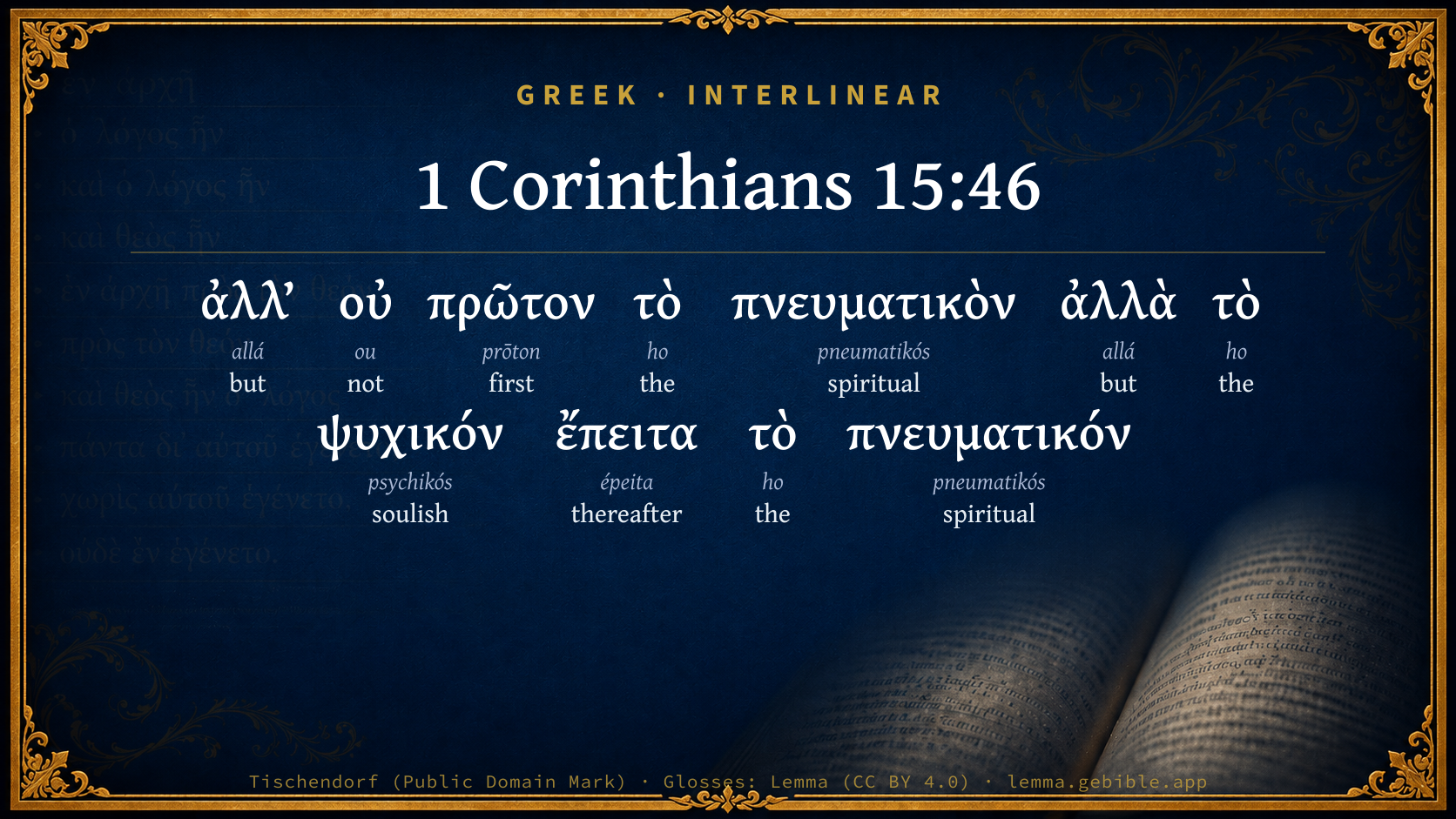
Greek (Tischendorf 8th ed.) 1 Corinthians 15:46 appears in the Greek New Testament. The text above is from the Tischendorf 8th edition. Each word links to its Strong’s number and a concise gloss. Click any word for its full Thayer’s Greek Lexicon entry.
Download image
Cite this verse

1 Corinthians 15:46 (World English Bible). Public Domain. Lemma interlinear Bible study tool, https://lemma.gebible.app/v/1-corinthians/15/46.

Show BibTeX & RIS
BibTeX
RIS
English Translation
However that which is spiritual isn't first, but that which is natural, then that which is spiritual.
World English Bible · Public Domain
Download a study sheet

One document with this verse’s original text, its word-by-word gloss line, the meaning frame, cross-references with their text, attributed commentary, and full source and license credits — printable, and it pastes into notes with its structure intact.

This verse Autodidact and up

Study sheet (.html) Plain text (.txt)

A passage Seminary Student

Up to 50 verses in one chapter. A passage sheet keeps up to 6 commentary sources and 12 cross-references per verse, in the order this page ranks them, and says so on the sheet whenever that leaves anything out. Ask for a single verse and you get the Autodidact verse sheet above.

Everything on this page stays free to read, with no account — the sheet is a download of what is already on screen, not access to it.

Want to remove ads? Support Godless Engineer
Compare translations 3

The same verse in 3 English versions, stacked beneath the original-language interlinear above. Click any original word for its lexicon entry.

Each is an independent rendering of the whole verse — the interlinear is not word-aligned to these translations.

Highlighted words mark where these versions differ — a whole-verse word diff, not a word-by-word alignment.

  • World English Bible Public Domain
    However that which is spiritual isn't first, but that which is natural, then that which is spiritual.
  • King James Version Public Domain
    Howbeit that was not first which is spiritual, but that which is natural; and afterward that which is spiritual.
  • unfoldingWord Literal Text CC BY-SA 4.0
    But the spiritual not first, but the natural, then the spiritual.

unfoldingWord Literal Text — © unfoldingWord, licensed CC BY-SA 4.0. Word-aligned USFM3 via Door43 (git.door43.org/unfoldingWord/en_ult).

Versions to compare (up to 4)

3 of 4 selected

Show all 19 translations

Every available English version of this verse, each an independent rendering of the whole verse.

  • World English Bible Public Domain
    However that which is spiritual isn't first, but that which is natural, then that which is spiritual.
  • Berean Standard Bible Public Domain
    The spiritual, however, was not first, but the natural, and then the spiritual.
  • Majority Standard Bible Public Domain
    The spiritual, however, was not first, but the natural, and then the spiritual.
  • King James Version Public Domain
    Howbeit that was not first which is spiritual, but that which is natural; and afterward that which is spiritual.
  • American Standard Version (1901) Public Domain
    Howbeit that is not first which is spiritual, but that which is natural; then that which is spiritual.
  • Revised Version (1885) Public Domain
    Howbeit that is not first which is spiritual, but that which is natural; then that which is spiritual.
  • Geneva Bible (1599) Public Domain
    Howbeit that was not first which is spirituall: but that which is naturall, and afterward that which is spirituall.
  • Douay-Rheims (1899) Public Domain
    Yet that was not first which is spiritual, but that which is natural; afterwards that which is spiritual.
  • Young's Literal Translation Public Domain
    but that which is spiritual `is' not first, but that which `was' natural, afterwards that which `is' spiritual.
  • Literal Standard Version CC BY-SA 4.0
    but that which is spiritual [is] not first, but that which [was] natural, afterward that which [is] spiritual.
  • Unlocked Literal Bible CC BY-SA 4.0
    But the spiritual did not come first but the natural, and then the spiritual.
  • unfoldingWord Literal Text CC BY-SA 4.0
    But the spiritual not first, but the natural, then the spiritual.
  • Darby Bible Public Domain
    But that which is spiritual [was] not first, but that which is natural, then that which is spiritual:
  • World Messianic Bible Public Domain
    However, that which is spiritual isn’t first, but that which is natural, then that which is spiritual.
  • Webster's Bible Public Domain
    However, that was not first which is spiritual, but that which is natural; and afterward that which is spiritual.
  • Free Bible Version CC BY-SA 4.0
    The spiritual did not come first, but the natural—the spiritual came after that.
  • Bible in Basic English Public Domain
    But that which is natural comes before that which is of the spirit.
  • Text-Critical English NT CC BY 4.0
    However, the spiritual body is not first, but the natural body, then the spiritual body.
  • Tyndale New Testament (1534) Public Domain
    How be it that is not fyrst which is spirituall: but that which is naturall and then that which is spretuall.

Literal Standard Version (2020), Covenant Press — licensed CC BY-SA 4.0. Text via the HelloAO Bible API (eBible.org). Unlocked Literal Bible (unfoldingWord) — licensed CC BY-SA 4.0. Text via the HelloAO Bible API (eBible.org). unfoldingWord Literal Text — © unfoldingWord, licensed CC BY-SA 4.0. Word-aligned USFM3 via Door43 (git.door43.org/unfoldingWord/en_ult). Free Bible Version, Dr. Jonathan Gallagher — licensed CC BY-SA 4.0. Text via the HelloAO Bible API (eBible.org).

Word by word

More ways to search: Search by grammar → Find every occurrence → Compare this word →

Practice this passage: Drill this verse → Learn its vocabulary →

About this verse

These counts appear in no published source. They are computed here, from the morphology-tagged text and Lemma’s own curated glosses. What Lemma adds →

11
words
7
distinct lemmas
Pauline Epistles
section

Notable vocabulary

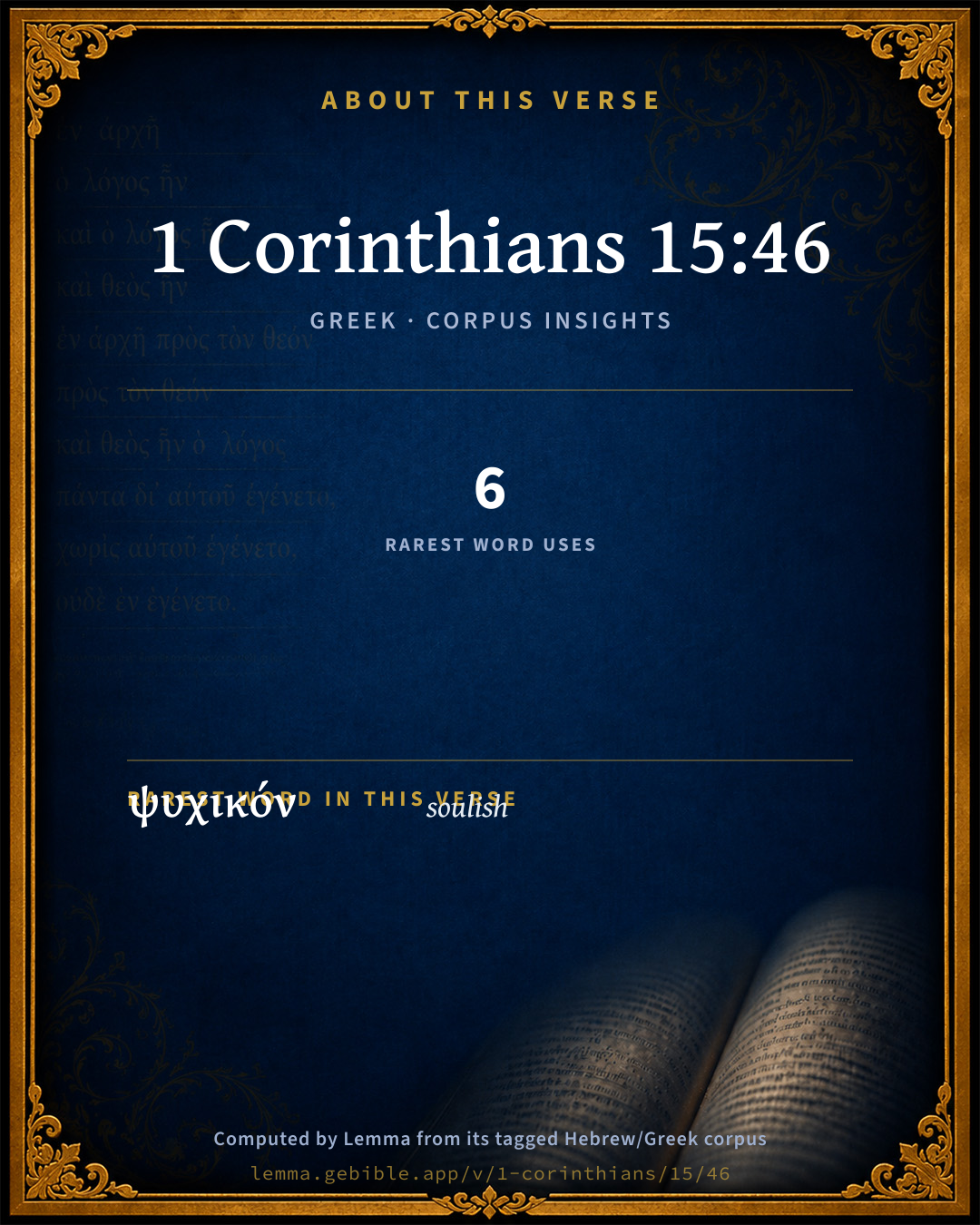
The rarest word here is ψυχικόν soulish G5591 — appearing just 6 times in the whole Greek New Testament.

Shared distinctive vocabulary

ψυχικόν soulish G5591 occurs in 5 verses of the Greek New Testament. Also found in:

Repetition

Words recur within this verse:

  • πνευματικὸν spiritual G4152 ×2
  • τὸ the G3588 ×3
  • ἀλλ’ but G235 ×2

Cross-references

3

Topical passages linked to 1 Corinthians 15:46 in the Treasury of Scripture Knowledge — connected by theme and wording, ordered by reader-vote popularity; previews shown in the World English Bible.

  • Romans 6:6 knowing this, that our old man was crucified with him, that the body of sin might be done away with, so that we would no longer be in bondage to sin.
  • Ephesians 4:22–24 that you put away, as concerning your former way of life, the old man, that grows corrupt after the lusts of deceit;
  • Colossians 3:9–10 Don't lie to one another, seeing that you have put off the old man with his doings,

Cross-references courtesy of OpenBible.info (CC BY 4.0).

Commentary

Notes on 1 Corinthians 15:46 from classic Christian and Jewish commentators (each source and its license shown beneath its notes). The classic Christian expositions comment on the surrounding passage and are grouped to its opening verse, so a note may address several verses; the Jewish commentaries on the Tanakh (Rashi and others) are per-verse, so they appear only where the commentator wrote on this verse.

Lemma curates 59 commentaries, every one of them public domain or Creative Commons licensed, each selected and text-cleaned for this edition rather than reprinted as found. About our sources →

The Biblical Illustrator

Joseph S. Exell

1Co_15:46

Howbeit that was not first which is spiritual, but that which is natural.

The natural and the spiritual

I. The natural precedes the spiritual. This is seen in--

1. Nature. Not until the earth was complete did God create man, a spiritual being, in His own image and after His own likeness, etc. Thus man stands at the head of the creation. By his physical organisation, which is natural, he is connected with all that is below him. But by his higher nature, which is spiritual, he is allied with God.

2. History. A nation is well advanced before it exhibits marked spiritual characteristics. Our own ancestors were rude men. Now the Anglo-Saxon race leads the world of thought.

3. The progress of revelation. The Old Testament histories and genealogies prepare the way for Christian doctrine. Bible study proceeds from the natural to the spiritual.

4. The development of religious life. When I was a child I spake as a child, etc. The existence of such a principle suggests the necessity of great consideration for weakness. We then that are strong ought to bear, etc. Weakness may be on the way to strength. Therefore it should be encouraged.

II. The natural conditions the spiritual. The spiritual life must inevitably be affected by the natural life with which it is associated. What a help health is to the spiritual faculties! what a restraint sickness is! As dissipation enfeebles the body, it very soon weakens the mind. How distressing it is to see a really great man like Solomon or Alexander a slave to dissipation! We feel that this is robbery. The spiritual power of such men requires the best assistance of their natural powers. How much has been lost in this way!

III. The spiritual governs the natural.

1. The questions, What shall I eat? What shall I drink? What is the limit of indulgence? are answered here. The natural is for the spiritual, the spiritual governs the natural. That which is truly best for the spiritual must determine the activities of the natural.

2. The more spiritual classes cannot thrive if the less spiritual classes are neglected. The thought and the sympathy of the palace must enter the hut and transform it into a neat cottage. The thought and the sympathy of the hut must go out to the palace, that the helping hand of kindly interest may be grasped. The masses must be instructed. But if the masses need education, then surely they must be willing to be taught. Christianity urges all men to be considerate, the higher to consider the lower, the lower to consider the higher.

IV. The natural is to give way to the spiritual. Not until the spiritual is completely realised does man discover the end of his existence. A tree lives, blossoms, bears fruit, and dies. It has accomplished the purpose of its existence. Not so, however, with man. He just begins to live when he dies. How emphatic are the words of Christ! I am the Resurrection and the Life, etc. I am come that they might have life, etc. (H. M. Booth.)

The true development

I. Natural life necessarily precedes the spiritual, or heavenly.

1. Progression is the law of all life.

2. So man was created in a lower condition with the prospect of advancing to a higher.

3. Natural life, so far from rendering a nobler life doubtful, much rather justifies the hope of it (1Co_15:45-46).

II. The natural and the spiritual life are mysteriously united.

1. Apparently they are distinct, as in the first and second Adam (1Co_15:47-48).

2. But they are really the same nature under different forms (1Co_15:49)

3. Hence when the earthly is lost in the heavenly humanity is still essentially the same.

III. The spiritual life is the glorification of the natural life. Mans destiny is immortality (1Co_15:50). The present mode of life (flesh and blood) is temporary, therefore must the natural be glorified that man may live for ever. (J. Lyth, D.D.)

The natural precedes the spiritual

Many an objector, on hearing the saying of 1Co_15:44, might say, Why should not God create the perfect spiritual life at once? St. Paul in answer applies a general law of the universe to the case before him. It would be contrary to the Divine order in Gods creation, which is first the natural, and afterward the spiritual. Consider--

I. The universality of this law. This is disclosed--

1. In the order of creation. Note the principle of gradation on which the universe arose in Genesis. And this is confirmed at every step by science. First, the formless earth, then the green herb, then the lowest forms of animal existence, then the highest types, then man, the last and noblest. And then, perhaps, an age to come, with a higher and nobler race of beings.

2. In the progress of the Jewish nation. Recollect their origin. They were a nation of slaves. Originally, too, they were of a rude, hard stock, and became in Egypt and in Palestine sensual, idolatrous, and money-loving. You are reminded of one of those trees whose exposed roots are seen gnarled and twisted, hard as iron, more like rock than wood, and yet whose foliage above is rich and noble: below extends the basis of the coarse and natural, above are manifested the beautiful and spiritual. By slow gradations did this nation of slaves rise into a spiritual people.

3. In the progress of the human race. St. Paul says, Adam was of the earth, earthy; and again, he calls him a living soul, that is, a natural man--a man with intelligence, perception, and a moral sense, with power to form a society and to subdue Nature to herself. The fall, then, was a step downwards from innocence, but also it was a giant step in human progress. It made goodness possible: for to know the evil, and to conquer it and choose the good, is far nobler than a state which only consists in our ignorance of both. Until the step of nature has been passed, the step of spirituality cannot be made. Thus did the race begin to share in the spiritual; and among many nations, and by means of many men, was the progress of mankind evolved; but their light was too scattered, and their isolated lives imparted little life. So the next stage in the progress of the race was the coming of Christ, the spiritual Man, whose prerogative it was, not as the first Adam, to live in Eden for Himself, but as the second Adam, to die on Calvary for others; not as the first Adam, to receive happiness, but as the second Adam, to confer life. It was no longer the natural man, but the quickening Spirit, that represented the race to God.

II. This law is true of us as men.

1. Our natural affections precede our spiritual. According to the two great commandments, in the order of importance the love of God is first; in the order of time the love of man. Love to man also begins lower down. We do not love our neighbours first, nor embrace the race in our affection all at once; we ascend from a lower point. The table given on Sinai only specifies one kind of love, but in the fifth commandment they all lie as the furture oak-tree lies in the acorn; the root of all the other developments of love is love and honour unto parents. The child is father to the man. The friend, the husband, the citizen are formed at the domestic hearth. Out of human love grows love to God. For a time the father represents God to the child. He is to train the affections which afterwards shall be given to God; and the brother those which shall expand hereafter for Christ. You cannot force love to God.

2. The moral precedes the spiritual. There is a time when the Adam is formed within us, when the Christ begins to be formed, when we feel within us the sense of Christ in us, the hope of glory, when the living soul, as ruler of the man, gives place to the quickening spirit. But there are two slates through which we pass.

(1) It was through temptation that the first Adam fell from a state of nature. It was through temptation, too, that the second Adam redeemed humanity into a state of grace.

(2) Through sorrow. (F. W. Robertson, M.A.)

The law of the psychical and the spiritual

It is in the history of the individual man that we find our best illustration of St. Pauls law. As babes and sucklings, our life is animal and instinctive, we are a mere complex of appetites--appetite for food, for warmth, for sleep: the mind is dormant. Soon however we begin to take notice, and to respond to notice; to imitate sounds; to pry into the nature of the things around us and their relation to us. Then we learn to name them, to speak about them, to like and dislike them. Intellect awakens; we master our first abstractions; we learn to put words for things. Our schooling commences; perception, imagination, memory, understanding are developed: all the intellectual facets of the soul are polished: and still we carry into this new stage of our life many of the animal and instinctive qualities of the earlier stage. After, and in much blended with, the intellectual comes the passionate era. We rise into that fine frenzy in which we live in another heart, in which we prefer, or fancy we prefer, anothers good to our own. With love comes the long train--desire, envy, jealousy, hatred of rivals, indifference to former affections, ambition to shine and to please. It is the passionate stage of our existence. In and through all these earlier stages there may be the rudiments of spiritual life. We may have formed some conception of God, of His goodness; we may have felt some love, some trust in Him. But, as a rule, the proper life of the spirit is kindred within us, or becomes regnant within us, only after we have passed through the intellectual and passionate stages of our course. The spiritual is not first in us, but the psychical. Nay, however early we may begin to think of God and to love Him, it is obvious that we must have learned to think before we can think of God that we must have learned to love before we can love God. (S. Cox, D.D.)

The two grand types of character

The words show--

I. That man has set before him two moral images or types of character. The earthy and the heavenly. These two are essentially distinct.

1. The one is sensuous, the other spiritual.

(1) The earthy man is material, partially developed--

(a) In his views of happiness. All his pleasures are of a sensuous order.

(b) In his views of wealth, viz:, worldly property.

(c) In his views of dignity, viz., the highest worldly position.

(2) the spiritual man lives behind the visible phenomena, realises the eternal. To him the invisible is the only reality; moral excellence, the only wealth and dignity. Though in the world, he is not of the world. He has citizenship in heaven.

2. The one is practically selfish, the other is benevolent.

(1) The earthy man is controlled by a regard to his own pleasures and aggrandisements. All outside of himself he values only so far as it serves him.

(2) The heavenly man is benevolent. His personal feelings are submerged in the ever-rising seas of sympathy with humanity and God. Like Christ, he pleases not himself.

3. The one is practically atheistic, the other is godly.

(1) The earthy man sees nothing but natural law, order, etc. God is not in all his thoughts. The universe to him is only either an eternal or a self-produced and self-regulating machine, a house that either has never had a builder, or whose builder has deserted it.

(2) The heavenly man sees God in all, like David, and, like Enoch, walks ever with Him.

II. That man does bear the one; he should bear the other. Every man, in the first stages of his life, bears the image of the earthy. This fact is at once the crime and the calamity of the race. But whilst we do bear the one image at first, we should strive to bear the other because--

1. It is right. This heavenly image realises the souls highest ideal of excellence. It is that for which we unconsciously hunger, and for which we shall hunger for ever unless we get it.

2. It is practicable.

(1) We have the model in its more imitable form in Christ. He was pre-eminently spiritual, benevolent, godly; and never was there a character more imitable than Christs--the most admirable, transparent, unchangeable.

(2) We have the means in the most effective forms. The gospel reveals the model, supplies the motives, and pledges the spiritual influences of heaven.

3. It is urgent. To do this is the grand mission of life. Unless the work is fulfilled our existence becomes a failure and a curse. To pass from the earthy to the heavenly is to pass from darkness to light, from sin to holiness, from Satan to God. (D. Thomas, D.D.)

The Divine order

The method of Gods working is upward progress. His path is as the Shining light, etc.

I. In the creation of the material world. First, there was the globe without life; then a world filled with life and beauty. First the protozoans, molluscs, and sponges of the primeval world; after that, man created in the image of God.

II. In the natural development of each individual man.

1. There is helpless infancy. Physical, mental, spiritual forces, and wild passions sleep in that little nebulous mass like thunderstorms in the quiet clouds or summer.

2. By and by we arrive at youth, this blossoming season of our nature, the time of fancy.

3. After that comes manhood. There is now fulness of reason and strength and responsibility.

III. In the dispensations of revealed religion. The law was given by Moses; but grace and truth came by Jesus Christ. Moses was an inspired man: Christ is God manifest in the flesh. Moses was faithful as a servant over all his house--Christ as a Son in His own house, whose house are we; and the grace and truth are more excellent than the law. The law demands obedience, but gives no help to obey; the gospel creates within us new hearts which make obedience a delight. The law revealed sin; the gospel proclaims pardon. The law threatens; the gospel invites. The great promise of the law was, Thou shalt inherit the land; that of the gospel is, I give unto them eternal life, etc. The law was for one nation; the gospel is for the whole world. The law was the shadow; the gospel is the substance. The law was bondage; the gospel is liberty.

IV. In Christian experience and in the development of Christian character.

1. Faith in religion is easy in childhood. Little children fresh from the hand of God are not sceptics. They have the power of reverence and faith. For a time they worship father and mother. They never regard the material universe as a thing to be weighed, and understood, and measured. It is to them a solemn mystery. Being thus constituted, it is the easiest thing in the world to teach a child to utter words of prayer.

2. The young man discovers that much ignorance has mingled with the reverence of childhood, and has not sufficient experience to replace his early fancy with the solid structure of reality and truth. Besides, the powers of childhood become full in youth. Self-will is strong, and the whole republic of the passions is up in arms against the authority of reason and conscience. But Christ is there, and His voice is heard amid the arrogant and noisy voices of the flesh. There is a long struggle. The young man wavers; but, thank God! Christ perseveres, and the Lord, what wilt Thou have me to do? shows that Christ has taken possession of his will.

3. The struggle is not yet over. A time of deep thought and anxious reflection arrives, and brings with it an intense desire to know the reason of faith, the basis of belief. The intellect demands greater evidence than is or can be given. It asks for demonstration. But during this time of intellectual revolt Christ is there; Christ speaks with authority and love, Believe on Me when thou canst not know. Worship before the mystery; what thou knowest not now thou shalt know hereafter. Christ is victorious again, and the pride of the intellect subsides, and the mind bows before Christ, saying, Thou art the power and wisdom of God; and I wish to be Thine for ever and ever.

4. After this comes old age--the best period of all by far. Childhood is untried innocence; youth little better than rebellion against Christ; manhood a struggle against intellectual difficulties and spiritual enemies; but as the years pass on, the mans whole nature is subdued and sanctified. The love of God is shed abroad in his heart. The peace of God, which passeth understanding, keeps his heart and mind in Christ Jesus. Joy unspeakable and full of glory flows in plentifully upon his spirit. By and by visitors from the unseen come and say, in tones never heard before, Brother, come away. What is best in the tree is the last to get perfect.

V. In the increase of the spiritual kingdom in the world. Here we may well ask, Can the gospel live and multiply? Think of China and India, whose very nature is engrained with their false religion and their fantastic philosophy. Can they be changed? But we need not go so far to seek difficulties. Think of the state of things here in England. Think, e.g., of the adoration of wealth and appearances. Can religion live in this dense atmosphere of worldliness? Think again of the unbelief of the age in which we live. There are unhealthy summer days when physical activity is almost an impossibility. A heavy, oppressive, stagnant atmosphere weighs down upon the land. That is a symbol of the spiritual atmosphere of Europe to-day. It is permeated with a spirit of unbelief. I ask again, then, Can Christianity live? Yes.

1. It has lived and increased in spite of the most determined opposition. After eighteen hundred years of trial and opposition, the foundation of God standeth sure. The powers of men and the powers of darkness have exerted themselves to remove this foundation, but it standeth sure, in spite of persecution and in spite of criticism.

2. Christianity has affinities with all good things. Truth, virtue, love, science, philosophy, literature, are good, and the gospel is nearly related to all these. It creates them where they do not already exist; and where they exist, it inspires and promotes them. Nothing good dies. It is falsehood, and not truth; evil, and not good; moral deformity, and not moral beauty, that is going to disappear. The gospel is the grandest truth, the greatest good, the most beautiful revelation ever given to man; and therefore it cannot perish. The word of the Lord endureth for ever.

3. We have the old promise of the Holy Ghost. Goethes last words were, More light! more light! This is the cry of the age. It is not more external evidence that is needed, but more internal illumination, more power of spiritual vision in the minds of men. The light is here in Divine plenitude. Christianity is either supernatural or it is nothing. Christianity makes its way in the world by the coming of the Spirit of God into contact with the spirits of men. Conclusion: The progress is not rapid. But let the Church calm her heart. Let us learn to wait and work. And, above all things, let us not be afraid. He that believeth shall not make haste. Gods method is upward progress, and that upward progress is slow in its development. But the progress is certain, and the end is sure. (T. Jones, D.D.)

The Biblical Illustrator, edited by Joseph S. Exell (c. 1880s–1900s) — public domain. Text from a community e-Sword module.

Bengel's Gnomon

Johann Albrecht Bengel

1Co 15:46. Οὐ πρῶτον,) not the first.—τὸ πνευματικὸν, the spiritual) body. This verse refers to 1Co 15:44, 1Co 15:45, making as it were a parenthesis, to which 1Co 15:47 afterwards corresponds.—ἔπειτα, afterward) This should be carefully noticed by those, who so dispute about the origin of evil, as if all things should have been not only good at the beginning, as they were, but also such as they will be at their consummation.

Bengel's Gnomon of the New Testament — English translation (T&T Clark, Edinburgh, 1860) — public domain. Text from a community e-Sword module.

Meyer's Critical & Exegetical Commentary

Heinrich August Wilhelm Meyer

1Co_15:46. After it has been stated and confirmed from Scripture in 1Co_15:44-45 that there exists not simply a psychical, but also a spiritual body, it is now further shown that the latter cannot precede the former, but that the reverse must be the case. Nevertheless the pneumatic is not first, but the psychical; afterwards the pneumatic. We are not, with the majority of the older commentators (also Flatt, Osiander, Hofmann), to supply σῶμα (which the context does not even suggest); but Paul states quite generally the law of development,[84] that the pneumatic appears later than the psychical, a gradation from lower to higher forms, which goes through the whole creation. This general statement he then proves:

[84] See also Ernesti, loc. cit. p. 126.

Meyer — Critical and Exegetical Commentary on the New Testament — English translation by Peter Christie, edited by Frederick Crombie (T&T Clark, 1880) — public domain. Text from a community e-Sword module.

Expositor's Greek Testament

ed. W. Robertson Nicoll

1Co 15:46 might have been expressly aimed at the Philonian exegesis; it affirms a development from lower to higher, from the dispensation of ψυχὴ to that of πνεῦμα , the precise opp [2553] of that extracted from Gen 1:2 by Philo. ( ἀλλʼ οὐ ) “Nay, but not first is the spiritual, but the psychic after that ( ἔπειτα : cf. 23) the spiritual”. P. states a general law ( σῶμα is not to be understood with the adjs.): the ψυχικὸν as such demands the πνευματικὸν to follow it (1Co 15:44 ); they succeed in this order, not the reverse. “The Ap. does not share the notion, long regarded as orthodox, that humanity was created in a state of moral and physical perfection.… Independently of the Fall, there must have been progress from an inferior state, the psychic, which he posits as man’s point of departure, to a superior state, the spiritual, foreseen and determined as man’s goal from the first” (Gd [2554] ad loc [2555] : see the whole passage).

[2553] opposite, opposition.

[2554] F. Godet’s Commentaire sur la prem. Ép. aux Corinthiens (Eng. Trans.).

[2555] ad locum , on this passage.

The Expositor's Greek Testament, edited by W. Robertson Nicoll (1897–1910) — public domain. Text from a community e-Sword module.

Hodge's Commentary on Romans, Ephesians & First Corinthians

Charles Hodge

1Co_15:46

Howbeit that (was) not first which is spiritual, but that which is natural; and afterward that which is spiritual.

This does not mean simply that the natural body precedes the spiritual body. But it announces, as it were, a general law. The lower precedes the higher; the imperfect the perfect. This is true in all the works of God, in which there is a development. Adams earthly state was to be preparatory to a heavenly one. The present life is like a seed time, the harvest is hereafter. The natural comes before the spiritual; as Calvin says, we are born before we are regenerated, we live before we rise.

Charles Hodge — Commentary on Romans (1835), First Corinthians (1857), and Ephesians (1856) — public domain. Text from a community e-Sword module.

Geneva Bible (1599)

Geneva Bible translators

Secondly he willeth the order of this double state or quality to be observed, that the natural was first, Adam being created of the clay of the earth: and the spiritual followed and came upon it, to wit, when the Lord being sent from heaven, endued our flesh which was prepared and made fit for him, with the fulness of the Godhead.

Geneva Bible (1599) marginal notes — public domain. Text via Bolls.life.

Jamieson, Fausset & Brown

Robert Jamieson, A. R. Fausset & David Brown

afterward--Adam had a soul not necessarily mortal, as it afterwards became by sin, but "a living soul," and destined to live for ever, if he had eaten of the tree of life (Gen 3:22); still his body was but an animal-souled body, not a spiritual body, such as believers shall have; much less was he a "life-giving spirit," as Christ. His soul had the germ of the Spirit, rather than the fulness of it, such as man shall have when restored "body, soul, and spirit," by the second Adam (Th1 5:23). As the first and lower Adam came before the second and heavenly Adam, so the animal-souled body comes first, and must die before it be changed into the spiritual body (that is, that in which the Spirit predominates over the animal soul).

Jamieson, Fausset & Brown — Commentary Critical and Explanatory on the Whole Bible (1871) — public domain (CC PDM 1.0). Text via the HelloAO Bible API.

Adam Clarke's Commentary

Verse 46. That was not first which is spiritual] The natural or animal body, described 1Co 15:44, was the first; it was the body with which Adam was created. The spiritual body is the last, and is that with which the soul is to be clothed in the resurrection.

Adam Clarke's Commentary on the Bible (1810–1826) — public domain. Text from a community e-Sword/MySword module.

Ellicott's Commentary for English Readers

(46) Howbeit that was not first which is spiritual.—Here a further thought is introduced. There is not only a variety of bodies—and that variety regulated by adaptability to their state of existence—but there is an ordered sequence in that variety. As the Adam was first from whom we derive the natural body and soul, and the Adam was last from whom comes our spiritual nature, so there will be the like order in regard to our bodies. The natural body first in this life—the spiritual body afterwards in the next life.

A Bible Commentary for English Readers, edited by Charles John Ellicott (1878–1897) — public domain. Text from a community e-Sword module.

The Cambridge Bible for Schools and Colleges

gen. ed. J. J. S. Perowne

46. Howbeit that was no first which is spiritual] See note on 1Co_15:23. “The law of God’s universe is progress.” Robertson. His whole lecture on this passage will repay study. He shews how the Fall was an illustration of this law, a necessary consequence of a state of mere natural life; a “step onward,” if for the time “downward.” He traces it in the history of nature and of nations, and finally applies it to individuals, and shews how our natural feelings and affections are the sources of our spiritual ones; how the moral life, the fulfilment, that is, of the law of our being as discerned by natural religion, the living up to the light we have (cf. Rom_2:14), leads up to the spiritual life, and how temptation and sorrow, themselves the fruit of a state of things undeveloped and incomplete, are necessary elements in the formation of the perfect, the spiritual man. Cf. Heb_2:10. Thomas Aquinas remarks how the law holds good in nature, even of one and the same being, that what is imperfect precedes what is perfect.

The Cambridge Bible for Schools and Colleges (gen. ed. J. J. S. Perowne; Cambridge University Press, 1878–1918) — public domain. Text from a community e-Sword module.

John Gill's Exposition

And as we have borne the image of the earthy,.... Which regards not so much the sinful image of the first man upon the soul, or the depravity of the powers and faculties of it, as his image of frailty and mortality on the body, having like him a body subject to infirmities and death:

we shall also bear the image of the heavenly; which likewise regards not so much the spiritual image of Christ stamped on the soul in regeneration, when Christ is formed in the heart, and the new man is created after his likeness, and which more and more appears, through every transforming view of him, and will be complete in glory, as the image and likeness of Christ upon the bodies of the saints in the resurrection, when they shall be fashioned like unto his: some copies, as the Alexandrian and others, read the words as an exhortation, let us bear the image, &c. as if the words were an improvement of the apostle's reasoning on this subject, engaging saints to be more concerned for, and seeking after a greater likeness to Christ in righteousness and true holiness; but the other reading and sense are best.

John Gill's Exposition of the Whole Bible (1746–1763) — public domain (CC PDM 1.0). Text via the HelloAO Bible API.

Trapp's Complete Commentary

John Trapp

46 Howbeit that was not first which is spiritual, but that which is natural; and afterward that which is spiritual.

Ver. 46. And afterward, that is spiritual] Nature, art, grace, proceed from less perfect or more perfect. Let us advance forward, and ripen apace, that we "may be accounted worthy to obtain that world and the resurrection from the dead," Luk 20:35.

John Trapp, A Commentary or Exposition upon All the Books of the Old and New Testament (1647–1656) — public domain. Text from a community e-Sword module.

Albert Barnes' Notes on the Bible

Howbeit - There is a due order observed, 1Co 15:23. The decaying, the dying, the weak, the corruptible, in the proper order of events, was first. This order was necessary, and this is observed everywhere. It is seen in the grain that dies in the ground, and in the resurrection of man. The imperfect is succeeded by the perfect; the impure by the pure; the vile and degraded by the precious and the glorious. The idea is, that there is a tendency toward perfection, and that God observes the proper order by which that which is most glorious shall be secured. It was not his plan that all things in the beginning should be perfect; but that perfection should be the work of time, and should be secured in an appropriate order of events. The design of Paul in this verse seems to be to vindicate the statement which he had made, by showing that it was in accordance with what was everywhere observed, that the proper order should be maintained. This idea is carried through the following verses.

Albert Barnes' Notes on the Bible (1834–1885) — public domain. Text from a community e-Sword/MySword module.

Matthew Poole's English Annotations

Christ, the spiritual Adam, was not first in order of time, but the natural Adam, God in his providence rising from more imperfect to more perfect dispensations: and so it is as to God’s providences relating unto us; we have first natural bodies, we are born with such, we grow up and die with such, but then we shall rise again with ohers, in respect of more excellent qualities and endowments.

Matthew Poole's English Annotations on the Holy Bible (1683–1685) — public domain. Text from a community e-Sword/MySword module.

Whedon's Commentary on the Bible

Daniel D. Whedon

46. Howbeit—Notwithstanding that it might be supposed that the greatest would be first, the reverse is the case.

Afterward… spiritual—God works by progresses and climaxes, bringing out the greatest last. See note on Rom_8:39.

Daniel D. Whedon (gen. ed.), Commentary on the Old and New Testaments (1874–1909) — public domain. Text from a community e-Sword module.

The Pulpit Commentary

That was not first which is spiritual. The imperfect precedes the perfect.

Vers. 46-49.

The two grand types of character.

"Howbeit that was not," etc. The words show

I That man has set before him TWO MORAL IMAGES OR TYPES OF CHARACTER the "earthy" and the "heavenly." These two are essentially distinct in the spring and spheres of their activities.

1. The one is sensuous, the other spiritual. The earthly man is material, partially developed, and gross.

(1) In his views of happiness. All his pleasures are of a sensuous order.

(2) In his views of wealth. He knows of no man that is rich but he who possesses worldly property.

(3) In his views of dignity. The only honourable man to him is he who occupies the highest worldly position, and who moves in the mere pageantry that dazzles the sensual eye. He is, in one word, a man of the flesh. He sees only the fleshly, appreciates only the fleshly, enjoys only the fleshly. On the contrary, the other is spiritual. He lives behind the visible phenomena, realizes the spiritual, the eternal. To him the invisible is the only reality, moral excellence the only wealth and dignity. Though in the world, he is not of the world. He has his citizenship in heaven.

1. The one is practically selfish, the other is benevolent. The earthly man is controlled in everything by a regard to his own pleasures and aggrandizements. Self is the centre and the circumference of all his activities, at once the lord of his faculties and the god of his worship. All outside of himself even the universe itself he values so far and no further than as it serves him. On the contrary, the heavenly man is benevolent. The social element within him controls the egotistic; his personal feelings are submerged in the ever-rising seas of sympathy with humanity and God. Like Christ, he "pleases not himself," and, like Paul, he would be "accursed" to help others.

2. The one is practically atheistic, the other is godly. The earthly man sees nothing but natural law, order, etc. "God is not in all his thoughts." The universe to him is only an eternal or a self-produced and self-regulating machine, a house that either has never had a builder or whose builder has deserted it. The other the heavenly man sees God in all; like the psalmist, sets him before him; like Enoch, walks ever with him. Such are the two images or types of character that are set before every man.

II That man DOES BEAR THE ONE, HE SHOULD BEAR THE OTHER. Account for it how you like, every man, in the first stages of his life, bears the image of the "earthy." He is sensual, selfish, godless. This fact, which is too obvious to need or even to justify illustration, is at once the crime and the calamity of the race. But whilst we do bear this image at first, we should strive to bear the other. "We shall also" (or as Dr. Davidson renders it, "let us also") bear the image of the heavenly. Let us do it:

1. Because it is right. This heavenly image, embodying all virtue, realizes the soul"s highest ideal of excellence. It is just that for which we unconsciously hunger, and for which we shall hunger forever unless we get it.

2. Because it is practicable.

(1) We have the model in its most imitable form. Christ is the model. He was pre-eminently spiritual, benevolent, godly; and never was there a character more imitable than Christ"s the most admirable, the most transparent, and the most unchangeable. We can never imitate a character that we cannot understand, admire, and find always the same. Christ was all this.

(2) We have the means in the most effective forms. The gospel reveals the model, supplies the motives, and pledges the spiritual influences of heaven.

3. Because it is urgent. To do this is the grand mission of life. Unless the work is fulfilled, our existence becomes a failure and a curse. To pass from the "earthy" to the "heavenly," is to pass from darkness to light, from sin to holiness, from Satan to God, from Pandemonium to Paradise.

CONCLUSION Here is a test of character. Conventional evangelism concludes that all who adopt certain tenets, join certain sects, and attend to certain religious ordinances are of the heavenly type and fold. A tremendous mistake is this! Without uncharitableness, it must be confessed that the vast majority of what are called Churches bear the image of the earthly; they are selfish, sensuous, and practically godless. Here also is a guide for preachers. Unless you get men from the earthly to the heavenly type of life, what boots your sermons, with all their ratiocination and rhetoric? Get their souls out of the earthly into the heavenly, and in the heavenly go on building up a character suited to the higher hierarchies of being.

So build we up the being that we are. Thus drinking in the soul of things, We shall be wise perforce: and while inspired By choice, and conscious that the will is free,

Unswerving shall we move, as if impelled By strict necessity along the path Of order and of good. Whate"er we see, Whate"er we feel, by agency direct

Or indirect, shall tend to feed and nurse Our faculties, shall fix in calmer seats Of moral strength, and raise to loftier heights Of love Divine, our intellectual soul. (Wordsworth)

The Pulpit Commentary (1880–1919), ed. H.D.M. Spence-Jones & Joseph S. Exell — public domain. Text from a community e-Sword module.

McGarvey & Pendleton's Commentaries

J. W. McGarvey

Howbeit that is not first which is spiritual, but that which is natural; then that which is spiritual .

J. W. McGarvey (with Philip Y. Pendleton), Commentaries on the New Testament (The Fourfold Gospel, 1914; Acts; and the epistles) — public domain. Text from a community e-Sword/MySword module.

The People's New Testament

B. W. Johnson

46. Howbeit that is not first which is spiritual. The first Adam came before the second Adam. The natural body which proceeds from the first Adam is our tabernacle first; after this life comes the “spiritual body,” which the second Adam gives.

B. W. Johnson's The People's New Testament with Notes (1889–1891) — public domain. Electronic text from the Christian Classics Ethereal Library (CCEL) ThML edition.

Cambridge Greek Testament for Schools and Colleges

46. ἀλλ’ οὐ πρῶτον. See note on 1Co 15:23. ‘The law of God’s universe is progress.’ Robertson. His whole lecture on this passage will repay study. He shews how the Fall was an illustration of this law, a necessary consequence of a state of mere natural life; a ‘step onward,’ if for the time ‘downward.’ He traces it in the history of nature and of nations, and finally applies it to individuals, and shews how our natural feelings and affections are the sources of our spiritual ones; how the moral life, the fulfilment, that is, of the law of our being as discerned by natural religion, the living up to the light we have (cf. Rom 2:14), leads up to the spiritual life, and how temptation and sorrow, themselves the fruit of a state of things undeveloped and incomplete, are necessary elements in the formation of the perfect, the spiritual man. Cf. Heb 2:10. Thomas Aquinas remarks how the law holds good in nature, even of one and the same being, that what is imperfect precedes what is perfect.

Cambridge Greek Testament for Schools and Colleges (Cambridge University Press, 1896; 21 vols, various authors incl. Carr, Maclear, Plummer, Farrar, Lumby, Moule, M. R. James, Simcox) — public domain. Text from a community e-Sword module.

Alford’s Greek Testament

Henry Alford

46.] But in the natural order, that which is animal precedes that which is spiritual (τὸ ψυχ., τὸ πνευμ., not σῶμα, but abstract and general): as in ver. 45, ὁ πρῶτος—ὁ ἔσχατος.

Henry Alford, The Greek Testament (1849–1861) — public domain. Text from a community e-Sword module.

International Critical Commentary

46. ἀλλʼ οὐ πρῶτον τὸ πνευματικόν. This states a general law, not merely what took place in a particular instance: understand ἐστι, not ἐγένετο. ‘The spiritual’ is more comprehensive than ‘spiritual body.’ Adam could not be created morally perfect, but only capable of attaining to perfection; indeed, even his physical and mental powers needed development. Therefore the lower moral stage must precede the higher. Holiness cannot be given ready made. It is the result of the habitual free offering of self, the constant choice of good and refusal of evil, and it is capable of indefinite increase. There is nothing final in the universe, except God. All came from Him, and it may be that all is tending (with whatever interruptions) towards Him. Man’s appointed task and privilege is to be ever drawing nearer to Him.

International Critical Commentary — older volumes (1896–1929), various authors — public domain. Text from a community e-Sword module.

Vincent's Word Studies in the New Testament

Marvin R. Vincent

Not first - spiritual - natural. A general principle, illustrated everywhere in human history, that the lower life precedes the higher.

Marvin R. Vincent, Word Studies in the New Testament (1887–1900) — public domain. Text from a community e-Sword/MySword module.

Godet's Commentaries

Frédéric Louis Godet

Vv. 46. “Howbeit that is not first which is spiritual, but that which is psychical; and afterward that which is spiritual.”

Are we right in regarding this as a general law, or must we, with Osiander and others, understand the substantive σῶμα, body, and apply the verse exclusively to the particular fact under discussion? The former meaning alone agrees with the ellipsis of the verb, which, if understood, can only be the present. In the latter sense, Paul would have required to use a verb in the aorist (ἐγένετο, 1Co 15:45). His object is to justify by a general principle what has taken place in respect of the body: the priority of the psychical to the spiritual body.

The law here enunciated, when rightly understood, throws a vivid light on the general course of God’s work within humanity. The life of the spirit is substantially identical with holiness; it could not therefore have been given immediately to man at the time of his creation; for holiness is not a thing imposed, it is essentially a product of liberty, the freewill offering of the individual. God therefore required to begin with an inferior state, the characteristic of which was simply freedom, the power in man to give or withhold himself. On the choice which he should make between these two alternatives, to keep his natural life or to give it in order to get it back transformed into a higher life, was to depend his fall or progress. In the former case, spiritual life could not be communicated to man; in the latter, it was accorded to him in response to his free and fervent aspiration; and elevation to the perfect state, even for the body, took place in the direct way of progress. But, even in the opposite case, it was not denied to him for ever; for the miseries of sin might, by a long and sad circuit of experience, bring man to exclaim: “Oh that Thou wouldest rend the heavens, that Thou wouldest come down!” (Isa 64:1). It was to secure the production of this aspiration, the condition of the gift of the Spirit, that during the course of the psychical period, God adopted a people in the midst of whom this need of the economy of the Spirit was intended to be more forcibly developed under the pedagogic influence of the law and the prophets. And when the longing awakened by these two means had reached its full intensity, the answer could at length be granted: the fulness of the times was come; the Son was sent, and the Spirit given (Gal 4:4-6). The apostle does not therefore share the idea, so long regarded as the orthodox view, according to which humanity was created in a state of moral and physical perfection, and fell from that height. He holds, that even independently of the fall there would have been progress from a lower state, the psychical state assigned as a point of departure, to a higher state, the spiritual state foreseen and willed as the end from the beginning. Apart altogether from sin, psychical humanity was called to develop in all directions the manifold powers with which it was endowed, that it might present to the heavenly guest, the Spirit, when He should come to dwell in it, the psychical and bodily organ fitted to display His perfection in the richest and most varied forms, those of art, science, industry, and social life in all its manifestations. The abnormal intervention of sin did not altogether prevent the realization of this Divine thought. In the East, the sense of the Great; in Greece, that of the True and Beautiful; in Rome, that of the Just; in Phenicia, through its commerce and colonies, that of the Useful; in Israel, that of the Holy, served to prepare for the spiritual economy, the new humanity; that Christendom in which we find so many miseries, but in which notwithstanding also the spirit of Pentecost unfolds. Thus, then, with or without the fall, two economies, that of the human soul (normal ancient history) and that of the Divine Spirit (normal modern history): such is the profound law which, from the viewpoint of a free humanity and a healthy Divine preparatory training, must control the history of man. First the psychical, then the pneumatical. This law applies, as Olshausen already remarked, to the course of collective no less than of individual life. What light is shed by this law on true Christian education! Instead of imposing the spiritual state on the child, begin by awakening the need of it, while giving free scope to the expansion of the psychical powers in every direction, which is morally legitimate.

The apostle renders the distinction palpable between the two economies which he has just distinguished, that of the soul and that of the spirit, by contrasting the two heads of both (1Co 15:47); thus he will come to the two races (1Co 15:48), and so return to the two bodies (1Co 15:49).

Frédéric Louis Godet — Commentaries on Luke, John, Romans, and 1 Corinthians — English translation (T&T Clark, Edinburgh, 1870s–1890s) — public domain. Text from a community e-Sword module.

Lesson kit

Teaching starters — assembled from the data on this page, not authored interpretation. Every prompt links to the verse data it draws on. Edit before teaching.

1 Corinthians, in the Pauline Epistles, opens this verse with 11 words (7 distinct Greek lemmas). Its most distinctive word is psychikós (“soulish”). A historical commentator’s framing appears above. Read the whole chapter for the surrounding context.

Discussion questions

  1. How does “soulish” (psychikós) shape what this verse is saying?
  2. How does 1 Corinthians 2:14, which shares the word «soulish», read alongside this verse?
  3. What does the repetition of “spiritual” (2× in this one verse) do in this verse?
  4. The translations on this page render this verse differently — a whole-verse word diff, not a word-by-word alignment. What might account for the different wordings?
  5. Compare how The Biblical Illustrator and Bengel's Gnomon read this verse. Where do they agree or differ?

Things to notice

  • These translations choose different wording for 5 words in this verse.
  • “spiritual” occurs 2× in this single verse.
  • 7 distinct Greek lemmas span 11 words in this verse.

Reading settings

Reading text

Shown beneath each verse's original-language words.

Old Testament
Old Testament edition

Read the OT as the Masoretic Hebrew (MT) or the Greek Septuagint (LXX).

English shown for the Greek Septuagint (in the Hebrew ↔ Greek comparison).

Comparing translations? Open the Compare panel on any verse page to stack up to four side by side.