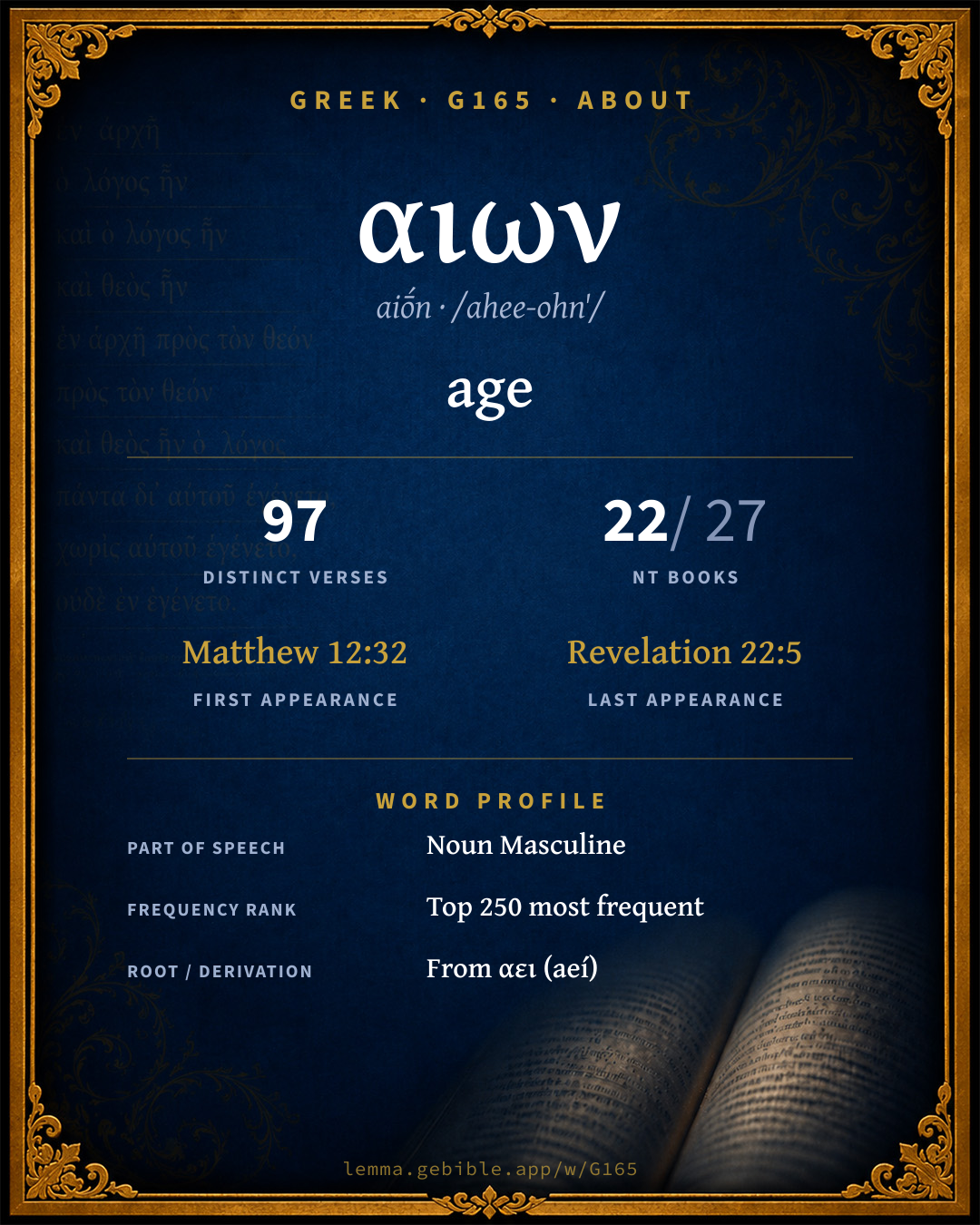
αἰών
age
‘age’ is one of 3 main senses fuller range ↓
Full lexicon entry — Thayer's Greek Lexicon
From Thayer's Greek Lexicon
Where this word appears
See every Accusative-case word in the Greek New Testament →
Grammar key — what these labels mean
Part of speech
- Noun
- A naming word — a person, place, thing, or idea.
Case
- Accusative
- The case of the direct object and of extent.
- Genitive
- The case of source, possession, or “of” — answers “whose / from what.”
- Dative
- The case of the indirect object, means, or location — “to / for / with / in.”
Gender
- Masculine
- Grammatically masculine.
Number
- Singular
- One.
- Plural
- More than one.
Grammatical forms
- Noun, Accusative, Singular, Masculine 31 times (25%)
- Noun, Accusative, Plural, Masculine 30 times (24%)
- Noun, Genitive, Plural, Masculine 29 times (23%)
- Noun, Genitive, Singular, Masculine 25 times (20%)
- Noun, Dative, Singular, Masculine 8 times (6%)
- Noun, Dative, Plural, Masculine 1 time (1%)
Parsed forms decoded from the imported morphology (Robinson–Tischendorf, public domain), counted across 124 parsed occurrences — not distinct verses.
Every verse where G165 appears — 97 distinct verses across 22 books. Click any verse to open its interlinear word-by-word view. Verse text shown in the World English Bible for context — . Each verse’s Greek form is shown with its reference; the English is not keyword-highlighted, since the data carries no word-level English alignment. Use “Compare translations” on any verse to read it across multiple English versions. This concordance covers the Greek New Testament; Septuagint (Greek Old Testament) occurrences of this word are not indexed here.
Matthew 8 verses
- Matthew 12:32 αἰῶνι n dat sg masc Whoever speaks a word against the Son of Man, it will be forgiven him; but whoever speaks against the Holy Spirit, it will not be forgiven him, neither in this age, nor in that which is to come.
- Matthew 13:22 αἰῶνος n gen sg masc What was sown among the thorns, this is he who hears the word, but the cares of this age and the deceitfulness of riches choke the word, and he becomes unfruitful.
- Matthew 13:39 αἰῶνός n gen sg masc The enemy who sowed them is the devil. The harvest is the end of the age, and the reapers are angels.
- Matthew 13:40 αἰῶνος n gen sg masc As therefore the darnel is gathered up and burned with fire; so will it be at the end of this age.
- Matthew 13:49 αἰῶνος n gen sg masc So will it be in the end of the world. The angels will come forth, and separate the wicked from among the righteous,
- Matthew 21:19 αἰῶνα n acc sg masc Seeing a fig tree by the road, he came to it, and found nothing on it but leaves. He said to it, "Let there be no fruit from you forever!" Immediately the fig tree withered away.
- Matthew 24:3 αἰῶνος n gen sg masc As he sat on the Mount of Olives, the disciples came to him privately, saying, "Tell us, when will these things be? What is the sign of your coming, and of the end of the age?"
- Matthew 28:20 αἰῶνος n gen sg masc teaching them to observe all things that I commanded you. Behold, I am with you always, even to the end of the age." Amen.
Mark 4 verses
- Mark 3:29 αἰῶνα n acc sg masc but whoever may blaspheme against the Holy Spirit never has forgiveness, but is guilty of an eternal sin"
- Mark 4:19 αἰῶνος n gen sg masc and the cares of this age, and the deceitfulness of riches, and the lusts of other things entering in choke the word, and it becomes unfruitful.
- Mark 10:30 αἰῶνι n dat sg masc but he will receive one hundred times more now in this time, houses, brothers, sisters, mothers, children, and land, with persecutions; and in the age to come eternal life.
- Mark 11:14 αἰῶνα n acc sg masc Jesus told it, "May no one ever eat fruit from you again!" and his disciples heard it.
Luke 7 verses
- Luke 1:33 αἰῶνας n acc pl masc and he will reign over the house of Jacob forever. There will be no end to his Kingdom."
- Luke 1:55 αἰῶνα n acc sg masc As he spoke to our fathers, To Abraham and his seed forever."
- Luke 1:70 αἰῶνος n gen sg masc (As he spoke by the mouth of his holy prophets who have been from of old),
- Luke 16:8 αἰῶνος n gen sg masc "His lord commended the dishonest manager because he had done wisely, for the children of this world are, in their own generation, wiser than the children of the light.
- Luke 18:30 αἰῶνι n dat sg masc who will not receive many times more in this time, and in the world to come, eternal life."
- Luke 20:34 αἰῶνος n gen sg masc Jesus said to them, "The children of this age marry, and are given in marriage.
- Luke 20:35 αἰῶνος n gen sg masc But those who are considered worthy to attain to that age and the resurrection from the dead, neither marry, nor are given in marriage.
John 12 verses
- John 4:14 αἰῶνα n acc sg masc but whoever drinks of the water that I will give him will never thirst again; but the water that I will give him will become in him a well of water springing up to eternal life."
- John 6:51 αἰῶνα n acc sg masc I am the living bread which came down out of heaven. If anyone eats of this bread, he will live forever. Yes, the bread which I will give for the life of the world is my flesh."
- John 6:58 αἰῶνα n acc sg masc This is the bread which came down out of heaven-- not as our fathers ate the manna, and died. He who eats this bread will live forever."
- John 8:35 αἰῶνα αἰῶνα n acc sg masc n acc sg masc A bondservant doesn't live in the house forever. A son remains forever.
- John 8:51 αἰῶνα n acc sg masc Most assuredly, I tell you, if a person keeps my word, he will never see death."
- John 8:52 αἰῶνα n acc sg masc Then the Jews said to him, "Now we know that you have a demon. Abraham died, and the prophets; and you say, 'If a man keeps my word, he will never taste of death.'
- John 9:32 αἰῶνος n gen sg masc Since the world began it has never been heard of that anyone opened the eyes of someone born blind.
- John 10:28 αἰῶνα n acc sg masc I give eternal life to them. They will never perish, and no one will snatch them out of my hand.
- John 11:26 αἰῶνα n acc sg masc Whoever lives and believes in me will never die. Do you believe this?"
- John 12:34 αἰῶνα n acc sg masc The multitude answered him, "We have heard out of the law that the Christ remains forever. How do you say, 'The Son of Man must be lifted up?' Who is this Son of Man?"
- John 13:8 αἰῶνα n acc sg masc Peter said to him, "You will never wash my feet!" Jesus answered him, "If I don't wash you, you have no part with me."
- John 14:16 αἰῶνα n acc sg masc I will pray to the Father, and he will give you another Counselor, that he may be with you forever,--
Acts 2 verses
Romans 5 verses
- Romans 1:25 αἰῶνας n acc pl masc who exchanged the truth of God for a lie, and worshiped and served the creature rather than the Creator, who is blessed forever. Amen.
- Romans 9:5 αἰῶνας n acc pl masc of whom are the fathers, and from whom is Christ as concerning the flesh, who is over all, God, blessed forever. Amen.
- Romans 11:36 αἰῶνας n acc pl masc For of him, and through him, and to him, are all things. To him be the glory for ever! Amen.
- Romans 12:2 αἰῶνι n dat sg masc Don't be conformed to this world, but be transformed by the renewing of your mind, so that you may prove what is the good, well-pleasing, and perfect will of God.
- Romans 16:27 αἰῶνας αἰώνων n acc pl masc n gen pl masc
1 Corinthians 7 verses
- 1 Corinthians 1:20 αἰῶνος n gen sg masc Where is the wise? Where is the scribe? Where is the lawyer of this world? Hasn't God made foolish the wisdom of this world?
- 1 Corinthians 2:6 αἰῶνος αἰῶνος n gen sg masc n gen sg masc We speak wisdom, however, among those who are full grown; yet a wisdom not of this world, nor of the rulers of this world, who are coming to nothing.
- 1 Corinthians 2:7 αἰώνων n gen pl masc But we speak God's wisdom in a mystery, the wisdom that has been hidden, which God foreordained before the worlds for our glory,
- 1 Corinthians 2:8 αἰῶνος n gen sg masc which none of the rulers of this world has known. For had they known it, they wouldn't have crucified the Lord of glory.
- 1 Corinthians 3:18 αἰῶνι n dat sg masc Let no one deceive himself. If anyone thinks that he is wise among you in this world, let him become a fool, that he may become wise.
- 1 Corinthians 8:13 αἰῶνα n acc sg masc Therefore, if food causes my brother to stumble, I will eat no meat forevermore, that I don't cause my brother to stumble.
- 1 Corinthians 10:11 αἰώνων n gen pl masc Now all these things happened to them by way of example, and they were written for our admonition, on whom the ends of the ages have come.
2 Corinthians 3 verses
- 2 Corinthians 4:4 αἰῶνος n gen sg masc in whom the god of this world has blinded the minds of the unbelieving, that the light of the Gospel of the glory of Christ, who is the image of God, should not dawn on them.
- 2 Corinthians 9:9 αἰῶνα n acc sg masc As it is written, "He has scattered abroad, he has given to the poor. His righteousness remains forever."
- 2 Corinthians 11:31 αἰῶνας n acc pl masc The God and Father of the Lord Jesus Christ, he who is blessed forevermore, knows that I don't lie.
Galatians 2 verses
Ephesians 6 verses
- Ephesians 1:21 αἰῶνι n dat sg masc far above all rule, and authority, and power, and dominion, and every name that is named, not only in this age, but also in that which is to come.
- Ephesians 2:2 αἰῶνα n acc sg masc in which you once walked according to the course of this world, according to the prince of the powers of the air, the spirit who now works in the children of disobedience;
- Ephesians 2:7 αἰῶσιν n dat pl masc that in the ages to come he might show the exceeding riches of his grace in kindness toward us in Christ Jesus;
- Ephesians 3:9 αἰώνων n gen pl masc and to make all men see what is the administration of the mystery which for ages has been hidden in God, who created all things through Jesus Christ;
- Ephesians 3:11 αἰώνων n gen pl masc according to the eternal purpose which he purposed in Christ Jesus our Lord;
- Ephesians 3:21 αἰῶνος αἰώνων n gen sg masc n gen pl masc to him be the glory in the assembly and in Christ Jesus to all generations forever and ever. Amen.
Philippians 1 verse
Colossians 1 verse
1 Timothy 2 verses
- 1 Timothy 1:17 αἰώνων αἰῶνας αἰώνων n gen pl masc n acc pl masc n gen pl masc Now to the King eternal, immortal, invisible, to God who alone is wise, be honor and glory forever and ever. Amen.
- 1 Timothy 6:17 αἰῶνι n dat sg masc Charge those who are rich in this present world that they not be haughty, nor have their hope set on the uncertainty of riches, but on the living God, who richly provides us with everything to enjoy;
2 Timothy 2 verses
- 2 Timothy 4:10 αἰῶνα n acc sg masc for Demas left me, having loved this present world, and went to Thessalonica; Crescens to Galatia, and Titus to Dalmatia.
- 2 Timothy 4:18 αἰῶνας αἰώνων n acc pl masc n gen pl masc And the Lord will deliver me from every evil work, and will preserve me for his heavenly Kingdom; to whom be the glory forever and ever. Amen.
Titus 1 verse
Hebrews 13 verses
- Hebrews 1:2 αἰῶνας n acc pl masc has at the end of these days spoken to us by his Son, whom he appointed heir of all things, through whom also he made the worlds.
- Hebrews 1:8 αἰῶνα αἰῶνος n acc sg masc n gen sg masc but of the Son he says, "Your throne, O God, is forever and ever; The scepter of uprightness is the scepter of your Kingdom.
- Hebrews 5:6 αἰῶνα n acc sg masc As he says also in another place, "You are a priest forever, After the order of Melchizedek."
- Hebrews 6:5 αἰῶνος n gen sg masc and tasted the good word of God, and the powers of the age to come,
- Hebrews 6:20 αἰῶνα n acc sg masc where as a forerunner Jesus entered for us, having become a high priest forever after the order of Melchizedek.
- Hebrews 7:17 αἰῶνα n acc sg masc for it is testified, "You are a priest forever, According to the order of Melchizedek."
- Hebrews 7:21 αἰῶνα n acc sg masc (for they indeed have been made priests without an oath), but he with an oath by him that says of him, "The Lord swore and will not change his mind, 'You are a priest forever, According to the order of Melchizedek'".
- Hebrews 7:24 αἰῶνα n acc sg masc But he, because he lives forever, has his priesthood unchangeable.
- Hebrews 7:28 αἰῶνα n acc sg masc For the law appoints men as high priests who have weakness, but the word of the oath which came after the law appoints a Son forever who has been perfected.
- Hebrews 9:26 αἰώνων n gen pl masc or else he must have suffered often since the foundation of the world. But now once at the end of the ages, he has been revealed to put away sin by the sacrifice of himself.
- Hebrews 11:3 αἰῶνας n acc pl masc By faith, we understand that the universe has been framed by the word of God, so that what is seen has not been made out of things which are visible.
- Hebrews 13:8 αἰῶνας n acc pl masc Jesus Christ is the same yesterday, today, and forever.
- Hebrews 13:21 αἰῶνας αἰώνων n acc pl masc n gen pl masc make you complete in every good work to do his will, working in you that which is well pleasing in his sight, through Jesus Christ, to whom be the glory forever and ever. Amen.
1 Peter 3 verses
- 1 Peter 1:25 αἰῶνα n acc sg masc But the Lord's word endures forever." This is the word of good news which was preached to you.
- 1 Peter 4:11 αἰῶνας αἰώνων n acc pl masc n gen pl masc If any man speaks, let it be as it were oracles of God. If any man serves, let it be as of the strength which God supplies, that in all things God may be glorified through Jesus Christ, to whom belong the glory and the dominion forever and ever. Amen.
- 1 Peter 5:11 αἰῶνας αἰώνων n acc pl masc n gen pl masc To him be the glory and the power forever and ever. Amen.
2 Peter 1 verse
1 John 1 verse
2 John 1 verse
Jude 2 verses
- Jude 1:13 αἰῶνα n acc sg masc wild waves of the sea, foaming out their own shame; wandering stars, for whom the blackness of darkness has been reserved forever.
- Jude 1:25 αἰῶνος αἰῶνας n gen sg masc n acc pl masc to God our Savior, who alone is wise, be glory and majesty, dominion and power, both now and forever. Amen.
Revelation 13 verses
- Revelation 1:6 αἰῶνας αἰώνων n acc pl masc n gen pl masc and he made us to be a Kingdom, priests to his God and Father; to him be the glory and the dominion forever and ever. Amen.
- Revelation 1:18 αἰῶνας αἰώνων n acc pl masc n gen pl masc and the Living one. I was dead, and behold, I am alive forevermore. Amen. I have the keys of Death and of Hades.
- Revelation 4:9 αἰῶνας αἰώνων n acc pl masc n gen pl masc When the living creatures give glory, honor, and thanks to him who sits on the throne, to him who lives forever and ever,
- Revelation 4:10 αἰῶνας αἰώνων n acc pl masc n gen pl masc the twenty-four elders fall down before him who sits on the throne, and worship him who lives forever and ever, and throw their crowns before the throne, saying,
- Revelation 5:13 αἰῶνας αἰώνων n acc pl masc n gen pl masc I heard every created thing which is in heaven, on the earth, under the earth, on the sea, and everything in them, saying, "To him who sits on the throne, and to the Lamb be the blessing, the honor, the glory, and the dominion, forever and ever! Amen!"
- Revelation 7:12 αἰῶνας αἰώνων n acc pl masc n gen pl masc saying, "Amen! Blessing, glory, wisdom, thanksgiving, honor, power, and might, be to our God forever and ever! Amen."
- Revelation 10:6 αἰῶνας αἰώνων n acc pl masc n gen pl masc and swore by him who lives forever and ever, who created heaven and the things that are in it, the earth and the things that are in it, and the sea and the things that are in it, that there will no longer be delay,
- Revelation 11:15 αἰῶνας αἰώνων n acc pl masc n gen pl masc The seventh angel sounded, and great voices in heaven followed, saying, "The kingdom of the world has become the Kingdom of our Lord, and of his Christ. He will reign forever and ever!"
- Revelation 14:11 αἰῶνας αἰώνων n acc pl masc n gen pl masc The smoke of their torment goes up forever and ever. They have no rest day and night, those who worship the beast and his image, and whoever receives the mark of his name.
- Revelation 15:7 αἰῶνας αἰώνων n acc pl masc n gen pl masc One of the four living creatures gave to the seven angels seven golden bowls full of the wrath of God, who lives forever and ever.
- Revelation 19:3 αἰῶνας αἰώνων n acc pl masc n gen pl masc A second said, "Hallelujah! Her smoke goes up forever and ever."
- Revelation 20:10 αἰῶνας αἰώνων n acc pl masc n gen pl masc The devil who deceived them was thrown into the lake of fire and sulfur, where the beast and the false prophet are also. They will be tormented day and night forever and ever.
- Revelation 22:5 αἰῶνας αἰώνων n acc pl masc n gen pl masc There will be no night, and they need no lamp light; for the Lord God will illuminate them. They will reign forever and ever.
About this entry
At a glance — auto-summarized from this page’s data, not written by a person. Every figure links to its source below. This summary describes the numbers; it doesn’t interpret them.
The Greek noun αιων centers on the idea of “age.” The King James Version usually renders it “ever,” while modern versions prefer “forever” (Berean Standard Bible) and “ages” (unfoldingWord Literal Text) — see the renderings breakdown. Spanning 97 verses in 22 books, it ranks among the moderately common words of the Greek New Testament. Debuting at Matthew 12:32, it then recurs through the corpus. Thayer's distinguishes 3 senses for it. Dig into 97-verse concordance and the renderings breakdown below.
Gloss history
Strong's 1890 vs modern scholarship
About this word
Strong's G165 catalogs a Greek word from the Greek New Testament.
These counts are not copied from any lexicon or concordance. They are computed here, from the morphology-tagged Greek New Testament. What Lemma adds →
- 97
- distinct verses
- The word appears in 97 distinct verses.
- 22 / 27
- NT books
- The word appears in 22 of 27 New Testament books.
- #132
- by frequency
- Top 250 most frequent Greek words (rank 132 of 5,347 Greek words by occurrence).
View all 97 occurrences in the concordance →
Most concentrated in
- Hebrews 13 verses 13%
- Revelation 13 verses 13%
- John 12 verses 12%
By section of the New Testament
By traditional corpus
Conventional, traditional groupings — biblical authorship is debated, so this is a traditional corpus grouping, not an authorship claim. Some books belong to more than one corpus (Luke is in both the Gospels and the Lukan corpus, and so on), so these shares overlap and need not total 100%. Each figure is a share of the word’s 97 distinct verses.
- Gospels 31 verses · 32%
- Pauline corpus 30 verses · 31%
- Johannine 27 verses · 28%
- Hebrews 13 verses · 13%
- Revelation 13 verses · 13%
- Lukan (Luke–Acts) 9 verses · 9%
- General (Catholic) Epistles 8 verses · 8%
How translations render this word
Counts come from each version’s own published word-to-Strong’s tagging or interlinear alignment — an approximate guide to how each version renders this word, not a word-level alignment the data otherwise carries. Because each total is that version’s own tagged count, the per-version totals vary from one another and need not match the appearance or distinct-verse counts above. These counts may also differ from a printed concordance because Lemma counts each distinctly tagged rendering and does not collapse phrase taggings into a single head-word total. This is a fixed set of word-tagged versions (KJV, ASV, BSB, ULT) and does not change with the reading translation you choose elsewhere. Each version’s license is shown beside its name below (and on Sources).
- King James Version: Ever 70×, World 31×, Evermore 3×
- American Standard Version: Ever 68×, World 25×, Ages 5×
- Berean Standard Bible: Forever 43×, Age 22×, Ever 22×
- unfoldingWord Literal Text: Ages 35×, Age 30×, Eternity 30×
King James Version Public Domain
Renders G165 across 117 tagged occurrences — most commonly:
Plus 2 renderings that appear only once — usually multi-word phrases or single function words the recovered tagging swept in, not distinct renderings. Not rendered by a distinct English word in 11 further occurrences.
American Standard Version Public Domain
Renders G165 across 118 tagged occurrences — most commonly:
Plus 8 renderings that appear only once — usually multi-word phrases or single function words the recovered tagging swept in, not distinct renderings.
Berean Standard Bible Public Domain
Renders G165 across 108 tagged occurrences — most commonly:
Plus 4 renderings that appear only once — usually multi-word phrases or single function words the recovered tagging swept in, not distinct renderings. Not rendered by a distinct English word in 16 further occurrences.
unfoldingWord Literal Text CC BY-SA 4.0
Renders G165 across 133 tagged occurrences — most commonly:
Plus 7 renderings that appear only once — usually multi-word phrases or single function words the recovered tagging swept in, not distinct renderings.
Senses in Thayer's
The 3 senses Thayer's distinguishes for this word, in lexicon order (not ranked by frequency or importance). The full entry — with sub-senses — is in the Lexicon Entry tab.
- for ever, an unbroken age, perpetuity of time, eternity
- the worlds, universe
- period of time, age
Word origin
Derived from αει (aeí) (G104) — always.
From the same as G104 ; properly an age ; by extension perpetuity (also past); by implication the world ; specifically (Jewish) a messianic period (present or future): - age course eternal (for) ever (-more) [n-] ever (beginning of the while the) world (began without end). Compare G5550 .
— Strong’s Exhaustive Concordance (1890), public domain.
Forms in the corpus
The 7 distinct written forms G165 takes in the Greek New Testament, most frequent first — each parse links to that case’s occurrences in the concordance.
| Form | Parsing | Example | Uses |
|---|---|---|---|
| αἰῶνα aiō̂na | Noun, Accusative, Singular, Masculine | Matthew 21:19 | 31 |
| αἰῶνας aiō̂nas | Noun, Accusative, Plural, Masculine | Luke 1:33 | 30 |
| αἰώνων aiṓnōn | Noun, Genitive, Plural, Masculine | Romans 16:27 | 29 |
| αἰῶνος aiō̂nos | Noun, Genitive, Singular, Masculine | Matthew 13:22 | 24 |
| αἰῶνι aiō̂ni | Noun, Dative, Singular, Masculine | Matthew 12:32 | 8 |
| αἰῶνός aiō̂nós | Noun, Genitive, Singular, Masculine | Matthew 13:39 | 1 |
| αἰῶσιν aiō̂sin | Noun, Dative, Plural, Masculine | Ephesians 2:7 | 1 |
Same root — word family
Other Thayer's entries built from the same root as G165, grouped by Strong’s listed origin. These share a root / origin per the lexicon — not necessarily a shared meaning. Each links to that word’s own entry.
Derives from
Shares the same root
Derived from this word
Compare all same-root words → Showing 4 of 5 — not the complete family. They share a root, not necessarily a meaning.
Septuagint usage
The same Greek word αιων appears 459 times in the Greek Old Testament (Septuagint), across 391 verses in 31 books.
- 459
- LXX occurrences
- Tagged occurrences of this Greek word in the Septuagint.
- 391
- verses
- Distinct Septuagint verses containing this word.
- 31 / 39
- OT books
- The word appears in 31 of the 39 Old Testament books.
Sample Septuagint occurrences
- Genesis 3:22 αἰών
- Exodus 12:24 αἰών
- Leviticus 3:17 αἰών
- Deuteronomy 5:29 αἰών
- Joshua 4:7 αἰών
- Judges 2:1 αἰών
- 1 Samuel 1:22 αἰών
- 2 Samuel 3:28 αἰών
- 1 Kings 1:31 αἰών
- 2 Kings 5:27 αἰών
- 1 Chronicles 15:2 αἰών
- 2 Chronicles 2:3 αἰών
Septuagint occurrences (same lexeme)
Every verse where the same Strong’s number (G165) appears in the Greek Septuagint — showing the first 50 of 391. Verse text shown in the World English Bible for context; the Greek form is the matched word — the English is not keyword-highlighted.
- Genesis 3:22 αἰών Yahweh God said, "Behold, the man has become like one of us, knowing good and evil. Now, lest he put forth his hand, and also take of the tree of life, and eat, and live forever..."
- Genesis 6:3 αἰών Yahweh said, "My Spirit will not strive with man forever, because he also is flesh; yet will his days be one hundred twenty years."
- Genesis 6:4 αἰών The Nephilim were in the earth in those days, and also after that, when God's sons came to men's daughters. They bore children to them: the same were the mighty men who were of old, men of renown.
- Genesis 13:15 αἰών for all the land which you see, I will give to you, and to your offspring forever.
- Exodus 12:24 αἰών You shall observe this thing for an ordinance to you and to your sons forever.
- Exodus 14:13 αἰών Moses said to the people, "Don't be afraid. Stand still, and see the salvation of Yahweh, which he will work for you today: for the Egyptians whom you have seen today, you shall never see them again.
- Exodus 15:18 αἰών Yahweh shall reign forever and ever."
- Exodus 19:9 αἰών Yahweh said to Moses, "Behold, I come to you in a thick cloud, that the people may hear when I speak with you, and may also believe you forever." Moses told the words of the people to Yahweh.
- Exodus 21:6 αἰών then his master shall bring him to God, and shall bring him to the door or to the door-post, and his master shall bore his ear through with an awl, and he shall serve him for ever.
- Exodus 29:9 αἰών You shall dress them with belts, Aaron and his sons, and bind headbands on them: and they shall have the priesthood by a perpetual statute: and you shall consecrate Aaron and his sons.
- Exodus 32:13 αἰών Remember Abraham, Isaac, and Israel, your servants, to whom you swore by your own self, and said to them, 'I will multiply your seed as the stars of the sky, and all this land that I have spoken of I will give to your seed, and they shall inherit it forever.'"
- Exodus 40:15 αἰών You shall anoint them, as you anointed their father, that they may minister to me in the priest's office. Their anointing shall be to them for an everlasting priesthood throughout their generations.
- Leviticus 3:17 αἰών "'It shall be a perpetual statute throughout your generations in all your dwellings, that you shall eat neither fat nor blood.'"
- Leviticus 25:46 αἰών You may make them an inheritance for your children after you, to hold for a possession; of them may you take your slaves forever: but over your brothers the children of Israel you shall not rule, one over another, with harshness.
- Deuteronomy 5:29 αἰών Oh that there were such a heart in them, that they would fear me, and keep all my commandments always, that it might be well with them, and with their children forever!
- Deuteronomy 12:28 αἰών Observe and hear all these words which I command you, that it may go well with you, and with your children after you forever, when you do that which is good and right in the eyes of Yahweh your God.
- Deuteronomy 13:17 αἰών There shall cleave nothing of the devoted thing to your hand; that Yahweh may turn from the fierceness of his anger, and show you mercy, and have compassion on you, and multiply you, as he has sworn to your fathers;
- Deuteronomy 15:17 αἰών then you shall take an awl, and thrust it through his ear to the door, and he shall be your servant forever. Also to your maid-servant you shall do likewise.
- Deuteronomy 23:4 αἰών because they didn't meet you with bread and with water in the way, when you came forth out of Egypt, and because they hired against you Balaam the son of Beor from Pethor of Mesopotamia, to curse you.
- Deuteronomy 23:7 αἰών You shall not abhor an Edomite; for he is your brother: you shall not abhor an Egyptian, because you lived as a foreigner in his land.
- Deuteronomy 28:46 αἰών and they shall be on you for a sign and for a wonder, and on your seed forever.
- Deuteronomy 29:28 αἰών and Yahweh rooted them out of their land in anger, and in wrath, and in great indignation, and cast them into another land, as at this day.
- Deuteronomy 32:7 αἰών Remember the days of old, Consider the years of many generations: Ask your father, and he will show you; Your elders, and they will tell you.
- Deuteronomy 32:40 αἰών For I lift up my hand to heaven, And say, As I live forever,
- Joshua 4:7 αἰών then you shall tell them, Because the waters of the Jordan were cut off before the ark of the covenant of Yahweh; when it passed over the Jordan, the waters of the Jordan were cut off: and these stones shall be for a memorial to the children of Israel forever.
- Joshua 8:28 αἰών So Joshua burnt Ai, and made it a heap forever, even a desolation, to this day.
- Joshua 14:9 αἰών Moses swore on that day, saying, Surely the land whereon your foot has trodden shall be an inheritance to you and to your children forever, because you have wholly followed Yahweh my God.
- Judges 2:1 αἰών The angel of Yahweh came up from Gilgal to Bochim. He said, I made you to go up out of Egypt, and have brought you to the land which I swore to your fathers; and I said, I will never break my covenant with you:
- 1 Samuel 1:22 αἰών But Hannah didn't go up; for she said to her husband, [I will not go up] until the child be weaned; and then I will bring him, that he may appear before Yahweh, and there abide forever.
- 1 Samuel 2:30 αἰών Therefore Yahweh, the God of Israel, says, I said indeed that your house, and the house of your father, should walk before me forever: but now Yahweh says, Be it far from me; for those who honor me I will honor, and those who despise me shall be lightly esteemed.
- 1 Samuel 3:13 αἰών For I have told him that I will judge his house forever, for the iniquity which he knew, because his sons did bring a curse on themselves, and he didn't restrain them.
- 1 Samuel 3:14 αἰών Therefore I have sworn to the house of Eli, that the iniquity of Eli's house shall not be expiated with sacrifice nor offering forever.
- 1 Samuel 13:13 αἰών Samuel said to Saul, You have done foolishly; you have not kept the commandment of Yahweh your God, which he commanded you: for now would Yahweh have established your kingdom on Israel forever.
- 1 Samuel 20:15 αἰών but also you shall not cut off your kindness from my house forever; no, not when Yahweh has cut off the enemies of David everyone from the surface of the earth.
- 1 Samuel 20:23 αἰών As touching the matter which you and I have spoken of, behold, Yahweh is between you and me forever.
- 1 Samuel 20:42 αἰών Jonathan said to David, Go in peace, because we have sworn both of us in the name of Yahweh, saying, Yahweh shall be between me and you, and between my seed and your seed, forever. He arose and departed: and Jonathan went into the city.
- 1 Samuel 27:12 αἰών Achish believed David, saying, He has made his people Israel utterly to abhor him; therefore he shall be my servant forever.
- 2 Samuel 3:28 αἰών Afterward, when David heard it, he said, I and my kingdom are guiltless before Yahweh forever of the blood of Abner the son of Ner:
- 2 Samuel 7:13 αἰών He shall build a house for my name, and I will establish the throne of his kingdom forever.
- 2 Samuel 7:16 αἰών Your house and your kingdom shall be made sure for ever before you: your throne shall be established forever.
- 2 Samuel 7:24 αἰών You did establish to yourself your people Israel to be a people to you forever; and you, Yahweh, became their God.
- 2 Samuel 7:25 αἰών Now, Yahweh God, the word that you have spoken concerning your servant, and concerning his house, confirm you it forever, and do as you have spoken.
- 2 Samuel 7:26 αἰών Let your name be magnified forever, saying, Yahweh of hosts is God over Israel; and the house of your servant David shall be established before you.
- 2 Samuel 7:29 αἰών now therefore let it please you to bless the house of your servant, that it may continue forever before you; for you, Lord Yahweh, have spoken it: and with your blessing let the house of your servant be blessed forever.
- 2 Samuel 12:10 αἰών Now therefore the sword will never depart from your house, because you have despised me, and have taken the wife of Uriah the Hittite to be your wife.'
- 2 Samuel 22:51 αἰών Great deliverance gives he to his king, Shows loving kindness to his anointed, To David and to his seed, forevermore.
- 1 Kings 1:31 αἰών Then Bathsheba bowed with her face to the earth, and did obeisance to the king, and said, Let my lord king David live forever.
- 1 Kings 2:33 αἰών So shall their blood return on the head of Joab, and on the head of his seed forever: but to David, and to his seed, and to his house, and to his throne, shall there be peace for ever from Yahweh.
- 1 Kings 2:45 αἰών But king Solomon shall be blessed, and the throne of David shall be established before Yahweh forever.
- 1 Kings 9:3 αἰών Yahweh said to him, I have heard your prayer and your supplication, that you have made before me: I have made this house holy, which you have built, to put my name there forever; and my eyes and my heart shall be there perpetually.
These are occurrences of the same Greek lexeme (G165) in the Septuagint — not a translation of any one Hebrew word. The store carries no word-level Hebrew↔Greek alignment, so no Hebrew original is asserted here. Counts come from the recovered LXX Strong's tagging — high-frequency vocabulary is well covered, while rare or late forms may be untagged — so they reflect tagged occurrences and may slightly undercount.