

Revelation 14:11
Greek (Tischendorf 8th ed.) Revelation 14:11 appears in the Greek New Testament. The text above is from the Tischendorf 8th edition. Each word links to its Strong’s number and a concise gloss. Click any word for its full Thayer’s Greek Lexicon entry.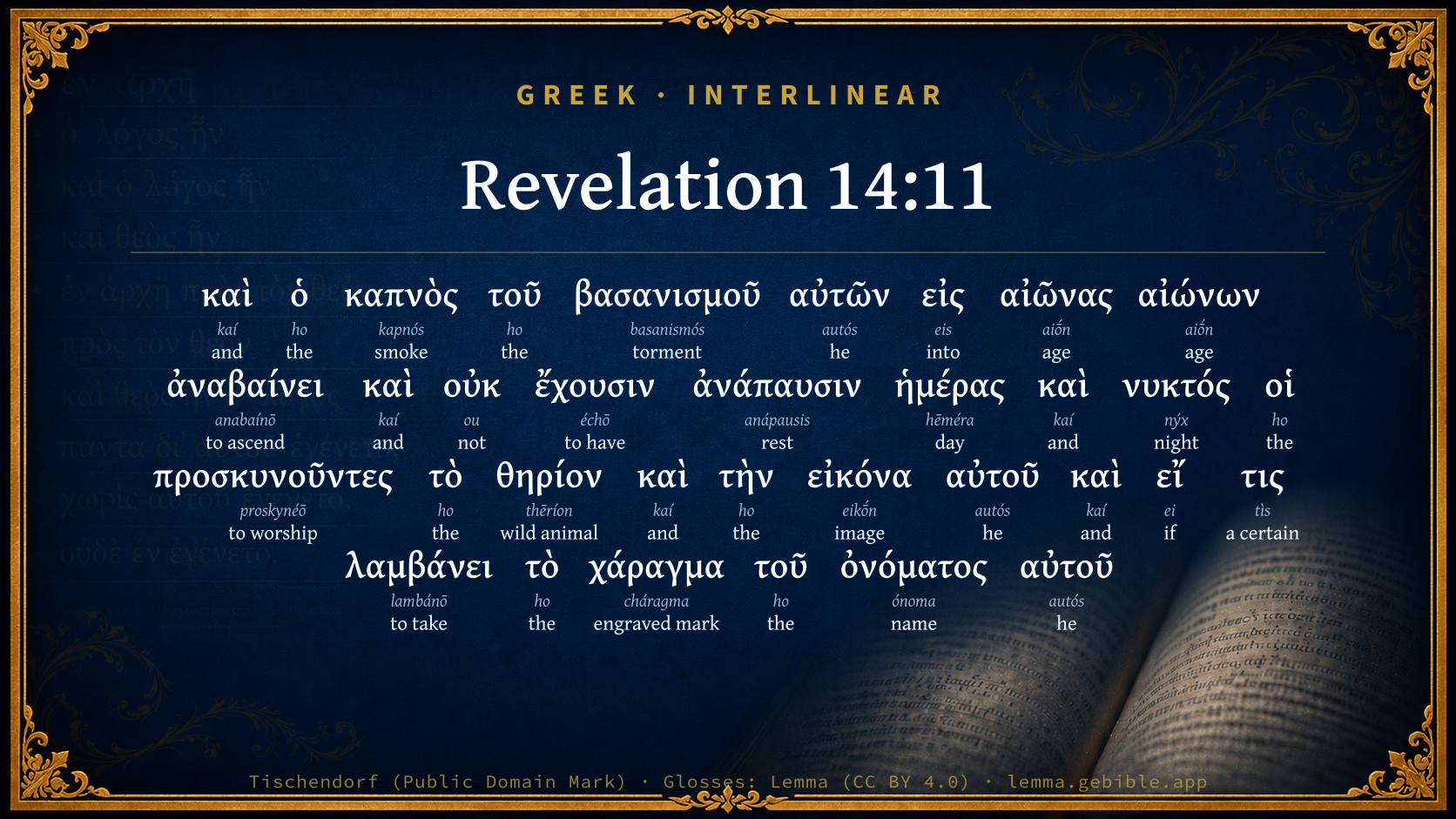
The smoke of their torment goes up forever and ever. They have no rest day and night, those who worship the beast and his image, and whoever receives the mark of his name.
Download a study sheet
One document with this verse’s original text, its word-by-word gloss line, the meaning frame, cross-references with their text, attributed commentary, and full source and license credits — printable, and it pastes into notes with its structure intact.
This verse Autodidact and up
A passage Seminary Student
Up to 50 verses in one chapter. A passage sheet keeps up to 6 commentary sources and 12 cross-references per verse, in the order this page ranks them, and says so on the sheet whenever that leaves anything out. Ask for a single verse and you get the Autodidact verse sheet above.
Everything on this page stays free to read, with no account — the sheet is a download of what is already on screen, not access to it.
Compare translations 3
The same verse in 3 English versions, stacked beneath the original-language interlinear above. Click any original word for its lexicon entry.
Each is an independent rendering of the whole verse — the interlinear is not word-aligned to these translations.
Highlighted words mark where these versions differ — a whole-verse word diff, not a word-by-word alignment.
-
World English Bible Public Domain
The smoke of their torment goes up forever and ever. They have no rest day and night, those who worship the beast and his image, and whoever receives the mark of his name.
-
King James Version Public Domain
And the smoke of their torment ascendeth up for ever and ever: and they have no rest day nor night, who worship the beast and his image, and whosoever receiveth the mark of his name.
-
unfoldingWord Literal Text CC BY-SA 4.0
And the smoke of their torment goes up to the ages of the ages, and they have no rest day and night, the ones worshiping the beast and his image and if anyone receives the mark of his name.
unfoldingWord Literal Text — © unfoldingWord, licensed CC BY-SA 4.0. Word-aligned USFM3 via Door43 (git.door43.org/unfoldingWord/en_ult).
Show all 19 translations
Every available English version of this verse, each an independent rendering of the whole verse.
-
World English Bible Public Domain
The smoke of their torment goes up forever and ever. They have no rest day and night, those who worship the beast and his image, and whoever receives the mark of his name.
-
Berean Standard Bible Public Domain
And the smoke of their torment rises forever and ever. Day and night there is no rest for those who worship the beast and its image, or for anyone who receives the mark of its name.”
-
Majority Standard Bible Public Domain
And the smoke of their torment rises forever and ever. Day and night there is no rest for those who worship the beast and its image, or for anyone who receives the mark of its name.”
-
King James Version Public Domain
And the smoke of their torment ascendeth up for ever and ever: and they have no rest day nor night, who worship the beast and his image, and whosoever receiveth the mark of his name.
-
American Standard Version (1901) Public Domain
and the smoke of their torment goeth up for ever and ever; and they have no rest day and night, they that worship the beast and his image, and whoso receiveth the mark of his name.
-
Revised Version (1885) Public Domain
and the smoke of their torment goeth up for ever and ever; and they have no rest day and night, they that worship the beast and his image, and whoso receiveth the mark of his name.
-
Geneva Bible (1599) Public Domain
And the smoke of their torment shall ascend euermore: and they shall haue no rest day nor night, which worship the beast and his image, and whosoeuer receiueth the print of his name.
-
Douay-Rheims (1899) Public Domain
And the smoke of their torments shall ascend up for ever and ever: neither have they rest day nor night, who have adored the beast, and his image, and whoever receiveth the character of his name.
-
Young's Literal Translation Public Domain
and the smoke of their torment doth go up to ages of ages; and they have no rest day and night, who are bowing before the beast and his image, also if any doth receive the mark of his name.
-
Literal Standard Version CC BY-SA 4.0
and the smoke of their torment goes up through ages of ages; and they have no rest day and night, who are worshiping the beast and his image, also if any receive the mark of his name.
-
Unlocked Literal Bible CC BY-SA 4.0
The smoke from their torment goes up forever and ever, and they have no rest day or night—these worshipers of the beast and his image, and everyone who receives the mark of his name.
-
unfoldingWord Literal Text CC BY-SA 4.0
And the smoke of their torment goes up to the ages of the ages, and they have no rest day and night, the ones worshiping the beast and his image and if anyone receives the mark of his name.
-
Darby Bible Public Domain
And the smoke of their torment goes up to ages of ages, and they have no respite day and night who do homage to the beast and to its image, and if any one receive the mark of its name.
-
World Messianic Bible Public Domain
The smoke of their torment goes up forever and ever. They have no rest day and night, those who worship the beast and his image, and whoever receives the mark of his name.
-
Webster's Bible Public Domain
And the smoke of their torment ascendeth up for ever and ever: and they have no rest day nor night, who worship the beast and his image, and whoever receiveth the mark of his name.
-
Free Bible Version CC BY-SA 4.0
The smoke of their anguish ascends for ever and ever. They don't have any relief day or night, those who worship the beast and his image and who receive the mark of his name.”
-
Bible in Basic English Public Domain
And the smoke of their pain goes up for ever and ever; and they have no rest day and night, who give worship to the beast and his image, and have on them the mark of his name.
-
Text-Critical English NT CC BY 4.0
And the smoke of their torment goes up forever and ever. There is no rest day or night for those who worship the beast and his image or for anyone who receives the mark of his name.”
-
Tyndale New Testament (1534) Public Domain
And the smoke of their turment ascendeth vp evermore. And they have no rest daye ner nyght which worshippe the beast and his ymage and whosoever receaveth the prynt of his name.
Literal Standard Version (2020), Covenant Press — licensed CC BY-SA 4.0. Text via the HelloAO Bible API (eBible.org). Unlocked Literal Bible (unfoldingWord) — licensed CC BY-SA 4.0. Text via the HelloAO Bible API (eBible.org). unfoldingWord Literal Text — © unfoldingWord, licensed CC BY-SA 4.0. Word-aligned USFM3 via Door43 (git.door43.org/unfoldingWord/en_ult). Free Bible Version, Dr. Jonathan Gallagher — licensed CC BY-SA 4.0. Text via the HelloAO Bible API (eBible.org).
Word by word
More ways to search: Search by grammar → Find every occurrence → Compare this word →
Practice this passage: Drill this verse → Learn its vocabulary →
- Appears 5× in the Greek New Testament
- First appears at Matthew 11:29
- Part of Speech
- Noun
- Case
- Accusative
- Number
- Singular
- Gender
- Feminine
Full Thayer's Definition
- καὶ kaí G2532 “and” Conjunction
- ὁ ho G3588 “the” Article, Nominative, Singular, Masculine
- καπνὸς kapnós G2586 “smoke” Noun, Nominative, Singular, Masculine
- τοῦ ho G3588 “the” Article, Genitive, Singular, Masculine
- βασανισμοῦ basanismós G929 “torment” Noun, Genitive, Singular, Masculine
- αὐτῶν autós G846 “he” Personal pronoun, Genitive, Plural, Masculine
- εἰς eis G1519 “into” Preposition
- αἰῶνας aiṓn G165 “age” Noun, Accusative, Plural, Masculine
- αἰώνων aiṓn G165 “age” Noun, Genitive, Plural, Masculine
- ἀναβαίνει anabaínō G305 “to ascend” Verb, Present, Active, Indicative, 3rd person, Singular
- καὶ kaí G2532 “and” Conjunction
- οὐκ ou G3756 “not” Particle, Negative
- ἔχουσιν échō G2192 “to have” Verb, Present, Active, Indicative, 3rd person, Plural
- ἀνάπαυσιν anápausis G372 “rest” Noun, Accusative, Singular, Feminine
- ἡμέρας hēméra G2250 “day” Noun, Genitive, Singular, Feminine
- καὶ kaí G2532 “and” Conjunction
- νυκτός nýx G3571 “night” Noun, Genitive, Singular, Feminine
- οἱ ho G3588 “the” Article, Nominative, Plural, Masculine
- προσκυνοῦντες proskynéō G4352 “to worship” Verb, Present, Active, Participle, Nominative, Plural, Masculine
- τὸ ho G3588 “the” Article, Accusative, Singular, Neuter
- θηρίον thēríon G2342 “wild animal” Noun, Accusative, Singular, Neuter
- καὶ kaí G2532 “and” Conjunction
- τὴν ho G3588 “the” Article, Accusative, Singular, Feminine
- εἰκόνα eikṓn G1504 “image” Noun, Accusative, Singular, Feminine
- αὐτοῦ autós G846 “he” Personal pronoun, Genitive, Singular, Neuter
- καὶ kaí G2532 “and” Conjunction
- εἴ ei G1487 “if” Conditional
- τις tìs G5100 “a certain” Indefinite pronoun, Nominative, Singular, Masculine
- λαμβάνει lambánō G2983 “to take” Verb, Present, Active, Indicative, 3rd person, Singular
- τὸ ho G3588 “the” Article, Accusative, Singular, Neuter
- χάραγμα cháragma G5480 “engraved mark” Noun, Accusative, Singular, Neuter
- τοῦ ho G3588 “the” Article, Genitive, Singular, Neuter
- ὀνόματος ónoma G3686 “name” Noun, Genitive, Singular, Neuter
- αὐτοῦ autós G846 “he” Personal pronoun, Genitive, Singular, Neuter
About this verse
These counts appear in no published source. They are computed here, from the morphology-tagged text and Lemma’s own curated glosses. What Lemma adds →
- 34
- words
- 21
- distinct lemmas
- Revelation
- section
Cross-references
25Topical passages linked to Revelation 14:11 in the Treasury of Scripture Knowledge — connected by theme and wording, ordered by reader-vote popularity; previews shown in the World English Bible.
- Isaiah 34:10 It shall not be quenched night nor day; the smoke of it shall go up for ever; from generation to generation it shall lie waste; none shall pass through it forever and ever.
- Revelation 19:3 A second said, "Hallelujah! Her smoke goes up forever and ever."
- Matthew 25:41 Then he will say also to those on the left hand, 'Depart from me, you cursed, into the eternal fire which is prepared for the devil and his angels;
- Matthew 25:46 These will go away into eternal punishment, but the righteous into eternal life."
- Revelation 20:10 The devil who deceived them was thrown into the lake of fire and sulfur, where the beast and the false prophet are also. They will be tormented day and night forever and ever.
- Isaiah 33:14 The sinners in Zion are afraid; trembling has seized the godless ones: Who among us can dwell with the devouring fire? who among us can dwell with everlasting burning?
- Mark 9:43–49 If your hand causes you to stumble, cut it off. It is better for you to enter into life maimed, rather than having your two hands to go into Gehenna, into the unquenchable fire,
- Luke 16:23–24 In Hades, he lifted up his eyes, being in torment, and saw Abraham far off, and Lazarus at his bosom.
- Revelation 14:9 Another angel, a third, followed them, saying with a great voice, "If anyone worships the beast and his image, and receives a mark on his forehead, or on his hand,
- Revelation 18:18 and cried out as they looked at the smoke of her burning, saying, 'What is like the great city?'
- Genesis 19:28 He looked toward Sodom and Gomorrah, and toward all the land of the plain, and looked, and saw that the smoke of the land went up as the smoke of a furnace.
- Revelation 5:13–14 I heard every created thing which is in heaven, on the earth, under the earth, on the sea, and everything in them, saying, "To him who sits on the throne, and to the Lamb be the blessing, the honor, the glory, and the dominion, forever and ever! Amen!"
- Exodus 15:18 Yahweh shall reign forever and ever."
- Psalms 10:16 Yahweh is King forever and ever! The nations will perish out of his land.
- Psalms 145:1 I will exalt you, my God, the King. I will praise your name forever and ever.
- Hebrews 1:8 but of the Son he says, "Your throne, O God, is forever and ever; The scepter of uprightness is the scepter of your Kingdom.
- Revelation 4:8–10 The four living creatures, each one of them having six wings, are full of eyes around about and within. They have no rest day and night, saying, "Holy, holy, holy, holy, holy, holy, holy, holy, holy is the Lord God, the Almighty, who was and who is and who is to come!"
- Revelation 7:12 saying, "Amen! Blessing, glory, wisdom, thanksgiving, honor, power, and might, be to our God forever and ever! Amen."
- Revelation 11:15 The seventh angel sounded, and great voices in heaven followed, saying, "The kingdom of the world has become the Kingdom of our Lord, and of his Christ. He will reign forever and ever!"
- Deuteronomy 28:65 Among these nations shall you find no ease, and there shall be no rest for the sole of your foot: but Yahweh will give you there a trembling heart, and failing of eyes, and pining of soul;
- Isaiah 57:20 But the wicked are like the troubled sea; for it can't rest, and its waters cast up mire and dirt.
- Joel 2:30 I will show wonders in the heavens and in the earth: Blood, fire, and pillars of smoke.
- Matthew 11:28 "Come to me, all you who labor and are heavily burdened, and I will give you rest.
- Revelation 13:12 He exercises all the authority of the first beast in his presence. He makes the earth and those who dwell in it to worship the first beast, whose fatal wound was healed.
- Revelation 22:5 There will be no night, and they need no lamp light; for the Lord God will illuminate them. They will reign forever and ever.
Cross-references courtesy of OpenBible.info (CC BY 4.0).
Lesson kit
Teaching starters — assembled from the data on this page, not authored interpretation. Every prompt links to the verse data it draws on. Edit before teaching.
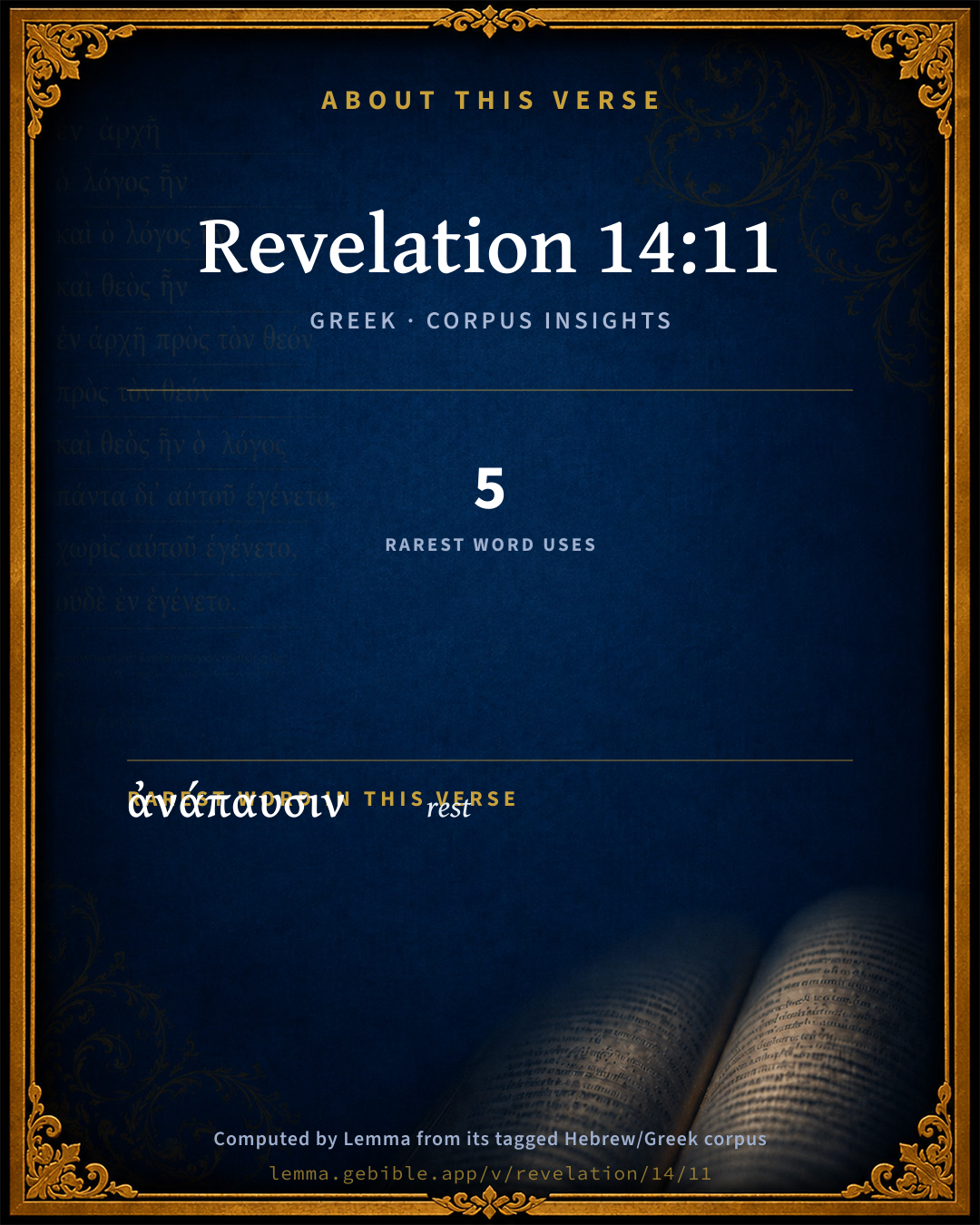
Revelation, in the Revelation, opens this verse with 34 words (21 distinct Greek lemmas). Its most distinctive word is anápausis (“rest”). A historical commentator’s framing appears above. Read the whole chapter for the surrounding context.
Discussion questions
- The word anápausis carries the sense “rest.” How does it shape the verse?
- Matthew 11:29 shares the word «rest» with this verse. How do the two illuminate each other?
- “age” occurs 2× in this one verse. What is the effect of the repetition?
- These translations render this verse differently; the difference is in the English rendering, not the original. What questions does that raise?
- Reading how Bengel's Gnomon and Jamieson, Fausset & Brown read this verse, where do the two commentators agree and where do they part?
Things to notice
- These translations choose different wording for 14 words in this verse.
- “age” occurs 2× in this single verse.
- 21 distinct Greek lemmas span 34 words in this verse.
Commentary
Notes on Revelation 14:11 from classic Christian and Jewish commentators (each source and its license shown beneath its notes). The classic Christian expositions comment on the surrounding passage and are grouped to its opening verse, so a note may address several verses; the Jewish commentaries on the Tanakh (Rashi and others) are per-verse, so they appear only where the commentator wrote on this verse.
Lemma curates 59 commentaries, every one of them public domain or Creative Commons licensed, each selected and text-cleaned for this edition rather than reprinted as found. About our sources →
Bengel's Gnomon
Johann Albrecht Bengel
Bengel's Gnomon of the New Testament — English translation (T&T Clark, Edinburgh, 1860) — public domain. Text from a community e-Sword module.
Jamieson, Fausset & Brown
Robert Jamieson, A. R. Fausset & David Brown
Jamieson, Fausset & Brown — Commentary Critical and Explanatory on the Whole Bible (1871) — public domain (CC PDM 1.0). Text via the HelloAO Bible API.
Adam Clarke's Commentary
Adam Clarke's Commentary on the Bible (1810–1826) — public domain. Text from a community e-Sword/MySword module.
Ellicott's Commentary for English Readers
A Bible Commentary for English Readers, edited by Charles John Ellicott (1878–1897) — public domain. Text from a community e-Sword module.
John Gill's Exposition
John Gill's Exposition of the Whole Bible (1746–1763) — public domain (CC PDM 1.0). Text via the HelloAO Bible API.
Trapp's Complete Commentary
John Trapp
John Trapp, A Commentary or Exposition upon All the Books of the Old and New Testament (1647–1656) — public domain. Text from a community e-Sword module.
Albert Barnes' Notes on the Bible
Albert Barnes' Notes on the Bible (1834–1885) — public domain. Text from a community e-Sword/MySword module.
Matthew Poole's English Annotations
Matthew Poole's English Annotations on the Holy Bible (1683–1685) — public domain. Text from a community e-Sword/MySword module.
The Pulpit Commentary
The Pulpit Commentary (1880–1919), ed. H.D.M. Spence-Jones & Joseph S. Exell — public domain. Text from a community e-Sword module.
John Wesley's Explanatory Notes
John Wesley, Explanatory Notes Upon the Whole Bible (1754–1765) — public domain. Text via the GEBible commentary corpus.
Scofield Reference Notes
C. I. Scofield
The Scofield Reference Bible (1917 edition), notes by C. I. Scofield — public domain. Text from a community e-Sword module.
The People's New Testament
B. W. Johnson
B. W. Johnson's The People's New Testament with Notes (1889–1891) — public domain. Electronic text from the Christian Classics Ethereal Library (CCEL) ThML edition.
unfoldingWord translationNotes
Door43 World Missions Community
unfoldingWord translationNotes — © Distant Shores Media and the Door43 World Missions Community, licensed CC BY-SA 4.0. Source: git.door43.org/Door43/en_tn.
Vincent's Word Studies in the New Testament
Marvin R. Vincent
Marvin R. Vincent, Word Studies in the New Testament (1887–1900) — public domain. Text from a community e-Sword/MySword module.