Galatians 1:5

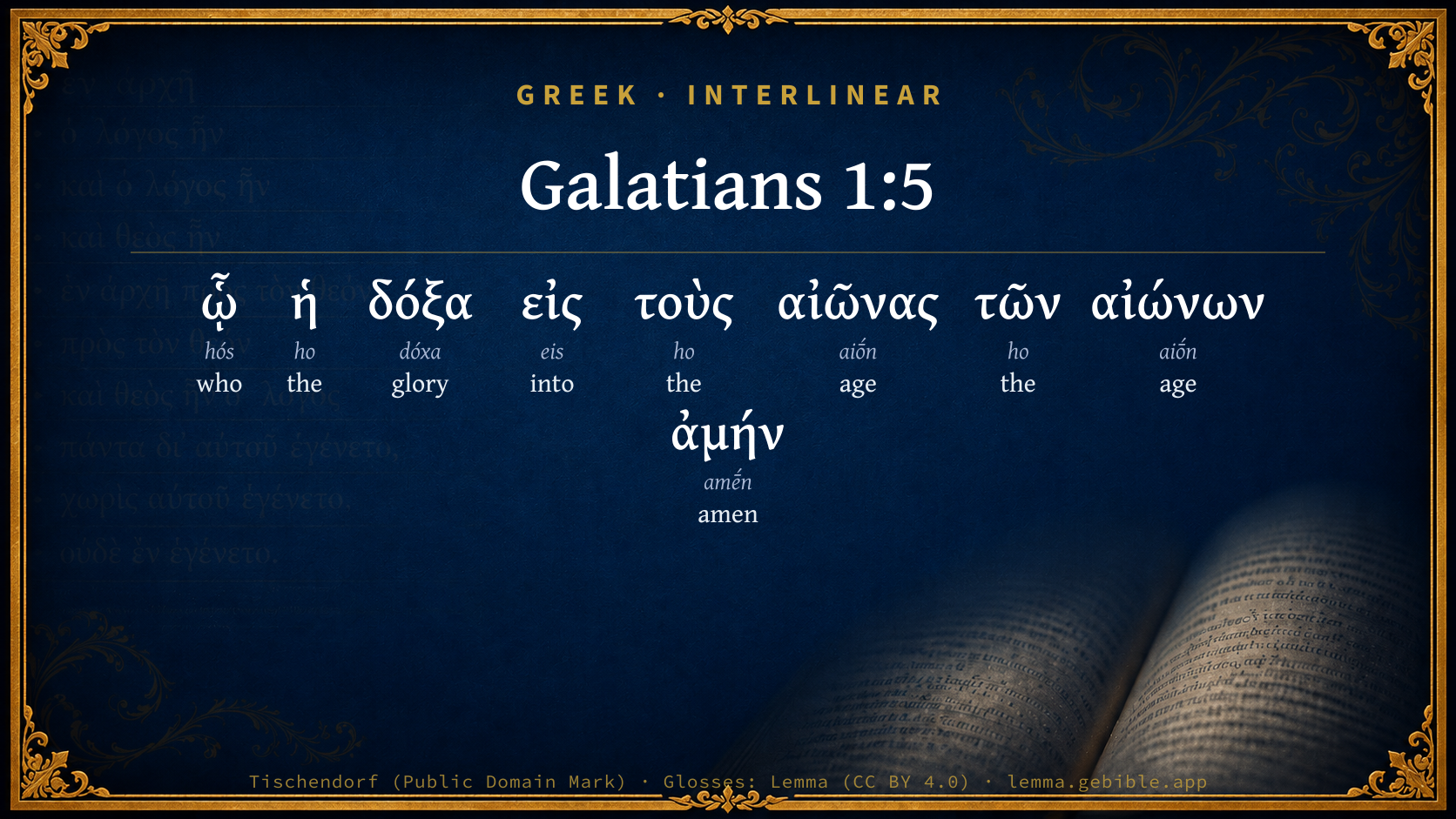
Greek (Tischendorf 8th ed.) Galatians 1:5 appears in the Greek New Testament. The text above is from the Tischendorf 8th edition. Each word links to its Strong’s number and a concise gloss. Click any word for its full Thayer’s Greek Lexicon entry.
Download image
Cite this verse

Galatians 1:5 (World English Bible). Public Domain. Lemma interlinear Bible study tool, https://lemma.gebible.app/v/galatians/1/5.

Show BibTeX & RIS
BibTeX
RIS
English Translation
to whom be the glory forever and ever. Amen.
World English Bible · Public Domain
Download a study sheet

One document with this verse’s original text, its word-by-word gloss line, the meaning frame, cross-references with their text, attributed commentary, and full source and license credits — printable, and it pastes into notes with its structure intact.

This verse Autodidact and up

Study sheet (.html) Plain text (.txt)

A passage Seminary Student

Up to 50 verses in one chapter. A passage sheet keeps up to 6 commentary sources and 12 cross-references per verse, in the order this page ranks them, and says so on the sheet whenever that leaves anything out. Ask for a single verse and you get the Autodidact verse sheet above.

Everything on this page stays free to read, with no account — the sheet is a download of what is already on screen, not access to it.

Want to remove ads? Support Godless Engineer
Compare translations 3

The same verse in 3 English versions, stacked beneath the original-language interlinear above. Click any original word for its lexicon entry.

Each is an independent rendering of the whole verse — the interlinear is not word-aligned to these translations.

Highlighted words mark where these versions differ — a whole-verse word diff, not a word-by-word alignment.

  • World English Bible Public Domain
    to whom be the glory forever and ever. Amen.
  • King James Version Public Domain
    To whom be glory for ever and ever. Amen.
  • unfoldingWord Literal Text CC BY-SA 4.0
    to whom the glory forever ever. Amen.

unfoldingWord Literal Text — © unfoldingWord, licensed CC BY-SA 4.0. Word-aligned USFM3 via Door43 (git.door43.org/unfoldingWord/en_ult).

Versions to compare (up to 4)

3 of 4 selected

Show all 19 translations

Every available English version of this verse, each an independent rendering of the whole verse.

  • World English Bible Public Domain
    to whom be the glory forever and ever. Amen.
  • Berean Standard Bible Public Domain
    to whom be glory forever and ever. Amen.
  • Majority Standard Bible Public Domain
    to whom be glory forever and ever. Amen.
  • King James Version Public Domain
    To whom be glory for ever and ever. Amen.
  • American Standard Version (1901) Public Domain
    to whom `be' the glory for ever and ever. Amen.
  • Revised Version (1885) Public Domain
    to whom be the glory for ever and ever. Amen.
  • Geneva Bible (1599) Public Domain
    To whom be glory for euer and euer, Amen.
  • Douay-Rheims (1899) Public Domain
    To whom is glory for ever and ever. Amen.
  • Young's Literal Translation Public Domain
    to whom `is' the glory to the ages of the ages. Amen.
  • Literal Standard Version CC BY-SA 4.0
    to whom [is] the glory through the ages of the ages. Amen.
  • Unlocked Literal Bible CC BY-SA 4.0
    to him be the glory forever and ever. Amen.
  • unfoldingWord Literal Text CC BY-SA 4.0
    to whom the glory forever ever. Amen.
  • Darby Bible Public Domain
    to whom [be] glory to the ages of ages. Amen.
  • World Messianic Bible Public Domain
    to whom be the glory forever and ever. Amen.
  • Webster's Bible Public Domain
    To whom be glory for ever and ever. Amen.
  • Free Bible Version CC BY-SA 4.0
    To him be glory forever and ever! Amen.
  • Bible in Basic English Public Domain
    To whom be the glory for ever and ever. So be it.
  • Text-Critical English NT CC BY 4.0
    To him be the glory forever and ever. Amen.
  • Tyndale New Testament (1534) Public Domain
    to whom be prayse for ever and ever. Amen.

Literal Standard Version (2020), Covenant Press — licensed CC BY-SA 4.0. Text via the HelloAO Bible API (eBible.org). Unlocked Literal Bible (unfoldingWord) — licensed CC BY-SA 4.0. Text via the HelloAO Bible API (eBible.org). unfoldingWord Literal Text — © unfoldingWord, licensed CC BY-SA 4.0. Word-aligned USFM3 via Door43 (git.door43.org/unfoldingWord/en_ult). Free Bible Version, Dr. Jonathan Gallagher — licensed CC BY-SA 4.0. Text via the HelloAO Bible API (eBible.org).

Word by word

More ways to search: Search by grammar → Find every occurrence → Compare this word →

Practice this passage: Drill this verse → Learn its vocabulary →

About this verse

These counts appear in no published source. They are computed here, from the morphology-tagged text and Lemma’s own curated glosses. What Lemma adds →

9
words
6
distinct lemmas
Pauline Epistles
section

Repetition

Words recur within this verse:

  • αἰῶνας age G165 ×2
  • ἡ the G3588 ×3

Cross-references

22

Topical passages linked to Galatians 1:5 in the Treasury of Scripture Knowledge — connected by theme and wording, ordered by reader-vote popularity; previews shown in the World English Bible.

  • Romans 11:36 For of him, and through him, and to him, are all things. To him be the glory for ever! Amen.
  • Jude 1:25 to God our Savior, who alone is wise, be glory and majesty, dominion and power, both now and forever. Amen.
  • Psalms 72:19 Blessed be his glorious name forever! Let the whole earth be filled with his glory! Amen and amen.
  • Hebrews 13:21 make you complete in every good work to do his will, working in you that which is well pleasing in his sight, through Jesus Christ, to whom be the glory forever and ever. Amen.
  • 1 Chronicles 29:13 Now therefore, our God, we thank you, and praise your glorious name.
  • Psalms 41:13 Blessed be Yahweh, the God of Israel, From everlasting and to everlasting! Amen and amen.
  • Isaiah 24:15 Therefore glorify Yahweh in the east, even the name of Yahweh, the God of Israel, in the isles of the sea!
  • Isaiah 42:12 Let them give glory to Yahweh, and declare his praise in the islands.
  • Matthew 6:13 Bring us not into temptation, but deliver us from the evil one. For yours is the Kingdom, the power, and the glory forever. Amen.'
  • Matthew 28:20 teaching them to observe all things that I commanded you. Behold, I am with you always, even to the end of the age." Amen.
  • Luke 2:14 "Glory to God in the highest, On earth peace, good will toward men."
  • Romans 16:27
  • Ephesians 1:12 to the end that we should be to the praise of his glory, we who had before hoped in Christ:
  • Philippians 4:20 Now to our God and Father be the glory forever and ever! Amen.
  • 1 Timothy 1:17 Now to the King eternal, immortal, invisible, to God who alone is wise, be honor and glory forever and ever. Amen.
  • 2 Timothy 4:18 And the Lord will deliver me from every evil work, and will preserve me for his heavenly Kingdom; to whom be the glory forever and ever. Amen.
  • 1 Peter 5:11 To him be the glory and the power forever and ever. Amen.
  • 2 Peter 3:18 But grow in the grace and knowledge of our Lord and Savior Jesus Christ. To him be the glory both now and forever. Amen.
  • Revelation 4:9–11 When the living creatures give glory, honor, and thanks to him who sits on the throne, to him who lives forever and ever,
  • Revelation 5:12 saying with a loud voice, "Worthy is the Lamb who has been killed to receive the power, wealth, wisdom, strength, honor, glory, and blessing!"
  • Revelation 7:12 saying, "Amen! Blessing, glory, wisdom, thanksgiving, honor, power, and might, be to our God forever and ever! Amen."
  • Revelation 14:7 He said with a loud voice, "Fear the Lord, and give him glory; for the hour of his judgment has come. Worship him who made the heaven, the earth, the sea, and the springs of waters!"

Cross-references courtesy of OpenBible.info (CC BY 4.0).

Commentary

Notes on Galatians 1:5 from classic Christian and Jewish commentators (each source and its license shown beneath its notes). The classic Christian expositions comment on the surrounding passage and are grouped to its opening verse, so a note may address several verses; the Jewish commentaries on the Tanakh (Rashi and others) are per-verse, so they appear only where the commentator wrote on this verse.

Lemma curates 59 commentaries, every one of them public domain or Creative Commons licensed, each selected and text-cleaned for this edition rather than reprinted as found. About our sources →

Tyndale Open Study Notes

Tyndale Open Resources

1:5 All glory must go to God for salvation, because it is his work alone.

Tyndale Open Study Notes — © Tyndale Open Resources, licensed CC BY-SA 4.0. Text via the HelloAO Bible API.

Bengel's Gnomon

Johann Albrecht Bengel

Gal 1:5. Ἡ δόξα, the glory) for this will, which brings salvation. A delightful introduction.

Bengel's Gnomon of the New Testament — English translation (T&T Clark, Edinburgh, 1860) — public domain. Text from a community e-Sword module.

Meyer's Critical & Exegetical Commentary

Heinrich August Wilhelm Meyer

Gal_1:5. To the mention of this counsel of deliverance the piety of the apostle annexes a doxology. Comp. 1Ti_1:17; Rom_11:36; Rom_9:5; Rom_16:27; Eph_3:21.

ἡ δόξα] that is, the honour due to Him for this θέλημα. We have to supply εἴη, and not ἐστί (Vulgate, Hofmann, Matthias), which is inserted (Rom_1:25; 1Pe_4:11) where there is no doxology. So in the frequent doxologies in the apostolic Fathers, e.g. Clement, Cor. I. 20, 38, 43, 45, 50, 58. Comp. the customary εὐλογητός, sc. εἴη, at Rom_9:5; Eph_1:3. See, further, on Eph_3:21.

Meyer — Critical and Exegetical Commentary on the New Testament — English translation by Peter Christie, edited by Frederick Crombie (T&T Clark, 1880) — public domain. Text from a community e-Sword module.

Expositor's Greek Testament

ed. W. Robertson Nicoll

Gal 1:5 . ᾧ ἡ δόξα , sc. ἐστιν . Our versions supply ἔστω and turn the clause accordingly into an invocation of praise. But the insertion of the article points rather to an affirmation, whose is the glory . The verb is usually omitted in the doxology, but ἐστιν is added in 1Pe 4:11 . The glory consists in the manifestation of the Father’s character throughout all the ages in the continual redemption of mankind according to His will. Hereby is revealed His union of perfect wisdom, holiness, and love. εἰς τ . αἰῶνας τ . αἰώνων . αἰών denotes in Scripture a divinely appointed period (see note on Gal 1:4 ). The larger of these divine dispensations comprehend within them other shorter periods, and are therefore designated αἰῶνες αἰώνων . The phrase in the text ascribes the glory to God for the whole term of these dispensations, i.e. , for all the ages of human life, since these together make up the sum of man’s existence. The full form is used by the Apostle in Phi 4:20 , 2Ti 4:18 , but he uses elsewhere the shorter form εἰς τ . αἰῶνας . ἀμήν . This Amen crowns the previous declaration of the glory of God by an invitation to the Churches to join in the ascription of praise.

The Expositor's Greek Testament, edited by W. Robertson Nicoll (1897–1910) — public domain. Text from a community e-Sword module.

Jamieson, Fausset & Brown

Robert Jamieson, A. R. Fausset & David Brown

be glory--rather, as Greek, "be the glory"; the glory which is peculiarly and exclusively His. Compare Note, see on Eph 3:21.

Jamieson, Fausset & Brown — Commentary Critical and Explanatory on the Whole Bible (1871) — public domain (CC PDM 1.0). Text via the HelloAO Bible API.

Adam Clarke's Commentary

Verse 5. To whom be glory for ever] Let him have the glory to whom alone it is due, for having delivered us from the present evil world, and from all bondage to Mosaic rites and ceremonies.

Adam Clarke's Commentary on the Bible (1810–1826) — public domain. Text from a community e-Sword/MySword module.

John Calvin's Commentaries

5. To whom be glory. By this sudden exclamation of thanksgiving, he intends to awaken powerfully in his readers the contemplation of that invaluable gift which they had received from God, and in this manner to prepare their minds more fully for receiving instruction. It must at the same time be viewed as a general exhortation. Every instance in which the mercy of God occurs to our remembrance, ought to be embraced by us as an occasion of ascribing glory to God.

John Calvin's Commentaries (1540-1563) — public domain. Text from the Calvin Translation Society English edition (1840s-50s) via the Christian Classics Ethereal Library (ccel.org). Calvin's coverage is partial (roughly two-thirds of the Bible); uncommented books and verses are honest gaps, never fabricated. The 19th-century editor's footnotes and remarks are omitted so the notes are faithfully Calvin's own voice.

Ellicott's Commentary for English Readers

(5) Glory.—Perhaps, properly, the glory—i.e., the divine glory: that pre-eminent glory with which no other can compare.

If this is the case, then it would be better to supply “is” than “be.” His own peculiar glory does belong to God, and therefore the Christian ascribes it to Him as that which is already His; he does not pray for it as something unfulfilled, as, e.g., he prays for the coming of God’s kingdom.

In the insertion of this brief doxology the mind of the Apostle obeys an involuntary impulse of reverential awe. For a similar ascription in the same parenthetic form, comp. Rom_9:5.

For ever and ever.—Literally, for ages of ages, a Hebraising expression for infinite time. Commonly, time was divided only into two great world-periods; but the second is, as it were, multiplied indefinitely—“for all possible ages.”

A Bible Commentary for English Readers, edited by Charles John Ellicott (1878–1897) — public domain. Text from a community e-Sword module.

The Cambridge Bible for Schools and Colleges

gen. ed. J. J. S. Perowne

5. to whom be glory … Amen] perh. ‘the glory’. All the glory of the great work of Redemption, in its design, in its process, in its results, is His alone and shall be throughout eternity.

Amen] A Hebrew word, signifying ‘truth,’ used to express concurrence in the prayer or praise uttered by another, especially in public worship. Deu_27:15; 1Ch_16:36. From the synagogue it passed into the acts of worship of the Christian Church (1Co_14:16). Here it is employed as an emphatic affirmation of the ascription to which it is appended. Comp. Psa_72:19; Rev_1:18; Rev_22:20.

The Cambridge Bible for Schools and Colleges (gen. ed. J. J. S. Perowne; Cambridge University Press, 1878–1918) — public domain. Text from a community e-Sword module.

John Gill's Exposition

To whom be glory for ever and ever. Amen. That is, either to Christ, who gave himself to expiate the sins of his people, on the account of which all honour and glory are due to him from them; or to God the Father, according to whose will of purpose and command Christ gave himself, for which glory ought to be ascribed unto him; and it may well be thought, that both are taken into this doxology: the Father is to be glorified, who of his everlasting love, and free favour, did in his eternal purposes and decrees in his counsel and covenant, so wisely frame and order things, that his own Son should be given to be an offering for sin; and Christ is to be glorified, that he, of his free rich grace and love, agreed to give himself, and did give himself to be a ransom for his people, which has been testified in due time. This ascription of glory to both shows the greatness of the blessing, and the grateful sense which all interested in it ought to bear upon their minds continually, "for ever and ever"; or "to the ages of ages", a Jewish phrase, the same with (c). To which the apostle adds his "Amen", as joining with all the saints, above or below, in ascribing salvation, and the glory of it, to him that sits upon the throne, and to the Lamb for ever and ever.

(c) Zohar in Gen. fol. 72. 3.

John Gill's Exposition of the Whole Bible (1746–1763) — public domain (CC PDM 1.0). Text via the HelloAO Bible API.

Trapp's Complete Commentary

John Trapp

5 To whom be glory for ever and ever. Amen.

Ver. 5. To whom be glory] The benefit of our redemption should make us lift up many a humble, joyful, and thankful heart to God.

John Trapp, A Commentary or Exposition upon All the Books of the Old and New Testament (1647–1656) — public domain. Text from a community e-Sword module.

Albert Barnes' Notes on the Bible

To whom be glory ... - Let Him have all the praise and honor of the plan and its execution. It is not uncommon for Paul to introduce an ascription of praise in the midst of an argument: see the note at Rom 1:25. It results from the strong desire which he had, that all the glory should be given to God, and showed that he believed that all blessings had their origin in God, and that God should be always acknowledged.

Albert Barnes' Notes on the Bible (1834–1885) — public domain. Text from a community e-Sword/MySword module.

Matthew Poole's English Annotations

To which Father, (yet not excluding the Son), for do great benefits bestowed upon us, be honour, and praise, from age to age, and to all eternity. The term Amen, being always used in Scripture either as a term of assertion, to aver the truth of a thing, or as a term of wishing, may here be understood in either or both senses; the apostle using it either to assert the glorifying of God to be our duty, and a homage we owe to God; or to signify his hearty desire that this homage may from all hands be paid unto him.

Matthew Poole's English Annotations on the Holy Bible (1683–1685) — public domain. Text from a community e-Sword/MySword module.

Whedon's Commentary on the Bible

Daniel D. Whedon

5. This complete cycle of gospel thought St. Paul rounds out with a doxology, as in Rom_11:36; Rom_9:5; Rom_16:27; Eph_3:21; 1Ti_1:17.

Be glory—Rather, the glory, with the article; that is, (not, as Alford and Lightfoot, the glory belonging to him, but) the glory of so glorious a redemption. “God’s all the glory—man’s the endless bliss.”

For ever and ever—Literal Greek, into aeons of aeons—into ages of ages. The phrase does not, with absolute exactness, express eternity, but only indefinite immensity. It does not absolutely deny all end, but ignores all end. It was, no doubt, the most powerful phrase to express eternity, and to explode from thought all idea of end that the language of the New Testament age knew. Hence it is here used to designate the duration of the existence of the divine glory. It may be added that the word aeon, in this phrase, is the same as that in the previous verse, which we have rendered time-world. This phrase, then, suggests that the endless future is not to be a quiet characterless stream, but a perpetual roll of stupendous revolutions.

Daniel D. Whedon (gen. ed.), Commentary on the Old and New Testaments (1874–1909) — public domain. Text from a community e-Sword module.

The Pulpit Commentary

To whom be glory for ever and ever. Amen (w hJ doxa eijv tounwn jAmhn). This doxology is not introduced as merely a reverential closing up of the greeting, before the writer hastens on to the subsequent words of rebuke. It is rather an indignant tender of homage to the Most High, flashing forth from a loyal, filial heart; confronting and seeking, so far as it thus may, to redress the wrong done to "our God and Father" by the Judaizing spirit uprearing itself among the Galatians. It is similar in tone to the indignant doxology in Rom_1:25. This view of its origin explains the fact that, as connected with agreeting, such doxology is found only in this of all St. Paul"s Epistles. The indignation which pervades the tone of the whole passage favours the suppletion of estw rather than of ejstin. Perhaps, indeed estw is in general the more natural suppletion. in 1Pe_4:11, where ejstin is added by the writer, we have not so much a direct ascription of praise as an affirmation that to God belongs or is due the glory of our performing our several duties with reference to this end. In like manner in the (most probably interpolated) doxology at the close of the Lord"s prayer inxa Mat_6:13, "For thine is the kingdom," etc., the ascription of praise is not so much expressed as implied. Viewed in themselves, the words simply state the truth which constitutes the ground for our addressing to "our Father" our praises and our petitions. The article is most commonly prefixed to do in such ascriptions of praise, whether doxa stands alone, Rom_11:36 Rom_16:27; Eph_3:21; Php_4:20; 2Ti_4:18; Heb_13:21; 2Pe_3:18; or in conjunction with other nouns, as 1Pe_4:11; Rev_1:6 Rev_7:12. It is wanting Luk_2:14 Luk_19:38; 1Ti_1:17 Jud_1:25. When the article is added it marks the noun as expressing its notion viewed absolutely, in its entirety or universality: q.d. "Whatever glory is to be ascribed anywhere, be it ascribed to him." Thus hJ do) is equivalent to "all glory." For ever and ever; literally, into the aions of the aions; apparently a form of expression adopted to denote intensification,or superlativeness, like "holy of holies" (cf. Winer, "Gram. N. T.," 2). It is used where especial intensity is wished to be added to the notion of long undetermined duration; as Rev_14:11 Rev_15:7 Rev_22:5, etc. The same notion is expressed, only with not the same passionate earnestness, by the phrase, "into the aions," in Luk_1:33; Rom_1:25 Rom_9:5 Rom_11:36, etc.; and by "into the aion," in Mat_21:19; Joh_6:51, Joh_6:58, etc. Possiblythere is a reference of contrast to" this present aidn" of ver. 4. This, however, is doubtful; for in ver. 4 aion points to a particular condition of affairs subsisting in this aion rather than to a mere mode of duration, which latter is alone in view here. The like observation applies to Eph_2:2 compared with ver. 7.

The Pulpit Commentary (1880–1919), ed. H.D.M. Spence-Jones & Joseph S. Exell — public domain. Text from a community e-Sword module.

John Wesley's Explanatory Notes

To whom be glory - For this his gracious will.

John Wesley, Explanatory Notes Upon the Whole Bible (1754–1765) — public domain. Text via the GEBible commentary corpus.

Luther on Galatians

Martin Luther

VERSE 5. To whom be glory for ever and ever. Amen.

Hebrew writing is interspersed with expressions of praise and gratitude. This peculiarity can be traced in the apostolic writings, particularly in those of Paul. The name of the Lord is to be mentioned with great reverence and thanksgiving.

Martin Luther — Commentary on the Epistle to the Galatians (1535), English translation by Theodore Graebner (Zondervan, 1939) — public domain (U.S. copyright not renewed). Text from a community e-Sword module.

Burkitt's Expository Notes on the New Testament

William Burkitt

That is, "To God the Father, and Christ Jesus our Redeemer, be given the highest degrees of honour and glory, throughout the present and eternal ages."

Note here, 1. The work and duty incumbent upon Christ’s redeemed ones, and that is, to ascribe all honour and homage, all glory and praise to God the Father, as the contriver, and to Christ the Son, as the accomplisher of the work of redemption; To whom, both whom, be glory.

Note, 2. The duration and continuance of this duty; not for a day, or year, but for eternal ages. This duty of ascribing honour and homage, glory and praise to the Father and Mediator, for the glorious work of man’s redemption, is such, that it can never be sufficiently discharged, but requires a succession of ages to perform it in: yea, eternity itself is too short for the performance of it: To whom be glory for ever and ever. The glory of the Redeemer, and of him that sent him to redeem, will be the long-lasting, and never-ending song of redeemed ones, through millions of ages, yea, to all eternity; a work begun on earth, never finished in heaven.

William Burkitt's Expository Notes on the New Testament (1700–1703) — public domain. Text from a community e-Sword module.

McGarvey & Pendleton's Commentaries

J. W. McGarvey

to whom be the glory for ever and ever. Amen. [The mention of the Lord Jesus Christ in the benediction, coupled with the thought which was uppermost in his mind, namely, that the Galatians were forsaking salvation through Jesus in the hope that they might obtain it through the law of Moses, leads Paul in these very opening sentences to fully set forth the atoning sacrifice of Christ, the deliverance through him, and the will of God, who ordered that atonement and deliverance should come in this way. Gratitude to Christ, who, owning his life, might have retained it, but freely gave it for us, and desire for deliverance from this present evil world, and respect for the sovereign will of God our Father, are three strong motives prompting us to be steadfast in the profession of our Christian faith. To each of these motives Paul appeals. It is the apostle's habit, whenever he has occasion to make mention of the mercy of God, to break forth in expressions of thanksgiving ( 2Co_9:15 ; Eph_3:20 ), and he follows his custom here.]

J. W. McGarvey (with Philip Y. Pendleton), Commentaries on the New Testament (The Fourfold Gospel, 1914; Acts; and the epistles) — public domain. Text from a community e-Sword/MySword module.

The People's New Testament

B. W. Johnson

5. To whom be glory. This doxology is an indirect rebuke to those who were exalting Moses to share the glory of Christ.

B. W. Johnson's The People's New Testament with Notes (1889–1891) — public domain. Electronic text from the Christian Classics Ethereal Library (CCEL) ThML edition.

Cambridge Greek Testament for Schools and Colleges

5. ᾧ ἡ δόξα κ.τ.λ. The doxology in the salutation (here only) takes the place of thanks to God for his readers. The article suggests “which properly belongs to Him.”

Cambridge Greek Testament for Schools and Colleges (Cambridge University Press, 1896; 21 vols, various authors incl. Carr, Maclear, Plummer, Farrar, Lumby, Moule, M. R. James, Simcox) — public domain. Text from a community e-Sword module.

Alford’s Greek Testament

Henry Alford

5. ᾧ ἡ δόξα] So (reff.) on other occasions, when speaking of the wonderful things of God, St. Paul adds a doxology. “In politeia, quando regum aut principum nomina appellamus, id honesto quodam gestu, reverentia, et genuflexione facere solemus. Multo magis cum de Deo loquimur, genu cordis flectere debemus.” Luther. In ἡ δόξα,—the glory κατʼ ἐξοχήν, or ‘the glory which is His,’—the article is probably inserted for solemnity. “In this and similar forms of doxology,—excepting the angelic doxology, Luk 2:14, and that of the multitude, Luk 19:38,—δόξα regularly takes the article when used alone: see Rom 11:36; Rom 16:27; Eph 3:21; Php 4:20; 2Ti 4:18; Heb 13:21; 2Pe 3:18. When joined with one or more substantives, it appears sometimes with the article (1Pe 4:11; Rev 1:6; Rev 7:12): sometimes without it (Rom 2:10; 1Ti 1:17; Jud 1:25).” Ellicott.

τοὺς αἰῶν. τ. αἰών.] See note on Eph 3:21.

Henry Alford, The Greek Testament (1849–1861) — public domain. Text from a community e-Sword module.

International Critical Commentary

5. ᾧ ἡ δόξα εἰς τοὺς αἰῶνας τῶν αἰώνων· ἀμήν. “to whom be the glory for ever and ever. Amen.” An ascription of praise to God for the gift of Christ and the deliverance accomplished through it. δόξα (here only in Gal.) is frequent in Paul, with considerable variation of meaning. See Th. s. v. and Kennedy, St. Paul’s Conception of the Last Things, pp. 229 ff. Its sense here, “praise,” comes down from the classic times, and is frequent in N. T. The article, when occurring, seems almost invariably to convey a reference to something which has just been mentioned; in this case, no doubt, the redeeming work of Christ. Cf. Rom 11:36, Rom 16:27, Eph 3:21, Php 4:20, 2Ti 4:18, Heb 13:21, 1Pe 4:11. Contrast Luk 2:14 (where, however, the poetic form may rather be the cause of the omission of the article); Rom 15:7, Php 2:11. The generic (or intensive) force of the article, such as apparently occurs in Rev 7:12 and perhaps in 2Pe 3:18, is possible but less probable than the demonstrative force suggested above. On εἰς τ. αἰ. τ. αἰώνων, see detached note on Αἰών, p. 426.

Ἀμήν (Heb. אָמֵן, an adverb derived from אָמֵן “to be firm,” Hiphil, “to believe,” “to trust”) is carried over into the N. T. vocabulary from the Hebrew. It is used in O. T. as confirming an oath (Num 5:22 et al.), as the solemn conclusion and confirmation of a doxology (Neh 8:6, Ps. 41:14, etc.), and otherwise. The Lxx usually translate it by γένοιτο, but occasionally transliterate (1Ch 16:36, Neh 5:13, Neh 5:8:6, Neh 5:1 Esd. 9:47, Tob. 8:8, 14:15), but none of these instances are at the end of a doxology or benediction. This usage, of which 3 Mac. 7:23 (see also 4 Mac. 18:24) apparently furnishes the earliest example, may have arisen from the custom of the congregation responding “Amen” to the prayer offered by the leader. Cf. Neh 8:6, 1Co 14:16, and Frame on 1Th 3:13, also M. and M. Voc. s. v.

On the relation between the salutations of the Pauline and other N. T. letters, and the methods of beginning letters current among Greek, Roman, Jewish, and early Christian writers, see extended and instructive note in Hilgenfeld, Der Galaterbrief, 1852, pp. 99 ff.; also respecting the classical Greek and Latin forms, Fritzsche on Rom 1:1; Wendland, Handbuch zum Neuen Testament, III 3, Beilage 15, pp. 411 ff.; Ziemann, De Epistularum graecarum formulis, in Diss. phil. Hal. XVIII 4, 1910. Respecting the evidence of the papyri, see Lietzmann, Griechische Papyri, 1905; Witkowski, Epistulae graecae privatae, 1906, and Milligan, Selections from the Greek Papyri, 1910. Cf. Frame on 1Th 1:1. See also Mayor, The Epistle of St. James, pp. 30, 31. The following are typical examples: Πλάτων Ἀρχύτᾳ Ταραντίνῳ εὐ πράττειν (Epistle IX, Ed. Hermann, p. 58). M. Cicero salutem dicit P. Lentulo Procos. (Ed. Mueller, IV 1, pp. 1 ff.); לְדָֽרְיָ֥וֶשׁ מַֽלְכָּ֖א שְׁלָמָ֥א כֹלָּא (Ezr 5:7); τοῖς ἀδελφοῖς τοῖς κατʼ Αἴγυπτον Ἰουδαίοις χαίρειν οἱ ἀδελφοὶ οἱ ἐν Ἰεροσολύμοις Ἰουδαῖοι καὶ οἱ ἐν τῆ χώρᾳ τῆς Ἰουδαίας, εἰρήνην ἀγαθήν (2 Mal 1:1). καὶ οἱ ἐν τῇ Ἰουδαίᾳ καὶ ἡ γερουσία καὶ Ἰοῦδας Ἀριστοβούλῳ … χαίρειν καὶ ὑγιαίνειν (2 Mal 1:10). Κλαύδιος Λυσίας τῷ κρατίστῳ ἡγεμόνι Φιλίκι χαίρειν (Act 23:26; cf. Act 15:23). Ἰωάνης ταῖς ἑπτὰ ἔκκλησίαις ταῖς ἐν τῆ Ἀσίᾳ. χάρις ὑμῖν καὶ εἰρήνη (Rev 1:4). Πολύκαρπος … τῇ ἐκκλησίᾳ τοῦ θεοῦ τῆ παροικούση Φιλίπποις· ἔλεος ὑμῖν καὶ εἰρήνη παρὰ θεοῦ (Polyc. Phil.). The following, from Milligan’s Selections, show the usage of the papyri: Πολυκράτης τῶι πατρὶ χαίρειν. Ἀπολλώνιος Πτολεμαίωι τῶ πατρὶ χαίρειν. Ἰλαρίων [α] Ἄλιτι τῆι ἀδελφῇι πλεῖστα χαίρειν. Θέων Τυράννωι τῶι τιμιωτάτωι πλεῖστα χαίρειν.

These and other examples cited by the writers above referred to show (1) that both Greeks and Romans, if not also the Hebrews, frequently began a letter with the writer’s name; (2) that the naming of the person or persons addressed, usually in the dative, but sometimes in the vocative, was the general custom among Greeks, Romans, and Hebrews; (3) that to these two it was customary among the Hebrews to add the word שָׁלוֹם, or if writing in Greek, εἰρήνη, among the Greeks χαίρειν, with or without the addition of λέγει, and among the Romans salutem with or without dicit; (4) that the early Christian writers followed in general the usages then current in the Roman world, but in the exercise of that liberty which these usages themselves sanctioned, combined elements derived on the one side from the Greek custom and on the other from the Hebrew, and introduced also distinctly Christian elements. As a result there seems to have been created almost a standard Christian form (note the resemblance between the salutation of the Pauline letters, those ascribed to Peter, 2 and 3 Jn., the salutation of Rev 1:4, and those used by Clem. Rom. and Polycarp), yet one which was freely modified by each writer in adaptation to the particular occasion and persons addressed. Note the variations from the usual form in Jas. and the Ignatian letters, and the lack of salutation in 1 Jn. and Heb., though these latter are perhaps rather literary epistles than letters in the stricter sense. See Deissmann, Bible Studies, chap. 1. In the creation of this general Christian form for beginning letters, the dates of the literature would suggest that Paul exerted a special influence, though there can hardly have been any slavish, perhaps not even a conscious, copying of his form by others.

International Critical Commentary — older volumes (1896–1929), various authors — public domain. Text from a community e-Sword module.

Vincent's Word Studies in the New Testament

Marvin R. Vincent

To whom be glory, etc. For similar doxologies see Rom 9:5; Rom 11:36; Rom 16:27; Eph 3:21; 1Ti 1:17.

Forever and ever [εις τους αιωνας των αιωνων] . Lit. unto the ages of the ages. See additional note on 2Th 1:9, and comp. Rom 16:27; Phi 4:20; 1Ti 1:17; 2Ti 4:18. Often in Revelation. In LXX habitually in the singular : see Psa 88:29; Psa 110:3, 30. In the doxology the whole period of duration is conceived as a succession of cycles.

Marvin R. Vincent, Word Studies in the New Testament (1887–1900) — public domain. Text from a community e-Sword/MySword module.

Lesson kit

Teaching starters — assembled from the data on this page, not authored interpretation. Every prompt links to the verse data it draws on. Edit before teaching.

Galatians, in the Pauline Epistles, opens this verse with 9 words (6 distinct Greek lemmas). Its most distinctive word is aiṓn (“age”). A historical commentator’s framing appears above. Read the whole chapter for the surrounding context.

Discussion questions

  1. How does “age” (aiṓn) shape what this verse is saying?
  2. Romans 11:36 shares this passage’s theme. How do the two illuminate each other?
  3. “age” occurs 2× in this one verse. What is the effect of the repetition?
  4. These translations render this verse differently. What is at stake in choosing one wording over another?
  5. Reading how Tyndale Open Study Notes and Bengel's Gnomon read this verse, where do the two commentators agree and where do they part?

Things to notice

  • These translations choose different wording for 1 word in this verse.
  • “age” occurs 2× in this single verse.
  • 6 distinct Greek lemmas span 9 words in this verse.

Reading settings

Reading text

Shown beneath each verse's original-language words.

Old Testament
Old Testament edition

Read the OT as the Masoretic Hebrew (MT) or the Greek Septuagint (LXX).

English shown for the Greek Septuagint (in the Hebrew ↔ Greek comparison).

Comparing translations? Open the Compare panel on any verse page to stack up to four side by side.