Ephesians 3:9

Greek (Tischendorf 8th ed.) Ephesians 3:9 appears in the Greek New Testament. The text above is from the Tischendorf 8th edition. Each word links to its Strong’s number and a concise gloss. Click any word for its full Thayer’s Greek Lexicon entry.
Download image
Cite this verse

Ephesians 3:9 (World English Bible). Public Domain. Lemma interlinear Bible study tool, https://lemma.gebible.app/v/ephesians/3/9.

Show BibTeX & RIS
BibTeX
RIS
English Translation
and to make all men see what is the administration of the mystery which for ages has been hidden in God, who created all things through Jesus Christ;
World English Bible · Public Domain
Download a study sheet

One document with this verse’s original text, its word-by-word gloss line, the meaning frame, cross-references with their text, attributed commentary, and full source and license credits — printable, and it pastes into notes with its structure intact.

This verse Autodidact and up

Study sheet (.html) Plain text (.txt)

A passage Seminary Student

Up to 50 verses in one chapter. A passage sheet keeps up to 6 commentary sources and 12 cross-references per verse, in the order this page ranks them, and says so on the sheet whenever that leaves anything out. Ask for a single verse and you get the Autodidact verse sheet above.

Everything on this page stays free to read, with no account — the sheet is a download of what is already on screen, not access to it.

Want to remove ads? Support Godless Engineer
Compare translations 3

The same verse in 3 English versions, stacked beneath the original-language interlinear above. Click any original word for its lexicon entry.

Each is an independent rendering of the whole verse — the interlinear is not word-aligned to these translations.

Highlighted words mark where these versions differ — a whole-verse word diff, not a word-by-word alignment.

  • World English Bible Public Domain
    and to make all men see what is the administration of the mystery which for ages has been hidden in God, who created all things through Jesus Christ;
  • King James Version Public Domain
    And to make all men see what is the fellowship of the mystery, which from the beginning of the world hath been hid in God, who created all things by Jesus Christ:
  • unfoldingWord Literal Text CC BY-SA 4.0
    and to reveal for everyone what the administration of the mystery that was hidden from the ages in God, the one having created all things,

unfoldingWord Literal Text — © unfoldingWord, licensed CC BY-SA 4.0. Word-aligned USFM3 via Door43 (git.door43.org/unfoldingWord/en_ult).

Versions to compare (up to 4)

3 of 4 selected

Show all 19 translations

Every available English version of this verse, each an independent rendering of the whole verse.

  • World English Bible Public Domain
    and to make all men see what is the administration of the mystery which for ages has been hidden in God, who created all things through Jesus Christ;
  • Berean Standard Bible Public Domain
    and to illuminate for everyone the stewardship of this mystery, which for ages past was kept hidden in God, who created all things.
  • Majority Standard Bible Public Domain
    and to illuminate for everyone the stewardship of this mystery, which for ages past was kept hidden in God, who created all things through Jesus Christ.
  • King James Version Public Domain
    And to make all men see what is the fellowship of the mystery, which from the beginning of the world hath been hid in God, who created all things by Jesus Christ:
  • American Standard Version (1901) Public Domain
    and to make all men see what is the dispensation of the mystery which for ages hath been hid in God who created all things;
  • Revised Version (1885) Public Domain
    and to make all men see what is the dispensation of the mystery which from all ages hath been hid in God who created all things;
  • Geneva Bible (1599) Public Domain
    And to make cleare vnto all men what the fellowship of the mysterie is, which from the beginning of the world hath bene hid in God, who hath created all things by Iesus Christ,
  • Douay-Rheims (1899) Public Domain
    And to enlighten all men, that they may see what is the dispensation of the mystery which hath been hidden from eternity in God, who created all things:
  • Young's Literal Translation Public Domain
    and to cause all to see what `is' the fellowship of the secret that hath been hid from the ages in God, who the all things did create by Jesus Christ,
  • Literal Standard Version CC BY-SA 4.0
    and to cause all to see what [is] the fellowship of the secret that has been hid from the ages in God, who created all things by Jesus Christ,
  • Unlocked Literal Bible CC BY-SA 4.0
    so that I will bring to light for everyone the plan—the mystery hidden for ages in God who created all things.
  • unfoldingWord Literal Text CC BY-SA 4.0
    and to reveal for everyone what the administration of the mystery that was hidden from the ages in God, the one having created all things,
  • Darby Bible Public Domain
    and to enlighten all [with the knowledge of] what is the administration of the mystery hidden throughout the ages in God, who has created all things,
  • World Messianic Bible Public Domain
    and to make all men see what is the administration of the mystery which for ages has been hidden in God, who created all things through Yeshua the Messiah,
  • Webster's Bible Public Domain
    And to make all men see what is the fellowship of the mystery, which from the beginning of the world hath been hid in God, who created all things by Jesus Christ:
  • Free Bible Version CC BY-SA 4.0
    and to help everyone see the purpose of the mystery which from the very beginning was hidden in God who made everything.
  • Bible in Basic English Public Domain
    And make all men see what is the ordering of the secret which from the first has been kept in God who made all things;
  • Text-Critical English NT CC BY 4.0
    and to bring to light for everyone the plan of the mystery that has been hidden for ages in God, who created all things through Jesus Christ.
  • Tyndale New Testament (1534) Public Domain
    and to make all men se what the felyshippe of the mistery is which from the begynnynge of the worlde hath bene hid in God which made all thynges thorow Iesus Christ

Literal Standard Version (2020), Covenant Press — licensed CC BY-SA 4.0. Text via the HelloAO Bible API (eBible.org). Unlocked Literal Bible (unfoldingWord) — licensed CC BY-SA 4.0. Text via the HelloAO Bible API (eBible.org). unfoldingWord Literal Text — © unfoldingWord, licensed CC BY-SA 4.0. Word-aligned USFM3 via Door43 (git.door43.org/unfoldingWord/en_ult). Free Bible Version, Dr. Jonathan Gallagher — licensed CC BY-SA 4.0. Text via the HelloAO Bible API (eBible.org).

Word by word

More ways to search: Search by grammar → Find every occurrence → Compare this word →

Practice this passage: Drill this verse → Learn its vocabulary →

ἀποκεκρυμμένου
apokrýptō
G613
“to hide”
Verb, Perfect, Passive, Participle, Genitive, Singular, Neuter
Part of Speech
Verb
Tense
Perfect
Voice
Passive
Mood
Participle
Case
Genitive
Number
Singular
Gender
Neuter
Full Thayer's Definition

Origin: from G575 and G2928

TDNT: 18:57,5

1. to hide 2. concealing, keeping secret
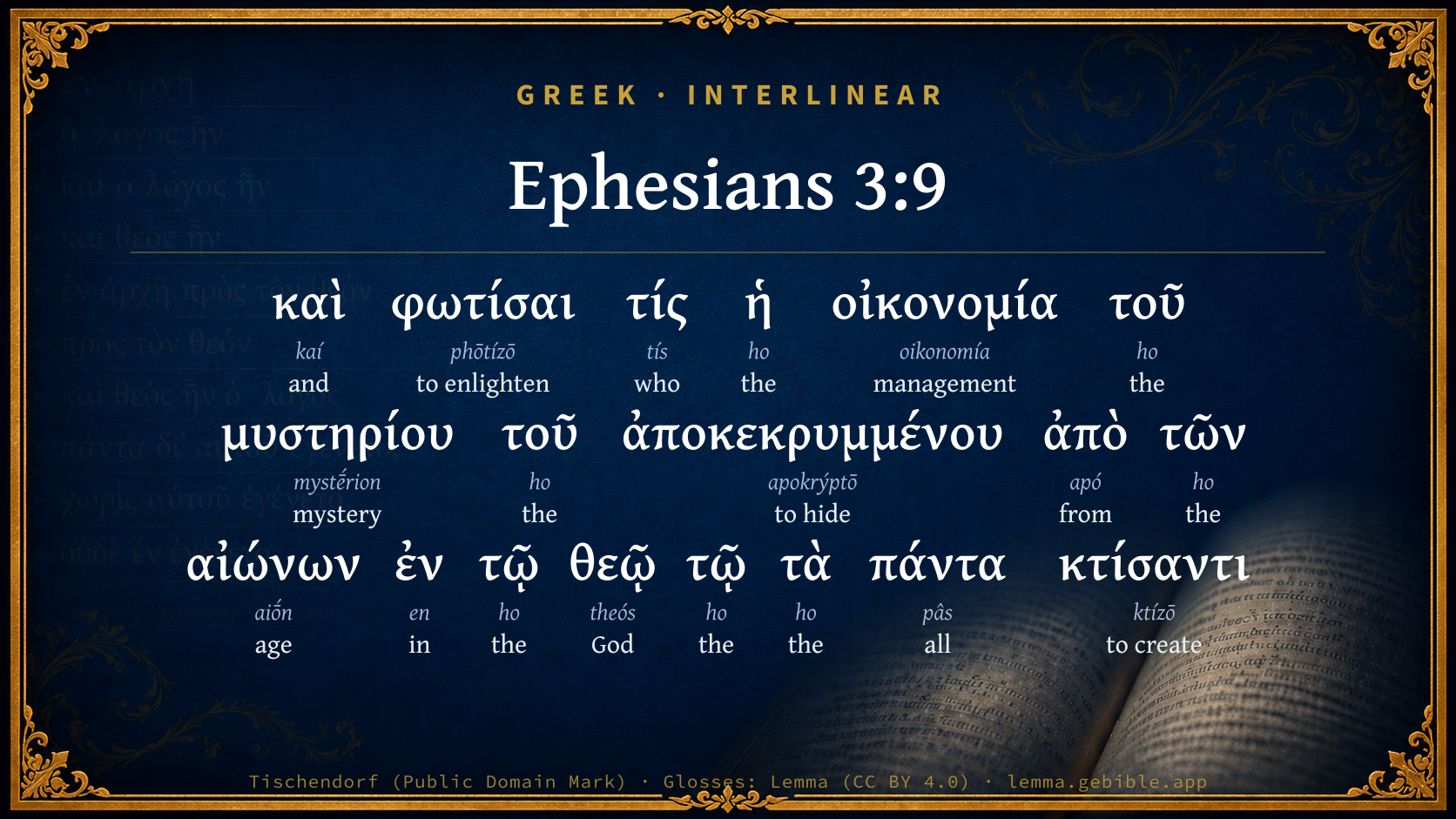
  1. καὶ kaí G2532 “and” Conjunction
  2. φωτίσαι phōtízō G5461 “to enlighten” Verb, Aorist, Active, Infinitive
  3. τίς tís G5101 “who” Interrogative pronoun, Nominative, Singular, Feminine
  4. ἡ ho G3588 “the” Article, Nominative, Singular, Feminine
  5. οἰκονομία oikonomía G3622 “management” Noun, Nominative, Singular, Feminine
  6. τοῦ ho G3588 “the” Article, Genitive, Singular, Neuter
  7. μυστηρίου mystḗrion G3466 “mystery” Noun, Genitive, Singular, Neuter
  8. τοῦ ho G3588 “the” Article, Genitive, Singular, Neuter
  9. ἀπὸ apó G575 “from” Preposition
  10. τῶν ho G3588 “the” Article, Genitive, Plural, Masculine
  11. αἰώνων aiṓn G165 “age” Noun, Genitive, Plural, Masculine
  12. ἐν en G1722 “in” Preposition
  13. τῷ ho G3588 “the” Article, Dative, Singular, Masculine
  14. θεῷ theós G2316 “God” Noun, Dative, Singular, Masculine
  15. τῷ ho G3588 “the” Article, Dative, Singular, Masculine
  16. τὰ ho G3588 “the” Article, Accusative, Plural, Neuter
  17. πάντα pâs G3956 “all” Adjective, Accusative, Plural, Neuter
  18. κτίσαντι ktízō G2936 “to create” Verb, Aorist, Active, Participle, Dative, Singular, Masculine

About this verse

These counts appear in no published source. They are computed here, from the morphology-tagged text and Lemma’s own curated glosses. What Lemma adds →

19
words
13
distinct lemmas
Pauline Epistles
section

Notable vocabulary

The rarest word here is ἀποκεκρυμμένου to hide G613 — appearing just 4 times in the whole Greek New Testament.

Shared distinctive vocabulary

ἀποκεκρυμμένου to hide G613 occurs in 4 verses of the Greek New Testament. Also found in:

Repetition

A word recurs within this verse:

Cross-references

34

Topical passages linked to Ephesians 3:9 in the Treasury of Scripture Knowledge — connected by theme and wording, ordered by reader-vote popularity; previews shown in the World English Bible.

  • Colossians 1:26 the mystery which has been hidden for ages and generations. But now it has been revealed to his saints,
  • Matthew 13:35 that it might be fulfilled which was spoken through the prophet, saying, "I will open my mouth in parables; I will utter things hidden from the foundation of the world."
  • 2 Timothy 1:9 who saved us and called us with a holy calling, not according to our works, but according to his own purpose and grace, which was given to us in Christ Jesus before times eternal,
  • Colossians 3:3 For you died, and your life is hidden with Christ in God.
  • Matthew 28:19 Therefore go, and make disciples of all nations, baptizing them in the name of the Father and of the Son and of the Holy Spirit,
  • Hebrews 3:3–4 For he has been counted worthy of more glory than Moses, inasmuch as he who built the house has more honor than the house.
  • Psalms 33:6 By Yahweh's word the heavens were made; All their host by the breath of his mouth.
  • Isaiah 44:24 Thus says Yahweh, your Redeemer, and he who formed you from the womb: I am Yahweh, who makes all things; who stretches forth the heavens alone; who spreads abroad the earth (who is with me?);
  • John 1:1–3 In the beginning was the Word, and the Word was with God, and the Word was God.
  • Hebrews 1:2–3 has at the end of these days spoken to us by his Son, whom he appointed heir of all things, through whom also he made the worlds.
  • Revelation 4:11 "Worthy are you, our Lord and God, the Holy One, to receive the glory, the honor, and the power, for you created all things, and because of your desire they existed, and were created!"
  • Romans 16:25–26
  • Ephesians 1:9–10 making known to us the mystery of his will, according to his good pleasure which he purposed in him
  • 1 Timothy 3:16 Without controversy, the mystery of godliness is great: God was revealed in the flesh, Justified in the spirit, Seen by angels, Preached among the nations, Believed on in the world, And received up in glory.
  • Titus 1:2 in hope of eternal life, which God, who can't lie, promised before eternal times;
  • Matthew 10:27 What I tell you in the darkness, speak in the light; and what you hear whispered in the ear, proclaim on the housetops.
  • Matthew 25:34 Then the King will tell those on his right hand, 'Come, blessed of my Father, inherit the Kingdom prepared for you from the foundation of the world;
  • Mark 16:15–16 He said to them, "Go into all the world, and preach the Gospel to the whole creation.
  • Luke 24:47 and that repentance and remission of sins should be preached in his name to all the nations, beginning at Jerusalem.
  • John 5:17 But Jesus answered them, "My Father is still working, so I am working, too."
  • John 5:19 Jesus therefore answered them, "Most assuredly, I tell you, the Son can do nothing of himself, but what he sees the Father doing. For whatever things he does, these the Son also does likewise.
  • John 10:30 I and the Father are one."
  • Acts 15:18 All his works are known to God from eternity.'
  • 1 Corinthians 2:7 But we speak God's wisdom in a mystery, the wisdom that has been hidden, which God foreordained before the worlds for our glory,
  • Ephesians 1:4 even as he chose us in him before the foundation of the world, that we would be holy and without blemish before him in love;
  • Ephesians 3:3–5 how that by revelation the mystery was made known to me, as I wrote before in few words,
  • Colossians 1:16–17 For by him were all things created, in the heavens and on the earth, things visible and things invisible, whether thrones or dominions or principalities or powers; all things have been created through him, and for him.
  • Colossians 1:23 if it is so that you continue in the faith, grounded and steadfast, and not moved away from the hope of the Gospel which you heard, which is being proclaimed in all creation under heaven; of which I, Paul, was made a servant.
  • 2 Thessalonians 2:13 But we are bound to always give thanks to God for you, brothers loved by the Lord, because God chose you from the beginning for salvation through sanctification of the Spirit and belief in the truth;
  • 2 Timothy 4:17 But the Lord stood by me, and strengthened me, that through me the message might be fully proclaimed, and that all the Gentiles might hear; and I was delivered out of the mouth of the lion.
  • 1 Peter 1:20 who was foreknown indeed before the foundation of the world, but was revealed at the end of times for your sake,
  • Revelation 13:8 All who dwell on the earth will worship him, everyone whose name has not been written from the foundation of the world in the book of life of the Lamb who has been killed.
  • Revelation 14:6 I saw an angel flying in mid heaven, having an eternal Gospel to proclaim to those who dwell on the earth, and to every nation, tribe, language, and people.
  • Revelation 17:8 The beast that you saw was, and is not; and is about to come up out of the abyss and to go into destruction. Those who dwell on the earth and whose names have not been written in the book of life from the foundation of the world will marvel when they see that the beast was, and is not, and shall be present.

Cross-references courtesy of OpenBible.info (CC BY 4.0).

Where the printed editions differ

2 variants

Places in this verse where the major printed Greek editions disagree on the wording in a way that affects the translation — a comparison of editions, not a manuscript-by-manuscript collation. The editions are the modern critical texts (Nestlé-Aland 28/27, SBL, Westcott-Hort, Tregelles, Tyndale House) and the traditional texts behind the KJV (the Textus Receptus and the Byzantine/Majority text). It is not a claim about which reading is original.

  1. Different wording
    οἰκονομία

    “administration”

    In NA28NA27TynSBLWHTregByz Not in TR

    κοινωνία (koinōnia) 'fellowship' occurs in traditional manuscripts (TR) instead of οἰκονομία (oikonomia) 'administration' in older manuscripts (NA28+NA27+Tyn+SBL+WH+Treg+Byz)

  2. Extra text
    διὰ Ἰησοῦ Χριστοῦ,

    “through Jesus Christ”

    In TRByz Not in NA28NA27TynSBLWHTreg

    διὰ Ἰησοῦ Χριστοῦ, (dia Iēsou Christou) 'through Jesus Christ' is only in traditional manuscripts (TR+Byz)

Textual data: Translators Amalgamated Greek New Testament (STEPBible TAGNT) · CC BY 4.0.

Commentary

Notes on Ephesians 3:9 from classic Christian and Jewish commentators (each source and its license shown beneath its notes). The classic Christian expositions comment on the surrounding passage and are grouped to its opening verse, so a note may address several verses; the Jewish commentaries on the Tanakh (Rashi and others) are per-verse, so they appear only where the commentator wrote on this verse.

Lemma curates 59 commentaries, every one of them public domain or Creative Commons licensed, each selected and text-cleaned for this edition rather than reprinted as found. About our sources →

The Biblical Illustrator

Joseph S. Exell

Eph_3:9

And to make all men see what is the fellowship of the mystery which from the beginning of the world hath been hid in God, who created all things by Jesus Christ.

Creation not hitherto complete

Whatever creatures may have thought, it is clear that God has never yet regarded the creation as in a final or completed condition. It is natural that men should look upon their heavens and earth as finished; and as a constitution of things appointed to serve for a time, they are finished; but in relation to Gods original design, they will yet have to undergo marvellous changes. It is probable that, prior to the great angel fall, the angels looked upon their heaven as finished and perfect; but God knew otherwise. He carried in Himself a purpose which no angel knew. That purpose is at length somewhat opened, both to men and angels, but it is by no means carried out. It is both worthy of God and advantageous to His creatures, that the universe should be perfected by their cooperation, and the future processes of ages. Myriads of myriads of ages could be occupied in no better way than in enriching, maturing, and harmonizing the whole house, which God and all His children are to inhabit and enjoy forever. Indeed it is incomprehensible that a house which is composed of countless orders of creatures, each one of whom has a separate, individual will, should hastily, or soon, realize its finally balanced relationships. It is surely the praise and glory of Gods plan, that it requires cycle after cycle, and dispensation after dispensation, for its development. In Himself, the plan was perfect, but apart from the long and manifold experiences of His creatures it could not be fulfilled. To be wrought in His Son was one thing, but to be wrought out in the wills and thoughts of His children, and in the condition of the creation, was a very different thing. He knew that only through failure, and out of failure, the finally steadfast and harmonious condition of things (the kingdom which cannot be moved) would grow. The failure and misery of self-will, and all the mistakes of creatures, will contribute both to the strength and the joy of the final house of God. The craving of infinite love will be satisfied. In the incarnation, conflict, and victory, of the Logos, the beginning of the end has come, and His reign (being the reign of all things in unity) will bring in the Fathers first idea, namely, the absolute perfectness and enduring order of His creation. In proportion to the magnitude of a work, very considerable progress must be made, before persons who are looking on from without, are able to form any idea of the design. Till a comparatively recent date, no one on earth, nor anyone in heaven, had the slightest conjecture of the work which God has set Himself to do. No one in heaven, nor in earth, neither under the earth, was able to open the book, neither to look thereon. Jesus, the Firstborn from the dead, is the Opener of the book. (J. Pulsford.)

We must make known the gospel

Huber, the great naturalist, tells us that if a single wasp discovers a deposit of honey or other food, he will return to his nest and impart the good news to his companions, who will sally forth in great numbers to partake of the fare which has been discovered for them. Shall we who have found honey in the rock Christ Jesus be less considerate of our fellow men than wasps are of their fellow insects? (C. H. Spurgeon.)

Teaching is the Churchs duty

To make all men see, that is, to teach all men the fellowship of the mystery, which, from the beginning of the world, hath been hid in God, who created all things by Jesus Christ. That is the duty of the Church. She is the teacher, the educator, the civilizer, the regenerator of the nations. Our text in this 9th verse reads fellowship, but the better reading is dispensation. Paul would teach all men to know something of the dispensation of the hidden mystery, and he asserts it was hidden in God from the beginning of the world. This 9th verse, then, teaches the following facts and truths:--

1. It is a great thing to be a preacher of the gospel.

2. Paul was the preacher and apostle of the Gentiles.

3. The union of the Jews and Gentiles in one body is a great mystery.

4. This mystery was hidden in God from the beginning of the world.

5. God created the world through the agency of Jesus Christ.

These things the Church is to teach. Her duty is to teach all men, to make all men see the glories of the economy of grace. (W. Graham, D. D.)

God the Creator

When Napoleon was returning to France from the expedition to Egypt, a group of French officers one evening entered into a discussion concerning the existence of a God; they were standing on the deck of the vessel as she was bearing them over the Mediterranean Sea. Thoroughly imbued with the infidel and atheistical spirit of the times, they were unanimous in their denial of this truth. It was at length proposed to ask the opinion of Napoleon on the subject, who was standing alone, wrapt in silent thought. On hearing the question, Is there a God? he raised his hand, and pointing to the starry firmament, simply responded, Gentlemen, Who made all that?

The Biblical Illustrator, edited by Joseph S. Exell (c. 1880s–1900s) — public domain. Text from a community e-Sword module.

Bengel's Gnomon

Johann Albrecht Bengel

Eph 3:9. Φωτίσαι) to make see, to show; comp. Col 1:28. For הורה, LXX. φωτίζει, 2Ki 12:3, and in other places.—τίς ἡ οἰκονομία, what is the dispensation) Col 1:25-26. [The reading οἰκονομία is acknowledged by the most earnest defenders of the more received readings[44]—Not. Crit.]—ἘΝ Τῷ ΘΕῷ, in God) An antithesis to creatures, even the most excellent, Eph 3:10.—τῷ τὰ πάντα κτίσαντι, who created all things) The creation of all things is the foundation of all the rest of the economy, most freely dispensed, according to the universal power of God. The expression, all things, includes τὰς ἀρχὰς, Κ.Τ.Λ., principalities, etc.

[44] Rec. Text has κοινωνία, with hardly any authority. So Engl. V. the fellowship. But ABCD(Δ)Gfg Vulg. Hilary 54, read οἰκονομία.—ED.

Bengel's Gnomon of the New Testament — English translation (T&T Clark, Edinburgh, 1860) — public domain. Text from a community e-Sword module.

Meyer's Critical & Exegetical Commentary

Heinrich August Wilhelm Meyer

Eph_3:9. Καὶ φωτίσαι πάντας] According to Harless, who is followed by Olshausen, Paul makes a transition to all men: not, however, to the Gentiles alone, but to all. Wrongly, since Paul must have written καὶ πάντας φωτίσαι, as he had before prefixed τοῖς ἔθνεσιν. πάντας applies to all Gentiles, and the progress of the discourse has regard not to the persons, but to a particular main point (καί, and in particular), upon which Paul in his proclamation of the riches of Christ gives information to all Gentiles.

φωτίσαι] collustrare, of the enlightenment of the mind (Joh_1:9), which is here to be conceived of as brought about by means of the preaching. Comp. Heb_6:4 (and Bleek, ad loc.), Heb_10:32; Psa_119:130; Sir_45:17. Docere (Grotius, Bengel, Rosenmüller, and others) hits doubtless the real sense, but unwarrantably abandons the figure. The possible difficulty that Christ Himself is in fact the light (Joh_1:9; Joh_12:35) disappears on considering that the apostles are mediately the enlightened ones (2Co_4:4; Mat_5:14), the proclaimers and bearers (Act_26:18) of the divine light and its moral powers (v. 8).

τίς ἡ οἰκονομία κ.τ.λ.] i.e. what is the arrangement, which is made with regard to the mystery, etc. As to οἰκονομία, see on Eph_1:10, Eph_3:2; the mystery is that indicated as to its contents in Eph_3:6; and what has been adjusted or arranged with regard thereto (ἡ οἰκονομία τοῦ μυστηρίου), consists in the fact that this mystery, hidden in God from the very first, was to be made known in the present time through the church to the heavenly powers. See what follows.

ἀποκεκρυμ.] σεσιγημένου, Rom_16:25. Comp. 1Co_2:7; Col_1:26.

ἀπὸ τῶν αἰώνων] from the world-periods, since they have begun to run their course, from the very beginning. The mystery, namely, was decreed already πρὸ τῶν αἰώνων, 1Co_2:7, comp. Eph_1:4, but is conceived of as hidden only since the beginning of the ages, because there was no one previously for whom it could be hidden. The same thing with ἀπὸ τῶν αἰώνων here is denoted at Rom_16:25 by the popular expression χρόνοις αἰωνίοις. We may add that ἀπὸ τῶν αἰώνων occurs in the N.T. only here and Col_1:26; elsewhere is found the expression current also in Greek authors, ἀπʼ αἰῶνος (Luk_1:70; Act_3:21), and ἐκ τοῦ αἰῶνος (Joh_9:32).

τῷ τὰ πάντα κτίσαντι] quippe qui omnia[176] creavit. Herein liesand this is the significant bearing of this more precise designation of Goda confirmation of what has just been said, τοῦ ἀποκεκρυμ. ἀπὸ τῶν αἰών. ἐν τῷ Θεῷ. Bengel aptly observes: rerum omnium creatio fundamentum est omnis reliquae oeconomiae, pro potestate Dei universali liberrime dispensatae. He who has created all that exists must already have had implicitly contained in His creative plan the great unfolding of the world, which forms the contents of this mystery, so that thus the latter was ἀπὸ τῶν αἰώνων hidden in God. Comp. on Ὁ ΠΟΙῶΝ ΤΑῦΤΑ ΓΝΩΣΤᾺ ἈΠʼ ΑἸῶΝΟς, Act_15:18, and as to the idea which underlies our passage also, that already the creative word contemplated Christ as its aim,[177] Col_1:16 ff., and the commentary thereon. Rückert thinks that Paul wishes to indicate how far it may not surprise us that He, from whom all things are derived, should have concealed a part of His all-embracing plan, in order to bring it to light only at the due time. But, apart from the fact that the creation of all things does not at all involve as a logical inference the concealment of a part of the divine plan, it was not the ἀποκεκρυμ. in itself that needed a ground assigned for it, since in fact this predicate is necessarily implied in the notion of μυστήριον, but the ἈΠΟΚΕΚΡ. ἈΠῸ ΤῶΝ ΑἸΏΝΩΝ. This ἈΠῸ ΤῶΝ ΑἸΏΝΩΝ is the terminus a quo, which was introduced with the κτίσις τῶν πάντων. At variance with the context, Olshausen holds that Paul wished to call attention to the fact that the establishment of redemption itself [of which the apostle in fact is not speaking] is a creative act of God, which could have proceeded only from Him who created all things. Harless places Τῷ ΤᾺ ΠΆΝΤΑ ΚΤΊΣ. in connection with ἽΝΑ Κ.Τ.Λ., Eph_3:10. But see on Eph_3:10.

[176] The totality of that which exists, the whole world. Every limitation of this universal meaning is unwarranted, as when Beza, Piscator, Flatt, and others refer it to mankind. Unus Deus omnes populos condidit, sic etiam nunc omnes ad se vocat, Beza. Holzhausen, too, arbitrarily limits it to all spiritual beings, called to everlasting life; while Matthies mixes up also in κτίσαντι the effecting of the spiritual blessedness.

[177] Hence εἰς Ἰησοῦν Χριστόν would have been a more correct gloss than διὰ Ἰησοῦ Χρ., which the Recepta has.

REMARK.

When διὰ Ἰησοῦ Χριστοῦ is recognised as not genuine (see the critical remarks), the possibility is taken away of referring κτίσαντι to the moral creation by Christ, as is done by Calvin, Zanchius, Calixtus, Grotius, Crell, Locke, Semler, Morus, Koppe, Usteri, Meier, Baumgarten-Crusius, and others. But even if those words were genuine, the formal and absolute κτίζειν, as well as the emphatically prefixed and unlimited τὰ πάντα, would justify only the reference to the physical creation, Genesis 1. Comp. Calovius and Reiche.

Meyer — Critical and Exegetical Commentary on the New Testament — English translation by Peter Christie, edited by Frederick Crombie (T&T Clark, 1880) — public domain. Text from a community e-Sword module.

Expositor's Greek Testament

ed. W. Robertson Nicoll

Eph 3:9 . καὶ φωτίσαι πάντας τίς ἡ κοινωνία τοῦ μυστηρίου τοῦ ἀποκεκρυμμένου ἀπὸ τῶν αἰώνων : and to make all see what is the fellowship (dispensation) of the mystery which from all ages hath been hidden . The πάντας which the TR inserts after φωτίσαι is omitted by some MSS. (including [272] 1 [273] ) and certain Fathers (Hil., Jer., Aug., etc.). It is rejected by Tisch., accepted by RV in the text, and dealt with by WH as a secondary reading. The κοινωνία of the TR, which has the slenderest possible authority, must give place to the οἰκονομία of the RV with LTTrWH, which is the reading of [274] [275] [276] [277] [278] [279] [280] [281] , etc. If the πάντας is omitted the sense becomes, as it is given in the margin of the RV, “to bring to light what is” the dispensation. If it is retained, the idea will be that of the enlightenment of all as to what the dispensation is. The πάντας , however, which occupies an unemphatic position here, after the verb (in contrast with the emphatic position of τοῖς ἔθνεσιν before its verb) can scarcely bear the absolute sense of all men , Jew and Gentile alike, but refers to all the ἔθνη previously mentioned. The verb φωτίσαι is more than διδάξαι or κηρύξαι . It means to illuminate . Paul was not only to deliver his Apostolic message, but also to spiritually enlighten those who heard it, so that they should understand it. The particular thing in that message which is here in view is the οἰκονομία (on which see under Eph 1:10 ), that is, the dispensation or arrangement of the mystery, to wit the admission of the Gentiles on equal terms with the Jews; the μυστήριον here having the same application as in Eph 3:6 . The formula ἀπὸ τῶν αἰώνων occurs in the NT only here and in Col 1:26 ; the forms ἀπὸ αἰῶνος and ἐκ τοῦ αἰῶνος also occur, the former in Luk 1:70 and Act 3:21 , the latter in Joh 9:32 . It means literally “from the ages,” “from the world-periods,” that is, from the beginning , or since the world began . It is to be distinguished from πρὸ τῶν αἰώνων (1Co 2:7 ). The Divine decree was formed before the ages of the world began; the keeping of that decree hidden was since the ages of the world began, i.e. , “from the commencement of the ages when intelligent beings from whom it could be concealed were called into existence” (Ell.). In Rom 16:25 we have the similar description of the μυστήριον as χρόνοις αἰωνίοις σεσιγημένου . ἐν τῷ Θεῷ τῷ τὰ πάντα κτίσαντι διὰ Ἰησοῦ χριστοῦ : in God who created all things [ through Jesus Christ ]. The “mystery” had its place of concealment in God Himself, in the Divine mind. And God is designated specially in respect of His creative power “God who created all things” (not “ inasmuch as He created all things,” which would require the omission of the τῷ ). The τὰ πάντα , which also occupies a somewhat emphatic position here, is not to be restricted either to the physical creation (Chrys.), or to the spiritual (Calv.), but has the absolute sense of all that exists . The TR adds διὰ Ἰησοῦ Χριστοῦ to the κτίσαντι (with [282] [283] [284] , etc.); but these words must be omitted, as the best authorities ( [285] [286] [287] [288] [289] [290] , 17, etc.) do not give them. But why is this reference to God as the Creator of all things introduced at this point? By way of confirmation, say some, of what has just been said of the “mystery” as having been hidden from the beginning in God; the point being that He who created all things must have had the contents of this “mystery” in His eternal plan (Mey.). To “enhance the idea of His omnipotence,” say others; He who created all things having “ ordained the mystery itself in the exercise of His undoubted prerogative of sovereign and creative power” (Ell.). Or, as others put it more precisely, its object is to take the wonder from the idea of the “mystery” having been so long unrevealed; the creation of all things by God being a fact which involves His perfect right to adjust all things as He will” (Alf.) the Creator of all being “free to make what arrangements He pleased as to the concealment and revelation of His purpose” (Abb.). None of these interpretations can be said to be either very clear or very adequate. This designation of God as the Creator of all that exists is intended rather to express the greatness of the “mystery” that is now disclosed and of which Paul is to be a preacher. The main thought in the verse in question is the thought with which it starts, viz. , the marvel of that Apostolic commission of which Paul had been put in trust by the grace of God; and the majesty and the wonder of that commission are made the greater by the grandeur of the “mystery” the Divine disposition of which he was appointed to declare to all men. This “mystery,” though long hidden, had been in the Divine mind from the first, and it had been there in such a sense that the whole scheme of created things had it in view, and in such wise that the knowledge of it was to be imparted even to the angelic world ( cf. Haupt). Or, as it may be better put, the “mystery” now at last revealed by God and proclaimed by Paul to all men in all the sovereign and surpassing wisdom of the Divine dispensation by which it was hidden long and in the fulness of time at last disclosed, was one of God’s own eternal secrets, one of His unsearchable thoughts, a thing that had its place from the beginning in His creative plan, a reserve in the Eternal mind that purposed and formed all that exists. And to Paul’s hands did the surpassing grace of God commit the proclamation of a truth of such magnitude, the illumination ( φωτίσαι ) of so unsearchable a disposition of the Divine wisdom!

[272] Codex Sinaiticus (sæc. iv.), now at St. Petersburg, published in facsimile type by its discoverer, Tischendorf, in 1862.

[273] Codex Alexandrinus (sæc. v.), at the British Museum, published in photographic facsimile by Sir E. M. Thompson (1879).

[274] Codex Vaticanus (sæc. iv.), published in photographic facsimile in 1889 under the care of the Abbate Cozza-Luzi.

[275] Codex Sinaiticus (sæc. iv.), now at St. Petersburg, published in facsimile type by its discoverer, Tischendorf, in 1862.

[276] Codex Alexandrinus (sæc. v.), at the British Museum, published in photographic facsimile by Sir E. M. Thompson (1879).

[277] Codex Ephraemi (sæc. v.), the Paris palimpsest, edited by Tischendorf in 1843.

[278] Codex Claromontanus (sæc. vi.), a Græco-Latin MS. at Paris, edited by Tischendorf in 1852.

[279] Codex Mosquensis (sæc. ix.), edited by Matthæi in 1782.

[280] Codex Augiensis (sæc. ix.), a Græco-Latin MS., at Trinity College, Cambridge, edited by Scrivener in 1859. Its Greek text is almost identical with that of G, and it is therefore not cited save where it differs from that MS. Its Latin version, f, presents the Vulgate text with some modifications.

[281] Codex Angelicus (sæc. ix.), at Rome, collated by Tischendorf and others.

[282] Codex Claromontanus (sæc. vi.), a Græco-Latin MS. at Paris, edited by Tischendorf in 1852.

[283] Codex Mosquensis (sæc. ix.), edited by Matthæi in 1782.

[284] Codex Angelicus (sæc. ix.), at Rome, collated by Tischendorf and others.

[285] Codex Vaticanus (sæc. iv.), published in photographic facsimile in 1889 under the care of the Abbate Cozza-Luzi.

[286] Codex Sinaiticus (sæc. iv.), now at St. Petersburg, published in facsimile type by its discoverer, Tischendorf, in 1862.

[287] Codex Alexandrinus (sæc. v.), at the British Museum, published in photographic facsimile by Sir E. M. Thompson (1879).

[288] Codex Ephraemi (sæc. v.), the Paris palimpsest, edited by Tischendorf in 1843.

[289] Codex Claromontanus (sæc. vi.), a Græco-Latin MS. at Paris, edited by Tischendorf in 1852.

[290] Codex Augiensis (sæc. ix.), a Græco-Latin MS., at Trinity College, Cambridge, edited by Scrivener in 1859. Its Greek text is almost identical with that of G, and it is therefore not cited save where it differs from that MS. Its Latin version, f, presents the Vulgate text with some modifications.

The Expositor's Greek Testament, edited by W. Robertson Nicoll (1897–1910) — public domain. Text from a community e-Sword module.

Hodge's Commentary on Romans, Ephesians & First Corinthians

Charles Hodge

Eph_3:9

It was Pauls first duty to preach the unsearchable riches of Christ among the Gentiles, for he was especially the apostle of the Gentiles. But his duty was not confined to them. He was commissioned both to preach to the Gentiles, and to make all see, etc. This is the common interpretation of the passage. Others, however, insist that the all is here limited by the context to the Gentiles. But the force of and, which marks the accession of a new idea, is thus in a great measure lost. And the following verse favors the widest latitude that can be given to the words in question.

The word φωτίζειν properly means, to shine, as any luminous body does, and then to illuminate, to impart light to, as a candle does to those on whom it shines, and as God does to the minds of men, and as the Gospel does, which is as a light shining in a dark place, and hence the apostle, 2Co_4:4, speaks of the φωτισμὸς τοῦ ευαγγελίου. Utitur apta similitudine, says Calvin, quum dicit, φωτίσαι πάντας, quasi plena luce effulgeat Dei gratia in suo apostolatu. The Church is compared to a candlestick, and ministers to stars. Their office is to dispense light. The light imparted by the Gospel was knowledge, and hence to illuminate is, in fact, to teach; which is the idea the word is intended here to express.

The thing taught was, ἡ οἰκονομία τοῦ μυστηρίου τοῦ ἀποκεκρυμμένου, the economy of the mystery which from the beginning of the world hath been hid in God. The common text in this clause reads κοινωνία, fellowship, but all the corrected editions of the New Testament, on the authority of the ancient MSS., read οἰκονομία, plan, or, economy. The mystery or secret, is not the simple purpose to call the Gentiles into the church, but the mystery of redemption. This mystery, ἀπὸ τῶν αἰώνων, from ages, from the beginning of time, had been hid in God. Compare Rom_16:25, The mystery which was kept secret since the world began; 1Co_2:7, The wisdom of God in a mystery, the hidden wisdom, which God ordained before the world; Col_1:26, The mystery which hath been hid from ages and from generations. In all these places the mystery spoken of is Gods purpose of redemption, formed in the counsels of eternity, impenetrably hidden from the view of men until revealed in his own time. It was this plan of redemption thus formed, thus long concealed, but now made known through the Gospel, that Paul was sent to bear as a guiding and saving light to all men.

Who created all things by Jesus Christ. The words διὰ Ἰησοῦ Χριστοὺ, (by Jesus Christ), being wanting in the great majority of oldest MSS., are generally regarded as spurious. The all things here referred to are by some restricted to everything pertaining to the Gospel dispensation. For this interpretation there is no necessity in the context; and it is contrary to the common usage and force of the terms. There must be some stringent necessity to justify making creator of all things, mean author of the new dispensation. Others restrict the terms to all men: He who created all men now calls all.‹9› This however is arbitrary and uncalled for. The words are to be taken in their natural sense, as referring to the universe. It was in the bosom of the Creator of all things that this purpose of redemption so long lay hid. The reference to God as creator in this connection, may be accounted for as merely an expression of reverence. We often call God the Infinite, the Almighty, the Creator, etc., without intending any special reference of the titles to the subject about which we may be speaking. So Paul often calls God, blessed, without any special reason for the appellation. Some however think that in the present case the apostle uses this expression in confirmation of his declaration that the plan of redemption was from ages hid in God for he who created all things must be supposed to have included redemption in his original purpose. Others suppose the association of the ideas is he who created, redeems the same God who made the universe has formed the plan of redemption. None but the creator can be a redeemer.

Charles Hodge — Commentary on Romans (1835), First Corinthians (1857), and Ephesians (1856) — public domain. Text from a community e-Sword module.

Jamieson, Fausset & Brown

Robert Jamieson, A. R. Fausset & David Brown

to make all men see--Greek, "to enlighten all" (Eph 1:18; Psa 18:28; Heb 6:4). "All" (compare Col 1:28).

fellowship--The oldest manuscripts read, "economy," or "dispensation" (compare Col 1:25-26; and see on Eph 1:10, above). "To make all see how it hath seemed good to God at this time to dispense (through me and others, His stewards) what heretofore was a mystery." ELLICOTT explains it, "the arrangement," or "regulation" of the mystery (the union of Jews and Gentiles in Christ) which was now to be humbly traced and acknowledged in the fact of its having secretly existed in the counsel of God, and now having been revealed to the heavenly powers by means of the Church.

from the beginning of the world--Greek, "from (the beginning of) the ages." Compare Eph 1:4; Rom 16:25; Co1 2:7. The "ages" are the vast successive periods of time, marked by successive stages of creation and orders of beings.

in God--"hidden in" His counsels (Eph 1:9).

created all things by Jesus Christ--God's creation of the world and all things therein is the foundation of the rest of the "economy," which is freely dispensed according to the universal power of God [BENGEL]. AS God created "the whole range of things" (so the Greek), physical and spiritual alike, He must have an absolute right to adjust all things as He will. Hence, we may see His right to keep the mystery of world-wide salvation in Christ "hidden in Himself," till his own good time for revealing it. The oldest manuscripts omit "by Jesus Christ."

Jamieson, Fausset & Brown — Commentary Critical and Explanatory on the Whole Bible (1871) — public domain (CC PDM 1.0). Text via the HelloAO Bible API.

Adam Clarke's Commentary

Verse 9. And to make all men see] και φωτισαι παντας. And to illuminate all; to give information both to Jews and Gentiles; to afford them a sufficiency of light, so that they might be able distinctly to discern the great objects exhibited in this Gospel.

What is the fellowship of the mystery] The word κοινωνια, which we properly translate fellowship, was used among the Greeks to signify their religious communities; here it may intimate the association of Jews and Gentiles in one Church or body, and their agreement in that glorious mystery which was now so fully opened relative to the salvation of both. But instead of κοινωνια, fellowship, οικονομια, dispensation or economy, is the reading of ABCDEFG, and more than fifty others; both the Syriac, Coptic, AEthiopic, Armenian, Slavonian, Vulgate and Itala, with the chief of the Greek fathers. Some of the best printed editions of the Greek text have the same reading, and that in our common text has very little authority to support it. Dispensation or economy is far more congenial to the scope of the apostle's declaration in this place; he wished to show them the economy of that mystery of bringing Jews and Gentiles to salvation by faith in Christ Jesus, which God from the beginning of the world had kept hidden in his own infinite mind, and did not think proper to reveal even when he projected the creation of the world, which had respect to the economy of human redemption. And although the world was made by Jesus Christ, the great Redeemer, yet at that period this revelation of the power of God, the design of saving men, whose fall infinite wisdom had foreseen, was not then revealed. This reading Griesbach has received into the text.

Who created all things by Jesus Christ] Some very judicious critics are of opinion that this does not refer to the material creation; and that we should understand the whole as referring to the formation of all God's dispensations of grace, mercy, and truth, which have been planned, managed, and executed by Christ, from the foundation of the world to the present time. But the words δια ιησου χριστου, by Jesus Christ, are wanting in ABCD*FG, and several others; also in the Syriac, Arabic of Erpen, Coptic, AEthiopic, Vulgate, and Itala; as also in several of the fathers. Griesbach has thrown the words out of the text; and Professor White says, "certissime delenda," they are indisputably spurious. The text, therefore, should be read: which from the beginning of the world had been hidden in God who created all things. No inferiority of Christ can be argued from a clause of whose spuriousness there is the strongest evidence.

Adam Clarke's Commentary on the Bible (1810–1826) — public domain. Text from a community e-Sword/MySword module.

John Calvin's Commentaries

9. What is the fellowship of the mystery. The publication of the gospel is called a fellowship, because it is the will of God that his purpose, which had formerly been hidden, shall now be shared by men. There is an appropriate metaphor in the words φωτίσαι πάντας, to enlighten all men, — conveying the thought, that, in his apostleship, the grace of God shines with the brightness of noon-day.

Which hath been hid in God. This is intended, as before, to obviate the prejudice of novelty, — to oppose the rashness of men, who think it improper that they should remain in ignorance of anything whatever. Who will question the right which God has to keep his own purposes concealed, until he shall be pleased to communicate them to men? What presumption, — yea, what madness is it, not to admit that God is wiser than we! Let us remember, therefore, that our rashness ought to receive a check, whenever the boundless height of the Divine foreknowledge is presented to our view. This, too, is the reason why he calls them the unsearchable riches of Christ; intimating that this subject, though it exceeds our capacity, ought to be contemplated with reverence and admiration.

Who created all things by Jesus Christ. This cannot so properly be understood of the first creation as of the spiritual renewal. It is, no doubt, true, and is frequently declared in Scripture, that by the Word of God all things were created; but the connection of the passage lays us under the necessity of understanding by it that renewal which is comprehended in the blessing of redemption. But it may, perhaps, be thought that the apostle is illustrating this renewal, by an argument drawn from the creation. “By Christ, as God, the Father created (John 1:3) all things; and why, then, should we wonder, if by Christ, as Mediator, all the Gentiles are now brought back to one body?” I have no objection to this view. A similar argument is used by him in another Epistle.

“For God, who commanded the light to shine out of darkness, is the same who hath shined in our hearts, to give the light of the knowledge of the glory of God in the face of Jesus Christ.” (2 Corinthians 4:6.)

From the creation of the world he concludes, that it is the work of God to enlighten the darkness; but what was visible in the former case is ascribed to the Spirit, when he comes to speak of the kingdom of Christ.

John Calvin's Commentaries (1540-1563) — public domain. Text from the Calvin Translation Society English edition (1840s-50s) via the Christian Classics Ethereal Library (ccel.org). Calvin's coverage is partial (roughly two-thirds of the Bible); uncommented books and verses are honest gaps, never fabricated. The 19th-century editor's footnotes and remarks are omitted so the notes are faithfully Calvin's own voice.

Ellicott's Commentary for English Readers

(9) To make all men see.—St. Paul speaks here first of manifestation to all men. The phrase used in the original is at once stronger and weaker than our version of it. It is stronger, for the word is, properly, to enlighten or illuminate—the same word used above (Eph_1:18), “the eyes of your heart being enlightened.” Strictly, Christ alone is the Light of the world, “which enlightens every man” (Joh_1:4-5; Joh_1:9; Joh_8:2); but, as reflecting Him, He declared His servants to be the “light of the world.” Yet it is weaker, for while we can enlighten, it is our daily sorrow that we cannot “make men see.” Even He wept over Jerusalem because His light was, by wilful blindness, “hidden from their eyes” (Luk_19:41). To “open the eyes, and turn men from darkness to light,” although (as in Act_26:18) attributed in general terms to the servants of God, because naturally following on their ministry, is properly the work of the Holy Spirit, even in relation to the words of our Lord Himself (Joh_14:26).

The fellowship of the mystery.—Both MS. authority and internal evidence point here to “the dispensation of the mystery” as the true reading. Probably here the reference is not to the commission of the mystery to the Apostle (as in Eph_3:2), but (as in Eph_1:10) to the law or order which God Himself has ordained for the manifestation of the truth, both to men and angels.

Who created all things by Jesus Christ.—The words “by Jesus Christ” should be omitted, probably having crept in from a gloss, and not belonging to the original. The description of God as “He who created all things,” material and spiritual, is here emphatic—designed to call attention to the dispensation of the gospel as existing in the primeval purpose of the Divine Mind (comp. Eph_1:4; 1Co_1:7), hidden from the beginning of the world (properly, from the ages) till the time of its revelation was come. The New Testament constantly dwells on this view of the Mediation of Christ, as belonging in some form to the relation of humanity to God in itself, and not merely to that relation as affected by the Fall; but nowhere with greater emphasis than in the profound and universal teaching of these Epistles.

A Bible Commentary for English Readers, edited by Charles John Ellicott (1878–1897) — public domain. Text from a community e-Sword module.

The Cambridge Bible for Schools and Colleges

gen. ed. J. J. S. Perowne

9. and to make all men see] Lit., “to illuminate all men.” The Latin versions have illuminare omnes.—Some ancient MSS. (including the great MS. of the British Museum, and the Sinaitic), and other authorities, omit “all men.” But the external and internal evidence for retention greatly preponderates.—The idea is of the Apostle as “casting bright light” on the universal scope of the Gospel, in the eyes of “all men,” no longer only of Jews.—The verb is the same as that in 2Ti_1:10; where lit., “hath thrown light upon, hath illuminated, life and immortality.” Truths once in shadow are by the Gospel brought out into the sun.

the fellowship] The true reading is undoubtedly dispensation, or stewardship. The reading represented by A.V. is probably an explanation, which crept into the text; representing very nearly the meaning of the true word. “The dispensation of the secret” is, in effect, the world-wide distribution, through the stewards of God, of the news and the blessings of the full Gospel, so long held in reserve.

See notes above on Eph_3:2-6.

from the beginning of the world] Lit., “from the ages;” R.V., from all ages. To define somewhat the meaning of the phrase; the great Truth in question was hidden in comparative secrecy, from the starting point of the progress of the developments (“ages”) of the Divine dealings for man, up to the actual Advent of the Messiah. We gather here that this was so not only at and after the call of Israel, but in the patriarchal age, and even in the angelic age, or ages. See below on Eph_3:10.

hid in God] the great Treasury of unknown blessings.

who created all things] Omit “by Jesus Christ,” with the preponderance of ancient authority.—The truth of the One Creator appears here as in deep harmony with the universal scope of His Redemption. All through Scripture, in very different contexts, the truths of Creation and Redemption are seen in connexion. See a vivid illustration in Colossians 1, where the Father, in and through the Son, both “creates all things,” and “reconciles all things.”

The Cambridge Bible for Schools and Colleges (gen. ed. J. J. S. Perowne; Cambridge University Press, 1878–1918) — public domain. Text from a community e-Sword module.

John Gill's Exposition

And to make all men see what is the fellowship of the mystery,.... Or "the dispensation of the mystery" as the Complutensian, and several copies, and the Vulgate Latin and Syriac versions, read. The mystery is the Gospel; the fellowship of it is the communication of grace by it, a participation of the truths and doctrines of it, communion with Father, Son, and Spirit, which the Gospel calls and leads unto, and that equal concern and interest which both Jews and Gentiles have in the privileges of it. Now men are naturally in the dark about these things, and the ministry of the word is the means of enlightening them, and is indeed the grand design of it; and the ministers of the Gospel do instrumentally enlighten persons, though it is God only that does it efficiently; and for this, gifts of grace were bestowed upon the apostle, even for the enlightening of all men, not every individual person in the world, but some of all sorts, particularly Gentiles, as well as Jews. The word rendered "all men", is left out in the Alexandrian copy.

Which from the beginning of the world hath been hid in God; in the heart of God, in his counsel and covenant; which shows the original and source of the Gospel, and expresses the richness and valuableness of it, as well as its safety and secrecy: here it was hid in some measure from the elect angels, and from Old Testament saints, and altogether from natural men, and especially from the Gentiles, whose times of ignorance God winked at, or overlooked: and this was kept so from ages past, from the beginning of time, till now, and was laid up in the breast of God from all eternity; for it was ordained before the world for the glory, of his people. What the apostle says of the Gospel, the Jews say of the law, that it was hid and treasured up two thousand years before the world was created (m); yea, they say (n), that many ages before the creation of the world it was written and left, , "in the bosom of God": and he is here described, as he

who created all things by Jesus Christ; not as an instrument, but as a co-efficient cause: and this is to be understood, not of the new creation, but of the old, and of all things in it; for without Christ, was not anything made that is made. The phrase, "by Jesus Christ", is left out in the Alexandrian and Claromontane copies, and in the Vulgate Latin, Syriac, and Ethiopic versions.

(m) Zohar in Exod. fol. 20. 4. & in Numb. fol. 66. 3. Targ. Jon. & Jeras. in Gen. iii. 24. (n) Abot R. Nathan, c. 31. T. Bab. Sabbat, fol. 88. 2.

John Gill's Exposition of the Whole Bible (1746–1763) — public domain (CC PDM 1.0). Text via the HelloAO Bible API.

Trapp's Complete Commentary

John Trapp

9 And to make all men see what is the fellowship of the mystery, which from the beginning of the world hath been hid in God, who created all things by Jesus Christ:

Ver. 9. And to make all men see] Gr. to illighten them, far more than the preaching of the prophets could, 2Pe 1:19. To us now is a great light sprung up, Mat 4:16.

The fellowship] οικονομια. Or (as some copies have it) the dispensation.

Who created all things] i.e. Restored, repaired. Hence gospel days are called the world to come, Heb 2:5.

John Trapp, A Commentary or Exposition upon All the Books of the Old and New Testament (1647–1656) — public domain. Text from a community e-Sword module.

Albert Barnes' Notes on the Bible

And to make all men see - In order that the whole human family might see the glory of God in the plan of salvation. Hitherto the revelation of his character and plans had been confined to the Jews. Now it was his design that all the race should be made acquainted with it.

What is the fellowship of the mystery - Instead of “fellowship” here - κοινωνία koinōnia - most mss. and versions read οἰκονομία oikonomia - “dispensation;” see Mill. This reading is adopted by Griesbach, Tittman, Rosenmuller, Koppe, and is regarded by most critics as being the genuine reading. The mistake might easily have been made by a transcriber. The meaning then would be, “to enlighten all in respect to rite dispensation of this mystery;” that is, to cause all to understand the manner in which this great truth of the plan of salvation is communicated to people. If the word “fellowship” is to be retained, it means that this doctrine, or secret counsel of God, was now “common” to all believers. It was not to be confined to any class or rank of people. Locke renders it,” and to make all people perceive how this mystery comes now to be communicated to the world.” Dr. Whately (Errors of Romanism, chapter ii. section 1) renders it, the common participation of the mystery;” that is, of truths formerly unknown, and which could not be known by man’s unaided powers, but which were now laid open by the gracious dispensation of Divine Providence; no longer concealed, or confined to a few, but to be partaken of by all.

The allusion, according to him, is to the mysteries of the ancient pagan religions; and he supposes that the apostle designs to contrast those “mysteries” with Christianity. In those “mysteries” there was a distinction between the initiated and uninitiated. There was a revelation to some of the worshippers, of certain holy secrets from which others were excluded. There were in some of the mysteries, as the Elensinian, “great and lesser” doctrines in which different persons were initiated. In strong contrast with these, the “great mystery” in Christianity was made known to all. It was concealed from none and there was no distinction made among those who were initiated. No truths which God had revealed were held back from any part, but there was a common participation by all. Christianity has no hidden truths for a part only of its friends; it has no “reserved” doctrines; it has no truths to be entrusted only to a sacred priesthood. Its doctrines are to be published to the wide world, and every follower of Christ is to be a partaker of all the benefits of the truths which Christ has revealed. It is difficult to determine which is the true reading, and it is not very important. The general sense is, that Paul felt himself called into the ministry in order that all people might understand now that salvation was free for all - a truth that had been concealed for ages. Bearing this great truth, he felt that he had a message of incalculable value to mankind, and he was desirous to go and proclaim it to the wide world. On the word “mystery,” see the notes on Eph 1:9.

Hath been hid in God - With God. It has been concealed in his bosom. The plan was formed, but it had not before been made known.

Who created all things - This is plain enough; but it is not quite so plain why the declaration is introduced in this place. Locke and Rosenmuller suppose that it refers to the new creation, and that the sense is, that God frames and manages this new creation wholly by Jesus Christ. But the expression contains a truth of larger import, and naturally conveys the idea that all things were made by God, and that this was only a part of his great and universal agency. The meaning is, that God formed all things, and that this purpose of extending salvation to the world was a part of his great plan, and was under his control.

By Jesus Christ - As this stands in our common Greek text, as well as in our English version, there is a striking resemblance between the passage and that in Col 1:15-16. But the phrase is missing in the Vulgate, the Syriac, the Coptic, and in several of the ancient mss. Mill remarks that it was probably inserted here by some transcriber from the parallel passage in Col 1:16; and it is rejected as an interpolation by Griesbach. It is not “very” material whether it be retained in this place or not, as the same sentiment is elsewhere abundantly taught; see Joh 1:3; Col 1:16; Heb 1:2. If it is to be retained, the sentiment is that the Son of God - the second person of the Trinity - was the great and immediate agent in the creation of the universe.

Albert Barnes' Notes on the Bible (1834–1885) — public domain. Text from a community e-Sword/MySword module.

Haydock's Catholic Bible Commentary

The Lord has commanded me to teach and declare his wisdom, displayed at this time in the mystery of our redemption; a mystery, which for so many ages, nay even from all eternity, has been locked up in the breast of the Almighty, but which he has at length vouchsafed to reveal. (Menochius)

George Leo Haydock (1774–1849), Haydock's Catholic Family Bible and Commentary, 1859 edition — public domain. Excludes Psalms (Douay-Rheims chapter numbering differs from Protestant) and Deuterocanonical books (Catholic canon only).

Matthew Poole's English Annotations

To make all men; all those to whom the apostle was sent.

See; or, to enlighten them; i.e. ministerially, Act 26:18; as to enlighten them principally belongs to Christ, Joh 1:9.

What is the fellowship of the mystery; or communication of the mystery, viz. concerning the salvation of the Gentiles without circumcision, or the works of the law which God now made known by Paul’s ministry, contrary to what the Jews believed.

Which from the beginning of the world hath been hid in God; not revealed to men as to the circumstances and manner of it, but hid in the mind and purpose of God: see the like, Eph 1:9.

Who created all things by Jesus Christ; this may be understood either of the first creation, or the second, or immediately of the first, and by that of the second; as God created all things at first, (and so both Jews and Gentiles), and gave them their being, by Christ, Joh 1:3; so he recreates, regenerates, and gives them a new being, by Christ, that they may be of the same body under him: see the like, 2Co 4:6.

Matthew Poole's English Annotations on the Holy Bible (1683–1685) — public domain. Text from a community e-Sword/MySword module.

Whedon's Commentary on the Bible

Daniel D. Whedon

9. Make… see—Φωτισαι, to illuminate as to what, etc.

Fellowship—A better reading would be economy, or established plan.

From the beginning of the world—That is, from the point of time and event at which the ages or dispensations started. Ellicott precisely expresses it:

“The counsel itself was formed before the ages.” 1Co_2:7. The concealment of it dated from the ages; that is, from their starting-point.

Created all things—St. Paul here (as in Eph_2:8, and often elsewhere) sedulously fastens the redemptive system to God himself; not to any Gentile polytheistic god, but to the supreme God, who founded and brought into existence all things, and not the least among them, this divine scheme of bringing our entire race within the unity of his Son.

Daniel D. Whedon (gen. ed.), Commentary on the Old and New Testaments (1874–1909) — public domain. Text from a community e-Sword module.

The Pulpit Commentary

And to make all men see what is the dispensation of the mystery. Another branch of his office, and another fruit of God"s grace in conferring it. He was not only to benefit man, but also to vindicate God. For "fellowship of the mystery" (A.V), the R.V has "dispensation of the mystery," founded on the preference of the reading oijkonomia, for which there is a great preponderance of authority over koinwnia. It was the apostle"s function to show how this mystery had been dispensed concealed for a long time and at last revealed. Which from the beginning of the ages hath been hid in God. The counsel itself was pronwn, before the foundation of the world; the concealment of it ajpo twn aijwnwn, from the beginning of the ages, when there were intelligent beings capable of understanding it whether angels or men. Whatever the angels may have known of the Divine plans, this feature of them was not known till revealed to the New Testament Church. Who created all things. The reason for adding this particular designation of God is not obvious; probably it is to indicate the relation of the matter in hand to the mightiest works of God. This is no trifling matter; it connects itself with God"s grandest operations; it has supremely glorious bearings. It might be supposed to have relations only to one race and to one period of time; but it has relations to "all things;" it is an integral element in God"s plan. The words, by Jesus Christ (A.V), are not found in a great preponderance of textual authorities.

The Pulpit Commentary (1880–1919), ed. H.D.M. Spence-Jones & Joseph S. Exell — public domain. Text from a community e-Sword module.

John Wesley's Explanatory Notes

What is the fellowship of the mystery - What those mysterious blessings are whereof all believers jointly partake. Which was, in a great measure, hidden from eternity by God, who, to make way for the free exercise of his love, created all things - This is the foundation of all his dispensations.

John Wesley, Explanatory Notes Upon the Whole Bible (1754–1765) — public domain. Text via the GEBible commentary corpus.

Scofield Reference Notes

C. I. Scofield

mystery

(See Scofield "Mat 13:11").

The Scofield Reference Bible (1917 edition), notes by C. I. Scofield — public domain. Text from a community e-Sword module.

The People's New Testament

B. W. Johnson

9–13. And to make all men see. Jews as well as Gentiles. What is the dispensation of the mystery. The office or stewardship of this mystery. It was demonstrated in his apostleship to the Gentiles. Hath been hid. It was from the beginning God's purpose to save the Gentiles by the gospel, but it had been kept hidden.

B. W. Johnson's The People's New Testament with Notes (1889–1891) — public domain. Electronic text from the Christian Classics Ethereal Library (CCEL) ThML edition.

Cambridge Greek Testament for Schools and Colleges

9. The second effect of the commission has a yet wider range. Ultimately it reaches the whole universe of created being by bringing into clear light an eternal fact of boundless issues.

φωτίσαι. The Gospel has an illuminating power ‘bringing life and immortality to light’ (2Ti 1:10) and piercing the gloom in which our hearts are shrouded (2Co 4:4-6). Here it is the Divine ordering of the universe that at last stands revealed.

ἡ οἰκονομία τοῦ μνστηρίου. In its widest sense, as perhaps in Eph 1:10. No longer the special office committed to St Paul (Eph 3:2).

τοῦ ἀποκεκρυμμένου. Cf. on Eph 3:5.

ἀπὸ τῶν αἰώνων. Cf. Col 1:26; Luk 1:70; and χρόνοις αἰωνίοις, Rom 16:25.

ἐν τῷ θεῷ. Cf. Col 3:3. For the thought cf. Mar 13:32.

τῷ τὰ πάντα κτίσαντι. Cf. Eph 1:11, Eph 2:10.

Cambridge Greek Testament for Schools and Colleges (Cambridge University Press, 1896; 21 vols, various authors incl. Carr, Maclear, Plummer, Farrar, Lumby, Moule, M. R. James, Simcox) — public domain. Text from a community e-Sword module.

Alford’s Greek Testament

Henry Alford

9.] and to enlighten (reff.; not merely externally to teach, referred to his work,—but internally to enlighten the hearers, referred to their apprehension: as when the Apostles gave witness with great power of the resurrection of the Lord Jesus, Act 4:33. On St. Paul’s mission to enlighten, see especially Act 26:18) all (no emphasis on πάντας, as Harl.—“not the Gentiles only, but all men,”—or as Mey. observes it would be πάντας (or τοὺς π.?) φωτίσαι) what (the ellipse is supplied by εἰς τὸ εἰδέναι in ch. 1:18) is the œconomy (see on ch. 1:10) of the mystery (“the dispensation (arrangement, regulation) of the mystery (the union of Jews and Gentiles in Christ, ver. 6) was now to be humbly traced and acknowledged in the fact of its having secretly existed in the primal counsels of God, and now having been revealed to the heavenly powers by means of the Church.” Ellicott) which has been hidden from (the beginning of) the ages (ἀπὸ τ. αἰώνων gives the temporal limit from which the concealment dated: so χρόνοις αἰωνίοις σεσιγημένου, Rom 16:25. The decree itself originated πρὸ καταβολῆς κόσμου, ch. 1:4, πρὸ τῶν αἰώνων 1Co 2:7: the αἰῶνες being the spaces or reaches of time necessary for the successive acts of created beings, either physical or spiritual) in (join with ἀποκεκρ.—hidden within,—humanly speaking, ‘in the bosom or the mind of’) God who created all things (“rerum omnium creatio fundamentum est omnis reliquæ œconomiæ, pro potestate Dei universali liberrime dispensatæ.” Beng. The stress is on τὰ πάντα—this concealment was nothing to be wondered at—for God of His own will and power created all things, a fact which involves His perfect right to adjust all things as He will. τὰ π., in the widest sense, embracing physical and spiritual alike),

Henry Alford, The Greek Testament (1849–1861) — public domain. Text from a community e-Sword module.

International Critical Commentary

9. καὶ φωτίσαι [πάντας]. The reading is doubtful. φωτίσαι without πάτας is read by א* A 672, Cyr., Hil. and apparently Jerome. πάντας is added by אc B C D G K L P, Ital, Vulg., Syr., Chrys., al.; Tisch. Treg. Westcott and Hort leave out the word. The insertion seems easy to account for, as the verb seemed to require an accusative, which it usually has in the N.T. As to the sense, the advantage seems to be on the side of the omission. The general meaning is, indeed, pretty much the same with either reading, since the result of bringing the οἰκ to light is that all men are enabled to see it. But πάντας would seem to represent this result as attained by opening the eyes of men, whereas, since it was by revelation that the apostle learned it, opening men’s eyes would not be sufficient; the mystery itself had to be brought to light. Besides, the meaning given to φωτίσαι with the reading πάντας, viz. to enlighten by way of instruction, has no parallel in the N.T., although it is so used in a few passages in the Sept. (Jdg 13:8; 2Ki 12:2, 2Ki 12:17:27, 28). Moreover, if πάντας is read, although it is not emphatic, it cannot be limited to the Gentiles, and it would hardly be in St. Paul’s manner to claim as his the office of enlightening all men as to the mystery.

τίς ἡ οἰκονομία τοῦ μυστηρίου. The Rec. Text has κοινωνία, a remarkable variation, but found in few MSS. οἰκονομία is in all the uncials, most cursives, and the versions and Fathers.

“What is the arrangement, or administration, of the mystery?” The mystery is that indicated in ver. 6, and that which was ordered or arranged as to the carrying out of this is the οἰκ. τ. μυστ. This was entrusted to St. Paul; cf. ver. 2. This seems more natural than to interpret οἰκ. as the arrangement which consisted in hitherto concealing the mystery and now revealing it. Comp. Col 1:25, τὴν οἰκ. τοῦ Θεοῦ τὴν δοθεῖσάν μοι εἰς ὑμᾶς πληρῶσαι τὸν λόγον τοῦ Θεοῦ τὸ μυστήριον τὸ ἀποκεκρυμμένον ἀπὸ τῶν αἰώνων.

τοῦ ἀποκεκρυμμένου, “which was hidden” = σεσιγημένου, Rom 16:25. Comp. also 1Co 2:7, καλοῦμεν Θεοῦ σοφίαν ἐν μυστηρίῳ τὴν ἀποκεκρυμμένην.

ἀπὸ τῶν αἰώνων, equivalent to χρόνοις αἰωνίοις Rom 16:25, “from the beginning.” The expression occurs only here and Col 1:26 in the N.T. ἀπʼ αἰῶνος (used also by Longinus) occurs in Luk 1:70; Act 3:21, Act 15:18. ἐκ τοῦ αἰ., which is used by St Joh 9:32, is also found in Greek writers. Comp. πρὸ τῶν αἰώνων, 1Co 2:7.

ἐν τῷ Θεῷ τῷ τὰ πάντα κτίσαντι. “In God who created all things.” The Rec. Text adds, διὰἸησοῦ Χριστοῦ, with Dc K L, Chrys., Theodoret, Oec. But the words are omitted by א A B C D* G P, Vulg., Syr-Pesh and Harcl (text) and other versions, Tert., Jerome, Augustine, al.

It is not quite clear what is the point here of the words τῷ τὰ π. κτίσαντι. When the words διὰἸ. Χρ. were read, a reference to the spiritual or new creation was naturally thought of; but these words being omitted, such a reference is excluded. But, in fact, it is remote from the context, and unsuitable to the emphatic and unrestricted πάντα as well as to the simple κτίσαντι.

It is clear that κτίζειν cannot be applied to the μυστήριον, which is not a thing created. The simplest explanation seems to be that the Creator of all was free to make what arrangement He pleased as to the concealment and revelation of His purpose. As Bengel remarks: “Rerum omnium creatio fundamentum est omnis reliquae oeconomiae pro potestate Dei universali liberrime dispensatae.” Harless connects the words with the following: “Created all things in order to reveal in the Church His varied wisdom.” But so important an assertion as this would hardly be made in so incidental a manner in a subordinate clause, especially as it has no analogy elsewhere in the N.T. Moreover, νῦν in the following clause is against this view; see on ver. 10.

International Critical Commentary — older volumes (1896–1929), various authors — public domain. Text from a community e-Sword module.

Vincent's Word Studies in the New Testament

Marvin R. Vincent

To make all men see [φωτισαι παντας] . Lit., to enlighten. The mystery. The admission of the Gentiles into covenant privileges. From the beginning of the world [απο των αιωνων] . Lit., from the ages. Rev., from all ages. See on Col 1:26.

All things [τα παντα] . Collectively.

Marvin R. Vincent, Word Studies in the New Testament (1887–1900) — public domain. Text from a community e-Sword/MySword module.

Lesson kit

Teaching starters — assembled from the data on this page, not authored interpretation. Every prompt links to the verse data it draws on. Edit before teaching.

Ephesians, in the Pauline Epistles, opens this verse with 19 words (13 distinct Greek lemmas). Its most distinctive word is apokrýptō (“to hide”). A historical commentator’s framing appears above. Read the whole chapter for the surrounding context.

Discussion questions

  1. How does “to hide” (apokrýptō) shape what this verse is saying?
  2. Luke 10:21 shares the word «to hide» with this verse. How do the two illuminate each other?
  3. “the” occurs 7× in this one verse. What is the effect of the repetition?
  4. The translations on this page render this verse differently — a whole-verse word diff, not a word-by-word alignment. What might account for the different wordings?
  5. Reading how The Biblical Illustrator and Bengel's Gnomon read this verse, where do the two commentators agree and where do they part?

Things to notice

Reading settings

Reading text

Shown beneath each verse's original-language words.

Old Testament
Old Testament edition

Read the OT as the Masoretic Hebrew (MT) or the Greek Septuagint (LXX).

English shown for the Greek Septuagint (in the Hebrew ↔ Greek comparison).

Comparing translations? Open the Compare panel on any verse page to stack up to four side by side.