
Ephesians 3:21

Greek (Tischendorf 8th ed.) Ephesians 3:21 appears in the Greek New Testament. The text above is from the Tischendorf 8th edition. Each word links to its Strong’s number and a concise gloss. Click any word for its full Thayer’s Greek Lexicon entry.
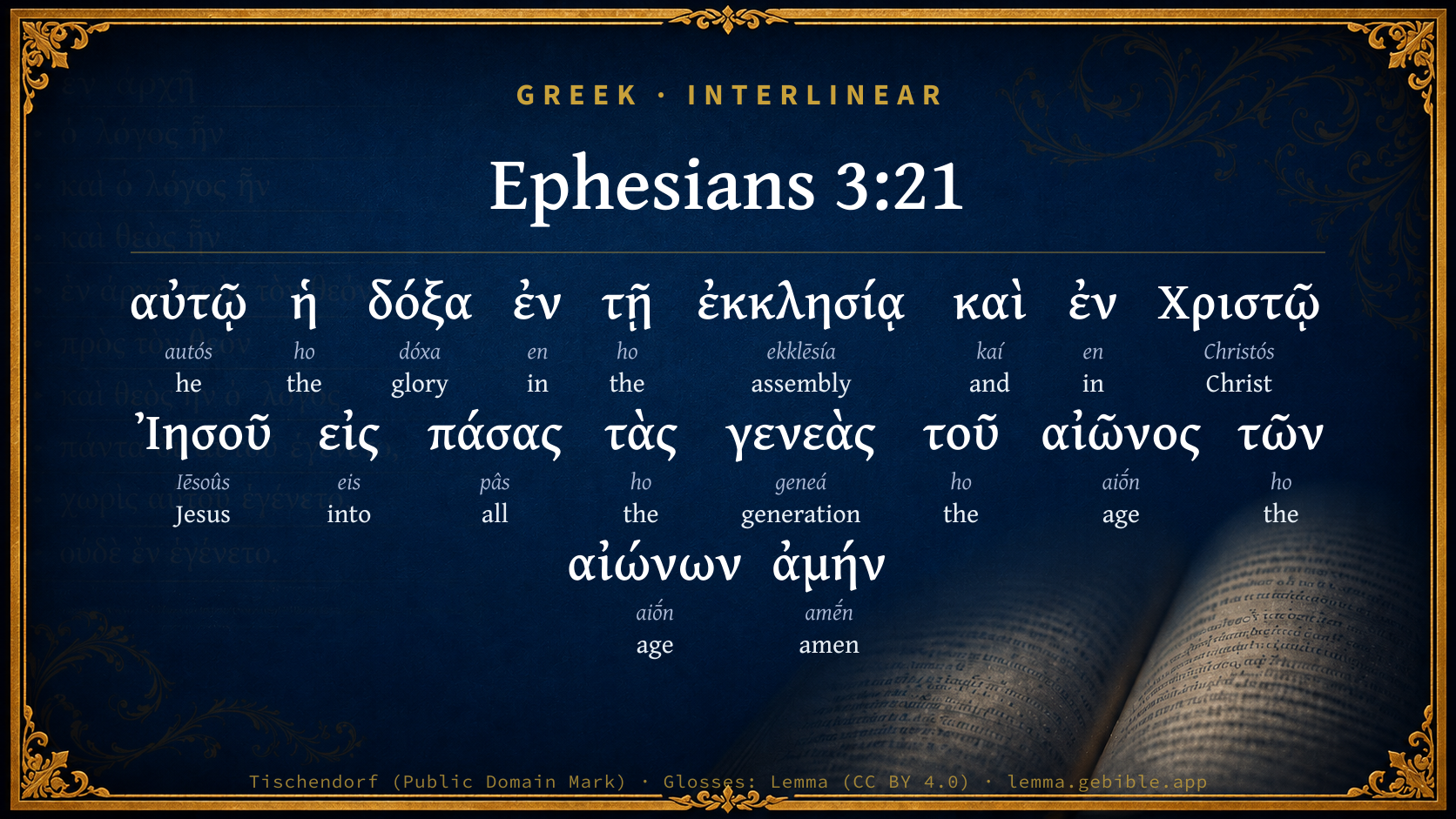
Download image
Cite this verse

Ephesians 3:21 (World English Bible). Public Domain. Lemma interlinear Bible study tool, https://lemma.gebible.app/v/ephesians/3/21.

Show BibTeX & RIS
BibTeX
RIS
English Translation
to him be the glory in the assembly and in Christ Jesus to all generations forever and ever. Amen.
World English Bible · Public Domain
Download a study sheet

One document with this verse’s original text, its word-by-word gloss line, the meaning frame, cross-references with their text, attributed commentary, and full source and license credits — printable, and it pastes into notes with its structure intact.

This verse Autodidact and up

Study sheet (.html) Plain text (.txt)

A passage Seminary Student

Up to 50 verses in one chapter. A passage sheet keeps up to 6 commentary sources and 12 cross-references per verse, in the order this page ranks them, and says so on the sheet whenever that leaves anything out. Ask for a single verse and you get the Autodidact verse sheet above.

Everything on this page stays free to read, with no account — the sheet is a download of what is already on screen, not access to it.

Want to remove ads? Support Godless Engineer
Compare translations 3

The same verse in 3 English versions, stacked beneath the original-language interlinear above. Click any original word for its lexicon entry.

Each is an independent rendering of the whole verse — the interlinear is not word-aligned to these translations.

Highlighted words mark where these versions differ — a whole-verse word diff, not a word-by-word alignment.

  • World English Bible Public Domain
    to him be the glory in the assembly and in Christ Jesus to all generations forever and ever. Amen.
  • King James Version Public Domain
    Unto him be glory in the church by Christ Jesus throughout all ages, world without end. Amen.
  • unfoldingWord Literal Text CC BY-SA 4.0
    to him the glory in the church and in Christ Jesus to all generations forever ever. Amen.

unfoldingWord Literal Text — © unfoldingWord, licensed CC BY-SA 4.0. Word-aligned USFM3 via Door43 (git.door43.org/unfoldingWord/en_ult).

Versions to compare (up to 4)

3 of 4 selected

Show all 19 translations

Every available English version of this verse, each an independent rendering of the whole verse.

  • World English Bible Public Domain
    to him be the glory in the assembly and in Christ Jesus to all generations forever and ever. Amen.
  • Berean Standard Bible Public Domain
    to Him be the glory in the church and in Christ Jesus throughout all generations, forever and ever. Amen.
  • Majority Standard Bible Public Domain
    to Him be the glory in the church in Christ Jesus throughout all generations, forever and ever. Amen.
  • King James Version Public Domain
    Unto him be glory in the church by Christ Jesus throughout all ages, world without end. Amen.
  • American Standard Version (1901) Public Domain
    unto him `be' the glory in the church and in Christ Jesus unto all generations for ever and ever. Amen.
  • Revised Version (1885) Public Domain
    unto him be the glory in the church and in Christ Jesus unto all generations for ever and ever. Amen.
  • Geneva Bible (1599) Public Domain
    Be praise in the Church by Christ Iesus, throughout all generations for euer, Amen.
  • Douay-Rheims (1899) Public Domain
    To him be glory in the church, and in Christ Jesus unto all generations, world without end. Amen.
  • Young's Literal Translation Public Domain
    to Him `is' the glory in the assembly in Christ Jesus, to all the generations of the age of the ages. Amen.
  • Literal Standard Version CC BY-SA 4.0
    to Him [is] the glory in the Assembly in Christ Jesus, to all the generations of the age of the ages. Amen.
  • Unlocked Literal Bible CC BY-SA 4.0
    to him be glory in the church and in Christ Jesus to all generations forever and ever. Amen.
  • unfoldingWord Literal Text CC BY-SA 4.0
    to him the glory in the church and in Christ Jesus to all generations forever ever. Amen.
  • Darby Bible Public Domain
    to him be glory in the assembly in Christ Jesus unto all generations of the age of ages. Amen).
  • World Messianic Bible Public Domain
    to him be the glory in the assembly and in Messiah Yeshua to all generations, forever and ever. Amen.
  • Webster's Bible Public Domain
    To him be glory in the church by Christ Jesus throughout all ages, world without end. Amen.
  • Free Bible Version CC BY-SA 4.0
    may he be glorified in the church and in Christ Jesus through all generations for ever and ever. Amen.
  • Bible in Basic English Public Domain
    To him be the glory in the church and in Christ Jesus to all generations for ever and ever. So be it.
  • Text-Critical English NT CC BY 4.0
    to him be glory in the church in Christ Jesus throughout all generations, forever and ever. Amen.
  • Tyndale New Testament (1534) Public Domain
    be prayse in the congregacion by Iesus Christ thorow out all generacios from tyme to tyme Amen.

Literal Standard Version (2020), Covenant Press — licensed CC BY-SA 4.0. Text via the HelloAO Bible API (eBible.org). Unlocked Literal Bible (unfoldingWord) — licensed CC BY-SA 4.0. Text via the HelloAO Bible API (eBible.org). unfoldingWord Literal Text — © unfoldingWord, licensed CC BY-SA 4.0. Word-aligned USFM3 via Door43 (git.door43.org/unfoldingWord/en_ult). Free Bible Version, Dr. Jonathan Gallagher — licensed CC BY-SA 4.0. Text via the HelloAO Bible API (eBible.org).

Word by word

More ways to search: Search by grammar → Find every occurrence → Compare this word →

Practice this passage: Drill this verse → Learn its vocabulary →

γενεὰς
geneá
G1074
“generation”
Noun, Accusative, Plural, Feminine
Part of Speech
Noun
Case
Accusative
Number
Plural
Gender
Feminine
Full Thayer's Definition

Origin: from (a presumed derivative of) G1085

TDNT: 12:02,1

1. fathered, birth, nativity 2. that which has been begotten, men of the same stock, a family a. the several ranks of natural descent, the successive members of a genealogy b. metaph. a group of men very like each other in endowments, pursuits, character 1. esp. in a bad sense, a perverse nation 3. the whole multitude of men living at the same time 4. an age (i.e. the time ordinarily occupied be each successive generation), a space of 30 - 33 years
  1. αὐτῷ autós G846 “he” Personal pronoun, Dative, Singular, Masculine
  2. ἡ ho G3588 “the” Article, Nominative, Singular, Feminine
  3. δόξα dóxa G1391 “glory” Noun, Nominative, Singular, Feminine
  4. ἐν en G1722 “in” Preposition
  5. τῇ ho G3588 “the” Article, Dative, Singular, Feminine
  6. ἐκκλησίᾳ ekklēsía G1577 “assembly” Noun, Dative, Singular, Feminine
  7. καὶ kaí G2532 “and” Conjunction
  8. ἐν en G1722 “in” Preposition
  9. Χριστῷ Christós G5547 “Christ” Noun, Dative, Singular, Masculine
  10. Ἰησοῦ Iēsoûs G2424 “Jesus” Noun, Dative, Singular, Masculine
  11. εἰς eis G1519 “into” Preposition
  12. πάσας pâs G3956 “all” Adjective, Accusative, Plural, Feminine
  13. τὰς ho G3588 “the” Article, Accusative, Plural, Feminine
  14. τοῦ ho G3588 “the” Article, Genitive, Singular, Masculine
  15. αἰῶνος aiṓn G165 “age” Noun, Genitive, Singular, Masculine
  16. τῶν ho G3588 “the” Article, Genitive, Plural, Masculine
  17. αἰώνων aiṓn G165 “age” Noun, Genitive, Plural, Masculine
  18. ἀμήν amḗn G281 “amen” Hebrew transliteration

About this verse

These counts appear in no published source. They are computed here, from the morphology-tagged text and Lemma’s own curated glosses. What Lemma adds →

19
words
13
distinct lemmas
Pauline Epistles
section

Shared distinctive vocabulary

γενεὰς generation G1074 occurs in 37 verses of the Greek New Testament. Also found in:
Repetition

Words recur within this verse:

Cross-references

26

Topical passages linked to Ephesians 3:21 in the Treasury of Scripture Knowledge — connected by theme and wording, ordered by reader-vote popularity; previews shown in the World English Bible.

  • Jude 1:25 to God our Savior, who alone is wise, be glory and majesty, dominion and power, both now and forever. Amen.
  • Romans 11:36 For of him, and through him, and to him, are all things. To him be the glory for ever! Amen.
  • 2 Peter 3:18 But grow in the grace and knowledge of our Lord and Savior Jesus Christ. To him be the glory both now and forever. Amen.
  • Revelation 7:12–17 saying, "Amen! Blessing, glory, wisdom, thanksgiving, honor, power, and might, be to our God forever and ever! Amen."
  • 1 Peter 5:11 To him be the glory and the power forever and ever. Amen.
  • 1 Chronicles 29:11 Yours, Yahweh, is the greatness, the power, the glory, the victory, and the majesty: for all that is in the heavens and in the earth is yours. Yours is the kingdom, Yahweh, and you are exalted as head above all.
  • Psalms 72:19 Blessed be his glorious name forever! Let the whole earth be filled with his glory! Amen and amen.
  • Isaiah 6:3 One called to another, and said, "Holy, holy, holy, is Yahweh of Hosts! The whole earth is full of his glory!"
  • Philippians 4:20 Now to our God and Father be the glory forever and ever! Amen.
  • Revelation 4:9–11 When the living creatures give glory, honor, and thanks to him who sits on the throne, to him who lives forever and ever,
  • Romans 16:27
  • Psalms 29:1–2 Ascribe to Yahweh, you sons of the mighty, Ascribe to Yahweh glory and strength.
  • Isaiah 42:12 Let them give glory to Yahweh, and declare his praise in the islands.
  • 1 Peter 2:5 You also, as living stones, are built up as a spiritual house, to be a holy priesthood, to offer up spiritual sacrifices, acceptable to God through Jesus Christ.
  • Galatians 1:5 to whom be the glory forever and ever. Amen.
  • Philippians 2:11 and that every tongue should confess that Jesus Christ is Lord, to the glory of God the Father.
  • Hebrews 13:21 make you complete in every good work to do his will, working in you that which is well pleasing in his sight, through Jesus Christ, to whom be the glory forever and ever. Amen.
  • Psalms 115:1 Not to us, Yahweh, not to us, But to your name give glory, For your loving kindness, and for your truth's sake.
  • Luke 2:14 "Glory to God in the highest, On earth peace, good will toward men."
  • Ephesians 1:6 to the praise of the glory of his grace, by which he freely bestowed favor on us in the Beloved,
  • Philippians 1:11 being filled with the fruits of righteousness, which are through Jesus Christ, to the glory and praise of God.
  • 2 Timothy 4:18 And the Lord will deliver me from every evil work, and will preserve me for his heavenly Kingdom; to whom be the glory forever and ever. Amen.
  • Revelation 5:9–14 They sang a new song, saying, "You are worthy to take the book, And to open its seals: For you were killed, And bought us for God with your blood, Out of every tribe, language, people, and nation,
  • Matthew 6:13 Bring us not into temptation, but deliver us from the evil one. For yours is the Kingdom, the power, and the glory forever. Amen.'
  • Ephesians 2:7 that in the ages to come he might show the exceeding riches of his grace in kindness toward us in Christ Jesus;
  • Hebrews 13:15–16 Through him, then, let us offer up a sacrifice of praise to God continually, that is, the fruit of lips which make confession to his name.

Cross-references courtesy of OpenBible.info (CC BY 4.0).

Commentary

Notes on Ephesians 3:21 from classic Christian and Jewish commentators (each source and its license shown beneath its notes). The classic Christian expositions comment on the surrounding passage and are grouped to its opening verse, so a note may address several verses; the Jewish commentaries on the Tanakh (Rashi and others) are per-verse, so they appear only where the commentator wrote on this verse.

Lemma curates 59 commentaries, every one of them public domain or Creative Commons licensed, each selected and text-cleaned for this edition rather than reprinted as found. About our sources →

The Biblical Illustrator

Joseph S. Exell

Eph_3:21

Unto him be glory in the church by Christ Jesus throughout all ages, world without end.

Amen.

Gods all-sufficiency and glory

I. Consider the acknowledgment, which the apostle makes, of Gods all-sufficiency. Gods ability intends not merely His power, but all those perfections which render Him a suitable object of our faith in prayer. It imports an exact knowledge of what our wants are, a ready disposition to supply them, wisdom to discern the proper time and manner of granting supplies, as well as power to effect whatever His wisdom sees best to be done.

1. God often does for men those favours which they never thought of asking for themselves.

2. God answers prayer in ways that we think not of. He will not always bestow the particular things which we ask, for we often mistake our own interest; but He will grant us things more valuable in themselves, or better adapted to our condition. Or, if He gives us the blessings in substance, He will send them in a more suitable time and manner, than we had proposed. I remember to have heard, on good authority, a remarkable story of an African, which will illustrate this thought. The poor negro, in his own country, was led, by contemplation on the works of nature, to conceive that there must be, though invisible to him, a supreme, all-powerful, wise, just, and good Being, who made and governed the world. Impressed with this sentiment, he used daily to pray to this in, visible Being, that he might, by some means or other, be brought to a more distinct knowledge of Him, and of the service due to Him. While in this contemplative and devout state of mind, he, with a number of others, was treacherously and perfidiously taken by some of his own countrymen, and soon after was sold for a slave. Now his faith began to waver. For, thought he with himself, if there is such a just and good Being, as I have supposed, who governs the world, how is it possible that fraud and iniquity should be successful against innocence and integrity? Why are I and my fellow prisoners, who have acted with openness and simplicity, made to suffer, while our enemies are permitted to triumph in the success of their deceit and violence? The poor fellow, after several changes of masters, was finally sold into a pious family in New England, where he was carefully instructed in the Christian religion, which he embraced with great appearance of sincerity and joy, and obeyed with exemplary diligence and zeal. And, in the relation of his story, he often made this pious reflection, that while he was perplexed to see the triumph of fraud over innocence, God was really answering his fervent prayers, and bringing him to the enjoyment of the means of religious knowledge and eternal salvation; that what he had thought was an objection against the justice of Providence, was really a wonderful and merciful compliance with his daily supplication.

3. The mercies which God is pleased to grant us, often produce happy consequences far beyond what we asked or thought,

4. The worth of the blessings which we ask and God bestows infinitely exceeds all our thoughts.

II. Consider the ascription of glory which the apostle makes to this all-sufficient God.

1. God is glorified by the increase of the Church.

2. God is glorified in the Church, when a devout regard is paid to the ordinances which He has instituted.

3. God is glorified by the observance of good order in the Church, and by the decent attendance of the members on their respective duties.

4. That God may be glorified, there must be peace and unity in the Church.

5. That glory may be given to God in the Church, there must be exemplary holiness in its members. (J. Lathrop, D. D.)

Glory to God though Jesus Christ

I. Glory must be given to God. The apostle, as may be inferred from the connection of the words, has chiefly in view the signal benefits of redemption in this elevated ascription of praise.

II. Through whom glory is to be given. Through Jesus Christ. Of Him, through Him, to Him, are all things. He is appointed Head over all. He is the only Mediator between God and man, whether for supplication or intercession or thanksgiving. In Him God bestows all grace upon us, and in Him all our words and our works are sanctified. Whatever we do in the service of God, if it be not done in the name of Christ, and in dependence upon His mediation and Lordship, it is done according to our own carnal will; it is not done according to the will of God.

III. By whom glory is to be given to God. The Church. By the Church is meant the congregation of faithful men, among whom the pure Word of God is preached, and the Sacraments rightly administered. All Gods works show His praise, but His saints shall bless Him.

IV. During what period. Throughout all ages. Every work of man has its limit and its end: all the glory of the creature is as the flower of the field; the wind passeth over it, and it is gone. But it is not so with the glory of God; His praises are endless as His life. Eternity only is the full scene of Gods praise, As it was in the beginning, so it is now, and shall be evermore. (H. J. Hastings, M. A.)

The glory of God

It must be remembered that no praise can add to Gods glory, nor blasphemies detract from it. The blessing tongue cannot make Him better, nor the cursing any worse. Nec melior si laudaveris, nec deterior si vituperaveris. As the sun is neither bettered by birds singing, nor injured by dogs barking. He is so infinitely great, and constantly good, that His glory admits neither addition nor diminution. (T. Adams, D. D.)

Glory is Gods alone

Caesar once said to his opponent, Either I will be Caesar, or nobody. So the Lord saith, Either I will be a great God, or no God, That man disparages the beauty of the sun who sets it upon a level with the twinkling stars, which only borrow their light therefrom. (Archbishop Seeker.)

How God is glorified

The glory of God is from His perfection, regarding extrinsically, and may in some degree be described thus:--It is the excellency of God above all things. God makes this glory manifest by external acts in various ways (Rom_1:23; Rom_9:4; Psa_8:1). But the modes of manifestation, which are declared to us in the Scriptures, are chiefly two; the one, by an effulgence of light and of unusual splendour, or by its opposite, a dense darkness or obscurity (Mat_17:2-5; Luk_2:9; Exo_16:10; 1Ki_8:11). The other, by the producing of works which agree with His perfection and excellence (Psa_19:1; Joh_2:11). (Arminius.)

Gods glory eternal

Agesilaus … might have led Tigranes, King of Armenia, captive at the wheels of his chariot. He rather chose to make him an ally; on which occasion he made use of that memorable expression, I prefer the glory that; will last forever to that of a day. (Plutarch.)

God glorified in Christ

A sick woman said to Mr. Cecil, Sir, I have no notion of God. I can form no notion of Him. You talk to me about Him, but I cannot get a single idea that seems to contain anything. But you know how to conceive of Jesus Christ as a man, replied Mr. Cecil; God comes down to you in Him, full of kindness and condescension. Ah! sir, that gives me something to lay hold on. There I can rest. I understand God in His Son. God was in Christ, reconciling the world to Himself, not imputing their trespasses unto them. (W. Baxendale.)

.

The Biblical Illustrator, edited by Joseph S. Exell (c. 1880s–1900s) — public domain. Text from a community e-Sword module.

Tyndale Open Study Notes

Tyndale Open Resources

3:21 The church—the community of believers, both Jews and Gentiles—is to be the reflection and full expression of the glory of God.

Tyndale Open Study Notes — © Tyndale Open Resources, licensed CC BY-SA 4.0. Text via the HelloAO Bible API.

Bengel's Gnomon

Johann Albrecht Bengel

Eph 3:21. Ἐν τῇ ἐκκλησίᾳ, in the Church) Eph 3:10.—εἰς πάσας, into all) Eph 3:11, ch. Eph 2:7: comp. again Psalms 117. Into all generations, which ὁ αἰὼν, the age, comprehends, and which terminates in the everlasting ages, τοὺς αἰῶνας.—τὰς γενεὰς, generations) A generation is properly a period of human life, whilst we proceed from parents to children; αἰῶνες are periods of the Divine economy, passing on as it were from one scene to another. Here both words, for the sake of amplification, with a metaphor in γενεὰ, generation, are joined together, so that a very long time may be implied. For there are in αἰῶνες no longer generations.[55]

[55] Therefore γενεὰ must be taken metaphorically.—ED.

Bengel's Gnomon of the New Testament — English translation (T&T Clark, Edinburgh, 1860) — public domain. Text from a community e-Sword module.

Meyer's Critical & Exegetical Commentary

Heinrich August Wilhelm Meyer

Eph_3:21. αὐτῷ] pointing back with rhetorical emphasis. See Schaef. Melet. p. 84; Kühner, II. p. 330.

ἡ δόξα] sc. εἴη: the befitting honour. Comp. Rom_11:36; Rom_16:27; Gal_1:5; Php_4:20. Certainly God has the glory (Eph_1:17), from which fact Harless explains the article; but it is not of this that the doxologies speak, not of this fact being testified to God, but of His receiving the human praise, which to Him pertains (Rev_4:11). Compare the conception, δοῦναι δόξαν τῷ Θεῷ, Luk_17:18; Act_12:23; Joh_9:24; Rom_4:20; Rev_4:9.

ἐν τῇ ἐκκλ. ἐν Χριστῷ Ἰ.] not to be taken together (Luther, Michaelis, Koppe, Rosenmüller, Flatt, Holzhausen, Meier, Olshausen), against which we may decidedly urge, not indeed the want of the article,since ἡ ἐκκλησία ἐν Χριστῷ, the Christian church, might be combined as one idea in contradistinction from the Jewish, or any other ἐκκλησία whatever,but the utter superfluousness of this distinguishing designation; for that ἡ ἐκκλησία was the Christian church, the ἐκκλησία κατʼ ἐξοχήν, was self-evident. Rather is ἐν τῇ ἐκκλ. the outward domain in which God is to be praised, and ἐν Χριστῷ the spiritual sphere in which this ascription of praise is to take place; for not outside of Christ, but in Christas the specific element of faith, in which the pious life-activity of the Christian movesdoes he praise God. Comp. Eph_3:5; Eph_3:20. Allied, but not identical (in opposition to Grotius and others), is the conception διὰ Χριστοῦ, Rom_1:8; Rom_7:25. Both conceptions: Col_3:17.

εἰς πάσας τὰς γενεὰς κ.τ.λ.] unto all generations of the world-age of world-ages.[196] This cumulation of the expressions is solemn. The αἰὼν τῶν αἰώνων denotes the eternal world-period beginning with the Parousia, the αἰὼν μέλλων, conceived of as the superlativum of all world periods (Winer, p. 220 [E. T. 309]), in so far as it, just as the last and eternal one, transcends all. other αἰῶνες since the beginning of the world. Comp. Dan_7:18; Daniel 3 Esdr. 4:38. The plural expression οἱ αἰῶνες τῶν αἰώνων (Gal_1:5; Php_4:20, al.) is not different as to the thing intended, but is so as to the conception; since in it the Messianic period, although equally thought of (comp. also on Luk_1:50) as the superlative of all the αἰῶνες, is not thought of in its unity without distinction, but as a continuous series of several periods: consequently not as a single totality, as in the case of ὁ αἰών, but according to the several constituent parts, which collectively form the whole of the Messianic eternity,in short, not as the time of times, as in our passage, but as the times of times. By εἰς πάσας τὰς γενεὰς κ.τ.λ. the thought is expressed, that the indicated ascription of praise to God will extend to all the generations of the (nigh) Messianic world-period, i.e. that this ascription of praise in the church is to endure not only up to the Parousia, but then also ever onward from generation to generation in the Messianic aeon,consequently to last not merely ἐς τὸ παρόν, but also ἐς τὸ ἀΐδιον. On γενεά, generation (three of which about = 100 years), comp. Act_14:16, and the passages from the LXX. and Apocrypha in Schleusners Thes.; from Greek writers, in Wessel, ad Diod. I. 24. The designation of the successive time-spaces of the everlasting Messianic αἰών by γενεαί, is derived from the lapse of time in the pre-Messianic world-periodin which with the changing generations one age of man ever succeeds anotherby virtue of a certain anthropological mode of regarding eternity. Of the church, however, it is presupposed that she herself (and so, too, will it be with her praising of God) endures on into the everlasting αἰών, but not that she has still a very long temporal duration before the Parousia, according to which de Wette has here found a contradiction to the apostles expectation elsewhere of the nearness of the Parousia. The Parousia brings for the ἐκκλησία not the end, but the consummation. Hofmann, Schriftbew. II. 2, p. 127, retaining καί before ἐν Χρ. Ἰ. (see the critical remarks), would have εἰς πάσας τὰς γενεάς κ.τ.λ., to belong only to ἐν Χρ. Ἰ., and not to ἐν τῇ ἐκκλησίᾳ; for only at present and upon earth does the glorification of God take place in the church, but in Christ it takes place eternally. Incorrectly, because even the temporal glorification does not take place otherwise than ἐν Χριστῷ Ἰησοῦ, consequently the καί would have had its logical position only after Χριστῷ Ἰησοῦ. If καί were genuine, it would not be equivalent to δέ, as would need to be assumed on Hofmanns view, but it would be et quidem, idque, however superfluous and cumbrous such a stress laid on it might be. According to Baur, p. 433, there meets us again here the Gnostic idea of the αἰῶνες, in accordance with which they, as the γενεαὶ τοῦ αἰῶνος τῶν αἰώνων, are the aeons in the sense, in which God Himself, as the extra-temporal unity of time, individualizes Himself in the aeons as the elements of self-unfolding time. In this way one may over-urge Gnosticism.

[196] αἰῶνες, periodi oeconomiae divinae ab una quasi scena ad aliam decurrentes, Bengel.

Meyer — Critical and Exegetical Commentary on the New Testament — English translation by Peter Christie, edited by Frederick Crombie (T&T Clark, 1880) — public domain. Text from a community e-Sword module.

Expositor's Greek Testament

ed. W. Robertson Nicoll

Eph 3:21 . αὐτῷ ἡ δόξα ἐν τῇ ἐκκλησίᾳ ἐν Χριστῷ Ἰησοῦ : unto Him be the glory in the Church in Christ Jesus (better, “and in Christ Jesus”). In the αὐτῷ the great Subject of the ascription is named the second time with rhetorical emphasis, and as it stands first in the sentence εἴη (not ἐστί ) is to be supplied. The article with δόξα defines it as the glory that is due to Him, or that befits Him. And that “glory” is to be given Him ἐν τῇ ἐκκλησίᾳ , the Church being the domain in which the praise that belongs to Him is to be rendered Him. The reading of the TR, ἐν τῇ ἐκκλησίᾳ ἐν Χριστῷ , Ιησοῦ , follows such authorities as [351] 2 [352] [353] [354] , Syr., Eth., Arm., Goth. It is rendered by some “in the Church which is in Christ Jesus”. But there is no evident reason for defining the Church here specifically as in Christ ; for it is the Christian Church that is obviously meant, and there is no need to distinguish it from the Church of Israel. Such a construction, too, distinguishing one Church from another, would have been clearer if τῇ had appeared before ἐν Χριστῷ , although the absence of the article is not fatal to it ( cf. 1Th 1:1 , etc.). Hence those who follow the TR take the words as two distinct clauses, ἐν τῇ ἐκκλησίᾳ , ἐν Χριστῷ Ἰησοῦ , understanding them to mean that the praise which is given in the Church is praise given in Christ in virtue of her union with Him as her Head, or taking them to point first to the Church as “the outward domain in which God is to be praised” and then to Christ as the “spiritual sphere in which this ascription of praise is to take place” (Mey.), it being only in Christ that believer or Church can really praise God. There is, however, a small, but important addition made to the text by some of the oldest and best authorities, by the insertion of καί before the ἐν Χριστῷ Ἰησοῦ . The evidence is so strong ( [355] [356] [357] [358] , 17, Vulg., Boh., etc.) that the καί can scarcely be refused, and it is accepted by LTTrWHRV. So the sentence becomes “in the Church and in Christ Jesus,” and the idea is that praise is to be given to God and His glorious perfections shown forth both in the Church which is the body, and in Christ who is the Head in the Church as chosen by Him, and in the Christ as given, raised, and exalted by Him. So Haupt, with a somewhat similar idea, understands the sense to be that the glorifying of God takes place in outward-wise in the circle of the Church and at the same time in such inward-wise that it is in Christ. εἰς πάσας τὰς γενεὰς τοῦ αἰῶνος τῶν αἰώνων . ἀμήν : unto all generations for ever and ever. Amen . More exactly “unto all the generations of the age of the ages. Amen.” Another of these reduplicated, cumulative expressions by which the mind of man working with the ideas of time labours to convey the idea of the eternal. The formula may be, as was suggested by Grotius, a combination of two distinct phrases of similar meaning, one in which continuance, endless continuance, is expressed in terms of γενεά , γενεαί ( cf. e.g. , Luk 1:50 ; εἰς γενεὰς γενεῶν , or εἰς γενεὰς καὶ γενεὰς with LTTrWHRV); and another in which the same idea is expressed in terms of αἰών , αἰῶνες ( cf. εἰς αἰῶνας αἰώνων , Rev 14:11 ; εἰς τοὺς αἰῶνας τῶν αἰώνων , Gal 1:5 , etc.). The peculiarity here is the conjunction of the two formulæ and the use of the sing. αἰών in the latter; cf. εἰς τὸν αἰῶνα τοῦ αἰῶνος , 3 Esdr. 4:38; ἕως αἰῶνος τῶν αἰώνων , Dan 7:18 ; εἰς τὸν αἰῶνα [ τοῦ αἰῶνος ], Heb 1:8 ; εἰς ἡμέραν αἰῶνος , 2Pe 3:18 . The precise idea underlying the phrase is not quite clear. It may be that the everlasting future is thought of as one long “age” embracing in it an unnumbered succession of “generations” and making the sum and crown of all possible “ages”. Or the “age of the ages” may have the force of a superlative, “the age par excellence ,” the “age beside which there is none other to be named,” and that regarded as containing in itself all conceivable “generations”. More precisely, the idea of the Parousia may be behind all, the age ( ὁ αἰών ) being the Messianic age which opens with the Parousia, brings all other “ages” with the “generations” belonging to them to an end, and is itself to endure for ever. Thus, as Meyer puts it, the idea is that the glory to be given to God in the Church and in Christ its Head is to “endure not only up to the Parousia, but then also ever onward from generation to generation in the Messianic æon consequently to last not merely εἰς τὸ παρόν , but also εἰς τὸ ἀΐδιον ”. The ἀμήν , which occurs so frequently in our Lord’s discourses at the beginning of an affirmation, is used here, as so often in the OT, at the close of the sentence in the sense of so be it (LXX, γένοιτο ; cf. Num 5:22 , etc.). It was the people’s assent in OT times to declarations made at solemn assemblies (Deu 27:15 ; Neh 5:13 ; Neh 8:6 , etc.). It was also their response to the prayers offered in the synagogue, and from 1Co 14:16 we gather that this use of the word was continued in the Christian Church.

[351] Codex Claromontanus (sæc. vi.), a Græco-Latin MS. at Paris, edited by Tischendorf in 1852.

[352] Codex Mosquensis (sæc. ix.), edited by Matthæi in 1782.

[353] Codex Angelicus (sæc. ix.), at Rome, collated by Tischendorf and others.

[354] Codex Porphyrianus (sæc. ix.), at St. Petersburg, collated by Tischendorf. Its text is deficient for chap. Eph 2:13-16 .

[355] Codex Vaticanus (sæc. iv.), published in photographic facsimile in 1889 under the care of the Abbate Cozza-Luzi.

[356] Codex Sinaiticus (sæc. iv.), now at St. Petersburg, published in facsimile type by its discoverer, Tischendorf, in 1862.

[357] Codex Alexandrinus (sæc. v.), at the British Museum, published in photographic facsimile by Sir E. M. Thompson (1879).

[358] Codex Ephraemi (sæc. v.), the Paris palimpsest, edited by Tischendorf in 1843.

The Expositor's Greek Testament, edited by W. Robertson Nicoll (1897–1910) — public domain. Text from a community e-Sword module.

Hodge's Commentary on Romans, Ephesians & First Corinthians

Charles Hodge

Eph_3:20, Eph_3:21

Pauls prayer had apparently reached a height beyond which neither faith, nor hope, nor even imagination could go, and yet he is not satisfied. An immensity still lay beyond. God was able to do not only what he had asked, but infinitely more than he knew how either to ask or think. Having exhausted all the forms of prayer, he casts himself on the infinitude of God, in full confidence that he can and will do all that omnipotence itself can effect. His power, not our prayers nor our highest conceptions, is the measure of the apostles anticipations and desires. This idea he weaves into a doxology, which has in it more of heaven than of earth.

There are two forms of expression here united; Paul says, τῷ ὑπὲρ πάντα ποιῆσαι δύναμένῳ, to him who is able to do more than all things; and as though this were not enough, he adds, ὑπερ ἐκπερισσοῦ ὧν αἰτούμεθα ἤ νοοῦμεν, exceeding abundantly above all we ask or think. God is not only unlimited in himself, but is unrestricted by our prayers or knowledge. No definite bounds, therefore, can be set to what they may expect in whom Christ dwells, and who are the objects of his infinite love.

Κατὰ τὴν δύναμιν τὴν ἐνεργουμένην ἐν ἡμῖν, according to the power that worketh in us. The infinite power of God from which so much may be expected, is the same of which we are now the subjects. It is that power which wrought in Christ when it raised him from the dead, and set him at the right hand of God, Eph_1:19-20, and which has wrought an analogous change in the believer in raising him from the death of sin, and making him to sit in heavenly places in Christ Jesus; and which still sustains and carries on the work of salvation in the soul. The past is a foretaste and pledge of the future. Those who have been raised from the dead, who have been transformed by the renewing of their minds, translated from the kingdom of darkness into the kingdom of Gods dear Son, and in whom God himself dwells by his Spirit, having already experienced a change which nothing but omnipotence could effect, may well join in the doxology to Him who is able to do exceeding abundantly above all we can ask or think.

The glory; ἡ δόξα is either the glory that is due, or the glory which God has. To give glory to God, is either to praise him, or to reveal his glory, i.e. cause it to be seen and acknowledged. Thus the doxology, To Him be glory may mean either, Let Him be praised; or, Let His glory be acknowledged.

In the church by Christ Jesus.‹11› The original is, ἐν τῇ ἐκκλησίᾳ καὶ ἐν Χριστῷ Ἰησοῦ, which Luther renders, in the church which is in Christ, i.e. the Christian church. This interpretation is adopted by several modern commentators. But in that case the article τῇ before ἐν Χριστῷ ought not to be omitted. Besides, as the Christian church is the only church which could be thought of, the addition of the words in Christ would be unnecessary. The ordinary interpretation, therefore, is to be preferred. Glory is to be rendered to God in the church, and in and through Christ Jesus, as her head and representative. The church is the company of the redeemed here and in heaven; which constitutes one body through which God is to manifest his manifold wisdom, and which is through all ages to ascribe unto him glory, honor, and dominion.

The idea of eternity or of endless duration is variously expressed in Scripture. Sometimes eternity is conceived of as one, and the singular αἴων is used; sometimes as an endless succession of periods or ages, and then the plural αἰῶνες is used. Thus εἰς τὸν αἰῶνα, to eternity, and εἰς τούς αἰῶνας, or εἰς τοὺς αἰῶνας τῶν αἰῶνων, to the ages indefinitely, i.e. endless ages, alike mean, forever. So, βασιλεὺς τοῦ αἰῶνος, king of eternity, and βασιλευς τῶν αἰῶνων, king of endless ages, both mean the king eternal. The peculiarity of the case before us is, that the apostle combines these two forms: εἰς πάσας τὰς γενεὰς τοῦ αἰῶνος τῶν αἰώνων, to all the generations of an eternity of ages. There is in keeping with the cumulative character of the whole context. Finding no ordinary forms of expression suited to his demands, the apostle heaps together terms of the largest import to give some vent to thoughts and aspirations which he felt to be unutterable. These things belong to the στεναγμοὶ ἀλαλήτοι of which he speaks in Rom_8:26.

Charles Hodge — Commentary on Romans (1835), First Corinthians (1857), and Ephesians (1856) — public domain. Text from a community e-Sword module.

Jamieson, Fausset & Brown

Robert Jamieson, A. R. Fausset & David Brown

Translate, "Unto Him be the glory (that is, the whole glory of the gracious dispensation of salvation just spoken of) in the Church (as the theater for the manifestation of the glory, Eph 3:10) in Christ Jesus (as in Him all the glory centers, Zac 6:13) to all the generations of eternal ages," literally, "of the age of the ages." Eternity is conceived as consisting of "ages" (these again consisting of "generations") endlessly succeeding one another.

Next: Ephesians Chapter 4

Jamieson, Fausset & Brown — Commentary Critical and Explanatory on the Whole Bible (1871) — public domain (CC PDM 1.0). Text via the HelloAO Bible API.

Adam Clarke's Commentary

Verse 21. Unto him] Thus possessed of power and goodness, be glory in the Church-be unceasing praises ascribed in all the assemblies of the people of God, wherever these glad tidings are preached, and wherever this glorious doctrine shall be credited.

By Christ Jesus] Through whom, and for whom, all these miracles of mercy and power are wrought.

Throughout all ages] εις πασας τας γενεας. Through all succeeding generations-while the race of human beings continues to exist on the face of the earth.

World without end.] του αιωνος των αιωνων. Throughout eternity-in the coming world as well as in this. The song of praise, begun upon earth, and protracted through all the generations of men, shall be continued in heaven, by all that are redeemed from the earth, where eras, limits, and periods are no more for ever.

Amen.] So be it. So let it be! and so it will be; for all the counsels of God are faithfulness and truth; and not one jot or tittle of his promise has failed, from the foundation of the world to the present day; nor can fail, till mortality is swallowed up of life.

Therefore, to the Father, Son, and holy Ghost, be glory, dominion, power, and thanksgiving, now, henceforth, and for ever. - Amen and Amen.

1. FOR the great importance of the matter contained in this chapter, and the sublimity of the language and conceptions, there is no portion of the New Testament equal to this. The apostle was now shut up in prison, but the word of the Lord was not bound; and the kingdom of God seems to have been opened to him in a most astonishing manner. There seems to have been exhibited to him a plan of the Divine counsels and conduct relative to the salvation of man, before and from the foundation of the world to the end of time; and while, with the eye of his mind, he contemplates this plan, he describes it in language at once the most elevated that can be conceived, and every where dignified and appropriate to the subject; so that he may with safety be compared with the finest of the Grecian writers. In the notes I have already observed how hard it is to give any literal translation of the many compound epithets which the apostle uses. Indeed his own nervous language seems to bend and tremble under the weight of the Divine ideas which it endeavours to express. This is most observable in the prayer and doxology which are contained in Eph 3:14-21. A passage in Thucydides, lib. vii. cap. lxxxvii, in fine, where he gives an account of the total overthrow of the Athenian general, Nicias, and his whole army, by the Sicilians, has been compared with this of the apostle; it is truly a grand piece, and no reader can be displeased with its introduction here: ξυνεβη τε εργον τουτο Ἑλληνικον των κατα τον πολεμον τονδε μεγιστον γενεσθαι - και τοις τε κρατησασι λαμπροτατον, και τοις διαφθαρεισι δυστυχεστατον· κατα παντα γαρ παντως νικηθεντες, και ουδεν ολιγον ες ουδεν κακοπαθησαντες, πανωλεθριᾳ δη, το λεγομενον, και πεζος και νηες, και ουδεν ὁ, τι ουκ απωλετο· και ολιγοι απο πολλων επ' οικου απενοστησαν· "This was the greatest discomfiture which the Greeks sustained during the whole war, and was as brilliant to the conquerors as it was calamitous to the vanquished. In every respect they were totally defeated; and they suffered no small evil in every particular: the destruction was universal, both of army and navy; there was nothing that did not perish; and scarcely any, out of vast multitudes, returned to their own homes.

The learned may compare the two passages; and while due credit is given to the splendid Greek historian, no critic will deny the palm to the inspired writer.

2. With such portions of the word of God before us, how is it that we can he said conscientiously to credit the doctrines of Christianity, and live satisfied with such slender attainments in the divine life? Can any man that pleads for the necessary and degrading continuance of indwelling sin, believe what the apostle has written? Can we, who profess to believe it, be excusable, and live under the influence of any temper or passion that does not belong to the mind of Christ? Will it be said in answer, that "this is only a prayer of the apostle, and contains his wish from the overflowings of his heart for the spiritual prosperity of the Ephesians?" Was the apostle inspired or not when he penned this prayer? If he were not inspired, the prayer makes no part of Divine revelation; if he were inspired, every petition is tantamount to a positive promise; for what God inspires the heart to pray for, that God purposes to bestow. Then it is his will that all these blessings should be enjoyed by his true followers, that Christ should inhabit their hearts, and that they should be filled with all the fulness of God; yea, and that God should do for them more abundantly than they can ask or think. This necessarily implies that they should be saved from all sin, inward and outward, in this life; that the thoughts of their hearts should be cleansed by the inspiration of God's Holy Spirit, that they might perfectly love him, and worthily magnify his holy name.

As sin is the cause of the ruin of mankind, the Gospel system, which is its cure, is called good news, or glad tidings; and it is good news because it proclaims him who saves his people from their sins. It would be dishonourable to the grace of Christ to suppose that sin had made wounds which that could not heal.

Adam Clarke's Commentary on the Bible (1810–1826) — public domain. Text from a community e-Sword/MySword module.

Ellicott's Commentary for English Readers

(21) Unto him be glory in the church by (properly, in) Christ Jesus.—In the parallelism of these clauses is implied the great idea of the Epistle—the unity of the Church in Christ. Hence all that is “in the Church” is “in Christ Jesus.” The visible unity of the Church represents, as it depends on, the invisible unity with God in Him.

Throughout all ages, world without end.—The original expression is emphatic and peculiar: to all the generations of the age of the ages; that is, in each successive generation of that age (or, dispensation) which includes in itself all the ages which we can reckon or conceive. The conception represents to us each generation, as adding its own peculiar thanksgiving to the great chorus of praise which fills eternity.

A Bible Commentary for English Readers, edited by Charles John Ellicott (1878–1897) — public domain. Text from a community e-Sword module.

The Cambridge Bible for Schools and Colleges

gen. ed. J. J. S. Perowne

21. glory] Lit., and better, the glory; the glory due to the Father of the Saviour, and of the saints in Him.

in the church by Christ Jesus] Lit., in Christ Jesus. “The glory” is ascribed “in Him” as the Father is manifested in Him, and “in Him reconciled the world to Himself.”—But very strong evidence favours the reading in the Church and in Christ Jesus. If this is adopted, and it is nearly certain, the meaning is that the reasons of eternal praise to the Father lie both in the Church and in the Saviour; in the Church, as chosen and glorified by Him, in the Saviour as His supreme and all-including Gift.

throughout all ages, &c.] Lit., unto all the generations of the age of the ages. Such is the length of prospect revealed for the Church of Christ, as the “habitation of God” (Eph_2:22). The meaning manifestly is, “to all eternity,” whatever manifestations the eternal Future may bring. This is viewed as one vast “age” (aiôn), the sum and circumference of ages, which ages again contain developments faintly imaged by the “generations” which make up the centuries of Time.—The phrases “for ever,” or “for ever and ever,” of our A. V., usually represent the “unto the age,” or “unto the ages,” or “unto the ages of the ages,” of the Greek. The first Gr. phrase is almost confined to St John’s Gospel and Epistles; the last is distinctive of the Revelation, but it occurs also in St Paul and St Peter. St Peter (2 Eph_3:18) writes “unto the day of the age,” the “Day” which shall usher in the Eternal State.—On the word aiôn see further, last note on Eph_1:21.

Amen] The word is properly a Hebrew adverb (“surely”), repeatedly used as here in O. T. See Psa_89:52; Jer_11:5 (marg. A. V.); &c.

On the great passage thus closed Monod remarks: “This doxology, which concludes at once the Apostle’s prayer and the first part of his epistle, would be remarkable anywhere, but it is doubly so here … After the grandest promises which human language can express, the Holy Spirit here closes by declaring that all which can be expressed is infinitely below the reality which is in God.… But nothing less could answer the vast and undefined need of the heart. All that the mind can clearly grasp and the mouth articulately utter is incapable of satisfying us. And thus this close, so astonishing and unexpected, is just what we needed … But alas, if this language which is infinitely below the reality which is in God is infinitely above the reality which is in us!… To pass from Scripture to our experience, seems like a fall from heaven to earth.… The Lord teach us how to bring our experience into harmony with His promises.”

The Cambridge Bible for Schools and Colleges (gen. ed. J. J. S. Perowne; Cambridge University Press, 1878–1918) — public domain. Text from a community e-Sword module.

Trapp's Complete Commentary

John Trapp

21 Unto him be glory in the church by Christ Jesus throughout all ages, world without end. Amen.

Ver. 21. Glory in the church of Christ] Who is the refulgency of his Father’s glory, Heb 1:3.

John Trapp, A Commentary or Exposition upon All the Books of the Old and New Testament (1647–1656) — public domain. Text from a community e-Sword module.

Albert Barnes' Notes on the Bible

Unto him be glory - see the notes, Rom 16:27.

In the church - Or, by the church; Eph 3:10. The church was to be the instrument by which the glory of God would be shown; and it was by the church that his praise would be celebrated.

Throughout all ages, world without end - There is a richness and amplification of language here which shows that his heart was full of the subject, and that it was difficult to find words to express his conceptions. It means, in the strongest sense, forever. It is one of “the apostle’s self-invented phrases” (Bloomfield); and Blackwall says that no version can fully express the meaning. It is literally, “Unto all generations of the age of ages,” or “unto all the generations of the eternity of eternities, or the eternity of ages.” It is the language of a heart full of the love of God, and desiring that he might be praised without ceasing forever and ever.

Remarks On Ephesians 3

1. It is a great and glorious truth that the offers of the gospel are made to us, who are by nature Gentiles; and that those offers are confined to no class or condition of people - to no nation or tribe; Eph 3:1-6. This truth had been concealed for ages. The Jews regarded themselves as a unique people, and as exclusively the favorites of Heaven. The great effort has been made everywhere to show that there was a favored class of people - a class whom God regarded with special affection, on account of their birth, or rank, or nation, or wealth, or complexion. In one nation, there has been a distinction of “caste” carefully kept up from age to age, and sustained by all the power of the priesthood and the laws; and it has been held that that one class was the favorite of Heaven, and that every other was overlooked or despised. In another nation, it has been held that the services of an illustrious ancestry made a difference among people, and that this fact was to he regarded, even in religion.

In another, complexion has made a difference; and the feeling has insensibly grown up that one class were the favorites of Heaven, because they had a skin not colored like others, and that those not thus favored might be doomed to hopeless toil and servitude. In another, the attempt is made to create such a distinction by wealth; and it is felt that the rich are the favorites of Heaven. In all these eases, there is the secret feeling that in virtue of rank, or blood, or property, one class are the objects of divine interest, more than others; and that the same plan of salvation is not needed for them which is required for the poor, for the ignorant, and for the slave. The gospel regards all people as on a level; offers the same salvation to all; and offers it on the same terms. This is one of its glories; and for this we should love it. It meets man as he is - as everywhere a fallen and a ruined being - and provides a plan adapted to raise all to the glories of the same heaven.

2. Humility becomes us Eph 3:8. Paul felt that he was the least of all saints. He remembered his former life. He recalled the time when he persecuted the church. He felt that he was not worthy to be enrolled in that society which he had so greatly injured. If Paul was humble, who should not be? Who, since his time, has equalled his ardor, his zeal, his attainments in the divine life? Yet the remembrance of his former life served always to keep him humble, and operated as a check on all the tendencies to pride in his bosom. So it should be with us - with all Christians. There has been enough in our past lives to make us humble, if we would recall it, and to make us feel that we are not worthy to be enrolled among the saints. One has been an infidel; one licentious; one intemperlate; one rash, revengeful, passionate; one has been proud and ambitious; one has been false, dishonest, faithless; all have had hearts opposed to God, alienated from good, and prone to evil; and there is not a Christian in the world who will not find enough in his past life to make him humble, if he will examine himself - enough to make him feel that he deserves not even the lowest place among the saints. So we shall feel if we look over our lives since we made a profession of religion. The painful conviction will come over our souls, that we have lived so far from God, and done so little in his cause, that we are not worthy of the lowest place among the blessed.

3. It is a privilege to preach the gospel; Eph 3:8. So Paul felt. It was an honor of which he felt that he was by no means worthy. It was proof of the favor of God toward him that he was permitted to do it. It is a privilege - an honor - to preach the gospel, anywhere arid to any class of people. It is an honor to be permitted to preach in Christian lands; it is an honor to preach among the pagan. It is an honor far above that of conquerors; and he who does it will win a brighter and more glorious crown than he who goes forth to obtain glory by dethroning kings, and laying nations waste. The warrior goes with the sword in one hand, and the torch in the other. His path is marked with blood, and with smouldering ruins. He treads among the slain; and the music of his march is made up of dying groans, and the shrieks of widows and orphans. Yet he is honored, and his name is blazoned abroad; he is crowned with the laurel, and triumphal arches are reared, and monuments are erected to perpetuate his fame. The man who carries the gospel goes for a different purpose. He is the minister of peace. He goes to tell of salvation. He fires no city; lays waste no field; robs no one of a home, no wife of a husband, no child of a father, no sister of a brother; - he goes to elevate the intellect, to mould the heart to virtue, to establish schools and colleges; to promote temperance, industry, and chastity; to wipe away tears, and to tell of heaven. “His” course is marked by intelligence and order; by peace and purity; by the joy of the domestic circle, and the happiness of a virtuous fire-side; by consolation on the bed of pain, and by the hope of heaven that cheers the dying. Who would not rather be a preacher of the gospel than a blood-stained warrior? Who would not rather have the wreath that shall encircle the brows of Paul, and Schwartz, and Martin, and Brainerd, than the laurels of Alexander and Caesar?

4. There is ample fullness in the plan of salvation by the Redeemer; Eph 3:8. In Christ there is unsearchable riches. None can understand the fulness that there is in him; none can exhaust it. Millions, and hundreds of million, have been saved by the fulness of his merits; and still those merits are as ample as ever. The sun in the heavens has shone for 6,000 years, and has shed light and comfort. on countless million; but his beams are not exhausted or diminished in splendor. Today, while I write - this beautiful, calm, sweet day - (June 24, 1840) his beams are as bright, as rich, as full, as they were when they were shed on Eden. So of the Sun of righteousness. Millions have been enlightened by his beams; but today they are as full, and rich, and glorious, as they were when the first ray from that sun reached the benighted mind of a penitent sinner. And that fulness is not to be exhausted. No matter how many partake of his abundance; no matter how many darkened minds are enlightened; no matter though nation after nation comes and partakes of his fulness, yet there is no approach to exhaustion. The sun in the heavens may waste his fires and burn out, and become a dark orb, diffusing horror over a cold and cheerless world; but not so with the Sun of righteousness. That will shine on in glory forever and ever; and the last penitent sinner on earth who comes to partake of the riches of the grace of Christ, shall find it as full and as free as did the first who sought pardon through his blood. Oh, the unsearchable riches of Christ! Who can understand this? Who can grow weary in its contemplation?

5. There is no good reason why any sinner should be lost; Eph 3:8. If the merits of the Saviour were limited; if his arm were a feeble human arm; if he died only for a part, and if his merit were already well-nigh exhausted, we might begin to despair. But it is not so. The riches of his grace are unbounded and inexhaustible. And why then does the sinner die? I can answer. He does like the man who expires of thirst while fountains bubble and streams flow all around him; like him who is starving amidst trees loaded with fruit; like him who is dying of fever in the midst of medicines that would at once restore him; like him who holds his breath and dies while the balmy air of heaven - pure, full, and free - floats all around him. If a man thus dies, who is to blame? If a man goes down to hell from lands where the gospel is preached, whose is the fault? It is not because the merits of Christ are limited; it is not because they are exhausted.

6. The church is designed to accomplish a most important purpose in the manifestation of the divine glory and perfections; Eph 3:10. It is by that that his great-wisdom is shown. It is by that entirely that his mercy is displayed; Eph 2:7. His power is shown in the creation and support of the worlds; his goodness in the works of creation and Providence; his truth in his promises and threatenings; his greatness and majesty are everywhere displayed in the universe which he has brought into being. His mercy is shown in the church; and there alone. Angels in heaven not having sinned, have had no occasion for its exercise; and angels that are fallen have had no offer of pardon. Throughout the wide universe there has been so far as we know, no exercise of mercy but in the church. Hence, the interest which the angelic beings feel in the work of redemption. Hence, they desire to look into these things, and to see more of the heighth and depth and length and breadth of the love of God evinced in the work of redemption. Hence the church is to be honored forever as the means of making known to distant worlds the way in which God shows mercy to rebellious creatures. It is honor enough for one world thus to be the sole means of making known to the universe one of the attributes of God; and while other worlds may contain more proofs of his power and greatness, it is enough for ours that it shows to distant worlds how he can exercise compassion.

7. All tribulation and affliction may be intended to do some good, and may benefit others; Eph 3:13. Paul felt that his sufferings were for the “glory” - the welfare and honor of the Gentiles, in whose cause he was suffering. He was then a prisoner at Rome. He was permitted no longer to go abroad from land to land to preach the gospel. How natural would it have been for him to be desponding, and to feel that he was leading a useless life. But he did not feel thus. He felt that in some Way he might be doing good. He was suffering in a good cause, and his trials had been brought on him by the appointment of God. He gave himself to writing letters; he talked with all who would come to him Act 28:30-31, and he expected to accomplish something by his example in his sufferings. The sick, the afflicted, and the imprisoned often feel that they are useless. They are laid aside from public and active life, and they feel that they are living in vain. But it is not so. The long imprisonment of John Bunyan - so mysterious to him and to his friends - was the means of producing the Pilgrim’s Progress, now translated into more than twenty languages, and already blessed to the salvation of thousands. The meekness, and patience, and kindness of a Christian on a bed of pain, may do more for the honor of religion than he could do in a life of health. It shows the sustaining power of the gospel; and this is much. It is “worth” much suffering to show to a world what the gospel can do in supporting the soul in times of trial; and he who is imprisoned or persecuted; he who lies month after month or year after year on a bed of languishing, may do more for the honor of religion than by many years of active life.

8. There is but one family among the friends of God; Eph 3:15. They all have one Father, and all are brethren. In heaven and on earth they belong to the same family, and worship the same God. Let Christians, therefore, first love one another. Let them lay aside all contention and strife. Let them feel that they are brethren - that though they belong to different denominations, and are called by different names, yet they belong to the same family, and are united under the same glorious head. Let them, secondly, realize how highly they are honored. They belong to the same family as the angels of light and the spirits of just men made perfect. It is an honor to belong to such a family; an honor to be a Christian. Oh, if we saw this in its true light, how much more honorable would it be to belong to this “family” than to belong to the families of the great on earth, and to have our names enrolled with nobles and with kings!

9. Let us seek to know more of the love of Christ in our redemption - to understand more of the extent of that love which he evinced for us; Eph 3:16-19. It is worth our study. It will reward our efforts. There are few Christians - if there are any - who understand the richness and fulness of the gospel of Christ; few who have such elevated views as they might have and should have of the glory of that gospel. It is wonderful that they who profess to love the Lord Jesus do not study that system more, and desire more to know the heighth, and depth, and length, and breadth of the love of Christ. True, it passes knowledge. We cannot hope fully to fathom it in this world. But we may know more of it than we do. We may aspire to being filled with all the fullness of God. We may long for it; pant for it; strive for it; pray for it - and we shall not strive in vain. Though we shall not attain all we wish; though there will be an infinity beyond what we can understand in this world, yet there will be enough attained to reward all our efforts, and to fill us with love and joy and peace. The love of God our Saviour is indeed an illimitable ocean; but we may see enough of it in this world to lead us to adore and praise God with overflowing hearts.

Albert Barnes' Notes on the Bible (1834–1885) — public domain. Text from a community e-Sword/MySword module.

Matthew Poole's English Annotations

Unto him be glory in the church; the whole church of Jews and Gentiles. The church only knows the mystery and partakes of the benefits before mentioned, and therefore the church only can rightly glorify God for them.

By Christ Jesus; either in Christ, in whom the Father hath displayed all his love to us; or rather by (according to our version) Christ, as the Mediator between God and us; by whom we offer up our services to God, praises as well as prayers, Rom 1:8; 7:25. Throughout all ages; or, through all generations.

Matthew Poole's English Annotations on the Holy Bible (1683–1685) — public domain. Text from a community e-Sword/MySword module.

Whedon's Commentary on the Bible

Daniel D. Whedon

21. Unto him—Repeated with majestic emphasis.

Be glory—Namely, an ascription of supreme adoring honour.

Throughout all ages… end— Literal Greek, into all generations of the age of ages. And here we might be surprised at generations being ascribed to the eternal ages. But the word generation designates, not a real progeny, but a time period. With the elder Hebrews a generation seems to have been a century, with the Greeks, one third of a century. (See Robinson’s Greek N.T. Lexicon on the word.) Grotius rightly says, For the purpose of magnifying, the apostle here mingles two Hebrew idioms, namely, “to generations of generations,” (as in Psa_10:6,) and “to ages of ages,” (as in Isa_45:17, and elsewhere.) But it may be asked how does this phrase truly and completely express eternity?—for it appears to express not time infinite, but merely time indefinite. We may reply, that, at any rate, St. Paul here uses it for time infinite or endless, since he uses it to measure the duration of Jehovah’s glory, which must be infinite in duration.

Amen—Grotius suggests: “The Churches were accustomed to acclaim amen at such doxologies, which, that they may do, Paul gives them a lead.” A beautiful thought, confirming the idea that St. Paul conceptually dedicates his Ephesian and universal Church with this prayer and choral finishing.

And now, this glorious Church, as viewed from its divine side, is delineated, erected, finished, and dedicated with prayer and rapturous anthem.—Let us next contemplate the human side of its churchly and Christian duties.

PART SECOND.

HUMAN SIDE OF CHURCHDOM—DUTIES OF GOD’S ELECT CHURCH ON EARTH, Eph_4:1 to Eph_6:24.

Daniel D. Whedon (gen. ed.), Commentary on the Old and New Testaments (1874–1909) — public domain. Text from a community e-Sword module.

John Wesley's Explanatory Notes

In the church - On earth and in heaven.

John Wesley, Explanatory Notes Upon the Whole Bible (1754–1765) — public domain. Text via the GEBible commentary corpus.

The People's New Testament

B. W. Johnson

21. Unto him be glory in the church. Let the church in all ages manifest his glory by its light. Throughout all ages. Literally, “Unto all the generations of the age of ages.” The idea is, through the endless succession of ages, or through all time.

B. W. Johnson's The People's New Testament with Notes (1889–1891) — public domain. Electronic text from the Christian Classics Ethereal Library (CCEL) ThML edition.

Cambridge Greek Testament for Schools and Colleges

21. αὐτῷ ἡ δόξα. ‘His is,’ or ‘To Him be’ the glory. The acknowledgement of the fact is perhaps stronger than the prayer for its recognition by men. Cf. the liturgical conclusion to the Lord’s Prayer, ‘Thine is the kingdom &c.’

ἐν τῇ ἐκκλησίᾳ, cf. Eph 3:10, διὰ τῆς ἑκκλησίας. The ‘glory’ has its permanent home on earth in the Church as the shrine of the Spirit.

καὶ ἐν Χ. Ἰη. In Jud 1:25; Rom 16:27, we have διἀ Ἰ. Χ., Jesus Christ being regarded as our High Priest and presenting our praises to the Father. Here ‘the glory’ dwells in Him and is manifested in Him to men. Note the recurrence of both forms in 2Co 1:20, and cf. 2Co 4:6; Php 4:19.

εἰς πάσας τἀς γενεὰς τοῦ αἰῶνος τῶν αἰώνων. Each age is composed of many generations. St Paul’s language here suggests the conception of an age, the constituent parts of which are not generations only but each a complete age. There is no exact parallel.

Cambridge Greek Testament for Schools and Colleges (Cambridge University Press, 1896; 21 vols, various authors incl. Carr, Maclear, Plummer, Farrar, Lumby, Moule, M. R. James, Simcox) — public domain. Text from a community e-Sword module.

Alford’s Greek Testament

Henry Alford

21.] Doxology, arising from the contemplation of the faithfulness and power of God with regard to His Church.

21.] to Him (solemn and emphatic repetition of the personal pronoun) be the glory (the whole glory accruing from all His dealings which have been spoken of: His own resulting glory) in the Church (as its theatre before men, in which that glory must be recognized and rendered) [and] in Christ Jesus (as its inner verity, and essential element in which it abides. If the καί be omitted, beware of rendering ‘in the Church which is in Christ Jesus,’ which would not only require the article (cf. Gal 1:22, ταῖς ἐκκλ. τῆς Ἰουδαίας ταῖς ἐν χριστῷ), but would make ἐν χριστῷ Ἰησοῦ superfluous. As the text stands, we need not say that ἐν χρ. Ἰησ. is a second independent clause: it belongs to ἐν τῇ ἐκκ. as inclusive of it, though not as descriptive of ἐκκλ.: ‘in the Church and (thus) in Christ Jesus’) to all the generations of the age of the ages (probably as Grot., ‘augendi causa duas locutiones Hebraicas miscuit Apostolus, quarum prior est ἀπὸ γενεᾶς εἰς γενεάν, לְדֹר וָדֹר, Psa 10:6, altera ἕως τοῦ αἰῶνος עוֹלְמֵי עַד, Isa 45:17.’ Probably the account of the meaning is, that the age of ages (eternity) is conceived as containing ages, just as our ‘age’ contains years: and then those ages are thought of as made up, like ours, of generations. Like the similar expression, αἰῶνες τῶν αἰώνων, it is used, by a transfer of what we know in time, to express, imperfectly, and indeed improperly, the idea of Eternity).

Henry Alford, The Greek Testament (1849–1861) — public domain. Text from a community e-Sword module.

International Critical Commentary

21. αὐτῷ ἡ δόξα ἐν τῇ ἐκκλησίᾳ καὶ ἐν Χριστῷ Ἰησοῦ. “To Him be glory in the Church and in Christ Jesus.” So א A B C 17, al., Vulg., Boh., Jerome. But καί is omitted by Db K L P, Syr. (both), Arm., Eth., Goth., Chrys., Theodoret, Theoph., Oecum. D* G transpose, and read: ἐν Χριστῷ Ἰησοῦ καὶ τῇ ἐκκλησίᾳ. This transposition is perhaps due to the thought that “Christ” should precede “the Church.” It is not very easy to see why καί should have been omitted if genuine; on the other hand, it is easy to see a reason for its insertion. It is, however, hard to resist the documentary evidence for the insertion. If καί is omitted we understand “in the Church,” in which thanks and praise are given, “in Christ Jesus,” not simply “through”; but as St. Paul so often uses this expression, and “in the Lord”; He is not the medium merely, but by virtue of His union with the Church it is in Him that it gives glory to God. Olshausen and Braune, with some older commentators, connect ἐν Χριστῷ Ἰησοῦ with τῃ ἐκκλησίᾳ. The absence of the article is not inconsistent with this, but the addition would be superfluous, since the ἐκκλ. can only be that which is in Christ Jesus.

If καί, however, is read, we must apparently interpret ἐν similarly in both cases. The Church, then, is that by whose greatness and perfection the δόξα of God is exhibited, as it is also exhibited in Christ Jesus (v. Soden and Moule).

εἰς πάσας τὰς γενεὰς τοῦ αἰῶνος τῶν αἰώνων ἀμήν. “To all generations, for ever and ever. Amen.” There seems to be a blending of the two formulae γενεαὶ γενεῶν and αἰῶνες, or αἰών, τῶν αἰώνων. εἰς τοὺς αἰῶνας τῶν αἰ. occurs Gal 1:5; Php 4:10; 1Ti 1:17; 2Ti 4:18, besides the Apocalypse; εἰς τὸν αἰῶνα τῶν in 3 Esdr. 4:38; and ἕως τοῦ αἰ. τῶν αἰ., Dan 7:18 (Theodot.). There seems to be no difference in the meaning. The phrase is understood by Meyer and others as designating the future αἰών, which begins with the Parousia, as the superlative age of all ages. It seems much more natural to explain it as the αἰών which includes many αἰῶνες “in omnes generationes quas complectitur ὁ αἰών, qui terminatur in τοὺς αἰῶνας perpetuos,” Bengel. But when we consider the difficulty of giving a logical analysis which shall be also grammatical of our own “world without end,” we may be content to accept the meaning without seeking to analyse the expression.

1 On εἵγε and εἴπερ compare Sanday and Headlam, Comm. on Rom 3:30, with the quotation there from Monro’s Homeric Grammar.

W. Schmidt Woldemar Schmidt, Editor of Meyer’s Comm. on Ephesians.

Boh Bohairic. Cited by Tisch. as “Coptic,” by Tregelles as “Memphitic,” by WH. as “me.”

Arm Armenian.

Ital Old Latin.

Tisch. Tischendorf.

Treg. Tregelles.

Syr-Pesh The Peshitto Syriac.

Harcl The Harclean Syriac.

1 A somewhat analogous difficulty has been raised in connexion with Luk 7:47: see note ad loc.

Eth Ethiopic.

International Critical Commentary — older volumes (1896–1929), various authors — public domain. Text from a community e-Sword module.

Vincent's Word Studies in the New Testament

Marvin R. Vincent

Glory. Properly, the glory, which is His due.

In the Church. Through which His many - tinted wisdom is to be displayed, and which is His fullness. The variety of the divine wisdom is again hinted at in all that we ask or think.

By Christ Jesus [εν] . Rev., better, in. As the Church is the outward domain in which God is to be praised, so Christ is the spiritual sphere of this praise.

Throughout all ages, world without end [εις πασας τας γενεας του αιωνος των αιωνων] . Lit., unto all the generations of the age of the ages. Eternity is made up of ages, and ages of generations.

Marvin R. Vincent, Word Studies in the New Testament (1887–1900) — public domain. Text from a community e-Sword/MySword module.

Lesson kit

Teaching starters — assembled from the data on this page, not authored interpretation. Every prompt links to the verse data it draws on. Edit before teaching.

Ephesians, in the Pauline Epistles, opens this verse with 19 words (13 distinct Greek lemmas). Its most distinctive word is geneá (“generation”). A historical commentator’s framing appears above. Read the whole chapter for the surrounding context.

Discussion questions

  1. The word geneá carries the sense “generation.” How does it shape the verse?
  2. Matthew 1:17 shares the word «generation» with this verse. How do the two illuminate each other?
  3. “age” occurs 2× in this one verse. What is the effect of the repetition?
  4. These translations render this verse differently; the difference is in the English rendering, not the original. What questions does that raise?
  5. Reading how The Biblical Illustrator and Tyndale Open Study Notes read this verse, where do the two commentators agree and where do they part?

Things to notice

Reading settings

Reading text

Shown beneath each verse's original-language words.

Old Testament
Old Testament edition

Read the OT as the Masoretic Hebrew (MT) or the Greek Septuagint (LXX).

English shown for the Greek Septuagint (in the Hebrew ↔ Greek comparison).

Comparing translations? Open the Compare panel on any verse page to stack up to four side by side.