Philippians 4:20

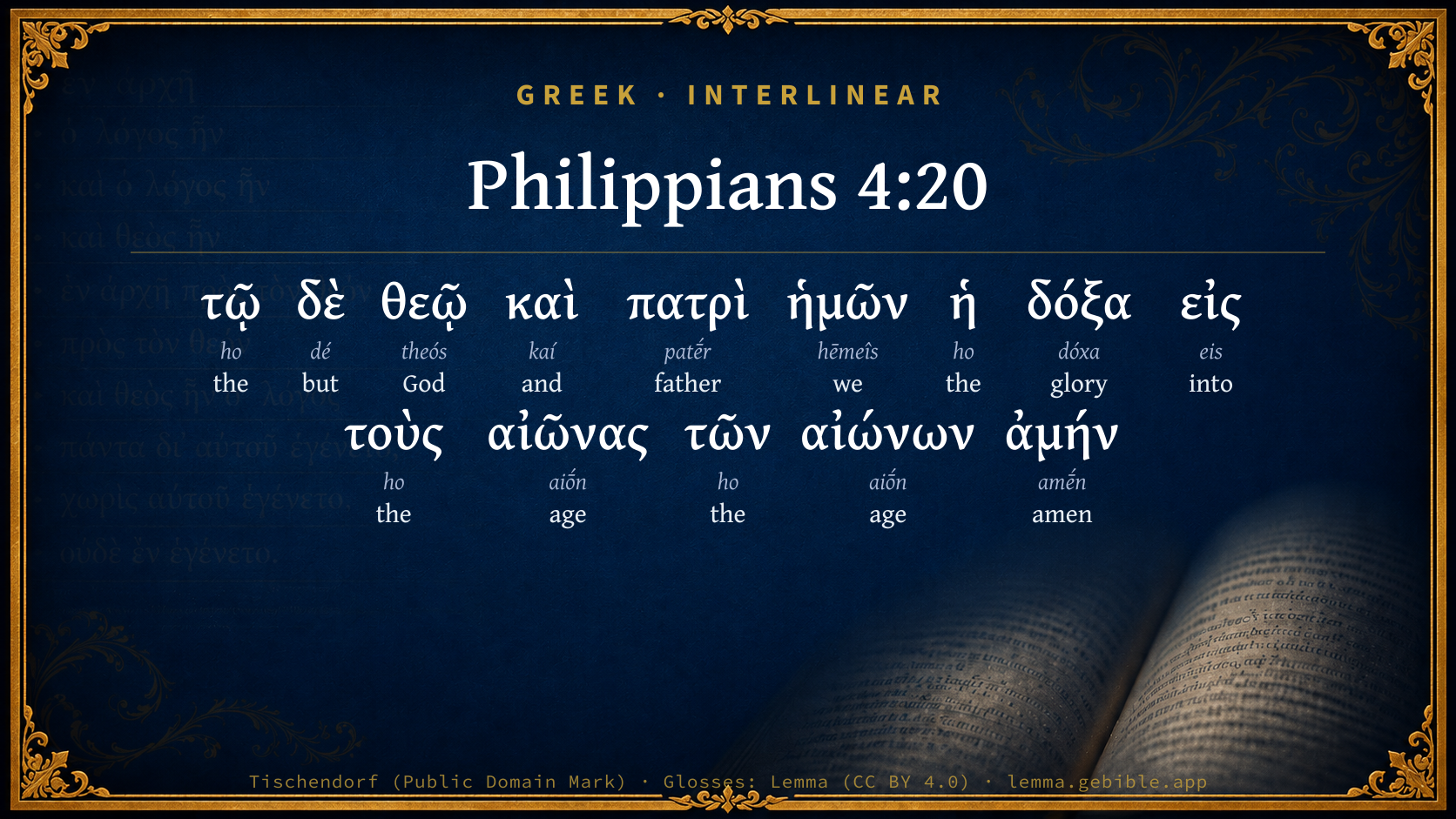
Greek (Tischendorf 8th ed.) Philippians 4:20 appears in the Greek New Testament. The text above is from the Tischendorf 8th edition. Each word links to its Strong’s number and a concise gloss. Click any word for its full Thayer’s Greek Lexicon entry.
Download image
Cite this verse

Philippians 4:20 (World English Bible). Public Domain. Lemma interlinear Bible study tool, https://lemma.gebible.app/v/philippians/4/20.

Show BibTeX & RIS
BibTeX
RIS
English Translation
Now to our God and Father be the glory forever and ever! Amen.
World English Bible · Public Domain
Download a study sheet

One document with this verse’s original text, its word-by-word gloss line, the meaning frame, cross-references with their text, attributed commentary, and full source and license credits — printable, and it pastes into notes with its structure intact.

This verse Autodidact and up

Study sheet (.html) Plain text (.txt)

A passage Seminary Student

Up to 50 verses in one chapter. A passage sheet keeps up to 6 commentary sources and 12 cross-references per verse, in the order this page ranks them, and says so on the sheet whenever that leaves anything out. Ask for a single verse and you get the Autodidact verse sheet above.

Everything on this page stays free to read, with no account — the sheet is a download of what is already on screen, not access to it.

Want to remove ads? Support Godless Engineer
Compare translations 3

The same verse in 3 English versions, stacked beneath the original-language interlinear above. Click any original word for its lexicon entry.

Each is an independent rendering of the whole verse — the interlinear is not word-aligned to these translations.

Highlighted words mark where these versions differ — a whole-verse word diff, not a word-by-word alignment.

  • World English Bible Public Domain
    Now to our God and Father be the glory forever and ever! Amen.
  • King James Version Public Domain
    Now unto God and our Father be glory for ever and ever. Amen.
  • unfoldingWord Literal Text CC BY-SA 4.0
    Now to our God and Father the glory forever ever. Amen.

unfoldingWord Literal Text — © unfoldingWord, licensed CC BY-SA 4.0. Word-aligned USFM3 via Door43 (git.door43.org/unfoldingWord/en_ult).

Versions to compare (up to 4)

3 of 4 selected

Show all 19 translations

Every available English version of this verse, each an independent rendering of the whole verse.

  • World English Bible Public Domain
    Now to our God and Father be the glory forever and ever! Amen.
  • Berean Standard Bible Public Domain
    To our God and Father be glory forever and ever. Amen.
  • Majority Standard Bible Public Domain
    To our God and Father be glory forever and ever. Amen.
  • King James Version Public Domain
    Now unto God and our Father be glory for ever and ever. Amen.
  • American Standard Version (1901) Public Domain
    Now unto our God and Father `be' the glory for ever and ever. Amen.
  • Revised Version (1885) Public Domain
    Now unto our God and Father be the glory for ever and ever. Amen.
  • Geneva Bible (1599) Public Domain
    Vnto God euen our Father be praise for euermore, Amen.
  • Douay-Rheims (1899) Public Domain
    Now to God and our Father be glory world without end. Amen.
  • Young's Literal Translation Public Domain
    and to God, even our Father, `is' the glory -- to the ages of the ages. Amen.
  • Literal Standard Version CC BY-SA 4.0
    and to God, even our Father, [is] the glory through the ages of the ages. Amen.
  • Unlocked Literal Bible CC BY-SA 4.0
    Now to our God and Father be the glory forever and ever. Amen.
  • unfoldingWord Literal Text CC BY-SA 4.0
    Now to our God and Father the glory forever ever. Amen.
  • Darby Bible Public Domain
    But to our God and Father [be] glory to the ages of ages. Amen.
  • World Messianic Bible Public Domain
    Now to our God and Father be the glory forever and ever! Amen.
  • Webster's Bible Public Domain
    Now to God and our Father be glory for ever and ever. Amen.
  • Free Bible Version CC BY-SA 4.0
    Glory be to God the Father, forever and ever. Amen.
  • Bible in Basic English Public Domain
    Now to God our Father be glory for ever and ever. So be it.
  • Text-Critical English NT CC BY 4.0
    Glory be to our God and Father forever and ever! Amen.
  • Tyndale New Testament (1534) Public Domain
    Vnto God and oure father be prayse for ever more. Amen.

Literal Standard Version (2020), Covenant Press — licensed CC BY-SA 4.0. Text via the HelloAO Bible API (eBible.org). Unlocked Literal Bible (unfoldingWord) — licensed CC BY-SA 4.0. Text via the HelloAO Bible API (eBible.org). unfoldingWord Literal Text — © unfoldingWord, licensed CC BY-SA 4.0. Word-aligned USFM3 via Door43 (git.door43.org/unfoldingWord/en_ult). Free Bible Version, Dr. Jonathan Gallagher — licensed CC BY-SA 4.0. Text via the HelloAO Bible API (eBible.org).

Word by word

More ways to search: Search by grammar → Find every occurrence → Compare this word →

Practice this passage: Drill this verse → Learn its vocabulary →

About this verse

These counts appear in no published source. They are computed here, from the morphology-tagged text and Lemma’s own curated glosses. What Lemma adds →

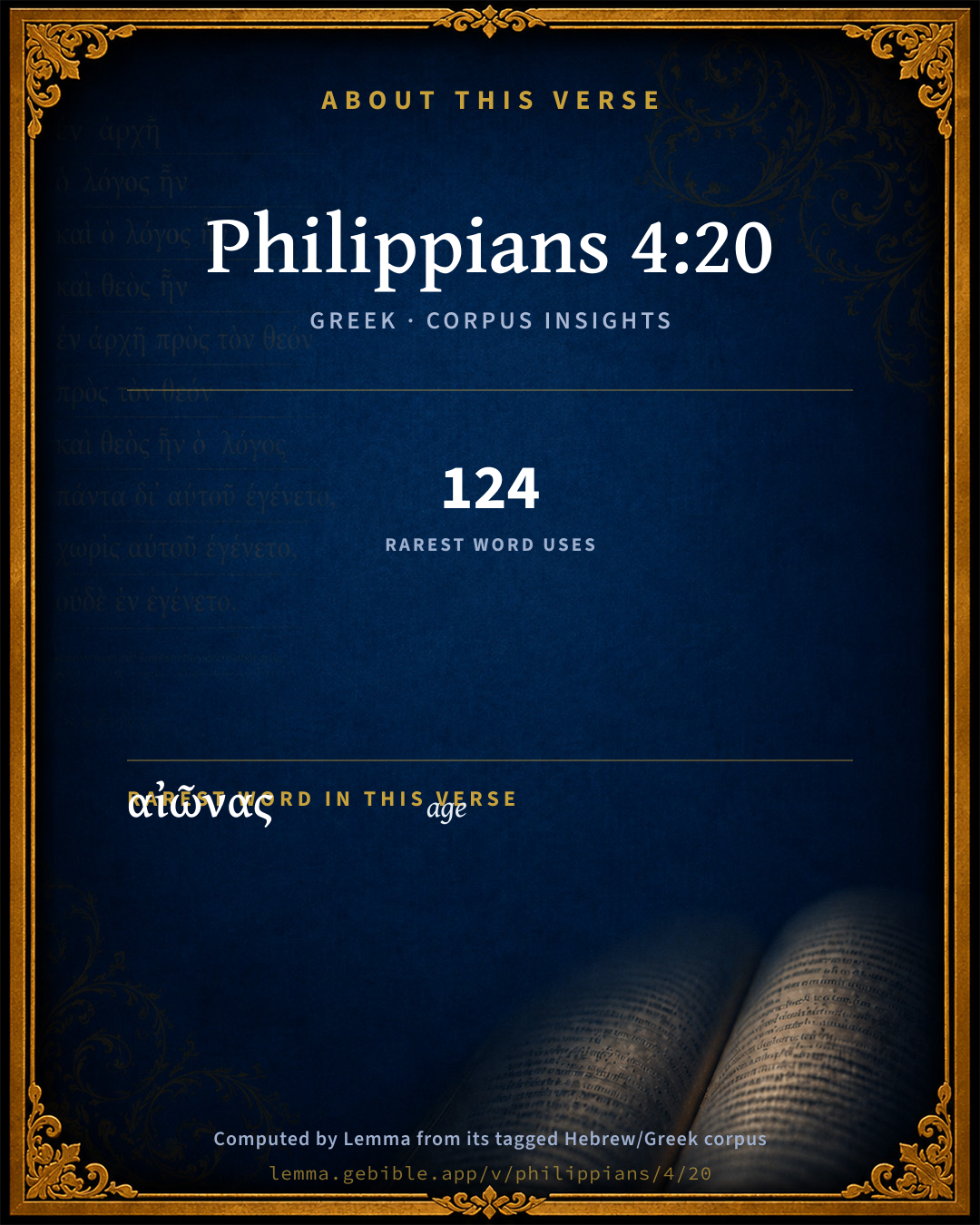
14
words
10
distinct lemmas
Pauline Epistles
section

Repetition

Words recur within this verse:

  • αἰῶνας age G165 ×2
  • τῷ the G3588 ×4

Cross-references

19

Topical passages linked to Philippians 4:20 in the Treasury of Scripture Knowledge — connected by theme and wording, ordered by reader-vote popularity; previews shown in the World English Bible.

  • Romans 11:36 For of him, and through him, and to him, are all things. To him be the glory for ever! Amen.
  • Psalms 115:1 Not to us, Yahweh, not to us, But to your name give glory, For your loving kindness, and for your truth's sake.
  • Revelation 14:7 He said with a loud voice, "Fear the Lord, and give him glory; for the hour of his judgment has come. Worship him who made the heaven, the earth, the sea, and the springs of waters!"
  • Revelation 7:12 saying, "Amen! Blessing, glory, wisdom, thanksgiving, honor, power, and might, be to our God forever and ever! Amen."
  • Psalms 72:19 Blessed be his glorious name forever! Let the whole earth be filled with his glory! Amen and amen.
  • Galatians 1:4–5 who gave himself for our sins, that he might deliver us out of this present evil age, according to the will of our God and Father--
  • Ephesians 3:21 to him be the glory in the assembly and in Christ Jesus to all generations forever and ever. Amen.
  • Philippians 1:11 being filled with the fruits of righteousness, which are through Jesus Christ, to the glory and praise of God.
  • Jude 1:25 to God our Savior, who alone is wise, be glory and majesty, dominion and power, both now and forever. Amen.
  • Revelation 1:6 and he made us to be a Kingdom, priests to his God and Father; to him be the glory and the dominion forever and ever. Amen.
  • Revelation 4:9–11 When the living creatures give glory, honor, and thanks to him who sits on the throne, to him who lives forever and ever,
  • Revelation 5:12 saying with a loud voice, "Worthy is the Lamb who has been killed to receive the power, wealth, wisdom, strength, honor, glory, and blessing!"
  • Matthew 6:9 Pray like this: 'Our Father in heaven, may your name be kept holy.
  • Matthew 6:12–13 Forgive us our debts, as we also forgive our debtors.
  • Matthew 28:20 teaching them to observe all things that I commanded you. Behold, I am with you always, even to the end of the age." Amen.
  • Romans 16:27
  • Philippians 4:23 The grace of the Lord Jesus Christ be with you all. Amen.
  • 1 Timothy 1:17 Now to the King eternal, immortal, invisible, to God who alone is wise, be honor and glory forever and ever. Amen.
  • Revelation 11:13 In that day there was a great earthquake, and a tenth of the city fell. Seven thousand people were killed in the earthquake, and the rest were terrified, and gave glory to the God of heaven.

Cross-references courtesy of OpenBible.info (CC BY 4.0).

Commentary

Notes on Philippians 4:20 from classic Christian and Jewish commentators (each source and its license shown beneath its notes). The classic Christian expositions comment on the surrounding passage and are grouped to its opening verse, so a note may address several verses; the Jewish commentaries on the Tanakh (Rashi and others) are per-verse, so they appear only where the commentator wrote on this verse.

Lemma curates 59 commentaries, every one of them public domain or Creative Commons licensed, each selected and text-cleaned for this edition rather than reprinted as found. About our sources →

Matthew Henry's Commentary

The apostle concludes the epistle in these verses,

1. With praises to God: Now unto God and our Father be glory for ever and ever, Amen, Phi 4:20. Observe, (1.) God is to be considered by us as our Father: Now unto God and our Father. It is a great condescension and favour in God to own the relation of Father to sinners, and allow us to say to him, Our Father; and it is a title peculiar to the gospel dispensation. It is also a great privilege and encouragement to us to consider him as our Father, as one so nearly related and who bears so tender an affection towards us. We should look upon God, under all our weaknesses and fears, not as a tyrant or an enemy, but as a Father, who is disposed to pity us and help us. (2.) We must ascribe glory to God as a Father, the glory of his own excellence and of all his mercy unto us. We must thankfully own the receipt of all from him, and give the praise of all to him. And our praise must be constant and perpetual; it must be glory for ever and ever.

2. With salutations to his friends at Philippi: "Salute every saint in Christ Jesus (Phi 4:21); give my hearty love to all the Christians in your parts." He desires remembrances not only to the bishops and deacons, and the church in general, but to every particular saint. Paul had a kind affection to all good Christians.

3. He sends salutations from those who were at Rome: "The brethren who are with me salute you; the ministers, and all the saints here, send their affectionate remembrances to you. Chiefly those who are of Caesar's household; the Christian converts who belonged to the emperor's court." Observe, (1.) There were saints in Caesar's household. Though Paul was imprisoned at Rome, for preaching the gospel, by the emperor's command, yet there were some Christians in his own family. The gospel early obtained among some of the rich and great. Perhaps the apostle fared the better, and received some favour, by means of his friends at court. (2.) Chiefly those, etc. Observe, They, being bred at court, were more complaisant than the rest. See what an ornament to religion sanctified civility is.

4. The apostolical benediction, as usual: "The grace of our Lord Jesus Christ be with you all, Amen. The free favour and good will of Christ be your portion and happiness."

Matthew Henry's Commentary on the Whole Bible (1708–1710) — public domain (CC PDM 1.0). Text via the HelloAO Bible API.

The Biblical Illustrator

Joseph S. Exell

Php_4:20-23

Now unto God and our Father

The spirit in which to close the year

I.

The doxology.

1. We are to give glory to God as to our heavenly Father. We are not to regard Him as a tyrant, nor as a governor merely, but as a kind and loving Father.

2. We are to give Him the glory, that is, the honour and praise, of all His mercies to us.

II. Benediction. Grace is the love of God as displayed in Christ, whereby we receive all those unmerited favours which are included in the gospel plan of salvation.

1. The beginning of religion is grace.

2. Its progress in the soul depends upon grace. (Homiletic Monthly.)

Parting thoughts should embrace

I. Thanks to God.

II. Love to the brethren.

III. Prayer for grace. (J. Lyth, D. D.)

Observe--

I. The glory of God--is absolute--full of grace--eternal.

II. Its acknowledgment--is due from all--in truth--forever. (J. Lyth, D. D.)

Glory is due

I. To God--as supreme--as our Father.

II. From all--in heaven--and on earth.

III. Forever--in time--and eternity.

IV. In sincerity and truth--amen. (J. Lyth, D. D.)

The Biblical Illustrator, edited by Joseph S. Exell (c. 1880s–1900s) — public domain. Text from a community e-Sword module.

Joseph Benson's Commentary

Php 4:20-22. Now unto God and, rather, even our Father — Or, To our God and Father, as τω Θεω και πατρι ημων properly signifies, be glory for ever — Which is justly due, and shall certainly be given to him by those of the angelic host who never fell, and by those of mankind who have been or shall be recovered from their fall. The brethren who are with me — My dear fellow-labourers, with whom I daily converse; greet you — Sincerely wish you peace and prosperity. These are supposed to be those whom he mentions at the close of his epistle to the Colossians and to Philemon. All the other saints — Here at Rome; salute you, chiefly they of Cesar’s household — See note on Php 1:13. It is uncertain whether the apostle meant some of the members of Cesar’s family, or his household servants, or the officers of his court, or his guards. Here Beza remarks, “What was this but that God reigned in the midst of hell?” The salutation from the brethren, in the emperor’s family, must have been a great consolation to the Philippians. For when they heard that the gospel had got footing in the palace, they would naturally presage the further progress of it in Rome. And the respect which persons, such as the Christians in Cesar’s house, here expressed for the Philippians, in sending their salutations to them, must have filled them with joy. And it seems very probable, as Macknight observes, though the apostle has not mentioned it in any of his letters, that, not long after this epistle was written, he obtained a fair hearing, and an honourable release, through the good offices of the Christians in Nero’s family, as well as on account of the justice of his cause.

Joseph Benson's Commentary on the Old and New Testaments (1811–1818) — public domain. Text from a community e-Sword module.

Whedon's Commentary on the Bible

Daniel D. Whedon

3. Doxology, Php_4:20.

20. Now unto God—The thought is too big and glorious for a mere statement, and the apostle’s full soul bursts out into doxology.

Daniel D. Whedon (gen. ed.), Commentary on the Old and New Testaments (1874–1909) — public domain. Text from a community e-Sword module.

The Preacher's Complete Homiletical Commentary

Joseph S. Exell (gen. ed.)

CRITICAL AND EXPLANATORY NOTES

Php_4:22. The saints … of Cæsar’s household.—This expression does not oblige us to think that any relatives of Cæsar had embraced Christianity. It comprises all who in any way were connected with the imperial service.

Php_4:23. Be with you all.—The oldest MSS. read, “Be with your spirit.”

MAIN HOMILETICS OF THE PARAGRAPH.—Php_4:20-23

Last Words.

I. A glowing ascription of praise to the divine Giver of every blessing.—“Now unto God and our Father be glory for ever and ever. Amen” (Php_4:20). To God, even our Father, the kind and liberal Supplier of every want to every child, be eternal glory ascribed. The ascription of praise is the language of spiritual instinct which cannot be repressed. Let the child realise its relation to the Father who feeds it, clothes it, and keeps it in life, who enlightens and guides it, pardons and purifies it, strengthens and upholds it, and all this in Christ Jesus, and it cannot but in its glowing consciousness cry out, “Now to God and our Father be the glory for ever.” The “Amen” is a fitting conclusion. As the lips shut themselves, the heart surveys again the facts and the grounds of praise, and adds, “So be it” (Eadie).

II. Christian salutations.—“Salute every saint in Christ Jesus. All the saints salute you, chiefly they that are of Cæsar’s household” (Php_4:21-22). Salutations are tokens of personal interest and living fellowship which should not be lightly esteemed. The apostolic salutations teach that the Christian religion does not make men unfriendly and stubborn, but courteous and friendly (Lange). The reference to the saints in Cæsar’s household may mean either kinsfolk of Nero or servants in the palace. It is improbable that so many near relatives of the emperor should have yielded themselves to Christ as to be designated by this phrase, and it is not likely to suppose that a combination of these two classes would be grouped under the one head. In all likelihood the reference is to servants holding more or less important positions in the imperial household—some, no doubt, slaves; and it is a suggestive testimony to the unwearied diligence and influence of the apostle in using every opportunity to make known the saving grace of the gospel. To explain to any the reason for his imprisonment was an occasion for preaching Christ. “O Rome, Rome!” exclaims Starke, “how greatly hast thou changed! Formerly thou hadst true saints even in the household of a pagan and tyrannical emperor; but now hast thou false saints, especially in and around the so-called chair of Peter and at the court of his supposed successor.”

III. Final benediction.—“The grace of our Lord Jesus Christ be with you all. Amen” (Php_4:23). The oldest MSS. read, “Be with your spirit.” It is important that the grace of God should be not only around us, but with us and in us. The benediction is a prayer that the divine favour may be conferred upon them, enriching the noblest elements of their nature with choicest blessings, making them to grow in spiritual wisdom, beauty, and felicity, that grace may ultimately merge into glory.

Lessons.—

1. Praise should be offered to God in all things.

2. The Christian spirit is full of kindly courtesy.

3. It is a comprehensive prayer that invokes the blessing of divine grace.

GERM NOTES ON THE VERSES

Php_4:20. Eternal Praise should be offered unto God—

I. For mercies enjoyed in the past.

II. For mercies which as our Father He holds for us and bestows on us in the present.

III. That the glory of His character may become increasingly conspicuous in His works of creation, providence, and grace.

Php_4:21-22. Christian Courtesy—

I. Elevates and sanctifies the amenities of social life.

II. Awakens and strengthens mutual sympathy and help in the Christian life.

III. Should be exercised by Christians of all ranks and conditions.

Php_4:23. The Grace of our Lord Jesus Christ—

I. Is the sum of all we can need for ourselves or desire for others.

II. Is a revelation of His own character and of His regard for us.

III. May be sought with the utmost confidence and enjoyed in ever-increasing measure.

The Preacher's Complete Homiletical Commentary (gen. ed. Joseph S. Exell; Funk & Wagnalls, c. 1892) — public domain (pre-1929). A full-Bible homiletical/sermon-outline anthology covering 65 of 66 books (2 John is absent from the source module). Text from a community e-Sword module.

MacLaren's Expositions of Holy Scripture

Alexander MacLaren

Philippians

FAREWELL WORDS

Php 4:20-23 {R.V.}.

These closing words fall into three unconnected parts, a doxology, greetings, and a benediction. As in all his letters, the Apostle follows the natural instinct of making his last words loving words. Even when he had to administer a bitter draught, the last drops in the cup were sweetened, and to the Philippians whom he loved so well, and in whose loyal love he confided so utterly, his parting was tender as an embrace. Taking together the three elements of this farewell, they present to us a soul filled with desire for the glory of God and with loving yearning for all His brethren. We shall best deal with them by simply taking them in order.

I. The Doxology.

It is possibly evoked by the immediately preceding thought of God’s infinite supply of all human need ‘according to his riches in glory ‘; but the glory which is so richly stored in Christ, and is the full storehouse from which our emptiness is to be filled, is not the same as the glory here ascribed to Him. The former is the sum of His divine perfections, the light of His own infinite being: the latter is the praise rendered to Him when we know Him for what He is, and exalt Him in our thankful thoughts and adoration. As this doxology is the last word of this whole letter, we may say that it gathers into one all that precedes it. Our ascription of glory to God is the highest object of all His self-manifestation, and should be the end of all our contemplations of Him and of His acts. The faith that God does ‘all for His glory’ may be and often has been so interpreted as to make his character repellent and hideous, but in reality it is another way of saying that God is love. He desires that all men should be gladdened and elevated by knowing Him as He is. His glory is to give. That to which He has committed the charge of interpreting Him to our dim eyes and disordered natures is not the attributes of sovereign power, or creative wisdom, or administrative providence, or any other elements which men lay hold of in their conceptions of deity. When men make gods they make them in their own image: when God reveals God, the emphasis is put on an altogether different aspect of His nature. It is His self-communicating and paternal love revealed to the heart of a son which will kindle the highest aspiration of praise, and that fatherhood is not found in the fact that God has made us, but in the higher fact that He has redeemed us and has sent the spirit of His Son into our hearts. The doxology of our text is a distinctively Christian doxology which Paul conceives can only be uttered by lips which have learned to say ‘Abba, Father,’ ‘and have received the adoption of sons’ through the eternal Son.

Mark, too, that this glad ascription of glory to God is conceived of as sounded forth for ever and ever, or literally through ‘ages and ages, as long as successive epochs shall unfold.’ It is not as if the revelation of the divine character were in the past, and the light of it continued to touch stony lips to music, but it fills in continuous forthcoming every age, and in every age men receive the fulness of God, and in every age redeemed hearts bring back their tribute of praise and love to Him.

II. The Greetings.

The Apostle’s habit of closing all his letters with kindly messages is, of course, more than a habit. It is the natural instinct to which all true hearts have a hundred times yielded. It is remarkable that in this letter there are no individual greetings, but that instead of such there is the emphatic greeting to every saint in Christ Jesus. He will not single out any where all are so near His heart, and He will have no jealousies to be fed by His selection of more favoured persons. It may be too, that the omission of individual messages is partly occasioned by some incipient tendencies to alienation and faction of which we see some traces in His earnest exhortations to stand fast in one spirit, and to be of the same mind, having the same love, and being of one accord, as well as in his exhortation to two Philippian women to be of the same mind in the Lord. The all-embracing word at parting singularly links the end of the letter with its beginning, where we find a remarkable sequence of similar allusions to ‘all’ the Philippian Christians. He has them all in His heart; they are all partakers with Him of grace; He longs after them all.

The designation by which Paul describes the recipients of his greeting carries in it a summons as well as a promise. They are saints, and they are so as being ‘in Christ.’ That name is often used as a clumsy sarcasm, but it goes to the very root of Christian character. The central idea contained in it is that of consecration to God, and that which is often taken to be its whole meaning is but a secondary one, a result of that consecration. The true basis of all real purity of conduct lies in devotion of heart and life to God, and for want of discerning the connection of these two elements the world’s ethics fail in theory and in practice. A ‘saint’ is not a faultless monster, and the persistence of failures and inconsistencies, whilst affording only too sad an occasion for penitence and struggle, afford no occasion for a man’s shrinking from taking to himself the humble claim to be a saint. Both the elements of consecration to God and of real and progressive, though never complete perfection of personal character, are realised only in Christ; in and only in fellowship with Him whose life was unbroken fellowship with the Father, and whose will was completely accordant with the Father’s, do we rise to the height of belonging to God. And only in Him who could challenge a world to convict Him of sin shall we make even a beginning of personal righteousness. If we are in Christ we should be saints to-day however imperfect our holiness, and shall be ‘as the angels of God’ in the day that is coming--nay, rather as the Lord of the Angels, ‘not having spot or blemish or any such thing.’

The New Testament has other names for believers, each of which expresses some great truth in regard to them; for example, the earliest name by which they knew themselves was the simple one of ‘brethren,’ which spoke of their common relation to a Father and pledged them to the sweetness and blessedness of a family. The sarcastic wits of Antioch called them Christians as seeing nothing in them other than what they had many a time seen in the adherents of some founder of a school or a party. They called themselves disciples or believers, revealing by both names their humble attitude and their Lord’s authority, and by the latter disclosing to seeing eyes the central bond which bound them to Him. But the name of Saint declares something more than these in that it speaks of their relation to God, the fulfilment of the Old Testament ideal, and carries in it a prophecy of personal character.

The sharers in Paul’s salutation call for some notice. We do not know who ‘the brethren that are with me’ were. We might have supposed from Paul’s pathetic words that he had no man like-minded with him, that the faithful band whom we find named in the other epistles of the captivity were dispersed. But though there were none ‘like-minded who will care truly for your state,’ there were some recognised as brethren who were closely associated with him, and who, though they had no such warm interest in the Philippians as he had, still had a real affection for them, drawn no doubt from him. Distinct from these was the whole body of the Roman Christians, from the mention of whom we may gather that his imprisonment did not prevent his intercourse with them. Again, distinct from these, though a part of them, were the saints of Cæsar’s household. He had apparently special opportunities for intercourse with them, and probably his imprisonment brought him through the prætorian guards into association with them, as Cæsar’s household included all the servants and retainers of Nero.

May we not see in this union of members of the most alien races a striking illustration of the new bond which the Gospel had woven among men? There was a Jew standing in the midst between Macedonian Greeks and proud Roman citizens, including members of that usually most heartless and arrogant of all classes, the lackeys of a profligate court, and they are all clasping one another’s hands in true brotherly love. Society was falling to pieces. We know the tragic spectacle that the empire presented then. Amidst universal decay of all that held men together, here was a new uniting principle; everywhere else dissolution was at work; here was again crystallising. A flower was opening its petals though it grew on a dunghill. What was it that drew slaves and patricians, the Pharisee of Tarsus, rude Lycaonians, the ‘barbarous’ people of Melita, the Areopagite of Athens, the citizens of Rome into one loving family? How came Lydia and her slave girl, Onesimus and his master, the prætorian guard and his prisoner, the courtier in Nero’s golden house and the jailer at Philippi into one great fellowship of love? They were all one in Christ Jesus.

And what lessons the saints in Cæsar’s household may teach us! Think of the abyss of lust and murder there, of the Emperor by turns a buffoon, a sensualist, and a murderer. A strange place to find saints in that sty of filth! Let no man say that it is impossible for a pure life to be lived in any circumstances, or try to bribe his conscience by insisting on the difficulties of his environment. It may be our duty to stand at our post however foul may be our surroundings and however uncongenial our company, and if we are sure that He has set us there, we may be sure that He is with us there, and that there we can live the life and witness to His name.

III. The Parting Benediction.

The form of the benediction seems to be more correctly given in the Revised Version, which reads ‘with your spirit’ instead of ‘with you all.’ That form reappears in Galatians and in Philemon. What Paul especially desires of his favourite church is that they may possess ‘the grace.’ Grace is love exercising itself to inferiors, and to those who deserve something sadder and darker. The gifts of that one grace are manifold. They comprise all blessings that man can need or receive. This angel comes with her hands and her lap full of good. Her name is shorthand for all that God can bestow or man can ask or think.

And it needs all the names by which Christ is known among men to describe the encyclopædiacal Person who can bestow the encyclopædiacal gift. Here we have them all gathered, as it were, into one great diadem, set on His head where once the crown of thorns was twined. He is Lord, the name which implies at least absolute authority, and is most probably the New Testament translation of the Old Testament name of Jehovah. He is our Lord as supreme over us, and wonderful as it is, as belonging to us. He holds the keys of the storehouse of grace. The river of the water of life flows where He turns it on. He is Jesus--the personal name which He bore in the days of His flesh, and by which men who knew Him only as one of themselves called Him. It is the token of His brotherhood and the guarantee of the sympathy which will ever bestow ‘grace for grace.’ He is the Christ, the Messiah, the name which points back to the Old Testament ideas and declares His office, realising all the rapturous anticipations of prophets, and the longings of psalmists, and more than fulfilling them all by giving Himself to men.

That great gift is to be the companion of every spirit which looks to that Jesus in the reality of His humanity, in the greatness of His office, in the loftiness of His divinity, and finds in each of His names an anchor for its faith and an authoritative claim for its obedience.

Such a wish as this benediction is the truest expression of human friendship; it is the highest desire any of us can form for ourselves or for those dearest to us. Do we keep it clear before us in our intercourse with them so that the end of that intercourse will naturally be such a prayer?

Our human love has its limitations. We can but wish for others the grace which Christ can give, but neither our wishes nor His giving can make the grace ours unless for ourselves we take the great gift that is freely given to us of God. It is no accident that all his letters close thus. This benediction is the last word of God’s revelation to man, the brightness in the clear west, the last strain of the great oratorio. The last word or last book of Scripture is ‘the grace of our Lord Jesus Christ be with you all.’ Let us take up the solemn Amen in our lips and in our hearts.

Alexander MacLaren, Expositions of Holy Scripture (1904–1910) — public domain. Text from a community e-Sword module.

Tyndale Open Study Notes

Tyndale Open Resources

4:20 Having reflected on God’s glorious blessings, Paul concludes appropriately with an expression of praise to God.

Tyndale Open Study Notes — © Tyndale Open Resources, licensed CC BY-SA 4.0. Text via the HelloAO Bible API.

Bengel's Gnomon

Johann Albrecht Bengel

Php 4:20. Ἡ δόξα, glory) in return for His gift, 2Co 9:15. The doxology flows from the joy that pervades the whole epistle.

Bengel's Gnomon of the New Testament — English translation (T&T Clark, Edinburgh, 1860) — public domain. Text from a community e-Sword module.

Meyer's Critical & Exegetical Commentary

Heinrich August Wilhelm Meyer

Php_4:20. The conception of the superabundant salvation, which Paul has just promised from God, forces from his heart a doxology.

πατρί] through Christ, in virtue of our υἱοθεσία, Rom_8:15; Gal_4:5. As to τ. Θεῷ κ. πατρὶ ἡμ. comp. on Gal_1:5.

ἡ δόξα] sc. εἴη, the befitting glory. See on Eph_3:21; Rom_11:36; Rom_16:27, et al.

εἰς τοὺς αἰῶν. τῶν αἰών.] Gal_1:5; 1Ti_1:17; 2Ti_4:18; Heb_13:21; 1Pe_4:11; 1Pe_5:11, and frequently in Rev. As to the analysis of the expression, see on Eph_3:21.

Meyer — Critical and Exegetical Commentary on the New Testament — English translation by Peter Christie, edited by Frederick Crombie (T&T Clark, 1880) — public domain. Text from a community e-Sword module.

Expositor's Greek Testament

ed. W. Robertson Nicoll

Phi 4:20 . Doxology. Doxologia fluit ex gaudio totius epistolae (Beng.). On the phrase τοὺς αἰῶνας τ . αἰώνων see the excellent note in Grimm-Thayer ad loc.

The Expositor's Greek Testament, edited by W. Robertson Nicoll (1897–1910) — public domain. Text from a community e-Sword module.

Jamieson, Fausset & Brown

Robert Jamieson, A. R. Fausset & David Brown

God and our Father--Translate, "Unto our God and Father."

be glory--rather as the Greek, "be the glory." Not to us, but to Him be "the glory" alike of your gift, and of His gracious recompense to you.

Jamieson, Fausset & Brown — Commentary Critical and Explanatory on the Whole Bible (1871) — public domain (CC PDM 1.0). Text via the HelloAO Bible API.

Adam Clarke's Commentary

Verse 20. Now unto God and our Father] God is our Father in Christ Jesus; and such pity as a father hath for his children, such has the Lord for them that fear him; as a father is concerned for the support and life of his children, so is God concerned for you. A father may be poor, and unable to help his most beloved children; God, your Father, is infinite in his riches of his grace and glory, and out of his abundance we have all received, and grace for grace. Therefore, to God our Father, be glory for ever and ever!

Adam Clarke's Commentary on the Bible (1810–1826) — public domain. Text from a community e-Sword/MySword module.

John Calvin's Commentaries

20 Now to our God and Father This may be taken as a general thanksgiving, by which he closes the epistle; or it may be viewed as bearing more particularly upon the last clause in reference to the liberality shewn to Paul. For in respect of the assistance which the Philippians had afforded him, it became him to reckon himself indebted to them for it in such a manner as to acknowledge, that this aid had been afforded to them by the mercy of God.

John Calvin's Commentaries (1540-1563) — public domain. Text from the Calvin Translation Society English edition (1840s-50s) via the Christian Classics Ethereal Library (ccel.org). Calvin's coverage is partial (roughly two-thirds of the Bible); uncommented books and verses are honest gaps, never fabricated. The 19th-century editor's footnotes and remarks are omitted so the notes are faithfully Calvin's own voice.

Ellicott's Commentary for English Readers

(20) Now unto God and our Father . . .—The doxology of this verse seems suggested by the very use of “glory” in the previous verse. “Glory” may be derivatively the privilege of man; but “the glory” (for the original has the article here)—the essential and incommunicable glory—must be ascribed to God alone. Whether we supply here the word “is” or “be” matters not. His it is; to Him let it be ascribed. Such doxologies are common with St. Paul (see Rom_16:27; Gal_1:5; Eph_3:21; 1Ti_1:17; 2Ti_4:18); always with the addition of “for ever and ever,” or literally, for the ages of the ages, throughout every age till time shall be no more; always in close connection with some declaration, not so much of the majesty, as of the wisdom, and still more the goodness, of the Father.

Php_4:21-23 contain the salutation and blessing. The salutation is very brief, as compared, for example, with the corresponding passage in the Colossian Epistle (Php_4:10-15), naming none, either of those saluted or those joining with St. Paul in the salutation. The omission in the latter case may perhaps be accounted for by the words above (Php_2:20-21), in which, with the single exception of Timotheus, St. Paul declares dissatisfaction with those near him, because “all seek their own, and not the things which are Jesus Christ’s.

A Bible Commentary for English Readers, edited by Charles John Ellicott (1878–1897) — public domain. Text from a community e-Sword module.

The Cambridge Bible for Schools and Colleges

gen. ed. J. J. S. Perowne

20. God and our Father] Better, our God and Father; the ultimate Source of all faith, love, and hope in the brethren and members of His Son.—“Our”:—“It is no longer [‘my’], for the reference is now not to himself as distinguished from the Philippians, but as united to them” (Lightfoot).

glory] Lit. and better, the glory; the adoring praise due in view of this their act of love, and of the certainty of a full supply of all their need.

for ever and ever] Lit., “to the ages of the ages.” The A.V. (and R.V.) are a true paraphrase. On the word aiôn (age) see notes in this Series, on Rom_16:25; Eph_1:21. The idea conveyed by the phrase here is of circles of duration consisting of, embracing, other circles ad infinitum.

Amen] Probably, but not quite certainly, to be retained in the text. The word is properly a Hebrew adverb (“surely”), repeatedly used as here in O. T. See e.g. Deu_27:15; Psa_72:19; Jer_11:5 (marg. A. V.).

The Cambridge Bible for Schools and Colleges (gen. ed. J. J. S. Perowne; Cambridge University Press, 1878–1918) — public domain. Text from a community e-Sword module.

John Gill's Exposition

Now unto God and our Father,.... To God, who is our Father in Christ,

be glory for ever and ever, Amen; for all the grace he gives now, and for all the glory and happiness expected hereafter; for the supply of every want both temporal and spiritual; seeing every good gift comes from him, and is to be ascribed to his free grace and favour, and not to any deserts of men: and particularly he may mean for what they had sent him, and he had received from them.

John Gill's Exposition of the Whole Bible (1746–1763) — public domain (CC PDM 1.0). Text via the HelloAO Bible API.

Trapp's Complete Commentary

John Trapp

20 Now unto God and our Father be glory for ever and ever. Amen.

Ver. 20. Now unto God] Paul cannot mention God’s bounty without a doxology.

John Trapp, A Commentary or Exposition upon All the Books of the Old and New Testament (1647–1656) — public domain. Text from a community e-Sword module.

Albert Barnes' Notes on the Bible

Now unto God and our Father, ... - see the notes at Rom 16:27. It was common for Paul to address such an ascription of praise to God, at the close of his epistles.

Albert Barnes' Notes on the Bible (1834–1885) — public domain. Text from a community e-Sword/MySword module.

Matthew Poole's English Annotations

From thanking of the Philippians, the holy man passeth to a giving of thanks unto God, the first cause, that they might not be elated. He had my God, Phi 4:19; now, our Father; not only adoring him as Maker of all, but as Father of all the faithful as well as of Paul, being born of him in Christ, Joh 1:12,13, through whom he takes a fatherly care of them, Mat 6:32. Christ saith, my Father, Joh 20:17, as being his only Son by eternal generation; and he allows believers to say our Father, as being his children by adoption. Unto whom they are obliged to ascribe praise, and always to give thanks in the name of our Lord Jesus Christ, Eph 5:20. And this indeed hath been their practice, which should be ours, Rom 1:25; 9:5; 11:33,36; 16:25,27; Eph 3:21; 1Ti 1:17; 1Pe 4:11; 5:11; 2Pe 3:18; Jud 1:25; Rev 1:6, &c. It intimates, their hearts being full with the glory of God, their pens and months were enlarged accordingly, exciting others to the like doxologies. To almost all which in the forecited places (as here)

ever and ever is added, connoting absolute eternity, and joining past, present, and future ages together. This form of

Amen, affixed in the close, doth signify how his heart did give, and rejoiced to give, all blessedness to our Father in Christ, as rejoicing that he is so blessed a God.

Matthew Poole's English Annotations on the Holy Bible (1683–1685) — public domain. Text from a community e-Sword/MySword module.

The Pulpit Commentary

Now unto God and our Father be glory for ever and ever. Amen; rather, with R.V, unto our God and Father be the glory. The thought of God"s present mercies, and the hope of glory to come mentioned in the last verse, suggest the doxology. Observe, St. Paul says, "our God and Father" here. He said, "my God" in ver. 19, where he was speaking of the reward which God would give for kindness shown to himself; but now "our God," as the one Object of praise and worship from the universal Church. The glory; the article is commonly used with doxa in these doxologies the glory which is God"s peculiar possession, which is essentially his. (comp. Joh_17:5) Bishop Lightfoot says, in his note onGal 1:5, "It is probable that we should supply estin in such cases rather than estw . It is an affirmation rather than a wish. Glory is the essential attribute of God. See 1Pe_4:11, W estixa kai to kratov , and the doxology added to the Lord"s Prayer." (Mat_6:13) For ever and ever; literally, for the ages of ages; for the ages which consist, not of years, but of ages, for the countless ages of eternity. (comp. Gal_1:5 and 1Ti_1:17)

The Pulpit Commentary (1880–1919), ed. H.D.M. Spence-Jones & Joseph S. Exell — public domain. Text from a community e-Sword module.

Burkitt's Expository Notes on the New Testament

William Burkitt

Note here, 1. The endearing title given to Almighty God, God our Father; the word Father is a title of great honour; the word our is a word of singular comfort. The appropriating positive terms, mine, thine, ours, have a great sweetness in them, and breathe abundance of affection. As Luther used to say, "The comfort of the gospel lay in pronouns possessive, when we can say with believing Thomas, My Lord and my God; with blessed Paul, Who loved me, and gave himself for me."

Learn, That God is a Father in a more peculiar and special manner to all that are interested in his Son Jesus Christ. The word Father implies spiritual generation, that we are begotten by him, and like unto him; it implies vehemency of affection, no bowels comparable unto a father’s; it implies designed benefit by correction, that he exercises in unto profit.

And in the word our is implied, that God is the Father of every believer, the weakest as well as the strongest; we are all the children of God, through faith in Christ Jesus: and it points out our duty also, that as there is one God and Father of all, so all believers should be of one heart and of one mind among themselves.

Note, 2. What it is which our apostle attributes and ascribes unto God, namely, glory, and that for ever and ever. Glory, that is, the manifestation of all his glorious excellences and perfections.

Learn hence, That it is the fervent desire of all believers to have the worth and excellences of God everlastingly acknowledged, and in a boundless manner displayed: Unto God be glory for ever and ever.

This word, for ever and ever, is, upon different accounts, the saddest and sweetest word in all the Bible. When applied to sinners, and what they suffer from God as the desert, the due desert, of their sins, then it is a word of the saddest weight, Rev 14:11. The smoke of their torment ascendeth up for ever and ever;

They shall be punished with everlasting destruction from the presence of the Lord. 2Th 1:9

’Tis the word for ever and ever that sets all hell a roaring, and it is the same word that fills heaven with joy and rejoicing. To God and our Father be glory for ever and ever. Amen.

William Burkitt's Expository Notes on the New Testament (1700–1703) — public domain. Text from a community e-Sword module.

The People's New Testament

B. W. Johnson

20. Now unto God and our Father. A rapturous outburst. All the glory is God's. He is the Giver. God put their good purposes into their hearts.

B. W. Johnson's The People's New Testament with Notes (1889–1891) — public domain. Electronic text from the Christian Classics Ethereal Library (CCEL) ThML edition.

Cambridge Greek Testament for Schools and Colleges

20. τῷ δὲ θεῷ κτλ. “Now to our God and Father &c.”; the ultimate Source of all blessing for the members of His Son.

ἡμῶν. “It is no longer μου, for the reference is now not to himself as distinguished from the Philippians, but as united to them” (Lightfoot).

ἡ δόξα. “The adoring praise” due in view of all fruits of His grace and promises of His blessing.

ἡ δ. εἰς τοὺς αἰῶνας τῶν αἰώνων. For this phrase in Ascriptions cp. Gal 1:5; 2Ti 4:18; Heb 13:21. The “for ever and ever” of A.V. and R.V. is a true paraphrase. The idea conveyed by the Greek is of cycles consisting of, embracing, other cycles, ad infinitum; the ever-developing “ages” of heavenly life.

ἀμήν. Properly a Hebrew adverb, אָמֵן, “surely”; repeatedly used as here in O.T. See e.g. Deu 27:15, &c., where “all the people” affirm the sentences against sin with their אָמֵן.

Cambridge Greek Testament for Schools and Colleges (Cambridge University Press, 1896; 21 vols, various authors incl. Carr, Maclear, Plummer, Farrar, Lumby, Moule, M. R. James, Simcox) — public domain. Text from a community e-Sword module.

Alford’s Greek Testament

Henry Alford

20.] The contemplation both of the Christian reward, of which he has been speaking, and of the glorious completion of all God’s dealings at the great day,—and the close of his Epistle,—suggests this ascription of praise.

δέ] But—however rich you may be in good works, however strong I may be by Christ to bear all things,—not to us, but to our God and Father be the glory. On εἰς τοὺς αἰῶνας τῶν αἰώνων, see note, Eph 3:21.

Henry Alford, The Greek Testament (1849–1861) — public domain. Text from a community e-Sword module.

International Critical Commentary

20. τῷ δὲ θεῷ καὶ πατρὶ ἡμῶν: ‘to our God and Father’; the God who will supply every need out of his fatherly bounty. For the formula, see Gal 1:4; 1Th 1:3, 1Th 1:3:11, 13. Ἡμῶν probably belongs to both nouns, since the article is unnecessary with θεῷ, and is apparently prefixed in order to bind both nouns with the pronoun. On the other hand, Ellic. suggests that, as πατρὶ expresses a relative idea and θεὸς an absolute one, the defining genitive may be intended for πατρὶ only. (See Ellic. and Lightf. on Gal 1:4.)

εἰς τοὺς αἰῶνας τῶν αἰώνων: ‘to the ages of the ages.’ Forever. For the formula, see Gal 1:5; 1Ti 1:17; 2Ti 4:18; 1Pe 4:11, and often in Apoc. LXX habitually in the singular; εἰς τὸν αἰῶνα τοῦ αἰῶνος (Psa 89:29 [88:30], 111[110]:3, 111:10); εἰς τοὺς αἰῶνας, omitting τῶν αἰώνων (Psa 61:4 [60:5], 77 [76]:8; 2Ch 6:2). For similar doxologies in Paul’s letters, see Rom 11:36; Gal 1:5; Eph 3:21; 1Ti 1:17. Paul has εἰς τοὺς αἰῶνας (Rom 1:25, Rom 9:5, Rom 11:36); εἰς τὸν αἰῶνα (1Co 8:13; 2Co 9:9); εἰς πάσας τὰς γενεὰς τοῦ αἰῶνος τῶν αἰώνων (Eph 3:21). Αἰὼν is a long space of time; an age; a cycle. In the doxology the whole period of duration is conceived as a succession of cycles.

CLOSING SALUTATIONS

International Critical Commentary — older volumes (1896–1929), various authors — public domain. Text from a community e-Sword module.

Lesson kit

Teaching starters — assembled from the data on this page, not authored interpretation. Every prompt links to the verse data it draws on. Edit before teaching.

Philippians, in the Pauline Epistles, opens this verse with 14 words (10 distinct Greek lemmas). Its most distinctive word is aiṓn (“age”). A historical commentator’s framing appears above. Read the whole chapter for the surrounding context.

Discussion questions

  1. The word aiṓn carries the sense “age.” How does it shape the verse?
  2. How does Romans 11:36, which shares this passage’s theme, read alongside this verse?
  3. What does the repetition of “age” (2× in this one verse) do in this verse?
  4. The translations on this page render this verse differently — a whole-verse word diff, not a word-by-word alignment. What might account for the different wordings?
  5. Compare how Matthew Henry's Commentary and The Biblical Illustrator read this verse. Where do they agree or differ?

Things to notice

  • These translations choose different wording for 1 word in this verse.
  • “age” occurs 2× in this single verse.
  • 10 distinct Greek lemmas span 14 words in this verse.

Reading settings

Reading text

Shown beneath each verse's original-language words.

Old Testament
Old Testament edition

Read the OT as the Masoretic Hebrew (MT) or the Greek Septuagint (LXX).

English shown for the Greek Septuagint (in the Hebrew ↔ Greek comparison).

Comparing translations? Open the Compare panel on any verse page to stack up to four side by side.