John 9:32

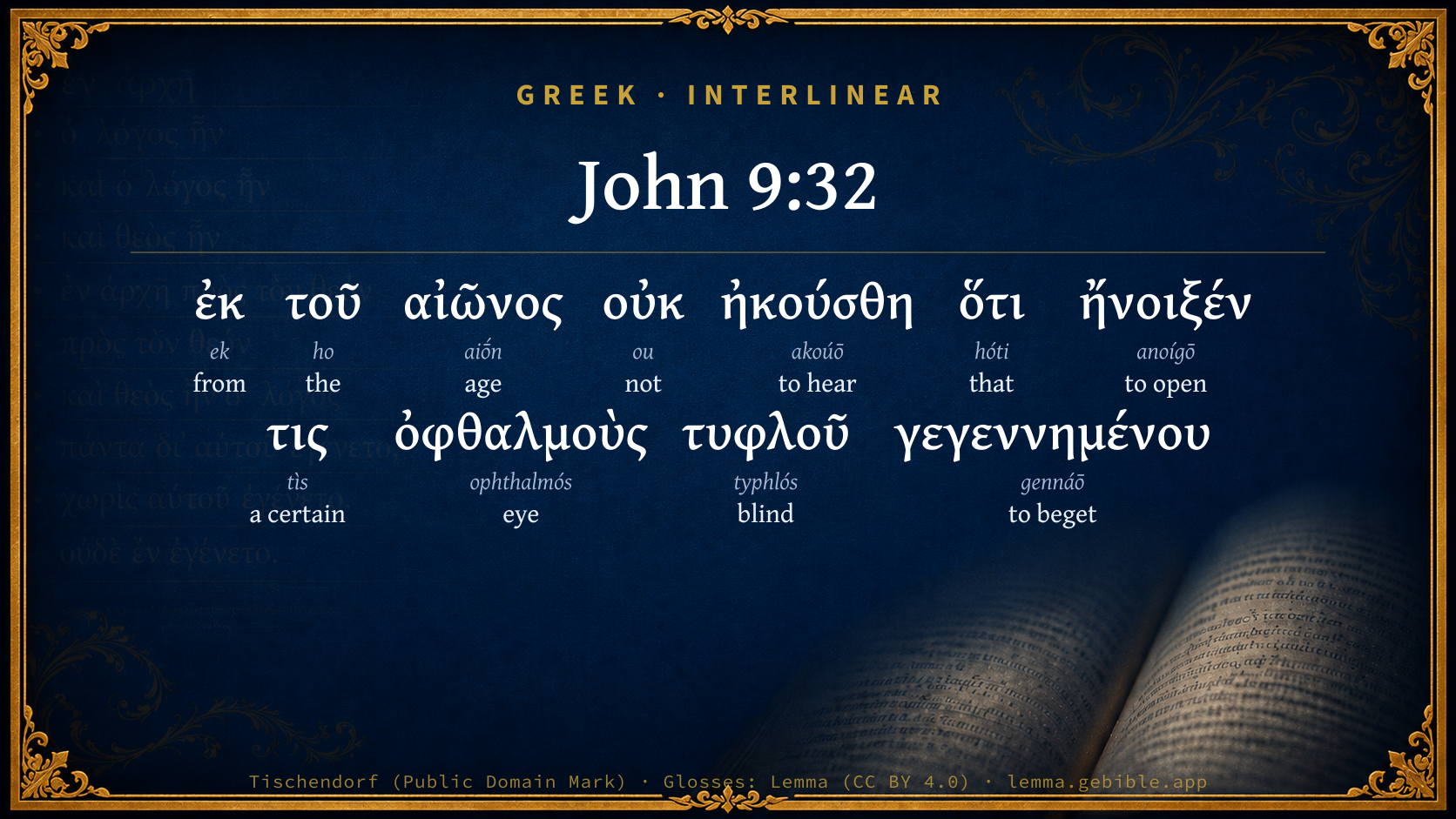
Greek (Tischendorf 8th ed.) John 9:32 appears in the Greek New Testament. The text above is from the Tischendorf 8th edition. Each word links to its Strong’s number and a concise gloss. Click any word for its full Thayer’s Greek Lexicon entry.
Download image
Cite this verse

John 9:32 (World English Bible). Public Domain. Lemma interlinear Bible study tool, https://lemma.gebible.app/v/john/9/32.

Show BibTeX & RIS
BibTeX
RIS
English Translation
Since the world began it has never been heard of that anyone opened the eyes of someone born blind.
World English Bible · Public Domain
Download a study sheet

One document with this verse’s original text, its word-by-word gloss line, the meaning frame, cross-references with their text, attributed commentary, and full source and license credits — printable, and it pastes into notes with its structure intact.

This verse Autodidact and up

Study sheet (.html) Plain text (.txt)

A passage Seminary Student

Up to 50 verses in one chapter. A passage sheet keeps up to 6 commentary sources and 12 cross-references per verse, in the order this page ranks them, and says so on the sheet whenever that leaves anything out. Ask for a single verse and you get the Autodidact verse sheet above.

Everything on this page stays free to read, with no account — the sheet is a download of what is already on screen, not access to it.

Want to remove ads? Support Godless Engineer
Compare translations 3

The same verse in 3 English versions, stacked beneath the original-language interlinear above. Click any original word for its lexicon entry.

Each is an independent rendering of the whole verse — the interlinear is not word-aligned to these translations.

Highlighted words mark where these versions differ — a whole-verse word diff, not a word-by-word alignment.

  • World English Bible Public Domain
    Since the world began it has never been heard of that anyone opened the eyes of someone born blind.
  • King James Version Public Domain
    Since the world began was it not heard that any man opened the eyes of one that was born blind.
  • unfoldingWord Literal Text CC BY-SA 4.0
    From eternity it has never been heard that anyone opened the eyes of one having been born blind.

unfoldingWord Literal Text — © unfoldingWord, licensed CC BY-SA 4.0. Word-aligned USFM3 via Door43 (git.door43.org/unfoldingWord/en_ult).

Versions to compare (up to 4)

3 of 4 selected

Show all 19 translations

Every available English version of this verse, each an independent rendering of the whole verse.

  • World English Bible Public Domain
    Since the world began it has never been heard of that anyone opened the eyes of someone born blind.
  • Berean Standard Bible Public Domain
    Never before has anyone heard of opening the eyes of a man born blind.
  • Majority Standard Bible Public Domain
    Never before has anyone heard of opening the eyes of a man born blind.
  • King James Version Public Domain
    Since the world began was it not heard that any man opened the eyes of one that was born blind.
  • American Standard Version (1901) Public Domain
    Since the world began it was never heard that any one opened the eyes of a man born blind.
  • Revised Version (1885) Public Domain
    Since the world began it was never heard that any one opened the eyes of a man born blind.
  • Geneva Bible (1599) Public Domain
    Since the world began, was it not heard, that any man opened the eyes of one that was borne blinde.
  • Douay-Rheims (1899) Public Domain
    From the beginning of the world it hath not been heard, that any man hath opened the eyes of one born blind.
  • Young's Literal Translation Public Domain
    from the age it was not heard, that any one did open eyes of one who hath been born blind;
  • Literal Standard Version CC BY-SA 4.0
    from the age it was not heard that anyone opened eyes of one who has been born blind;
  • Unlocked Literal Bible CC BY-SA 4.0
    Since the world began it has never been heard that anyone opened the eyes of a man born blind.
  • unfoldingWord Literal Text CC BY-SA 4.0
    From eternity it has never been heard that anyone opened the eyes of one having been born blind.
  • Darby Bible Public Domain
    Since time was, it has not been heard that any one opened the eyes of one born blind.
  • World Messianic Bible Public Domain
    Since the world began it has never been heard of that anyone opened the eyes of someone born blind.
  • Webster's Bible Public Domain
    Since the world began hath it not been heard that any man opened the eyes of one that was born blind.
  • Free Bible Version CC BY-SA 4.0
    Never before in the whole of history has anyone heard of a man born blind being healed.
  • Bible in Basic English Public Domain
    In all the years nobody has ever before seen the eyes of a man blind from birth made open.
  • Text-Critical English NT CC BY 4.0
    Never before has anyone heard of someone opening the eyes of a man born blind.
  • Tyndale New Testament (1534) Public Domain
    Sence the worlde beganne was it not hearde that eny man opened the eyes of one that was borne blynd.

Literal Standard Version (2020), Covenant Press — licensed CC BY-SA 4.0. Text via the HelloAO Bible API (eBible.org). Unlocked Literal Bible (unfoldingWord) — licensed CC BY-SA 4.0. Text via the HelloAO Bible API (eBible.org). unfoldingWord Literal Text — © unfoldingWord, licensed CC BY-SA 4.0. Word-aligned USFM3 via Door43 (git.door43.org/unfoldingWord/en_ult). Free Bible Version, Dr. Jonathan Gallagher — licensed CC BY-SA 4.0. Text via the HelloAO Bible API (eBible.org).

Word by word

More ways to search: Search by grammar → Find every occurrence → Compare this word →

Practice this passage: Drill this verse → Learn its vocabulary →

About this verse

These counts appear in no published source. They are computed here, from the morphology-tagged text and Lemma’s own curated glosses. What Lemma adds →

11
words
11
distinct lemmas
Gospels
section

Cross-references

4

Topical passages linked to John 9:32 in the Treasury of Scripture Knowledge — connected by theme and wording, ordered by reader-vote popularity; previews shown in the World English Bible.

  • Isaiah 64:4 For from of old men have not heard, nor perceived by the ear, neither has the eye seen a God besides you, who works for him who waits for him.
  • Job 20:4 Don't you know this from old time, Since man was placed on earth,
  • Luke 1:70 (As he spoke by the mouth of his holy prophets who have been from of old),
  • Revelation 16:18 There were lightnings, sounds, and thunders; and there was a great earthquake, such as was not since there were men on the earth, so great an earthquake, so mighty.

Cross-references courtesy of OpenBible.info (CC BY 4.0).

Commentary

Notes on John 9:32 from classic Christian and Jewish commentators (each source and its license shown beneath its notes). The classic Christian expositions comment on the surrounding passage and are grouped to its opening verse, so a note may address several verses; the Jewish commentaries on the Tanakh (Rashi and others) are per-verse, so they appear only where the commentator wrote on this verse.

Lemma curates 59 commentaries, every one of them public domain or Creative Commons licensed, each selected and text-cleaned for this edition rather than reprinted as found. About our sources →

The Biblical Illustrator

Joseph S. Exell

Joh_9:32

Since the world began it was not heard that any man opened the eyes of one that was born blind.

--This was quite true at the time.

In 1728, Dr. Cheselden, of St. Thomass Hospital, for the first time gave sight to a man who had been blind from his youth up, and since then couching has been several times performed on those who were born blind. With regard to this man note

I. THE PECULIARITY OF HIS CASE.

1. It was not the case of want of light; that might have been remedied. There are millions who have no light, and while we cannot give men eyes we can give them light. There are children of God who walk in darkness and are immured in Doubting Castle. May it be ours by explanation and example to illumine them.

2. This was not a case of accidental blindness. Here again mans help might have been of service. Persons who have been struck with blindness have been recovered. We can do much in cases where blindness is traceable to circumstances, e.g., to prejudice, which might be removed by a wise and tender statement of the truth.

3. The man was blind from his birth. His was a blindness of nature which, therefore, baffled all surgical skill.

(1) Since the beginning of the world no one has opened the eyes of one afflicted with sin. Mans understanding is blind because

(a) His whole nature is disordered. His other faculties act upon his mind and prevent it operating in a proper manner.

(b) His natural pride and self-reliance revolt against the gospel.

(c) He judges spiritual things by the senses, and with as much success as a man who measures the heavens with a foot rule.

(d) He is at a distance from God and consequently does not believe in Him. If we lived near to God our understanding would be clarified by its contact with truth.

(2) Some imagine that they can open the sinners blind eye

(a) By rhetoric. As well hope of sing a stone into sensibility. Sinners have been dazzled a thousand times by the pyrotechnics of oratory and have remained as blind as ever.

(b) By argument; but reason alone gives no man the power to see the light of heaven.

(c) By earnest gospel appeals; but how many in our congregations are proof against these!

II. THE SPECIALTIES OF THE CURE. Not of this mans only.

1. It is usually accomplished by the most simple means. It is very humbling to a preacher to find that God cares little for him or his sermon, and that a stray remark of his in the street is what God has blessed. Souls are not usually converted by bodies of divinity and theological discussions. When David put off Sauls armour and took the sling and the stone he slew the giant. We must keep to the simple gospel plainly preached. The clay and the spittle were not an artistic combination, yet by these and a wash in Siloam eyes were opened.

2. In every case it is a Divine work. No eye is ever opened to see Jesus except by Jesus. Blindness of soul yields only to the voice which said, Let there be light.

3. It is often instantaneous, and when the eye is opened it frequently sees as perfectly as if it had been always seeing, though in other cases it is gradual.

4. It brings new sensations, and therefore should surprise us. Do you remember the first sight you had of Christ? There is fixed in the memories of some of us the first time we saw the sea, or the Alps, but these were nothing, It is not surprising that young converts should get excited.

5. It is very clear to the man himself. Others may doubt but not he.

6. The restored faculty is capable of abundant use. The man who could see the Pharisees could by and by see Jesus. Once give a man spiritual sight and he has a capacity to see Divine mysteries.

III. THE CONDITION OF THE HEALED MAN.

1. He had strong impressions in favour of his Healer. First He was a prophet, then the object of worship. No man has his eyes opened without intense love for Jesus, and without believing in His Deity, and worshipping Him as the Son of God.

2. He becomes from that moment a confessor of Christ, the first of his class. If the Lord has opened our eyes we shall not hesitate to say so.

3. He became an advocate for Christ, and an able one, for the facts which were his arguments baffled his adversaries. You will never meet infidelity except with such facts.

4. He was driven out of the synagogue. One of the worst things that can happen as far as this world is concerned is to know too much. If you will bravely keep abreast of the times you may be tolerated, but if you get ahead of it you must expect ill-treatment.

5. Christ found him. What a blessing to lose the Pharisees and to find the Saviour! What a mercy when the world casts us out! (C. H. Spurgeon.)

The Biblical Illustrator, edited by Joseph S. Exell (c. 1880s–1900s) — public domain. Text from a community e-Sword module.

Tyndale Open Study Notes

Tyndale Open Resources

9:32-33 Only God could do something such as open the eyes of someone born blind. By healing the man, Jesus offered the Jewish leaders an unquestionable sign that he was from God and was the Messiah (cp. Ps 146:8; Isa 35:5; 42:7).

Tyndale Open Study Notes — © Tyndale Open Resources, licensed CC BY-SA 4.0. Text via the HelloAO Bible API.

Expositor's Greek Testament

ed. W. Robertson Nicoll

Joh 9:32 . ἐκ τοῦ αἰῶνος , rather “from of old” than “since the world began”. Cf. Luk 1:70 , τῶν ἀπʼ αἰῶνος προφητῶν , and Act 3:21 ; Act 15:18 . To this there is no reply but abuse and dismissal.

The Expositor's Greek Testament, edited by W. Robertson Nicoll (1897–1910) — public domain. Text from a community e-Sword module.

Adam Clarke's Commentary

Verse 32. Since the world began] εκ του αιωνος, From the age - probably meaning from the commencement of time. Neither Moses nor the prophets have ever opened the eyes of a man who was born blind: if this person then were not the best of beings, would God grant him a privilege which he has hitherto denied to his choicest favourites?

Opened the eyes of one that was born blind.] It will readily appear that our Lord performed no surgical operation in this cure: the man was born blind, and he was restored to sight by the power of God; the simple means used could have had no effect in the cure; the miracle is therefore complete. That there are cases, in which a person who was born blind may be restored to sight by surgical means, we know: but no such means were used by Christ: and it is worthy of remark that, from the foundation of the world, no person born blind has been restored to sight, even by surgical operation, till about the year of our Lord, 1728; when the celebrated Dr. Cheselden, by couching the eyes of a young man, 14 years of age, who had been born blind, restored him to perfect soundness. This was the effect of well directed surgery: that performed by Christ was a miracle.

Adam Clarke's Commentary on the Bible (1810–1826) — public domain. Text from a community e-Sword/MySword module.

Ellicott's Commentary for English Readers

(32) Since the world began was it not heard.—Literally, from the world-age was it not heard. The phrase is a reminiscence of Isa_64:4. (Comp. also Note on Luk_1:70.)

The eyes of one that was born blind.—This differentiates the miracle from the others in cases of blindness, and still more from all ordinary cures of maladies of the eyes. The man expresses what was simply true, that no science or skill had at that time been equal to the removal of blindness which had accompanied birth. That modern science has succeeded in making even this possible, is altogether beside the question, unless it is pretended that human skill could effect it under like conditions and with the same means. For the man himself there had been years of darkness without a ray of hope, for none had ever dreamt that recovery was within the limits of possibility; and now that the blessing has come, he regards it as the gift of God, and doubts not that the immediate giver is from God.

A Bible Commentary for English Readers, edited by Charles John Ellicott (1878–1897) — public domain. Text from a community e-Sword module.

The Cambridge Bible for Schools and Colleges

gen. ed. J. J. S. Perowne

32. Since the world began] There is no healing of the blind in O.T.

The Cambridge Bible for Schools and Colleges (gen. ed. J. J. S. Perowne; Cambridge University Press, 1878–1918) — public domain. Text from a community e-Sword module.

John Gill's Exposition

If this man were not of God,.... If he had not his mission, commission, and credentials from God; if he had not been sent by him, and had not authority from him, and was not assisted by him, as man, or God was not with him,

he could do nothing; or "not do these things", as the Syriac version reads; that is, such miraculous works; or, as the Persic version, "he could not do this miracle": open the eyes of a man born blind. His doing this is a full proof that he is of God, and comes from him.

John Gill's Exposition of the Whole Bible (1746–1763) — public domain (CC PDM 1.0). Text via the HelloAO Bible API.

Trapp's Complete Commentary

John Trapp

32 Since the world began was it not heard that any man opened the eyes of one that was born blind.

Ver. 32. Since the world began was it not heard] Those historians then that have ascribed such a power to Vespasian, as to cure men that were born blind, are in no wise to be believed. (Dio in Vespas.) Vopiscus (who himself was one of them) ingenuously confesseth (in Vita Aureliani), neminem historicorum non aliquid esse mentitum, that they are all liars more or less, especially in setting forth the lives and acts of their emperors.

John Trapp, A Commentary or Exposition upon All the Books of the Old and New Testament (1647–1656) — public domain. Text from a community e-Sword module.

Albert Barnes' Notes on the Bible

Since the world began - Neither Moses nor any of the prophets had ever done this. No instance of this kind is recorded in the Old Testament. As this was a miracle which had never been performed, the man argued justly that he who had done it must be from God. As Jesus did it not by surgical operations, but by clay, it showed that he had power of working miracles by any means. It may be also remarked that the restoration of sight to the blind by surgical operations was never performed until the year 1728. Dr. Cheselden, an English surgeon, was the first who attempted it successfully, who was enabled to remove a cataract from the eye of a young man, and to restore sight. This fact shows the difficulty of the operation when the most skillful natural means are employed, and the greatness of the miracle performed by the Saviour.

Albert Barnes' Notes on the Bible (1834–1885) — public domain. Text from a community e-Sword/MySword module.

Haydock's Catholic Bible Commentary

From the beginning of the world it hath not been heard. Though we read of many miracles done by Moses and the prophets, this, saith he, is the first example of any man receiving his sight who had been born blind. (Witham)

George Leo Haydock (1774–1849), Haydock's Catholic Family Bible and Commentary, 1859 edition — public domain. Excludes Psalms (Douay-Rheims chapter numbering differs from Protestant) and Deuterocanonical books (Catholic canon only).

Matthew Poole's English Annotations

He proveth Christ to be sent from God, (though it appears by Joh 9:33 that he looked as yet upon him in no higher notion than a man), from the nature of the miracle that was wrought; which was not the recovery of a blind man’s sight only, but giving sight to one who was born blind. Now, saith this poor man, this is such a work as was never done by Moses, or by any of the prophets who have been since the creation of the world. Some who have been blind from some accidental cause, and something which hath befallen them, films and cataracts, &c., have been cured; and possibly God by his almighty power may have given sight to one born blind; but we never heard of any such thing done by Moses, whom we magnify; nor by the prophets, for whom we have the greatest veneration.

Matthew Poole's English Annotations on the Holy Bible (1683–1685) — public domain. Text from a community e-Sword/MySword module.

Whedon's Commentary on the Bible

Daniel D. Whedon

32. Since the world began—Philosophers at the present day, like Hume and his followers, maintain that as miracles are contrary to experience, they can never take place. But, 1. A thing is not contrary to experience because it is unexperienced. To be contrary to experience, somebody must have a positive experience that a miracle cannot take place. But no one ever had or can have such an experience. 2. Miracles are not contrary but according to experience. This man could hold that giving sight to the blind-born was hitherto unexperienced; but he positively knew that it was not contrary to experience, for he knew that he himself had just experienced it. 3. Human experience is, that the so-called laws of nature are in themselves permanent, and yet that their operations are sometimes interrupted or varied by divine interpositions. And these two experiences are perfectly consistent with each other. Hence our man here correctly argues, human experience is, that ordinarily the born-blind is never restored; but a human experience also is, that in the present case the operation of that law has received a divine exception. 4. To say that a miracle never happened, because it is contrary to experience, is reasoning in a circle. For to say “it is contrary to experience” is but to say, in other words, that “it never happened.” So that the reasoning then is: A miracle “never happened” because it “never happened.”

Daniel D. Whedon (gen. ed.), Commentary on the Old and New Testaments (1874–1909) — public domain. Text from a community e-Sword module.

The Pulpit Commentary

Vers. 32, 33. The man, having once begun, will not be stopped in his argument. Since the world began (ek tou aiwnov does not elsewhere occur in the New Testament; we have ap aiwnov three times, and apo twn aiwnwn) it was never heard that any one opened the eyes of one born blind. There is no record of any cure of blindness in the Old Testament. The miracle stands forth with grand distinctness on the page of history. If such stories had been told, neither he nor the author of this narrative knew of them. The Pharisees and Jews have no reply to this burst of grateful but indignant testimony to the uniqueness of his Deliverer, and then, with a home-thrust which cut through their weak objections and repudiated their cruel inferences, he added, Unless this Man were from God, he could do nothing; he could neither have wrought this marvel, nor any of the deep impressions wrought upon you. "From God;" that is the man"s final answer to the query, "What sayest thou of him, seeing that he hath opened thine eyes?" God has the glory, while I repudiate what you give as a judgment against him. Verily God has heard him as One who in this thing has simply done his will. Thus the Jews are compelled for a few moments to hear, from one known as a street-beggar, words of teaching along the finest lines of a deep experience.

The attestation of Christ"s works to his Divinity.

The natural good sense of the man born blind was sharpened by the experience through which he passed, and by the controversy in which he was involved. Hence it was that several of his sayings anticipate the mature arguments of the most thoughtful defenders of the Christian faith. The manner in which he here argues from the character of our Lord"s works to his Divine commission and authority, is deserving of all admiration. This is an argument as valid as, and perhaps more effective now than, when it was first spontaneously propounded.

I THE SPIRITUAL CHARACTER OF CHRIST"S WORK PROVES HIS DIVINE ORIGIN AND POWER. God is a Spirit; the realm of spirit is that which is to him of deepest interest. It is evident that if the Son of God has visited earth, it must have been in order to introduce principles of vitality and blessing into the spiritual existence of men. This is exactly what Christ has undeniably been doing. To him men owe the enlightenment of the mind by spiritual truth; the new law of moral life; the new motive of Divine love; the great distinctive social principle of self-denying benevolence; the effective consolation for human sorrow; the true encouragement for those tempted to depression and hopelessness; the glorious prospect of the spiritual renewal of mankind; the mighty inspiration owing to the revelation of an immortal life.

II THE INCOMPARABLE EFFICIENCY WITH WHICH THIS WORK WAS DONE IS PROOF OF CHRIST"S DIVINE ORIGIN AND AUTHORITY. To appreciate this, we should compare the work of Christ with that of others, e.g. with that of the most renowned of earth conquerors and kings, sages and religious leaders. How meager their sway! how transitory their dominion! How rapidly have they become merely a memory, a name! On the other hand, what moral significance has characterized the work of the Lord Jesus! During his ministry, what transformations of character he wrought, what extreme and desperate cases of sin and wretchedness he successfully dealt with] And, after his ascension," greater works "than these which were yet equally his works accompanied the preaching of his gospel. Well might Julian the apostate exclaim, Vicisti, Galilaee! Well might Napoleon acknowledge that the empire of Christ transcended all earthly monarchies in true and lasting solidity and glory. If this Man were not Of God, could such results have attended and followed his earthly mission fulfilled, as it was, upon a scene so limited, in a period so brief, and in circumstances so lowly?

III THE WIDE EXTENT OF OUR LORD"S WORK IS EVIDENCE OF HIS DIVINITY. Even during his three years of labor, Jesus brought blessing, not to Israelites alone, but to Samaritans, Phoenicians, Greeks, and Romans. And when Pentecost inaugurated the mission of the Church, then the descent of the Spirit and the utterances in many tongues were a prediction of a universal religion. The middle wall of partition was broken down. One new humanity was fashioned from diverse and seemingly discordant materials from Jews and from Gentiles. And Christianity has from that time onward been proving its adaptation to man as man to the barbarian and the civilized, to the East and the West, to persons of all ages, ranks, and characters. The Son of man is proving himself to be the Savior of man.

IV THE DIVINE AUTHORITY OF CHRIST IS SUPPORTED BY THE PERPETUITY AND BY THE EVER-GROWING PREVALENCE OF HIS WORKS. Other systems are for a period, for a generation, or for a century; "they have their day, and cease to be." But Christ"s mighty works go forward as in an unbroken and ever-swelling procession, testifying to their Author. His power to save and bless is as yet undiminished, and it is reasonable to believe it to be inexhaustible. "This Man" has done, and is doing, all this! Who can he be but the Son of the Eternal? T.

The Pulpit Commentary (1880–1919), ed. H.D.M. Spence-Jones & Joseph S. Exell — public domain. Text from a community e-Sword module.

unfoldingWord translationNotes

Door43 World Missions Community

Connecting Statement:

The man who had been blind continues speaking to the Jews.

it has never been heard that anyone opened

This is a passive statement. You can translate it in an active form. AT: "no one has ever heard of anyone who healed a man who was blind from birth" (See: Active or Passive)

If this man were not from God, he could do nothing

This sentence uses a double negative pattern. "Only a man from God could do something like that!" (See: Double Negatives)

You were completely born in sins, and you are teaching us?

This remark appears in the form of a question to add emphasis. It also implies that the man was born blind because of the sins of his parents. AT: "You were born as a result of your parents' sins. You are not qualified to teach us!" (See: Rhetorical Question)

they threw him out

"they threw him out of the synagogue"

translationWords

God

cast out

unfoldingWord translationNotes — © Distant Shores Media and the Door43 World Missions Community, licensed CC BY-SA 4.0. Source: git.door43.org/Door43/en_tn.

Cambridge Greek Testament for Schools and Colleges

32. ἐκ τ. αἰῶνος. Here only: Col 1:26 we have ἀπὸ τῶν αἰώνων. There is no healing of the blind in O.T.

Cambridge Greek Testament for Schools and Colleges (Cambridge University Press, 1896; 21 vols, various authors incl. Carr, Maclear, Plummer, Farrar, Lumby, Moule, M. R. James, Simcox) — public domain. Text from a community e-Sword module.

International Critical Commentary

32. ἐκ τοῦ αἰῶνος. The phrase ἀπὸ τοῦ αἰῶνος or ἀπʼ αἰῶνος occurs Luk 1:70, Act 3:21, Act 15:18, and is common in the LXX (1Ch 16:36, Psa 25:6, Psa 90:2, Ecclus. 14:17, Jer 2:20, etc.), as it is in the papyri. But ἐκ τοῦ αἰῶνος does not occur again in the Greek Bible, the nearest phrase being ἐξ αἰῶνος, Pro 8:21. (Wetstein illustrates it freely from non-Biblical authors.) We have here an instance of the interchangeability of ἐκ and ἀπό which we have already observed in Jn. (see on 1:44, 6:38).

ἐκ τοῦ αἰῶνος κτλ., “Since the world began it was unheard of that any one opened the eyes of one who was born blind.” It is this point, viz. that the blindness was congenital, that is insisted on throughout; whereas in the case of the cure of the man at Bethesda, the circumstance that he had been infirm for thirty-eight years (5:5) passes out of view at once, and attention is concentrated on the fact that he was cured on a Sabbath day.

International Critical Commentary — older volumes (1896–1929), various authors — public domain. Text from a community e-Sword module.

Vincent's Word Studies in the New Testament

Marvin R. Vincent

Since the world began [εκ του αιωνος] . The exact phrase only here in the New Testament. Ap' is found in Act 3:21; Act 14:18; ajpo twn aijwnwn in Col 1:26.

Marvin R. Vincent, Word Studies in the New Testament (1887–1900) — public domain. Text from a community e-Sword/MySword module.

Lesson kit

Teaching starters — assembled from the data on this page, not authored interpretation. Every prompt links to the verse data it draws on. Edit before teaching.

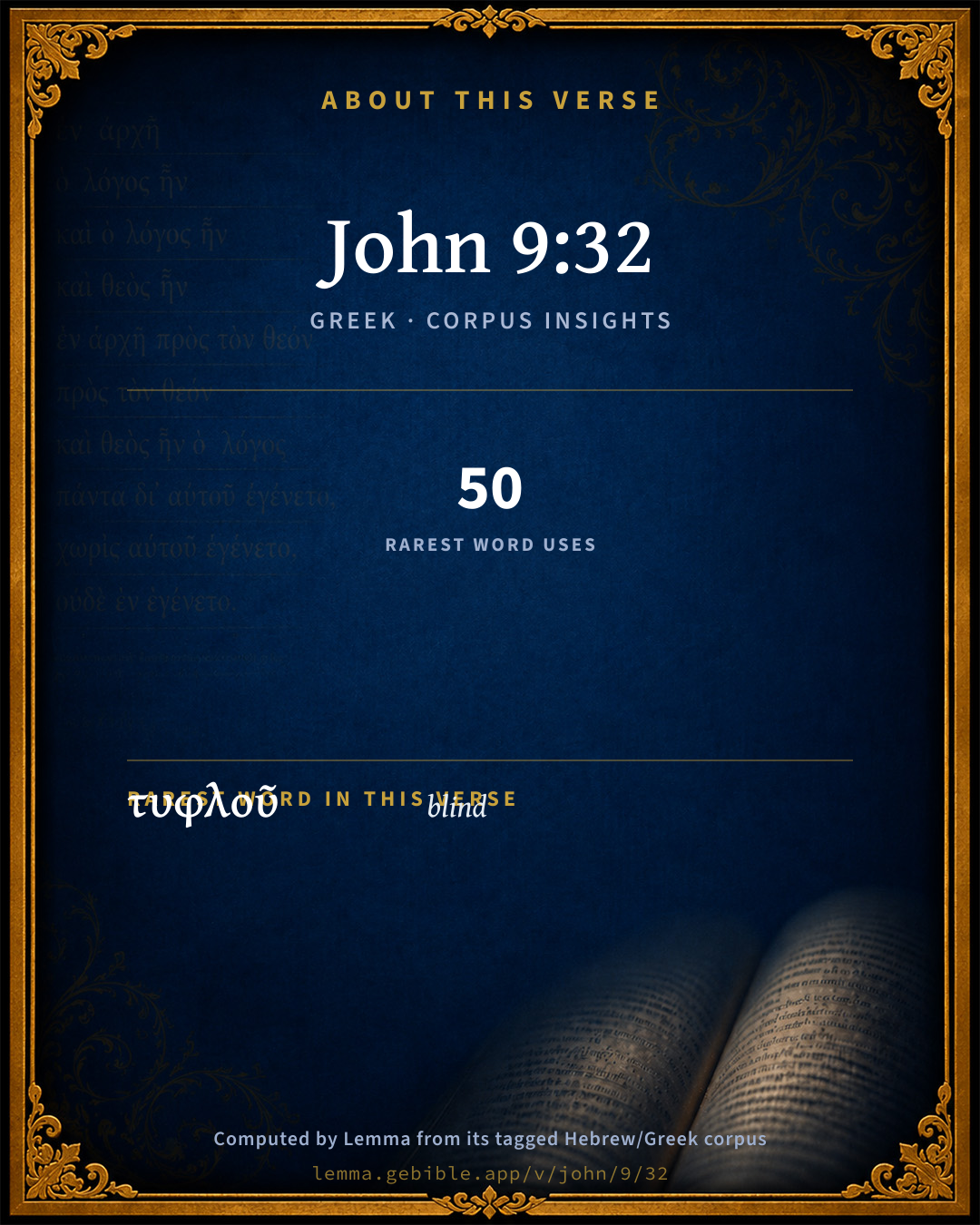
John, in the Gospels, opens this verse with 11 words (11 distinct Greek lemmas). Its most distinctive word is typhlós (“blind”). A historical commentator’s framing appears above. Read the whole chapter for the surrounding context.

Discussion questions

  1. What does “blind” (typhlós) contribute to the verse as a whole?
  2. How does Matthew 9:27, which shares the word «blind», read alongside this verse?
  3. The translations on this page render this verse differently — a whole-verse word diff, not a word-by-word alignment. What might account for the different wordings?
  4. Compare how The Biblical Illustrator and Tyndale Open Study Notes read this verse. Where do they agree or differ?

Things to notice

Reading settings

Reading text

Shown beneath each verse's original-language words.

Old Testament
Old Testament edition

Read the OT as the Masoretic Hebrew (MT) or the Greek Septuagint (LXX).

English shown for the Greek Septuagint (in the Hebrew ↔ Greek comparison).

Comparing translations? Open the Compare panel on any verse page to stack up to four side by side.