

Jude 1:13
Greek (Tischendorf 8th ed.) Jude 1:13 appears in the Greek New Testament. The text above is from the Tischendorf 8th edition. Each word links to its Strong’s number and a concise gloss. Click any word for its full Thayer’s Greek Lexicon entry.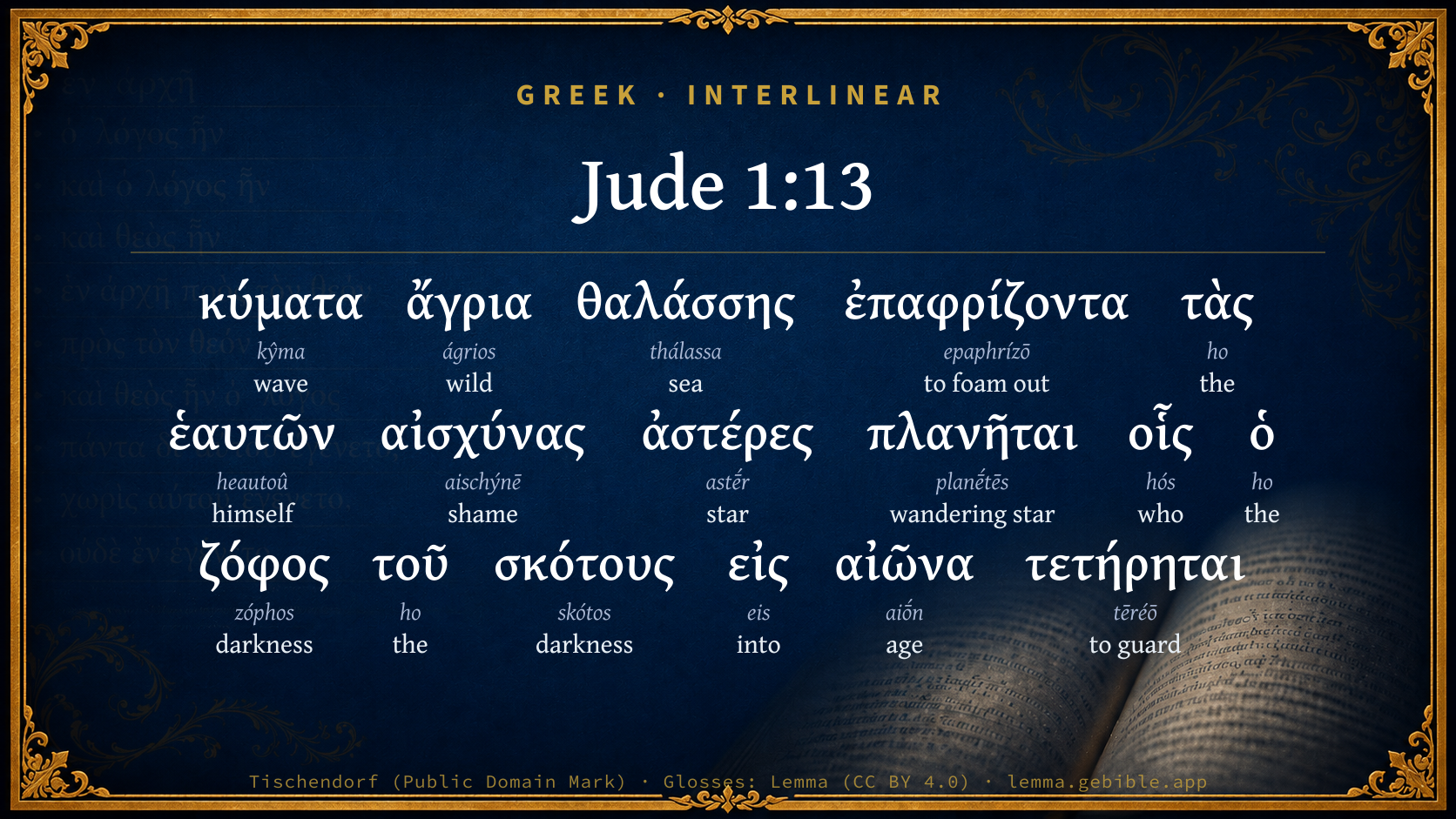
wild waves of the sea, foaming out their own shame; wandering stars, for whom the blackness of darkness has been reserved forever.
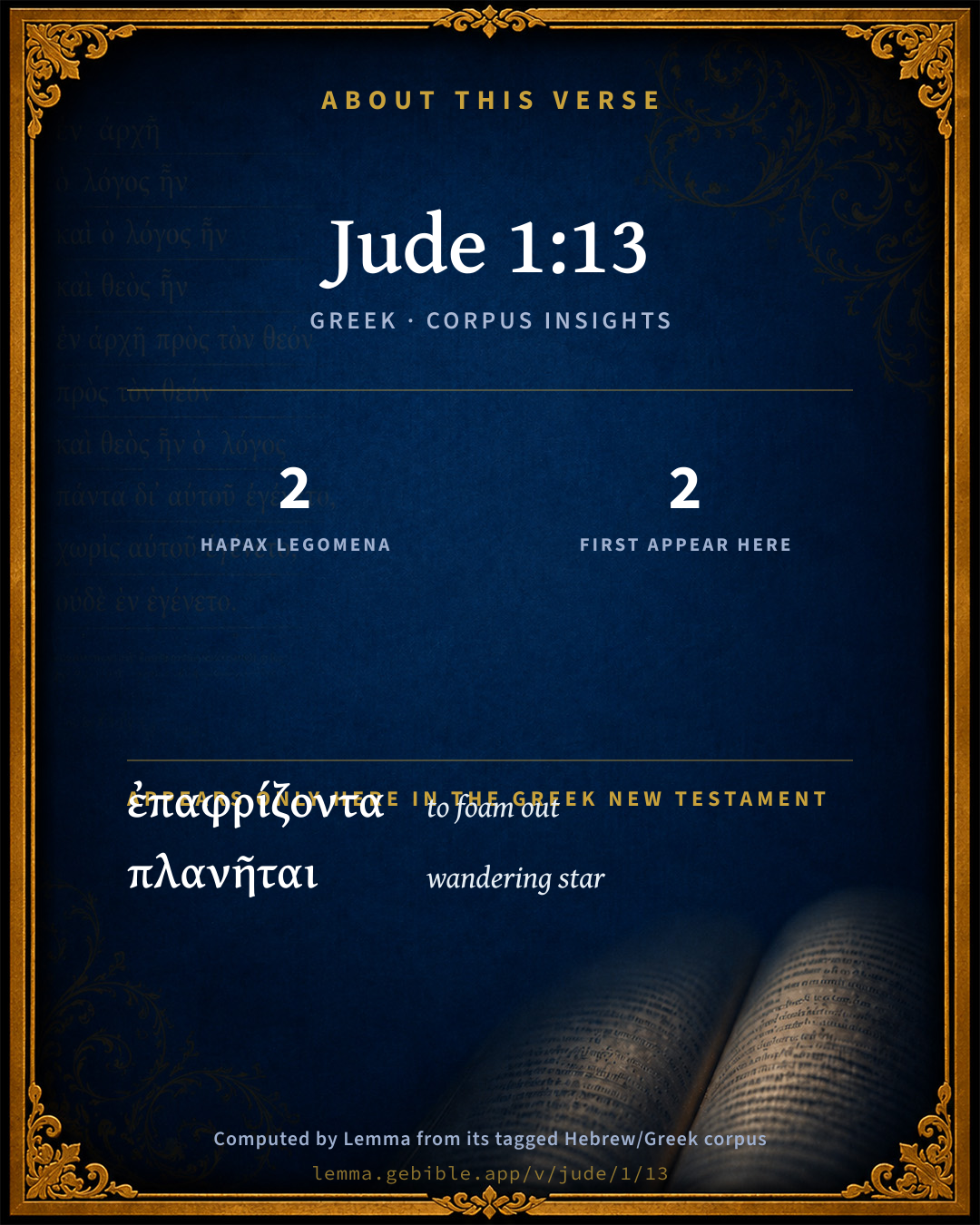
- 2 hapax legomena — only here in the Greek New Testament
- 2 first appearances in the Greek New Testament
Download a study sheet
One document with this verse’s original text, its word-by-word gloss line, the meaning frame, cross-references with their text, attributed commentary, and full source and license credits — printable, and it pastes into notes with its structure intact.
This verse Autodidact and up
A passage Seminary Student
Up to 50 verses in one chapter. A passage sheet keeps up to 6 commentary sources and 12 cross-references per verse, in the order this page ranks them, and says so on the sheet whenever that leaves anything out. Ask for a single verse and you get the Autodidact verse sheet above.
Everything on this page stays free to read, with no account — the sheet is a download of what is already on screen, not access to it.
Compare translations 3
The same verse in 3 English versions, stacked beneath the original-language interlinear above. Click any original word for its lexicon entry.
Each is an independent rendering of the whole verse — the interlinear is not word-aligned to these translations.
Highlighted words mark where these versions differ — a whole-verse word diff, not a word-by-word alignment.
-
World English Bible Public Domain
wild waves of the sea, foaming out their own shame; wandering stars, for whom the blackness of darkness has been reserved forever.
-
King James Version Public Domain
Raging waves of the sea, foaming out their own shame; wandering stars, to whom is reserved the blackness of darkness for ever.
-
unfoldingWord Literal Text CC BY-SA 4.0
wild waves of the sea, foaming out their own shameful deeds; wandering stars, for whom the gloom of darkness has been kept to eternity.
unfoldingWord Literal Text — © unfoldingWord, licensed CC BY-SA 4.0. Word-aligned USFM3 via Door43 (git.door43.org/unfoldingWord/en_ult).
Show all 19 translations
Every available English version of this verse, each an independent rendering of the whole verse.
-
World English Bible Public Domain
wild waves of the sea, foaming out their own shame; wandering stars, for whom the blackness of darkness has been reserved forever.
-
Berean Standard Bible Public Domain
They are wild waves of the sea, foaming up their own shame; wandering stars, for whom blackest darkness has been reserved forever.
-
Majority Standard Bible Public Domain
They are wild waves of the sea, foaming up their own shame; wandering stars, for whom blackest darkness has been reserved forever.
-
King James Version Public Domain
Raging waves of the sea, foaming out their own shame; wandering stars, to whom is reserved the blackness of darkness for ever.
-
American Standard Version (1901) Public Domain
Wild waves of the sea, foaming out their own shame; wandering stars, for whom the blackness of darkness hath been reserved forever.
-
Revised Version (1885) Public Domain
Wild waves of the sea, foaming out their own shame; wandering stars, for whom the blackness of darkness hath been reserved for ever.
-
Geneva Bible (1599) Public Domain
They are the raging waues of the sea, foming out their owne shame: they are wandring starres, to whome is reserued the blackenesse of darkenesse for euer.
-
Douay-Rheims (1899) Public Domain
Raging waves of the sea, foaming out their own confusion; wandering stars, to whom the storm of darkness is reserved for ever.
-
Young's Literal Translation Public Domain
wild waves of a sea, foaming out their own shames; stars going astray, to whom the gloom of the darkness to the age hath been kept.
-
Literal Standard Version CC BY-SA 4.0
wild waves of a sea, foaming up their own shameful [deeds]; stars going astray, for whom the gloom of the darkness throughout the age has been kept.
-
Unlocked Literal Bible CC BY-SA 4.0
They are violent waves in the sea, foaming out their own shame. They are wandering stars, for whom the gloom of thick darkness has been reserved forever.
-
unfoldingWord Literal Text CC BY-SA 4.0
wild waves of the sea, foaming out their own shameful deeds; wandering stars, for whom the gloom of darkness has been kept to eternity.
-
Darby Bible Public Domain
raging waves of the sea, foaming out their own shames; wandering stars, to whom has been reserved the gloom of darkness for eternity.
-
World Messianic Bible Public Domain
wild waves of the sea, foaming out their own shame; wandering stars, for whom the blackness of darkness has been reserved forever.
-
Webster's Bible Public Domain
Raging waves of the sea, foaming out their own shame; wandering stars, to whom is reserved the blackness of darkness for ever.
-
Free Bible Version CC BY-SA 4.0
They're violent ocean waves, foaming in their own disgrace. They're false stars, doomed forever to utter darkness.
-
Bible in Basic English Public Domain
Violent waves of the sea, streaming with their shame, wandering stars for whom the darkest night is kept in store for ever.
-
Text-Critical English NT CC BY 4.0
They are wild waves of the sea, foaming out their own shameful deeds; wayward stars, for whom the thick gloom of darkness has been reserved forever.
-
Tyndale New Testament (1534) Public Domain
They are the ragynge waves of the see fominge out their awne shame. They are wandrynge starres to whom is reserved the myst of darcknes for ever.
Literal Standard Version (2020), Covenant Press — licensed CC BY-SA 4.0. Text via the HelloAO Bible API (eBible.org). Unlocked Literal Bible (unfoldingWord) — licensed CC BY-SA 4.0. Text via the HelloAO Bible API (eBible.org). unfoldingWord Literal Text — © unfoldingWord, licensed CC BY-SA 4.0. Word-aligned USFM3 via Door43 (git.door43.org/unfoldingWord/en_ult). Free Bible Version, Dr. Jonathan Gallagher — licensed CC BY-SA 4.0. Text via the HelloAO Bible API (eBible.org).
Word by word
More ways to search: Search by grammar → Find every occurrence → Compare this word →
Practice this passage: Drill this verse → Learn its vocabulary →
- Appears 1× in the Greek New Testament
- First appears here
- Part of Speech
- Verb
- Tense
- Present
- Voice
- Active
- Mood
- Participle
- Case
- Nominative
- Number
- Plural
- Gender
- Neuter
Full Thayer's Definition
- κύματα kŷma G2949 “wave” Noun, Nominative, Plural, Neuter
- ἄγρια ágrios G66 “wild” Adjective, Nominative, Plural, Neuter
- θαλάσσης thálassa G2281 “sea” Noun, Genitive, Singular, Feminine
- ἐπαφρίζοντα epaphrízō G1890 “to foam out” Verb, Present, Active, Participle, Nominative, Plural, Neuter
- τὰς ho G3588 “the” Article, Accusative, Plural, Feminine
- ἑαυτῶν heautoû G1438 “himself” Reflexive pronoun, 3rd person, Genitive, Plural, Neuter
- αἰσχύνας aischýnē G152 “shame” Noun, Accusative, Plural, Feminine
- ἀστέρες astḗr G792 “star” Noun, Nominative, Plural, Masculine
- πλανῆται planḗtēs G4107 “wandering star” Noun, Nominative, Plural, Masculine
- οἷς hós G3739 “who” Relative pronoun, Dative, Plural, Masculine
- ὁ ho G3588 “the” Article, Nominative, Singular, Masculine
- ζόφος zóphos G2217 “darkness” Noun, Nominative, Singular, Masculine
- τοῦ ho G3588 “the” Article, Genitive, Singular, Neuter
- σκότους skótos G4655 “darkness” Noun, Genitive, Singular, Neuter
- εἰς eis G1519 “into” Preposition
- αἰῶνα aiṓn G165 “age” Noun, Accusative, Singular, Masculine
- τετήρηται tēréō G5083 “to guard” Verb, Perfect, Passive, Indicative, 3rd person, Singular
About this verse
These counts appear in no published source. They are computed here, from the morphology-tagged text and Lemma’s own curated glosses. What Lemma adds →
- 17
- words
- 15
- distinct lemmas
- General Epistles
- section
Notable vocabulary
2 hapax legomena — words that appear only here in the entire Greek New Testament:
First appearance in Scripture
These words make their first canonical appearance in the Greek New Testament here:
Shared distinctive vocabulary
ἄγρια wild G66 occurs in 3 verses of the Greek New Testament. Also found in:
Repetition
A word recurs within this verse:
- τὰς the G3588 ×3
Cross-references
11Topical passages linked to Jude 1:13 in the Treasury of Scripture Knowledge — connected by theme and wording, ordered by reader-vote popularity; previews shown in the World English Bible.
- 2 Peter 2:17 These are wells without water, clouds driven by a storm; for whom the blackness of darkness has been reserved forever.
- Philippians 3:19 whose end is destruction, whose god is the belly, and whose glory is in their shame, who think about earthly things.
- Isaiah 57:20 But the wicked are like the troubled sea; for it can't rest, and its waters cast up mire and dirt.
- Psalms 65:7 Who stills the roaring of the seas, The roaring of their waves, And the turmoil of the nations.
- 2 Timothy 3:13 But evil men and impostors will grow worse and worse, deceiving and being deceived.
- Revelation 14:10–11 he also will drink of the wine of the wrath of God, which is prepared unmixed in the cup of his anger. He will be tormented with fire and sulfur in the presence of the holy angels, and in the presence of the Lamb.
- Revelation 20:10 The devil who deceived them was thrown into the lake of fire and sulfur, where the beast and the false prophet are also. They will be tormented day and night forever and ever.
- Psalms 93:3–4 The floods have lifted up, Yahweh, The floods have lifted up their voice. The floods lift up their waves.
- Jeremiah 5:22–23 Don't you fear me? says Yahweh: won't you tremble at my presence, who have placed the sand for the bound of the sea, by a perpetual decree, that it can't pass it? and though the waves of it toss themselves, yet they can't prevail; though they roar, yet they can't pass over it.
- Revelation 8:10–11 The third angel sounded, and a great star fell from the sky, burning like a torch, and it fell on one third of the rivers, and on the springs of the waters.
- Revelation 21:8 But for the cowardly, unbelieving, sinners, abominable, murderers, sexually immoral, sorcerers, idolaters, and all liars, their part is in the lake that burns with fire and sulfur, which is the second death."
Cross-references courtesy of OpenBible.info (CC BY 4.0).
Lesson kit
Teaching starters — assembled from the data on this page, not authored interpretation. Every prompt links to the verse data it draws on. Edit before teaching.
Jude, in the General Epistles, opens this verse with 17 words (15 distinct Greek lemmas). Its most distinctive word is epaphrízō (“to foam out”). A historical commentator’s framing appears above. Read the whole chapter for the surrounding context.
Discussion questions
- The word epaphrízō carries the sense “to foam out.” How does it shape the verse?
- 2 words here appear nowhere else in the Greek New Testament. Why might the author reach for such rare wording?
- 2 words make their first appearance in Scripture here. What does this debut establish?
- How does Matthew 3:4, which shares the word «wild», read alongside this verse?
- What does the repetition of “the” (3× in this one verse) do in this verse?
- The translations on this page render this verse differently — a whole-verse word diff, not a word-by-word alignment. What might account for the different wordings?
- Compare how The Biblical Illustrator and Joseph Benson's Commentary read this verse. Where do they agree or differ?
Things to notice
- 2 words in this verse appear nowhere else in the Greek New Testament.
- 2 words make their first canonical appearance in Scripture here.
- These translations choose different wording for 14 words in this verse.
- “the” occurs 3× in this single verse.
- 15 distinct Greek lemmas span 17 words in this verse.
Commentary
Notes on Jude 1:13 from classic Christian and Jewish commentators (each source and its license shown beneath its notes). The classic Christian expositions comment on the surrounding passage and are grouped to its opening verse, so a note may address several verses; the Jewish commentaries on the Tanakh (Rashi and others) are per-verse, so they appear only where the commentator wrote on this verse.
Lemma curates 59 commentaries, every one of them public domain or Creative Commons licensed, each selected and text-cleaned for this edition rather than reprinted as found. About our sources →
The Biblical Illustrator
Joseph S. Exell
The Biblical Illustrator, edited by Joseph S. Exell (c. 1880s–1900s) — public domain. Text from a community e-Sword module.
Joseph Benson's Commentary
Joseph Benson's Commentary on the Old and New Testaments (1811–1818) — public domain. Text from a community e-Sword module.
Tyndale Open Study Notes
Tyndale Open Resources
Tyndale Open Study Notes — © Tyndale Open Resources, licensed CC BY-SA 4.0. Text via the HelloAO Bible API.
Bengel's Gnomon
Johann Albrecht Bengel
Bengel's Gnomon of the New Testament — English translation (T&T Clark, Edinburgh, 1860) — public domain. Text from a community e-Sword module.
Meyer's Critical & Exegetical Commentary
Heinrich August Wilhelm Meyer
Meyer — Critical and Exegetical Commentary on the New Testament — English translation by Peter Christie, edited by Frederick Crombie (T&T Clark, 1880) — public domain. Text from a community e-Sword module.
Expositor's Greek Testament
ed. W. Robertson Nicoll
The Expositor's Greek Testament, edited by W. Robertson Nicoll (1897–1910) — public domain. Text from a community e-Sword module.
Geneva Bible (1599)
Geneva Bible translators
Geneva Bible (1599) marginal notes — public domain. Text via Bolls.life.
Jamieson, Fausset & Brown
Robert Jamieson, A. R. Fausset & David Brown
Jamieson, Fausset & Brown — Commentary Critical and Explanatory on the Whole Bible (1871) — public domain (CC PDM 1.0). Text via the HelloAO Bible API.
Adam Clarke's Commentary
Adam Clarke's Commentary on the Bible (1810–1826) — public domain. Text from a community e-Sword/MySword module.
John Calvin's Commentaries
John Calvin's Commentaries (1540-1563) — public domain. Text from the Calvin Translation Society English edition (1840s-50s) via the Christian Classics Ethereal Library (ccel.org). Calvin's coverage is partial (roughly two-thirds of the Bible); uncommented books and verses are honest gaps, never fabricated. The 19th-century editor's footnotes and remarks are omitted so the notes are faithfully Calvin's own voice.
The Cambridge Bible for Schools and Colleges
gen. ed. J. J. S. Perowne
The Cambridge Bible for Schools and Colleges (gen. ed. J. J. S. Perowne; Cambridge University Press, 1878–1918) — public domain. Text from a community e-Sword module.
John Gill's Exposition
John Gill's Exposition of the Whole Bible (1746–1763) — public domain (CC PDM 1.0). Text via the HelloAO Bible API.
Albert Barnes' Notes on the Bible
Albert Barnes' Notes on the Bible (1834–1885) — public domain. Text from a community e-Sword/MySword module.
Matthew Poole's English Annotations
Matthew Poole's English Annotations on the Holy Bible (1683–1685) — public domain. Text from a community e-Sword/MySword module.
Whedon's Commentary on the Bible
Daniel D. Whedon
Daniel D. Whedon (gen. ed.), Commentary on the Old and New Testaments (1874–1909) — public domain. Text from a community e-Sword module.
John Wesley's Explanatory Notes
John Wesley, Explanatory Notes Upon the Whole Bible (1754–1765) — public domain. Text via the GEBible commentary corpus.
Godbey's Commentary on the New Testament
William B. Godbey
William B. Godbey, Commentary on the New Testament (1896–1900) — public domain. Text from a community e-Sword module.
The People's New Testament
B. W. Johnson
B. W. Johnson's The People's New Testament with Notes (1889–1891) — public domain. Electronic text from the Christian Classics Ethereal Library (CCEL) ThML edition.
Cambridge Greek Testament for Schools and Colleges
Cambridge Greek Testament for Schools and Colleges (Cambridge University Press, 1896; 21 vols, various authors incl. Carr, Maclear, Plummer, Farrar, Lumby, Moule, M. R. James, Simcox) — public domain. Text from a community e-Sword module.
Alford’s Greek Testament
Henry Alford
Henry Alford, The Greek Testament (1849–1861) — public domain. Text from a community e-Sword module.
International Critical Commentary
International Critical Commentary — older volumes (1896–1929), various authors — public domain. Text from a community e-Sword module.
Vincent's Word Studies in the New Testament
Marvin R. Vincent
Marvin R. Vincent, Word Studies in the New Testament (1887–1900) — public domain. Text from a community e-Sword/MySword module.