Ephesians 3:11

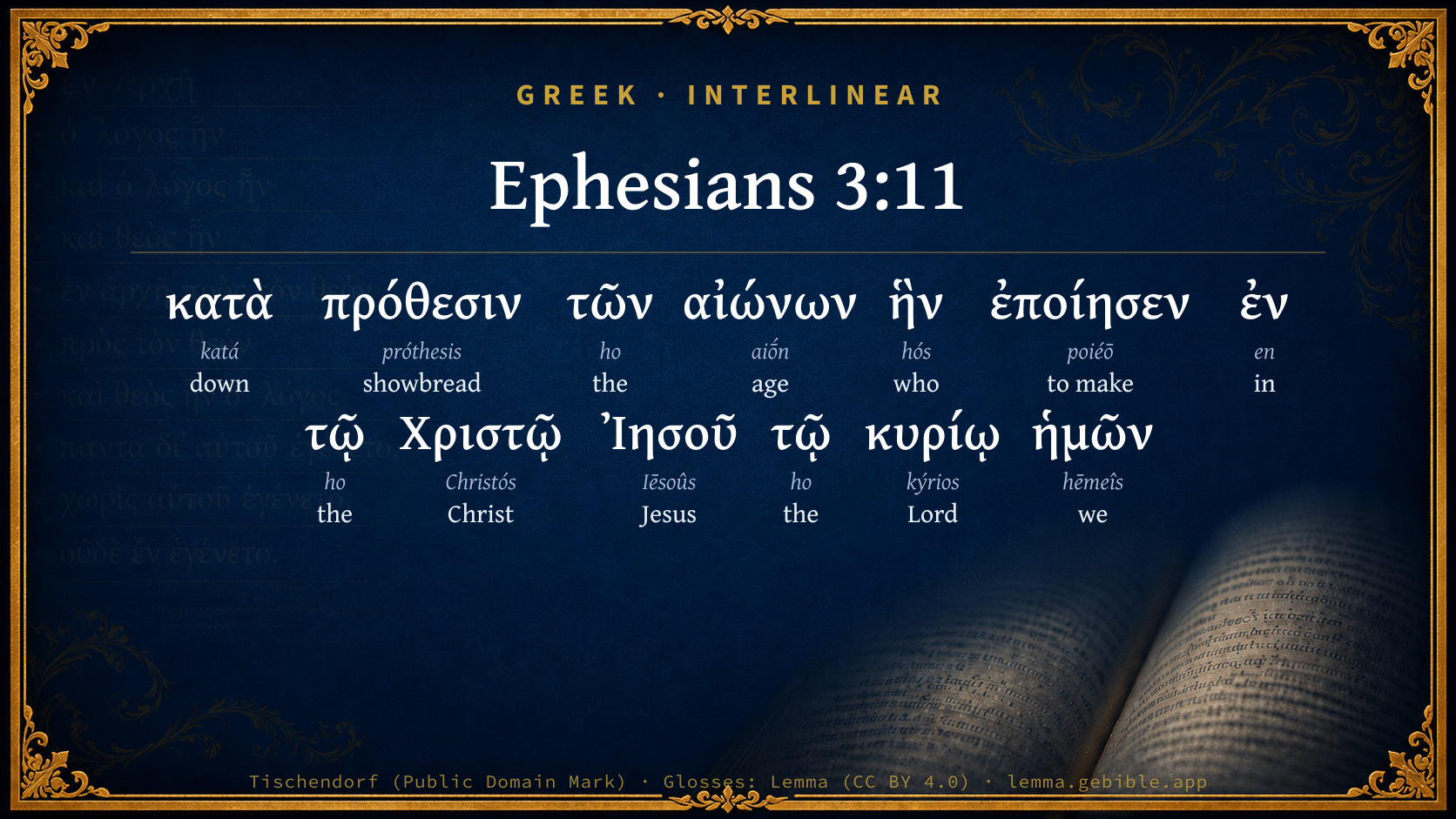
Greek (Tischendorf 8th ed.) Ephesians 3:11 appears in the Greek New Testament. The text above is from the Tischendorf 8th edition. Each word links to its Strong’s number and a concise gloss. Click any word for its full Thayer’s Greek Lexicon entry.
Download image
Cite this verse

Ephesians 3:11 (World English Bible). Public Domain. Lemma interlinear Bible study tool, https://lemma.gebible.app/v/ephesians/3/11.

Show BibTeX & RIS
BibTeX
RIS
English Translation
according to the eternal purpose which he purposed in Christ Jesus our Lord;
World English Bible · Public Domain
Download a study sheet

One document with this verse’s original text, its word-by-word gloss line, the meaning frame, cross-references with their text, attributed commentary, and full source and license credits — printable, and it pastes into notes with its structure intact.

This verse Autodidact and up

Study sheet (.html) Plain text (.txt)

A passage Seminary Student

Up to 50 verses in one chapter. A passage sheet keeps up to 6 commentary sources and 12 cross-references per verse, in the order this page ranks them, and says so on the sheet whenever that leaves anything out. Ask for a single verse and you get the Autodidact verse sheet above.

Everything on this page stays free to read, with no account — the sheet is a download of what is already on screen, not access to it.

Want to remove ads? Support Godless Engineer
Compare translations 3

The same verse in 3 English versions, stacked beneath the original-language interlinear above. Click any original word for its lexicon entry.

Each is an independent rendering of the whole verse — the interlinear is not word-aligned to these translations.

Highlighted words mark where these versions differ — a whole-verse word diff, not a word-by-word alignment.

  • World English Bible Public Domain
    according to the eternal purpose which he purposed in Christ Jesus our Lord;
  • King James Version Public Domain
    According to the eternal purpose which he purposed in Christ Jesus our Lord:
  • unfoldingWord Literal Text CC BY-SA 4.0
    according to the eternal purpose that he accomplished in Christ Jesus our Lord,

unfoldingWord Literal Text — © unfoldingWord, licensed CC BY-SA 4.0. Word-aligned USFM3 via Door43 (git.door43.org/unfoldingWord/en_ult).

Versions to compare (up to 4)

3 of 4 selected

Show all 19 translations

Every available English version of this verse, each an independent rendering of the whole verse.

  • World English Bible Public Domain
    according to the eternal purpose which he purposed in Christ Jesus our Lord;
  • Berean Standard Bible Public Domain
    according to the eternal purpose that He accomplished in Christ Jesus our Lord.
  • Majority Standard Bible Public Domain
    according to the eternal purpose that He accomplished in Christ Jesus our Lord.
  • King James Version Public Domain
    According to the eternal purpose which he purposed in Christ Jesus our Lord:
  • American Standard Version (1901) Public Domain
    according to the eternal purpose which he purposed in Christ Jesus our Lord:
  • Revised Version (1885) Public Domain
    according to the eternal purpose which he purposed in Christ Jesus our Lord:
  • Geneva Bible (1599) Public Domain
    According to the eternall purpose, which he wrought in Christ Iesus our Lord:
  • Douay-Rheims (1899) Public Domain
    According to the eternal purpose, which he made, in Christ Jesus our Lord:
  • Young's Literal Translation Public Domain
    according to a purpose of the ages, which He made in Christ Jesus our Lord,
  • Literal Standard Version CC BY-SA 4.0
    according to a purpose of the ages, which He made in Christ Jesus our Lord,
  • Unlocked Literal Bible CC BY-SA 4.0
    This happened according to the eternal plan that he accomplished in Christ Jesus our Lord.
  • unfoldingWord Literal Text CC BY-SA 4.0
    according to the eternal purpose that he accomplished in Christ Jesus our Lord,
  • Darby Bible Public Domain
    according to [the] purpose of the ages, which he purposed in Christ Jesus our Lord,
  • World Messianic Bible Public Domain
    according to the eternal purpose which he accomplished in Messiah Yeshua our Lord.
  • Webster's Bible Public Domain
    According to the eternal purpose which he purposed in Christ Jesus our Lord:
  • Free Bible Version CC BY-SA 4.0
    This was in accordance with God's eternal purpose that he carried out in Christ Jesus our Lord.
  • Bible in Basic English Public Domain
    Which is seen in his eternal purpose in Christ Jesus our Lord:
  • Text-Critical English NT CC BY 4.0
    according to the eternal purpose that God has carried out in Christ Jesus our Lord.
  • Tyndale New Testament (1534) Public Domain
    accordinge to the eternall purpose which he purposed in Christ Iesu oure lorde

Literal Standard Version (2020), Covenant Press — licensed CC BY-SA 4.0. Text via the HelloAO Bible API (eBible.org). Unlocked Literal Bible (unfoldingWord) — licensed CC BY-SA 4.0. Text via the HelloAO Bible API (eBible.org). unfoldingWord Literal Text — © unfoldingWord, licensed CC BY-SA 4.0. Word-aligned USFM3 via Door43 (git.door43.org/unfoldingWord/en_ult). Free Bible Version, Dr. Jonathan Gallagher — licensed CC BY-SA 4.0. Text via the HelloAO Bible API (eBible.org).

Word by word

More ways to search: Search by grammar → Find every occurrence → Compare this word →

Practice this passage: Drill this verse → Learn its vocabulary →

πρόθεσιν
próthesis
G4286
“showbread”
Noun, Accusative, Singular, Feminine
Part of Speech
Noun
Case
Accusative
Number
Singular
Gender
Feminine
Full Thayer's Definition

Origin: from G4388

TDNT: 10:44,1

1. a setting forth of a thing, placing of it in view, the shewbread a. twelve loaves of wheaten bread, corresponding to the number of the tribes of Israel, which loaves were offered to God every Sabbath, and separated into two rows, lay for seven days upon a table placed in the sanctuary or front portion of the tabernacle, and afterwards of the temple 2. a purpose
  1. κατὰ katá G2596 “down” Preposition
  2. τῶν ho G3588 “the” Article, Genitive, Plural, Masculine
  3. αἰώνων aiṓn G165 “age” Noun, Genitive, Plural, Masculine
  4. ἣν hós G3739 “who” Relative pronoun, Accusative, Singular, Feminine
  5. ἐποίησεν poiéō G4160 “to make” Verb, Aorist, Active, Indicative, 3rd person, Singular
  6. ἐν en G1722 “in” Preposition
  7. τῷ ho G3588 “the” Article, Dative, Singular, Masculine
  8. Χριστῷ Christós G5547 “Christ” Noun, Dative, Singular, Masculine
  9. Ἰησοῦ Iēsoûs G2424 “Jesus” Noun, Dative, Singular, Masculine
  10. τῷ ho G3588 “the” Article, Dative, Singular, Masculine
  11. κυρίῳ kýrios G2962 “Lord” Noun, Dative, Singular, Masculine
  12. ἡμῶν hēmeîs G2249 “we” Personal pronoun, 1st person, Genitive, Plural

About this verse

These counts appear in no published source. They are computed here, from the morphology-tagged text and Lemma’s own curated glosses. What Lemma adds →

13
words
11
distinct lemmas
Pauline Epistles
section

Notable vocabulary

The rarest word here is πρόθεσιν showbread G4286 — appearing just 12 times in the whole Greek New Testament.

Shared distinctive vocabulary

πρόθεσιν showbread G4286 occurs in 12 verses of the Greek New Testament. Also found in:

Repetition

A word recurs within this verse:

Cross-references

9

Topical passages linked to Ephesians 3:11 in the Treasury of Scripture Knowledge — connected by theme and wording, ordered by reader-vote popularity; previews shown in the World English Bible.

  • 2 Timothy 1:9 who saved us and called us with a holy calling, not according to our works, but according to his own purpose and grace, which was given to us in Christ Jesus before times eternal,
  • Ephesians 1:11 in whom also we were assigned an inheritance, having been foreordained according to the purpose of him who works all things after the counsel of his will;
  • Ephesians 1:4 even as he chose us in him before the foundation of the world, that we would be holy and without blemish before him in love;
  • Romans 9:11 For being not yet born, neither having done anything good or bad, that the purpose of God according to election might stand, not of works, but of him who calls,
  • Isaiah 46:10–11 declaring the end from the beginning, and from ancient times things that are not [yet] done; saying, My counsel shall stand, and I will do all my pleasure;
  • Isaiah 14:24–27 Yahweh of Hosts has sworn, saying, Surely, as I have thought, so shall it happen; and as I have purposed, so shall it stand:
  • Ephesians 1:9 making known to us the mystery of his will, according to his good pleasure which he purposed in him
  • Romans 8:28–30 We know that all things work together for good for those who love God, to those who are called according to his purpose.
  • Jeremiah 51:29 The land trembles and is in pain; for the purposes of Yahweh against Babylon do stand, to make the land of Babylon a desolation, without inhabitant.

Cross-references courtesy of OpenBible.info (CC BY 4.0).

Commentary

Notes on Ephesians 3:11 from classic Christian and Jewish commentators (each source and its license shown beneath its notes). The classic Christian expositions comment on the surrounding passage and are grouped to its opening verse, so a note may address several verses; the Jewish commentaries on the Tanakh (Rashi and others) are per-verse, so they appear only where the commentator wrote on this verse.

Lemma curates 59 commentaries, every one of them public domain or Creative Commons licensed, each selected and text-cleaned for this edition rather than reprinted as found. About our sources →

Albert Barnes' Notes on the Bible

According to the eternal purpose - see the note, Eph 1:4. Literally, “the purpose of ages,” or of eternity. Locke, Chandler, and Whitby render this, “according to that disposition or arrangement of the ages which he made in Jesus Christ, or through him.” The object of such an interpretation seems to be to avoid the doctrine that God had a purpose or plan in the salvation of people, and hence such expositors suppose it refers to the arrangement of the “ages” of the world by which the plan of redemption was introduced. On the word rendered here as “purpose” - προθέσις prothesis - see the notes at Rom 8:28; compare Eph 1:11. It is rendered “showbread” - the bread of setting before,” Mat 12:4; Mar 2:26; Luk 6:4; Heb 9:2; “purpose,” Act 11:23; Act 27:13; Rom 8:28; Rom 9:11; Eph 1:11; Eph 3:11; 2Ti 1:9; 2Ti 3:10. It does not occur elsewhere in the New Testament. In most of these cases it refers to the “purpose or intention” of God; in not a single case does it mean “arrangement or disposition” in any sense like that of making an arrangement of “ages” or periods of the world; and the interpretation proposed by Whitby, Locke, Clarke, and others, is wholly at variance with the settled use of the word.

The word rendered “eternal” - αἰώνων aiōnōn - may mean “ages;” but it also most usually means eternity; see Eph 3:9. Here it may mean “the purpose of ages;” i. e., the purpose formed in past ages; but the word is most commonly used in the New Testament in the sense of “ever, and forever;” compare the following places, where it is so rendered in our common version, and beyond a doubt correctly; Mat 6:13; Mat 21:19; Mar 3:29; Mar 11:14; Luk 1:33, Luk 1:55; Joh 4:14; Joh 6:51, Joh 6:58; Joh 8:35; Joh 14:16; Rom 1:25; Rom 9:5; Rom 11:36; Rom 16:27; 2Co 9:9; 2Co 11:31; Gal 1:5. The fair meaning of the passage here is, that God had formed a plan which was “eternal” in reference to the salvation of people; that that plan had reference to the Lord Jesus; and that it was now executed by the gospel. It is impossible to get away from the idea that God has a “plan.” It is too often affirmed in the Scriptures, and is too consonant with out’ reason to be disputed. It is as “undesirable” as it is impossible to escape from that idea. Who could respect or honor an intelligent being that had no plan, no purpose, no intention, and that did all things by caprice and hap-hazard? If God has any plan, it must he eternal. He has no new schemes; he has no intentions which he did not always have.

Which he purposed - Literally, “which he made.”

In Christ Jesus - With reference to him; or which were to be executed through him. The eternal plan had respect to him, and was to be executed by his coming and work.

Albert Barnes' Notes on the Bible (1834–1885) — public domain. Text from a community e-Sword/MySword module.

Bengel's Gnomon

Johann Albrecht Bengel

Eph 3:11. Πρόθεσιν τῶν αἰώνων, the purpose of the ages [eternal purpose]) concerning the ages, and before the ages, 2Ti 1:9.—ἣν, which) This refers to πρόθεσιν, purpose.—ἡμῶν, our, of us) viz. believers, who are the Church.

Bengel's Gnomon of the New Testament — English translation (T&T Clark, Edinburgh, 1860) — public domain. Text from a community e-Sword module.

Meyer's Critical & Exegetical Commentary

Heinrich August Wilhelm Meyer

Eph_3:11. Κατὰ πρόθεσιν τῶν αἰώνων] belongs neither to πολυποίκιλος (Holzhausen) nor to σοφία (Koppe, Baumgarten-Crusius), nor does it relate to Eph_3:9 (Michaelis), nor yet to all that precedes from Eph_3:3 or Eph_3:5 (Flatt, comp. Zanchius, Morus), but to ἵνα γνωρισθῇ κ.τ.λ., giving information important in its bearing on this ἵνα: in accordance with the purpose of the world-periods, i.e. in conformity with the purpose which God had during the world-periods (from the commencement of the ages up to the execution of the purpose); for already πρὸ καταβολῆς κόσμου it was formed, Eph_1:3, but from the beginning of the world-ages it was hidden in God, Eph_3:9. On the genitive, comp. Jud_1:6; Psa_145:13; Winer, p. 169 [E. T. 234]. Others, incorrectly, take it as: the purpose concerning the different periods of the world, according to which, namely, God at first chose no people, then chose the Jews, and lastly called Jews and Gentiles to the Messianic kingdom (Schoettgen, comp. Chrysostom, Theophylact, Estius, Cornelius a Lapide, Baumgarten, Semler); for it is only the one purpose, accomplished in Christ, that is spoken of. See what follows. According to Baur, κατὰ πρόθεσιν τῶν αἰών. means: according to what God ideally proposed to Himself in the aeons (that is, the subjects of the divine ideas, constituting as such the essence of God). According to the Gnostic view, this returns, after it has been accomplished in Christ, as the realized idea back into itself.

ἣν ἐποίησεν ἐν Χ. Ἰ.] applies not to σοφία (Jerome, Luther, Moldenhauer), but to πρόθεσιν, and means: which He has fulfilled in Christ Jesus. So Castalio, Vatablus, Grotius, Zachariae, Koppe, Rosenmüller, Holzhausen, Matthies, Olshausen, de Wette, Bleek, and others. Comp. τὸ θέλημα ποιεῖν (Eph_2:3; Mat_21:31; Joh_6:38), τὴν γνώμην ποιεῖν (Act_17:17). Others: which He has formed in Christ Jesus. So Beza, Calvin, Estius, Michaelis, Morus, et al., including Flatt, Rückert, Meier, Harless, Baumgarten-Crusius; also Hofmann, Schriftbew. I. p. 230. Linguistically admissible. Comp. Mar_3:6; Mar_15:1; Isa_29:15; Herod. i. 127. But the context tells in favour of the first-named interpretation, since what follows is the explanation assigning the ground of the purpose not as formed, but as carried into effect; hence not merely ἐν Χριστῷ is said, but ἐν Χριστῷ Ἰησοῦ (comp. Eph_1:5), since not the forming of that purpose, but its accomplishment, took place in the historically manifested Messiah, Jesusin Him, in His personal self-sacrifice is the realization of that divine purpose contained.

Meyer — Critical and Exegetical Commentary on the New Testament — English translation by Peter Christie, edited by Frederick Crombie (T&T Clark, 1880) — public domain. Text from a community e-Sword module.

Expositor's Greek Testament

ed. W. Robertson Nicoll

Eph 3:11 . κατὰ πρόθεσιν τῶν αἰώνων : according to the eternal purpose . Literally, “according to the purpose of the ages” or “world-periods”; but represented with substantial accuracy by the “eternal” of the AV and the other old English Versions with exception of Wicl. and the Rhemish. The term πρόθεσις must be taken here as elsewhere in the proper sense of purpose , not in that of foreknowledge (Chrys.); and the clause is to be connected neither with the σοφία nor with the πολυποίκιλος in particular, but with the γνωρισθῇ . The disclosure of the manifold wisdom of God to the angelic world, contemplated in the commission given by God’s grace to Paul, was of further-reaching moment than that. It was contemplated in God’s eternal purpose and took place in accordance with that. The gen. αἰώνων may be a gen. of time ( cf. Jud 1:6 ); Alf. compares our phrase “an opinion of years”; or it may rather be one of the many forms of the gen. of possession “the purpose pertaining to the ages ,” formed before the foundation of the world (Eph 1:3 ), long hidden in the Divine Mind (Eph 3:9 ), but existent and in God’s view from the beginning till now ( cf. 2Ti 1:9 ). ἣν ἐποίησεν ἐν Χριστῷ Ἰησοῦ τῷ Κυρίῳ ἡμῶν : which he wrought in Christ Jesus our Lord . The subject of the ἐποίησεν is the πρόθεσις , not the σοφία (Jer., Luth., etc.). The verb is rendered “purposed” by the RV; as it is also taken by many to mean formed, constituted (Calv., Harl., Hofm., De Wette, Alf., Abb., etc.). This use of the verb is somewhat like that in Mar 3:6 ; Mar 15:1 ( συμβούλιον ποιεῖν ), etc., and gives a good sense. On the other hand, the use of ποιεῖν in such connections as θέλημα ποιεῖν (Mat 21:31 ; Joh 6:38 ; Eph 2:3 ), γνώμην ποιεῖν (Rev 17:17 ), etc., seems to be sufficient justification for giving it the sense of fulfilling, carrying out ; and the designation Christ Jesus (not Christ simply), pointing as it does to the historical Person, suggests that what is in view now is the realisation of the purpose rather than its formation . On the whole, therefore, it is perhaps best to render it “which He wrought , or carried into effect , in Him whom we preach as Christ Jesus our Lord” (Mey., Ell., etc.). The TR (with [291] 1 3 [292] 3 [293] [294] [295] , etc.) gives ἐν Χριστῷ Ἰησοῦ ; the best critics (LTTrWHRV), on the authority of [296] [297] [298] [299] [300] 17, etc., insert τῷ before Χριστῷ . The designation ὁ Χριστὸς Ἰησοῦς ὁ Κύριος ἡμῶν is singular; cf. , however, the τὸν Χριστὸν Ἰησοῦν τὸν Κύριον of Col 2:6 .

[291] Codex Sinaiticus (sæc. iv.), now at St. Petersburg, published in facsimile type by its discoverer, Tischendorf, in 1862.

[292] Codex Ephraemi (sæc. v.), the Paris palimpsest, edited by Tischendorf in 1843.

[293] Codex Claromontanus (sæc. vi.), a Græco-Latin MS. at Paris, edited by Tischendorf in 1852.

[294] Codex Mosquensis (sæc. ix.), edited by Matthæi in 1782.

[295] Codex Angelicus (sæc. ix.), at Rome, collated by Tischendorf and others.

[296] Codex Vaticanus (sæc. iv.), published in photographic facsimile in 1889 under the care of the Abbate Cozza-Luzi.

[297] Autograph of the original scribe of א .

[298] Autograph of the original scribe of א .

[299] Codex Alexandrinus (sæc. v.), at the British Museum, published in photographic facsimile by Sir E. M. Thompson (1879).

[300] Codex Ephraemi (sæc. v.), the Paris palimpsest, edited by Tischendorf in 1843.

The Expositor's Greek Testament, edited by W. Robertson Nicoll (1897–1910) — public domain. Text from a community e-Sword module.

Hodge's Commentary on Romans, Ephesians & First Corinthians

Charles Hodge

Eph_3:11

This exhibition of the manifold wisdom of God was contemplated in the original conception of the plan of redemption; for the apostle adds, it was according to the eternal purpose which he purposed in Christ Jesus our Lord. Πρόθεσιν τῶν αἰώνων, purpose formed in eternity which existed through all past ages not, purpose concerning the ages, or different periods of the world. Compare 2Ti_1:9, πρόθεσιν πρὸ χρόνων αἰωνίων. The words ἣν ἐποίησε may be rendered either, as by our translators, which he purposed, or, which he executed. The latter method is preferred by the majority of commentators, as better suited to the context, and especially to the words in Christ Jesus our Lord, as the title Christ Jesus always refers to the historical Christ, the incarnate Son of God. The purpose of God to make provision for the redemption of men has been fulfilled in the incarnation and death of his Son.

Charles Hodge — Commentary on Romans (1835), First Corinthians (1857), and Ephesians (1856) — public domain. Text from a community e-Sword module.

Geneva Bible (1599)

Geneva Bible translators

Which was before all beginnings.

Geneva Bible (1599) marginal notes — public domain. Text via Bolls.life.

Jamieson, Fausset & Brown

Robert Jamieson, A. R. Fausset & David Brown

which he purposed--Greek, "made." ELLICOTT translates, "wrought."

Jamieson, Fausset & Brown — Commentary Critical and Explanatory on the Whole Bible (1871) — public domain (CC PDM 1.0). Text via the HelloAO Bible API.

Adam Clarke's Commentary

Verse 11. According to the eternal purpose] κατα προθεσιν των αιωνων. According to the purpose concerning the periods. This seems to refer to the complete round of the Jewish system, and to that of the Gospel. I have often observed, that though the proper grammatical meaning of the word is ever-during or endless duration, yet it is often applied to those systems, periods, governments, c., which have a complete duration, taking in the whole of them, from their commencement to their termination, leaving nothing of their duration unembraced. So, here, God purposed that the Jewish dispensation should commence at such a time, and terminate at such a time that the Gospel dispensation should commence when the Jewish ended, and terminate only with life itself; and that the results of both should be endless. This is probably what is meant by the above phrase.

Which he purposed in Christ Jesus] ην εποιησεν. Which he made or constituted in or for Christ Jesus. The manifestation of Christ, and the glory which should follow, were the grand objects which God kept in view in all his dispensations.

Adam Clarke's Commentary on the Bible (1810–1826) — public domain. Text from a community e-Sword/MySword module.

John Calvin's Commentaries

11. According to the eternal purpose. How carefully does he guard against the objection, that the purpose of God has been changed! A third time, he repeats that the decree was eternal and unchangeable, but must be carried into effect by Christ Jesus our Lord, because in him it was made. Thus he declares, that the proper time for publishing this decree belongs to the kingdom of Christ. Literally the words run, “according to the eternal purpose (ἣν ἐποίησοεν) which he made.” But I consider the meaning to be, which he purposed; because the present discussion does not relate solely to the execution of the decree, but to the appointment itself, which, though it took place before all ages, was known to God only — till the manifestation of Christ.

John Calvin's Commentaries (1540-1563) — public domain. Text from the Calvin Translation Society English edition (1840s-50s) via the Christian Classics Ethereal Library (ccel.org). Calvin's coverage is partial (roughly two-thirds of the Bible); uncommented books and verses are honest gaps, never fabricated. The 19th-century editor's footnotes and remarks are omitted so the notes are faithfully Calvin's own voice.

Ellicott's Commentary for English Readers

(11) The eternal purpose.—Properly, the purpose of the ages; but the sense clearly is, of the purpose of God (see Eph_1:11), conceived before the ages of His dispensation, and fulfilled through them. Hence the rendering of our version is substantially correct.

Which he purposed.—It should be, which He wrought, or made, for the word is quite distinct from the substantive “purpose,” and is in itself ambiguous, capable of meaning either ordained or worked out. Either sense will suit the passage; but the latter perhaps better, since the idea is throughout of the completion and manifestation of the mystery of God’s purpose in the Lord Jesus Christ.

A Bible Commentary for English Readers, edited by Charles John Ellicott (1878–1897) — public domain. Text from a community e-Sword module.

The Cambridge Bible for Schools and Colleges

gen. ed. J. J. S. Perowne

11. according to the eternal purpose] Lit., and better, according to the purpose of the ages. I.e. the Church, as watched by the angels, presents to them the final result (final in kind) of the great Plan of Divine developments by which the glory of God was to be displayed in His dealings with Sin. The redeemed Church corresponds to this Plan; it is (in kind, in essence,) the realization of the Divine Idea. No other and better thing in that kind is to succeed it. The past “ages,” angelic, paradisaic, patriarchal, Mosaic, prophetic, have led up to the Universal Church, in its spiritual reality, as their goal.

in Christ Jesus our Lord] Lit., in the Christ, Jesus our Lord.—The “Purpose” was “purposed” (lit. “made”) “in Him,” inasmuch as both Idea and Working were altogether bound up with Him. “In Christ” God was to “reconcile the world”; “in Christ” the saints were to “have redemption in His blood”; “in Him” to be “rooted and built up”; “complete in Him”; “abiding in Him”; “walking in Him”; “dying in Him” (Rev_14:13); “made alive in Him” (1Co_15:22). Thus “in the Christ,” the Eternal and Anointed Son and Word, the Idea stood forth formed; and in that Christ, as “Jesus our Lord,” incarnate, sacrificed, glorified, the Idea is carried into realization.

The Cambridge Bible for Schools and Colleges (gen. ed. J. J. S. Perowne; Cambridge University Press, 1878–1918) — public domain. Text from a community e-Sword module.

John Gill's Exposition

According to the eternal purpose,.... The whole of salvation, in which is displayed the great wisdom of God, is according to a purpose of his; the scheme of it is fixed in the council of peace; the thing itself is effected in pursuance of it; Christ, the Redeemer, was set forth in it; his incarnation, the time of his coming into the world, his sufferings and death, with all their circumstances, were decreed by God; and the persons for whom Christ became incarnate, suffered, and died, were appointed unto salvation by him; and the application of it to them is according to his purpose; the time when, the place where, and the means whereby souls are converted, are all settled in the decrees of God; the Gospel itself, the preaching of it by such and such persons, its use to make men see the mysteries of grace, and the fellowship of them, and to make known these things to the angels of heaven, are all according to a divine purpose: and this purpose is eternal, or was in the mind of God from all eternity; for no new will can arise in him; no purpose, resolution, or decree can be made by him in time, which was not in his breast from everlasting; and his purpose concerning the salvation of men must be eternal, since a council of peace was held, a covenant of peace was made, a promise of life was given, persons were fixed upon to be saved, a Saviour was appointed for them, and grace, and the blessings of it were put into his hands before the world began.

Which he purposed in Christ Jesus our Lord; the constitution of it was in him; God was in Christ contriving the scheme of salvation; eye was upon him, his thoughts centred in him, in him are all his promises, and blessings of grace designed and provided for his people; and the execution of this purpose is by him; though some refer this clause to the church in Eph 3:10 which he has made in Christ, or by Christ, has built upon him, and united to him; and others, to the manifold wisdom of God displayed in Christ, who is the wisdom of God, and in whom all the treasures of wisdom and knowledge are hid.

John Gill's Exposition of the Whole Bible (1746–1763) — public domain (CC PDM 1.0). Text via the HelloAO Bible API.

Trapp's Complete Commentary

John Trapp

11 According to the eternal purpose which he purposed in Christ Jesus our Lord:

Ver. 11. According to the eternal purpose] Of calling and saving the Gentiles by Christ; a secret that the angels themselves could not understand till the afore appointed time came.

John Trapp, A Commentary or Exposition upon All the Books of the Old and New Testament (1647–1656) — public domain. Text from a community e-Sword module.

Matthew Poole's English Annotations

According to the eternal purpose: all that God doeth in the work of our redemption, whereby he sets forth his manifold wisdom, he doeth according to what he had from eternity purposed to do, and therein likewise shows his wisdom, to which it belongs to order and determine things before the doing of them, and then to do them as they have been ordered.

Which he purposed in Christ Jesus our Lord; not only as the eternal Wisdom of the Father, but as designed in God’s decree to be the Head of the church, and he by whom God would in time execute his eternal purpose.

Matthew Poole's English Annotations on the Holy Bible (1683–1685) — public domain. Text from a community e-Sword/MySword module.

Whedon's Commentary on the Bible

Daniel D. Whedon

11. Eternal purpose—Of reconciling the whole race in Christ, Eph_1:10; which purpose takes completion in the elect through faith. But the wisdom of God is manifold. As the ideal of God is not realized, so that that pure mercy is not fulfilled, thereupon he avails himself of that non-realization to unfold his attribute of justice in judgment upon sin, and thus reveals more completely his full-orbed nature.

Daniel D. Whedon (gen. ed.), Commentary on the Old and New Testaments (1874–1909) — public domain. Text from a community e-Sword module.

The Pulpit Commentary

According to the eternal purpose which he purposed in Christ Jesus our Lord. The apostle is ever anxious that we should connect these operations, of God with the profundity, deliberation, and awfulness of an eternal decree, and that we should thus contrast them in our minds with many even of the most important works of man which are often determined, on his part, by a passing event or other trivial cause. The verb in this clause is ejpoihse, which he made, and it has been debated whether it denotes the original formation of the purpose, or the execution of it under Christ. With A.V and R.V, we prefer the former. The object of the apostle is to indicate that the purpose existed from eternity; but, besides, the meaning of "fulfilled" or "executed" can hardly be sustained by &retype. The closing formula, "in Christ Jesus," is perfectly applicable to the eternal formation of the purpose; it is the constantly returning indication of the element in which the whole scheme of grace had its beginning, its progress, and its end.

The Pulpit Commentary (1880–1919), ed. H.D.M. Spence-Jones & Joseph S. Exell — public domain. Text from a community e-Sword module.

Burkitt's Expository Notes on the New Testament

William Burkitt

Our apostle here shows,

1. That whatever the wisdom of God has done in the work of redemption, was from all eternity purposed to be done, and that our Lord Jesus Christ was the Person by whom God would in time execute his eternal purpose: According to the eternal purpose which he purposed in Christ Jesus.

Next, he shows the great and gracious privileges which all believers are admitted to the participation of, by and through our Lord Jesus Christ; namely, boldness, access, and confidence: In whom we have boldness, and access, with confidence, through the faith of him.

Access’ that is, a liberty of approach to God as a Father:

Boldness; that is, a freedom of speech in delivering our heart, our whole mind and heart, to him, in the duty of prayer and thanksgiving:

Confidence; that is, a well-grounded persuasion that both our persons and performances shall find acceptance with God.

All which privileges are enjoyed by the exercise of faith in Christ: We have boldness, access, and confidence, through the faith of him.

Lastly, He exhorts them not to faint under or be discouraged at, his present sufferings, much less to backslide from christianity upon that account, seeing that his tribulations were both profitable, and also glorious and honourable: I desire that ye faint not at my tribulations for you, which is your glory.

Observe here, 1. That new converts to christianity are subject to faintings and drooping discouragements at the news of sufferings.

Observe, 2. That persecution for the gospel of Christ is a trial, not only to those who are under it, but to those that hear of it. St. Paul here was more afraid of the Ephesians fainting under his sufferings, than he was of his own fainting, and therefore he doth carefully guard against it: I desire you not to faint at my tribulations.

Observe, 3. That the persecutions and afflictions, the hardships and severities, which the ministers of Christ do for the most part endure and undergo, are for the sake of their people; they might shift off and shun the cross as well as other men, did not love to the souls of their people engage them to suffer the sharpest persecution for their sake: I desire you faint not at my tribulation for you; that is, for preaching the gospel to you.

Observe, 4. From those words, My tribulation, which is your glory: so honourable it is to suffer for Christ, that not only the ministers of Christ themselves, who suffer, are thereby honoured, but the people of their charge also are greatly honoured thereby; in testifying God’s high esteem of such a people in sending his ministers not only to teach and instruct them, but to suffer for them, yea, even to die for them. Which consideration ought not only to prevent our people’s fainting at our sufferings, but should make them glory in them, and take encouragement from them: My tribulation, saith St. Paul, is in your glory.

William Burkitt's Expository Notes on the New Testament (1700–1703) — public domain. Text from a community e-Sword module.

The People's New Testament

B. W. Johnson

11. According to the eternal purpose. The purpose which God had in all the ages proposed to fulfill through Jesus Christ.

B. W. Johnson's The People's New Testament with Notes (1889–1891) — public domain. Electronic text from the Christian Classics Ethereal Library (CCEL) ThML edition.

Cambridge Greek Testament for Schools and Colleges

11. κατὰ πρόθεσιν τῶν αἰώνων. ‘In accordance with a plan for the ages.’ Cf. on Eph 1:9.

ἣν ἐποίησεν. This may be taken in two ways; either (1) ‘which He formed,’ i.e. to which He gave a definite objective existence. ἣν ἐποιήσατο = προέθετο would have left the plan purely ‘subjective.’ This would correspond to the first clause in 2Ti 1:9 and with Eph 1:4. Cf. Isa 29:15; Isa 30:1. Or (2) ‘fulfilled,’ ‘wrought out.’ Cf. ποιεῖν τὰ θελήματα (Eph 2:3), τὸ θέλημα (Mat 21:31). But Robinson is clearly right in urging that for this sense a stronger word than ποιεῖν would be required. If this sense were adopted it might be illustrated by the second clause in 2Ti 1:9 f., διὰ τῆς ἐπιφανείας τοῦ σωτῆρος ἡμῶν Χρ. Ἰ.

ἐν τῷ χρ. Ἰ. τῷ κυρίῳ ἡμῶν. The full phrase is found elsewhere only in Col 2:6. ‘In the Christ, that is, Jesus our Lord.’ It is given here in full because of the stress that is to be laid on the power of faith in the verses that follow, and to connect the eternal purpose with its historic manifestation.

Cambridge Greek Testament for Schools and Colleges (Cambridge University Press, 1896; 21 vols, various authors incl. Carr, Maclear, Plummer, Farrar, Lumby, Moule, M. R. James, Simcox) — public domain. Text from a community e-Sword module.

Alford’s Greek Testament

Henry Alford

11.] according to (depends on γνωρισθῇ—this imparting of the knowledge of God’s manifold wisdom was in accordance with, &c.) the (not, ‘a:’ after a preposition, especially when a limiting genitive, as here, follows, the omission of the article can hardly be regarded as affecting the sense) purpose of (the) ages (the genitive is apparently one of time, as when we say, ‘it has been an opinion of years:’ the duration all that time giving the αἰῶνες a kind of possession. If so, the sense is best given in English by ‘eternal’ as in E. V.), which (πρόθεσιν) He made (constituted, ordained. So Calv., Beza, Harl., Rück. On the other hand, Thdrt., Grot., Koppe, Olsh, Mey., De W., Stier, Ellic., would apply it to the carrying out, executing, in its historical realization. I can hardly think that so indefinite a word as ποιέω would have been used to express so very definite an idea, now introduced for the first time, but believe the Apostle would have used some word like ἐπετέλεσεν. Further, we should thus rather expect the perfect; whereas the aorist seems to refer back the act spoken of to the origination of the design. Both senses of ποιέω are abundantly justified: see, for our sense, Mar 15:1; Isa 29:15: for the other, ch. 2:3; Mat 21:31; Joh 6:38; 1Th 5:24 al.) in Jesus our Lord the Christ (or, ‘in the Christ, (namely) Jesus our Lord.’ The former is official, the latter personal. It was in his Christ that He made the purpose: and that Christ is Jesus our Lord. The words do not necessarily refer ἐποίησεν to the carrying out of the design. They bind together God’s eternal purpose and our present state of access to Him by redemption in Christ, and so close the train of thought of the last eleven verses, by bringing us again home to the sense of our own blessedness in Christ. That he says, ἐν τ. χριστῷ Ἰησ., does not, as Olsh. and Stier, imply that the act spoken of must necessarily be subsequent to the Incarnation: see ch. 1:3, 4: it is the complex personal appellation of the Son of God, taken from, and familiar to us by His incarnation, but applied to Him in His præexistence also),

Henry Alford, The Greek Testament (1849–1861) — public domain. Text from a community e-Sword module.

International Critical Commentary

11. κατὰ πρόθεσιν τῶν αἰώνων. “According to the purpose of the ages.” The genitive does not seem to be correctly taken as that of the object, the purpose concerning the ages, the foreordering of the ages (Whitby), since the writer is speaking of the one purpose carried out in Christ. Nor can πρόθεσις be taken as = foreknowledge (Chrys.). Modern commentators generally take it as = eternal. Ellicott compares πρόθεσιν … πρὸ χρόνων αἰωνίων, 2Ti 1:9; but then the latter words are connected with δοθεῖσαν, not with πρόθ. A better sense is obtained by taking the genitive as one of possession, “the purpose that runs through the ages.” Cf. Tennyson, “through the ages one increasing purpose runs.”

ἣν ἐποίησεν ἐν τῷ Χριστῷ Ἰησοῦ τῷ Κυρίῳ ἡμῶν. “Which He purposed in Christ Jesus our Lord.” It is questioned whether ἐποίησεν means “formed” or “executed” the purpose. The immediate connexion favours the former view; but it is urged by Meyer, Ellicott, al., that what follows belongs to the execution, not the formation of the purpose; and this has been thought also to account for Ἰησοῦ being added, since it was not the formation of the purpose, but its accomplishment that took place in the historical Jesus. For the use of ποιεῖν in this sense we are referred to ch. 2:3; Mat 21:31; Joh 6:38, and in the Sept. 1Ki 5:8; Isa 44:28. But in all these passages the object of the verb is θέλημα, which primarily means that which is willed, so that the exact meaning of π. θέλημα is to perform that which God, e.g., has willed. It could not mean to form a purpose. With πρόθεσις it is otherwise. This properly means the purpose as an act, although by a natural figure it may also be used of that which is purposed. The natural meaning of ποιεῖν πρ., therefore, is to form a purpose, and the passages cited do not prove that any other sense is possible. Meyer also compares ποιεῖν γνώμην, Rev 17:17; but even if this were quite parallel, we cannot explain St. Paul’s Greek by that of the Apocalypse. In any case, when it is a πρόθεσις τῶν αἰώνων that is in question, ποιεῖν would be a very weak verb to use. The addition of Ἰησοῦ is sufficiently accounted for by this, that the apostle desired to bring to the mind of his readers the thought that He whom they know as Jesus their Lord is none other than the Christ in whom God had from eternity formed His purpose. So likewise ch. 1:4.

International Critical Commentary — older volumes (1896–1929), various authors — public domain. Text from a community e-Sword module.

Vincent's Word Studies in the New Testament

Marvin R. Vincent

Eternal purpose [προθεσιν των αιωνων] . Lit., the purpose of the ages.

He wrought [εποιησεν] . Carried into effect. See on fulfilling, ch. 2 3.

Marvin R. Vincent, Word Studies in the New Testament (1887–1900) — public domain. Text from a community e-Sword/MySword module.

Lesson kit

Teaching starters — assembled from the data on this page, not authored interpretation. Every prompt links to the verse data it draws on. Edit before teaching.

Ephesians, in the Pauline Epistles, opens this verse with 13 words (11 distinct Greek lemmas). Its most distinctive word is próthesis (“showbread”). A historical commentator’s framing appears above. Read the whole chapter for the surrounding context.

Discussion questions

  1. What does “showbread” (próthesis) contribute to the verse as a whole?
  2. How does Matthew 12:4, which shares the word «showbread», read alongside this verse?
  3. What does the repetition of “the” (3× in this one verse) do in this verse?
  4. These translations render this verse differently; the difference is in the English rendering, not the original. What questions does that raise?
  5. Compare how Albert Barnes' Notes on the Bible and Bengel's Gnomon read this verse. Where do they agree or differ?

Things to notice

Reading settings

Reading text

Shown beneath each verse's original-language words.

Old Testament
Old Testament edition

Read the OT as the Masoretic Hebrew (MT) or the Greek Septuagint (LXX).

English shown for the Greek Septuagint (in the Hebrew ↔ Greek comparison).

Comparing translations? Open the Compare panel on any verse page to stack up to four side by side.