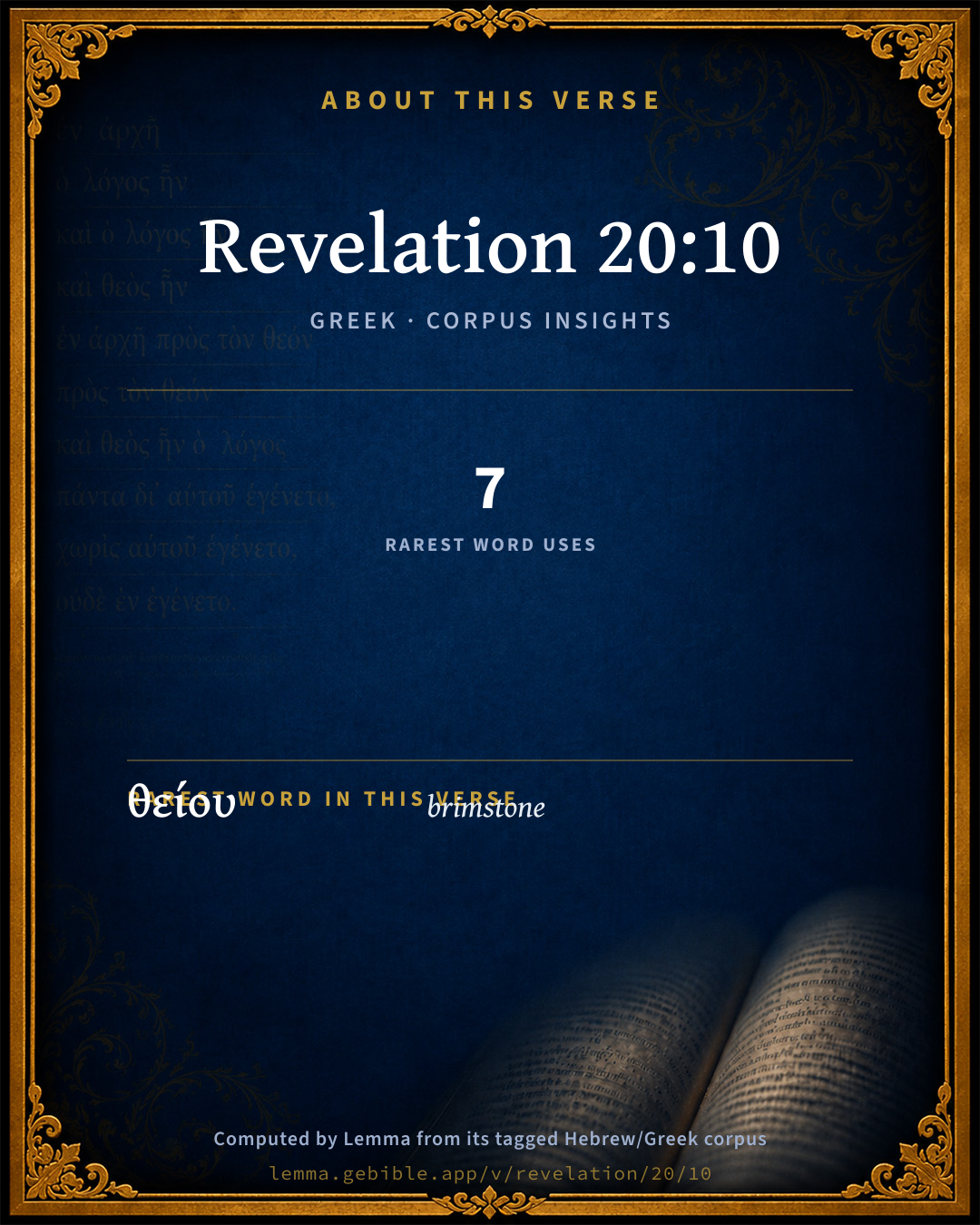
Revelation 20:10

Greek (Tischendorf 8th ed.) Revelation 20:10 appears in the Greek New Testament. The text above is from the Tischendorf 8th edition. Each word links to its Strong’s number and a concise gloss. Click any word for its full Thayer’s Greek Lexicon entry.
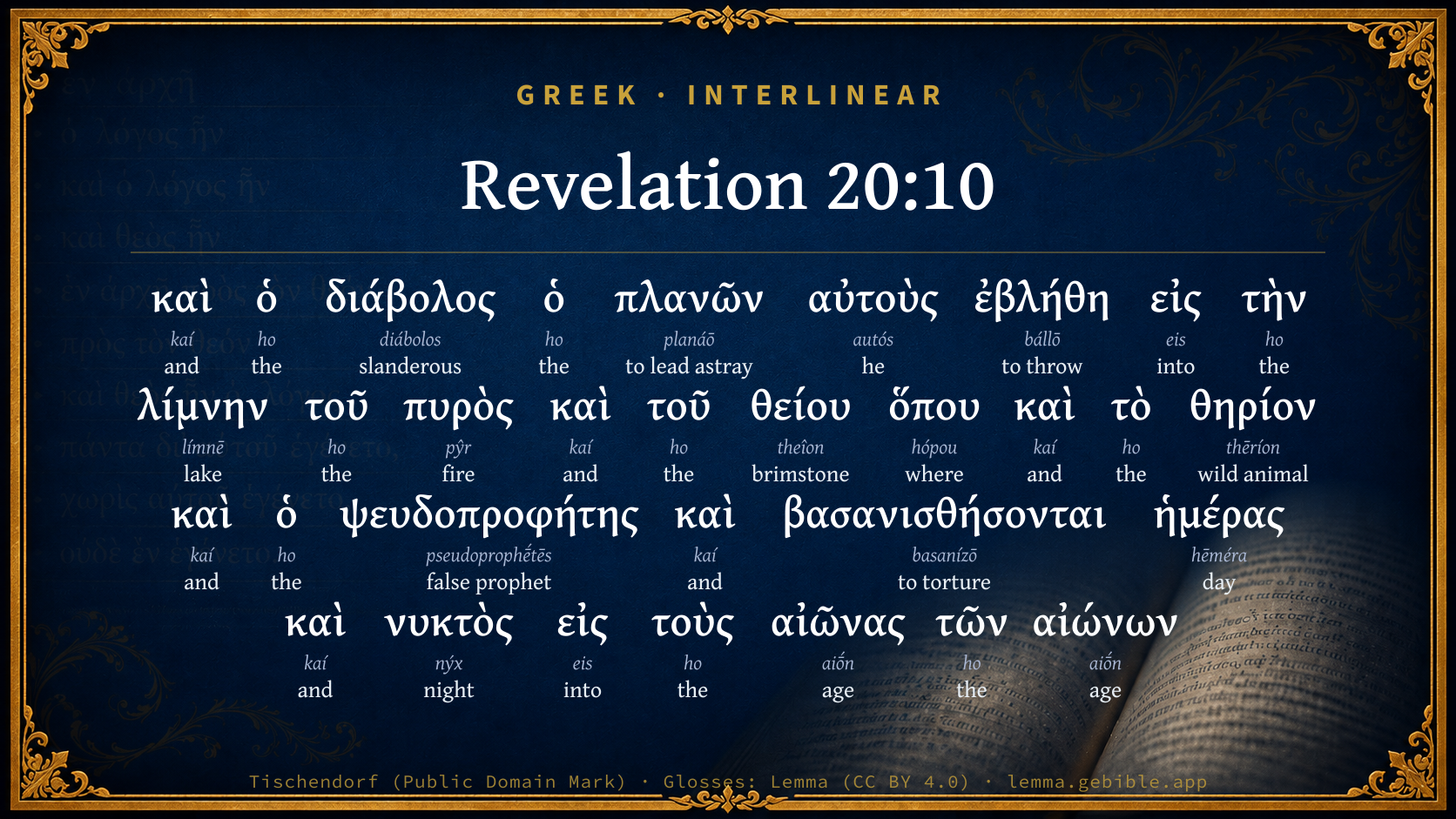
Download image
Cite this verse

Revelation 20:10 (World English Bible). Public Domain. Lemma interlinear Bible study tool, https://lemma.gebible.app/v/revelation/20/10.

Show BibTeX & RIS
BibTeX
RIS
English Translation
The devil who deceived them was thrown into the lake of fire and sulfur, where the beast and the false prophet are also. They will be tormented day and night forever and ever.
World English Bible · Public Domain
Download a study sheet

One document with this verse’s original text, its word-by-word gloss line, the meaning frame, cross-references with their text, attributed commentary, and full source and license credits — printable, and it pastes into notes with its structure intact.

This verse Autodidact and up

Study sheet (.html) Plain text (.txt)

A passage Seminary Student

Up to 50 verses in one chapter. A passage sheet keeps up to 6 commentary sources and 12 cross-references per verse, in the order this page ranks them, and says so on the sheet whenever that leaves anything out. Ask for a single verse and you get the Autodidact verse sheet above.

Everything on this page stays free to read, with no account — the sheet is a download of what is already on screen, not access to it.

Want to remove ads? Support Godless Engineer
Compare translations 3

The same verse in 3 English versions, stacked beneath the original-language interlinear above. Click any original word for its lexicon entry.

Each is an independent rendering of the whole verse — the interlinear is not word-aligned to these translations.

Highlighted words mark where these versions differ — a whole-verse word diff, not a word-by-word alignment.

  • World English Bible Public Domain
    The devil who deceived them was thrown into the lake of fire and sulfur, where the beast and the false prophet are also. They will be tormented day and night forever and ever.
  • King James Version Public Domain
    And the devil that deceived them was cast into the lake of fire and brimstone, where the beast and the false prophet are, and shall be tormented day and night for ever and ever.
  • unfoldingWord Literal Text CC BY-SA 4.0
    And the devil deceiving them was thrown into the lake of fire and sulfur where the beast and the false prophet, and they will be tormented day and night to the ages of the ages.

unfoldingWord Literal Text — © unfoldingWord, licensed CC BY-SA 4.0. Word-aligned USFM3 via Door43 (git.door43.org/unfoldingWord/en_ult).

Versions to compare (up to 4)

3 of 4 selected

Show all 19 translations

Every available English version of this verse, each an independent rendering of the whole verse.

  • World English Bible Public Domain
    The devil who deceived them was thrown into the lake of fire and sulfur, where the beast and the false prophet are also. They will be tormented day and night forever and ever.
  • Berean Standard Bible Public Domain
    And the devil who had deceived them was thrown into the lake of fire and sulfur, into which the beast and the false prophet had already been thrown. There they will be tormented day and night forever and ever.
  • Majority Standard Bible Public Domain
    And the devil who had deceived them was thrown into the lake of fire and sulfur, into which the beast and the false prophet had already been thrown. There they will be tormented day and night forever and ever.
  • King James Version Public Domain
    And the devil that deceived them was cast into the lake of fire and brimstone, where the beast and the false prophet are, and shall be tormented day and night for ever and ever.
  • American Standard Version (1901) Public Domain
    And the devil that deceived them was cast into the lake of fire and brimstone, where are also the beast and the false prophet; and they shall be tormented day and night for ever and ever.
  • Revised Version (1885) Public Domain
    And the devil that deceived them was cast into the lake of fire and brimstone, where are also the beast and the false prophet; and they shall be tormented day and night for ever and ever.
  • Geneva Bible (1599) Public Domain
    And the deuill that deceiued them, was cast into a lake of fire and brimstone, where that beast and that false prophet are, and shall be tormented euen day and night for euermore.
  • Douay-Rheims (1899) Public Domain
    And the false prophet shall be tormented day and night for ever and ever.
  • Young's Literal Translation Public Domain
    and the Devil, who is leading them astray, was cast into the lake of fire and brimstone, where `are' the beast and the false prophet, and they shall be tormented day and night -- to the ages of the ages.
  • Literal Standard Version CC BY-SA 4.0
    and the Devil, who is leading them astray, was cast into the lake of fire and brimstone where the beast and the false prophet [are], and they will be tormented day and night through the ages of the ages.
  • Unlocked Literal Bible CC BY-SA 4.0
    The devil, who deceived them, was thrown into the lake of burning sulfur, where the beast and the false prophet had been thrown. They will be tormented day and night forever and ever.
  • unfoldingWord Literal Text CC BY-SA 4.0
    And the devil deceiving them was thrown into the lake of fire and sulfur where the beast and the false prophet, and they will be tormented day and night to the ages of the ages.
  • Darby Bible Public Domain
    And the devil who deceived them was cast into the lake of fire and brimstone, where [are] both the beast and the false prophet; and they shall be tormented day and night for the ages of ages.
  • World Messianic Bible Public Domain
    The devil who deceived them was thrown into the lake of fire and sulfur, where the beast and the false prophet are also. They will be tormented day and night forever and ever.
  • Webster's Bible Public Domain
    And the devil that deceived them was cast into the lake of fire and brimstone, where the beast and the false prophet are, and shall be tormented day and night for ever and ever.
  • Free Bible Version CC BY-SA 4.0
    The devil, who had deceived them, was thrown into the lake of fire and sulfur where the beast and the false prophet had also been thrown, and they will suffer in anguish day and night for ever and ever.
  • Bible in Basic English Public Domain
    And the Evil One who put them in error was sent down into the sea of ever-burning fire, where the beast and the false prophet are, and their punishment will go on day and night for ever and ever.
  • Text-Critical English NT CC BY 4.0
    And the devil, who had deceived them, was thrown into the lake of fire and sulfur, where the beast and the false prophet had been thrown, and they will be tormented day and night forever and ever.
  • Tyndale New Testament (1534) Public Domain
    and the devyll that desceaved them was cast into a lake of fyre and brymstone where the beest and the falce prophet were and shalbe tormented daye and nyght for ever more.

Literal Standard Version (2020), Covenant Press — licensed CC BY-SA 4.0. Text via the HelloAO Bible API (eBible.org). Unlocked Literal Bible (unfoldingWord) — licensed CC BY-SA 4.0. Text via the HelloAO Bible API (eBible.org). unfoldingWord Literal Text — © unfoldingWord, licensed CC BY-SA 4.0. Word-aligned USFM3 via Door43 (git.door43.org/unfoldingWord/en_ult). Free Bible Version, Dr. Jonathan Gallagher — licensed CC BY-SA 4.0. Text via the HelloAO Bible API (eBible.org).

Word by word

More ways to search: Search by grammar → Find every occurrence → Compare this word →

Practice this passage: Drill this verse → Learn its vocabulary →

θείου
theîon
G2303
“brimstone”
Noun, Genitive, Singular, Neuter
Part of Speech
Noun
Case
Genitive
Number
Singular
Gender
Neuter
Full Thayer's Definition

Origin: probably of G2304 (in its original sense of flashing)

TDNT: 3:122,*

1. brimstone a. divine incense, because burning brimstone was regarded as having power to purify, and to ward off disease
  1. καὶ kaí G2532 “and” Conjunction
  2. ὁ ho G3588 “the” Article, Nominative, Singular, Masculine
  3. διάβολος diábolos G1228 “slanderous” Adjective, Nominative, Singular, Masculine
  4. ὁ ho G3588 “the” Article, Nominative, Singular, Masculine
  5. πλανῶν planáō G4105 “to lead astray” Verb, Present, Active, Participle, Nominative, Singular, Masculine
  6. αὐτοὺς autós G846 “he” Personal pronoun, Accusative, Plural, Masculine
  7. ἐβλήθη bállō G906 “to throw” Verb, Aorist, Passive, Indicative, 3rd person, Singular
  8. εἰς eis G1519 “into” Preposition
  9. τὴν ho G3588 “the” Article, Accusative, Singular, Feminine
  10. λίμνην límnē G3041 “lake” Noun, Accusative, Singular, Feminine
  11. τοῦ ho G3588 “the” Article, Genitive, Singular, Neuter
  12. πυρὸς pŷr G4442 “fire” Noun, Genitive, Singular, Neuter
  13. καὶ kaí G2532 “and” Conjunction
  14. τοῦ ho G3588 “the” Article, Genitive, Singular, Neuter
  15. ὅπου hópou G3699 “where” Adverb
  16. καὶ kaí G2532 “and” Conjunction
  17. τὸ ho G3588 “the” Article, Nominative, Singular, Neuter
  18. θηρίον thēríon G2342 “wild animal” Noun, Nominative, Singular, Neuter
  19. καὶ kaí G2532 “and” Conjunction
  20. ὁ ho G3588 “the” Article, Nominative, Singular, Masculine
  21. ψευδοπροφήτης pseudoprophḗtēs G5578 “false prophet” Noun, Nominative, Singular, Masculine
  22. καὶ kaí G2532 “and” Conjunction
  23. βασανισθήσονται basanízō G928 “to torture” Verb, Future, Passive, Indicative, 3rd person, Plural
  24. ἡμέρας hēméra G2250 “day” Noun, Genitive, Singular, Feminine
  25. καὶ kaí G2532 “and” Conjunction
  26. νυκτὸς nýx G3571 “night” Noun, Genitive, Singular, Feminine
  27. εἰς eis G1519 “into” Preposition
  28. τοὺς ho G3588 “the” Article, Accusative, Plural, Masculine
  29. αἰῶνας aiṓn G165 “age” Noun, Accusative, Plural, Masculine
  30. τῶν ho G3588 “the” Article, Genitive, Plural, Masculine
  31. αἰώνων aiṓn G165 “age” Noun, Genitive, Plural, Masculine

About this verse

These counts appear in no published source. They are computed here, from the morphology-tagged text and Lemma’s own curated glosses. What Lemma adds →

32
words
17
distinct lemmas
Revelation
section

Notable vocabulary

The rarest word here is θείου brimstone G2303 — appearing just 7 times in the whole Greek New Testament.

Shared distinctive vocabulary

θείου brimstone G2303 occurs in 7 verses of the Greek New Testament. Also found in:

Repetition

Words recur within this verse:

Cross-references

8

Topical passages linked to Revelation 20:10 in the Treasury of Scripture Knowledge — connected by theme and wording, ordered by reader-vote popularity; previews shown in the World English Bible.

  • Matthew 25:41 Then he will say also to those on the left hand, 'Depart from me, you cursed, into the eternal fire which is prepared for the devil and his angels;
  • Revelation 19:20 The beast was taken, and with him the false prophet who worked the signs in his sight, with which he deceived those who had received the mark of the beast and those who worshiped his image. These two were thrown alive into the lake of fire that burns with sulfur.
  • Matthew 25:46 These will go away into eternal punishment, but the righteous into eternal life."
  • Revelation 20:2–3 He seized the dragon, the old serpent, which is the devil and Satan, who deceives the whole inhabited earth, and bound him for a thousand years,
  • Revelation 20:14–15 Death and Hades were thrown into the lake of fire. This is the second death, the lake of fire.
  • Revelation 20:8 and he will come out to deceive the nations which are in the four corners of the earth, Gog and Magog, to gather them together to the war; the number of whom is as the sand of the sea.
  • Revelation 14:10–11 he also will drink of the wine of the wrath of God, which is prepared unmixed in the cup of his anger. He will be tormented with fire and sulfur in the presence of the holy angels, and in the presence of the Lamb.
  • Revelation 16:13 I saw coming out of the mouth of the dragon, and out of the mouth of the beast, and out of the mouth of the false prophet, three unclean spirits, something like frogs;

Cross-references courtesy of OpenBible.info (CC BY 4.0).

Commentary

Notes on Revelation 20:10 from classic Christian and Jewish commentators (each source and its license shown beneath its notes). The classic Christian expositions comment on the surrounding passage and are grouped to its opening verse, so a note may address several verses; the Jewish commentaries on the Tanakh (Rashi and others) are per-verse, so they appear only where the commentator wrote on this verse.

Lemma curates 59 commentaries, every one of them public domain or Creative Commons licensed, each selected and text-cleaned for this edition rather than reprinted as found. About our sources →

Tyndale Open Study Notes

Tyndale Open Resources

20:10 they will be tormented . . . forever: Rebellion against God has eternal consequences. While the concept of unending punishment repulses some, it is the message of Revelation and of Scripture generally that God will deal sternly with sin and rebellion by those who reject Christ’s saving work (see Matt 13:42; 25:41-46; John 3:18, 36; Rom 2:7). Perhaps more than any book in Scripture, Revelation illustrates that the unrepentant persist in their rebellion despite the consequences (Rev 9:20-21; 16:9-11; cp. Luke 16:31). Revelation also emphasizes that God is just and deals with sin as it deserves.

Tyndale Open Study Notes — © Tyndale Open Resources, licensed CC BY-SA 4.0. Text via the HelloAO Bible API.

Bengel's Gnomon

Johann Albrecht Bengel

Rev 20:10. Καὶ βασανισθήσονται) The more recent Latin copies badly omit καὶ:[221] and thence construe it thus, where both the beast and the false prophet shall be tormented; as though the devil himself were not to be tormented. The purity of the text is the more to be defended in this place, lest the casting of the beast and the false prophet into the lake of fire previously to that of the devil should be obliterated, whereas the particle καὶ necessarily infers it. [Not until now does the punishment of Satan commence. Until this limit he continues to sin without restraint, if you except his imprisonment during the thousand years, during which there is an interruption of his worst doings.—V. g.]

[221] A Vulg. and Rec. Text support καί; h omits it: also it and Vulg. read the plur. pseudoprophetæ.—E.

Bengel's Gnomon of the New Testament — English translation (T&T Clark, Edinburgh, 1860) — public domain. Text from a community e-Sword module.

Geneva Bible (1599)

Geneva Bible translators

The third member, eternal destruction against those that are overcome: as I noted in the same place.

Geneva Bible (1599) marginal notes — public domain. Text via Bolls.life.

Jamieson, Fausset & Brown

Robert Jamieson, A. R. Fausset & David Brown

that deceived--Greek, "that deceiveth."

lake of fire--his final doom: as "the bottomless pit" (Rev 20:1) was his temporary prison.

where--so Coptic. But A, B, Vulgate, and Syriac read, "where also."

the beast and the false prophet are-- (Rev 19:20).

day and night--figurative for without intermission (Rev 22:5), such as now is caused by night interposing between day and day. The same phrase is used of the external state of the blessed (Rev 4:8). As the bliss of these is eternal, so the woe of Satan and the lost must be. As the beast and the false prophet led the former conspiracy against Christ and His people, so Satan in person heads the last conspiracy. Satan shall not be permitted to enter this Paradise regained, to show the perfect security of believers, unlike the first Adam whom Satan succeeded in robbing of Paradise; and shall, like Pharaoh at the Rod Sea, receive in this last attempt his final doom.

for ever and ever--Greek, "to the ages of the ages."

Jamieson, Fausset & Brown — Commentary Critical and Explanatory on the Whole Bible (1871) — public domain (CC PDM 1.0). Text via the HelloAO Bible API.

Adam Clarke's Commentary

Verse 10. And the devil-was cast onto the lake] Before Satan was bound, that is, his power was curtailed and restrained; now, he is cast into the lake of fire, his power being totally taken away.

Adam Clarke's Commentary on the Bible (1810–1826) — public domain. Text from a community e-Sword/MySword module.

Ellicott's Commentary for English Readers

(10) And the devil that deceived them . . .—Better, And the devil that deceiveth them, or was deceiving them, was cast into the lake of fire and brimstone, where are also the wild beasts and the false prophet; and they shall be tormented by day and by night unto the ages of the ages. The devil cast from heaven (Rev_12:9), bound in the abyss (Rev_20:3), is now flung into the flaming lake. There they (i.e., the devil, the wild beast, and the false prophet) are tormented unto the ages of ages. (Comp. Rev_14:10-11; and Note on Rev_19:20.)

THE JUDGMENT OF THE WORLD.—The three enemies have been overthrown and driven forth from the earth which they have sought to destroy (Rev_11:18). The judgment of human beings must follow.

A Bible Commentary for English Readers, edited by Charles John Ellicott (1878–1897) — public domain. Text from a community e-Sword module.

The Cambridge Bible for Schools and Colleges

gen. ed. J. J. S. Perowne

10. And the devil that deceived them] Lit. that deceiveth, but the sense is general: as if we were to say “their deceiver.”

into the lake &c.] Rev_19:20.

where] Read, where also.

the beast and the false prophet are] It might be better to supply were cast. That they are there still, not consumed by their more than thousand years of torment, is not stated in this clause but is in the next.

shall be &c.] To prevent ambiguity we should render, they shall be, all three of them.

for ever and ever] Lit. to the ages of the ages, as strong an expression for absolute endlessness as Biblical language affords. The expression “day and night” seems hardly consistent with the view often expressed, that the eternity here spoken of is unaccompanied with a sense of duration like that which we call time.

The Cambridge Bible for Schools and Colleges (gen. ed. J. J. S. Perowne; Cambridge University Press, 1878–1918) — public domain. Text from a community e-Sword module.

John Gill's Exposition

And the devil that deceived them,.... Both before death, in the present life, by tempting and drawing them into immorality and profaneness, or idolatry, superstition, and will worship, or persecution of the saints; and after their resurrection, by instigating them to make this foolish attempt upon the saints of the most High:

was cast into the lake of fire and brimstone; the same with the everlasting fire, prepared for the devil and his angels; this will be his full torment, in which he is not as yet; and this will not be until the judgment is finished hereafter described; though it is here mentioned to issue the account of Satan at once, and to show what will be his final state and condition:

where the beast and false prophet are; Rev 19:20 who for so many years have been companions in wickedness together; the beast being the first beast that received his power, seat, and authority from the dragon, or devil; the false prophet being the second beast, or antichrist in his ecclesiastical capacity, as the beast is antichrist in his civil power, whose coming is after the working of Satan, with signs and lying wonders:

and shall be tormented day and night for ever and ever; that is, not only the devil, but the beast and false prophet, for the word is in the plural number: and this will be the case of all wicked men, of all whose minds are enmity to God and Christ, and to his people; and is a proof of the eternity of hell torments.

John Gill's Exposition of the Whole Bible (1746–1763) — public domain (CC PDM 1.0). Text via the HelloAO Bible API.

Trapp's Complete Commentary

John Trapp

10 And the devil that deceived them was cast into the lake of fire and brimstone, where the beast and the false prophet are, and shall be tormented day and night for ever and ever.

Ver. 10. And the devil] This Mr Brightman interprets of the Turk, called here the devil, because instigated and set awork by the devil. Albeit another learned expositor is of opinion, that by the fall of the beast and conversion of the Jews, the Turks and other states of the East shall be brought to embrace the gospel, being first taught thereto by some notable foil. What to think of this I know not; but cannot but like well of Diodate’s note upon Rev 20:4; that in all this prophecy it is better and more sure to expect and stay for the explication by the event than to give it without any certain ground.

And shall be tormented] Gr. βασανισθησονται, racked. The devil and the damned have punishment without pity, misery without mercy, sorrow without succour, crying without comfort, mischief without measure, torments without end and past imagination.

For ever and ever] This is as another hell in the midst of hell, and forceth them to cry, ουαι, ουαι, " woe, woe," as if they should say, ουκ αει, ουκ αει, "not ever, not ever, Lord." Whereto conscience answereth as an echo, αει, αει, "ever, ever." Hence that doleful ουαι, "woe and alas" for evermore.

John Trapp, A Commentary or Exposition upon All the Books of the Old and New Testament (1647–1656) — public domain. Text from a community e-Sword module.

Albert Barnes' Notes on the Bible

And the devil that deceived them - See the notes on Rev 20:3, Rev 20:8.

Was cast into the lake of fire and brimstone - In Rev 19:20, it is said of the beast and the false prophet that they were “cast alive into a lake of fire, burning with brimstone.” Satan, on the other hand, instead of being doomed at once to that final ruin, was confined for a season in a dark abyss, Rev 20:1-3. As the final punishment, however, he is appropriately represented as consigned to the same doom as the beast and the false prophet, that those great enemies of God, that had been associated and combined in deceiving the nations, might share the same appropriate punishment in the end. Compare Rev 16:13-14.

Where the beast and the false prophet are - See the notes on Rev 19:20.

And shall be tormented day and night forever - Compare the notes on Rev 14:11. All the great enemies of the church are destroyed, and henceforward there is to be no array of hostile forces; no combination of malignant powers against the kingdom of God. The gospel triumphs; the way is prepared for the final consummation.

Section d. - Condition of things in the period referred to in Rev 20:9-10;

(1) There will be, after the release of Satan, and of course at the close of the millennial period properly so called, a state of things which may be well represented by the invasion of a country by hostile, formidable forces. This, as shown in the exposition, need not be supposed to be literal; but it is implied that there will be decided hostility against the true religion. It may be an organization and consolidation, so to speak, of infidel principles, or a decided worldly spirit, or some prevalent form of error, or some new form of depravity that shall be developed by the circumstances of that age. What it will be it is impossible now to determine; but, as shown above (section c, (4)), it is by no means improbable that this will occur even at the close of the millennium.

(2) There will be a decided defeat of these forces thus combined, “as if” fire should come down from heaven to destroy an invading army. The “mode” in which this will be done is not indeed stated, for there is no necessity of understanding the statement in Rev 20:9 “literally,” anymore than the other parts of the chapter. The fair inference, however, is that it will be by a manifest divine agency; that it will be sudden, and that the destruction will be entire. We have no reason, therefore, to suppose that the outbreak will be of long continuance, or that it will very materially disturb the settled order of human affairs on the earth - anymore than a formidable invasion of a country does, when the invading army is suddenly cut off by some terrible judgment from heaven.

(3) This overthrow of the enemies of God and of the church will be “final.” Satan will be “cast into the lake of fire and brimstone, to be tormented day and night forever.” The beast and the false prophet are already there Rev 19:20; that is, they will have ceased long since, even before the beginning of the millennial period (Rev 19:20, compared with Rev 20:1-3), to have opposed the progress of truth in the world, and their power will have been brought to an end. Satan now, the last enemy, will be doomed to the same hopeless woe; and all the enemies that have ever opposed the church - in all forms of paganism, Mohammedanism, Popery, and delusion - will be destroyed forever. The world then will have peace; the church will have rest; the great triumph will have been achieved.

(4) For reasons stated in the analysis of the chapter, 5. (c), it is possible that there will be a long period of continued prosperity and peace between the events stated in Rev 20:9-10, and the final judgment, as described in Rev 20:11-15. If so, however, the purpose of the book did not require that that should be described at length, and it must be admitted that the most “obvious” interpretation of the New Testament would not be favorable to such a supposition. Compare Luk 17:26-30; Luk 18:8; 1Th 5:2, 1Th 5:3; 2Pe 3:3-4. The great glory of the world will be the millennial period; when religion shall have the ascendency and the race shall have reached its highest point of progress on earth, and the blessings of liberty, intelligence, peace, and piety, shall have during that period been spread over the globe. In that long duration, who can estimate the numbers that shah be redeemed and saved? That period passed, the great purpose contemplated by the creation of the earth - the glory of God in the redemption of a fallen race, and in setting up a kingdom of righteousness in a world of apostasy - will have been accomplished, and there will be no reason why the final judgment should not then occur. “The work of redemption will now be finished. The end for which the means of grace have been instituted shall be obtained. All the effect which was intended to be accomplished by them shall now be accomplished. All the great wheels of Providence have gone round all things are ripe for Christ’s coming to judgment” (President Edwards’ History of Redemption).

Albert Barnes' Notes on the Bible (1834–1885) — public domain. Text from a community e-Sword/MySword module.

Matthew Poole's English Annotations

After this shall be the end of the world, when the devil shall be restrained to hell, the place of torments, where he shall have all heathens, and all the rabble of antichrist, who shall be there tormented constantly and for ever and ever.

Matthew Poole's English Annotations on the Holy Bible (1683–1685) — public domain. Text from a community e-Sword/MySword module.

Whedon's Commentary on the Bible

Daniel D. Whedon

10. Beast and false prophet—Of this antichristic triad two are allegorical persons, and the third only a literal. It might seem that their fate must be literal cessation of existence, and no consciousness of torment. The for ever and ever, literally taken, can only signify that for them there should never be reversal of their doom. Yet, as figurative persons, they are figuratively held to suffer, as truly as to be slain, in the last chapter; and so their doom is ideally held to be eternal.

Day and night—Figuratively representing ceaselessness, even after day and night have forever ceased.

Daniel D. Whedon (gen. ed.), Commentary on the Old and New Testaments (1874–1909) — public domain. Text from a community e-Sword module.

The Pulpit Commentary

And the devil that deceived them was cast into the lake of fire and brimstone, where the beast and the false prophet are, and shall be tormented day and night forever and ever; and they shall be tormented. The last clause shows that this is the final judgment and punishment of the devil. Thus at this verse is completed the whole series of visions commencing at Re 12, in which arc set forth the origin and progress of the influence of evil, and the final termination of the conflict between God and his Church on the one hand, and the devil and his adherents on the other. It remains now only to shadow forth the surpassing glory of the saints in their everlasting home, and thus to bring the book to a conclusion. This, therefore, is the theme of the remaining chapters. (On "the devil that deceiveth them," see on ver. 3; and on "the lake of fire and brimstone," see on Rev_19:20) Shall be tormented. (cf. Mat_8:29, "Art thou come hither to torment us before the time?

The Pulpit Commentary (1880–1919), ed. H.D.M. Spence-Jones & Joseph S. Exell — public domain. Text from a community e-Sword module.

John Wesley's Explanatory Notes

And they - All these. Shall be tormented day and night - That is, without any intermission. Strictly speaking, there is only night there: no day, no sun, no hope!

John Wesley, Explanatory Notes Upon the Whole Bible (1754–1765) — public domain. Text via the GEBible commentary corpus.

Scofield Reference Notes

C. I. Scofield

devil

Satan, Summary: This fearful being, apparently created one of the cherubim (See Scofield "Eze 1:5") See Scofield "Eze 28:12" and anointed for a position of great authority, perhaps over the primitive creation, (note 3); See Scofield "Gen 1:2" Eze 28:11-15 fell through pride Isa 14:12-14 His "I will" Isa 14:13 marks the introduction of sin into the universe. Cast out of heaven Luk 10:18 he makes earth and air the scene of his tireless activity; Eph 2:2; 1Pe 5:8. After the creation of man he entered into the serpent. See Scofield "Gen 3:1", and, beguiling Eve by his subtilty, secured the downfall of Adam and through him of the race, and the entrance of sin into the world of men Rom 5:12-14.

The Adamic Covenant (See Scofield "Gen 3:14") promised the ultimate destruction of Satan through the "Seed of the woman." Then began his long warfare against the work of God in behalf of humanity, which still continues. The present world-system Rev 13:8 organized upon the principle of force, greed, selfishness, ambition, and sinful pleasure, is his work and was the bribe which he offered to Christ Mat 4:8; Mat 4:9. Of that world-system he is prince; Joh 14:30; Joh 16:11 and god 2Co 4:4. As "prince of the power of the air" Eph 2:2 he is at the head of vast host of demons. See Scofield "Mat 7:22". To him, under God, was committed upon earth the power of death Heb 2:14. Cast out of heaven as his proper sphere and "first estate," he still has access to God as the "accuser of the brethren" Rev 12:10 and is permitted a certain power of sifting or testing the self-confident and carnal among believers; Job 1:6-11; Luk 22:31; Luk 22:32; 1Co 5:5; 1Ti 1:20 but this is strictly permissive and limited power, and believers so sifted are kept in faith through the advocacy of Christ Luk 22:31; Luk 22:32. See Scofield "1Jn 2:1". At the beginning of the great tribulation Satan’s privilege of access to God as accuser will be withdrawn Rev 12:7-12. At the return of Christ in glory Satan will be bound for one thousand years Rev 20:2 after which he will be "loosed for a little season" Rev 20:3; Rev 20:7; Rev 20:8 and will become the head of final effort to overthrow the kingdom. Defeated in this, he will be finally cast into the lake of fire, his final doom. The notion that he reigns in hell is Miltonic, not biblical. He is prince of this present world-system, but will be tormented in the lake of fire.

The Scofield Reference Bible (1917 edition), notes by C. I. Scofield — public domain. Text from a community e-Sword module.

The People's New Testament

B. W. Johnson

10. And the devil that deceived them was cast into the lake of fire. This is Satan's last battle. His time has come. The great deceiver is not cast into the bottomless pit now. The lake of fire is opened, and we discover there the beast and the false prophet, but they have gone whence none ever return. There the devil is cast in and locked up to abide with his allies in wickedness forever.

B. W. Johnson's The People's New Testament with Notes (1889–1891) — public domain. Electronic text from the Christian Classics Ethereal Library (CCEL) ThML edition.

Cambridge Greek Testament for Schools and Colleges

10. ὅπου καί. Text. Rec[773] omits καὶ with א 1 Hieron[774] cop[775] arm[776] æth[777][773] Rec. Textus Receptus as printed by Scrivener.

[774] St Jerome.

[775] Coptic.

[776] Armenian.

[777] Aethiopic Version.

θηρίον καί. א adds ὅπου.

10. ὁ πλανῶν αὐτούς. The sense is general, as if we were to say “their deceiver.”

εἰς τὴν λίμνην. Rev 19:20.

ὃπου καὶ … If we are to try to fill up the ellipse, which no reader of the original would feel necessary, ἐβλήθησαν would be better than εἰσίν. That they are there still, not consumed by their more than thousand years of torment, is not stated in this clause, but is in the next.

καὶ βασανισθήσονται. The subject is all three.

εἰς τοὺς αἰῶνας τῶν αἰώνων. Lit. “to the ages of the ages,” as strong an expression for absolute endlessness as Biblical language affords. The expression “ἡμέρας καὶ νυκτὸς” seems hardly consistent with the view often expressed, that the eternity here spoken of is unaccompanied with a sense of duration like that which we call time.

St Thomas Aquinas who inferred from Rev 10:6 that time (measured by the motion of heavenly bodies) will end with the resurrection, and from Isa 60:20 that the sun and moon of the new heavens will never set, also inferred from Job 24:19 “ad nimium calorem transeat ab aquis nivium” that the lost would have a change of torments, and that this decides the sense of Psa 80:16 (Psa 81:15), “Inimici Domini mentiti sunt ei, et erit tempus eorum in saecula,” so that the lost live in everlasting time, while the blessed who see God are partakers of His eternity which is whole at every instant, Summa, Pars Prima, Quaestio x. Artic. 3, 6. Not that this eternal blessedness excludes a succession of subordinate delights. St Augustin half hoped, De Trin. xv. [xvi.] 26, that in the saints the endless round of changing thought would be still at last, St Thomas (ubi sup.) answers that it would not affect their changeless vision of the changeless Word. So too the glorified body will range at will through space to behold all the beautiful things God has made without leaving His presence. Sup. 3, Tertiae Partis Quaest. lxxxiv. Artic. 2. Respect for St Thomas’ view may have led the translators of the Bible and the “Athanasian Creed” to introduce what has struck many as an arbitrary distinction between everlasting punishment and life eternal.

Cambridge Greek Testament for Schools and Colleges (Cambridge University Press, 1896; 21 vols, various authors incl. Carr, Maclear, Plummer, Farrar, Lumby, Moule, M. R. James, Simcox) — public domain. Text from a community e-Sword module.

Lesson kit

Teaching starters — assembled from the data on this page, not authored interpretation. Every prompt links to the verse data it draws on. Edit before teaching.

Revelation, in the Revelation, opens this verse with 32 words (17 distinct Greek lemmas). Its most distinctive word is theîon (“brimstone”). A historical commentator’s framing appears above. Read the whole chapter for the surrounding context.

Discussion questions

  1. How does “brimstone” (theîon) shape what this verse is saying?
  2. Luke 17:29 shares the word «brimstone» with this verse. How do the two illuminate each other?
  3. “into” occurs 2× in this one verse. What is the effect of the repetition?
  4. These translations render this verse differently. What is at stake in choosing one wording over another?
  5. Reading how Tyndale Open Study Notes and Bengel's Gnomon read this verse, where do the two commentators agree and where do they part?

Things to notice

Reading settings

Reading text

Shown beneath each verse's original-language words.

Old Testament
Old Testament edition

Read the OT as the Masoretic Hebrew (MT) or the Greek Septuagint (LXX).

English shown for the Greek Septuagint (in the Hebrew ↔ Greek comparison).

Comparing translations? Open the Compare panel on any verse page to stack up to four side by side.