
Joshua 14:9

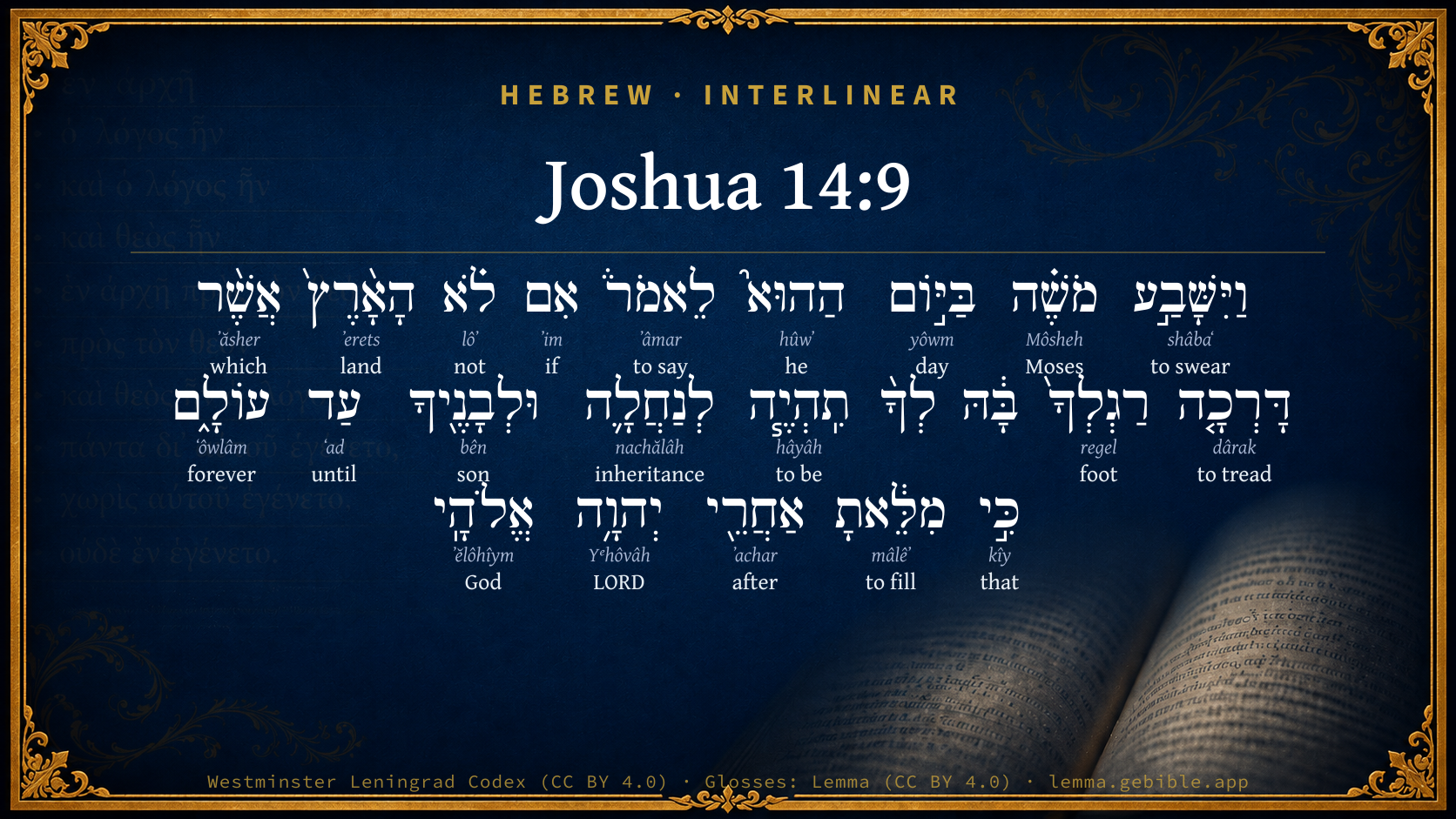
Hebrew (Westminster Leningrad Codex) Joshua 14:9 appears in the Hebrew Old Testament. The text above is from the Westminster Leningrad Codex. Each word links to its Strong’s number, a concise gloss, and parsing drawn from the Open Scriptures Hebrew Bible morphology. Click any word for its full Brown-Driver-Briggs (BDB) entry.
Download image
Cite this verse

Joshua 14:9 (World English Bible). Public Domain. Lemma interlinear Bible study tool, https://lemma.gebible.app/v/joshua/14/9.

Show BibTeX & RIS
BibTeX
RIS
English Translation
Moses swore on that day, saying, Surely the land whereon your foot has trodden shall be an inheritance to you and to your children forever, because you have wholly followed Yahweh my God.
World English Bible · Public Domain
Download a study sheet

One document with this verse’s original text, its word-by-word gloss line, the meaning frame, cross-references with their text, attributed commentary, and full source and license credits — printable, and it pastes into notes with its structure intact.

This verse Autodidact and up

Study sheet (.html) Plain text (.txt)

A passage Seminary Student

Up to 50 verses in one chapter. A passage sheet keeps up to 6 commentary sources and 12 cross-references per verse, in the order this page ranks them, and says so on the sheet whenever that leaves anything out. Ask for a single verse and you get the Autodidact verse sheet above.

Everything on this page stays free to read, with no account — the sheet is a download of what is already on screen, not access to it.

Want to remove ads? Support Godless Engineer
Compare translations 3

The same verse in 3 English versions, stacked beneath the original-language interlinear above. Click any original word for its lexicon entry.

Each is an independent rendering of the whole verse — the interlinear is not word-aligned to these translations.

Highlighted words mark where these versions differ — a whole-verse word diff, not a word-by-word alignment.

  • World English Bible Public Domain
    Moses swore on that day, saying, Surely the land whereon your foot has trodden shall be an inheritance to you and to your children forever, because you have wholly followed Yahweh my God.
  • King James Version Public Domain
    And Moses sware on that day, saying, Surely the land whereon thy feet have trodden shall be thine inheritance, and thy children's for ever, because thou hast wholly followed the LORD my God.
  • unfoldingWord Literal Text CC BY-SA 4.0
    And Moses swore on that day, saying, ‘If the land on which your foot has trodden will not be for an inheritance for you and for your sons unto forever, for you were full after Yahweh my God.’

unfoldingWord Literal Text — © unfoldingWord, licensed CC BY-SA 4.0. Word-aligned USFM3 via Door43 (git.door43.org/unfoldingWord/en_ult).

Versions to compare (up to 4)

3 of 4 selected

Show all 18 translations

Every available English version of this verse, each an independent rendering of the whole verse.

  • World English Bible Public Domain
    Moses swore on that day, saying, Surely the land whereon your foot has trodden shall be an inheritance to you and to your children forever, because you have wholly followed Yahweh my God.
  • Berean Standard Bible Public Domain
    On that day Moses swore to me, saying, ‘Surely the land on which you have set foot will be an inheritance to you and your children forever, because you have wholly followed the LORD my God.’
  • Majority Standard Bible Public Domain
    On that day Moses swore to me, saying, ‘Surely the land on which you have set foot will be an inheritance to you and your children forever, because you have wholly followed the LORD my God.’
  • King James Version Public Domain
    And Moses sware on that day, saying, Surely the land whereon thy feet have trodden shall be thine inheritance, and thy children's for ever, because thou hast wholly followed the LORD my God.
  • American Standard Version (1901) Public Domain
    And Moses sware on that day, saying, Surely the land whereon thy foot hath trodden shall be an inheritance to thee and to thy children for ever, because thou hast wholly followed Jehovah my God.
  • Revised Version (1885) Public Domain
    And Moses sware on that day, saying, Surely the land whereon thy foot hath trodden shall be an inheritance to thee and to thy children for ever, because thou hast wholly followed the LORD my God.
  • Geneva Bible (1599) Public Domain
    Wherefore Moses sware the same day, saying, Certainely the land whereon thy feete haue troden, shalbe thine inheritance, and thy childrens for euer, because thou hast followed constantly the Lord my God.
  • Douay-Rheims (1899) Public Domain
    And Moses swore in that day, saying: The land which thy foot hath trodden upon shall be thy possession, and thy children's for ever, because thou hast followed the Lord my God.
  • Young's Literal Translation Public Domain
    and Moses sweareth in that day, saying, If not -- the land on which thy foot hath trodden, to thee it is for inheritance, and to thy sons -- to the age, for thou hast been fully after Jehovah my God.
  • Literal Standard Version CC BY-SA 4.0
    and Moses swears in that day, saying, Nevertheless—the land on which your foot has trodden, it is to you for an inheritance, and to your sons—for all time, for you have been fully after my God YHWH.
  • Unlocked Literal Bible CC BY-SA 4.0
    Moses swore on that day, saying, 'Surely the land on which your foot has walked will be an inheritance for you and for your children forever, because you have completely followed Yahweh my God.'
  • unfoldingWord Literal Text CC BY-SA 4.0
    And Moses swore on that day, saying, ‘If the land on which your foot has trodden will not be for an inheritance for you and for your sons unto forever, for you were full after Yahweh my God.’
  • Darby Bible Public Domain
    And Moses swore on that day, saying, The land whereon thy feet have trodden shall assuredly be thine inheritance, and thy children's for ever! for thou hast wholly followed Jehovah my God.
  • World Messianic Bible Public Domain
    Moses swore on that day, saying, ‘Surely the land where you walked shall be an inheritance to you and to your children forever, because you have wholly followed the LORD my God.’
  • Webster's Bible Public Domain
    And Moses swore on that day, saying, Surely the land on which thy feet have trodden shall be thy inheritance, and thy children's for ever; because thou hast wholly followed the LORD my God.
  • Free Bible Version CC BY-SA 4.0
    At that time Moses made a solemn promise, telling me, ‘The land where you have walked will belong to you and your children forever, because you faithfully followed the Lord my God.’
  • Bible in Basic English Public Domain
    And on that day Moses took an oath, saying, Truly the land where your feet have been placed will become a heritage for you and your children for ever, because you have been true to the Lord your God with all your heart.
  • JPS Tanakh (1917) Public Domain
    And Moses swore on that day, saying: Surely the land whereon thy foot hath trodden shall be an inheritance to thee and to thy children for ever, because thou hast wholly followed the LORD my God.

Literal Standard Version (2020), Covenant Press — licensed CC BY-SA 4.0. Text via the HelloAO Bible API (eBible.org). Unlocked Literal Bible (unfoldingWord) — licensed CC BY-SA 4.0. Text via the HelloAO Bible API (eBible.org). unfoldingWord Literal Text — © unfoldingWord, licensed CC BY-SA 4.0. Word-aligned USFM3 via Door43 (git.door43.org/unfoldingWord/en_ult). Free Bible Version, Dr. Jonathan Gallagher — licensed CC BY-SA 4.0. Text via the HelloAO Bible API (eBible.org).

Word by word

More ways to search: Search by grammar → Find every occurrence → Compare this word →

Practice this passage: Drill this verse → Learn its vocabulary →

דָּרְכָ֤ה
dârak
H1869
“to tread”
Verb, Qal, Perfect, 3rd Person, Feminine, Singular
Part of Speech
Verb
Stem
Qal
Form
Perfect
Person
3rd Person
Gender
Feminine
Number
Singular
Full BDB Definition

Origin: a primitive root

TWOT: 453

to tread, bend, lead, march - (Qal) - to tread, march, march forth - to tread on, tread upon - to tread (a press) - to tread (bend) a bow - archer, bow-benders (participle) - (Hiphil) - to tread, tread down - to tread (bend with the foot) a bow - to cause to go, lead, march, tread
  1. וַיִּשָּׁבַ֣ע shâbaʻ H7650 “and · to swear” Conjunction + Verb, Niphal, Sequential Imperfect, 3rd Person, Masculine, Singular
  2. מֹשֶׁ֗ה Môsheh H4872 “Moses” Noun, Proper
  3. בַּיּ֣וֹם yôwm H3117 “in/at the · day” Preposition, Determined + Noun, Common, Masculine, Singular, Absolute
  4. הַהוּא֮ hûwʼ H1931 “the · he” Particle, Definite Article + Pronoun, Personal, 3rd Person, Masculine, Singular
  5. לֵאמֹר֒ ʼâmar H559 “to say” Preposition + Verb, Qal, Infinitive Construct
  6. אִם ʼim H518 “if” Conjunction
  7. לֹ֗א lôʼ H3808 “not” Particle, Negative
  8. הָאָ֨רֶץ֙ ʼerets H776 “the · land” Particle, Definite Article + Noun, Common, Both, Singular, Absolute
  9. אֲשֶׁ֨ר ʼăsher H834 “which” Particle, Relative
  10. רַגְלְךָ֙ regel H7272 “foot · your” Noun, Common, Feminine, Singular, Construct + Suffix, Personal, 2nd Person, Masculine, Singular
  11. תִֽהְיֶ֧ה hâyâh H1961 “to be” Verb, Qal, Imperfect, 3rd Person, Feminine, Singular
  12. לְנַחֲלָ֛ה nachălâh H5159 “to/for · inheritance” Preposition + Noun, Common, Feminine, Singular, Absolute
  13. וּלְבָנֶ֖יךָ bên H1121 “and · to/for · sons · your” Conjunction + Preposition + Noun, Common, Masculine, Plural, Construct + Suffix, Personal, 2nd Person, Masculine, Singular
  14. עַד ʻad H5704 “until” Preposition
  15. עוֹלָ֑ם ʻôwlâm H5769 “forever” Noun, Common, Masculine, Singular, Absolute
  16. כִּ֣י kîy H3588 “that” Conjunction
  17. מִלֵּ֔אתָ mâlêʼ H4390 “to fill” Verb, Piel, Perfect, 2nd Person, Masculine, Singular
  18. אַחֲרֵ֖י ʼachar H310 “after” Preposition
  19. יְהוָ֥ה Yᵉhôvâh H3068 “LORD” Noun, Proper
  20. אֱלֹהָֽי ʼĕlôhîym H430 “God(s) · my” Noun, Common, Masculine, Plural, Construct + Suffix, Personal, 1st Person, Common, Singular

About this verse

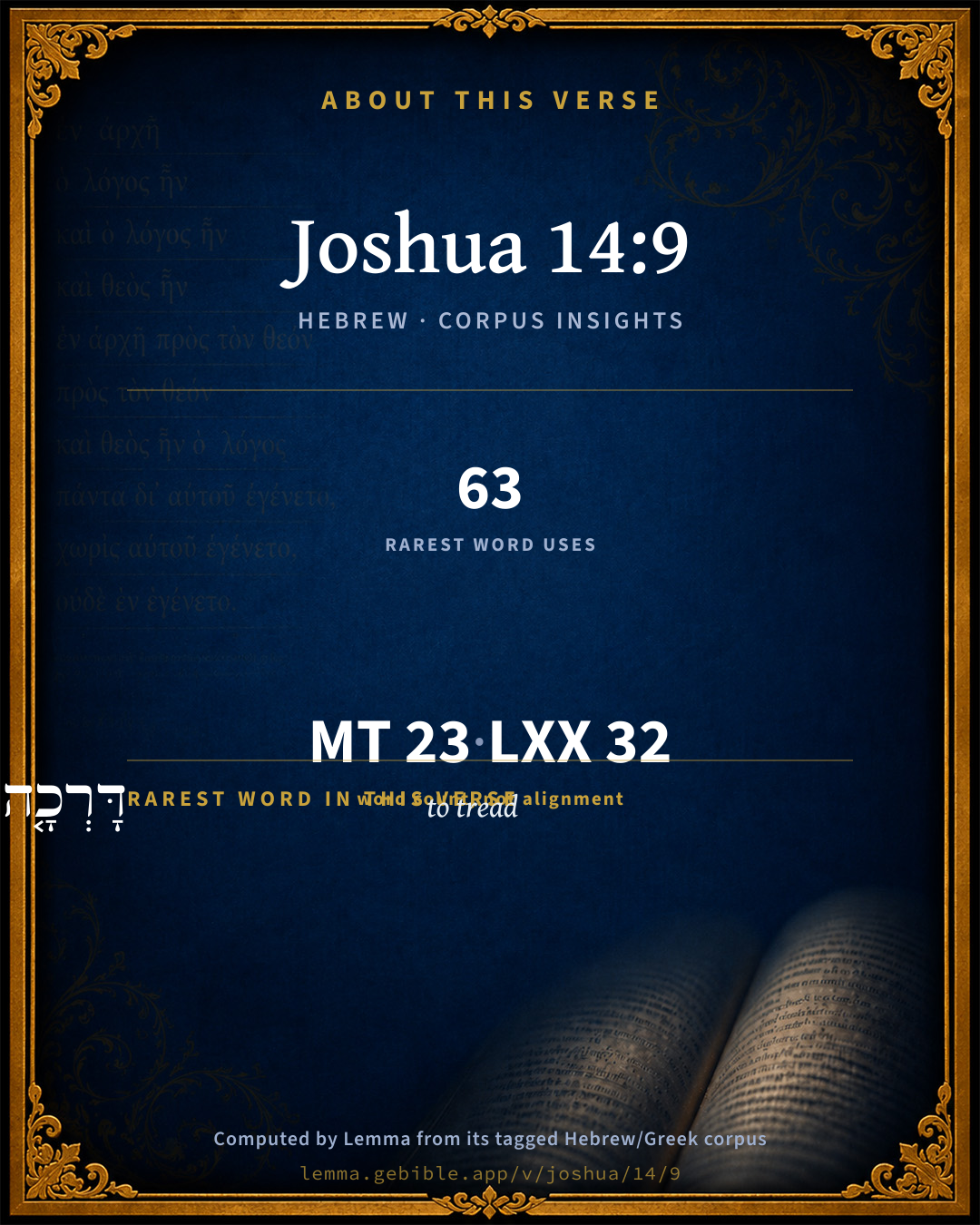
These counts appear in no published source. They are computed here, from the morphology-tagged text and Lemma’s own curated glosses. What Lemma adds →

23
words
21
distinct lemmas
Historical
section

Grammatical profile

  • 5 verbs
  • 9 nouns
  • 1 pronoun
  • 4 prepositions
  • 2 conjunctions
  • 2 particles

Verb forms

  • וַיִּשָּׁבַ֣ע Niphal · Sequential Imperfect
  • לֵאמֹר֒ Qal · Infinitive Construct
  • דָּרְכָ֤ה Qal · Perfect
  • תִֽהְיֶ֧ה Qal · Imperfect
  • מִלֵּ֔אתָ Piel · Perfect

Hebrew & Septuagint length

In English translation the verse runs 33 words from the Hebrew and 36 from the Septuagint (LXX English) — closely comparable.

A rough comparison of the two English renderings, which tokenize alike — not a word-level alignment.

Word counts can differ between the Hebrew and the Greek without any difference in meaning — e.g. the Hebrew direct-object marker אֵת has no separate Greek word, and Greek often adds the article ὁ.

In the original languages it is 23 Hebrew tokens and 32 Greek tokens — but the two are counted differently (Hebrew bundles its prefixes and suffixes into one token; the Greek is in lemma form), so that isn’t a like-for-like length.

Cross-references

4

Topical passages linked to Joshua 14:9 in the Treasury of Scripture Knowledge — connected by theme and wording, ordered by reader-vote popularity; previews shown in the World English Bible.

  • Joshua 1:3 Every place that the sole of your foot shall tread on, to you have I given it, as I spoke to Moses.
  • Deuteronomy 1:36 save Caleb the son of Jephunneh: he shall see it; and to him will I give the land that he has trodden on, and to his children, because he has wholly followed Yahweh.
  • Numbers 14:22–24 because all those men who have seen my glory, and my signs, which I worked in Egypt and in the wilderness, yet have tempted me these ten times, and have not listened to my voice;
  • Numbers 13:22 They went up by the South, and came to Hebron; and Ahiman, Sheshai, and Talmai, the children of Anak, were there. (Now Hebron was built seven years before Zoan in Egypt.)

Cross-references courtesy of OpenBible.info (CC BY 4.0).

Hebrew and Greek witnesses Masoretic Hebrew ↔ Greek Septuagint

The same verse in the two great witnesses to the Old Testament, shown verse-for-verse.

These are two independent witnesses, not word-aligned to each other, and the Septuagint is shown in lemma (dictionary) form.

Hebrew Joshua 14:9 Masoretic · Westminster Leningrad Codex

וַיִּשָּׁבַ֣ע מֹשֶׁ֗ה בַּיּ֣וֹם הַהוּא֮ לֵאמֹר֒ אִם לֹ֗א הָאָ֨רֶץ֙ אֲשֶׁ֨ר דָּרְכָ֤ה רַגְלְךָ֙ בָּ֔הּ לְךָ֨ תִֽהְיֶ֧ה לְנַחֲלָ֛ה וּלְבָנֶ֖יךָ עַד עוֹלָ֑ם כִּ֣י מִלֵּ֔אתָ אַחֲרֵ֖י יְהוָ֥ה אֱלֹהָֽי

Moses swore on that day, saying, Surely the land whereon your foot has trodden shall be an inheritance to you and to your children forever, because you have wholly followed Yahweh my God.

World English Bible · Public Domain

Greek LXX Joshua 14:9 Septuagint · lemma form

καί ὄμνυμι μωυσῆς ἐν ἐκεῖνος ὁ ἡμέρα λέγω ὁ γῆ ἐπί ὅς ἐπιβαίνω σύ εἰμί ἐν κλῆρος καί ὁ τέκνον σύ εἰς ὁ αἰών ὅτι προςτίθημι ἐπιἀκολουθέω ὀπίσω κύριος ὁ θεός ἐγώ

And Moses swore on that day, saying, The land on which you are gone up, it shall be your inheritance and your children's for ever, because you have applied yourself to follow the Lord our God.

LXX2012 (modern English Septuagint) · Public Domain

Hebrew: Westminster Leningrad Codex (CC BY 4.0). Greek: Septuagint (public domain); English from LXX2012 (modern English Septuagint) (Public Domain). How the Septuagint differs from the Hebrew →

Targum (Aramaic paraphrase)

1

The Targum is the ancient Jewish Aramaic paraphrase of the Hebrew Scriptures — an interpretive translation, not the Hebrew text itself. Onkelos (literal) and Pseudo-Jonathan (expansive) render the Torah, and Jonathan the Prophets. Coverage is partial: where no permissively-licensed English translation exists for a verse, only the Aramaic is shown. This is verse-level text, not a word-by-word alignment to the Hebrew.

  1. Targum Jonathan Prophets (Joshua–Malachi)
    וְקַיֵם מֹשֶׁה בְּיוֹמָא הַהוּא לְמֵימָר אִם לָא אַרְעָא דִי דְרָכַת פַּרְסַת רִגְלָךְ בָּהּ דִילָךְ תְּהֵי לְאַחֲסָנָא וְלִבְנָךְ עַד עָלְמָא אֲרֵי אַשְׁלֵימְתָּא בָּתַר דַחַלְתָּא דַייָ אֱלָהִי:

    (no public-domain English translation for this verse)

    Targum Jonathan — Aramaic: “Mikraot Gedolot” (public domain). English: “Sefaria Community Translation” (CC0 1.0 (public-domain dedication)); “London "Chaldee Paraphrase," 1871” (public domain). Text via Sefaria.

Commentary

Notes on Joshua 14:9 from classic Christian and Jewish commentators (each source and its license shown beneath its notes). The classic Christian expositions comment on the surrounding passage and are grouped to its opening verse, so a note may address several verses; the Jewish commentaries on the Tanakh (Rashi and others) are per-verse, so they appear only where the commentator wrote on this verse.

Lemma curates 59 commentaries, every one of them public domain or Creative Commons licensed, each selected and text-cleaned for this edition rather than reprinted as found. About our sources →

Trapp's Complete Commentary

John Trapp

Jos 14:9 And Moses sware on that day, saying, Surely the land whereon thy feet have trodden shall be thine inheritance, and thy children’s for ever, because thou hast wholly followed the LORD my God.

Ver. 9. Whereon thy feet have trodden.] And whereon thy faith hath triumphed.

Because thou hast wholly followed.] See Jos 14:8, and take notice that God’s retributions are more than bountiful.

John Trapp, A Commentary or Exposition upon All the Books of the Old and New Testament (1647–1656) — public domain. Text from a community e-Sword module.

Joseph Benson's Commentary

Jos 14:9. Moses sware on that day — See Deu 1:35-36. What is here mentioned was first pronounced by God himself, and that with an oath, Num 14:21-24. It was also, however, repeated by Moses, so that the expression of the sacred writer is just.

Joseph Benson's Commentary on the Old and New Testaments (1811–1818) — public domain. Text from a community e-Sword module.

Tyndale Open Study Notes

Tyndale Open Resources

14:9 Moses . . . promised: See Num 14:24.

Tyndale Open Study Notes — © Tyndale Open Resources, licensed CC BY-SA 4.0. Text via the HelloAO Bible API.

Adam Clarke's Commentary

Verse 9. The land whereon thy feet have trodden] This probably refers to Hebron, which was no doubt mentioned on this occasion.

Adam Clarke's Commentary on the Bible (1810–1826) — public domain. Text from a community e-Sword/MySword module.

John Calvin's Commentaries

9. And Moses swear on that day, etc Here, then, is one fruit of the embassy honestly and faithfully performed — to gain possession of an inheritance of which the whole people is deprived. For although long life is justly accounted one of the mercies of God, the end proposed by it is here added, viz., that Caleb may obtain the inheritance which is denied to others. This was no ordinary privilege. He next extols the faithfulness of God in having prolonged his life, and not only so, but supplied vigor and strength, so that though he was now above eighty years of age, he was not a whit feebler than when in the flower of his youth. Others, too, had a green old age, but they were few in number, and then in their case there was not added to the even tenor of their days a manly vigor, remaining wholly unimpaired up to their eighty-fifth year. For he lays claim not only to the skill and valor of a leader, but also to the physical strength of a soldier.

He next adds the other offices and actions of his life. For to go out and in is equivalent in Hebrew to the observance and execution of all parts of our duty. And this Caleb confirms by fact, when he demands it as his task to assail and expel the giants. He is not, however, elated by stolid pride to a confident assurance of victory, but hopes for a prosperous event from the assistance of God. There seems, indeed, to be an incongruous expression of doubt in the word Perhaps, as if he were begirding himself fortuitously for the fight. Those expositors who think that he is distrusting himself from a feeling of modesty and considering his own weakness, say something to the point, but do not say the whole. They certainly omit what is of principal import, viz., that this Perhaps refers to the common feelings which men would entertain on taking a view of the actual state of matters.

The first thing necessary is duly to consider what his design is. Had he asked the gift of a mountain, which he could have seized without any great exertion, it would have been more difficult to obtain it. But now when the difficulty of the task is plainly set forth, he gains the favor of Joshua and the princes, because in assenting to his prayer, they grant him nothing but the certainty of an arduous, doubtful, and perilous contest. Knowing, then, that the children of Israel trembled and were in terror at the very name of the giants, he speaks according to their opinion as of a matter attended with doubt and uncertainty. As regards himself, the words clearly demonstrate how far he was from viewing that which had been said to him with a dubious or vacillating mind. I shall drive them out, he says, as the Lord has declared. Shall we say that when he utters the declaration of God, he is in doubt whether or not God will do what he promised? It is quite plain that he only reminded them how dangerous the business was, in order that he might the more easily obtain their assent. Although it is not uncommon in Hebrew to employ this term to denote difficulty merely, without meaning to imply that the mind is agitated by distrust or disquietude. How very difficult it was to drive out the giants from that fastness, may be inferred from the fact that the death of Joshua took place before Caleb ventured to attack them.

John Calvin's Commentaries (1540-1563) — public domain. Text from the Calvin Translation Society English edition (1840s-50s) via the Christian Classics Ethereal Library (ccel.org). Calvin's coverage is partial (roughly two-thirds of the Bible); uncommented books and verses are honest gaps, never fabricated. The 19th-century editor's footnotes and remarks are omitted so the notes are faithfully Calvin's own voice.

Ellicott's Commentary for English Readers

(9) And Moses sware on that day . . . the land whereon thy feet have trodden shall be thine.—Whether Moses referred to Hebron specifically in this promise, it is impossible to say.

A Bible Commentary for English Readers, edited by Charles John Ellicott (1878–1897) — public domain. Text from a community e-Sword module.

The Cambridge Bible for Schools and Colleges

gen. ed. J. J. S. Perowne

9. And Moses sware on that day] The oath of the great Lawgiver is not mentioned either in Num_14:23, or Deu_1:35. Caleb probably quotes an express declaration of Moses, not recorded in the Pentateuch, but familiar to Joshua, in whose hearing it may have been first related by Moses.

Surely the land] Comp. Num_13:22; Num_14:24; Deu_1:36.

The Cambridge Bible for Schools and Colleges (gen. ed. J. J. S. Perowne; Cambridge University Press, 1878–1918) — public domain. Text from a community e-Sword module.

John Gill's Exposition

And Moses sware on that day, saying,.... Or declared the oath of the Lord, for it was the Lord that sware to what follows; see Deu 1:34,

surely the land whereon thy feet have trodden shall be thine inheritance, and thy children's for ever: not the whole land of Canaan, nor all the parts of it Caleb travelled through, but particularly Hebron; which though not expressly mentioned in the aforesaid oath, yet was understood and known to be the meaning of it, and which Joshua by the following grant owned, and it is elsewhere expressly affirmed, Jdg 1:20; and it is remarked, that it is not said "they", but "he" came to Hebron, Num 13:22; that is Caleb, so that it was literally true that his feet had trodden there: now the reason of this oath, and the inheritance assured by it to Caleb, was:

because thou hast wholly followed the Lord thy God; in all his ways, and with full purpose of heart, and particularly had acted the upright and faithful part in the report he made of the good land; See Gill on Num 14:24.

John Gill's Exposition of the Whole Bible (1746–1763) — public domain (CC PDM 1.0). Text via the HelloAO Bible API.

Albert Barnes' Notes on the Bible

Moses sware - i. e. God swore; and His promise, confirmed by an oath, was communicated, of course, through Moses.

Albert Barnes' Notes on the Bible (1834–1885) — public domain. Text from a community e-Sword/MySword module.

Matthew Poole's English Annotations

See Num 14:24; Deu 1:36.

Matthew Poole's English Annotations on the Holy Bible (1683–1685) — public domain. Text from a community e-Sword/MySword module.

Whedon's Commentary on the Bible

Daniel D. Whedon

9. Moses sware — The oath was God’s own oath, (Num_14:24; Deu_1:13,) but declared and accepted by Moses.

Daniel D. Whedon (gen. ed.), Commentary on the Old and New Testaments (1874–1909) — public domain. Text from a community e-Sword module.

The Pulpit Commentary

And Moses sware on that day. (cf. Num_14:21-24 Deu_1:35, Deu_1:36) Keil raises the difficulty that in the above passage not Moses, but God is said to have sworn, and that no special inheritance is promised to Caleb, but only that he shall enter the promised land. But this is not the fact, as a comparison of this passage with Deu_1:36 will show. That either passage gives the ipsissima verba of Moses is unlikely. The main sense of the promise is given in each. And there is no impropriety in speaking of the proclamation by Moses of God"s decree as an oath pronounced by Moses himself.

The Pulpit Commentary (1880–1919), ed. H.D.M. Spence-Jones & Joseph S. Exell — public domain. Text from a community e-Sword module.

Keil & Delitzsch

C. F. Keil & F. Delitzsch

Jehovah swore at that time, that the land upon which his (Caleb's) foot had trodden should be an inheritance for him and his sons for ever. This oath is not mentioned in Num 14:20., nor yet in Deu 1:35-36, where Moses repeats the account of the whole occurrence to the people. For the oath of Jehovah mentioned in Num 14:21, Num 14:24, viz., that none of the murmuring people should see the land of Canaan, but that Caleb alone should come thither and his seed should possess it, cannot be the one referred to, as the promise given to Caleb in this oath does not relate to the possession of Hebron in particular, but to the land of Canaan generally, "the land which Jehovah had sworn to their fathers." We must assume, therefore, that in addition to what is mentioned in Num 14:24, God gave a special promise to Caleb, which is passed over there, with reference to the possession of Hebron itself, and that Joshua, who heard it at the time, is here reminded of that promise by Caleb. This particular promise from God was closely related to the words with which Caleb endeavoured to calm the minds of the people when they rose up against Moses (Num 13:30), viz., by saying to them, "We are well able to overcome it," notwithstanding the Anakites who dwelt in Hebron and had filled the other spies with such great alarm on account of their gigantic size. With reference to this the Lord had promised that very land to Caleb for his inheritance. Upon this promise Caleb founded his request (Jos 14:10-12) that Joshua would give him these mountains, of which Joshua had heard at that time that there were Anakites and large fortified cities there, inasmuch as, although forty-five years had elapsed since God had spoken these words, and he was now eighty-five years old, he was quite as strong as he had been then. From the words, "The Lord hath kept me alive these forty-five years," Theodoret justly infers, that the conquest of Canaan by Joshua was completed in seven years, since God spake these words towards the end of the second year after the exodus from Egypt, and therefore thirty-eight years before the entrance into Canaan. The clause וגו הלך אשׁר (Jos 14:10) is also dependent upon וגו ארבּעים יד: viz., "these forty-five years that Israel has wandered in the desert" (on this use of אשׁר, see Ewald, 331, c.). The expression is a general one, and the years occupied in the conquest of Canaan, during which Israel had not yet entered into peaceful possession of the promised land, are reckoned as forming part of the years of wandering in the desert. As another reason for his request, Caleb adds in Jos 14:11 : "I am still as strong to-day as at that time; as my strength was then, so is it now for war, and to go out and in" (see Num 27:17).

Keil & Delitzsch — Biblical Commentary on the Old Testament (1861–1891) — public domain (CC PDM 1.0). Text via the HelloAO Bible API. (Old Testament only.)

Lesson kit

Teaching starters — assembled from the data on this page, not authored interpretation. Every prompt links to the verse data it draws on. Edit before teaching.

Joshua, in the Historical, opens this verse with 23 words (21 distinct Hebrew lemmas). Its most distinctive word is dârak (“to tread”). A historical commentator’s framing appears above. Read the whole chapter for the surrounding context.

Discussion questions

  1. The word dârak carries the sense “to tread.” How does it shape the verse?
  2. Joshua 1:3 shares this passage’s theme. How do the two illuminate each other?
  3. These translations render this verse differently; the difference is in the English rendering, not the original. What questions does that raise?
  4. The verb «וַיִּשָּׁבַ֣ע» is Niphal Sequential Imperfect. How does its form color the action?
  5. Reading how Trapp's Complete Commentary and Joseph Benson's Commentary read this verse, where do the two commentators agree and where do they part?

Things to notice

Reading settings

Reading text

Shown beneath each verse's original-language words.

Old Testament
Old Testament edition

Read the OT as the Masoretic Hebrew (MT) or the Greek Septuagint (LXX).

English shown for the Greek Septuagint (in the Hebrew ↔ Greek comparison).

Comparing translations? Open the Compare panel on any verse page to stack up to four side by side.