
Exodus 12:24

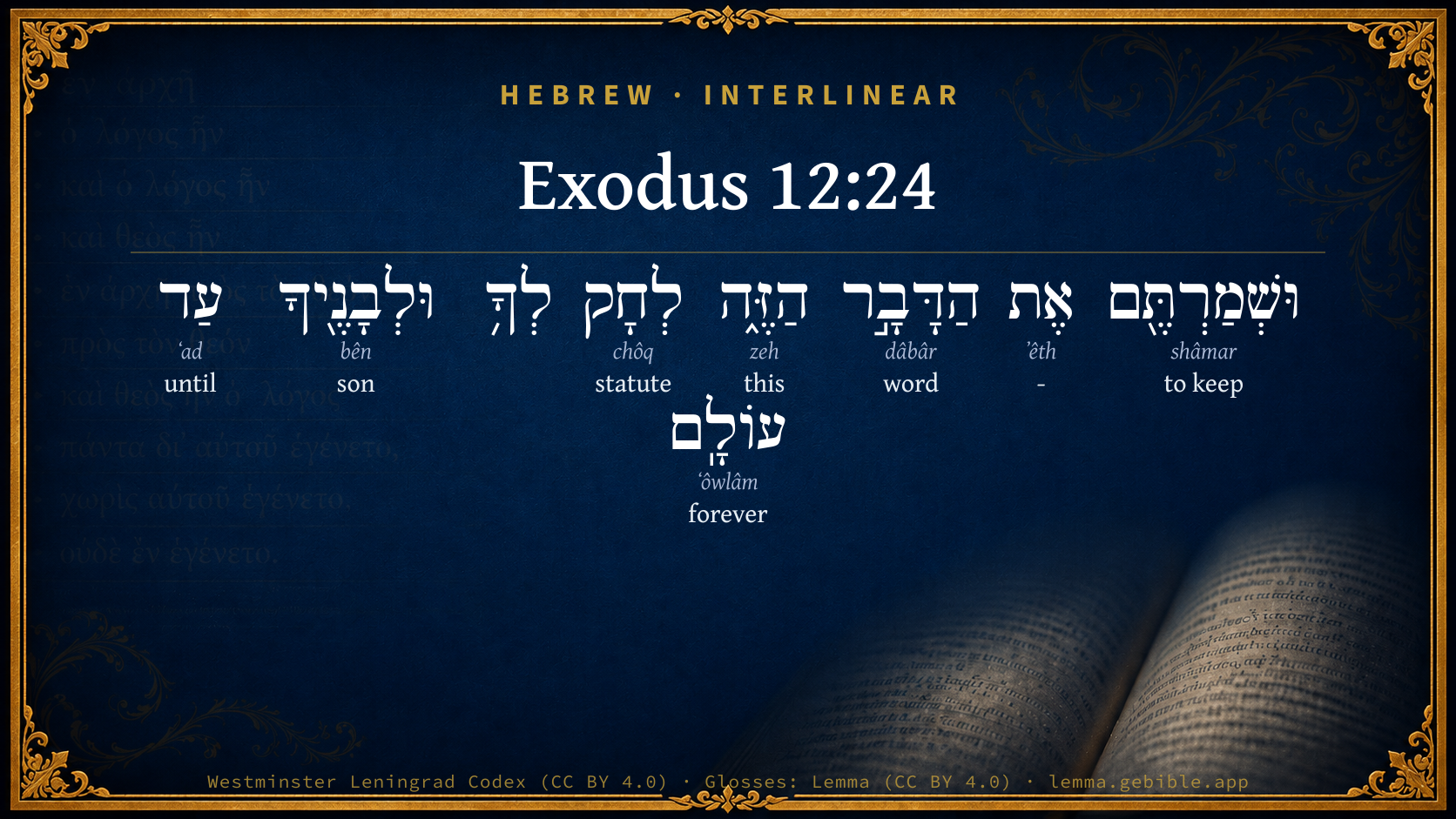
Hebrew (Westminster Leningrad Codex) Exodus 12:24 appears in the Hebrew Old Testament. The text above is from the Westminster Leningrad Codex. Each word links to its Strong’s number, a concise gloss, and parsing drawn from the Open Scriptures Hebrew Bible morphology. Click any word for its full Brown-Driver-Briggs (BDB) entry.
Download image
Cite this verse

Exodus 12:24 (World English Bible). Public Domain. Lemma interlinear Bible study tool, https://lemma.gebible.app/v/exodus/12/24.

Show BibTeX & RIS
BibTeX
RIS
English Translation
You shall observe this thing for an ordinance to you and to your sons forever.
World English Bible · Public Domain
Download a study sheet

One document with this verse’s original text, its word-by-word gloss line, the meaning frame, cross-references with their text, attributed commentary, and full source and license credits — printable, and it pastes into notes with its structure intact.

This verse Autodidact and up

Study sheet (.html) Plain text (.txt)

A passage Seminary Student

Up to 50 verses in one chapter. A passage sheet keeps up to 6 commentary sources and 12 cross-references per verse, in the order this page ranks them, and says so on the sheet whenever that leaves anything out. Ask for a single verse and you get the Autodidact verse sheet above.

Everything on this page stays free to read, with no account — the sheet is a download of what is already on screen, not access to it.

Want to remove ads? Support Godless Engineer
Compare translations 3

The same verse in 3 English versions, stacked beneath the original-language interlinear above. Click any original word for its lexicon entry.

Each is an independent rendering of the whole verse — the interlinear is not word-aligned to these translations.

Highlighted words mark where these versions differ — a whole-verse word diff, not a word-by-word alignment.

  • World English Bible Public Domain
    You shall observe this thing for an ordinance to you and to your sons forever.
  • King James Version Public Domain
    And ye shall observe this thing for an ordinance to thee and to thy sons for ever.
  • unfoldingWord Literal Text CC BY-SA 4.0
    And you shall keep this thing as a statute for you and for your sons until eternity.

unfoldingWord Literal Text — © unfoldingWord, licensed CC BY-SA 4.0. Word-aligned USFM3 via Door43 (git.door43.org/unfoldingWord/en_ult).

Versions to compare (up to 4)

3 of 4 selected

Show all 18 translations

Every available English version of this verse, each an independent rendering of the whole verse.

  • World English Bible Public Domain
    You shall observe this thing for an ordinance to you and to your sons forever.
  • Berean Standard Bible Public Domain
    And you are to keep this command as a permanent statute for you and your descendants.
  • Majority Standard Bible Public Domain
    And you are to keep this command as a permanent statute for you and your descendants.
  • King James Version Public Domain
    And ye shall observe this thing for an ordinance to thee and to thy sons for ever.
  • American Standard Version (1901) Public Domain
    And ye shall observe this thing for an ordinance to thee and to thy sons for ever.
  • Revised Version (1885) Public Domain
    And ye shall observe this thing for an ordinance to thee and to thy sons for ever.
  • Geneva Bible (1599) Public Domain
    Therefore shall ye obserue this thing as an ordinance both for thee and thy sonnes for euer.
  • Douay-Rheims (1899) Public Domain
    Thou shalt keep this thing as a law for thee and thy children for ever.
  • Young's Literal Translation Public Domain
    `And ye have observed this thing, for a statute to thee, and to thy sons -- unto the age;
  • Literal Standard Version CC BY-SA 4.0
    And you have observed this thing for a statute to you and to your sons for all time;
  • Unlocked Literal Bible CC BY-SA 4.0
    You must observe this event. This will always be a law for you and your descendants.
  • unfoldingWord Literal Text CC BY-SA 4.0
    And you shall keep this thing as a statute for you and for your sons until eternity.
  • Darby Bible Public Domain
    And ye shall observe this as an ordinance for thee and for thy sons for ever.
  • World Messianic Bible Public Domain
    You shall observe this thing for an ordinance to you and to your sons forever.
  • Webster's Bible Public Domain
    And ye shall observe this thing for an ordinance to thee and to thy sons for ever.
  • Free Bible Version CC BY-SA 4.0
    You and your descendants are to remember to observe these instructions for all time to come.
  • Bible in Basic English Public Domain
    And you are to keep this as an order to you and to your sons for ever.
  • JPS Tanakh (1917) Public Domain
    And ye shall observe this thing for an ordinance to thee and to thy sons for ever.

Literal Standard Version (2020), Covenant Press — licensed CC BY-SA 4.0. Text via the HelloAO Bible API (eBible.org). Unlocked Literal Bible (unfoldingWord) — licensed CC BY-SA 4.0. Text via the HelloAO Bible API (eBible.org). unfoldingWord Literal Text — © unfoldingWord, licensed CC BY-SA 4.0. Word-aligned USFM3 via Door43 (git.door43.org/unfoldingWord/en_ult). Free Bible Version, Dr. Jonathan Gallagher — licensed CC BY-SA 4.0. Text via the HelloAO Bible API (eBible.org).

Word by word

More ways to search: Search by grammar → Find every occurrence → Compare this word →

Practice this passage: Drill this verse → Learn its vocabulary →

לְחָק
chôq
H2706
“to/for · statute”
Preposition + Noun, Common, Masculine, Singular, Absolute
Part of Speech
Preposition + Noun
Type
Common
Gender
Masculine
Number
Singular
State
Absolute
Full BDB Definition

Origin: from H2710

TWOT: 728a

statute, ordinance, limit, something prescribed, due - prescribed task - prescribed portion - action prescribed (for oneself), resolve - prescribed due - prescribed limit, boundary - enactment, decree, ordinance - specific decree - law in general - enactments, statutes - conditions - enactments - decrees - civil enactments prescribed by God
  1. וּשְׁמַרְתֶּ֖ם shâmar H8104 “and · to keep” Conjunction + Verb, Qal, Sequential Perfect, 2nd Person, Masculine, Plural
  2. אֶת ʼêth H853 “-” Particle, Direct Object
  3. הַדָּבָ֣ר dâbâr H1697 “the · word” Particle, Definite Article + Noun, Common, Masculine, Singular, Absolute
  4. הַזֶּ֑ה zeh H2088 “the · this” Particle, Definite Article + Pronoun, Demonstrative, Masculine, Singular
  5. וּלְבָנֶ֖יךָ bên H1121 “and · to/for · sons · your” Conjunction + Preposition + Noun, Common, Masculine, Plural, Construct + Suffix, Personal, 2nd Person, Masculine, Singular
  6. עַד ʻad H5704 “until” Preposition
  7. עוֹלָֽם ʻôwlâm H5769 “forever” Noun, Common, Masculine, Singular, Absolute

About this verse

These counts appear in no published source. They are computed here, from the morphology-tagged text and Lemma’s own curated glosses. What Lemma adds →

9
words
8
distinct lemmas
Pentateuch
section

Grammatical profile

  • 1 verb
  • 4 nouns
  • 1 pronoun
  • 2 prepositions
  • 1 particle

Verb forms

  • וּשְׁמַרְתֶּ֖ם Qal · Sequential Perfect

Hebrew & Septuagint length

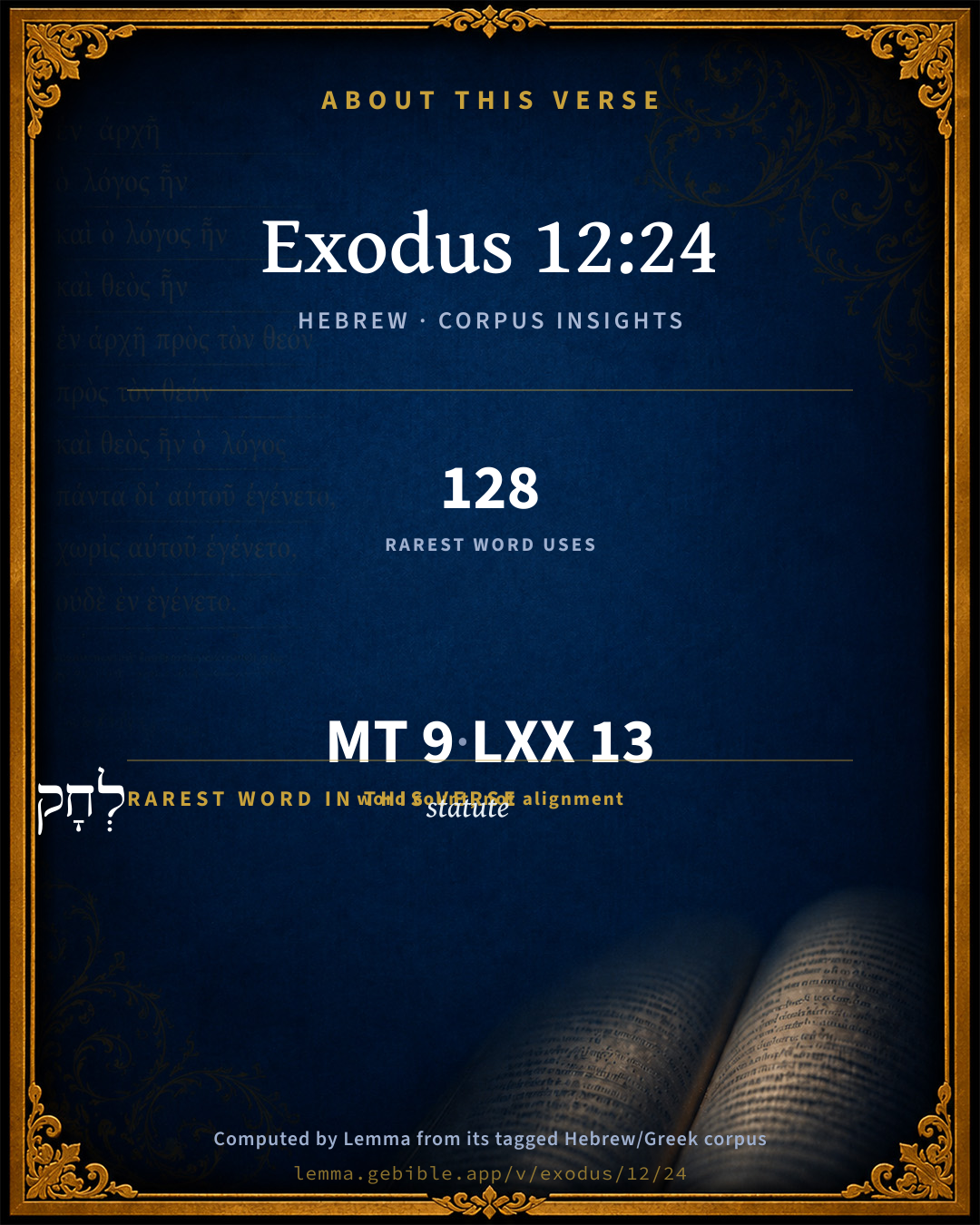
In English translation the verse runs 15 words from the Hebrew and 16 from the Septuagint (LXX English) — closely comparable.

A rough comparison of the two English renderings, which tokenize alike — not a word-level alignment.

Word counts can differ between the Hebrew and the Greek without any difference in meaning — e.g. the Hebrew direct-object marker אֵת has no separate Greek word, and Greek often adds the article ὁ.

In the original languages it is 9 Hebrew tokens and 13 Greek tokens — but the two are counted differently (Hebrew bundles its prefixes and suffixes into one token; the Greek is in lemma form), so that isn’t a like-for-like length.

Cross-references

2

Topical passages linked to Exodus 12:24 in the Treasury of Scripture Knowledge — connected by theme and wording, ordered by reader-vote popularity; previews shown in the World English Bible.

  • Genesis 17:8–10 I will give to you, and to your seed after you, the land where you are traveling, all the land of Canaan, for an everlasting possession. I will be their God."
  • Exodus 12:14 This day shall be to you for a memorial, and you shall keep it a feast to Yahweh: throughout your generations you shall keep it a feast by an ordinance forever.

Cross-references courtesy of OpenBible.info (CC BY 4.0).

Hebrew and Greek witnesses Masoretic Hebrew ↔ Greek Septuagint

The same verse in the two great witnesses to the Old Testament, shown verse-for-verse.

These are two independent witnesses, not word-aligned to each other, and the Septuagint is shown in lemma (dictionary) form.

Hebrew Exodus 12:24 Masoretic · Westminster Leningrad Codex

וּשְׁמַרְתֶּ֖ם אֶת הַדָּבָ֣ר הַזֶּ֑ה לְחָק לְךָ֥ וּלְבָנֶ֖יךָ עַד עוֹלָֽם

You shall observe this thing for an ordinance to you and to your sons forever.

World English Bible · Public Domain

Greek LXX Exodus 12:24 Septuagint · lemma form

καί φυλάσσω ὁ ῥῆμα οὗτος νόμιμος σεαυτοῦ καί ὁ υἱός σύ ἕως αἰών

And keep you⌃ this thing as an ordinance for yourself and for your children for ever.

LXX2012 (modern English Septuagint) · Public Domain

Hebrew: Westminster Leningrad Codex (CC BY 4.0). Greek: Septuagint (public domain); English from LXX2012 (modern English Septuagint) (Public Domain). How the Septuagint differs from the Hebrew →

Targum (Aramaic paraphrase)

2

The Targum is the ancient Jewish Aramaic paraphrase of the Hebrew Scriptures — an interpretive translation, not the Hebrew text itself. Onkelos (literal) and Pseudo-Jonathan (expansive) render the Torah, and Jonathan the Prophets. Coverage is partial: where no permissively-licensed English translation exists for a verse, only the Aramaic is shown. This is verse-level text, not a word-by-word alignment to the Hebrew.

  1. Targum Onkelos Torah (Genesis–Deuteronomy)
    וְתִטְרוּן יָת פִּתְגָמָא הָדֵין לִקְיָם לָךְ וְלִבְנָיךְ עַד עָלָם:

    (no public-domain English translation for this verse)

    Targum Onkelos — Aramaic: “Onkelos Genesis” (public domain); “Onkelos Exodus” (public domain); “Onkelos Leviticus” (public domain); “Onkelos Numbers” (public domain); “Onkelos Deuteronomy” (public domain). English: “Sefaria Community Translation” (CC0 1.0 (public-domain dedication)); “J.W. Etheridge. The Targums of Onkelos and Jonathan Ben Uzziel on the Pentateuch. London: Longmans, Green, 1862” (public domain). Text via Sefaria.

  2. Targum Pseudo-Jonathan Torah (Genesis–Deuteronomy)
    וְתִיטְרוּן יַת פִּתְגָמָא הָדֵין לִקְיַם לָךְ וְלִבְנָךְ דְּכוּרַיָא עַד עַלְמָא

    And you shall observe this thing for a statute to thee and to thy sons for a memorial for ever.

    Targum Pseudo-Jonathan — Aramaic: “Targum Jonathan on Genesis” (public domain); “Targum Jonathan on Exodus” (public domain); “Targum Jonathan on Leviticus” (public domain); “Targum Jonathan on Numbers” (public domain); “Targum Jonathan on Deuteronomy” (public domain). English: “The Targum of Jonathan ben Uzziel, trans. J. W. Etheridge, London, 1862” (public domain). Text via Sefaria.

Commentary

Notes on Exodus 12:24 from classic Christian and Jewish commentators (each source and its license shown beneath its notes). The classic Christian expositions comment on the surrounding passage and are grouped to its opening verse, so a note may address several verses; the Jewish commentaries on the Tanakh (Rashi and others) are per-verse, so they appear only where the commentator wrote on this verse.

Lemma curates 59 commentaries, every one of them public domain or Creative Commons licensed, each selected and text-cleaned for this edition rather than reprinted as found. About our sources →

Trapp's Complete Commentary

John Trapp

Exo 12:24 And ye shall observe this thing for an ordinance to thee and to thy sons for ever.

Ver. 24. For ever.] {See Trapp on "Exo 12:15"}

John Trapp, A Commentary or Exposition upon All the Books of the Old and New Testament (1647–1656) — public domain. Text from a community e-Sword module.

The Biblical Illustrator

Joseph S. Exell

Exo_12:24-25

Ye shall keep this service.

Celebration of the Passover

I. In this incident we have a clear recognition of the principle of vicarious suffering. It is seen in the birth of the infant, in the history of the family circle, in the events of everyday life, but supremely in the Cross of Christ. In the Cross of Christ it is seen in its highest embodiment, in its truest meaning, and in its most glorious possibility. There is the innocent dying for the guilty, the God-man suffering for the race.

II. In this incident we have a clear recognition of the need of falling in with all the requirements of the great scheme of salvation. The method whereby the Israelites were to be protected from the stroke of the Destroying Angel was Divinely originated, clearly revealed, and imperative in requirement. The sinner must be saved in Gods way, and not after his own. He may reason about the peculiarity of the method of salvation; be may think that other means will be more effective to the end desired; but if he at last is found out of the Divine way of safety, he will inevitably be lost. The blood of Christ sprinkled on the heart is the only sign the Destroying Angel will recognize and regard as the token of safety.

III. In this incident we have a clear recognition of the fact that the Divine method of salvation will avert the most awful peril. The trustful soul shall not be hurt by the second death.

IV. In this incident we have a clear recognition of the fact that the efficacy of the Divine method of salvation should be associated with public religious ordinances (Exo_12:24).

V. In this incident we have a clear recognition of the fact that the good should be able to give an intelligent explanation of their moral safety (Exo_12:27). (J. S. Exell, M. A.)

The need of an intelligent apprehension of the service and worship of God

I. It is necessary in order to the true performance of religious service and worship.

II. It is necessary in order to the true performance of parental duty and instruction.

III. It is necessary in order to refute and silence the sceptical reasonings of men. (J. S. Exell, M. A.)

The blood of sprinkling and the children

I. The importance attached to the blood of sacrifice is here made very plain.

1. It became and remained the national mark.

2. It was also the saving token.

3. It was rendered as conspicuous as possible.

4. It was made very dear to the people themselves by the fact that they trusted in it in the most implicit manner.

5. The paschal bloodshedding was to be had in perpetual remembrance.

6. This sprinkling of the blood was to be an all-pervading memory.

II. The institution that was connected with the remembrance of the Passover. Inquiry should be excited respecting spiritual things in the minds of children. The doctrine of the expiatory sacrifice is a gospel for the youngest. (C. H. Spurgeon.)

Children should be taught the doctrine of the Cross

It is well to explain to children the ordinance of the Lords Supper, for this shows forth the death of Christ in symbol. I regret that children do not oftener see this ordinance. Baptism and the Lords Supper should both be placed in view of the rising generation, that they may then ask us, What mean ye by this? Now, the Lords Supper is a perennial gospel sermon, and it turns mainly upon the sacrifice for sin. You may banish the doctrine of the Atonement from the pulpit, but it will always live in the Church through the Lords Supper. You cannot explain that broken bread and that cup filled with the fruit of the vine, without reference to the Lords atoning death. You cannot explain the communion of the body of Christ without bringing in, in some form or other, the death of Jesus in our place and stead. Let your little ones, then, see the Lords Supper, and let them be told most clearly what it sets forth. Tell them who it was that suffered, and why. And when attention is excited upon the best of themes, let us be ready to explain the great transaction by which God is just, and yet sinners are justified. Children can well understand the doctrine of the expiatory sacrifice; it was meant to be a gospel for the youngest. The gospel of substitution is a simplicity, though it is a mystery. We ought not to be content until our little ones know and trust in their finished Sacrifice. This is essential knowledge, and the key to all other spiritual teaching. With all their gettings may they get an understanding of this, and they will have the foundation rightly laid. This will necessitate your teaching the child his need of a Saviour. You must not hold back from this needful task. Do not flatter the child with delusive rubbish about his nature being good and needing to be developed. Tell him he must be born again. Dont bolster him up with the fancy of his own innocence, but show him his sin. Mention the childish sins to which he is prone, and pray the Holy Spirit to work conviction in his heart and conscience. (J. S. Exell, M. A.)

The Biblical Illustrator, edited by Joseph S. Exell (c. 1880s–1900s) — public domain. Text from a community e-Sword module.

Ellicott's Commentary for English Readers

(24) This thing.—Not the sprinkling of the blood, which was never repeated after the first occasion, but the sacrifice of the lamb, commanded in Exo_12:21.

A Bible Commentary for English Readers, edited by Charles John Ellicott (1878–1897) — public domain. Text from a community e-Sword module.

The Cambridge Bible for Schools and Colleges

gen. ed. J. J. S. Perowne

24. The ceremonies prescribed in vv. 21, 22 (‘this thing’) are to be observed in perpetuity, year by year.

The Cambridge Bible for Schools and Colleges (gen. ed. J. J. S. Perowne; Cambridge University Press, 1878–1918) — public domain. Text from a community e-Sword module.

John Gill's Exposition

And ye shall observe this thing for an ordinance to thee and thy sons for ever. Not this last thing of sprinkling the blood, which was peculiar to the passover in Egypt; but the whole before observed relating to the feast of the passover, and the feast of unleavened bread, and all the rites appertaining to them, which were to be observed until the coming of Christ.

And ye shall observe this thing for an ordinance to thee and thy sons for ever. Not this last thing of sprinkling the blood, which was peculiar to the passover in Egypt; but the whole before observed relating to the feast of the passover, and the feast of unleavened bread, and all the rites appertaining to them, which were to be observed until the coming of Christ.

Exodus 12:25

exo 12:25

exo 12:25

exo 12:25And it shall come to pass, when ye be come to the land,.... To the land of Canaan, towards which they were just about to set forward on their journey, and in a few years would be in the possession of:

which the Lord will give you according as he hath promised; to their fathers, Abraham, Isaac, and Jacob, and to them:

that ye shall keep this service; enjoined them, respecting the passover lamb, and leavened bread, with all the rites and ceremonies relative thereunto, excepting such as were peculiar to the first passover in Egypt.

John Gill's Exposition of the Whole Bible (1746–1763) — public domain (CC PDM 1.0). Text via the HelloAO Bible API.

Haydock's Catholic Bible Commentary

Children; twelve years old, Luke ii. 42. (Menochius) --- Ever. Samaritan adds, "in this month."

George Leo Haydock (1774–1849), Haydock's Catholic Family Bible and Commentary, 1859 edition — public domain. Excludes Psalms (Douay-Rheims chapter numbering differs from Protestant) and Deuterocanonical books (Catholic canon only).

Matthew Poole's English Annotations

This thing, viz. the substance of the thing, the passover and feast of unleavened bread, though not all the rites and ceremonies, whereof divers were peculiar to the first time.

Matthew Poole's English Annotations on the Holy Bible (1683–1685) — public domain. Text from a community e-Sword/MySword module.

Whedon's Commentary on the Bible

Daniel D. Whedon

24-27. The monumental character of this feast as a perpetual reminder of the supernatural origin of the nation, and as a means of education to all the generations of the people, is here minutely emphasized and enforced.

Daniel D. Whedon (gen. ed.), Commentary on the Old and New Testaments (1874–1909) — public domain. Text from a community e-Sword module.

The Pulpit Commentary

To thee and to thy children. The change from the plural to the singular is curious, Perhaps, we are to understand that Moses insisted on the perpetuity of the ordinance to each of the elders severally.

The Pulpit Commentary (1880–1919), ed. H.D.M. Spence-Jones & Joseph S. Exell — public domain. Text from a community e-Sword module.

unfoldingWord translationNotes

Door43 World Missions Community

this event ... this act of worship

These phrases refer to the Passover or Festival of Unleavened Bread. Observing the Passover was an act of worshiping Yahweh.

translationWords

law, laws

descend

promise

worship

unfoldingWord translationNotes — © Distant Shores Media and the Door43 World Missions Community, licensed CC BY-SA 4.0. Source: git.door43.org/Door43/en_tn.

Ramban (Nachmanides)

Rabbi Moshe ben Nachman (Ramban / Nachmanides)

AND YE SHALL OBSERVE THIS THING. This refers to the Passover-offering itself, concerning which He had said above, and slaughter the Passover lamb, even though it is removed [by two verses from here]. It does not refer to the putting of the blood [upon the lintel and on the two side-posts, mentioned above] in the verse nearby, since only in the Passover of Egypt were they commanded to do so, [i.e., to put the blood upon the lintel, etc.], as it is said, For the Eternal will pass through to smite the Egyptians; and when He seeth the blood upon the lintel, etc. as an ordinance forever, when it applied only to the Passover of Egypt? Hence we must say that the expression, this thing, refers to the Passover-offering itself, mentioned above in Verse 21, which we are commanded to observe forever, i.e., whenever the Sanctuary is in existence. Verse 11, which states, And thus shall ye eat it: with your loins girded, etc., also applied only to the Passover of Egypt (Pesachim 96 a). Similarly, the expression, and ye shall keep this service, means the offering of the Passover. A similar case [of a Scriptural expression that is connected with one that is far removed and not with the one nearby], is the verse, And also unto thy bondwoman thou shalt do likewise.

Ramban (Nachmanides) on the Tanakh — English translation: “Commentary on the Torah by Ramban (Nachmanides). Translated and annotated by Charles B. Chavel. New York, Shilo Pub. House, 1971-1976” (CC BY 4.0). Text via Sefaria.

Lesson kit

Teaching starters — assembled from the data on this page, not authored interpretation. Every prompt links to the verse data it draws on. Edit before teaching.

Exodus, in the Pentateuch, opens this verse with 9 words (8 distinct Hebrew lemmas). Its most distinctive word is chôq (“statute”). A historical commentator’s framing appears above. Read the whole chapter for the surrounding context.

Discussion questions

  1. The word chôq carries the sense “statute.” How does it shape the verse?
  2. How does Genesis 17:8–10, which shares this passage’s theme, read alongside this verse?
  3. These translations render this verse differently; the difference is in the English rendering, not the original. What questions does that raise?
  4. «וּשְׁמַרְתֶּ֖ם» is a Qal Sequential Perfect verb. How does that grammatical form shape the action described?
  5. Compare how Trapp's Complete Commentary and The Biblical Illustrator read this verse. Where do they agree or differ?

Things to notice

Reading settings

Reading text

Shown beneath each verse's original-language words.

Old Testament
Old Testament edition

Read the OT as the Masoretic Hebrew (MT) or the Greek Septuagint (LXX).

English shown for the Greek Septuagint (in the Hebrew ↔ Greek comparison).

Comparing translations? Open the Compare panel on any verse page to stack up to four side by side.