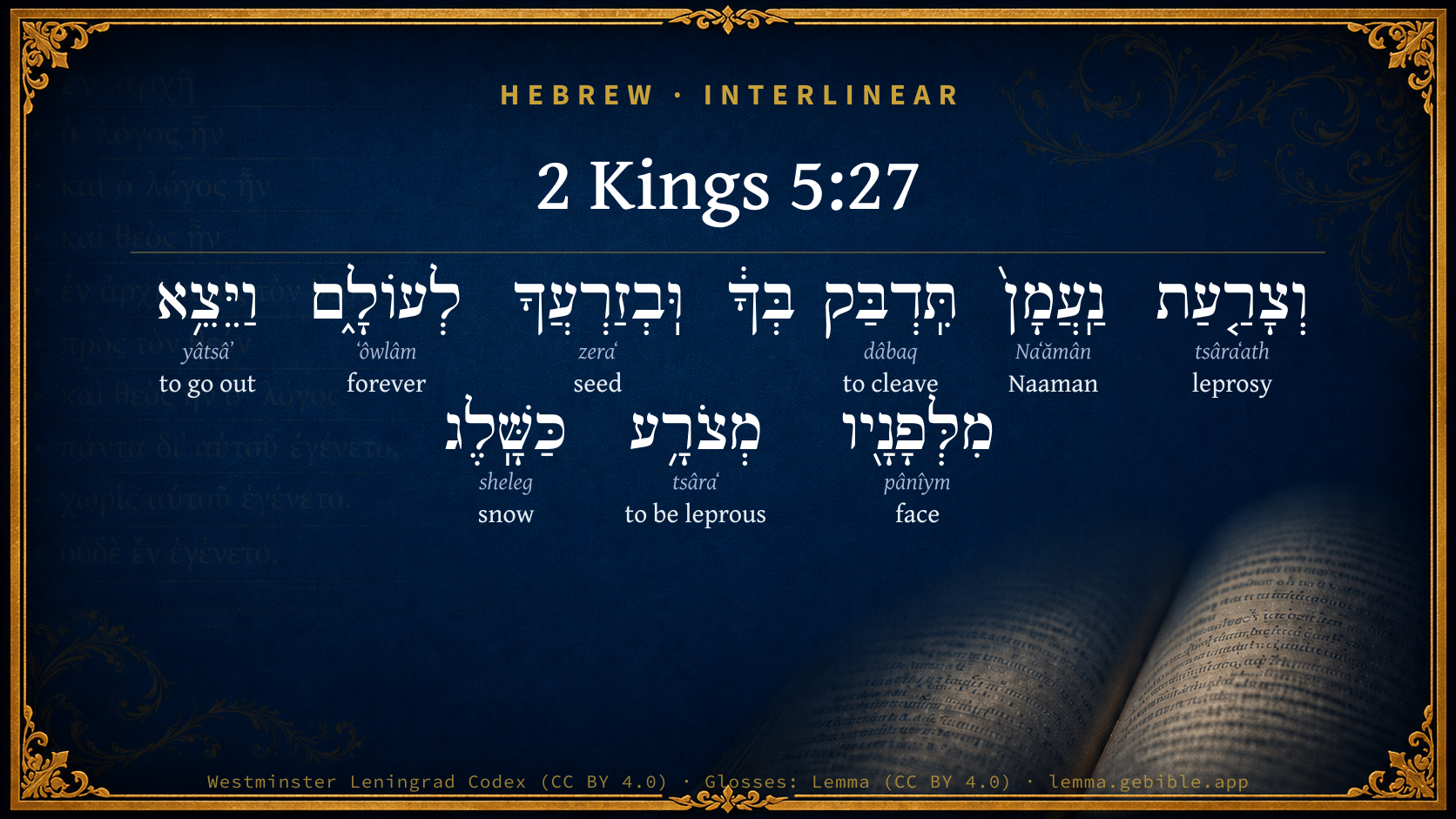
2 Kings 5:27

Hebrew (Westminster Leningrad Codex) 2 Kings 5:27 appears in the Hebrew Old Testament. The text above is from the Westminster Leningrad Codex. Each word links to its Strong’s number, a concise gloss, and parsing drawn from the Open Scriptures Hebrew Bible morphology. Click any word for its full Brown-Driver-Briggs (BDB) entry.
Download image
Cite this verse

2 Kings 5:27 (World English Bible). Public Domain. Lemma interlinear Bible study tool, https://lemma.gebible.app/v/2-kings/5/27.

Show BibTeX & RIS
BibTeX
RIS
English Translation
The leprosy therefore of Naaman shall cleave to you, and to your seed forever. He went out from his presence a leper [as white] as snow.
World English Bible · Public Domain
Download a study sheet

One document with this verse’s original text, its word-by-word gloss line, the meaning frame, cross-references with their text, attributed commentary, and full source and license credits — printable, and it pastes into notes with its structure intact.

This verse Autodidact and up

Study sheet (.html) Plain text (.txt)

A passage Seminary Student

Up to 50 verses in one chapter. A passage sheet keeps up to 6 commentary sources and 12 cross-references per verse, in the order this page ranks them, and says so on the sheet whenever that leaves anything out. Ask for a single verse and you get the Autodidact verse sheet above.

Everything on this page stays free to read, with no account — the sheet is a download of what is already on screen, not access to it.

Want to remove ads? Support Godless Engineer
Compare translations 3

The same verse in 3 English versions, stacked beneath the original-language interlinear above. Click any original word for its lexicon entry.

Each is an independent rendering of the whole verse — the interlinear is not word-aligned to these translations.

Highlighted words mark where these versions differ — a whole-verse word diff, not a word-by-word alignment.

  • World English Bible Public Domain
    The leprosy therefore of Naaman shall cleave to you, and to your seed forever. He went out from his presence a leper [as white] as snow.
  • King James Version Public Domain
    The leprosy therefore of Naaman shall cleave unto thee, and unto thy seed for ever. And he went out from his presence a leper as white as snow.
  • unfoldingWord Literal Text CC BY-SA 4.0
    Now the leprosy of Naaman will cling to you and to your seed to forever.” And he went out from to his face, afflicted with leprosy like snow.

unfoldingWord Literal Text — © unfoldingWord, licensed CC BY-SA 4.0. Word-aligned USFM3 via Door43 (git.door43.org/unfoldingWord/en_ult).

Versions to compare (up to 4)

3 of 4 selected

Show all 18 translations

Every available English version of this verse, each an independent rendering of the whole verse.

  • World English Bible Public Domain
    The leprosy therefore of Naaman shall cleave to you, and to your seed forever. He went out from his presence a leper [as white] as snow.
  • Berean Standard Bible Public Domain
    Therefore, the leprosy of Naaman will cling to you and your descendants forever!” And as Gehazi left his presence, he was leprous—as white as snow.
  • Majority Standard Bible Public Domain
    Therefore, the leprosy of Naaman will cling to you and your descendants forever!” And as Gehazi left his presence, he was leprous—as white as snow.
  • King James Version Public Domain
    The leprosy therefore of Naaman shall cleave unto thee, and unto thy seed for ever. And he went out from his presence a leper as white as snow.
  • American Standard Version (1901) Public Domain
    The leprosy therefore of Naaman shall cleave unto thee, and unto thy seed for ever. And he went out from his presence a leper `as white' as snow.
  • Revised Version (1885) Public Domain
    The leprosy therefore of Naaman shall cleave unto thee, and unto thy seed for ever. And he went out from his presence a leper as white as snow.
  • Geneva Bible (1599) Public Domain
    The leprosie therefore of Naaman shall cleaue vnto thee, and to thy seede for euer. And he went out from his presence a leper white as snowe.
  • Douay-Rheims (1899) Public Domain
    But the leprosy of Naaman shall also stick to thee, and to thy seed for ever. And he went out from him a leper as white as snow.
  • Young's Literal Translation Public Domain
    yea, the leprosy of Naaman doth cleave to thee, and to thy seed, -- to the age;' and he goeth out from before him -- leprous as snow.
  • Literal Standard Version CC BY-SA 4.0
    Indeed, the leprosy of Naaman cleaves to you and to your seed for all time”; and he goes out from before him—leprous as snow.
  • Unlocked Literal Bible CC BY-SA 4.0
    So the leprosy of Naaman will be on you and your descendants forever.” So Gehazi went out from his presence, a leper as white as snow.
  • unfoldingWord Literal Text CC BY-SA 4.0
    Now the leprosy of Naaman will cling to you and to your seed to forever.” And he went out from to his face, afflicted with leprosy like snow.
  • Darby Bible Public Domain
    But the leprosy of Naaman shall fasten upon thee, and upon thy seed for ever. And he went out from his presence leprous, as snow.
  • World Messianic Bible Public Domain
    Therefore the leprosy of Naaman will cling to you and to your offspring forever.” He went out from his presence a leper, as white as snow.
  • Webster's Bible Public Domain
    The leprosy therefore of Naaman shall cleave to thee, and to thy seed for ever. And he went out from his presence a leper as white as snow.
  • Free Bible Version CC BY-SA 4.0
    Consequently Naaman's leprosy will stick to you and your descendants forever!” As Gehazi left him, he had leprosy—he looked as white as snow.
  • Bible in Basic English Public Domain
    Because of what you have done, the disease of Naaman the leper will take you in its grip, and your seed after you, for ever. And he went out from before him a leper as white as snow.
  • JPS Tanakh (1917) Public Domain
    The leprosy therefore of Naaman shall cleave unto thee, and unto thy seed for ever.' And he went out from his presence a leper as white as snow.

Literal Standard Version (2020), Covenant Press — licensed CC BY-SA 4.0. Text via the HelloAO Bible API (eBible.org). Unlocked Literal Bible (unfoldingWord) — licensed CC BY-SA 4.0. Text via the HelloAO Bible API (eBible.org). unfoldingWord Literal Text — © unfoldingWord, licensed CC BY-SA 4.0. Word-aligned USFM3 via Door43 (git.door43.org/unfoldingWord/en_ult). Free Bible Version, Dr. Jonathan Gallagher — licensed CC BY-SA 4.0. Text via the HelloAO Bible API (eBible.org).

Word by word

More ways to search: Search by grammar → Find every occurrence → Compare this word →

Practice this passage: Drill this verse → Learn its vocabulary →

נַֽעֲמָן֙
Naʻămân
H5283
“Naaman”
Noun, Proper
Part of Speech
Noun
Type
Proper
Full BDB Definition

Origin: the same as H5282

TWOT: None

Naaman = "pleasantness" - son of Bela of the family of Benjamin; he was among the family of Jacob that went down to Egypt - commander-in-chief of the army of Syria; stricken with leprosy he went to Elisha, eventually followed his instructions, and was cured
  1. וְצָרַ֤עַת tsâraʻath H6883 “and · leprosy of” Conjunction + Noun, Common, Feminine, Singular, Construct
  2. תִּֽדְבַּק dâbaq H1692 “to cleave” Verb, Qal, Imperfect, 3rd Person, Feminine, Singular
  3. וּֽבְזַרְעֲךָ zeraʻ H2233 “and · in/at · seed · your” Conjunction + Preposition + Noun, Common, Masculine, Singular, Construct + Suffix, Personal, 2nd Person, Masculine, Singular
  4. לְעוֹלָ֑ם ʻôwlâm H5769 “to/for · forever” Preposition + Noun, Common, Masculine, Singular, Absolute
  5. וַיֵּצֵ֥א yâtsâʼ H3318 “and · to go out” Conjunction + Verb, Qal, Sequential Imperfect, 3rd Person, Masculine, Singular
  6. מִלְּפָנָ֖יו pânîym H6440 “from · to/for · face(s) · his” Preposition + Preposition + Noun, Common, Both, Plural, Construct + Suffix, Personal, 3rd Person, Masculine, Singular
  7. מְצֹרָ֥ע tsâraʻ H6879 “leprous” Verb, Pual, Participle Passive, Masculine, Singular, Absolute
  8. כַּשָּֽׁלֶג sheleg H7950 “like/as the · snow” Preposition, Determined + Noun, Common, Masculine, Singular, Absolute

About this verse

These counts appear in no published source. They are computed here, from the morphology-tagged text and Lemma’s own curated glosses. What Lemma adds →

10
words
9
distinct lemmas
Historical
section

Notable vocabulary

The rarest word here is נַֽעֲמָן֙ Naaman H5283 — appearing just 16 times in the whole Hebrew Bible.

Shared distinctive vocabulary

נַֽעֲמָן֙ Naaman H5283 occurs in 14 verses of the Hebrew Bible. Also found in:

Grammatical profile

  • 3 verbs
  • 6 nouns
  • 1 preposition

Verb forms

  • תִּֽדְבַּק Qal · Imperfect
  • וַיֵּצֵ֥א Qal · Sequential Imperfect
  • מְצֹרָ֥ע Pual · Participle Passive

Hebrew & Septuagint length

In English translation the verse runs 26 words from the Hebrew and 25 from the Septuagint (LXX English) — closely comparable.

A rough comparison of the two English renderings, which tokenize alike — not a word-level alignment.

Word counts can differ between the Hebrew and the Greek without any difference in meaning — e.g. the Hebrew direct-object marker אֵת has no separate Greek word, and Greek often adds the article ὁ.

Cross-references

17

Topical passages linked to 2 Kings 5:27 in the Treasury of Scripture Knowledge — connected by theme and wording, ordered by reader-vote popularity; previews shown in the World English Bible.

  • Exodus 4:6 Yahweh said furthermore to him, "Now put your hand inside your cloak." He put his hand inside his cloak, and when he took it out, behold, his hand was leprous, as white as snow.
  • Numbers 12:10 The cloud removed from over the Tent; and, behold, Miriam was leprous, as [white as] snow: and Aaron looked at Miriam, and, behold, she was leprous.
  • 2 Kings 15:5 Yahweh struck the king, so that he was a leper to the day of his death, and lived in a separate house. Jotham the king's son was over the household, judging the people of the land.
  • Joshua 7:25 Joshua said, Why have you troubled us? Yahweh shall trouble you this day. All Israel stoned him with stones; and they burned them with fire, and stoned them with stones.
  • 1 Samuel 2:30–36 Therefore Yahweh, the God of Israel, says, I said indeed that your house, and the house of your father, should walk before me forever: but now Yahweh says, Be it far from me; for those who honor me I will honor, and those who despise me shall be lightly esteemed.
  • 2 Samuel 3:29 let it fall on the head of Joab, and on all his father's house; and let there not fail from the house of Joab one who has an issue, or who is a leper, or who leans on a staff, or who falls by the sword, or who lacks bread.
  • 2 Kings 5:1 Now Naaman, captain of the host of the king of Syria, was a great man with his master, and honorable, because by him Yahweh had given victory to Syria: he was also a mighty man of valor, [but he was] a leper.
  • Isaiah 59:2–3 but your iniquities have separated between you and your God, and your sins have hidden his face from you, so that he will not hear.
  • Hosea 10:13 You have plowed wickedness. You have reaped iniquity. You have eaten the fruit of lies, For you trusted in your way, in the multitude of your mighty men.
  • Malachi 2:3–4 Behold, I will rebuke your seed, and will spread dung on your faces, even the dung of your feasts; and you will be taken away with it.
  • Malachi 2:8–9 But you have turned aside out of the way. You have caused many to stumble in the law. You have corrupted the covenant of Levi," says Yahweh of Hosts.
  • Matthew 27:3–5 Then Judas, who betrayed him, when he saw that Jesus was condemned, felt remorse, and brought back the thirty pieces of silver to the chief priests and elders,
  • Acts 5:5 Ananias, hearing these words, fell down and died. Great fear came on all who heard these things.
  • Acts 5:10 She fell down immediately at his feet, and died. The young men came in and found her dead, and they carried her out and buried her by her husband.
  • Acts 8:20 But Peter said to him, "May your silver perish with you, because you thought you could obtain the gift of God with money!
  • 1 Timothy 6:10 For the love of money is a root of all kinds of evil. Some have been led astray from the faith in their greed, and have pierced themselves through with many sorrows.
  • 2 Peter 2:3 In covetousness they will exploit you with deceptive words: whose sentence now from of old doesn't linger, and their destruction will not slumber.

Cross-references courtesy of OpenBible.info (CC BY 4.0).

Hebrew and Greek witnesses Masoretic Hebrew ↔ Greek Septuagint

The same verse in the two great witnesses to the Old Testament, shown verse-for-verse.

These are two independent witnesses, not word-aligned to each other, and the Septuagint is shown in lemma (dictionary) form.

Hebrew 2 Kings 5:27 Masoretic · Westminster Leningrad Codex

וְצָרַ֤עַת נַֽעֲמָן֙ תִּֽדְבַּק בְּךָ֔ וּֽבְזַרְעֲךָ לְעוֹלָ֑ם וַיֵּצֵ֥א מִלְּפָנָ֖יו מְצֹרָ֥ע כַּשָּֽׁלֶג

The leprosy therefore of Naaman shall cleave to you, and to your seed forever. He went out from his presence a leper [as white] as snow.

World English Bible · Public Domain

Greek LXX 2 Kings 5:27 Septuagint · lemma form

καί ὁ λέπρα ναιμαν κολλάω ἐν σύ καί ἐν ὁ σπέρμα σύ εἰς ὁ αἰών καί ἐκἔρχομαι ἐκ πρόσωπον αὐτός λεπρόω ὡσεί χιών

The leprosy also of Naiman shall cleave to you, and to your seed for ever. And he went out from his presence leprous, like snow.

LXX2012 (modern English Septuagint) · Public Domain

Hebrew: Westminster Leningrad Codex (CC BY 4.0). Greek: Septuagint (public domain); English from LXX2012 (modern English Septuagint) (Public Domain). How the Septuagint differs from the Hebrew →

Targum (Aramaic paraphrase)

1

The Targum is the ancient Jewish Aramaic paraphrase of the Hebrew Scriptures — an interpretive translation, not the Hebrew text itself. Onkelos (literal) and Pseudo-Jonathan (expansive) render the Torah, and Jonathan the Prophets. Coverage is partial: where no permissively-licensed English translation exists for a verse, only the Aramaic is shown. This is verse-level text, not a word-by-word alignment to the Hebrew.

  1. Targum Jonathan Prophets (Joshua–Malachi)
    וּסְגִירוּת נַעֲמָן תִּדְבַּק בָּךְ וּבִבְנָךְ לְעָלָם וּנְפַק מִן קֳדָמוֹהִי חִוָר כְּתַלְגָא:

    (no public-domain English translation for this verse)

    Targum Jonathan — Aramaic: “Mikraot Gedolot” (public domain). English: “Sefaria Community Translation” (CC0 1.0 (public-domain dedication)); “London "Chaldee Paraphrase," 1871” (public domain). Text via Sefaria.

Commentary

Notes on 2 Kings 5:27 from classic Christian and Jewish commentators (each source and its license shown beneath its notes). The classic Christian expositions comment on the surrounding passage and are grouped to its opening verse, so a note may address several verses; the Jewish commentaries on the Tanakh (Rashi and others) are per-verse, so they appear only where the commentator wrote on this verse.

Lemma curates 59 commentaries, every one of them public domain or Creative Commons licensed, each selected and text-cleaned for this edition rather than reprinted as found. About our sources →

Trapp's Complete Commentary

John Trapp

2Ki 5:27 The leprosy therefore of Naaman shall cleave unto thee, and unto thy seed for ever. And he went out from his presence a leper [as white] as snow.

Ver. 27. The leprosy therefore of Naaman.] As thou hast his money, so take his leprosy, a filthy disease for thy filthy lucre; a sad bequeath to thy children whom thou thoughtest to have raised for ever. Gain got by a lie will burn our fingers, burn in our purses, rot our estates, root out our posterity: it is like a bundle of plague clothes, &c.

A leper as white as snow.] How much better to Gehazi had been a light purse and a homely coat, with a sound body and a clear soul! Peter Martyr compareth the Pope to Gehazi.

John Trapp, A Commentary or Exposition upon All the Books of the Old and New Testament (1647–1656) — public domain. Text from a community e-Sword module.

Joseph Benson's Commentary

2Ki 5:27. The leprosy of Naaman shall cleave unto thee and thy seed for ever — That is, for some generations, as the expression is often used, and as may be thought by comparing this with Exo 20:5; Exo 34:7. This was a sentence which Gehazi justly deserved, for his crime was aggravated by a greedy covetousness, which is idolatry, profanation of God’s name, a downright theft, in taking that to himself which was given for others, deliberate and impudent lying, a desperate contempt of God’s omnipotence, justice, and holiness, a horrible reproach cast upon the prophet and his religion, and a pernicious scandal given to Naaman, and every other Syrian who should chance to hear of it. We are taught from hence that God knows our sins, though committed in secret, and will punish them; and particularly that his wrath pursues, not only the unrighteous, but all those in general who are given to covetousness and dishonest gain; and that goods acquired by wicked means carry a curse with them, which often descends from parents to their children. He went out from his presence a leper as white as snow — Which is the worst kind of leprosy, and noted by physicians to be incurable. Those who get money by any way which is displeasing to God, make a dear purchase. What was Gehazi profited by the two talents of silver, when he lost his health, if not his soul, for ever?

Joseph Benson's Commentary on the Old and New Testaments (1811–1818) — public domain. Text from a community e-Sword module.

Geneva Bible (1599)

Geneva Bible translators

To be an example to all such, as by whose covetousness God’s word might be slandered.

Geneva Bible (1599) marginal notes — public domain. Text via Bolls.life.

Jamieson, Fausset & Brown

Robert Jamieson, A. R. Fausset & David Brown

leper as white as snow--(See on Lev 13:3). This heavy infliction was not too severe for the crime of Gehazi. For it was not the covetousness alone that was punished; but, at the same time, it was the ill use made of the prophet's name to gain an object prompted by a mean covetousness, and the attempt to conceal it by lying [KEIL].

Next: 2 Kings Chapter 6

Jamieson, Fausset & Brown — Commentary Critical and Explanatory on the Whole Bible (1871) — public domain (CC PDM 1.0). Text via the HelloAO Bible API.

Adam Clarke's Commentary

Verse 27. The leprosy of Naaman - shall cleave unto thee] Thou hast got much money, and thou shalt have much to do with it. Thou hast got Naaman's silver, and thou shalt have Naaman's leprosy. Gehazi is not the last who has got money in an unlawful way, and has got God's curse with it.

A leper as white as snow.] The moment the curse was pronounced, that moment the signs of the leprosy began to appear. The white shining spot was the sign that the infection had taken place. See on Le 13:2, and the notes at the end of that chapter. See Clarke on Le 13:58.

1. SOME have thought, because of the prophet's curse, The leprosy of Naaman shall cleave unto thee and thy seed for ever, that there are persons still alive who are this man's real descendants, and afflicted with this horrible disease. Mr. Maundrell when he was in Judea made diligent inquiry concerning this, but could not ascertain the truth of the supposition. To me it appears absurd; the denunciation took place in the posterity of Gehazi till it should become extinct, and under the influence of this disorder this must soon have taken place. The for ever implies as long as any of his posterity should remain. This is the import of the word לעולם leolam. It takes in the whole extent or duration of the thing to which it is applied. The for ever of Gehazi was till his posterity became extinct.

2. The god Rimmon, mentioned 2Kg 5:18, we meet with nowhere else in the Scriptures, unless it be the same which Stephen calls Remphan. See Ac 7:43, and the note there. Selden thinks that Rimmon is the same with Elion, a god of the Phoenicians, borrowed undoubtedly from the עליון Elion, the Most High, of the Hebrews, one of the names of the supreme God, which attribute became a god of the Phoenicians. Hesychius has the word Ῥαμας Ramas, which he translates ὁ ὑψιστος Θεος, the Most High God, which agrees very well with the Hebrew רמון Rimmon, from רמה ramah, to make high or exalt. And all these agree with the sun, as being the highest or most exalted in what is called the solar system. Some think Saturn is intended, and others Venus. Much may be seen on this subject in Selden De Diis Syris.

3. Let us not suppose that the offence of Gehazi was too severely punished.

1) Look at the principle, covetousness.

2) Pride and vanity; he wished to become a great man.

3) His lying, in order to impose on Naaman: Behold even now there be come to me, c.

4) He in effect sells the cure of Naaman for so much money for if Naaman had not been cured, could he have pretended to ask the silver and raiment?

5) It was an act of theft; he applied that to his own use which Naaman gave him for his master.

6) He dishonoured his master by getting the money and raiment in his name, who had before so solemnly refused it.

7) He closed the whole by lying to his master, denying that he had gone after Naaman, or that he had received any thing from him. But was it not severe to extend the punishment of his crime to his innocent posterity? I answer, it does not appear that any of Gehazi's children, if he had any prior to this, were smitten with the leprosy; and as to those whom he might beget after this time, their leprosy must be the necessary consequence of their being engendered by a leprous father.

Reader, see the end of avarice and ambition; and see the truth of those words, "He that WILL be rich, shall fall into temptation, and a snare, and into divers hurtful lusts which drown men in destruction and perdition." - St. Paul.

4. We have already remarked the apparently severe and manifestly kind providence of God in this business.

1) A marauding party was permitted to spoil the confines of the land of Israel.

2) They brought away, to reduce to captivity, a little maid, probably the hope of her father's house.

3) She became Naaman's property, and waited on his wife.

4) She announced God and his prophet.

5) Naaman, on the faith of her account, took a journey to Samaria.

6) Gets healed of his leprosy.

7) Is converted to the Lord; and, doubtless, brought at least his whole family to believe to the saving of their souls. What was severe to the parents of the little maid was most kind to Naaman and his family; and the parents lost their child only a little time, that they might again receive her with honour and glory for ever. How true are the words of the poet!

"Behind a frowning providence he hides a smiling face."

And see the benefits of a religious education! Had not this little maid been brought up in the knowledge of the true God, she had not been the instrument of so great a salvation. See my sermon on this subject 2Kg 5:12.

Adam Clarke's Commentary on the Bible (1810–1826) — public domain. Text from a community e-Sword/MySword module.

Ellicott's Commentary for English Readers

(27) Shall cleave.—Or, cleave! i.e., let it cleave. The prophetic sentence is naturally expressed as an imperative.

A leper as white as snow.—Comp. Exo_4:6 Num_12:10. A sudden outbreak of leprosy may follow upon extreme fright or mortification (Michaelis).

Unto thy seed for ever.—Like other skin diseases, leprosy is hereditary. If it be thought that the sentence is too strong, it should be remembered that the prophet is really pronouncing inspired judgment upon the sin of Gehazi, and milder language might have produced erroneous impressions. Covetousness and lying are never spared in Scripture, and it is well for mankind that it is so. (Comp. Acts 5)

A Bible Commentary for English Readers, edited by Charles John Ellicott (1878–1897) — public domain. Text from a community e-Sword module.

The Cambridge Bible for Schools and Colleges

gen. ed. J. J. S. Perowne

27. The leprosy therefore of Naaman shall cleave unto thee] ‘Oh heavy talents of Gehazi’, says Bishop Hall, ‘oh the horror of this one unchangeable suit … How much better had been a light purse and a homely coat, with a sound body and a clear soul’.

a leper as white as snow] Both here and elsewhere in this phrase, the words ‘as white’ are inserted to explain the comparison. Cf. Num_12:10. As the incrustation of leprosy is sometimes rather rose-coloured than white, it seems likely that the point of the comparison is not the whiteness only, but that likeness which it bears to a light downlike covering, as if the limbs had been sprinkled over in the manner, though not always with the colour, of snow.

The Cambridge Bible for Schools and Colleges (gen. ed. J. J. S. Perowne; Cambridge University Press, 1878–1918) — public domain. Text from a community e-Sword module.

John Gill's Exposition

The leprosy therefore of Naaman shall cleave unto thee, and unto thy seed for ever,.... As long as any of his race remained; as through his covetousness he had his money, so for his punishment he should have his disease:

and he went out from his presence; as one ashamed and confounded, and discharged from his master's service:

a leper as white as snow; a leprosy of which colour is the worst, and is incurable.

Next: 2 Kings Chapter 6

John Gill's Exposition of the Whole Bible (1746–1763) — public domain (CC PDM 1.0). Text via the HelloAO Bible API.

Haydock's Catholic Bible Commentary

For ever. Not perhaps to those who might be already born, unless they were accomplices in the crime. The leprosy is hereditary. Giezi was punished for simony, in selling the miracle, as well as for lying and disobedience. (Calmet) --- He might also have given occasion to Naaman to judge ill of his master; as the false prophets were noted for such avarice, Micheas iii. 11. But Eliseus would probably take care to give him better information. (Tirinus) --- He did not require his servant to give up what he had unjustly received, as the general had made over the property to him; and he thought proper to leave it in the hands of Giezi, to indemnity him for past services, and that he might have wherewith to support himself, as he now dismissed him from his company. (Salien, the year before Christ 903.) --- Snow, and therefore more incurable. (Tirinus) --- See Leviticus xiii. (Calmet) --- "All the covetous and misers, together with their riches, possess the leprosy of Giezi:" thesaurum criminum congregarunt. (St. Ambrose) Giezi prefigured Judas, the false apostles of Christ, and all those who buy or sell spiritual things. By their avarice, they procure infamy in this world, and damnation in the next. (St. Augustine, ep. 208, de Temp.) (Worthington)

George Leo Haydock (1774–1849), Haydock's Catholic Family Bible and Commentary, 1859 edition — public domain. Excludes Psalms (Douay-Rheims chapter numbering differs from Protestant) and Deuterocanonical books (Catholic canon only).

Matthew Poole's English Annotations

And unto thy seed for ever, i.e. for some generations; or for a long time, as that word is oft used, and as may be thought by comparing this with Exo 20:5; 24:7.

He went out from his presence; being confounded with the sense of his guilt, and shame, and misery, and banished from the company of others by God’s law, Le 13; Le 14.

A leper as white as snow; which is the worst kind of leprosy, and noted by physicians to be incurable. See Exo 4:6; Num 12:10; 2Ch 26:19,20. Nor was this punishment too severe for Gehazi’s wickedness, which was great and various; horrid covetousness, which is idolatry; the profanation of God’s name by a wicked oath; downright theft; deliberate and impudent lying, and that to a prophet, which was in a manner a lying to the Holy Ghost, like theirs, Act 5:3; a desperate contempt of God’s omniscience, justice, and holiness; a horrible reproach fastened upon the prophet, and his religion; and a mischievous scandal given to Naaman and all other Syrians that might hear of it.

Matthew Poole's English Annotations on the Holy Bible (1683–1685) — public domain. Text from a community e-Sword/MySword module.

Whedon's Commentary on the Bible

Daniel D. Whedon

27. Unto thy seed forever — “Who can tell but that the victims of this horrid plague, now seen about the city [Samaria] and at Nablus, the present home of all the Samaritans, may be the heirs of this heritage of Gehazi?” — Thomson.

He went out from his presence — And from that time forth he seems not again to have ministered unto Elisha, though he might afterwards have been often called the servant of Elisha. See on 2Ki_8:4.

A leper as white as snow — Hence we learn that the disease of Naaman and the curse of Gehazi was the white leprosy. Comp. Exo_4:6; Num_12:10.

Let not the punishment of Gehazi be thought too severe. Important principles were involved in his conduct, for, according to 2Ki_5:26, it was a time when the representatives of the sacred office needed to observe the greatest caution against the spirit of worldliness. Then, too, Gehazi’s acts on this occasion were a complication of wickedness. He showed contempt for the judgment of his master in the matter of receiving gifts: he meanly misrepresented the prophet by making him ask for what Naaman had just heard him most positively refuse: he invented a false story to blind the eyes of Naaman: and finally told a miserable lie in the hope of escaping detection from Elisha. Add to all this the foul spirit of covetousness that actuated him through all this evil course and his curse will not appear too great.

The extending of his curse to his children after him is but another exhibition of the terrible consequences of human sinfulness. Gehazi’s posterity were innocent of their father’s sins, but, like many others, they were compelled to bear the consequences of ancestral crimes. That thousands of innocents are subjected to suffering because of the sins of others is a fact which none can deny. Why this is permitted, under the government of an all-wise God, is a question which he has not seen fit fully to answer.

Daniel D. Whedon (gen. ed.), Commentary on the Old and New Testaments (1874–1909) — public domain. Text from a community e-Sword module.

The Pulpit Commentary

The leprosy therefore of Naaman shall cleave unto thee; i.e. "As thou hast taken his goods, thou shalt also take his leprosy, which goes with them." A just Nemesis. And unto thy seed forever. The iniquity of the fathers is visited upon the children. Gehazi, however, could avoid this part of the curse by not marrying. And he went out from his presence a leper as white as snow. There were many forms and degrees of leprosy. (Lev_13:2-46) Gehazi"s was of the most pronounced kind, And it fell on him suddenly, as her leprosy fell upon Miriam, (Num_12:10) complete at once, so that there could he no further aggravation of it. The lesson should be taken to heart, and should be a warning to us, both against lying and against covetousness.

The Pulpit Commentary (1880–1919), ed. H.D.M. Spence-Jones & Joseph S. Exell — public domain. Text from a community e-Sword module.

John Wesley's Explanatory Notes

For ever - That is, for some generations; as that word is often used and as may be thought by comparing this with Exod. xx, 55. (?) White - Which is the worst kind of leprosy, and noted by physicians to be incurable. Those who get money by any way displeasing to God, make a dear purchase. What was Gehazi profited by his two talents, when he lost his health, if not his soul, forever?

John Wesley, Explanatory Notes Upon the Whole Bible (1754–1765) — public domain. Text via the GEBible commentary corpus.

Keil & Delitzsch

C. F. Keil & F. Delitzsch

"And let the leprosy of Naaman cleave to thee and to thy seed for ever." This punishment took effect immediately. Gehazi went out from Elisha covered with leprosy as if with snow (cf. ex. Kg2 4:6; Num 12:10). It was not too harsh a punishment that the leprosy taken from Naaman on account of his faith in the living God, should pass to Gehazi on account of his departure from the true God. For it was not his avarice only that was to be punished, but the abuse of the prophet's name for the purpose of carrying out his selfish purpose, and his misrepresentation of the prophet.

(Note: "This was not the punishment of his immoderate δωροδοκίας (receiving of gifts) merely, but most of all of his lying. For he who seeks to deceive the prophet in relation to the things which belong to his office, is said to lie to the Holy Ghost, whose instruments the prophets are" (vid., Act 5:3). - Grotius.)

Keil & Delitzsch — Biblical Commentary on the Old Testament (1861–1891) — public domain (CC PDM 1.0). Text via the HelloAO Bible API. (Old Testament only.)

Lesson kit

Teaching starters — assembled from the data on this page, not authored interpretation. Every prompt links to the verse data it draws on. Edit before teaching.

2 Kings, in the Historical, opens this verse with 10 words (9 distinct Hebrew lemmas). Its most distinctive word is Naʻămân (“Naaman”). A historical commentator’s framing appears above. Read the whole chapter for the surrounding context.

Discussion questions

  1. The word Naʻămân carries the sense “Naaman.” How does it shape the verse?
  2. Genesis 46:21 shares the word «Naaman» with this verse. How do the two illuminate each other?
  3. These translations render this verse differently; the difference is in the English rendering, not the original. What questions does that raise?
  4. The verb «תִּֽדְבַּק» is Qal Imperfect. How does its form color the action?
  5. Reading how Trapp's Complete Commentary and Joseph Benson's Commentary read this verse, where do the two commentators agree and where do they part?

Things to notice

Reading settings

Reading text

Shown beneath each verse's original-language words.

Old Testament
Old Testament edition

Read the OT as the Masoretic Hebrew (MT) or the Greek Septuagint (LXX).

English shown for the Greek Septuagint (in the Hebrew ↔ Greek comparison).

Comparing translations? Open the Compare panel on any verse page to stack up to four side by side.