
Leviticus 25:46

Hebrew (Westminster Leningrad Codex) Leviticus 25:46 appears in the Hebrew Old Testament. The text above is from the Westminster Leningrad Codex. Each word links to its Strong’s number, a concise gloss, and parsing drawn from the Open Scriptures Hebrew Bible morphology. Click any word for its full Brown-Driver-Briggs (BDB) entry.
Download image
Cite this verse

Leviticus 25:46 (World English Bible). Public Domain. Lemma interlinear Bible study tool, https://lemma.gebible.app/v/leviticus/25/46.

Show BibTeX & RIS
BibTeX
RIS
English Translation
You may make them an inheritance for your children after you, to hold for a possession; of them may you take your slaves forever: but over your brothers the children of Israel you shall not rule, one over another, with harshness.
World English Bible · Public Domain
Download a study sheet

One document with this verse’s original text, its word-by-word gloss line, the meaning frame, cross-references with their text, attributed commentary, and full source and license credits — printable, and it pastes into notes with its structure intact.

This verse Autodidact and up

Study sheet (.html) Plain text (.txt)

A passage Seminary Student

Up to 50 verses in one chapter. A passage sheet keeps up to 6 commentary sources and 12 cross-references per verse, in the order this page ranks them, and says so on the sheet whenever that leaves anything out. Ask for a single verse and you get the Autodidact verse sheet above.

Everything on this page stays free to read, with no account — the sheet is a download of what is already on screen, not access to it.

Want to remove ads? Support Godless Engineer
Compare translations 3

The same verse in 3 English versions, stacked beneath the original-language interlinear above. Click any original word for its lexicon entry.

Each is an independent rendering of the whole verse — the interlinear is not word-aligned to these translations.

Highlighted words mark where these versions differ — a whole-verse word diff, not a word-by-word alignment.

  • World English Bible Public Domain
    You may make them an inheritance for your children after you, to hold for a possession; of them may you take your slaves forever: but over your brothers the children of Israel you shall not rule, one over another, with harshness.
  • King James Version Public Domain
    And ye shall take them as an inheritance for your children after you, to inherit them for a possession; they shall be your bondmen for ever: but over your brethren the children of Israel, ye shall not rule one over another with rigor.
  • unfoldingWord Literal Text CC BY-SA 4.0
    And you may give them as an inheritance to your sons after you, to inherit a possession. You may make them serve to perpetuity, but your brothers, the sons of Israel, a man with his brother, you shall not rule over him with harshness.

unfoldingWord Literal Text — © unfoldingWord, licensed CC BY-SA 4.0. Word-aligned USFM3 via Door43 (git.door43.org/unfoldingWord/en_ult).

Versions to compare (up to 4)

3 of 4 selected

Show all 18 translations

Every available English version of this verse, each an independent rendering of the whole verse.

  • World English Bible Public Domain
    You may make them an inheritance for your children after you, to hold for a possession; of them may you take your slaves forever: but over your brothers the children of Israel you shall not rule, one over another, with harshness.
  • Berean Standard Bible Public Domain
    You may leave them to your sons after you to inherit as property; you can make them slaves for life. But as for your brothers, the Israelites, no man may rule harshly over his brother.
  • Majority Standard Bible Public Domain
    You may leave them to your sons after you to inherit as property; you can make them slaves for life. But as for your brothers, the Israelites, no man may rule harshly over his brother.
  • King James Version Public Domain
    And ye shall take them as an inheritance for your children after you, to inherit them for a possession; they shall be your bondmen for ever: but over your brethren the children of Israel, ye shall not rule one over another with rigor.
  • American Standard Version (1901) Public Domain
    And ye shall make them an inheritance for your children after you, to hold for a possession; of them shall ye take your bondmen for ever: but over your brethren the children of Israel ye shall not rule, one over another, with rigor.
  • Revised Version (1885) Public Domain
    And ye shall make them an inheritance for your children after you, to hold for a possession; of them shall ye take your bondmen for ever: but over your brethren the children of Israel ye shall not rule, one over another, with rigour.
  • Geneva Bible (1599) Public Domain
    So ye shall take them as inheritance for your children after you, to possesse them by inheritance, ye shall vse their labours for euer: but ouer your brethren the children of Israel ye shall not rule one ouer another with crueltie.
  • Douay-Rheims (1899) Public Domain
    And by right of inheritance shall leave them to your posterity, and shall possess them for ever. But oppress not your brethren the children of Israel by might.
  • Young's Literal Translation Public Domain
    and ye have taken them for inheritance to your sons after you, to occupy `for' a possession; to the age ye lay service upon them, but upon your brethren, the sons of Israel, one with another, thou dost not rule over him with rigour.
  • Literal Standard Version CC BY-SA 4.0
    and you have taken them for an inheritance for your sons after you, to inherit [for] a possession; you lay service on them for all time, but on your brothers, the sons of Israel, each with his brother—you do not rule over him with rigor.
  • Unlocked Literal Bible CC BY-SA 4.0
    You may provide such slaves as an inheritance for your children after you, to hold as property, and make them slaves for life, but you must not rule over your brothers among the people of Israel with harshness.
  • unfoldingWord Literal Text CC BY-SA 4.0
    And you may give them as an inheritance to your sons after you, to inherit a possession. You may make them serve to perpetuity, but your brothers, the sons of Israel, a man with his brother, you shall not rule over him with harshness.
  • Darby Bible Public Domain
    And ye shall leave them as an inheritance to your children after you, to inherit them as a possession: these may ye make your bondmen for ever; but as for your brethren, the children of Israel, ye shall not rule over one another with rigour.
  • World Messianic Bible Public Domain
    You may make them an inheritance for your children after you, to hold for a possession. Of them you may take your slaves forever, but over your brothers the children of Israel you shall not rule, one over another, with harshness.
  • Webster's Bible Public Domain
    And ye shall take them as an inheritance for your children after you, to inherit them for a possession, they shall be your bond-men for ever: but over your brethren the children of Israel, ye shall not rule one over another with rigor.
  • Free Bible Version CC BY-SA 4.0
    You can pass them on to your children to inherit as property after you die. You can make them slaves for life, but you must not brutally treat any of your own people, the Israelites, as a slave.
  • Bible in Basic English Public Domain
    And they will be your children's heritage after you, to keep as their property; they will be your servants for ever; but you may not be hard masters to your countrymen, the children of Israel.
  • JPS Tanakh (1917) Public Domain
    And ye may make them an inheritance for your children after you, to hold for a possession: of them may ye take your bondmen for ever; but over your brethren the children of Israel ye shall not rule, one over another, with rigour.

Literal Standard Version (2020), Covenant Press — licensed CC BY-SA 4.0. Text via the HelloAO Bible API (eBible.org). Unlocked Literal Bible (unfoldingWord) — licensed CC BY-SA 4.0. Text via the HelloAO Bible API (eBible.org). unfoldingWord Literal Text — © unfoldingWord, licensed CC BY-SA 4.0. Word-aligned USFM3 via Door43 (git.door43.org/unfoldingWord/en_ult). Free Bible Version, Dr. Jonathan Gallagher — licensed CC BY-SA 4.0. Text via the HelloAO Bible API (eBible.org).

Word by word

More ways to search: Search by grammar → Find every occurrence → Compare this word →

Practice this passage: Drill this verse → Learn its vocabulary →

בְּפָֽרֶךְ
perek
H6531
“in/at · cruelty”
Preposition + Noun, Common, Masculine, Singular, Absolute
Part of Speech
Preposition + Noun
Type
Common
Gender
Masculine
Number
Singular
State
Absolute
Full BDB Definition

Origin: from an unused root meaning to break apart

TWOT: 1817a

harshness, severity, cruelty
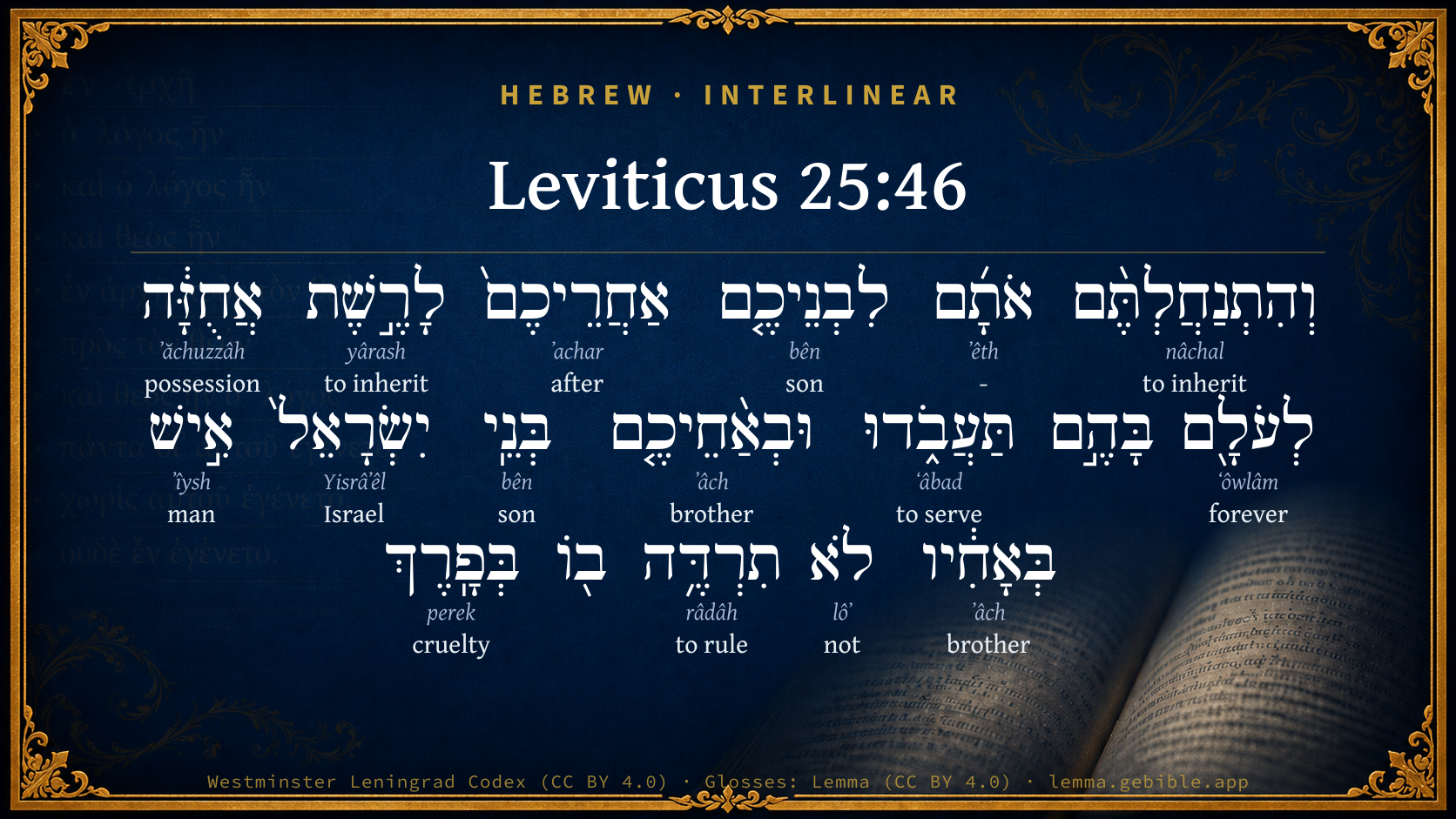
  1. וְהִתְנַחֲלְתֶּ֨ם nâchal H5157 “and · to inherit” Conjunction + Verb, Hithpael, Sequential Perfect, 2nd Person, Masculine, Plural
  2. אֹתָ֜ם ʼêth H853 “- · them” Particle, Direct Object + Suffix, Personal, 3rd Person, Masculine, Plural
  3. לִבְנֵיכֶ֤ם bên H1121 “to/for · sons · your” Preposition + Noun, Common, Masculine, Plural, Construct + Suffix, Personal, 2nd Person, Masculine, Plural
  4. אַחֲרֵיכֶם֙ ʼachar H310 “after · you” Preposition + Suffix, Personal, 2nd Person, Masculine, Plural
  5. לָרֶ֣שֶׁת yârash H3423 “to inherit” Preposition + Verb, Qal, Infinitive Construct
  6. אֲחֻזָּ֔ה ʼăchuzzâh H272 “possession” Noun, Common, Feminine, Singular, Absolute
  7. לְעֹלָ֖ם ʻôwlâm H5769 “to/for · forever” Preposition + Noun, Common, Masculine, Singular, Absolute
  8. תַּעֲבֹ֑דוּ ʻâbad H5647 “to serve” Verb, Qal, Imperfect, 2nd Person, Masculine, Plural
  9. וּבְאַ֨חֵיכֶ֤ם ʼâch H251 “and · in/at · brothers · your” Conjunction + Preposition + Noun, Common, Masculine, Plural, Construct + Suffix, Personal, 2nd Person, Masculine, Plural
  10. בְּנֵֽי bên H1121 “sons of” Noun, Common, Masculine, Plural, Construct
  11. יִשְׂרָאֵל֙ Yisrâʼêl H3478 “Israel” Noun, Proper
  12. אִ֣ישׁ ʼîysh H376 “man” Noun, Common, Masculine, Singular, Absolute
  13. בְּאָחִ֔יו ʼâch H251 “in/at · brother · his” Preposition + Noun, Common, Masculine, Singular, Construct + Suffix, Personal, 3rd Person, Masculine, Singular
  14. לֹא lôʼ H3808 “not” Particle, Negative
  15. תִרְדֶּ֥ה râdâh H7287 “to rule” Verb, Qal, Imperfect, 2nd Person, Masculine, Singular

About this verse

These counts appear in no published source. They are computed here, from the morphology-tagged text and Lemma’s own curated glosses. What Lemma adds →

18
words
14
distinct lemmas
Pentateuch
section

Notable vocabulary

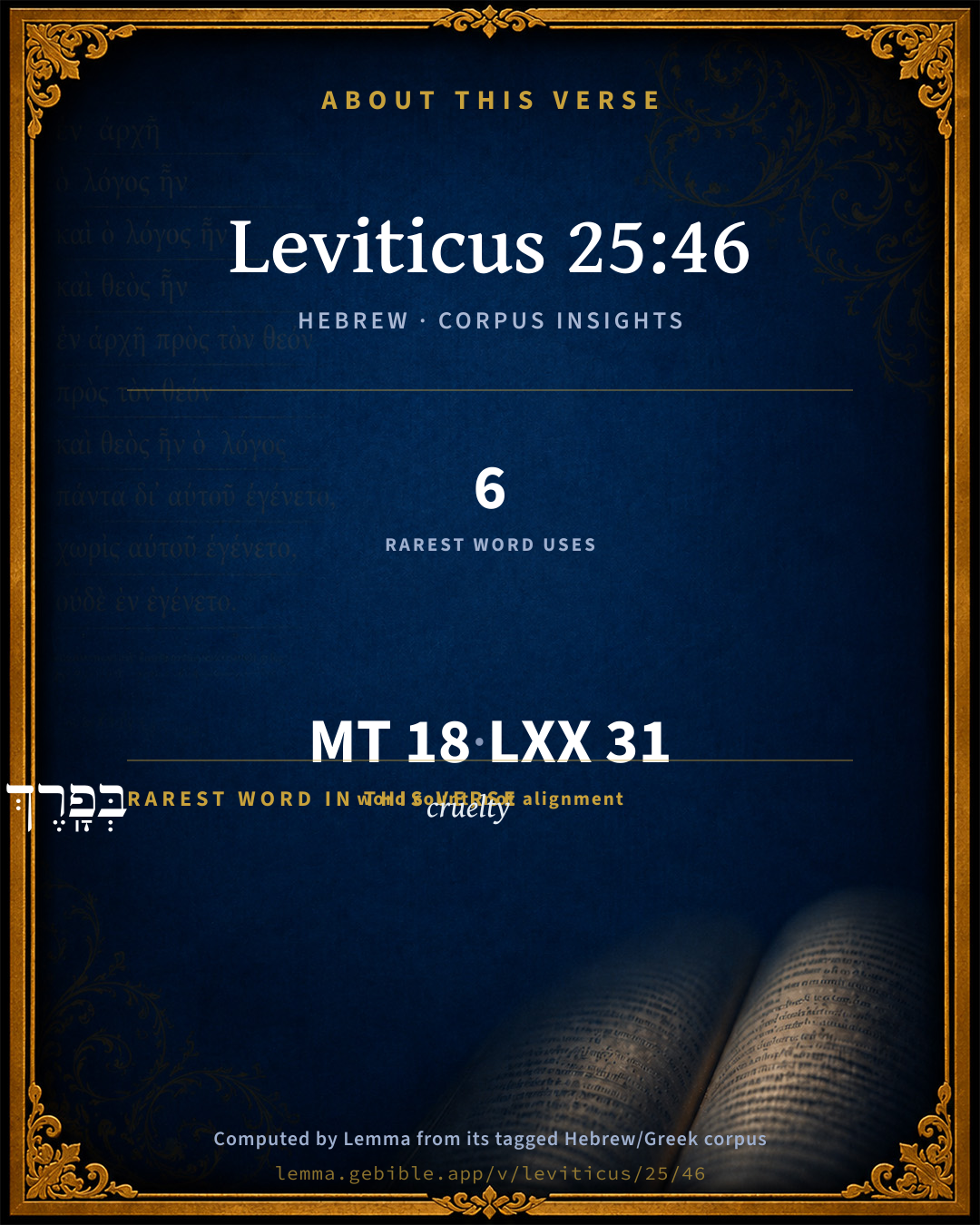
The rarest word here is בְּפָֽרֶךְ cruelty H6531 — appearing just 6 times in the whole Hebrew Bible.

Shared distinctive vocabulary

בְּפָֽרֶךְ cruelty H6531 occurs in 6 verses of the Hebrew Bible. Also found in:

Grammatical profile

  • 4 verbs
  • 9 nouns
  • 3 prepositions
  • 2 particles

Verb forms

  • וְהִתְנַחֲלְתֶּ֨ם Hithpael · Sequential Perfect
  • לָרֶ֣שֶׁת Qal · Infinitive Construct
  • תַּעֲבֹ֑דוּ Qal · Imperfect
  • תִרְדֶּ֥ה Qal · Imperfect

Repetition

Words recur within this verse — often emphatic in Hebrew:

  • לִבְנֵיכֶ֤ם son H1121 ×2
  • וּבְאַ֨חֵיכֶ֤ם brother H251 ×2

Hebrew & Septuagint length

In English translation the verse runs 41 words from the Hebrew and 36 from the Septuagint (LXX English) — closely comparable.

A rough comparison of the two English renderings, which tokenize alike — not a word-level alignment.

Word counts can differ between the Hebrew and the Greek without any difference in meaning — e.g. the Hebrew direct-object marker אֵת has no separate Greek word, and Greek often adds the article ὁ.

In the original languages it is 18 Hebrew tokens and 31 Greek tokens — but the two are counted differently (Hebrew bundles its prefixes and suffixes into one token; the Greek is in lemma form), so that isn’t a like-for-like length.

Cross-references

2

Topical passages linked to Leviticus 25:46 in the Treasury of Scripture Knowledge — connected by theme and wording, ordered by reader-vote popularity; previews shown in the World English Bible.

  • Isaiah 14:2 The peoples shall take them, and bring them to their place; and the house of Israel shall possess them in the land of Yahweh for servants and for handmaids: and they shall take them captive whose captives they were; and they shall rule over their oppressors.
  • Leviticus 25:43 You shall not rule over him with harshness, but shall fear your God.

Cross-references courtesy of OpenBible.info (CC BY 4.0).

Hebrew and Greek witnesses Masoretic Hebrew ↔ Greek Septuagint

The same verse in the two great witnesses to the Old Testament, shown verse-for-verse.

These are two independent witnesses, not word-aligned to each other, and the Septuagint is shown in lemma (dictionary) form.

Hebrew Leviticus 25:46 Masoretic · Westminster Leningrad Codex

וְהִתְנַחֲלְתֶּ֨ם אֹתָ֜ם לִבְנֵיכֶ֤ם אַחֲרֵיכֶם֙ לָרֶ֣שֶׁת אֲחֻזָּ֔ה לְעֹלָ֖ם בָּהֶ֣ם תַּעֲבֹ֑דוּ וּבְאַ֨חֵיכֶ֤ם בְּנֵֽי יִשְׂרָאֵל֙ אִ֣ישׁ בְּאָחִ֔יו לֹא תִרְדֶּ֥ה ב֖וֹ בְּפָֽרֶךְ

You may make them an inheritance for your children after you, to hold for a possession; of them may you take your slaves forever: but over your brothers the children of Israel you shall not rule, one over another, with harshness.

World English Bible · Public Domain

Greek LXX Leviticus 25:46 Septuagint · lemma form

καί καταμερίζω αὐτός ὁ τέκνον σύ μετά σύ καί εἰμί σύ κατόχιμος εἰς ὁ αἰών ὁ ἀδελφός σύ ὁ υἱός ἰσραήλ ἕκαστος ὁ ἀδελφός αὐτός οὐ κατατείνω αὐτός ἐν ὁ μόχθος

And you⌃ shall distribute them to your children after you, and they shall be to you permanent possessions for ever: but of your brethren the children of Israel, one shall not oppress his brother in labors.

LXX2012 (modern English Septuagint) · Public Domain

Hebrew: Westminster Leningrad Codex (CC BY 4.0). Greek: Septuagint (public domain); English from LXX2012 (modern English Septuagint) (Public Domain). How the Septuagint differs from the Hebrew →

Targum (Aramaic paraphrase)

2

The Targum is the ancient Jewish Aramaic paraphrase of the Hebrew Scriptures — an interpretive translation, not the Hebrew text itself. Onkelos (literal) and Pseudo-Jonathan (expansive) render the Torah, and Jonathan the Prophets. Coverage is partial: where no permissively-licensed English translation exists for a verse, only the Aramaic is shown. This is verse-level text, not a word-by-word alignment to the Hebrew.

  1. Targum Onkelos Torah (Genesis–Deuteronomy)
    וְתַחֲסוּן יָתְהוֹן לִבְנֵיכוֹן בַּתְרֵיכוֹן לִירוּתַת אַחֲסָנָא לְעָלָם בְּהוֹן תִּפְלְחוּן וּבְאֲחֵיכוֹן בְּנֵי יִשְׂרָאֵל גְבַר בַּאֲחוּהִי לָא תִפְלַח בֵּהּ בְּקַשְׁיוּ

    (no public-domain English translation for this verse)

    Targum Onkelos — Aramaic: “Onkelos Genesis” (public domain); “Onkelos Exodus” (public domain); “Onkelos Leviticus” (public domain); “Onkelos Numbers” (public domain); “Onkelos Deuteronomy” (public domain). English: “Sefaria Community Translation” (CC0 1.0 (public-domain dedication)); “J.W. Etheridge. The Targums of Onkelos and Jonathan Ben Uzziel on the Pentateuch. London: Longmans, Green, 1862” (public domain). Text via Sefaria.

  2. Targum Pseudo-Jonathan Torah (Genesis–Deuteronomy)
    וְתַחְסְנוּן יַתְהוֹן לִבְנֵיכוֹן בַּתְרֵיכוֹן לִירוּתַת אַחֲסָנָא לַעֲלַם בְּהוֹן תִּפְלְחוּן וּבְאֲחוּכוֹן בְּנֵי יִשְרָאֵל גְבַר בְּחַבְרֵיהּ לָא תְשַׁעֲבְּדוּן בְּהוֹן בְּקַשְׁיוּ

    And you may leave them to your children after you, to inherit as a perpetual possession; them you shall make to serve: but of your brethren of the sons of Israel no man (may enslave) his fellow; them shall you not make to serve with rigour.

    Targum Pseudo-Jonathan — Aramaic: “Targum Jonathan on Genesis” (public domain); “Targum Jonathan on Exodus” (public domain); “Targum Jonathan on Leviticus” (public domain); “Targum Jonathan on Numbers” (public domain); “Targum Jonathan on Deuteronomy” (public domain). English: “The Targum of Jonathan ben Uzziel, trans. J. W. Etheridge, London, 1862” (public domain). Text via Sefaria.

Commentary

Notes on Leviticus 25:46 from classic Christian and Jewish commentators (each source and its license shown beneath its notes). The classic Christian expositions comment on the surrounding passage and are grouped to its opening verse, so a note may address several verses; the Jewish commentaries on the Tanakh (Rashi and others) are per-verse, so they appear only where the commentator wrote on this verse.

Lemma curates 59 commentaries, every one of them public domain or Creative Commons licensed, each selected and text-cleaned for this edition rather than reprinted as found. About our sources →

Trapp's Complete Commentary

John Trapp

Lev 25:46 And ye shall take them as an inheritance for your children after you, to inherit [them for] a possession; they shall be your bondmen for ever: but over your brethren the children of Israel, ye shall not rule one over another with rigour.

Ver. 46. But over your brethren the children of Israel.] Tacitus observed of the Jews in his time, that to their own countrymen they were very kind: but toward all others, cursed and cruel.

John Trapp, A Commentary or Exposition upon All the Books of the Old and New Testament (1647–1656) — public domain. Text from a community e-Sword module.

Ellicott's Commentary for English Readers

(46) And ye shall take them as an inheritance for your children.—That is, they may appropriate them to themselves, as their personal property, which is transmissible as inheritance to posterity with the family land.

They shall be your bondmen for ever.—These are not subject to the laws of jubile. They remain in perpetual serfdom unless they or their friends redeem them, or their master has maimed any one of them. In case of injury the master is obliged to manumit him (Exo_21:26-27). The authorities during the second Temple enacted that the master’s right, even with regard to this kind of bondmen, is restricted to their labour, but that he has no right to barter with them, to misuse them, or to put them to shame.

Over your brethren . . . ye shall not rule . . . with rigour.—In contrast to these heathen bondmen the Jewish bondmen are here designated “brethren.” They are co-religionists, who have been reduced to temporary servitude, but who are, nevertheless, fellow-heirs with them in the land of their possession. Hence the greatest consideration was to be shown to them in these adverse circumstances. The authorities during the second Temple have therefore enacted that there must be no difference between the daily food, raiment, and dwelling of the master and his Hebrew slave, and that the master and the servant are alike in these respects.

A Bible Commentary for English Readers, edited by Charles John Ellicott (1878–1897) — public domain. Text from a community e-Sword module.

John Gill's Exposition

And ye shall take them as an inheritance for your children after you,.... Which they might leave them at their death to inherit, as they did their estates and lands; for such servants are, with the Jews (y), said to be like immovable goods, as fields, vineyards:

to inherit them for a possession; as their property, as anything else that was bequeathed to hem, as negroes now are in our plantations abroad:

thy shall be your bondmen for ever; and not be released at the year jubilee, nor before nor after; unless they obtained their liberty, either by purchase, which they might make themselves, or by the means of others, or else by a writing under their master's hand dismissing them from his service (z); or in case they were maimed by him, then he was obliged to let them go free, Exo 21:26,

but over your brethren, the children of Israel, ye shall not rule one over another with rigour; which repeated for the confirmation of it, and for the fuller explanation and description of the person not to be ruled over with rigour; and that it might be the more taken notice of, and to make them the more careful in the observance of it and though this peculiarly respects masters' treatment of their servants, yet Jarchi thinks it comprehends a prince over his people, and a king over his ministers, whom he may not rule with rigour.

(y) Maimon. & Bartenora in Misn. Kiddushin, c. 1. sect. 3. (z) Misn. Kiddushin, ib.

John Gill's Exposition of the Whole Bible (1746–1763) — public domain (CC PDM 1.0). Text via the HelloAO Bible API.

Whedon's Commentary on the Bible

Daniel D. Whedon

46. Take… as an inheritance — Rather, leave as an inheritance.

Bondmen forever — Albert Barnes thus explains this: “The permanent provision for servants was not that they were to enslave or employ their brethren, the Hebrews, but that they were to employ foreigners.” In other words, olam, forever, refers not to the persons bought and their children, but to the ordinance. But in case it did refer to persons there must be the following limitations: 1.) The law required the emancipation of a servant organically injured by the violence of the master. Exo_21:26; Exo_27:2.) Though the ear-bored servant was to be in bondage forever, the rabbins understand that he went out free at the jubilee. Hence we see no objection to this limitation of olam in the case of all servants, Gentile as well as Hebrew, to the year of jubilee. It is certainly limited to the term of life, which is often less than the jubilee period. See Lev_25:10, note.

Daniel D. Whedon (gen. ed.), Commentary on the Old and New Testaments (1874–1909) — public domain. Text from a community e-Sword module.

Rashi

Rabbi Shlomo Yitzchaki (Rashi)

והתנחלתם אתם לבניכם means, you may hold them as your possession, לבניכם אחריכם, for the benefit of your children after you. It would not, however, be correct to give the word והתנחלתם the meaning: “leave them as an inheritance to your children”, for if this were intended it should have written: והנחלתם אותם לבניכם (the Hiphil), but והתנחלתם (which is the Hithpael form) is equivalent to והתחזקתם “you may hold them as your possession”.

איש באחיו ONE OVER ANOTHER — These apparently redundant words (for the text might have run: ובאחיכם בני ישראל לא תרדו בפרך) are intended to include in the prohibition that the prince must not rule with rigour over his people nor the king over his subjects.

Rashi on the Tanakh — English translations: “The Judaica Press complete Tanach with Rashi, translated by A. J. Rosenberg” (CC BY 4.0); “Pentateuch with Rashi's commentary by M. Rosenbaum and A.M. Silbermann, 1929-1934” (public domain); “The Metsudah Tanach series, Lakewood, N.J” (CC BY 4.0); and “The Book of Joshua, Metsudah Publications, 1997” (CC BY 4.0). Text via Sefaria.

Lesson kit

Teaching starters — assembled from the data on this page, not authored interpretation. Every prompt links to the verse data it draws on. Edit before teaching.

Leviticus, in the Pentateuch, opens this verse with 18 words (14 distinct Hebrew lemmas). Its most distinctive word is perek (“cruelty”). A historical commentator’s framing appears above. Read the whole chapter for the surrounding context.

Discussion questions

  1. The word perek carries the sense “cruelty.” How does it shape the verse?
  2. How does Exodus 1:13, which shares the word «cruelty», read alongside this verse?
  3. What does the repetition of “son” (2× in this one verse) do in this verse?
  4. The translations on this page render this verse differently — a whole-verse word diff, not a word-by-word alignment. What might account for the different wordings?
  5. «וְהִתְנַחֲלְתֶּ֨ם» is a Hithpael Sequential Perfect verb. How does that grammatical form shape the action described?
  6. Compare how Trapp's Complete Commentary and Ellicott's Commentary for English Readers read this verse. Where do they agree or differ?

Things to notice

Reading settings

Reading text

Shown beneath each verse's original-language words.

Old Testament
Old Testament edition

Read the OT as the Masoretic Hebrew (MT) or the Greek Septuagint (LXX).

English shown for the Greek Septuagint (in the Hebrew ↔ Greek comparison).

Comparing translations? Open the Compare panel on any verse page to stack up to four side by side.