
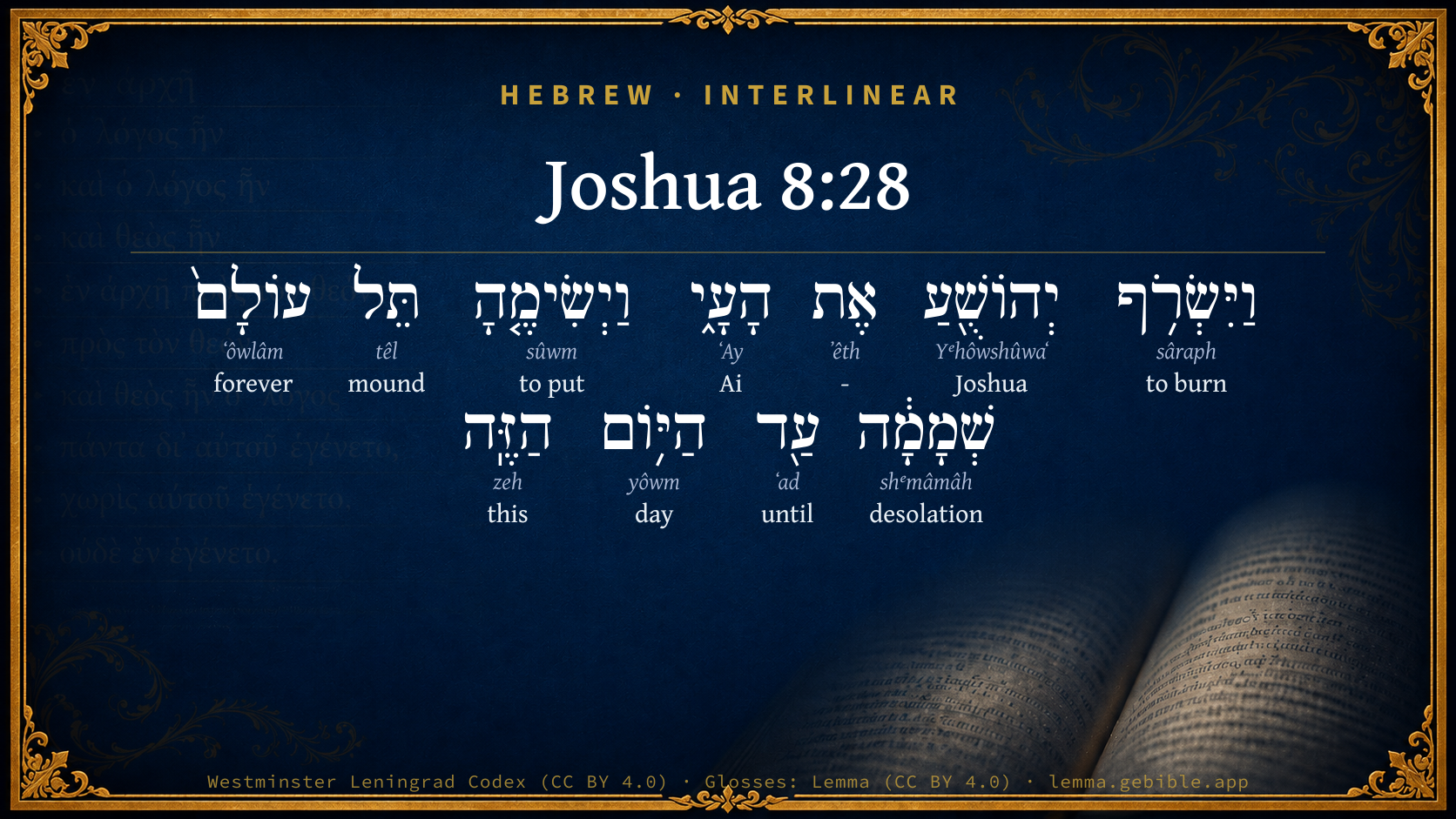
Joshua 8:28

Hebrew (Westminster Leningrad Codex) Joshua 8:28 appears in the Hebrew Old Testament. The text above is from the Westminster Leningrad Codex. Each word links to its Strong’s number, a concise gloss, and parsing drawn from the Open Scriptures Hebrew Bible morphology. Click any word for its full Brown-Driver-Briggs (BDB) entry.
Download image
Cite this verse

Joshua 8:28 (World English Bible). Public Domain. Lemma interlinear Bible study tool, https://lemma.gebible.app/v/joshua/8/28.

Show BibTeX & RIS
BibTeX
RIS
English Translation
So Joshua burnt Ai, and made it a heap forever, even a desolation, to this day.
World English Bible · Public Domain
Download a study sheet

One document with this verse’s original text, its word-by-word gloss line, the meaning frame, cross-references with their text, attributed commentary, and full source and license credits — printable, and it pastes into notes with its structure intact.

This verse Autodidact and up

Study sheet (.html) Plain text (.txt)

A passage Seminary Student

Up to 50 verses in one chapter. A passage sheet keeps up to 6 commentary sources and 12 cross-references per verse, in the order this page ranks them, and says so on the sheet whenever that leaves anything out. Ask for a single verse and you get the Autodidact verse sheet above.

Everything on this page stays free to read, with no account — the sheet is a download of what is already on screen, not access to it.

Want to remove ads? Support Godless Engineer
Compare translations 3

The same verse in 3 English versions, stacked beneath the original-language interlinear above. Click any original word for its lexicon entry.

Each is an independent rendering of the whole verse — the interlinear is not word-aligned to these translations.

Highlighted words mark where these versions differ — a whole-verse word diff, not a word-by-word alignment.

  • World English Bible Public Domain
    So Joshua burnt Ai, and made it a heap forever, even a desolation, to this day.
  • King James Version Public Domain
    And Joshua burnt Ai, and made it an heap for ever, even a desolation unto this day.
  • unfoldingWord Literal Text CC BY-SA 4.0
    And Joshua burned Ai, and he made it a mound forever, a desolation to this day.

unfoldingWord Literal Text — © unfoldingWord, licensed CC BY-SA 4.0. Word-aligned USFM3 via Door43 (git.door43.org/unfoldingWord/en_ult).

Versions to compare (up to 4)

3 of 4 selected

Show all 18 translations

Every available English version of this verse, each an independent rendering of the whole verse.

  • World English Bible Public Domain
    So Joshua burnt Ai, and made it a heap forever, even a desolation, to this day.
  • Berean Standard Bible Public Domain
    So Joshua burned Ai and made it a permanent heap of ruins, a desolation to this day.
  • Majority Standard Bible Public Domain
    So Joshua burned Ai and made it a permanent heap of ruins, a desolation to this day.
  • King James Version Public Domain
    And Joshua burnt Ai, and made it an heap for ever, even a desolation unto this day.
  • American Standard Version (1901) Public Domain
    So Joshua burnt Ai, and made it a heap for ever, even a desolation, unto this day.
  • Revised Version (1885) Public Domain
    So Joshua burnt Ai, and made it an heap for ever, even a desolation, unto this day.
  • Geneva Bible (1599) Public Domain
    And Ioshua burnt Ai, and made it an heape for euer, and a wildernes vnto this day.
  • Douay-Rheims (1899) Public Domain
    And he burned the city, and made it a heap for ever:
  • Young's Literal Translation Public Domain
    And Joshua burneth Ai, and maketh it a heap age-during -- a desolation unto this day;
  • Literal Standard Version CC BY-SA 4.0
    And Joshua burns Ai, and makes it a continuous heap—a desolation to this day;
  • Unlocked Literal Bible CC BY-SA 4.0
    Joshua burned Ai and turned it into a heap of ruins forever. It is an abandoned place to this day.
  • unfoldingWord Literal Text CC BY-SA 4.0
    And Joshua burned Ai, and he made it a mound forever, a desolation to this day.
  • Darby Bible Public Domain
    And Joshua burned Ai, and made it an everlasting heap of desolation to this day.
  • World Messianic Bible Public Domain
    So Joshua burned Ai and made it a heap forever, even a desolation, to this day.
  • Webster's Bible Public Domain
    And Joshua burnt Ai, and made it a heap for ever, even a desolation to this day.
  • Free Bible Version CC BY-SA 4.0
    So Joshua burned the town of Ai, making it permanently into a heap of ruins where no one lives to this very day.
  • Bible in Basic English Public Domain
    So Joshua gave Ai to the flames, and made it a waste mass of stones for ever, as it is to this day.
  • JPS Tanakh (1917) Public Domain
    So Joshua burnt Ai, and made it a heap for ever, even a desolation, unto this day.

Literal Standard Version (2020), Covenant Press — licensed CC BY-SA 4.0. Text via the HelloAO Bible API (eBible.org). Unlocked Literal Bible (unfoldingWord) — licensed CC BY-SA 4.0. Text via the HelloAO Bible API (eBible.org). unfoldingWord Literal Text — © unfoldingWord, licensed CC BY-SA 4.0. Word-aligned USFM3 via Door43 (git.door43.org/unfoldingWord/en_ult). Free Bible Version, Dr. Jonathan Gallagher — licensed CC BY-SA 4.0. Text via the HelloAO Bible API (eBible.org).

Word by word

More ways to search: Search by grammar → Find every occurrence → Compare this word →

Practice this passage: Drill this verse → Learn its vocabulary →

תֵּל
têl
H8510
“mound of”
Noun, Common, Masculine, Singular, Construct
Part of Speech
Noun
Type
Common
Gender
Masculine
Number
Singular
State
Construct
Full BDB Definition

Origin: by contraction from H8524

TWOT: 2513a

mound, heap, heap of ruins - mound (of ruin-heap of city) - mound, hill (of elevation on which city stood)
  1. וַיִּשְׂרֹ֥ף sâraph H8313 “and · to burn” Conjunction + Verb, Qal, Sequential Imperfect, 3rd Person, Masculine, Singular
  2. יְהוֹשֻׁ֖עַ Yᵉhôwshûwaʻ H3091 “Joshua” Noun, Proper
  3. אֶת ʼêth H853 “-” Particle, Direct Object
  4. הָעָ֑י ʻAy H5857 “the · Ai” Particle, Definite Article + Noun, Proper
  5. וַיְשִׂימֶ֤הָ sûwm H7760 “and · to put · her” Conjunction + Verb, Qal, Sequential Imperfect, 3rd Person, Masculine, Singular + Suffix, Personal, 3rd Person, Feminine, Singular
  6. עוֹלָם֙ ʻôwlâm H5769 “forever” Noun, Common, Masculine, Singular, Absolute
  7. שְׁמָמָ֔ה shᵉmâmâh H8077 “desolation” Noun, Common, Feminine, Singular, Absolute
  8. עַ֖ד ʻad H5704 “until” Preposition
  9. הַיּ֥וֹם yôwm H3117 “the · day” Particle, Definite Article + Noun, Common, Masculine, Singular, Absolute
  10. הַזֶּֽה zeh H2088 “the · this” Particle, Definite Article + Pronoun, Demonstrative, Masculine, Singular

About this verse

These counts appear in no published source. They are computed here, from the morphology-tagged text and Lemma’s own curated glosses. What Lemma adds →

11
words
11
distinct lemmas
Historical
section

Notable vocabulary

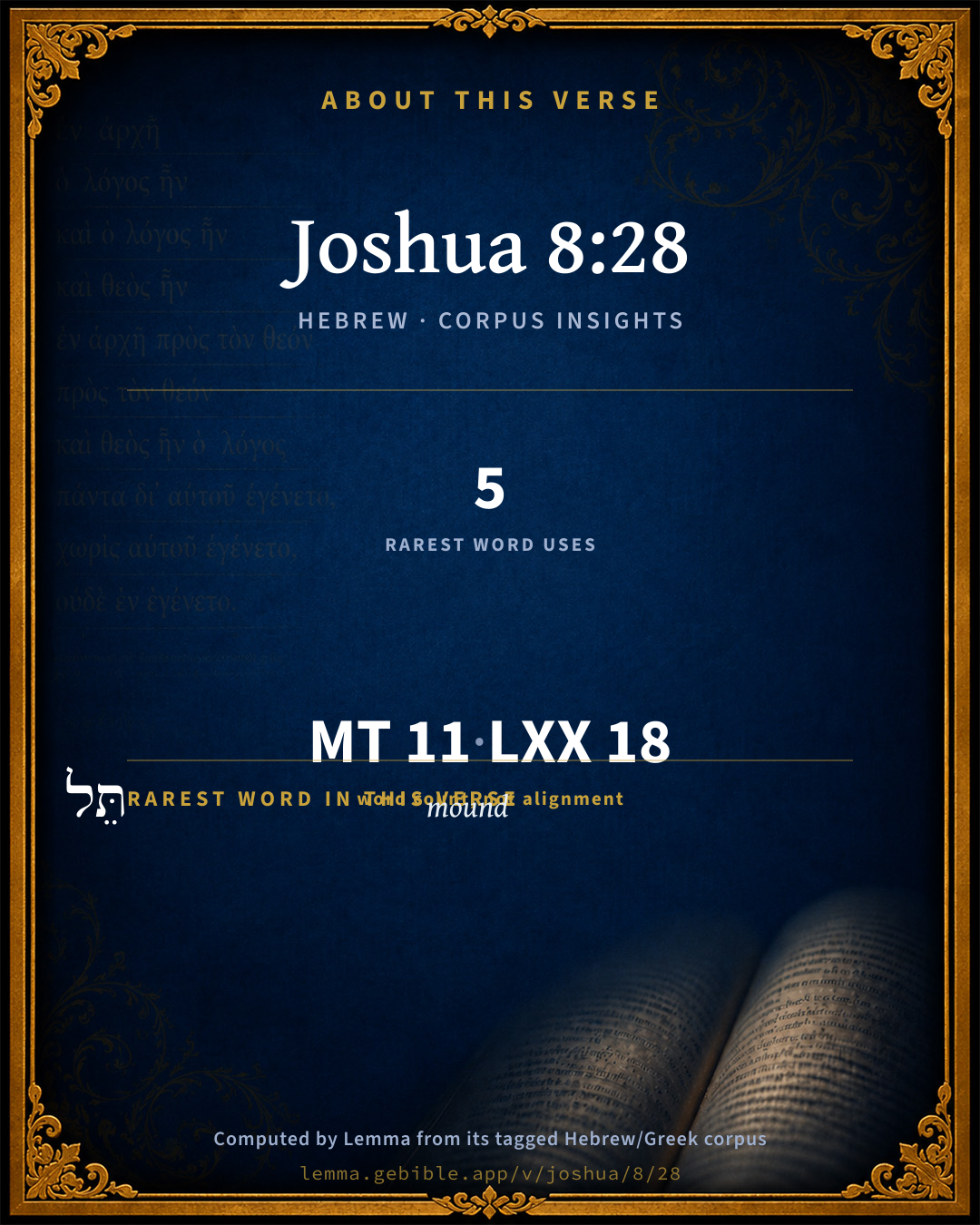
The rarest word here is תֵּל mound H8510 — appearing just 5 times in the whole Hebrew Bible.

Shared distinctive vocabulary

תֵּל mound H8510 occurs in 5 verses of the Hebrew Bible. Also found in:

Grammatical profile

  • 2 verbs
  • 6 nouns
  • 1 pronoun
  • 1 preposition
  • 1 particle

Verb forms

  • וַיִּשְׂרֹ֥ף Qal · Sequential Imperfect
  • וַיְשִׂימֶ֤הָ Qal · Sequential Imperfect

Hebrew & Septuagint length

In English translation the verse runs 16 words from the Hebrew and 19 from the Septuagint (LXX English) — closely comparable.

A rough comparison of the two English renderings, which tokenize alike — not a word-level alignment.

Word counts can differ between the Hebrew and the Greek without any difference in meaning — e.g. the Hebrew direct-object marker אֵת has no separate Greek word, and Greek often adds the article ὁ.

In the original languages it is 11 Hebrew tokens and 18 Greek tokens — but the two are counted differently (Hebrew bundles its prefixes and suffixes into one token; the Greek is in lemma form), so that isn’t a like-for-like length.

Cross-references

9

Topical passages linked to Joshua 8:28 in the Treasury of Scripture Knowledge — connected by theme and wording, ordered by reader-vote popularity; previews shown in the World English Bible.

  • Deuteronomy 13:16 You shall gather all the spoil of it into the midst of the street of it, and shall burn with fire the city, and all the spoil of it every whit, to Yahweh your God: and it shall be a heap forever; it shall not be built again.
  • Joshua 4:9 Joshua set up twelve stones in the midst of the Jordan, in the place where the feet of the priests who bore the ark of the covenant stood: and they are there to this day.
  • 2 Kings 19:25 Haven't you heard how I have done it long ago, and formed it of ancient times? now have I brought it to pass, that it should be yours to lay waste fortified cities into ruinous heaps.
  • Isaiah 17:1 The burden of Damascus. Behold, Damascus is taken away from being a city, and it shall be a ruinous heap.
  • Isaiah 25:2 For you have made of a city a heap, of a fortified city a ruin, a palace of strangers to be no city; it shall never be built.
  • Jeremiah 9:11 I will make Jerusalem heaps, a dwelling-place of jackals; and I will make the cities of Judah a desolation, without inhabitant.
  • Jeremiah 49:2 Therefore, behold, the days come, says Yahweh, that I will cause an alarm of war to be heard against Rabbah of the children of Ammon; and it shall become a desolate heap, and her daughters shall be burned with fire: then shall Israel possess those who did possess him, says Yahweh.
  • Jeremiah 50:26 Come against her from the utmost border; open her store-houses; cast her up as heaps, and destroy her utterly; let nothing of her be left.
  • Micah 3:12 Therefore Zion for your sake will be plowed like a field, And Jerusalem will become heaps of rubble, And the mountain of the temple like the high places of a forest.

Cross-references courtesy of OpenBible.info (CC BY 4.0).

Hebrew and Greek witnesses Masoretic Hebrew ↔ Greek Septuagint

The same verse in the two great witnesses to the Old Testament, shown verse-for-verse.

These are two independent witnesses, not word-aligned to each other, and the Septuagint is shown in lemma (dictionary) form.

Hebrew Joshua 8:28 Masoretic · Westminster Leningrad Codex

וַיִּשְׂרֹ֥ף יְהוֹשֻׁ֖עַ אֶת הָעָ֑י וַיְשִׂימֶ֤הָ תֵּל עוֹלָם֙ שְׁמָמָ֔ה עַ֖ד הַיּ֥וֹם הַזֶּֽה

So Joshua burnt Ai, and made it a heap forever, even a desolation, to this day.

World English Bible · Public Domain

Greek LXX Joshua 8:28 Septuagint · lemma form

καί ἐνπυρίζω ἰησοῦς ὁ πόλις ἐν πῦρ χῶμα ἀοίκητος εἰς ὁ αἰών τίθημι αὐτός ἕως ὁ ἡμέρα οὗτος

And Joshua burnt the city with fire: he made it an uninhabited heap for ever, even to this day.

LXX2012 (modern English Septuagint) · Public Domain

Hebrew: Westminster Leningrad Codex (CC BY 4.0). Greek: Septuagint (public domain); English from LXX2012 (modern English Septuagint) (Public Domain). How the Septuagint differs from the Hebrew →

Targum (Aramaic paraphrase)

1

The Targum is the ancient Jewish Aramaic paraphrase of the Hebrew Scriptures — an interpretive translation, not the Hebrew text itself. Onkelos (literal) and Pseudo-Jonathan (expansive) render the Torah, and Jonathan the Prophets. Coverage is partial: where no permissively-licensed English translation exists for a verse, only the Aramaic is shown. This is verse-level text, not a word-by-word alignment to the Hebrew.

  1. Targum Jonathan Prophets (Joshua–Malachi)
    וְאוֹקִיד יְהוֹשֻׁעַ יַת עָי וְשַׁוְיָהּ תֵּל חֲרִיב לְעָלַם לְצָדוּ עַד יוֹמָא הָדֵין:

    (no public-domain English translation for this verse)

    Targum Jonathan — Aramaic: “Mikraot Gedolot” (public domain). English: “Sefaria Community Translation” (CC0 1.0 (public-domain dedication)); “London "Chaldee Paraphrase," 1871” (public domain). Text via Sefaria.

Commentary

Notes on Joshua 8:28 from classic Christian and Jewish commentators (each source and its license shown beneath its notes). The classic Christian expositions comment on the surrounding passage and are grouped to its opening verse, so a note may address several verses; the Jewish commentaries on the Tanakh (Rashi and others) are per-verse, so they appear only where the commentator wrote on this verse.

Lemma curates 59 commentaries, every one of them public domain or Creative Commons licensed, each selected and text-cleaned for this edition rather than reprinted as found. About our sources →

The Cambridge Bible for Schools and Colleges

gen. ed. J. J. S. Perowne

28. a heap] “an everlasting toumbe,” Wyclif. Heb. a “Tel,” always with the article, The Tel, or Heap. “For a long time modern explorers in vain sought for the site of Ai, where they knew it must have stood. “The inhabitants of the neighbouring villages,” writes Canon Williams, “declared repeatedly and emphatically that this was Tel and nothing else. I was satisfied that it should be so when, on subsequent reference to the original text of Jos_8:28, I found it written that ‘Joshua burnt Ai, and made it a Tel for ever, even a desolation unto this day.’ There are many Tels in modern Palestine, that land of Tels, even Tel with some other name attached to it to mark the former site. But the site of Ai has no other name ‘unto this day.’ It is simply et-Tel = the Heap, ‘par excellence’.”

The Cambridge Bible for Schools and Colleges (gen. ed. J. J. S. Perowne; Cambridge University Press, 1878–1918) — public domain. Text from a community e-Sword module.

Trapp's Complete Commentary

John Trapp

Jos 8:28 And Joshua burnt Ai, and made it an heap for ever, [even] a desolation unto this day.

Ver. 28. And Joshua burnt Ai.] {See Trapp on "Jos 8:8"}

John Trapp, A Commentary or Exposition upon All the Books of the Old and New Testament (1647–1656) — public domain. Text from a community e-Sword module.

Tyndale Open Study Notes

Tyndale Open Resources

8:28 Prior to its destruction, Ai was called by an unknown name. The writer of Joshua always referred to it as Ai (meaning “ruin”), the name it was given after its destruction.

Tyndale Open Study Notes — © Tyndale Open Resources, licensed CC BY-SA 4.0. Text via the HelloAO Bible API.

Geneva Bible (1599)

Geneva Bible translators

That it could never be built again.

Geneva Bible (1599) marginal notes — public domain. Text via Bolls.life.

Jamieson, Fausset & Brown

Robert Jamieson, A. R. Fausset & David Brown

Joshua burnt Ai, and made it an heap for ever--"For ever" often signifies "a long time" (Gen 6:3). One of the remarkable things with regard to the tell we have identified with Ai is its name--the tell of the heap of stones--a name which to this day remains [VAN DE VELDE].

Jamieson, Fausset & Brown — Commentary Critical and Explanatory on the Whole Bible (1871) — public domain (CC PDM 1.0). Text via the HelloAO Bible API.

Adam Clarke's Commentary

Verse 28. Unto this day.] This last clause was probably added by a later hand.

Adam Clarke's Commentary on the Bible (1810–1826) — public domain. Text from a community e-Sword/MySword module.

Ellicott's Commentary for English Readers

(28) An heap for ever.—Heb., Tel-ôlam; modern name, Et-tel.

A Bible Commentary for English Readers, edited by Charles John Ellicott (1878–1897) — public domain. Text from a community e-Sword module.

John Gill's Exposition

And Joshua burnt Ai,.... The whole city, fire being only set before to a few houses, to make a smoke as a signal; he did with it as he had done with Jericho, for so he was ordered, Jos 8:2,

and made it an heap for ever; that is, for a long time, for it appears to have been rebuilt, and to have been inhabited by the Jews, after their return from their Babylonish captivity, Neh 11:31,

even a desolation unto this day; to the time of the writing of this book; and by what has been just observed, it appears that Ezra could not be the writer of it, since this city was inhabited in his time.

John Gill's Exposition of the Whole Bible (1746–1763) — public domain (CC PDM 1.0). Text via the HelloAO Bible API.

Haydock's Catholic Bible Commentary

For ever, or for a long time. It was rebuilt before the captivity, 2 Esdras vii. 31.

George Leo Haydock (1774–1849), Haydock's Catholic Family Bible and Commentary, 1859 edition — public domain. Excludes Psalms (Douay-Rheims chapter numbering differs from Protestant) and Deuterocanonical books (Catholic canon only).

Matthew Poole's English Annotations

For ever, or, for a long time, as that word oft signifies, as Gen 6:3; Isa 42:14; for that it was after some ages rebuilt, may seem from Neh 11:31, unless that were another city built near the former, there being some little difference in the name also.

Matthew Poole's English Annotations on the Holy Bible (1683–1685) — public domain. Text from a community e-Sword/MySword module.

Whedon's Commentary on the Bible

Daniel D. Whedon

28. A heap for ever — [The word translated heap is תל, Tel, and strikingly confirms Capt. Wilson’s identification of the site of Ai with the mound still bearing, after the lapse of ages, the name Et-Tel, the ruined heap. Compare note on Jos_7:2.] Because the meaning of Ai is a heap of ruins the Rationalists build up a theory that the history of its conquest is a myth, growing out of ruins of unknown origin. But the city destroyed by Joshua may have taken the name of Ai or Hai, the ruins, from the ruins of a more ancient city out of which it may have been built.

Unto this day — This clause seems awkward, coming immediately after for ever, but it shows that the word for ever sometimes has a limited reference. Perhaps, however, the historian, or some later editor, meant by the former clause, closing with for ever, to express Joshua’s purpose to make Ai a perpetual desolation, and by the latter clause to indicate its fulfilment. The name of Ai appears again, after a thousand years, as inhabited. Neh_11:31. But it was probably on another site, just as there were an Old and a New Troy, an Old and a New Tyre.

Daniel D. Whedon (gen. ed.), Commentary on the Old and New Testaments (1874–1909) — public domain. Text from a community e-Sword module.

The Pulpit Commentary

And Joshua burnt Ai. He continued the work of destruction which the ambush had begun, until the city was entirely destroyed. The word in ver. 19 (prc) has rather the sense of kindling a fire; the word here (txy), more the sense of destruction by fire. A heap forever. a heap of eternity; i.e., a heap forever, at least up to the time of our writer. But the Ai mentioned in Ezr_2:28 may have been a city built, not on precisely the same spot, but near enough to it to take its name. And if Ai signifies ruins, and Dean Stanley be right in regarding it as referring to ruins in the days of the Philistines, the name would be particularly suitable to this particular city. Travellers have identified the place with Tel-el. Hajar, immediately to the south of the Wady Mutyah. But see note on Jos_7:2 for Robinson"s conclusion, which is confirmed by Canon Tristram, from the belief that Tel-el-Hajar does not answer to the description of Ai in the Scripture narrative. Hanged on a tree. Literally, "on the tree." Perhaps after his death, But see Gen_40:22 Deu_21:22. Until eventide. We find here a remarkable coincidence with the precept in Deu_21:23. The fact that no notice is here taken of that passage is conclusive against its having been inserted with a view to that precept in later times, and this affords a strong presumption against the Elohist and Jehovist theory. Heap. Here lG, an expression usually applied to a heap of stones, a cairn, though not always in precisely this sense. (see Jer_9:10)

The Pulpit Commentary (1880–1919), ed. H.D.M. Spence-Jones & Joseph S. Exell — public domain. Text from a community e-Sword module.

Lesson kit

Teaching starters — assembled from the data on this page, not authored interpretation. Every prompt links to the verse data it draws on. Edit before teaching.

Joshua, in the Historical, opens this verse with 11 words (11 distinct Hebrew lemmas). Its most distinctive word is têl (“mound”). A historical commentator’s framing appears above. Read the whole chapter for the surrounding context.

Discussion questions

  1. How does “mound” (têl) shape what this verse is saying?
  2. Deuteronomy 13:16 shares the word «mound» with this verse. How do the two illuminate each other?
  3. The translations on this page render this verse differently — a whole-verse word diff, not a word-by-word alignment. What might account for the different wordings?
  4. The verb «וַיִּשְׂרֹ֥ף» is Qal Sequential Imperfect. How does its form color the action?
  5. Reading how The Cambridge Bible for Schools and Colleges and Trapp's Complete Commentary read this verse, where do the two commentators agree and where do they part?

Things to notice

Reading settings

Reading text

Shown beneath each verse's original-language words.

Old Testament
Old Testament edition

Read the OT as the Masoretic Hebrew (MT) or the Greek Septuagint (LXX).

English shown for the Greek Septuagint (in the Hebrew ↔ Greek comparison).

Comparing translations? Open the Compare panel on any verse page to stack up to four side by side.