Hebrews 13:21

Greek (Tischendorf 8th ed.) Hebrews 13:21 appears in the Greek New Testament. The text above is from the Tischendorf 8th edition. Each word links to its Strong’s number and a concise gloss. Click any word for its full Thayer’s Greek Lexicon entry.
Download image
Cite this verse

Hebrews 13:21 (World English Bible). Public Domain. Lemma interlinear Bible study tool, https://lemma.gebible.app/v/hebrews/13/21.

Show BibTeX & RIS
BibTeX
RIS
English Translation
make you complete in every good work to do his will, working in you that which is well pleasing in his sight, through Jesus Christ, to whom be the glory forever and ever. Amen.
World English Bible · Public Domain
Download a study sheet

One document with this verse’s original text, its word-by-word gloss line, the meaning frame, cross-references with their text, attributed commentary, and full source and license credits — printable, and it pastes into notes with its structure intact.

This verse Autodidact and up

Study sheet (.html) Plain text (.txt)

A passage Seminary Student

Up to 50 verses in one chapter. A passage sheet keeps up to 6 commentary sources and 12 cross-references per verse, in the order this page ranks them, and says so on the sheet whenever that leaves anything out. Ask for a single verse and you get the Autodidact verse sheet above.

Everything on this page stays free to read, with no account — the sheet is a download of what is already on screen, not access to it.

Want to remove ads? Support Godless Engineer
Compare translations 3

The same verse in 3 English versions, stacked beneath the original-language interlinear above. Click any original word for its lexicon entry.

Each is an independent rendering of the whole verse — the interlinear is not word-aligned to these translations.

Highlighted words mark where these versions differ — a whole-verse word diff, not a word-by-word alignment.

  • World English Bible Public Domain
    make you complete in every good work to do his will, working in you that which is well pleasing in his sight, through Jesus Christ, to whom be the glory forever and ever. Amen.
  • King James Version Public Domain
    Make you perfect in every good work to do his will, working in you that which is wellpleasing in his sight, through Jesus Christ; to whom be glory for ever and ever. Amen.
  • unfoldingWord Literal Text CC BY-SA 4.0
    may he prepare you in every thing good to do his will, working in us well-pleasing before him, through Jesus Christ, to whom the glory forever ever. Amen.

unfoldingWord Literal Text — © unfoldingWord, licensed CC BY-SA 4.0. Word-aligned USFM3 via Door43 (git.door43.org/unfoldingWord/en_ult).

Versions to compare (up to 4)

3 of 4 selected

Show all 19 translations

Every available English version of this verse, each an independent rendering of the whole verse.

  • World English Bible Public Domain
    make you complete in every good work to do his will, working in you that which is well pleasing in his sight, through Jesus Christ, to whom be the glory forever and ever. Amen.
  • Berean Standard Bible Public Domain
    equip you with every good thing to do His will. And may He accomplish in us what is pleasing in His sight through Jesus Christ, to whom be glory forever and ever. Amen.
  • Majority Standard Bible Public Domain
    equip you with every good work to do His will. And may He accomplish in you what is pleasing in His sight through Jesus Christ, to whom be glory forever and ever. Amen.
  • King James Version Public Domain
    Make you perfect in every good work to do his will, working in you that which is wellpleasing in his sight, through Jesus Christ; to whom be glory for ever and ever. Amen.
  • American Standard Version (1901) Public Domain
    make you perfect in every good thing to do his will, working in us that which is well-pleasing in his sight, through Jesus Christ; to whom `be' the glory for ever and ever. Amen.
  • Revised Version (1885) Public Domain
    make you perfect in every good thing to do his will, working in us that which is well-pleasing in his sight, through Jesus Christ; to whom be the glory for ever and ever. Amen.
  • Geneva Bible (1599) Public Domain
    Make you perfect in all good workes, to doe his will, working in you that which is pleasant in his sight through Iesus Christ, to whom be praise for euer and euer, Amen.
  • Douay-Rheims (1899) Public Domain
    Fit you in all goodness, that you may do his will; doing in you that which is well pleasing in his sight, through Jesus Christ, to whom is glory for ever and ever. Amen.
  • Young's Literal Translation Public Domain
    make you perfect in every good work to do His will, doing in you that which is well-pleasing before Him, through Jesus Christ, to whom `is' the glory -- to the ages of the ages! Amen.
  • Literal Standard Version CC BY-SA 4.0
    make you perfect in every good work to do His will, doing in you that which is well-pleasing before Him, through Jesus Christ, to whom [is] the glory through the ages of the ages! Amen.
  • Unlocked Literal Bible CC BY-SA 4.0
    equip you with everything good to do his will, working in us what is pleasing to him, through Jesus Christ, to whom be the glory forever. Amen.
  • unfoldingWord Literal Text CC BY-SA 4.0
    may he prepare you in every thing good to do his will, working in us well-pleasing before him, through Jesus Christ, to whom the glory forever ever. Amen.
  • Darby Bible Public Domain
    perfect you in every good work to the doing of his will, doing in you what is pleasing before him through Jesus Christ; to whom [be] glory for the ages of ages. Amen.
  • World Messianic Bible Public Domain
    make you complete in every good work to do his will, working in you that which is well pleasing in his sight, through Yeshua the Messiah, to whom be the glory forever and ever. Amen.
  • Webster's Bible Public Domain
    Make you perfect in every good work to do his will, working in you that which is well-pleasing in his sight, through Jesus Christ; to whom be glory for ever and ever. Amen.
  • Free Bible Version CC BY-SA 4.0
    may he provide you with all that is good so you can do his will. May he work in us, doing everything that pleases him, through Jesus Christ—glory to him forever and ever. Amen.
  • Bible in Basic English Public Domain
    Make you full of every good work and ready to do all his desires, working in us whatever is pleasing in his eyes through Jesus Christ; and may the glory be given to him for ever and ever. So be it.
  • Text-Critical English NT CC BY 4.0
    equip you in every good work so that you may do his will. May he accomplish in you what is pleasing in his sight, through Jesus Christ, to whom be the glory forever and ever. Amen.
  • Tyndale New Testament (1534) Public Domain
    make you parfect in all good workes to do his will workynge in you that which is pleasaut in his syght thorow Iesus christ To whom be prayse for ever whill the worlde endureth Amen.

Literal Standard Version (2020), Covenant Press — licensed CC BY-SA 4.0. Text via the HelloAO Bible API (eBible.org). Unlocked Literal Bible (unfoldingWord) — licensed CC BY-SA 4.0. Text via the HelloAO Bible API (eBible.org). unfoldingWord Literal Text — © unfoldingWord, licensed CC BY-SA 4.0. Word-aligned USFM3 via Door43 (git.door43.org/unfoldingWord/en_ult). Free Bible Version, Dr. Jonathan Gallagher — licensed CC BY-SA 4.0. Text via the HelloAO Bible API (eBible.org).

Word by word

More ways to search: Search by grammar → Find every occurrence → Compare this word →

Practice this passage: Drill this verse → Learn its vocabulary →

εὐάρεστον
euárestos
G2101
“pleasing”
Adjective, Accusative, Singular, Neuter
Part of Speech
Adjective
Case
Accusative
Number
Singular
Gender
Neuter
Full Thayer's Definition

Origin: from G2095 and G701

TDNT: 08:36,8

1. well pleasing, acceptable
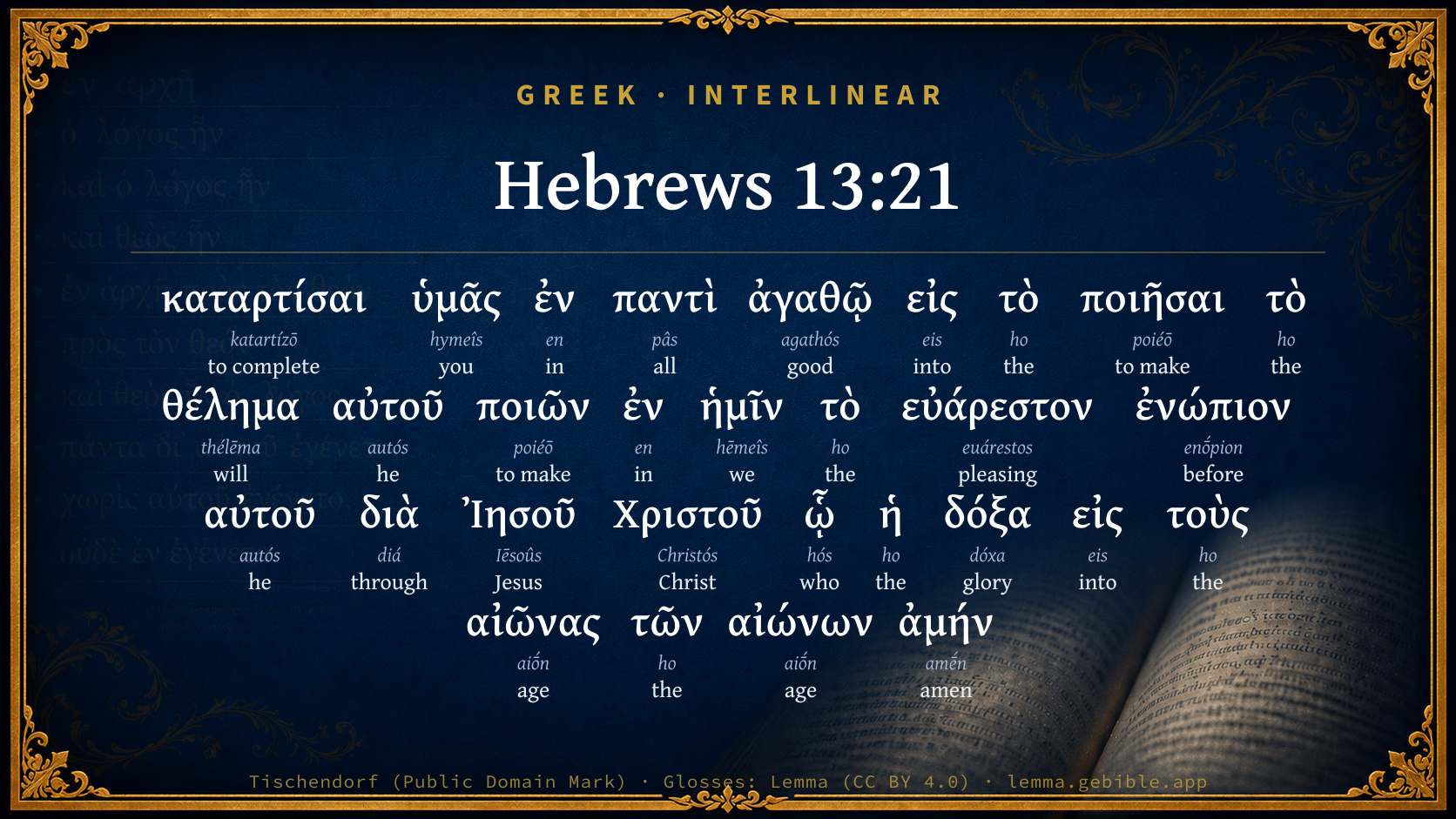
  1. καταρτίσαι katartízō G2675 “to complete” Verb, Aorist, Active, Optative, 3rd person, Singular
  2. ὑμᾶς hymeîs G5210 “you” Personal pronoun, 2nd person, Accusative, Plural
  3. ἐν en G1722 “in” Preposition
  4. παντὶ pâs G3956 “all” Adjective, Dative, Singular, Neuter
  5. ἀγαθῷ agathós G18 “good” Adjective, Dative, Singular, Neuter
  6. εἰς eis G1519 “into” Preposition
  7. τὸ ho G3588 “the” Article, Accusative, Singular, Neuter
  8. ποιῆσαι poiéō G4160 “to make” Verb, Aorist, Active, Infinitive
  9. τὸ ho G3588 “the” Article, Accusative, Singular, Neuter
  10. θέλημα thélēma G2307 “will” Noun, Accusative, Singular, Neuter
  11. αὐτοῦ autós G846 “he” Personal pronoun, Genitive, Singular, Masculine
  12. ποιῶν poiéō G4160 “to make” Verb, Present, Active, Participle, Nominative, Singular, Masculine
  13. ἐν en G1722 “in” Preposition
  14. ἡμῖν hēmeîs G2249 “we” Personal pronoun, 1st person, Dative, Plural
  15. τὸ ho G3588 “the” Article, Accusative, Singular, Neuter
  16. ἐνώπιον enṓpion G1799 “before” Adverb
  17. αὐτοῦ autós G846 “he” Personal pronoun, Genitive, Singular, Masculine
  18. διὰ diá G1223 “through” Preposition
  19. Ἰησοῦ Iēsoûs G2424 “Jesus” Noun, Genitive, Singular, Masculine
  20. Χριστοῦ Christós G5547 “Christ” Noun, Genitive, Singular, Masculine
  21. ᾧ hós G3739 “who” Relative pronoun, Dative, Singular, Masculine
  22. ἡ ho G3588 “the” Article, Nominative, Singular, Feminine
  23. δόξα dóxa G1391 “glory” Noun, Nominative, Singular, Feminine
  24. εἰς eis G1519 “into” Preposition
  25. τοὺς ho G3588 “the” Article, Accusative, Plural, Masculine
  26. αἰῶνας aiṓn G165 “age” Noun, Accusative, Plural, Masculine
  27. τῶν ho G3588 “the” Article, Genitive, Plural, Masculine
  28. αἰώνων aiṓn G165 “age” Noun, Genitive, Plural, Masculine
  29. ἀμήν amḗn G281 “amen” Hebrew transliteration

About this verse

These counts appear in no published source. They are computed here, from the morphology-tagged text and Lemma’s own curated glosses. What Lemma adds →

30
words
20
distinct lemmas
General Epistles
section

Notable vocabulary

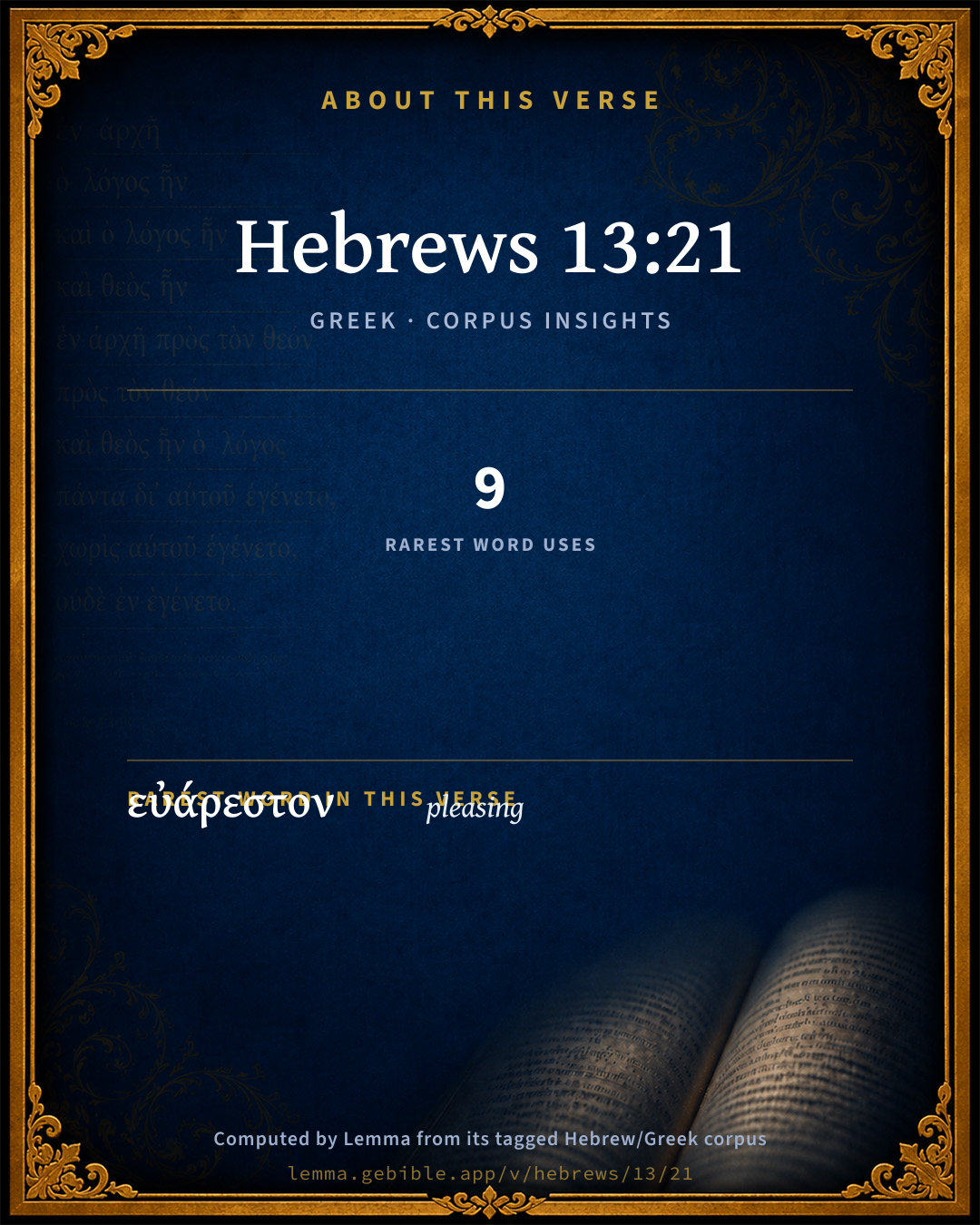
The rarest word here is εὐάρεστον pleasing G2101 — appearing just 9 times in the whole Greek New Testament.

Shared distinctive vocabulary

εὐάρεστον pleasing G2101 occurs in 9 verses of the Greek New Testament. Also found in:

Repetition

Words recur within this verse:

  • εἰς into G1519 ×2
  • ποιῆσαι to make G4160 ×2
  • αἰῶνας age G165 ×2
  • τὸ the G3588 ×6
  • ἐν in G1722 ×2
  • αὐτοῦ he G846 ×2

Cross-references

48

Topical passages linked to Hebrews 13:21 in the Treasury of Scripture Knowledge — connected by theme and wording, ordered by reader-vote popularity; previews shown in the World English Bible.

  • Philippians 2:13 For it is God who works in you both to will and to work, for his good pleasure.
  • 2 Thessalonians 2:17 comfort your hearts and establish you in every good work and word.
  • Philippians 4:13 I can do all things through Christ, who strengthens me.
  • 1 Peter 5:10–11 But may the God of all grace, who called you to his eternal glory by Christ Jesus, after you have suffered a little while, perfect, establish, strengthen, and settle you.
  • 1 Peter 2:5 You also, as living stones, are built up as a spiritual house, to be a holy priesthood, to offer up spiritual sacrifices, acceptable to God through Jesus Christ.
  • Philippians 1:11 being filled with the fruits of righteousness, which are through Jesus Christ, to the glory and praise of God.
  • 2 Timothy 4:18 And the Lord will deliver me from every evil work, and will preserve me for his heavenly Kingdom; to whom be the glory forever and ever. Amen.
  • 1 Thessalonians 5:23 May the God of peace himself sanctify you completely. May your whole spirit, soul, and body be preserved blameless at the coming of our Lord Jesus Christ.
  • 2 Corinthians 9:8 And God is able to make all grace abound to you, that you, always having all sufficiency in everything, may abound to every good work.
  • Ephesians 2:10 For we are his workmanship, created in Christ Jesus for good works, which God prepared before that we would walk in them.
  • Colossians 3:17 Whatever you do, in word or in deed, do all in the name of the Lord Jesus, giving thanks to God the Father, through him.
  • Hebrews 10:36 For you need endurance so that, having done the will of God, you may receive the promise.
  • Deuteronomy 32:4 The Rock, his work is perfect; For all his ways are justice: A God of faithfulness and without iniquity, Just and right is he.
  • Psalms 72:18–19 Praise be to Yahweh God, the God of Israel, Who alone does marvelous deeds.
  • 1 Peter 4:2 that you no longer should live the rest of your time in the flesh for the lusts of men, but for the will of God.
  • Jude 1:25 to God our Savior, who alone is wise, be glory and majesty, dominion and power, both now and forever. Amen.
  • Revelation 5:9 They sang a new song, saying, "You are worthy to take the book, And to open its seals: For you were killed, And bought us for God with your blood, Out of every tribe, language, people, and nation,
  • Psalms 138:8 Yahweh will fulfill that which concerns me; Your loving kindness, Yahweh, endures forever. Don't forsake the works of your own hands.
  • Matthew 6:13 Bring us not into temptation, but deliver us from the evil one. For yours is the Kingdom, the power, and the glory forever. Amen.'
  • Romans 14:17–18 for the Kingdom of God is not eating and drinking, but righteousness, peace, and joy in the Holy Spirit.
  • 1 Timothy 1:17 Now to the King eternal, immortal, invisible, to God who alone is wise, be honor and glory forever and ever. Amen.
  • 1 John 2:17 The world is passing away with its lusts, but he who does God's will remains forever.
  • 1 John 3:22 and whatever we ask, we receive from him, because we keep his commandments and do the things that are pleasing in his sight.
  • Matthew 28:20 teaching them to observe all things that I commanded you. Behold, I am with you always, even to the end of the age." Amen.
  • Ephesians 2:18 For through him we both have our access in one Spirit to the Father.
  • Philippians 4:18 But I have all things, and abound. I am filled, having received from Epaphroditus the things that came from you, a sweet-smelling fragrance, an acceptable and well-pleasing sacrifice to God.
  • Colossians 1:9–12 For this cause, we also, since the day we heard this, don't cease praying and making requests for you, that you may be filled with the knowledge of his will in all spiritual wisdom and understanding,
  • Colossians 4:12 Epaphras, who is one of you, a servant of Christ, salutes you, always striving for you in his prayers, that you may stand perfect and complete in all the will of God.
  • 1 Thessalonians 3:13 to the end he may establish your hearts blameless in holiness before our God and Father, at the coming of our Lord Jesus with all his saints.
  • 1 Timothy 5:10 being approved by good works, if she has brought up children, if she has been hospitable to strangers, if she has washed the saints' feet, if she has relieved the afflicted, and if she has diligently followed every good work.
  • 1 Timothy 6:16 who alone has immortality, dwelling in unapproachable light; whom no man has seen, nor can see: to whom be honor and eternal power. Amen.
  • Hebrews 13:16 But don't forget to be doing good and sharing, for with such sacrifices God is well pleased.
  • Romans 11:36–12:2 For of him, and through him, and to him, are all things. To him be the glory for ever! Amen.
  • Galatians 1:5 to whom be the glory forever and ever. Amen.
  • Ephesians 3:16–19 that he would grant you, according to the riches of his glory, that you may be strengthened with power through his Spirit in the inward man;
  • Philippians 2:11 and that every tongue should confess that Jesus Christ is Lord, to the glory of God the Father.
  • Colossians 3:20 Children, obey your parents in all things, for this pleases the Lord.
  • 1 Thessalonians 4:3 For this is the will of God: your sanctification, that you abstain from sexual immorality,
  • Hebrews 12:23 to the general assembly and assembly of the firstborn who are enrolled in heaven, to God the Judge of all, to the spirits of just men made perfect,
  • 2 Peter 3:18 But grow in the grace and knowledge of our Lord and Savior Jesus Christ. To him be the glory both now and forever. Amen.
  • Revelation 4:6 Before the throne was something like a sea of glass, similar to crystal. In the midst of the throne, and around the throne were four living creatures full of eyes before and behind.
  • Revelation 5:13 I heard every created thing which is in heaven, on the earth, under the earth, on the sea, and everything in them, saying, "To him who sits on the throne, and to the Lamb be the blessing, the honor, the glory, and the dominion, forever and ever! Amen!"
  • Matthew 7:21 Not everyone who says to me, 'Lord, Lord,' will enter into the Kingdom of Heaven; but he who does the will of my Father who is in heaven.
  • Matthew 21:31 Which of the two did the will of his father?" They said to him, "The first." Jesus said to them, "Most assuredly I tell you that the tax collectors and the prostitutes are entering into the Kingdom of God before you.
  • John 7:17 If anyone desires to do his will, he will know about the teaching, whether it is from God, or if I am speaking from myself.
  • John 16:23–24 "In that day you will ask me no questions. Most assuredly I tell you, whatever you may ask of the Father in my name, he will give it to you.
  • John 17:23 I in them, and you in me, that they may be perfected into one; that the world may know that you sent me, and loved them, even as you loved me.
  • Romans 16:27

Cross-references courtesy of OpenBible.info (CC BY 4.0).

Where the printed editions differ

2 variants

Places in this verse where the major printed Greek editions disagree on the wording in a way that affects the translation — a comparison of editions, not a manuscript-by-manuscript collation. The editions are the modern critical texts (Nestlé-Aland 28/27, SBL, Westcott-Hort, Tregelles, Tyndale House) and the traditional texts behind the KJV (the Textus Receptus and the Byzantine/Majority text). It is not a claim about which reading is original.

  1. Extra text
    ἔργῳ

    “work”

    In TregTRByz Not in NA28NA27TynSBLWH

    ἔργῳ (ergō) 'work' is only in traditional manuscripts (Treg+TR+Byz)

  2. Different wording
    ἡμῖν

    “us”

    In NA28NA27TynSBLWH Not in TregTRByz

    ὑμῖν (humin) 'you' occurs in traditional manuscripts (Treg+TR+Byz) instead of ἡμῖν (hēmin) 'us' in older manuscripts (NA28+NA27+Tyn+SBL+WH)

Textual data: Translators Amalgamated Greek New Testament (STEPBible TAGNT) · CC BY 4.0.

Commentary

Notes on Hebrews 13:21 from classic Christian and Jewish commentators (each source and its license shown beneath its notes). The classic Christian expositions comment on the surrounding passage and are grouped to its opening verse, so a note may address several verses; the Jewish commentaries on the Tanakh (Rashi and others) are per-verse, so they appear only where the commentator wrote on this verse.

Lemma curates 59 commentaries, every one of them public domain or Creative Commons licensed, each selected and text-cleaned for this edition rather than reprinted as found. About our sources →

MacLaren's Expositions of Holy Scripture

Alexander MacLaren

Hebrews

GREAT PRAYER BASED ON GREAT PLEAS

Heb 13:21.

Massive foundations prognosticate a great building. We do not dig deep, and lay large blocks, in order to rear some flimsy structure. We have seen, in a previous sermon, how the words preceding my text bring out certain great aspects of the divine character and work, and now we have to turn to the great prayer which is based upon these. It is a prophecy as well as a prayer; for such a contemplation of what God is and does makes certain the fulfilment of the desires which the contemplation excites. Small petitions to a great God are insults. He is ‘the God of peace,’ therefore we may ask Him to ‘make us perfect,’ and be sure that He will. He is the God ‘that brought again from the dead the great Shepherd of the sheep,’ therefore we may ask Him and be sure. He is the God who has sealed an ‘everlasting covenant’ with us by the blood of the Shepherd, therefore we may ask Him and be sure.

This prayer is the parting highest wish of the writer for his friends. Do our desires for ourselves, and for those whom we would seek to bless, run in the same mould? How strange it is that Christian people, who believe in the God whom the previous verse sets before us, so imperfectly and languidly cherish the confidence which inspires desires, for themselves and their brethren, such as those of our text this morning! Let us look at these great petitions, then, in the light of the great name on which they are based.

I. And, first, I ask you to consider the prayer which the name excites.

‘Make you perfect in every good work.’ Now, I need only observe here, in regard to the language of the petition, that the word translated ‘make perfect’ is not the ordinary one employed for that idea, but a somewhat remarkable one, with a very rich and pregnant variety of significance. For instance, it is employed to describe the action of the fisherman apostles in mending their nets. It is employed to describe the divine action which ‘by faith we understand’ when He ‘made the worlds.’ It is employed to describe the action which the Apostle commends to one of his churches when he bids them ‘restore such an one in the spirit of meekness.’ It is the condition which he described when he desired another of his churches to be ‘perfectly joined together, in one mind and in one judgment.’ It is still again the expression employed when he speaks of ‘filling up,’ or ‘perfecting that which is lacking in their faith.’ The general idea of the word, then, is to make sound, or fit, or complete, by restoring, by mending, by filling up what is lacking, and by adapting all together in harmonious cooperation. And so this is what Christians ought to look for, and to desire as being the will of God concerning them. The writer goes on to still further deepen the idea when he says, ‘make you perfect in every good work’ where the word work is a supplement, and unnecessarily limits the idea of the text. For that applies much rather to character than to work, and the ‘make you perfect in every good’ refers rather to an inward process than to any outward manifestation. And this character, thus harmonised, corrected, restored, filled up where it is lacking, and that in regard of all manner of good - ‘whatsoever things are fair, and lovely, and of good report’ - that character is ‘well-pleasing to God.’

So, brethren, you see the width of the hopes - ay! of the confidence - that you and I ought to cherish. We should expect that all the discord of our nature shall be changed into a harmonious co-operation of all its parts towards one great end. We bear about within us a warning anarchy and tumultuous chaos, where solid and fluid, warm and cold, light and dark, calm and storm, contend. Is there any power that can harmonise this divided nature of ours, where lusts and passions, and inclinations of all sorts, drag one away, and duty draws another, so as that a man is torn apart as it were by wild horses? There is one. ‘The worlds’ were harmonised, adapted, and framed together, and chaos turned into order and beauty, and the God of Peace will come and do that for us, if we will let Him, so that the long schism which affects our natures, and makes us say sometimes, ‘I find a law in my members warring against the law of my mind.’ ‘Oh! wretched man that I am; who shall deliver me from the body of this death?’ may be changed into perfect harmony, and the ‘bear shall eat straw like the ox, and the lion shall lie down with the lamb; and a little child shall lead them’ - the meekness of a patient love bridling all their ravening passions. It is possible that our hearts may be united to fear His name; and that one unbroken temper of whole-spirited submission may be ours.

Again, we should expect, and desire, and strive towards the correction of all that is wrong, the mending of the nets, the restoring of the havoc wrought in legitimate occupations and by any other cause. Again; we may strive with hope and confidence towards the supply of all that is lacking, ‘In every good’ - an all-round completeness of excellence ought to be the hope, and the aim, as well as the prayer, of every Christian. Of course our various perfectings will be various. ‘Star differeth from star in glory; and the new man in many respects follows the lines of the old man, and temperament is permanent. But still, whilst all that, is true, and while each shall ray back the divine light and radiance at a different angle, and so with a different hue from that which his neighbour, standing beside him, may catch and reflect, on the other hand the gospel is given to us to correct temperament, and to make the most uncongenial types of grace and excellence ours. It is meant to make it possible that men should ‘gather grapes of thorns and figs of thistles’; and to correct and fill up what is wrong and what is defective in our natural dispositions, so as that the passionate man may be made meek, and the hesitating man may be made prompt, and the animal man may be sublimed into spirit, and all that is proper to my peculiar constitution and character may be curbed and limited, and much that is not congenial to it may be appropriated and made mine. We are all apt to grow one-sided Christians, and it is our business to try to make ours the things that are lacking in our faith, and to supplement, by the grace of God working in our hearts, the defects of our qualities and the failures of our disposition and temperament. Do not grow like a tree stuck in the middle of a shrubbery, which has only space to put forth branches on one side, and is all lop-sided and awry; but like some symmetrical growth out in the open, equal all round the strong hole, and rising in perfect completeness of harmonious beauty to the topmost twig. that looks up to the sky. God means to make us ‘perfect in every good’; to harmonise, to correct, to restore, to perfect us, that we, having all grace, may abound in all good to His glory.

Such is His purpose. Ah, brethren! has not the recognition of that as His purpose alarmingly died out of our minds; and do we live up to the height of this prayer? I would that we should all remember more, as defining our aims, and animating our courage, and directing our hopes, that ‘this is the will of God, even our sanctification’; and that, when faith is dim, and effort burns low, and we are ready to put all such hopes away as a fair dream, we might be stirred to more lofty expectations, and to open our mouths wider by the thought of the’ God of peace that brought again from the dead the Lord Jesus, that great Shepherd of the sheep, by the blood of the everlasting covenant’; and ask ourselves what result on us will correspond to that mighty name of the Lord.

II. And so, secondly, note the divine work which fulfils the prayer.

‘Working in you that which is well-pleasing in His sight, through Jesus Christ.’ Creation, Providence and all God’s works in the world are also through Jesus Christ. But the work which is spoken of here is yet greater and more wonderful than the general operations of the creating and preserving God, which also are produced and ministered through that eternal Word by whom the heavens were of old, and by whom the heavens are still, sustained and administered. There is, says my text, an actual divine operation in the inmost spirit of every believing man.

I suppose that everybody must believe that, who believes in a God having any real connection with His creatures. Surely He is not so imprisoned in His own majesty, or shut out from His own creation, by His own creation, as that He cannot touch the spirits which He has made. And surely we are not so walled up by our own separate individuality as that we cannot, if we will, open the door for Him to come in and dwell with us, and work on us. Surely if there be any reality in the gospel teaching at all there is this in it, that Christ in us, or God in Christ working in us by His divine spirit, is the crown of that hope and blessing of which Christ for us is the beginning and foundation.

I do not want men to think less of the Cross. God forbid! But I do feel, and feel growingly, that the Christianity of this generation has not a firm hold of this other aspect of Christ’s work. Do not think less of what He has done, but, oh I think more of what He is doing. The perspective of our Christian faith is wrong: not that we draw the Cross too large, but that we paint the dove too small. And I would for myself and for you, dear brethren, lay this thought upon our hearts, as a far more important one than the ordinary type of Christian thinking makes it out to be - the present dwelling of God in Christ, through the divine spirit, in the hearts of all who believe, and working there that which is well-pleasing in His sight.

If that has truth, surely these things follow as our plain duty. Expect that operation! Do you? You Christian men and women, do you believe that God will work in your hearts? Some of you do not live as if you did. Desire it! Do you desire it? Do you want Him to come and clear out that stable of filth that you carry about with you? Do you wish Him to come and sift and search, and bring the candle of the Lord into the dusty comers? Do you want to get rid of what is not pleasing in His sight? Would you like Him to come and search you, ‘to try you and see if’ - ah, it is not an if! - ‘there be any wicked way in you, and lead you’ - where alas! our feet are often not found - ‘in the way everlasting’? Expect it! desire it! pray for it! And when you have got it, see that you profit by it!

God does not work by magic. The Spirit of God which cleanses men’s hearts cleanses them on condition, first, of their faith; second, of their submission; and, third, of their use of His gift. If you fling yourselves into the roar of worldly life, the noise of the streets, and the whirring of the looms, and the racket of the children in the nursery, and the buzzing of temptations round about you, and the yelpings for ‘food of your own passions, will deafen your ears so as that you will never hear the still, small voice that speaks a present God. If God dwells in us and works in us, let us yield ourselves to the workings and open our hearts to the Guest, and say,

‘Into every corner, O Lord, I would that Thou wouldst go, to restore and complete.’

III. Lastly, notice the visible manifestation of this inward work.

Now the writer of our text employs the same word in the two clauses, in order to bring out the idea of a correspondence Between the human and the Divine Worker. ‘To work His will, working in you that which is well- pleasing in His sight.’

God works in order that you and I may work. Our action is to follow His. Practical obedience is the issue, and it is the test, of having this divine operation in our hearts. There are plenty of people who will talk largely about spiritual gifts, and almost vaunt their possession of such a divine operation. Let us bring them and ourselves to this test: Are you doing God’s will in daily life in the little things? In the monotonous grind of the dusty, level road with never a turn in it, and the same thing to be done to- morrow that was done to-day, and so on for indefinite weeks and months, are you, with the spirit that freshens the monotony, doing God’s will? If so, then you may believe that God is working in you. If not, it is no use talking about spiritual gifts. The test of being filled with the divine operation is that our actions shall be conformed to His will ‘As many as are led by the Spirit of God, they are the Sons of God.’ That is a pin prick that will empty many a swollen bladder, and bring it down to its real tenuity of substance.

Action is the end of all We get the truth, we get our souls saved, we have all the abundance and exuberance of divine revelation, we have the Cross of Jesus Christ, we have the gift of the Divine Spirit - miracles and marvels of all sorts have been done for the one purpose, to make us able to do what is right in God’s sight, and to do it because it is His will.

This practical obedience to God’s will is the perfection of human conduct. And, on the other hand, a man who does good things without reference to the highest - viz., the will of God - in the doing of them, lacks the fine gold that gilds his deed; and the violet of his virtue is scentless. A good thing may be done without reference to God - good from the point of view of morality and the self-sacrifice and generosity that are embodied in it. But no good thing reaches its supremest goodness unless it he an act of conscious obedience to God’s will.

And this doing of the will of God is perfect blessedness. All things are right for us if we submit to the will of our Father. No storms can blow us out of our course then. ‘Thou shalt make a league With the beasts of the field, and the stones of the field shall be at peace with thee,’ for all creatures being God’s servants, are in covenant with him who does the will of the Lord.

And how are we to do it, brother? The world says, ‘cultivate your own nature; correct your faults; strive to fill up your deficiencies.’ Christ says, ‘Cast away yourselves; and trust to Me; and I will give you new life, and a new spirit. Cultivate that!’ If we are to do God’s will we must have the spirit of Him who said, ‘I come to do Thy will, O Lord; and Thy law is within My heart.’ Let us open our hearts to Him; let us seek for Him to enter in. And then,’ the God of peace, that brought again from the dead the Lord Jesus, that great Shepherd of the sheep, through the blood of the everlasting covenant, shall make us perfect in every good; to do His will, working in us that which is well-pleasing in His sight, through Jesus Christ.’

Alexander MacLaren, Expositions of Holy Scripture (1904–1910) — public domain. Text from a community e-Sword module.

Bengel's Gnomon

Johann Albrecht Bengel

Heb 13:21. Καταρτίσαι, fit or join you perfectly together) 1Co 1:10, note [the antithesis of σχίσματα, divisions].—ποιῆσαι, ποιῶν) God doing, we will do. [God fits us for doing; nay, indeed He rather does Himself, 2Pe 1:3.—V. g.]—τὀ θέλημα, the will) Comp. Isa 53:10 on the resurrection of Christ and progress of the Divine will.—διὰ, through) Construed with ποιῶν, doing, working, Php 1:11.—ᾧ, to whom) viz. to GOD, Heb 13:20; Rom 16:27, note; Gal 1:5, note. Then, and then only, can glory be given to God, if we subject ourselves to His salutary will. Comp. concerning Christ, 2Pe 3:18.—δόξα, glory) They to whom he wrote had not afforded any occasion for a joyful exordium or commencement, in which thanks might be given; Paul therefore uses in this passage the Doxology, as at Gal 1:5-6, note.

Bengel's Gnomon of the New Testament — English translation (T&T Clark, Edinburgh, 1860) — public domain. Text from a community e-Sword module.

Meyer's Critical & Exegetical Commentary

Heinrich August Wilhelm Meyer

Heb_13:21. Καταρτίσαι ὑμᾶς ἐν παντὶ ἔργῳ ἀγαθῷ] cause that ye become ἄρτιοι, ready or perfect, in every good work. Oecumenius: πληρώσαι, τελειώσαι. That, for the rest, καταρτίσαι is optative, and not, as Kurtz strangely supposes, imperative aorist middle, is self-evident.

εἰς τὸ ποιῆσαι] Statement of the design, not of the effect (Schlichting and others): that ye may accomplish.

τὸ θέλημα αὐτοῦ] His will, i.e. that which is morally good and salutary. There is certainly comprehended under the expression the faithful continuance in Christianity.

ποιῶν ἑν ὑμῖν τὸ εὐάρεστον ἐνώπιον αὐτοῦ διὰ Ἰησοῦ Χριστοῦ] working in you (wrongly Böhme: among you) that which is well-pleasing in His sight, through Christ Jesus. Modal definition to καταρτίσαι.

τὸ εὐάρεστον ἐνώπιον αὐτοῦ] Comp. 2Co_5:9; Rom_12:1; Rom_14:18; Eph_5:10; Php_4:18.

διὰ Ἰησοῦ Χριστοῦ] belongs neither to καταρτίσαι (Bloomfield) nor to τὸ εὐάρεστον ἐνώπιον αὐτοῦ (Grotius, Hammond, Michaelis, Storr, and others), but to ποιῶν.

ᾧ ἡ δόξα εἰς τοὺς αἰῶνας] sc. ἔστω

ἡ δόξα] the glory due to Him.

The doxology is referred by Limborch, Wetstein, Bengel, Chr. Fr. Schmid, Ernesti, Delitzsch, Alford, Kluge, Woerner, and others, to God; and in favour of this it may be urged that in the wish of blessing ὁ θεός forms the main subject. More correctly, however, shall we refer it, partly on account of the immediate joining of ᾧ to Ἰησοῦ Χριστοῦ, partly on account of the design of the whole epistle, to warn the readers, who had become wavering in their faith in Christ, against relapse into Judaism, with Calvin, Jac. Cappellus, Grotius, Owen, Böhme, Stuart, Bleek, Stengel, Tholuck, Bisping, Riehm (Lehrbegr. des Hebräerbr. p. 286), Maier, Moll, and the majority, to Christ.

Meyer — Critical and Exegetical Commentary on the New Testament — English translation by Peter Christie, edited by Frederick Crombie (T&T Clark, 1880) — public domain. Text from a community e-Sword module.

Geneva Bible (1599)

Geneva Bible translators

Make you fit or meet.

Hence cometh that saying of the Fathers, that God crowneth his works in us.

Geneva Bible (1599) marginal notes — public domain. Text via Bolls.life.

Jamieson, Fausset & Brown

Robert Jamieson, A. R. Fausset & David Brown

Make you perfect--properly said of healing a rent; join you together in perfect harmony [BENGEL].

to do his will, working in you-- (Heb 10:36); rather as Greek, "doing in you." Whatever good we do, God does in us.

well-pleasing in his sight-- (Isa 53:10; Eph 5:10).

through Jesus Christ--"God doing (working) in you that . . . through Jesus Christ" (Phi 1:11).

to whom--to Christ. He closes as he began (Heb 1:1-14), with giving glory to Christ.

Jamieson, Fausset & Brown — Commentary Critical and Explanatory on the Whole Bible (1871) — public domain (CC PDM 1.0). Text via the HelloAO Bible API.

Adam Clarke's Commentary

Verse 21. Make you perfect] καταρτισια υμας. Put you completely in joint. 2Cor 13:9, where the meaning of the original word is largely considered. From the following terms we see what the apostle meant by the perfection for which he prays. They were to do the will of God in every good work, from God working in them that which is well pleasing in his sight.

1. This necessarily implies a complete change in the whole soul, that God may be well pleased with whatsoever he sees in it; and this supposes its being cleansed from all sin, for God's sight cannot be pleased with any thing that is unholy.

2. This complete inward purity is to produce an outward conformity to God's will, so they were to be made perfect in every good work.

3. The perfection within and the perfection without were to be produced by the blood of the everlasting covenant; for although God is love, yet it is not consistent with his justice or holiness to communicate any good to mankind but through his Son, and through him as having died for the offences of the human race.

To whom be glory for ever.] As God does all in, by, and through Christ Jesus, to him be the honour of his own work ascribed through time and eternity. Amen.

Adam Clarke's Commentary on the Bible (1810–1826) — public domain. Text from a community e-Sword/MySword module.

John Calvin's Commentaries

21. To do his will, etc. He now gives a definition of good works by laying down God’s will as the rule; for he thus intimates, that no works are to be deemed good, but such as are agreeable to the will of God, as Paul also teaches us in Romans 12:2, and in many other places. Let us then remember, that it is the perfection of a good and holy life, when we live in obedience to his will. The clause which next follows is explanatory, working (or doing) in you what is well pleasing in his sight. He had spoken of that will which is made known in the Law; he now shows, that in vain is obtruded on God what he has not commanded; for he values the decrees of his own will far more than all the inventions of the world.

Through Jesus Christ, etc. This may be explained in two ways, — “Working through Jesus Christ”, or, “Well-pleasing through Jesus Christ.” Both senses are suitable. For we know that the spirit of regeneration and also all graces are bestowed on us through Christ; and then it is certain, that as nothing can proceed from us absolutely perfect, nothing can be acceptable to God without that pardon which we obtain through Christ. Thus it comes, that our works, performed by the odor of Christ’s grace, emit a sweet fragrance in God’s presence, while otherwise they would have a fetid smell. I am disposed to include both meanings.

To whom be glory, etc. This I refer to Christ. And as he here ascribes to Christ what peculiarly belongs to God alone, he thus bears a clear testimony to his divinity; but still if anyone prefers to explain this of the Father, I do not object; though I embrace the other sense, as being the most obvious.

John Calvin's Commentaries (1540-1563) — public domain. Text from the Calvin Translation Society English edition (1840s-50s) via the Christian Classics Ethereal Library (ccel.org). Calvin's coverage is partial (roughly two-thirds of the Bible); uncommented books and verses are honest gaps, never fabricated. The 19th-century editor's footnotes and remarks are omitted so the notes are faithfully Calvin's own voice.

Ellicott's Commentary for English Readers

(21) Make you perfect.—To “make perfect” is the translation of two different words in this Epistle. In the one, which is of frequent occurrence (Heb_2:10; Heb_10:1; Heb_12:23, et al.), “perfect” stands contrasted with that which is immature, which has not attained its end and aim. The other, which is used here (and in a somewhat different sense in Heb_10:5; Heb_11:3), rather conveys the thought of completeness, complete equipment or preparation.

Every good work.—The best authorities read “every good thing;” and below, substitute “us” for “you.”

Working.—Literally, doing, or making. The words of Php_2:12-13, are different, but the general thought is the same. “Well pleasing” recalls Heb_11:5; Heb_12:28; Heb_13:16. (Rom_12:2; Eph_5:10.)

Through Jesus Christ.—That is, “working in us through Jesus Christ that which is well-pleasing in His sight.” In Heb_13:20 (as in Heb_2:9) we read of the exaltation of “Jesus.” Here, where the subject of thought is the lasting mediation of our High Priest, the writer introduces the complete name “Jesus Christ,” thus preparing for the doxology which follows. That this ascription of praise is addressed to our Saviour (as in 2Ti_4:18; Rev_1:6; 2Pe_3:18), it seems hardly possible to doubt.

Glory.—Rather, the glory. (See Gal_1:5.)

A Bible Commentary for English Readers, edited by Charles John Ellicott (1878–1897) — public domain. Text from a community e-Sword module.

The Cambridge Bible for Schools and Colleges

gen. ed. J. J. S. Perowne

21. make you perfect] Not the verb so often used to express “perfecting” but another verb—“may He fit” or “stablish” or “equip you.”

to do his will, working in you …] In the Greek there is a play on the words “to do His will, doing in you.” There is a similar play on words in Php_2:13.

to whom be glory for ever and ever] Lit. “to whom be the glory (which is His of right) unto the ages of the ages.” The same formula occurs in Gal_1:5; 2Ti_4:18. The doxology may be addressed to Christ as in 2Pe_3:18.

The Cambridge Bible for Schools and Colleges (gen. ed. J. J. S. Perowne; Cambridge University Press, 1878–1918) — public domain. Text from a community e-Sword module.

John Gill's Exposition

Make you perfect in every good work to do his will,.... The Alexandrian copy reads, "in every good work and word"; as in Th2 2:17 every good work is to be done: a good work is what is done in obedience to the command of God, and in faith, and from a principle of love, in the name and strength of Christ, and with a view to the glory of God; and every such work should be diligently attended to; such as concern God, and are of a moral nature, or of positive institution; and such as concern each other, whether as men or Christians: and the will of God is the rule of every good work, both as to matter and manner; whatever is not agreeably to the revealed will of God, let it have ever such a show of religion and holiness in it, it is not a good work; continuance in the performance of good works, and the perfection of them, are things to be desired of God; it requires grace to perform good works, and more grace to abound in them, and to keep men from being weary of well doing; and though the best of works are imperfect, yet perfection in them is desirable, and it is God alone that can make the saints perfect in any sense; see Pe1 5:10. The Arabic and Ethiopic versions render it, "strengthen you", or "confirm you"; saints need to be strengthened with spiritual strength, to perform good works; for they are weak and feeble, and unable of themselves to do anything spiritually good; without Christ they can do nothing, but through him strengthening them, they can do all things; and they have need to be confirmed in them, that they are the will of God, and that it is their duty to regard them. The Vulgate Latin version renders it, "fit you": men are naturally unfit for good works; in order to do them aright, it is necessary that they should have knowledge of the will of God; that they be regenerated and created in Christ; that they be sanctified and cleansed, and so meet for the master's use; that they have the Spirit of God, and strength from Christ; and that they be believers in him: nor is there always a fitness in saints themselves, or a readiness to good works, only when God gives both will and power to do them; wherefore such a petition as this is very proper and pertinent; another follows, or the same carried on, and more largely expressed; though it rather seems to be a distinct one, and that in order to the former:

working in you that which is wellpleasing in his sight, through Jesus Christ; the good work of grace being necessary to the performance of good works; nor can any man do a good work well, unless he has the good work of grace wrought in him: grace is a work not of man, but of God; it is an internal work, something in a man's heart, and not anything without him, or done by him; and it is a gradual and progressive work; it is carried on by degrees, and is not yet perfect, though it will be. God is continually working in his people, carrying on his work, and will at length perform it; See Gill on Phi 1:6, and this is "well pleasing in his sight"; it is in his sight; it is obvious to his view, when it is not to others, nor to themselves, being the hidden man of the heart; and it is very agreeable to him; it makes men like unto him; hereby they become a suitable habitation for him, and are put into a capacity of serving him; to such he gives more grace, and on that grace he entails glory: and all this is

through Jesus Christ; all the grace necessary for the beginning and carrying on, and finishing of the good work of grace, and for the performance of every good work, comes through the hands of Christ, in whom all fulness of it dwells; and through the blood and intercession of Christ, by virtue of which it is communicated; and all become acceptable to God through him, as the persons of the Lord's people, so the grace that is wrought in them, and the works that are done by them:

to whom be glory for ever and ever, Amen; either to God the Father of Christ, and the Father of mercies, and God of salvation; and as he is the God of peace, and the bringer of Christ from the dead; the appointer, provider, and giver of the great Shepherd; the author and finisher of all good in his people: or to Jesus Christ, the great Shepherd of the sheep, through whom all grace and good things come; to him does this doxology of right belong; he has a glory both as God, and as Mediator; and the glory of both is to be given to him: the glory of his deity, by asserting it; by attributing all divine perfections and works unto him; by worshipping of him, and by ascribing the efficacy of his mediatorial actions to it: and the glory of salvation and redemption is to be given to him, who alone has obtained it; by discarding all other Saviours; by trusting alone in him; by looking to him alone for peace, pardon, justification, sanctification, and eternal life: and this glory should be ascribed continually, for ever and ever, as it will be by angels, and saints to all eternity, The word "Amen" is added, to show that the apostle assented to it, and wished it might be, and that he firmly believed it, and so asserted that it would be; for it is expressive of assent, asseveration, and prayer.

John Gill's Exposition of the Whole Bible (1746–1763) — public domain (CC PDM 1.0). Text via the HelloAO Bible API.

Trapp's Complete Commentary

John Trapp

21 Make you perfect in every good work to do his will, working in you that which is wellpleasing in his sight, through Jesus Christ; to whom be glory for ever and ever. Amen.

Ver. 21. In every good work, &c.] Works materially good may never prove so formally and eventually; as when they are but external, partial, coactive, inconstant, &c.

John Trapp, A Commentary or Exposition upon All the Books of the Old and New Testament (1647–1656) — public domain. Text from a community e-Sword module.

Albert Barnes' Notes on the Bible

Make you perfect - The apostle here does not affirm that they were then perfect, or that they would be in this life. The word used here - καταρτιζω katartizō - means to make fully ready; to put in full order; to make complete. The meaning here is, that Paul prayed that God would fully endow them with whatever grace was necessary to do his will and to keep his commandments; see the word explained in the notes on Heb 11:3. It is an appropriate prayer to be offered at all times, and by all who love the church, that God would make all his people perfectly qualified to do all his will.

Working in you - Margin, “Doing.” The idea here is, that the only hope that they would do the will of God was, that he would, by his own agency, cause them to do what was well-pleasing in his sight; compare notes on Phi 2:12. It is not from any expectation that man would do it himself.

Through Jesus Christ - The idea is, that God does not directly, and by his own immediate agency, convert and sanctify the heart, but it is through the gospel of Christ, and all good influences on the soul must be expected through the Saviour.

To whom be glory forever and ever - That is, to Christ; for so the connection evidently demands. It is not uncommon for the apostle Paul to introduce doxologies in this way in the midst of a letter; see the notes, Rom 9:5. It was common among the Jews, as it is now in the writings and conversation of the Muslims, when the name of God was mentioned to accompany it with an expression of praise.

Albert Barnes' Notes on the Bible (1834–1885) — public domain. Text from a community e-Sword/MySword module.

Matthew Poole's English Annotations

Make you perfect in every good work to do his will: may this God dispose, incline, and fit you for, may he finish and perfect in you, grace to perform all the forementioned duties, and every other good work, which he enjoineth on you towards God, one another, and all men, 2Co 13:9; Eph 4:12; Tit 3:14; 1Pe 4:2; 5:10, according to his written will and law, Eph 2:10.

Working in you that which is well-pleasing in his sight, through Jesus Christ: working in you by his Spirit continually, that all these good works may satisfy his expectation, be a sweet savour in his nostrils, and so pleasing in his sight, that his soul may delight in them, Phi 2:13; Col 1:9,10; that God’s good-will may return unto them, and he may reward them according to their works, Heb 11:5,6; while all is rendered by Jesus Christ, sprinkled with his blood, and perfumed with his incense, Heb 10:19-22. As they are to have all done through Christ, so through his merit and intercession the apostle begs all this from the Father for them.

To whom be glory for ever and ever; to this God the Father, in the Son, and by the Spirit, working all this good in them and for them, be really, truly, heartily, and perpetually, throughout all ages, ascribed the honour and glory due to him for the glorious manifestation of his perfections in them, Eph 3:21; Phi 4:20; 2Pe 3:18; Rev 4:11; 5:13. The firm seal of this, from his believing heart, is his Amen, longing for the addition of God’s Amen, so be it in heaven, to his on earth.

Matthew Poole's English Annotations on the Holy Bible (1683–1685) — public domain. Text from a community e-Sword/MySword module.

Whedon's Commentary on the Bible

Daniel D. Whedon

21. Perfect—Symmetrical and complete.

In every good work—In all well doing. A perfection of Christian life, not consisting only in internal emotion, or showing itself mainly by outward profession, but manifesting itself in all well doing, and rendering vocal profession less necessary.

His will—Which is the expression of perfect right.

Working in you—Whilst you cooperate with his working. God will not work effectually in us unless we work efficiently with him.

To whom—The nearness of the word Christ induces many commentators to make whom refer to him; and thus to him would be ascribed glory for ever and ever. But the naming of Christ here is comparatively incidental, the main subject being God, (Heb_13:20,) so that the reference is more probably to him.

Amen—This closes the epistle, and what follows is a personal postscript.

Daniel D. Whedon (gen. ed.), Commentary on the Old and New Testaments (1874–1909) — public domain. Text from a community e-Sword module.

Scofield Reference Notes

C. I. Scofield

perfect

(See Scofield "Mat 5:48") .

The Scofield Reference Bible (1917 edition), notes by C. I. Scofield — public domain. Text from a community e-Sword module.

The People's New Testament

B. W. Johnson

21. Make you perfect in every good work. By supplying what is defective. Working in you. See Phil. 2:13. God works in us by his Spirit.

B. W. Johnson's The People's New Testament with Notes (1889–1891) — public domain. Electronic text from the Christian Classics Ethereal Library (CCEL) ThML edition.

Cambridge Greek Testament for Schools and Colleges

21. καταρτίσαι. Τελειόω, the verb so often used to express “perfecting,” is here replaced by another verb—“may He fit” or “stablish” or “equip you.”

ποιῆσαι … ποιῶν. There is a play on the words “to do His will, doing in you.” There is a similar play on words in Php 2:13.

ᾦ ἡ δόξα κ.τ.λ. Lit., “to whom be the glory (which is His of right) unto the ages of the ages.” The same formula occurs in Gal 1:5; 2Ti 4:18. The doxology may be addressed to Christ as in 2Pe 3:18.

Cambridge Greek Testament for Schools and Colleges (Cambridge University Press, 1896; 21 vols, various authors incl. Carr, Maclear, Plummer, Farrar, Lumby, Moule, M. R. James, Simcox) — public domain. Text from a community e-Sword module.

Alford’s Greek Testament

Henry Alford

21.] Solemn concluding prayer. πρῶτον παρʼ αὐτῶν αἰτήσας τὰς εὐχάς, τότε καὶ αὐτὸς αὐτοῖς ἐπεύχεται πάντα τὰ ἀγαθά. Chrys.

21.] perfect you (πληρώσαι, τελειώσαι, Œc. μαρτυρεῖ αὐτοῖς μεγάλα· τὸ γὰρ καταρτιζόμενόν ἐστι τὸ ἀρχὴν ἔχον, εἶτα πληρούμενον, Chrys. Still, as Bleek remarks, the praise of having made a beginning is not necessarily involved in the wish that they may be perfected) in every good work, towards the doing His will (cf. ch. 10:36. The expression here is in the same final sense as there, as the aor. shews: it is not εἰς τὸ ποιεῖν, ‘to the habit of doing,’ but εἰς τὸ ποιῆσαι, ‘to the having done,’ i. e. ‘to the accomplishing’), doing in you (ποιῶν chosen expressly as taking up εἰς τὸ ποιῆσαι, in exact correspondence with St. Paul’s saying Php 2:13, ὁ ἐνεργῶν ἐν ὑμῖν καὶ τὸ θέλειν καὶ τὸ ἐνεργεῖν) that which is well-pleasing in His sight (ἐνώπιον τοῦ θεοῦ, an expression of St. Luke’s principally. It is a pregnant construction, involving τὸ ἀγαθὸν ἐνώπιον αὐτοῦ, καὶ διὰ τοῦτο εὐάρεστον αὐτῷ. See Eph 5:10 al.), through Jesus Christ (the reference is variously given: to εὐάρεστον, well-pleasing &c. through J. C.; so Grot., Hammond (“secundum Christi præcepta” &c.), al.: or to the verb, ποιῶν, as Thl., ὥστε, ὅταν ποιῶμεν ἡμεῖς τὸ καλόν, ὁ θεὸς ποιεῖ τοῦτο ἐν ἡμῖν διὰ Ἰησοῦ χριστοῦ, τουτέστι, μεσίτῃ κ. ἐνέργῳ τούτῳ χρώμενος: so Œc. The latter is by far the more probable, as the former would introduce a superfluity): to whom (i. e. to God, the chief subject of the whole sentence, God, who is the God of peace, who brought up the Lord Jesus from the dead, who can perfect us in every good work, to accomplish His will, and works in us that which is well-pleasing to Him through Jesus Christ. The whole majesty of the sentence requires this reverting to its main agent, and speaks against the referring ᾧ ἡ δόξα to our blessed Lord, who is only incidentally mentioned. See the very similar construction 1Pe 4:11, where however the reference is not by any means equally certain) be (in 1 Pet. l. c. ἐστίν: and possibly also here: but perhaps ἔστω is the more probable supplement) the glory for ever. Amen.

Henry Alford, The Greek Testament (1849–1861) — public domain. Text from a community e-Sword module.

Vincent's Word Studies in the New Testament

Marvin R. Vincent

Make you perfect [καταρτισαι υμας] . The verb is aptly chosen, since the readers are addressed as a body - the flock of Christ. The prayer is for the complete mutual adjustment of all the members of the flock into a perfected whole, fitted to do the perfect will of God. See on 1Pe 5:10, and comp. notes on 2Ti 3:17; 1Co 1:10; 2Co 13:11. Ignatius uses the word of the church 's being joined [κατηρτισμενοι] in common subjection to the Bishops and the Presbytery (Eph. ii), and of himself as one composed or settled into union [εις ενωσιν] , that is, avoiding division in the church (Philad. 8); and again to the Smyrnaeans (1) "I have perceived that ye are settled or compacted in faith immovable, being, as it were, nailed on the cross of the Lord Jesus Christ in flesh and in spirit."

In every good work [εν παντι αγαθω] . A. V. follows T. R. ergw work. Rend. "in every good thing."

To do his will [εις το ποιησαι το θελημα αυτου] . To the end that you do, etc.

Working in you [ποιων εν ημιν] . Rend. "in us." A. V. follows T. R. uJmin you. For "working" rend. "doing." The word plays on poihsai to do. "Make you perfect to do his will, he doing in us what is well - pleasing in his sight."

That which is well - pleasing in his sight [το αυαρεστον ενωπιον αυτου] . Comp. Eph 5:10. The phrase N. T. o. Euareston usually with the simple dative, as Rom 12:1; Rom 14:8; Eph 5:10; Phi 4:18. Comp. 1Jo 3:22.

Marvin R. Vincent, Word Studies in the New Testament (1887–1900) — public domain. Text from a community e-Sword/MySword module.

Westcott on Hebrews & the Epistles of John

Brooke Foss Westcott

21. καταρτίσαι ὕ. ἐν w. dy.) make you perfect in every good thing. Vulg. aptet ros in omni bono.

Comp. 1 Pot. v. 10. Tho word καταρτίζειν, to make perfect, includes tho thoughts of the harmonious combination of different powors (comp. Eph. iv. 12 xarapriopos, 2 Cor. xiii. 9 xarapriors), of the supply of that which is dofective (1 Thess. iii, 10), and of the amondment of that which is fanity (Gal. vi. 1; comp. Mk. i. 19). Comp. Ign. Eph. 2; Phil.8; Smyrn.1; Mart. Ign. 4.

Chrysostom remarks wisely on the choice of the word, πάλιν μαρτυρεῖ αὐτοῖς μεγάλα" τὸ ydp καταρτιζόμενόν ἐστι τὸ ἀρχὴν ἔχον dea πληρούμενον.

Tho general phrase ἐν παντὶ ἀγαθῷ conveys the thoughts expressed by the explanatory glosses %pyp and

καὶ λόγφ. ‘ony τὸ ποιῆσαι... to the end that you do.... Action is the true object of the harmonious perfection of our

powors. And ench deed is at once the deed of man and the deed of God (ποιῆσαι, ποιῶν) The work of God makes man’s work possible. He Himself does (αὐτὸς ποιῶν), as the one source of all good, that which in another sense man does as freely accepting His grace. And all is wrought in man ‘through Jesus Ohrist” Comp. Acts iii. 16.

διὰ ᾿Ιησοῦ Χριστοῦ) El μεσίτης yeνέσθαι θεοῦ καὶ ἡμῶν ἠθέλησεν εἰκότως δι᾽ αὐτοῦ ὁ πατὴρ τὸ εὐάρεστον αὐτῷ els ἡμᾶς ἐπιτελέσει (Cocum.).

ᾧ ἡ δόξα... The doxology may be addrossed to Christ as in 2 Tim. iv. 18; 2 Pot. iff. 18; Apoc. i 6. The Greek, however, admits the reference of the relative to the main subject of ii. 9), and this is the most likely interpretation. Primasius combines both porsons: Cui est gloria, id cst, Deo Patri et Jesu Christo. Compare Additional Note.

els τοὺς al. τῶν al.] Comp. 0. 8 note. The phrase occurs here only in the Epistle. It is common in the Apocalypse (twelve times, with the varied phrase els αἰῶνας αἰώνων in xiv. 11), and is found also in Phil. iv. 20; 1 Tim. i. 17; 2 Tim. iv. 18; τ Pet. iv. 11 (all doxologies).

The language of the Apostle's prayer has given occasion to an instructive expression of the characteristic differences of Greek and Latin

a» 9 oe aQtwywy* any.

On the other hand Primasius writes: A vobis nihil boni habere potestis nisi illo preeveniente et subsequente.... Per illum facti et redempti sumus, et per illum quidgquid boni habemus nobis subministratur, And this thought is forcibly expressed by Herveius in a note on Ὁ. 25: Heec est gratia que mentem prevenit et adjuvat ut homo sus voluntatis οἱ operationis obsequium subjungat; et dictum ex hoc ne de liberi arbitrii sui viribus preesumerent et quasi ex seipsis hzeo posse bene agere putarent (Herv.).

It is obvious that the two views are capable of being reconciled in that larger viow of man’s constitution and destiny which acknowledges that the Fall has not destroyed the image of God in which he was created. Every act of man, so far as it is good, is wrought in fellowship with God.

Brooke Foss Westcott (1825–1901), The Epistle to the Hebrews (1889) and The Epistles of St John (1883) — public domain (pre-1929). Text recovered from Internet Archive / Google Books OCR scans. Westcott’s Gospel of John commentary is not included (its OCR lost the chapter running-heads required for reliable verse-keying). Some Greek quoted in the Hebrews volume is imperfectly rendered by the OCR.

Lesson kit

Teaching starters — assembled from the data on this page, not authored interpretation. Every prompt links to the verse data it draws on. Edit before teaching.

Hebrews, in the General Epistles, opens this verse with 30 words (20 distinct Greek lemmas). Its most distinctive word is euárestos (“pleasing”). A historical commentator’s framing appears above. Read the whole chapter for the surrounding context.

Discussion questions

  1. The word euárestos carries the sense “pleasing.” How does it shape the verse?
  2. How does Romans 12:1, which shares the word «pleasing», read alongside this verse?
  3. What does the repetition of “into” (2× in this one verse) do in this verse?
  4. These translations render this verse differently; the difference is in the English rendering, not the original. What questions does that raise?
  5. Compare how MacLaren's Expositions of Holy Scripture and Bengel's Gnomon read this verse. Where do they agree or differ?

Things to notice

Reading settings

Reading text

Shown beneath each verse's original-language words.

Old Testament
Old Testament edition

Read the OT as the Masoretic Hebrew (MT) or the Greek Septuagint (LXX).

English shown for the Greek Septuagint (in the Hebrew ↔ Greek comparison).

Comparing translations? Open the Compare panel on any verse page to stack up to four side by side.