
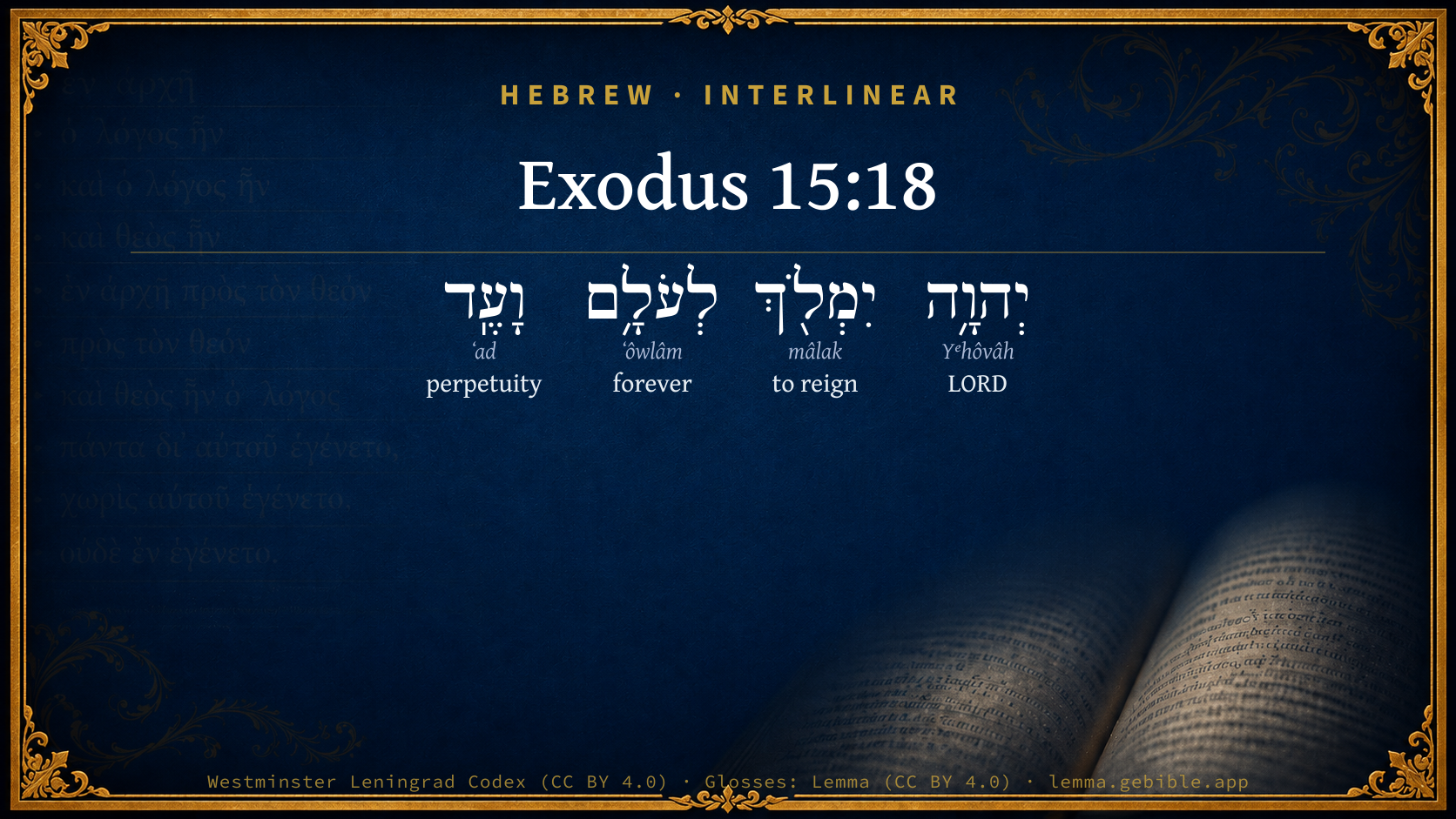
Exodus 15:18

Hebrew (Westminster Leningrad Codex) Exodus 15:18 appears in the Hebrew Old Testament. The text above is from the Westminster Leningrad Codex. Each word links to its Strong’s number, a concise gloss, and parsing drawn from the Open Scriptures Hebrew Bible morphology. Click any word for its full Brown-Driver-Briggs (BDB) entry.
Download image
Cite this verse

Exodus 15:18 (World English Bible). Public Domain. Lemma interlinear Bible study tool, https://lemma.gebible.app/v/exodus/15/18.

Show BibTeX & RIS
BibTeX
RIS
English Translation
Yahweh shall reign forever and ever."
World English Bible · Public Domain
Highlights
  • 1 first appearance in the Hebrew Bible
Full analysis ↓
Download a study sheet

One document with this verse’s original text, its word-by-word gloss line, the meaning frame, cross-references with their text, attributed commentary, and full source and license credits — printable, and it pastes into notes with its structure intact.

This verse Autodidact and up

Study sheet (.html) Plain text (.txt)

A passage Seminary Student

Up to 50 verses in one chapter. A passage sheet keeps up to 6 commentary sources and 12 cross-references per verse, in the order this page ranks them, and says so on the sheet whenever that leaves anything out. Ask for a single verse and you get the Autodidact verse sheet above.

Everything on this page stays free to read, with no account — the sheet is a download of what is already on screen, not access to it.

Want to remove ads? Support Godless Engineer
Compare translations 3

The same verse in 3 English versions, stacked beneath the original-language interlinear above. Click any original word for its lexicon entry.

Each is an independent rendering of the whole verse — the interlinear is not word-aligned to these translations.

Highlighted words mark where these versions differ — a whole-verse word diff, not a word-by-word alignment.

  • World English Bible Public Domain
    Yahweh shall reign forever and ever."
  • King James Version Public Domain
    The LORD shall reign for ever and ever.
  • unfoldingWord Literal Text CC BY-SA 4.0
    Yahweh will reign forever and ever.”

unfoldingWord Literal Text — © unfoldingWord, licensed CC BY-SA 4.0. Word-aligned USFM3 via Door43 (git.door43.org/unfoldingWord/en_ult).

Versions to compare (up to 4)

3 of 4 selected

Show all 18 translations

Every available English version of this verse, each an independent rendering of the whole verse.

  • World English Bible Public Domain
    Yahweh shall reign forever and ever."
  • Berean Standard Bible Public Domain
    The LORD will reign forever and ever!”
  • Majority Standard Bible Public Domain
    The LORD will reign forever and ever!”
  • King James Version Public Domain
    The LORD shall reign for ever and ever.
  • American Standard Version (1901) Public Domain
    Jehovah shall reign for ever and ever.
  • Revised Version (1885) Public Domain
    The LORD shall reign for ever and ever.
  • Geneva Bible (1599) Public Domain
    The Lord shall reigne for euer and euer.
  • Douay-Rheims (1899) Public Domain
    The Lord shall reign for ever and ever.
  • Young's Literal Translation Public Domain
    Jehovah reigneth -- to the age, and for ever!'
  • Literal Standard Version CC BY-SA 4.0
    YHWH reigns—[for] all time and forever!”
  • Unlocked Literal Bible CC BY-SA 4.0
    Yahweh will reign forever and ever.”
  • unfoldingWord Literal Text CC BY-SA 4.0
    Yahweh will reign forever and ever.”
  • Darby Bible Public Domain
    Jehovah shall reign for ever and ever!
  • World Messianic Bible Public Domain
    The LORD will reign forever and ever.”
  • Webster's Bible Public Domain
    The LORD shall reign for ever and ever.
  • Free Bible Version CC BY-SA 4.0
    The Lord will reign forever and ever!
  • Bible in Basic English Public Domain
    The Lord is King for ever and ever.
  • JPS Tanakh (1917) Public Domain
    The LORD shall reign for ever and ever.

Literal Standard Version (2020), Covenant Press — licensed CC BY-SA 4.0. Text via the HelloAO Bible API (eBible.org). Unlocked Literal Bible (unfoldingWord) — licensed CC BY-SA 4.0. Text via the HelloAO Bible API (eBible.org). unfoldingWord Literal Text — © unfoldingWord, licensed CC BY-SA 4.0. Word-aligned USFM3 via Door43 (git.door43.org/unfoldingWord/en_ult). Free Bible Version, Dr. Jonathan Gallagher — licensed CC BY-SA 4.0. Text via the HelloAO Bible API (eBible.org).

Word by word

More ways to search: Search by grammar → Find every occurrence → Compare this word →

Practice this passage: Drill this verse → Learn its vocabulary →

וָעֶֽד
ʻad
H5703
“and · perpetuity”
Conjunction + Noun, Common, Masculine, Singular, Absolute
Part of Speech
Conjunction + Noun
Type
Common
Gender
Masculine
Number
Singular
State
Absolute
Full BDB Definition

Origin: from H5710

TWOT: 1565a

perpetuity, for ever, continuing future - ancient (of past time) - for ever (of future time) - of continuous existence - for ever (of God's existence)
  1. יְהוָ֥ה Yᵉhôvâh H3068 “LORD” Noun, Proper
  2. יִמְלֹ֖ךְ mâlak H4427 “to reign” Verb, Qal, Imperfect, 3rd Person, Masculine, Singular
  3. לְעֹלָ֥ם ʻôwlâm H5769 “to/for · forever” Preposition + Noun, Common, Masculine, Singular, Absolute

About this verse

These counts appear in no published source. They are computed here, from the morphology-tagged text and Lemma’s own curated glosses. What Lemma adds →

4
words
4
distinct lemmas
Pentateuch
section

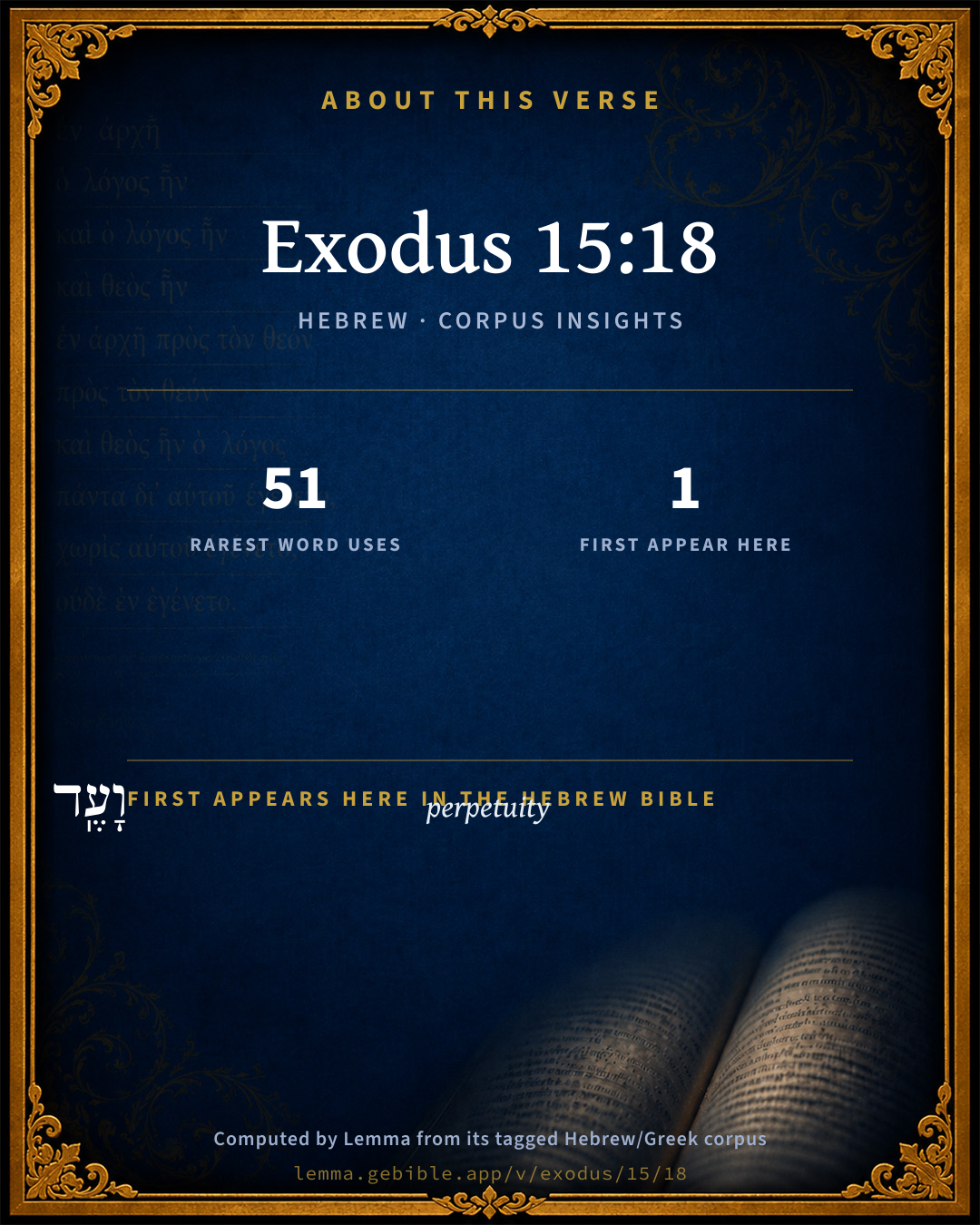
First appearance in Scripture

This word makes its first canonical appearance in the Hebrew Bible here:

  • וָעֶֽד perpetuity H5703

Shared distinctive vocabulary

וָעֶֽד perpetuity H5703 occurs in 49 verses of the Hebrew Bible. Also found in:

Grammatical profile

  • 1 verb
  • 3 nouns

Verb forms

  • יִמְלֹ֖ךְ Qal · Imperfect

Hebrew & Septuagint length

In English translation the verse runs 6 words from the Hebrew and 9 from the Septuagint (LXX English) — closely comparable.

A rough comparison of the two English renderings, which tokenize alike — not a word-level alignment.

Word counts can differ between the Hebrew and the Greek without any difference in meaning — e.g. the Hebrew direct-object marker אֵת has no separate Greek word, and Greek often adds the article ὁ.

Cross-references

10

Topical passages linked to Exodus 15:18 in the Treasury of Scripture Knowledge — connected by theme and wording, ordered by reader-vote popularity; previews shown in the World English Bible.

  • Psalms 10:16 Yahweh is King forever and ever! The nations will perish out of his land.
  • Psalms 29:10 Yahweh sat enthroned at the Flood. Yes, Yahweh sits as King forever.
  • Psalms 146:10 Yahweh will reign forever; Your God, O Zion, to all generations. Praise Yah!
  • Isaiah 57:15 For thus says the high and lofty One who inhabits eternity, whose name is Holy: I dwell in the high and holy place, with him also who is of a contrite and humble spirit, to revive the spirit of the humble, and to revive the heart of the contrite.
  • Daniel 2:44 In the days of those kings shall the God of heaven set up a kingdom which shall never be destroyed, nor shall the sovereignty of it be left to another people; but it shall break in pieces and consume all these kingdoms, and it shall stand forever.
  • Revelation 11:15–17 The seventh angel sounded, and great voices in heaven followed, saying, "The kingdom of the world has become the Kingdom of our Lord, and of his Christ. He will reign forever and ever!"
  • Daniel 4:3 How great are his signs! and how mighty are his wonders! his kingdom is an everlasting kingdom, and his dominion is from generation to generation.
  • Daniel 7:14 There was given him dominion, and glory, and a kingdom, that all the peoples, nations, and languages should serve him: his dominion is an everlasting dominion, which shall not pass away, and his kingdom that which shall not be destroyed.
  • Daniel 7:27 The kingdom and the dominion, and the greatness of the kingdoms under the whole the sky, shall be given to the people of the saints of the Most High: his kingdom is an everlasting kingdom, and all dominions shall serve and obey him.
  • Matthew 6:13 Bring us not into temptation, but deliver us from the evil one. For yours is the Kingdom, the power, and the glory forever. Amen.'

Cross-references courtesy of OpenBible.info (CC BY 4.0).

Hebrew and Greek witnesses Masoretic Hebrew ↔ Greek Septuagint

The same verse in the two great witnesses to the Old Testament, shown verse-for-verse.

These are two independent witnesses, not word-aligned to each other, and the Septuagint is shown in lemma (dictionary) form.

Hebrew Exodus 15:18 Masoretic · Westminster Leningrad Codex

יְהוָ֥ה יִמְלֹ֖ךְ לְעֹלָ֥ם וָעֶֽד

Yahweh shall reign forever and ever."

World English Bible · Public Domain

Greek LXX Exodus 15:18 Septuagint · lemma form

κύριος βασιλεύω ὁ αἰών καί ἐπί αἰών καί ἔτι

The Lord reigns for ever and ever and ever.

LXX2012 (modern English Septuagint) · Public Domain

On this verse, Haydock's Catholic Bible Commentary discusses the Septuagint’s reading. Read the note in Commentary ↓

Hebrew: Westminster Leningrad Codex (CC BY 4.0). Greek: Septuagint (public domain); English from LXX2012 (modern English Septuagint) (Public Domain). How the Septuagint differs from the Hebrew →

Targum (Aramaic paraphrase)

2

The Targum is the ancient Jewish Aramaic paraphrase of the Hebrew Scriptures — an interpretive translation, not the Hebrew text itself. Onkelos (literal) and Pseudo-Jonathan (expansive) render the Torah, and Jonathan the Prophets. Coverage is partial: where no permissively-licensed English translation exists for a verse, only the Aramaic is shown. This is verse-level text, not a word-by-word alignment to the Hebrew.

  1. Targum Onkelos Torah (Genesis–Deuteronomy)
    יְיָ מַלְכוּתֵהּ קָאֵם לְעָלַם וּלְעָלְמֵי עָלְמַיָא:

    (no public-domain English translation for this verse)

    Targum Onkelos — Aramaic: “Onkelos Genesis” (public domain); “Onkelos Exodus” (public domain); “Onkelos Leviticus” (public domain); “Onkelos Numbers” (public domain); “Onkelos Deuteronomy” (public domain). English: “Sefaria Community Translation” (CC0 1.0 (public-domain dedication)); “J.W. Etheridge. The Targums of Onkelos and Jonathan Ben Uzziel on the Pentateuch. London: Longmans, Green, 1862” (public domain). Text via Sefaria.

  2. Targum Pseudo-Jonathan Torah (Genesis–Deuteronomy)
    כַּד חָמוּן עַמָּא בֵּית יִשְרָאֵל יַת נִיסַיָא וְיַת פְּרִישְׁוָותָא דְּעָבַד לְהוֹן קוּדְשָׁא יְהֵי שְׁמֵיהּ מְשַׁבַּח עַל יַמָא דְסוּף וּגְבוּרַת יְדֵיהּ בְּנֵי גְּלַלְיָא עַנְיָין וְאָמְרִין אִילֵין לְאִילֵין אִיתוּ נִיתַּן כְּלִיל דִּרְבוּ בְּרֵישׁ פְּרוֹקַן דְּהוּא מַעֲבִיר וְלָא עָבַר דְּהוּא מַחֲלִיף וְלָא חֲלִיף דְּדִילֵיהּ הוּא כְּלִיל מַלְכוּתָא וְהוּא מֶלֶךְ מַלְכִין בְּעָלְמָא הָדֵין וְדִילֵיהּ הוּא מַלְכוּתָא לְעַלְמָא דְאָתֵי וְדִילֵיהּ הִיא וְהַוְיָא לְעָלְמֵי עַלְמִין

    When the people of the house of Israel beheld the signs and manifestations which the Holy One, whose Name be praised, had done at the sea of Suph, and the power of His hand, the children of the captives answering said one to the other, Come, and let us set the crown of majesty on the head of our Redeemer, who maketh to pass over, and passeth not; who changeth, and is not changed; whose is the crown of the kingdom; the King of kings in this world; whose, too, is the kingdom in the world to come, for ever and ever.

    Targum Pseudo-Jonathan — Aramaic: “Targum Jonathan on Genesis” (public domain); “Targum Jonathan on Exodus” (public domain); “Targum Jonathan on Leviticus” (public domain); “Targum Jonathan on Numbers” (public domain); “Targum Jonathan on Deuteronomy” (public domain). English: “The Targum of Jonathan ben Uzziel, trans. J. W. Etheridge, London, 1862” (public domain). Text via Sefaria.

Commentary

Notes on Exodus 15:18 from classic Christian and Jewish commentators (each source and its license shown beneath its notes). The classic Christian expositions comment on the surrounding passage and are grouped to its opening verse, so a note may address several verses; the Jewish commentaries on the Tanakh (Rashi and others) are per-verse, so they appear only where the commentator wrote on this verse.

Lemma curates 59 commentaries, every one of them public domain or Creative Commons licensed, each selected and text-cleaned for this edition rather than reprinted as found. About our sources →

Trapp's Complete Commentary

John Trapp

Exo 15:18 The LORD shall reign for ever and ever.

Ver. 18. The Lord shall reign.] Gaudeo quod Christus Dominus est; alioqui totus desperassem, writes Miconius to Calvin, upon the view of the Church’s enemies. The Lord Christ reigneth: or else I had been out of all hope of better.

John Trapp, A Commentary or Exposition upon All the Books of the Old and New Testament (1647–1656) — public domain. Text from a community e-Sword module.

The Biblical Illustrator

Joseph S. Exell

Exo_15:18

Hast led forth the people which Thou hast redeemed.

Lessons

1. Gods future providence as well as past deliverance is the matter of faiths praise.

2. God, as a shepherd, leadeth His people through their course to rest, and will lead, as if it were done.

3. Mercy is the rule of all Gods conduct to His Church here below.

4. God hath saved, and will redeem His Israel out of all their troubles. It is His promise (Psa_130:8).

5. Gods holy habitation, Sion in type and heaven in truth, is the end of all His providential guidance unto His.

6. Gods strength secureth the Churchs conduct to His holy habitation.

7. Tender, sweet, and gentle is Gods guidance of His Church through their way to rest (Isa_40:11).

8. All this promised guidance faith must return to the praise of God. (G. Hughes, B. D.)

The song of Moses

I. Past mercies acknowledged. The fact celebrated is redemption from Egypt--Thou in Thy mercy hast led forth Thy people which Thou hast redeemed. The whole glory of deliverance is ascribed to the Lord, without any reference to second causes. The believer will often look back and contemplate his mercies, and celebrate his deliverances; like Samuel, he will raise his Ebenezer (1Sa_7:12).

II. Future mercies anticipated. Thou hast guided them, in Thy strength, unto Thy holy habitation. Here is the language of strong faith, as if they were already in Canaan. Moses knew that God had promised to bring them to His holy hill, and to His dwelling; he knew that Gods promises were as good as His performances; and we may say so too, for they are all yea and amen in Christ Jesus. The Lord had done so much for Israel, that Moses felt no doubt as to the future--Thou shalt bring them in, and plant them in the mountain of Thine inheritance.

III. Israels enemies confounded. The people shall hear and be afraid, sorrow shall take hold of the inhabitants of Palestine, etc. The world has now much to say against the people and cause of God. Religion is denounced by them as a delusion--a gloomy thing--as madness; but then every objection will be silenced. Satan, too, is now very busy with his temptations and accusations; but this state of things shall not always last. Trembling shall take hold of the believers enemies, when the people of God are safely brought to the heavenly Canaan. Then where will be the venom of the world? where the accusations of Satan? Not one mouth will then be opened against the meanest and most neglected of Gods people on earth. He shall then have nothing to fear; admitted within the pearly gates of the heavenly Jerusalem, he shall be for ever with the Lord. All enemies will be for ever excluded. The Church shall be saved and God glorified.

IV. The Kingdom of God permanently triumphant. The Lord shall reign for ever and ever.

1. To the enemies of Christ. You see that the Lord must reign; then what must become of you?

2. To the friends of Christ, yea, to those who wish to love the Saviour.

(1) Look back and review your mercies; how numerous, how seasonable, how undeserved! See the Lords hand in them, and this will add to their sweetness.

(2) Look forward. Consider what God has promised to do for you. You have your trials, and you will have them; but you have not one too many.

(3) Look upward to that promised rest--that inheritance which is incorruptible, undefiled, and fadeth not away, etc. (George Breay, B. A.)

The Biblical Illustrator, edited by Joseph S. Exell (c. 1880s–1900s) — public domain. Text from a community e-Sword module.

Joseph Benson's Commentary

Exo 15:18-19. The Lord shall reign, &c. — This concludes the whole song, by which Moses not only expresses his own faith and that of the people in God’s everlasting kingdom, but promises, in the name of them all, to bear eternally in mind the signal deliverance God had wrought out for them. For ever and ever — They had now seen an end of Pharaoh’s reign, but time itself shall not put a period to Jehovah’s reign, which, like himself, is eternal.

Joseph Benson's Commentary on the Old and New Testaments (1811–1818) — public domain. Text from a community e-Sword module.

Adam Clarke's Commentary

Verse 18. The Lord shall reign for ever and ever.] This is properly the grand chorus in which all the people joined. The words are expressive of God's everlasting dominion, not only in the world, but in the Church; not only under the law, but also under the Gospel; not only in time, but through eternity. The original לעלם ועד leolam vaed may be translated, for ever and onward; or, by our very expressive compound term, for EVERMORE, i.e. for ever and more-not only through time, but also through all duration. His dominion shall be ever the same, active and infinitely extending. With this verse the song seems to end, as with it the hemistichs or poetic lines terminate. The 20th and beginning of the 21st are in plain prose, but the latter part of the 21st is in hemistichs, as it contains the response made by Miriam and the Israelitish women at different intervals during the song. See Dr. Kennicott's arrangement of the parts at the end of this chapter.

Adam Clarke's Commentary on the Bible (1810–1826) — public domain. Text from a community e-Sword/MySword module.

Ellicott's Commentary for English Readers

(18) The Lord shall reign for ever and ever.—Compare Psa_10:16; Psa_29:10; Psa_145:13; Psa_146:10. In simplicity and consequent force the expression of the idea by Moses transcends all later ones.

A Bible Commentary for English Readers, edited by Charles John Ellicott (1878–1897) — public domain. Text from a community e-Sword module.

The Cambridge Bible for Schools and Colleges

gen. ed. J. J. S. Perowne

18. With this short concluding verse, ‘glancing at Jehovah’s lasting kingship (Deu_33:5) over His people, settled round His sanctuary, the hymn is brought to a fine and effective close’ (Di.). The thought of Jehovah as King occurs already in Deu_33:5, and in the seemingly early Psa_24:7-10; Psa_29:10; but the stress laid on His active exertion of sovereignty occurs first in Mic_4:7, but is chiefly later, Isa_52:7 (hence Psa_93:1; Psa_96:10; Psa_97:1; Psa_98:1), Isa_24:23 (post-exilic), Psa_146:10 (with ‘for ever,’ as also Mic_4:7).

The Cambridge Bible for Schools and Colleges (gen. ed. J. J. S. Perowne; Cambridge University Press, 1878–1918) — public domain. Text from a community e-Sword module.

John Gill's Exposition

The Lord shall reign for ever and ever. Even that same Lord that is spoken of throughout this song, and to whom everything in it is ascribed, and who is no other than the Lord Jesus Christ; his reign began in eternity, when he was set up and anointed as King over God's holy hill of Zion, his church, the elect, who were a kingdom put under his care and charge, and which he will deliver up again one day, complete and perfect: he reigned throughout the whole Old Testament dispensation, and was acknowledged as well as prophesied of as a King; in his state of humiliation he had a kingdom, though not of this world, and upon his ascension to heaven he was made and declared Lord and Christ; and thenceforward his kingdom became very visible in the Gentile world, through the ministration of his word, accompanied by his almighty power; and ever since, more or less, he has ruled by his Spirit and grace in the hearts of many of the children of men, and, ere long, will take upon him his great power, and reign, in a more visible, spiritual, and glorious manner, in the midst of his churches, in the present state of things; and then he will reign with all his saints raised from the dead, for the space of a thousand years on earth, and after that will reign with them for ever in heaven, in the ultimate state of glory and happiness: the reigns of all others are but short, or, however, but for a time, but the reign of Christ is for ever and ever; the reigns of sin, and of Satan, and of death, have an end, but of the government of Christ, and the peace thereof, there will be no end; the reigns of the greatest potentates, emperors, and kings, of cruel and tyrannical princes, such as Pharaoh, are limited to a certain time, as is the reign of antichrist, which when ended, and the saints will have got the victory over him, the song of Moses and the Lamb will be sung; but Christ's kingdom is an everlasting kingdoms, and his dominion is evermore: the Targum of Jonathan is,"let us set a crown on the head of our Redeemer, whose is the royal crown, and he is King of kings in this world, and whose is the kingdom in the world to come, and whose it is and will be for ever and ever;''and to the same purpose is the Jerusalem Targum.

The Lord shall reign for ever and ever. Even that same Lord that is spoken of throughout this song, and to whom everything in it is ascribed, and who is no other than the Lord Jesus Christ; his reign began in eternity, when he was set up and anointed as King over God's holy hill of Zion, his church, the elect, who were a kingdom put under his care and charge, and which he will deliver up again one day, complete and perfect: he reigned throughout the whole Old Testament dispensation, and was acknowledged as well as prophesied of as a King; in his state of humiliation he had a kingdom, though not of this world, and upon his ascension to heaven he was made and declared Lord and Christ; and thenceforward his kingdom became very visible in the Gentile world, through the ministration of his word, accompanied by his almighty power; and ever since, more or less, he has ruled by his Spirit and grace in the hearts of many of the children of men, and, ere long, will take upon him his great power, and reign, in a more visible, spiritual, and glorious manner, in the midst of his churches, in the present state of things; and then he will reign with all his saints raised from the dead, for the space of a thousand years on earth, and after that will reign with them for ever in heaven, in the ultimate state of glory and happiness: the reigns of all others are but short, or, however, but for a time, but the reign of Christ is for ever and ever; the reigns of sin, and of Satan, and of death, have an end, but of the government of Christ, and the peace thereof, there will be no end; the reigns of the greatest potentates, emperors, and kings, of cruel and tyrannical princes, such as Pharaoh, are limited to a certain time, as is the reign of antichrist, which when ended, and the saints will have got the victory over him, the song of Moses and the Lamb will be sung; but Christ's kingdom is an everlasting kingdoms, and his dominion is evermore: the Targum of Jonathan is,"let us set a crown on the head of our Redeemer, whose is the royal crown, and he is King of kings in this world, and whose is the kingdom in the world to come, and whose it is and will be for ever and ever;''and to the same purpose is the Jerusalem Targum.

Exodus 15:19

exo 15:19

exo 15:19

exo 15:19For the horse of Pharaoh went in with his chariots and with his horsemen into the sea,.... Meaning not that particular and single horse on which Pharaoh was carried, but all the horses of his that drew in his chariots, and all on which his cavalry was mounted; these all went into the Red sea, following the Israelites thither: these words are either the concluding part of the song, recapitulating and reducing into a compendium the subject matter of it; or are a reason why Moses and the children of Israel sung it; or else they are to be connected more strictly with the preceding verse, and give a reason why the Lord reigns over his people for ever; because he has destroyed their enemies, and delivered them out of their hands:

and the Lord brought again the waters of the sea upon them; after he had divided them, for the Israelites to pass through them, he caused them to close again, and to fall upon the Egyptians and cover and drown them:

but the children of Israel went on dry land in the midst of the sea; which was a very wonderful thing, and was a just and sufficient reason for singing the above song to the Lord, see Exo 14:29.

John Gill's Exposition of the Whole Bible (1746–1763) — public domain (CC PDM 1.0). Text via the HelloAO Bible API.

Haydock's Catholic Bible Commentary

And ever. Literally, et ultra, "and beyond;" holam, which denotes a long duration, is often used to mean a time that will have an end. To add the greater emphasis to it, the latter term is sometimes used when eternity is meant. The Septuagint, "The Lord shall reign over this generation, or age of the Mosaic law, and over an age lasting from Christ to the end, and still." His kingdom shall extend over all eternity. (Calmet)

George Leo Haydock (1774–1849), Haydock's Catholic Family Bible and Commentary, 1859 edition — public domain. Excludes Psalms (Douay-Rheims chapter numbering differs from Protestant) and Deuterocanonical books (Catholic canon only).

The Pulpit Commentary

In terms most simple yet most grand, often imitated, (Psa_10:16 Psa_29:10 Psa_146:10, etc.) but never surpassed, the poet gives the final result of all God"s providential and temporary arrangements, to wit, the eternal establishment of his most glorious kingdom. And here reaching the final consummation of all things, (1Co_15:28) he will not weaken the impression made by adding another word, but ends his ode.

The Pulpit Commentary (1880–1919), ed. H.D.M. Spence-Jones & Joseph S. Exell — public domain. Text from a community e-Sword module.

John Wesley's Explanatory Notes

The Lord shall reign forever and ever - They had now seen an end of Pharaoh's reign, but time itself shall not put a period to Jehovah's reign, which like himself is eternal.

John Wesley, Explanatory Notes Upon the Whole Bible (1754–1765) — public domain. Text via the GEBible commentary corpus.

Rashi

Rabbi Shlomo Yitzchaki (Rashi)

לעלם ועד The word ועד is an expression denoting ETERNITY — The ו in it is a root-letter, and consequently it is vowelled with a Patach; but in the similar word in (Jeremiah 29:23) “I am He that knoweth and am witness (ועד)”, where the ו is a servile letter (a prefix) it is vowelled with a Kametz.

Rashi on the Tanakh — English translations: “The Judaica Press complete Tanach with Rashi, translated by A. J. Rosenberg” (CC BY 4.0); “Pentateuch with Rashi's commentary by M. Rosenbaum and A.M. Silbermann, 1929-1934” (public domain); “The Metsudah Tanach series, Lakewood, N.J” (CC BY 4.0); and “The Book of Joshua, Metsudah Publications, 1997” (CC BY 4.0). Text via Sefaria.

Ramban (Nachmanides)

Rabbi Moshe ben Nachman (Ramban / Nachmanides)

THE ETERNAL SHALL REIGN FOR EVER AND EVER. Moses is saying that just as He has now shown that He is King and Ruler by having brought deliverance to His servants and destruction upon those that rebel against Him, so may it be His will to do so in all generations forever, that He withdraw not His eyes from the righteous, nor hide them [His eyes] from the wicked ones who inflict evil upon others. There are many verses that are to be interpreted in this way, such as: The Eternal will reign for ever, thy G-d, O Zion, unto all generations. Hallelujah; Blessed be the Name of the Eternal from this time forth and for ever;, 113:2. And the Eternal shall be King over all the earth. Now Onkelos was apprehensive [of translating this verse literally, which is stated in a future tense], since G-d’s sovereignty is [indeed] to all eternity [and no prayer for its continuance is possible]. Therefore he rendered it in the present tense: “The Kingdom of the Eternal endureth for ever and to all eternity,” just as is expressed in the verse, Thy Kingdom is a Kingdom for all ages. But I have not understood Onkelos’ opinion in this matter, for it is written: May the Glory of the Eternal endure for ever;, 104:31. And let the whole earth be filled with His Glory;, 72:19. “Magnified and sanctified shall be [His great Name]”; prayer. In Ricanti’s work on the Torah in quoting this text from Ramban, he writes clearly: “and in the Kaddish [we say], ‘Magnified, etc.’” It is thus to be noted that the Kaddish-text is quoted by Ramban amidst Scriptural verses as authority for his thesis! The great sanctity of the Kaddish prayer is thus clearly indicated. Yea, let it be established, and let Thy Name be magnified for ever. It is possible that the meaning of these [future tenses] is similar to the secret of the benedictions.

Ramban (Nachmanides) on the Tanakh — English translation: “Commentary on the Torah by Ramban (Nachmanides). Translated and annotated by Charles B. Chavel. New York, Shilo Pub. House, 1971-1976” (CC BY 4.0). Text via Sefaria.

Lesson kit

Teaching starters — assembled from the data on this page, not authored interpretation. Every prompt links to the verse data it draws on. Edit before teaching.

Exodus, in the Pentateuch, opens this verse with 4 words (4 distinct Hebrew lemmas). Its most distinctive word is ʻad (“perpetuity”). A historical commentator’s framing appears above. Read the whole chapter for the surrounding context.

Discussion questions

  1. How does “perpetuity” (ʻad) shape what this verse is saying?
  2. This is the first place “perpetuity” appears in Scripture (first appears here). What does its debut here establish?
  3. How does Numbers 24:20, which shares the word «perpetuity», read alongside this verse?
  4. The translations on this page render this verse differently — a whole-verse word diff, not a word-by-word alignment. What might account for the different wordings?
  5. «יִמְלֹ֖ךְ» is a Qal Imperfect verb. How does that grammatical form shape the action described?
  6. Compare how Trapp's Complete Commentary and The Biblical Illustrator read this verse. Where do they agree or differ?

Things to notice

  • 1 word makes its first canonical appearance in Scripture here.
  • These translations choose different wording for 5 words in this verse.
  • 4 distinct Hebrew lemmas span 4 words in this verse.

Reading settings

Reading text

Shown beneath each verse's original-language words.

Old Testament
Old Testament edition

Read the OT as the Masoretic Hebrew (MT) or the Greek Septuagint (LXX).

English shown for the Greek Septuagint (in the Hebrew ↔ Greek comparison).

Comparing translations? Open the Compare panel on any verse page to stack up to four side by side.