
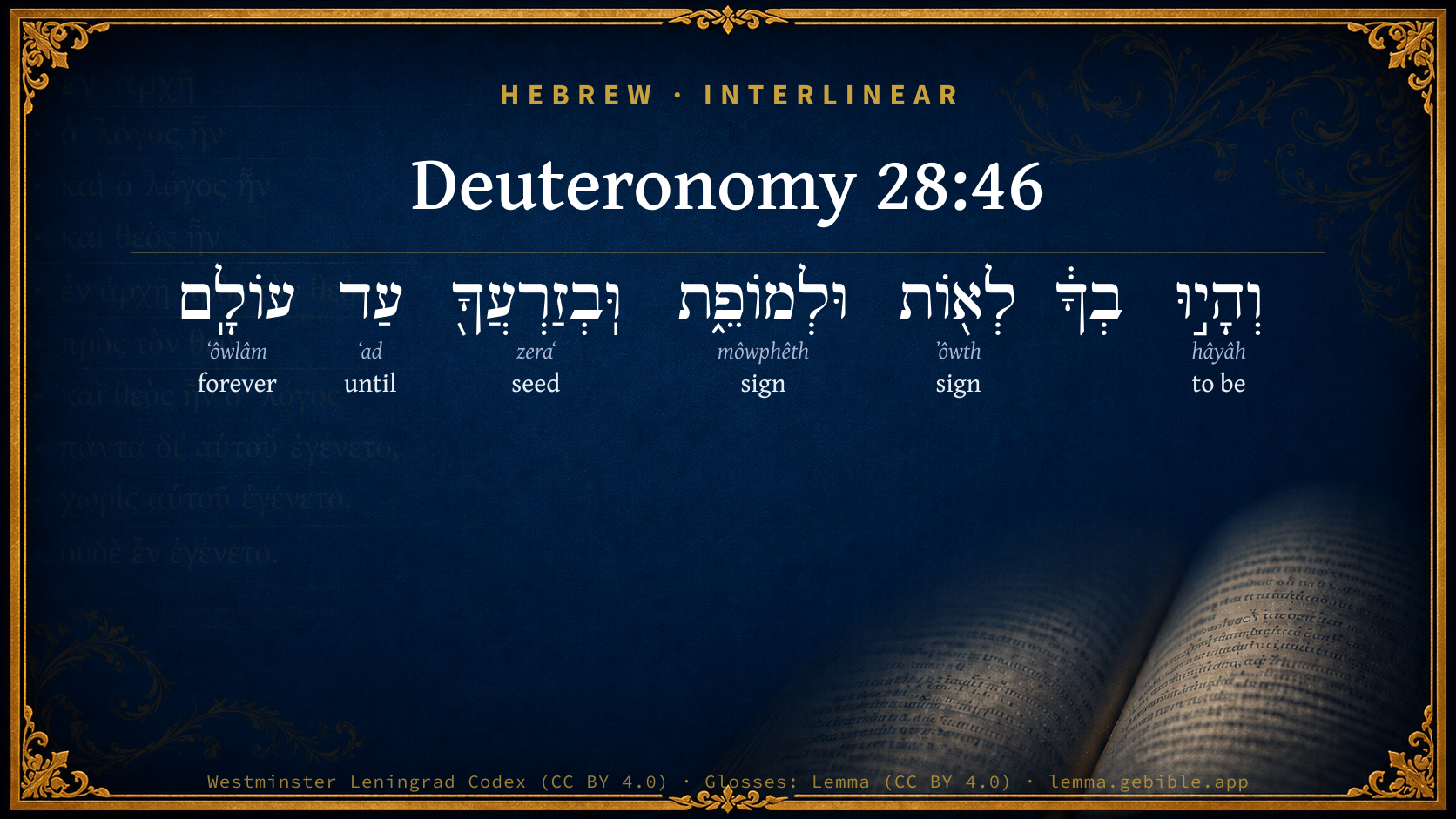
Deuteronomy 28:46

Hebrew (Westminster Leningrad Codex) Deuteronomy 28:46 appears in the Hebrew Old Testament. The text above is from the Westminster Leningrad Codex. Each word links to its Strong’s number, a concise gloss, and parsing drawn from the Open Scriptures Hebrew Bible morphology. Click any word for its full Brown-Driver-Briggs (BDB) entry.
Download image
Cite this verse

Deuteronomy 28:46 (World English Bible). Public Domain. Lemma interlinear Bible study tool, https://lemma.gebible.app/v/deuteronomy/28/46.

Show BibTeX & RIS
BibTeX
RIS
English Translation
and they shall be on you for a sign and for a wonder, and on your seed forever.
World English Bible · Public Domain
Download a study sheet

One document with this verse’s original text, its word-by-word gloss line, the meaning frame, cross-references with their text, attributed commentary, and full source and license credits — printable, and it pastes into notes with its structure intact.

This verse Autodidact and up

Study sheet (.html) Plain text (.txt)

A passage Seminary Student

Up to 50 verses in one chapter. A passage sheet keeps up to 6 commentary sources and 12 cross-references per verse, in the order this page ranks them, and says so on the sheet whenever that leaves anything out. Ask for a single verse and you get the Autodidact verse sheet above.

Everything on this page stays free to read, with no account — the sheet is a download of what is already on screen, not access to it.

Want to remove ads? Support Godless Engineer
Compare translations 3

The same verse in 3 English versions, stacked beneath the original-language interlinear above. Click any original word for its lexicon entry.

Each is an independent rendering of the whole verse — the interlinear is not word-aligned to these translations.

Highlighted words mark where these versions differ — a whole-verse word diff, not a word-by-word alignment.

  • World English Bible Public Domain
    and they shall be on you for a sign and for a wonder, and on your seed forever.
  • King James Version Public Domain
    And they shall be upon thee for a sign and for a wonder, and upon thy seed for ever.
  • unfoldingWord Literal Text CC BY-SA 4.0
    And they will be on you as signs and as wonders, and on your seed until forever.

unfoldingWord Literal Text — © unfoldingWord, licensed CC BY-SA 4.0. Word-aligned USFM3 via Door43 (git.door43.org/unfoldingWord/en_ult).

Versions to compare (up to 4)

3 of 4 selected

Show all 18 translations

Every available English version of this verse, each an independent rendering of the whole verse.

  • World English Bible Public Domain
    and they shall be on you for a sign and for a wonder, and on your seed forever.
  • Berean Standard Bible Public Domain
    These curses will be a sign and a wonder upon you and your descendants forever.
  • Majority Standard Bible Public Domain
    These curses will be a sign and a wonder upon you and your descendants forever.
  • King James Version Public Domain
    And they shall be upon thee for a sign and for a wonder, and upon thy seed for ever.
  • American Standard Version (1901) Public Domain
    and they shall be upon thee for a sign and for a wonder, and upon thy seed for ever.
  • Revised Version (1885) Public Domain
    and they shall be upon thee for a sign and for a wonder, and upon thy seed for ever:
  • Geneva Bible (1599) Public Domain
    And they shalbe vpon thee for signes and wonders, and vpon thy seede for euer,
  • Douay-Rheims (1899) Public Domain
    And they shall be as signs and wonders on thee, and on thy seed for ever.
  • Young's Literal Translation Public Domain
    and they have been on thee for a sign and for a wonder, also on thy seed -- to the age.
  • Literal Standard Version CC BY-SA 4.0
    and they have been on you for a sign and for a wonder, also on your seed—for all time.
  • Unlocked Literal Bible CC BY-SA 4.0
    These curses will be on you as signs and wonders, and on your descendants forever.
  • unfoldingWord Literal Text CC BY-SA 4.0
    And they will be on you as signs and as wonders, and on your seed until forever.
  • Darby Bible Public Domain
    And they shall be upon thee for a sign and for a wonder, and upon thy seed for ever.
  • World Messianic Bible Public Domain
    They will be for a sign and for a wonder to you and to your offspring forever.
  • Webster's Bible Public Domain
    And they shall be upon thee for a sign and for a wonder, and upon thy seed for ever.
  • Free Bible Version CC BY-SA 4.0
    They will be lasting evidence, visible signs of what happened to you and your descendants.
  • Bible in Basic English Public Domain
    These things will come on you and on your seed, to be a sign and a wonder for ever;
  • JPS Tanakh (1917) Public Domain
    And they shall be upon thee for a sign and for a wonder, and upon thy seed for ever;

Literal Standard Version (2020), Covenant Press — licensed CC BY-SA 4.0. Text via the HelloAO Bible API (eBible.org). Unlocked Literal Bible (unfoldingWord) — licensed CC BY-SA 4.0. Text via the HelloAO Bible API (eBible.org). unfoldingWord Literal Text — © unfoldingWord, licensed CC BY-SA 4.0. Word-aligned USFM3 via Door43 (git.door43.org/unfoldingWord/en_ult). Free Bible Version, Dr. Jonathan Gallagher — licensed CC BY-SA 4.0. Text via the HelloAO Bible API (eBible.org).

Word by word

More ways to search: Search by grammar → Find every occurrence → Compare this word →

Practice this passage: Drill this verse → Learn its vocabulary →

וּלְמוֹפֵ֑ת
môwphêth
H4159
“and · to/for · sign”
Conjunction + Preposition + Noun, Common, Masculine, Singular, Absolute
Part of Speech
Conjunction + Preposition + Noun
Type
Common
Gender
Masculine
Number
Singular
State
Absolute
Full BDB Definition

Origin: from H3302 in the sense of conspicuousness

TWOT: 152a

wonder, sign, miracle, portent - wonder (as a special display of God's power) - sign, token (of future event)
  1. וְהָי֣וּ hâyâh H1961 “and · to be” Conjunction + Verb, Qal, Sequential Perfect, 3rd Person, Common, Plural
  2. לְא֖וֹת ʼôwth H226 “to/for · sign” Preposition + Noun, Common, Both, Singular, Absolute
  3. וּֽבְזַרְעֲךָ֖ zeraʻ H2233 “and · in/at · seed · your” Conjunction + Preposition + Noun, Common, Masculine, Singular, Construct + Suffix, Personal, 2nd Person, Masculine, Singular
  4. עַד ʻad H5704 “until” Preposition
  5. עוֹלָֽם ʻôwlâm H5769 “forever” Noun, Common, Masculine, Singular, Absolute

About this verse

These counts appear in no published source. They are computed here, from the morphology-tagged text and Lemma’s own curated glosses. What Lemma adds →

7
words
6
distinct lemmas
Pentateuch
section

Shared distinctive vocabulary

וּלְמוֹפֵ֑ת sign H4159 occurs in 35 verses of the Hebrew Bible. Also found in:

Grammatical profile

  • 1 verb
  • 4 nouns
  • 2 prepositions

Verb forms

  • וְהָי֣וּ Qal · Sequential Perfect

Hebrew & Septuagint length

In English translation the verse runs 18 words from the Hebrew and 15 from the Septuagint (LXX English) — closely comparable.

A rough comparison of the two English renderings, which tokenize alike — not a word-level alignment.

Word counts can differ between the Hebrew and the Greek without any difference in meaning — e.g. the Hebrew direct-object marker אֵת has no separate Greek word, and Greek often adds the article ὁ.

Cross-references

11

Topical passages linked to Deuteronomy 28:46 in the Treasury of Scripture Knowledge — connected by theme and wording, ordered by reader-vote popularity; previews shown in the World English Bible.

  • Isaiah 8:18 Behold, I and the children whom Yahweh has given me are for signs and for wonders in Israel from Yahweh of Hosts, who dwells in Mount Zion.
  • Deuteronomy 28:37 You shall become an astonishment, a proverb, and a byword, among all the peoples where Yahweh shall lead you away.
  • Ezekiel 14:8 and I will set my face against that man, and will make him an astonishment, for a sign and a proverb, and I will cut him off from the midst of my people; and you shall know that I am Yahweh.
  • Jeremiah 25:18 [to wit], Jerusalem, and the cities of Judah, and the kings of it, and the princes of it, to make them a desolation, an astonishment, a hissing, and a curse, as it is this day;
  • Deuteronomy 28:59 then Yahweh will make your plagues wonderful, and the plagues of your seed, even great plagues, and of long continuance, and sore sicknesses, and of long continuance.
  • Deuteronomy 29:20 Yahweh will not pardon him, but then the anger of Yahweh and his jealousy will smoke against that man, and all the curse that is written in this book shall lie on him, and Yahweh will blot out his name from under the sky.
  • Deuteronomy 29:28 and Yahweh rooted them out of their land in anger, and in wrath, and in great indignation, and cast them into another land, as at this day.
  • Jeremiah 19:8 I will make this city an astonishment, and a hissing; everyone who passes thereby shall be astonished and hiss because of all the plagues of it.
  • Ezekiel 23:32–33 Thus says the Lord Yahweh: You shall drink of your sister's cup, which is deep and large; you shall ridiculed and had in derision; it contains much.
  • Ezekiel 36:20 When they came to the nations, where they went, they profaned my holy name; in that men said of them, These are the people of Yahweh, and are gone forth out of his land.
  • 1 Corinthians 10:11 Now all these things happened to them by way of example, and they were written for our admonition, on whom the ends of the ages have come.

Cross-references courtesy of OpenBible.info (CC BY 4.0).

Hebrew and Greek witnesses Masoretic Hebrew ↔ Greek Septuagint

The same verse in the two great witnesses to the Old Testament, shown verse-for-verse.

These are two independent witnesses, not word-aligned to each other, and the Septuagint is shown in lemma (dictionary) form.

Hebrew Deuteronomy 28:46 Masoretic · Westminster Leningrad Codex

וְהָי֣וּ בְךָ֔ לְא֖וֹת וּלְמוֹפֵ֑ת וּֽבְזַרְעֲךָ֖ עַד עוֹלָֽם

and they shall be on you for a sign and for a wonder, and on your seed forever.

World English Bible · Public Domain

Greek LXX Deuteronomy 28:46 Septuagint · lemma form

καί εἰμί ἐν σύ σημεῖον καί τέρας καί ἐν ὁ σπέρμα σύ ἕως ὁ αἰών

And these things shall be signs in you, and wonders among your seed for ever;

LXX2012 (modern English Septuagint) · Public Domain

Hebrew: Westminster Leningrad Codex (CC BY 4.0). Greek: Septuagint (public domain); English from LXX2012 (modern English Septuagint) (Public Domain). How the Septuagint differs from the Hebrew →

Targum (Aramaic paraphrase)

2

The Targum is the ancient Jewish Aramaic paraphrase of the Hebrew Scriptures — an interpretive translation, not the Hebrew text itself. Onkelos (literal) and Pseudo-Jonathan (expansive) render the Torah, and Jonathan the Prophets. Coverage is partial: where no permissively-licensed English translation exists for a verse, only the Aramaic is shown. This is verse-level text, not a word-by-word alignment to the Hebrew.

  1. Targum Onkelos Torah (Genesis–Deuteronomy)
    וִיהוֹן בָּךְ לְאָת וּלְמוֹפֵת וּבִבְנָיךְ עַד עֳלָם

    (no public-domain English translation for this verse)

    Targum Onkelos — Aramaic: “Onkelos Genesis” (public domain); “Onkelos Exodus” (public domain); “Onkelos Leviticus” (public domain); “Onkelos Numbers” (public domain); “Onkelos Deuteronomy” (public domain). English: “Sefaria Community Translation” (CC0 1.0 (public-domain dedication)); “J.W. Etheridge. The Targums of Onkelos and Jonathan Ben Uzziel on the Pentateuch. London: Longmans, Green, 1862” (public domain). Text via Sefaria.

  2. Targum Pseudo-Jonathan Torah (Genesis–Deuteronomy)
    וִיהוֹן בְּכוֹן לְאָתִין וּלְתִמְהִין וּבִבְנֵיכוֹן עַד עָלְמָא

    And they will be upon you for signs and portents, and upon your children for ever;

    Targum Pseudo-Jonathan — Aramaic: “Targum Jonathan on Genesis” (public domain); “Targum Jonathan on Exodus” (public domain); “Targum Jonathan on Leviticus” (public domain); “Targum Jonathan on Numbers” (public domain); “Targum Jonathan on Deuteronomy” (public domain). English: “The Targum of Jonathan ben Uzziel, trans. J. W. Etheridge, London, 1862” (public domain). Text via Sefaria.

Commentary

Notes on Deuteronomy 28:46 from classic Christian and Jewish commentators (each source and its license shown beneath its notes). The classic Christian expositions comment on the surrounding passage and are grouped to its opening verse, so a note may address several verses; the Jewish commentaries on the Tanakh (Rashi and others) are per-verse, so they appear only where the commentator wrote on this verse.

Lemma curates 59 commentaries, every one of them public domain or Creative Commons licensed, each selected and text-cleaned for this edition rather than reprinted as found. About our sources →

Trapp's Complete Commentary

John Trapp

Deu 28:46 And they shall be upon thee for a sign and for a wonder, and upon thy seed for ever.

Ver. 46. For a sign.] Of God’s heavy displeasure.

John Trapp, A Commentary or Exposition upon All the Books of the Old and New Testament (1647–1656) — public domain. Text from a community e-Sword module.

Joseph Benson's Commentary

Deu 28:46. They (these curses now mentioned) shall be upon thee for a sign — This, indeed, they have been in a most wonderful and astonishing manner. Since man was first placed on the earth, never was there a people that were such a sign to all the inhabitants of it as the Jews have been. Never did any other people experience such a strange series of events; never were calamities like theirs; never were people so dispersed, and carried into captivity, and yet kept so entire and separate, and thereby made a spectacle and sign to all nations. Though the above verse was written above three thousand years ago, yet do the nations of the earth see it in full force at this day! The seed of this very people still remain, and their state is such, as makes them for a sign and a wonder over the face of the earth. What a striking and wonderful evidence is this of the divinity of the Holy Scriptures! Who but God, that declareth the end from the beginning, could declare this, and bring it to pass? O God, very wonderful art thou! Thou makest thy enemies to bear witness to thy truth, and advance thy honour!

Joseph Benson's Commentary on the Old and New Testaments (1811–1818) — public domain. Text from a community e-Sword module.

Tyndale Open Study Notes

Tyndale Open Resources

28:46 sign and warning (literally sign and wonder): This expression indicates God’s miraculous acts that arrest the attention of those who witness them and attest to his power and sovereignty (see 6:22). They are intended to produce intense fear among his own people.

Tyndale Open Study Notes — © Tyndale Open Resources, licensed CC BY-SA 4.0. Text via the HelloAO Bible API.

Geneva Bible (1599)

Geneva Bible translators

God’s plagues be evident signs that he is offended with thee.

Geneva Bible (1599) marginal notes — public domain. Text via Bolls.life.

John Gill's Exposition

A nation of fierce countenance,.... Or, "strong of face" (y); which aptly describes the old Romans, who are always represented as such; and whereas it is said of the Chaldeans, that they were a nation dreadful and terrible, Hab 1:7; the same is said of the fourth beast, or Roman empire, Dan 7:7; who were a terror to all the world:

which shall not regard the person of the old, nor show favour to the young: cruel, unmerciful, and uncompassionate, to persons of whatsoever age or sex; which, as it was the character of the Chaldeans, Ch2 36:17; so of the Romans, who especially showed no mercy to the Jews, as Josephus (z), who was an eyewitness, testifies."The Romans (says he) showed no mercy to any age, out of hatred to the nation (of the Jews), and in remembrance of the injuries done to Cestius;''one of their governors, when among them. And in another place he says (a),"the Romans, remembering what they suffered in the siege, spared none, and showed no mercy.''

(y) "fortem faciebus", Montanus; "robustam facie", Vatablus. (z) De Bello Jud. l. 3. c. 7. sect. 1. (a) Ibid. sect. 34.

John Gill's Exposition of the Whole Bible (1746–1763) — public domain (CC PDM 1.0). Text via the HelloAO Bible API.

Haydock's Catholic Bible Commentary

For ever. The nations which were employed by God to scourge the Jews, recognized that they were the instruments of his indignation. We are accustomed to consider many evils as the necessary appendages of human nature; but the surprising misfortunes, with which God visited his people, subjecting them to the Babylonians, Greeks, and Romans, could not be taken in this light. (Calmet)

George Leo Haydock (1774–1849), Haydock's Catholic Family Bible and Commentary, 1859 edition — public domain. Excludes Psalms (Douay-Rheims chapter numbering differs from Protestant) and Deuterocanonical books (Catholic canon only).

Matthew Poole's English Annotations

They shall be, i.e. these curses now mentioned. For a wonder, i.e. signal and wonderful to all that hear of them.

Matthew Poole's English Annotations on the Holy Bible (1683–1685) — public domain. Text from a community e-Sword/MySword module.

The Pulpit Commentary

These curses would be for a sign and for a wonder, exciting astonishment and dismay in the beholder, and showing that it was indeed the hand of God that was upon the rebellious nation. Forever. This, though it may imply the final and utter rejection of Israel as a nation, does not preclude the hope of restoration of a part of Israel as individuals, or as a remnant remaining in or returning to faith and obedience. (cf. Isa_10:22 Isa_6:13; Rom_9:27 Rom_11:5)

The Pulpit Commentary (1880–1919), ed. H.D.M. Spence-Jones & Joseph S. Exell — public domain. Text from a community e-Sword module.

John Wesley's Explanatory Notes

They - These curses now mentioned. A wonder - Signal and wonderful to all that hear of them. 'Tis amazing, a people so incorporated, should be so universally disperst! And that a people scattered in all nations, should not mix with any, but like Cain, be fugitives and vagabonds, and yet so marked as to be known.

John Wesley, Explanatory Notes Upon the Whole Bible (1754–1765) — public domain. Text via the GEBible commentary corpus.

Lesson kit

Teaching starters — assembled from the data on this page, not authored interpretation. Every prompt links to the verse data it draws on. Edit before teaching.

Deuteronomy, in the Pentateuch, opens this verse with 7 words (6 distinct Hebrew lemmas). Its most distinctive word is môwphêth (“sign”). A historical commentator’s framing appears above. Read the whole chapter for the surrounding context.

Discussion questions

  1. How does “sign” (môwphêth) shape what this verse is saying?
  2. How does Exodus 4:21, which shares the word «sign», read alongside this verse?
  3. These translations render this verse differently. What is at stake in choosing one wording over another?
  4. «וְהָי֣וּ» is a Qal Sequential Perfect verb. How does that grammatical form shape the action described?
  5. Compare how Trapp's Complete Commentary and Joseph Benson's Commentary read this verse. Where do they agree or differ?

Things to notice

Reading settings

Reading text

Shown beneath each verse's original-language words.

Old Testament
Old Testament edition

Read the OT as the Masoretic Hebrew (MT) or the Greek Septuagint (LXX).

English shown for the Greek Septuagint (in the Hebrew ↔ Greek comparison).

Comparing translations? Open the Compare panel on any verse page to stack up to four side by side.