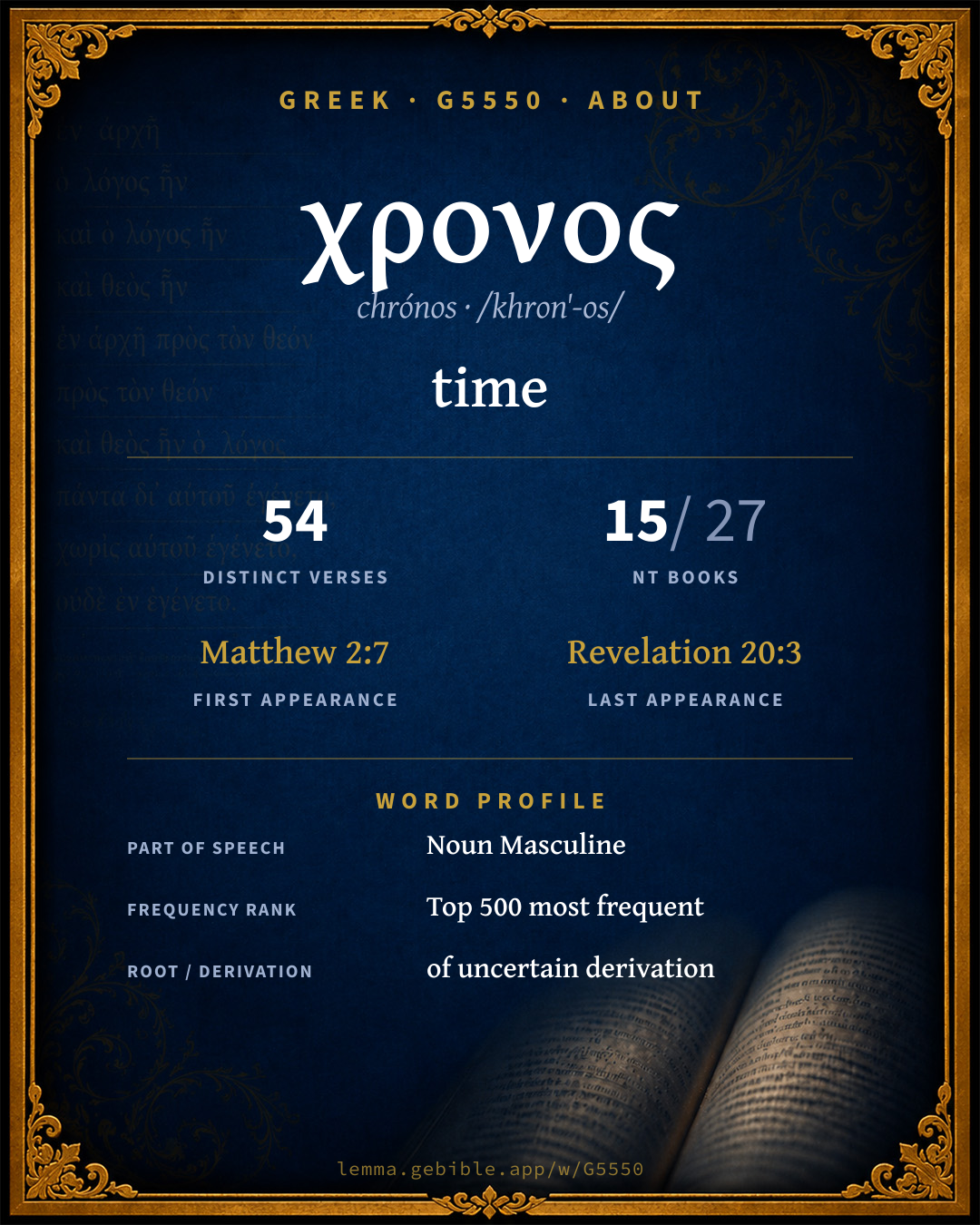
χρόνος
time
Full lexicon entry — Thayer's Greek Lexicon
From Thayer's Greek Lexicon
Where this word appears
See every Accusative-case word in the Greek New Testament →
Grammar key — what these labels mean
Part of speech
- Noun
- A naming word — a person, place, thing, or idea.
Case
- Accusative
- The case of the direct object and of extent.
- Nominative
- The case of the subject (and the predicate nominative).
- Genitive
- The case of source, possession, or “of” — answers “whose / from what.”
- Dative
- The case of the indirect object, means, or location — “to / for / with / in.”
Gender
- Masculine
- Grammatically masculine.
Number
- Singular
- One.
- Plural
- More than one.
Grammatical forms
- Noun, Accusative, Singular, Masculine 27 times (50%)
- Noun, Nominative, Singular, Masculine 7 times (13%)
- Noun, Genitive, Plural, Masculine 6 times (11%)
- Noun, Dative, Singular, Masculine 5 times (9%)
- Noun, Genitive, Singular, Masculine 4 times (7%)
- Noun, Accusative, Plural, Masculine 3 times (6%)
- Noun, Dative, Plural, Masculine 2 times (4%)
Parsed forms decoded from the imported morphology (Robinson–Tischendorf, public domain), counted across 54 parsed occurrences — not distinct verses.
Every verse where G5550 appears — 54 distinct verses across 15 books. Click any verse to open its interlinear word-by-word view. Verse text shown in the World English Bible for context — . Each verse’s Greek form is shown with its reference; the English is not keyword-highlighted, since the data carries no word-level English alignment. Use “Compare translations” on any verse to read it across multiple English versions. This concordance covers the Greek New Testament; Septuagint (Greek Old Testament) occurrences of this word are not indexed here.
Matthew 3 verses
- Matthew 2:7 χρόνον n acc sg masc Then Herod secretly called the wise men, and learned from them exactly what time the star appeared.
- Matthew 2:16 χρόνον n acc sg masc Then Herod, when he saw that he was mocked by the wise men, was exceedingly angry, and sent out, and killed all the male children who were in Bethlehem and in all the surrounding countryside, from two years old and under, according to the exact time which he had learned from the wise men.
- Matthew 25:19 χρόνον n acc sg masc "Now after a long time the lord of those servants came, and reconciled accounts with them.
Mark 2 verses
- Mark 2:19 χρόνον n acc sg masc Jesus said to them, "Can the groomsmen fast while the bridegroom is with them? As long as they have the bridegroom with them, they can't fast.
- Mark 9:21 χρόνος n nom sg masc He asked his father, "How long has it been since this has come to him?" He said, "From childhood.
Luke 7 verses
- Luke 1:57 χρόνος n nom sg masc Now the time that Elizabeth should give birth was fulfilled, and she brought forth a son.
- Luke 4:5 χρόνου n gen sg masc The devil, leading him up on a high mountain, showed him all the kingdoms of the world in a moment of time.
- Luke 8:27 χρόνῳ n dat sg masc When Jesus stepped ashore, a certain man out of the city who had demons for a long time met him. He wore no clothes, and didn't live in a house, but in the tombs.
- Luke 8:29 χρόνοις n dat pl masc For Jesus was commanding the unclean spirit to come out of the man. For the unclean spirit had often seized the man. He was kept under guard, and bound with chains and fetters. Breaking the bands apart, he was driven by the demon into the desert.
- Luke 18:4 χρόνον n acc sg masc He wouldn't for a while, but afterward he said to himself, 'Though I neither fear God, nor respect man,
- Luke 20:9 χρόνους n acc pl masc He began to tell the people this parable. "A man planted a vineyard, and rented it out to some farmers, and went into another country for a long time.
- Luke 23:8 χρόνων n gen pl masc Now when Herod saw Jesus, he was exceedingly glad, for he had wanted to see him for a long time, because he had heard many things about him. He hoped to see some miracle done by him.
John 4 verses
- John 5:6 χρόνον n acc sg masc When Jesus saw him lying there, and knew that he had been sick for a long time, he asked him, "Do you want to be made well?"
- John 7:33 χρόνον n acc sg masc Then Jesus said, "I will be with you a little while longer, then I go to him who sent me.
- John 12:35 χρόνον n acc sg masc Jesus therefore said to them, "Yet a little while the light is with you. Walk while you have the light, that darkness doesn't overtake you. He who walks in the darkness doesn't know where he is going.
- John 14:9 χρόνῳ n dat sg masc Jesus said to him, "Have I been with you such a long time, and do you not know me, Philip? He who has seen me has seen the Father. How do you say, 'Show us the Father?'
Acts 17 verses
- Acts 1:6 χρόνῳ n dat sg masc Therefore, when they had come together, they asked him, "Lord, are you now restoring the kingdom to Israel?"
- Acts 1:7 χρόνους n acc pl masc He said to them, "It isn't for you to know times or seasons which the Father has set within His own authority.
- Acts 1:21 χρόνῳ n dat sg masc Of the men therefore who have accompanied us all the time that the Lord Jesus went in and out among us,
- Acts 3:21 χρόνων n gen pl masc whom heaven must receive until the times of restoration of all things, which God spoke long ago by the mouth of his holy prophets.
- Acts 7:17 χρόνος n nom sg masc "But as the time of the promise came close which God had sworn to Abraham, the people grew and multiplied in Egypt,
- Acts 7:23 χρόνος n nom sg masc But when he was forty years old, it came into his heart to visit his brothers, the children of Israel.
- Acts 8:11 χρόνῳ n dat sg masc They listened to him, because for a long time he had amazed them with his sorceries.
- Acts 13:18 χρόνον n acc sg masc For a period of about forty years he put up with them in the wilderness.
- Acts 14:3 χρόνον n acc sg masc Therefore they stayed there a long time, speaking boldly in the Lord, who testified to the word of his grace, granting signs and wonders to be done by their hands.
- Acts 14:28 χρόνον n acc sg masc They stayed there with the disciples for a long time.
- Acts 15:33 χρόνον n acc sg masc After they had spent some time there, they were sent back with greetings from the brothers to the apostles.
- Acts 17:30 χρόνους n acc pl masc The times of ignorance therefore God overlooked. But now he commands that all people everywhere should repent,
- Acts 18:20 χρόνον n acc sg masc When they asked him to stay with them a longer time, he declined;
- Acts 18:23 χρόνον n acc sg masc Having spent some time there, he departed, and went through the region of Galatia, and Phrygia, in order, establishing all the disciples.
- Acts 19:22 χρόνον n acc sg masc Having sent into Macedonia two of those who ministered to him, Timothy and Erastus, he himself stayed in Asia for a while.
- Acts 20:18 χρόνον n acc sg masc When they had come to him, he said to them, "You yourselves know, from the first day that I set foot in Asia, how I was with you all the time,
- Acts 27:9 χρόνου n gen sg masc When much time had passed and the voyage was now dangerous, because the Fast had now already gone by, Paul admonished them,
Romans 2 verses
1 Corinthians 2 verses
- 1 Corinthians 7:39 χρόνον n acc sg masc A wife is bound by law for as long as her husband lives; but if the husband is dead, she is free to be married to whoever she desires, only in the Lord.
- 1 Corinthians 16:7 χρόνον n acc sg masc For I do not wish to see you now in passing, but I hope to stay a while with you, if the Lord permits.
Galatians 2 verses
1 Thessalonians 1 verse
2 Timothy 1 verse
Titus 1 verse
Hebrews 3 verses
- Hebrews 4:7 χρόνον n acc sg masc he again defines a certain day, today, saying through David so long a time afterward (just as has been said), "Today if you will hear his voice, Don't harden your hearts."
- Hebrews 5:12 χρόνον n acc sg masc For when by reason of the time you ought to be teachers, you again need to have someone teach you the rudiments of the first principles of the oracles of God. You have come to need milk, and not solid food.
- Hebrews 11:32 χρόνος n nom sg masc What more shall I say? For the time would fail me if I told of Gideon, Barak, Samson, Jephthah, David, Samuel, and the prophets;
1 Peter 4 verses
- 1 Peter 1:17 χρόνον n acc sg masc If you call on him as Father, who without respect of persons judges according to each man's work, pass the time of your living as strangers here in reverent fear:
- 1 Peter 1:20 χρόνων n gen pl masc who was foreknown indeed before the foundation of the world, but was revealed at the end of times for your sake,
- 1 Peter 4:2 χρόνον n acc sg masc that you no longer should live the rest of your time in the flesh for the lusts of men, but for the will of God.
- 1 Peter 4:3 χρόνος n nom sg masc For we have spent enough of our past time doing the desire of the Gentiles, and having walked in lewdness, lusts, drunken binges, orgies, carousings, and abominable idolatries.
Jude 1 verse
Revelation 4 verses
- Revelation 2:21 χρόνον n acc sg masc I gave her time to repent, but she refuses to repent of her sexual immorality.
- Revelation 6:11 χρόνον n acc sg masc A long white robe was given to each of them. They were told that they should rest yet for a while, until their fellow servants and their brothers, who would also be killed even as they were, should complete their course.
- Revelation 10:6 χρόνος n nom sg masc and swore by him who lives forever and ever, who created heaven and the things that are in it, the earth and the things that are in it, and the sea and the things that are in it, that there will no longer be delay,
- Revelation 20:3 χρόνον n acc sg masc and cast him into the abyss, and shut it, and sealed it over him, that he should deceive the nations no more, until the thousand years were finished. After this, he must be freed for a short time.
About this entry
At a glance — auto-summarized from this page’s data, not written by a person. Every figure links to its source below. This summary describes the numbers; it doesn’t interpret them.
“time” is the headline sense of the Greek noun χρονος (chrónos). First canonically at Matthew 2:7, it enters the text early. With 54 verses in 15 books, it is a moderately common word in the Greek New Testament. It concentrates in Acts, which alone accounts for 31% of its uses. It clusters with χρονιζω and χρονοτριβεω under a shared root. The sections below give every sense, occurrence, and version rendering.
Gloss history
Strong's 1890 vs modern scholarship

About this word
Strong's G5550 catalogs a Greek word from the Greek New Testament.
These counts are not copied from any lexicon or concordance. They are computed here, from the morphology-tagged Greek New Testament. What Lemma adds →
- 54
- distinct verses
- The word appears in 54 distinct verses.
- 15 / 27
- NT books
- The word appears in 15 of 27 New Testament books.
- #295
- by frequency
- Top 500 most frequent Greek words (rank 295 of 5,347 Greek words by occurrence).
View all 54 occurrences in the concordance →
By section of the New Testament
By traditional corpus
Conventional, traditional groupings — biblical authorship is debated, so this is a traditional corpus grouping, not an authorship claim. Some books belong to more than one corpus (Luke is in both the Gospels and the Lukan corpus, and so on), so these shares overlap and need not total 100%. Each figure is a share of the word’s 54 distinct verses.
- Lukan (Luke–Acts) 24 verses · 44%
- Gospels 16 verses · 30%
- Pauline corpus 9 verses · 17%
- Johannine 8 verses · 15%
- General (Catholic) Epistles 5 verses · 9%
- Revelation 4 verses · 7%
- Hebrews 3 verses · 6%
How translations render this word
Counts come from each version’s own published word-to-Strong’s tagging or interlinear alignment — an approximate guide to how each version renders this word, not a word-level alignment the data otherwise carries. Because each total is that version’s own tagged count, the per-version totals vary from one another and need not match the appearance or distinct-verse counts above. These counts may also differ from a printed concordance because Lemma counts each distinctly tagged rendering and does not collapse phrase taggings into a single head-word total. This is a fixed set of word-tagged versions (KJV, ASV, BSB, ULT) and does not change with the reading translation you choose elsewhere. Each version’s license is shown beside its name below (and on Sources).
- King James Version: Time 28×, Times 5×, Season 3×
- American Standard Version: Time 28×, Times 6×, While 4×
- Berean Standard Bible: Time 28×, Times 6×, Longer 2×
- unfoldingWord Literal Text: Time 43×, A 12×, Times 7×
King James Version Public Domain
Renders G5550 across 48 tagged occurrences — most commonly:
Plus 7 renderings that appear only once — usually multi-word phrases or single function words the recovered tagging swept in, not distinct renderings. Not rendered by a distinct English word in 5 further occurrences.
American Standard Version Public Domain
Renders G5550 across 55 tagged occurrences — most commonly:
Plus 12 renderings that appear only once — usually multi-word phrases or single function words the recovered tagging swept in, not distinct renderings.
Berean Standard Bible Public Domain
Renders G5550 across 45 tagged occurrences — most commonly:
Plus 7 renderings that appear only once — usually multi-word phrases or single function words the recovered tagging swept in, not distinct renderings. Not rendered by a distinct English word in 8 further occurrences.
unfoldingWord Literal Text CC BY-SA 4.0
Renders G5550 across 71 tagged occurrences — most commonly:
Plus 4 renderings that appear only once — usually multi-word phrases or single function words the recovered tagging swept in, not distinct renderings.
Senses in Thayer's
The 1 sense Thayer's distinguishes for this word, in lexicon order (not ranked by frequency or importance). The full entry — with sub-senses — is in the Lexicon Entry tab.
- time either long or short
Word origin
Origin: of uncertain derivation
Of uncertain derivation; a space of time (in genitive case and thus properly distinguished from G2540 which designates a fixed or special occasion; and from G165 which denotes a particular period ) or interval ; by extension an individual opportunity ; by implication delay : - + years old season space (X often-) time (-s) (a) while.
— Strong’s Exhaustive Concordance (1890), public domain.
Forms in the corpus
The 7 distinct written forms G5550 takes in the Greek New Testament, most frequent first — each parse links to that case’s occurrences in the concordance.
| Form | Parsing | Example | Uses |
|---|---|---|---|
| χρόνον chrónon | Noun, Accusative, Singular, Masculine | Matthew 2:7 | 27 |
| χρόνος chrónos | Noun, Nominative, Singular, Masculine | Mark 9:21 | 7 |
| χρόνων chrónōn | Noun, Genitive, Plural, Masculine | Luke 23:8 | 6 |
| χρόνῳ chrónō | Noun, Dative, Singular, Masculine | Luke 8:27 | 5 |
| χρόνου chrónou | Noun, Genitive, Singular, Masculine | Luke 4:5 | 4 |
| χρόνους chrónous | Noun, Accusative, Plural, Masculine | Luke 20:9 | 3 |
| χρόνοις chrónois | Noun, Dative, Plural, Masculine | Luke 8:29 | 2 |
Same root — word family
Other Thayer's entries built from the same root as G5550, grouped by Strong’s listed origin. These share a root / origin per the lexicon — not necessarily a shared meaning. Each links to that word’s own entry.
Derived from this word
Compare all same-root words → They share a root, not necessarily a meaning.
Septuagint usage
The same Greek word χρονος appears 69 times in the Greek Old Testament (Septuagint), across 64 verses in 13 books.
- 69
- LXX occurrences
- Tagged occurrences of this Greek word in the Septuagint.
- 64
- verses
- Distinct Septuagint verses containing this word.
- 13 / 39
- OT books
- The word appears in 13 of the 39 Old Testament books.
Sample Septuagint occurrences
- Genesis 26:1 χρόνος
- Exodus 14:13 χρόνος
- Deuteronomy 12:19 χρόνος
- Joshua 4:14 χρόνος
- Ezra 4:15 χρόνος
- Esther 2:15 χρόνος
- Job 2:9 χρόνος
- Psalms 88:46 χρόνος
- Proverbs 1:22 χρόνος
- Ecclesiastes 3:1 χρόνος
- Isaiah 9:6 χρόνος
- Jeremiah 30:2 χρόνος
Septuagint occurrences (same lexeme)
Every verse where the same Strong’s number (G5550) appears in the Greek Septuagint — showing the first 50 of 64. Verse text shown in the World English Bible for context; the Greek form is the matched word — the English is not keyword-highlighted.
- Genesis 26:1 χρόνος There was a famine in the land, besides the first famine that was in the days of Abraham. Isaac went to Abimelech king of the Philistines, to Gerar.
- Genesis 26:15 χρόνος Now all the wells which his father's servants had dug in the days of Abraham his father, the Philistines had stopped, and filled with earth.
- Exodus 14:13 χρόνος Moses said to the people, "Don't be afraid. Stand still, and see the salvation of Yahweh, which he will work for you today: for the Egyptians whom you have seen today, you shall never see them again.
- Deuteronomy 12:19 χρόνος Take heed to yourself that you don't forsake the Levite as long as you live in your land.
- Deuteronomy 22:19 χρόνος and they shall fine him one hundred [shekels] of silver, and give them to the father of the young lady, because he has brought up an evil name on a virgin of Israel: and she shall be his wife; he may not put her away all his days.
- Deuteronomy 22:29 χρόνος then the man who lay with her shall give to the lady's father fifty [shekels] of silver, and she shall be his wife, because he has humbled her; he may not put her away all his days.
- Deuteronomy 32:29 χρόνος Oh that they were wise, that they understood this, That they would consider their latter end!
- Joshua 4:14 χρόνος On that day Yahweh magnified Joshua in the sight of all Israel; and they feared him, as they feared Moses, all the days of his life.
- Joshua 4:24 χρόνος that all the peoples of the earth may know the hand of Yahweh, that it is mighty; that you may fear Yahweh your God forever.
- Joshua 24:29 χρόνος It happened after these things, that Joshua the son of Nun, the servant of Yahweh, died, being one hundred ten years old.
- Ezra 4:15 χρόνος that search may be made in the book of the records of your fathers: so shall you find in the book of the records, and know that this city is a rebellious city, and hurtful to kings and provinces, and that they have moved sedition within the same of old time; for which cause was this city laid waste.
- Ezra 20:35 χρόνος
- Ezra 23:31 χρόνος
- Esther 2:15 χρόνος Now when the turn of Esther, the daughter of Abihail the uncle of Mordecai, who had taken her for his daughter, was come to go in to the king, she required nothing but what Hegai the king's chamberlain, the keeper of the women, appointed. Esther obtained favor in the sight of all those who looked at her.
- Esther 9:28 χρόνος and that these days should be remembered and kept throughout every generation, every family, every province, and every city; and that these days of Purim should not fail from among the Jews, nor the memory of them perish from their seed.
- Job 2:9 χρόνος Then his wife said to him, "Do you still maintain your integrity? Renounce God, and die."
- Job 6:11 χρόνος What is my strength, that I should wait? What is my end, that I should be patient?
- Job 10:20 χρόνος Aren't my days few? Cease then, Leave me alone, that I may find a little comfort,
- Job 12:5 χρόνος In the thought of him who is at ease there is contempt for misfortune, It is ready for them whose foot slips.
- Job 12:12 χρόνος With aged men is wisdom, In length of days understanding.
- Job 14:5 χρόνος Seeing his days are determined, The number of his months is with you, And you have appointed his bounds that he can't pass;
- Job 14:11 χρόνος As the waters fail from the sea, And the river wastes and dries up,
- Job 14:13 χρόνος "Oh that you would hide me in Sheol, That you would keep me secret, until your wrath is past, That you would appoint me a set time, and remember me!
- Job 29:18 χρόνος Then I said, 'I shall die in my own house, I shall number my days as the sand.
- Job 32:6 χρόνος Elihu the son of Barachel the Buzite answered, "I am young, and you are very old; Therefore I held back, and didn't dare show you my opinion.
- Job 32:7 χρόνος I said, 'Days should speak, And multitude of years should teach wisdom.'
- Psalms 88:46 χρόνος
- Proverbs 1:22 χρόνος "How long, you simple ones, will you love simplicity? How long will mockers delight themselves in mockery, And fools hate knowledge?
- Proverbs 7:12 χρόνος Now she is in the streets, now in the squares, And lurking at every corner.
- Proverbs 9:11 χρόνος For by me your days will be multiplied. The years of your life will be increased.
- Proverbs 9:18 χρόνος But he doesn't know that the dead are there, That her guests are in the depths of Sheol.
- Proverbs 15:15 χρόνος All the days of the afflicted are wretched, But one who has a cheerful heart enjoys a continual feast.
- Proverbs 28:16 χρόνος A tyrannical ruler lacks judgment. One who hates ill-gotten gain will have long days.
- Ecclesiastes 3:1 χρόνος For everything there is a season, and a time for every purpose under heaven:
- Isaiah 9:6 χρόνος For to us a child is born, to us a son is given; and the government shall be on his shoulder: and his name shall be called Wonderful, Counselor, Mighty God, Everlasting Father, Prince of Peace.
- Isaiah 13:20 χρόνος It shall never be inhabited, neither shall it be lived in from generation to generation: neither shall the Arabian pitch tent there; neither shall shepherds make their flocks to lie down there.
- Isaiah 14:20 χρόνος You shall not be joined with them in burial, because you have destroyed your land, you have killed your people; the seed of evil-doers shall not be named forever.
- Isaiah 18:7 χρόνος In that time shall a present be brought to Yahweh of Hosts [from] a people tall and smooth, even from a people awesome from their beginning onward, a nation that measures out and treads down, whose land the rivers divide, to the place of the name of Yahweh of Hosts, Mount Zion.
- Isaiah 23:15 χρόνος It shall come to pass in that day, that Tyre shall be forgotten seventy years, according to the days of one king: after the end of seventy years it shall be to Tyre as in the song of the prostitute.
- Isaiah 27:10 χρόνος For the fortified city is solitary, a habitation deserted and forsaken, like the wilderness: there shall the calf feed, and there shall he lie down, and consume the branches of it.
- Isaiah 27:11 χρόνος When the boughs of it are withered, they shall be broken off; the women shall come, and set them on fire; for it is a people of no understanding: therefore he who made them will not have compassion on them, and he who formed them will show them no favor.
- Isaiah 30:27 χρόνος Behold, the name of Yahweh comes from far, burning with his anger, and in thick rising smoke: his lips are full of indignation, and his tongue is as a devouring fire;
- Isaiah 33:20 χρόνος Look on Zion, the city of our solemnities: your eyes shall see Jerusalem a quiet habitation, a tent that shall not be removed, the stakes of it shall never be plucked up, neither shall any of the cords of it be broken.
- Isaiah 34:10 χρόνος It shall not be quenched night nor day; the smoke of it shall go up for ever; from generation to generation it shall lie waste; none shall pass through it forever and ever.
- Isaiah 34:17 χρόνος He has cast the lot for them, and his hand has divided it to them by line: they shall possess it forever; from generation to generation shall they dwell therein.
- Isaiah 38:5 χρόνος Go, and tell Hezekiah, Thus says Yahweh, the God of David your father, I have heard your prayer, I have seen your tears: behold, I will add to your days fifteen years.
- Isaiah 49:1 χρόνος Listen, isles, to me; and listen, you peoples, from far: Yahweh has called me from the womb; from the bowels of my mother has he made mention of my name:
- Isaiah 51:8 χρόνος For the moth shall eat them up like a garment, and the worm shall eat them like wool; but my righteousness shall be forever, and my salvation to all generations.
- Isaiah 54:7 χρόνος For a small moment have I forsaken you; but with great mercies will I gather you.
- Isaiah 54:9 χρόνος For this is [as] the waters of Noah to me; for as I have sworn that the waters of Noah shall no more go over the earth, so have I sworn that I will not be angry with you, nor rebuke you.
These are occurrences of the same Greek lexeme (G5550) in the Septuagint — not a translation of any one Hebrew word. The store carries no word-level Hebrew↔Greek alignment, so no Hebrew original is asserted here. Counts come from the recovered LXX Strong's tagging — high-frequency vocabulary is well covered, while rare or late forms may be untagged — so they reflect tagged occurrences and may slightly undercount.