Revelation 7:12

Greek (Tischendorf 8th ed.) Revelation 7:12 appears in the Greek New Testament. The text above is from the Tischendorf 8th edition. Each word links to its Strong’s number and a concise gloss. Click any word for its full Thayer’s Greek Lexicon entry.
Download image
Cite this verse

Revelation 7:12 (World English Bible). Public Domain. Lemma interlinear Bible study tool, https://lemma.gebible.app/v/revelation/7/12.

Show BibTeX & RIS
BibTeX
RIS
English Translation
saying, "Amen! Blessing, glory, wisdom, thanksgiving, honor, power, and might, be to our God forever and ever! Amen."
World English Bible · Public Domain
Download a study sheet

One document with this verse’s original text, its word-by-word gloss line, the meaning frame, cross-references with their text, attributed commentary, and full source and license credits — printable, and it pastes into notes with its structure intact.

This verse Autodidact and up

Study sheet (.html) Plain text (.txt)

A passage Seminary Student

Up to 50 verses in one chapter. A passage sheet keeps up to 6 commentary sources and 12 cross-references per verse, in the order this page ranks them, and says so on the sheet whenever that leaves anything out. Ask for a single verse and you get the Autodidact verse sheet above.

Everything on this page stays free to read, with no account — the sheet is a download of what is already on screen, not access to it.

Want to remove ads? Support Godless Engineer
Compare translations 3

The same verse in 3 English versions, stacked beneath the original-language interlinear above. Click any original word for its lexicon entry.

Each is an independent rendering of the whole verse — the interlinear is not word-aligned to these translations.

Highlighted words mark where these versions differ — a whole-verse word diff, not a word-by-word alignment.

  • World English Bible Public Domain
    saying, "Amen! Blessing, glory, wisdom, thanksgiving, honor, power, and might, be to our God forever and ever! Amen."
  • King James Version Public Domain
    Saying, Amen: Blessing, and glory, and wisdom, and thanksgiving, and honour, and power, and might, be unto our God for ever and ever. Amen.
  • unfoldingWord Literal Text CC BY-SA 4.0
    saying, “Amen! Praise and glory and wisdom and thanks and honor and power and strength to our God, to the ages of the ages! Amen!”

unfoldingWord Literal Text — © unfoldingWord, licensed CC BY-SA 4.0. Word-aligned USFM3 via Door43 (git.door43.org/unfoldingWord/en_ult).

Versions to compare (up to 4)

3 of 4 selected

Show all 19 translations

Every available English version of this verse, each an independent rendering of the whole verse.

  • World English Bible Public Domain
    saying, "Amen! Blessing, glory, wisdom, thanksgiving, honor, power, and might, be to our God forever and ever! Amen."
  • Berean Standard Bible Public Domain
    saying, “Amen! Blessing and glory and wisdom and thanks and honor and power and strength be to our God forever and ever! Amen.”
  • Majority Standard Bible Public Domain
    saying, “Amen! Blessing and glory and wisdom and thanks and honor and power and strength be to our God forever and ever! Amen.”
  • King James Version Public Domain
    Saying, Amen: Blessing, and glory, and wisdom, and thanksgiving, and honour, and power, and might, be unto our God for ever and ever. Amen.
  • American Standard Version (1901) Public Domain
    saying, Amen: Blessing, and glory, and wisdom, and thanksgiving, and honor, and power, and might, `be' unto our God for ever and ever. Amen.
  • Revised Version (1885) Public Domain
    saying, Amen: Blessing, and glory, and wisdom, and thanksgiving, and honour, and power, and might, be unto our God for ever and ever. Amen.
  • Geneva Bible (1599) Public Domain
    Saying, Amen. Praise, and glorie, and wisdom, and thankes, and honour, and power, and might bee vnto our God for euermore, Amen.
  • Douay-Rheims (1899) Public Domain
    Saying: Amen. Benediction, and glory, and wisdom, and thanksgiving, honour, and power, and strength to our God for ever and ever. Amen.
  • Young's Literal Translation Public Domain
    saying, `Amen! the blessing, and the glory, and the wisdom, and the thanksgiving, and the honour, and the power, and the strength, `are' to our God -- to the ages of the ages! Amen!'
  • Literal Standard Version CC BY-SA 4.0
    saying, “Amen! The blessing, and the glory, and the wisdom, and the thanksgiving, and the honor, and the power, and the strength, [are] to our God through the ages of the ages! Amen!”
  • Unlocked Literal Bible CC BY-SA 4.0
    saying, “Amen! Praise, glory, wisdom, thanksgiving, honor, power, and strength be to our God forever and ever! Amen!”
  • unfoldingWord Literal Text CC BY-SA 4.0
    saying, “Amen! Praise and glory and wisdom and thanks and honor and power and strength to our God, to the ages of the ages! Amen!”
  • Darby Bible Public Domain
    saying, Amen: Blessing, and glory, and wisdom, and thanksgiving, and honour, and power, and strength, to our God, to the ages of ages. Amen.
  • World Messianic Bible Public Domain
    saying, “Amen! Blessing, glory, wisdom, thanksgiving, honor, power, and might, be to our God forever and ever! Amen.”
  • Webster's Bible Public Domain
    Saying, Amen: Blessing, and glory, and wisdom, and thanksgiving, and honor, and power, and might, be to our God for ever and ever. Amen.
  • Free Bible Version CC BY-SA 4.0
    “Amen!” they said. “Blessing, glory, wisdom, gratitude, honor, power, and strength, be to God for ever and ever. Amen.”
  • Bible in Basic English Public Domain
    So be it. Let blessing and glory and wisdom and praise and honour and power and strength be given to our God for ever and ever. So be it.
  • Text-Critical English NT CC BY 4.0
    saying, “Amen! Blessing, glory, and wisdom, thanksgiving and honor, power and strength, be to our God forever and ever! Amen.”
  • Tyndale New Testament (1534) Public Domain
    sayinge amen: Blessynge and glory wisdome and thankes and honour and power and myght be vnto oure god for evermore Amen.

Literal Standard Version (2020), Covenant Press — licensed CC BY-SA 4.0. Text via the HelloAO Bible API (eBible.org). Unlocked Literal Bible (unfoldingWord) — licensed CC BY-SA 4.0. Text via the HelloAO Bible API (eBible.org). unfoldingWord Literal Text — © unfoldingWord, licensed CC BY-SA 4.0. Word-aligned USFM3 via Door43 (git.door43.org/unfoldingWord/en_ult). Free Bible Version, Dr. Jonathan Gallagher — licensed CC BY-SA 4.0. Text via the HelloAO Bible API (eBible.org).

Word by word

More ways to search: Search by grammar → Find every occurrence → Compare this word →

Practice this passage: Drill this verse → Learn its vocabulary →

ἰσχὺς
ischýs
G2479
“strength”
Noun, Nominative, Singular, Feminine
Part of Speech
Noun
Case
Nominative
Number
Singular
Gender
Feminine
Full Thayer's Definition

Origin: from a derivative of is (force, cf eschon, a form of G2192 )

TDNT: 09:37,4

1. ability, force, strength, might
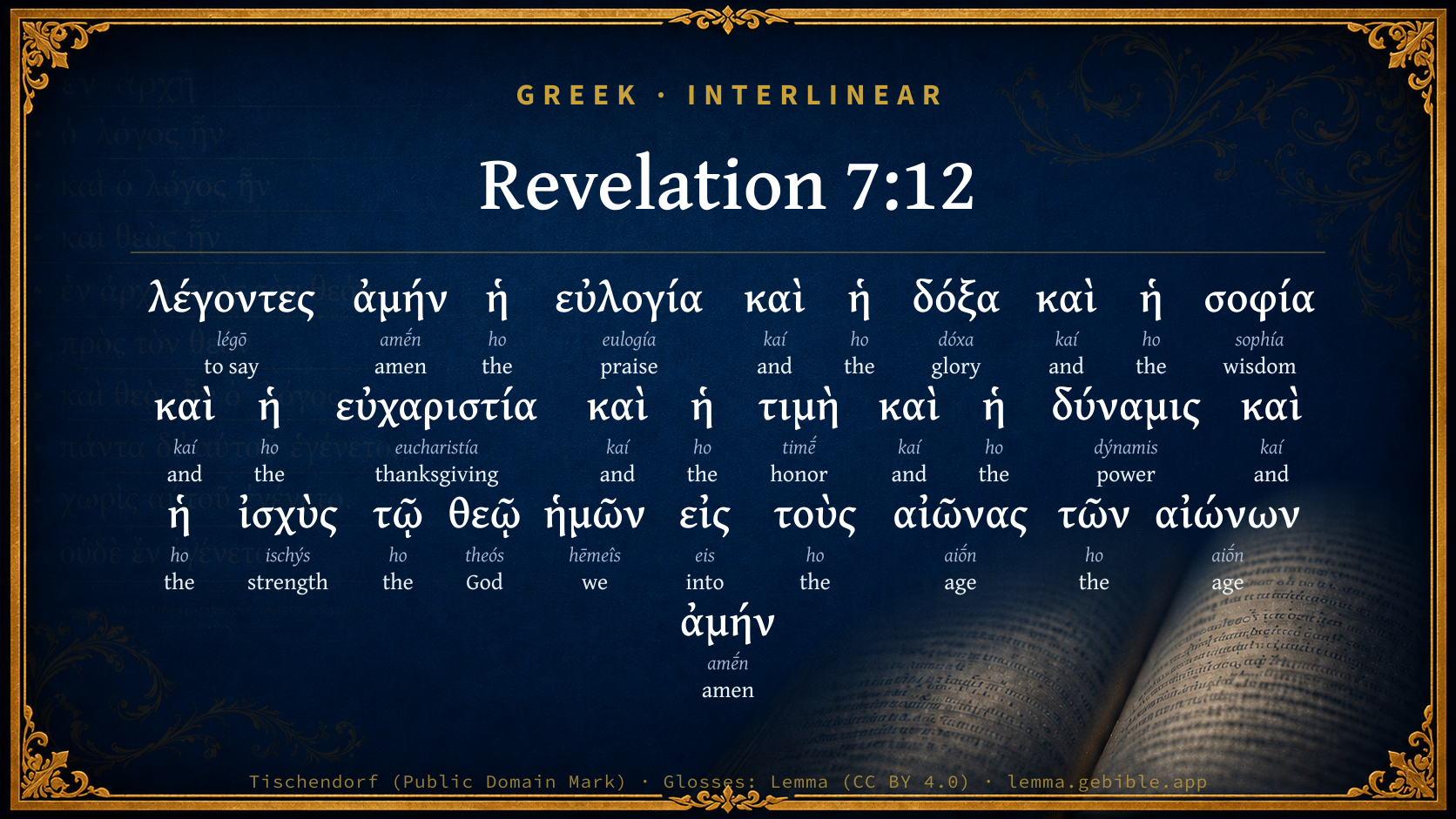
  1. λέγοντες légō G3004 “to say” Verb, Present, Active, Participle, Nominative, Plural, Masculine
  2. ἀμήν amḗn G281 “amen” Hebrew transliteration
  3. ἡ ho G3588 “the” Article, Nominative, Singular, Feminine
  4. εὐλογία eulogía G2129 “praise” Noun, Nominative, Singular, Feminine
  5. καὶ kaí G2532 “and” Conjunction
  6. ἡ ho G3588 “the” Article, Nominative, Singular, Feminine
  7. δόξα dóxa G1391 “glory” Noun, Nominative, Singular, Feminine
  8. καὶ kaí G2532 “and” Conjunction
  9. ἡ ho G3588 “the” Article, Nominative, Singular, Feminine
  10. σοφία sophía G4678 “wisdom” Noun, Nominative, Singular, Feminine
  11. καὶ kaí G2532 “and” Conjunction
  12. ἡ ho G3588 “the” Article, Nominative, Singular, Feminine
  13. εὐχαριστία eucharistía G2169 “thanksgiving” Noun, Nominative, Singular, Feminine
  14. καὶ kaí G2532 “and” Conjunction
  15. ἡ ho G3588 “the” Article, Nominative, Singular, Feminine
  16. τιμὴ timḗ G5092 “honor” Noun, Nominative, Singular, Feminine
  17. καὶ kaí G2532 “and” Conjunction
  18. ἡ ho G3588 “the” Article, Nominative, Singular, Feminine
  19. δύναμις dýnamis G1411 “power” Noun, Nominative, Singular, Feminine
  20. καὶ kaí G2532 “and” Conjunction
  21. ἡ ho G3588 “the” Article, Nominative, Singular, Feminine
  22. τῷ ho G3588 “the” Article, Dative, Singular, Masculine
  23. θεῷ theós G2316 “God” Noun, Dative, Singular, Masculine
  24. ἡμῶν hēmeîs G2249 “we” Personal pronoun, 1st person, Genitive, Plural
  25. εἰς eis G1519 “into” Preposition
  26. τοὺς ho G3588 “the” Article, Accusative, Plural, Masculine
  27. αἰῶνας aiṓn G165 “age” Noun, Accusative, Plural, Masculine
  28. τῶν ho G3588 “the” Article, Genitive, Plural, Masculine
  29. αἰώνων aiṓn G165 “age” Noun, Genitive, Plural, Masculine
  30. ἀμήν amḗn G281 “amen” Hebrew transliteration

About this verse

These counts appear in no published source. They are computed here, from the morphology-tagged text and Lemma’s own curated glosses. What Lemma adds →

31
words
15
distinct lemmas
Revelation
section

Notable vocabulary

The rarest word here is ἰσχὺς strength G2479 — appearing just 10 times in the whole Greek New Testament.

Shared distinctive vocabulary

ἰσχὺς strength G2479 occurs in 10 verses of the Greek New Testament. Also found in:

Repetition

Words recur within this verse:

  • ἀμήν amen G281 ×2
  • αἰῶνας age G165 ×2
  • ἡ the G3588 ×10
  • καὶ and G2532 ×6

Cross-references

25

Topical passages linked to Revelation 7:12 in the Treasury of Scripture Knowledge — connected by theme and wording, ordered by reader-vote popularity; previews shown in the World English Bible.

  • Revelation 5:12–14 saying with a loud voice, "Worthy is the Lamb who has been killed to receive the power, wealth, wisdom, strength, honor, glory, and blessing!"
  • Jude 1:25 to God our Savior, who alone is wise, be glory and majesty, dominion and power, both now and forever. Amen.
  • Psalms 100:4 Enter into his gates with thanksgiving, Into his courts with praise. Give thanks to him, and bless his name.
  • Colossians 3:17 Whatever you do, in word or in deed, do all in the name of the Lord Jesus, giving thanks to God the Father, through him.
  • Revelation 19:4 The twenty-four elders and the four living creatures fell down and worshiped God who sits on the throne, saying, "Amen! Hallelujah!"
  • Psalms 107:22 Let them offer the sacrifices of thanksgiving, And declare his works with singing.
  • Psalms 147:7 Sing to Yahweh with thanksgiving. Sing praises on the harp to our God,
  • Jonah 2:9 But I will sacrifice to you with the voice of thanksgiving. I will pay that which I have vowed. Salvation belongs to Yahweh."
  • Psalms 72:19 Blessed be his glorious name forever! Let the whole earth be filled with his glory! Amen and amen.
  • Psalms 89:52 Blessed be Yahweh forevermore. Amen, and Amen.
  • Psalms 41:13 Blessed be Yahweh, the God of Israel, From everlasting and to everlasting! Amen and amen.
  • Isaiah 51:3 For Yahweh has comforted Zion; he has comforted all her waste places, and has made her wilderness like Eden, and her desert like the garden of Yahweh; joy and gladness shall be found therein, thanksgiving, and the voice of melody.
  • Jeremiah 33:11 the voice of joy and the voice of gladness, the voice of the bridegroom and the voice of the bride, the voice of those who say, Give thanks to Yahweh of Hosts, for Yahweh is good, for his loving kindness endures forever; [and of them] who bring [sacrifices of] thanksgiving into the house of Yahweh. For I will cause the captivity of the land to return as at the first, says Yahweh.
  • Psalms 95:2 Let's come before his presence with thanksgiving. Let's extol him with songs!
  • Psalms 106:48 Blessed be Yahweh, the God of Israel, From everlasting even to everlasting! Let all the people say, "Amen." Praise Yah!
  • Psalms 116:17 I will offer to you the sacrifice of thanksgiving, And will call on the name of Yahweh.
  • 2 Corinthians 4:15 For all things are for your sakes, that the grace, being multiplied through the many, may cause the thanksgiving to abound to the glory of God.
  • 2 Corinthians 9:11–12 you being enriched in everything to all liberality, which works through us thanksgiving to God.
  • Colossians 2:7 rooted and built up in him, and established in the faith, even as you were taught, abounding in it in thanksgiving.
  • Nehemiah 12:8 Moreover the Levites: Jeshua, Binnui, Kadmiel, Sherebiah, Judah, [and] Mattaniah, who was over the thanksgiving, he and his brothers.
  • Nehemiah 12:46 For in the days of David and Asaph of old there was a chief of the singers, and songs of praise and thanksgiving to God.
  • Psalms 50:14 Offer to God the sacrifice of thanksgiving. Pay your vows to the Most High.
  • Jeremiah 33:9 [This city] shall be to me for a name of joy, for a praise and for a glory, before all the nations of the earth, which shall hear all the good that I do to them, and shall fear and tremble for all the good and for all the peace that I procure to it.
  • Matthew 6:13 Bring us not into temptation, but deliver us from the evil one. For yours is the Kingdom, the power, and the glory forever. Amen.'
  • Revelation 1:18 and the Living one. I was dead, and behold, I am alive forevermore. Amen. I have the keys of Death and of Hades.

Cross-references courtesy of OpenBible.info (CC BY 4.0).

Commentary

Notes on Revelation 7:12 from classic Christian and Jewish commentators (each source and its license shown beneath its notes). The classic Christian expositions comment on the surrounding passage and are grouped to its opening verse, so a note may address several verses; the Jewish commentaries on the Tanakh (Rashi and others) are per-verse, so they appear only where the commentator wrote on this verse.

Lemma curates 59 commentaries, every one of them public domain or Creative Commons licensed, each selected and text-cleaned for this edition rather than reprinted as found. About our sources →

Bengel's Gnomon

Johann Albrecht Bengel

Rev 7:12. [86] Ἡ τιμὴ) The Apocalypse everywhere divides sevens into four and three, as we show in its proper place. Now, when all the angels say, ἡ εὐλογία καὶ ἡ δόξα καὶ ἡ σοφία καὶ ἡ εὐχαριστία, (καὶ) ἡ τιμὴ καὶ ἡ δύναμις καὶ ἡ ἰσχὺς τῷ Θεῷ ἡμῶν, the first four acclamations have reference to the trumpet of the first, the second, the third, and the fourth angel; the remaining three, to the trumpet of the fifth, the sixth, and the seventh angel. Therefore if καὶ is omitted before ἡ τιμὴ, the sentiment begins as it were afresh. The Latin, indeed, omits the particle “and,” and with him Ambrose Ansbert. Nor does that appear worthy of neglect: for often, in a passage containing many connecting conjunctions, some clauses are put without a conjunction: Exo 23:23; Exo 32:2; Jer 1:10. The Greek copyists easily supplied καὶ: and in this passage befittingly in the seven words,—the hymn is distinguished into a set of four and a set of three. I definitively decide nothing in this case. Let the reader judge. [Moreover, this hymn is appropriately inserted in the description of the multitude adorned with white robes: when immediately afterwards the trumpets are delivered to the seven angels.—V. g.]

[86] ἡ σωτηρία, salvation) GOD enriched them with the salvation which they proclaim. More sublime doxologies follow at length.—V. g.

Bengel's Gnomon of the New Testament — English translation (T&T Clark, Edinburgh, 1860) — public domain. Text from a community e-Sword module.

Jamieson, Fausset & Brown

Robert Jamieson, A. R. Fausset & David Brown

Greek, "The blessing, the glory, the wisdom, the thanksgiving, the honor, the power, the might [the doxology is sevenfold, implying its totality and completeness], unto the ages of the ages."

Jamieson, Fausset & Brown — Commentary Critical and Explanatory on the Whole Bible (1871) — public domain (CC PDM 1.0). Text via the HelloAO Bible API.

Adam Clarke's Commentary

Verse 12. Saying, Amen] Giving their most cordial and grateful assent to the praises attributed to God and the Lamb.

Blessing, and glory, &c.] There are here seven different species of praise attributed to God, as in Re 5:12, where see the note.

Adam Clarke's Commentary on the Bible (1810–1826) — public domain. Text from a community e-Sword/MySword module.

The Cambridge Bible for Schools and Colleges

gen. ed. J. J. S. Perowne

12. Blessing, and glory &c.] The seven words of praise have each the article: see on ch. Rev_5:13.

The Cambridge Bible for Schools and Colleges (gen. ed. J. J. S. Perowne; Cambridge University Press, 1878–1918) — public domain. Text from a community e-Sword module.

John Gill's Exposition

Saying, Amen,.... As approving and confirming what the great multitude of men had said in Rev 7:10; in ascribing the glory of salvation to God, and the Lamb: the angels, though they have no part in it themselves, yet highly approve of it as right and just, that men should give the glory of it where it is due.

Blessing, and glory, and wisdom, and thanksgiving, and honour, and power, and might, be unto our God for ever and ever. Amen. Here a seven fold praise is given to God by the angels, as to the Lamb, in Rev 5:12, and in words much the same they rightly ascribe blessing to God, who is blessed in himself, and is the source of all blessedness to his creatures, angels and men. And also "glory"; the glory of his divine perfections, who is the God of glory; and of all his works of nature and providence, and especially of the salvation of men by Christ. "And wisdom"; he being the only wise God, whose wisdom is to be seen in all the works of creation, and in the government of the world, and in nothing more than in the scheme of redemption by the Son of God: "and thanksgiving": for all mercies and favours, temporal, spiritual, and eternal, enjoyed by angels, or by men: "and honour"; which is due to him from all his creatures, as he is the Creator of them; and from all his children, as he is their Father; and from all his servants, as he their master: "and power": which he has exerted, in making all things out of nothing, in supporting the whole universe in its being, and in saving and preserving his own people: "and might"; or "strength", he being the almighty God, the strength of Israel, and the rock of ages, in whom is everlasting strength; and the praise and ascription of all this, the angels wish to be given him by themselves and others, to all eternity; and as desiring that so it might be, and as believing that so it would be, they add their to it.

John Gill's Exposition of the Whole Bible (1746–1763) — public domain (CC PDM 1.0). Text via the HelloAO Bible API.

Trapp's Complete Commentary

John Trapp

12 Saying, Amen: Blessing, and glory, and wisdom, and thanksgiving, and honour, and power, and might, be unto our God for ever and ever. Amen.

Ver. 12. Amen; Blessing and glory, &c.] The angels assent to what the saints had said, and add much more, according to their greater measure of knowledge and love to God: write we after this fairer copy.

John Trapp, A Commentary or Exposition upon All the Books of the Old and New Testament (1647–1656) — public domain. Text from a community e-Sword module.

Albert Barnes' Notes on the Bible

Saying, Amen - See the notes on Rev 1:7. The word “Amen” here is a word strongly affirming the truth of what is said, or expressing hearty assent to it. It may be uttered, as expressing this, either in the beginning or end of a sentence. Thus, wills are commonly commenced, “In the name of God, Amen.”

Blessing, and glory, ... - Substantially the same ascription of praise occurs in Rev 5:12. See the notes on that verse. The general idea is, that the highest kind of praise is to be ascribed to God; everything excellent in character is to be attributed to him; every blessing which is received is to be traced to him. The order of the words indeed is changed, but the sense is substantially the same. In the former case Rev 5:12 the ascription of praise is to the Lamb - the Son of God; here it is to God. In both instances the worship is described as rendered in heaven; and the use of the language shows that God and the Lamb are regarded in heaven as entitled to equal praise. The only words found here which do not occur in Rev 5:12 are thanksgiving and might - words which require no particular explanation.

Albert Barnes' Notes on the Bible (1834–1885) — public domain. Text from a community e-Sword/MySword module.

Matthew Poole's English Annotations

These words only signify the union and harmony of the angels and saints in praising God: See Poole on "Rev 5:12".

Matthew Poole's English Annotations on the Holy Bible (1683–1685) — public domain. Text from a community e-Sword/MySword module.

Whedon's Commentary on the Bible

Daniel D. Whedon

12. Amen—Their profound assent to the loud voice of the great multitude.

Blessing—We have here the seven ascriptions; the first three headed by blessing, the remaining four by thanksgiving. The former refer more to the moral attributes of God—his glory and his wisdom; the latter to his physical attributes, his τιμη, preciousness or infinite worth; his power in manifestation, his intrinsic strength.

Be unto our God—Both in our ascription and in their intrinsic reality.

Daniel D. Whedon (gen. ed.), Commentary on the Old and New Testaments (1874–1909) — public domain. Text from a community e-Sword module.

The Pulpit Commentary

Saying, Amen. In Rev_5:14 the four living creatures respond "Amen" to the praises uttered by the angels; here, in response to the praise offered by the redeemed in ver. 10, the angels utter "Amen," preparatory to joining in the universal adoration. Blessing, and glory, and wisdom, and thanksgiving, and honour, and power, and might, be unto our God forever and ever. Amen. The blessing, etc.; that is, "all blessing," etc.. (see on Rev_4:11) The terms of the ascription are the same as those in Rev_5:12, except that we have here eucaristia , "thanksgiving," substituted for ploutov , "riches". (see on Rev_5:12) The sevenfold character of the ascription of praise denotes its universal and all-embracing character. (see on Rev_1:4 Rev_5:1)

What "Amen," means.

"Saying, Amen." There is probably no more dishonoured word in the Bible than this. It has come to mean, in the minds of many, a mere signal for leaving off the beneficent word that announces that the time of weariness and restraint is over, and that they may go back to what is of far more interest to them than God"s Word or worship can ever be. They look upon it as meaning no more than the word "Finis" at the end of a book, which tells them that there is no more to come. But when we remember that the word was one which was perpetually on our Saviour"s lips, and that it is one of the august names which he claims for himself, we can at once see that to regard it as a mere mechanical symbol, as a mere note of termination, like a period or full stop, is terribly to degrade it, and such as it could never have been intended for. And we are all of us in danger of forgetting, in our frequent use of the word, what it really means. But its mere interest demands more respectful and reverent usage of it. It is almost a universal word. It is told of two strangers meeting on board ship in Eastern seas, and ignorant of each other"s language, that they at length discovered that they had two words in common. One was "Hallelujah," and the other "Amen." You will hear this sacred word in Mohammedan mosques from Calcutta to Morocco, in all the liturgies of Greek, Roman, and Anglican Christians, and there is no sect of Christians anywhere that does not use it. And it is a most ancient word. It has come down to us from the ancient Jewish people, and was heard amidst the rocks of Sinai in those far off days of old. It has been likened to one of those granite boulders which we sometimes find in the midst of a flat plain, and which has been borne along by old world glaciers and torrents, and carried far away from its native home. So this word has been borne down by the stream of time till it has reached our shores and this our day. But its importance lies in the great spiritual truths it teaches us. As

I GOD"S DESIRE FOR OUR RESPONSE. The word is associated perpetually with the utterance of prayer and the declaration of Divine truth. Now, God desires such response:

1. In worship. "Let all the people say, Amen." It is the people"s word; was so not alone in the Jewish Church, but in the Christian as well. Hence St. Paul pleads for the use of plain language in worship, so that the unlearned may be able to say "Amen" at the giving of thanks. And in the early Church the acts of the presiding minister were not deemed complete without the assent of the people in their loudly expressed "Amen." Especially was this so in thanksgiving at the Lord"s Supper. The whole congregation so said "Amen" that it was as a shout or cheer, and was heard far off, and like a peal of thunder reverberating through the spacious church. But it is the inward assent and response that is craved; the outward goes for very little if this be lacking. And how can it be present when we allow ourselves as so many do in listlessness and inattention and indifference? But if it be present, how precious, how uplifting, how full of help, that worship becomes to those who unite in it! Let us hold down our minds, and as Abraham drove away the birds which sought to devour his sacrifice, so let us drive away those flitting, wandering thoughts which are ever on the wing, and which destroy our sacrifice of prayer or praise. But in order to this inward assent and response, there must be like faith. If I do not believe in God as the heavenly Father, as my Father, how can I say "Amen" to prayer addressed to him? If I regard the Lord Jesus as no more than a noble hearted and saintly Jew, how can I prostrate myself in worship at his feet? But the chief hindrances to this inward response are not those of the intellect, but of the heart. It is not because we come to the house of God with our minds cobwebbed and confused with doubt, but rather because we come with hearts absorbed with worldly things, that the "Amen" God desires is not forthcoming, though our lips may loudly say, "Amen." What a falsehood the word becomes when our hearts are not in it!

2. In regard to the declaration of truth. It is given when the word comes with power. As when Chrysostom preached, the multitudes who thronged the vast church could not restrain themselves from shouts and cries and tears, so greatly were they moved. And the preaching of even false doctrine, as in the mosque at Mecca so it has been related yet when the people heartily believe, they are greatly moved by it, and break forth into loud cries of "Amen, amen!" under the spell of the preacher"s voice, and by the power over them of the doctrines he and they alike believe. But God desires this response in regard to his truth; and again and again it has been given. At Pentecost; at Philippi, where the Lord opened the heart of Lydia, and then of the jailor; at Corinth, where Paul tells how unbelieving men came into the assembly, and, under the prophetic word, were convinced, and fell down and confessed the presence of God in their midst. But oh for much more of such response! As worship is no good without it, so neither is preaching, and nothing can compensate for it or be put in its place.

II SINCERITY IS ESSENTIAL IN ALL OUR APPROACHES TO GOD. The word "Amen" comes from one which signifies "that which is reliable, that which can be trusted," as the massive foundation stone, the strong pillar, or other such sure support. Our Lord declares of himself, "I am the Truth;" and St. John tells of him as "the Amen," which means the same. And St. Paul tells how all God"s promises are "Yea and Amen in Christ Jesus." And before his most weighty words our Lord was wont to utter his "Amen, amen," which in our versions is rendered "Verily, verily." At the end of the books of the Bible it is generally found, and everywhere it is the attestation of the truth of what has been or is to be said. And at the end of our prayers, it is as if we protested, "Lord God, I mean this." Formerly men headed their wills with the words, "In the name of God, Amen." But the meaning is ever the same a declaration of truth and sincerity in regard to that which it precedes or follows. And hence our being commanded to say "Amen" shows God"s demand for sincerity. They who worship him must worship him in truth. It is like signing our name a thing we are very careful about in our secular affairs, knowing the responsibility it involves. Would that we were similarly thoughtful when we utter, as we often do, this solemn word "Amen"!

III CHRIST IS THE ALONE GUARANTEE AND PLEDGE OF SUCCESS. For "Amen" is one of Christ"s own names. The word was ever on his lips, and he is "the Amen." And his love and power lie underneath and behind it wherever it is sincerely uttered. It is a virtual calling upon him for his help a call he will not disdain. If he be "the Amen" of our prayer and service, then he will make that real which we can only ask may be so. It is his endorsement of our petition. And when at length life"s pilgrimage is (tone, and the shadows of our earthly days are deepening down into the night of death, if our hope and trust be in him who is "the Amen," then amidst the increasing gloom we shall see him coming to us, according to his word that so he would come; and our last word shall be, "Amen. Even so, come, Lord Jesus. S.C.

The Pulpit Commentary (1880–1919), ed. H.D.M. Spence-Jones & Joseph S. Exell — public domain. Text from a community e-Sword module.

John Wesley's Explanatory Notes

Amen - With this word all the angels confirm the words of the "great multitude;" but they likewise carry the praise much higher. The blessing, and the glory, and the wisdom, and the thanksgiving, and the honour, and the power, and the strength, be unto our God forever and ever - Before the Lamb began to open the seven seals, a sevenfold hymn of praise was brought him by many angels, chap. v, 12. Now he is upon opening the last seal, and the seven angels are going to receive seven trumpets, in order to make the kingdoms of the world subject to God. All the angels give sevenfold praise to God.

John Wesley, Explanatory Notes Upon the Whole Bible (1754–1765) — public domain. Text via the GEBible commentary corpus.

Cambridge Greek Testament for Schools and Colleges

12. ἡ εὐλογία καὶ ἡ δόξα κ.τ.λ. The seven words of praise have each the article: see on chap. Rev 5:13.

Cambridge Greek Testament for Schools and Colleges (Cambridge University Press, 1896; 21 vols, various authors incl. Carr, Maclear, Plummer, Farrar, Lumby, Moule, M. R. James, Simcox) — public domain. Text from a community e-Sword module.

Alford’s Greek Testament

Henry Alford

12.] The choir of angels, as in ch. 5:11, respond to the ascription of praise. And all the angels were standing (εἱστήκειν is in sense imperfect, just as ἕστηκα is in sense present: this latter importing “I have placed myself,” = “I stand,” and the former “I had placed myself,” = “I was standing”) round the throne and the elders and the four living-beings, and fell before the throne on their faces (then they were in the vision in the similitude of men) and worshipped God, saying, Amen: the blessing and the glory and the wisdom and the thanksgiving and the honour and the power and the might (observe the sevenfold ascription) be to our God unto the ages of the ages. Amen.

Henry Alford, The Greek Testament (1849–1861) — public domain. Text from a community e-Sword module.

Vincent's Word Studies in the New Testament

Marvin R. Vincent

Blessing, etc. On the doxologies, see on chapter Rev 1:6.

Marvin R. Vincent, Word Studies in the New Testament (1887–1900) — public domain. Text from a community e-Sword/MySword module.

Lesson kit

Teaching starters — assembled from the data on this page, not authored interpretation. Every prompt links to the verse data it draws on. Edit before teaching.

Revelation, in the Revelation, opens this verse with 31 words (15 distinct Greek lemmas). Its most distinctive word is ischýs (“strength”). A historical commentator’s framing appears above. Read the whole chapter for the surrounding context.

Discussion questions

  1. What does “strength” (ischýs) contribute to the verse as a whole?
  2. How does Mark 12:30, which shares the word «strength», read alongside this verse?
  3. What does the repetition of “amen” (2× in this one verse) do in this verse?
  4. The translations on this page render this verse differently — a whole-verse word diff, not a word-by-word alignment. What might account for the different wordings?
  5. Compare how Bengel's Gnomon and Jamieson, Fausset & Brown read this verse. Where do they agree or differ?

Things to notice

Reading settings

Reading text

Shown beneath each verse's original-language words.

Old Testament
Old Testament edition

Read the OT as the Masoretic Hebrew (MT) or the Greek Septuagint (LXX).

English shown for the Greek Septuagint (in the Hebrew ↔ Greek comparison).

Comparing translations? Open the Compare panel on any verse page to stack up to four side by side.