
Exodus 29:9

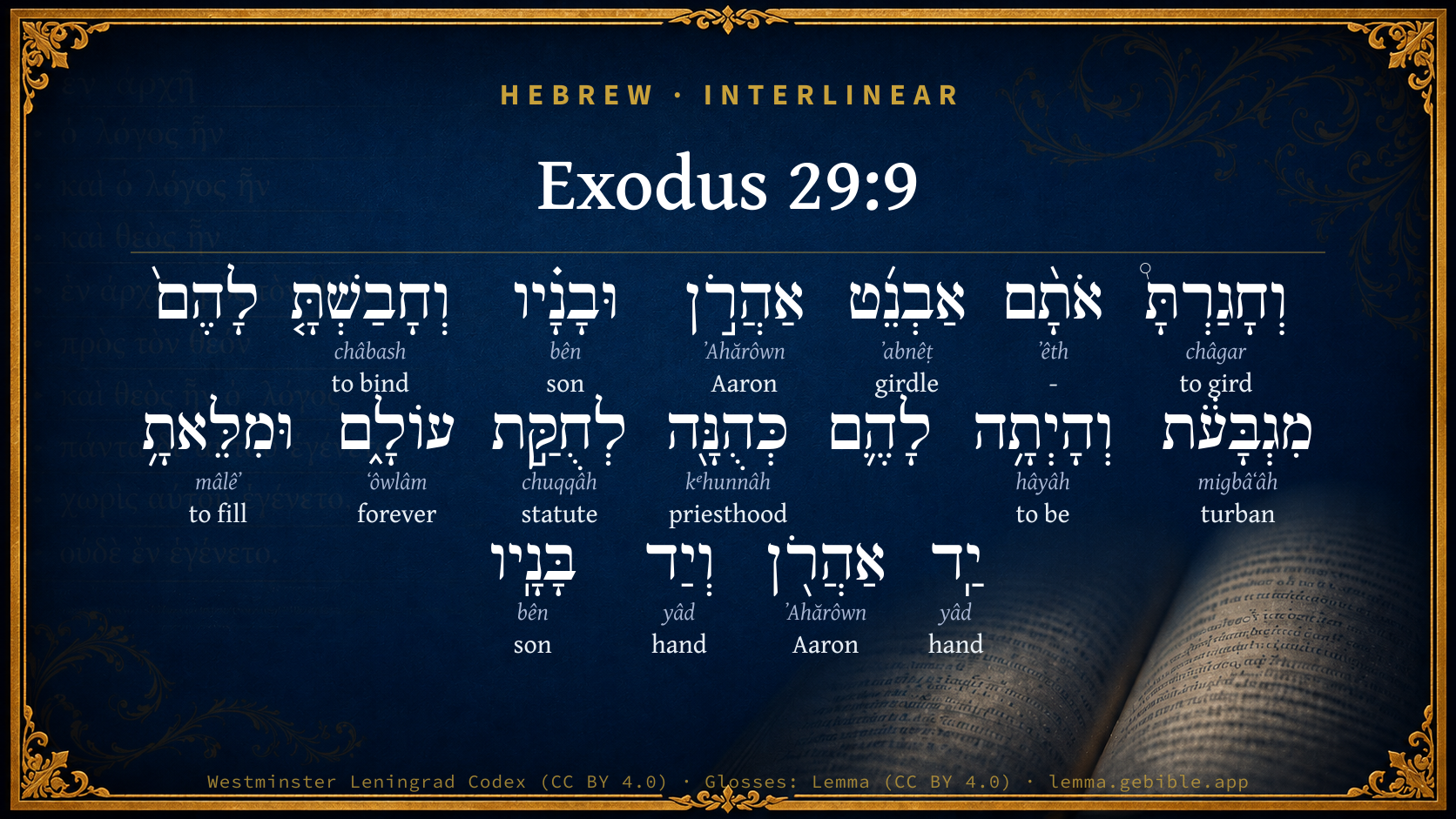
Hebrew (Westminster Leningrad Codex) Exodus 29:9 appears in the Hebrew Old Testament. The text above is from the Westminster Leningrad Codex. Each word links to its Strong’s number, a concise gloss, and parsing drawn from the Open Scriptures Hebrew Bible morphology. Click any word for its full Brown-Driver-Briggs (BDB) entry.
Download image
Cite this verse

Exodus 29:9 (World English Bible). Public Domain. Lemma interlinear Bible study tool, https://lemma.gebible.app/v/exodus/29/9.

Show BibTeX & RIS
BibTeX
RIS
English Translation
You shall dress them with belts, Aaron and his sons, and bind headbands on them: and they shall have the priesthood by a perpetual statute: and you shall consecrate Aaron and his sons.
World English Bible · Public Domain
Highlights
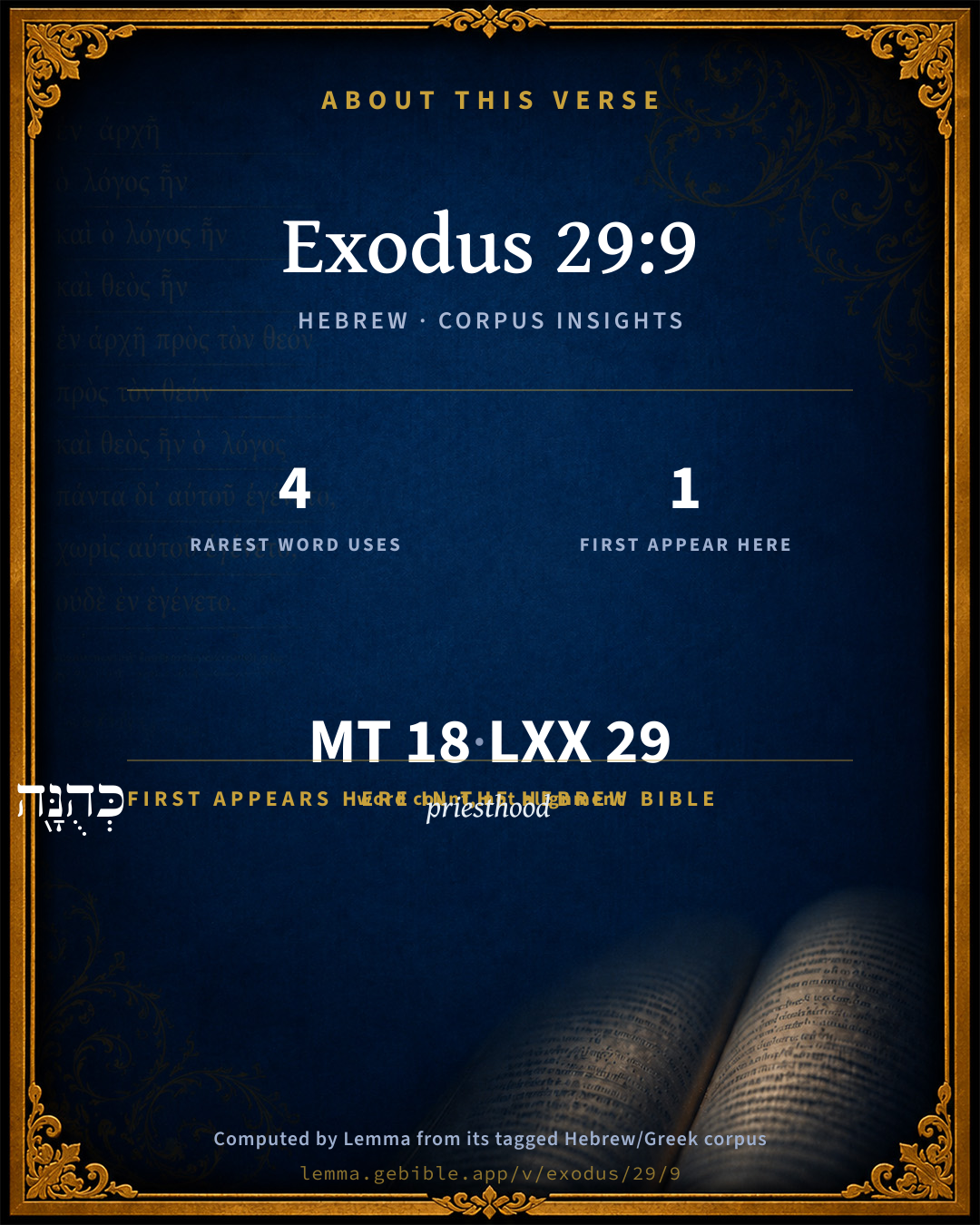
  • 1 first appearance in the Hebrew Bible
Full analysis ↓
Download a study sheet

One document with this verse’s original text, its word-by-word gloss line, the meaning frame, cross-references with their text, attributed commentary, and full source and license credits — printable, and it pastes into notes with its structure intact.

This verse Autodidact and up

Study sheet (.html) Plain text (.txt)

A passage Seminary Student

Up to 50 verses in one chapter. A passage sheet keeps up to 6 commentary sources and 12 cross-references per verse, in the order this page ranks them, and says so on the sheet whenever that leaves anything out. Ask for a single verse and you get the Autodidact verse sheet above.

Everything on this page stays free to read, with no account — the sheet is a download of what is already on screen, not access to it.

Want to remove ads? Support Godless Engineer
Compare translations 3

The same verse in 3 English versions, stacked beneath the original-language interlinear above. Click any original word for its lexicon entry.

Each is an independent rendering of the whole verse — the interlinear is not word-aligned to these translations.

Highlighted words mark where these versions differ — a whole-verse word diff, not a word-by-word alignment.

  • World English Bible Public Domain
    You shall dress them with belts, Aaron and his sons, and bind headbands on them: and they shall have the priesthood by a perpetual statute: and you shall consecrate Aaron and his sons.
  • King James Version Public Domain
    And thou shalt gird them with girdles, Aaron and his sons, and put the bonnets on them: and the priest's office shall be theirs for a perpetual statute: and thou shalt consecrate Aaron and his sons.
  • unfoldingWord Literal Text CC BY-SA 4.0
    And you shall wrap them—Aaron and his sons—with the sash and bind headbands to them. And the priesthood will be to them as a statute forever. And you shall fill the hand of Aaron and the hand of his sons.

unfoldingWord Literal Text — © unfoldingWord, licensed CC BY-SA 4.0. Word-aligned USFM3 via Door43 (git.door43.org/unfoldingWord/en_ult).

Versions to compare (up to 4)

3 of 4 selected

Show all 18 translations

Every available English version of this verse, each an independent rendering of the whole verse.

  • World English Bible Public Domain
    You shall dress them with belts, Aaron and his sons, and bind headbands on them: and they shall have the priesthood by a perpetual statute: and you shall consecrate Aaron and his sons.
  • Berean Standard Bible Public Domain
    Wrap the sashes around Aaron and his sons and tie headbands on them. The priesthood shall be theirs by a permanent statute. In this way you are to ordain Aaron and his sons.
  • Majority Standard Bible Public Domain
    Wrap the sashes around Aaron and his sons and tie headbands on them. The priesthood shall be theirs by a permanent statute. In this way you are to ordain Aaron and his sons.
  • King James Version Public Domain
    And thou shalt gird them with girdles, Aaron and his sons, and put the bonnets on them: and the priest's office shall be theirs for a perpetual statute: and thou shalt consecrate Aaron and his sons.
  • American Standard Version (1901) Public Domain
    And thou shalt gird them with girdles, Aaron and his sons, and bind head-tires on them: and they shall have the priesthood by a perpetual statute: and thou shalt consecrate Aaron and his sons.
  • Revised Version (1885) Public Domain
    And thou shalt gird them with girdles, Aaron and his sons, and bind headtires on them: and they shall have the priesthood by a perpetual statute: and thou shalt consecrate Aaron and his sons.
  • Geneva Bible (1599) Public Domain
    And shalt girde them with girdles, both Aaron and his sonnes: and shalt put the bonets on them, and the Priestes office shalbe theirs for a perpetuall lawe: thou shalt also fill the hands of Aaron, and the hands of his sonnes.
  • Douay-Rheims (1899) Public Domain
    To wit, Aaron and his children, and thou shalt put mitres upon them: and they shall be priests to me by a perpetual ordinance. After thou shalt have consecrated their hands,
  • Young's Literal Translation Public Domain
    and hast girded them `with' a girdle (Aaron and his sons), and hast bound on them bonnets; and the priesthood hath been theirs by a statute age-during, and thou hast consecrated the hand of Aaron, and the hand of his sons,
  • Literal Standard Version CC BY-SA 4.0
    and have girded them [with] a girdle (Aaron and his sons), and have bound caps on them; and the priesthood has been theirs by a continuous statute, and you have consecrated the hand of Aaron, and the hand of his sons,
  • Unlocked Literal Bible CC BY-SA 4.0
    You must clothe Aaron and his sons with sashes and put headbands on them. The work of the priesthood will belong to them by permanent law. In this way you must consecrate Aaron and his sons for them to serve me.
  • unfoldingWord Literal Text CC BY-SA 4.0
    And you shall wrap them—Aaron and his sons—with the sash and bind headbands to them. And the priesthood will be to them as a statute forever. And you shall fill the hand of Aaron and the hand of his sons.
  • Darby Bible Public Domain
    And thou shalt gird them with the girdle -- Aaron and his sons, and bind the high caps on them; and the priesthood shall be theirs for an everlasting statute; and thou shalt consecrate Aaron and his sons.
  • World Messianic Bible Public Domain
    You shall clothe them with belts, Aaron and his sons, and bind headbands on them. They shall have the priesthood by a perpetual statute. You shall consecrate Aaron and his sons.
  • Webster's Bible Public Domain
    And thou shalt gird them with girdles (Aaron and his sons) and put the bonnets on them; and the priest's office shall be theirs for a perpetual statute: and thou shalt consecrate Aaron and his sons.
  • Free Bible Version CC BY-SA 4.0
    Tie the sashes around Aaron and his sons and put headdresses on them. The priesthood belongs to them forever. This is how you are to ordain Aaron and his sons.
  • Bible in Basic English Public Domain
    And put the linen bands round Aaron and his sons, and the head-dresses on them, to make them priests by my order for ever: so you are to make Aaron and his sons holy to me.
  • JPS Tanakh (1917) Public Domain
    And thou shalt gird them with girdles, Aaron and his sons, and bind head-tires on them; and they shall have the priesthood by a perpetual statute; and thou shalt consecrate Aaron and his sons.

Literal Standard Version (2020), Covenant Press — licensed CC BY-SA 4.0. Text via the HelloAO Bible API (eBible.org). Unlocked Literal Bible (unfoldingWord) — licensed CC BY-SA 4.0. Text via the HelloAO Bible API (eBible.org). unfoldingWord Literal Text — © unfoldingWord, licensed CC BY-SA 4.0. Word-aligned USFM3 via Door43 (git.door43.org/unfoldingWord/en_ult). Free Bible Version, Dr. Jonathan Gallagher — licensed CC BY-SA 4.0. Text via the HelloAO Bible API (eBible.org).

Word by word

More ways to search: Search by grammar → Find every occurrence → Compare this word →

Practice this passage: Drill this verse → Learn its vocabulary →

מִגְבָּעֹ֔ת
migbâʻâh
H4021
“turbans”
Noun, Common, Feminine, Plural, Absolute
Part of Speech
Noun
Type
Common
Gender
Feminine
Number
Plural
State
Absolute
Full BDB Definition

Origin: from the same as H1389

TWOT: 309c

turban, head-gear
  1. וְחָגַרְתָּ֩ châgar H2296 “and · to gird” Conjunction + Verb, Qal, Sequential Perfect, 2nd Person, Masculine, Singular
  2. אֹתָ֨ם ʼêth H853 “- · them” Particle, Direct Object + Suffix, Personal, 3rd Person, Masculine, Plural
  3. אַבְנֵ֜ט ʼabnêṭ H73 “girdle” Noun, Common, Masculine, Singular, Absolute
  4. אַהֲרֹ֣ן ʼAhărôwn H175 “Aaron” Noun, Proper
  5. וּבָנָ֗יו bên H1121 “and · sons · his” Conjunction + Noun, Common, Masculine, Plural, Construct + Suffix, Personal, 3rd Person, Masculine, Singular
  6. וְחָבַשְׁתָּ֤ châbash H2280 “and · to bind” Conjunction + Verb, Qal, Sequential Perfect, 2nd Person, Masculine, Singular
  7. וְהָיְתָ֥ה hâyâh H1961 “and · to be” Conjunction + Verb, Qal, Sequential Perfect, 3rd Person, Feminine, Singular
  8. כְּהֻנָּ֖ה kᵉhunnâh H3550 “priesthood” Noun, Common, Feminine, Singular, Absolute
  9. לְחֻקַּ֣ת chuqqâh H2708 “to/for · statute of” Preposition + Noun, Common, Both, Singular, Construct
  10. עוֹלָ֑ם ʻôwlâm H5769 “forever” Noun, Common, Masculine, Singular, Absolute
  11. וּמִלֵּאתָ֥ mâlêʼ H4390 “and · to fill” Conjunction + Verb, Piel, Sequential Perfect, 2nd Person, Masculine, Singular
  12. יַֽד yâd H3027 “hand of” Noun, Common, Both, Singular, Construct
  13. אַהֲרֹ֖ן ʼAhărôwn H175 “Aaron” Noun, Proper
  14. וְיַד yâd H3027 “and · hand of” Conjunction + Noun, Common, Both, Singular, Construct
  15. בָּנָֽיו bên H1121 “sons · his” Noun, Common, Masculine, Plural, Construct + Suffix, Personal, 3rd Person, Masculine, Singular

About this verse

These counts appear in no published source. They are computed here, from the morphology-tagged text and Lemma’s own curated glosses. What Lemma adds →

18
words
13
distinct lemmas
Pentateuch
section

Notable vocabulary

The rarest word here is מִגְבָּעֹ֔ת turban H4021 — appearing just 4 times in the whole Hebrew Bible.

First appearance in Scripture

This word makes its first canonical appearance in the Hebrew Bible here:

  • כְּהֻנָּ֖ה priesthood H3550

Shared distinctive vocabulary

מִגְבָּעֹ֔ת turban H4021 occurs in 4 verses of the Hebrew Bible. Also found in:

Grammatical profile

  • 4 verbs
  • 11 nouns
  • 2 prepositions
  • 1 particle

Verb forms

  • וְחָגַרְתָּ֩ Qal · Sequential Perfect
  • וְחָבַשְׁתָּ֤ Qal · Sequential Perfect
  • וְהָיְתָ֥ה Qal · Sequential Perfect
  • וּמִלֵּאתָ֥ Piel · Sequential Perfect

Repetition

Words recur within this verse — often emphatic in Hebrew:

  • אַהֲרֹ֣ן Aaron H175 ×2
  • וּבָנָ֗יו son H1121 ×2
  • יַֽד hand H3027 ×2

Hebrew & Septuagint length

In English translation the verse runs 33 words from the Hebrew and 39 from the Septuagint (LXX English) — closely comparable.

A rough comparison of the two English renderings, which tokenize alike — not a word-level alignment.

Word counts can differ between the Hebrew and the Greek without any difference in meaning — e.g. the Hebrew direct-object marker אֵת has no separate Greek word, and Greek often adds the article ὁ.

In the original languages it is 18 Hebrew tokens and 29 Greek tokens — but the two are counted differently (Hebrew bundles its prefixes and suffixes into one token; the Greek is in lemma form), so that isn’t a like-for-like length.

Cross-references

17

Topical passages linked to Exodus 29:9 in the Treasury of Scripture Knowledge — connected by theme and wording, ordered by reader-vote popularity; previews shown in the World English Bible.

  • Numbers 18:7 You and your sons with you shall keep your priesthood for everything of the altar, and for that within the veil; and you shall serve: I give you the priesthood as a service of gift: and the stranger who comes near shall be put to death.
  • Leviticus 8:22–28 He presented the other ram, the ram of consecration: and Aaron and his sons laid their hands on the head of the ram.
  • Deuteronomy 18:5 For Yahweh your God has chosen him out of all your tribes, to stand to minister in the name of Yahweh, him and his sons for ever.
  • Exodus 40:15 You shall anoint them, as you anointed their father, that they may minister to me in the priest's office. Their anointing shall be to them for an everlasting priesthood throughout their generations.
  • Leviticus 8:33 You shall not go out from the door of the Tent of Meeting seven days, until the days of your consecration are fulfilled: for he shall consecrate you seven days.
  • Numbers 3:10 You shall appoint Aaron and his sons, and they shall keep their priesthood. The stranger who comes near shall be put to death."
  • Numbers 16:10 and that he has brought you near, and all your brothers the sons of Levi with you? and seek you the priesthood also?
  • Numbers 16:35 Fire came forth from Yahweh, and devoured the two hundred fifty men who offered the incense.
  • Numbers 16:40 to be a memorial to the children of Israel, to the end that no stranger, who isn't of the seed of Aaron, comes near to burn incense before Yahweh; that he not be as Korah, and as his company: as Yahweh spoke to him by Moses.
  • Numbers 25:13 and it shall be to him, and to his seed after him, the covenant of an everlasting priesthood; because he was jealous for his God, and made atonement for the children of Israel.
  • Hebrews 5:4–5 Nobody takes this honor on himself, but he is called by God, just like Aaron was.
  • Exodus 28:1 "Bring Aaron your brother, and his sons with him, near to you from among the children of Israel, that he may minister to me in the priest's office, even Aaron, Nadab and Abihu, Eleazar and Ithamar, Aaron's sons.
  • Exodus 28:40–41 "You shall make coats for Aaron's sons, and you shall make sashes for them and headbands shall you make for them, for glory and for beauty.
  • Exodus 32:29 Moses said, "Consecrate yourselves today to Yahweh, yes, every man against his son, and against his brother; that he may bestow on you a blessing this day."
  • Hebrews 5:10 named by God a high priest after the order of Melchizedek.
  • Hebrews 7:11–14 Now if there was perfection through the Levitical priesthood (for under it the people have received the law), what further need was there for another priest to arise after the order of Melchizedek, and not be called after the order of Aaron?
  • Hebrews 7:23–28 Many, indeed, have been made priests, because they are hindered from continuing by death.

Cross-references courtesy of OpenBible.info (CC BY 4.0).

Hebrew and Greek witnesses Masoretic Hebrew ↔ Greek Septuagint

The same verse in the two great witnesses to the Old Testament, shown verse-for-verse.

These are two independent witnesses, not word-aligned to each other, and the Septuagint is shown in lemma (dictionary) form.

Hebrew Exodus 29:9 Masoretic · Westminster Leningrad Codex

וְחָגַרְתָּ֩ אֹתָ֨ם אַבְנֵ֜ט אַהֲרֹ֣ן וּבָנָ֗יו וְחָבַשְׁתָּ֤ לָהֶם֙ מִגְבָּעֹ֔ת וְהָיְתָ֥ה לָהֶ֛ם כְּהֻנָּ֖ה לְחֻקַּ֣ת עוֹלָ֑ם וּמִלֵּאתָ֥ יַֽד אַהֲרֹ֖ן וְיַד בָּנָֽיו

You shall dress them with belts, Aaron and his sons, and bind headbands on them: and they shall have the priesthood by a perpetual statute: and you shall consecrate Aaron and his sons.

World English Bible · Public Domain

Greek LXX Exodus 29:9 Septuagint · lemma form

καί ζώννυμι αὐτός ὁ ζωνή καί περιτίθημι αὐτός ὁ κίδαρις καί εἰμί αὐτός ἱερατεία ἐγώ εἰς ὁ αἰών καί τελειόω ὁ χείρ ααρων καί ὁ χείρ ὁ υἱός αὐτός

And you shall gird them with the girdles, and put the tires upon them, and they shall have a priestly office to me for ever; and you shall fill the hands of Aaron and the hands of his sons.

LXX2012 (modern English Septuagint) · Public Domain

Hebrew: Westminster Leningrad Codex (CC BY 4.0). Greek: Septuagint (public domain); English from LXX2012 (modern English Septuagint) (Public Domain). How the Septuagint differs from the Hebrew →

Targum (Aramaic paraphrase)

2

The Targum is the ancient Jewish Aramaic paraphrase of the Hebrew Scriptures — an interpretive translation, not the Hebrew text itself. Onkelos (literal) and Pseudo-Jonathan (expansive) render the Torah, and Jonathan the Prophets. Coverage is partial: where no permissively-licensed English translation exists for a verse, only the Aramaic is shown. This is verse-level text, not a word-by-word alignment to the Hebrew.

  1. Targum Onkelos Torah (Genesis–Deuteronomy)
    וּתְזָרֵז יָתְהוֹן הֶמְיָנִין אַהֲרֹן וּבְנוֹהִי וְתַתְקֵן לְהוֹן כּוֹבָעִין וּתְהֵי לְהוֹן כְּהֻנְתָּא לִקְיַם עָלָם וּתְקָרֵב קֻרְבָּנָא דְאַהֲרֹן וְקֻרְבָּנָא דִבְנוֹהִי:

    (no public-domain English translation for this verse)

    Targum Onkelos — Aramaic: “Onkelos Genesis” (public domain); “Onkelos Exodus” (public domain); “Onkelos Leviticus” (public domain); “Onkelos Numbers” (public domain); “Onkelos Deuteronomy” (public domain). English: “Sefaria Community Translation” (CC0 1.0 (public-domain dedication)); “J.W. Etheridge. The Targums of Onkelos and Jonathan Ben Uzziel on the Pentateuch. London: Longmans, Green, 1862” (public domain). Text via Sefaria.

  2. Targum Pseudo-Jonathan Torah (Genesis–Deuteronomy)
    וְתִּטְכַס יַתְהוֹן בְּקַמּוּרִין לְאַהֲרן וּבְנוֹי וְתִכְבּוֹשׁ לְהוֹן כּוּבְעִין וּתְהֵי לְהוֹן כְּהוּנָתָא לִקְיַים עֲלָם וּתְקָרֵיב קוּרְבָּנָא דְאַהֲרן וְקוּרְבָּנָא דִבְנוֹי

    and indue (ordain) them with the girdles, Aharon and his sons, and wrap on them the mitres; and the priesthood shall be theirs by an everlasting statute. And thou shalt offer the oblation of Aharon, and the oblation of his sons.

    Targum Pseudo-Jonathan — Aramaic: “Targum Jonathan on Genesis” (public domain); “Targum Jonathan on Exodus” (public domain); “Targum Jonathan on Leviticus” (public domain); “Targum Jonathan on Numbers” (public domain); “Targum Jonathan on Deuteronomy” (public domain). English: “The Targum of Jonathan ben Uzziel, trans. J. W. Etheridge, London, 1862” (public domain). Text via Sefaria.

Commentary

Notes on Exodus 29:9 from classic Christian and Jewish commentators (each source and its license shown beneath its notes). The classic Christian expositions comment on the surrounding passage and are grouped to its opening verse, so a note may address several verses; the Jewish commentaries on the Tanakh (Rashi and others) are per-verse, so they appear only where the commentator wrote on this verse.

Lemma curates 59 commentaries, every one of them public domain or Creative Commons licensed, each selected and text-cleaned for this edition rather than reprinted as found. About our sources →

Trapp's Complete Commentary

John Trapp

Exo 29:9 And thou shalt gird them with girdles, Aaron and his sons, and put the bonnets on them: and the priest’s office shall be theirs for a perpetual statute: and thou shalt consecrate Aaron and his sons.

Ver. 9. Consecrate.] Heb., Fill their hands, sc., with sacrifices: they were not to fill their own hands, as Jeroboam’s priests did. {1Ki 13:33, margin; Heb 5:5}

John Trapp, A Commentary or Exposition upon All the Books of the Old and New Testament (1647–1656) — public domain. Text from a community e-Sword module.

Tyndale Open Study Notes

Tyndale Open Resources

29:9 forever: The fulfillment of this promise, as with the one to David, clearly leads beyond the merely human. Aaron’s own behavior was less than sterling (e.g., ch 32; Num 11), and the behavior of his sons and descendants was no better (1 Sam 2:12-17; Isa 28:7; Ezek 8:15-16; Mal 2:1-9). The promise could only find its ultimate fulfillment in Jesus Christ (see Heb 7:26; 9:11). • To ordain (literally to fill the hands) means to give a person a task to perform.

Tyndale Open Study Notes — © Tyndale Open Resources, licensed CC BY-SA 4.0. Text via the HelloAO Bible API.

Geneva Bible (1599)

Geneva Bible translators

Or, consecrate them.

Geneva Bible (1599) marginal notes — public domain. Text via Bolls.life.

The Cambridge Bible for Schools and Colleges

gen. ed. J. J. S. Perowne

9. consecrate] install (lit. fill the hands of): see on Exo_28:41.

The Cambridge Bible for Schools and Colleges (gen. ed. J. J. S. Perowne; Cambridge University Press, 1878–1918) — public domain. Text from a community e-Sword module.

John Gill's Exposition

And thou shalt gird them with girdles (Aaron and his sons),.... Aaron with the girdle of the ephod, and with the girdle of needlework, and his sons with common girdles made for them; all which showed what strength, diligence, and expedition were necessary for the discharge of their office:

and put the bonnets on them; upon their heads, which differed only from the high priest's mitre in the manner of rolling or wrapping, as has been observed on Exo 28:39,

and the priest's office shall be theirs for a perpetual statute; that is, shall descend from father to son in Aaron's family throughout all generations, until the Messiah should come; who would be a priest of another order, and put an end to the Aaronic priesthood, by fulfilling what that was a type of, and so abolishing it:

and thou shall consecrate Aaron and his sons; or "fill the hand of them"; that is, with sacrifices to offer for themselves and others; see Gill on Exo 28:41. The Targums of Onkelos and Jonathan are,"shall offer the offering of Aaron, and the offering of his sons,''of which there is an after account, and was one part of their consecration.

John Gill's Exposition of the Whole Bible (1746–1763) — public domain (CC PDM 1.0). Text via the HelloAO Bible API.

Matthew Poole's English Annotations

A perpetual statute; so long as the Jewish pedagogy and policy lasts.

Matthew Poole's English Annotations on the Holy Bible (1683–1685) — public domain. Text from a community e-Sword/MySword module.

The Pulpit Commentary

The bonnets. Rather "caps." There is no article. Thou shalt consecrate Aaron and his sons. Literally, "Thou shalt fill the hand of Aaron and the hand of his sons." Installation in an office was usually effected among the Eastern nations by putting into the hand of the official the insignia which marked his functions. In this particular case certain portions of the offerings were used as the insignia. See ver. 24.

The Pulpit Commentary (1880–1919), ed. H.D.M. Spence-Jones & Joseph S. Exell — public domain. Text from a community e-Sword module.

Scofield Reference Notes

C. I. Scofield

gird

Symbol of service. Luk 12:37; Luk 17:8; Joh 13:4; Rev 1:13.

The Scofield Reference Bible (1917 edition), notes by C. I. Scofield — public domain. Text from a community e-Sword module.

Rashi

Rabbi Shlomo Yitzchaki (Rashi)

והיתה להם AND SHALL BE UNTO THEM This “filling of hands” shall be for an everlasting priesthood.

ומלאת AND THOU SHALT “FILL” by means of these following matters

יד אהרן ויד בניו AARON’S HAND AND HIS SONS’ HANDS in the appointment and assigment to the priesthood.

Rashi on the Tanakh — English translations: “The Judaica Press complete Tanach with Rashi, translated by A. J. Rosenberg” (CC BY 4.0); “Pentateuch with Rashi's commentary by M. Rosenbaum and A.M. Silbermann, 1929-1934” (public domain); “The Metsudah Tanach series, Lakewood, N.J” (CC BY 4.0); and “The Book of Joshua, Metsudah Publications, 1997” (CC BY 4.0). Text via Sefaria.

Ramban (Nachmanides)

Rabbi Moshe ben Nachman (Ramban / Nachmanides)

AND THOU SHALT GIRD THEM WITH BELTS. This alludes to Aaron and his sons, and then Scripture reverts and explains, Aaron and his sons. This is similar to the expressions: let him bring it, the Eternal’s offering; alludes already to the Eternal’s offering, but then Scripture itself reverts and explains it. The same principle applies in the next example. the kingdom which will not serve him, Nebuchadnezzar. Such are the words of Rabbi Abraham ibn Ezra. But if so, [the following phrase in the verse before us,] and thou shalt bind ‘migba’oth’ on them refers only to some of them [mentioned before, namely, Aaron’s sons], for Aaron’s head-dress was not of the migba’oth, and besides, the mitznepheth is already on his head [as mentioned in Verse 6]. It is possible that the explanation of the verse is: “and thou shalt gird them with belts, and Aaron and his sons.” The verse is thus stating that he should gird Aaron’s sons mentioned with belts, and Aaron himself should be girded with his sons. For since the belt was alike for all of them [for Aaron and his sons], it was not mentioned above among the particular garments of Aaron; therefore it now became necessary to say that he should gird Aaron too with a belt like his sons. The breeches were not mentioned here as it was not necessary, as I have explained. And the reason why the breeches were singled out from the rest of the garments [by not being mentioned here] is that it was Moses who clothed them with all the garments, as G-d commanded, and thou shalt clothe them. But the breeches which were to cover the flesh of their nakedness, they themselves put on in privacy. Therefore He did not mention them here among the garments — and thou shalt take the garments, and clothe Aaron… and therefore He separated them [from the other garments] in command and in punishment, as I have mentioned above.

Ramban (Nachmanides) on the Tanakh — English translation: “Commentary on the Torah by Ramban (Nachmanides). Translated and annotated by Charles B. Chavel. New York, Shilo Pub. House, 1971-1976” (CC BY 4.0). Text via Sefaria.

Lesson kit

Teaching starters — assembled from the data on this page, not authored interpretation. Every prompt links to the verse data it draws on. Edit before teaching.

Exodus, in the Pentateuch, opens this verse with 18 words (13 distinct Hebrew lemmas). Its most distinctive word is migbâʻâh (“turban”). A historical commentator’s framing appears above. Read the whole chapter for the surrounding context.

Discussion questions

  1. What does “turban” (migbâʻâh) contribute to the verse as a whole?
  2. The word “priesthood” first appears here in Scripture. What is being introduced at this debut?
  3. Exodus 28:40 shares the word «turban» with this verse. How do the two illuminate each other?
  4. “Aaron” occurs 2× in this one verse. What is the effect of the repetition?
  5. The translations on this page render this verse differently — a whole-verse word diff, not a word-by-word alignment. What might account for the different wordings?
  6. The verb «וְחָגַרְתָּ֩» is Qal Sequential Perfect. How does its form color the action?
  7. Reading how Trapp's Complete Commentary and Tyndale Open Study Notes read this verse, where do the two commentators agree and where do they part?

Things to notice

Reading settings

Reading text

Shown beneath each verse's original-language words.

Old Testament
Old Testament edition

Read the OT as the Masoretic Hebrew (MT) or the Greek Septuagint (LXX).

English shown for the Greek Septuagint (in the Hebrew ↔ Greek comparison).

Comparing translations? Open the Compare panel on any verse page to stack up to four side by side.