Hebrews 7:28

Greek (Tischendorf 8th ed.) Hebrews 7:28 appears in the Greek New Testament. The text above is from the Tischendorf 8th edition. Each word links to its Strong’s number and a concise gloss. Click any word for its full Thayer’s Greek Lexicon entry.
Download image
Cite this verse

Hebrews 7:28 (World English Bible). Public Domain. Lemma interlinear Bible study tool, https://lemma.gebible.app/v/hebrews/7/28.

Show BibTeX & RIS
BibTeX
RIS
English Translation
For the law appoints men as high priests who have weakness, but the word of the oath which came after the law appoints a Son forever who has been perfected.
World English Bible · Public Domain
Download a study sheet

One document with this verse’s original text, its word-by-word gloss line, the meaning frame, cross-references with their text, attributed commentary, and full source and license credits — printable, and it pastes into notes with its structure intact.

This verse Autodidact and up

Study sheet (.html) Plain text (.txt)

A passage Seminary Student

Up to 50 verses in one chapter. A passage sheet keeps up to 6 commentary sources and 12 cross-references per verse, in the order this page ranks them, and says so on the sheet whenever that leaves anything out. Ask for a single verse and you get the Autodidact verse sheet above.

Everything on this page stays free to read, with no account — the sheet is a download of what is already on screen, not access to it.

Want to remove ads? Support Godless Engineer
Compare translations 3

The same verse in 3 English versions, stacked beneath the original-language interlinear above. Click any original word for its lexicon entry.

Each is an independent rendering of the whole verse — the interlinear is not word-aligned to these translations.

Highlighted words mark where these versions differ — a whole-verse word diff, not a word-by-word alignment.

  • World English Bible Public Domain
    For the law appoints men as high priests who have weakness, but the word of the oath which came after the law appoints a Son forever who has been perfected.
  • King James Version Public Domain
    For the law maketh men high priests which have infirmity; but the word of the oath, which was since the law, maketh the Son, who is consecrated for evermore.
  • unfoldingWord Literal Text CC BY-SA 4.0
    For the law appoints high priests men having weakness, but the word of the swearing of an oath, which after the law, a Son, having been made perfect forever.

unfoldingWord Literal Text — © unfoldingWord, licensed CC BY-SA 4.0. Word-aligned USFM3 via Door43 (git.door43.org/unfoldingWord/en_ult).

Versions to compare (up to 4)

3 of 4 selected

Show all 19 translations

Every available English version of this verse, each an independent rendering of the whole verse.

  • World English Bible Public Domain
    For the law appoints men as high priests who have weakness, but the word of the oath which came after the law appoints a Son forever who has been perfected.
  • Berean Standard Bible Public Domain
    For the law appoints as high priests men who are weak; but the oath, which came after the law, appointed the Son, who has been made perfect forever.
  • Majority Standard Bible Public Domain
    For the law appoints as high priests men who are weak; but the oath, which came after the law, appointed the Son, who has been made perfect forever.
  • King James Version Public Domain
    For the law maketh men high priests which have infirmity; but the word of the oath, which was since the law, maketh the Son, who is consecrated for evermore.
  • American Standard Version (1901) Public Domain
    For the law appointeth men high priests, having infirmity; but the word of the oath, which was after the law, `appointeth' a Son, perfected for evermore.
  • Revised Version (1885) Public Domain
    For the law appointeth men high priests, having infirmity; but the word of the oath, which was after the law, appointeth a Son, perfected for evermore.
  • Geneva Bible (1599) Public Domain
    For the Law maketh men hie Priestes, which haue infirmitie: but the word of the othe that was since the Lawe, maketh the Sonne, who is consecrated for euermore.
  • Douay-Rheims (1899) Public Domain
    For the law maketh men priests, who have infirmity: but the word of the oath, which was since the law, the Son who is perfected for evermore.
  • Young's Literal Translation Public Domain
    for the law doth appoint men chief priests, having infirmity, but the word of the oath that `is' after the law `appointeth' the Son -- to the age having been perfected.
  • Literal Standard Version CC BY-SA 4.0
    for the Law appoints men [as] chief priests, having weakness, but the word of the oath that [is] after the Law [appoints] the Son having been perfected throughout the age.
  • Unlocked Literal Bible CC BY-SA 4.0
    For the law appoints as high priests men who have weaknesses. But the word of the oath, which came after the law, appointed a Son, who has been made perfect forever.
  • unfoldingWord Literal Text CC BY-SA 4.0
    For the law appoints high priests men having weakness, but the word of the swearing of an oath, which after the law, a Son, having been made perfect forever.
  • Darby Bible Public Domain
    For the law constitutes men high priests, having infirmity; but the word of the swearing of the oath which [is] after the law, a Son perfected for ever.
  • World Messianic Bible Public Domain
    For the Torah appoints men as high priests who have weakness, but the word of the oath, which came after the law, appoints a Son forever who has been perfected.
  • Webster's Bible Public Domain
    For the law maketh men high priests who have infirmity; but the word of the oath, which was after the law, maketh the Son, who is consecrated for evermore.
  • Free Bible Version CC BY-SA 4.0
    The law appoints imperfect men as high priests, but God gave his solemn vow after the law, and appointed his Son, perfect forever.
  • Bible in Basic English Public Domain
    The law makes high priests of men who are feeble; but the word of the oath, which was made after the law, gives that position to a Son, in whom all good is for ever complete.
  • Text-Critical English NT CC BY 4.0
    For the law appoints as high priests men who have weakness, but the word of the oath, which came after the law, appoints the Son, who has been made perfect forever.
  • Tyndale New Testament (1534) Public Domain
    For the lawe maketh men prestes which have infirmitie: but the worde of the othe that came fence the lawe maketh the sonne prest which is parfecte for ever more.

Literal Standard Version (2020), Covenant Press — licensed CC BY-SA 4.0. Text via the HelloAO Bible API (eBible.org). Unlocked Literal Bible (unfoldingWord) — licensed CC BY-SA 4.0. Text via the HelloAO Bible API (eBible.org). unfoldingWord Literal Text — © unfoldingWord, licensed CC BY-SA 4.0. Word-aligned USFM3 via Door43 (git.door43.org/unfoldingWord/en_ult). Free Bible Version, Dr. Jonathan Gallagher — licensed CC BY-SA 4.0. Text via the HelloAO Bible API (eBible.org).

Word by word

More ways to search: Search by grammar → Find every occurrence → Compare this word →

Practice this passage: Drill this verse → Learn its vocabulary →

ὁρκωμοσίας
horkōmosía
G3728
“oath”
Noun, Genitive, Singular, Feminine
Part of Speech
Noun
Case
Genitive
Number
Singular
Gender
Feminine
Full Thayer's Definition

Origin: from a compound of G3727 and a derivative of G3660

TDNT: 12:43,7

1. affirmation made on oath, the taking of an oath, an oath
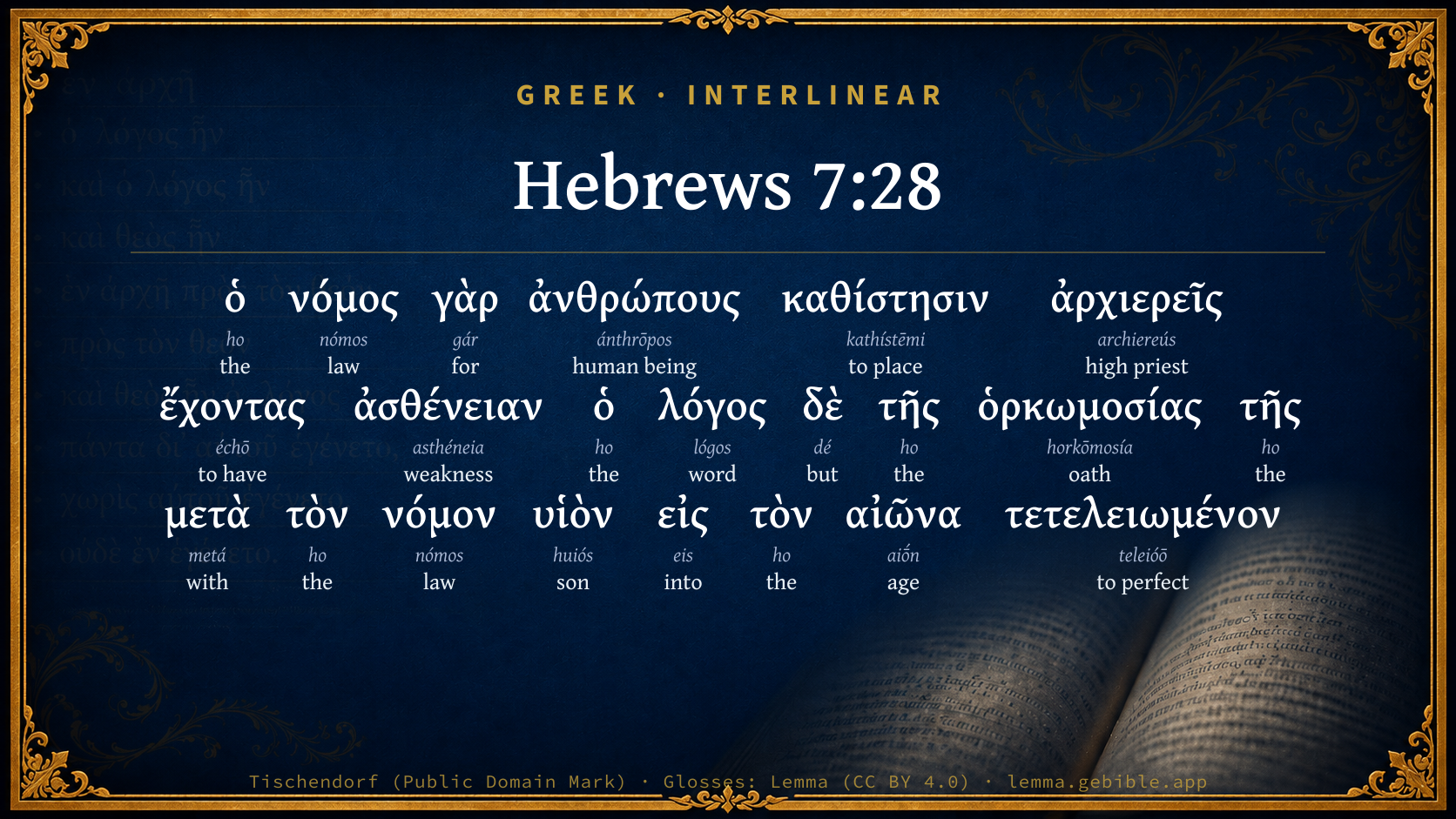
  1. ὁ ho G3588 “the” Article, Nominative, Singular, Masculine
  2. νόμος nómos G3551 “law” Noun, Nominative, Singular, Masculine
  3. γὰρ gár G1063 “for” Conjunction
  4. ἀνθρώπους ánthrōpos G444 “human being” Noun, Accusative, Plural, Masculine
  5. καθίστησιν kathístēmi G2525 “to place” Verb, Present, Active, Indicative, 3rd person, Singular
  6. ἀρχιερεῖς archiereús G749 “high priest” Noun, Accusative, Plural, Masculine
  7. ἔχοντας échō G2192 “to have” Verb, Present, Active, Participle, Accusative, Plural, Masculine
  8. ἀσθένειαν asthéneia G769 “weakness” Noun, Accusative, Singular, Feminine
  9. ὁ ho G3588 “the” Article, Nominative, Singular, Masculine
  10. λόγος lógos G3056 “word” Noun, Nominative, Singular, Masculine
  11. δὲ dé G1161 “but” Conjunction
  12. τῆς ho G3588 “the” Article, Genitive, Singular, Feminine
  13. τῆς ho G3588 “the” Article, Genitive, Singular, Feminine
  14. μετὰ metá G3326 “with” Preposition
  15. τὸν ho G3588 “the” Article, Accusative, Singular, Masculine
  16. νόμον nómos G3551 “law” Noun, Accusative, Singular, Masculine
  17. υἱὸν huiós G5207 “son” Noun, Accusative, Singular, Masculine
  18. εἰς eis G1519 “into” Preposition
  19. τὸν ho G3588 “the” Article, Accusative, Singular, Masculine
  20. αἰῶνα aiṓn G165 “age” Noun, Accusative, Singular, Masculine
  21. τετελειωμένον teleióō G5048 “to perfect” Verb, Perfect, Passive, Participle, Accusative, Singular, Masculine

About this verse

These counts appear in no published source. They are computed here, from the morphology-tagged text and Lemma’s own curated glosses. What Lemma adds →

22
words
16
distinct lemmas
General Epistles
section

Notable vocabulary

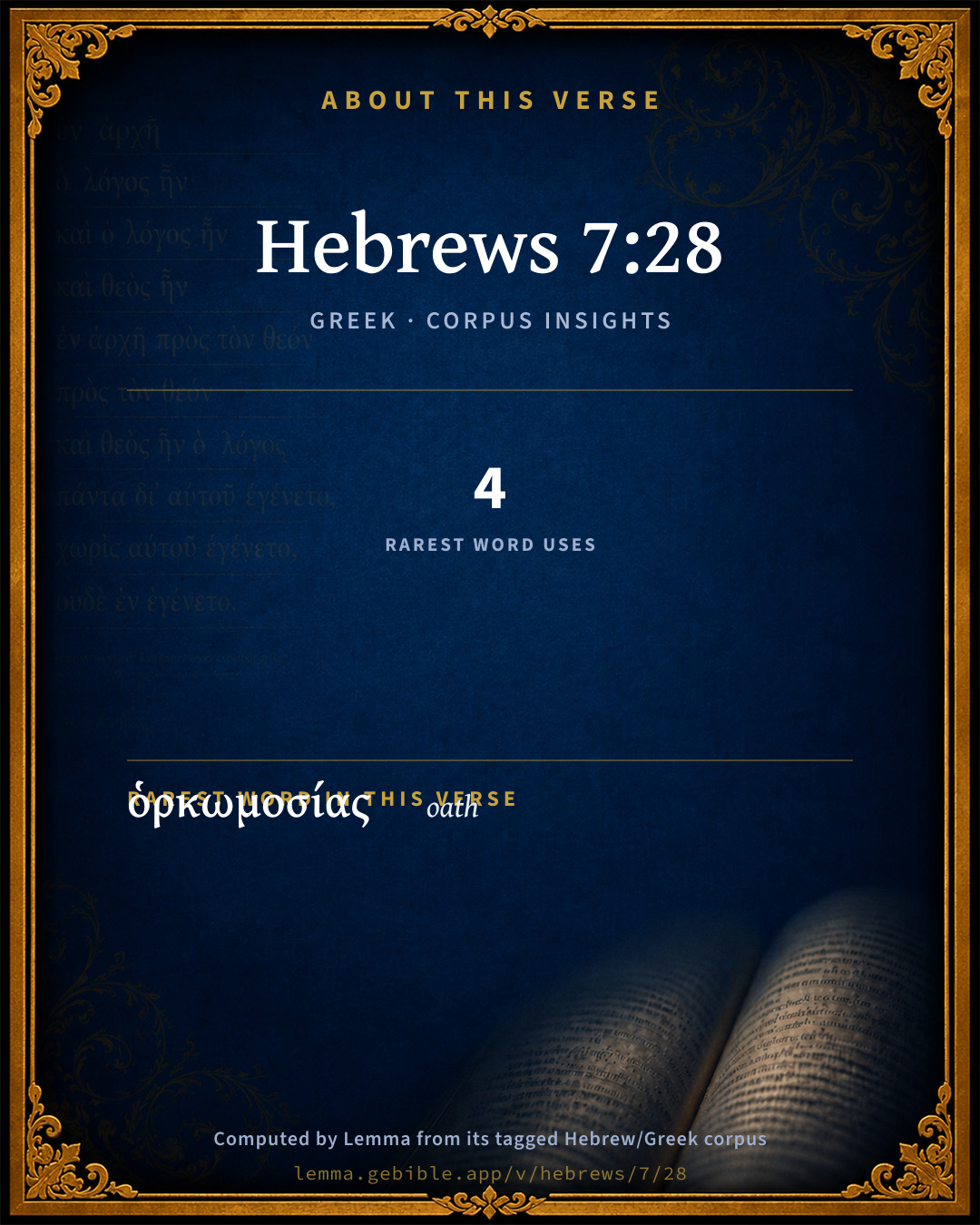
The rarest word here is ὁρκωμοσίας oath G3728 — appearing just 4 times in the whole Greek New Testament.

Shared distinctive vocabulary

ὁρκωμοσίας oath G3728 occurs in 3 verses of the Greek New Testament. Also found in:

Repetition

Words recur within this verse:

Cross-references

15

Topical passages linked to Hebrews 7:28 in the Treasury of Scripture Knowledge — connected by theme and wording, ordered by reader-vote popularity; previews shown in the World English Bible.

  • Hebrews 2:10 For it became him, for whom are all things, and through whom are all things, in bringing many children to glory, to make the author of their salvation perfect through sufferings.
  • Hebrews 1:2 has at the end of these days spoken to us by his Son, whom he appointed heir of all things, through whom also he made the worlds.
  • Hebrews 7:21 (for they indeed have been made priests without an oath), but he with an oath by him that says of him, "The Lord swore and will not change his mind, 'You are a priest forever, According to the order of Melchizedek'".
  • Hebrews 5:1–2 For every high priest, being taken from among men, is appointed for men in things pertaining to God, that he may offer both gifts and sacrifices for sins.
  • Psalms 110:4 Yahweh has sworn, and will not change his mind: "You are a priest forever in the order of Melchizedek."
  • Luke 13:32 He said to them, "Go and tell that fox, 'Behold, I cast out demons and perform cures today and tomorrow, and the third day I complete my mission.
  • Exodus 32:21–22 Moses said to Aaron, "What did these people do to you, that you have brought a great sin on them?"
  • Leviticus 4:3 if the anointed priest sins so as to bring guilt on the people, then let him offer for his sin, which he has sinned, a young bull without blemish to Yahweh for a sin offering.
  • John 19:30 When Jesus therefore had received the vinegar, he said, "It is finished." He bowed his head, and gave up his spirit.
  • Hebrews 3:6 but Christ is faithful as a Son over his house; whose house we are, if we hold fast our confidence and the glorying of our hope firm to the end.
  • Hebrews 5:5 So also Christ didn't glorify himself to be made a high priest, but it was he who said to him, "You are my Son. Today I have become your father."
  • Hebrews 5:8–9 though he was a Son, yet learned obedience by the things which he suffered.
  • Hebrews 7:3 without father, without mother, without genealogy, having neither beginning of days nor end of life, but made like the Son of God), remains a priest continually.
  • Hebrews 7:24 But he, because he lives forever, has his priesthood unchangeable.
  • Hebrews 4:14 Having then a great high priest, who has passed through the heavens, Jesus, the Son of God, let us hold tightly to our confession.

Cross-references courtesy of OpenBible.info (CC BY 4.0).

Commentary

Notes on Hebrews 7:28 from classic Christian and Jewish commentators (each source and its license shown beneath its notes). The classic Christian expositions comment on the surrounding passage and are grouped to its opening verse, so a note may address several verses; the Jewish commentaries on the Tanakh (Rashi and others) are per-verse, so they appear only where the commentator wrote on this verse.

Lemma curates 59 commentaries, every one of them public domain or Creative Commons licensed, each selected and text-cleaned for this edition rather than reprinted as found. About our sources →

Tyndale Open Study Notes

Tyndale Open Resources

7:28 This verse echoes 5:1-3 and sums up the entire discussion of Christ’s appointment as High Priest (5:1-10; 7:1-28). • Limited by human weakness refers primarily to human sinfulness and mortality (5:2-3; 7:18, 23-27). • God appointed his Son with an oath: See Ps 110:4, the key Old Testament passage behind Heb 7:11-28. • perfect . . . forever: The words High Priest are not in the Greek text but are implied in the context. • In Hebrews, the term perfect means complete or mature (see 2:10; 5:9; 7:11; 9:9-11); the Son, through his sacrificial death and resurrection, has become completely qualified to serve as our eternal High Priest, and his priesthood lasts forever.

Tyndale Open Study Notes — © Tyndale Open Resources, licensed CC BY-SA 4.0. Text via the HelloAO Bible API.

Bengel's Gnomon

Johann Albrecht Bengel

Heb 7:28. Ὁ νόμος γὰρ· ὁ λόγος δὲ, for the law: but the word) The antithesis is very express, as the conjunction is put after the nouns.—ὁ λόγος, the word) rendered as strong as possible in consequence of the oath.—τῆς μετὰ τὸν νόμον) Not only the word, but the oath of God, is said to have been given after the law (comp. v. 18) in the time of David, and that too by David, as GOD very often swears by the mouth of the prophets. Comp. Act 2:30, where Peter speaks of the kingdom of Christ sanctioned by an oath in that same age. Paul is reasoning from the order of revelations, as Gal 3:17, note. Below, ch. Heb 10:7; Heb 10:16.—Υἱὸν) Son of GOD. The antithesis is, men having infirmity.—εἰς τὸν αἰῶνα, for ever) It is thus resolved: The Son (once made perfect) was constituted a priest for ever, ch. Heb 5:9-10, note. Absolute eternity is here intended. Jesus continues a priest for ever. His work being finished, His state remains.

Bengel's Gnomon of the New Testament — English translation (T&T Clark, Edinburgh, 1860) — public domain. Text from a community e-Sword module.

Meyer's Critical & Exegetical Commentary

Heinrich August Wilhelm Meyer

Heb_7:28. Establishment of τοῦτο ἐποίησεν ἐφάπαξ, Heb_7:27, by the definite formulating of the statement of the fourth point of superiority of the New Testament High Priest over the high priests of the Old Covenant,a statement for which the way has been prepared by Heb_7:26-27. The law constitutes high priests men who are subject to weakness, and thus also to sin (comp. Heb_5:2-3), on which account they have to offer, as for the people, so also for themselves, and have ofttimes to repeat this sacrifice; the word of the oath, on the other hand (comp. Heb_7:21), which ensued after the law,namely, only in the time of David,and consequently annulled the law, ordains as high priest the Son (see on Heb_1:1), who is for ever perfected, i.e. without sin (Heb_4:15), and by His exaltation withdrawn from all human ἀσθένεια, however greatly He had part therein during His life on earth; wherefore He needed not for Himself to present an expiatory sacrifice, but only for the people, and, inasmuch as this fully accomplished its end, He needed not to repeat the same.

Entirely misapprehending the reasoning of the author, Ebrard supposes that even the first half of the proposition, Heb_7:28, is likewise to be referred to Jesus. The author, he tells us, presupposes as well known, that Christ has been as well ἄνθρωπος ἀσθένειαν ἔχων (according to chap. 5) as υἱὸς τετελειωμένος εἰς τὸν αἰῶνα (according to chap. 7), and is here recapitulating (!) the two. Thus, then, ὁ νόμος γὰρ … ἀσθένειαν contains a concession (!) having reference to chap. 5, and the thought is: the law (in so far as it has not (!) been annulled) demands of all high priests (consequently (!) also of Jesus) that they be ἄνθρωποι ἔχοντες ἀσθένειαν; the sworn word of promise, however (given after the law), proceeding far beyond and above the same, constitutes as high priest the Son for ever perfected (!). A misinterpreting of the meaning, against which even the opposition of ὁ νόμος … ὁ λόγος δέ, as a manifest parallel to οἱ μὲν … ὁ δέ, Heb_7:20 f., Heb_7:23 f., ought to have kept him.

τῆς μετὰ τὸν νόμον] The author did not write ὁ μετὰ τὸν νόμον, according to which the Vulgate and Luther translate, because he wished to accentuate ὁρκωμοσία as the principal notion.

Meyer — Critical and Exegetical Commentary on the New Testament — English translation by Peter Christie, edited by Frederick Crombie (T&T Clark, 1880) — public domain. Text from a community e-Sword module.

Geneva Bible (1599)

Geneva Bible translators

The commandment of God which was bound with an oath.

Another argument taken of the time: former things are taken away by the latter.

Exhibited.

Geneva Bible (1599) marginal notes — public domain. Text via Bolls.life.

Jamieson, Fausset & Brown

Robert Jamieson, A. R. Fausset & David Brown

For--reason for the difference stated in Heb 7:27, between His one sacrifice and their oft repeated sacrifices, namely, because of His entire freedom from the sinful infirmity to which they are subject. He needed not, as they, to offer FOR HIS OWN SIN; and being now exempt from death and "perfected for evermore," He needs not to REPEAT His sacrifice.

the word--"the word" confirmed by "the oath."

which--which oath was after the law, namely, in Psa 110:4, abrogating the preceding law-priesthood.

the Son--contrasted with "men."

consecrated--Greek, "made perfect" once for all, as in Heb 2:10; Heb 5:9; see on Heb 2:10; Heb 5:9. Opposed to "having infirmity." Consecrated as a perfected priest by His perfected sacrifice, and consequent anointing and exaltation to the right hand of the Father.

Next: Hebrews Chapter 8

Jamieson, Fausset & Brown — Commentary Critical and Explanatory on the Whole Bible (1871) — public domain (CC PDM 1.0). Text via the HelloAO Bible API.

Adam Clarke's Commentary

Verse 28. For the law maketh men high priests] The Jewish priests have need of these repeated offerings and sacrifices, because they are fallible, sinful men: but the word of the oath (still referring to Ps 110:4) which was since the law; for David, who mentions this, lived nearly 500 years after the giving of the law, and consequently that oath, constituting another priesthood, abrogates the law; and by this the SON is consecrated, τετελειωμενον, is perfected, for evermore. Being a high priest without blemish, immaculately holy, every way perfect, immortal, and eternal, HE is a priest ειςτον αιωνα, to ETERNITY.

I. THERE are several respects in which the apostle shows the priesthood of Christ to be more excellent than that of the Jews, which priesthood was typified by that of Melchisedec.

1. Being after the order of Melchisedec, there was no need of a rigorous examination of his genealogy to show his right.

2. He has an eternal priesthood; whereas theirs was but temporal.

3. The other priests, as a token of the dignity of their office, and their state of dependence on God, received tithes from the people. Melchisedec, a priest and king, after whose order Christ comes, tithed Abraham, δεδεκατωκετοναβρααμ, the father of the patriarchs; Jesus, infinitely greater than all, having an absolute and independent life, needs none. He is no man's debtor, but all receive out of his fulness.

4. He alone can bless the people, not by praying for their good merely, but by communicating the good which is necessary.

5. As another priesthood, different from that of Aaron, was promised, it necessarily implies that the Levitical priesthood was insufficient; the priesthood of Christ, being that promised, must be greater than that of Aaron.

6. That which God has appointed and consecrated with an oath, as to endure for ever, must be greater than that which he has appointed simply for a time: but the priesthood of Christ is thus appointed; therefore, c.

7. All the Levitical priests were fallible and sinful men but Christ was holy and undefiled.

8. The Levitical priests were only by their office distinguished from the rest of their brethren, being equally frail, mortal, and corruptible; but Jesus, our high priest, is higher than the heavens. The statements from which these differences are drawn are all laid down in this chapter.

II. As the word surety, εγγυος, in Heb 7:22, has been often abused, or used in an unscriptural and dangerous sense, it may not be amiss to inquire a little farther into its meaning. The Greek word εγγυος, from εγγυη, a pledge, is supposed to be so called from being lodged ενγυιοις, in the hands of the creditor. It is nearly of the same meaning with bail, and signifies an engagement made by C. with A. that B. shall fulfil certain conditions then and there specified, for which C. makes himself answerable; if, therefore, B. fails, C. becomes wholly responsible to A. In such suretiship it is never designed that C. shall pay any debt or fulfil any engagement that belongs to B.; but, if B. fail, then C. becomes responsible, because he had pledged himself for B. In this scheme A. is the person legally empowered to take the bail or pledge, B. the debtor, and C. the surety. The idea therefore of B. paying his own debt, is necessarily implied in taking the surety. Were it once to be supposed that the surety undertakes absolutely to pay the debt, his suretiship is at an end, and he becomes the debtor; and the real debtor is no longer bound. Thus the nature of the transaction becomes entirely changed, and we find nothing but debtor and creditor in the case. In this sense, therefore, the word εγγυος, which we translate surety, cannot be applied in the above case, for Christ never became surety that, if men did not fulfil the conditions of this better covenant, i.e. repent of sin, turn from it, believe on the Son of God, and having received grace walk as children of the light, and be faithful unto death, he would do all these things for them himself! This would be both absurd and impossible: and hence the gloss of some here is both absurd and dangerous, viz., "That Christ was the surety of the first covenant to pay the debt; of the second, to perform the duty." That it cannot have this meaning in the passage in question is sufficiently proved by Dr. Macknight; and instead of extending my own reasoning on the subject, I shall transcribe his note.

"The Greek commentators explain this word εγγυος very properly by μεσιτης, a mediator, which is its etymological meaning; for it comes from εγγυς, near, and signifies one who draws near, or who causes another to draw near. Now, as in this passage a comparison is stated between Jesus as a high priest, and the Levitical high priests; and as these were justly considered by the apostle as the mediators of the Sinaitic covenant, because through their mediation the Israelites worshipped God with sacrifices, and received from him, as their king, a political pardon, in consequence of the sacrifices offered by the high priest on the day of atonement; it is evident that the apostle in this passage calls Jesus the High Priest, or Mediator of the better covenant, because through his mediation, that is, through the sacrifice of himself which he offered to God, believers receive all the blessings of the better covenant. And as the apostle has said, Heb 7:19, that by the introduction of a better hope, εγγιζομεν, we draw near to God; he in this verse very properly calls Jesus εγγυος, rather than μεσιτης, to denote the effect of his mediation. See Heb 7:25. Our translators indeed, following the Vulgate and Beza, have rendered εγγυος by the word surety, a sense which it has, Ecclus. 29:16, and which naturally enough follows from its etymological meaning; for the person who becomes surety for the good behaviour of another, or for his performing something stipulated, brings that other near to the party to whom he gives the security; he reconciles the two. But in this sense the word εγγυος is not applicable to the Jewish high priests; for to be a proper surety, one must either have power to compel the party to perform that for which he has become his surety; or, in case of his not performing it, he must be able to perform it himself. This being the ease, will any one say that the Jewish high priests were sureties to God for the Israelites performing their part of the covenant of the law! Or to the people for God's performing his part of the covenant! As little is the appellation, surety of the new covenant, applicable to Jesus. For since the new covenant does not require perfect obedience, but only the obedience of faith; if the obedience of faith be not given by men themselves, it cannot be given by another in their room; unless we suppose that men can be saved without personal faith. I must therefore infer, that those who speak of Jesus as the surety of the new covenant, must hold that it requires perfect obedience; which, not being in the power of believers to give, Jesus has performed for them. But is not this to make the covenant of grace a covenant of works, contrary to the whole tenor of Scripture! For these reasons I think the Greek commentators have given the true meaning of the word εγγνος, in this passage, when they explain it by μεσιτης, mediator."

The chief difference lies here. The old covenant required perfect obedience from the very commencement of life; this is impossible, because man comes into the world depraved. The new covenant declares God's righteousness for the remission of sins that are past; and furnishes grace to enable all true believers to live up to all the requisitions of the moral law, as found in the gospels. But in this sense Christ cannot be called the surety, for the reasons given above; for he does not perform the obedience or faith in behalf of any man. It is the highest privilege of believers to love God with all their hearts, and to serve him with all their strength; and to remove their obligation to keep this moral law would be to deprive them of the highest happiness they can possibly have on this side heaven.

Adam Clarke's Commentary on the Bible (1810–1826) — public domain. Text from a community e-Sword/MySword module.

John Calvin's Commentaries

28. For the law, etc. From the defects of men he draws his conclusion as to the weakness of the priesthood, as though he had said, “Since the law makes no real priests, the defect must by some other means be remedied; and it is remedied by the word of the oath; for Christ was made a priest, being not of the common order of men, but the Son of God, subject to no defect, but adorned and endowed with the highest perfection.” He again reminds us, that the oath was posterior to the law, in order to show that God, being not satisfied with the priesthood of the law, designed to constitute a better priesthood; for in the institutions of God what succeeds advances the former to a better state, or it abolishes what was designed to exist only for a time.

John Calvin's Commentaries (1540-1563) — public domain. Text from the Calvin Translation Society English edition (1840s-50s) via the Christian Classics Ethereal Library (ccel.org). Calvin's coverage is partial (roughly two-thirds of the Bible); uncommented books and verses are honest gaps, never fabricated. The 19th-century editor's footnotes and remarks are omitted so the notes are faithfully Calvin's own voice.

Ellicott's Commentary for English Readers

(28) For the law maketh men high priests which have infirmity . . .—Better, For the Law appointeth men high priests, (men) having infirmity; but the word of the oath, which was after the Law, appointeth a Son, who hath been perfected for ever. On “the word of the oath” see Heb_7:20-21. Coming “after the Law,” it revoked the commandment (Heb_7:18), and was not revoked by it. (“A Son,” see Heb_1:3; Heb_5:8. “Perfected,” see Heb_2:10; Heb_5:10.) We are not to understand that Jesus was first “perfected” and then appointed as High Priest: this would contradict what has just been taught (Heb_7:27), for it was as High Priest that He offered the sacrifice of Himself. In these closing words are united the two cardinal predictions of Psalms 2, 110 (comp. Heb_5:5-6): Thou art My Son,” “Thou art a Priest for ever.”

A Bible Commentary for English Readers, edited by Charles John Ellicott (1878–1897) — public domain. Text from a community e-Sword module.

The Cambridge Bible for Schools and Colleges

gen. ed. J. J. S. Perowne

28. men] i.e. ordinary “human beings.”

the oath, which was since the law] Namely, in Psa_110:4.

consecrated] Rather, “who has been perfected.” The word “consecrated” in our A.V. is a reminiscence of Lev_21:10; Exo_29:9. The “perfected” has the same meaning as in Heb_2:10, Heb_5:9.

The Cambridge Bible for Schools and Colleges (gen. ed. J. J. S. Perowne; Cambridge University Press, 1878–1918) — public domain. Text from a community e-Sword module.

Trapp's Complete Commentary

John Trapp

28 For the law maketh men high priests which have infirmity; but the word of the oath, which was since the law, maketh the Son, who is consecrated for evermore.

Ver. 28. For the law maketh] As if the apostle should say, Shall I sum up and shut up all in a word? the law maketh men high priests which have infirmity, &c. Dull scholars must have it over and over. Nunquam satis dicitur, quod nunquam satis diseitur. (Seneca.)

John Trapp, A Commentary or Exposition upon All the Books of the Old and New Testament (1647–1656) — public domain. Text from a community e-Sword module.

Albert Barnes' Notes on the Bible

For the law - The ceremonial law.

Which have infirmity - Who are weak, frail, sinful, dying. Such were all who were appointed to the office of priest under the Jewish Law.

But the word of the oath - By which one was appointed after the order of Melchizedek; note, Heb 7:21.

Maketh the Son - The Son of God. That appointment has resulted in his being set apart to this work.

Who is consecrated forevermore - Margin, “Perfected;” see the note at Heb 2:10. The idea is, that the appointment is “complete” and “permanent.” It does not pass from one to the other. It is perfect in all the arrangements, and will remain so forever.

Remarks

The subject of this chapter is the exalted high priesthood of the Redeemer. This is a subject which pertains to all Christians, and to all men. All religions imply the priestly office; all suppose sacrifice of some kind. In regard to the priestly office of Christ as illustrated in this chapter, we may observe:

(1) He stands alone. In that office he had no predecessor, and has no one to succeed him. In this respect he was without father, mother, or descent - and he stands in lonely majesty as the only one who sustains the office; Heb 7:3.

(2) He is superior to Abraham. Abraham never laid claim to the ofrice of priest, but he recognized his inferiority to one whom the Messiah was to resemble; Heb 7:2, Heb 7:4.

(3) He is superior to all the Jewish priesthood - sustaining a rank and performing an office above them all. The great ancestor of all the Levitical priests recognized his inferiority to one of the rank or “order” of which the Messiah was to be, and received from him a blessing. In our contemplation of Christ, therefore, as priest, we have the privilege of regarding him as superior to the Jewish high priest - exalted as was his office, and important as were the functions of his office; as more grand, more pure, more worthy of confidence and love.

(4) The great High Priest of the Christian profession is the only perfect priest; Heb 7:11, Heb 7:19. The Jewish priests were all imperfect and sinful men. The sacrifices which they offered were imperfect, and could not give peace to the conscience. There was need of some better system, and they all looked forward to it. But in the Lord Jesus, and in his work, there is absolute perfection. What he did was complete, and his office needs no change.

(5) The office now is permanent. It does not change from hand to hand; Heb 7:23-24. He who sustains this office does not die, and we may ever apply to him and cast our cares on him. Men die; one generation succeeds another; but our High Priest is the same. We may trust in him in whom our fathers found peace and salvation, and then we may teach our children to confide in the same High Priest - and so send the invaluable lesson down to latest generations.

(6) His work is firm and sure; Heb 7:20-22. His office is founded on an oath, and he has become the security for all who will commit their cause to him. Can great interests like those of the soul be entrusted to better hands? Are they not safer in his keeping than in our own?

(7) He is able to save to the uttermost; Heb 7:25. That power he showed when he was on earth; that power he is constantly evincing. No one has asked aid of him and found him unable to render it; no one has been suffered to sink down to hell because his arm was weak. What he has done for a few he can do for “all;” and they who will entrust themselves to him will find him a sure Saviour. So why will people not be persuaded to commit themselves to him? Can they save themselves? Where is there one who has shown that he was able to do it? Do they not need a Saviour? Let the history of the world answer. Can man conduct his own cause before God? How weak, ignorant, and blind is he; how little qualified for such an office! Has anyone suffered wrong by committing himself to the Redeemer? If there is such an one, where is he? Who has ever made this complaint that has tried it? Who ever will make it? In countless millions of instances, the trial has been made whether Christ was “able to save.” Men have gone with a troubled spirit; with a guilty conscience; and with awful apprehensions of the wrath to come, and have asked him to save them. Not one of those who have done this has found reason to doubt his ability; not one has regretted that he has committed the deathless interest of the soul into his hands.

(8) Christ saves to the uttermost; Heb 7:25. He makes the salvation complete. So the Bible assures us; and so we see it in fact as far as we can trace the soul. When a Christian friend dies, we stand at his bed-side and accompany him as far as we can into the valley of the shadow of death. We ask him whether he feels that Christ is able to save? He replies, “yes.” When he has lost the power of speaking above a whisper, we ask him the same question, and receive the same reply. When he gives us the parting hand, and we, still anxious to know whether all is well, ask the same question, a sign, a smile, a lighting up of the dying eye, declares that all is well. As far as we can trace the departing soul when it goes into the dark valley, we receive the same assurance; and why should we doubt that the same grace is bestowed further onward, and that he saves “to the uttermost?” But what else thus saves? Friends give the parting hand at the gloomy entrance to that valley, and the frivolous and the worldly coolly turn away. The delusions of infidelity there forsake the soul, and minister no comfort then. Flatterers turn away from the dying scene - for who flatters the dying with the praise of beauty or accomplishments? Taste, skill, learning, talent, do not help then, for how can they save a dying soul? None but Jesus saves to the “uttermost;” no other friend but he goes with us entirely through the valley of death. Is it not better to have such a friend than to go alone through that dark, gloomy path? Any other gloomy and dangerous way may be more safely trod without a friend, than the vale of death.

(9) The Christian religion is suited to our condition; Heb 7:26-27. It has just such a High Priest as we need - holy, harmless, undefiled. Just such an atonement has been made as is necessary - ample, rich, full, and not needing to be made again. It reveals just such truth as we want - that respecting the immortality of the soul, and the glorious state of the redeemed beyond the grave. It imparts just such consolation as is suited to our condition - pure, rich, unfailing, elevating. It reconciles us to God just as it should be done - in such a way that God can be honored, and the purity and dignity of his Law maintained. It is the religion adapted to dying, ignorant, sinful, wretched man. No other system so much consults the true dignity of our nature, and the honor of God; no one diffuses such consolations through the life that is, or fills with such hopes in regard to the life to come.

(10) since, then, we have now such a Great High Priest; since the promises of the gospel are settled on so firm a foundation; and since the gospel in its provisions of mercy is all that we can desire it to be, let us yield our hearts entirely to the Saviour, and make this salvation wholly ours. We have the privilege, if we will, of drawing near to God with boldness. We may come near his throne. Though we are poor, and sinful, and deserve neither notice nor mercy, yet we may come and ask for all that we need. We may go to God, and supplicate his favor, with the assurance that he is ready to hear. We may go feeling that the great atonement has been made for our sins, and that no other offering is now needed; that the last bloody offering which God required has been presented, and that all that he now asks is the sacrifice of a contrite and a grateful heart. All that was needful to be done on the part of God to provide a way of salvation has been done; all that remains is for man to forsake his sins and to come back to a God who waits to be gracious.

Albert Barnes' Notes on the Bible (1834–1885) — public domain. Text from a community e-Sword/MySword module.

Matthew Poole's English Annotations

This is the reason why the Aaronical priests had need to sacrifice for themselves, and the gospel High Priest had not, and is finally describing him who is so.

For the law maketh men high priests which have infirmity; for the law which God gave to Moses, the ceremonial law, constituteth, sets up, and puts into this Aaronical order and office of priesthood, such as are not only liable to bodily infirmities, but to moral ones, sins. Aaron and all his sons had their spiritual sinful infirmities, Heb 5:2, for which they were to offer their propitiatory sacrifices to God, as well as for those of the people; they were sinful, dying men, Heb 7:26.

But the word of the oath, which was since the law; but God the Father’s promise to his Son, ratified with an oath, that he should he the great High Priest perfecting of souls for God, as David testifieth, Psa 110:4, to be revealed to him; and this four hundred years after the law was given which constituted the Aaronical priesthood. The word revealed God’s promise to him, the oath made it irreversible; yet this promise was not actually performed to him till his ascension in the human nature higher than the heavens, Psa 110:1.

Maketh the Son, who is consecrated for evermore; God the Son incarnate, the man Christ God’s fellow, the glorious only begotten and bosom Son of the Father, Zec 13:7; Joh 1:14,18; 1Ti 2:5, is made by this ratified word the only single everlasting High Priest, who is not only completely and perfectly holy, as opposed to the infirmities of the Aaronical priests, but ever able and fit for his work, as successful in it. Who would not therefore leave that abolished priesthood, and cleave to this which must abide for ever?

Matthew Poole's English Annotations on the Holy Bible (1683–1685) — public domain. Text from a community e-Sword/MySword module.

Whedon's Commentary on the Bible

Daniel D. Whedon

28. The Mosaic law—In antithesis with the psalmist’s word, or expression of the oath inaugurating the perpetual High Priest. Notes on Heb_7:20-21.

Since the law—For the psalm is later than the Pentateuch, and unfolds the later revelation of God’s purposes.

The Son—Of Heb_1:1. It stands in antithesis with men… which have infirmity. The divine Son has no infirmity. He is unmarred by sin.

Consecrated—Rather, perfected, absolutely completed, as the Model, Expiator, and Saviour.

Daniel D. Whedon (gen. ed.), Commentary on the Old and New Testaments (1874–1909) — public domain. Text from a community e-Sword module.

The Pulpit Commentary

For the Law maketh men high priests, having infirmity; but the word of the oath, which was after the Law, maketh the Son, perfected for evermore. With men (i.e. a succession of men; cf. ver. 8) having infirmity is contrasted the one Son, for ever perfected. The absence of the article before uio does not imply the meaning "a son;" the title denotes here, as throughout the Epistle, the peculiar Son of prophecy. (see Heb_1:1) There is here no denial of his complete humanity, though he is plainly regarded as more than man. Nor is his participation In human asyeneia , in the sense explained under Heb 5, denied. His implied freedom from it may mean either that he never had any inherent in himself, none due to personal imperfection, or that now, in his exalted state, he is altogether removed from it. In both these senses the implication is true; and both may be understood; but teteleiwmenon being here opposed to econtav asyeneian (as uion to anyrwpouv), the latter sense may be conceived to have been especially in the writer"s mind. It is, in fact, our ever-living High Priest, interceding for us above, after passing through human experience, and after atonement completed, that is now being presented to our view. It is to be observed, lastly, that teteleiwmenon in this verse may be intended to bear, or at any rate to suggest, the special sense noted under Heb_5:9, and strenuously maintained by Jackson, and hence to be not incorrectly rendered by "consecrated" in the A.V; and this notwithstanding Alford"s protest against this rendering as "obliterating both sense anti analogy with Heb_2:10 and Heb_5:1."

The Pulpit Commentary (1880–1919), ed. H.D.M. Spence-Jones & Joseph S. Exell — public domain. Text from a community e-Sword module.

John Wesley's Explanatory Notes

The law maketh men high priests that have infirmity - That are both weak, mortal, and sinful. But the oath which was since the law - Namely, in the time of David. Maketh the son, who is consecrated forever - Who being now free, both from sin and death, from natural and moral infirmity, remaineth a priest forever.

John Wesley, Explanatory Notes Upon the Whole Bible (1754–1765) — public domain. Text via the GEBible commentary corpus.

Burkitt's Expository Notes on the New Testament

William Burkitt

That is, the Levitical law appointed men to be high priests that laboured under infirmities, were sinners, and subject to mortality; but the promise made to Christ, and confirmed by God’s oath long since the law was given, maketh the Son, and none but the Son, (who is perfect, holy, and consecrated to this everlasting office) a priest for evermore.

Learn hence, 1. That there never was any more that two sorts of priests in the church; the one made by the law, the other by the oath of God.

Learn, 2. That the great foundation of our faith, and the main hinge whereon all our consolation depends, is this, that our High Priest is The Son of God, and his everlasting continuance in his office is secured by the oath of God.

William Burkitt's Expository Notes on the New Testament (1700–1703) — public domain. Text from a community e-Sword module.

The People's New Testament

B. W. Johnson

28. For the law, etc. The law puts imperfect men into the Aaronic priesthood. But the word of the oath … maketh the Son. The spotless and Divine one who became an eternal priest.

B. W. Johnson's The People's New Testament with Notes (1889–1891) — public domain. Electronic text from the Christian Classics Ethereal Library (CCEL) ThML edition.

Cambridge Greek Testament for Schools and Colleges

28. ἀνθρώπους, i.e. ordinary “human beings.”

μετὰ τὸν νόμον. Namely, in Psa 110:4.

τετελειωμένον, “who has been perfected.” The word “consecrated” in our A.V. is a reminiscence of Lev 21:10; Exo 29:9. The “perfected” has the same meaning as in Heb 2:10, Heb 5:9.

Cambridge Greek Testament for Schools and Colleges (Cambridge University Press, 1896; 21 vols, various authors incl. Carr, Maclear, Plummer, Farrar, Lumby, Moule, M. R. James, Simcox) — public domain. Text from a community e-Sword module.

Alford’s Greek Testament

Henry Alford

28.] Final bringing out of the contrast between the Aaronic priests and Christ. For (gives the reason for the difference in the last verse) the Law makes men (emphatic, opposed to υἱόν below) high priests, who have infirmity (cf. ch. 5:2, of the human high priest, ἐπεὶ καὶ αὐτὸς περίκειται ἀσθένειαν: and see below. The expression here involves, from the context, liability to sin, and subjection to, removal by, death. Christ had not the first, and therefore need not offer for his own sin: he was free from the second, and therefore need not repeat His sacrifice): but the word (utterance; or, purport: cf. ver. 21, ὁ δὲ μετὰ ὁρκωμοσίας διὰ τοῦ λέγοντος πρὸς αὐτὸν κ.τ.λ.) of the oath which was after the law (τῆς μετά, not ὁ μετά (“sermo autem jurisjurandi qui post legem est,” vulg.), which ought to be marked in the E. V. by the omission of the comma after “oath.” This oath is recorded in David, i. e. subsequently to the giving of the law, and therefore as antiquating it and setting it aside. The argument is similar to that in Gal 3:17. Of course Erasmus’s rendering, “supra legem,” is out of the question) (makes) the Son (see on υἱόν, not τὸν υἱ, note on ch. 1:1), made perfect (in this participle, as Del. remarks, lies enwrapped the whole process of the Son’s assumption of human ἀσθένεια, and being exalted through it: for this τετελειῶσθαι was διὰ παθημάτων, ch. 2:10; 5:9. Those priests, by their ἀσθένεια, were removed away in death, and replaced by others: He, by that ἀσθένεια which He took on Him, went out through death into glory eternal, and an unrenewable priesthood) for evermore (these words belong simply and entirely to the participle, not as Luther, fesst den Sohn ewig und vollkommen, and Bengel, “Resolve: filius, semel consummatus, constitutus est sacerdos in æternum.” The E. V. has obliterated both sense, and analogy with ch. 2:10 and 5:9, by rendering τετελ., “consecrated”).

Henry Alford, The Greek Testament (1849–1861) — public domain. Text from a community e-Sword module.

Vincent's Word Studies in the New Testament

Marvin R. Vincent

Summarizing the contents of vers. 26, 27. - The law constitutes weak men high priests. God 's sworn declaration constitutes a son, perfected forevermore. jAnqrwpouv men, many in number as contrasted with one Son. Econtav ajsqeneian having infirmity, stronger than ajsqeneiv weak, which might imply only special exhibitions of weakness, while having infirmity indicates a general characteristic. See on Joh 16:22. A son. Again the high - priesthood is bound up with sonship, as in ch. 5 5, 6. ===Heb8

CHAPTER VIII

Christ 's fulfillment of his high - priestly office as related to the Aaronic priesthood. - Christ 's ministry is superior to that of the Levitical priests as he himself is superior to them.

Marvin R. Vincent, Word Studies in the New Testament (1887–1900) — public domain. Text from a community e-Sword/MySword module.

Westcott on Hebrews & the Epistles of John

Brooke Foss Westcott

28. ὁ νόμος...ὁ λόγος τῆς ὁρκωμ....} The freedom of Christ from the necessity by which the Aaronic Highpriests are bound follows from His nature, for the Law... The truth which has been laid open in the two preceding verses is here expressed summarily by recapitulation in its final form: the Levitical High-priests are weak men, the High-priest after the order of Melchizedek a Son eternally perfected.

Now it is regarded in its abiding issues. Comp. ii. 18 πέπονθεν note.

The participle, as contrasted with the adjective τέλειος, forms a complete antithesis to ἔχων ἀσθένειαν. The perfection is gained through the experience of a true human life (c v.

Tho realisation of the Pricsthood of Christ necessarily carries with it the abrogation of the typical priesthood of the Law. The presence of ‘ weakness’ in the Levitical priests was realised in the consequences of imperfoction and doath. Such a priesthood could not bring τελείωσις, aud it was of nocossity intorrupted. On the other hand Christ took upon Himself human nature (iv. 15) subjoct to temptation and death, that so He might taste death for all, but as Highpriest in His glory He is ‘raised wholly above all infirmity and death, though still able to sympathise with those who are subject to them (οἷν 1 £). Compare Additioual Note.

Brooke Foss Westcott (1825–1901), The Epistle to the Hebrews (1889) and The Epistles of St John (1883) — public domain (pre-1929). Text recovered from Internet Archive / Google Books OCR scans. Westcott’s Gospel of John commentary is not included (its OCR lost the chapter running-heads required for reliable verse-keying). Some Greek quoted in the Hebrews volume is imperfectly rendered by the OCR.

Lesson kit

Teaching starters — assembled from the data on this page, not authored interpretation. Every prompt links to the verse data it draws on. Edit before teaching.

Hebrews, in the General Epistles, opens this verse with 22 words (16 distinct Greek lemmas). Its most distinctive word is horkōmosía (“oath”). A historical commentator’s framing appears above. Read the whole chapter for the surrounding context.

Discussion questions

  1. What does “oath” (horkōmosía) contribute to the verse as a whole?
  2. How does Hebrews 7:20, which shares the word «oath», read alongside this verse?
  3. What does the repetition of “law” (2× in this one verse) do in this verse?
  4. The translations on this page render this verse differently — a whole-verse word diff, not a word-by-word alignment. What might account for the different wordings?
  5. Compare how Tyndale Open Study Notes and Bengel's Gnomon read this verse. Where do they agree or differ?

Things to notice

Reading settings

Reading text

Shown beneath each verse's original-language words.

Old Testament
Old Testament edition

Read the OT as the Masoretic Hebrew (MT) or the Greek Septuagint (LXX).

English shown for the Greek Septuagint (in the Hebrew ↔ Greek comparison).

Comparing translations? Open the Compare panel on any verse page to stack up to four side by side.