1 Timothy 1:17

Greek (Tischendorf 8th ed.) 1 Timothy 1:17 appears in the Greek New Testament. The text above is from the Tischendorf 8th edition. Each word links to its Strong’s number and a concise gloss. Click any word for its full Thayer’s Greek Lexicon entry.
Download image
Cite this verse

1 Timothy 1:17 (World English Bible). Public Domain. Lemma interlinear Bible study tool, https://lemma.gebible.app/v/1-timothy/1/17.

Show BibTeX & RIS
BibTeX
RIS
English Translation
Now to the King eternal, immortal, invisible, to God who alone is wise, be honor and glory forever and ever. Amen.
World English Bible · Public Domain
Download a study sheet

One document with this verse’s original text, its word-by-word gloss line, the meaning frame, cross-references with their text, attributed commentary, and full source and license credits — printable, and it pastes into notes with its structure intact.

This verse Autodidact and up

Study sheet (.html) Plain text (.txt)

A passage Seminary Student

Up to 50 verses in one chapter. A passage sheet keeps up to 6 commentary sources and 12 cross-references per verse, in the order this page ranks them, and says so on the sheet whenever that leaves anything out. Ask for a single verse and you get the Autodidact verse sheet above.

Everything on this page stays free to read, with no account — the sheet is a download of what is already on screen, not access to it.

Want to remove ads? Support Godless Engineer
Compare translations 3

The same verse in 3 English versions, stacked beneath the original-language interlinear above. Click any original word for its lexicon entry.

Each is an independent rendering of the whole verse — the interlinear is not word-aligned to these translations.

Highlighted words mark where these versions differ — a whole-verse word diff, not a word-by-word alignment.

  • World English Bible Public Domain
    Now to the King eternal, immortal, invisible, to God who alone is wise, be honor and glory forever and ever. Amen.
  • King James Version Public Domain
    Now unto the King eternal, immortal, invisible, the only wise God, be honour and glory for ever and ever. Amen.
  • unfoldingWord Literal Text CC BY-SA 4.0
    Now to the King of the ages, immortal, invisible, the only God, honor and glory forever ever. Amen.

unfoldingWord Literal Text — © unfoldingWord, licensed CC BY-SA 4.0. Word-aligned USFM3 via Door43 (git.door43.org/unfoldingWord/en_ult).

Versions to compare (up to 4)

3 of 4 selected

Show all 19 translations

Every available English version of this verse, each an independent rendering of the whole verse.

  • World English Bible Public Domain
    Now to the King eternal, immortal, invisible, to God who alone is wise, be honor and glory forever and ever. Amen.
  • Berean Standard Bible Public Domain
    Now to the King eternal, immortal, and invisible, the only God, be honor and glory forever and ever. Amen.
  • Majority Standard Bible Public Domain
    Now to the King eternal, immortal, and invisible, the only wise God, be honor and glory forever and ever. Amen.
  • King James Version Public Domain
    Now unto the King eternal, immortal, invisible, the only wise God, be honour and glory for ever and ever. Amen.
  • American Standard Version (1901) Public Domain
    Now unto the King eternal, immortal, invisible, the only God, `be' honor and glory forever and ever. Amen.
  • Revised Version (1885) Public Domain
    Now unto the King eternal, incorruptible, invisible, the only God, be honour and glory for ever and ever. Amen.
  • Geneva Bible (1599) Public Domain
    Nowe vnto the King euerlasting, immortall, inuisible, vnto God onely wise, be honour and glorie, for euer, and euer, Amen.
  • Douay-Rheims (1899) Public Domain
    Now to the king of ages, immortal, invisible, the only God, be honour and glory for ever and ever. Amen.
  • Young's Literal Translation Public Domain
    and to the King of the ages, the incorruptible, invisible, only wise God, `is' honour and glory -- to the ages of the ages! Amen.
  • Literal Standard Version CC BY-SA 4.0
    And to the King of the ages, the incorruptible, invisible, only wise God, [is] honor and glory through the ages of the ages! Amen.
  • Unlocked Literal Bible CC BY-SA 4.0
    Now to the king of the ages, the immortal, invisible, the only God, be honor and glory forever and ever. Amen.
  • unfoldingWord Literal Text CC BY-SA 4.0
    Now to the King of the ages, immortal, invisible, the only God, honor and glory forever ever. Amen.
  • Darby Bible Public Domain
    Now to the King of the ages, [the] incorruptible, invisible, only God, honour and glory to the ages of ages. Amen.
  • World Messianic Bible Public Domain
    Now to the King eternal, immortal, invisible, to God who alone is wise, be honor and glory forever and ever. Amen.
  • Webster's Bible Public Domain
    Now to the King eternal, immortal, invisible, God the only wise, be honor and glory for ever and ever. Amen.
  • Free Bible Version CC BY-SA 4.0
    Honor and glory forever and ever to the eternal King, the immortal, invisible, and only God! Amen.
  • Bible in Basic English Public Domain
    Now to the King eternal, ever-living, unseen, the only God, be honour and glory for ever and ever. So be it.
  • Text-Critical English NT CC BY 4.0
    Now to the King of the ages, immortal, invisible, the only wise God, be honor and glory forever and ever. Amen.
  • Tyndale New Testament (1534) Public Domain
    So then vnto god kynge everlastinge immortall invisible and wyse only be honoure and prayse for ever and ever Amen.

Literal Standard Version (2020), Covenant Press — licensed CC BY-SA 4.0. Text via the HelloAO Bible API (eBible.org). Unlocked Literal Bible (unfoldingWord) — licensed CC BY-SA 4.0. Text via the HelloAO Bible API (eBible.org). unfoldingWord Literal Text — © unfoldingWord, licensed CC BY-SA 4.0. Word-aligned USFM3 via Door43 (git.door43.org/unfoldingWord/en_ult). Free Bible Version, Dr. Jonathan Gallagher — licensed CC BY-SA 4.0. Text via the HelloAO Bible API (eBible.org).

Word by word

More ways to search: Search by grammar → Find every occurrence → Compare this word →

Practice this passage: Drill this verse → Learn its vocabulary →

ἀοράτῳ
aóratos
G517
“invisible”
Adjective, Dative, Singular, Masculine
Part of Speech
Adjective
Case
Dative
Number
Singular
Gender
Masculine
Full Thayer's Definition

Origin: from G1 (as a negative particle) and G3707

TDNT: 11:08,7

1. unseen, or that which can not be seen, e.g. invisible
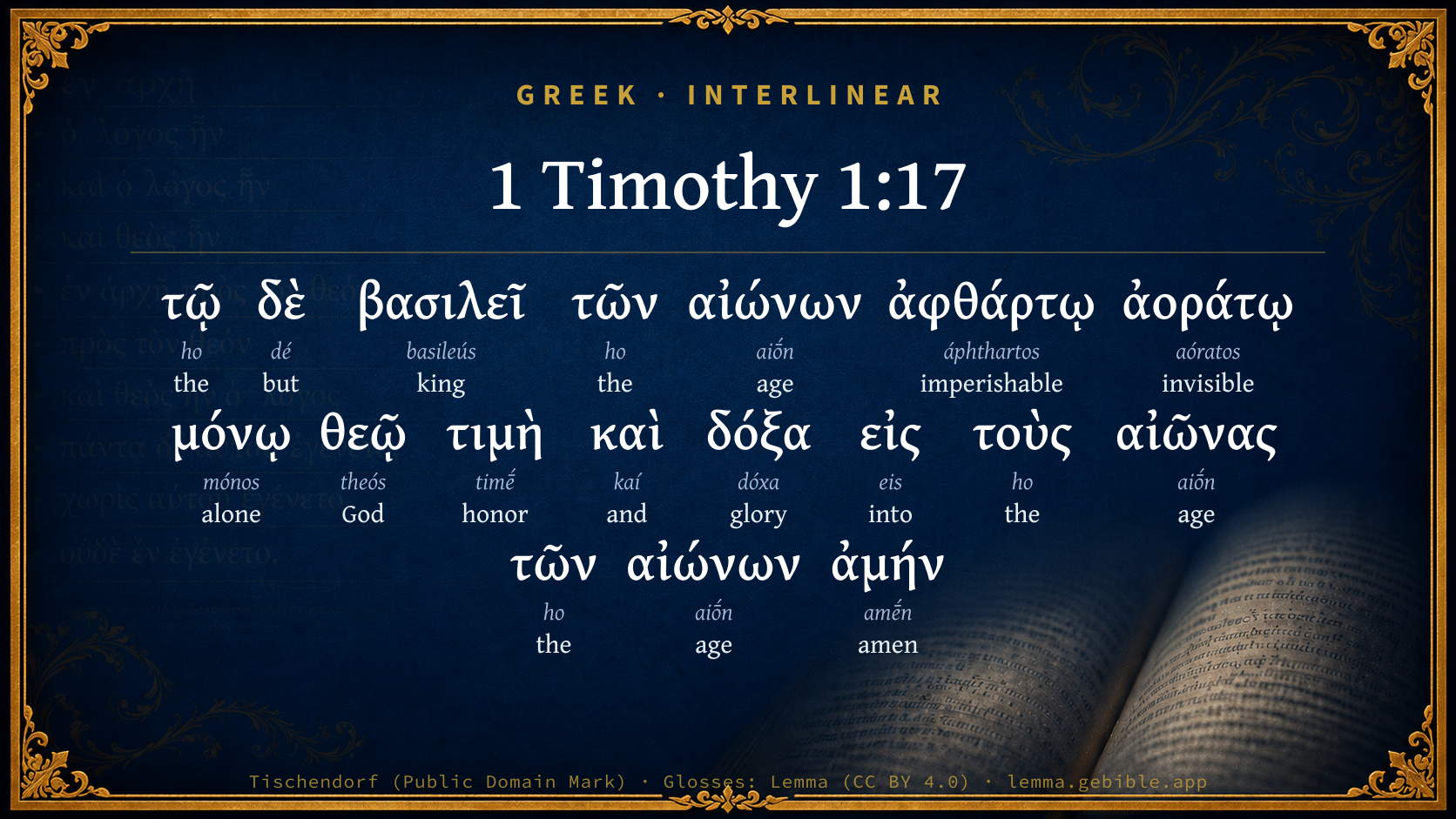
  1. τῷ ho G3588 “the” Article, Dative, Singular, Masculine
  2. δὲ dé G1161 “but” Conjunction
  3. βασιλεῖ basileús G935 “king” Noun, Dative, Singular, Masculine
  4. τῶν ho G3588 “the” Article, Genitive, Plural, Masculine
  5. αἰώνων aiṓn G165 “age” Noun, Genitive, Plural, Masculine
  6. ἀφθάρτῳ áphthartos G862 “imperishable” Adjective, Dative, Singular, Masculine
  7. μόνῳ mónos G3441 “alone” Adjective, Dative, Singular, Masculine
  8. θεῷ theós G2316 “God” Noun, Dative, Singular, Masculine
  9. τιμὴ timḗ G5092 “honor” Noun, Nominative, Singular, Feminine
  10. καὶ kaí G2532 “and” Conjunction
  11. δόξα dóxa G1391 “glory” Noun, Nominative, Singular, Feminine
  12. εἰς eis G1519 “into” Preposition
  13. τοὺς ho G3588 “the” Article, Accusative, Plural, Masculine
  14. αἰῶνας aiṓn G165 “age” Noun, Accusative, Plural, Masculine
  15. τῶν ho G3588 “the” Article, Genitive, Plural, Masculine
  16. αἰώνων aiṓn G165 “age” Noun, Genitive, Plural, Masculine
  17. ἀμήν amḗn G281 “amen” Hebrew transliteration

About this verse

These counts appear in no published source. They are computed here, from the morphology-tagged text and Lemma’s own curated glosses. What Lemma adds →

18
words
13
distinct lemmas
Pauline Epistles
section

Notable vocabulary

The rarest word here is ἀοράτῳ invisible G517 — appearing just 5 times in the whole Greek New Testament.

Shared distinctive vocabulary

ἀοράτῳ invisible G517 occurs in 5 verses of the Greek New Testament. Also found in:

Repetition

Words recur within this verse:

  • αἰώνων age G165 ×3
  • τῷ the G3588 ×4

Cross-references

45

Topical passages linked to 1 Timothy 1:17 in the Treasury of Scripture Knowledge — connected by theme and wording, ordered by reader-vote popularity; previews shown in the World English Bible.

  • Ephesians 3:20–21 Now to him who is able to do exceedingly abundantly above all that we ask or think, according to the power that works in us,
  • Jude 1:25 to God our Savior, who alone is wise, be glory and majesty, dominion and power, both now and forever. Amen.
  • 1 Timothy 6:15–16 which in its own times he will show, who is the blessed and only Ruler, the King of kings, and Lord of lords;
  • Revelation 17:14 These will war against the Lamb, and the Lamb will overcome them, for he is Lord of lords, and King of kings. They also will overcome who are with him, called and chosen and faithful."
  • Revelation 19:1 After these things I heard something like a loud voice of a great multitude in heaven, saying, "Hallelujah! Salvation, power, and glory belong to our God:
  • 1 Chronicles 29:11 Yours, Yahweh, is the greatness, the power, the glory, the victory, and the majesty: for all that is in the heavens and in the earth is yours. Yours is the kingdom, Yahweh, and you are exalted as head above all.
  • Colossians 1:15 who is the image of the invisible God, the firstborn of all creation.
  • Revelation 19:16 He has on his garment and on his thigh a name written, "KING OF KINGS, AND LORD OF LORDS."
  • Psalms 45:6 Your throne, God, is forever and ever. A scepter of equity is the scepter of your kingdom.
  • Psalms 10:16 Yahweh is King forever and ever! The nations will perish out of his land.
  • Romans 1:23 and traded the glory of the incorruptible God for the likeness of an image of corruptible man, and of birds, and four-footed animals, and creeping things.
  • Hebrews 1:8–13 but of the Son he says, "Your throne, O God, is forever and ever; The scepter of uprightness is the scepter of your Kingdom.
  • Revelation 19:6 I heard something like the voice of a great multitude, and like the voice of many waters, and like the voice of mighty thunders, saying, "Hallelujah! For the Lord our God, the Almighty, reigns!
  • Nehemiah 9:5 Then the Levites, Jeshua, and Kadmiel, Bani, Hashabneiah, Sherebiah, Hodiah, Shebaniah, [and] Pethahiah, said, Stand up and bless Yahweh your God from everlasting to everlasting; and blessed be your glorious name, which is exalted above all blessing and praise.
  • Psalms 47:6–8 Sing praise to God, sing praises. Sing praises to our King, sing praises.
  • Psalms 72:18–19 Praise be to Yahweh God, the God of Israel, Who alone does marvelous deeds.
  • Psalms 90:2 Before the mountains were brought forth, Or ever you had formed the earth and the world, Even from everlasting to everlasting, you are God.
  • Psalms 106:48 Blessed be Yahweh, the God of Israel, From everlasting even to everlasting! Let all the people say, "Amen." Praise Yah!
  • Psalms 145:13 Your kingdom is an everlasting kingdom. Your dominion endures throughout all generations.
  • Jeremiah 10:10 But Yahweh is the true God; he is the living God, and an everlasting King: at his wrath the earth trembles, and the nations are not able to abide his indignation.
  • Daniel 4:34 At the end of the days I, Nebuchadnezzar, lifted up my eyes to heaven, and my understanding returned to me, and I blessed the Most High, and I praised and honored him who lives forever; for his dominion is an everlasting dominion, and his kingdom from generation to generation.
  • Daniel 4:37 Now I, Nebuchadnezzar, praise and extol and honor the King of heaven; for all his works are truth, and his ways justice; and those who walk in pride he is able to abase.
  • Daniel 7:14 There was given him dominion, and glory, and a kingdom, that all the peoples, nations, and languages should serve him: his dominion is an everlasting dominion, which shall not pass away, and his kingdom that which shall not be destroyed.
  • Micah 5:2 But you, Bethlehem Ephrathah, Being small among the clans of Judah, Out of you one will come forth to me that is to be ruler in Israel; Whose goings forth are from of old, from everlasting.
  • Malachi 1:14 "But the deceiver is cursed, who has in his flock a male, and vows, and sacrifices to the Lord a blemished thing; for I am a great King," says Yahweh of hosts, "and my name is awesome among the nations."
  • Matthew 6:13 Bring us not into temptation, but deliver us from the evil one. For yours is the Kingdom, the power, and the glory forever. Amen.'
  • Matthew 25:34 Then the King will tell those on his right hand, 'Come, blessed of my Father, inherit the Kingdom prepared for you from the foundation of the world;
  • Matthew 28:20 teaching them to observe all things that I commanded you. Behold, I am with you always, even to the end of the age." Amen.
  • John 1:18 No one has seen God at any time. The one and only Son, who is in the bosom of the Father, he has declared him.
  • Romans 1:20 For the invisible things of him since the creation of the world are clearly seen, being perceived through the things that are made, even his everlasting power and divinity; that they may be without excuse.
  • Romans 2:7 to those who by patience in well-doing seek for glory and honor and incorruptibility, eternal life;
  • Romans 11:36 For of him, and through him, and to him, are all things. To him be the glory for ever! Amen.
  • Romans 16:27
  • Hebrews 11:27 By faith, he left Egypt, not fearing the wrath of the king; for he endured, as seeing him who is invisible.
  • 1 Peter 5:11 To him be the glory and the power forever and ever. Amen.
  • 2 Peter 3:18 But grow in the grace and knowledge of our Lord and Savior Jesus Christ. To him be the glory both now and forever. Amen.
  • 1 John 4:12 No one has seen God at any time. If we love one another, God remains in us, and his love has been perfected in us.
  • Revelation 4:8–11 The four living creatures, each one of them having six wings, are full of eyes around about and within. They have no rest day and night, saying, "Holy, holy, holy, holy, holy, holy, holy, holy, holy is the Lord God, the Almighty, who was and who is and who is to come!"
  • Revelation 5:9–14 They sang a new song, saying, "You are worthy to take the book, And to open its seals: For you were killed, And bought us for God with your blood, Out of every tribe, language, people, and nation,
  • Revelation 7:12 saying, "Amen! Blessing, glory, wisdom, thanksgiving, honor, power, and might, be to our God forever and ever! Amen."
  • Revelation 15:3 They sang the song of Moses, the servant of God, and the song of the Lamb, saying, "Great and marvelous are your works, Lord God, the Almighty; Righteous and true are your ways, you King of the nations.
  • Psalms 41:13 Blessed be Yahweh, the God of Israel, From everlasting and to everlasting! Amen and amen.
  • Psalms 45:1 My heart overflows with a noble theme. I recite my verses for the king. My tongue is like the pen of a skillful writer.
  • Psalms 57:11 Be exalted, God, above the heavens. Let your glory be over all the earth.
  • Daniel 2:44 In the days of those kings shall the God of heaven set up a kingdom which shall never be destroyed, nor shall the sovereignty of it be left to another people; but it shall break in pieces and consume all these kingdoms, and it shall stand forever.

Cross-references courtesy of OpenBible.info (CC BY 4.0).

Where the printed editions differ

1 variant

Places in this verse where the major printed Greek editions disagree on the wording in a way that affects the translation — a comparison of editions, not a manuscript-by-manuscript collation. The editions are the modern critical texts (Nestlé-Aland 28/27, SBL, Westcott-Hort, Tregelles, Tyndale House) and the traditional texts behind the KJV (the Textus Receptus and the Byzantine/Majority text). It is not a claim about which reading is original.

  1. Extra text
    σοφῷ

    “wise”

    In TRByz Not in NA28NA27TynSBLWHTreg

    σοφῷ (sophō) 'wise' is only in traditional manuscripts (TR+Byz)

Textual data: Translators Amalgamated Greek New Testament (STEPBible TAGNT) · CC BY 4.0.

Commentary

Notes on 1 Timothy 1:17 from classic Christian and Jewish commentators (each source and its license shown beneath its notes). The classic Christian expositions comment on the surrounding passage and are grouped to its opening verse, so a note may address several verses; the Jewish commentaries on the Tanakh (Rashi and others) are per-verse, so they appear only where the commentator wrote on this verse.

Lemma curates 59 commentaries, every one of them public domain or Creative Commons licensed, each selected and text-cleaned for this edition rather than reprinted as found. About our sources →

The Biblical Illustrator

Joseph S. Exell

1Ti_1:17

Now unto the King eternal

The King of the Ages

The King eternal, or, literally, as in the margin of the Revised Version, The King of the Ages, words which do not simply tell us something about the King, but also give us some account of His rule; and put into the hands of Faith a key to the highest positions of modern thought and science.

For in all their realms--of matter, mind, and spirit--there is one common element, viz., Law. Whether we look around us, or within, order and rule are being ever more clearly and universally demonstrated. But the Christian attitude is becoming more candid; and now accepts, or is learning to accept the truth of a widespread reign of law with less of fear than of gratitude. For is not this state of order and harmony just what we should expect in His working whose Being is the perfect harmony? For while we know this as an age of Law, and are sometimes perplexed by its inexorableness, the thoughtful mind asks: Have all the ages been as ordered? In the world of spirit and of matter have there not been whole epochs of distraction and ravage by undisciplined forces? For example, does not the earth on which we tread, bear in her very structure the record of ages of confusion and chaos, darkness and death? when lawlessness, not law, seemed to rule? when, so far as we can judge, there was no guiding thought, no ruling hand? In fact, does not the same defiance of law meet us today in the earthquake? Is law universal or only widespread? But the deeper readings of science assure us that it is not only the quiet processes which gladden the eye and heart that have their ordered course. The silent and regular development through blade and ear to the full corn, is not more determined and invariable than is the dread convulsion that entombs its thousands; and it was through the exercise of unyielding law that that strife was wrought which has made the structure of our earth what we find it. This decided every event and ordered all the disorder of those ages of seeming unrule. And shall we not take the comfort the spiritual reading of this truth can give? For it is not only in the world of matter such a record of strife and confusion is written. In the brief history of our race there is the same tale in human characters. What is the meaning of such scenes as the French Revolution, for example? Are they the rough sport of unruled passion? Is there nothing determining their methods or moulding their results? What if that struggle and ruin, decay and destruction were the working and manifestation of a Divine health and order, casting away that which it could not assimilate and arrange? the removing of those things which could be shaken that those things which could not be shaken might remain? And these words, which speak of a King of the Ages, tell us why. They point to its source--to One who makes and administers that law, who is in and yet above it. But the faith of a Divine rule of each separate age is not enough. The heart of man craves something more than even such a confidence. There is inwrought into our very being a longing for Unity; and the words we are now considering justify this instinct, and pledge its fulfilment. For we are assured that, if He is King of the Ages in any adequate sense, they are bound together by the strong band of His will, which gives to them its own oneness and intimacy. They are no longer isolated units, but parts of a whole; and it is as a whole and not simply as units they are subjected. As the successive points of a circle stand in harmonious relation, not only to their common centre, hut through this to each other; so the ages, which make one mighty cycle, having but one Lord and one law, stand related amongst themselves with an inner harmony as deep and true as their hearts. And not only so. There is more than this close relation and perfect agreement between the ages. If this were all it would leave unfulfilled another instinctive craving of the heart--that of Progress and Consummation. But these words which speak of the King of the Ages tell us there is one supreme will and word which they obey--one harmonious thought, which being the Kings thought, must be a growing and deepening one. There is but little appearance of all this at times. Judging only of the part we see--that displayed on the earth and amidst ourselves--is not the show of things rather that of age at war with age? A backward movement, in which much that has been hardly won through centuries is easily lost in a moment? But it is only as the flow of the tide rolling inland, which surely advances, though seeming to recede; receding but to rally its forces and sweep onward to larger conquests. One perfect plan is being achieved, in many times and many ways indeed; yet in all, and through all, God is ever fulfilling Himself. Let us not, then, be troubled as though the issue is or could be uncertain, or the plan be marred. Trust--not only for the ages gone and the ages to come; but what is harder, for the age that now is. The King of the Ages is Himself invisible; He is not, therefore, less King. Nor is His kingdom less real because its presence is silent and unsuspected. For there are latent glories in this rule of the King of the Ages; a glorious mystery which was hidden from the ages and generations until the fulness of the time, when the Word became flesh and tabernacled amongst men, whose humanity He thus united with Deity, that He might reconcile man, and in man, all creation unto God. (A. A. Dauncey.)

King immortal

Queen Elizabeth was once seized with a violent illness, accompanied with high fever. The Privy Council was hastily summoned from London, and in the ante-chamber of the room where she was believed to be dying, they sat with blank faces, discussing who was to be her successor. In the morning the worst symptoms abated, and in a few days she was convalescent. Our Monarch can have no successor. He is alive for evermore, and of His kingdom there can be no end. (H. O. Mackey.)

The Biblical Illustrator, edited by Joseph S. Exell (c. 1880s–1900s) — public domain. Text from a community e-Sword module.

Joseph Benson's Commentary

1Ti 1:17. Now unto the King, &c. — A consideration of the great mercy which God had shown him, in not only pardoning him when he was involved in such great guilt, but in making him an example for the comfort of future penitents, causes him to break forth in a rapture of praise and thanksgiving; eternal — Whose existence had no beginning, and shall have no end; immortal — Or incorruptible, as αφθαρτω also signifies; it is however rightly translated immortal, because what is incorruptible is likewise immortal; invisible — To mortal eyes. By this epithet the true God is distinguished from all those heathen deities who were the workmanship of men’s hands, or the creatures of God, such as the luminaries of heaven, and from all those deified heroes and other human beings who had once been visible on earth, and were made the objects of worship after their decease. To the only wise God — Or, to God only wise; that is, originally, independently, essentially, and infinitely; or, to the wise God alone, (for the reason of which rendering see note on Rom 16:27,) be honour and glory — That is, let these excellences be more sensibly manifested, more seriously and frequently acknowledged, and sincerely venerated.

Joseph Benson's Commentary on the Old and New Testaments (1811–1818) — public domain. Text from a community e-Sword module.

MacLaren's Expositions of Holy Scripture

Alexander MacLaren

1 Timothy

THE GLORY OF THE KING

1Ti 1:17.

With this burst of irrepressible praise the Apostle ends his reference to his own conversion as a transcendent, standing instance of the infinite love and transforming power of God. Similar doxologies accompany almost all his references to the same fact. This one comes from the lips of ‘Paul the aged,’ looking back from almost the close of a life which owed many sorrows and troubles to that day on the road to Damascus. His heart fills with thankfulness that overflows into the great words of my text. He had little to be thankful for, judged according to the rules of sense; but, though weighed down with care, having made but a poor thing of the world because of that vision which he saw that day, and now near martyrdom, he turns with a full heart to God, and breaks into this song of thanksgiving. There are lives which bear to be looked back upon. Are ours of that kind?

But my object is mainly to draw your attention to what seems to me a remarkable feature in this burst of thanksgiving. And perhaps I shall best impress the thought which it has given to me if I ask you to look, first, at the character of the God who is glorified by Paul’s salvation; second, at the facts which glorify such a God; and, last, at the praise which should fill the lives of those who know the facts.

I. First, then, notice the God who is glorified by Paul’s salvation.

Now what strikes me as singular about this great doxology is the characteristics, or, to use a technical word, the attributes, of the divine nature which the Apostle selects. They are all those which separate God from man; all those which present Him as arrayed in majesty, apart from human weaknesses, unapproachable by human sense, and filling a solitary throne. These are the characteristics which the Apostle thinks receive added lustre, and are lifted to a loftier height of ‘honour and glory,’ by the small fact that he, Paul, was saved from sins as he journeyed to Damascus.

It would be easy to roll out oratorical platitudes about these specific characteristics of the divine nature, but that would be as unprofitable as it would be easy. All that I want to do now is just to note the force of the epithets; and, if I can, to deepen the impression of the remarkableness of their selection.

With regard, then, to the first of them, we at once feel that the designation of ‘the King’ is unfamiliar to the New Testament. It brings with it lofty ideas, no doubt; but it is not a name which the writers of the New Testament, who had been taught in the school of love, and led by a Son to the knowledge of God, are most fond of using. ‘The King’ has melted into ‘the Father.’ But here Paul selects that more remote and less tender name for a specific purpose. He is ‘the King’--not ‘ eternal ,’ as our Bible renders it, but more correctly ‘the King of the Ages.’ The idea intended is not so much that of unending existence as that He moulds the epochs of the world’s history, and directs the evolution of its progress. It is the thought of an overruling Providence, with the additional thought that all the moments are a linked chain, through which He flashes the electric force of His will. He is ‘King of the Ages.’

The other epithets are more appropriately to be connected with the word ‘God’ which follows than with the word ‘King’ which precedes. The Apostle’s meaning is this: ‘The King of the ages, even the God who is,’ etc. And the epithets thus selected all tend in the same direction. ‘Incorruptible.’ That at once parts that mystic and majestic Being from all of which the law is decay . There may be in it some hint of moral purity, but more probably it is simply what I may call a physical attribute, that that immortal nature not only does not, but cannot , pass into any less noble forms. Corruption has no share in His immortal being.

As to ‘invisible,’ no word need be said to illustrate that. It too points solely to the separation of God from all approach by human sense.

And then the last of the epithets, which, according to the more accurate reading of the text, should be, not as our Bible has it, ‘the only wise God,’ but ‘the only God,’ lifts Him still further above all comparison and contact with other beings.

So the whole set forth the remote attributes which make a man feel, ‘The gulf between Him and me is so great that thought cannot pass across it, and I doubt whether love can live half-way across that flight, or will not rather, like some poor land bird with tiny wings, drop exhausted, and be drowned in the abyss before it reaches the other side.’ We expect to find a hymn to the infinite love. Instead of that we get praise, which might be upon the lips of many a thinker of Paul’s day and of ours, who would laugh the idea of revelation, and especially of a revelation such as Paul believed in, to absolute scorn. And yet he knew what he was saying when he did not lift up his praise to the God of tenderness, of pity, of forgiveness, of pardoning love, but to ‘the King of the ages; the incorruptible, invisible, only God’; the God whose honour and glory were magnified by the revelation of Himself in Jesus Christ.

II. And so that brings me, in the second place, to ask you to look at the facts which glorify even such a God.

Paul was primarily thinking of his own individual experience; of what passed when the voice spoke to him, ‘Why persecutest thou Me?’ and of the transforming power which had changed him, the wolf, with teeth red with the blood of the saints, into a lamb. But, as he is careful to point out, the personal allusion is lost in his contemplation of his own history, as being a specimen and test-case for the blessing and encouragement of all who ‘should hereafter believe upon Him unto life everlasting.’ So what we come to is this--that the work of Jesus Christ is that which paints the lily and gilds the refined gold of the divine loftinesses and magnificence, and which brings honour and glory even to that remote and inaccessible majesty. For, in that revelation of God in Jesus Christ, there is added to all these magnificent and all but inconceivable attributes and excellences, something that is far diviner and nobler than themselves.

There be two great conceptions smelted together in the revelation of God in Jesus Christ, of which neither attains its supremest beauty except by the juxtaposition of the other. Power is harsh, and scarcely worthy to be called divine, unless it be linked with love. Love is not glorious unless it be braced and energised by power. And, says Paul, these two are brought together in Jesus; and therefore each is heightened by the other. It is the love of God that lifts His power to its highest height; it is the revelation of Him as stooping that teaches us His loftiness. It is because He has come within the grasp of our humanity in Jesus Christ that we can hymn our highest and noblest praises to ‘the King eternal, the invisible God.’

The sunshine falls upon the snow-clad peaks of the great mountains and flushes them with a tender pink that makes them nobler and fairer by far than when they were veiled in clouds. And so all the divine majesty towers higher when we believe in the divine condescension, and there is no god that men have ever dreamed of so great as the God who stoops to sinners and is manifest in the flesh and Cross of the Man of Sorrows.

Take these characteristics of the divine nature as get forth in the text one by one, and consider how the Revelation in Jesus Christ, and its power on sinful men, raises our conceptions of them. ‘The King of the ages’--and do we ever penetrate so deeply into the purpose which has guided His hand, as it moulded and moved the ages, as when we can say with Paul that His ‘good pleasure’ is that, ‘in the dispensation of the fulness of times, He might gather together in one all things in Christ.’ The intention of the epochs as they emerge, the purpose of all their linked intricacies and apparently diverse movements, is this one thing, that God in Christ may be manifest to men, a nd that humanity may be gathered, like sheep round the Shepherd, into the one fold of the one Lord. For that the world stands; for that the ages roll, and He who is the King of the epochs hath put into the hands of the Lamb that was slain the Book that contains all their events; and only His hand, pierced upon Calvary, is able to open the seals, to read the Book. The King of the ages is the Father of Christ.

And in like manner, that incorruptible God, far away from us because He is so, and to whom we look up here doubtingly and despairingly and often complainingly and ask, ‘Why hast Thou made us thus, to be weighed upon with the decay of all things and of ourselves?’ comes near to us all in the Christ who knows the mystery of death, and thereby makes us partakers of an inheritance incorruptible. Brethren, we shall never adore, or even dimly understand, the blessedness of believing in a God who cannot decay nor change, unless from the midst of graves and griefs we lift our hearts to Him as revealed in the face of the dying Christ. He, though He died, did not see corruption, and we through Him shall pass into the same blessed immunity.

‘The King . . . the God invisible.’ No man hath seen God ‘at any time, nor can see Him.’ Who will honour and glorify that attribute which parts Him wholly from our sense, and so largely from our apprehension, as will he who can go on to say, ‘the only begotten Son which is in the bosom of the Father, He hath declared Him.’ We look up into a waste Heaven; thought and fear, and sometimes desire, travel into its tenantless spaces. We say the blue is an illusion; there is nothing there but blackness. But ‘he that hath seen Me hath seen the Father.’ And we can lift thankful praise to Him, the King invisible, when we hear Jesus saying, ‘thou hast both seen Him, and it is He that talketh with thee.’

‘The only God.’ How that repels men from His throne! And yet, if we apprehend the meaning of Christ’s Cross and work, we understand that the solitary God welcomes my solitary soul into such mysteries and sacred sweetnesses of fellowship with Himself that, the humanity remaining undisturbed, and the divinity remaining unintruded upon, we yet are one in Him, and partakers of a divine nature. Unless we come to God through Jesus Christ, the awful attributes in the text spurn a man from His throne, and make all true fellowship impossible.

So let me remind you that the religion which does not blend together in indissoluble union these two, the majesty and the lowliness, the power and the love, the God inaccessible and the God who has tabernacled with us in Jesus Christ, is sure to be almost an impotent religion. Deism in all its forms, the religion which admits a God and denies a revelation; the religion which, in some vague sense, admits a revelation and denies an incarnation; the religion which admits an incarnation and denies a sacrifice; all these have little to say to man as a sinner; little to say to man as a mourner; little power to move his heart, little power to infuse strength into his weakness. If once you strike out the thought of a redeeming Christ from your religion, the temperature will go down alarmingly, and all will soon be frost bound.

Brethren, there is no real adoration of the loftiness of the King of the ages, no true apprehension of the majesty of the God incorruptible, invisible, eternal, until we see Him in the face and in the Cross of Jesus Christ. The truths of this gospel of our salvation do not in the smallest degree impinge upon or weaken, but rather heighten, the glory of God. The brightest glory streams from the Cross. It was when He was standing within a few hours of it, and had it full in view, that Jesus Christ broke out into that strange strain of triumph, ‘Now is God glorified.’ ‘The King of the ages, incorruptible, invisible, the only God,’ is more honoured and glorified in the forgiveness that comes through Jesus Christ, and in the transforming power which He puts forth in the Gospel, than in all besides.

III. Lastly, let me draw your attention to the praise which should fill the lives of those who know these facts.

I said that this Apostle seems always, when he refers to his own individual conversion, to have been melted into fresh outpourings of thankfulness and of praise. And that is what ought to be the life of all of you who call yourselves Christians; a continual warmth of thankfulness welling up in the heart, and not seldom finding utterance in the words, but always filling the life.

Not seldom, I say, finding utterance in the words. It is a delicate thing for a man to speak about himself, and his own religious experience. Our English reticence, our social habits, and many other even less worthy hindrances rise in the way; and I should be the last man to urge Christian people to cast their pearls before swine, or too fully to

‘Open wide the bridal chamber of the heart,’

to let in the day. There is a wholesome fear of men who are always talking about their own religious experiences. But there are times and people to whom it is treason to the Master for us not to be frank in the confession of what we have found in Him. And I think there would be less complaining of the want of power in the public preaching of the Word if more professing Christians more frequently and more simply said to those to whom their words are weighty, ‘Come and hear and I will tell you what God hath done for my soul.’ ‘Ye are my witnesses,’ saith the Lord. It is a strange way that Christian people in this generation have of discharging their obligations that they should go, as so many of them do, from the cradle of their Christian lives to their graves, never having opened their lips for the Master who has done all for them.

Only remember, if you venture to speak you will have to live your preaching. ‘There is no speech nor language, their voice is not heard, their sound is gone out through all the earth.’ The silent witness of life must always accompany the audible proclamation, and in many cases is far more eloquent than it. Your consistent thankfulness manifested in your daily obedience, and in the transformation of your character, will do far more than all my preaching, or the preaching of thousands like me, to commend the Gospel of Jesus Christ.

One last word, brethren. This revelation is made to us all. What is God to you, friend? Is He a remote, majestic, unsympathising, terrible Deity? Is He dim, shadowy, unwelcome; or is He God whose love softens His power; Whose power magnifies his love? Oh! I beseech you, open your eyes and your hearts to see that that remote Deity is of no use to you, will do nothing for you, cannot help you, may probably judge you, but will never heal you. And open your hearts to see that ‘the only God’ whom men can love is God in Christ. If here we lift up grateful praise ‘unto Him that loveth us and hath loosed us from our sins in His blood,’ we, too, shall one day join in that great chorus which at last will be heard saying, ‘Blessing and honour and glory and power be unto Him that sitteth upon the throne, and unto the Lamb for ever and ever.’

Alexander MacLaren, Expositions of Holy Scripture (1904–1910) — public domain. Text from a community e-Sword module.

Bengel's Gnomon

Johann Albrecht Bengel

1Ti 1:17. Τῷ δὲ) The doxology flows from a sense of grace.—Βασιλεῖ τῶν αἰώνων, to the King of œons or ages [eternal]) A frequent phrase with the Hebrews. The thought of eternity is particularly delightful to those assured of grace, while it miserably terrifies others.—ἀοράτῳ, invisible) This attribute is given Him in the way of praise. See how perverse they are who affirm that there is no God, because they do not see Him.—μόνῳ Θεῷ, the only God) So, the only Potentate, ch. 1Ti 6:15; comp. Psa 86:10; Joh 5:44; Jud 1:25. [A magnificent reading![13]—Not. Crit.]—τιμὴ, δόξα, honour, glory) Such an Asyndeton is commonly used, where circumstances and feelings would tend to render the words much accumulated (tend to produce somewhat of an accumulation of words): for example, honour and glory and strength, etc.; and where nevertheless he leaves them to be supplied in the mind of the hearer. Such an Asyndeton is very suitable to the ardour of the apostle in doxologies, ch. 1Ti 6:16; 1Pe 5:11; although the transcribers have very generally inserted καὶ. The omission of this particle in so many passages is not accidental; but its addition is due to the over-busy officiousness of transcribers.[14]

[13] So AD(Δ) corrected, Gfg Vulg. But Rec. Text adds σόφῳ to μὀνῳ, with later Syr. He who alone is God gives a more striking sense than the only wise God.—ED.

[14] Unfortunately for Bengel’s argument, the best authorities, which Lachm. and Tisch. follow, read the καὶ. However, many secondary authorities omit it.—ED.

Bengel's Gnomon of the New Testament — English translation (T&T Clark, Edinburgh, 1860) — public domain. Text from a community e-Sword module.

Meyer's Critical & Exegetical Commentary

Heinrich August Wilhelm Meyer

1Ti_1:17. Ex sensu gratiae fluit doxologia (Bengel). With this doxology the apostle closes the digression begun in 1Ti_1:11, and returns again to the proper epistolary style.

τῷ δὲ βασιλεῖ τῶν αἰώνων] This designation for God is not found elsewhere in the N. T. (even the use of βασιλεύς of God only occurs elsewhere in chap. 1Ti_6:15 and Mat_5:35), but it is found in the Apocrypha of the O. T. in Tob_13:6; Tob_13:10. (Sir_36:19 : ὁ Θεὸς τῶν αἰώνων.) Οἱ αἰῶνες means either the world, as in Heb_1:2; Heb_11:3 (see Delitzsch and Lünemann on this passage), or the times. The former meaning is adopted by Chrysostom, Leo, etc. (Leo appealing to Eusebius, de Laud. Constant. chap. vi. p. 431, ed. Heinrichs: τὸν μέγαν τοῦ σύμπαντος αἰῶνος βασιλέα); the latter, by Matthies: the ruler of all times, so that all generations are at the same time concretely included. In a similar way, Heydenreich has the supreme ruler of time, and of all that takes place in its course. This latter explanation is supported as correct both by the preceding μελλόντων (van Oosterzee), and also by the ἀφθάρτῳ following, and by εἰς τοὺς αἰῶνας τῶν αἰώνων farther on.[71] It is incorrect to take αἰῶνες as equivalent to eternity, and translate: to the king eternal (de Wette, but tentatively; Hofmann: the king who is for ever and without end),[72] for αἰῶνες never has that meaning in itself. Only in the formulas ἀπὸ τῶν αἰώνων and εἰς τοὺς αἰῶνας does the meaning of the word approach that idea. Besides, the apostle would surely have expressed that adjectival idea by an adjective. It is quite erroneous to take the word here in the Gnostic sense of series of emanations, synonymous with γενεαλογίαι in 1Ti_1:4; for, on the one hand, no proof is given that this expression had been already used by the heretics alluded to in this epistle; and, on the other, the apostle considered the whole theory of genealogies as belonging to the sphere of myths. It was impossible, therefore, for him in his doxology to speak of God as the king of things which were to Him nothing but the inventions of fancy.

ἀφθάρτῳ] is only used of God elsewhere in Rom_1:23 (Plut. adv. St. 31; Wis_12:1). Matthies: God is the Imperishable One, because His nature is unchanging and based on itself, equivalent to ὁ μόνος ἔχων ἀθανασίαν, chap. 1Ti_6:16.

ἀοράτῳ] comp. Heb_11:27 (without Θεός), Rom_1:20, and Col_1:15 (with Θεός); equivalent to ὃν εἶδεν οὐδεὶς ἀνθρώπων, οὐδὲ ἰδεῖν δύναται, chap. 1Ti_6:16; comp. also Joh_1:18.

μόνῳ Θεῷ] chap. 1Ti_6:15 : μόνος δυναστής; comp. also Joh_5:44; Joh_17:3; Rom_16:27 : μόνῳ σοφῷ Θεῷ. The words ἀφθάρτῳ … Θεῷ are to be taken as in apposition to τῷ βασιλεῖ. But it is doubtful whether Θεῷ is to be joined with μόνῳ only, or also with ἀφθάρτῳ and ἀοράτῳ, as is commonly done. De Wette is wrong in asserting that all these predicates are used of God superfluously: they manifestly express the absolute exaltation of God above all conditioned finite being, and are occasioned naturally (which Hofmann disputes) by the contrast with the heresy which denied the absoluteness of the divine existence.

τιμὴ καὶ δόξα] The two words are united also in Rom_2:7; Rom_2:10; Heb_2:7; but only here and in the Apocalypse do they occur in doxologies. Paul elsewhere uses only δόξα, and always with the article.

εἰς τοὺς αἰῶνας τῶν αἰώνων] a very common conclusion in doxologies, and found in Pauls other epistles. It is not to be overlooked that this doxology has a peculiar character distinct from those usually occurring in Paul, both in the mode of connection (elsewhere a pronoun connects them with what precedes) and also in the designation for God and the expressions used.

[71] Comp. Psa_144:13, LXX.: ἡ βασιλεία σου βασιλεία πάντων τῶν αἰώνων καὶ ἡ δεσποτεία σου ἐν πάσῃ γενεᾷ καὶ γενεᾷ.

[72] Wiesinger explains it: He is a king of the aeons, which together give the idea of eternity, just as His kingdom is an everlasting kingdom.

Meyer — Critical and Exegetical Commentary on the New Testament — English translation by Peter Christie, edited by Frederick Crombie (T&T Clark, 1880) — public domain. Text from a community e-Sword module.

Expositor's Greek Testament

ed. W. Robertson Nicoll

1Ti 1:17 . This noble doxology might be one used by St. Paul himself in one of his eucharistic prayers. It is significant that in the Jewish forms of thanksgiving מֶֽלֶךְ הָעוֹלָם is of constant occurrence. See reff., and θεὸς τῶν αἰ . in Sir 36:22 . Bengel’s suggestion (on ch. 1Ti 1:4 ) that there is a polemical reference to the aeons of Gnosticism is fanciful and unnecessary. βασιλεύς , as a title of God the Father, is found in 1Ti 6:15 and Rev 15:3 , a passage of which Swete says ( comm . in loc.), “The thought as well as the phraseology of the Song is strangely Hebraic”. Cf. Ps. 9:37 (Psa 10:16 ).

ἀφθάρτῳ : The three adjectives ἀφθάρτῳ , ἀοράτῳ , μόνῳ are co-ordinate epithets of θεῷ , to God immortal, invisible, unique .

ἄφθαρτος , immortal , as an epithet of God, occurs Rom 1:23 ( cf. Wis 12:1 , τὸ γὰρ ἄφθαρτόν σου … πνεῦμά ἐστιν ἐν πᾶσιν , and Moulton and Milligan, Expositor , vii., vi. 376). It is expanded in 1Ti 6:15 sq., who only hath immortality , just as ἀοράτῳ becomes whom no man hath seen, nor can see (for the thought, see Joh 1:18 , Col 1:15 , Heb 11:27 , 1Jn 4:12 ), and μόνῳ becomes the blessed and only potentate . For the epithet μόνος , used absolutely, see reff. and also Psa 86:10 , Joh 17:3 , Rom 16:27 .

τιμὴ καὶ δόξα : This combination in a doxology is found Rev 4:9 , δώσουσιν … δόξαν καὶ τιμὴν ; 1Ti 5:13 , ἡ τιμὴ καὶ ἡ δόξα . In St. Paul’s other doxologies (Gal 1:5 , Rom 11:36 ; Rom 16:27 , Phi 4:20 , Eph 3:21 , 1Ti 6:16 , 2Ti 4:18 ), with the exception of 1Ti 6:16 ( τιμὴ καὶ κράτος ), τιμή is not found; and he always has ἡ δόξα (see Westcott, Additional Note on Heb 13:21 ).

The Expositor's Greek Testament, edited by W. Robertson Nicoll (1897–1910) — public domain. Text from a community e-Sword module.

Cambridge Greek Testament for Schools and Colleges

17. μόνῳ θεῷ. So א*AD2*G and nearly all versions. אcD2bcKLP and the Peshito add σοφῷ after μόνῳ; but this (the reading of rec. text) is probably a corruption introduced from Rom 16:27. See Jud 1:25 for a similar variation.

17. We have here a characteristic breaking out into a doxology. A complete list of the Apostolic doxologies has been drawn out by Dr Westcott (Additional Note on Heb 13:21)[517], and will repay careful study. In the three doxologies of the Pastoral Epistles (1Ti 1:17; 1Ti 6:16, and 2Ti 4:18) we may perhaps observe a greater tendency to dwell on the absolute Eternity, Power, Unity of the Godhead, than in the expressions of thanksgiving in the earlier letters; but the main features are the same in all. In only one instance, 1Pe 4:11, is the verb expressed, ᾧ ἐστὶν ἡ δόξα καὶ τὸ κράτος; and it seems probable that in every instance ἐστίν rather than ἔστω should be understood. So the verb in the doxology at the end of the Lord’s Prayer (Mat 6:13) is in the indicative mood. A doxology is not a prayer or an aspiration; it is a reverent and thankful statement of the Divine glory.

[517] See also Chase, Lord’s Prayer in the Early Church, p. 168 ff.

τῷ δὲ βασιλεῖ τῶν αἰώνων. This exact phrase occurs elsewhere in the Greek Bible only in Tob 13:6; Tob 13:10, and in Rev 15:3 (where the received text has τῶν ἁγίων); but it naturally flows from the language of Psa 145:13, ἡ βασιλεία σου βασιλεία πάντων τῶν αἰώνων. Cp. Exo 15:18 (where Philo read βασιλεύων τῶν αἰώνων, De Mundo, 7), Sir 36:19, and Bk of Enoch ix. 4, where one of the texts has βασιλεὐς τῶν αἰώνων. See also Book of Jubilees, xxv. 15; xxxi. 13. The corresponding expression οἱ βασιλεῖαι τοῦ αἰῶνος τούτου, which occurs in Ignatius (Romans 6), brings the meaning out well. There is no reference to the aeons of Gnostic heresy; αἰών in the singular means an ‘age,’ a certain limit of time, and so ὁ αἰὼν οὖτος is ‘this present age.’ But in the plural, when we sum up these ‘ages’ or ‘world periods,’ we arrive at the idea of eternity; and ‘the King who rules over the ages’ is ‘the King eternal.’ So too εἰς τὸν αἰῶνα = ‘to the end of this present age’; but εἰς τοὺς αἰῶνας = ‘for ever.’

ἀφθάρτῳ ἀοράτῳ μόνῳ. All three adjectives qualify θεῷ, not the preceding βασιλεῖ τῶν αἰώνων. ἄφθαρτος θεός is a combination only found again in Rom 1:23; but ἄφθαρτος is a regular epithet of Deity in Philo (e.g. Quod deus immut. 6). For ἀόρατος we may compare Rom 1:20; Col 1:15, and Heb 11:27. With both expressions cp. ὁ μόνος ἔχων ἀθανασίαν … δν εἶδεν οὐδεὶς ἀνθρώπων of 1Ti 6:16.

μὁνῳ θεῷ. Bengel calls this a ‘magnifica lectio’ (see critical note). Cp. Joh 17:3, τὸν μόνον ἀληθινὸν θεόν, Rom 16:27 and ch. 1Ti 6:15. Compare also Philo’s μἁ τὸν ἀληθῆ μόνον θεόν (Leg. All. ii. 17) and ἡ θεοῦ μόνου θεραπεία (De Prof. 7).

τιμἠ καὶ δόξα. This combination in a doxology occurs again only in Rev 5:13. Cp. Rev 4:9 and Rom 2:7; Rom 2:10.

εἰς τοὺς αἰῶνας τῶν αἰώνων· ἀμήν. Perhaps this phrase implies that the form of doxology in this verse had become stereotyped by liturgical use. At all events this is a common ending. See Heb 13:21; 1Pe 4:11; 1Pe 5:11; Rev 7:12: cp. Psalms passim.

Cambridge Greek Testament for Schools and Colleges (Cambridge University Press, 1896; 21 vols, various authors incl. Carr, Maclear, Plummer, Farrar, Lumby, Moule, M. R. James, Simcox) — public domain. Text from a community e-Sword module.

Geneva Bible (1599)

Geneva Bible translators

See John 17:3.

He breaketh out into an exclamation, even for very zeal of mind, for that he cannot satisfy himself in amplifying the grace of God.

Geneva Bible (1599) marginal notes — public domain. Text via Bolls.life.

Jamieson, Fausset & Brown

Robert Jamieson, A. R. Fausset & David Brown

A suitable conclusion to the beautifully simple enunciation of the Gospel, of which his own history is a living sample or pattern. It is from the experimental sense of grace that the doxology flows [BENGEL].

the King, eternal--literally, "King of the (eternal) ages." The Septuagint translates Exo 15:18, "The Lord shall reign for ages and beyond them." Psa 145:13, Margin, "Thy kingdom is an everlasting kingdom," literally, "a kingdom of all ages." The "life everlasting" (Ti1 1:16) suggested here "the King eternal," or everlasting. It answers also to "for ever and ever" at the close, literally, "to the ages of the ages" (the countless succession of ages made up of ages).

immortal--The oldest manuscripts read, "incorruptible." The Vulgate, however, and one very old manuscript read as English Version (Rom 1:23).

invisible-- (Ti1 6:16; Exo 33:20; Joh 1:18; Col 1:15; Heb 11:27).

the only wise God--The oldest manuscripts omit "wise," which probably crept in from Rom 16:27, where it is more appropriate to the context than here (compare Jde 1:25). "The only Potentate" (Ti1 6:15; Psa 86:10; Joh 5:44).

for ever, &c.--See note, above. The thought of eternity (terrible as it is to unbelievers) is delightful to those assured of grace (Ti1 1:16) [BENGEL].

Jamieson, Fausset & Brown — Commentary Critical and Explanatory on the Whole Bible (1871) — public domain (CC PDM 1.0). Text via the HelloAO Bible API.

Adam Clarke's Commentary

Verse 17. Now unto the King eternal] This burst of thanksgiving and gratitude to God, naturally arose from the subject then under his pen and eye. God has most wondrously manifested his mercy, in this beginning of the Gospel, by saving me, and making me a pattern to all them that shall hereafter believe on Christ. He is βασιλευς των αιωνων, the king of eternities; the eternity a parte ante, and the eternity a parte post; the eternity that was before time was, and the eternity that shall be when time is no more. Therefore, ever living to justify and save sinners, to the end of the world.

Immortal] αφθαρτω. Incorruptible-not liable to decay or corruption; a simple uncompounded essence, incapable, therefore, of decomposition, and consequently permanent and eternal. One MS., the later Syriac in the margin, the Vulgate, one copy of the Itala, and some of the Latin fathers, read αθανατω, immortal, which our translation follows; but it is not the original reading.

Invisible] αορατω. One who fills all things, works everywhere, and yet is invisible to angels and men; the perfect reverse of false gods and idols, who are confined to one spot, work nowhere, and, being stocks and stones, are seen by every body.

The only wise God] The word σοφω wise, is omitted by AD*FG, Syriac, Erpen's Arabic, Coptic, Sahidic, AEthiopic, Armenian, Vulgate, and Itala. Some of the Greek fathers quote it sometimes, and omit it at others; which shows that it was an unsettled reading, probably borrowed from Ro 16:27. See the note there. Griesbach leaves it out of the text. Without it the reading is very strong and appropriate: To the only God; nothing visible or invisible being worthy of adoration but himself.

Be honour] All the respect and reverence that can be paid by intelligent beings, ascribing to him at the same time all the glory-excellences, and perfections, which can be possessed by an intelligent, unoriginated, independent, and eternal Being; and this for ever and ever-through eternity.

Adam Clarke's Commentary on the Bible (1810–1826) — public domain. Text from a community e-Sword/MySword module.

John Calvin's Commentaries

17 Now to the King eternal His amazing vehemence at length breaks out into this exclamation; because he could not find words to express his gratitude; for those sudden bursts occur chiefly when we are constrained to break off the discourse, in consequence of being overpowered by the vastness of the subject. And is there anything more astonishing than Paul’s conversion? Yet, at the same time, by his example he reminds us all that we ought never to think of the grace manifested in God’s calling without being carried to lofty admiration.

Eternal, invisible, only wise This sublime praise of the grace which God had bestowed on him swallows up the remembrance of his former life. For how great a deep is the glory of God! Those attributes which he ascribes to God, though they belong to him always, yet are admirably adapted to the present occasion. The Apostle calls him the King eternal, not liable to any change; Invisible, because (1 Timothy 6:16) he dwells in light that is inaccessible; and, lastly, the Only Wise, because he renders foolish, and condemns as vanity, all the wisdom of men. The whole agrees with that conclusion at which he arrives:

“O the depth of the riches both of the wisdom and knowledge of God! How incomprehensible are his designs! How unsearchable his ways!” (Romans 11:33.)

He means that the infinite and incomprehensible wisdom of God should be beheld by us with such reverence that, if his works surpass our senses, still we may be restrained by admiration.

Yet as to the last epithet Only, it is doubtful whether he means to claim all glory for God alone, or calls him the only wise, or says that he only is God. The second of these meanings is that which I prefer; for it was in fine harmony with his present subject to say, that the understanding of men, whatever it may be, must bend to the secret purpose of God. And yet I do not deny that he affirms that God alone is worthy of all glory; for, while he scatters on his creatures, in every direction, the sparks of his glory, still all glory belongs truly and perfectly to him alone. But either of those meanings implies that there is no glory but that which belongs to God.

John Calvin's Commentaries (1540-1563) — public domain. Text from the Calvin Translation Society English edition (1840s-50s) via the Christian Classics Ethereal Library (ccel.org). Calvin's coverage is partial (roughly two-thirds of the Bible); uncommented books and verses are honest gaps, never fabricated. The 19th-century editor's footnotes and remarks are omitted so the notes are faithfully Calvin's own voice.

Ellicott's Commentary for English Readers

(17) Now unto the King.—The wonderful chain of thoughts (1Ti_1:12-16) which so well illustrate the great assertion of 1Ti_1:15—“that Jesus Christ came into the world to save sinners”—St. Paul closes with a noble ascription of praise and thankfulness to the great God.

This doxology is addressed to no one Person of the ever blessed Trinity, but is—as has been said with great truth—“a grand testimony to the monotheism of St. Paul: the Godhead, the Trinity of his worship, is a sublime unity. To this Eternal, Incorruptible One be glory and honour unto the ages of the ages. Amen.”

Eternal.—More accurately rendered, (to the King) of the ages. The King of the Ages is the sovereign dispenser and disposer of the ages of the world. There is no reference at all here to the Gnostic æons.

Immortal (or incorruptible).—This epithet and the following one—“invisible”—are connected with “God,” not, with the preceding clause, “to the King of the Ages.” God is immortal, in contrast with the beings of earth, and—

Invisible, in contrast with the visible creation.

The only wise God.—The only God, the most ancient authorities omitting “wise.” “Only,” as in 1Ti_6:15 : “the blessed and only potentate.” “The only God,” a contrast to the multitude of created spirits, angels, principalities, powers, &c. (See 1Co_8:5-6.)

For ever and ever.—Literally, to the ages of the ages, to all eternity—a Hebraistic expression for a duration of time superlatively (infinitely) long.

A Bible Commentary for English Readers, edited by Charles John Ellicott (1878–1897) — public domain. Text from a community e-Sword module.

The Cambridge Bible for Schools and Colleges

gen. ed. J. J. S. Perowne

17. honour and glory] This combination by itself is only found here. St Paul uses ‘glory’ with the article generally.

Such an ascription is with St Paul a most characteristic close of passages which are the evident outburst of strong warm feeling excited by some particular train of thought.

The Cambridge Bible for Schools and Colleges (gen. ed. J. J. S. Perowne; Cambridge University Press, 1878–1918) — public domain. Text from a community e-Sword module.

John Gill's Exposition

Now unto the King eternal,.... This doxology, or ascription of glory to God, on account of the grace bestowed upon the apostle, may be considered, either as referring to all the three divine Persons, Father, Son, and Spirit, who are the one and only God; and to whom all the attributes of wisdom, power, eternity, immortality, or incorruptibleness, and invisibility, belong; and who are jointly concerned in the grace bestowed upon any of the sons of men. Or else to God the Father, in agreement with a parallel place in Rom 16:27 who is the only true God, in opposition to nominal and fictitious deities, though not to the exclusion of the Son and Spirit; and to whom the several epithets here used may be unquestionably given: he has shown his wisdom in the works of creation, providence, and grace; he is the everlasting King, or the King of ages, or of worlds; he is Maker of the worlds, and the Governor of them throughout all ages and generations; he only has immortality, and is the incorruptible God, and who is invisible, whose shape has never been seen, nor his voice heard: or else this may be thought to belong to Jesus Christ, since it is to him the apostle gives thanks for putting him into the ministry; and from him he obtained mercy, and received abundant grace; and he it was who came into the world to save sinners, and who showed forth all longsuffering in him, see Ti1 1:12, upon which the apostle breaks out into this attribution of glory and honour, and which agrees with Jde 1:25. And everything here said is applicable to him; he is the eternal King, whose is the kingdom of nature, providence, and grace; his throne is for ever and ever, and of his kingdom and government there is no end; he is the "King of ages", as the phrase may be rendered, and so his kingdom is called , "the kingdom of all ages", Psa 145:13 and which endures throughout all generations; and this distinguishes him from all other kings. Scarce any king ever reigned an age, but Christ has reigned, and will reign throughout all ages. No regard is here had, as some have thought, to the Aeones of the Gnostics and Valentinians; but rather the apostle adopts a phrase into his doxology, frequently used by the Jews in their prayers, many of which begin after this manner,

"blessed art thou, O Lord our God, "the king of the age, or world", &c.

and , "Lord of all ages, or worlds", &c. (p). Other attributes and epithets follow, as

immortal or "incorruptible". Christ is the living God, and the living Redeemer; and though he died as man, he will die no more, but ever lives to make intercession for his people, and to reign over them, and protect them: who also may be said to be "invisible", who was so in his divine nature, till manifest in the flesh; and now in his human nature he is taken out of the sight of men, and is not to be beheld with bodily eyes by men on earth: and he is

the only wise God; he is "the only God", so the Alexandrian copy, the Syriac and Vulgate Latin versions, read; not to the exclusion of the Father or Spirit, but in opposition to all false deities, or those who are not by nature God: and he is the only wise God; who is wisdom itself, and of himself; and is the fountain of wisdom, both natural and spiritual, unto others; wherefore to him be

honour and glory for ever and ever, Amen. Christ is crowned with honour and glory, and he is worthy of it; and it becomes all men to honour the Son, as they do the Father: he is the brightness of his glory, and equal to him; and the glory of deity, of all the divine perfections, and works, and also worship, should be given him; as well as the glory of salvation, and of all the grace the sons of men partake of; and that not only now, but to all eternity,

(p) Seder Tephillot, fol. 2. 2. & 3. 2. & 37. 1, 2. Ed. Basil. fol. 2. 1, 2. & 3. 1. & 4. 1. & 5. 2. & passim, Ed. Amsterdam.

John Gill's Exposition of the Whole Bible (1746–1763) — public domain (CC PDM 1.0). Text via the HelloAO Bible API.

Trapp's Complete Commentary

John Trapp

17 Now unto the King eternal, immortal, invisible, the only wise God, be honour and glory for ever and ever. Amen.

Ver. 17. Invisible] God is too subtle for sinew or sight to bear upon. We can but see his back parts and live; we need see no more, that we may live.

Now unto the King immortal] Paul cannot mention the great work of our redemption without a thankful acclamation. The Grecians being restored to liberty by the Roman general Quintus Flaminius, he was entertained by them with such applauses and acclamations, while they roared out Saviour, Saviour, that the very birds that flew over them, astonished with the noise, fell to the ground. When Hunniades had overthrown Mosites, the Turk’s general, at his return from the camp, some called him the father, some the defender of his country; the soldiers, their invincible general; the captives, their deliverer; the women, their protector.

The only wise God] The temple of Sophia in Constantinople is now the Turk’s chief mosque, and by them still called Sophia, because they hold, even as we do, that the wisdom of God is incomprehensible.

John Trapp, A Commentary or Exposition upon All the Books of the Old and New Testament (1647–1656) — public domain. Text from a community e-Sword module.

Albert Barnes' Notes on the Bible

Now unto the king eternal - This ascription of praise is offered to God in view of the mercy which he had shown to so great a sinner. It is the outbreak of that grateful emotion which swelled his bosom, and which would not be denied expression, when Paul recalled his former life and the mercy of God to his soul. It somewhat interrupts indeed the train of his remarks, but the heart was so full that it demanded utterance. It is just an instance of the joy and gratitude which fill the soul of a Christian when he is led along in a train of reflections which conduct him to the recollections of his former sin and danger, and to the fact that he has obtained mercy and has now the hope of heaven. The apostle Paul not unfrequently, in accordance with a mode of writing that was common among the Hebrews, interposes an expression of praise in the midst of his reasonings; compare Rom 1:25; 2Co 11:31. God is called King here, as he is often in the Scriptures, to denote that he rules over the universe. A literal translation of the passage would be, “To the King of ages, who is immortal,” etc. The meaning of this expression - “the King of ages” - βασιλει τὼν αἰώνων basilei tōn aiōnōn - is, that he is a king who rules throughout all ages. This does not mean that he himself lives for ever, but that his dominion extends over all ages or generations. The rule of earthly monarchs does not extend into successive ages; his does. Their reign is temporary; his is enduring, and continues as one generation after another passes on, and thus embraces them all.

Immortal - This refers to God himself, not to his reign. It means that he does not die, and it is given to him to distinguish him from other sovereigns. All other monarchs but God expire - and are just as liable to die at any moment as any other people.

Invisible - 1Ti 6:16; see the notes on Joh 1:18.

The only wise God - notes, Rom 16:27. The word “wise” is missing in many mss., and in some editions of the New Testament. It is omitted by Griesbach; marked as doubtful by Tittman, and rejected in the valuable edition of Hahn. Erasmus conjectures that it was added against the Arians, who maintained that the Father only was God, and that as he is here mentioned as such, the word wise was interpolated to denote merely that the attribute of perfect wisdom belonged only to him. Wetstein regards the reading as genuine, and suspects that in some of the early manuscripts where it is missing it was omitted by the transcriber, because it was regarded as inelegant for two adjectives to be united in this manner. It is not easy to determine as to the genuineness of the reading. The sense is not materially affected, whichever view be adopted. It is true that Yahweh is the only God; it is also true that he is the only wise God. The gods of the pagan are “vanity and a lie,” and they are wholly destitute of wisdom; see Psa 115:3-8; Psa 135:15-18; Isa 40:18-20; Isa 44:10-17.

Be honour - Let there be all the respect and veneration shown to him which is his due.

And glory - Praise. Let him be praised by all for ever.

Amen - So be it; an expression of strong affirmation; Joh 3:3. Here it is used to denote the solemn assent of the heart to the sentiment conveyed by the words used; see the Mat 6:13 note; 1Co 14:16 note.

Albert Barnes' Notes on the Bible (1834–1885) — public domain. Text from a community e-Sword/MySword module.

Matthew Poole's English Annotations

The apostle falleth out of this discourse with a doxology, or sentence giving glory to God, whom he calls

the King, that is, the Moderator and Governor of all things.

Eternal; without beginning of days or end of life.

Immortal; not subject, as creatures, to any passion, or determination of being.

Invisible; not obvious to our senses, whom no mortal eye ever saw.

Only wise, primitively and originally, and eminently, from whom all wisdom is derived.

Be honour and glory for ever and ever; be given all praises, homage, and acknowledgments, by which he can be made glorious for ever.

Matthew Poole's English Annotations on the Holy Bible (1683–1685) — public domain. Text from a community e-Sword/MySword module.

Whedon's Commentary on the Bible

Daniel D. Whedon

17. Now—But; as rising from himself, the finite, to God, the infinite, and tracing his salvation to Him.

Unto the King eternal—Literally, King of the aeons, or ages. Ellicott says that this phrase should not be diluted into eternal. God is sovereign of the aeons and all they embrace. Yet as they are endless, the idea of eternity is included.

Immortal—Rather, incorruptible. All things decay and fade from one aeon into another; the sole, essentially undecaying, One, through the ever-rolling waves of aeons, is the King of aeons.

Invisible—The unseen, behind the vail of the seen.

Wise—Omitted as a false reading, leaving only God; excluding all polytheism, and recognising one God as one universe.

For ever and ever—Εις τους αιωνας των αιωνων, into and throughout the ages of ages. Note, Eph_1:10. This, as the other doxologies of St. Paul, marks the terminus of a climax of thought.

Daniel D. Whedon (gen. ed.), Commentary on the Old and New Testaments (1874–1909) — public domain. Text from a community e-Sword module.

The Pulpit Commentary

Incorruptible for immortal, A.V; only God for only wise God, A.V and T.R. The King eternal. The Greek has the unusual phrase, tw basilei twn aijwnwn, "the king of the worlds or ages," which is not found elsewhere in the New Testament, but is found twice in the LXX RAPC Tobit 13:6, 10 and in the Liturgy of St. James, in the eujchrxewv and elsewhere. The similar phrase, oJ Qeonwn, is also found in Ecc 36:17. In all these passages it is quite clear that the phrase is equivalent to aijwniov, Eternal, as a title of the Lord, as innwn Rom_16:26. The genitive twn aijw is qualitative. In RAPC Tob 13:6 he is "the Lord of righteousness," i.e. the righteous Lord; and "the King of the ages," i.e. of eternity, i.e. "the eternal King," the King through all the ages. And in ver. 10 it is said, "Bless the eternal King," who, it follows, will, as King, "love the miserable eijv pasav tav geneav tou aijwnov;" and then it follows, in ver. 12, "They that love thee shall be blessed eijv ton aijwna;" and again in ver. 18, "Bless the Lord, who hath exalted Jerusalem eijv pantav touv aijwnav;" and the same conception is in the phrase, su ei= oJ Qeonwn. Satan, on the other hand. is oJ qeotou, "the god of this world" (compare such passages as. Psa_102:24 Psa_104:31 Psa_105:8 Psa_135:13 Psa_145:13; and the doxology in the Lord"s Prayer, "Thine is the kingdom, and the power, and the glory, eijv, touv aijwnav It seems to be, therefore, quite certain that St. Paul is here using a familiar Jewish phrase for "eternal" which has nothing whatever to do with Gnostic eons. Perhaps in the use of the phrase, basileunwn, we may trace a contrast passing through the writer"s mind between the short-lived power of that hateful basileuv, Nero, by whom his life would soon be taken away, and the kingdom of the eternal King. (comp. 1Ti_6:15, 1Ti_6:16) Incorruptible (ajfqartw); applied to God also innov Rom_1:23, where, as here, it means "immortal" (oJ mo) ecwn ajqanasian, (1Ti_6:16) not subject to the corruption of death, just as ajfqarsia is coupled with "life" (2Ti_1:10) and opposed to "death" So on the other hand, fqora means "death." fqartov, "perishable." Elsewhere it is applied to a crown, to the raised dead, to the inherit-ante of the saints, to the seed of the new birth, to the apparel of a holy heart, which no rust or moth corrupts (1Co_9:25 1Co_15:52; 1Pe_1:4, 23 3:4) Invisible (ajoratw); as Col_1:15; Heb_11:27. (See also Rom_1:20; and 1Ti_6:16, for the sense) The word is used by Philo of God, and of the Word. Here it is especially predicated of God the Father, according to what our Lord says; (Joh_1:18 Joh_6:46 Joh_14:9) though some of the Fathers, Nicene and post-Nicene, predicate it also of the Word or Second Person (Hilary, Chrysostom, etc.). But in Scripture the Son is spoken of as the Manifestation, the Image (eijkwn and carakthr) of the Father, through whom t he Father is seen and known; ajoratov, therefore, applies to the Father. (see Bishop Lightfoot"s note on Col_1:15) The only God. The best manuscripts omit sofw, which seems to have crept in here from, Rom_16:26. The exact construction is, "To the eternal King, the Immortal, the Invisible, the only God or, "who alone is God" be honor," etc. Be honor and glory. A little varied from St. Paul"s usual doxologies (see Rom_11:36; Gal_1:5; Eph_3:21; and 1Ti_6:16) where do stands alone, and has the article. (Ellicott on Gal_1:5) Inxa Rom_2:10 do and timh are coupled together, but applied to man. This interposition of doxology is quite in St. Paul"s manner.

The Pulpit Commentary (1880–1919), ed. H.D.M. Spence-Jones & Joseph S. Exell — public domain. Text from a community e-Sword module.

John Wesley's Explanatory Notes

The King of eternity - A phrase frequent with the Hebrews. How unspeakably sweet is the thought of eternity to believers!

John Wesley, Explanatory Notes Upon the Whole Bible (1754–1765) — public domain. Text via the GEBible commentary corpus.

Fairbairn on Ezekiel, Jonah & the Pastoral Epistles

Patrick Fairbairn

Ver. 17. Now, to the King of the ages, the incorruptible, invisible, only God, be honour and glory for ages of ages (or, for ever and ever). Amen. The language in this doxology is somewhat peculiar, and has no exact parallel in New Testament Scripture. In a very few passages is the epithet King applied to God, as in Mat 5:35, “the great King;” 1Ti 6:15, “King of kings;” Rev 15:3, “King of nations” (according to the correct reading), but here only King of the ages. Our translators have softened and generalized the expression, by rendering “the King eternal.” It is better, however, to adhere to the proper import of the word. Αἰών, from ἀίω, ἄημι, to breathe (Hom. Il. xv. 252), means (1) lifetime, life; (2) long period of time, perpetuity=Lat. oevum; and in this latter sense various shades of meaning quite naturally arise according to the connection: in particular, (a) past time, from of old, or since time began (Luk 1:70; Act 3:21; Col 1:26); (b) the present epoch of passing time, the age in which one lives, or the existing world (Mat 13:22; Luk 16:8; Rom 12:2, etc.); (c) the successive stages or epochs of the world’s history, dispensational time (Mat 24:3; Heb 9:26; 1Co 10:11),—the termination of the aeons or ages being in this case coincident with the end of the world. But as the indefinite extension of such successive periods may readily enter into our conceptions of the future as well as of the past, so there naturally came, (d) by a reduplication of the word, the idea of eternity—ages of ages, dispensational epochs of indefinite number=eternity. So here, for example, at the close of the doxology, εἰς τοὺς αἰῶνας τῶν αἰώνων, for ever and ever; and in other passages, the word, sometimes in the singular, sometimes in the plural, stands simply for eternity, whether as before or as after the periods we designate by the general name of time, as in Eph 3:11, Eph 3:21; 1Pe 1:25; 2Pe 3:18; Mar 3:29, Mar 11:14, etc. There is no difficulty in understanding the import of the expression as connected with God; and it is best, as we have said, to retain it in its simplicity. When He is spoken of as King of the ages. He is presented to our view as supreme Lord and Director of the successive cycles or stages of development through which this world, or creation at large, was destined to pass—the Sovereign Epoch-maker, who arranges everything pertaining to them beforehand, according to the counsel of His own will, and controls whatever takes place, so as to subordinate it to His design. The idea is presented in many other parts of Scripture, in the Old Testament as well as in the New; and in Psa 145:13, the kingdom of God is in the Septuagint described as βασιλεία πάντων τῶν αἰωνων, a kingdom of all the ages. In the apocryphal books the expression King of ages is distinctly applied to God (Sir 36:17 (22); Tob 13:6).—The epithets which follow, ἀφθάρτῳ ἀοράτῳ μόνῳ (the received text has also σοφῷ), but against the best authorities), are to be coupled with the θεῷ which follows,—the whole specifying and characterizing the Being designated as King of the ages; He is the incorruptible, invisible, sole God. To Him alone belong honour and glory, and to Him they belong to all eternity. The same expressions are together applied to God in Rev 4:9, Rev 4:11, and to the glorified Christ in Heb 2:9, Rev 5:13.

As to the reason for introducing here such an ascription of praise to God, no other can be assigned than the devout and grateful emotions of the apostle’s heart; nor is any other needed. The train of reflection into which he had been led, naturally brought the thought of God very prominently before him; of God as the free and sovereign dispenser of the grace which he had received, and which had changed the whole state of his condition and prospects. And penetrated with a sense of the infinite greatness and overruling wisdom, power, and goodness of God as manifested in his own singular history, he rises from the particular to the general, and winds up this touching and personal interlude in his discourse by a devout acknowledgment of God as the Lord of the universe,—of all its ages, and the issues therewith connected,—and glorifying Him as such.

Patrick Fairbairn — An Exposition of Ezekiel (1851), Jonah (1849), and The Pastoral Epistles (1874) — public domain. Text from a community e-Sword module.

Scofield Reference Notes

C. I. Scofield

immortal incorruptible.

invisible Cf. (See Scofield "Joh 1:18")

The Scofield Reference Bible (1917 edition), notes by C. I. Scofield — public domain. Text from a community e-Sword module.

Burkitt's Expository Notes on the New Testament

William Burkitt

Our apostle being ravished with a sweet sense of the greatness of God’s pardoning mercy towards himself, concludes this whole matter with a pathetical doxology, and an affectionate thanksgiving unto God. As if he had thus said, "The sense of the afore named unspeakable mercy calleth up my soul to speak with joy the praises of our God, who is eternal, immortal, and invisible, the only God, absolutely wise, over angels and all creatures: to him be honour and glory, for ever and ever."

William Burkitt's Expository Notes on the New Testament (1700–1703) — public domain. Text from a community e-Sword module.

The People's New Testament

B. W. Johnson

17. Now unto the King. The remembrance of the great mercy to him causes him to break forth in praise. Compare Rom. 16:25–27, and 1 Tim. 6:16. Eternal. King of the ages.

B. W. Johnson's The People's New Testament with Notes (1889–1891) — public domain. Electronic text from the Christian Classics Ethereal Library (CCEL) ThML edition.

Alford’s Greek Testament

Henry Alford

17.] but (δέ takes the thought entirely off from himself and every thing else, and makes the following sentence exclusive as applied to God. ‘Ex sensu gratiæ fluit doxologan.’ Bengel. Compare by all means the very similar doxology, Rom 16:25 ff.: and see, on their similarity, the inferences in the Prolegomena, ch. vii. § i. 33, and note) to the King (this name, as applied to God, is found, in N. T., only in Mat 5:35 (not 25:34 ff.) and our ch. 6:15. See below) of the ages (i.e. of eternity: cf. the reff. Tobit, where the same expression occurs, and Sir.—θεὸς τῶν αἰώνων: also Psa 144:13, ἡ βασιλεία σου βασιλεία πάντων τῶν αἰώνων,—מַלְכוּת כָּל־עֹלָמִים. Comparing these with the well-known εἰς τοὺς αἰῶνας τῶν αἰώνων, εἰς τοὺς αἰῶνας, and the like, it is far more likely that οἱ αἰῶνες here should mean eternity, than the ages of this world, as many have understood it. The doxology is to the Father, not to the Trinity (Thdrt.), nor to the Son (Calov., al.): cf. ἀοράτῳ), incorruptible (in ref. Rom. only, used of God), invisible (reff.: see also ch. 6:16: Joh 1:18. Beware of taking ἀφθάρτῳ, ἀοράτῳ with θεῷ, as recommended by Bishop Middleton, on the ground of the articles being wanting before these adjectives. It is obvious that no such consideration is of any weight in a passage like the present. The abstract adjectives of attribute are used almost as substantives, and stand by themselves, referring not to βασιλεῖ immediately, but to Him of whom βασιλεύς is a title, as well as they: q. d. ‘to Him who is the King of the ages, the Incorruptible, the Invisible, …’), the only God (σοφῷ has apparently come from the doxology at the end of Romans, where it is most appropriate), be honour and glory to the ages of the ages (the periods which are made up of αἰῶνες, as these last are of years,—as years are of days: see note, Eph 3:21: and Ellic. on Gal 1:5), Amen.

18 ff.] He now returns to the matter which he dropped in ver. 3, not indeed formally, so as to supply the apodosis there neglected, but virtually: the παραγγελία not being the one there hinted at, for that was one not given to Timotheus, but to be given by him. Nor is it that in ver. 5, for that is introduced as regarding a matter quite different from the present—viz. the aberrations of the false teachers, who do not here appear till the exhortation to Timotheus is over. What this command is, is plain from the following. This command I commit (as a deposit, to be faithfully guarded and kept: see ref. 2 Tim. and ch. 6:20: Herod. vi. 86, beginning) to thee, son Timotheus (see on ver. 2), according to (in pursuance of: these words belong to παρατίθεμαί σοι, not as Œc., Flatt, al., to ἵνα στρατεύῃ below) the former prophecies concerning thee (the directions, or, prophecies properly so called, of the Holy Spirit, which were spoken concerning Timotheus at his first conversion, or at his admission (cf. ch. 4:14) into the ministry, by the προφῆται in the church. We have instances of such prophetic intimations in Act 13:1, Act 13:2,—(11:28,)—21:10, 11. By such intimations, spoken perhaps by Silas, who was with him, and who was a προφήτης (Act 15:32), may St. Paul have been first induced to take Timotheus to him as a companion, Act 16:3. All other meanings, which it has been attempted to give to προφητείας, are unwarranted, and beside the purpose here: as e.g. ‘the good hopes conceived of thee,’ Heinrichs. The ἐπὶ σέ belongs to προφητείας, the preposition of motion being easily accounted for by the reference to a subject implied in the word), that thou mayest (purpose, and at the same time purport, of the παραγγελία: cf. note, 1Co 14:13; and Ellicott on Eph 1:16) war (στρατεύεσθαι, of the whole business of the employed soldier; not merely of fighting, properly so called) in them (not as De W. ‘by virtue of them,’ but as Mack, Matth., and Wies., ‘in,’ as clad with them, as if they were his defence and confirmation. This is not zu künstlich, as Huther, seeing that the whole expression is figurative) the good warfare (not, as Conyb., ‘fight the good fight,’—by which same words he renders the very different expression in 2Ti 4:7, τὸν ἀγῶνα τὸν καλὸν ἠγώνισμαι. It is the whole campaign, not the fight alone, which is here spoken of), holding fast (more than ‘having;’ but we must hardly, as Matth., carry on the metaphor and think of the shield of faith Eph 6:16, such continuation being rendered unlikely by the unmetaphorical character of τὴν ἀγαθὴν συνείδησιν) faith (subjective: cf. περὶ τὴν πίστιν below) and good conscience (cf. ver. 5),—which (latter, viz. good conscience—not, both) some having thrust from them (there is something in the word implying the violence of the act required, and the importunity of conscience, reluctant to be so extruded. So Bengel: ‘recedit invita: semper dicit, noli me Iædere’) made shipwreck (the similitude is so common a one, that it is hardly necessary to extend the figure of a shipwreck beyond the word itself, nor to find in ἀπωσάμενοι allusions to a rudder, anchor, &c. See examples in Wetst.) concerning (see reff., and cf. Act 19:25, οἱ περὶ τὰ τοιαῦτα ἐργάται, also Luk 10:40. The same is elsewhere expressed by ἐν,—so Diog. Laërt. v. 2. 14, ἐν τοῖς ἰδίοις μάλα νεναυαγηκώς,—Plut. Symp. i. 4, ἐν οἷς τὰ πλεῖστα ναυαγεῖ συμπόσια. See other examples in Kypke: Winer, edn. 6, § 49. i.: and Ellicott’s note here) the faith (objective): of whom (genitive partitive: among whom) is Hymenæus (there is a Hymenæus mentioned 2Ti 2:17, in conjunction with Philetus, as an heretical teacher. There is no reason to distinguish him from this one: nor any difficulty occasioned (De W.) by the fact of his being here παραδοθεὶς τῷ σατανᾷ, and there mentioned as overthrowing the faith of many. He would probably go on with his evil teaching in spite of the Apostle’s sentence, which could carry weight with those only who were sound in the faith) and Alexander (in all probability identical with Ἀλέξανδρος ὁ χαλκεύς, 2Ti 4:14. There is nothing against it in what is there said of him (against De Wette). He appears there to have been an adversary of the Apostle, who had withstood and injured him at his late visit to Ephesus: but there is no reason why he should not have been still under this sentence at that time): whom I delivered over to Satan (there does not seem to be, as almost always taken for granted, any necessary assertion of excommunication properly so called. The delivering to Satan, as in 1Co 5:5, seems to have been an apostolic act, for the purpose of active punishment, in order to correction. It might or might not be accompanied by extrusion from the church: it appears to have been thus accompanied in 1Co 5:5:—but the two must not be supposed identical. The upholders of such identity allege the fact of Satan’s empire being conceived as including all outside the church (Act 26:18 al.): but such expressions are too vague to be adduced as applying to a direct assertion like this. Satan, the adversary, is evidently regarded as the buffeter and tormentor, cf. 2Co 12:7—ever ready, unless his hand were held, to distress and afflict God’s people,—and ready therefore, when thus let loose by one having power over him, to execute punishment with all his malignity.

Observe that the verb is not perfect but aorist. He did this when he was last at Ephesus. On the ecclesiastical questions here involved, Ellic. has, as usual, some very useful references) that they may be disciplined (the subj. after the aorist indicates that the effect of what was done still abides; the sentence was not yet taken off, nor the παίδευσις at an end.

παιδεύω, as in reff., to instruct by punishment, to discipline) not to blaspheme (God, or Christ, whose holy name was brought to shame by these men associating it with unholy and unclean doctrines).

Henry Alford, The Greek Testament (1849–1861) — public domain. Text from a community e-Sword module.

International Critical Commentary

17. For similar doxologies, cf. Gal 1:5, Rom 11:36, Rom 16:27, Php 4:20, Eph 3:21 inf. 6:16.

τῷ βασιλειͅ τῶν αἰώνων] This first title is suggested by τῶν μελλόντων and by ζωὴν αἰώνιον of 16, and ἀφθάρτῳ also by ζωὴν αἰώνιον: but the others are not specially connected with the context, and the whole is probably a semi-quotation from some Jewish liturgical formula; cf. Psa 10:16 βασιλεύσει κύριος εἰς τὸν αἰῶνα καὶ εἰς τὸν αἰῶνα τοῦ αἰῶνος: Tob 13:1, 6, 10 in prayer, εὐλογητὸς ὁ θεὸς ὁ ζῶν εἰς τονὺς αἰῶνας . . . ὑψώσατε τὸν βασιλέα τῶν αἰώνων . . . εὐλόγει τὸν βας. τῶν αἰώνων . . . εἰς πάσας τας γενεας τοῦ αἰῶνος: Test. XII. Patr., Reuben, c. 6; Clem. Rom 1:61 (also in a prayer), Liturg. Jacobi, Brightman, E. and W. Lit., p. 51.

ἀφθάρτῳ, ἀοράτῳ] Cf. 6:16, Joh 1:18: both common thoughts in Greek philosophical conceptions of God, and in later Jewish speculations; cf. Wisd 12:1; Philo, de Abr. 75 f.; Vita Mosis, ii. 171 ; Josephus, Bell. Jud. vii. 346; Epicurus ap. Diog. Laert. x. 123, τὸν θεὸν ζῶον ἄφθαρτον καὶ μακάριον νομίζων (and other exx. in Wetstein or Dibelius); cf. Clem. Rom. ii. 20, τῷ μόνῳ Θεῷ ἀοράτῳ, πατρὶ τῆς ἀληθείας, τῷ εξζαποστείλαντι ἡμῖν τὸν σωτῆρα καὶ ἀρχηγὸν τῆς ἀφθαρσίας, διʼ οὗ καὶ ἐφανέρωσεν ἡμῖν τὴν ἀλήθειαν καὶ τὴν ἐπουράνιον ζωήν, αὐτῷ ἡ δόξα εἰς τοὺς αἰῶνας τῶν αἰώνων.

μόνῳ] Cf. 6:16, Rom 16:27. 1Co 8:4, 1Co 8:5 explains the emphasis on this.

International Critical Commentary — older volumes (1896–1929), various authors — public domain. Text from a community e-Sword module.

Vincent's Word Studies in the New Testament

Marvin R. Vincent

King eternal [βασιλει των αιωνων] . Lit. the king of the ages. Only here and Rev 14:3. Comp. Heb 1:2; Heb 11:3. In LXX, Tob. 6 10. For kindred expressions in LXX, see Exo 14:18; 1Sa 13:13; Psa 9:7; Psa 28:10; Psa 73:12; Psa 144:13; Psa 145. See also additional note on 2Th 1:9.

Immortal [αφθαρτω] . Lit. Incorruptible. In Paul, applied to God only, Rom 1:23.

Invisible [αορτω] . Applied to God, Col 1:15; Heb 11:27. The only wise God [μονω θεω] . Wise should be omitted. Rend. The only God. Sofw wise was interpolated from Rom 16:27 - the only instance in which Paul applies the term to God. Comp. Jude 1:4, 25; Luk 5:21; Jas 5:4 4.

Honor and glory [τιμη και δοξα] . This combination in doxology only here and Rev 5:12, 13. Comp. Rev 4:9. In doxologies Paul uses only doxa glory, with the article, the glory, and with to whom or to him. (Be).

Forever and ever [εις τους αιωνας των αιωνων] . Lit unto the aeons of the aeons. The formula in Paul, Rom 16:26; Gal 1:5; Phi 4:20. Also in Hebrews and 1 Peter, and often in Revelation The doxology as a whole is unique in N. T.

Marvin R. Vincent, Word Studies in the New Testament (1887–1900) — public domain. Text from a community e-Sword/MySword module.

Lesson kit

Teaching starters — assembled from the data on this page, not authored interpretation. Every prompt links to the verse data it draws on. Edit before teaching.

1 Timothy, in the Pauline Epistles, opens this verse with 18 words (13 distinct Greek lemmas). Its most distinctive word is aóratos (“invisible”). A historical commentator’s framing appears above. Read the whole chapter for the surrounding context.

Discussion questions

  1. How does “invisible” (aóratos) shape what this verse is saying?
  2. Romans 1:20 shares the word «invisible» with this verse. How do the two illuminate each other?
  3. “age” occurs 3× in this one verse. What is the effect of the repetition?
  4. These translations render this verse differently; the difference is in the English rendering, not the original. What questions does that raise?
  5. Reading how The Biblical Illustrator and Joseph Benson's Commentary read this verse, where do the two commentators agree and where do they part?

Things to notice

Reading settings

Reading text

Shown beneath each verse's original-language words.

Old Testament
Old Testament edition

Read the OT as the Masoretic Hebrew (MT) or the Greek Septuagint (LXX).

English shown for the Greek Septuagint (in the Hebrew ↔ Greek comparison).

Comparing translations? Open the Compare panel on any verse page to stack up to four side by side.