1 Samuel 27:12

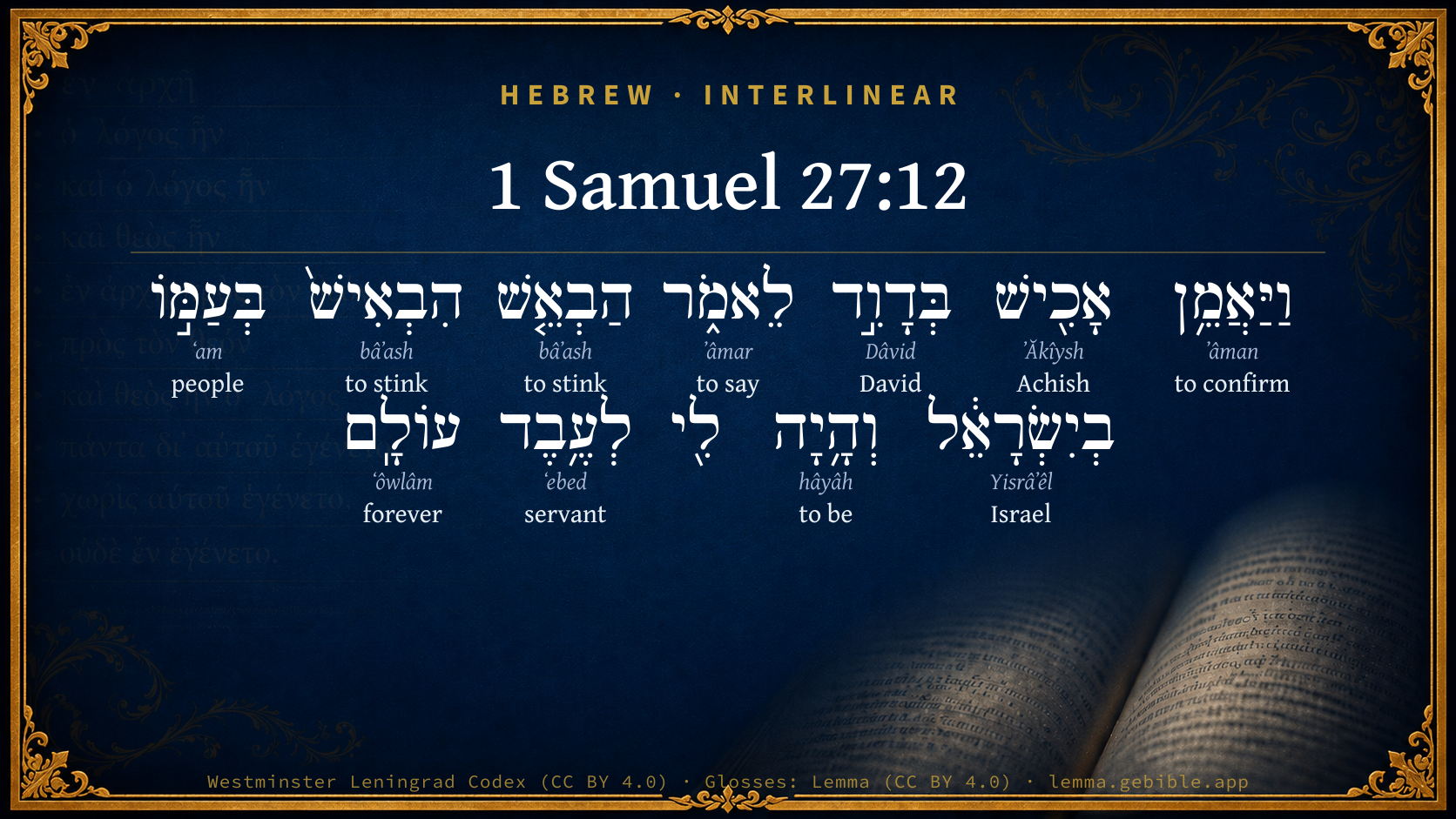
Hebrew (Westminster Leningrad Codex) 1 Samuel 27:12 appears in the Hebrew Old Testament. The text above is from the Westminster Leningrad Codex. Each word links to its Strong’s number, a concise gloss, and parsing drawn from the Open Scriptures Hebrew Bible morphology. Click any word for its full Brown-Driver-Briggs (BDB) entry.
Download image
Cite this verse

1 Samuel 27:12 (World English Bible). Public Domain. Lemma interlinear Bible study tool, https://lemma.gebible.app/v/1-samuel/27/12.

Show BibTeX & RIS
BibTeX
RIS
English Translation
Achish believed David, saying, He has made his people Israel utterly to abhor him; therefore he shall be my servant forever.
World English Bible · Public Domain
Download a study sheet

One document with this verse’s original text, its word-by-word gloss line, the meaning frame, cross-references with their text, attributed commentary, and full source and license credits — printable, and it pastes into notes with its structure intact.

This verse Autodidact and up

Study sheet (.html) Plain text (.txt)

A passage Seminary Student

Up to 50 verses in one chapter. A passage sheet keeps up to 6 commentary sources and 12 cross-references per verse, in the order this page ranks them, and says so on the sheet whenever that leaves anything out. Ask for a single verse and you get the Autodidact verse sheet above.

Everything on this page stays free to read, with no account — the sheet is a download of what is already on screen, not access to it.

Want to remove ads? Support Godless Engineer
Compare translations 3

The same verse in 3 English versions, stacked beneath the original-language interlinear above. Click any original word for its lexicon entry.

Each is an independent rendering of the whole verse — the interlinear is not word-aligned to these translations.

Highlighted words mark where these versions differ — a whole-verse word diff, not a word-by-word alignment.

  • World English Bible Public Domain
    Achish believed David, saying, He has made his people Israel utterly to abhor him; therefore he shall be my servant forever.
  • King James Version Public Domain
    And Achish believed David, saying, He hath made his people Israel utterly to abhor him; therefore he shall be my servant for ever.
  • unfoldingWord Literal Text CC BY-SA 4.0
    And Achish trusted in David, saying, “Stinking, he stinks among his people in Israel, so he will be to me for a servant forever.”

unfoldingWord Literal Text — © unfoldingWord, licensed CC BY-SA 4.0. Word-aligned USFM3 via Door43 (git.door43.org/unfoldingWord/en_ult).

Versions to compare (up to 4)

3 of 4 selected

Show all 18 translations

Every available English version of this verse, each an independent rendering of the whole verse.

  • World English Bible Public Domain
    Achish believed David, saying, He has made his people Israel utterly to abhor him; therefore he shall be my servant forever.
  • Berean Standard Bible Public Domain
    So Achish trusted David, thinking, “Since he has made himself an utter stench to his people Israel, he will be my servant forever.”
  • Majority Standard Bible Public Domain
    So Achish trusted David, thinking, “Since he has made himself an utter stench to his people Israel, he will be my servant forever.”
  • King James Version Public Domain
    And Achish believed David, saying, He hath made his people Israel utterly to abhor him; therefore he shall be my servant for ever.
  • American Standard Version (1901) Public Domain
    And Achish believed David, saying, He hath made his people Israel utterly to abhor him; therefore he shall be my servant for ever.
  • Revised Version (1885) Public Domain
    And Achish believed David, saying, He hath made his people Israel utterly to abhor him; therefore he shall be my servant for ever.
  • Geneva Bible (1599) Public Domain
    And Achish beleeued Dauid, saying, He hath made his people of Israel vtterly to abhorre him: therefore he shalbe my seruant for euer.
  • Douay-Rheims (1899) Public Domain
    And Achis believed David, saying: He hath done much harm to his people Israel: therefore he shall be my servant for ever.
  • Young's Literal Translation Public Domain
    And Achish believeth in David, saying, `He hath made himself utterly abhorred among his people, in Israel, and hath been to me for a servant age-during.'
  • Literal Standard Version CC BY-SA 4.0
    And Achish believes in David, saying, “He has made himself utterly abhorred among his people in Israel, and has been for a perpetual servant to me.”
  • Unlocked Literal Bible CC BY-SA 4.0
    Achish believed David, saying, “He has made his people Israel utterly abhor him; he will therefore be my servant forever.”
  • unfoldingWord Literal Text CC BY-SA 4.0
    And Achish trusted in David, saying, “Stinking, he stinks among his people in Israel, so he will be to me for a servant forever.”
  • Darby Bible Public Domain
    And Achish trusted David, saying, He has made himself utterly odious among his people Israel; and he shall be my servant for ever.
  • World Messianic Bible Public Domain
    Achish believed David, saying, “He has made his people Israel utterly to abhor him. Therefore he will be my servant forever.”
  • Webster's Bible Public Domain
    And Achish believed David, saying, He hath made his people Israel utterly to abhor him; therefore he shall be my servant for ever.
  • Free Bible Version CC BY-SA 4.0
    Achish trusted David, and said to himself, “He's made himself so offensive to his people the Israelites that he'll have to serve me forever.”
  • Bible in Basic English Public Domain
    And Achish had belief in what David said, saying, He has made himself hated by all his people Israel, and so he will be my servant for ever.
  • JPS Tanakh (1917) Public Domain
    And Achish believed David, saying: 'He hath made his people Israel utterly to abhor him; therefore he shall be my servant for ever.'

Literal Standard Version (2020), Covenant Press — licensed CC BY-SA 4.0. Text via the HelloAO Bible API (eBible.org). Unlocked Literal Bible (unfoldingWord) — licensed CC BY-SA 4.0. Text via the HelloAO Bible API (eBible.org). unfoldingWord Literal Text — © unfoldingWord, licensed CC BY-SA 4.0. Word-aligned USFM3 via Door43 (git.door43.org/unfoldingWord/en_ult). Free Bible Version, Dr. Jonathan Gallagher — licensed CC BY-SA 4.0. Text via the HelloAO Bible API (eBible.org).

Word by word

More ways to search: Search by grammar → Find every occurrence → Compare this word →

Practice this passage: Drill this verse → Learn its vocabulary →

הַבְאֵ֤שׁ
bâʼash
H887
“to stink”
Verb, Hiphil, Infinitive Absolute
Part of Speech
Verb
Stem
Hiphil
Form
Infinitive Absolute
Full BDB Definition

Origin: a primitive root

TWOT: 195

to have a bad smell, stink, smell bad - (Qal) to stink, smell bad - (Niphal) - to become odious - to make oneself odious - (Hiphil) - to stink, emit a stinking odour - to cause to stink - of wickedness (figuratively) - (Hithpael) to make oneself odious - (TWOT) to abhor
  1. וַיַּאֲמֵ֥ן ʼâman H539 “and · to confirm” Conjunction + Verb, Hiphil, Sequential Imperfect, 3rd Person, Masculine, Singular
  2. אָכִ֖ישׁ ʼĂkîysh H397 “Achish” Noun, Proper
  3. בְּדָוִ֣ד Dâvid H1732 “in/at · David” Preposition + Noun, Proper
  4. לֵאמֹ֑ר ʼâmar H559 “to say” Preposition + Verb, Qal, Infinitive Construct
  5. הִבְאִישׁ֙ bâʼash H887 “to stink” Verb, Hiphil, Perfect, 3rd Person, Masculine, Singular
  6. בְּעַמּ֣וֹ ʻam H5971 “in/at · people · his” Preposition + Noun, Common, Masculine, Singular, Construct + Suffix, Personal, 3rd Person, Masculine, Singular
  7. בְיִשְׂרָאֵ֔ל Yisrâʼêl H3478 “in/at · Israel” Preposition + Noun, Proper
  8. וְהָ֥יָה hâyâh H1961 “and · to be” Conjunction + Verb, Qal, Sequential Perfect, 3rd Person, Masculine, Singular
  9. לְעֶ֥בֶד ʻebed H5650 “to/for · servant of” Preposition + Noun, Common, Masculine, Singular, Construct
  10. עוֹלָֽם ʻôwlâm H5769 “forever” Noun, Common, Masculine, Singular, Absolute

About this verse

These counts appear in no published source. They are computed here, from the morphology-tagged text and Lemma’s own curated glosses. What Lemma adds →

12
words
10
distinct lemmas
Historical
section

Notable vocabulary

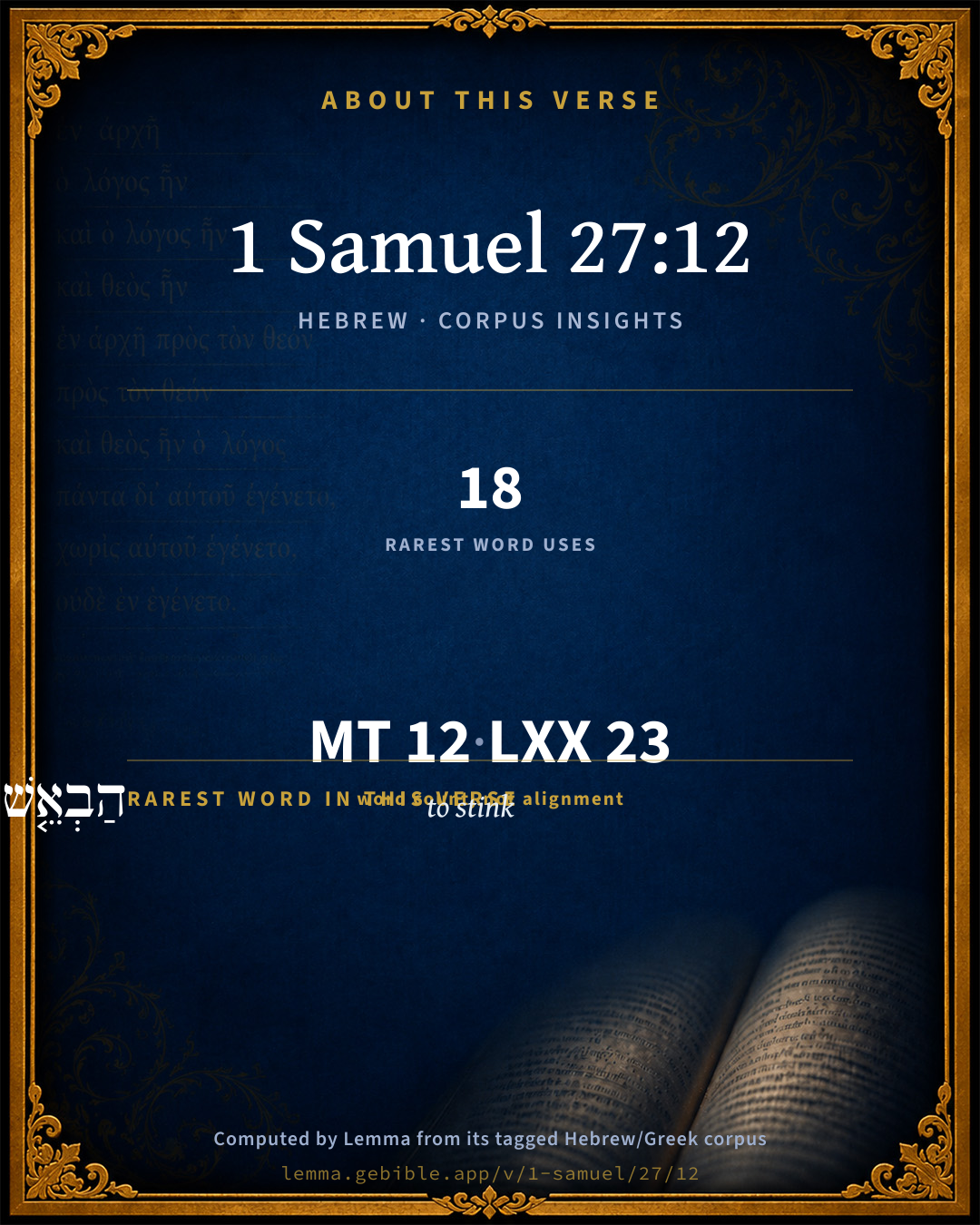
The rarest word here is הַבְאֵ֤שׁ to stink H887 — appearing just 18 times in the whole Hebrew Bible.

Shared distinctive vocabulary

הַבְאֵ֤שׁ to stink H887 occurs in 17 verses of the Hebrew Bible. Also found in:

Grammatical profile

  • 5 verbs
  • 6 nouns
  • 1 preposition

Verb forms

  • וַיַּאֲמֵ֥ן Hiphil · Sequential Imperfect
  • לֵאמֹ֑ר Qal · Infinitive Construct
  • הַבְאֵ֤שׁ Hiphil · Infinitive Absolute
  • הִבְאִישׁ֙ Hiphil · Perfect
  • וְהָ֥יָה Qal · Sequential Perfect

Repetition

A word recurs within this verse — often emphatic in Hebrew:

  • הַבְאֵ֤שׁ to stink H887 ×2

Hebrew & Septuagint length

In English translation the verse runs 21 words from the Hebrew and 27 from the Septuagint (LXX English) — closely comparable.

A rough comparison of the two English renderings, which tokenize alike — not a word-level alignment.

Word counts can differ between the Hebrew and the Greek without any difference in meaning — e.g. the Hebrew direct-object marker אֵת has no separate Greek word, and Greek often adds the article ὁ.

In the original languages it is 12 Hebrew tokens and 23 Greek tokens — but the two are counted differently (Hebrew bundles its prefixes and suffixes into one token; the Greek is in lemma form), so that isn’t a like-for-like length.

Cross-references

2

Topical passages linked to 1 Samuel 27:12 in the Treasury of Scripture Knowledge — connected by theme and wording, ordered by reader-vote popularity; previews shown in the World English Bible.

  • Genesis 34:30 Jacob said to Simeon and Levi, "You have troubled me, to make me odious to the inhabitants of the land, among the Canaanites and the Perizzites. I am few in number. They will gather themselves together against me and strike me, and I will be destroyed, I and my house."
  • 1 Samuel 13:4 All Israel heard say that Saul had struck the garrison of the Philistines, and also that Israel was had in abomination with the Philistines. The people were gathered together after Saul to Gilgal.

Cross-references courtesy of OpenBible.info (CC BY 4.0).

Hebrew and Greek witnesses Masoretic Hebrew ↔ Greek Septuagint

The same verse in the two great witnesses to the Old Testament, shown verse-for-verse.

These are two independent witnesses, not word-aligned to each other, and the Septuagint is shown in lemma (dictionary) form.

Hebrew 1 Samuel 27:12 Masoretic · Westminster Leningrad Codex

וַיַּאֲמֵ֥ן אָכִ֖ישׁ בְּדָוִ֣ד לֵאמֹ֑ר הַבְאֵ֤שׁ הִבְאִישׁ֙ בְּעַמּ֣וֹ בְיִשְׂרָאֵ֔ל וְהָ֥יָה לִ֖י לְעֶ֥בֶד עוֹלָֽם

Achish believed David, saying, He has made his people Israel utterly to abhor him; therefore he shall be my servant forever.

World English Bible · Public Domain

Greek LXX 1 Samuel 27:12 Septuagint · lemma form

καί πιστεύω δαυίδ ἐν ὁ αγχους σφόδρα λέγω αἰσχύνω αἰσχύνω ἐν ὁ λαός αὐτός ἐν ἰσραήλ καί εἰμί ἐγώ δοῦλος εἰς ὁ αἰών

So David had the full confidence of Anchus, who said, He is thoroughly disgraced among his people in Israel and he shall be my servant for ever.

LXX2012 (modern English Septuagint) · Public Domain

On this verse, Haydock's Catholic Bible Commentary discusses the Septuagint’s reading. Read the note in Commentary ↓

Hebrew: Westminster Leningrad Codex (CC BY 4.0). Greek: Septuagint (public domain); English from LXX2012 (modern English Septuagint) (Public Domain). How the Septuagint differs from the Hebrew →

Targum (Aramaic paraphrase)

1

The Targum is the ancient Jewish Aramaic paraphrase of the Hebrew Scriptures — an interpretive translation, not the Hebrew text itself. Onkelos (literal) and Pseudo-Jonathan (expansive) render the Torah, and Jonathan the Prophets. Coverage is partial: where no permissively-licensed English translation exists for a verse, only the Aramaic is shown. This is verse-level text, not a word-by-word alignment to the Hebrew.

  1. Targum Jonathan Prophets (Joshua–Malachi)
    וְהֵימִין אָכִישׁ בְּדָוִד לְמֵימָר אִתְגְרָאָה אִתְגָרֵי בְּעַמֵיהּ בְּיִשְׂרָאֵל וִיהֵי לִי עֲבַד פְּלַח לַעֲלָם:

    (no public-domain English translation for this verse)

    Targum Jonathan — Aramaic: “Mikraot Gedolot” (public domain). English: “Sefaria Community Translation” (CC0 1.0 (public-domain dedication)); “London "Chaldee Paraphrase," 1871” (public domain). Text via Sefaria.

Commentary

Notes on 1 Samuel 27:12 from classic Christian and Jewish commentators (each source and its license shown beneath its notes). The classic Christian expositions comment on the surrounding passage and are grouped to its opening verse, so a note may address several verses; the Jewish commentaries on the Tanakh (Rashi and others) are per-verse, so they appear only where the commentator wrote on this verse.

Lemma curates 59 commentaries, every one of them public domain or Creative Commons licensed, each selected and text-cleaned for this edition rather than reprinted as found. About our sources →

The Cambridge Bible for Schools and Colleges

gen. ed. J. J. S. Perowne

12. Achish believed David] Connect 1Sa_27:12 with 1Sa_27:10. Achish believed that David had brought himself into ill odour (see on 1Sa_13:4) with his own countrymen by his attacks on them, and would now be his permanent vassal.

The Cambridge Bible for Schools and Colleges (gen. ed. J. J. S. Perowne; Cambridge University Press, 1878–1918) — public domain. Text from a community e-Sword module.

Trapp's Complete Commentary

John Trapp

1Sa 27:12 And Achish believed David, saying, He hath made his people Israel utterly to abhor him; therefore he shall be my servant for ever.

Ver. 12. And Achish believed David.] Heb., Believed in David, which was much; but so God would have it, for David’s good. Achish, haply, thought that David would not lie; and it was easy, saith Josephus, to persuade him to believe that which he greatly affected and desired.

John Trapp, A Commentary or Exposition upon All the Books of the Old and New Testament (1647–1656) — public domain. Text from a community e-Sword module.

Keil & Delitzsch

C. F. Keil & F. Delitzsch

Sa1 27:12 is connected with Sa1 27:10; Achish believed David's words, and said (to himself), "He hath made himself stinking (i.e., hated) among his own people, among Israel, and will be my servant (i.e., subject to me) for ever."

Keil & Delitzsch — Biblical Commentary on the Old Testament (1861–1891) — public domain (CC PDM 1.0). Text via the HelloAO Bible API. (Old Testament only.)

Geneva Bible (1599)

Geneva Bible translators

Or, he doth surely abhor his people.

Geneva Bible (1599) marginal notes — public domain. Text via Bolls.life.

Adam Clarke's Commentary

Verse 12. He hath made his people - utterly to abhor him] This deception, which Dr. Delaney says "did harm to nobody, and to the account of which he is at an utter loss what degree of guilt to charge," imposed upon Achish, had the most direct tendency to make him imagine himself secure, while in the utmost danger; and to have a faithful friend and able ally in David, while he was the veriest enemy he could possibly have. Shame on him who becomes the apologist of such conduct! As to Dr. Chandler, he should know that no lie is of the truth, and that all falsity is an abomination to the Lord.

Adam Clarke's Commentary on the Bible (1810–1826) — public domain. Text from a community e-Sword/MySword module.

John Gill's Exposition

And Achish believed David,.... As he would have him understand his story; imposing upon him by ambiguous terms, insinuating he had been against the southern parts of Judah, when he had been against foreign nations that lay to the south of Judah:

saying, he hath made his people Israel utterly to abhor him; they shall never forgive him the destruction of their cities, and the inhabitants of them, and the plunder of their goods and cattle; his name will be had in the utmost detestation and abhorrence, and he must never return thither any more:

therefore he shall be my servant for ever: would be glad to continue with him as a servant, and be obliged to serve him faithfully and truly, since his own people, and even those of his own tribe, would never more receive him; it being, as he understood it, the south of Judah that he had been plundering.

Next: 1 Samuel Chapter 28

John Gill's Exposition of the Whole Bible (1746–1763) — public domain (CC PDM 1.0). Text via the HelloAO Bible API.

Haydock's Catholic Bible Commentary

Harm. Hebrew, "he hath made himself stinking (an object of horror) to his people." A strong expression used, Genesis xxxiv. 30., and Exodus v. 21. (Calmet) --- Septuagint, "he is quite covered with confusion." Achis supposed that David had thus forfeited all his pretensions to dwell among, much less, to reign over Israel: so that he might keep him always in his service. (Haydock) --- In the mean time, Saul was exterminating the people of Gabaon, which brought a pestilence on Israel, 40 years later. (Theodoret) --- He perhaps supposed that the oath of Josue had not been yet put in execution, as it ought to be, herein indulging too much his cruel temper. (Salien)

George Leo Haydock (1774–1849), Haydock's Catholic Family Bible and Commentary, 1859 edition — public domain. Excludes Psalms (Douay-Rheims chapter numbering differs from Protestant) and Deuterocanonical books (Catholic canon only).

Matthew Poole's English Annotations

Achish believed David; partly, because of his confidence in David’s authority and fidelity; partly, because most men easily believe what they heartily wish to be true; and partly, from God’s providence, which blinded him in this and in divers other particulars relating to David’s coming hither, and abiding here.

Matthew Poole's English Annotations on the Holy Bible (1683–1685) — public domain. Text from a community e-Sword/MySword module.

Lesson kit

Teaching starters — assembled from the data on this page, not authored interpretation. Every prompt links to the verse data it draws on. Edit before teaching.

1 Samuel, in the Historical, opens this verse with 12 words (10 distinct Hebrew lemmas). Its most distinctive word is bâʼash (“to stink”). A historical commentator’s framing appears above. Read the whole chapter for the surrounding context.

Discussion questions

  1. How does “to stink” (bâʼash) shape what this verse is saying?
  2. Genesis 34:30 shares the word «to stink» with this verse. How do the two illuminate each other?
  3. “to stink” occurs 2× in this one verse. What is the effect of the repetition?
  4. The translations on this page render this verse differently — a whole-verse word diff, not a word-by-word alignment. What might account for the different wordings?
  5. The verb «וַיַּאֲמֵ֥ן» is Hiphil Sequential Imperfect. How does its form color the action?
  6. Reading how The Cambridge Bible for Schools and Colleges and Trapp's Complete Commentary read this verse, where do the two commentators agree and where do they part?

Things to notice

Reading settings

Reading text

Shown beneath each verse's original-language words.

Old Testament
Old Testament edition

Read the OT as the Masoretic Hebrew (MT) or the Greek Septuagint (LXX).

English shown for the Greek Septuagint (in the Hebrew ↔ Greek comparison).

Comparing translations? Open the Compare panel on any verse page to stack up to four side by side.