
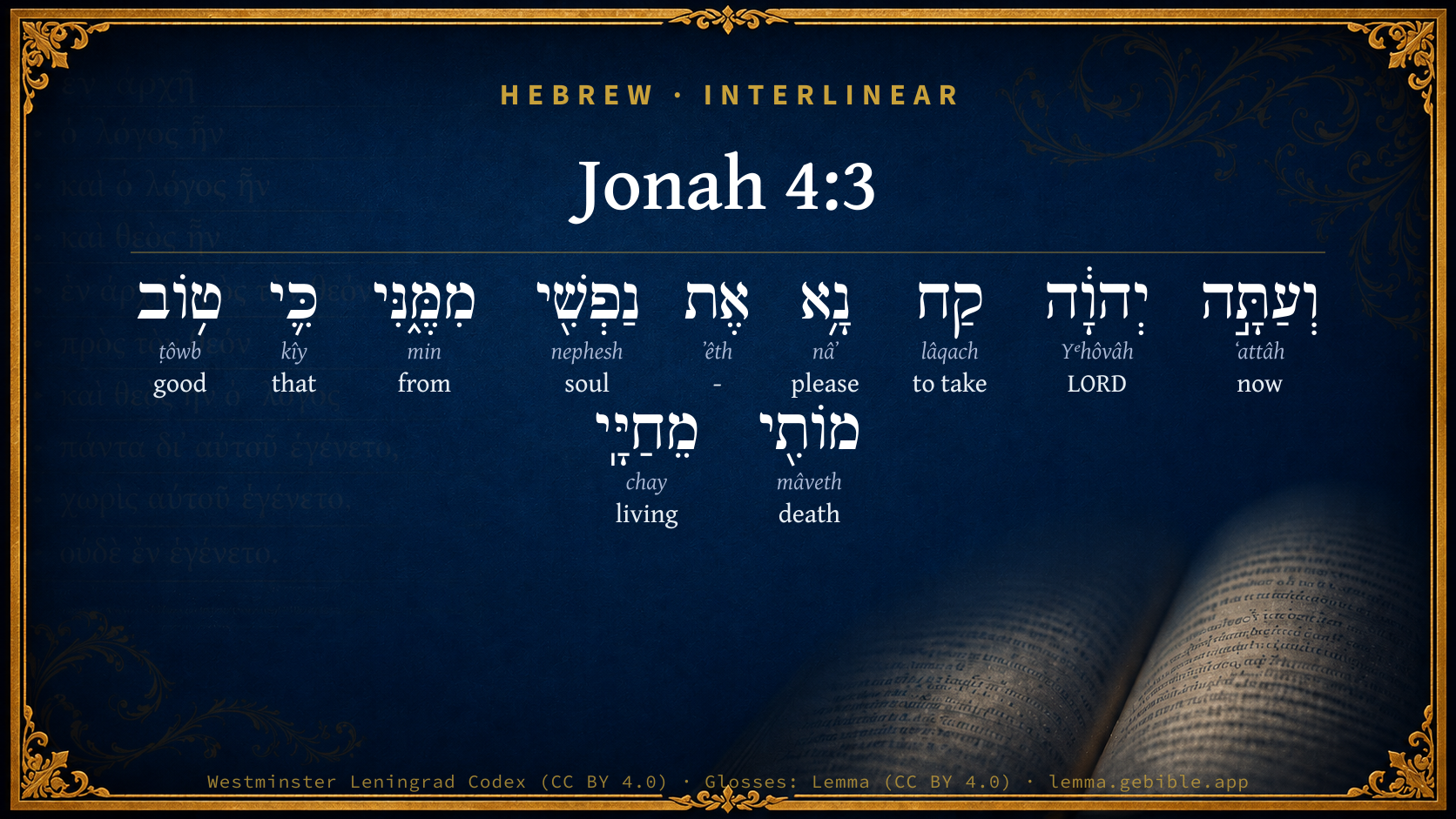
Jonah 4:3

Hebrew (Westminster Leningrad Codex) Jonah 4:3 appears in the Hebrew Old Testament. The text above is from the Westminster Leningrad Codex. Each word links to its Strong’s number, a concise gloss, and parsing drawn from the Open Scriptures Hebrew Bible morphology. Click any word for its full Brown-Driver-Briggs (BDB) entry.
Download image
Cite this verse

Jonah 4:3 (World English Bible). Public Domain. Lemma interlinear Bible study tool, https://lemma.gebible.app/v/jonah/4/3.

Show BibTeX & RIS
BibTeX
RIS
English Translation
Therefore now, Yahweh, take, I beg you, my life from me; for it is better for me to die than to live."
World English Bible · Public Domain
Download a study sheet

One document with this verse’s original text, its word-by-word gloss line, the meaning frame, cross-references with their text, attributed commentary, and full source and license credits — printable, and it pastes into notes with its structure intact.

This verse Autodidact and up

Study sheet (.html) Plain text (.txt)

A passage Seminary Student

Up to 50 verses in one chapter. A passage sheet keeps up to 6 commentary sources and 12 cross-references per verse, in the order this page ranks them, and says so on the sheet whenever that leaves anything out. Ask for a single verse and you get the Autodidact verse sheet above.

Everything on this page stays free to read, with no account — the sheet is a download of what is already on screen, not access to it.

Want to remove ads? Support Godless Engineer
Compare translations 3

The same verse in 3 English versions, stacked beneath the original-language interlinear above. Click any original word for its lexicon entry.

Each is an independent rendering of the whole verse — the interlinear is not word-aligned to these translations.

Highlighted words mark where these versions differ — a whole-verse word diff, not a word-by-word alignment.

  • World English Bible Public Domain
    Therefore now, Yahweh, take, I beg you, my life from me; for it is better for me to die than to live."
  • King James Version Public Domain
    Therefore now, O LORD, take, I beseech thee, my life from me; for it is better for me to die than to live.
  • unfoldingWord Literal Text CC BY-SA 4.0
    So now, Yahweh, I beg you, take my life from me, for my death is better than my life.”

unfoldingWord Literal Text — © unfoldingWord, licensed CC BY-SA 4.0. Word-aligned USFM3 via Door43 (git.door43.org/unfoldingWord/en_ult).

Versions to compare (up to 4)

3 of 4 selected

Show all 18 translations

Every available English version of this verse, each an independent rendering of the whole verse.

  • World English Bible Public Domain
    Therefore now, Yahweh, take, I beg you, my life from me; for it is better for me to die than to live."
  • Berean Standard Bible Public Domain
    And now, O LORD, please take my life from me, for it is better for me to die than to live.”
  • Majority Standard Bible Public Domain
    And now, O LORD, please take my life from me, for it is better for me to die than to live.”
  • King James Version Public Domain
    Therefore now, O LORD, take, I beseech thee, my life from me; for it is better for me to die than to live.
  • American Standard Version (1901) Public Domain
    Therefore now, O Jehovah, take, I beseech thee, my life from me; for it is better for me to die than to live.
  • Revised Version (1885) Public Domain
    Therefore now, O LORD, take, I beseech thee, my life from me; for it is better for me to die than to live.
  • Geneva Bible (1599) Public Domain
    Therefore nowe O Lord, take, I beseech thee, my life from me: for it is better for me to die then to liue.
  • Douay-Rheims (1899) Public Domain
    And now, O Lord, I beseech thee take my life from me: for it is better for me to die than to live.
  • Young's Literal Translation Public Domain
    And now, O Jehovah, take, I pray Thee, my soul from me, for better `is' my death than my life.'
  • Literal Standard Version CC BY-SA 4.0
    And now, O YHWH, please take my soul from me, for better [is] my death than my life.”
  • Unlocked Literal Bible CC BY-SA 4.0
    Therefore now, Yahweh, I beg you, take my life from me, for it is better for me to die than to live.”
  • unfoldingWord Literal Text CC BY-SA 4.0
    So now, Yahweh, I beg you, take my life from me, for my death is better than my life.”
  • Darby Bible Public Domain
    And now, Jehovah, take, I beseech thee, my life from me, for it is better for me to die than to live.
  • World Messianic Bible Public Domain
    Therefore now, LORD, take, I beg you, my life from me, for it is better for me to die than to live.”
  • Webster's Bible Public Domain
    Therefore now, O LORD, take, I beseech thee, my life from me; for it is better for me to die than to live.
  • Free Bible Version CC BY-SA 4.0
    So just kill me now, Lord, because I'd prefer to die than to live!”
  • Bible in Basic English Public Domain
    So now, O Lord, give ear to my prayer and take my life from me; for death is better for me than life.
  • JPS Tanakh (1917) Public Domain
    Therefore now, O LORD, take, I beseech Thee, my life from me; for it is better for me to die than to live.'

Literal Standard Version (2020), Covenant Press — licensed CC BY-SA 4.0. Text via the HelloAO Bible API (eBible.org). Unlocked Literal Bible (unfoldingWord) — licensed CC BY-SA 4.0. Text via the HelloAO Bible API (eBible.org). unfoldingWord Literal Text — © unfoldingWord, licensed CC BY-SA 4.0. Word-aligned USFM3 via Door43 (git.door43.org/unfoldingWord/en_ult). Free Bible Version, Dr. Jonathan Gallagher — licensed CC BY-SA 4.0. Text via the HelloAO Bible API (eBible.org).

Word by word

More ways to search: Search by grammar → Find every occurrence → Compare this word →

Practice this passage: Drill this verse → Learn its vocabulary →

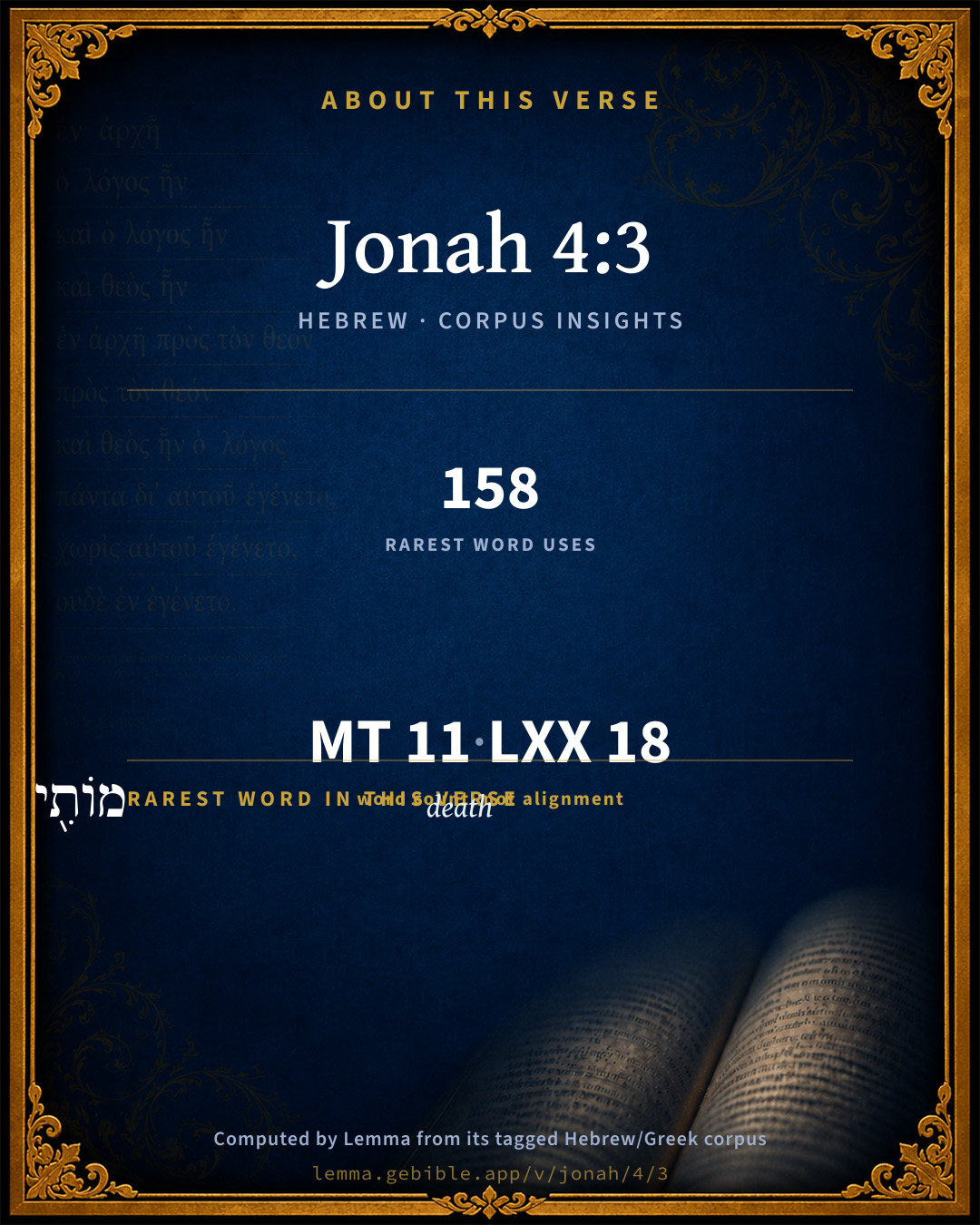
מוֹתִ֖י
mâveth
H4194
“death · my”
Noun, Common, Masculine, Singular, Construct + Suffix, Personal, 1st Person, Common, Singular
Part of Speech
Noun
Type
Common
Gender
Masculine
Number
Singular
State
Construct
Full BDB Definition

Origin: from H4191

TWOT: 1169a

death, dying, Death (personified), realm of the dead - death - death by violence (as a penalty) - state of death, place of death
  1. וְעַתָּ֣ה ʻattâh H6258 “and · now” Conjunction + Adverb
  2. יְהוָ֔ה Yᵉhôvâh H3068 “LORD” Noun, Proper
  3. קַח lâqach H3947 “take” Verb, Qal, Imperative, 2nd Person, Masculine, Singular
  4. נָ֥א nâʼ H4994 “please” Particle, Exhortation
  5. אֶת ʼêth H853 “-” Particle, Direct Object
  6. נַפְשִׁ֖י nephesh H5315 “soul · my” Noun, Common, Both, Singular, Construct + Suffix, Personal, 1st Person, Common, Singular
  7. מִמֶּ֑נִּי min H4480 “from · me” Preposition + Suffix, Personal, 1st Person, Common, Singular
  8. כִּ֛י kîy H3588 “that” Conjunction
  9. ט֥וֹב ṭôwb H2896 “good” Adjective, Adjective, Masculine, Singular, Absolute
  10. מֵחַיָּֽי chay H2416 “from · living things · my” Preposition + Noun, Common, Masculine, Plural, Construct + Suffix, Personal, 1st Person, Common, Singular

About this verse

These counts appear in no published source. They are computed here, from the morphology-tagged text and Lemma’s own curated glosses. What Lemma adds →

11
words
11
distinct lemmas
Prophets
section

Grammatical profile

  • 1 verb
  • 4 nouns
  • 1 adjective
  • 1 preposition
  • 1 conjunction
  • 1 adverb
  • 2 particles

Verb forms

  • קַח Qal · Imperative

Hebrew & Septuagint length

In English translation the verse runs 22 words from the Hebrew and 20 from the Septuagint (LXX English) — closely comparable.

A rough comparison of the two English renderings, which tokenize alike — not a word-level alignment.

Word counts can differ between the Hebrew and the Greek without any difference in meaning — e.g. the Hebrew direct-object marker אֵת has no separate Greek word, and Greek often adds the article ὁ.

In the original languages it is 11 Hebrew tokens and 18 Greek tokens — but the two are counted differently (Hebrew bundles its prefixes and suffixes into one token; the Greek is in lemma form), so that isn’t a like-for-like length.

Cross-references

11

Topical passages linked to Jonah 4:3 in the Treasury of Scripture Knowledge — connected by theme and wording, ordered by reader-vote popularity; previews shown in the World English Bible.

  • 1 Kings 19:4 But he himself went a day's journey into the wilderness, and came and sat down under a juniper tree: and he requested for himself that he might die, and said, It is enough; now, O Yahweh, take away my life; for I am not better than my fathers.
  • Ecclesiastes 7:1 A good name is better than fine perfume; and the day of death better than the day of one's birth.
  • Numbers 11:15 If you deal thus with me, please kill me out of hand, if I have found favor in your sight; and let me not see my wretchedness.
  • Jeremiah 20:14–18 Cursed be the day in which I was born: don't let the day in which my mother bore me be blessed.
  • Numbers 20:3 The people strove with Moses, and spoke, saying, Would that we had died when our brothers died before Yahweh!
  • Jonah 4:8 It happened, when the sun arose, that God prepared a sultry east wind; and the sun beat on Jonah's head, so that he fainted, and requested for himself that he might die, and said, "It is better for me to die than to live."
  • Job 3:20–21 "Why is light given to him who is in misery, Life to the bitter in soul,
  • Job 6:8–9 "Oh that I might have my request; That God would grant the thing that I long for!
  • Job 7:15–16 So that my soul chooses strangling, Death rather than my bones.
  • 1 Corinthians 9:15 But I have used none of these things, and I don't write these things that it may be done so in my case; for I would rather die, than that anyone should make my boasting void.
  • Philippians 1:21–25 For to me to live is Christ, and to die is gain.

Cross-references courtesy of OpenBible.info (CC BY 4.0).

Hebrew and Greek witnesses Masoretic Hebrew ↔ Greek Septuagint

The same verse in the two great witnesses to the Old Testament, shown verse-for-verse.

These are two independent witnesses, not word-aligned to each other, and the Septuagint is shown in lemma (dictionary) form.

Hebrew Jonah 4:3 Masoretic · Westminster Leningrad Codex

וְעַתָּ֣ה יְהוָ֔ה קַח נָ֥א אֶת נַפְשִׁ֖י מִמֶּ֑נִּי כִּ֛י ט֥וֹב מוֹתִ֖י מֵחַיָּֽי

Therefore now, Yahweh, take, I beg you, my life from me; for it is better for me to die than to live."

World English Bible · Public Domain

Greek LXX Jonah 4:3 Septuagint · lemma form

καί νῦν δεσπότης κύριος λαμβάνω ὁ ψυχή ἐγώ ἀπό ἐγώ ὅτι καλός ὁ ἀποθνήσκω ἐγώ ἤ ζάω ἐγώ

And now, Lord God, take my life from me; for it is better for me to die than to live.

LXX2012 (modern English Septuagint) · Public Domain

Hebrew: Westminster Leningrad Codex (CC BY 4.0). Greek: Septuagint (public domain); English from LXX2012 (modern English Septuagint) (Public Domain). How the Septuagint differs from the Hebrew →

Targum (Aramaic paraphrase)

1

The Targum is the ancient Jewish Aramaic paraphrase of the Hebrew Scriptures — an interpretive translation, not the Hebrew text itself. Onkelos (literal) and Pseudo-Jonathan (expansive) render the Torah, and Jonathan the Prophets. Coverage is partial: where no permissively-licensed English translation exists for a verse, only the Aramaic is shown. This is verse-level text, not a word-by-word alignment to the Hebrew.

  1. Targum Jonathan Prophets (Joshua–Malachi)
    וּכְעַן יְיָ סַב כְּעַן יַת נַפְשִׁי מִנִי אֲרֵי טַב דַאֲמוּת מִדְאֵיחֵי:

    And now, LORD, take — now! — my life from me, because better I die than live.”

    Targum Jonathan — Aramaic: “Mikraot Gedolot” (public domain). English: “Sefaria Community Translation” (CC0 1.0 (public-domain dedication)); “London "Chaldee Paraphrase," 1871” (public domain). Text via Sefaria.

Commentary

Notes on Jonah 4:3 from classic Christian and Jewish commentators (each source and its license shown beneath its notes). The classic Christian expositions comment on the surrounding passage and are grouped to its opening verse, so a note may address several verses; the Jewish commentaries on the Tanakh (Rashi and others) are per-verse, so they appear only where the commentator wrote on this verse.

Lemma curates 59 commentaries, every one of them public domain or Creative Commons licensed, each selected and text-cleaned for this edition rather than reprinted as found. About our sources →

Trapp's Complete Commentary

John Trapp

Jon 4:3 Therefore now, O LORD, take, I beseech thee, my life from me; for [it is] better for me to die than to live.

Ver. 3. Therefore now, O Lord, take, I beseech thee, my life from me] A pitiful peevish prayer, such as was that of Job, and that of Jeremiah above noted; to which may be added Sarah’s hasty wish for God to arbitrate between her and her husband; Moses’ quibbling with God, till at length he was angry, Exo 4:10; Exo 4:14; Elias’s desire to die out of discontent, &c. What a deal of filth and of flesh clogs and cleaves to our best performances! Hence David so prays for his prayers, and Nehemiah for pardon of his reformations. Anger is ever an evil counsellor; but when it creeps into our prayers it corrupts them worse than vinegar doth the vessel wherein it standeth. "Submit yourselves therefore to God," as Jonah should have done, "resist this devil" of pride and passion, "and he will flee from you," Jas 4:7; as by giving place to impatience ye "give place to the devil," Eph 4:26, who else by his vile injections, or at least by his vain impertinencies, will so spoil and mar our duties that we may well wonder they are not cast back as dirt into our faces. Sure it is that if the Holy Ghost had not his hand in our prayers there would not be the least goodness in them; no, not uprightness and truth, without which Christ would never present them, or the Father accept them.

For it is better for me to die than to live] sc. in that disgrace that I shall now undergo of being a false prophet, not henceforth to be believed. Lo, this was it that troubled the man so much, as it did likewise Moses, Exo 4:1, "They will not believe me; for they will say, The Lord hath not appeared unto thee." But God should have been trusted by them for that, and his call obeyed howsoever, without consults or disputes; careless of their own credit, so that God might be exalted. True it is that a man had better die with honour than live in disgrace truly so called. "It were better for me to die," saith holy Paul, "than that any man should make my glorying void," 1Co 9:15. Provident we must be (but not overly tender) to preserve our reputation; learning of the unjust steward by lawful (though he did by unlawful) means to do it; for our Saviour noted this defect in the children of light, that herein they were not often as wise as they should be, Luk 16:8. But Jonah was too heady and hasty in this wish of his death; because his credit, as he thought, was cracked, and he should be looked upon as a liar. But was the Euge of a good conscience nothing to him? was God’s approbation of no value, nor the good esteem of his faithful people? It was enough for Demetrius that he had a good report of the truth, 3Jn 1:12, whatever the world held or said of him. What is the honour of the world but a puff of stinking breath? and why should any Jonah be so ambitious for it, as that without it he cannot find in his heart to live? Life is better than honour. "Joseph is yet alive," saith Jacob. To have heard that Joseph lived a servant would have joyed him more than to hear that he died honourably. The greater blessing obscureth the less. He is not worthy of honour that is not thankful for life. St Paul’s desire to be dissolved that he might be with Christ, which is far the better, Php 1:23, was much different from this of Jonah.

John Trapp, A Commentary or Exposition upon All the Books of the Old and New Testament (1647–1656) — public domain. Text from a community e-Sword module.

The Biblical Illustrator

Joseph S. Exell

Jon_4:3

It is better for me to die than to live.

Is life worth living

Jonahs mission, though in some respects strange and terrible, was one of mercy, to lead the Ninevites to repentance; and Jonah knew this from the first. The Lord could have found another messenger, but He had chosen this man for His purpose; so He brought him back, and commanded him for the second time to go to Nineveh, and cry the cry that I bid thee. The mercy shown to Nineveh displeased Jonah exceedingly, and made him very angry. It was not merely that he seemed to be discredited by the issue, and made a fool of, but he was vexed and chagrined at what took place, and boded no good from it. He would have let the doom fall without a warning. As Jonah sat in his booth there is still some lingering hope in his mind that the threatened overthrow may yet take place. He shows no sign of brotherly-kindness; he does not sympathise with the Divine philanthropy that has no pleasure in the death of the wicked. And so, when mercy rejoiceth against judgment, he thinks it well to be angry, even unto death. He counts that for him it is better to die than to live. It is the fretting of a wounded and disappointed spirit. His words bring up a question that has been asked again and again--Is life worth living? The question is a vague one, and really covers a wide diversity both of meanings and mental moods. Life is very different to different men. The problem of life will be viewed differently by men according to their different standing-point. We must find some standing-point which does not shift with the century, or with the changing conditions under which we pass. Such is furnished us by the revelation of Gods purpose of grace in Christ Jesus. What we see in Christ is the very life which is the gift of God for mans possession. If we would only cease trying to fit theological notions into a perfect system, and set ourselves to view this revelation of Gods gracious purpose, the problem of life would be wonderfully cleared and simplified. (J. Culros, D. D.)

The Biblical Illustrator, edited by Joseph S. Exell (c. 1880s–1900s) — public domain. Text from a community e-Sword module.

Tyndale Open Study Notes

Tyndale Open Resources

4:3-5 Jonah’s desire to die rather than embrace God’s will (see also 4:8-9), and his willingness to wait in hope that the city would be destroyed (4:5), are signs of his hard-heartedness and his hatred for the Assyrians.

Tyndale Open Study Notes — © Tyndale Open Resources, licensed CC BY-SA 4.0. Text via the HelloAO Bible API.

Geneva Bible (1599)

Geneva Bible translators

Thus he prayed of grief fearing lest God’s Name by this forgiveness might be blasphemed, as though he sent his Prophets forth to denounce his judgments in vain.

Geneva Bible (1599) marginal notes — public domain. Text via Bolls.life.

Jamieson, Fausset & Brown

Robert Jamieson, A. R. Fausset & David Brown

Jonah's impatience of life under disappointed hopes of Israel's reformation through the destruction of Nineveh, is like that of Elijah at his plan for reforming Israel (1Ki. 18:1-46) failing through Jezebel ().

Jamieson, Fausset & Brown — Commentary Critical and Explanatory on the Whole Bible (1871) — public domain (CC PDM 1.0). Text via the HelloAO Bible API.

Adam Clarke's Commentary

Verse 3. Take, I beseech thee, my life from me] קח נא את נפשי kach na eth naphshi, "Take, I beseech thee, even my soul." Do not let me survive this disgrace. Thou hast spared this city. I thought thou wouldst do so, because thou art merciful and gracious, and it was on this account that I refused to go at first, as I knew that thou mightest change thy purpose, though thou hadst commanded me to make an absolute denunciation of judgment. God has left this example on record to show that an inconsiderate man is not fit to be employed in his work; and he chose this one example that it might serve as an endless warning to his Church to employ no man in the work of the ministry that is not scripturally acquainted with God's justice and mercy.

Adam Clarke's Commentary on the Bible (1810–1826) — public domain. Text from a community e-Sword/MySword module.

John Calvin's Commentaries

We here see how angry Jonah was in his zeal: for this prayer cannot certainly be ascribed to his faith, as some think, who say that Jonah took a flight as it were in his soul to heaven, when he made this prayer, as though he dreaded not death, but having been divested of all fear, being free and disengaged, he presented himself to God. I do not think that the mind of Jonah was so heroic. There is indeed no doubt, as I have already said, but that he still retained some seed of piety; and this, I said, is sufficiently proved by the word prayer; for if Jonah had burst out in the strain of one in despair, it would not have been a prayer. Since then he prayed by thus speaking, it follows that it was not the cry of despair, but of too much displeasure, which Jonah did not restrain. In short, this prayer proceeded from a pious and holy zeal; but Jonah sinned as to its measure or excess; for he had in a manner forgotten himself, when he preferred death to life

Thou Jehovah, he says, take me away. He was first not free from blame in hastily wishing to die; for it is not in our power to quit this world; but we ought with submissive minds to continue in it as long as God keeps us in the station in which we are placed. whosoever, then, hastens to death with so great an ardor no doubt offends God. Paul knew that death was desirable in his case, (Philippians 1:22;) but when he understood that his labor would be useful to the Church, he was contented with his lot, and preferred the will of God to his own will; and thus he was prepared both to live and to die, as it seemed good to God. It was otherwise with Jonah, “Now,” he says, “take away my life.” This was one fault; but the other was, — that he wished to die, because God spared the Ninevites. Though he was touched with some grief, he ought not yet to have gone so far as this, or rather to rush on, so as to desire death on account of the weariness of his life.

But we hence learn to what extremes men are carried, when once they give loose reins to inconsiderate zeal. The holy Prophet Jonah, who had been lately tamed and subdued by so heavy a chastisements is now seized and carried away by a desire to die, — and why? because he thought that it was hard that he denounced destruction on the Ninevites, and that still their city remained safe. This example ought to check us, that we express not too boldly our opinion respecting the doings of God, but, on the contrary, hold our thoughts captive, lest any presumption of this kind be manifested by us; for there is none of us who does not condemn Jonah, as also he condemned himself; for he does not here narrate his own praise, but means to show how foolishly he had judged of God’s work. Jonah then confesses his own folly; and therefore his experience is to us an evidence that there is nothing more preposterous than for us to settle this or that according to our own wisdom, since this is alone true wisdom, to submit ourselves wholly to the will of God.

Now if any one raises a question here, — whether it is lawful to desire death; the answer may be briefly this, — that death is not to be desired on account of the weariness of life; this is one thing: and by the weariness of life I understand that state of mind, when either poverty, or want, or disgrace, or any such thing, renders life hateful to us: but if any, through weariness on account of his sins and hatred to them, regrets his delay on earth, and can adopt the language of Paul,

“Miserable am I, who will free me from the body of this death!” (Romans 7:24,)

— he entertains a holy and pious wish, provided the submission, to which I have referred, be added so that this feeling may not break forth in opposition to the will of God; but that he who has such a desire may still suffer himself to be detained by his hand as long as he pleases. And further, when any one wishes to die, because he fears for himself as to the future, or dreads to undergo any evil, he also struggles against God; and such was the fault of Jonah; for he says that death was better to him than life, — and why? because the Lord had spared the Ninevites. We hence see how he was blinded, yea, carried away by a mad impulse to desire death.

Let us then learn so to love this life as to be prepared to lay it down whenever the Lord pleases: let us also learn to desire death, but so as to live to the Lord, and to proceed in the race set before use until he himself lead us to its end. Now follows the reproof of God —

John Calvin's Commentaries (1540-1563) — public domain. Text from the Calvin Translation Society English edition (1840s-50s) via the Christian Classics Ethereal Library (ccel.org). Calvin's coverage is partial (roughly two-thirds of the Bible); uncommented books and verses are honest gaps, never fabricated. The 19th-century editor's footnotes and remarks are omitted so the notes are faithfully Calvin's own voice.

Ellicott's Commentary for English Readers

(3) Take, I beseech thee.—We naturally refer to the history of Elijah for a similar weariness and disgust of life. (Comp. also the case of Moses, Num_11:15). It should be noticed, as a contrast of Hebrew with heathen feeling, that none of these men in their loathing of life contemplated the possibility of suicide.

A Bible Commentary for English Readers, edited by Charles John Ellicott (1878–1897) — public domain. Text from a community e-Sword module.

The Cambridge Bible for Schools and Colleges

gen. ed. J. J. S. Perowne

3. take … my life from me] So had Moses prayed (Num_11:15) and Elijah (1Ki_19:4), both with better cause, and in nobler spirit, but both in the same utter weariness of life as Jonah. No one of them, however, attempts to take his own life. They all regard it as a sacred deposit, entrusted to them by God and only to be relinquished at His bidding, or in accordance with His will. Comp. Jon_4:8 below.

The Cambridge Bible for Schools and Colleges (gen. ed. J. J. S. Perowne; Cambridge University Press, 1878–1918) — public domain. Text from a community e-Sword module.

John Gill's Exposition

Therefore now, O Lord, take, I beseech thee, my life from me,.... Or, "my soul" (x). This, as Drusius remarks, may be observed against those that think the soul is not immortal; for by this it appears that it my be taken from the body, and that it exists separate from it, and does not die with it; and since the body dies upon its removal, for "the body without the spirit is dead", as James says; death is expressed by this phrase, Job 27:8; here Jonah allows that God is the God of life, the author and giver of it, and is the sole disposer of it; it is in his own power to take it away, and not man's: so far Jonah was right, that he did not in his passion attempt to take away his own life; only desires the Lord to do it, though in that he is not to be justified; for though it may be lawful for good men to desire to die, with submission to the will of God; that they might be free from sin, and serve him without it, and be with Christ, and in the enjoyment of the divine Presence, as the Apostle Paul and others did, Co2 5:6; but not through discontent, as Elijah, Kg1 19:4; or merely to be rid of troubles, and to be free from pain and afflictions, as Job, Job 6:1; and much less in a pet and passion, as Jonah here, giving this reason for it,

for it is better for me to die than to live; not being able to bear the reproach of being a false prophet, which he imagined would be cast upon him; or, as Aben Ezra and Kimchi, that he might not see the evil come upon Israel, which he feared the repentance of the Ninevites would be the occasion of, Jonah was in a very poor frame of spirit to die in; this would not have been dying in faith and hope in God; which graces cannot be thought to be in lively exercise in him when he was quarrelling with God; neither in love to God, with whom he was angry; nor in love to men, at whose repentance, and finding mercy with the Lord, he was displeased.

(x) "animam meam", V. L. Pagninus, Montanus, Junius & Tremellins, Piscator, Drusius, Cocceius.

John Gill's Exposition of the Whole Bible (1746–1763) — public domain (CC PDM 1.0). Text via the HelloAO Bible API.

Albert Barnes' Notes on the Bible

Therefore now, O Lord, take I beseech Thee my life from me - He had rather die, than see the evil which was to come upon his country. Impatient though he was, he still cast himself upon God. By asking of God to end his life, he, at least, committed himself to the sovereign disposal of God . “Seeing that the Gentiles are, in a manner, entering in, and that those words are being fulfilled, Deu 32:21. “They have moved Me to jealousy with” that which is “not God, and I will move them to jealousy with” those which are “not a people, I will provoke them to anger with a foolish nation,” he despairs of the salvation of Israel, and is convulsed with great sorrow, which bursts out into words and sets forth the causes of grief, saying in a manner, ‘Am I alone chosen out of so many prophets, to announce destruction to my people through the salvation of others?’ He grieved not, as some think, that the multitude of nations is saved, but that Israel perishes. Whence our Lord also wept over Jerusalem. The Apostles first preached to Israel. Paul wishes to become an anathema for his Rom 9:3-5. brethren who are Israelites, whose is the adoption and the glory and the covenant, and the giving of the law and the service of God, and the promises, whose are the fathers, and of whom, as concerning the flesh, Christ came.” Jonah had discharged his office faithfully now. He had done what God commanded; God had done by him what He willed. Now, then, he prayed to be discharged. So Augustine in his last illness prayed that he might die, before the Vandals brought suffering and devastation on his country .

Albert Barnes' Notes on the Bible (1834–1885) — public domain. Text from a community e-Sword/MySword module.

Matthew Poole's English Annotations

Therefore, Heb. And now; now presently, let no time slip. O Lord, who art, as the only Author, so the great Arbiter of life; the mighty and eternal God. His sovereignty was enough to command Jonah’s reverence, but Jonah forgets himself and his God.

Take, I beseech thee, life from me: in a peevish humour Jonah is weary of his life, and prays for death; yet in this request some mixture there is of grace with passion; somewhat of mercy from God to Jonah, in that he doth not give him up to his own passion; and Jonah, as weary as he is, yet will live till God will take away his life.

It is better for me to die; it is more desirable to me to die and be buried, for then my prophesying that never came to pass will be soon forgotten; however, I shall never more blush at the rebukes the world will cast upon me.

Than to live, disgraced and upbraided by atheists and hardened sinners, who will reflect the lie upon me or on my God.

Matthew Poole's English Annotations on the Holy Bible (1683–1685) — public domain. Text from a community e-Sword/MySword module.

Whedon's Commentary on the Bible

Daniel D. Whedon

3, 4. Therefore now — Since he is discredited as a prophet (Deu_18:21-22), life is no longer worth living; yet he does not think of taking his own life; he asks Him who gave it to take it away.

It is better for me to die than to live — Elijah also (1Ki_19:4) prayed God to take his life (compare Num_11:15), but his weariness of life was due to another cause. G.A. Smith points out the difference between the two prophets in these words: “Elijah was jealous for Jehovah, Jonah was jealous of him.” The former failed in his attempt to convert the people to whom he was sent; the latter did succeed, but was disappointed when the Ninevites were converted; he grudged them the divine pardon. Jonah was too narrow; he “could not bear to see the love which, as he thought, was promised to Israel alone, and cherished by her, bestowed equally on her heathen oppressor.” He would rather die than see this done. Jehovah does not condemn Jonah harshly for this unreasonable outbreak; he rather attempts to brings him to his senses.

Doest thou well to be angry? — “It is the gentle question of suggested reproof, designed to still the tumult of passion and lead to consideration and reflection.”

Daniel D. Whedon (gen. ed.), Commentary on the Old and New Testaments (1874–1909) — public domain. Text from a community e-Sword module.

The Pulpit Commentary

Take... my life from me (comp. ver. 8). Jonah throughout represents himself as petty, hasty, and self-willed, prone to exaggerate matters, and easily reduced to despair. Here, because his word is not fulfilled, he wishes to die, though he will not take his own life. In a different spirit Moses (Exo_32:32) is ready to die for his people"s sake, and Elijah asked for death because his zeal for God had apparently wrought no effect. (1Ki_19:4)

The Pulpit Commentary (1880–1919), ed. H.D.M. Spence-Jones & Joseph S. Exell — public domain. Text from a community e-Sword module.

John Wesley's Explanatory Notes

Than to live - Disgraced and upbraided by hardened sinners, who will brand me for a liar.

John Wesley, Explanatory Notes Upon the Whole Bible (1754–1765) — public domain. Text via the GEBible commentary corpus.

Radak

Rabbi David Kimhi (Radak)

Now, please, take my life: so that I do not see the harm to Israel, like Moses our Teacher of blessed memory said, "erase me from Your book," and "kill me, please."

Radak on the Tanakh — English translations: “Sefaria Community Translation” (CC0 1.0 (public-domain dedication)); “Eliyahu Munk, HaChut Hameshulash” (CC BY 4.0); “Rabbi Mike Feuer, Jerusalem Anthology” (CC BY 4.0); and “R. David Kimhi on the first book of Psalms, Translated by R.G. Finch, London, 1919” (public domain). Text via Sefaria.

Ibn Ezra

Rabbi Abraham ibn Ezra

Now: seeing that Israel had not repented, he feared that harm would come to them, and so he prayed, "please take my life," like Moses said "erase me [from Your book]...

Ibn Ezra on the Tanakh — English translations: “Sefaria Community Translation” (CC0 1.0 (public-domain dedication)); “Yalkut, Sifsei Chachomim Chumash, Metsudah Publications, 2009” (CC BY 4.0); and “Commentary of Ibn Ezra on Isaiah - trans. by M. Friedlander, 1873” (public domain). Text via Sefaria.

Lesson kit

Teaching starters — assembled from the data on this page, not authored interpretation. Every prompt links to the verse data it draws on. Edit before teaching.

Jonah, in the Prophets, opens this verse with 11 words (11 distinct Hebrew lemmas). Its most distinctive word is mâveth (“death”). A historical commentator’s framing appears above. Read the whole chapter for the surrounding context.

Discussion questions

  1. The word mâveth carries the sense “death.” How does it shape the verse?
  2. How does 1 Kings 19:4, which shares this passage’s theme, read alongside this verse?
  3. These translations render this verse differently. What is at stake in choosing one wording over another?
  4. «קַח» is a Qal Imperative verb. How does that grammatical form shape the action described?
  5. Compare how Trapp's Complete Commentary and The Biblical Illustrator read this verse. Where do they agree or differ?

Things to notice

Reading settings

Reading text

Shown beneath each verse's original-language words.

Old Testament
Old Testament edition

Read the OT as the Masoretic Hebrew (MT) or the Greek Septuagint (LXX).

English shown for the Greek Septuagint (in the Hebrew ↔ Greek comparison).

Comparing translations? Open the Compare panel on any verse page to stack up to four side by side.