2 Chronicles 24:15

Hebrew (Westminster Leningrad Codex) 2 Chronicles 24:15 appears in the Hebrew Old Testament. The text above is from the Westminster Leningrad Codex. Each word links to its Strong’s number, a concise gloss, and parsing drawn from the Open Scriptures Hebrew Bible morphology. Click any word for its full Brown-Driver-Briggs (BDB) entry.
Download image
Cite this verse

2 Chronicles 24:15 (World English Bible). Public Domain. Lemma interlinear Bible study tool, https://lemma.gebible.app/v/2-chronicles/24/15.

Show BibTeX & RIS
BibTeX
RIS
English Translation
But Jehoiada grew old and was full of days, and he died; one hundred thirty years old was he when he died.
World English Bible · Public Domain
Download a study sheet

One document with this verse’s original text, its word-by-word gloss line, the meaning frame, cross-references with their text, attributed commentary, and full source and license credits — printable, and it pastes into notes with its structure intact.

This verse Autodidact and up

Study sheet (.html) Plain text (.txt)

A passage Seminary Student

Up to 50 verses in one chapter. A passage sheet keeps up to 6 commentary sources and 12 cross-references per verse, in the order this page ranks them, and says so on the sheet whenever that leaves anything out. Ask for a single verse and you get the Autodidact verse sheet above.

Everything on this page stays free to read, with no account — the sheet is a download of what is already on screen, not access to it.

Want to remove ads? Support Godless Engineer
Compare translations 3

The same verse in 3 English versions, stacked beneath the original-language interlinear above. Click any original word for its lexicon entry.

Each is an independent rendering of the whole verse — the interlinear is not word-aligned to these translations.

Highlighted words mark where these versions differ — a whole-verse word diff, not a word-by-word alignment.

  • World English Bible Public Domain
    But Jehoiada grew old and was full of days, and he died; one hundred thirty years old was he when he died.
  • King James Version Public Domain
    But Jehoiada waxed old, and was full of days when he died; an hundred and thirty years old was he when he died.
  • unfoldingWord Literal Text CC BY-SA 4.0
    And Jehoiada grew old and was full of days, and he died, a son of 130 years at his death.

unfoldingWord Literal Text — © unfoldingWord, licensed CC BY-SA 4.0. Word-aligned USFM3 via Door43 (git.door43.org/unfoldingWord/en_ult).

Versions to compare (up to 4)

3 of 4 selected

Show all 18 translations

Every available English version of this verse, each an independent rendering of the whole verse.

  • World English Bible Public Domain
    But Jehoiada grew old and was full of days, and he died; one hundred thirty years old was he when he died.
  • Berean Standard Bible Public Domain
    When Jehoiada was old and full of years, he died at the age of 130.
  • Majority Standard Bible Public Domain
    When Jehoiada was old and full of years, he died at the age of 130.
  • King James Version Public Domain
    But Jehoiada waxed old, and was full of days when he died; an hundred and thirty years old was he when he died.
  • American Standard Version (1901) Public Domain
    But Jehoiada waxed old and was full of days, and he died; a hundred and thirty years old was he when he died.
  • Revised Version (1885) Public Domain
    But Jehoiada waxed old and was full of days, and he died; an hundred and thirty years old was he when he died.
  • Geneva Bible (1599) Public Domain
    But Iehoiada waxed olde, and was ful of dayes and dyed. An hundreth and thirtie yeere olde was he when he dyed.
  • Douay-Rheims (1899) Public Domain
    But Joiada grew old and was full of days, and died when he was a hundred and thirty years old.
  • Young's Literal Translation Public Domain
    And Jehoiada is aged and satisfied with days, and dieth -- a son of a hundred and thirty years in his death,
  • Literal Standard Version CC BY-SA 4.0
    And Jehoiada is aged and satisfied with days, and dies—a son of one hundred and thirty years in his death,
  • Unlocked Literal Bible CC BY-SA 4.0
    Jehoiada grew old and was full of days, and then he died; he was 130 years old when he died.
  • unfoldingWord Literal Text CC BY-SA 4.0
    And Jehoiada grew old and was full of days, and he died, a son of 130 years at his death.
  • Darby Bible Public Domain
    And Jehoiada grew old and was full of days, and he died; he was a hundred and thirty years old when he died.
  • World Messianic Bible Public Domain
    But Jehoiada grew old and was full of days, and he died. He was one hundred thirty years old when he died.
  • Webster's Bible Public Domain
    But Jehoiada grew old, and was full of days when he died; a hundred and thirty years old was he when he died.
  • Free Bible Version CC BY-SA 4.0
    Jehoiada grew old and died at the age of 130, having lived a full life.
  • Bible in Basic English Public Domain
    But Jehoiada became old and full of days, and he came to his end; he was a hundred and thirty years old at the time of his death.
  • JPS Tanakh (1917) Public Domain
    But Jehoiada waxed old and was full of days, and he died; a hundred and thirty years old was he when he died.

Literal Standard Version (2020), Covenant Press — licensed CC BY-SA 4.0. Text via the HelloAO Bible API (eBible.org). Unlocked Literal Bible (unfoldingWord) — licensed CC BY-SA 4.0. Text via the HelloAO Bible API (eBible.org). unfoldingWord Literal Text — © unfoldingWord, licensed CC BY-SA 4.0. Word-aligned USFM3 via Door43 (git.door43.org/unfoldingWord/en_ult). Free Bible Version, Dr. Jonathan Gallagher — licensed CC BY-SA 4.0. Text via the HelloAO Bible API (eBible.org).

Word by word

More ways to search: Search by grammar → Find every occurrence → Compare this word →

Practice this passage: Drill this verse → Learn its vocabulary →

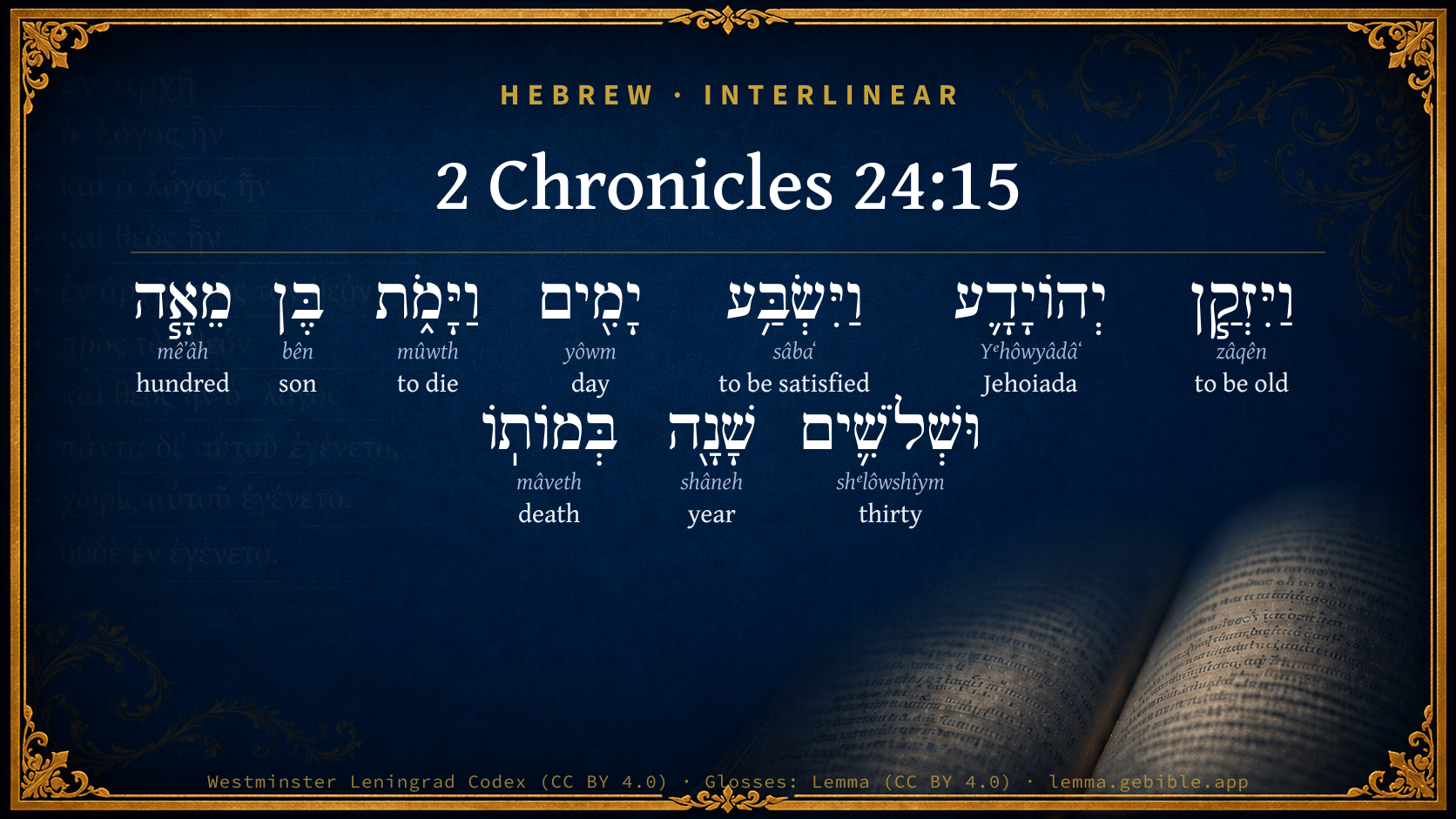
וַיִּזְקַ֧ן
zâqên
H2204
“and · to be old”
Conjunction + Verb, Qal, Sequential Imperfect, 3rd Person, Masculine, Singular
Part of Speech
Conjunction + Verb
Stem
Qal
Form
Sequential Imperfect
Person
3rd Person
Gender
Masculine
Number
Singular
Full BDB Definition

Origin: a primitive root

TWOT: 574

to be old, become old - (Qal) to be old, become old - (Hiphil) to grow old, show age
  1. יְהוֹיָדָ֛ע Yᵉhôwyâdâʻ H3077 “Jehoiada” Noun, Proper
  2. וַיִּשְׂבַּ֥ע sâbaʻ H7646 “and · to be satisfied” Conjunction + Verb, Qal, Sequential Imperfect, 3rd Person, Masculine, Singular
  3. יָמִ֖ים yôwm H3117 “days” Noun, Common, Masculine, Plural, Absolute
  4. וַיָּמֹ֑ת mûwth H4191 “and · to die” Conjunction + Verb, Qal, Sequential Imperfect, 3rd Person, Masculine, Singular
  5. בֶּן bên H1121 “son of” Noun, Common, Masculine, Singular, Construct
  6. מֵאָ֧ה mêʼâh H3967 “hundred” Adjective, Cardinal number, Both, Singular, Absolute
  7. וּשְׁלֹשִׁ֛ים shᵉlôwshîym H7970 “and · thirty” Conjunction + Adjective, Cardinal number, Both, Plural, Absolute
  8. שָׁנָ֖ה shâneh H8141 “year” Noun, Common, Feminine, Singular, Absolute
  9. בְּמוֹתֽוֹ mâveth H4194 “in/at · death · his” Preposition + Noun, Common, Masculine, Singular, Construct + Suffix, Personal, 3rd Person, Masculine, Singular

About this verse

These counts appear in no published source. They are computed here, from the morphology-tagged text and Lemma’s own curated glosses. What Lemma adds →

10
words
10
distinct lemmas
Historical
section

Shared distinctive vocabulary

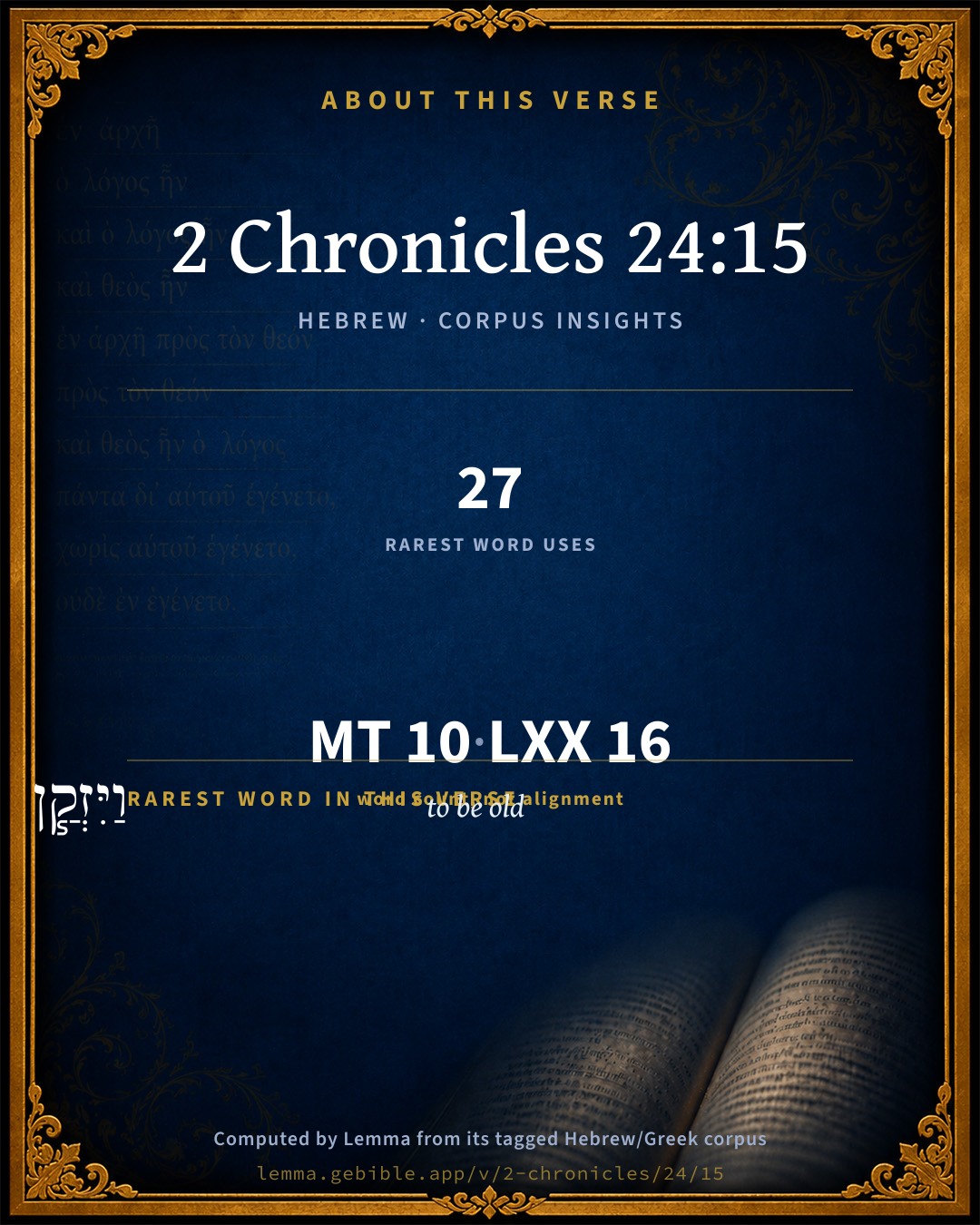
וַיִּזְקַ֧ן to be old H2204 occurs in 26 verses of the Hebrew Bible. Also found in:

Grammatical profile

  • 3 verbs
  • 5 nouns
  • 2 adjectives

Verb forms

  • וַיִּזְקַ֧ן Qal · Sequential Imperfect
  • וַיִּשְׂבַּ֥ע Qal · Sequential Imperfect
  • וַיָּמֹ֑ת Qal · Sequential Imperfect

Hebrew & Septuagint length

In English translation the verse runs 22 words from the Hebrew and 21 from the Septuagint (LXX English) — closely comparable.

A rough comparison of the two English renderings, which tokenize alike — not a word-level alignment.

Word counts can differ between the Hebrew and the Greek without any difference in meaning — e.g. the Hebrew direct-object marker אֵת has no separate Greek word, and Greek often adds the article ὁ.

In the original languages it is 10 Hebrew tokens and 16 Greek tokens — but the two are counted differently (Hebrew bundles its prefixes and suffixes into one token; the Greek is in lemma form), so that isn’t a like-for-like length.

Cross-references

7

Topical passages linked to 2 Chronicles 24:15 in the Treasury of Scripture Knowledge — connected by theme and wording, ordered by reader-vote popularity; previews shown in the World English Bible.

  • Genesis 15:15 But you will go to your fathers in peace. You will be buried in a good old age.
  • Genesis 25:8 Abraham gave up the spirit, and died in a good old age, an old man, and full of years, and was gathered to his people.
  • Genesis 47:9 Jacob said to Pharaoh, "The days of the years of my pilgrimage are one hundred thirty years. Few and evil have been the days of the years of my life, and they have not attained to the days of the years of the life of my fathers in the days of their pilgrimage."
  • 1 Chronicles 23:1 Now David was old and full of days; and he made Solomon his son king over Israel.
  • Job 5:26 You shall come to your grave in a full age, Like a shock of grain comes in its season.
  • Psalms 90:10 The days of our years are seventy, Or even by reason of strength eighty years; Yet their pride is but labor and sorrow, For it passes quickly, and we fly away.
  • Psalms 91:16 I will satisfy him with long life, And show him my salvation."

Cross-references courtesy of OpenBible.info (CC BY 4.0).

Hebrew and Greek witnesses Masoretic Hebrew ↔ Greek Septuagint

The same verse in the two great witnesses to the Old Testament, shown verse-for-verse.

These are two independent witnesses, not word-aligned to each other, and the Septuagint is shown in lemma (dictionary) form.

Hebrew 2 Chronicles 24:15 Masoretic · Westminster Leningrad Codex

וַיִּזְקַ֧ן יְהוֹיָדָ֛ע וַיִּשְׂבַּ֥ע יָמִ֖ים וַיָּמֹ֑ת בֶּן מֵאָ֧ה וּשְׁלֹשִׁ֛ים שָׁנָ֖ה בְּמוֹתֽוֹ

But Jehoiada grew old and was full of days, and he died; one hundred thirty years old was he when he died.

World English Bible · Public Domain

Greek LXX 2 Chronicles 24:15 Septuagint · lemma form

καί γηράω ιωδαε πλήρης ἡμέρα καί τελευτάω εἰμί ἑκατόν καί τριάκοντα ἔτος ἐν ὁ τελευτάω αὐτός

And Jodae grew old, being full of days, and he died, being one hundred and thirty years old at his death.

LXX2012 (modern English Septuagint) · Public Domain

On this verse, The Pulpit Commentary discusses the Septuagint’s reading. Read the note in Commentary ↓

Hebrew: Westminster Leningrad Codex (CC BY 4.0). Greek: Septuagint (public domain); English from LXX2012 (modern English Septuagint) (Public Domain). How the Septuagint differs from the Hebrew →

Commentary

Notes on 2 Chronicles 24:15 from classic Christian and Jewish commentators (each source and its license shown beneath its notes). The classic Christian expositions comment on the surrounding passage and are grouped to its opening verse, so a note may address several verses; the Jewish commentaries on the Tanakh (Rashi and others) are per-verse, so they appear only where the commentator wrote on this verse.

Lemma curates 59 commentaries, every one of them public domain or Creative Commons licensed, each selected and text-cleaned for this edition rather than reprinted as found. About our sources →

Matthew Henry's Commentary

We have here a sad account of the degeneracy and apostasy of Joash. God had done great things for him; he had done something for God; but now he proved ungrateful to his God and false to the engagements he had laid himself under to him. How has the gold become dim, and the most fine gold changed! Here we find,

I. The occasions of his apostasy. When he did that which was right it was not with a perfect heart. He never was sincere, never acted from principle, but in compliance to Jehoiada, who had helped him to the crown, and because he had been protected in the temple and rose upon the ruins of idolatry; and therefore, when the wind turned, he turned with it. 1. His good counsellor left him, and was by death removed from him. It was a mercy to him and his kingdom that Jehoiada lived so long-130 years (Ch2 24:15), by which it appears that he was born in Solomon's time, and had lived six entire reigns before this. It was an encouragement to him to go on in that good way which Jehoiada had trained him up in to see what honour was done to Jehoiada at his death: They buried him among the kings, with this honourable encomium (perhaps it was part of the inscription on his grave-stone), that he had done good in Israel. Judah is called Israel, because, the other tribes having revolted from God, they only were Israelites indeed. Note, It is the greatest honour to do good in our generations, and those who do that which is good shall have praise of the same. He had done good towards God; not that any man's goodness can extend unto him, but he had done good towards his house, in reviving the temple service, Ch2 23:8. Note, Those do the greatest good to their country that lay out themselves in their places to promote religion. Well, Jehoiada finished his course with honour; but the little religion that Joash had was all buried in his grave, and, after his death, both king and kingdom miserably degenerated. See how much one head may sustain, and what a great judgment to any prince or people the death of godly, zealous, useful men is. See how necessary it is that, as our Saviour speaks, we have salt in ourselves, that we act in religion from an inward principle, which will carry us on through all changes. Then the loss of a parent, a minister, a friend, will not involve the loss of our religion. 2. Bad counsellors got about him, insinuated themselves into his affections, wheedled him, flattered him, made obeisance to him, and, instead of condoling, congratulated him upon the death of his old tutor, as his release from the discipline he had been so long under, unworthy a man, a king. They tell him he must be priest-ridden no longer, he is now discharged from grave lessons and restraints, he may do as he pleases: and (would you think it?) the princes of Judah were the men that were so industrious to debauch him, Ch2 24:17. His father and grandfather were corrupted by the house of Ahab, from whom no better could be expected. But that the princes of Judah should be seducers to their king was very sad. But those that incline to the counsels of the ungodly will never want ungodly counsellors. They made obeisance to the king, flattered him into an opinion of his absolute power, promised to stand by him in making his royal will and pleasure pass for a law, any divine precept or institution to the contrary in any wise notwithstanding. And he hearkened to them: their discourse pleased him, and was more agreeable than Jehoiada's dictates used to be. Princes and inferior people have been many a time thus flattered into their ruin by those who have promised them liberty and dignity, but who have really brought them into the greatest servitude and disgrace.

II. The apostasy itself: They left the house of God, and served groves and idols, Ch2 24:18. The princes, it is likely, had a request to the king, which they tell him they durst not offer while Jehoiada lived; but now they hope it will give no offence: it is that they may set up the groves and idols again which were thrown down in the beginning of his reign, for they hate to be always confined to the dull old-fashioned service of the temple. And he not only gave them leave to do it themselves, but he joined with them. The king and princes, who, a little while ago, were repairing the temple, now forsook the temple; those who had pulled down groves and idols now themselves served them. So inconstant a thing is man and so little confidence is to be put in him!

III. The aggravations of this apostasy and the additions of guilt to it. God sent prophets to them (Ch2 24:19) to reprove them for their wickedness, and to tell them what would be in the end thereof, and so to bring them again unto the Lord. It is the work of ministers to bring people, not to themselves, but to God - to bring those again to him who have gone a whoring from him. In the most degenerate times God left not himself without witness; though they had dealt very disingenuously with God, yet he sent prophets to them to convince and instruct them, and to assure them that they should find favour with him if yet they would return; for he would rather sinners should turn and live than go on and die, and those that perish shall be left inexcusable. The prophets did their part: they testified against them; but, few or none received their testimony.

1. They slighted all the prophets; they would not give ear, were so strangely wedded to their idols that no reproofs, warnings, threatenings, nor any of the various methods which the prophets took to convince them would reclaim them. Few would hear them, fewer would heed them, but fewest of all would believe them or be governed by them.

2. They slew one of the most eminent, Zechariah the son of Jehoiada, and perhaps others. Concerning him observe,

(1.) The message which he delivered to them in the name of God, Ch2 24:20. The people were assembled in the court of the temple (for they had not quite left it), probably on occasion of some solemn feast, when this Zechariah, being filled with the spirit of prophecy, and known (it is likely) to be a prophet, stood up in some of the desks that were in the court of the priests, and very plainly, but without any provoking language, told the people of their sin and what would be the consequences of it. He did not impeach any particular persons, nor predict any particular judgments, as sometimes the prophets did, but as inoffensively as possible reminded them of what was written in the law. Let them but look into their Bibles, and there they would find, [1.] The precept they broke: "You transgress the commandments of the Lord, you know you do so, in serving groves and idols: and why will you so offend God and wrong yourselves?" [2.] The penalty they incurred: "You know, if the word of God be true, you cannot prosper in this evil way; never expect to do ill and fare well. Nay, you find already that because you have forsaken the Lord he hath forsaken you, as he told you he would," Deu 29:25; Deu 31:16, Deu 31:17. This is the work of ministers, by the word of God, as a lamp and a light, to expose the sin of men and expound the providences of God.

(2.) The barbarous treatment they gave him for his kindness and faithfulness in delivering this message to them, Ch2 24:21. By the conspiracy of the princes, or some of their party, and by the commandment of the king, who thought himself affronted by this fair warning, they stoned him to death immediately, not under colour of law, accusing him as a blasphemer, a traitor, or a false prophet, but in a popular tumult, in the court of the house of the Lord - as horrid a piece of wickedness as perhaps any we read of in all the history of the kings. The person was sacred - a priest, the place sacred - the court of the temple (the inner court, between the porch and the altar), the message yet more sacred, and we have reason to think that they knew it came from the spirit of prophecy. The reproof was just, the warning fair, both backed with scripture, and the delivery very gentle and tender; and yet so impudently and daringly do they defy God himself that nothing less than the blood of the prophet can satisfy their indignation at the prophecy. Be astonished, O heavens! at this, and tremble, O earth! that ever such villany should be committed by men, by Israelites, in contempt and violation of every thing that is just, honourable, and sacred - that a king, a king in covenant with God, should command the murder of one whom it was his office to protect and countenance! The Jews say there were seven transgressions in this; for they killed a priest, a prophet, a judge, they shed innocent blood, and polluted the court of the temple, the sabbath, and the day of expiation: for on that day, their tradition says, this happened.

(3.) The aggravation of this sin, that this Zechariah, who suffered martyrdom for his faithfulness to God and his country, was the son of Jehoiada, who had done so much good in Israel, and particularly had been as a father to Joash, Ch2 24:22. The affront done by it to God, and the contempt put on religion, are not so particularly taken notice of as the ingratitude there was in it to the memory of Jehoiada. He remembered not the kindness of the father, but slew the son for doing his duty, and what the father would have done if he had been there. Call a man ungrateful, and you can call him no worse.

(4.) The dying martyr's prophetic imprecation of vengeance upon his murderers: The Lord look upon it, and require it! This came not from a spirit of revenge, but a spirit of prophecy: He will require it. This would be the continual cry of the blood they shed, as Abel's blood cried against Cain: "Let the God to whom vengeance belongs demand blood for blood. He will do it, for he is righteous." This precious blood was quickly reckoned for in the judgments that came upon this apostate prince; it came into the account afterwards in the destruction of Jerusalem by the Chaldeans - their misusing the prophets was that which brought upon them ruin without remedy (Ch2 36:16); nay, our Saviour makes the persecutors of him and his gospel answerable for the blood of this Zechariah; so loud, so long, does the blood of the martyrs cry. See Mat 23:35. Such as this is the cry of the souls under the altar (Rev 6:10), How long ere thou avenge our blood? For it shall not always go unrevenged.

IV. The judgments of God which came upon Joash for this aggravated wickedness of his. 1. A small army of Syrians made themselves masters of Jerusalem, destroyed the princes, plundered the city, and sent the spoil of it to Damascus, Ch2 24:23, Ch2 24:24. God's people, while they kept in with God, had often been conquerors when the enemy had the advantage of the greater number; but now, on the contrary, an inconsiderable handful of Syrians routed a very great host of Israelites, because they had forsaken the Lord God of their fathers, and then they were not only put upon the level with their enemies, but opposed them with the utmost disadvantage; for their God not only departed from them, but turned to be their enemy and fought against them. The Syrians were employed as instruments in God's hand to execute judgments against Joash, though they little thought so, Isa 10:6, Isa 10:7, and see Deu 32:30. 2. God smote him with great diseases, of body, or mind, or both, either like his grandfather (Ch2 21:18), or, like Saul, an evil spirit from God troubling him. While he was plagued with the Syrians he thought that, if he could but get clear of them, he should do well enough. But, before they departed from him, God smote him with diseases. If vengeance pursue men, the end of one trouble will but be the beginning of another. 3. His own servants conspired against him. Perhaps he began to hope his disease would be cured - he was but a middle-aged man and might recover it; but he that cometh up out of the pit shall fall into the snare. When he thought he should escape death by sickness he met it by the sword. They slew him in his bed for the blood of the sons of Jehoiada, by which it should seem that he did not only slay Zechariah, but others of the sons of Jehoiada for his sake. Perhaps those that slew him intended to take vengeance for that blood; but, whether they did or not, this was what God intended in permitting them to slay him. Those that drink the blood of the saints shall have their own blood given them to drink, for they are worthy. The regicides are here named (Ch2 24:26), and it is observable that the mothers of them both were foreigners, one an Ammonitess and the other a Moabitess. The idolatrous kings, it is likely, countenanced those marriages which the law prohibited for the prevention of idolatry; and see how they resulted in their own destruction. 4. His people would not bury him in the sepulchres of the kings because he had stained his honour by his mal-administration. Let him not be written with the righteous, Psa 69:28. These judgments are called the burdens laid upon him (Ch2 24:27), for the wrath of God is a heavy burden, too heavy for any man to bear. Or it may be meant of the threatenings denounced against him by the prophets, for those are called burdens. Usually God sets some special marks of his displeasure upon apostates in this life, for warning to all to remember Lot's wife.

Matthew Henry's Commentary on the Whole Bible (1708–1710) — public domain (CC PDM 1.0). Text via the HelloAO Bible API.

Jamieson, Fausset & Brown

Robert Jamieson, A. R. Fausset & David Brown

JEHOIADA BEING DEAD. (Ch2 24:15-16)

Jehoiada waxed old . . . and died--His life, protracted to unusual longevity and spent in the service of his country, deserved some tribute of public gratitude, and this was rendered in the posthumous honors that were bestowed on him. Among the Hebrews, intramural interment was prohibited in every city but Jerusalem, and there the exception was made only to the royal family and persons of eminent merit, on whom the distinction was conferred of being buried in the city of David, among the kings, as in the case of Jehoiada.

Jamieson, Fausset & Brown — Commentary Critical and Explanatory on the Whole Bible (1871) — public domain (CC PDM 1.0). Text via the HelloAO Bible API.

Ellicott's Commentary for English Readers

DEATH AND BURIAL OF JEHOIADA. NATIONAL APOSTACY AND MURDER OF ZECHARIAH BEN JEHOIADA THE PROPHET (2Ch_24:15-22).

This section is wholly wanting in the Kings. It serves as a moral explanation of the after-history of Joash, recorded there and here (2Ki_12:17-21).

(15) But Jehoiada . . . when he died.—Literally, And Jehoiada became old, and was satisfied with days, and he died. The verb “to be satisfied” is only so used here and in 1Ch_23:1. (Comp. Psa_91:16.) The ancient expression was adjectival, “full of days” (Gen_25:8; Gen_35:29; Job_42:17; 1Ch_29:28, only).

An hundred and thirty years old.—According to some modern physiologists, one hundred and five is the proper limit of human life; that is to say, five times the period usually required for the attainment of full growth. Under favourable conditions it is even supposed that life might extend to half a century longer (M. Flourens, of the French Academy of Sciences). When persons of advanced age (eighty to one hundred) die, it is usually from preventible causes, As a French medical writer has remarked, “Men do not commonly die; they kill themselves.” The ago of Jehoiada, then, would seem to be not impossible, although an error of transcription in our text is also not impossible.

A Bible Commentary for English Readers, edited by Charles John Ellicott (1878–1897) — public domain. Text from a community e-Sword module.

Trapp's Complete Commentary

John Trapp

2Ch 24:15 But Jehoiada waxed old, and was full of days when he died; an hundred and thirty years old [was he] when he died.

Ver. 15. But Jehoiada waxed old.] And therefore, haply, had been the more remiss. {2Ch 24:6}

And was full of days.] See on 1Ch 23:1.

When he died.] The good people were ready to wish, as the Romans did of Augustus, that either he had never been born, or had never died.

John Trapp, A Commentary or Exposition upon All the Books of the Old and New Testament (1647–1656) — public domain. Text from a community e-Sword module.

The Biblical Illustrator

Joseph S. Exell

2Ch_24:15-16

Jehoiada waxed old.

A message for the aged

I. Examine the name of this aged priest. Jehoiada--one who has knowledge of Jehovah.

1. He had been experimentally acquainted with Jehovah in His fatherly and merciful character.

2. He had as priest special opportunities of gaining acquaintance with God.

II. Consider his beneficent influence in--

1. Instructing the youthful king.

2. Acting as regent of the kingdom.

3. Patriotically serving his country and promoting the well-being of her people.

4. Doing good to, and in connection with, the house of God.

III. Contemplate the honoured close of a long and useful life. (Fairfax Goodall, M.A.)

Religious instructors useful to civil society

Some have conjectured that these words were a part of an epitaph put upon Jehoiadas tomb. They express the high sense which the nation entertained of his eminent usefulness in his sacred profession.

I. The common opinion of mankind respecting the usefulness of religious instructors in civil society. The opinion of the world upon this subject is evidenced by their uniform and immemorial practice. Jews, Christians, and heathen have universally agreed to support religious teachers.

II. This common opinion of mankind respecting religious instructors is well founded.

1. The common opinion of the world is generally just. Men seldom form a wrong judgment of those things which come under their own observation and experience.

2. Another argument is drawn--

(1) From the duties which the ministers of religion ought to teach.

(a) The duties which rulers owe to their subjects.

(b) The duties which subjects owe to their rulers.

(c) Every private as well as public duty.

(2) From the motives by which they ought to enforce all their religious instructions.

(a) The being and presence of the all-seeing and heart-searching God.

(b) The infinite authority of all His precepts and prohibitions.

(c) The controlling influence of His universal providence.

(d) Future and eternal rewards and punishments.

III. Suggestions.

1. Since men in all ages have generally and justly agreed in the opinion that religious instructors are useful in civil society, it discovers no less ignorance than presumption in those who adopt and endeavour to propagate the opposite sentiment.

(1) It betrays want of knowledge in the science of politics.

(2) It betrays ignorance of the impotency of human laws.

2. None are fit for civil rulers who would exclude religious instructors from civil society.

3. A people ought to consider the gift of wise and faithful ministers as a great public blessing.

4. It is the wisdom and duty of civil rulers to favour the cause of religion and employ every proper method to promote the general diffusion of religious knowledge.

5. It argues a great degree of infatuation in those who govern to oppose or restrain religious instruction.

6. It is extremely difficult for civil rulers to subvert a good government while religious teachers faithfully discharge their duty.

7. Ministers of the gospel ought to exert all the power and influence which their sacred office gives them to prevent the ruin of the nation.

8. We have great reason to fear the displeasure of God for neglecting and abusing the ministrations of His Word. (N. Emmons, D.D.)

The Biblical Illustrator, edited by Joseph S. Exell (c. 1880s–1900s) — public domain. Text from a community e-Sword module.

Joseph Benson's Commentary

2Ch 24:15-16. A hundred and thirty years old was he, &c. — By which it appears, that he was born in Solomon’s time, and had lived six entire reigns before this. They buried him among the kings — With this honourable encomium, (perhaps inscribed upon his grave-stone,) that he had done good in Israel — But the little religion that Joash had, was all buried in his grave. See how great a judgment, to any prince or people, the death of holy, useful men is! Both toward God, and toward his house — He had been an instrument in restoring the divine worship, which now, they were sensible, was a great blessing, and in repairing the decays which were in the temple, and furnishing it with vessels for the service of God.

2Ch 24:17. Came the princes of Judah — Some of the great men, who continued Baalites in their hearts; and made obeisance to the king — And in that posture presented their requests to him, that they might not be confined to troublesome journeys to Jerusalem, but might have the liberty, which their forefathers enjoyed, of worshipping God in the high places. This liberty once obtained, they knew they could worship idols without disturbance, which was the thing at which they aimed: and for the prevention of such abuses, God obliged all to worship him in one place. Then the king hearkened unto them — He consented to their request, that they might worship in the high places. For fair words and flatteries easily deceive princes, as Grotius here observes; and they wanted not specious reasons to persuade the king, not to be so strict as to insist on their worshipping only at the temple.

Joseph Benson's Commentary on the Old and New Testaments (1811–1818) — public domain. Text from a community e-Sword module.

Tyndale Open Study Notes

Tyndale Open Resources

24:15-16 A lifespan of 130 years indicates that Jehoiada received great blessing by the Lord. Further, his royal burial as a priest-king shows great honor from the people.

Tyndale Open Study Notes — © Tyndale Open Resources, licensed CC BY-SA 4.0. Text via the HelloAO Bible API.

The Cambridge Bible for Schools and Colleges

gen. ed. J. J. S. Perowne

15–19 (no parallel in 2 Kin.). The Apostasy of Joash

15. when he died] R.V. and he died.

an hundred and thirty years] The age of Jacob (Gen_47:9).

The Cambridge Bible for Schools and Colleges (gen. ed. J. J. S. Perowne; Cambridge University Press, 1878–1918) — public domain. Text from a community e-Sword module.

John Gill's Exposition

Now after the death of Jehoiada came the princes of Judah,.... Who had been secretly inclined to idolatry, but durst not discover it during the life of Jehoiada; whose influence at court was too great for them to counterwork, but when dead they came to court:

and made obeisance to the king; bowed in a very lowly manner, fawned upon him, and flattered him. Some Jewish writers, as Kimchi observes, understand this of religious adoration, that they made a god of him, and worshipped him, pretending, as a foundation for it, his being hid six months in the temple, and preserved; but it designs no more than civil worship and homage:

then the king hearkened unto them; coursing with him about divine worship, which the business they came about; desiring that they might, not be obliged to come to Jerusalem to worship, but might make use of the high places, and by that means worship what idol they pleased, which he granted to them; the Targum is,"he received their idols from them.''

John Gill's Exposition of the Whole Bible (1746–1763) — public domain (CC PDM 1.0). Text via the HelloAO Bible API.

Albert Barnes' Notes on the Bible

An hundred and thirty years old - Most critics suppose the number in the text to be corrupt, and suggest 103 or 83 in its stead.

Albert Barnes' Notes on the Bible (1834–1885) — public domain. Text from a community e-Sword/MySword module.

Whedon's Commentary on the Bible

Daniel D. Whedon

15. A hundred and thirty years old — Longevity without parallel since the days of the patriarchs. Compare Gen_47:9. A number of critics, however, regard the number as corrupt, and propose to substitute one hundred and three, or eighty-three. This aged priest had been as a sun and a shield to his people. He had preserved the royal seed of David from destruction, delivered the kingdom from the curse of Athaliah’s rule, exalted Joash to the throne, and counseled him in the ways of Jehovah, and lived long to guard and strengthen his reign. Well might a grateful people bury him “among the kings,” and remember and chronicle the “good” he had done in Israel. The death of this high priest is mentioned as the turning-point in the reign of Joash. When his priestly friend and counsellor was gone, he was soon led astray by evil advisers, and thus brought judgment upon himself and his people.

DEFECTION AND WICKEDNESS OF THE KING AND THE PEOPLE, 2Ch_24:17-22.

Daniel D. Whedon (gen. ed.), Commentary on the Old and New Testaments (1874–1909) — public domain. Text from a community e-Sword module.

The Pulpit Commentary

But Jehoiada died; a hundred and thirty years old. This good man, husband of Jehoram"s daughter, (2Ch_22:11) only comes to view in virtue of what his wife did, and what he did,; on behalf of Joash the infant and Joash the king for the good of the nation or kingdom of Judah. We seem to know too little of him, and the parallel supplies considerably less than our text in Chronicles. His age, as stated in this verse when he died, seems very improbable, and for a very clear and admirable putting of the case, see Lord Arthur C. Hervey"s article in Dr. Smith"s "Bible Dictionary," 1:944. There is, however, no manifest or even suspicious symptom of corruptness in the text just here, supported as it is by the Septuagint and Josephus, by the stress laid on his old age, whether it showed a hundred and thirty years, or thirty years or fifty years (as have been variously suggested) fewer; the little fact, otherwise looking very significant, that the expression, full of days, is used beside only of Abraham, Isaac, Job, and David, loses its pertinence in that very circumstance that it is used of David, whose age was in no way extreme. The age of the other three, however, exceeded this reputed age given to Jehoiada!

Vers. 15, 16.

A noble character and a useful life.

These are two things which are not always closely associated, though they are very frequently found together; they certainly were thus united in the person and experience of Jehoiada. In him we have

I A NOBLE CHARACTER. And this:

1. Was based upon true piety. Jehoiada was the man he was because he was a faithful servant of Jehovah. He was rich "toward God." His mind and heart were turned toward him, to worship in his house, to study and to do his will, to promote his glory. Everything else that was good in him rested on his religious conviction and practice as on a sure foundation; every other virtue took its root and found its source and spring in that.

2. Acquired great strength. By the exercise and cultivation of his piety and moral worth, by his confidence in God, and by all that he daily gained from God in response to his devotion, he acquired great force of goodness. He was a man that "seemed to be a pillar," and who was such; a strong stay, which no antagonism could remove, no treachery undermine. He "stood foursquare to all the winds that blew." Men felt that in him they would find a determined and powerful enemy to whatever evil thing they might propose.

3. Shone forth in unselfish service. He fearlessly and nobly risked everything in order to rid his country of a vile usurper, and place upon the throne one that would rule in righteousness. And though he certainly lent all the weight of his influence to the support of the sovereign, he does not appear to have arrogated any undue authority (see ver. 6). He was actuated by a pure, magnanimous devotion to the highest interests of his country. So he lived

II A USEFUL LIFE.

1. He effected a most desirable and salutary revolution; overturning adynasty that had no right to the throne, and restoring the family of David; exchanging an idolatrous ruler for one that reigned in the fear of God.

2. He solemnly pledged the people to the service of Jehovah, and arranged for systematic services in his temple. (2Ch_23:16-18)

3. He sustained the hand of Joash in his work of repairing the temple. Thiswe might assume, but this the words of the text, "toward his house," clearly indicate.

4. He did much (as the following verses show) to maintain the worship ofGod in the land, against all reactionary influences, whether at court or among the princes or the people. He "did good to Israel" indeed. If we except the judges and kings as those whose official positions gave them quite exceptional opportunities, we may safely say that there are not more than three or four men who rendered such distinguished service to their country as Jehoiada the priest. He was well worthy, when he died in an honoured old age, to be "buried among the kings." Probably few kinglier men than he have been "gathered to their fathers.

We learn:

1. That honour rests upon faithful service, on true usefulness suchhonour as is worth possessing.

2. That usefulness is the product of excellency of character. Men may beeloquent, ambitious, capable, endowed with large administrative abilities, but if they are not unselfish, if they do not know how to subordinate their own aims and interests to the public weal, they are as likely to be harmful as helpful in their course. Only solid worth of character, rectitude allied with patriotism and philanthropy, is any security for substantial usefulness.

3. That character is only sound when it is sacred; that it is only the manwho reveres God, and who places himself and his life under Divine guidance, on whom we can thoroughly rely. All other defences and inspirations fail. "The fear of God" of which the devout Israelite spoke, the love and service of Jesus Christ of which we speak, this is the rock on which to build a noble character and a useful life. C.

Vers. 15, 16.

The life, death, burial, and epitaph of a great man.

I JEHOIADA"S LIFE.

1. Pious; i.e.

(1) Good. No man really pious who is not inwardly good.

(2) Sincere. As a priest of Jehovah, he was under solemn covenant to lead a holy life.

(3) Courageous. It required no small heroism to stand forth as a servant of Jehovah in the days of Ahaziah and Athaliah.

2. Useful. "We live in deeds, not years; in thoughts, not breaths," etc. (Bailey). Jehoiada"s life was spent, not in indolence, but activity; this activity was directed, not by personal ambitions, but by considerations of public advantage, and ceased not until the close of his life. Besides discharging the multifarious duties devolving upon him as high priest of the nation, he practically became the nation"s leader during the times of Jehoram, Ahaziah, and Athaliah; the nation"s saviour, effecting the overthrow of Athaliah, the preservation of Joash, and in him the continuance of David"s throne; and the nation"s ruler, acting as regent during Joash"s minority, and as prime minister of Joash until the end came. In particular, to him the nation owed the preservation of its king, its throne, its religion, its temple.

3. Long. Nevertheless, the end came, though long delayed. He died "full ofdays," satisfied with living, like Abraham, (Gen_25:8) Isaac, (Gen_35:29) David, (1Ch_23:1) and Job, (Job_42:17) an old man of a hundred and thirty years, the longest recorded life of any Hebrew, the patriarchs excepted. "What man is he that desireth life, and loveth many days, that he may see good?" etc.. (Psa_34:12-14)

II JEHOIADA"S DEATH.

1. To himself a gain. (Php_1:21)

(1) A blessed repose after life"s labours (Isa_57:2; Dan_12:13; 2Th_1:7; Rev_14:13) "After life"s fitful labour he sleeps well" ("Macbeth," act 3. sc. 2).

(2) A splendid exchange for time"s vanities: "length of days for ever and (Psa_21:4 Psa_37:18; Joh_10:28; Heb_11:10, Heb_11:16; 1Pe_1:4; Rev_2:10)

(3) A magnificent reward for earth"s services (Psa_16:11 Psa_17:15; Pro_3:35; Joh_12:26; Rom_2:7; Rev_2:7, Rev_2:17, Rev_2:26)

2. To Joash a loss. (2Ki_2:3) Jehoiada"s death the removal of

(1) the saviour of his infancy;

(2) the teacher of his boyhood;

(3) the counsellor of his manhood. Whether Joash recognized the greatness of his loss may be doubtful. The notion that he felt the decease of the grey-haired priest as something of a relief is not without countenance.

3. To the nation a calamity. (2Sa_3:38) Born to be a king, Joash wanted the capacity to rule. The fittest man to have sat upon the throne was Jehoiada. Only Divine providence does not always assign men the posts for which they are best qualified. The incompetency of Joash would have earlier proved a curse to Judah had the statesman-priest not been at his elbow. So long as Jehoiada kept his hand upon the helm, the ship of state sailed over stormiest seas with safety; when death compelled his grasp to relax, the vessel"s rocking amid the tumbling waves showed how capable a pilot he bad been.

III JEHOIADA"S BURIAL.

1. National. The people paid him public obsequies. Not the king alone, but the entire realm lamented him, and joined in the sad ceremonial of

2. consigning his lifeless body to the tomb. Public funerals are often gigantic hypocrisies. Not of such sort was this of the great priest of Jerusalem.

3. Royal. The grandeur of his obsequies equalled that lavished on the funerals of kings. Of some kings, among whom Joash must be numbered (ver. 25), it is recorded that the people declined to honour them with royal burial; (2Ch_21:19, 20 26:23 28:27) of Jehoiada, though not a king, except in nobility of soul, it is written, his people "buried him in the city of David among the kings as it were recognizing in him a sovereign greater than many, and equal to the best.

IV JEHOIADA"S EPITAPH.

1. Short. One sentence of three clauses: "He did good in Israel, both toward God, and towards his house." Nothing more offensive to good taste and refined feeling, not to say more untrue to fact, than the fulsome and extravagant paragraphs which often appear on tombstones.

2. Simple. All who read might understand, and, understanding, might verify from their own experience, assisted (if need were) by the recollections of others. The last place at which to make a display of eloquence and rhetoric is the grave"s month. What is here recorded of this uncrowned King of Judah stands in startling contrast with the magniloquence of Egyptian and Assyrian kings.

3. Sufficient. What more or better could be testified of any man than that in his lifetime he had done good, lived a life of piety towards God and of philanthropy towards man, promoted God"s glory and advanced man"s good, furthered God"s kingdom and increased man"s happiness?

Learn:

1. The possibility of combining statesmanship and piety.

2. The commanding influence of religion when associated with talent and rank.

3. The advisability of looking beyond man in both Church and state, since statesmen and priests are not suffered to continue by reason of death.

4. The certainty that a life of philanthropy and piety will sooner or later find recognition.

5. The fitness of rewarding with becoming honour in death those who sincerely and successfully serve their generation when in life. W.

The Pulpit Commentary (1880–1919), ed. H.D.M. Spence-Jones & Joseph S. Exell — public domain. Text from a community e-Sword module.

John Wesley's Explanatory Notes

An hundred and thirty years old - By which it appears, that he was born in Solomon's time, and had lived six entire reigns before this. They buried him among the kings, with this honourable encomium, (perhaps inscribed upon his grave-stone) that he had done good in Israel. But the little religion that Joash had, was all buried in his grave. See how great a judgment to any prince or people, the death of holy, useful men is!

John Wesley, Explanatory Notes Upon the Whole Bible (1754–1765) — public domain. Text via the GEBible commentary corpus.

Kretzmann's Popular Commentary

Paul E. Kretzmann

The Defection of Joash and its Punishment

v. 15. But Jehoiada waxed old, and was full of days when he died, he lived to reach an unusually great age; an hundred and thirty years old was he when he died.

v. 16. And they buried him in the City of David among the kings, giving him one of the highest honors which could be bestowed upon any man in Judah, because he had done good in Israel, both toward God and toward His house. This was, as in many similar cases, followed by a strange reaction in the land.

v. 17. Now, after the death of Jehoiada came the princes of Judah and made obeisance to the king. As long as the old priest had lived, they had not dared to show their preference for the idolatrous customs of the heathen, but they thought the time had now come to assert themselves and to gain control of the king. Then the king hearkened unto them, permitting himself to be swayed by their wicked whisperings. This incident shows how deeply the nation had been corrupted at the time of Jehoiada’s reformation, how firmly even the leaders had been attached to idolatry.

v. 18. And they left the house of the Lord God of their fathers and served groves, Asherim, the wooden pillars erected in honor of Astarte, and idols; and wrath came upon Judah and Jerusalem for this their trespass, for this is the inevitable consequence of the desertion of the true God and the turning to idolatry in any form.

v. 19. Yet He, the Lord, sent prophets to them, to bring them again unto the Lord; and they testified against them, with warnings which pointed out the certain consequences of such behavior; but they would not give ear, they were too deeply steeped in their sins and too stubborn to heed the words which were intended to bring them back to the right pathway.

v. 20. And the Spirit of God came upon Zechariah, the son of Jehoiada, that is, the grandson, for his father’s name was Barachias, the priest, which stood above the people, for the inner court, where he stood, was higher than the outer court, where the people were assembled, and said unto them, Thus saith God, Why transgress ye the commandments of the Lord that ye cannot prosper? Because ye have forsaken the Lord, He hath also forsaken you. Forsaking the Lord invariably brought misfortune, as the people should have known without this inspired warning.

v. 21. And they, the people, conspired against him, and stoned him with stones at the commandment of the king in the court of the house of the Lord. This shows how quickly and how deeply Joash had fallen from the right way after the death of Jehoiada. The incident is referred to by Christ in one of His warnings to the Jews of His time, Mat 23:35; Luk 11:51.

v. 22. Thus Joash the king remembered not the kindness which Jehoiada, his father, had done to him, in being his steadfast and reliable counselor for so many years, but slew his son. Ingratitude is the mark of the godless. And when he, Zechariah, died, he said, The Lord look upon it and require it, he left the vengeance, the punishment of this crime, to Jehovah.

v. 23. And it came to pass at the end of the year, at the season when campaigns were usually opened, that the host of Syria came up against him, the Lord’s withdrawing the blessing of peace from His people being direct evidence that He had forsaken them. And they came to Judah and Jerusalem, under the leadership of their King Hazael, and destroyed all the princes of the people from among the people, probably including the very ones who had reintroduced idolatry, and sent all the spoil of them unto the king of Damascus.

v. 24. For the army of the Syrians came with a small company of men, just as Moses had predicted would happen, Lev 26:8; Deu 32:30, and the Lord delivered a very great host into their hand because they had forsaken the Lord God of their fathers. So they, the soldiers of the enemy, executed judgment against Joash, the Lord made use of them in carrying out His sentence of punishment upon the backsliding nation.

v. 25. And when they were departed from him, (for they left him in great diseases, with many wounds, which resulted in a painful malady,) his own servants conspired against him for the blood of the sons of Jehoiada, the priest, and slew him on his bed, and he died, for public opinion ascribed these great disasters to the king. And they buried him in the City of David; but they burled him not in the sepulchers of the kings, he was not given that distinction, but was treated with dishonor, like Jehoram, 2Ch 21:20.

v. 26. And these are they that conspired against him: Zabad (or Jozachar), the son of Shlmeath, an Ammonitess, and Jehozabad, the son of Shimrlth (or Shomer), a Moabitess, neither of them members of the Jewish nation.

v. 27. Now, concerning his sons, and the greatness of the burdens laid upon him, the treasure which he had to send as a tribute to Hazael of Syria, and the repairing of the house of God, behold, they are written in the story of the Book of the Kings. And Amaziah, his son, reigned in his stead, 2Ki 12:21. The history of Joash contains an earnest warning to all those who at one time were zealous for the Lord, but later turned to the opposite extreme. If one deliberately turns to the service of sin, all the efforts of an earlier blameless life will be of no avail.

Paul E. Kretzmann, Popular Commentary of the Bible (1921–1924) — public domain. Text from a community e-Sword module.

unfoldingWord translationNotes

Door43 World Missions Community

grew old and was full of days

These two phrases mean the same thing and emphasize how long he lived. AT: "became very old" (See: Doublet)

was full of days

This idiom means he lived a long time. (See: Idiom)

130 years old

"one hundred and thirty years old" (See: Numbers)

among the kings

"among the tombs of the kings" or "among the graves of the kings"

because he had done good in Israel, toward God, and to God's house

The nominal adjective "good" can be translated as an adjective. AT: "because he had done good things in Judah for God and for God's temple" (See: Nominal Adjectives)

translationWords

die

bury

city of David

unfoldingWord translationNotes — © Distant Shores Media and the Door43 World Missions Community, licensed CC BY-SA 4.0. Source: git.door43.org/Door43/en_tn.

Lesson kit

Teaching starters — assembled from the data on this page, not authored interpretation. Every prompt links to the verse data it draws on. Edit before teaching.

2 Chronicles, in the Historical, opens this verse with 10 words (10 distinct Hebrew lemmas). Its most distinctive word is zâqên (“to be old”). A historical commentator’s framing appears above. Read the whole chapter for the surrounding context.

Discussion questions

  1. How does “to be old” (zâqên) shape what this verse is saying?
  2. Genesis 18:12 shares the word «to be old» with this verse. How do the two illuminate each other?
  3. These translations render this verse differently; the difference is in the English rendering, not the original. What questions does that raise?
  4. The verb «וַיִּזְקַ֧ן» is Qal Sequential Imperfect. How does its form color the action?
  5. Reading how Matthew Henry's Commentary and Jamieson, Fausset & Brown read this verse, where do the two commentators agree and where do they part?

Things to notice

Reading settings

Reading text

Shown beneath each verse's original-language words.

Old Testament
Old Testament edition

Read the OT as the Masoretic Hebrew (MT) or the Greek Septuagint (LXX).

English shown for the Greek Septuagint (in the Hebrew ↔ Greek comparison).

Comparing translations? Open the Compare panel on any verse page to stack up to four side by side.