
Jeremiah 26:16

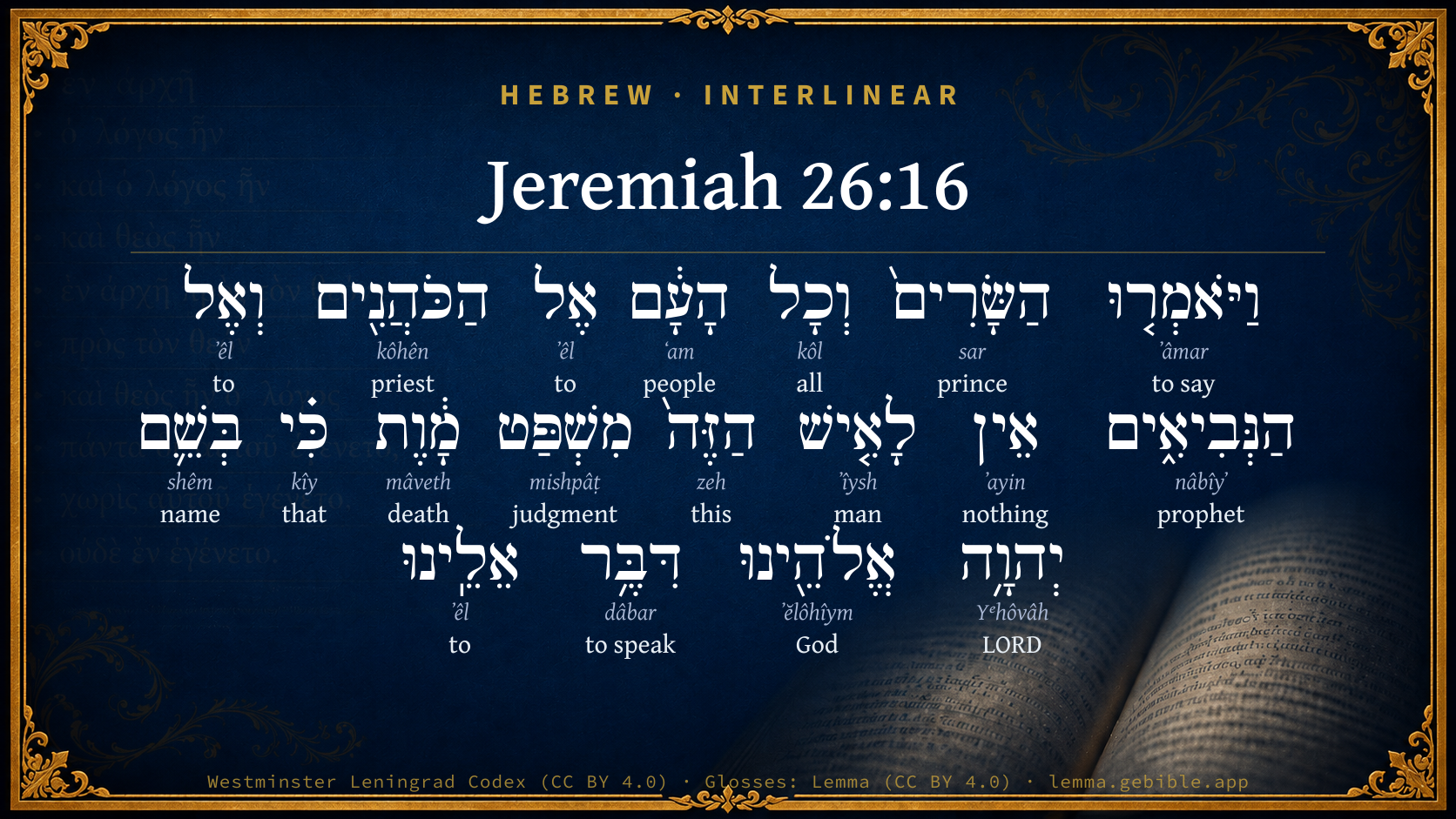
Hebrew (Westminster Leningrad Codex) Jeremiah 26:16 appears in the Hebrew Old Testament. The text above is from the Westminster Leningrad Codex. Each word links to its Strong’s number, a concise gloss, and parsing drawn from the Open Scriptures Hebrew Bible morphology. Click any word for its full Brown-Driver-Briggs (BDB) entry.
Download image
Cite this verse

Jeremiah 26:16 (World English Bible). Public Domain. Lemma interlinear Bible study tool, https://lemma.gebible.app/v/jeremiah/26/16.

Show BibTeX & RIS
BibTeX
RIS
English Translation
Then said the princes and all the people to the priests and to the prophets: This man is not worthy of death; for he has spoken to us in the name of Yahweh our God.
World English Bible · Public Domain
Download a study sheet

One document with this verse’s original text, its word-by-word gloss line, the meaning frame, cross-references with their text, attributed commentary, and full source and license credits — printable, and it pastes into notes with its structure intact.

This verse Autodidact and up

Study sheet (.html) Plain text (.txt)

A passage Seminary Student

Up to 50 verses in one chapter. A passage sheet keeps up to 6 commentary sources and 12 cross-references per verse, in the order this page ranks them, and says so on the sheet whenever that leaves anything out. Ask for a single verse and you get the Autodidact verse sheet above.

Everything on this page stays free to read, with no account — the sheet is a download of what is already on screen, not access to it.

Want to remove ads? Support Godless Engineer
Compare translations 3

The same verse in 3 English versions, stacked beneath the original-language interlinear above. Click any original word for its lexicon entry.

Each is an independent rendering of the whole verse — the interlinear is not word-aligned to these translations.

Highlighted words mark where these versions differ — a whole-verse word diff, not a word-by-word alignment.

  • World English Bible Public Domain
    Then said the princes and all the people to the priests and to the prophets: This man is not worthy of death; for he has spoken to us in the name of Yahweh our God.
  • King James Version Public Domain
    Then said the princes and all the people unto the priests and to the prophets; This man is not worthy to die: for he hath spoken to us in the name of the LORD our God.
  • unfoldingWord Literal Text CC BY-SA 4.0
    And the officials and all the people said to the priests and to the prophets, “There is no judgment of death for this man, for in the name of Yahweh our God he has spoken to us.”

unfoldingWord Literal Text — © unfoldingWord, licensed CC BY-SA 4.0. Word-aligned USFM3 via Door43 (git.door43.org/unfoldingWord/en_ult).

Versions to compare (up to 4)

3 of 4 selected

Show all 18 translations

Every available English version of this verse, each an independent rendering of the whole verse.

  • World English Bible Public Domain
    Then said the princes and all the people to the priests and to the prophets: This man is not worthy of death; for he has spoken to us in the name of Yahweh our God.
  • Berean Standard Bible Public Domain
    Then the officials and all the people told the priests and prophets, “This man is not worthy of death, for he has spoken to us in the name of the LORD our God!”
  • Majority Standard Bible Public Domain
    Then the officials and all the people told the priests and prophets, “This man is not worthy of death, for he has spoken to us in the name of the LORD our God!”
  • King James Version Public Domain
    Then said the princes and all the people unto the priests and to the prophets; This man is not worthy to die: for he hath spoken to us in the name of the LORD our God.
  • American Standard Version (1901) Public Domain
    Then said the princes and all the people unto the priests and to the prophets: This man is not worthy of death; for he hath spoken to us in the name of Jehovah our God.
  • Revised Version (1885) Public Domain
    Then said the princes and all the people unto the priests and to the prophets: This man is not worthy of death; for he hath spoken to us in the name of the LORD our God.
  • Geneva Bible (1599) Public Domain
    Then saide the princes and all the people vnto the Priestes, and to the prophets, This man is not worthie to die: for he hath spoken vnto vs in the Name of the Lord our God.
  • Douay-Rheims (1899) Public Domain
    Then the princes, and all the people said to the priests, and to the prophets: There is no judgement of death for this man: for he hath spoken to us in the name of the Lord our God.
  • Young's Literal Translation Public Domain
    And the heads and all the people say unto the priests and unto the prophets, `There is not for this man a judgment of death, for in the name of Jehovah our God he hath spoken unto us.'
  • Literal Standard Version CC BY-SA 4.0
    And the heads and all the people say to the priests and to the prophets, “There is not a judgment of death for this man, for he has spoken to us in the Name of our God YHWH.”
  • Unlocked Literal Bible CC BY-SA 4.0
    Then the officials and all the people said to the priests and prophets, “It is not right for this man to die, for he has proclaimed things to us in the name of Yahweh our God.”
  • unfoldingWord Literal Text CC BY-SA 4.0
    And the officials and all the people said to the priests and to the prophets, “There is no judgment of death for this man, for in the name of Yahweh our God he has spoken to us.”
  • Darby Bible Public Domain
    And the princes and all the people said unto the priests and to the prophets, This man is not worthy to die; for he hath spoken to us in the name of Jehovah our God.
  • World Messianic Bible Public Domain
    Then the princes and all the people said to the priests and to the prophets: “This man is not worthy of death; for he has spoken to us in the name of the LORD our God.”
  • Webster's Bible Public Domain
    Then said the princes and all the people to the priests and to the prophets; This man is not worthy to die: for he hath spoken to us in the name of the LORD our God.
  • Free Bible Version CC BY-SA 4.0
    Then the leaders and all the people told the priests and prophets, “This man doesn't deserve the death penalty because he was speaking on behalf of the Lord our God.”
  • Bible in Basic English Public Domain
    Then the rulers and all the people said to the priests and the prophets, It is not right for this man to be put to death: for he has said words to us in the name of the Lord our God.
  • JPS Tanakh (1917) Public Domain
    Then said the princes and all the people unto the priests and to the prophets: 'This man is not worthy of death; for he hath spoken to us in the name of the LORD our God.'

Literal Standard Version (2020), Covenant Press — licensed CC BY-SA 4.0. Text via the HelloAO Bible API (eBible.org). Unlocked Literal Bible (unfoldingWord) — licensed CC BY-SA 4.0. Text via the HelloAO Bible API (eBible.org). unfoldingWord Literal Text — © unfoldingWord, licensed CC BY-SA 4.0. Word-aligned USFM3 via Door43 (git.door43.org/unfoldingWord/en_ult). Free Bible Version, Dr. Jonathan Gallagher — licensed CC BY-SA 4.0. Text via the HelloAO Bible API (eBible.org).

Word by word

More ways to search: Search by grammar → Find every occurrence → Compare this word →

Practice this passage: Drill this verse → Learn its vocabulary →

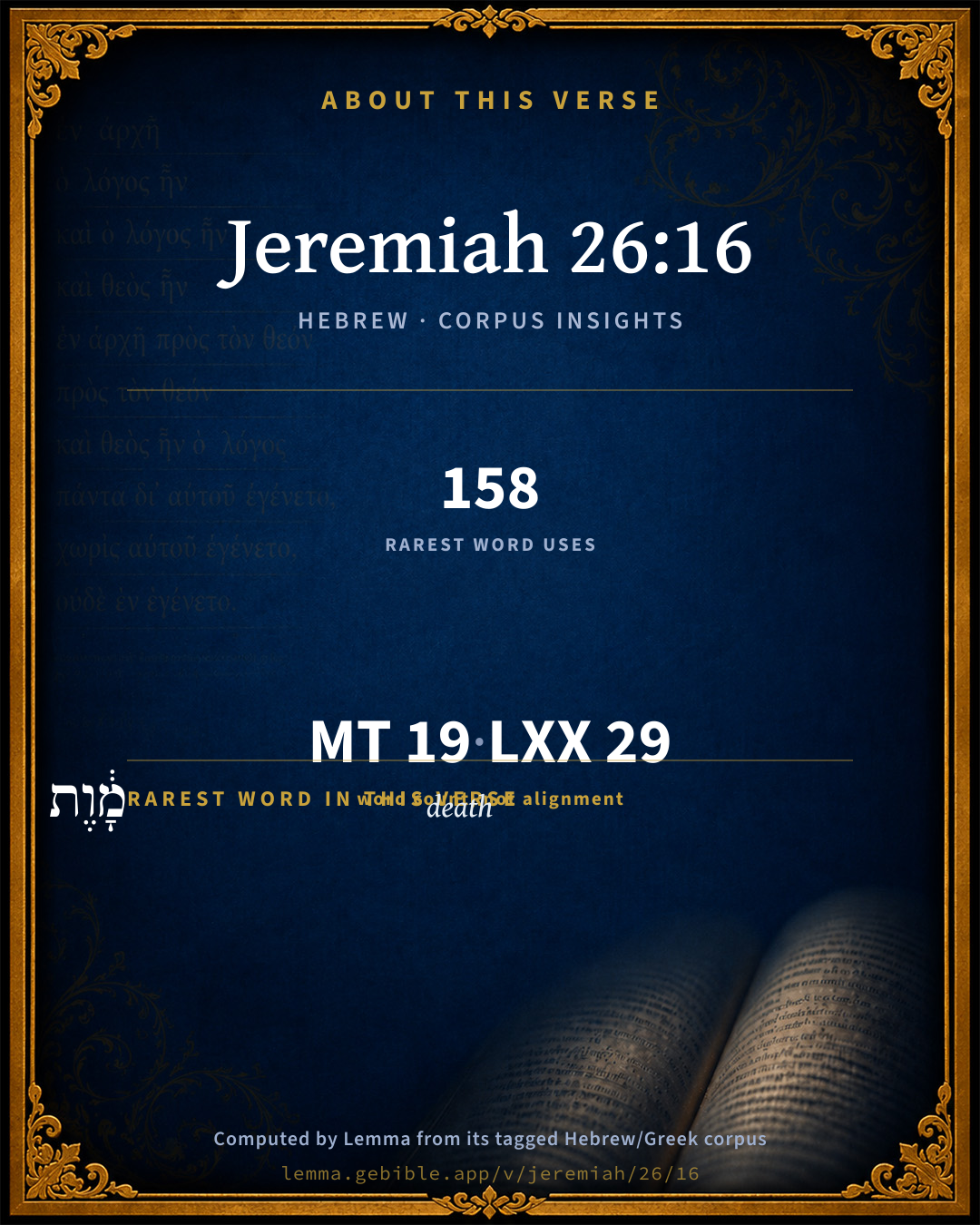
מָ֔וֶת
mâveth
H4194
“death”
Noun, Common, Masculine, Singular, Absolute
Part of Speech
Noun
Type
Common
Gender
Masculine
Number
Singular
State
Absolute
Full BDB Definition

Origin: from H4191

TWOT: 1169a

death, dying, Death (personified), realm of the dead - death - death by violence (as a penalty) - state of death, place of death
  1. וַיֹּאמְר֤וּ ʼâmar H559 “and · to say” Conjunction + Verb, Qal, Sequential Imperfect, 3rd Person, Masculine, Plural
  2. הַשָּׂרִים֙ sar H8269 “the · princes” Particle, Definite Article + Noun, Common, Masculine, Plural, Absolute
  3. וְכָל kôl H3605 “and · all of” Conjunction + Noun, Common, Masculine, Singular, Construct
  4. הָעָ֔ם ʻam H5971 “the · people” Particle, Definite Article + Noun, Common, Masculine, Singular, Absolute
  5. אֶל ʼêl H413 “to” Preposition
  6. הַכֹּהֲנִ֖ים kôhên H3548 “the · priests” Particle, Definite Article + Noun, Common, Masculine, Plural, Absolute
  7. וְאֶל ʼêl H413 “and · to” Conjunction + Preposition
  8. הַנְּבִיאִ֑ים nâbîyʼ H5030 “the · prophets” Particle, Definite Article + Noun, Common, Masculine, Plural, Absolute
  9. אֵין ʼayin H369 “nothing” Particle, Negative
  10. לָאִ֤ישׁ ʼîysh H376 “to/for the · man” Preposition, Determined + Noun, Common, Masculine, Singular, Absolute
  11. הַזֶּה֙ zeh H2088 “the · this” Particle, Definite Article + Pronoun, Demonstrative, Masculine, Singular
  12. מִשְׁפַּט mishpâṭ H4941 “judgment of” Noun, Common, Masculine, Singular, Construct
  13. כִּ֗י kîy H3588 “that” Conjunction
  14. בְּשֵׁ֛ם shêm H8034 “in/at · name of” Preposition + Noun, Common, Masculine, Singular, Construct
  15. יְהוָ֥ה Yᵉhôvâh H3068 “LORD” Noun, Proper
  16. אֱלֹהֵ֖ינוּ ʼĕlôhîym H430 “God(s) · our” Noun, Common, Masculine, Plural, Construct + Suffix, Personal, 1st Person, Common, Plural
  17. דִּבֶּ֥ר dâbar H1696 “to speak” Verb, Piel, Perfect, 3rd Person, Masculine, Singular
  18. אֵלֵֽינוּ ʼêl H413 “to · us” Preposition + Suffix, Personal, 1st Person, Common, Plural

About this verse

These counts appear in no published source. They are computed here, from the morphology-tagged text and Lemma’s own curated glosses. What Lemma adds →

19
words
17
distinct lemmas
Prophets
section

Grammatical profile

  • 2 verbs
  • 11 nouns
  • 1 pronoun
  • 3 prepositions
  • 1 conjunction
  • 1 particle

Verb forms

  • וַיֹּאמְר֤וּ Qal · Sequential Imperfect
  • דִּבֶּ֥ר Piel · Perfect

Repetition

A word recurs within this verse — often emphatic in Hebrew:

  • אֶל to H413 ×3

Hebrew & Septuagint length

In the original languages it is 19 Hebrew tokens and 29 Greek tokens — but the two are counted differently (Hebrew bundles its prefixes and suffixes into one token; the Greek is in lemma form), so that isn’t a like-for-like length.

Cross-references

16

Topical passages linked to Jeremiah 26:16 in the Treasury of Scripture Knowledge — connected by theme and wording, ordered by reader-vote popularity; previews shown in the World English Bible.

  • Acts 5:34–39 But one stood up in the council, a Pharisee named Gamaliel, a teacher of the law, honored by all the people, and commanded to put the apostles out for a little while.
  • Acts 23:9 A great clamor arose, and some of the scribes of the Pharisees part stood up, and contended, saying, "We find no evil in this man. But if a spirit or angel has spoken to him, let's not fight against God!"
  • Acts 23:29 I found him to be accused about questions of their law, but to have nothing laid to his charge worthy of death or of bonds.
  • Acts 25:25 But when I found that he had committed nothing worthy of death, and as he himself appealed to the emperor I determined to send him.
  • Jeremiah 36:19 Then said the princes to Baruch, Go, hide you, you and Jeremiah; and let no man know where you are.
  • Jeremiah 36:25 Moreover Elnathan and Delaiah and Gemariah had made intercession to the king that he would not burn the scroll; but he would not hear them.
  • Esther 4:14 For if you altogether hold your peace at this time, then will relief and deliverance arise to the Jews from another place, but you and your father's house will perish: and who knows whether you haven't come to the kingdom for such a time as this?
  • Proverbs 16:7 When a man's ways please Yahweh, He makes even his enemies to be at peace with him.
  • Jeremiah 26:11 Then spoke the priests and the prophets to the princes and to all the people, saying, This man is worthy of death; for he has prophesied against this city, as you have heard with your ears.
  • Jeremiah 38:7–13 Now when Ebedmelech the Ethiopian, a eunuch, who was in the king's house, heard that they had put Jeremiah in the dungeon (the king then sitting in the gate of Benjamin),
  • Matthew 27:23–24 But the governor said, "Why? What evil has he done?" But they cried out exceedingly, saying, "Let him be crucified!"
  • Matthew 27:54 Now the centurion, and those who were with him watching Jesus, when they saw the earthquake, and the things that were done, feared exceedingly, saying, "Truly this was the Son of God."
  • Luke 23:14–15 and said to them, "You brought this man to me as one that perverts the people, and see, I have examined him before you, and found no basis for a charge against this man concerning those things of which you accuse him.
  • Luke 23:41 And we indeed justly, for we receive the due reward for our deeds, but this man has done nothing wrong."
  • Luke 23:47 When the centurion saw what was done, he glorified God, saying, "Certainly this was a righteous man."
  • Acts 26:31–32 When they had withdrawn, they spoke one to another, saying, "This man does nothing worthy of death or of bonds."

Cross-references courtesy of OpenBible.info (CC BY 4.0).

Hebrew and Greek witnesses Masoretic Hebrew ↔ Greek Septuagint

The same verse in the two great witnesses to the Old Testament, shown verse-for-verse.

These are two independent witnesses, not word-aligned to each other, and the Septuagint is shown in lemma (dictionary) form.

Hebrew Jeremiah 26:16 Masoretic · Westminster Leningrad Codex

וַיֹּאמְר֤וּ הַשָּׂרִים֙ וְכָל הָעָ֔ם אֶל הַכֹּהֲנִ֖ים וְאֶל הַנְּבִיאִ֑ים אֵין לָאִ֤ישׁ הַזֶּה֙ מִשְׁפַּט מָ֔וֶת כִּ֗י בְּשֵׁ֛ם יְהוָ֥ה אֱלֹהֵ֖ינוּ דִּבֶּ֥ר אֵלֵֽינוּ

Then said the princes and all the people to the priests and to the prophets: This man is not worthy of death; for he has spoken to us in the name of Yahweh our God.

World English Bible · Public Domain

Greek LXX Structure differs

In the Septuagint, Jeremiah is about an eighth shorter than the Hebrew and arranges its material differently — the Oracles Against the Nations (Hebrew chapters 46–51) appear in the middle of the Greek book, after 25:13. Because the chapter and verse boundaries do not line up, a verse-for-verse comparison with the Hebrew is not shown.

A verse-for-verse comparison isn’t shown here because the chapters and verses don’t line up. Switch to the LXX edition with the MT / LXX toggle above to read the Greek directly.

Hebrew: Westminster Leningrad Codex (CC BY 4.0). Greek: Septuagint (public domain); English from a public-domain English Septuagint. How the Septuagint differs from the Hebrew →

Targum (Aramaic paraphrase)

1

The Targum is the ancient Jewish Aramaic paraphrase of the Hebrew Scriptures — an interpretive translation, not the Hebrew text itself. Onkelos (literal) and Pseudo-Jonathan (expansive) render the Torah, and Jonathan the Prophets. Coverage is partial: where no permissively-licensed English translation exists for a verse, only the Aramaic is shown. This is verse-level text, not a word-by-word alignment to the Hebrew.

  1. Targum Jonathan Prophets (Joshua–Malachi)
    וַאֲמָרוּ רַבְרְבַיָא וְכָל עַמָא לְכַהֲנַיָא וּלְסַפְרַיָא לֵית לְגַבְרָא הָדֵין חוֹבַת דִין דִקְטוֹל אֲרֵי בִשְׁמָא דַייָ אֱלָהָנָא מַלֵיל עִמָנָא:

    (no public-domain English translation for this verse)

    Targum Jonathan — Aramaic: “Mikraot Gedolot” (public domain). English: “Sefaria Community Translation” (CC0 1.0 (public-domain dedication)); “London "Chaldee Paraphrase," 1871” (public domain). Text via Sefaria.

Commentary

Notes on Jeremiah 26:16 from classic Christian and Jewish commentators (each source and its license shown beneath its notes). The classic Christian expositions comment on the surrounding passage and are grouped to its opening verse, so a note may address several verses; the Jewish commentaries on the Tanakh (Rashi and others) are per-verse, so they appear only where the commentator wrote on this verse.

Lemma curates 59 commentaries, every one of them public domain or Creative Commons licensed, each selected and text-cleaned for this edition rather than reprinted as found. About our sources →

Matthew Henry's Commentary

Here is, I. The acquitting of Jeremiah from the charge exhibited against him. He had indeed spoken the words as they were laid in the indictment, but they are not looked upon to be seditious or treasonable, ill-intended or of any bad tendency, and therefore the court and country agree to find him not guilty. The priests and prophets, notwithstanding his rational plea for himself, continued to demand judgment against him; but the princes, and all the people, are clear in it that this man is not worthy to die (Jer 26:16); for (say they) he hath spoken to us, not of himself, but in the name of the Lord our God. And are they willing to own that he did indeed speak to them in the name of the Lord and that that Lord is their God? Why then did they not amend their ways and doings, and take the method he prescribed to prevent the ruin of their country? If they say, His prophecy is from heaven, it may justly be asked, Why did you not then believe him? Mat 21:25. Note, It is a pity that those who are so far convinced of the divine original of gospel preaching as to protect it from the malice of others do not submit to the power and influence of it themselves.

II. A precedent quoted to justify them in acquitting Jeremiah. Some of the elders of the land, either the princes before mentioned or the more intelligent men of the people, stood up, and put the assembly in mind of a former case, as is usual with us in giving judgment; for the wisdom of our predecessors is a direction to us. The case referred to is that of Micah. We have extant the book of his prophecy among the minor prophets. 1. Was it thought strange that Jeremiah prophesied against this city and the temple? Micah did so before him, even in the reign of Hezekiah, that reign of reformation, Jer 26:18. Micah said it as publicly as Jeremiah had now spoken to the same purport, Zion shall be ploughed like a field, the building shall be all destroyed, so that nothing shall hinder but it may be ploughed; Jerusalem shall become heaps of ruins, and the mountain of the house on which the temple is built shall be as the high places of the forest, overrun with briers and thorns. That prophet not only spoke this, but wrote it, and left it on record; we find it, Mic 3:12. By this it appears that a man may be, as Micah was, a true prophet of the Lord, and yet may prophesy the destruction of Zion and Jerusalem. When we threaten secure sinners with the taking away of the Spirit of God and the kingdom of God from them, and declining churches with the removal of the candlestick, we say no more than what has been said many a time, and what we have warrant from the word of God to say. 2. Was it thought fit by the princes to justify Jeremiah in what he had done? It was what Hezekiah did before them in a like case. Did Hezekiah, and the people of Judah (that is, the representatives of the people, the commons in parliament), did they complain of Micah the prophet? Did they impeach him, or make an act to silence him and put him to death? No; on the contrary, they took the warning he gave them. Hezekiah, that renowned prince, of blessed memory, set a good example before his successors, for he feared the Lord (Jer 26:19), as Noah, who, being warned of God of things not seen as yet, was moved with fear. Micah's preaching drove him to his knees; he besought the Lord to turn away the judgment threatened and to be reconciled to them, and he found it was not in vain to do so, for the Lord repented him of the evil and returned in mercy to them; he sent an angel, who routed the army of the Assyrians, that threatened to plough Zion like a field. Hezekiah got good by the preaching, and then you may be sure he would do no harm to the preacher. These elders conclude that it would be of dangerous consequence to the state if they should gratify the importunity of the priests and prophets in putting Jeremiah to death: Thus might we procure great evil against our souls. Note, It is good to deter ourselves from sin with the consideration of the mischief we shall certainly do to ourselves by it and the irreparable damage it will be to our own souls.

III. Here is an instance of another prophet that was put to death by Jehoiakim for prophesying as Jeremiah had done, Jer 26:20, etc. Some make this to be urged by the prosecutors, as a case that favoured the prosecution, a modern case, in which speaking such words as Jeremiah had spoken was adjudged treason. Others think that the elders, who were advocates for Jeremiah, alleged this to show that thus they might procure great evil against their souls, for it would be adding sin to sin. Jehoiakim, the present king, had slain one prophet already; let them not fill up the measure by slaying another. Hezekiah, who protected Micah, prospered; but did Jehoiakim prosper who slew Urijah? No; they all saw the contrary. As good examples, and the good consequences of them, should encourage us in that which is good, so the examples of bad men, and the bad consequences of them, should deter us from that which is evil. But some good interpreters take this narrative from the historian that penned the book, Jeremiah himself, or Baruch, who, to make Jeremiah's deliverance by means of the princes the more wonderful, takes notice of this that happened about the same time; for both were in the reign of Jehoiakim, and this in the beginning of his reign, Jer 26:1. Observe, 1. Urijah's prophecy. It was against this city, and this land, according to all the words of Jeremiah. The prophets of the Lord agreed in their testimony, and one would have thought that out of the mouth of so many witnesses the word would be regarded. 2. The prosecution of him for it, Jer 26:21. Jehoiakim and his courtiers were exasperated against him, and sought to put him to death; in this wicked design the king himself was principally concerned. 3. His absconding thereupon: When he heard that the king had become his enemy, and sought his life, he was afraid, and fled, and went in to Egypt. This was certainly his fault, and an effect of the weakness of his faith, and it sped accordingly. He distrusted God, and his power to protect him and bear him out; he was too much under the power of that fear of man which brings a snare. It looked as if he durst not stand to what he had said or was ashamed of his Master. It was especially unbecoming him to flee into Egypt, and so in effect to abandon the land of Israel and to throw himself quite out of the way of being useful. Note, There are many that have much grace, but they have little courage, that are very honest, but withal very timorous. 4. His execution notwithstanding. Jehoiakim's malice, one would think, might have contented itself with his banishment, and it might suffice to have driven him out of the country; but those are bloodthirsty that hate the upright, Pro 29:10. It was the life, that precious life, that he hunted after, and nothing else would satisfy him. So implacable is his revenge that he sends a party of soldiers into Egypt, some hundreds of miles, and they bring him back by force of arms. It would not sufficiently gratify him to have him slain in Egypt, but he must feed his eyes with the bloody spectacle. They brought him to Jehoiakim, and he slew him with the sword, for aught I know with his own hands. Yet neither did this satisfy his insatiable malice, but he loads the dead body of the good man with infamy, would not allow it the decent respects usually and justly paid to the remains of men of distinction, but cast it into the graves of the common people, as if he had not been a prophet of the Lord; thus was the shield of Saul vilely cast away, as though he had not been anointed with oil. Thus Jehoiakim hoped both to ruin his reputation with the people, that no heed might be given to his predictions, and to deter others from prophesying in like manner; but in vain; Jeremiah says the same. There is no contending with the word of God. Herod thought he had gained his point when he had cut off John Baptist's head, but found himself deceived when, soon after, he heard of Jesus Christ, and said, in a fright, This is John the Baptist.

IV. Here is Jeremiah's deliverance. Though Urijah was lately put to death, and persecutors, when they have tasted the blood of saints, are apt to thirst after more (as Herod, Act 12:2, Act 12:3), yet God wonderfully preserved Jeremiah, though he did not flee, as Urijah did, but stood his ground. Ordinary ministers may use ordinary means, provided they be lawful ones, for their own preservation; but those that had an extraordinary protection. God raised up a friend for Jeremiah, whose hand was with him; he took him by the hand in a friendly way, encouraged him, assisted him, appeared for him. It was Ahikam the son of Shaphan, one that was a minister of state in Josiah's time; we read of him, Kg2 22:12. Some think Gedaliah was the son of this Ahikam. He had a great interest, it should seem, among the princes, and he used it in favour of Jeremiah, to prevent the further designs of the priests and prophets against him, who would have had him turned over into the hand of the people, not those people (Jer 26:16) that had adjudged him innocent, but the rude and insolent mob, whom they could persuade by their cursed insinuations not only to cry, Crucify him, crucify him, but to stone him to death in a popular tumult; for perhaps Jehoiakim had been so reproached by his own conscience for slaying Urijah that they despaired of making him the tool of their malice. Note, God can, when he pleases, raise up great men to patronize good men; and it is an encouragement to us to trust him in the way of duty that he has all men's hearts in his hands.

Matthew Henry's Commentary on the Whole Bible (1708–1710) — public domain (CC PDM 1.0). Text via the HelloAO Bible API.

Trapp's Complete Commentary

John Trapp

Jer 26:16 Then said the princes and all the people unto the priests and to the prophets; This man [is] not worthy to die: for he hath spoken to us in the name of the LORD our God.

Ver. 16. Then said the princes and all the people.] The mobile vulgus. changeable mob, on Jer 26:9. The good prophet is acquitted, as Athanasius afterwards was often; for if to be accused were enough to make a man guilty, none should be innocent.

John Trapp, A Commentary or Exposition upon All the Books of the Old and New Testament (1647–1656) — public domain. Text from a community e-Sword module.

Tyndale Open Study Notes

Tyndale Open Resources

26:16 Jeremiah was successful in his defense; he convinced the officials and the people that he was innocent because he spoke for the Lord.

Tyndale Open Study Notes — © Tyndale Open Resources, licensed CC BY-SA 4.0. Text via the HelloAO Bible API.

Jamieson, Fausset & Brown

Robert Jamieson, A. R. Fausset & David Brown

princes . . . all the people--The fickle people, as they were previously influenced by the priests to clamor for his death (Jer 26:8), so now under the princes' influence require that he shall not be put to death. Compare as to Jesus, Jeremiah's antitype, the hosannas of the multitude a few days before the same people, persuaded by the priests as in this case, cried, Away with Him, crucify Him (Mat 21:1-11; Mat 27:20-25). The priests, through envy of his holy zeal, were more his enemies than the princes, whose office was more secular than religious. A prophet could not legally be put to death unless he prophesied in the name of other gods (therefore, they say, "in the name of the Lord"), or after his prophecy had failed in its accomplishment. Meanwhile, if he foretold calamity, he might be imprisoned. Compare Micaiah's case (1Ki. 22:1-28).

Jamieson, Fausset & Brown — Commentary Critical and Explanatory on the Whole Bible (1871) — public domain (CC PDM 1.0). Text via the HelloAO Bible API.

Adam Clarke's Commentary

Verse 16. This man is not worthy to die] The whole court acquitted him.

Adam Clarke's Commentary on the Bible (1810–1826) — public domain. Text from a community e-Sword/MySword module.

John Calvin's Commentaries

Jeremiah shews here that the sentence pronounced on him by the priests and false prophets was soon changed. They had indeed heard him, and had given some appearance of docility, as it is the case with hypocrites who for a time attend; but they exasperated themselves against God, and as their minds were previously malignant, they were rendered much worse by hearing. So it happened to the priests and false prophets, and in their blind rage they doomed the holy Prophet to death. He now says that he was acquitted by the princes and the king’s counsellors, and also by the votes of the people. The people had, indeed, lately condemned him, but they had been carried away by the vain pomp and splendor of the priests and prophets; when they saw these so incensed against Jeremiah, they could not bring themselves to inquire into the cause. Thus the common people are always blinded by prejudices, so that they will not examine the matter itself. So it was when Jeremiah was condemned. We have said that the people were of themselves quiet and peaceable; but the prophets and priests were the farmers, and hence it was that the people immediately gave their consent. But in the presence of the princes they went in a contrary direction.

This passage, in short, teaches us how mischievous are rulers when there is no regard had for equity or justice; and it also teaches us how desirable it is to have honest and temperate rulers, who defend what is good and just, and aid the miserable and the oppressed. But we see that there is nothing steady or fixed in the common people; for they are carried here and there like the wind, which blows now from this quarter and then from that.

But we must notice this clause, that Jeremiah was not worthy of death, because he had spoken in the name of Jehovah They thus confessed, that whatever came from God ought to have been received, and that men were mad who opposed the servants of God, for they hurried themselves headlong into their own destruction.

We may hence deduce a useful truth, that whatever God has commanded ought, without exception, to be reverently received, and that his name is worthy of such a regard, that we ought to attempt nothing against his servants and prophets. Now, to speak in the name of Jehovah is no other thing than faithfully to declare what God has commanded. The false prophets, indeed, assumed the name of God, but they did so falsely; but the people acknowledge here that Jeremiah was a true prophet, who did not presumptuously thrust in himself, nor falsely pretended God’s name, but who in sincerity performed the duties of his office. It follows, —

John Calvin's Commentaries (1540-1563) — public domain. Text from the Calvin Translation Society English edition (1840s-50s) via the Christian Classics Ethereal Library (ccel.org). Calvin's coverage is partial (roughly two-thirds of the Bible); uncommented books and verses are honest gaps, never fabricated. The 19th-century editor's footnotes and remarks are omitted so the notes are faithfully Calvin's own voice.

Ellicott's Commentary for English Readers

(16) This man is not worthy to die.—Literally, as before in Jer_26:11, There is no judgment of death for this man. Here again the later parallel comes unbidden to our memory. The lay-rulers are in favour of the true prophet, whom the priests and false prophets would have condemned. Pilate declares, in presence of priests and scribes, and the clamouring multitude, “I find no fault in this man” (Luk_23:4). Here, however, as yet the people are with the true prophet, and against the priests, as they were when they shouted their Hosannas to the prophet’s great antitype.

A Bible Commentary for English Readers, edited by Charles John Ellicott (1878–1897) — public domain. Text from a community e-Sword module.

The Cambridge Bible for Schools and Colleges

gen. ed. J. J. S. Perowne

16. The princes, not being prejudiced as were Jeremiah’s accusers, give a fair decision and carry the people with them.

16–19. See introd. summary to ch.

The Cambridge Bible for Schools and Colleges (gen. ed. J. J. S. Perowne; Cambridge University Press, 1878–1918) — public domain. Text from a community e-Sword module.

John Gill's Exposition

Then said the princes and all the people unto the priests and to the prophets,.... Hearing Jeremiah's apology for himself, by which it appeared that he was to be justified in what he had done, took his part, and acquitted him; and the people, who before were on the side of the priests and false prophets; yet hearing what Jeremiah had to say for himself, and also the judgment of the princes, took his part also, and joined with the court in an address to the priests and prophets, who were the chief accusers, and who would fain have had him brought in guilty of death:

this man is not worthy to die; or, "the judgment of death is not for this man"; we cannot give judgment against him; he is not guilty of any crime deserving death; See Gill on Jer 26:11;

for he hath spoken to us in the name of the Lord our God; not in his own name, and of his own head; but in the name of the Lord, and by his order; and therefore was not a false, but a true prophet: what methods they took to know this, and to make it appear to the people, is not said; very probably the settled character of the prophet; their long acquaintance with him, and knowledge of him; his integrity and firmness of mind; the plain marks of seriousness and humility, and a disinterested view, made them conclude in his favour.

John Gill's Exposition of the Whole Bible (1746–1763) — public domain (CC PDM 1.0). Text via the HelloAO Bible API.

Albert Barnes' Notes on the Bible

This man ... - literally, There is not to this man a sentence of death, i. e., he is acquitted by the princes and the congregation.

Albert Barnes' Notes on the Bible (1834–1885) — public domain. Text from a community e-Sword/MySword module.

Haydock's Catholic Bible Commentary

All. The populace easily changes either for better or for worse. (Worthington)

George Leo Haydock (1774–1849), Haydock's Catholic Family Bible and Commentary, 1859 edition — public domain. Excludes Psalms (Douay-Rheims chapter numbering differs from Protestant) and Deuterocanonical books (Catholic canon only).

Matthew Poole's English Annotations

The judges in this case, with the assent of the people, acquit the prophet, and vindicate him from the charge of sedition given against him by the corrupt priests and false prophets, distinguishing betwixt one who of his own head spreadeth false news, and threateneth evil to a place, and one who doth it by authority from God, or by Divine revelation, which is here meant by

in the name of our Lord God. Thus the civil magistrates taught the priests and prophets a point of divinity, which they ought not to have been ignorant of. Some may inquire how the princes knew that Jeremiah spake what he spake in the name of the Lord. To which it may be replied, that Jeremiah had been a prophet now about twenty years, for he began in the thirteenth of Josiah, Jer 1:1,2. Josiah reigned thirty-one years, 2Ki 22:1. Then Shallum or Jehoahaz reigned three months; this was in the beginning of Jehoiakim’s reign, in which time they had had a large experience both of his doctrine and conversation; and though the priests and prophets, who had had the like experience, were filled with malice and prejudice, yet the princes and a part of the people were more equal; and though the people were many of them led away with the priests, yet hearing the prophet’s defence, and the princes’ judgment upon it, they concur with them to acquit the prophet.

Matthew Poole's English Annotations on the Holy Bible (1683–1685) — public domain. Text from a community e-Sword/MySword module.

Whedon's Commentary on the Bible

Daniel D. Whedon

16. The princes and all the people — The action of these magistrates was worthy of better times. Jeremiah’s simple and heroic words are rightly seen to indicate the true prophet; and so they refuse the popular clamour for his blood. This decision commands the approval of the people, showing that not all had a positive temper against him; but, on the contrary, many were open to feel the force and truthfulness of his words. This trial, in many particulars, answers to that other trial in which the great archetypal Prophet stood before the world’s tribunal, as represented by Pilate, and, by the resistless force of his own divine purity, compelled the verdict, “I find no fault in the man.”

Daniel D. Whedon (gen. ed.), Commentary on the Old and New Testaments (1874–1909) — public domain. Text from a community e-Sword module.

The Pulpit Commentary

Vers. 16-19. The truth makes an impression upon the princes and the people, who declare Jeremiah to be a true prophet, and therefore innocent.

Jeremiah reckoned not worthy of death.

The contrast is very decided between ver. 11 and ver. 16. In ver. 11 there is what appears an irresistible and deadly accusation, coming from men who hardly knew a check of any kind. In ver. 16 there is the answer of those to whom they speak, refusing to ratify their demand. What has happened between? Only the appeal of one who was strong in the consciousness that he had been a faithful servant of God. If we consider his words carefully, we shall see that underneath them there are three considerations, of which the first is more important than the second, and the second more important than the third.

I We may say that, first of all, HE IS THINKING OF THE GOD WHO HAD SENT HIM. That which threatened him at the same time insulted and tried to thwart Jehovah. Not that Jeremiah was careless about his own safety, but the glory of his God was paramount in his thoughts. He had in him the true spirit of apostleship; the claims he had to make were not his own claims; he was a sent man, and sent of God. Just in proportion as a man feels that God has sent him, must be his distress to find that others do not recognize the credentials of the messenger and the importance of the message. On one side the prophet was dealing with God, on the other with men. Every day deepened on him the impression of God"s intimate presence with him; and yet this same God who was so much to him was nothing to these people; the name that thrilled and subdued his susceptible heart, was perhaps the least potent of sounds in their ears. Hence the need of appealing to them again and again, if perchance there might be roused in them some sort of apprehension that they were dealing, not with a brother man, but with the almighty and holy God. While they were all absorbed in considerations of their own territorial dignity, God in his justice was comings, ever nearer. Whatever happens to the people or to the prophet himself, that prophet will at all events exalt God before them to the latest hour of his existence. If he has to die, the message of God shall live more gloriously in his closing hours.

II HE IS THINKING OF THE INTERESTS OF THIS APPARENTLY OBDURATE PEOPLE. Though at the present moment it is he who seems to be in danger, he well knows that his peril is but a surface trifle when compared with that attaching to the scowling enemies who are crowded around him. He can be rescued, if so it please God; but who is to rescue those who are striding onwards, ever more swiftly, to a righteous doom? God can deliver the prophet from his enemies, for the prophet himself interposes no obstacle to his deliverance; but these people of Judah and Jerusalem interpose insurmountable obstacles, in that they will not amend their ways and doings and obey the voice of God. More than that, it seems as if they were about to add a fresh obstacle by shedding the innocent blood of God"s latest messenger. The persecutor is always in greater peril than the persecuted. Physical pain and physical death are transitory and unreturning ills, but the evildoer has to face the worm that dieth not. Compare with the words of the prophet here the words of Jesus as he was being led to crucifixion: "Daughters of Jerusalem, weep not for me, but weep for yourselves, and for your children". (Luk_23:28)

III HE IS THINKING OF HIS OWN PRESENT POSITION. (See ver. 14) This verse reveals a calm, intermediate position between the reckless fanaticism that even courts death and the spirit that turns back the moment threatening is heard. "I am in your hands," says the prophet. He admits their power to the fullest extent, and he does not in any way dare them to the exercise of it. He is neither anxious for life nor afraid of death. This surely is the spirit to be gained if one would be a true witness for God. Jeremiah seems to speak here as one who had gained, for the moment at least, something of the calm of eternity. And his very calmness must surely have been a considerable element in determining the rapid change of feeling among the multitude. Perfect presence of mind, when it comes from an all-sufficient Divine stay within, must have a wondrous power in checking those whose fury is roused by an attack on their base and selfish interests. Y.

The Pulpit Commentary (1880–1919), ed. H.D.M. Spence-Jones & Joseph S. Exell — public domain. Text from a community e-Sword module.

unfoldingWord translationNotes

Door43 World Missions Community

in the name of Yahweh our God

The person's name is a metonym for his authority. AT: "with the authority of Yahweh our God" (See: Metonymy)

translationWords

priest

prophet

name

elder

assembly

unfoldingWord translationNotes — © Distant Shores Media and the Door43 World Missions Community, licensed CC BY-SA 4.0. Source: git.door43.org/Door43/en_tn.

Lesson kit

Teaching starters — assembled from the data on this page, not authored interpretation. Every prompt links to the verse data it draws on. Edit before teaching.

Jeremiah, in the Prophets, opens this verse with 19 words (17 distinct Hebrew lemmas). Its most distinctive word is mâveth (“death”). A historical commentator’s framing appears above. Read the whole chapter for the surrounding context.

Discussion questions

  1. The word mâveth carries the sense “death.” How does it shape the verse?
  2. Acts 5:34–39 shares this passage’s theme. How do the two illuminate each other?
  3. “to” occurs 3× in this one verse. What is the effect of the repetition?
  4. The translations on this page render this verse differently — a whole-verse word diff, not a word-by-word alignment. What might account for the different wordings?
  5. The verb «וַיֹּאמְר֤וּ» is Qal Sequential Imperfect. How does its form color the action?
  6. Reading how Matthew Henry's Commentary and Trapp's Complete Commentary read this verse, where do the two commentators agree and where do they part?

Things to notice

Reading settings

Reading text

Shown beneath each verse's original-language words.

Old Testament
Old Testament edition

Read the OT as the Masoretic Hebrew (MT) or the Greek Septuagint (LXX).

English shown for the Greek Septuagint (in the Hebrew ↔ Greek comparison).

Comparing translations? Open the Compare panel on any verse page to stack up to four side by side.