
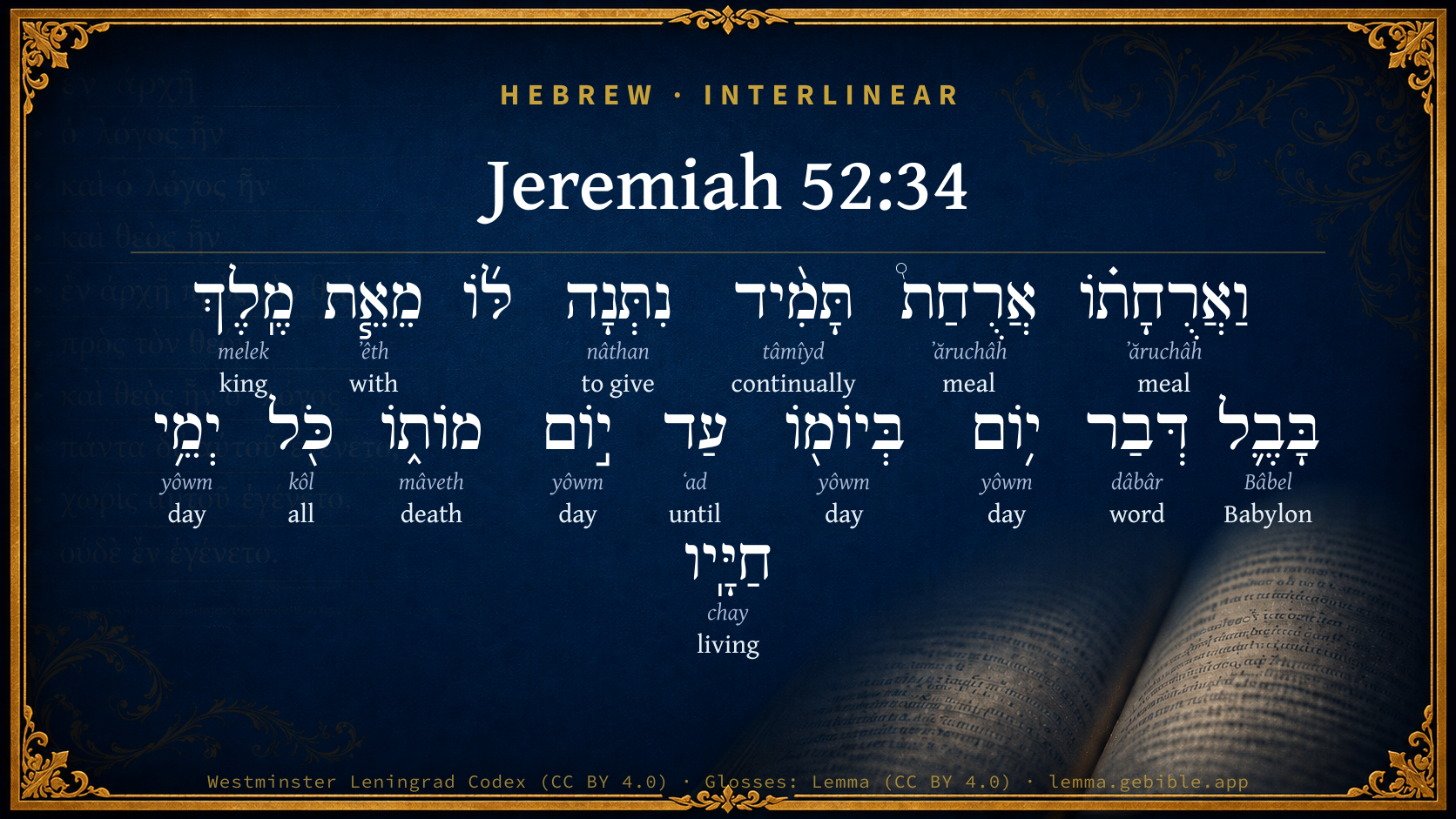
Jeremiah 52:34

Hebrew (Westminster Leningrad Codex) Jeremiah 52:34 appears in the Hebrew Old Testament. The text above is from the Westminster Leningrad Codex. Each word links to its Strong’s number, a concise gloss, and parsing drawn from the Open Scriptures Hebrew Bible morphology. Click any word for its full Brown-Driver-Briggs (BDB) entry.
Download image
Cite this verse

Jeremiah 52:34 (World English Bible). Public Domain. Lemma interlinear Bible study tool, https://lemma.gebible.app/v/jeremiah/52/34.

Show BibTeX & RIS
BibTeX
RIS
English Translation
and for his allowance, there was a continual allowance given him by the king of Babylon, every day a portion until the day of his death, all the days of his life.
World English Bible · Public Domain
Download a study sheet

One document with this verse’s original text, its word-by-word gloss line, the meaning frame, cross-references with their text, attributed commentary, and full source and license credits — printable, and it pastes into notes with its structure intact.

This verse Autodidact and up

Study sheet (.html) Plain text (.txt)

A passage Seminary Student

Up to 50 verses in one chapter. A passage sheet keeps up to 6 commentary sources and 12 cross-references per verse, in the order this page ranks them, and says so on the sheet whenever that leaves anything out. Ask for a single verse and you get the Autodidact verse sheet above.

Everything on this page stays free to read, with no account — the sheet is a download of what is already on screen, not access to it.

Want to remove ads? Support Godless Engineer
Compare translations 3

The same verse in 3 English versions, stacked beneath the original-language interlinear above. Click any original word for its lexicon entry.

Each is an independent rendering of the whole verse — the interlinear is not word-aligned to these translations.

Highlighted words mark where these versions differ — a whole-verse word diff, not a word-by-word alignment.

  • World English Bible Public Domain
    and for his allowance, there was a continual allowance given him by the king of Babylon, every day a portion until the day of his death, all the days of his life.
  • King James Version Public Domain
    And for his diet, there was a continual diet given him of the king of Babylon, every day a portion until the day of his death, all the days of his life.
  • unfoldingWord Literal Text CC BY-SA 4.0
    and a regular food allowance was given to him every day for the rest of his life until his death.

unfoldingWord Literal Text — © unfoldingWord, licensed CC BY-SA 4.0. Word-aligned USFM3 via Door43 (git.door43.org/unfoldingWord/en_ult).

Versions to compare (up to 4)

3 of 4 selected

Show all 18 translations

Every available English version of this verse, each an independent rendering of the whole verse.

  • World English Bible Public Domain
    and for his allowance, there was a continual allowance given him by the king of Babylon, every day a portion until the day of his death, all the days of his life.
  • Berean Standard Bible Public Domain
    And the king of Babylon provided Jehoiachin a daily portion for the rest of his life, until the day of his death.
  • Majority Standard Bible Public Domain
    And the king of Babylon provided Jehoiachin a daily portion for the rest of his life, until the day of his death.
  • King James Version Public Domain
    And for his diet, there was a continual diet given him of the king of Babylon, every day a portion until the day of his death, all the days of his life.
  • American Standard Version (1901) Public Domain
    and for his allowance, there was a continual allowance given him by the king of Babylon, every day a portion until the day of his death, all the days of his life.
  • Revised Version (1885) Public Domain
    and for his allowance, there was a continual allowance given him of the king of Babylon, every day a portion until the day of his death, all the days of his life.
  • Geneva Bible (1599) Public Domain
    His porcion was a continuall portion giuen him of ye king of Babel, euery day a certaine, all the dayes of his life vntill he died.
  • Douay-Rheims (1899) Public Domain
    And for his diet a continual provision was allowed him by the king of Babylon, every day a portion, until the day of his death, all the days of his life.
  • Young's Literal Translation Public Domain
    And his allowance -- a continual allowance -- hath been given to him by the king of Babylon, the matter of a day in its day, till the day of his death -- all days of his life.
  • Literal Standard Version CC BY-SA 4.0
    And his allowance—a continual allowance—has been given to him by the king of Babylon, the matter of a day in its day, until [the] day of his death—all [the] days of his life.
  • Unlocked Literal Bible CC BY-SA 4.0
    and a regular food allowance was given to him every day for the rest of his life until his death.
  • unfoldingWord Literal Text CC BY-SA 4.0
    and a regular food allowance was given to him every day for the rest of his life until his death.
  • Darby Bible Public Domain
    and his allowance was a continual allowance given him by the king of Babylon, every day a portion until the day of his death, all the days of his life.
  • World Messianic Bible Public Domain
    For his allowance, there was a continual allowance given him by the king of Babylon, every day a portion until the day of his death, all the days of his life.
  • Webster's Bible Public Domain
    And for his food there was a continual diet given him of the king of Babylon, every day a portion until the day of his death, all the days of his life.
  • Free Bible Version CC BY-SA 4.0
    The king provided Jehoiachin with a daily allowance for the rest of his life until he died.
  • Bible in Basic English Public Domain
    And for his food, the king gave him a regular amount every day till the day of his death, for the rest of his life.
  • JPS Tanakh (1917) Public Domain
    And for his allowance, there was a continual allowance given him of the king of Babylon, every day a portion until the day of his death, all the days of his life.

Literal Standard Version (2020), Covenant Press — licensed CC BY-SA 4.0. Text via the HelloAO Bible API (eBible.org). Unlocked Literal Bible (unfoldingWord) — licensed CC BY-SA 4.0. Text via the HelloAO Bible API (eBible.org). unfoldingWord Literal Text — © unfoldingWord, licensed CC BY-SA 4.0. Word-aligned USFM3 via Door43 (git.door43.org/unfoldingWord/en_ult). Free Bible Version, Dr. Jonathan Gallagher — licensed CC BY-SA 4.0. Text via the HelloAO Bible API (eBible.org).

Word by word

More ways to search: Search by grammar → Find every occurrence → Compare this word →

Practice this passage: Drill this verse → Learn its vocabulary →

וַאֲרֻחָת֗וֹ
ʼăruchâh
H737
“and · meal · his”
Conjunction + Noun, Common, Feminine, Singular, Construct + Suffix, Personal, 3rd Person, Masculine, Singular
Part of Speech
Conjunction + Noun
Type
Common
Gender
Feminine
Number
Singular
State
Construct
Full BDB Definition

Origin: passive participle of H732 (in the sense of appointing)

TWOT: 161b

meal, allowance, ration - food - diet
  1. אֲרֻחַת֩ ʼăruchâh H737 “meal of” Noun, Common, Feminine, Singular, Construct
  2. תָּמִ֨יד tâmîyd H8548 “continually” Noun, Common, Masculine, Singular, Absolute
  3. נִתְּנָה nâthan H5414 “to give” Verb, Niphal, Perfect, 3rd Person, Feminine, Singular
  4. מֵאֵ֧ת ʼêth H854 “from · with” Preposition + Preposition
  5. מֶֽלֶךְ melek H4428 “king of” Noun, Common, Masculine, Singular, Construct
  6. בָּבֶ֛ל Bâbel H894 “Babylon” Noun, Proper
  7. דְּבַר dâbâr H1697 “word of” Noun, Common, Masculine, Singular, Construct
  8. י֥וֹם yôwm H3117 “day” Noun, Common, Masculine, Singular, Absolute
  9. בְּיוֹמ֖וֹ yôwm H3117 “in/at · day · his” Preposition + Noun, Common, Masculine, Singular, Construct + Suffix, Personal, 3rd Person, Masculine, Singular
  10. עַד ʻad H5704 “until” Preposition
  11. י֣וֹם yôwm H3117 “day of” Noun, Common, Masculine, Singular, Construct
  12. מוֹת֑וֹ mâveth H4194 “death · his” Noun, Common, Masculine, Singular, Construct + Suffix, Personal, 3rd Person, Masculine, Singular
  13. כֹּ֖ל kôl H3605 “all of” Noun, Common, Masculine, Singular, Construct
  14. יְמֵ֥י yôwm H3117 “days of” Noun, Common, Masculine, Plural, Construct
  15. חַיָּֽיו chay H2416 “living things · his” Noun, Common, Masculine, Plural, Construct + Suffix, Personal, 3rd Person, Masculine, Singular

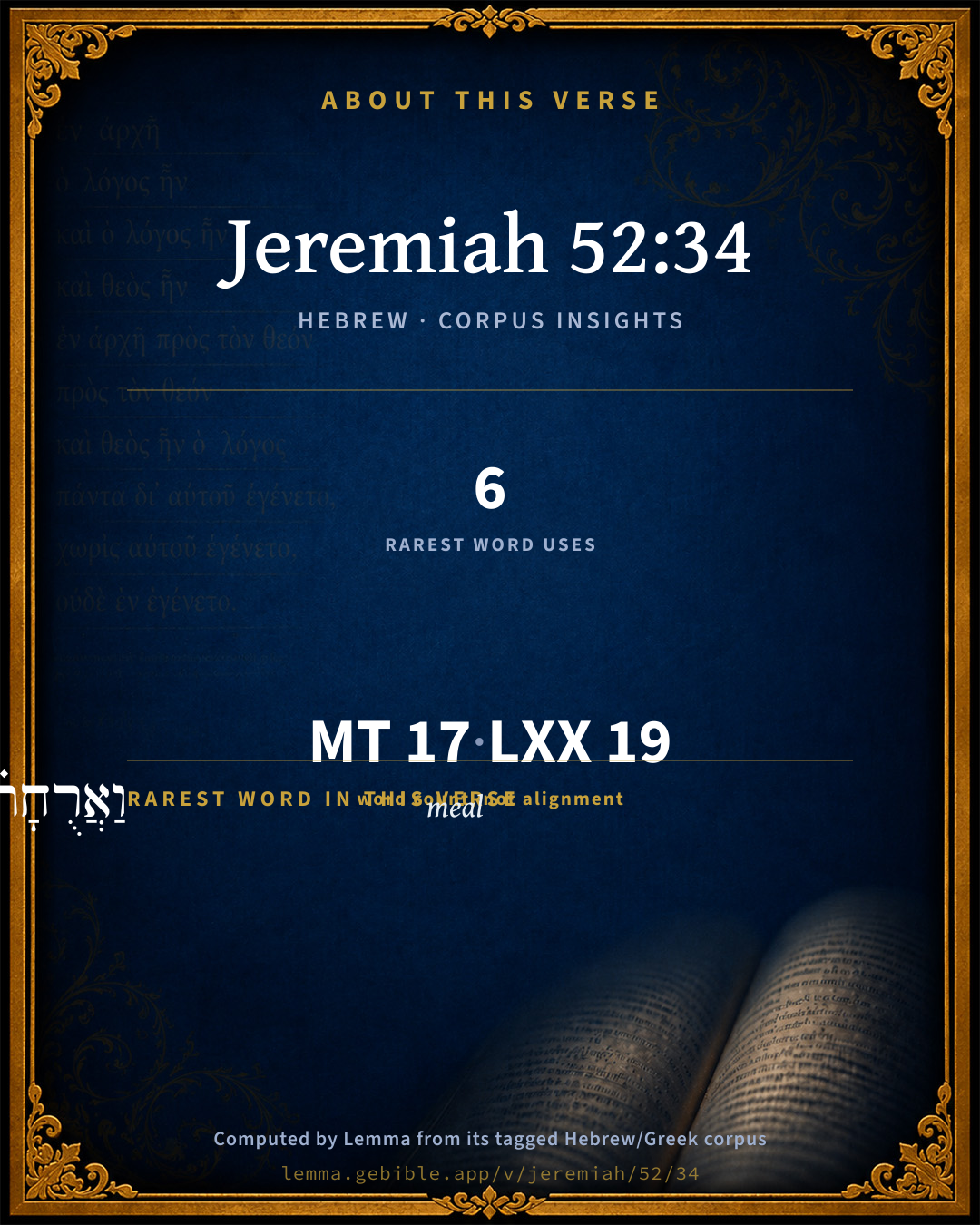
About this verse

These counts appear in no published source. They are computed here, from the morphology-tagged text and Lemma’s own curated glosses. What Lemma adds →

17
words
12
distinct lemmas
Prophets
section

Notable vocabulary

The rarest word here is וַאֲרֻחָת֗וֹ meal H737 — appearing just 6 times in the whole Hebrew Bible.

Shared distinctive vocabulary

וַאֲרֻחָת֗וֹ meal H737 occurs in 4 verses of the Hebrew Bible. Also found in:

Grammatical profile

  • 1 verb
  • 13 nouns
  • 3 prepositions

Verb forms

  • נִתְּנָה Niphal · Perfect

Repetition

Words recur within this verse — often emphatic in Hebrew:

  • י֥וֹם day H3117 ×4
  • וַאֲרֻחָת֗וֹ meal H737 ×2

Hebrew & Septuagint length

In the original languages it is 17 Hebrew tokens and 19 Greek tokens — but the two are counted differently (Hebrew bundles its prefixes and suffixes into one token; the Greek is in lemma form), so that isn’t a like-for-like length.

Cross-references

3

Topical passages linked to Jeremiah 52:34 in the Treasury of Scripture Knowledge — connected by theme and wording, ordered by reader-vote popularity; previews shown in the World English Bible.

  • 2 Samuel 9:10 You shall till the land for him, you, and your sons, and your servants; and you shall bring in [the fruits], that your master's son may have bread to eat: but Mephibosheth your master's son shall eat bread always at my table." Now Ziba had fifteen sons and twenty servants.
  • Matthew 6:11 Give us today our daily bread.
  • Luke 11:3 Give us day by day our daily bread.

Cross-references courtesy of OpenBible.info (CC BY 4.0).

Hebrew and Greek witnesses Masoretic Hebrew ↔ Greek Septuagint

The same verse in the two great witnesses to the Old Testament, shown verse-for-verse.

These are two independent witnesses, not word-aligned to each other, and the Septuagint is shown in lemma (dictionary) form.

Hebrew Jeremiah 52:34 Masoretic · Westminster Leningrad Codex

וַאֲרֻחָת֗וֹ אֲרֻחַת֩ תָּמִ֨יד נִתְּנָה לּ֜וֹ מֵאֵ֧ת מֶֽלֶךְ בָּבֶ֛ל דְּבַר י֥וֹם בְּיוֹמ֖וֹ עַד י֣וֹם מוֹת֑וֹ כֹּ֖ל יְמֵ֥י חַיָּֽיו

and for his allowance, there was a continual allowance given him by the king of Babylon, every day a portion until the day of his death, all the days of his life.

World English Bible · Public Domain

Greek LXX Structure differs

In the Septuagint, Jeremiah is about an eighth shorter than the Hebrew and arranges its material differently — the Oracles Against the Nations (Hebrew chapters 46–51) appear in the middle of the Greek book, after 25:13. Because the chapter and verse boundaries do not line up, a verse-for-verse comparison with the Hebrew is not shown.

A verse-for-verse comparison isn’t shown here because the chapters and verses don’t line up. Switch to the LXX edition with the MT / LXX toggle above to read the Greek directly.

On this verse, Adam Clarke's Commentary discusses the Septuagint’s reading. Read the note in Commentary ↓

Hebrew: Westminster Leningrad Codex (CC BY 4.0). Greek: Septuagint (public domain); English from a public-domain English Septuagint. How the Septuagint differs from the Hebrew →

Targum (Aramaic paraphrase)

1

The Targum is the ancient Jewish Aramaic paraphrase of the Hebrew Scriptures — an interpretive translation, not the Hebrew text itself. Onkelos (literal) and Pseudo-Jonathan (expansive) render the Torah, and Jonathan the Prophets. Coverage is partial: where no permissively-licensed English translation exists for a verse, only the Aramaic is shown. This is verse-level text, not a word-by-word alignment to the Hebrew.

  1. Targum Jonathan Prophets (Joshua–Malachi)
    וְשֵׁרוּתֵהּ שֵׁרוּתָא תְּדִירָא מִתְיהֲבָא לֵיהּ מִן קֳדָם מַלְכָּא דְבָבֶל פִּתְגַם יוֹם בְּיוֹמֵיהּ עַד יוֹם מוֹתֵיהּ כֹּל יוֹמֵי חַיוֹהִי:

    (no public-domain English translation for this verse)

    Targum Jonathan — Aramaic: “Mikraot Gedolot” (public domain). English: “Sefaria Community Translation” (CC0 1.0 (public-domain dedication)); “London "Chaldee Paraphrase," 1871” (public domain). Text via Sefaria.

Commentary

Notes on Jeremiah 52:34 from classic Christian and Jewish commentators (each source and its license shown beneath its notes). The classic Christian expositions comment on the surrounding passage and are grouped to its opening verse, so a note may address several verses; the Jewish commentaries on the Tanakh (Rashi and others) are per-verse, so they appear only where the commentator wrote on this verse.

Lemma curates 59 commentaries, every one of them public domain or Creative Commons licensed, each selected and text-cleaned for this edition rather than reprinted as found. About our sources →

Geneva Bible (1599)

Geneva Bible translators

That is he had allowance in the court, and thus at length he had rest and quietness because he obeyed Jeremiah the Prophet, whereas the others were cruelly ordered, that would not obey him.

Geneva Bible (1599) marginal notes — public domain. Text via Bolls.life.

Jamieson, Fausset & Brown

Robert Jamieson, A. R. Fausset & David Brown

every day a portion--rather, "its portion," (compare Kg1 8:59, Margin).

Next: Lamentations Introduction

Jamieson, Fausset & Brown — Commentary Critical and Explanatory on the Whole Bible (1871) — public domain (CC PDM 1.0). Text via the HelloAO Bible API.

Adam Clarke's Commentary

Verse 34. And - there was a continual diet given him] This was probably a ration allowed by the king for the support of Jehoiachin's household. For other particulars, 2Kg 25:30.

All the days of his life.] I believe these words have been by mistake added from the preceding verse. There, they are proper; here, they are tautological. They are wanting in the Septuagint and in the Arabic.

The preceding words, עד יום מותו ad yom motho, "to the day of his death," are wanting in two of De Rossi's and one of Kennicott's MSS.

Coverdale ends thus: All the days of his life untill he died. This is better than the common Version.

Immediately after this verse my old MS. Bible adds the following words: And done is aftir that into caitifte is brougt Israel, and Jerusalem is bestroide, satte Jeremye the prophet weepund, and weiled with this lamentation Jerusalem; and with bitter inwit sighand and criand weilawai, seide. Then follows in red letters: Here beginneth the Lamentation of Jeremye, that is intitle Cenoth; with the sortynge out of Ebrue letters.

ALEPH: How sitteth aloon the city, &c. See something of a similar kind from other authorities, at the beginning of Lamentations.

MASORETIC NOTES

Number of verses in this Book, 1365.

Middle verse, Jer 28:11.

Masoretic sections, 31.

Adam Clarke's Commentary on the Bible (1810–1826) — public domain. Text from a community e-Sword/MySword module.

The Cambridge Bible for Schools and Colleges

gen. ed. J. J. S. Perowne

34. until the day of his death, all the days of his life] The latter of these clauses (absent from LXX) is probably either an addition to, or originally a substitution for, the former, in order to avoid the inauspicious ending with the word death.

The Cambridge Bible for Schools and Colleges (gen. ed. J. J. S. Perowne; Cambridge University Press, 1878–1918) — public domain. Text from a community e-Sword module.

Matthew Poole's English Annotations

He treated him like a prince, with a respect becoming his former state, took care both for his habit and diet: for his habit, that it should be decent, such as became a person of his quality, though a captive: for his diet, that he should have it in his court, thereby learning others that humanity which becometh all men to treat others with that are fallen under their power; that decency which becometh them as men, and as men whose circumstances have been better; doing to others as we would they should do unto us. Thus Jehoiachin’s lot was different from that of his father Jehoiakim, whose body was cast out, as we heard before; as also from that of his uncle Zedekiah, who did not only die in Babylon, but died a prisoner; his nephew Jehoiachin died there, and a captive, but not in durance.

Thee four last verses are found also 2Ki 25:27-30; and being found here in a narrative form, related as a piece of history relating a thing done not in a prophetical style, are an argument (as was said before) that this whole chapter is no part of the prophecy of Jeremiah, and probably not wrote by him; for he beginning his prophecy in the thirteenth year of Josiah, who reigned thirty-one years, and continuing it three months during the reign of Jehoahaz, and eleven years during the reign of Jehoiakim, and three months during the reign of Jehoiachin, (or Jeconiah,) and eleven years during the reign of Zedekiah, and Jehoiachin outliving the reign of Zedekiah twenty-five years, it must needs be sixty-five years and a half after the word of the Lord first came to Jeremiah before the death of Jehoiachin; so as the prophet, if he lived to that time, must be near a hundred years old, which is not probable.

Here now endeth the history of the kingdom of Judah. I shall only note the severe judgment of God upon this people, whose kingdom was made up of the two tribes of Judah and Benjamin, and half the tribe of Manasseh. In the numbering of the persons belonging to these two tribes, Num 1, (counting half of the number of the tribe of Manasseh,) we find one hundred twenty-six thousand one hundred. Num 26, we find of them one hundred forty-eight thousand four hundred and fifty. Here, Jer 52:30, we find no more of them carried into captivity than four thousand and six hundred. From whence we may judge what a multitude of them were slain by the sword, or killed by the famine and the pestilence, though we make a great allowance for such as were left in the land to dress vineyards and to till the ground. It is a dreadful thing to fall into the hands of the living God, to mock his messengers, despise his words, and misuse his prophets, till there be no remedy, as this people did, 2Ch 36:16.

Matthew Poole's English Annotations on the Holy Bible (1683–1685) — public domain. Text from a community e-Sword/MySword module.

John Wesley's Explanatory Notes

All the days of his life - Here ends the history of the kingdom of Judah. I shall only observe the severe judgment of God upon this people, whose kingdom was made up of the two tribes of Judah and Benjamin, and half the tribe of Manasseh. In the numbering of the persons belonging to these two tribes, Num. i, 27, 35, 37, (counting half of the number of the tribe of Manasseh) we find one hundred twenty-six thousand one hundred: Num. xxvi, 22, 34, 41, we find of them one hundred forty-eight thousand four hundred and fifty. Here, ver. lii, 30, we find no more of them carried into captivity, than four thousand and six hundred. From whence we may judge what a multitude of them were slain by the sword, by the famine, and pestilence! It is a dreadful thing to fall into the hands of the living God, to mock his messengers, despise his words, and misuse his prophets, 'till there be no remedy, 2 Chron. xxxvi, 16.

John Wesley, Explanatory Notes Upon the Whole Bible (1754–1765) — public domain. Text via the GEBible commentary corpus.

Lesson kit

Teaching starters — assembled from the data on this page, not authored interpretation. Every prompt links to the verse data it draws on. Edit before teaching.

Jeremiah, in the Prophets, opens this verse with 17 words (12 distinct Hebrew lemmas). Its most distinctive word is ʼăruchâh (“meal”). A historical commentator’s framing appears above. Read the whole chapter for the surrounding context.

Discussion questions

  1. How does “meal” (ʼăruchâh) shape what this verse is saying?
  2. How does 2 Kings 25:30, which shares the word «meal», read alongside this verse?
  3. What does the repetition of “day” (4× in this one verse) do in this verse?
  4. These translations render this verse differently; the difference is in the English rendering, not the original. What questions does that raise?
  5. «נִתְּנָה» is a Niphal Perfect verb. How does that grammatical form shape the action described?
  6. Compare how Geneva Bible (1599) and Jamieson, Fausset & Brown read this verse. Where do they agree or differ?

Things to notice

Reading settings

Reading text

Shown beneath each verse's original-language words.

Old Testament
Old Testament edition

Read the OT as the Masoretic Hebrew (MT) or the Greek Septuagint (LXX).

English shown for the Greek Septuagint (in the Hebrew ↔ Greek comparison).

Comparing translations? Open the Compare panel on any verse page to stack up to four side by side.