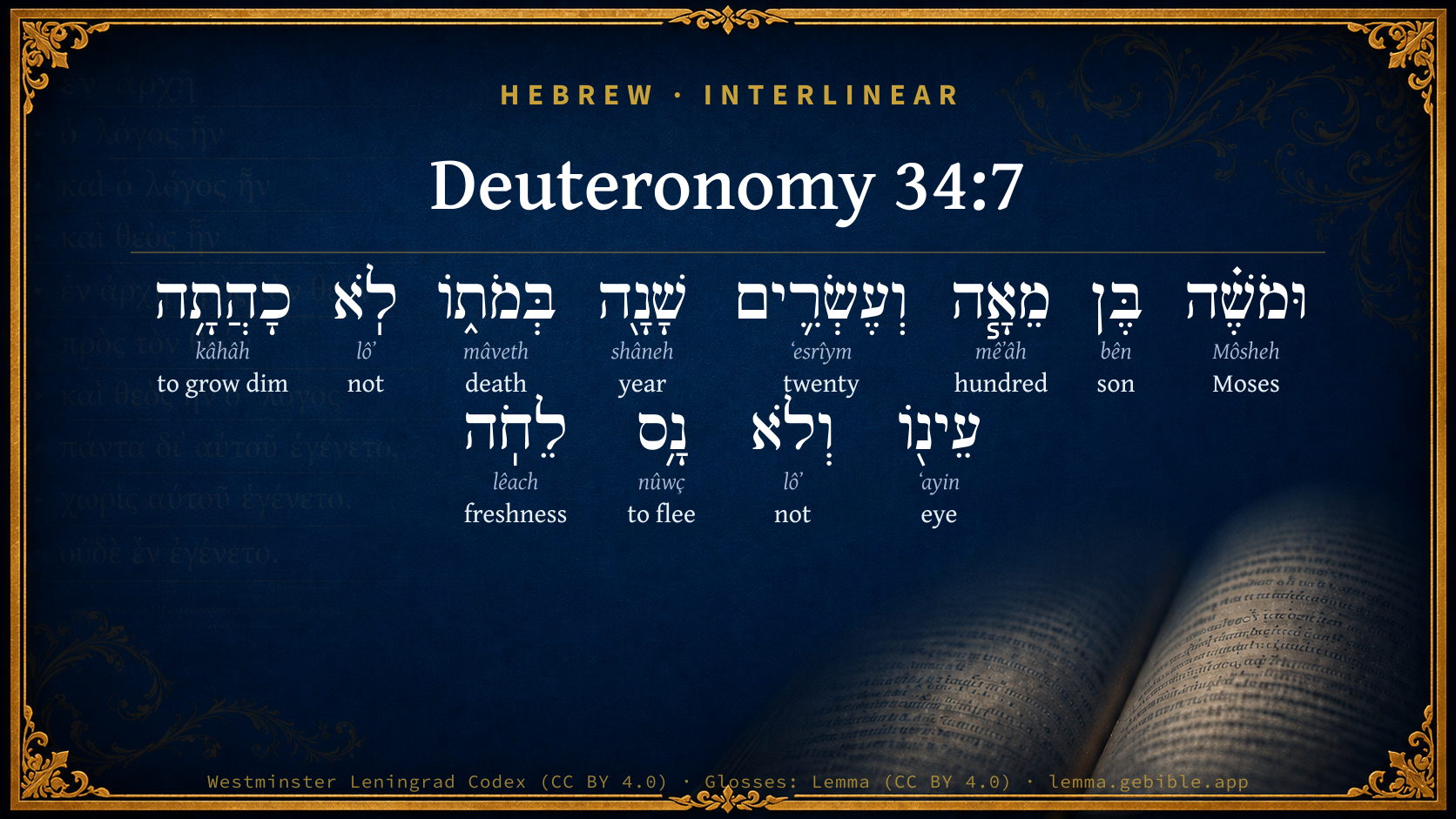
Deuteronomy 34:7

Hebrew (Westminster Leningrad Codex) Deuteronomy 34:7 appears in the Hebrew Old Testament. The text above is from the Westminster Leningrad Codex. Each word links to its Strong’s number, a concise gloss, and parsing drawn from the Open Scriptures Hebrew Bible morphology. Click any word for its full Brown-Driver-Briggs (BDB) entry.
Download image
Cite this verse

Deuteronomy 34:7 (World English Bible). Public Domain. Lemma interlinear Bible study tool, https://lemma.gebible.app/v/deuteronomy/34/7.

Show BibTeX & RIS
BibTeX
RIS
English Translation
Moses was one hundred twenty years old when he died: his eye was not dim, nor his natural force abated.
World English Bible · Public Domain
Highlights
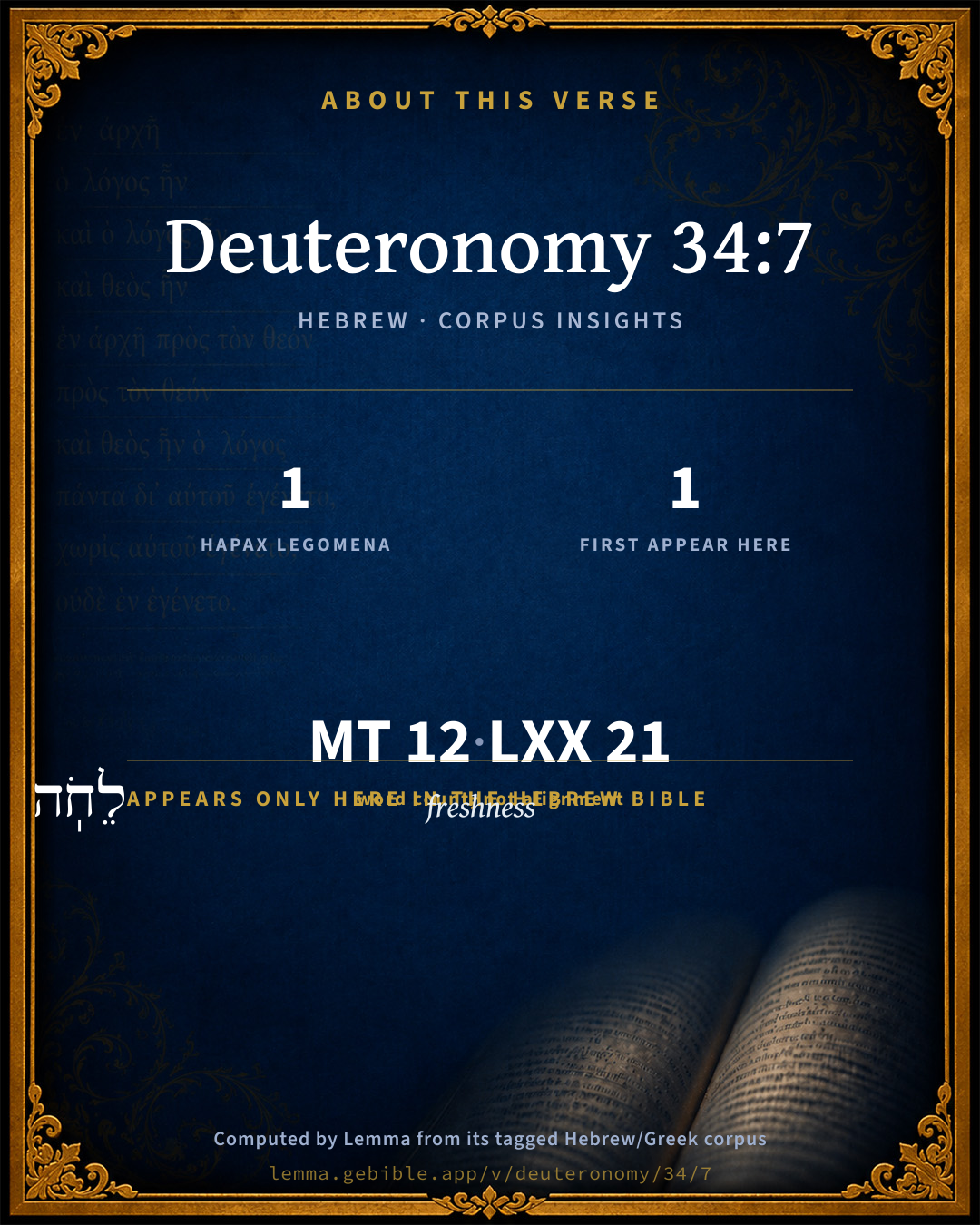
  • 1 hapax legomenon — only here in the Hebrew Bible
  • 1 first appearance in the Hebrew Bible
Full analysis ↓
Download a study sheet

One document with this verse’s original text, its word-by-word gloss line, the meaning frame, cross-references with their text, attributed commentary, and full source and license credits — printable, and it pastes into notes with its structure intact.

This verse Autodidact and up

Study sheet (.html) Plain text (.txt)

A passage Seminary Student

Up to 50 verses in one chapter. A passage sheet keeps up to 6 commentary sources and 12 cross-references per verse, in the order this page ranks them, and says so on the sheet whenever that leaves anything out. Ask for a single verse and you get the Autodidact verse sheet above.

Everything on this page stays free to read, with no account — the sheet is a download of what is already on screen, not access to it.

Want to remove ads? Support Godless Engineer
Compare translations 3

The same verse in 3 English versions, stacked beneath the original-language interlinear above. Click any original word for its lexicon entry.

Each is an independent rendering of the whole verse — the interlinear is not word-aligned to these translations.

Highlighted words mark where these versions differ — a whole-verse word diff, not a word-by-word alignment.

  • World English Bible Public Domain
    Moses was one hundred twenty years old when he died: his eye was not dim, nor his natural force abated.
  • King James Version Public Domain
    And Moses was an hundred and twenty years old when he died: his eye was not dim, nor his natural force abated.
  • unfoldingWord Literal Text CC BY-SA 4.0
    And Moses a son of 120 years when he died; his eye was not dim, nor had his vigor fled.

unfoldingWord Literal Text — © unfoldingWord, licensed CC BY-SA 4.0. Word-aligned USFM3 via Door43 (git.door43.org/unfoldingWord/en_ult).

Versions to compare (up to 4)

3 of 4 selected

Show all 18 translations

Every available English version of this verse, each an independent rendering of the whole verse.

  • World English Bible Public Domain
    Moses was one hundred twenty years old when he died: his eye was not dim, nor his natural force abated.
  • Berean Standard Bible Public Domain
    Moses was a hundred and twenty years old when he died, yet his eyes were not weak, and his vitality had not diminished.
  • Majority Standard Bible Public Domain
    Moses was a hundred and twenty years old when he died, yet his eyes were not weak, and his vitality had not diminished.
  • King James Version Public Domain
    And Moses was an hundred and twenty years old when he died: his eye was not dim, nor his natural force abated.
  • American Standard Version (1901) Public Domain
    And Moses was a hundred and twenty years old when he died: his eye was not dim, nor his natural force abated.
  • Revised Version (1885) Public Domain
    And Moses was an hundred and twenty years old when he died: his eye was not dim, nor his natural force abated.
  • Geneva Bible (1599) Public Domain
    Moses was nowe an hundreth and twentie yeere olde when hee died, his eye was not dimme, nor his naturall force abated.
  • Douay-Rheims (1899) Public Domain
    Moses was a hundred and twenty years old when he died: his eye was not dim, neither were his teeth moved.
  • Young's Literal Translation Public Domain
    And Moses `is' a son of a hundred and twenty years when he dieth; his eye hath not become dim, nor hath his moisture fled.
  • Literal Standard Version CC BY-SA 4.0
    And Moses [is] a son of one hundred and twenty years when he dies; his eye has not become dim, nor has his moisture fled.
  • Unlocked Literal Bible CC BY-SA 4.0
    Moses was one hundred twenty years old when he died; his eye was not dim, nor his natural force abated.
  • unfoldingWord Literal Text CC BY-SA 4.0
    And Moses a son of 120 years when he died; his eye was not dim, nor had his vigor fled.
  • Darby Bible Public Domain
    And Moses was a hundred and twenty years old when he died; his eye was not dim, nor his natural force abated.
  • World Messianic Bible Public Domain
    Moses was one hundred twenty years old when he died. His eye was not dim, nor his strength gone.
  • Webster's Bible Public Domain
    And Moses was a hundred and twenty years old when he died: his eye was not dim, nor his natural force abated.
  • Free Bible Version CC BY-SA 4.0
    Moses was 120 when he died, yet he was still seeing clearly and he was still strong.
  • Bible in Basic English Public Domain
    And Moses at his death was a hundred and twenty years old: his eye had not become clouded, or his natural force become feeble.
  • JPS Tanakh (1917) Public Domain
    And Moses was a hundred and twenty years old when he died: his eye was not dim, nor his natural force abated.

Literal Standard Version (2020), Covenant Press — licensed CC BY-SA 4.0. Text via the HelloAO Bible API (eBible.org). Unlocked Literal Bible (unfoldingWord) — licensed CC BY-SA 4.0. Text via the HelloAO Bible API (eBible.org). unfoldingWord Literal Text — © unfoldingWord, licensed CC BY-SA 4.0. Word-aligned USFM3 via Door43 (git.door43.org/unfoldingWord/en_ult). Free Bible Version, Dr. Jonathan Gallagher — licensed CC BY-SA 4.0. Text via the HelloAO Bible API (eBible.org).

Word by word

More ways to search: Search by grammar → Find every occurrence → Compare this word →

Practice this passage: Drill this verse → Learn its vocabulary →

לֵחֹֽה
lêach
H3893
“freshness · his”
Noun, Common, Masculine, Singular, Construct + Suffix, Personal, 3rd Person, Masculine, Singular
Part of Speech
Noun
Type
Common
Gender
Masculine
Number
Singular
State
Construct
Full BDB Definition

Origin: from the same as H3892

TWOT: 1102b

moisture, freshness, vigour
  1. וּמֹשֶׁ֗ה Môsheh H4872 “and · Moses” Conjunction + Noun, Proper
  2. בֶּן bên H1121 “son of” Noun, Common, Masculine, Singular, Construct
  3. מֵאָ֧ה mêʼâh H3967 “hundred” Adjective, Cardinal number, Both, Singular, Absolute
  4. וְעֶשְׂרִ֛ים ʻesrîym H6242 “and · twenty” Conjunction + Adjective, Cardinal number, Both, Plural, Absolute
  5. שָׁנָ֖ה shâneh H8141 “year” Noun, Common, Feminine, Singular, Absolute
  6. בְּמֹת֑וֹ mâveth H4194 “in/at · death · his” Preposition + Noun, Common, Masculine, Singular, Construct + Suffix, Personal, 3rd Person, Masculine, Singular
  7. לֹֽא lôʼ H3808 “not” Particle, Negative
  8. כָהֲתָ֥ה kâhâh H3543 “to grow dim” Verb, Qal, Perfect, 3rd Person, Feminine, Singular
  9. עֵינ֖וֹ ʻayin H5869 “eye · his” Noun, Common, Both, Singular, Construct + Suffix, Personal, 3rd Person, Masculine, Singular
  10. וְלֹא lôʼ H3808 “and · not” Conjunction + Particle, Negative
  11. נָ֥ס nûwç H5127 “to flee” Verb, Qal, Perfect, 3rd Person, Masculine, Singular

About this verse

These counts appear in no published source. They are computed here, from the morphology-tagged text and Lemma’s own curated glosses. What Lemma adds →

12
words
11
distinct lemmas
Pentateuch
section

Notable vocabulary

1 hapax legomenon — a word that appears only here in the entire Hebrew Bible:

  • לֵחֹֽה freshness H3893

First appearance in Scripture

This word makes its first canonical appearance in the Hebrew Bible here:

  • לֵחֹֽה freshness H3893

Shared distinctive vocabulary

כָהֲתָ֥ה to grow dim H3543 occurs in 7 verses of the Hebrew Bible. Also found in:

Grammatical profile

  • 2 verbs
  • 6 nouns
  • 2 adjectives
  • 2 particles

Verb forms

  • כָהֲתָ֥ה Qal · Perfect
  • נָ֥ס Qal · Perfect

Repetition

A word recurs within this verse — often emphatic in Hebrew:

Hebrew & Septuagint length

In English translation the verse runs 20 words from the Hebrew and 23 from the Septuagint (LXX English) — closely comparable.

A rough comparison of the two English renderings, which tokenize alike — not a word-level alignment.

Word counts can differ between the Hebrew and the Greek without any difference in meaning — e.g. the Hebrew direct-object marker אֵת has no separate Greek word, and Greek often adds the article ὁ.

In the original languages it is 12 Hebrew tokens and 21 Greek tokens — but the two are counted differently (Hebrew bundles its prefixes and suffixes into one token; the Greek is in lemma form), so that isn’t a like-for-like length.

Cross-references

7

Topical passages linked to Deuteronomy 34:7 in the Treasury of Scripture Knowledge — connected by theme and wording, ordered by reader-vote popularity; previews shown in the World English Bible.

  • Deuteronomy 31:2 He said to them, I am one hundred twenty years old this day; I can no more go out and come in: and Yahweh has said to me, You shall not go over this Jordan.
  • Joshua 14:10–11 Now, behold, Yahweh has kept me alive, as he spoke, these forty-five years, from the time that Yahweh spoke this word to Moses, while Israel walked in the wilderness: and now, behold, I am this day eighty-five years old.
  • Genesis 27:1 It happened, that when Isaac was old, and his eyes were dim, so that he could not see, he called Esau his elder son, and said to him, "My son?" He said to him, "Here I am."
  • Genesis 48:10 Now the eyes of Israel were dim for age, so that he couldn't see. He brought them near to him; and he kissed them, and embraced them.
  • Acts 7:36 This man led them out, having worked wonders and signs in Egypt, in the Red Sea, and in the wilderness for forty years.
  • Acts 7:30 "When forty years were fulfilled, an angel of the Lord appeared to him in the wilderness of Mount Sinai, in a flame of fire in a bush.
  • Acts 7:23 But when he was forty years old, it came into his heart to visit his brothers, the children of Israel.

Cross-references courtesy of OpenBible.info (CC BY 4.0).

Hebrew and Greek witnesses Masoretic Hebrew ↔ Greek Septuagint

The same verse in the two great witnesses to the Old Testament, shown verse-for-verse.

These are two independent witnesses, not word-aligned to each other, and the Septuagint is shown in lemma (dictionary) form.

Hebrew Deuteronomy 34:7 Masoretic · Westminster Leningrad Codex

וּמֹשֶׁ֗ה בֶּן מֵאָ֧ה וְעֶשְׂרִ֛ים שָׁנָ֖ה בְּמֹת֑וֹ לֹֽא כָהֲתָ֥ה עֵינ֖וֹ וְלֹא נָ֥ס לֵחֹֽה

Moses was one hundred twenty years old when he died: his eye was not dim, nor his natural force abated.

World English Bible · Public Domain

Greek LXX Deuteronomy 34:7 Septuagint · lemma form

μωυσῆς δέ εἰμί ἑκατόν καί εἴκοσι ἔτος ἐν ὁ τελευτάω αὐτός οὐ ἀμαυρόω ὁ ὀφθαλμός αὐτός οὐδέ φθείρω ὁ χελύνιον αὐτός

And Moses was one hundred and twenty years old at his death; his eyes were not dimmed, nor were his natural powers destroyed.

LXX2012 (modern English Septuagint) · Public Domain

Hebrew: Westminster Leningrad Codex (CC BY 4.0). Greek: Septuagint (public domain); English from LXX2012 (modern English Septuagint) (Public Domain). How the Septuagint differs from the Hebrew →

Targum (Aramaic paraphrase)

2

The Targum is the ancient Jewish Aramaic paraphrase of the Hebrew Scriptures — an interpretive translation, not the Hebrew text itself. Onkelos (literal) and Pseudo-Jonathan (expansive) render the Torah, and Jonathan the Prophets. Coverage is partial: where no permissively-licensed English translation exists for a verse, only the Aramaic is shown. This is verse-level text, not a word-by-word alignment to the Hebrew.

  1. Targum Onkelos Torah (Genesis–Deuteronomy)
    וּמֹשֶׁה בַּר מְאָה וְעַשְׂרִין שְׁנִין כַּד מִית לָא כְהַת עֵינוֹהִי וְלָא שְׁנָא זִיו יְקָרָא דְאַפּוֹהִי

    (no public-domain English translation for this verse)

    Targum Onkelos — Aramaic: “Onkelos Genesis” (public domain); “Onkelos Exodus” (public domain); “Onkelos Leviticus” (public domain); “Onkelos Numbers” (public domain); “Onkelos Deuteronomy” (public domain). English: “Sefaria Community Translation” (CC0 1.0 (public-domain dedication)); “J.W. Etheridge. The Targums of Onkelos and Jonathan Ben Uzziel on the Pentateuch. London: Longmans, Green, 1862” (public domain). Text via Sefaria.

  2. Targum Pseudo-Jonathan Torah (Genesis–Deuteronomy)
    וּמשֶׁה בַּר מְאָה וְעֶשְרִין שְׁנִין כַּד שְׁכִיב לָא כַהֲיָין גִלְגוּלֵי עֵינוֹי וְלָא נַתְרוֹן נִיבֵי לִסְתֵיהּ

    Mosheh was a son of a hundred and twenty years when be died; the orbs of his eyes were not darkened, nor had his teeth passed away.

    Targum Pseudo-Jonathan — Aramaic: “Targum Jonathan on Genesis” (public domain); “Targum Jonathan on Exodus” (public domain); “Targum Jonathan on Leviticus” (public domain); “Targum Jonathan on Numbers” (public domain); “Targum Jonathan on Deuteronomy” (public domain). English: “The Targum of Jonathan ben Uzziel, trans. J. W. Etheridge, London, 1862” (public domain). Text via Sefaria.

Commentary

Notes on Deuteronomy 34:7 from classic Christian and Jewish commentators (each source and its license shown beneath its notes). The classic Christian expositions comment on the surrounding passage and are grouped to its opening verse, so a note may address several verses; the Jewish commentaries on the Tanakh (Rashi and others) are per-verse, so they appear only where the commentator wrote on this verse.

Lemma curates 59 commentaries, every one of them public domain or Creative Commons licensed, each selected and text-cleaned for this edition rather than reprinted as found. About our sources →

Trapp's Complete Commentary

John Trapp

Deu 34:7 And Moses [was] an hundred and twenty years old when he died: his eye was not dim, nor his natural force abated.

Ver. 7. Nor his natural force {a} abated.] Jerome reads it, Nor his teeth loosed. And the use of manna might be some reason, it being an exquisitely pure kind of food, of an aerial, and not very corruptible substance.

{a} לחה gena, maxilla.

John Trapp, A Commentary or Exposition upon All the Books of the Old and New Testament (1647–1656) — public domain. Text from a community e-Sword module.

Joseph Benson's Commentary

Deu 34:7. Moses was a hundred and twenty years old when he died — But though he lived the full length of human life, and to an age which, in others that live up to it, is accompanied with many diseases and infirmities, yet this had made little or no alteration in him. By a miraculous work of God, in mercy to his church, and for the support of the great cause committed to him, it appears the full vigour of every faculty, both of body and mind, was preserved to him to his dying hour.

Joseph Benson's Commentary on the Old and New Testaments (1811–1818) — public domain. Text from a community e-Sword module.

Tyndale Open Study Notes

Tyndale Open Resources

34:7 At age 120, Moses was as strong as ever and in full possession of his faculties. He did not fail to enter Canaan because he died; he died because he failed to enter Canaan.

Tyndale Open Study Notes — © Tyndale Open Resources, licensed CC BY-SA 4.0. Text via the HelloAO Bible API.

Adam Clarke's Commentary

Verse 7. His eye was not dim] Even at the advanced age of a hundred and twenty; nor his natural force abated - he was a young man even in old age, notwithstanding the unparalleled hardships he had gone through. See the account of his life at the end of this chapter (De 34:10).

Adam Clarke's Commentary on the Bible (1810–1826) — public domain. Text from a community e-Sword/MySword module.

The Cambridge Bible for Schools and Colleges

gen. ed. J. J. S. Perowne

7. an hundred and twenty years] Dates, we have seen, are characteristic of P; this one is a round number = three full generations (see on Deu_2:7); cp. Exo_7:7.

nor his natural force abated] Lit. nor had his sap fled or ebbed. The phrase cannot be assigned to one source more than another.

The Cambridge Bible for Schools and Colleges (gen. ed. J. J. S. Perowne; Cambridge University Press, 1878–1918) — public domain. Text from a community e-Sword module.

John Gill's Exposition

And Moses was an hundred and twenty years old when he died,.... Which age of his may be divided into three equal periods, forty years in Pharaoh's court, forty years in Midian, and forty in the care and government of Israel, in Egypt and in the wilderness; so long he lived, though the common age of man in his time was but threescore years and ten, Psa 90:10; and what is most extraordinary is:

his eyes were not dim; as Isaac's were, and men at such an age, and under, generally be:

nor his natural force abated; neither the rigour of his mind nor the strength of his body; his intellectuals were not decayed, his memory and judgment; nor was his body feeble, and his countenance aged; his "moisture" was not "fled" (m), as it may be rendered, his radical moisture; he did not look withered and wrinkled, but plump and sleek, as if he was a young man in the prime of his days: this may denote the continued use of the ceremonial law then to direct to Christ, and the force of the moral law as in the hands of Christ, requiring obedience and conformity to it, as a rule of walk and conversation, Co1 9:21.

(m) So Ainsworth.

John Gill's Exposition of the Whole Bible (1746–1763) — public domain (CC PDM 1.0). Text via the HelloAO Bible API.

Haydock's Catholic Bible Commentary

Eye. Hebrew also, "colour." His sight and complexion were as good as in his youth, though he was 120 years old. --- Moved. The rays "of glory never changed," but attended him to the grave. (Chaldean) Hebrew, "his natural force (and vigour) never left him; or his cheeks did not fall in." (Calmet) --- The Roman Martyrology places the death of Moses on the 4th of September, though the Rabbins say he died in the 12th month. (Salien)

George Leo Haydock (1774–1849), Haydock's Catholic Family Bible and Commentary, 1859 edition — public domain. Excludes Psalms (Douay-Rheims chapter numbering differs from Protestant) and Deuterocanonical books (Catholic canon only).

Matthew Poole's English Annotations

By a miraculous work of God in mercy to his church and people.

Matthew Poole's English Annotations on the Holy Bible (1683–1685) — public domain. Text from a community e-Sword/MySword module.

Whedon's Commentary on the Bible

Daniel D. Whedon

7. Moses was a hundred and twenty years old when he died — What an eventful life he has led since he lay “a weeping boy” in the ark by the river’s brink! Forty years pass, and he is in the prime of manhood, a prince taught in all the learning of the most cultured nation of remote antiquity. Then forty years he spends in the quiet pastoral life of Midian, and forty years in the varied experience of the wilderness wandering. Since he led the people out of Egypt a whole generation has passed away. Of those who crossed the Red Sea how many have left their bones in the desert! How few of those who heard the song of triumph, “I will sing unto Jehovah, for he hath triumphed gloriously,” (Exodus 15,) listened to the “blessing wherewith Moses the man of God blessed the children of Israel before his death!”

Daniel D. Whedon (gen. ed.), Commentary on the Old and New Testaments (1874–1909) — public domain. Text from a community e-Sword module.

The Pulpit Commentary

Though Moses had reached the age of a hundred and twenty years, his eye had not become dim, nor were the juices of his body dried. Natural force. The word so rendered (jle) occurs only here; but it is doubtless the subst. connected with the adj. jl moist, fresh (cf. Gen_30:37; Num_6:3) and properly means moisture, freshness. It is used here of the natural juices of the body.

The Pulpit Commentary (1880–1919), ed. H.D.M. Spence-Jones & Joseph S. Exell — public domain. Text from a community e-Sword module.

John Wesley's Explanatory Notes

His eye was not dim - By a miraculous work of God in mercy to his church and people.

John Wesley, Explanatory Notes Upon the Whole Bible (1754–1765) — public domain. Text via the GEBible commentary corpus.

Keil & Delitzsch

C. F. Keil & F. Delitzsch

Though he died at the age of one hundred and twenty (see at Deu 31:2), Moses' eyes had not become dim, and his freshness had not abated (לח ב̔́נ. כוד., connected with לח in Gen 30:37, signifies freshness). Thus had the Lord preserved the full vital energy of His servant, even till the time of his death. The mourning of the people lasted thirty days, as in the case of Aaron (Num 20:29).

Keil & Delitzsch — Biblical Commentary on the Old Testament (1861–1891) — public domain (CC PDM 1.0). Text via the HelloAO Bible API. (Old Testament only.)

unfoldingWord translationNotes

Door43 World Missions Community

one hundred twenty years old ... thirty days

"120 years old ... 30 days" (See: Numbers)

his eye was not dim, nor his natural force abated

This means his eyes and body were still strong and healthy.

translationWords

mourn

Moab

unfoldingWord translationNotes — © Distant Shores Media and the Door43 World Missions Community, licensed CC BY-SA 4.0. Source: git.door43.org/Door43/en_tn.

Rashi

Rabbi Shlomo Yitzchaki (Rashi)

לא כהתה עינו HIS EYE WAS NOT DIM — even after he had died (Sifrei Devarim 357:34).

ולא נס לחו means, nor did the life-sap that was in him depart (Sifrei Devarim 357:35): decomposition had no power over him (had no effect on his body), and the appearance of his face had not changed.

Rashi on the Tanakh — English translations: “The Judaica Press complete Tanach with Rashi, translated by A. J. Rosenberg” (CC BY 4.0); “Pentateuch with Rashi's commentary by M. Rosenbaum and A.M. Silbermann, 1929-1934” (public domain); “The Metsudah Tanach series, Lakewood, N.J” (CC BY 4.0); and “The Book of Joshua, Metsudah Publications, 1997” (CC BY 4.0). Text via Sefaria.

Lesson kit

Teaching starters — assembled from the data on this page, not authored interpretation. Every prompt links to the verse data it draws on. Edit before teaching.

Deuteronomy, in the Pentateuch, opens this verse with 12 words (11 distinct Hebrew lemmas). Its most distinctive word is lêach (“freshness”). A historical commentator’s framing appears above. Read the whole chapter for the surrounding context.

Discussion questions

  1. How does “freshness” (lêach) shape what this verse is saying?
  2. 1 word here appears nowhere else in the Hebrew Bible. Why might the author reach for such rare wording?
  3. This is the first place “freshness” appears in Scripture (first appears here). What does its debut here establish?
  4. How does Genesis 27:1, which shares the word «to grow dim», read alongside this verse?
  5. What does the repetition of “not” (2× in this one verse) do in this verse?
  6. These translations render this verse differently; the difference is in the English rendering, not the original. What questions does that raise?
  7. «כָהֲתָ֥ה» is a Qal Perfect verb. How does that grammatical form shape the action described?
  8. Compare how Trapp's Complete Commentary and Joseph Benson's Commentary read this verse. Where do they agree or differ?

Things to notice

  • 1 word in this verse appears nowhere else in the Hebrew Bible.
  • 1 word makes its first canonical appearance in Scripture here.
  • This verse counts 12 Hebrew ↔ 21 Greek words.
  • These translations choose different wording for 12 words in this verse.
  • “not” occurs 2× in this single verse.

Reading settings

Reading text

Shown beneath each verse's original-language words.

Old Testament
Old Testament edition

Read the OT as the Masoretic Hebrew (MT) or the Greek Septuagint (LXX).

English shown for the Greek Septuagint (in the Hebrew ↔ Greek comparison).

Comparing translations? Open the Compare panel on any verse page to stack up to four side by side.