
Deuteronomy 21:22

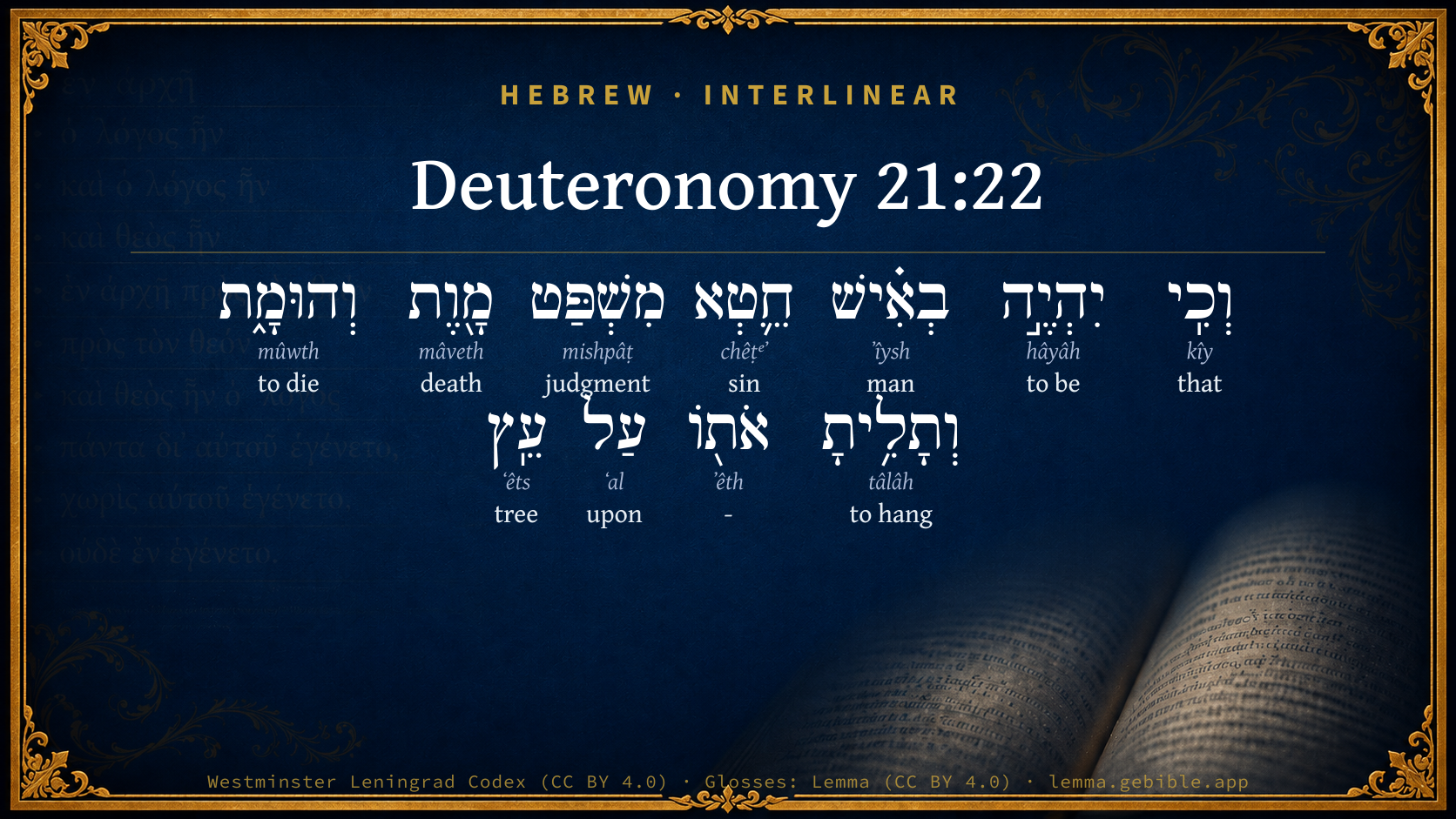
Hebrew (Westminster Leningrad Codex) Deuteronomy 21:22 appears in the Hebrew Old Testament. The text above is from the Westminster Leningrad Codex. Each word links to its Strong’s number, a concise gloss, and parsing drawn from the Open Scriptures Hebrew Bible morphology. Click any word for its full Brown-Driver-Briggs (BDB) entry.
Download image
Cite this verse

Deuteronomy 21:22 (World English Bible). Public Domain. Lemma interlinear Bible study tool, https://lemma.gebible.app/v/deuteronomy/21/22.

Show BibTeX & RIS
BibTeX
RIS
English Translation
If a man have committed a sin worthy of death, and he be put to death, and you hang him on a tree;
World English Bible · Public Domain
Download a study sheet

One document with this verse’s original text, its word-by-word gloss line, the meaning frame, cross-references with their text, attributed commentary, and full source and license credits — printable, and it pastes into notes with its structure intact.

This verse Autodidact and up

Study sheet (.html) Plain text (.txt)

A passage Seminary Student

Up to 50 verses in one chapter. A passage sheet keeps up to 6 commentary sources and 12 cross-references per verse, in the order this page ranks them, and says so on the sheet whenever that leaves anything out. Ask for a single verse and you get the Autodidact verse sheet above.

Everything on this page stays free to read, with no account — the sheet is a download of what is already on screen, not access to it.

Want to remove ads? Support Godless Engineer
Compare translations 3

The same verse in 3 English versions, stacked beneath the original-language interlinear above. Click any original word for its lexicon entry.

Each is an independent rendering of the whole verse — the interlinear is not word-aligned to these translations.

Highlighted words mark where these versions differ — a whole-verse word diff, not a word-by-word alignment.

  • World English Bible Public Domain
    If a man have committed a sin worthy of death, and he be put to death, and you hang him on a tree;
  • King James Version Public Domain
    And if a man have committed a sin worthy of death, and he be to be put to death, and thou hang him on a tree:
  • unfoldingWord Literal Text CC BY-SA 4.0
    And if a man has sinned, a judgment of death and he is put to death, and you hang him on a tree,

unfoldingWord Literal Text — © unfoldingWord, licensed CC BY-SA 4.0. Word-aligned USFM3 via Door43 (git.door43.org/unfoldingWord/en_ult).

Versions to compare (up to 4)

3 of 4 selected

Show all 18 translations

Every available English version of this verse, each an independent rendering of the whole verse.

  • World English Bible Public Domain
    If a man have committed a sin worthy of death, and he be put to death, and you hang him on a tree;
  • Berean Standard Bible Public Domain
    If a man has committed a sin worthy of death, and he is executed, and you hang his body on a tree,
  • Majority Standard Bible Public Domain
    If a man has committed a sin worthy of death, and he is executed, and you hang his body on a tree,
  • King James Version Public Domain
    And if a man have committed a sin worthy of death, and he be to be put to death, and thou hang him on a tree:
  • American Standard Version (1901) Public Domain
    And if a man have committed a sin worthy of death, and he be put to death, and thou hang him on a tree;
  • Revised Version (1885) Public Domain
    And if a man have committed a sin worthy of death, and he be put to death, and thou hang him on a tree;
  • Geneva Bible (1599) Public Domain
    If a man also haue committed a trespasse worthy of death, and is put to death, and thou hangest him on a tree,
  • Douay-Rheims (1899) Public Domain
    When a man hath committed a crime for which he is to be punished with death, and being condemned to die is hanged on a gibbet:
  • Young's Literal Translation Public Domain
    `And when there is in a man a sin -- a cause of death, and he hath been put to death, and thou hast hanged him on a tree,
  • Literal Standard Version CC BY-SA 4.0
    And when there is a sin in a man [with] a judgment of death, and he has been put to death, and you have hanged him on a tree,
  • Unlocked Literal Bible CC BY-SA 4.0
    If a man has committed a sin worthy of death and he is put to death, and you hang him on a tree,
  • unfoldingWord Literal Text CC BY-SA 4.0
    And if a man has sinned, a judgment of death and he is put to death, and you hang him on a tree,
  • Darby Bible Public Domain
    And if a man have committed a sin worthy of death, and he be put to death, and thou have hanged him on a tree,
  • World Messianic Bible Public Domain
    If a man has committed a sin worthy of death, and he is put to death, and you hang him on a tree,
  • Webster's Bible Public Domain
    And if a man shall have committed a sin worthy of death, and he must be put to death, and thou shalt hang him on a tree:
  • Free Bible Version CC BY-SA 4.0
    If someone commits a crime punishable by death, and the person is executed by hanging on a tree,
  • Bible in Basic English Public Domain
    If a man does a crime for which the punishment is death, and he is put to death by hanging him on a tree;
  • JPS Tanakh (1917) Public Domain
    And if a man have committed a sin worthy of death, and he be put to death, and thou hang him on a tree;

Literal Standard Version (2020), Covenant Press — licensed CC BY-SA 4.0. Text via the HelloAO Bible API (eBible.org). Unlocked Literal Bible (unfoldingWord) — licensed CC BY-SA 4.0. Text via the HelloAO Bible API (eBible.org). unfoldingWord Literal Text — © unfoldingWord, licensed CC BY-SA 4.0. Word-aligned USFM3 via Door43 (git.door43.org/unfoldingWord/en_ult). Free Bible Version, Dr. Jonathan Gallagher — licensed CC BY-SA 4.0. Text via the HelloAO Bible API (eBible.org).

Word by word

More ways to search: Search by grammar → Find every occurrence → Compare this word →

Practice this passage: Drill this verse → Learn its vocabulary →

וְתָלִ֥יתָ
tâlâh
H8518
“and · to hang”
Conjunction + Verb, Qal, Sequential Perfect, 2nd Person, Masculine, Singular
Part of Speech
Conjunction + Verb
Stem
Qal
Form
Sequential Perfect
Person
2nd Person
Gender
Masculine
Number
Singular
Full BDB Definition

Origin: a primitive root

TWOT: 2512

to hang - (Qal) - to hang - to hang up (any object) - to put to death by hanging - (Niphal) to be hanged - (Piel) to hang, hang up (for display)
  1. וְכִֽי kîy H3588 “and · that” Conjunction + Conjunction
  2. יִהְיֶ֣ה hâyâh H1961 “to be” Verb, Qal, Imperfect, 3rd Person, Masculine, Singular
  3. בְאִ֗ישׁ ʼîysh H376 “in/at · man” Preposition + Noun, Common, Masculine, Singular, Absolute
  4. חֵ֛טְא chêṭᵉʼ H2399 “sin of” Noun, Common, Masculine, Singular, Construct
  5. מִשְׁפַּט mishpâṭ H4941 “judgment of” Noun, Common, Masculine, Singular, Construct
  6. מָ֖וֶת mâveth H4194 “death” Noun, Common, Masculine, Singular, Absolute
  7. וְהוּמָ֑ת mûwth H4191 “and · to die” Conjunction + Verb, Hophal, Sequential Perfect, 3rd Person, Masculine, Singular
  8. אֹת֖וֹ ʼêth H853 “- · him” Particle, Direct Object + Suffix, Personal, 3rd Person, Masculine, Singular
  9. עַל ʻal H5921 “upon” Preposition
  10. עֵֽץ ʻêts H6086 “tree” Noun, Common, Masculine, Singular, Absolute

About this verse

These counts appear in no published source. They are computed here, from the morphology-tagged text and Lemma’s own curated glosses. What Lemma adds →

11
words
11
distinct lemmas
Pentateuch
section

Shared distinctive vocabulary

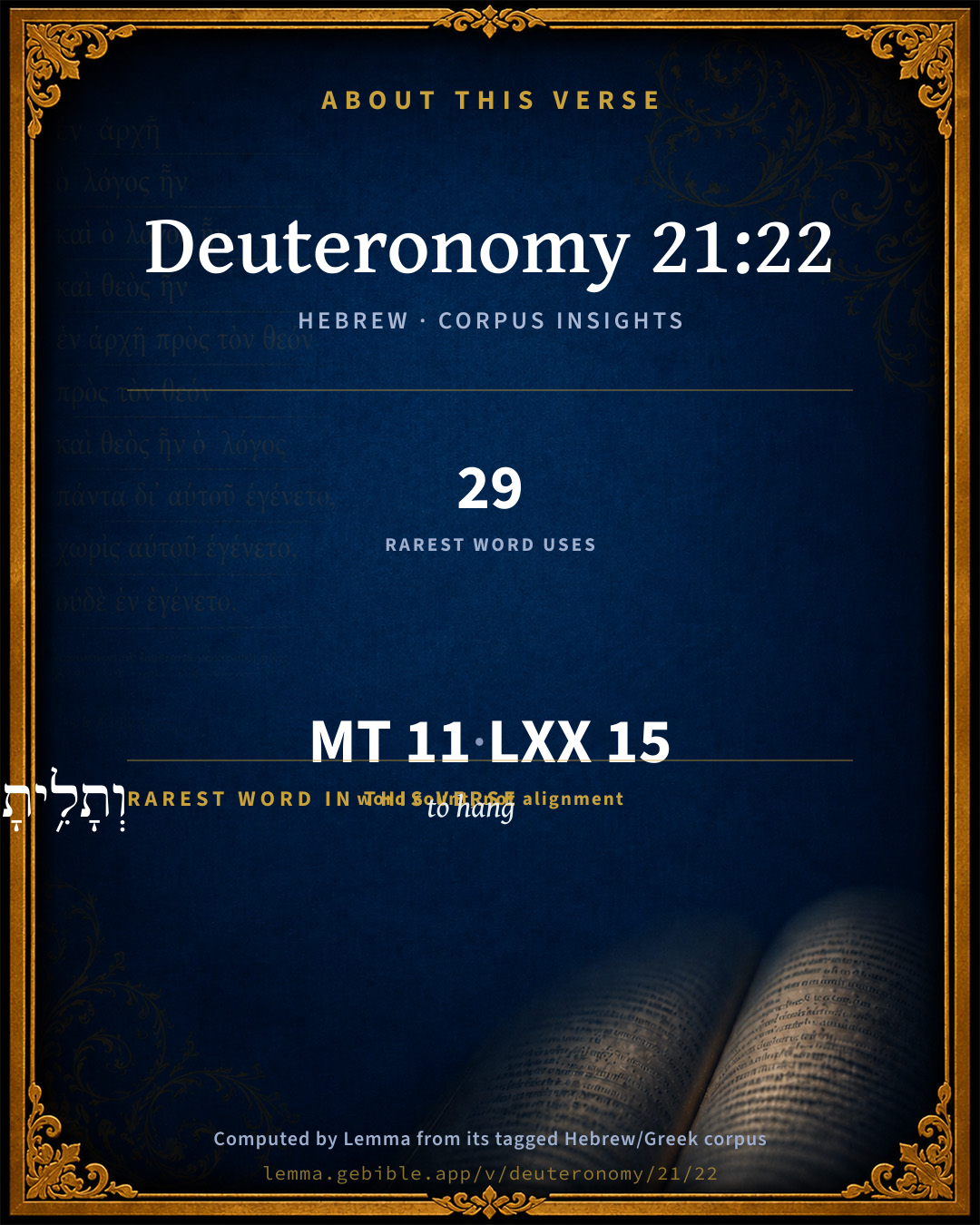
וְתָלִ֥יתָ to hang H8518 occurs in 27 verses of the Hebrew Bible. Also found in:

Grammatical profile

  • 3 verbs
  • 5 nouns
  • 1 preposition
  • 1 conjunction
  • 1 particle

Verb forms

  • יִהְיֶ֣ה Qal · Imperfect
  • וְהוּמָ֑ת Hophal · Sequential Perfect
  • וְתָלִ֥יתָ Qal · Sequential Perfect

Hebrew & Septuagint length

In English translation the verse runs 23 words from the Hebrew and 29 from the Septuagint (LXX English) — closely comparable.

A rough comparison of the two English renderings, which tokenize alike — not a word-level alignment.

Word counts can differ between the Hebrew and the Greek without any difference in meaning — e.g. the Hebrew direct-object marker אֵת has no separate Greek word, and Greek often adds the article ὁ.

In the original languages it is 11 Hebrew tokens and 15 Greek tokens — but the two are counted differently (Hebrew bundles its prefixes and suffixes into one token; the Greek is in lemma form), so that isn’t a like-for-like length.

Cross-references

17

Topical passages linked to Deuteronomy 21:22 in the Treasury of Scripture Knowledge — connected by theme and wording, ordered by reader-vote popularity; previews shown in the World English Bible.

  • John 19:31–38 Therefore the Jews, because it was the Preparation Day, so that the bodies wouldn't remain on the cross on the Sabbath (for that Sabbath was a special one), asked of Pilate that their legs might be broken, and that they might be taken away.
  • Acts 26:31 When they had withdrawn, they spoke one to another, saying, "This man does nothing worthy of death or of bonds."
  • Deuteronomy 22:26 but to the lady you shall do nothing; there is in the lady no sin worthy of death: for as when a man rises against his neighbor, and kills him, even so is this matter;
  • Matthew 26:66 What do you think?" They answered, "He is worthy of death!"
  • Luke 23:33 When they came to the place that is called The Skull, they crucified him there with the criminals, one on the right and the other on the left.
  • Acts 23:29 I found him to be accused about questions of their law, but to have nothing laid to his charge worthy of death or of bonds.
  • Deuteronomy 19:6 lest the avenger of blood pursue the manslayer, while his heart is hot, and overtake him, because the way is long, and strike him mortally; whereas he was not worthy of death, inasmuch as he didn't hate him in time past.
  • Joshua 8:29 The king of Ai he hanged on a tree until the evening: and at the going down of the sun Joshua commanded, and they took his body down from the tree, and cast it at the entrance of the gate of the city, and raised thereon a great heap of stones, to this day.
  • Joshua 10:26 Afterward Joshua struck them, and put them to death, and hanged them on five trees: and they were hanging on the trees until the evening.
  • 1 Samuel 26:16 This thing isn't good that you have done. As Yahweh lives, you are worthy to die, because you have not kept watch over your lord, Yahweh's anointed. Now see where the king's spear is, and the jar of water that was at his head.
  • 2 Samuel 4:12 David commanded his young men, and they killed them, and cut off their hands and their feet, and hanged them up beside the pool in Hebron. But they took the head of Ish-bosheth, and buried it in the grave of Abner in Hebron.
  • 2 Samuel 21:6 let seven men of his sons be delivered to us, and we will hang them up to Yahweh in Gibeah of Saul, the chosen of Yahweh. The king said, I will give them.
  • 2 Samuel 21:9 He delivered them into the hands of the Gibeonites, and they hanged them in the mountain before Yahweh, and they fell [all] seven together. They were put to death in the days of harvest, in the first days, at the beginning of barley harvest.
  • Mark 14:64 You have heard the blasphemy! What do you think?" They all condemned him to be worthy of death.
  • Acts 25:11 For if I have done wrong, and have committed anything worthy of death, I don't refuse to die; but if none of those things is true that they accuse me of, no one can give me up to them. I appeal to Caesar!"
  • Numbers 25:4 Yahweh said to Moses, Take all the chiefs of the people, and hang them up to Yahweh before the sun, that the fierce anger of Yahweh may turn away from Israel.
  • Acts 25:25 But when I found that he had committed nothing worthy of death, and as he himself appealed to the emperor I determined to send him.

Cross-references courtesy of OpenBible.info (CC BY 4.0).

Hebrew and Greek witnesses Masoretic Hebrew ↔ Greek Septuagint

The same verse in the two great witnesses to the Old Testament, shown verse-for-verse.

These are two independent witnesses, not word-aligned to each other, and the Septuagint is shown in lemma (dictionary) form.

Hebrew Deuteronomy 21:22 Masoretic · Westminster Leningrad Codex

וְכִֽי יִהְיֶ֣ה בְאִ֗ישׁ חֵ֛טְא מִשְׁפַּט מָ֖וֶת וְהוּמָ֑ת וְתָלִ֥יתָ אֹת֖וֹ עַל עֵֽץ

If a man have committed a sin worthy of death, and he be put to death, and you hang him on a tree;

World English Bible · Public Domain

Greek LXX Deuteronomy 21:22 Septuagint · lemma form

ἐάν δέ γίγνομαι ἐν τις ἁμαρτία κρίμα θάνατος καί ἀποθνήσκω καί κρεμάζω αὐτός ἐπί ξύλον

And if there be sin in any one, and the judgment of death be upon him, and he be put to death, and you⌃ hang him on a tree:

LXX2012 (modern English Septuagint) · Public Domain

On this verse, Ellicott's Commentary for English Readers discusses the Septuagint’s reading. Read the note in Commentary ↓

Hebrew: Westminster Leningrad Codex (CC BY 4.0). Greek: Septuagint (public domain); English from LXX2012 (modern English Septuagint) (Public Domain). How the Septuagint differs from the Hebrew →

Targum (Aramaic paraphrase)

2

The Targum is the ancient Jewish Aramaic paraphrase of the Hebrew Scriptures — an interpretive translation, not the Hebrew text itself. Onkelos (literal) and Pseudo-Jonathan (expansive) render the Torah, and Jonathan the Prophets. Coverage is partial: where no permissively-licensed English translation exists for a verse, only the Aramaic is shown. This is verse-level text, not a word-by-word alignment to the Hebrew.

  1. Targum Onkelos Torah (Genesis–Deuteronomy)
    וַאֲרֵי יְהֵי בִגְבַר חוֹבַת דִין דִקְטוֹל וְיִתְקְטֵל וְתִצְלוֹב יָתֵהּ עַל צְלִיבָא

    (no public-domain English translation for this verse)

    Targum Onkelos — Aramaic: “Onkelos Genesis” (public domain); “Onkelos Exodus” (public domain); “Onkelos Leviticus” (public domain); “Onkelos Numbers” (public domain); “Onkelos Deuteronomy” (public domain). English: “Sefaria Community Translation” (CC0 1.0 (public-domain dedication)); “J.W. Etheridge. The Targums of Onkelos and Jonathan Ben Uzziel on the Pentateuch. London: Longmans, Green, 1862” (public domain). Text via Sefaria.

  2. Targum Pseudo-Jonathan Torah (Genesis–Deuteronomy)
    וַאֲרוּם אִין יְהֵי בִּגְבַר חוֹבַת דִּין קְטוֹל וְיִתְחַיֵּיב אַטְלוּת אַבְנִין וּבָתַר כְּדֵין יִצְלְבוּן יָתֵיהּ עַל קֵיסָא

    When a man hath become guilty of the judgment of death, and is condemned to be stoned, and they afterwards hang him on a beam,

    Targum Pseudo-Jonathan — Aramaic: “Targum Jonathan on Genesis” (public domain); “Targum Jonathan on Exodus” (public domain); “Targum Jonathan on Leviticus” (public domain); “Targum Jonathan on Numbers” (public domain); “Targum Jonathan on Deuteronomy” (public domain). English: “The Targum of Jonathan ben Uzziel, trans. J. W. Etheridge, London, 1862” (public domain). Text via Sefaria.

Commentary

Notes on Deuteronomy 21:22 from classic Christian and Jewish commentators (each source and its license shown beneath its notes). The classic Christian expositions comment on the surrounding passage and are grouped to its opening verse, so a note may address several verses; the Jewish commentaries on the Tanakh (Rashi and others) are per-verse, so they appear only where the commentator wrote on this verse.

Lemma curates 59 commentaries, every one of them public domain or Creative Commons licensed, each selected and text-cleaned for this edition rather than reprinted as found. About our sources →

Ellicott's Commentary for English Readers

Deu_21:22-23.—HANGING.

(22) And he be put to death.—Better, and he hath been put to death. Hanging followed death in Israel (Jos_10:26-27).

(23) His body shall not remain all night.—Observed by Joshua, but broken by the Gibeonites (2Sa_22:9-10; 2Sa_22:14).

He that is hanged is accursed of God.—In the LXX., “Cursed of God is every one that hangeth upon a tree,” and cited in this form by St. Paul (Gal_3:13). We cannot see why he should be pronounced cursed, except for the sake of that which was designed by “the determined counsel and foreknowledge of God,” that His Son Jesus Christ should bear our sins in His own body on the tree, and redeem us from the curse of the Law, by being “made a curse for us.”

Rashi’s note upon this shows how strangely the rays of truth are sometimes refracted in the Jewish mina: “‘He that is hanged is the curse of God’—that is, he is the King’s disgrace. For man was made in the likeness of His image. And Israel are his children. There were two twin brothers, who were much alike. One was made king, the other was taken up for highway robbery, and was hanged. Every one who saw him said, ‘There hangs the king!’” From this note it is clear that Rashi takes the words to mean, “He that is hanged is God’s disgrace,” because man is “made after the similitude of God.” There is no doubt as to the shame of the punishment which our Lord endured and despised.

Thou shalt in any wise bury him that day.—Another law, remarkably and providentially fulfilled in our Lord’s death. We do not read that the robbers who were crucified with Him were buried, though their bodies were removed from the cross. It is not improbable that this law was also intended to prevent the barbarous practice of leaving men impaled op sharp stakes or suspended upon crosses from day to day until they died of pain and thirst. It certainly is a disgrace to the Divine image to treat it thus.

A Bible Commentary for English Readers, edited by Charles John Ellicott (1878–1897) — public domain. Text from a community e-Sword module.

The Cambridge Bible for Schools and Colleges

gen. ed. J. J. S. Perowne

22 f. Of the Exposed Corpse of a Criminal

A corpse exposed after execution shall be buried before night; cursed of God it must not be left to defile the land. In the Sg. address and closing with a deuteronomic formula.

Hanging (or impalement? see below) was not the form of the criminal’s death but was subsequent to the execution and an aggravation of its dishonour. This is clear not only from Deu_21:22, but from Jos_8:29; Jos_10:26, 1Sa_31:10, 2Sa_4:12 and is perhaps intended also in Gen_40:19 (and by consequence in Deu_21:22, Gen_41:13). Compare the similar treatment of the corpses of traitors and other notorious criminals in Europe till within recent times. In early Israel bodies thus exposed were buried before night and under or behind great stones, as though finally to suppress and get rid of the spirit of the criminal, which otherwise would continue to haunt the neighbourhood. If that was the original idea, it is ignored by D and this other substituted, that the hanged thing was under God’s curse and unburied might infect His holy land with His wrath.

22. if a man, etc.] Cp. Deu_21:15; Deu_21:18; lit. if there be against a man a sin, a sentence (mishpaṭ), of death. This compound phrase seems a fusion of a sin of death, a capital sin, Deu_22:26, and a sentence of death, a capital charge, Deu_19:6. Or mishpaṭ is a gloss.

and thou hang him on a tree] Not necessarily tree but something wooden (see Deu_19:5), LXX ἐπὶ ξύλου. It may have been a stake or pole, Est_7:9, EVV. gallows. Of the cross in Gal_3:13. So also hang, LXX κρεμάσητε, may be both here and in passages cited above affix or impale, Est_7:9, LXX σταμροῦν (but this was in Persia, for which cp. the ἀνασκολοπίζειν of Herod. i. 128). Impalement is implied in Ezr_6:11; and probably in 2Ma_15:35, Jdt_14:1, Lam_5:12. As their sculptures illustrate, Assyrians and Babylonians frequently impaled the bodies of their enemies.

The Cambridge Bible for Schools and Colleges (gen. ed. J. J. S. Perowne; Cambridge University Press, 1878–1918) — public domain. Text from a community e-Sword module.

The Biblical Illustrator

Joseph S. Exell

Deu_21:22-23

He that is hanged is accursed of God.

Hanging

I. Hanging a disgraceful punishment. The body was exposed to insult and assault. Shameful deeds were kept in public memory, and the dead was a spectacle to the world. It was only inflicted on most infamous offenders. Cicero calls it a nameless wickedness. Its pain and disgrace were extreme.

II. Hanging a defilement of the land That thy land be not defiled. The vices of the living and the bodies of the dead defiled the land (Num_35:34).

1. Physically it would be defiled. In the hot climate its decomposition would injure the health and peril the life of others.

2. Morally, as the land of Jehovah, it would be polluted. Remembrance of crime would harden the heart and breed familiarity.

III. Hanging a warning to others. The punishment was designed to deter others. They saw the terrible consequences of guilt. Alas! hanging is no warning, and men leave the very gibbet or the gallows to commit their crimes.

IV. Hanging a type of the death of Christ (Act_5:35; Gal_3:13).

1. He became our substitute.

2. He was buried in the evening (Joh_19:31).

3. As the land was cleansed by removal of curse, so the conscience and the Church purified by Christ. (J. Wolfendale.)

The accursed tree

I. A shameful death awaits abominable crime. Worthy, of death, lit., if there be on a man a right of death, he was hanged upon a tree.

II. Public ignominy expressed in this shameful death. Penalty for crime, detestation of the perpetrator, and the curse of God.

III. The desirability of taking away the memory of this shame. He shall not remain all night, take him down from the tree and bury him; blot out his name and remove the curse.

IV. Christ alone removes the curse. The best of men treated as one of the vilest, died the just for the unjust, who His own self bare our sins in His own body on the tree. (J. Wolfendale.)

.

The Biblical Illustrator, edited by Joseph S. Exell (c. 1880s–1900s) — public domain. Text from a community e-Sword module.

Joseph Benson's Commentary

Deu 21:22. On a tree — Which was done after the malefactor was put to death some other way; this public shame being added to his former punishment.

Joseph Benson's Commentary on the Old and New Testaments (1811–1818) — public domain. Text from a community e-Sword module.

Tyndale Open Study Notes

Tyndale Open Resources

21:22 hung on a tree: This was not the method of execution, at least in this text. It was a shameful display of those already put to death for capital offenses, probably to show the Lord’s hatred of sin and to deter others who might commit such acts (see also Gen 40:19, 22; Josh 10:26; 2 Sam 4:12; 21:12; Esth 2:23; 7:10).

Tyndale Open Study Notes — © Tyndale Open Resources, licensed CC BY-SA 4.0. Text via the HelloAO Bible API.

Jamieson, Fausset & Brown

Robert Jamieson, A. R. Fausset & David Brown

if a man have committed a sin . . . and thou hang him on a tree--Hanging was not a Hebrew form of execution (gibbeting is meant), but the body was not to be left to rot or be a prey to ravenous birds; it was to be buried "that day," either because the stench in a hot climate would corrupt the air, or the spectacle of an exposed corpse bring ceremonial defilement on the land.

Next: Deuteronomy Chapter 22

Jamieson, Fausset & Brown — Commentary Critical and Explanatory on the Whole Bible (1871) — public domain (CC PDM 1.0). Text via the HelloAO Bible API.

John Gill's Exposition

And if a man have committed a sin worthy of death,.... This before mentioned, or any other that deserves death, any kind of death, as strangling, killing with the sword, burning and stoning, to which the Jews restrain it here:

and he be to be put to death, and thou hang him, on a tree; is condemned to stoning, and after that they hang him, as the Targum of Jonathan; and according to the Jewish Rabbins, as Jarchi observes, all that were stoned were to be hanged, and only men, not women (g); for it is remarked that it is said "him" and not "her" (h): about this there is a dispute in the Misnah (i);"all that are stoned are hanged, they are the words of R. Eliezer; but the wise men say none are to be hanged but the blasphemer and idolater; a man is to be hanged with his face to the people, a woman with her face to the tree, they are the words of R. Eliezer; but the wise men say, a man is to be hanged, but no woman, to whom R. Eliezer replied, did not Simeon Ben Shetach hang women in Ashkelon? they answered him, he hung eighty women (at once), but they do not judge or condemn two in one day;''so that this was a particular case at a particular time, and not be drawn into an example: in the same place it is asked,

"how they hang one? they fix a beam in the earth, and a piece of wood goes out of it (near the top of it, as one of the commentator (k) remarks), and join his two hands together and hang him;''that is, by his hand, not by his neck, as with us, but rather in the crucifixion; only in that the hands are spread, and one hand is fastened to one part of the cross beam, and the other to the other end.

(g) Misn. Sotah, c. 3. sect. 8. (h) Maimon. & Bartenora in. ib. (i) Misn. Sanhedrin, c. 6. sect. 4. (k) Bartenora in Misn. Sanhedrin, c. 6. sect. 4.

John Gill's Exposition of the Whole Bible (1746–1763) — public domain (CC PDM 1.0). Text via the HelloAO Bible API.

Albert Barnes' Notes on the Bible

There were four methods of execution in use among the ancient Jews; stoning (Exo 17:4; Deu 13:10, etc.), burning Lev 20:14; Lev 21:9, the sword Exo 32:27, and strangulation. The latter, though not named in Scripture, is regarded by the rabbis as the most common, and the proper one to be adopted when no other is expressly enjoined by the Law. Suspension, whether from cross, stake, or gallows, was not used as a mode of taking life, but was sometimes added after death as an enhancement of punishment. Pharaoh’s chief baker Gen 40:19 was hanged after being put to death by the sword; and similarly Joshua appears Jos 10:26 to have dealt with the five kings who made war against Gibeon. Compare also Num 25:4.

Albert Barnes' Notes on the Bible (1834–1885) — public domain. Text from a community e-Sword/MySword module.

Haydock's Catholic Bible Commentary

Gibbet. Whether the person was first killed, as the Jews assert, or he was left to die upon the gibbet, see Calmet’s Diss. It is also a matter of doubt, whether he was nailed to the gibbet, or hung on it by a rope. (Bonfrere)

George Leo Haydock (1774–1849), Haydock's Catholic Family Bible and Commentary, 1859 edition — public domain. Excludes Psalms (Douay-Rheims chapter numbering differs from Protestant) and Deuterocanonical books (Catholic canon only).

Matthew Poole's English Annotations

Which was done after the malefactor was put to death some other way, this public shame being added to his former punishment. See Jos 7:25; 8:29; 10:26; 2Sa 4:12.

Matthew Poole's English Annotations on the Holy Bible (1683–1685) — public domain. Text from a community e-Sword/MySword module.

Whedon's Commentary on the Bible

Daniel D. Whedon

22. If a man… be put to death — Capital punishment among the Hebrews was usually inflicted by stoning. See Exo_17:4; Deu_13:10; Joh_10:31; Act_14:5. Burning, in early times, was the punishment for unchastity. Gen_38:24. In Lev_21:9, it is made the penalty for this sin in the case of a priest’s daughter. It was also the punishment for incest. Death by the sword or spear is mentioned in Exo_19:13; Exo_32:27; Num_25:7-8. According to the rabbins strangling was the most common method of capital punishment.

Hang him on a tree — That is, after he has been put to death his body is to be ignominiously exposed to public view.

Daniel D. Whedon (gen. ed.), Commentary on the Old and New Testaments (1874–1909) — public domain. Text from a community e-Sword module.

The Pulpit Commentary

Vers. 22, 23. When a criminal was put to death and was hanged upon a tree, his body was not to remain there over-night, but was to be buried the same day on which he was executed.

If a man have committed a sin worthy of death; literally, If there be on a man a judgment of death; if he lie under sentence of death. Hang him on a tree. This refers not to putting to death by strangling, but to the impaling of the body after death (cf. C. B. Michaelis, "De Judiciis Poenisque Capitalibus in Sac. Script. Commemoratis," in "Sylloge Commentt. Theolog.," edita a D. J. Pott, vol. 4. p. 209). This was an aggravation of the punishment, as the body so impaled was exposed to insult and assault (cf. Num_25:4; Gen_40:19)

Ver. 23. He that is hanged is accursed of God; literally, a curse of God. Some take this as meaning an insult to God, a contemning of him, "since man his image is thus given up to scorn and insult" (Rashi). But the more probable meaning is "a curse inflicted by God," which the transgressor is made to endure. (cf. Gal_3:13) That thy land be not defiled. The land was defiled, not only by sins committed by its inhabitants, but also by the public exposure of criminals who had been put to death for their sins. (cf. Lev_18:24, Lev_18:25; Num_35:33, Num_35:34) On this law Joshua acted. (cf. Jos_8:29 Jos_10:26, Jos_10:27)

Vers. 22, 23. Upon the tree!

These words form part of the criminal code of the Hebrews, and though as such they may be regarded as practically obsolete, yet they contain principles which will never wax old, and are, moreover, so frequently alluded to in the New Testament, that they furnish us with a starting-point of no mean interest for a devout Christian meditation. The case supposed in the text is not that of a man being put to death by crucifixion, but of his having suffered capital punishment, and of his body being afterwards hung upon a stake and put to an open shame by the exposure, as having been one of the vilest of criminals. Such an exposure after death was to be, so to speak, the expression of the execration of the people. It would be their public brand upon detestable guilt. And, when thus the public detestation and horror of wickedness had been expressed, that accursed thing was to be taken down that night and buried out of sight forever, as a sign that the curse had spent itself. This vox populi was vox Dei. "He that is hanged is accursed of God.

Now, it may be asked, "Why take up the time of a congregation by recalling an obsolete enactment like this?" Our reply is, Let us now turn to Act_5:30. Peter knew how the Jews would regard these words ye slew and hanged on a tree." They would understand their significance to be, "You put him to an open shame, as though he, the best of men, were one of the vilest malefactors." Shall we call this the "irony of history?" How was it that God let the treatment of the basest of criminals be accorded to the holiest of our race? We often speak of it as a "mystery of Providence" when some great trouble befalls a good man. But of all such mysteries there is none so great as this. As a bare piece of history unexplained, there is no fact which in all its surroundings is so inexplicable as this, that Jesus Christ of Nazareth should have died amid such deep disgrace and shame. "Hanged on a tree!" Let us go further on. Read 1Pe_2:24. Note the emphasis, "who his own self bare our sins in his own body on the tree." Here is an explanation of the strange fact. He was pressed down with others" woes, and burdened with the guilt of others" sins. And why? What was the effect of all? Read again. in Gal_3:13, Gal_3:14, the apostle, quoting these words of Moses, shows us that in the fact of the ignominious death of the Lord Jesus Christ upon the tree, we are to see at once

(1) the Divine execration of sin, and

(2) the Divine redemption of the sinner.

I Under a moral government, a righteous governor will, yea, must append blessing to good, and affix a curse to evil. If anyone asks Why? we do not know that any one can answer further than to say that suffering is the desert of ill, and gladness the appropriate consequence of well-doing. No other theory would be workable in any well-ordered family, or nation, or city. In the family, paternal punishment expresses the father"s sense of wrong done in the State, punishment marks the nation"s sense of wrong done. And these are but echoes of that Divine disapproval of sin to which the conscience of man with certainty points. And it is well known and understood that the disapproval and condemnation of wrong on the part of any government is never to be confounded with, but is very far removed from, personal vindictiveness. No government, indeed, would command the confidence of the people under which crime could be carried on with impunity. Without branding crime against a State, no government could long exist. That brand is "the curse of the law.

II There is a law above all human laws. The latter are partial and defective, and may become obsolete. The everlasting law of righteousness is co-eternal with the Great Supreme. He judges the world in righteousness. Every child of man is answerable to his tribunal. Every deed, word, and thought are scanned by his all-seeing eye, and are estimated rightly by his unerring judgment. And he, the Great Judge, brings against each and all the charge of being law-breakers. (see Rom 1:, Rom_1:2) The Jew is so because he has broken a written Law; the Gentile, because he has broken an unwritten one. All the world is guilty before God. Under such circumstances, what is a righteous Being to do to secure the stability of his throne? To connive at sin? To pass it by, and take no notice of it? To let the sinner have the same grace as if he had never sinned? No; there must be a declaration, a demonstration, of his righteousness, as Paul calls it. And the demonstration of righteousness certainly involves the condemnation of sin.

III If we are sinners, as we are, the Divine condemnation of sin places us under a curse. We must be careful to understand that in the Divine curse there is nothing vindictive, excessive, defective, or ineffective; there is nothing in it out of harmony with the everlasting love of righteousness which is the bulwark and safeguard of the Divine government of souls. As many as are of the works of the Law are continue to be under the curse. As long as a man"s life is unright, by God"s law he abides under condemnation.

IV Guilty men are under the curse; a Guiltless One comes under it. So Gal_3:13, "being made a curse for us," rather, "having become a curse." (Let the student note here, as in John 1., the careful use of, and the distinction between, the words for" being" and "becoming.") The Son of God, the Law-maker, comes and dwells with the lawbreakers, and becomes as one of them. Joyfully taking their place, he bears their burdens and accepts their liabilities as if they were his own! He is pressed down as with a great weight. His sweat is as it were great drops of blood. He goes to the tree. The deepest indignity the Law knows is his. He is numbered with the transgressors. He is put to "an open shame." He dies as the worst of male. factors died on the tree! The One who stands pre-eminent among men for the purity of his life stands out also conspicuously among men for the humiliation which attends on his death! He hangs on a tree, as if accursed of God!

V Our Lord Jesus Christ then represented our race, and for them had become a curse. A stupendous transaction was then and there effected, to which we know of no parallel in heaven or on earth. (cf. 1Pe_2:24; 2Co_5:21; Joh_1:29)

Note:

1. He was of such dignity that he could represent the race.

2. His act was entirely spontaneous; he willed to do it.

3. It was the Father"s appointment that he should do it.

4. Foreseeing the result of his work, he rejoiced to do it. (Isa_53:11 (Hebrew); Heb_12:1, Heb_12:2)

Amid the external humiliation, the thought of saving men thereby, bore him on and bore him through.

VI By bearing the curse on himself upon the tree he bore it off from us. He has redeemed us therefrom. He has bought us up out of it. He who deserved it not, was pressed down by it, that we who deserved it might be lifted up out of it. Sin having been, in him, condemned once, completely, righteously, eternally the righteousness of the Lawgiver was demonstrated. Then was his love free to act towards us apart from Law, on the principle of grace.

VII The curse being thus rolled away, the way is prepared for the coming in of the blessing. However fully and freely infinite love now heaps blessing on blessing on the vilest sinner, not from one quarter of the universe can the murmur rise up that God thinks lightly of sin, when, in order to lift its weight off the guilty sinner, the Infinite Son of God has taken the whole load upon himself, and atoned for sin by his own sacrifice!

VIII The blessing comes to men when they repent and believe. So argues Paul in both his Epistles to the Romans and Galatians. See especially Rom_4:16, and the wonderful parallel between the first and the second Adam in Ro 5.

IN CONCLUSION.

1. Let us adore and magnify the grace and righteousness of God in the atoning work of Christ on the tree. The manifold perfections of the Divine nature shine forth here in combined luster. Thousands have objected to the doctrine of" the atonement. No one ever objected to it who did not first misapprehend it.

2. Let us cultivate deep, serious, and earnest thinkings as to the evil of sin, thus branded with the curse of God. Only low moral conceptions can consist with the denial of the necessity for an atonement.

3. Let us see that we rely entirely and penitently on the work of the Son of God on our behalf.

4. Let us defend the manifold glories of the cross against all deniers and opponents.

5. Let us, before whom this Divine act of self-surrender stands as the warrant of our hope, have it ever before us also as the model and standard of our life. And, in studying ever more and more fully the meaning of Christ"s self-surrender to God for us, shall we find the inspiration of our self-surrender to God for others!

Vers. 22, 23. Accursed of God.

The criminal who had committed a sin worthy of death, and was put to death under the law, was viewed as dying under the ban or curse of God. When the crime was very execrable, and the criminal might be regarded as perishing under God"s most awful curse, the fact was intimated by exposing the body on a tree. Compare the old custom of hanging a notorious criminal in chains. The placing of the body on a tree was not that which made the person accursed, but was an external sign or token of his being an accursed one. It was, therefore, a singular and striking feature in God"s providential arrangements, not only that the death of Christ should be brought about as a result of judgment passed on him by the constituted authorities of his nation, pronouncing him guilty of the worst of all crimes under the theocracy, that of blasphemy, but that in the manner of his death even this external token of ignominy should not be wanting. In this act, the placing of Jesus on the cross, the sin and madness of the world were overruled, as in several other instances (Mat_27:25, Mat_27:29, Mat_27:42; Mar_15:27, 28; Joh_11:50) to give unwitting expression to the highest truth. "Christ hath redeemed us from the curse of the Law, being made a curse for us; for it is written, Cursed is every one that hangeth on a. (Gal_3:13) The crucifixion of Jesus signifies to us:

1. The world"s judgment upon Christ. It put him to death as one accursed of God. It treated him as the worst of malefactors, and interpreted his death upon the cross as a sure token of God having forsaken him. (Mat_27:43) To many it may have appeared as if the inference were just. The Sanhedrim had convicted him of blasphemy, and their verdict seemed confirmed by the failure of Christ to deliver himself out of their hands. A true Christ would not thus have succumbed before his enemies. The cross was the refutation of his claims, and the proof of his being an impostor, justly doomed to die. "We did esteem him stricken, smitten of God, and afflicted". (Isa_53:4) The world was wrong, for Jesus was never dearer to his Father than in that hour when he hung upon the tree; but, in a sense unknown to itself, it gave utterance to a truth.

2. Christ"s submission to a cursed death for the world. The subjection of the sinless Christ to the death of the cross is a fact which requires explanation. If the world put him to death as one accursed, it is none the less true that he voluntarily submitted to this suffering and ignominy, and that the Father permitted him so to be "made a curse." A yet more mysterious feature in the death of Christ is that, in the direst hour of his agony, the Father seemed to side with the world, by withdrawing from him the light and comfort of his presence. (Mat_27:46) Christ was dealt with by Heaven, not less than by men, as One under a curse; if not a sinner, he was treated as if he were one. The apostolic writings lay stress on this as a fact of essential importance in the work of Christ for man"s salvation. (2Co_5:21; Gal_3:13) Subjection to the curse of the Law in the name of the world of sinners with whose lot he had identified himself, was not all that was necessary for their redemption from that curse, but it was involved in what was necessary. Any theory of atonement which leaves out the recognition of Christ "made sin" for us by voluntary endurance of sin"s doom, must, on scriptural grounds, be pronounced at least incomplete. J.O.

Vers. 22, 23. The doom of law the embodiment of Divine curse.

The suspension of a human body on the gallows-tree is the utmost climax of ruin and disgrace. It is the fullest exponent of the public detestation and horror for the deed. In this case the curse of men is the curse of God. But this curse was not to continue. Blessing was to be perpetual, abiding, uninterrupted; but the curse was to endure for a moment. The body so accursed was to be buried before sunset. Many reasons have been assigned for this.

I BECAUSE VINDICTIVE ANGER SHOULD BE KEPT WITHIN DUE BOUNDS. Anger against monstrous crime is a great assistance in the performance of painful duty. We are braced to do under stress of anger what we could scarcely do in calmer moods of feeling. Anger has its use, but should not be prolonged. When the painful deed is done, vengeful passion should cease. To this end let the lifeless body be buried out of sight.

II BECAUSE THE HUMAN FORM IS SACRED AS GOD"S TEMPLE. The temple may be in ruins, yet sentiments of veneration hover round the ruined shrines. We know that yonder executed man was the workmanship of the living God. Every vein, and artery, and muscle, and nerve in that mutilated body was the handiwork of God. With that man"s history God had taken pains; and over his mistaken course God had grieved. We think of what that man might have been, how fruitful in goodness and virtue! how meet for Divine service and honor! And the spectacle of that man"s doom should arouse our fear. We may well stand in awe of sin. To commit such a corpse with gentle pity to the grave will do us good.

III BECAUSE MORAL DEFILEMENT WOULD OTHERWISE RESULT. The exposure of a dead body in that climate beyond a single day would taint the atmosphere and damage health. But to accustom the minds of men to such a ghastly spectacle would tend to moral defilement. It would serve to harden their better feelings, and make too familiar the exhibition of Jehovah"s curse. In our present condition sacred things may become too common. Here especially "familiarity breeds contempt." No greater evil can befall the soul than when it becomes heedless of Divine judgments. D.

The Pulpit Commentary (1880–1919), ed. H.D.M. Spence-Jones & Joseph S. Exell — public domain. Text from a community e-Sword module.

John Wesley's Explanatory Notes

On a tree - Which was done after the malefactor was put to death some other way, this publick shame being added to his former punishment.

John Wesley, Explanatory Notes Upon the Whole Bible (1754–1765) — public domain. Text via the GEBible commentary corpus.

Keil & Delitzsch

C. F. Keil & F. Delitzsch

Burial of those who had been Hanged. - If there was a sin upon a man, מות משׁפּט, lit., a right of death, i.e., a capital crime (cf. Deu 19:6 and Deu 22:26), and he was put to death, and they hanged him upon a tree (wood), his body was not to remain upon the wood over night, but they were to bury him on the same day upon which he as hanged; "for the hanged man is a curse of God," and they were not to defile the land which Jehovah gave for an inheritance. The hanging, not of criminals who were to be put to death, but of those who had been executed with the sword, was an intensification of the punishment of death (see at Num 25:4), inasmuch as the body was thereby exposed to peculiar kinds of abominations. Moses commanded the burial of those who had been hanged upon the day of their execution, - that is to say, as we may see from the application of this law in Jos 8:29; Jos 10:26-27, before sunset, - because the hanged man, being a curse of God, defiled the land. The land was defiled not only by vices and crimes (cf. Lev 18:24, Lev 18:28; Num 35:34), but also by the exposure to view of criminals who had been punished with death, and thus had been smitten by the curse of God, inasmuch as their shameful deeds were thereby publicly exposed to view. We are not to think of any bodily defilement of the land through the decomposition consequent upon death, as J. D. Mich. and Sommer suppose; so that there is no ground for speaking of any discrepancy between this and the old law. - (On the application of this law to Christ, see Gal 3:13.), - This regulation is appended very loosely to what precedes. The link of connection is contained in the thought, that with the punishment of the wicked the recollection of their crimes was also to be removed.

Keil & Delitzsch — Biblical Commentary on the Old Testament (1861–1891) — public domain (CC PDM 1.0). Text via the HelloAO Bible API. (Old Testament only.)

Kretzmann's Popular Commentary

Paul E. Kretzmann

Concerning the Body of One Hanged

v. 22. And if a man have committed a sin worthy of death, one upon which the death penalty had been placed and also put into execution, and he be to be put to death, and thou hang him on a tree, literally, "on a wood," on some form of gallows,

v. 23. his body shall not remain all night upon the tree, but thou shalt in any wise bury him that day, before sunset, (for he that is hanged is accursed of God,) rejected as detestable and as defiling the land, that thy land be not defiled, morally, by the presence of this curse above the ground, which the offender had no longer been worthy to tread, which the Lord, thy God, giveth thee for an inheritance. This rule was carried out also in the case of Jesus, Joh 19:31, because, as St. Paul writes, He became a curse for our sakes, Gal 3:13.

Paul E. Kretzmann, Popular Commentary of the Bible (1921–1924) — public domain. Text from a community e-Sword module.

unfoldingWord translationNotes

Door43 World Missions Community

General Information:

Moses continues speaking to the people of Israel as if he were speaking to one man, so the words "you" and "your" are singular. (See: Forms of You)

If a man has committed a sin worthy of death

"If a man has done something so bad that you need to punish him by killing him"

he is put to death

This can be stated in active form. AT: "you execute him" or "you kill him" (See: Active or Passive)

you hang him on a tree

Possible meanings are 1) "after he has died you hang him on a tree" or 2) "you kill him by hanging him on a wooden post"

bury him the same day

"bury him on the same day as when you execute him"

for whoever is hanged is cursed by God

This can be stated in active form. Possible meanings are 1) "because God curses everyone whom people hang on trees" and 2) "people hang on trees those whom God has cursed." (See: Active or Passive)

do not defile the land

by leaving something God has cursed hanging in the tree

translationWords

sin

die

hang

body

bury

curse

obey

command

defile

unfoldingWord translationNotes — © Distant Shores Media and the Door43 World Missions Community, licensed CC BY-SA 4.0. Source: git.door43.org/Door43/en_tn.

Rashi

Rabbi Shlomo Yitzchaki (Rashi)

וכי יהיה באיש חטא משפט מות AND IF THERE BE IN A MAN A SIN DESERVING THE JUDGMENT OF DEATH — The juxtaposition of these sections (this and that of the rebellious son) tells us that if father and mother spare him (the rebellious son), he will in the latter end turn to mischief and commit sins for which he will become liable to the death penalty by the court (cf. Midrash Tanchuma, Ki Teitzei 1).

ותלית אתו על עץ [AND IF THERE BE IN A MAN A SIN DESERVING THE JUDGMENT OF DEATH] THOU SHALT HANG HIM ON A TREE — Our Rabbis said, All those who have to be put to death by stoning must afterwards be hanged, for it is said here (v. 23) “for cursing of God ends in hanging”, and we are told that one who curses God is punished with stoning (cf. Leviticus 24:15—16; Sanhedrin 45b).

Rashi on the Tanakh — English translations: “The Judaica Press complete Tanach with Rashi, translated by A. J. Rosenberg” (CC BY 4.0); “Pentateuch with Rashi's commentary by M. Rosenbaum and A.M. Silbermann, 1929-1934” (public domain); “The Metsudah Tanach series, Lakewood, N.J” (CC BY 4.0); and “The Book of Joshua, Metsudah Publications, 1997” (CC BY 4.0). Text via Sefaria.

Ramban (Nachmanides)

Rabbi Moshe ben Nachman (Ramban / Nachmanides)

AND THOU SHALT HANG HIM. “Our Rabbis have said: All that have been stoned must be hanged. It is this which is stated, for he that is hanged is a reproach unto G-d, and is a degradation of the King, for man is made in the image of the King, and the Israelites are His children. There is a parable of two brothers who resembled each other etc.” This is Rashi’s language. “All that have been stoned must be hanged” are the words of an individual Sage [i.e., Rabbi Eliezer], but the law is according to the words of the Sages that no offender [executed by] stoning is hanged save the blasphemer and the idolator. This is the sense of the phrase, for he that is hanged is a reproach unto G-d, — because people will say, “Why was this person hanged? Because he blasphemed G-d or worshipped a particular idol by means of this particular service, and he saw therein this sign or wonder.” The discussion of the idol and the service thereof are considered a k’lalah [“a reproach” to G-d]. Or it is an expression of “degradation” as the Rabbi [Rashi] mentioned, from the expressions and he cursed me with a grievous ‘k’lalah (curse); that his sons did bring ‘a curse’ upon themselves [both verses being expressions of] contempt. And the parable concerning the twin brothers contains a secret; it does not refer, as the Rabbi thought, to the Israelites who are called the children of G-d. In line with the simple meaning of Scripture the verse is stating: “If a man has committed a great sin for which he is deserving of death and of hanging on a tree because of the grievous nature of his sin, nevertheless his body shall not remain all night upon the tree, for the most accursed and blasted of all people is the hanged. Among all forms of death, there is none as ugly and despicable like it [this degradation of the human body], and it is not fitting that we defile the Land and that G-d’s curse be within the Holy Land, for there the Eternal commanded the blessing, even life forever. Therefore Joshua commanded and they took them down off the trees. In my opinion the affair of Saul’s children who were left hanging? The answer follows in the text. — It should also be pointed out that because of their display of cruelty the Gibeonites were forever banned from marrying into Israel (Yebamoth 79a). was because they were not hanged by a court of Israel, nor by any Israelite. Rather, David who turned them [the seven members of Saul’s family] over to the Gibeonites to do as they pleased with them, and it was they who hanged them [Saul’s relatives] and did not wish to bury them in order to demonstrate their vengeance against Saul’s family, and those that remain shall hear, and fear., 19:20: And those that remain shall hear, and fear. But when water was poured upon them from heaven then David knew that their sin had been forgiven, and that G-d was entreated for the Land, Verse 14. that the Eternal had remembered the Land with rain and the famine would end. Then he commanded and they [the Israelites] buried them with their fathers in honor of their royal status. David bore no guilt at all [in the entire affair], for we were commanded only that we not defile the Land by allowing someone whom we hanged [to remain on a gallows overnight]. Now, G-d did not want to forgive their sin [i.e., the sin of Saul’s conduct towards the Gibeonites] immediately in order to let it be known that G-d loves proselytes, as our Rabbis have said. (Joshua 9:26). When Saul smote Nob, the city of the priests (I Samuel 22:19) the Gibeonites were thus deprived of their source of livelihood. It was this grudge that they held against Saul and his family. When they finally satisfied their vengeful feelings against the members of Saul’s family, all the heathens proclaimed “There is no nation as worthy of our allegiance as Israel! See how the G-d of Israel atoned for a wrong inflicted upon wretched proselytes through the sons of kings!” At that time, one hundred and fifty thousand heathens were converted to Judaism, because it was shown that G-d loves proselytes (Yebamoth 79a).And Rabbi Abraham ibn Ezra said by way of the plain meaning of Scripture [that the phrase ki kilelath Elokim talui means] “that it is G-d Who invokes the evil, and the curse will descend upon the place near the hanged person, for there is a secret [in the fact that the contaminated air surrounding the corpse] affects the soul [of the living]. Therefore thou defile not thy Land. ” Thus whoever allows the body [of a criminal] to hang overnight transgresses both a negative commandment [his body shall not remain all night upon the tree] and a positive commandment (613) Commandments. See “The Commandments,” Vol. I, pp. 243-244, and Vol. II, p. 65. [but thou shalt surely bury him the same day]. Our Rabbis have likewise interpreted that the same law applies to all other dead, that whoever suffers his dead to remain overnight, except in order to render it honor, ). If the burial is delayed for any of these reasons, no transgression is committed. [violates the above commandments]. Just as [leaving the criminal hanging overnight upon] “the tree” is a form of disgrace, so all forms of disrespect [shown to the dead are also forbidden]. Now, according to the opinion of the Rabbis [that this law applies equally to every deceased, we must say] that the phrase ki kilelath Elokim talui states that “although this criminal is deserving of disgrace” because of his great sin, nevertheless you shall not do so. And the parable of the two brothers [mentioned above] applies to everyone who suffers his dead to remain overnight. So also the curse [emanating from a corpse] to which Rabbi Abraham ibn Ezra referred, applies to every house where there is a dead person, and therefore he defiles everyone that cometh into the tent, and every thing that is in the tent.

Ramban (Nachmanides) on the Tanakh — English translation: “Commentary on the Torah by Ramban (Nachmanides). Translated and annotated by Charles B. Chavel. New York, Shilo Pub. House, 1971-1976” (CC BY 4.0). Text via Sefaria.

Lesson kit

Teaching starters — assembled from the data on this page, not authored interpretation. Every prompt links to the verse data it draws on. Edit before teaching.

Deuteronomy, in the Pentateuch, opens this verse with 11 words (11 distinct Hebrew lemmas). Its most distinctive word is tâlâh (“to hang”). A historical commentator’s framing appears above. Read the whole chapter for the surrounding context.

Discussion questions

  1. How does “to hang” (tâlâh) shape what this verse is saying?
  2. Genesis 40:19 shares the word «to hang» with this verse. How do the two illuminate each other?
  3. The translations on this page render this verse differently — a whole-verse word diff, not a word-by-word alignment. What might account for the different wordings?
  4. The verb «יִהְיֶ֣ה» is Qal Imperfect. How does its form color the action?
  5. Reading how Ellicott's Commentary for English Readers and The Cambridge Bible for Schools and Colleges read this verse, where do the two commentators agree and where do they part?

Things to notice

Reading settings

Reading text

Shown beneath each verse's original-language words.

Old Testament
Old Testament edition

Read the OT as the Masoretic Hebrew (MT) or the Greek Septuagint (LXX).

English shown for the Greek Septuagint (in the Hebrew ↔ Greek comparison).

Comparing translations? Open the Compare panel on any verse page to stack up to four side by side.