
Proverbs 26:18

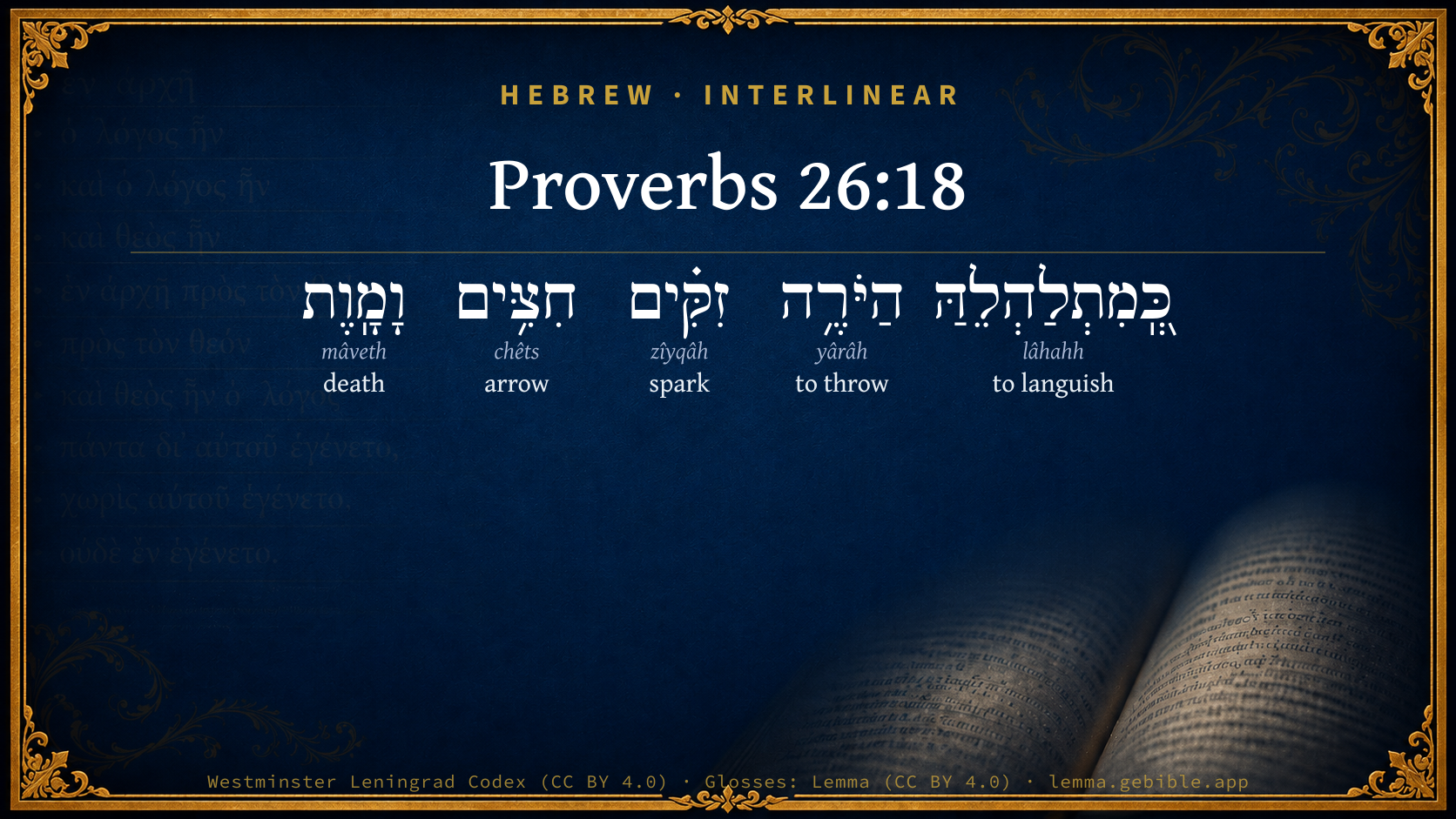
Hebrew (Westminster Leningrad Codex) Proverbs 26:18 appears in the Hebrew Old Testament. The text above is from the Westminster Leningrad Codex. Each word links to its Strong’s number, a concise gloss, and parsing drawn from the Open Scriptures Hebrew Bible morphology. Click any word for its full Brown-Driver-Briggs (BDB) entry.
Download image
Cite this verse

Proverbs 26:18 (World English Bible). Public Domain. Lemma interlinear Bible study tool, https://lemma.gebible.app/v/proverbs/26/18.

Show BibTeX & RIS
BibTeX
RIS
English Translation
Like a madman who shoots firebrands, arrows, and death,
World English Bible · Public Domain
Download a study sheet

One document with this verse’s original text, its word-by-word gloss line, the meaning frame, cross-references with their text, attributed commentary, and full source and license credits — printable, and it pastes into notes with its structure intact.

This verse Autodidact and up

Study sheet (.html) Plain text (.txt)

A passage Seminary Student

Up to 50 verses in one chapter. A passage sheet keeps up to 6 commentary sources and 12 cross-references per verse, in the order this page ranks them, and says so on the sheet whenever that leaves anything out. Ask for a single verse and you get the Autodidact verse sheet above.

Everything on this page stays free to read, with no account — the sheet is a download of what is already on screen, not access to it.

Want to remove ads? Support Godless Engineer
Compare translations 3

The same verse in 3 English versions, stacked beneath the original-language interlinear above. Click any original word for its lexicon entry.

Each is an independent rendering of the whole verse — the interlinear is not word-aligned to these translations.

Highlighted words mark where these versions differ — a whole-verse word diff, not a word-by-word alignment.

  • World English Bible Public Domain
    Like a madman who shoots firebrands, arrows, and death,
  • King James Version Public Domain
    As a mad man who casteth firebrands, arrows, and death,
  • unfoldingWord Literal Text CC BY-SA 4.0
    Like an insane shooting firebrands, arrows, and death,

unfoldingWord Literal Text — © unfoldingWord, licensed CC BY-SA 4.0. Word-aligned USFM3 via Door43 (git.door43.org/unfoldingWord/en_ult).

Versions to compare (up to 4)

3 of 4 selected

Show all 18 translations

Every available English version of this verse, each an independent rendering of the whole verse.

  • World English Bible Public Domain
    Like a madman who shoots firebrands, arrows, and death,
  • Berean Standard Bible Public Domain
    Like a madman shooting firebrands and deadly arrows,
  • Majority Standard Bible Public Domain
    Like a madman shooting firebrands and deadly arrows,
  • King James Version Public Domain
    As a mad man who casteth firebrands, arrows, and death,
  • American Standard Version (1901) Public Domain
    As a madman who casteth firebrands, Arrows, and death,
  • Revised Version (1885) Public Domain
    As a madman who casteth firebrands, arrows, and death;
  • Geneva Bible (1599) Public Domain
    As he that faineth himselfe mad, casteth fire brands, arrowes, and mortall things,
  • Douay-Rheims (1899) Public Domain
    As he is guilty that shooteth arrows, and lances unto death:
  • Young's Literal Translation Public Domain
    As `one' pretending to be feeble, Who is casting sparks, arrows, and death,
  • Literal Standard Version CC BY-SA 4.0
    As [one] pretending to be feeble, || Who is casting sparks, arrows, and death,
  • Unlocked Literal Bible CC BY-SA 4.0
    Like a madman who shoots burning arrows,
  • unfoldingWord Literal Text CC BY-SA 4.0
    Like an insane shooting firebrands, arrows, and death,
  • Darby Bible Public Domain
    As a madman who casteth firebrands, arrows, and death,
  • World Messianic Bible Public Domain
    Like a madman who shoots torches, arrows, and death,
  • Webster's Bible Public Domain
    As a mad man who casteth fire-brands, arrows, and death,
  • Free Bible Version CC BY-SA 4.0
    You're like a crazy person firing off blazing arrows and killing people
  • Bible in Basic English Public Domain
    As one who is off his head sends about flaming sticks and arrows of death,
  • JPS Tanakh (1917) Public Domain
    As a madman who casteth firebrands, arrows, and death;

Literal Standard Version (2020), Covenant Press — licensed CC BY-SA 4.0. Text via the HelloAO Bible API (eBible.org). Unlocked Literal Bible (unfoldingWord) — licensed CC BY-SA 4.0. Text via the HelloAO Bible API (eBible.org). unfoldingWord Literal Text — © unfoldingWord, licensed CC BY-SA 4.0. Word-aligned USFM3 via Door43 (git.door43.org/unfoldingWord/en_ult). Free Bible Version, Dr. Jonathan Gallagher — licensed CC BY-SA 4.0. Text via the HelloAO Bible API (eBible.org).

Word by word

More ways to search: Search by grammar → Find every occurrence → Compare this word →

Practice this passage: Drill this verse → Learn its vocabulary →

About this verse

These counts appear in no published source. They are computed here, from the morphology-tagged text and Lemma’s own curated glosses. What Lemma adds →

5
words
5
distinct lemmas
Wisdom
section

Notable vocabulary

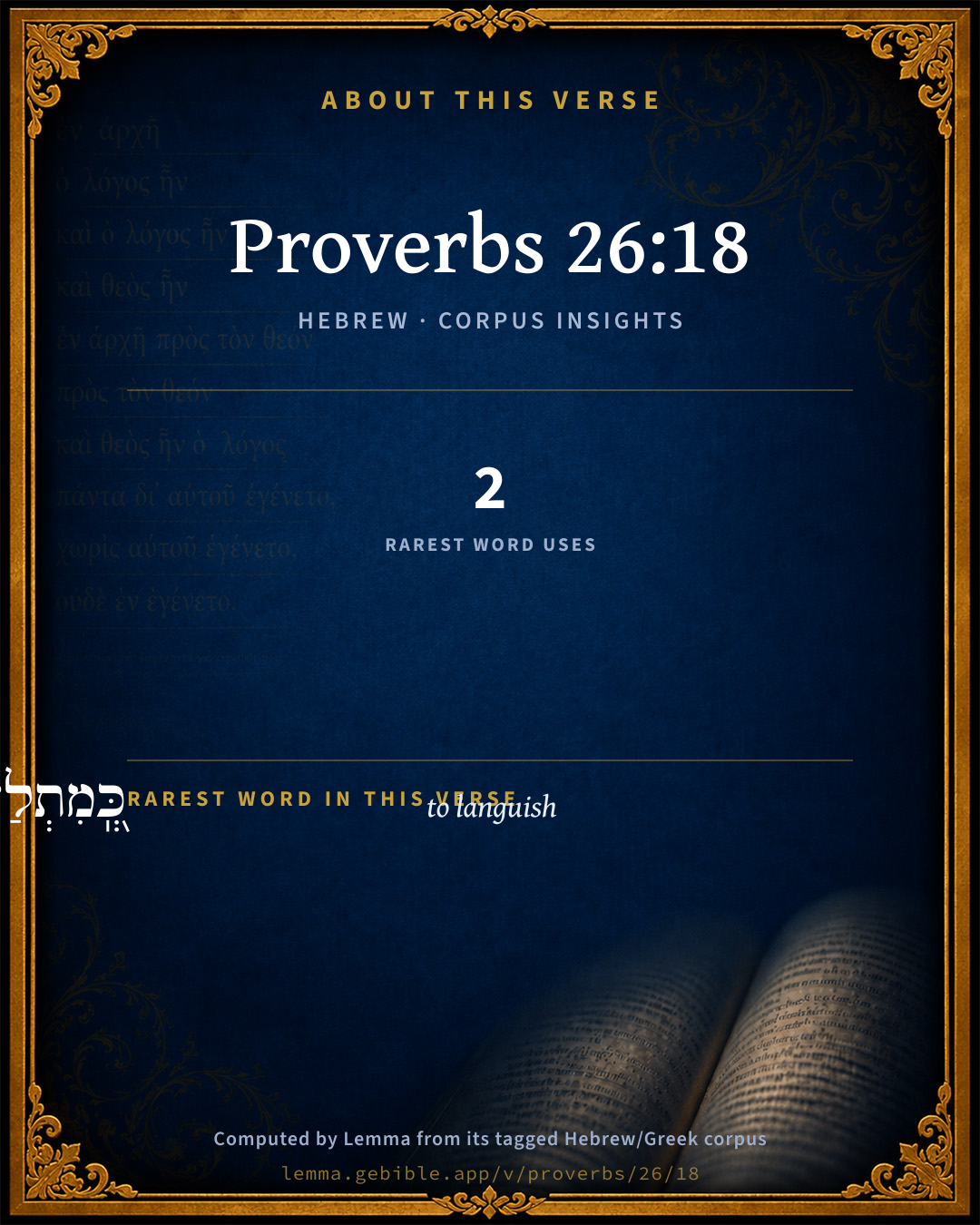
The rarest word here is כְּֽ֭מִתְלַהְלֵהַּ to languish H3856 — appearing just 2 times in the whole Hebrew Bible.

Shared distinctive vocabulary

כְּֽ֭מִתְלַהְלֵהַּ to languish H3856 occurs in 2 verses of the Hebrew Bible. Also found in:

Grammatical profile

  • 2 verbs
  • 3 nouns

Verb forms

  • כְּֽ֭מִתְלַהְלֵהַּ Hithpalpel · Participle Active
  • הַיֹּרֶ֥ה Qal · Participle Active

Hebrew & Septuagint length

In English translation the verse runs 9 words from the Hebrew and 23 from the Septuagint (LXX English) — the Septuagint runs noticeably longer here. See the side-by-side →

A rough comparison of the two English renderings, which tokenize alike — not a word-level alignment.

Word counts can differ between the Hebrew and the Greek without any difference in meaning — e.g. the Hebrew direct-object marker אֵת has no separate Greek word, and Greek often adds the article ὁ.

Cross-references

4

Topical passages linked to Proverbs 26:18 in the Treasury of Scripture Knowledge — connected by theme and wording, ordered by reader-vote popularity; previews shown in the World English Bible.

  • Proverbs 25:18 A man who gives false testimony against his neighbor Is like a club, a sword, or a sharp arrow.
  • Isaiah 50:11 Behold, all you who kindle a fire, who gird yourselves about with firebrands; walk you in the flame of your fire, and among the brands that you have kindled. This shall you have of my hand; you shall lie down in sorrow.
  • Proverbs 7:23 Until an arrow strikes through his liver, As a bird hurries to the snare, And doesn't know that it will cost his life.
  • Genesis 49:23 The archers have sorely grieved him, Shot at him, and persecute him:

Cross-references courtesy of OpenBible.info (CC BY 4.0).

Hebrew and Greek witnesses Masoretic Hebrew ↔ Greek Septuagint

The same verse in the two great witnesses to the Old Testament, shown verse-for-verse.

Here the Septuagint runs noticeably longer than the Hebrew — LXX2012 (modern English Septuagint) 23 words vs World English Bible 9. A rough length comparison of the two English translations, not a word-level alignment — read both below.

These are two independent witnesses, not word-aligned to each other, and the Septuagint is shown in lemma (dictionary) form.

Hebrew Proverbs 26:18 Masoretic · Westminster Leningrad Codex

כְּֽ֭מִתְלַהְלֵהַּ הַיֹּרֶ֥ה זִקִּ֗ים חִצִּ֥ים וָמָֽוֶת

Like a madman who shoots firebrands, arrows, and death,

World English Bible · Public Domain

Greek LXX Proverbs 26:18 Septuagint · lemma form

ὥσπερ ὁ ἰάομαι προβάλλω λόγος εἰς ἄνθρωπος ὁ δέ ἀποἀντάω ὁ λόγος πρῶτος ὑποσκελίζω

As those who need correction put forth fair words to men, and he that first falls in with the proposal will be overthrown;

LXX2012 (modern English Septuagint) · Public Domain

On this verse, The Pulpit Commentary discusses the Septuagint’s reading. Read the note in Commentary ↓

Hebrew: Westminster Leningrad Codex (CC BY 4.0). Greek: Septuagint (public domain); English from LXX2012 (modern English Septuagint) (Public Domain). How the Septuagint differs from the Hebrew →

Commentary

Notes on Proverbs 26:18 from classic Christian and Jewish commentators (each source and its license shown beneath its notes). The classic Christian expositions comment on the surrounding passage and are grouped to its opening verse, so a note may address several verses; the Jewish commentaries on the Tanakh (Rashi and others) are per-verse, so they appear only where the commentator wrote on this verse.

Lemma curates 59 commentaries, every one of them public domain or Creative Commons licensed, each selected and text-cleaned for this edition rather than reprinted as found. About our sources →

Joseph Benson's Commentary

Pro 26:18-19. As a madman — Hebrew, כמתלהלה, as one that makes, or feigns himself mad, in order that, under that pretence, he may do mischief with impunity; casteth firebrands, arrows, and death — Any instruments of death and destruction against his neighbour’s person, house, or goods; so is the man that deceiveth his neighbour — That wrongs him under a false pretence of kindness and familiarity; and saith, Am I not in sport? — And then asks his neighbour why he resents it so heinously, saying he was only in jest: and intended merely to try how he would take it.

Joseph Benson's Commentary on the Old and New Testaments (1811–1818) — public domain. Text from a community e-Sword module.

Whedon's Commentary on the Bible

Daniel D. Whedon

18, 19. As a mad man — According to some, one who feigns himself mad. The form of the word suggests this, but it is hardly sustained by the use. “Like a silly jester.” — Stuart and Bertheau. Death is used tropically for a deadly weapon. The Geneva Bible translates Pro_26:18 : “As he that feigneth himself mad casteth fyre brandes, arrowes, and mortal things.”

Deceiveth — Better, throweth down. “Deceiveth” is a secondary meaning.

The primary — “that throws his neighbour down and says, ‘It was only a joke’” — is better here. Compare Pro_25:18. The throwing down, however, is metaphorical, and implies injury — cheating him.

Daniel D. Whedon (gen. ed.), Commentary on the Old and New Testaments (1874–1909) — public domain. Text from a community e-Sword module.

Tyndale Open Study Notes

Tyndale Open Resources

26:18-19 Lies are extremely dangerous because they lead people to act on false information. Liars cannot cover up later by claiming that they were only joking (see 6:16-19; 14:5, 25; 25:18).

Tyndale Open Study Notes — © Tyndale Open Resources, licensed CC BY-SA 4.0. Text via the HelloAO Bible API.

Matthew Henry's Commentary

See here, 1. How mischievous those are that make no scruple of deceiving their neighbours; they are as madmen that cast firebrands, arrows, and death, so much hurt may they do by their deceits. They value themselves upon it as polite cunning men, but really they are as madmen. There is not a greater madness in the world than a wilful sin. It is not only the passionate furious man, but the malicious deceitful man, that is a madman; he does in effect cast fire-brands, arrows, and death; he does more mischief than he can imagine. Fraud and falsehood burn like fire-brands, kill, even at a distance, like arrows. 2. See how frivolous the excuse is which men commonly make for the mischief they do, that they did it in a jest; with this they think to turn it off when they are reproved for it, Am not I in sport? But it will prove dangerous playing with fire and jesting with edge-tools. Not that those are to be commended who are captious, and can take no jest (those that themselves are wise must suffer fools, Co2 11:19, Co2 11:20), but those are certainly to be condemned who are any way abusive to their neighbours, impose upon their credulity, cheat them in their bargains with them, tell lies to them or tell lies of them, give them ill language, or sully their reputation, and then think to excuse it by saying that they did but jest. Am not I in sport? He that sins in just must repent in earnest, or his sin will be his ruin. Truth is too valuable a thing to be sold for a jest, and so is the reputation of our neighbour. By lying and slandering in jest men learn themselves, and teach others, to lie and slander in earnest; and a false report, raised in mirth, may be spread in malice; besides, if a man may tell a lie to make himself merry, why not to make himself rich, and so truth quite perishes, and men teach their tongues to tell lies, Jer 9:5. If men would consider that a lie comes from the devil, and brings to hell-fire, surely that would spoil the sport of it; it is casting arrows and death to themselves.

Matthew Henry's Commentary on the Whole Bible (1708–1710) — public domain (CC PDM 1.0). Text via the HelloAO Bible API.

Jamieson, Fausset & Brown

Robert Jamieson, A. R. Fausset & David Brown

Such are reckless of results.

Jamieson, Fausset & Brown — Commentary Critical and Explanatory on the Whole Bible (1871) — public domain (CC PDM 1.0). Text via the HelloAO Bible API.

Ellicott's Commentary for English Readers

(18) Firebrands.—Arrows to which some blazing material was attached, in order that they might set on fire whatever they touched.

A Bible Commentary for English Readers, edited by Charles John Ellicott (1878–1897) — public domain. Text from a community e-Sword module.

John Gill's Exposition

As a mad man, who casteth firebrands, arrows, and death. Or the instruments of death, as Aben Ezra; or the sharp arrows of death, as the Targum and Syriac version; who casts firebrands into the houses and barns of his neighbours, to consume them; or arrows at their persons and cattle, to destroy them; or any other instruments of death, which none but a mad man, or one wickedly mad, would do. Or, "as one that makes himself mad" (e); that feigns himself mad, and, under colour of this, does mischief to his neighbour's person and property: or, "as one that hides himself" (f); that casts firebrands, arrows, and other deadly things, in a private way, so as not to be seen, and that it may not be known from whence they come: or, "as one that wearies himself" (g), so Jarchi; in doing mischief in such a way. The word in the Arabic language signifies to play and be in sport; and so it means one that does these things in sport, as it is a sport to a fool to do mischief; which sense agrees with what follows.

(e) "ut se habet qui iunsanum ne simulat", Piscator; "ut qui se insanire fingit", Cocceius. (f) "Sicut abscondit se", Pagninus, Mercerus, Gejerus. (g) "Ut sese fatigat", Tigurine version.

John Gill's Exposition of the Whole Bible (1746–1763) — public domain (CC PDM 1.0). Text via the HelloAO Bible API.

Albert Barnes' Notes on the Bible

The teacher cuts off the plea which people make when they have hurt their neighbor by lies, that they “did not mean mischief,” that they were “only in fun.” Such jesting is like that of the madman flinging firebrands or arrows.

Albert Barnes' Notes on the Bible (1834–1885) — public domain. Text from a community e-Sword/MySword module.

Matthew Poole's English Annotations

As a madman, as one that feigneth himself mad, that under that pretence he may do mischief with impunity,

who casteth fire-brands, to hurt his neighbour’s person, or to consume his house or goods.

Death; any instruments of death.

Matthew Poole's English Annotations on the Holy Bible (1683–1685) — public domain. Text from a community e-Sword/MySword module.

The Pulpit Commentary

Vers. 18, 19 A tetrastich, but without parallelisms. As a mad man who casteth firebrands, arrows, and death. The word rendered "madman" is an apax legomenon , and has been variously explained; but the Authorized Version is probably correct. "Firebrands" are darts with some blazing material attached to them. "Death "forms a climax with the other dangers mentioned, which the madman deals forth recklessly and indiscriminately.

So is the man that deceiveth his neighbour, and saith, Am not I in sport? When a man has injured his neighbour by lies or malice, the plea that he was only in joke is not allowed; the injury is not less real because he excuses it by alleging it was done not seriously, but playfully; no more than the fatal effects of the use of murderous weapons are lessened by their being employed by the hands of a maniac. Practical joking is often a most serious matter. A mediaeval adage says wisely"Cum jocus est verus, jocus est malus atque severus,

Septuagint, "Even as those who are under medical treatment (iwmenoi ) throw words at men, and he who first meets the word will be overthrown; so are all they that lay wait for their own friends, and when they are seen, say, I did it in jest." As insane persons who abuse and ill treat their physicians are excused by reason of their infirmity, so those who injure friends in secret try to excuse themselves when found out by alleging that they were only joking.

Vers. 18, 19. The condemnation of sin.

We have here, in a few strong sentences, a most forcible presentation of the evil and the guiltiness of wrong doing. We see

I ITS UGLIEST FEATURE DECEPTION. "The man that deceiveth his neighbour" is not here simply the man who overreaches his customer or who introduces a low cunning into his business; he is rather the man who deliberately misleads his acquaintance, his "friend," and induces him to do that which is unwise and unworthy. He is the man who knows better himself, but who indoctrinates the inexperienced and the unwary with the principles, or rather the vain imaginations, of folly. He stoops so low that he does not hesitate:

1. To recommend forbidden pleasure as an object worthy of pursuit, though he knows well (or ought to know, if he can learn from experience) that guilty gratification is the very costliest thing that any man can buy.

2. To persuade men that an unprincipled life is a profitable life, as if "a man"s life consisted in the abundance of the things which he possessed;" as if a life without integrity were not the most utter add miserable failure.

3. To recommend selfishness and indulgence as a condition of liberty, when in fact it is the beginning and is sure to end in the most humiliating bondage.

4. To represent the service of God and of man as a drudgery and a dreariness, when in truth it is the height of human nobility and the very essence of enjoyment.

5. To prevail upon the young to snatch at honour arid success instead of honestly labouring and patiently waiting for it. There is no more painful and repulsive thing under heaven than the sight of experience and maturity breathing its fallacies, its sophisms, its delusions, into the ear of inexperience and innocency.

II ITS BITTER FRUIT. What do these delusions bring forth? The deceiver is a man who "scatters firebrands, arrows, and death." The ultimate consequences of the "deceitfulness of sin" are sad indeed; they are:

1. Impoverishment in circumstance.

2. The loss of the love and the honour of the wise and good.

3. Remorse of soul and, frequently, if not usually, the departure of self-respect.

4. Hopelessness and death.

5. The extension of the evil which has been imbibed to those around; becoming a source of poisonous error, a fountain of evil and wrong and misery.

III ITS PRACTICAL INSANITY. The fool who does wantonly scatter the seeds of deadly delusions in the minds of men is "as a madman." There is no small measure of insanity in sin. Sin is a spiritual disease; it is our spiritual nature in a state of complete derangement, our mind filled with false ideas, our heart affected with delusive hopes and fears. There is no soundness, no wholeness or health about us, so far as we are under the dominion of sin. We do things which we could not possibly have done if only reason and rectitude held sway within us.

IV ITS POOR AND PITIFUL APOLOGY. "He saith, Am not I in sport?" When a man deludes and betrays, when he wrongs and ruins a human soul, and then makes a joke of it, he only adds meanness to his transgression. Who, outside the bottomless pit, can see any fun in a blighted life, in a wounded and bleeding spirit, in a soiled and stained soul, in the ruin of reputation, in the blasting of a noble hope, in the shadow of spiritual death? Human life and character and destiny are infinitely serious things; they are not to be the butt of fools. C.

The Pulpit Commentary (1880–1919), ed. H.D.M. Spence-Jones & Joseph S. Exell — public domain. Text from a community e-Sword module.

John Wesley's Explanatory Notes

And death - Any instruments of death.

John Wesley, Explanatory Notes Upon the Whole Bible (1754–1765) — public domain. Text via the GEBible commentary corpus.

Keil & Delitzsch

C. F. Keil & F. Delitzsch

These verses form a tetrastich:

18 As a man who casteth brands,

And arrows, and death;

19 So is the man who deceiveth his neighbour,

And saith: I only make sport.

The old translations of מתלהלה are very diverse. Aquila has rendered it by κακοηθιζόμενος; Symmachus: πειρώμενοι; the Syr.: the vainglorious; the Targ.: מתּחת (from נחת), a successor (spiritually); Jerome: noxius (injurious; for which Luther: secret). There is thus no traditional translation. Kimchi explains the word by השׁתגע (Venet. ἐξεστώς); Aben Ezra by השׁתטה (from שׂטה), to behave thoughtlessly, foolishly; but both erroneously, confounding with it ותּלהּ, Gen 47:13, which is formed from להה and not from לההּ, and is related to לאה, according to which מתלהלה would designate him who exerts himself (Rashi, המתיגע), or who is worn out (Saadia: who does not know what to do, and in weariness passes his time). The root לההּ (להּ), whence the reflex form התלהלהּ, like התמהמהּ, from מההּ, מהּ) leads to another primary idea. The root להּ presents in (Arab.) âliha (vid., Fleischer in the Comm. zur Genesis, p. 57), waliha, and taliha, formed from the 8th form of this verb (aittalah), the fundamental meaning of internal and external unrest; these verbs are used of the effect of fear (shrinking back from fear), and, generally, the want of self-command; the Syr. otlahlah, to be terrified, obstupescere, confirms this primary conception, connecting itself with the R. להּ. Accordingly, he who shoots every possible death-bringing arrow, is thought of as one who is beside himself, one who is of confused mind, in which sense the passive forms of (Arab.) âlah and talah are actually used. Schultens' reference to (Arab.) lâh micare, according to which כמתלהלה must mean sicut ludicram micationem exercens (Bttcher: one who exerts himself; Malbim: one who scoffs, from התל), is to be rejected, because מתלהלה must be the direct opposite of משׂחק; and Ewald's comparison of (Arab.) wâh and akhkh, to be entangled, distorted, lâh, to be veiled, confounds together heterogeneous words. Regarding זקּים (from זנק), burning arrows, vid., under Isa 50:11. Death stands third, not as comprehensive (that which is deadly of every kind), but as a climax (yea, even death itself). The כּן of the principal sentence, correlate to כּ of the contiguous clause, has the Makkeph in our editions; but the laws of the metrical Makkeph require כּן אישׁ (with Munach), as it occurs e.g., in Cod. 1294. A man who gives vent to his malice against his neighbour, and then says: seest thou not that... (הלא, like Arab. âlâ), i.e., I am only jesting, I have only a joke with thee: he exhibits himself as being mad, who in blind rage scatters about him deadly arrows.

Keil & Delitzsch — Biblical Commentary on the Old Testament (1861–1891) — public domain (CC PDM 1.0). Text via the HelloAO Bible API. (Old Testament only.)

Bridges on Proverbs

Charles Bridges

How little does the thoughtless man consider the misery, which his wantonness occasions to others! He bears no malice. He indulges only the pure love of mischief. He carries on a scheme of imposition as harmless play. His companions compliment him upon his adroitness, and join in the laugh of triumph over the victim of his cruel jest. But "sporting with their own deceivings" (2Pe 2:13 ) is a black mark of ungodliness. What the man calls sport (Pro 10:23 ), is the madman, scattering murderous mischief — firebrands, arrows and death. What are smoothly called ’practical jokes’ — such as are practiced at school, or even at college — come under this awful charge. ’There is little difference in this case betwixt fraud and fury. He that purposely deceives his neighbor, under color of a jest, is no less prejudicial to him than a lunatic, that doth wrong out of frenzy and distemper.’†1 Yet this solemn line of distinction is drawn. The madman is irresponsible for his actions; the deceiver is accountable to God and his fellow-creatures. ’He that sins in jest, must repent in earnest; or his sin will be his ruin.’†2

’What hath a Christian’ — saith Bernard — ’to do with jesting?’ Let him practically observe the wholesome caution against it, as "not convenient." (Eph 5:4 .) Let him cultivate the valuable graces of seriousness, consideration, and self-discipline. Let him study his Master’s image, embodying both the spirit and the rules of his gospel.

Footnotes:

†1 Bp. Hall.

†2 Henry.

Charles Bridges, An Exposition of the Book of Proverbs (1846) — public domain. Text from a community e-Sword module.

unfoldingWord translationNotes

Door43 World Missions Community

Like a madman ... is the one who deceives ... telling a joke?"

Both the madman and the deceiver hurt people but do not take responsibility for it.

Was I not telling a joke?

The deceiver uses this question to imply that since he his joke was only for fun, he should not be blamed for any harm he has caused. AT: "I was only telling a joke." or "Do not blame me. I was only telling a joke." (See: Rhetorical Question and Assumed Knowledge and Implicit Information)

translationWords

bow and arrow

deceive

neighbor

unfoldingWord translationNotes — © Distant Shores Media and the Door43 World Missions Community, licensed CC BY-SA 4.0. Source: git.door43.org/Door43/en_tn.

Rashi

Rabbi Shlomo Yitzchaki (Rashi)

Like one who wearies himself Like one who wearies himself shooting sparks of fire, as in (Isa. 50: 11): “and in the flames (ובזיקות) you have kindled”; from the expression זיקוקים דינור (Ber. 58b), flames of fire. Another explanation. זקים, frondeles in Old French, slings, from an expression of slingstones (Zech. 9:15), and so in the Talmud (Baba Mezia 94a) זיקתא פסוק לן, “slingers are assigned to us.” He shoots arrows and death.

Rashi on the Tanakh — English translations: “The Judaica Press complete Tanach with Rashi, translated by A. J. Rosenberg” (CC BY 4.0); “Pentateuch with Rashi's commentary by M. Rosenbaum and A.M. Silbermann, 1929-1934” (public domain); “The Metsudah Tanach series, Lakewood, N.J” (CC BY 4.0); and “The Book of Joshua, Metsudah Publications, 1997” (CC BY 4.0). Text via Sefaria.

Lesson kit

Teaching starters — assembled from the data on this page, not authored interpretation. Every prompt links to the verse data it draws on. Edit before teaching.

Proverbs, in the Wisdom, opens this verse with 5 words (5 distinct Hebrew lemmas). Its most distinctive word is lâhahh (“to languish”). The Greek Septuagint runs longer here. A historical commentator’s framing appears above. Read the whole chapter for the surrounding context.

Discussion questions

  1. The word lâhahh carries the sense “to languish.” How does it shape the verse?
  2. Genesis 47:13 shares the word «to languish» with this verse. How do the two illuminate each other?
  3. Compared with the Hebrew, the Septuagint runs longer here. What questions does that raise?
  4. These translations render this verse differently; the difference is in the English rendering, not the original. What questions does that raise?
  5. The verb «כְּֽ֭מִתְלַהְלֵהַּ» is Hithpalpel Participle Active. How does its form color the action?
  6. Reading how Joseph Benson's Commentary and Whedon's Commentary on the Bible read this verse, where do the two commentators agree and where do they part?

Things to notice

Reading settings

Reading text

Shown beneath each verse's original-language words.

Old Testament
Old Testament edition

Read the OT as the Masoretic Hebrew (MT) or the Greek Septuagint (LXX).

English shown for the Greek Septuagint (in the Hebrew ↔ Greek comparison).

Comparing translations? Open the Compare panel on any verse page to stack up to four side by side.