
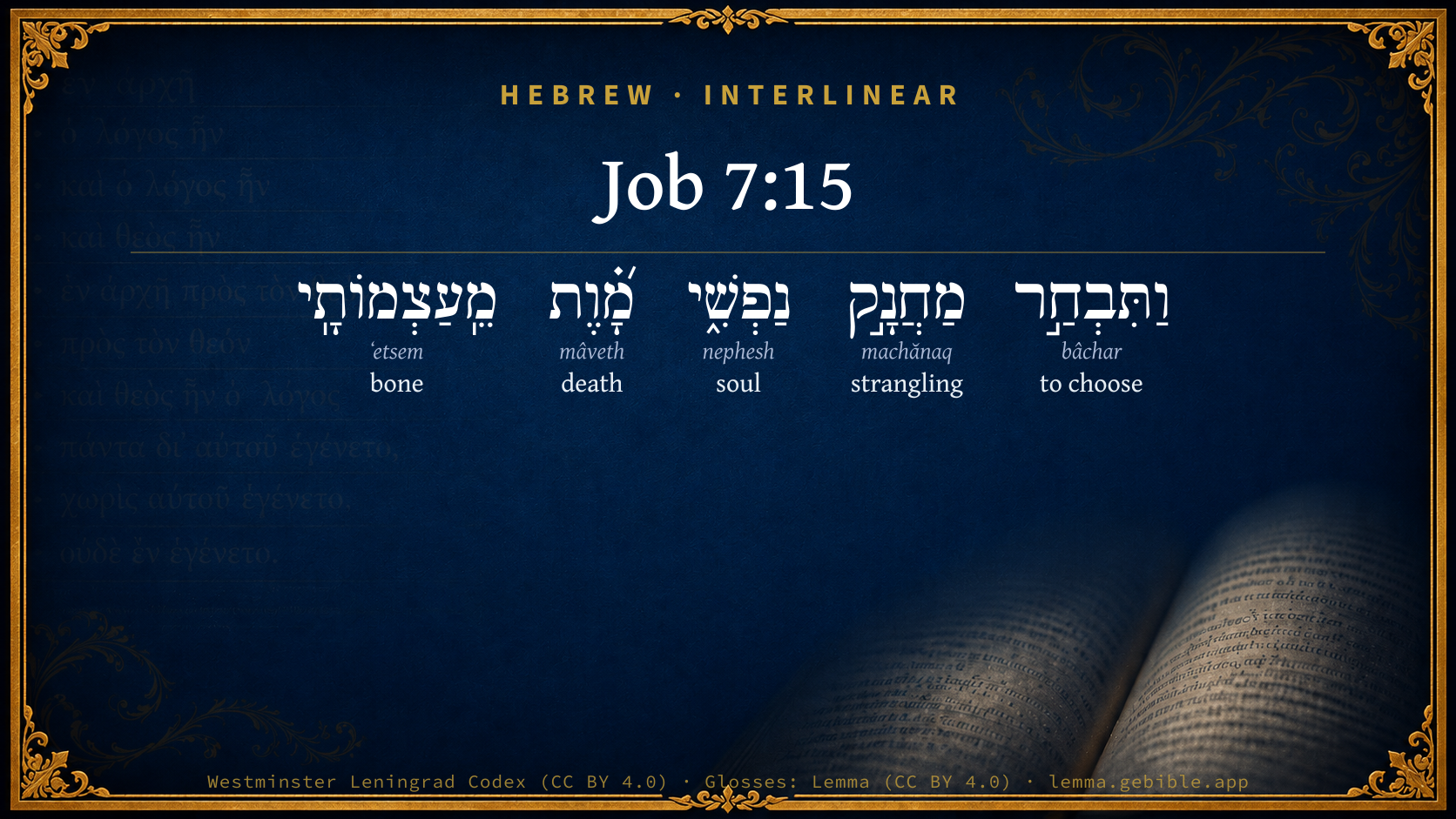
Job 7:15

Hebrew (Westminster Leningrad Codex) Job 7:15 appears in the Hebrew Old Testament. The text above is from the Westminster Leningrad Codex. Each word links to its Strong’s number, a concise gloss, and parsing drawn from the Open Scriptures Hebrew Bible morphology. Click any word for its full Brown-Driver-Briggs (BDB) entry.
Download image
Cite this verse

Job 7:15 (World English Bible). Public Domain. Lemma interlinear Bible study tool, https://lemma.gebible.app/v/job/7/15.

Show BibTeX & RIS
BibTeX
RIS
English Translation
So that my soul chooses strangling, Death rather than my bones.
World English Bible · Public Domain
Highlights
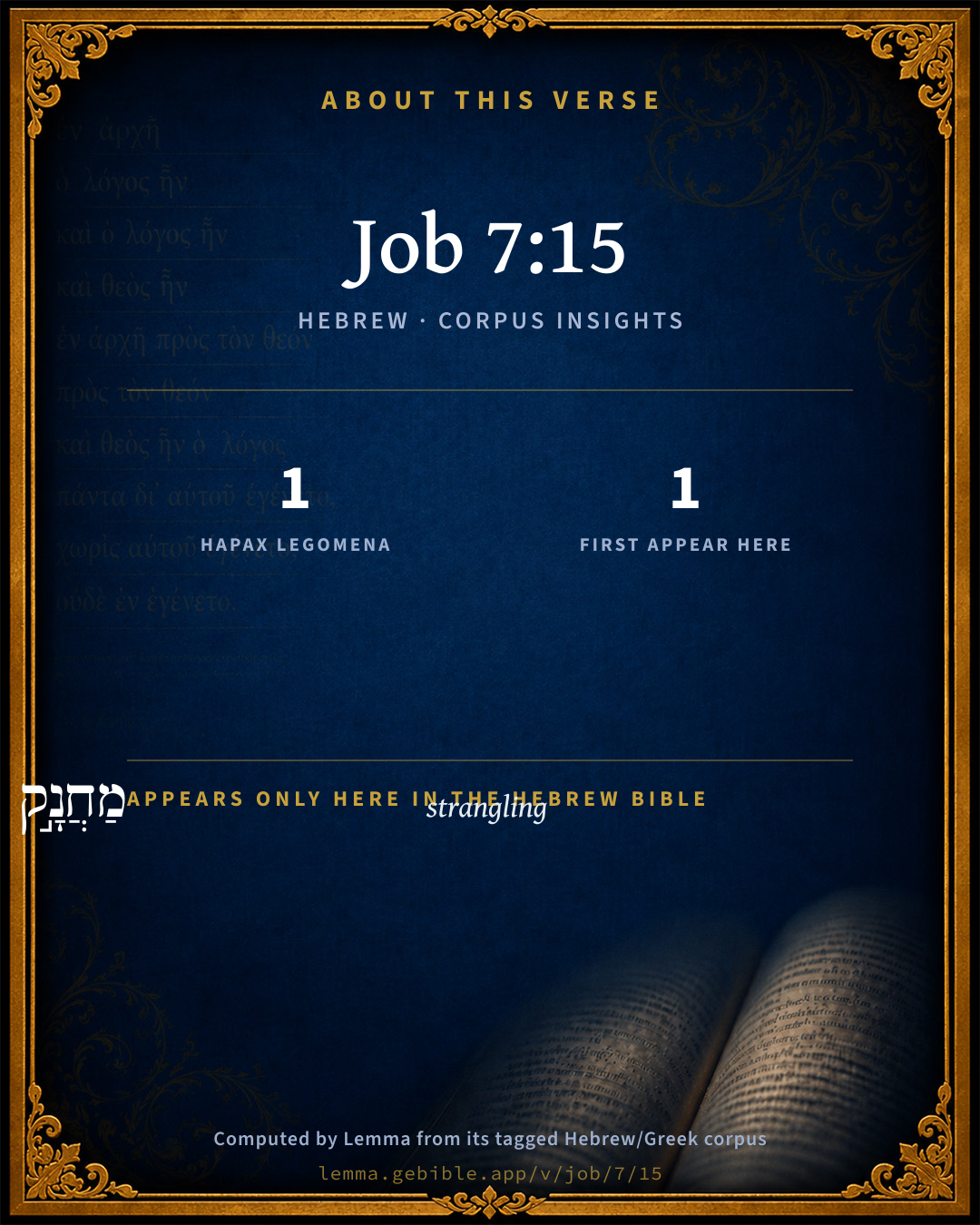
  • 1 hapax legomenon — only here in the Hebrew Bible
  • 1 first appearance in the Hebrew Bible
Full analysis ↓
Download a study sheet

One document with this verse’s original text, its word-by-word gloss line, the meaning frame, cross-references with their text, attributed commentary, and full source and license credits — printable, and it pastes into notes with its structure intact.

This verse Autodidact and up

Study sheet (.html) Plain text (.txt)

A passage Seminary Student

Up to 50 verses in one chapter. A passage sheet keeps up to 6 commentary sources and 12 cross-references per verse, in the order this page ranks them, and says so on the sheet whenever that leaves anything out. Ask for a single verse and you get the Autodidact verse sheet above.

Everything on this page stays free to read, with no account — the sheet is a download of what is already on screen, not access to it.

Want to remove ads? Support Godless Engineer
Compare translations 3

The same verse in 3 English versions, stacked beneath the original-language interlinear above. Click any original word for its lexicon entry.

Each is an independent rendering of the whole verse — the interlinear is not word-aligned to these translations.

Highlighted words mark where these versions differ — a whole-verse word diff, not a word-by-word alignment.

  • World English Bible Public Domain
    So that my soul chooses strangling, Death rather than my bones.
  • King James Version Public Domain
    So that my soul chooseth strangling, and death rather than my life.
  • unfoldingWord Literal Text CC BY-SA 4.0
    and my soul chooses strangling, death, rather than my bones.

unfoldingWord Literal Text — © unfoldingWord, licensed CC BY-SA 4.0. Word-aligned USFM3 via Door43 (git.door43.org/unfoldingWord/en_ult).

Versions to compare (up to 4)

3 of 4 selected

Show all 18 translations

Every available English version of this verse, each an independent rendering of the whole verse.

  • World English Bible Public Domain
    So that my soul chooses strangling, Death rather than my bones.
  • Berean Standard Bible Public Domain
    so that I would prefer strangling and death over my life in this body.
  • Majority Standard Bible Public Domain
    so that I would prefer strangling and death over my life in this body.
  • King James Version Public Domain
    So that my soul chooseth strangling, and death rather than my life.
  • American Standard Version (1901) Public Domain
    So that my soul chooseth strangling, And death rather than `these' my bones.
  • Revised Version (1885) Public Domain
    So that my soul chooseth strangling, and death rather than these my bones.
  • Geneva Bible (1599) Public Domain
    Therefore my soule chuseth rather to be strangled and to die, then to be in my bones.
  • Douay-Rheims (1899) Public Domain
    So that my soul rather chooseth hanging, and my bones death.
  • Young's Literal Translation Public Domain
    And my soul chooseth strangling, Death rather than my bones.
  • Literal Standard Version CC BY-SA 4.0
    And my soul chooses strangling, || Death rather than my bones.
  • Unlocked Literal Bible CC BY-SA 4.0
    so that I would choose strangling and death rather than preserving these bones of mine.
  • unfoldingWord Literal Text CC BY-SA 4.0
    and my soul chooses strangling, death, rather than my bones.
  • Darby Bible Public Domain
    So that my soul chooseth strangling, death, rather than my bones.
  • World Messianic Bible Public Domain
    so that my soul chooses strangling, death rather than my bones.
  • Webster's Bible Public Domain
    So that my soul chooseth strangling, and death rather than my life.
  • Free Bible Version CC BY-SA 4.0
    that I would rather be strangled—I would rather die than become just a bag of bones.
  • Bible in Basic English Public Domain
    So that a hard death seems better to my soul than my pains.
  • JPS Tanakh (1917) Public Domain
    So that my soul chooseth strangling, and death rather than these my bones.

Literal Standard Version (2020), Covenant Press — licensed CC BY-SA 4.0. Text via the HelloAO Bible API (eBible.org). Unlocked Literal Bible (unfoldingWord) — licensed CC BY-SA 4.0. Text via the HelloAO Bible API (eBible.org). unfoldingWord Literal Text — © unfoldingWord, licensed CC BY-SA 4.0. Word-aligned USFM3 via Door43 (git.door43.org/unfoldingWord/en_ult). Free Bible Version, Dr. Jonathan Gallagher — licensed CC BY-SA 4.0. Text via the HelloAO Bible API (eBible.org).

Word by word

More ways to search: Search by grammar → Find every occurrence → Compare this word →

Practice this passage: Drill this verse → Learn its vocabulary →

About this verse

These counts appear in no published source. They are computed here, from the morphology-tagged text and Lemma’s own curated glosses. What Lemma adds →

5
words
5
distinct lemmas
Wisdom
section

Notable vocabulary

1 hapax legomenon — a word that appears only here in the entire Hebrew Bible:

  • מַחֲנָ֣ק strangling H4267

First appearance in Scripture

This word makes its first canonical appearance in the Hebrew Bible here:

  • מַחֲנָ֣ק strangling H4267

Grammatical profile

  • 1 verb
  • 4 nouns

Verb forms

  • וַתִּבְחַ֣ר Qal · Sequential Imperfect

Hebrew & Septuagint length

In English translation the verse runs 11 words from the Hebrew and 14 from the Septuagint (LXX English) — closely comparable.

A rough comparison of the two English renderings, which tokenize alike — not a word-level alignment.

Word counts can differ between the Hebrew and the Greek without any difference in meaning — e.g. the Hebrew direct-object marker אֵת has no separate Greek word, and Greek often adds the article ὁ.

Cross-references

2

Topical passages linked to Job 7:15 in the Treasury of Scripture Knowledge — connected by theme and wording, ordered by reader-vote popularity; previews shown in the World English Bible.

  • 2 Samuel 17:23 When Ahithophel saw that his counsel was not followed, he saddled his donkey, and arose, and got him home, to his city, and set his house in order, and hanged himself; and he died, and was buried in the tomb of his father.
  • Matthew 27:5 He threw down the pieces of silver in the sanctuary, and departed. He went away and hanged himself.

Cross-references courtesy of OpenBible.info (CC BY 4.0).

Hebrew and Greek witnesses Masoretic Hebrew ↔ Greek Septuagint

The same verse in the two great witnesses to the Old Testament, shown verse-for-verse.

These are two independent witnesses, not word-aligned to each other, and the Septuagint is shown in lemma (dictionary) form.

Hebrew Job 7:15 Masoretic · Westminster Leningrad Codex

וַתִּבְחַ֣ר מַחֲנָ֣ק נַפְשִׁ֑י מָ֝֗וֶת מֵֽעַצְמוֹתָֽי

So that my soul chooses strangling, Death rather than my bones.

World English Bible · Public Domain

Greek LXX Job 7:15 Septuagint · lemma form

ἀποἀλλάσσω ἀπό πνεῦμα ἐγώ ὁ ψυχή ἐγώ ἀπό δέ θάνατος ὁ ὀστέον ἐγώ

You will separate life from my spirit; and yet keep my bones from death.

LXX2012 (modern English Septuagint) · Public Domain

On this verse, Albert Barnes' Notes on the Bible discusses the Septuagint’s reading. Read the note in Commentary ↓

Hebrew: Westminster Leningrad Codex (CC BY 4.0). Greek: Septuagint (public domain); English from LXX2012 (modern English Septuagint) (Public Domain). How the Septuagint differs from the Hebrew →

Commentary

Notes on Job 7:15 from classic Christian and Jewish commentators (each source and its license shown beneath its notes). The classic Christian expositions comment on the surrounding passage and are grouped to its opening verse, so a note may address several verses; the Jewish commentaries on the Tanakh (Rashi and others) are per-verse, so they appear only where the commentator wrote on this verse.

Lemma curates 59 commentaries, every one of them public domain or Creative Commons licensed, each selected and text-cleaned for this edition rather than reprinted as found. About our sources →

Trapp's Complete Commentary

John Trapp

Job 7:15 So that my soul chooseth strangling, [and] death rather than my life.

Ver. 15. So that my soul chooseth strangling] i.e. Quamvis durissimam sed praesentissimam mortem, any violent or ignominious death, as long as it were a speedy death. Hippocrates telleth us, that many have been so frightened with dreams and apparitions, that they have hanged themselves, leaped into deep pits, or otherwise committed suicide. Let those that either have not been so terrified, or so tempted, or so deserted of God, bless him for that mercy.

And death rather than life] Heb. Rather than my bones; that is, any kind of death rather than such a body, which is now nothing else but a bag of bones; or than such rotten bones full of sores and ulcers. He maketh mention of his bones, because his pain had pierced as far as his very bones; the putrefaction had sunk down into his marrow.

John Trapp, A Commentary or Exposition upon All the Books of the Old and New Testament (1647–1656) — public domain. Text from a community e-Sword module.

Joseph Benson's Commentary

Job 7:15. So that my soul chooseth strangling — The most violent death, so it be but certain and sudden, rather than such a wretched life. Hebrews מעצמותי, megnatsmothai, rather than my bones — That is, than my body, the skin of which was everywhere broken, and the flesh almost consumed, so that little remained but bones.

Joseph Benson's Commentary on the Old and New Testaments (1811–1818) — public domain. Text from a community e-Sword module.

Geneva Bible (1599)

Geneva Bible translators

He speaketh as one overcome with sorrow, and not of judgment, or of the examination of his faith.

Geneva Bible (1599) marginal notes — public domain. Text via Bolls.life.

Jamieson, Fausset & Brown

Robert Jamieson, A. R. Fausset & David Brown

UMBREIT translates, "So that I could wish to strangle myself--dead by my own hands." He softens this idea of Job's harboring the thought of suicide, by representing it as entertained only in agonizing dreams, and immediately repudiated with horror in Job 7:16, "Yet that (self-strangling) I loathe." This is forcible and graphic. Perhaps the meaning is simply, "My soul chooses (even) strangling (or any violent death) rather than my life," literally, "my bones" (Psa 35:10); that is, rather than the wasted and diseased skeleton, left to him. In this view, "I loathe it" (Job 7:16) refers to his life.

Jamieson, Fausset & Brown — Commentary Critical and Explanatory on the Whole Bible (1871) — public domain (CC PDM 1.0). Text via the HelloAO Bible API.

Adam Clarke's Commentary

Verse 15. Chooseth strangling] It is very likely that he felt, in those interrupted and dismal slumbers, an oppression and difficulty of breathing something like the incubus or nightmare; and, distressing as this was, he would prefer death by this means to any longer life in such miseries.

Adam Clarke's Commentary on the Bible (1810–1826) — public domain. Text from a community e-Sword/MySword module.

Ellicott's Commentary for English Readers

(15) So that my soul maketh choice of strangling and death rather than a life like this. Literally, than these my bones, or, as some take it, a death by these my members: a death inflicted by myself, suicide.

A Bible Commentary for English Readers, edited by Charles John Ellicott (1878–1897) — public domain. Text from a community e-Sword module.

The Cambridge Bible for Schools and Colleges

gen. ed. J. J. S. Perowne

15. Consequence of the preceding, Job_7:14.

chooseth strangling] A sense of choking is one of the accompaniments of the disease, which is said to end sometimes in actual suffocation. Job refers to this symptom, saying that he is driven to desire that it might be really fatal. The parallel word death in the next clause shews that this is what he is driven to wish for, but he selects this form of death as one incidental to his disease, and one with which he had perhaps felt himself more than once threatened.

death rather than my life] lit. death rather than these my bones. So he describes the emaciated skeleton to which he was reduced.

The Cambridge Bible for Schools and Colleges (gen. ed. J. J. S. Perowne; Cambridge University Press, 1878–1918) — public domain. Text from a community e-Sword module.

John Gill's Exposition

So that my soul chooseth strangling,.... Not to strangle himself, as Ahithophel did, or to be strangled by others, this being a kind of death inflicted on capital offenders; but rather, as Mr. Broughton renders it, "to be choked to death" by any distemper and disease, as some are of a suffocating nature, as a catarrh, quinsy, &c. and kill in that way; and indeed death in whatsoever way is the stopping of a man's breath; and it was death that Job chose, let it be in what way it would, whether natural or violent; so weary was he of life through his sore and heavy afflictions:

and death rather than my life; or, "than my bones" (i); which are the more solid parts of the body, and the support of it, and are put for the whole and the life thereof; or than these bones of his, which were full of strong pain, and which had nothing but skin upon them, and that was broken and covered with worms, rottenness, and dust; the Vulgate Latin version renders it, "and my bones death"; that is, desired and chose death, being so full of pain, see Psa 35:10.

(i) "prae ossibus meis", Montanus, Tigurine version, Bolducius, Cocceius, Schmidt, Schultens; so Mercerus, Piscator, Michaelis.

John Gill's Exposition of the Whole Bible (1746–1763) — public domain (CC PDM 1.0). Text via the HelloAO Bible API.

Albert Barnes' Notes on the Bible

So that my soul - So that I; the soul being put for himself.

Chooseth strangling - Dr. Good renders it “suffocation,” and supposes that Job alludes to the oppression of breathing, produced by what is commonly called the night-mare, and that he means that he would prefer the sense of suffocation excited at such a time to the terrible images before his mind. Herder renders it, death. Jerome, suspendium. The Septuagint, “Thou separatest (ἀπαλλάξεις apallaceis) my life from my spirit, and my bones from death;” but what idea they attached to it, it is impossible now to tell. The Syriac renders it, “Thou choosest my soul from perdition, and my bones from death.” The word rendered strangling (מחנק machănaq) is from חנק chânaq, to be narrow, strait, close; and then means to strangle, to throttle, Nah 2:12; 2Sa 17:23. Here it means death; and Job designs to say that he would prefer even the most violent kind of death to the life that he was then leading. I see no evidence that the idea suggested by Dr. Good is to be found in the passage.

And death rather than my life - Margin, as in Hebrew, bones. There has been great variety in the exposition of this part of the verse. Herder renders it, “death rather than this frail body.” Rosenmuller and Noyes, “death rather than my bones;” that is, he preferred death to such an emaciated body as he then had, to the wasted skeleton which was then all that he had left to him. This is probably the true sense. Job was a sufferer in body and in soul. His flesh was wasting away, his body was covered with ulcers, and his mind was harassed with apprehensions. By day he had no peace, and at night he was terrified by alarming visions and spectres; and he preferred death in any form to such a condition.

Albert Barnes' Notes on the Bible (1834–1885) — public domain. Text from a community e-Sword/MySword module.

Haydock's Catholic Bible Commentary

Hanging. Protestants, "strangling and death, rather than my life," or Marginal note, "bones." (Haydock) --- Any species of Death would be preferable to this misery. (Calmet) --- Who would not entertain the same sentiments, if the fear of worse in the other world did not withhold him? But Job had reason to hope that his sorrows would end with his life. (Haydock) --- It is thought that he was dreadfully tempted to despair. (Calmet) --- Yet he resisted manfully, and overcame all attempts of the wicked one.

George Leo Haydock (1774–1849), Haydock's Catholic Family Bible and Commentary, 1859 edition — public domain. Excludes Psalms (Douay-Rheims chapter numbering differs from Protestant) and Deuterocanonical books (Catholic canon only).

Matthew Poole's English Annotations

Chooseth; not simply and in itself, but comparatively, rather than such a wretched life.

Strangling; the most violent, so it be but a certain and sudden death.

Rather than my life, Heb. than my bones, i.e. than my body, formerly the soul’s dear and desired companion; or than to be in the body, which commonly consists of skin, and flesh, and bones, but in Job was in a manner nothing but a bundle of boiles; for his skin was every where broken, and his flesh was quite consumed, as he oft complains, and his bones also were not free from pain and torment; for as Satan’s commission reached to Job’s bones, Job 2:5, so doubtless his malice and wicked design would engage him to execute it to the utmost.

Matthew Poole's English Annotations on the Holy Bible (1683–1685) — public domain. Text from a community e-Sword/MySword module.

Whedon's Commentary on the Bible

Daniel D. Whedon

15. Strangling — Difficulty of swallowing is one of the symptoms of elephantiasis, (Bridel,) and suffocation is its usual end. (Delitzsch.) It often becomes necessary to open the jugular vein to relieve the hoarseness and the tendency to suffocation. (Avicenna.)

Life — Literally, my bones. So emaciated was he that he calls his body but mere bones. Schlottmann and Umbreit render מן“than,” from, and read from my bones, and attribute to Job the thought of suicide. But there is no authority for using “bones” in the sense of hands. Umbreit’s admission “that the sufferer is represented as strangling himself in agonizing dreams,” is fatal to his theory. “There is fearful irony,” says Davidson, “in the comparison of this skeleton, impotent and helpless, his very weakness a terror to himself and his on-lookers, to the great heaven-assaulting ocean, lifting itself up in the consciousness of infinite power, or to some dragon of the prime, in which the whole energy of creation in its youth lay compressed.”

Daniel D. Whedon (gen. ed.), Commentary on the Old and New Testaments (1874–1909) — public domain. Text from a community e-Sword module.

The Pulpit Commentary

So that my soul chooseth strangling; i.e. "so that I would prefer strangling to such horrid dreams," which are worse than any physical sufferings. Some see here a reference to suicide: but this is s very forced explanation. Suicide, as already observed, seems never even to have occurred to the thoughts of Job. (see the comment on Job_6:8) And death rather than my life; literally, rather than my bones. Death, that is, would be preferable to such a life as he leads, which is that of a living skeleton.

The Pulpit Commentary (1880–1919), ed. H.D.M. Spence-Jones & Joseph S. Exell — public domain. Text from a community e-Sword module.

Rashi

Rabbi Shlomo Yitzchaki (Rashi)

death rather than these my bones I choose death rather than these limbs in my body.

Rashi on the Tanakh — English translations: “The Judaica Press complete Tanach with Rashi, translated by A. J. Rosenberg” (CC BY 4.0); “Pentateuch with Rashi's commentary by M. Rosenbaum and A.M. Silbermann, 1929-1934” (public domain); “The Metsudah Tanach series, Lakewood, N.J” (CC BY 4.0); and “The Book of Joshua, Metsudah Publications, 1997” (CC BY 4.0). Text via Sefaria.

Lesson kit

Teaching starters — assembled from the data on this page, not authored interpretation. Every prompt links to the verse data it draws on. Edit before teaching.

Job, in the Wisdom, opens this verse with 5 words (5 distinct Hebrew lemmas). Its most distinctive word is machănaq (“strangling”). A historical commentator’s framing appears above. Read the whole chapter for the surrounding context.

Discussion questions

  1. The word machănaq carries the sense “strangling.” How does it shape the verse?
  2. This verse holds 1 word here found nowhere else in the Hebrew Bible. What might the rare word draw attention to?
  3. The word “strangling” first appears here in Scripture. What is being introduced at this debut?
  4. 2 Samuel 17:23 shares this passage’s theme. How do the two illuminate each other?
  5. These translations render this verse differently; the difference is in the English rendering, not the original. What questions does that raise?
  6. The verb «וַתִּבְחַ֣ר» is Qal Sequential Imperfect. How does its form color the action?
  7. Reading how Trapp's Complete Commentary and Joseph Benson's Commentary read this verse, where do the two commentators agree and where do they part?

Things to notice

  • 1 word in this verse appears nowhere else in the Hebrew Bible.
  • 1 word makes its first canonical appearance in Scripture here.
  • These translations choose different wording for 4 words in this verse.
  • 5 distinct Hebrew lemmas span 5 words in this verse.

Reading settings

Reading text

Shown beneath each verse's original-language words.

Old Testament
Old Testament edition

Read the OT as the Masoretic Hebrew (MT) or the Greek Septuagint (LXX).

English shown for the Greek Septuagint (in the Hebrew ↔ Greek comparison).

Comparing translations? Open the Compare panel on any verse page to stack up to four side by side.