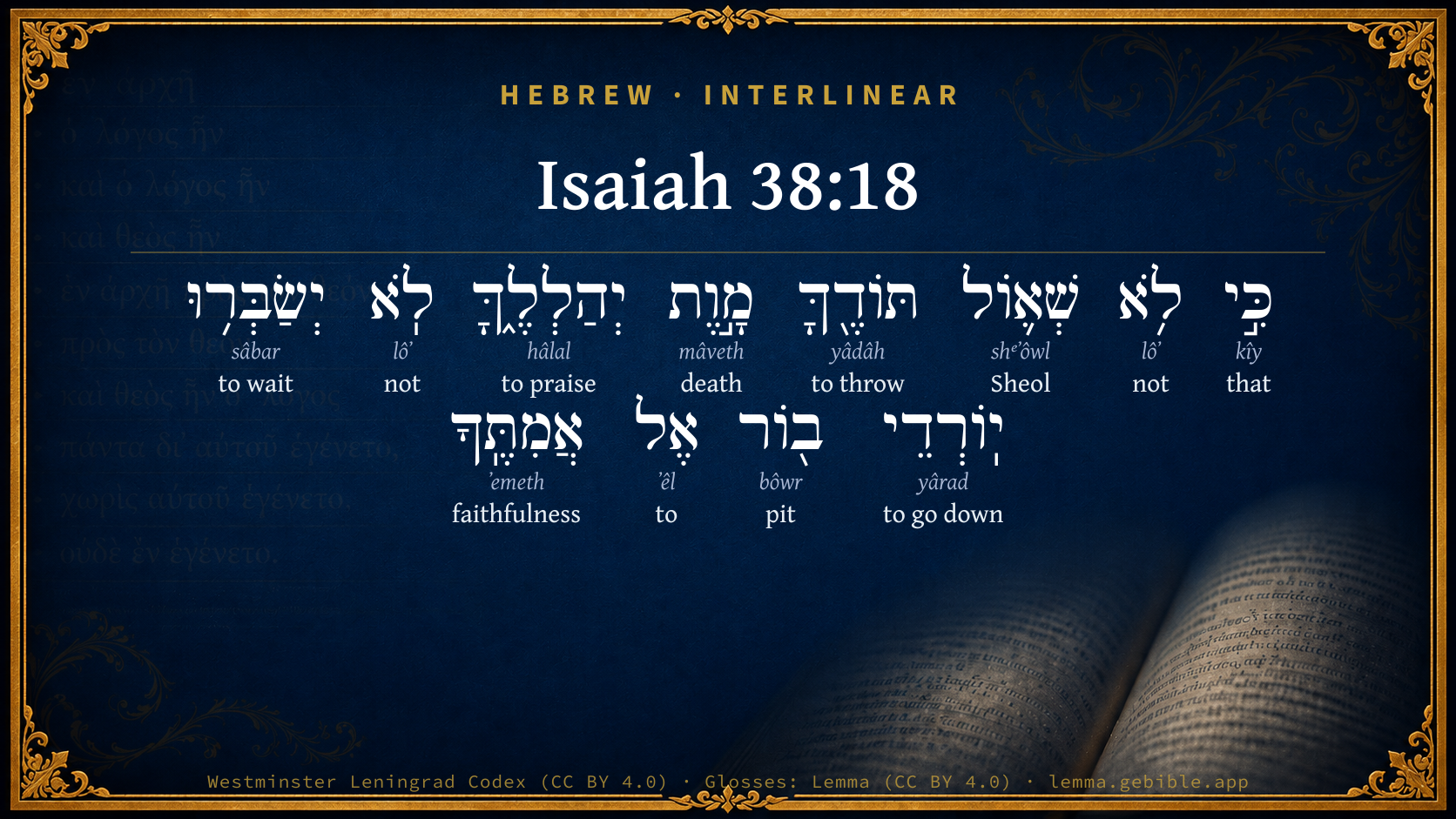
Isaiah 38:18

Hebrew (Westminster Leningrad Codex) Isaiah 38:18 appears in the Hebrew Old Testament. The text above is from the Westminster Leningrad Codex. Each word links to its Strong’s number, a concise gloss, and parsing drawn from the Open Scriptures Hebrew Bible morphology. Click any word for its full Brown-Driver-Briggs (BDB) entry.
Download image
Cite this verse

Isaiah 38:18 (World English Bible). Public Domain. Lemma interlinear Bible study tool, https://lemma.gebible.app/v/isaiah/38/18.

Show BibTeX & RIS
BibTeX
RIS
English Translation
For Sheol can't praise you, death can't celebrate you: Those who go down into the pit can't hope for your truth.
World English Bible · Public Domain
Download a study sheet

One document with this verse’s original text, its word-by-word gloss line, the meaning frame, cross-references with their text, attributed commentary, and full source and license credits — printable, and it pastes into notes with its structure intact.

This verse Autodidact and up

Study sheet (.html) Plain text (.txt)

A passage Seminary Student

Up to 50 verses in one chapter. A passage sheet keeps up to 6 commentary sources and 12 cross-references per verse, in the order this page ranks them, and says so on the sheet whenever that leaves anything out. Ask for a single verse and you get the Autodidact verse sheet above.

Everything on this page stays free to read, with no account — the sheet is a download of what is already on screen, not access to it.

Want to remove ads? Support Godless Engineer
Compare translations 3

The same verse in 3 English versions, stacked beneath the original-language interlinear above. Click any original word for its lexicon entry.

Each is an independent rendering of the whole verse — the interlinear is not word-aligned to these translations.

Highlighted words mark where these versions differ — a whole-verse word diff, not a word-by-word alignment.

  • World English Bible Public Domain
    For Sheol can't praise you, death can't celebrate you: Those who go down into the pit can't hope for your truth.
  • King James Version Public Domain
    For the grave cannot praise thee, death can not celebrate thee: they that go down into the pit cannot hope for thy truth.
  • unfoldingWord Literal Text CC BY-SA 4.0
    For not does Sheol thank you, does death praise you; the ones going down the pit do not watch for your faithfulness.

unfoldingWord Literal Text — © unfoldingWord, licensed CC BY-SA 4.0. Word-aligned USFM3 via Door43 (git.door43.org/unfoldingWord/en_ult).

Versions to compare (up to 4)

3 of 4 selected

Show all 18 translations

Every available English version of this verse, each an independent rendering of the whole verse.

  • World English Bible Public Domain
    For Sheol can't praise you, death can't celebrate you: Those who go down into the pit can't hope for your truth.
  • Berean Standard Bible Public Domain
    For Sheol cannot thank You; Death cannot praise You. Those who descend to the Pit cannot hope for Your faithfulness.
  • Majority Standard Bible Public Domain
    For Sheol cannot thank You; Death cannot praise You. Those who descend to the Pit cannot hope for Your faithfulness.
  • King James Version Public Domain
    For the grave cannot praise thee, death can not celebrate thee: they that go down into the pit cannot hope for thy truth.
  • American Standard Version (1901) Public Domain
    For Sheol cannot praise thee, death cannot celebrate thee: They that go down into the pit cannot hope for thy truth.
  • Revised Version (1885) Public Domain
    For the grave cannot praise thee, death cannot celebrate thee: they that go down into the pit cannot hope for thy truth.
  • Geneva Bible (1599) Public Domain
    For the graue cannot confesse thee: death cannot praise thee: they that goe downe into the pit, cannot hope for thy trueth.
  • Douay-Rheims (1899) Public Domain
    For hell shall not confess to thee, neither shall death praise thee: nor shall they that go down into the pit, look for thy truth.
  • Young's Literal Translation Public Domain
    For Sheol doth not confess Thee, Death doth not praise Thee, Those going down to the pit hope not for Thy truth.
  • Literal Standard Version CC BY-SA 4.0
    For Sheol does not confess You, || Death does not praise You, || Those going down to the pit do not hope for Your truth.
  • Unlocked Literal Bible CC BY-SA 4.0
    For Sheol does not thank you; death does not praise you; those who go down into the pit do not hope in your trustworthiness.
  • unfoldingWord Literal Text CC BY-SA 4.0
    For not does Sheol thank you, does death praise you; the ones going down the pit do not watch for your faithfulness.
  • Darby Bible Public Domain
    For not Sheol shall praise thee, nor death celebrate thee; they that go down into the pit do not hope for thy truth.
  • World Messianic Bible Public Domain
    For Sheol can’t praise you. Death can’t celebrate you. Those who go down into the pit can’t hope for your truth.
  • Webster's Bible Public Domain
    For the grave cannot praise thee, death can not celebrate thee: they that go down into the pit cannot hope for thy truth.
  • Free Bible Version CC BY-SA 4.0
    Those in the grave cannot praise you, the dead cannot praise you. Those who go down into the pit can no longer hope in your faithfulness.
  • Bible in Basic English Public Domain
    For the underworld is not able to give you praise, death gives you no honour: for those who go down into the underworld there is no hope in your mercy.
  • JPS Tanakh (1917) Public Domain
    For the nether-world cannot praise Thee, death cannot celebrate Thee; they that go down into the pit cannot hope for Thy truth.

Literal Standard Version (2020), Covenant Press — licensed CC BY-SA 4.0. Text via the HelloAO Bible API (eBible.org). Unlocked Literal Bible (unfoldingWord) — licensed CC BY-SA 4.0. Text via the HelloAO Bible API (eBible.org). unfoldingWord Literal Text — © unfoldingWord, licensed CC BY-SA 4.0. Word-aligned USFM3 via Door43 (git.door43.org/unfoldingWord/en_ult). Free Bible Version, Dr. Jonathan Gallagher — licensed CC BY-SA 4.0. Text via the HelloAO Bible API (eBible.org).

Word by word

More ways to search: Search by grammar → Find every occurrence → Compare this word →

Practice this passage: Drill this verse → Learn its vocabulary →

יְשַׂבְּר֥וּ
sâbar
H7663
“to wait”
Verb, Piel, Imperfect, 3rd Person, Masculine, Plural
Part of Speech
Verb
Stem
Piel
Form
Imperfect
Person
3rd Person
Gender
Masculine
Number
Plural
Full BDB Definition

Origin: a primitive root

TWOT: 2232

to inspect, examine, wait, hope, wait upon - (Qal) examined (participle) - (Piel) - to wait (for), wait upon - to hope (for)
  1. כִּ֣י kîy H3588 “that” Conjunction
  2. לֹ֥א lôʼ H3808 “not” Particle, Negative
  3. שְׁא֛וֹל shᵉʼôwl H7585 “Sheol” Noun, Proper
  4. תּוֹדֶ֖ךָּ yâdâh H3034 “to throw · you” Verb, Hiphil, Imperfect, 3rd Person, Feminine, Singular + Suffix, Personal, 2nd Person, Masculine, Singular
  5. מָ֣וֶת mâveth H4194 “death” Noun, Common, Masculine, Singular, Absolute
  6. יְהַלְלֶ֑ךָּ hâlal H1984 “to praise · you” Verb, Piel, Imperfect, 3rd Person, Masculine, Singular + Suffix, Personal, 2nd Person, Masculine, Singular
  7. לֹֽא lôʼ H3808 “not” Particle, Negative
  8. יֽוֹרְדֵי yârad H3381 “going down” Verb, Qal, Participle Active, Masculine, Plural, Construct
  9. ב֖וֹר bôwr H953 “pit” Noun, Common, Masculine, Singular, Absolute
  10. אֶל ʼêl H413 “to” Preposition
  11. אֲמִתֶּֽךָ ʼemeth H571 “faithfulness · your” Noun, Common, Feminine, Singular, Construct + Suffix, Personal, 2nd Person, Masculine, Singular

About this verse

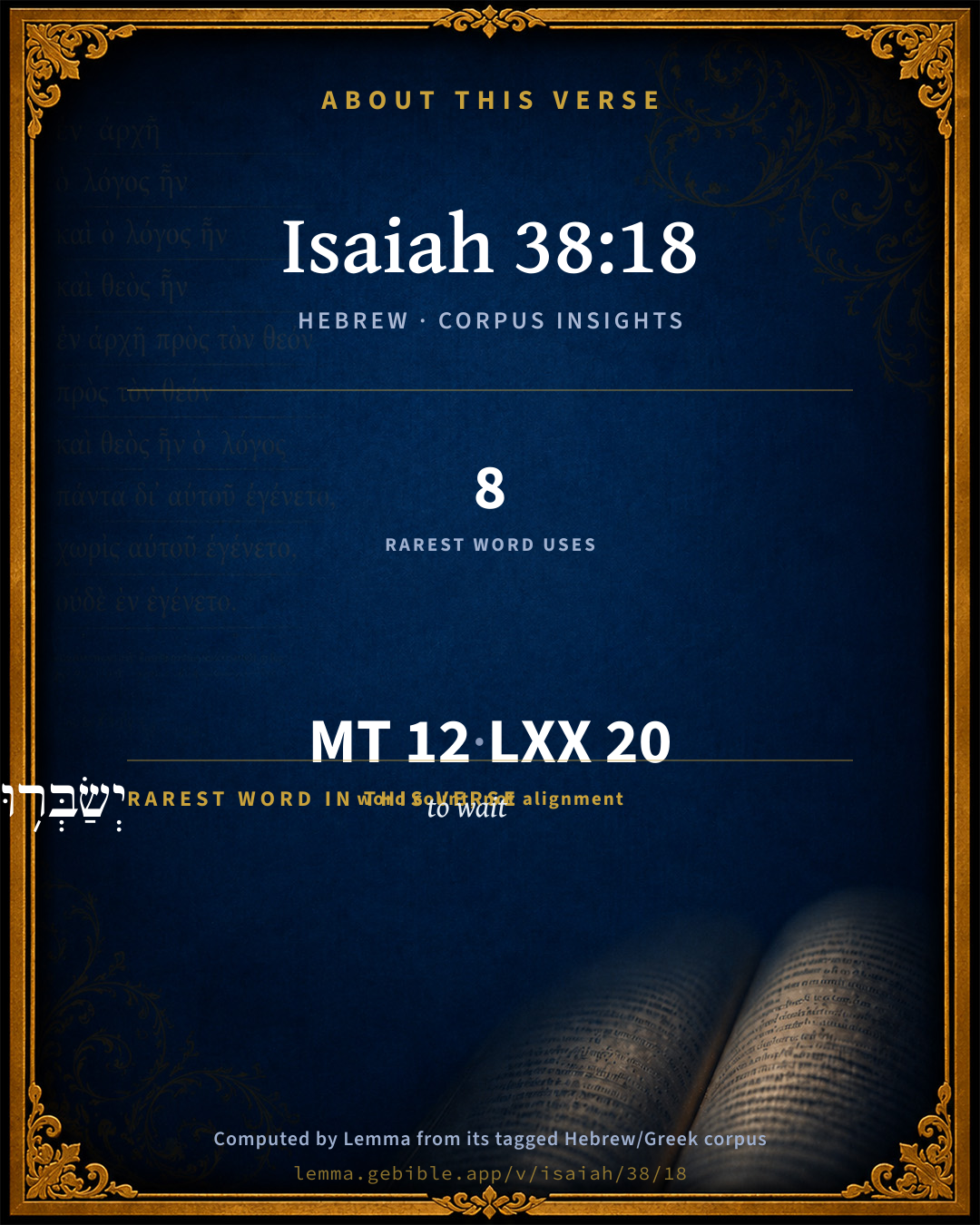
These counts appear in no published source. They are computed here, from the morphology-tagged text and Lemma’s own curated glosses. What Lemma adds →

12
words
11
distinct lemmas
Prophets
section

Notable vocabulary

The rarest word here is יְשַׂבְּר֥וּ to wait H7663 — appearing just 8 times in the whole Hebrew Bible.

Shared distinctive vocabulary

יְשַׂבְּר֥וּ to wait H7663 occurs in 8 verses of the Hebrew Bible. Also found in:

Grammatical profile

  • 4 verbs
  • 4 nouns
  • 1 preposition
  • 1 conjunction
  • 2 particles

Verb forms

  • תּוֹדֶ֖ךָּ Hiphil · Imperfect
  • יְהַלְלֶ֑ךָּ Piel · Imperfect
  • יְשַׂבְּר֥וּ Piel · Imperfect
  • יֽוֹרְדֵי Qal · Participle Active

Repetition

A word recurs within this verse — often emphatic in Hebrew:

Hebrew & Septuagint length

In English translation the verse runs 21 words from the Hebrew and 28 from the Septuagint (LXX English) — closely comparable.

A rough comparison of the two English renderings, which tokenize alike — not a word-level alignment.

Word counts can differ between the Hebrew and the Greek without any difference in meaning — e.g. the Hebrew direct-object marker אֵת has no separate Greek word, and Greek often adds the article ὁ.

In the original languages it is 12 Hebrew tokens and 20 Greek tokens — but the two are counted differently (Hebrew bundles its prefixes and suffixes into one token; the Greek is in lemma form), so that isn’t a like-for-like length.

Cross-references

10

Topical passages linked to Isaiah 38:18 in the Treasury of Scripture Knowledge — connected by theme and wording, ordered by reader-vote popularity; previews shown in the World English Bible.

  • Ecclesiastes 9:10 Whatever your hand finds to do, do it with your might; for there is no work, nor device, nor knowledge, nor wisdom, in Sheol, where you are going.
  • Psalms 6:5 For in death there is no memory of you. In Sheol, who shall give you thanks?
  • Psalms 30:9 "What profit is there in my destruction, if I go down to the pit? Shall the dust praise you? Shall it declare your truth?
  • Psalms 88:10–11 Do you show wonders to the dead? Do the dead rise up and praise you? Selah.
  • Psalms 115:17–18 The dead don't praise Yah, Neither any who go down into silence;
  • Numbers 16:33 So they, and all that appertained to them, went down alive into Sheol: and the earth closed on them, and they perished from among the assembly.
  • Proverbs 14:32 The wicked is brought down in his calamity, But in death, the righteous has a refuge.
  • Matthew 8:12 but the children of the Kingdom will be thrown out into the outer darkness. There will be weeping and the gnashing of teeth."
  • Matthew 25:46 These will go away into eternal punishment, but the righteous into eternal life."
  • Luke 16:26–31 Besides all this, between us and you there is a great gulf fixed, that those who want to pass from here to you are not able, and that none may cross over from there to us.'

Cross-references courtesy of OpenBible.info (CC BY 4.0).

Hebrew and Greek witnesses Masoretic Hebrew ↔ Greek Septuagint

The same verse in the two great witnesses to the Old Testament, shown verse-for-verse.

These are two independent witnesses, not word-aligned to each other, and the Septuagint is shown in lemma (dictionary) form.

Hebrew Isaiah 38:18 Masoretic · Westminster Leningrad Codex

כִּ֣י לֹ֥א שְׁא֛וֹל תּוֹדֶ֖ךָּ מָ֣וֶת יְהַלְלֶ֑ךָּ לֹֽא יְשַׂבְּר֥וּ יֽוֹרְדֵי ב֖וֹר אֶל אֲמִתֶּֽךָ

For Sheol can't praise you, death can't celebrate you: Those who go down into the pit can't hope for your truth.

World English Bible · Public Domain

Greek LXX Isaiah 38:18 Septuagint · lemma form

οὐ γάρ ὁ ἐν ᾅδης αἰνέω σύ οὐδέ ὁ ἀποθνήσκω εὐλογέω σύ οὐδέ ἐλπίζω ὁ ἐν ᾅδης ὁ ἐλεημοσύνη σύ

For they that are in the grave shall not praise you, neither shall the dead bless you, neither shall they that are in Hades hope for your mercy.

LXX2012 (modern English Septuagint) · Public Domain

Hebrew: Westminster Leningrad Codex (CC BY 4.0). Greek: Septuagint (public domain); English from LXX2012 (modern English Septuagint) (Public Domain). How the Septuagint differs from the Hebrew →

Targum (Aramaic paraphrase)

1

The Targum is the ancient Jewish Aramaic paraphrase of the Hebrew Scriptures — an interpretive translation, not the Hebrew text itself. Onkelos (literal) and Pseudo-Jonathan (expansive) render the Torah, and Jonathan the Prophets. Coverage is partial: where no permissively-licensed English translation exists for a verse, only the Aramaic is shown. This is verse-level text, not a word-by-word alignment to the Hebrew.

  1. Targum Jonathan Prophets (Joshua–Malachi)
    אֲרֵי לָא דְבִשְׁאוֹל מוֹדַן קֳדָמָךְ מֵיתַיָא לָא מְשַׁבְּחִין לָךְ לָא מְסַבְּרִין נַחְתֵי גוּב בֵּית אָבְדָנָא לְפוּרְקָנָךְ:

    For they that are in the grave do not praise Thee; neither do the dead celebrate Thee, nor do those that descend into the pit of the place of Abaddon hope for Thy salvation.

    Targum Jonathan — Aramaic: “Mikraot Gedolot” (public domain). English: “Sefaria Community Translation” (CC0 1.0 (public-domain dedication)); “London "Chaldee Paraphrase," 1871” (public domain). Text via Sefaria.

Commentary

Notes on Isaiah 38:18 from classic Christian and Jewish commentators (each source and its license shown beneath its notes). The classic Christian expositions comment on the surrounding passage and are grouped to its opening verse, so a note may address several verses; the Jewish commentaries on the Tanakh (Rashi and others) are per-verse, so they appear only where the commentator wrote on this verse.

Lemma curates 59 commentaries, every one of them public domain or Creative Commons licensed, each selected and text-cleaned for this edition rather than reprinted as found. About our sources →

Trapp's Complete Commentary

John Trapp

Isa 38:18 For the grave cannot praise thee, death can [not] celebrate thee: they that go down into the pit cannot hope for thy truth.

Ver. 18. For the grave cannot praise thee,] i.e., Palam et cum aliis, openly and exemplarily. See Psa 6:5. {See Trapp on "Psa 6:5"} David desires to live for no other end, and so Hezekiah, than to be glorifying of God.

They that go down into the pit.] Of the grave; so of despair. It is a sin for any man to say, I am a reprobate, for it keeps him in sin, and cuts the sinews of endeavour.

John Trapp, A Commentary or Exposition upon All the Books of the Old and New Testament (1647–1656) — public domain. Text from a community e-Sword module.

The Biblical Illustrator

Joseph S. Exell

Isa_38:18-19

For the grave cannot praise Thee

The praiseful life

Bacon says, Prosperity is the blessing of the Old Testament, adversity is the blessing of the New.

He would have been nearer the truth had he said, that temporal blessings were the promise of the Old Testament, spiritual blessings the promise of the New. The remark, however, suggests thoughts introductory to the consideration of our text from a Christian standpoint.

1. The Jews were for the most part influenced by the prospect of temporal rewards and punishments. Hezekiah in this place seems to have no thought of a future life, and to be moved only by the prospect of leaving this. There is a development in revelation, in this as in other matters.

2. When our Lord came, the germ of the doctrine of the future life, only dimly discernible to the spiritual mind, was developed.

I. THE DEAD CANNOT PRAISE GOD.

1. This is true of natural death. The hands once strong to labour are now nerveless and still, there is no disquisition in the eyes, and the heart is unmoved by the things of joy and grief that thrilled it in life.

2. It is true of spiritual death, of which natural is in the New Testament the constant type.

II. THE LIVING MUST PRAISE GOD.

1. The natural duty of praising God is recognised by Hezekiah; and it would be strange if it were not so, for we have a loathing of ingratitude from man to man.

(1) The pagans would shame us if we did not praise God; for they gave the first fruits of their corn and the best of the prey taken in hunting as offerings to their gods, and before a feast made libations to them.

(2) The Psalmist is an eminent example of a praiseful spirit.

2. But those who have been partakers of the spiritual resurrection can alone truly praise God, for they alone can fully realise all His bounty.

(1) God has designed all things to His praise, and looks for it in His people.

(2) We must thank Him for all things, for the blessings of this life, but above all for His inestimable love in the redemption of the world. Nay, for miseries as well as for mercies.

(3) A stimulus to praise will be found in the remembrance of Gods bounty. In the Greek mythology, Mnemosyne was the mother of the Muses; memory is the mother of praise.

3. But the most perfect praise will be in the spiritual body after the resurrection. (J. G. Pilkington, M. A.)

Hezekiah in prospect of death

Hezekiah was, in the full sense of the word, a good king. His piety is shown--

(1) In his conduct with reference to idolatry.

(2) In his conduct in the matter of the siege of Jerusalem by Sennacherib. But there are two passages in his life which show the weak side of his character. One is his parading his treasures before the ambassadors of the king of Babylon; the other is his conduct in the matter of his severe illness.

I. The essence of the history is this, that IN THE PROSPECT OF DEATH HEZEKIAHS STRENGTH OF MIND QUITE BROKE DOWN. He looks upon death as a thing to be dreaded and shunned; he speaks of it in a way in which no Christian who has learned the Lords prayer could ever venture or even wish to speak of it. Hezekiah knew that he must serve God while life lasted; he had manifestly no express revelation beyond, and therefore he looked upon the grave with dismay.

II. WE HAVE GREATER SPIRITUAL HELP THAN HEZEKIAH, and brighter light, and clearer grounds of hope, and it is incumbent on us to act, not like those who groped their way in the twilight of the old dispensation, but like those upon whom the brightness of the knowledge of the glory of God has shined in the face of Jesus Christ. (Bp. Harvey Goodwin, D. D.)

The Biblical Illustrator, edited by Joseph S. Exell (c. 1880s–1900s) — public domain. Text from a community e-Sword module.

Joseph Benson's Commentary

Isa 38:18-20. For the grave cannot praise thee — The dead cannot be instruments of promoting thy glory among men upon earth, or of making thy goodness known to others, which I desire and determine to do. They cannot hope for thy truth — Cannot expect nor receive the accomplishment of thy promised goodness in this world. The living, &c., shall praise thee — They are especially obliged to do it, and they only have the privilege of doing it among men on earth. The father to the children, &c. — They shall not only praise thee while they live, but shall take care to propagate and perpetuate thy praise to all succeeding generations. Or, he means, “Thy wonderful mercy toward me shall be recorded for the benefit of after ages; and fathers shall mention it to their children, as an instance of thy faithfulness.” The Lord was ready to save me — Was a present help to me, ready to hear and succour me upon my praying to him in my great extremity. Therefore will we sing my songs — Both I and my people will sing those songs of praise which are due, especially from me, for God’s great mercy to me; to the stringed instruments — Or, to the harp, (as Bishop Lowth renders it,) which was according to the custom of those times. Some infer from this verse that Hezekiah composed several other sacred songs, some of which may be still extant among the Psalms. All the days of our life in the house of the Lord — Here we are taught, that the proper fruit of deliverance from evil is thanksgiving, diffusing itself through all the actions of our life. This passage exhibits to us especially a picture of our duty and state as Christians, who, redeemed as we are by the precious blood of the Son of God from everlasting destruction, ought, with all the powers of our souls and bodies, to celebrate his name and glory, so that our whole life may appear one continued thanksgiving. — Vitringa.

Joseph Benson's Commentary on the Old and New Testaments (1811–1818) — public domain. Text from a community e-Sword module.

Keil & Delitzsch

C. F. Keil & F. Delitzsch

In strophe 4 he rejoices in the preservation of his life as the highest good, and promises to praise God for it as long as he lives.

"For Hades does not praise Thee; death does not sing praises to Thee:

They that sink into the grave do not hope for Thy truth.

The living, the living, he praises Thee, as I do today;

The father to the children makes known Thy truth.

Jehovah is ready to give me salvation;

Therefore will we play my stringed instruments all the days of my life

In the house of Jehovah."

We have here that comfortless idea of the future state, which is so common in the Psalms (vid., Psa 6:6; Psa 30:10; Psa 88:12-13, cf., Psa 115:17), and also in the book of Ecclesiastes (Ecc 9:4-5, Ecc 9:10). The foundation of this idea, notwithstanding the mythological dress, is an actual truth (vid., Psychol. p. 409), which the personal faith of the hero of Job endeavours to surmount (Comment. pp. 150-153, and elsewhere), but the decisive removal of which was only to be effected by the progressive history of salvation. The v. is introduced with "for" (kı̄), inasmuch as the gracious act of God is accounted for on the ground that He wished to be still further glorified by His servant whom He delivered. לא, in Isa 38:18, is written only once instead of twice, as in Isa 23:4. They "sink into the grave," i.e., are not thought of as dying, but as already dead. "Truth" ('ĕmeth) is the sincerity of God, with which He keeps His promises. Isa 38:19 reminds us that Manasseh, who was twelve years old when he succeeded his father, was not yet born (cf., Isa 39:7). The להושׁיעני יהוה, μέλλει σώζειν με, is the same as in Isa 37:26. The change in the number in Isa 38:20 may be explained from the fact that the writer thought of himself as the choral leader of his family; ay is a suffix, not a substantive termination (Ewald, 164, p. 427). The impression follows us to the end, that we have cultivated rather than original poetry here. Hezekiah's love to the older sacred literature is well known. He restored the liturgical psalmody (Ch2 29:30). He caused a further collection of proverbs to be made, as a supplement to the older book of Proverbs (Pro 25:1). The "men of Hezekiah" resembled the Pisistratian Society, of which Onomacritos was the head.

Keil & Delitzsch — Biblical Commentary on the Old Testament (1861–1891) — public domain (CC PDM 1.0). Text via the HelloAO Bible API. (Old Testament only.)

Geneva Bible (1599)

Geneva Bible translators

Forasmuch as God hath placed man in this world to glorify him, the godly take it as a sign of his wrath, when their days were shortened, either because that they seemed unworthy for their sins to live longer in his service, or for their zeal to God’s glory, seeing that there are so few in earth that do regard it, as Ps. 6:5; 115:17.

Geneva Bible (1599) marginal notes — public domain. Text via Bolls.life.

Jamieson, Fausset & Brown

Robert Jamieson, A. R. Fausset & David Brown

death--that is, the dead; Hades and its inhabitants (Job 28:22; see on Isa 38:11). Plainly Hezekiah believed in a world of disembodied spirits; his language does not imply what skepticism has drawn from it, but simply that he regarded the disembodied state as one incapable of declaring the praises of God before men, for it is, as regards this world, an unseen land of stillness; "the living" alone can praise God on earth, in reference to which only he is speaking; Isa 57:1-2 shows that at this time the true view of the blessedness of the righteous dead was held, though not with the full clearness of the Gospel, which "has brought life and immortality to light" (Ti2 1:10).

hope for thy truth-- (Psa 104:27). Their probation is at an end. They can no longer exercise faith and hope in regard to Thy faithfulness to Thy promises, which are limited to the present state. For "hope" ceases (even in the case of the godly) when sight begins (Rom 8:24-25); the ungodly have "no hope" (Th1 4:13). Hope in God's truth is one of the grounds of praise to God (Psa 71:14; Psa 119:49). Others translate, "cannot celebrate."

Jamieson, Fausset & Brown — Commentary Critical and Explanatory on the Whole Bible (1871) — public domain (CC PDM 1.0). Text via the HelloAO Bible API.

Ellicott's Commentary for English Readers

(18) For the grave . . .—i.e., Sheol, or Hades. We return to the king’s thoughts of the dim shadow-world, Death and Sheol (joined together, as in Isa_28:15; Psa_6:5). In that region of dimness there are no psalms of thanksgiving, no loud hallelujahs. The thought of spiritual energies developed and intensified after death is essentially one which belongs to the “illuminated” immortality (2Ti_1:10), of Christian thought. (Comp. Psa_6:5; Psa_30:9; Psa_88:11-12; Psa_115:17; Ecc_9:4-5; Ecc_9:10).

A Bible Commentary for English Readers, edited by Charles John Ellicott (1878–1897) — public domain. Text from a community e-Sword module.

The Cambridge Bible for Schools and Colleges

gen. ed. J. J. S. Perowne

18. With the thought of this verse comp. Psa_6:5; Psa_30:9; Psa_88:10-12; Psa_115:17.

the grave] Sheol.

18, 19. The deepest motive for the saint’s gratitude is that only on earth can he know the joys of fellowship with God.

The Cambridge Bible for Schools and Colleges (gen. ed. J. J. S. Perowne; Cambridge University Press, 1878–1918) — public domain. Text from a community e-Sword module.

John Gill's Exposition

The living, the living, he shall praise thee, as I do this day,.... Every one of the living, or such who are both corporeally and spiritually alive; and therefore the word is repeated; none but such who are alive in a corporeal sense can praise the Lord in this world; and none but such who are spiritually alive can praise him aright, and such do under a true sense of the greatness of his mercies, and of their own unworthiness; and such a one was Hezekiah; for the words may be rendered, "as I am this day (x)"; that is, alive in both the above senses; and so did he praise God, in such a spiritual manner, even on the day he committed this to writing, and was now in the temple offering up this thanksgiving:

the father to the children shall make known thy truth: not meaning himself, for at this time he had no children; though, no doubt, when he had any, as he afterwards had, particularly Manasseh, he took care to acquaint him with the truth and faithfulness of God in the fulfilling of his promises to him; and which every religious parent would do, and so transmit the memory thereof to future ages.

(x) "quails ego sum hodie", Syr.

John Gill's Exposition of the Whole Bible (1746–1763) — public domain (CC PDM 1.0). Text via the HelloAO Bible API.

Albert Barnes' Notes on the Bible

For the grave cannot praise thee - The Hebrew word here is sheol. It is put by metonymy here for those who are in the grave, that is, for the dead. The word ‘praise’ here refers evidently to the public and solemn celebration of the goodness of God. It is clear, I think, that Hezekiah had a belief in a future state, or that he expected to dwell with ‘the inhabitants of the land of silence’ Isa 38:11 when he died. But he did not regard that state as one adapted to the celebration of the public praises of God. It was a land of darkness; an abode of silence and stillness; a place where there was no temple, and no public praise such as he had been accustomed to. A similar sentiment is expressed by David in Psa 6:5 :

For in death there is no remembrance of thee;

In the grave who shall give thee thanks?

In regard to the Jewish conceptions of the state of the dead, see the notes at Isa 14:15, Isa 14:19.

(See the Supplementary note at Isa 14:9; also the Prefatory Remarks by the Editor on the Author’s exposition of Job. The ideas entertained by the Author on the state of knowledge among the ancient saints regarding a future world, cannot but be regarded as especially unfortunate. After the fashion of some German critics, the Old Testament worthies are reduced to the same level with the heroes of Homer and Virgil, as far as this matter is concerned at least.)

Cannot hope for thy truth - They are shut out from all the means by which thy truth is brought to the mind, and the offers of salvation are presented. Their probation is at an end; their privileges are closed; their destiny is sealed up. The idea is, it is a privilege to live, because this is a world where the offers of salvation are made, and where those who are conscious of guilt may hope in the mercy of God.

Albert Barnes' Notes on the Bible (1834–1885) — public domain. Text from a community e-Sword/MySword module.

Haydock's Catholic Bible Commentary

Truth. He speaks only of the body.

George Leo Haydock (1774–1849), Haydock's Catholic Family Bible and Commentary, 1859 edition — public domain. Excludes Psalms (Douay-Rheims chapter numbering differs from Protestant) and Deuterocanonical books (Catholic canon only).

Matthew Poole's English Annotations

In this and the following verse, he declares God’s design in delivering him, that he might praise him in his church, which if he had died he could not have done.

The grave cannot praise thee; the dead are not capable of glorifying thy name among men upon earth; which I desire and determine to do. See the like expressions, Psa 6:5; 30:9; 88:10, &c. The grave is put for the persons lodged in it by a metonymy.

Cannot hope for thy truth; they cannot expect nor receive the accomplishment of thy promised goodness in the land of the living.

Matthew Poole's English Annotations on the Holy Bible (1683–1685) — public domain. Text from a community e-Sword/MySword module.

Whedon's Commentary on the Bible

Daniel D. Whedon

18. The grave cannot praise thee — The idea of sheol, above mentioned, is here recognised. See Psa_6:5; Psa_30:9; Psa_88:11-12. The removal of this sad idea was effected only by the progressive history of salvation. There was, indeed, beyond this, a vague belief of a future state, ever growing more receptive of strength and vividness, till, by Christianity, “life and immortality” were brought fully to light. But Hezekiah’s age saw principally the dark, natural images of the future state, which fact explains the words of this verse.

Daniel D. Whedon (gen. ed.), Commentary on the Old and New Testaments (1874–1909) — public domain. Text from a community e-Sword module.

The Pulpit Commentary

The grave cannot praise thee (compare the comment on ver. 11). It is avoiding the plain force of these passages to say that Hezekiah only means that those who go to Hades in a state of condemnation cannot be expected there to praise God (Kay). He speaks broadly and generally of all: "The living, the living, shall praise thee; Sheol cannot praise thee; Death cannot celebrate thee." Manifestly, though he believes in a future state, it is one in which there is either no energy at all, or at any rate no devotional energy. He may think, with Isaiah. that "the righteous man," when he is "taken away," will "enter into peace"; (Isa_57:1, Isa_57:2) but absolute "peace" precludes energy (see Arist., "Eth. Nit.," 1. 10. Hezekiah shrinks from losing all his activities, including his sense of personal communion with God. He does not, perhaps, "look on the condition of the faithful departed as one of comfortless gloom;" but he views it as one of deprivation, and is unwilling to enter into it. It was by the coming of Christ and the preaching of his gospel that "life and immortality" were first truly "brought to light". (2Ti_1:10)

The Pulpit Commentary (1880–1919), ed. H.D.M. Spence-Jones & Joseph S. Exell — public domain. Text from a community e-Sword module.

John Wesley's Explanatory Notes

Praise - The dead are not capable of glorifying thy name among men upon earth. They cannot expect nor receive the accomplishment of thy promised goodness in the land of the living.

John Wesley, Explanatory Notes Upon the Whole Bible (1754–1765) — public domain. Text via the GEBible commentary corpus.

J. A. Alexander on Isaiah

Joseph Addison Alexander

“For the grave shall not confess Thee (nor) death praise Thee; they that go down to the pit shall not hope for Thy truth.” Here, as often in the Psalms, the loss of the opportunity of praising God is urged as a reason, not only why he should be loathe to die, but why God should preserve him. (See Psa 6:5; Psa 30:9; Psa 88:10-11). The language is that of extreme agitation and distress, in which the prospect of the future is absorbed in contemplation of the present, and so far as he does think of futurity, it is upon the supposition of God’s wrath. Regarding death, in this case, as a proof of the divine displeasure, he cannot but look upon it as the termination of his solemn praises. The truth mentioned in the last clause is the truth of God’s promises, to hope for which is to expect the promised blessing.

Joseph Addison Alexander, The Prophecies of Isaiah (1846–1847; New York: Scribner, 1870–1878) — public domain. Text from a community e-Sword module.

Scofield Reference Notes

C. I. Scofield

grave Heb. "Sheol," (See Scofield "Hab 2:5")

death (See Scofield "Ecc 9:10")

The Scofield Reference Bible (1917 edition), notes by C. I. Scofield — public domain. Text from a community e-Sword module.

unfoldingWord translationNotes

Door43 World Missions Community

General Information:

Hezekiah continues his written prayer.

For Sheol does not thank you; death does not praise you

Here "Sheol" and "death" refer to "dead people." AT: "For those in Sheol do not thank you; dead people do not praise you" (See: Metonymy)

those who go down into the pit

"those who go down to the grave"

do not hope in your trustworthiness

"do not have hope in your faithfulness." Here "your" is singular and refers to Yahweh. (See: Forms of You)

The living person, the living person

Hezekiah repeats this phrase to emphasize that only a living person, not a dead person, can give thanks to Yahweh. (See: Parallelism)

translationWords

Hades

die

praise

hope

trust

life

unfoldingWord translationNotes — © Distant Shores Media and the Door43 World Missions Community, licensed CC BY-SA 4.0. Source: git.door43.org/Door43/en_tn.

Rashi

Rabbi Shlomo Yitzchaki (Rashi)

[For the grave shall not thank You Had I died, I would not thank You for the miracle of the downfall of Sennacherib, and I would not hope for the realization of Your promise that You promised me concerning him.]

Rashi on the Tanakh — English translations: “The Judaica Press complete Tanach with Rashi, translated by A. J. Rosenberg” (CC BY 4.0); “Pentateuch with Rashi's commentary by M. Rosenbaum and A.M. Silbermann, 1929-1934” (public domain); “The Metsudah Tanach series, Lakewood, N.J” (CC BY 4.0); and “The Book of Joshua, Metsudah Publications, 1997” (CC BY 4.0). Text via Sefaria.

Ibn Ezra

Rabbi Abraham ibn Ezra

For the grave, etc. The body which is in the grave; the negation לא is to be repeated after מות: death cannot celebrate thee; comp. Prov. 21:14.

ישברו They hope. Comp. Ps. 145:15. Many are surprised to find here the prophet declaring such things, as if denying the truth of the resurrection of the dead; but the body has no power, no knowledge, when the soul has left it; and why should we be surprised at it? Man has sometimes no understanding when the soul is in the body, much less after his death.

Ibn Ezra on the Tanakh — English translations: “Sefaria Community Translation” (CC0 1.0 (public-domain dedication)); “Yalkut, Sifsei Chachomim Chumash, Metsudah Publications, 2009” (CC BY 4.0); and “Commentary of Ibn Ezra on Isaiah - trans. by M. Friedlander, 1873” (public domain). Text via Sefaria.

Lesson kit

Teaching starters — assembled from the data on this page, not authored interpretation. Every prompt links to the verse data it draws on. Edit before teaching.

Isaiah, in the Prophets, opens this verse with 12 words (11 distinct Hebrew lemmas). Its most distinctive word is sâbar (“to wait”). A historical commentator’s framing appears above. Read the whole chapter for the surrounding context.

Discussion questions

  1. How does “to wait” (sâbar) shape what this verse is saying?
  2. How does Ruth 1:13, which shares the word «to wait», read alongside this verse?
  3. What does the repetition of “not” (2× in this one verse) do in this verse?
  4. The translations on this page render this verse differently — a whole-verse word diff, not a word-by-word alignment. What might account for the different wordings?
  5. «תּוֹדֶ֖ךָּ» is a Hiphil Imperfect verb. How does that grammatical form shape the action described?
  6. Compare how Trapp's Complete Commentary and The Biblical Illustrator read this verse. Where do they agree or differ?

Things to notice

Reading settings

Reading text

Shown beneath each verse's original-language words.

Old Testament
Old Testament edition

Read the OT as the Masoretic Hebrew (MT) or the Greek Septuagint (LXX).

English shown for the Greek Septuagint (in the Hebrew ↔ Greek comparison).

Comparing translations? Open the Compare panel on any verse page to stack up to four side by side.