
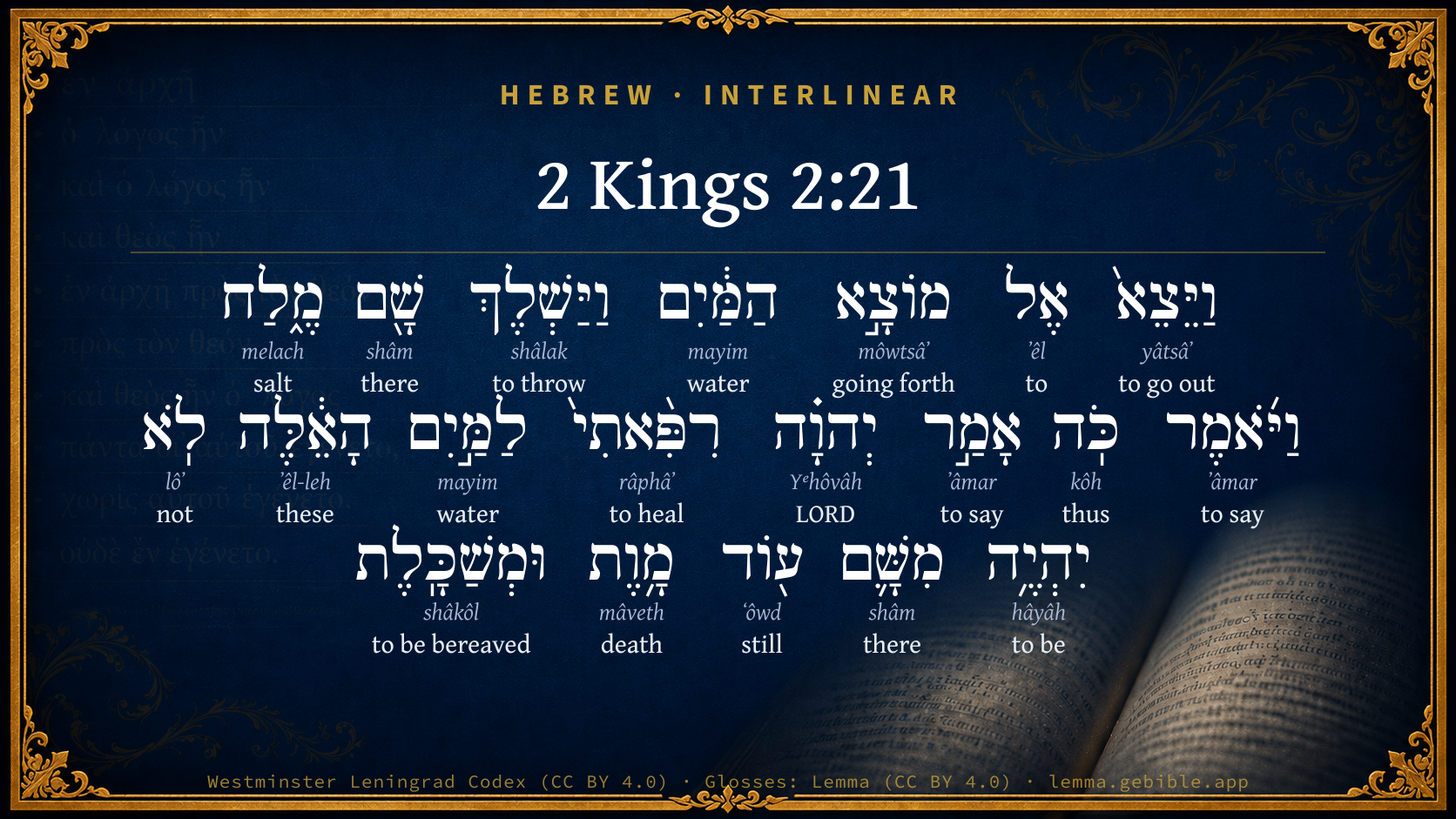
2 Kings 2:21

Hebrew (Westminster Leningrad Codex) 2 Kings 2:21 appears in the Hebrew Old Testament. The text above is from the Westminster Leningrad Codex. Each word links to its Strong’s number, a concise gloss, and parsing drawn from the Open Scriptures Hebrew Bible morphology. Click any word for its full Brown-Driver-Briggs (BDB) entry.
Download image
Cite this verse

2 Kings 2:21 (World English Bible). Public Domain. Lemma interlinear Bible study tool, https://lemma.gebible.app/v/2-kings/2/21.

Show BibTeX & RIS
BibTeX
RIS
English Translation
He went forth to the spring of the waters, and cast salt therein, and said, Thus says Yahweh, I have healed these waters; there shall not be from there any more death or miscarrying.
World English Bible · Public Domain
Download a study sheet

One document with this verse’s original text, its word-by-word gloss line, the meaning frame, cross-references with their text, attributed commentary, and full source and license credits — printable, and it pastes into notes with its structure intact.

This verse Autodidact and up

Study sheet (.html) Plain text (.txt)

A passage Seminary Student

Up to 50 verses in one chapter. A passage sheet keeps up to 6 commentary sources and 12 cross-references per verse, in the order this page ranks them, and says so on the sheet whenever that leaves anything out. Ask for a single verse and you get the Autodidact verse sheet above.

Everything on this page stays free to read, with no account — the sheet is a download of what is already on screen, not access to it.

Want to remove ads? Support Godless Engineer
Compare translations 3

The same verse in 3 English versions, stacked beneath the original-language interlinear above. Click any original word for its lexicon entry.

Each is an independent rendering of the whole verse — the interlinear is not word-aligned to these translations.

Highlighted words mark where these versions differ — a whole-verse word diff, not a word-by-word alignment.

  • World English Bible Public Domain
    He went forth to the spring of the waters, and cast salt therein, and said, Thus says Yahweh, I have healed these waters; there shall not be from there any more death or miscarrying.
  • King James Version Public Domain
    And he went forth unto the spring of the waters, and cast the salt in there, and said, Thus saith the LORD, I have healed these waters; there shall not be from thence any more death or barren land.
  • unfoldingWord Literal Text CC BY-SA 4.0
    And he went out to the source of the waters, and he threw salt there. And he said, “Thus says Yahweh, ‘I have healed these waters. Death and miscarrying will not still be from there.’”

unfoldingWord Literal Text — © unfoldingWord, licensed CC BY-SA 4.0. Word-aligned USFM3 via Door43 (git.door43.org/unfoldingWord/en_ult).

Versions to compare (up to 4)

3 of 4 selected

Show all 18 translations

Every available English version of this verse, each an independent rendering of the whole verse.

  • World English Bible Public Domain
    He went forth to the spring of the waters, and cast salt therein, and said, Thus says Yahweh, I have healed these waters; there shall not be from there any more death or miscarrying.
  • Berean Standard Bible Public Domain
    and Elisha went out to the spring, cast the salt into it, and said, “This is what the LORD says: ‘I have healed this water. No longer will it cause death or unfruitfulness.’”
  • Majority Standard Bible Public Domain
    and Elisha went out to the spring, cast the salt into it, and said, “This is what the LORD says: ‘I have healed this water. No longer will it cause death or unfruitfulness.’”
  • King James Version Public Domain
    And he went forth unto the spring of the waters, and cast the salt in there, and said, Thus saith the LORD, I have healed these waters; there shall not be from thence any more death or barren land.
  • American Standard Version (1901) Public Domain
    And he went forth unto the spring of the waters, and cast salt therein, and said, Thus saith Jehovah, I have healed these waters; there shall not be from thence any more death or miscarrying.
  • Revised Version (1885) Public Domain
    And he went forth unto the spring of the waters, and cast salt therein, and said, Thus saith the LORD, I have healed these waters; there shall not be from thence any more death or miscarrying.
  • Geneva Bible (1599) Public Domain
    And he went vnto the spring of the waters, and cast there the salt, and said, Thus saith the Lord, I haue healed this water: death shall no more come thereof, neither barennesse to the ground.
  • Douay-Rheims (1899) Public Domain
    He went out to the spring of the waters, and cast the salt into it, and said: Thus saith the Lord: I have healed these waters, and there shall be no more in them death or barrenness.
  • Young's Literal Translation Public Domain
    and he goeth out unto the source of the waters, and casteth there salt, and saith, `Thus said Jehovah, I have given healing to these waters; there is not thence any more death and sterility.'
  • Literal Standard Version CC BY-SA 4.0
    and he goes out to the source of the waters, and casts salt there, and says, “Thus said YHWH: I have given healing to these waters; there is not anymore death and sterility there.”
  • Unlocked Literal Bible CC BY-SA 4.0
    Elisha went out to the spring of water and threw salt in it; then he said, “Yahweh says this, 'I have healed these waters. From this time on, there will be no more death or unfruitful land.'”
  • unfoldingWord Literal Text CC BY-SA 4.0
    And he went out to the source of the waters, and he threw salt there. And he said, “Thus says Yahweh, ‘I have healed these waters. Death and miscarrying will not still be from there.’”
  • Darby Bible Public Domain
    And he went forth to the source of the waters, and cast the salt in there, and said, Thus saith Jehovah: I have healed these waters: there shall not be from thence any more death or barrenness.
  • World Messianic Bible Public Domain
    He went out to the spring of the waters, and threw salt into it, and said, “The LORD says, ‘I have healed these waters. There shall not be from there any more death or barren wasteland.’”
  • Webster's Bible Public Domain
    And he went forth to the spring of the waters, and cast the salt in there, and said, Thus saith the LORD, I have healed these waters; there shall not be from thence any more death or barren land.
  • Free Bible Version CC BY-SA 4.0
    Then Elisha went to the spring, threw the salt into it, and said, “This is what the Lord says: ‘I have purified this water. It won't cause death or miscarriages anymore.’”
  • Bible in Basic English Public Domain
    Then he went out to the spring from which the water came, and put salt in it, and said, The Lord says, Now I have made this water sweet; no longer will it be death-giving or unfertile.
  • JPS Tanakh (1917) Public Domain
    And he went forth unto the spring of the waters, and cast salt therein, and said: 'Thus saith the LORD: I have healed these waters; there shall not be from thence any more death or miscarrying.'

Literal Standard Version (2020), Covenant Press — licensed CC BY-SA 4.0. Text via the HelloAO Bible API (eBible.org). Unlocked Literal Bible (unfoldingWord) — licensed CC BY-SA 4.0. Text via the HelloAO Bible API (eBible.org). unfoldingWord Literal Text — © unfoldingWord, licensed CC BY-SA 4.0. Word-aligned USFM3 via Door43 (git.door43.org/unfoldingWord/en_ult). Free Bible Version, Dr. Jonathan Gallagher — licensed CC BY-SA 4.0. Text via the HelloAO Bible API (eBible.org).

Word by word

More ways to search: Search by grammar → Find every occurrence → Compare this word →

Practice this passage: Drill this verse → Learn its vocabulary →

וּמְשַׁכָּֽלֶת
shâkôl
H7921
“and · being bereaved”
Conjunction + Verb, Piel, Participle Active, Feminine, Singular, Absolute
Part of Speech
Conjunction + Verb
Stem
Piel
Form
Participle Active
Gender
Feminine
Number
Singular
State
Absolute
Full BDB Definition

Origin: a primitive root

TWOT: 2385

to be bereaved, make childless, miscarry - (Qal) to be bereaved - (Piel) - to make childless - to cause barrenness, show barrenness or abortion - to miscarry - (Hiphil) miscarrying (participle)
  1. וַיֵּצֵא֙ yâtsâʼ H3318 “and · to go out” Conjunction + Verb, Qal, Sequential Imperfect, 3rd Person, Masculine, Singular
  2. אֶל ʼêl H413 “to” Preposition
  3. מוֹצָ֣א môwtsâʼ H4161 “going forth of” Noun, Common, Masculine, Singular, Construct
  4. הַמַּ֔יִם mayim H4325 “the · water(s)” Particle, Definite Article + Noun, Common, Masculine, Plural, Absolute
  5. וַיַּשְׁלֶךְ shâlak H7993 “and · to throw” Conjunction + Verb, Hiphil, Sequential Imperfect, 3rd Person, Masculine, Singular
  6. שָׁ֖ם shâm H8033 “there” Adverb
  7. מֶ֑לַח melach H4417 “salt” Noun, Common, Masculine, Singular, Absolute
  8. וַיֹּ֜אמֶר ʼâmar H559 “and · to say” Conjunction + Verb, Qal, Sequential Imperfect, 3rd Person, Masculine, Singular
  9. כֹּֽה kôh H3541 “thus” Adverb
  10. אָמַ֣ר ʼâmar H559 “to say” Verb, Qal, Perfect, 3rd Person, Masculine, Singular
  11. יְהוָ֗ה Yᵉhôvâh H3068 “LORD” Noun, Proper
  12. רִפִּ֨אתִי֙ râphâʼ H7495 “to heal” Verb, Piel, Perfect, 1st Person, Common, Singular
  13. לַמַּ֣יִם mayim H4325 “to/for the · water(s)” Preposition, Determined + Noun, Common, Masculine, Plural, Absolute
  14. הָאֵ֔לֶּה ʼêl-leh H428 “the · these” Particle, Definite Article + Pronoun, Demonstrative, Common, Plural
  15. לֹֽא lôʼ H3808 “not” Particle, Negative
  16. יִהְיֶ֥ה hâyâh H1961 “to be” Verb, Qal, Imperfect, 3rd Person, Masculine, Singular
  17. מִשָּׁ֛ם shâm H8033 “from · there” Preposition + Adverb
  18. ע֖וֹד ʻôwd H5750 “still” Adverb
  19. מָ֥וֶת mâveth H4194 “death” Noun, Common, Masculine, Singular, Absolute

About this verse

These counts appear in no published source. They are computed here, from the morphology-tagged text and Lemma’s own curated glosses. What Lemma adds →

20
words
17
distinct lemmas
Historical
section

Notable vocabulary

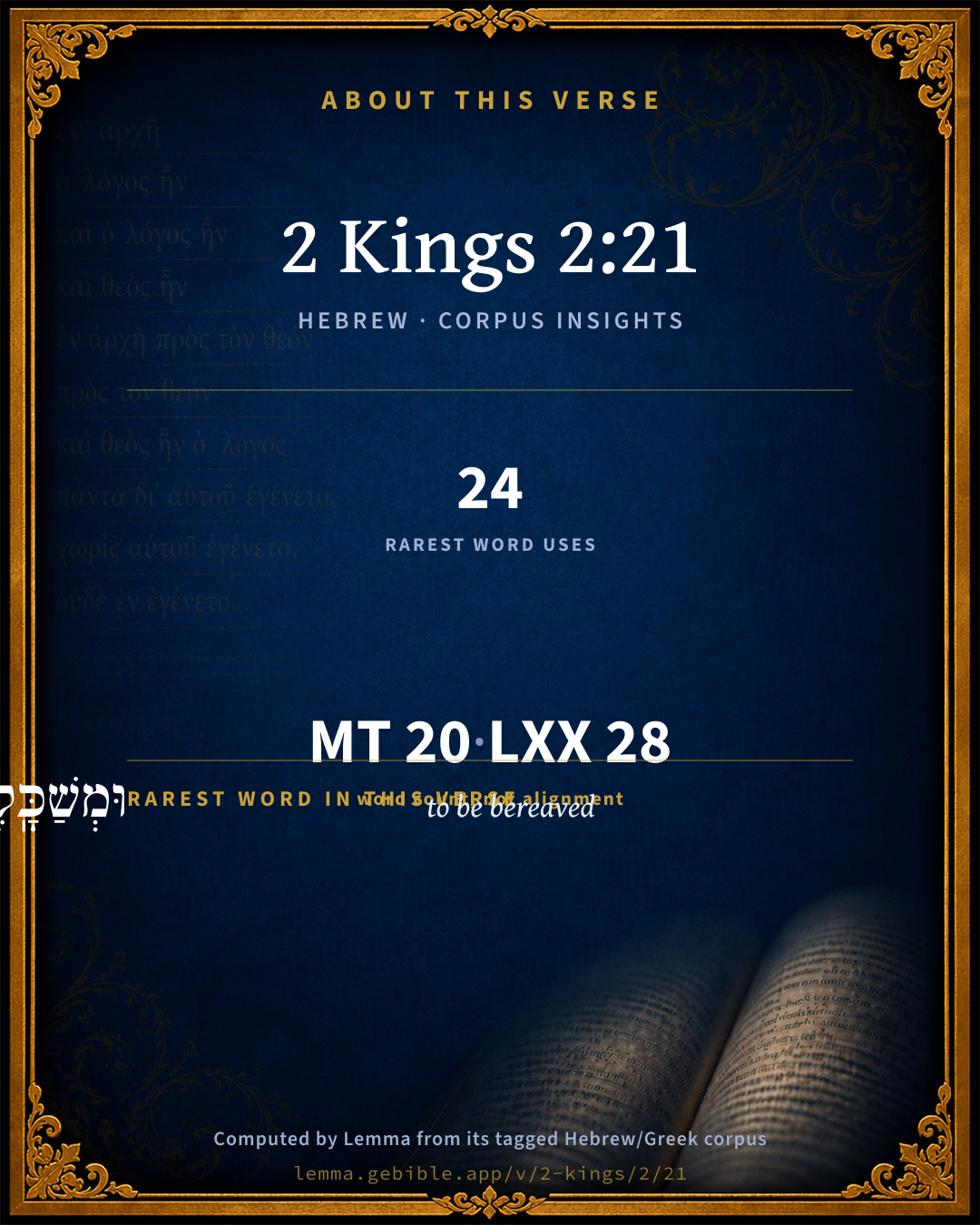
The rarest word here is וּמְשַׁכָּֽלֶת to be bereaved H7921 — appearing just 24 times in the whole Hebrew Bible.

Shared distinctive vocabulary

וּמְשַׁכָּֽלֶת to be bereaved H7921 occurs in 22 verses of the Hebrew Bible. Also found in:

Grammatical profile

  • 7 verbs
  • 6 nouns
  • 1 pronoun
  • 1 preposition
  • 4 adverbs
  • 1 particle

Verb forms

  • וַיֵּצֵא֙ Qal · Sequential Imperfect
  • וַיַּשְׁלֶךְ Hiphil · Sequential Imperfect
  • וַיֹּ֜אמֶר Qal · Sequential Imperfect
  • אָמַ֣ר Qal · Perfect
  • רִפִּ֨אתִי֙ Piel · Perfect
  • יִהְיֶ֥ה Qal · Imperfect
  • וּמְשַׁכָּֽלֶת Piel · Participle Active

Repetition

Words recur within this verse — often emphatic in Hebrew:

  • הַמַּ֔יִם water H4325 ×2
  • שָׁ֖ם there H8033 ×2
  • וַיֹּ֜אמֶר to say H559 ×2

Hebrew & Septuagint length

In English translation the verse runs 34 words from the Hebrew and 36 from the Septuagint (LXX English) — closely comparable.

A rough comparison of the two English renderings, which tokenize alike — not a word-level alignment.

Word counts can differ between the Hebrew and the Greek without any difference in meaning — e.g. the Hebrew direct-object marker אֵת has no separate Greek word, and Greek often adds the article ὁ.

In the original languages it is 20 Hebrew tokens and 28 Greek tokens — but the two are counted differently (Hebrew bundles its prefixes and suffixes into one token; the Greek is in lemma form), so that isn’t a like-for-like length.

Cross-references

12

Topical passages linked to 2 Kings 2:21 in the Treasury of Scripture Knowledge — connected by theme and wording, ordered by reader-vote popularity; previews shown in the World English Bible.

  • Exodus 15:25–26 Then he cried to Yahweh. Yahweh shown him a tree, and he threw it into the waters, and the waters were made sweet. There he made a statute and an ordinance for them, and there he tested them;
  • 2 Kings 4:41 But he said, Then bring meal. He cast it into the pot; and he said, Pour out for the people, that they may eat. There was no harm in the pot.
  • Leviticus 2:13 Every offering of your meal offering you shall season with salt; neither shall you allow the salt of the covenant of your God to be lacking from your meal offering. With all your offerings you shall offer salt.
  • 2 Kings 6:6 The man of God said, Where fell it? He shown him the place. He cut down a stick, and cast it in there, and made the iron to swim.
  • Revelation 21:4 He will wipe away from them every tear from their eyes. Death will be no more; neither will there be mourning, nor crying, nor pain, any more. The first things have passed away."
  • Revelation 22:2–3 in the middle of its street. On this side of the river and on that was the tree of life, bearing twelve kinds of fruits, yielding its fruit every month. The leaves of the tree were for the healing of the nations.
  • Mark 9:50 Salt is good, but if the salt has lost its saltiness, with what will you season it? Have salt in yourselves, and be at peace with one another."
  • John 9:6 When he had said this, he spat on the ground, made mud with the saliva, anointed the blind man's eyes with the mud,
  • Matthew 5:11 "Blessed are you when people reproach you, persecute you, and say all kinds of evil against you falsely, for my sake.
  • 1 Corinthians 1:18–28 For the word of the cross is foolishness to those who are dying, but to us who are saved it is the power of God.
  • Psalms 107:33–38 He turns rivers into a desert, Water springs into a thirsty ground,
  • Ezekiel 47:8–11 Then said he to me, These waters issue forth toward the eastern region, and shall go down into the Arabah; and they shall go toward the sea; into the sea [shall the waters go] which were made to issue forth; and the waters shall be healed.

Cross-references courtesy of OpenBible.info (CC BY 4.0).

Hebrew and Greek witnesses Masoretic Hebrew ↔ Greek Septuagint

The same verse in the two great witnesses to the Old Testament, shown verse-for-verse.

These are two independent witnesses, not word-aligned to each other, and the Septuagint is shown in lemma (dictionary) form.

Hebrew 2 Kings 2:21 Masoretic · Westminster Leningrad Codex

וַיֵּצֵא֙ אֶל מוֹצָ֣א הַמַּ֔יִם וַיַּשְׁלֶךְ שָׁ֖ם מֶ֑לַח וַיֹּ֜אמֶר כֹּֽה אָמַ֣ר יְהוָ֗ה רִפִּ֨אתִי֙ לַמַּ֣יִם הָאֵ֔לֶּה לֹֽא יִהְיֶ֥ה מִשָּׁ֛ם ע֖וֹד מָ֥וֶת וּמְשַׁכָּֽלֶת

He went forth to the spring of the waters, and cast salt therein, and said, Thus says Yahweh, I have healed these waters; there shall not be from there any more death or miscarrying.

World English Bible · Public Domain

Greek LXX 2 Kings 2:21 Septuagint · lemma form

καί ἐκἔρχομαι ελισαιε εἰς ὁ διέξοδος ὁ ὕδωρ καί ῥίπτω ἐκεῖ ἅλς καί εἶπον ὅδε λέγω κύριος ἰάομαι ὁ ὕδωρ οὗτος οὐ εἰμί ἔτι ἐκεῖθεν θάνατος καί ἀτεκνόω

And Elisaie went out to the spring of the waters, and cast salt therein, and says, Thus says the Lord, I have healed these waters; there shall not be any longer death thence or barren land.

LXX2012 (modern English Septuagint) · Public Domain

On this verse, Ellicott's Commentary for English Readers discusses the Septuagint’s reading. Read the note in Commentary ↓

Hebrew: Westminster Leningrad Codex (CC BY 4.0). Greek: Septuagint (public domain); English from LXX2012 (modern English Septuagint) (Public Domain). How the Septuagint differs from the Hebrew →

Targum (Aramaic paraphrase)

1

The Targum is the ancient Jewish Aramaic paraphrase of the Hebrew Scriptures — an interpretive translation, not the Hebrew text itself. Onkelos (literal) and Pseudo-Jonathan (expansive) render the Torah, and Jonathan the Prophets. Coverage is partial: where no permissively-licensed English translation exists for a verse, only the Aramaic is shown. This is verse-level text, not a word-by-word alignment to the Hebrew.

  1. Targum Jonathan Prophets (Joshua–Malachi)
    וּנְפַק לְמַפְקָנָא דְמַיָא וּרְמָא תַּמָן מִלְחָא וַאֲמַר כִּדְנַן אֲמַר יְיָ אַסֵיתִי לְמַיָא הָאִלֵין וְלָא יְהֵי מִתַּמָן עוֹד מוֹתָא וּמְתַכְּלָא:

    (no public-domain English translation for this verse)

    Targum Jonathan — Aramaic: “Mikraot Gedolot” (public domain). English: “Sefaria Community Translation” (CC0 1.0 (public-domain dedication)); “London "Chaldee Paraphrase," 1871” (public domain). Text via Sefaria.

Commentary

Notes on 2 Kings 2:21 from classic Christian and Jewish commentators (each source and its license shown beneath its notes). The classic Christian expositions comment on the surrounding passage and are grouped to its opening verse, so a note may address several verses; the Jewish commentaries on the Tanakh (Rashi and others) are per-verse, so they appear only where the commentator wrote on this verse.

Lemma curates 59 commentaries, every one of them public domain or Creative Commons licensed, each selected and text-cleaned for this edition rather than reprinted as found. About our sources →

Trapp's Complete Commentary

John Trapp

2Ki 2:21 And he went forth unto the spring of the waters, and cast the salt in there, and said, Thus saith the LORD, I have healed these waters; there shall not be from thence any more death or barren [land].

Ver. 21. And he went forth unto the spring of the waters, and cast the salt in there.] Not into the channel, but into the spring. So must we, if we would be healed, cast the salt of mortification into our hearts, those fountains of speeches and actions. The Paracelsian holdeth that there is salt in every body. Sure enough there ought to be godly sorrow in every soul.

I have healed these waters.] If God casteth into our hearts but one cruseful of the salt of his Spirit, we are whole: no thought can pass between the receipt and the remedy.

John Trapp, A Commentary or Exposition upon All the Books of the Old and New Testament (1647–1656) — public domain. Text from a community e-Sword module.

Joseph Benson's Commentary

2Ki 2:21-22. He went forth unto the spring, and cast the salt in there — If the salt had been a proper remedy for the brackishness of these waters and the barrenness of the land, what could so small a quantity have done, and especially as cast into the fountain? For a fountain quickly works out any thing cast into it. But Elisha only used it as a sign of God’s power, which was to produce the effect, and to render the operation of that power more conspicuous. Therefore he says, Thus saith the Lord God, I have healed these waters — He himself; the new cruise and the salt were no more than mere instruments, or channels through which God was pleased to convey this healing virtue. There shall not be from thence any more death — Hurt or danger, to man or beast, by drinking the water. So the waters were healed unto this day — There is a fountain at this very day, toward the west of Jericho, which rises about three quarters of a league above the town in the way to Jerusalem, and, yielding a great deal of water, very excellent in its kind, runs along and fructifies the plain: and many authors speak of the extraordinary fruitfulness and pleasantness of the country hereabouts, after this time. See Josephus, Bell. Jud., book 5, cap. 4.

Joseph Benson's Commentary on the Old and New Testaments (1811–1818) — public domain. Text from a community e-Sword module.

Geneva Bible (1599)

Geneva Bible translators

Thus God gave him power, even contrary to nature, to make that water profitable for man’s use, which before was hurtful.

Geneva Bible (1599) marginal notes — public domain. Text via Bolls.life.

Adam Clarke's Commentary

Verse 21. And cast the salt in there] He cast in the salt at the place where the waters sprang out of the earth. Jarchi well observes here, "Salt is a thing which corrupts water; therefore, it is evident that this was a true miracle." What Elisha did on this occasion, getting the new cruse and throwing in the salt, was only to make the miracle more conspicuous. If the salt could have had any natural tendency to render the water salubrious, it could have acted only for a short time, and only on that portion of the stream which now arose from the spring; and in a few moments its effects must have disappeared. But the miracle here was permanent: the death of men and cattle, which had been occasioned by the insalubrity of the waters, ceased, the land was no longer barren; and the waters became permanently fit for all agricultural and domestic uses.

Adam Clarke's Commentary on the Bible (1810–1826) — public domain. Text from a community e-Sword/MySword module.

Ellicott's Commentary for English Readers

(21) The spring of the waters.—Now called Aines Sultân (“the Sultan’s Fountain”), a fine spring of sweet water, which irrigates the neighbouring plain.

Thus saith the Lord.—Not the prophet’s own power, nor the natural virtues of the salt, but the Divine creative will was effectual to the healing of the spring.

There shall not be.—Many MSS., and all the versions, save LXX., read “and there shall not be,” or, “arise.”

Death.—Caused by the unwholesome water, either to the people, or to their unborn offspring.

Or barren land.—The same word as in 2Ki_2:19. Literally, and making (or, multiplying) abortion, which is apparently used as a substantive here (i.e., cause of abortion).

Unto this day.—The time when the narrative was first committed to writing.

A Bible Commentary for English Readers, edited by Charles John Ellicott (1878–1897) — public domain. Text from a community e-Sword module.

The Cambridge Bible for Schools and Colleges

gen. ed. J. J. S. Perowne

21. Thus saith the Lord, I have healed these waters] The prophet by his words carries the thought away from the sign to the thing signified, the power of God exerted at the prayer of the prophet. We cannot suppose, though no mention is made of it, that the healing was attempted without a calling upon God.

any more death or barren land] R.V. or miscarrying. The R.V. thus conforms to its rendering of verse 19, and gives a wider sense than that conveyed by the A.V. This is to be preferred because the root of the word applies in the first instance rather to deprivation of children than to sterility of soil.

The Cambridge Bible for Schools and Colleges (gen. ed. J. J. S. Perowne; Cambridge University Press, 1878–1918) — public domain. Text from a community e-Sword module.

John Gill's Exposition

So the waters were healed unto this day, according to the saying of Elisha which he spake. In the name of the Lord; and not only they remained so unto the time of the writer of this history, but to the times of Josephus, as he testifies (s), and even to ours; for there is a spring now called Elisha's spring or fountain, of which Mr. Maundrell says (t),"its waters are at present received in a basin about nine or ten paces long, and five or six broad; and from thence issuing out in good plenty, divide themselves into several small streams, dispersing their refreshment to all the field between this and Jericho, and rendering it exceeding fruitful.''So some other travellers (u) say of it, that the water is very clear and cool, and issues in a copious steam. Pliny (w) gives it the name of "Calirroe", the beautiful stream, and speaks of it as hot, wholesome, and medicinal, and of great note.

(s) De Bello Jud. l. 4. c. 8. sect. 3. (t) Journey from Aleppo, &c. p. 80. (u) Egmont and Heyman's Travels, vol. 1. p. 331. (w) Nat. Hist. l. 5. c. 16.

John Gill's Exposition of the Whole Bible (1746–1763) — public domain (CC PDM 1.0). Text via the HelloAO Bible API.

Albert Barnes' Notes on the Bible

The spring of the waters - The spring intended is probably that now called Ain-es-Sultan, which is not much more than a mile from the site of the ancient town. It is described as a large and beautiful fountain of sweet and pleasant water. The springs issuing from the eastern base of the highlands of Judah and Benjamin are to this day generally brackish.

Albert Barnes' Notes on the Bible (1834–1885) — public domain. Text from a community e-Sword/MySword module.

Haydock's Catholic Bible Commentary

Barrenness. By the divine power they are become salubrious. (Haydock)

George Leo Haydock (1774–1849), Haydock's Catholic Family Bible and Commentary, 1859 edition — public domain. Excludes Psalms (Douay-Rheims chapter numbering differs from Protestant) and Deuterocanonical books (Catholic canon only).

Matthew Poole's English Annotations

Cast the salt in there; which was in itself idle and ineffectual, considering both the quality of salt, and the small quantity of it, and the place where it was put, the fountain, which quickly works out any thing which is put into it; see Lev 11:36; but was only used as a sign of God’s presence and power, which did the thing: compare Exo 15:25; 2Ki 4:41; 6:6.

Any more death, i.e. hurt or danger, as death is oft used, (as 2Co 11:23) to men or beasts, by drinking of it, as formerly.

Matthew Poole's English Annotations on the Holy Bible (1683–1685) — public domain. Text from a community e-Sword/MySword module.

Whedon's Commentary on the Bible

Daniel D. Whedon

21. The spring of the waters — “The fountain bursts forth at the eastern foot of a high double mound, or group of mounds, situated a mile or more in front of the mountain Quarantania, and about thirty-five minutes from the modern village of Jericho. It is a large and beautiful fountain of sweet and pleasant water; not, indeed, cold, but also not warm. It is the only one near Jericho, and there is every reason to regard it as the scene of Elisha’s miracle.” — Robinson.

I have healed these waters — Not Elisha, but Elisha’s God was the author of that miraculous change in the mineral sources of the fountain. This miracle, says Wordsworth, “was typical of the work done by the Lord after the ascension of Christ, by means of the apostles and their successors casting the salt of Christian doctrine from the new cruse of the Gospel into the unhealthful waters of the Jericho of this world, and healing them.” Compare with this miracle that of the healing of the poisonous pottage, 2Ki_4:38-41, and the waters of Marah, Exo_15:25.

Daniel D. Whedon (gen. ed.), Commentary on the Old and New Testaments (1874–1909) — public domain. Text from a community e-Sword module.

The Pulpit Commentary

And he went forth unto the spring of the waters, and cast the salt in there. The "spring" intended is supposed to be that now called Ain-es-Sultan, "the spring of the Sultan," which is the only copious source near the site of the ancient Jericho. The modern town lies at a distance of two miles from it. Ain-es-Sultan is described as "a large and beautiful fountain of sweet and pleasant water" (Robinson, "Researches," vol. 2. p. 384), and as "scattering, even at the hottest season, the richest and most grateful vegetation over what would otherwise be a bare tract of sandy soft." The other springs of the neighborhood are mostly brackish. And said, Thus saith the Lord, I have healed these waters; there shall not be from thencei.e. , from the watersany more death or barren land; rather, or miscarrying.

The Pulpit Commentary (1880–1919), ed. H.D.M. Spence-Jones & Joseph S. Exell — public domain. Text from a community e-Sword module.

John Wesley's Explanatory Notes

Death - Hurt, or danger, to man or beast, by drinking of it.

John Wesley, Explanatory Notes Upon the Whole Bible (1754–1765) — public domain. Text via the GEBible commentary corpus.

unfoldingWord translationNotes

Door43 World Missions Community

healed these waters

This speaks of Yahweh making the bad water pure as if he healed it. AT: "made the waters pure" (See: Metaphor)

there will be no more death or unfruitful land

This refers to things caused by the bad water. This also can be written in positive form. AT: "there will be no more death or problems with crops caused by this water" or "from now on this water will bring life and help the land become fruitful" (See: Double Negatives)

the waters were healed

This can be stated in active form. AT: "the waters have remained pure" (See: Active or Passive)

to this day, ... spoke

This means that something remains in a certain condition until the present time. AT: "by the word which Elisha spoke, and have always remained pure since" (See: Idiom)

translationWords

fountain

water

Yahweh

cure

die

word

unfoldingWord translationNotes — © Distant Shores Media and the Door43 World Missions Community, licensed CC BY-SA 4.0. Source: git.door43.org/Door43/en_tn.

Rashi

Rabbi Shlomo Yitzchaki (Rashi)

To the source of the water. From where the water flowed.

And threw salt there. Now is not salt a thing that spoils water? This was a miracle within a miracle.

Rashi on the Tanakh — English translations: “The Judaica Press complete Tanach with Rashi, translated by A. J. Rosenberg” (CC BY 4.0); “Pentateuch with Rashi's commentary by M. Rosenbaum and A.M. Silbermann, 1929-1934” (public domain); “The Metsudah Tanach series, Lakewood, N.J” (CC BY 4.0); and “The Book of Joshua, Metsudah Publications, 1997” (CC BY 4.0). Text via Sefaria.

Lesson kit

Teaching starters — assembled from the data on this page, not authored interpretation. Every prompt links to the verse data it draws on. Edit before teaching.

2 Kings, in the Historical, opens this verse with 20 words (17 distinct Hebrew lemmas). Its most distinctive word is shâkôl (“to be bereaved”). A historical commentator’s framing appears above. Read the whole chapter for the surrounding context.

Discussion questions

  1. How does “to be bereaved” (shâkôl) shape what this verse is saying?
  2. How does Genesis 27:45, which shares the word «to be bereaved», read alongside this verse?
  3. What does the repetition of “water” (2× in this one verse) do in this verse?
  4. The translations on this page render this verse differently — a whole-verse word diff, not a word-by-word alignment. What might account for the different wordings?
  5. «וַיֵּצֵא֙» is a Qal Sequential Imperfect verb. How does that grammatical form shape the action described?
  6. Compare how Trapp's Complete Commentary and Joseph Benson's Commentary read this verse. Where do they agree or differ?

Things to notice

Reading settings

Reading text

Shown beneath each verse's original-language words.

Old Testament
Old Testament edition

Read the OT as the Masoretic Hebrew (MT) or the Greek Septuagint (LXX).

English shown for the Greek Septuagint (in the Hebrew ↔ Greek comparison).

Comparing translations? Open the Compare panel on any verse page to stack up to four side by side.