
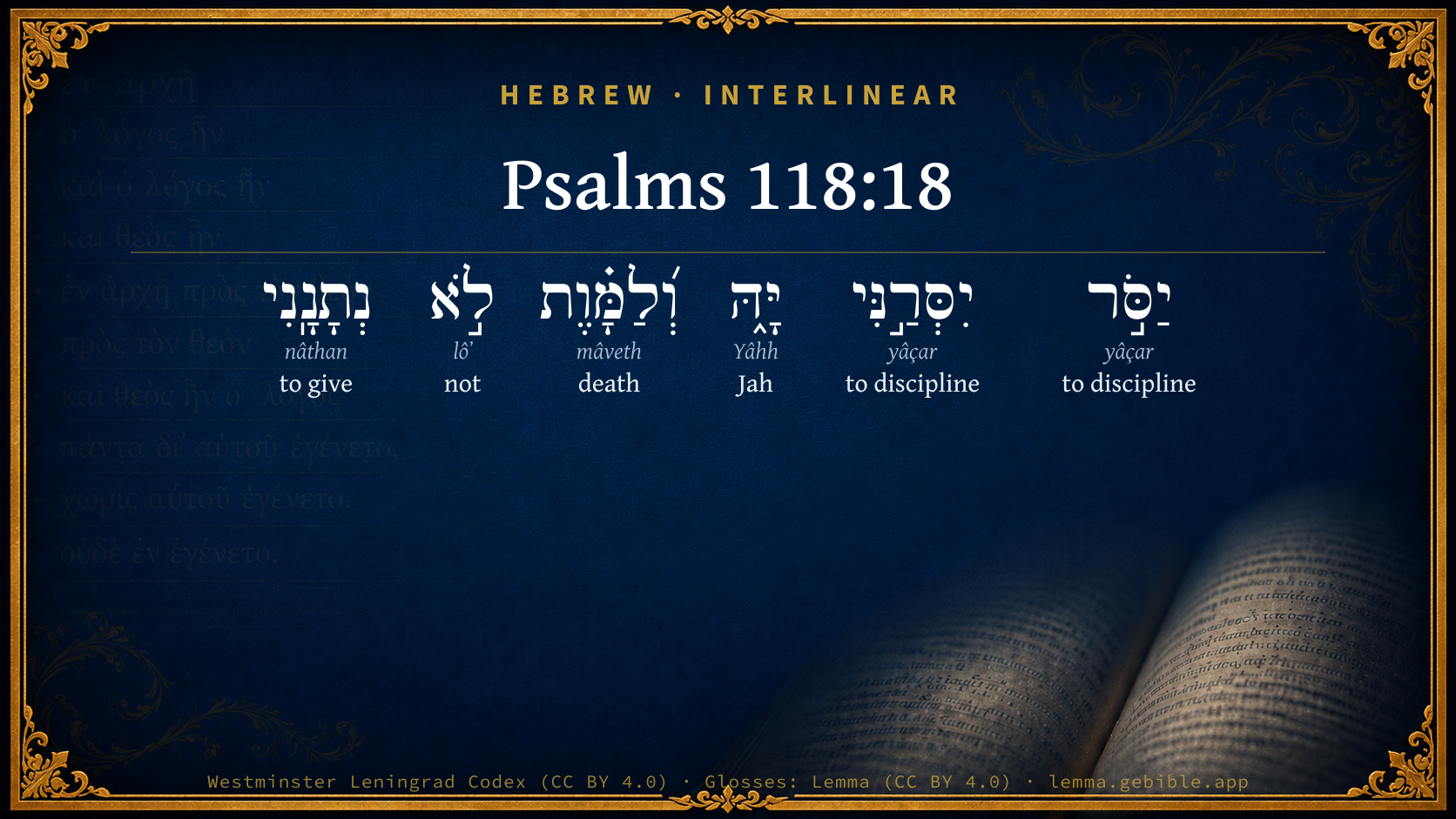
Psalms 118:18

Hebrew (Westminster Leningrad Codex) Psalms 118:18 appears in the Hebrew Old Testament. The text above is from the Westminster Leningrad Codex. Each word links to its Strong’s number, a concise gloss, and parsing drawn from the Open Scriptures Hebrew Bible morphology. Click any word for its full Brown-Driver-Briggs (BDB) entry.
Download image
Cite this verse

Psalms 118:18 (World English Bible). Public Domain. Lemma interlinear Bible study tool, https://lemma.gebible.app/v/psalms/118/18.

Show BibTeX & RIS
BibTeX
RIS
English Translation
Yah has punished me severely, But he has not given me over to death.
World English Bible · Public Domain
Download a study sheet

One document with this verse’s original text, its word-by-word gloss line, the meaning frame, cross-references with their text, attributed commentary, and full source and license credits — printable, and it pastes into notes with its structure intact.

This verse Autodidact and up

Study sheet (.html) Plain text (.txt)

A passage Seminary Student

Up to 50 verses in one chapter. A passage sheet keeps up to 6 commentary sources and 12 cross-references per verse, in the order this page ranks them, and says so on the sheet whenever that leaves anything out. Ask for a single verse and you get the Autodidact verse sheet above.

Everything on this page stays free to read, with no account — the sheet is a download of what is already on screen, not access to it.

Want to remove ads? Support Godless Engineer
Compare translations 3

The same verse in 3 English versions, stacked beneath the original-language interlinear above. Click any original word for its lexicon entry.

Each is an independent rendering of the whole verse — the interlinear is not word-aligned to these translations.

Highlighted words mark where these versions differ — a whole-verse word diff, not a word-by-word alignment.

  • World English Bible Public Domain
    Yah has punished me severely, But he has not given me over to death.
  • King James Version Public Domain
    The LORD hath chastened me sore: but he hath not given me over unto death.
  • unfoldingWord Literal Text CC BY-SA 4.0
    To chastise, Yah has chastised me; but to death he has not given me.

unfoldingWord Literal Text — © unfoldingWord, licensed CC BY-SA 4.0. Word-aligned USFM3 via Door43 (git.door43.org/unfoldingWord/en_ult).

Versions to compare (up to 4)

3 of 4 selected

Show all 18 translations

Every available English version of this verse, each an independent rendering of the whole verse.

  • World English Bible Public Domain
    Yah has punished me severely, But he has not given me over to death.
  • Berean Standard Bible Public Domain
    The LORD disciplined me severely, but He has not given me over to death.
  • Majority Standard Bible Public Domain
    The LORD disciplined me severely, but He has not given me over to death.
  • King James Version Public Domain
    The LORD hath chastened me sore: but he hath not given me over unto death.
  • American Standard Version (1901) Public Domain
    Jehovah hath chastened me sore; But he hath not given me over unto death.
  • Revised Version (1885) Public Domain
    The LORD hath chastened me sore: but he hath not given me over unto death.
  • Geneva Bible (1599) Public Domain
    The Lord hath chastened me sore, but he hath not deliuered me to death.
  • Douay-Rheims (1899) Public Domain
    The Lord chastising hath chastised me: but he hath not delivered me over to death.
  • Young's Literal Translation Public Domain
    Jah hath sorely chastened me, And to death hath not given me up.
  • Literal Standard Version CC BY-SA 4.0
    YAH has severely disciplined me, || And has not given me up to death.
  • Unlocked Literal Bible CC BY-SA 4.0
    Yahweh has punished me harshly; but he has not handed me over to death.
  • unfoldingWord Literal Text CC BY-SA 4.0
    To chastise, Yah has chastised me; but to death he has not given me.
  • Darby Bible Public Domain
    Jah hath chastened me sore; but he hath not given me over unto death.
  • World Messianic Bible Public Domain
    The LORD has punished me severely, but he has not given me over to death.
  • Webster's Bible Public Domain
    The LORD hath chastened me severely: but he hath not given me over to death.
  • Free Bible Version CC BY-SA 4.0
    Even though the Lord punished me severely, he did not let me die.
  • Bible in Basic English Public Domain
    The hand of Jah has been hard on me; but he has not given me up to death.
  • JPS Tanakh (1917) Public Domain
    The LORD hath chastened me sore; but He hath not given me over unto death.

Literal Standard Version (2020), Covenant Press — licensed CC BY-SA 4.0. Text via the HelloAO Bible API (eBible.org). Unlocked Literal Bible (unfoldingWord) — licensed CC BY-SA 4.0. Text via the HelloAO Bible API (eBible.org). unfoldingWord Literal Text — © unfoldingWord, licensed CC BY-SA 4.0. Word-aligned USFM3 via Door43 (git.door43.org/unfoldingWord/en_ult). Free Bible Version, Dr. Jonathan Gallagher — licensed CC BY-SA 4.0. Text via the HelloAO Bible API (eBible.org).

Word by word

More ways to search: Search by grammar → Find every occurrence → Compare this word →

Practice this passage: Drill this verse → Learn its vocabulary →

About this verse

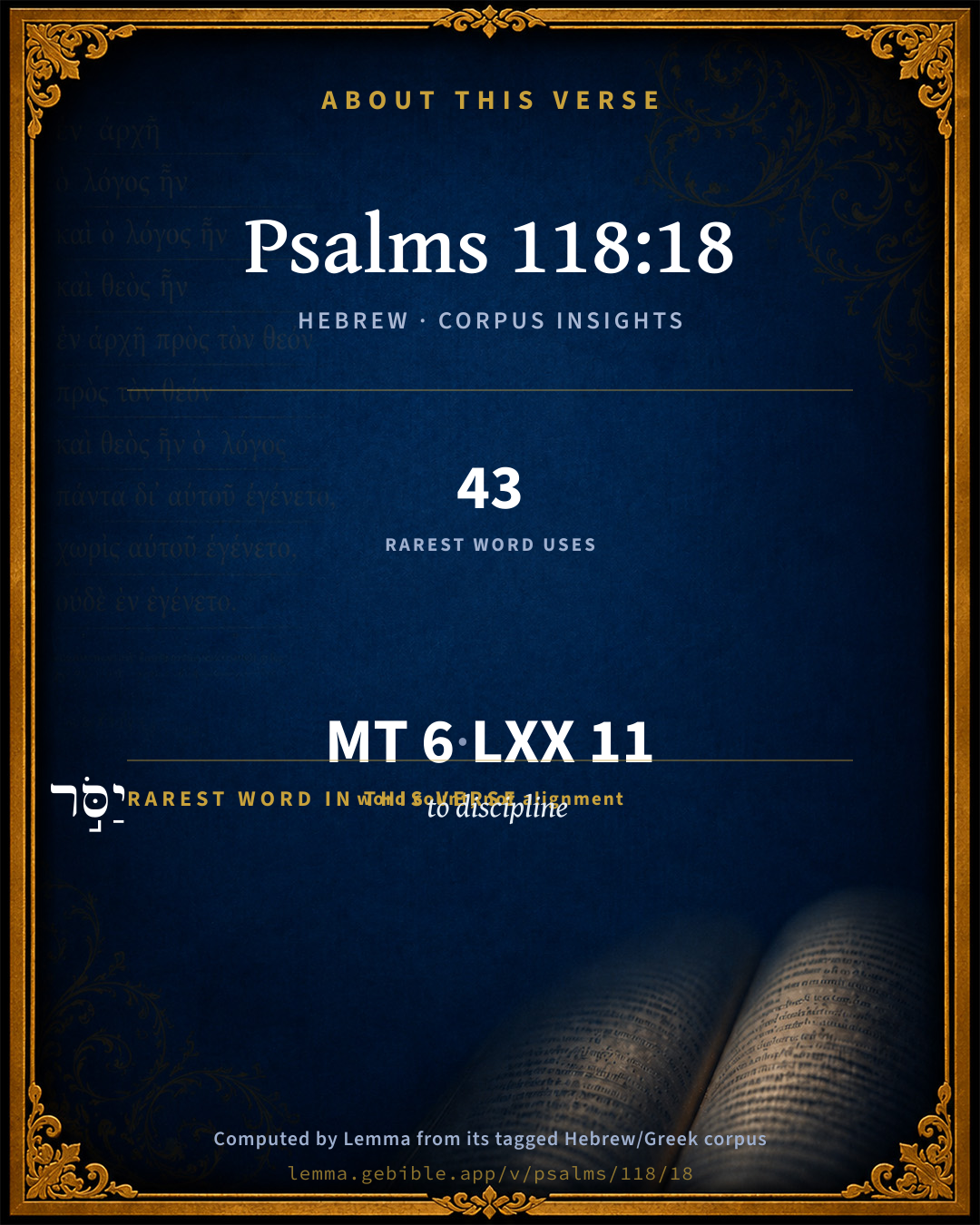
These counts appear in no published source. They are computed here, from the morphology-tagged text and Lemma’s own curated glosses. What Lemma adds →

6
words
5
distinct lemmas
Wisdom
section

Shared distinctive vocabulary

יַסֹּ֣ר to discipline H3256 occurs in 38 verses of the Hebrew Bible. Also found in:

Grammatical profile

  • 3 verbs
  • 2 nouns
  • 1 particle

Verb forms

  • יַסֹּ֣ר Piel · Infinitive Absolute
  • יִסְּרַ֣נִּי Piel · Perfect
  • נְתָנָֽנִי Qal · Perfect

Repetition

A word recurs within this verse — often emphatic in Hebrew:

  • יַסֹּ֣ר to discipline H3256 ×2

Hebrew & Septuagint length

In English translation the verse runs 14 words from the Hebrew and 15 from the Septuagint (LXX English) — closely comparable.

A rough comparison of the two English renderings, which tokenize alike — not a word-level alignment.

Word counts can differ between the Hebrew and the Greek without any difference in meaning — e.g. the Hebrew direct-object marker אֵת has no separate Greek word, and Greek often adds the article ὁ.

In the original languages it is 6 Hebrew tokens and 11 Greek tokens — but the two are counted differently (Hebrew bundles its prefixes and suffixes into one token; the Greek is in lemma form), so that isn’t a like-for-like length.

Cross-references

13

Topical passages linked to Psalms 118:18 in the Treasury of Scripture Knowledge — connected by theme and wording, ordered by reader-vote popularity; previews shown in the World English Bible.

  • 1 Corinthians 11:32 But when we are judged, we are punished by the Lord, that we may not be condemned with the world.
  • Job 5:17–18 "Behold, happy is the man whom God corrects: Therefore do not despise the chastening of the Almighty.
  • 2 Corinthians 6:9 as unknown, and yet well known; as dying, and behold, we live; as punished, and not killed;
  • Proverbs 3:11–12 My son, don't despise Yahweh's discipline, Neither be weary of his reproof:
  • Psalms 94:12–13 Blessed is the man whom you discipline, Yah, And teach out of your law;
  • 2 Corinthians 1:9–11 Yes, we ourselves have had the sentence of death within ourselves, that we should not trust in ourselves, but in God who raises the dead,
  • Psalms 66:10–12 For you, God, have tested us. You have refined us, as silver is refined.
  • Jonah 2:6 I went down to the bottoms of the mountains. The earth barred me in forever: Yet have you brought up my life from the pit, Yahweh my God.
  • Job 33:16–30 Then he opens the ears of men, And seals their instruction,
  • 2 Samuel 12:10 Now therefore the sword will never depart from your house, because you have despised me, and have taken the wife of Uriah the Hittite to be your wife.'
  • 2 Samuel 13:1–39 It happened after this, that Absalom the son of David had a beautiful sister, whose name was Tamar; and Amnon the son of David loved her.
  • Hebrews 12:10–11 For they indeed, for a few days, punished us as seemed good to them; but he for our profit, that we may be partakers of his holiness.
  • 2 Samuel 16:1–23 When David was a little past the top [of the ascent], behold, Ziba the servant of Mephibosheth met him, with a couple of donkeys saddled, and on them two hundred loaves of bread, and one hundred clusters of raisins, and one hundred summer fruits, and a bottle of wine.

Cross-references courtesy of OpenBible.info (CC BY 4.0).

Hebrew and Greek witnesses Masoretic Hebrew ↔ Greek Septuagint

The same verse in the two great witnesses to the Old Testament, shown verse-for-verse.

You’re reading Greek Psalm 117 (Hebrew Psalm 118). The Septuagint counts the superscription, so verse numbers can differ from the Hebrew — chapter-level alignment, not verse-by-verse. Numbering follows Rahlfs.

These are two independent witnesses, not word-aligned to each other, and the Septuagint is shown in lemma (dictionary) form.

Hebrew Psalms 118:18 Masoretic · Westminster Leningrad Codex

יַסֹּ֣ר יִסְּרַ֣נִּי יָּ֑הּ וְ֝לַמָּ֗וֶת לֹ֣א נְתָנָֽנִי

Yah has punished me severely, But he has not given me over to death.

World English Bible · Public Domain

Greek LXX Greek Psalm 117:18 Septuagint · lemma form

παιδεύω παιδεύω ἐγώ ὁ κύριος καί ὁ θάνατος οὐ παραδίδωμι ἐγώ

The Lord has chastened me sore: but he has not given me up to death.

LXX2012 (modern English Septuagint) · Public Domain

Hebrew: Westminster Leningrad Codex (CC BY 4.0). Greek: Septuagint (public domain); English from LXX2012 (modern English Septuagint) (Public Domain). How the Septuagint differs from the Hebrew →

Commentary

Notes on Psalms 118:18 from classic Christian and Jewish commentators (each source and its license shown beneath its notes). The classic Christian expositions comment on the surrounding passage and are grouped to its opening verse, so a note may address several verses; the Jewish commentaries on the Tanakh (Rashi and others) are per-verse, so they appear only where the commentator wrote on this verse.

Lemma curates 59 commentaries, every one of them public domain or Creative Commons licensed, each selected and text-cleaned for this edition rather than reprinted as found. About our sources →

Trapp's Complete Commentary

John Trapp

Psa 118:18 The LORD hath chastened me sore: but he hath not given me over unto death.

Ver. 18. The Lord hath chastened me sore] Corripuit me seria et severa castigatione; and yet David was his darling.

But he hath not given me over unto death] It might have been worse, may the afflicted saint say; and it will yet be better: It is in mercy and in measure that God chastiseth his children. It is his care that the spirit fail not before him, nor the souls which he hath made, Isa 57:16. If his child swoons in the whipping God lets fall the rod, and falls a kissing it, to fetch life into it again.

John Trapp, A Commentary or Exposition upon All the Books of the Old and New Testament (1647–1656) — public domain. Text from a community e-Sword module.

The Biblical Illustrator

Joseph S. Exell

Psa_118:18

The Lord hath chastened me sore: but He hath not given me over unto death.

The afflictions of Gods people

I. The condition.

1. The Author of it. Affliction comes not out of the dust; God is the Inflicter of all evils and crosses upon us.

(1) Look up to the Lord in every affliction and labour So see Him in it.

(2) Here is matter of comfort to the servants of God: that whosoever, or whatsoever may be the instrument, God Himself is the principal cause of every trouble to them. It is the cup which their Father gives them to drink, and therefore they may be sure that it is well mingled and tempered for them.

2. The nature of it--a chastening, for the better rule and government of His family. (l) To wean us from the world, and an inordinate love of things below.

(2) To embitter sin to us, and subdue corruption.

(3) For examples to others--

(a) of warning, that they may avoid and take heed of the like provocations;

(b) of patience, that they may be strengthened to endure the like afflictions.

3. The aggravation.

(1) The frequency of these chastenings, not once only, but often, even again and again.

(2) The multitude of these chastenings, not one single one only, but many, one in the neck of another.

(3) The grievousness and tediousness of them, not some light ones only, but such as were very irksome and hard to be borne.

II. The qualification. But He hath not given me over unto death. Consider these words--

1. In their connection, add so they are a qualification of those that went before, and they serve to show unto us the manner of Gods dealings with His people, which is to mitigate His afflictions of them, and to correct them still in measure; He chastens them but does not undo them. Thus (2Co_6:9; 2Co_4:8-9; 1Co_10:13; Lam_3:32).

(1) Gods aim and intent is not destruction but reformation, which death doth hinder and prevent the opportunities of, unto us.

(2) As God does thus mitigate His corrections in wisdom, so also in mercy, because He is a gracious God, and He continues still so to be without alteration (Lam_3:22; Mal_3:6).

2. Absolutely. He hath not given me over unto death.

(1) Out of His goodness, and mercy, and love to His people.

(2) Because He has work and service for them to do.

(3) For the good and comfort of their friends. (T. Hereon, D. D.)

The Biblical Illustrator, edited by Joseph S. Exell (c. 1880s–1900s) — public domain. Text from a community e-Sword module.

J. A. Alexander on Psalms

Joseph Addison Alexander

18. (Psa 118:18) Surely has Jah chastened me, but to death did not give me. This verse, though simple in its structure and transparent in its meaning, is highly idiomatic in its form. The adverb used in the translation represents the emphatic repetition of the verb in Hebrew, which is sometimes imitated in the English Bible (chastening has Jah chastened me), but seldom so as to convey the whole idea. Of such a repetition we have had an instance in Psa 118:13. Another unavoidable departure from the original form consists in using but for and, at the beginning of the second clause. Did not give, give up, give over or abandon. The chastisement here mentioned must be the calamity from which the people had been recently delivered, and in which we have already seen good grounds to recognise the Babylonish conquest, domination and captivity.

Joseph Addison Alexander, The Psalms Translated and Explained (1850) — public domain. Text from a community e-Sword module.

John Calvin's Commentaries

18. In chastising God has chastised me. In these words David owns that his enemies assailed him unjustly, that they were employed by God to correct him, that this was fatherly chastisement, God not inflicting a deadly wound, but correcting him in measure and in mercy. He seems to anticipate the perverse decisions of perverse men which grievously pressed upon him, as if all the ills which he had endured were so many evidences of his being cast off by God. These calumnies which the reprobate cast upon him he applies very differently, by declaring that his correction was mild and paternal. The main thing in adversity is to know that we are laid low by the hand of God, and that this is the way which he takes to prove our allegiance, to arouse us from our torpidity, to crucify our old man, to purge us from our filthiness, to bring us into submission and subjection to God, and to excite us to meditate on the heavenly life.

If these things were recollected by us, there is not one of us who would not shudder at the thought of fretting against God, but would much rather yield submission to him with a mild and meek spirit. Our champing the bit, and rushing forward impatiently, certainly proceeds from the majority of men not looking upon their afflictions as God’s rods, and from others not participating in his paternal care. The last clause of the verse, therefore, merits particular attention, That God always deals mercifully with his own people, so that his correction proves their cure. Not that his paternal regard is always visible, but that in the end it will be shown that his chastisements, so far from being deadly, serve the purpose of a medicine, which, though it produce a temporary debility, rids us of our malady, and renders us healthy and vigorous.

John Calvin's Commentaries (1540-1563) — public domain. Text from the Calvin Translation Society English edition (1840s-50s) via the Christian Classics Ethereal Library (ccel.org). Calvin's coverage is partial (roughly two-thirds of the Bible); uncommented books and verses are honest gaps, never fabricated. The 19th-century editor's footnotes and remarks are omitted so the notes are faithfully Calvin's own voice.

John Gill's Exposition

This gate of the Lord, into which the righteous shall enter. This seems to be spoken by some other person or persons, distinct from David and the Messiah, pointing at some particular and principal gate, upon hearing the above word: by which is meant, not the gate of the house of the sanctuary of the Lord, as the Targum; but the Messiah himself, afterwards spoken of as the stone rejected by the builders, and made the head of the corner; who is the way of access to God; the door into the church or sheepfold; the strait gate that leads to eternal life; by which none but righteous persons enter into heaven; even such who are made righteous, through the imputation of his righteousness to them; see Joh 10:1.

.

Psalms 118:21

psa 118:21

psa 118:21

psa 118:21I will praise thee, for thou hast heard me,.... Here the psalmist reassumes his part in this song, and determines to praise the Lord for hearing him when in distress, and when he was encompassed with his enemies, and for delivering him out of their hands;

and art become my salvation; the author of it, and therefore deserving of praise; and who is no other than the Messiah Jesus, who is described in the next verse.

John Gill's Exposition of the Whole Bible (1746–1763) — public domain (CC PDM 1.0). Text via the HelloAO Bible API.

Albert Barnes' Notes on the Bible

The Lord hath chastened me sore - Hebrew, “The Lord has chastened - has chastened me.” See the notes at Psa 118:13. The psalmist had been greatly afflicted, and he now looked upon his affliction in the light of a fatherly chastisement or correction. It had been a severe trial, and he was not insensible to its severity, though he regarded it as designed for his own good.

But he hath not given we over unto death - He interposed when I was in danger; he rescued me when I was on the verge of the grave. This is the close of the psalmist’s statement in regard to the divine dealings with him. He had passed through great danger; he had been sorely afflicted; but he had been rescued and spared, and he came now to express his thanks to God for his recovery. In the following verse he addresses those who had the care of the sanctuary, and asks that he might be permitted to enter and offer his thanks to God.

Albert Barnes' Notes on the Bible (1834–1885) — public domain. Text from a community e-Sword/MySword module.

Matthew Poole's English Annotations

Hath chastened me sore by the hands of mine enemies, whom God used to that very purpose for my greater good, and their own greater and surer ruin and confusion.

Matthew Poole's English Annotations on the Holy Bible (1683–1685) — public domain. Text from a community e-Sword/MySword module.

The Treasury of David

Charles H. Spurgeon

Ver. 18. The LORD hath chastened me sore. This is faith's version of the former passage, "Thou hast thrust sore at me; "for the attacks of the enemy are chastisements from the hand of God. The devil tormented Job for his own purposes, but in reality the sorrows of the patriarch were chastisements from the Lord. "Chastening, Jah hath chastened me, "says our poet: as much as to say that the Lord had smitten him very severely, and made him sorrowfully to know the full weight of his rod. The Lord frequently appears to save his heaviest blows for his best beloved ones; if any one affliction be more painful than another it falls to, the lot of those whom he most distinguishes in his service. The gardener prunes his best roses with most care. Chastisement is sent to keep successful saints humble, to make them tender towards others, and to enable them to bear the high honours which their heavenly Friend puts upon them.

But he hath not given me over unto death. This verse, like the thirteenth, concludes with a blessed "but, "which constitutes a saving clause. The Psalmist felt as if he had been beaten within an inch of his life, but yet death did not actually ensue. There is always a merciful limit to the scourging of the sons of God. Forty stripes save one were all that an Israelite might receive, and the Lord will never allow that one, that killing stroke, to fall upon his children. They are "chastened, but not killed"; their pains are for their instruction, not for their destruction. By these things the ungodly die, but gracious Hezekiah could say, "By these things men live, and in all these things is the life of my spirit." No, blessed be the name of God, he may chastise us, but he will not condemn us; we must feel the smarting rod, but we shall not feel the killing sword. He does not give us over unto death at any time, and we may be quite sure that he has not done so while he condescends to chasten us, for if he intended our final rejection he would not take the pains to place us under his fatherly discipline. It may seem hard to be under the afflicting rod, but it would be a far more dreadful thing if the Lord were to say, "He is given unto idols, let him alone." Even from our griefs we may distil consolation, and gather sweet flowers from the garden in which the Lord has planted salutary rue and wormwood. It is a cheering fact that if we endure chastening God dealeth with us as with sons, and we may well be satisfied with the common lot of his beloved family.

The hero, restored to health, and rescued from the dangers of battle, now lifts up his own song unto the Lord, and asks all Israel, led on by the goodly fellowship of the priests, to assist him in chanting a joyful Te Deum.

Ver. 18. The LORD hath chastened me sore. Strong humours require strong physic to purge them out. Where corruption is deeply rooted in the heart, a light or small matter will not serve the turn to work it out. No; but a great deal of stir and ado must be made with it. Thomas Horton.

Ver. 18. But he hath not given me over unto death. It might have been worse, may the afflicted saint say, and it will yet be better; it is in mercy and in measure that God chastiseth his children. It is his care that "the spirit fail not before him, nor the souls which he hath made, "Isa 57:16. If his child swoons in the whipping, God lets fall the rod, and falls a kissing it, to fetch life into it again. John Trapp.

Ver. 18.

1. The afflictions of the people of God are chastisements: "The Lord hath chastened me."

2. Those chastisements are often severe: hath chastened me sore.

3. The severity is limited: "it is not unto death." G. R.

Psalms 118:19*

Ver 19. Open to me the gates of righteousness. The grateful champion having reached the entrance of the temple, asks for admission in set form, as if he felt that he could only approach the hallowed shrine by divine permission, and wished only to enter in the appointed manner. The temple of God was meant for the righteous to enter and offer the sacrifices of righteousness, hence the gates are called the gates of righteousness. Righteous deeds were done within its walls and righteous teachings sounded forth from its courts. The phrase "the gate is sometimes used to signify power or empire"; as, for instance, "the Sublime Porte" signifies the seat of empire of Turkey; the entrance to the temple was the true Sublime Porte, and what is better, it was the porta justitiae, the gate of righteousness, the palace of the great King, who is in all things just.

I will go into them, and I will praise the LORD. Only let the gate be opened, and the willing worshipper will enter; and he will enter in the right spirit, and for the best of purposes, that he may render homage unto the Most High. Alas, there are multitudes who do not care whether the gates of God's house are opened or not; and although they know that they are opened wide they never care to enter, neither does the thought of praising God so much as cross their minds. The time will come for them when they shall find the gates of heaven shut against them, for those gates are peculiarly the gates of righteousness through which there shall by no means enter anything that defileth. Our champion might have praised the Lord in secret, and doubtless he did so; but he was not content without going up to the assembly, there to register his thanksgivings. Those who neglect public worship generally neglect all worship; those who praise God within their own gates are among the readiest to praise him within his temple gates. Our hero had also in all probability been sore sick, and therefore like Hezekiah he says, "The Lord was ready to save me: therefore we will sing my songs to the stringed instruments all the days of my life in the house of the Lord." Public praise for public mercies is every way most appropriate, most acceptable to God, and most profitable to others.

Charles H. Spurgeon's The Treasury of David (1869–1885) — public domain. Psalms only. Text from a community e-Sword/MySword module.

Whedon's Commentary on the Bible

Daniel D. Whedon

18. Unto death—Still the image of death, so recently escaped, (Psa_118:17,) is before him. There is a wonderful freshness and life in this psalm. It is the recital of experience.

Daniel D. Whedon (gen. ed.), Commentary on the Old and New Testaments (1874–1909) — public domain. Text from a community e-Sword module.

The Pulpit Commentary

The Lord hath chastened me sore. By the long sufferings of the Captivity. But he hath not given me over unto death (see the comment on ver. 17).

What God seems to be and what God is.

We are constantly oppressed with the mystery of God"s permissions. He permits afflictions to visit us, and often times to take very trying forms. We can say, "He hath chastened me sore." But it is a great relief to find that our experience is but the experience of the saints of all ages. It is the old and age-long trouble of all who will live godly in this sinful world. God must put them into discipline, and the forms it takes must, of necessity, sometimes seem strange. Divine dealings would not always do their appointed work if we thoroughly understood them. There is no call to trust when we have perfect sight. "What I do thou knowest not now." In the olden days, and still, there appear, to the godly man, most oppressive differences between what God seems, and what God is. We are distressed while we do but look at what God seems, and we gain rest when we look at what God is.

I WHAT GOD SEEMS. Illustrate from the mists of mountain-lands. "Clouds and darkness are round about him". (Psa_97:2)

1. See what God seems in nature. Take single things, and we may easily get wrong impressions. Look at nature as a whole, and it becomes clear that all things are working together towards issues that are right and good.

2. See what God seems in human lives. Take single incidents an untimely death; a sweeping pestilence; a crushed enterprise: a wasting sickness; and it seems as if there were nothing but "cloud and darkness," the mystery of a strange and unreasoning sovereignty round God and his ways. But look at life as a whole, and it soon comes into view that this thing is working in with that, and all are working together for good, through the controlling of him who is love and who loves. Only, if we would see things clearly, and apprehend them aright, we must keep two things in mind.

(1) That God"s good is not circumstance; it is character, which finds expression in varying circumstance.

(2) For some of us God"s idea may be our vicarious suffering for the sake of others. And of this the Lord Jesus affords the sublime example. Affliction is often an insoluble mystery (as was Job"s affliction), until it is seen to be Divine agency for working good to others. And God graciously honors some to suffer as his agents.

3. See what God seems in Divine revelations. Here again single things are often most perplexing, because their form and shaping are, in the first instance, precisely fitted to times and seasons, and we find it so difficult to separate the form from the thing, the kernel from the husk. Single things can only be "parts of God"s ways." But to us, in these latter days, the revelations of all the ages have been given, duly set m order and relation. We ought to be able to fit so many things of Divine revelation together, as to fully convince ourselves that all do fit.

II WHAT GOD IS. This we find out through personal experiences. "He hath not given me over unto death," though he seems to be a "sore chastener." Experiences correct appearances. "I have heard of thee by the hearing of the ear; but now mine eye seeth thee." "We walk by faith soul-vision, which reveals what is "not by sight bodily vision, which only reveals what seems. To some the clouds about Sinai were God; just as to some travelers the mists hanging about the mountain are the mountain. We want to know what God is. "This is eternal life, to know thee, the only true God." And it is infinite satisfaction to discover that he is righteousness. And righteousness involves and includes love, as certainly as it does holiness and wisdom. When we find for ourselves what God is, we can describe him thus: "The Being who is always right;" or, as a psalmist expresses it, "Righteousness and judgment are the foundation of his throne." He is right in himself, "just;" and right in his doings, ever doing justice and justice is not justice unless mercy is at the heart of it. When this is well fixed into our very mind and soul, then we get above and beyond all the evil influence of the things that seem; we begin to get vision of the things that are. Right may still seem stern; but we know it must be kind. Right may still seem strange; but we know it must be wise. We cannot stop with this hath chastened me sore." We must go on; we must say what else what is the full fact, what is! And then we have to say, "But he hath not given me over unto death. R.T.

The Pulpit Commentary (1880–1919), ed. H.D.M. Spence-Jones & Joseph S. Exell — public domain. Text from a community e-Sword module.

Rashi

Rabbi Shlomo Yitzchaki (Rashi)

God has chastised me in exile, and there all my iniquities were expiated, and You did not deliver me to death.

Rashi on the Tanakh — English translations: “The Judaica Press complete Tanach with Rashi, translated by A. J. Rosenberg” (CC BY 4.0); “Pentateuch with Rashi's commentary by M. Rosenbaum and A.M. Silbermann, 1929-1934” (public domain); “The Metsudah Tanach series, Lakewood, N.J” (CC BY 4.0); and “The Book of Joshua, Metsudah Publications, 1997” (CC BY 4.0). Text via Sefaria.

Lesson kit

Teaching starters — assembled from the data on this page, not authored interpretation. Every prompt links to the verse data it draws on. Edit before teaching.

Psalms, in the Wisdom, opens this verse with 6 words (5 distinct Hebrew lemmas). Its most distinctive word is yâçar (“to discipline”). A historical commentator’s framing appears above. Read the whole chapter for the surrounding context.

Discussion questions

  1. How does “to discipline” (yâçar) shape what this verse is saying?
  2. How does Leviticus 26:18, which shares the word «to discipline», read alongside this verse?
  3. What does the repetition of “to discipline” (2× in this one verse) do in this verse?
  4. These translations render this verse differently. What is at stake in choosing one wording over another?
  5. «יַסֹּ֣ר» is a Piel Infinitive Absolute verb. How does that grammatical form shape the action described?
  6. Compare how Trapp's Complete Commentary and The Biblical Illustrator read this verse. Where do they agree or differ?

Things to notice

Reading settings

Reading text

Shown beneath each verse's original-language words.

Old Testament
Old Testament edition

Read the OT as the Masoretic Hebrew (MT) or the Greek Septuagint (LXX).

English shown for the Greek Septuagint (in the Hebrew ↔ Greek comparison).

Comparing translations? Open the Compare panel on any verse page to stack up to four side by side.