
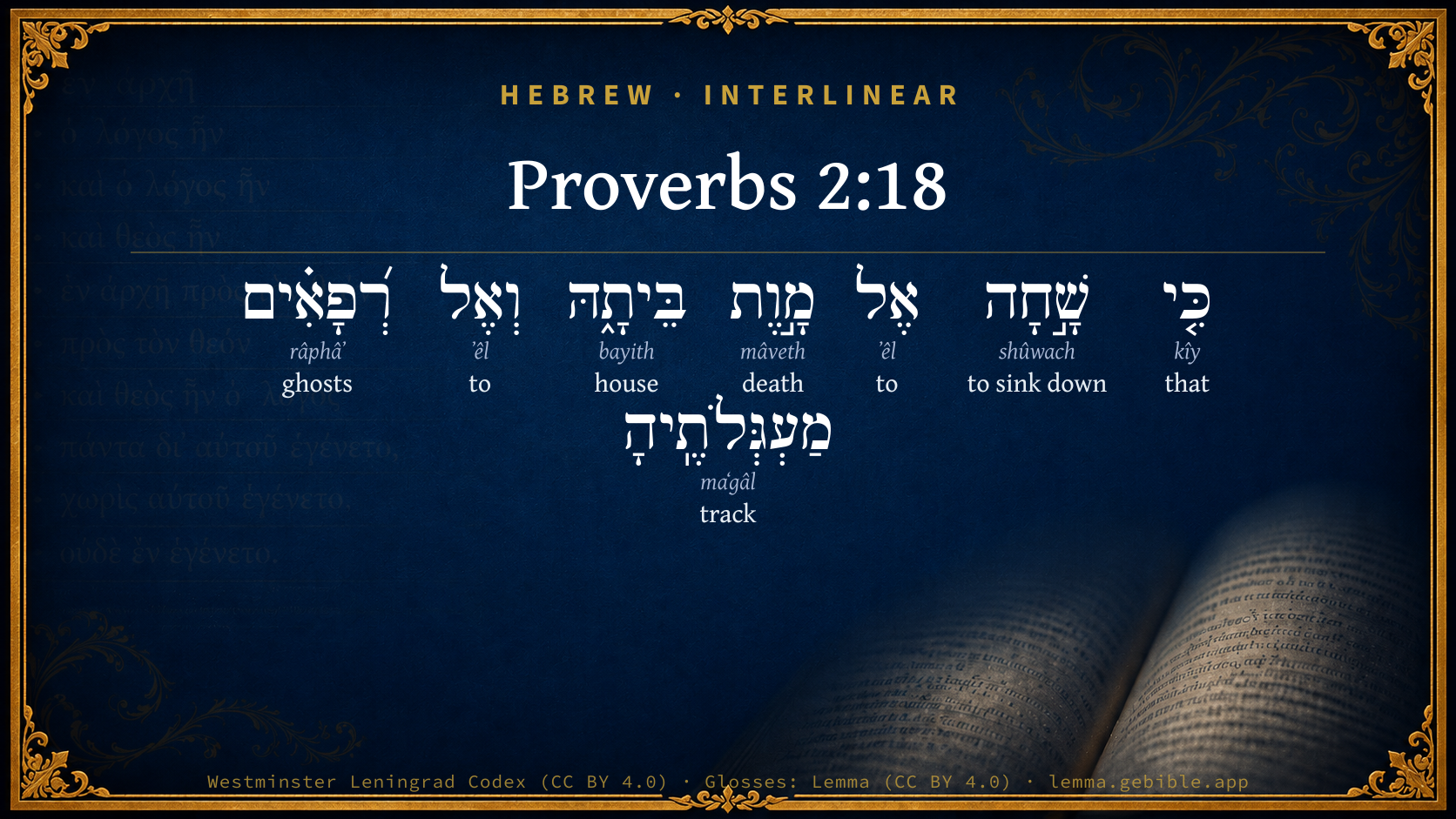
Proverbs 2:18

Hebrew (Westminster Leningrad Codex) Proverbs 2:18 appears in the Hebrew Old Testament. The text above is from the Westminster Leningrad Codex. Each word links to its Strong’s number, a concise gloss, and parsing drawn from the Open Scriptures Hebrew Bible morphology. Click any word for its full Brown-Driver-Briggs (BDB) entry.
Download image
Cite this verse

Proverbs 2:18 (World English Bible). Public Domain. Lemma interlinear Bible study tool, https://lemma.gebible.app/v/proverbs/2/18.

Show BibTeX & RIS
BibTeX
RIS
English Translation
For her house leads down to death, Her paths to the dead.
World English Bible · Public Domain
Download a study sheet

One document with this verse’s original text, its word-by-word gloss line, the meaning frame, cross-references with their text, attributed commentary, and full source and license credits — printable, and it pastes into notes with its structure intact.

This verse Autodidact and up

Study sheet (.html) Plain text (.txt)

A passage Seminary Student

Up to 50 verses in one chapter. A passage sheet keeps up to 6 commentary sources and 12 cross-references per verse, in the order this page ranks them, and says so on the sheet whenever that leaves anything out. Ask for a single verse and you get the Autodidact verse sheet above.

Everything on this page stays free to read, with no account — the sheet is a download of what is already on screen, not access to it.

Want to remove ads? Support Godless Engineer
Compare translations 3

The same verse in 3 English versions, stacked beneath the original-language interlinear above. Click any original word for its lexicon entry.

Each is an independent rendering of the whole verse — the interlinear is not word-aligned to these translations.

Highlighted words mark where these versions differ — a whole-verse word diff, not a word-by-word alignment.

  • World English Bible Public Domain
    For her house leads down to death, Her paths to the dead.
  • King James Version Public Domain
    For her house inclineth unto death, and her paths unto the dead.
  • unfoldingWord Literal Text CC BY-SA 4.0
    For her house sinks down to death and her tracks, to the spirits of dead ones.

unfoldingWord Literal Text — © unfoldingWord, licensed CC BY-SA 4.0. Word-aligned USFM3 via Door43 (git.door43.org/unfoldingWord/en_ult).

Versions to compare (up to 4)

3 of 4 selected

Show all 18 translations

Every available English version of this verse, each an independent rendering of the whole verse.

  • World English Bible Public Domain
    For her house leads down to death, Her paths to the dead.
  • Berean Standard Bible Public Domain
    For her house sinks down to death, and her tracks to the departed spirits.
  • Majority Standard Bible Public Domain
    For her house sinks down to death, and her tracks to the departed spirits.
  • King James Version Public Domain
    For her house inclineth unto death, and her paths unto the dead.
  • American Standard Version (1901) Public Domain
    For her house inclineth unto death, And her paths unto the dead;
  • Revised Version (1885) Public Domain
    For her house inclineth unto death, and her paths unto the dead:
  • Geneva Bible (1599) Public Domain
    Surely her house tendeth to death, and her paths vnto the dead.
  • Douay-Rheims (1899) Public Domain
    And hath forgotten the covenant of her God: for her house inclineth unto death, and her paths to hell.
  • Young's Literal Translation Public Domain
    For her house hath inclined unto death, And unto Rephaim her paths.
  • Literal Standard Version CC BY-SA 4.0
    For her house has inclined to death, || And her paths to Rephaim.
  • Unlocked Literal Bible CC BY-SA 4.0
    For her house leads down to death and her tracks will lead you to those in the grave.
  • unfoldingWord Literal Text CC BY-SA 4.0
    For her house sinks down to death and her tracks, to the spirits of dead ones.
  • Darby Bible Public Domain
    -- for her house inclineth unto death, and her paths unto the dead;
  • World Messianic Bible Public Domain
    for her house leads down to death, her paths to the departed spirits.
  • Webster's Bible Public Domain
    For her house inclineth to death, and her paths to the dead.
  • Free Bible Version CC BY-SA 4.0
    What happens in her house leads to death; following her way leads to the grave.
  • Bible in Basic English Public Domain
    For her house is on the way down to death; her footsteps go down to the shades:
  • JPS Tanakh (1917) Public Domain
    For her house sinketh down unto death, and her paths unto the shades;

Literal Standard Version (2020), Covenant Press — licensed CC BY-SA 4.0. Text via the HelloAO Bible API (eBible.org). Unlocked Literal Bible (unfoldingWord) — licensed CC BY-SA 4.0. Text via the HelloAO Bible API (eBible.org). unfoldingWord Literal Text — © unfoldingWord, licensed CC BY-SA 4.0. Word-aligned USFM3 via Door43 (git.door43.org/unfoldingWord/en_ult). Free Bible Version, Dr. Jonathan Gallagher — licensed CC BY-SA 4.0. Text via the HelloAO Bible API (eBible.org).

Word by word

More ways to search: Search by grammar → Find every occurrence → Compare this word →

Practice this passage: Drill this verse → Learn its vocabulary →

About this verse

These counts appear in no published source. They are computed here, from the morphology-tagged text and Lemma’s own curated glosses. What Lemma adds →

8
words
7
distinct lemmas
Wisdom
section

Notable vocabulary

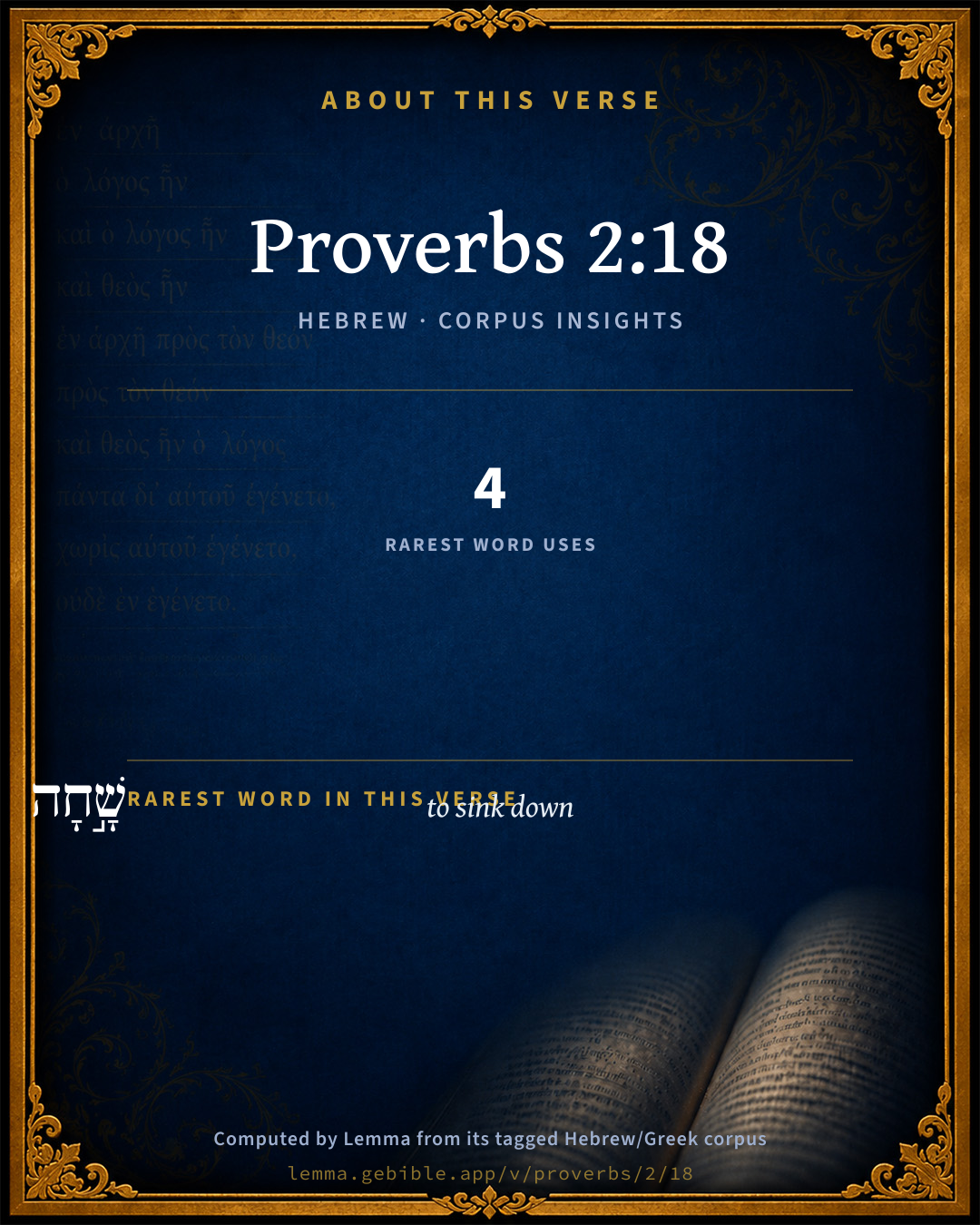
The rarest word here is שָׁ֣חָה to sink down H7743 — appearing just 4 times in the whole Hebrew Bible.

Shared distinctive vocabulary

שָׁ֣חָה to sink down H7743 occurs in 3 verses of the Hebrew Bible. Also found in:

Grammatical profile

  • 1 verb
  • 4 nouns
  • 2 prepositions
  • 1 conjunction

Verb forms

  • שָׁ֣חָה Qal · Perfect

Repetition

A word recurs within this verse — often emphatic in Hebrew:

  • אֶל to H413 ×2

Hebrew & Septuagint length

In English translation the verse runs 12 words from the Hebrew and 17 from the Septuagint (LXX English) — the Septuagint runs noticeably longer here. See the side-by-side →

A rough comparison of the two English renderings, which tokenize alike — not a word-level alignment.

Word counts can differ between the Hebrew and the Greek without any difference in meaning — e.g. the Hebrew direct-object marker אֵת has no separate Greek word, and Greek often adds the article ὁ.

Cross-references

9

Topical passages linked to Proverbs 2:18 in the Treasury of Scripture Knowledge — connected by theme and wording, ordered by reader-vote popularity; previews shown in the World English Bible.

  • Proverbs 9:18 But he doesn't know that the dead are there, That her guests are in the depths of Sheol.
  • 1 Corinthians 6:9–11 Or don't you know that the unrighteous will not inherit the Kingdom of God? Don't be deceived. Neither the sexually immoral, nor idolaters, nor adulterers, nor male prostitutes, nor homosexuals,
  • Proverbs 5:4–14 But in the end she is as bitter as wormwood, And as sharp as a two-edged sword.
  • Galatians 5:19–21 Now the works of the flesh are obvious, which are: adultery, sexual immorality, uncleanness, lustfulness,
  • Ephesians 5:5 Know this for sure, that no sexually immoral person, nor unclean person, nor covetous man, who is an idolater, has any inheritance in the Kingdom of Christ and God.
  • Revelation 21:8 But for the cowardly, unbelieving, sinners, abominable, murderers, sexually immoral, sorcerers, idolaters, and all liars, their part is in the lake that burns with fire and sulfur, which is the second death."
  • Proverbs 6:26–35 For a prostitute reduces you to a piece of bread. The adulteress hunts for your precious life.
  • Proverbs 7:22–27 He followed her immediately, As an ox goes to the slaughter, As a fool stepping into a noose.
  • Revelation 22:15 Outside are the dogs, the sorcerers, the sexually immoral, the murderers, the idolaters, and everyone who loves and practices falsehood.

Cross-references courtesy of OpenBible.info (CC BY 4.0).

Hebrew and Greek witnesses Masoretic Hebrew ↔ Greek Septuagint

The same verse in the two great witnesses to the Old Testament, shown verse-for-verse.

Here the Septuagint runs noticeably longer than the Hebrew — LXX2012 (modern English Septuagint) 17 words vs World English Bible 12. A rough length comparison of the two English translations, not a word-level alignment — read both below.

These are two independent witnesses, not word-aligned to each other, and the Septuagint is shown in lemma (dictionary) form.

Hebrew Proverbs 2:18 Masoretic · Westminster Leningrad Codex

כִּ֤י שָׁ֣חָה אֶל מָ֣וֶת בֵּיתָ֑הּ וְאֶל רְ֝פָאִ֗ים מַעְגְּלֹתֶֽיהָ

For her house leads down to death, Her paths to the dead.

World English Bible · Public Domain

Greek LXX Proverbs 2:18 Septuagint · lemma form

τίθημι γάρ παρά ὁ θάνατος ὁ οἶκος αὐτός καί παρά ὁ ᾅδης μετά ὁ γηγενής ὁ ἄξων αὐτός

For she has fixed her house near death, and guided her wheels near Hades with the giants.

LXX2012 (modern English Septuagint) · Public Domain

On this verse, Whedon's Commentary on the Bible discusses the Septuagint’s reading. Read the note in Commentary ↓

Hebrew: Westminster Leningrad Codex (CC BY 4.0). Greek: Septuagint (public domain); English from LXX2012 (modern English Septuagint) (Public Domain). How the Septuagint differs from the Hebrew →

Commentary

Notes on Proverbs 2:18 from classic Christian and Jewish commentators (each source and its license shown beneath its notes). The classic Christian expositions comment on the surrounding passage and are grouped to its opening verse, so a note may address several verses; the Jewish commentaries on the Tanakh (Rashi and others) are per-verse, so they appear only where the commentator wrote on this verse.

Lemma curates 59 commentaries, every one of them public domain or Creative Commons licensed, each selected and text-cleaned for this edition rather than reprinted as found. About our sources →

Trapp's Complete Commentary

John Trapp

Pro 2:18 For her house inclineth unto death, and her paths unto the dead.

Ver. 18. For her house inclineth unto death.] Terence calleth harlots Cruces, quia iuvenes macerent et offligant. Venery {a} is death’s best harbinger: Venus ab antiquis λυσιμελης dicta. She provideth, saith one, {b} not for those that are already born, but for those that shall be born. Of Pope Paul the Fourth, that old goat, it went for a byword, Eum per eandem partem animam profudisse, per quam acceperat. Pope John the Twelfth being taken with an adulteress, was stabbed to death by her husband. {c} Alexander the Great and Otho the Third test their lives by their lusts. But how many, alas! by this means have lost their souls. Fleshly lusts, by a specialty, "fight against the soul." {1Pe 2:12} And nothing hath so much enriched hell, saith one, as beautiful faces.

And her paths unto the dead.] Heb., El Rhephaim, to the giants: {d} To that part of hell where those damned monsters are, together with those sensual Sodomites, who, giving themselves over to fornication, and "going after strange flesh, are thrown forth, προκεινται, proiecti sunt, for an example, suffering the vengeance of eternal fire." {Jdg 1:7}

{a} The practice or pursuit of sexual pleasure; indulgence of sexual desire.

{b} Jacob. Revius.

{c} Barns.

{d} παρα τω Aδη μετα των γηγενων - Sept.

John Trapp, A Commentary or Exposition upon All the Books of the Old and New Testament (1647–1656) — public domain. Text from a community e-Sword module.

Joseph Benson's Commentary

Pro 2:18-19. For her house inclineth unto death — Conversation with her (which was most usual in her own house) is the certain way to death, which it brings many ways, and undoubtedly, without repentance, to God’s wrath and the second death. None that go unto her — That is, few or none; a hyperbolical expression, used Isa 64:7; return again — From her and from this wicked way unto God and his ways. Whoremongers and adulterers are very rarely brought to repentance, but are generally hardened by the power and deceitfulness of their sin, and by God’s just judgment, peculiarly inflicted upon such persons, Heb 13:4; neither take they hold of the paths of life — Of those courses which lead to true and eternal life and happiness.

Joseph Benson's Commentary on the Old and New Testaments (1811–1818) — public domain. Text from a community e-Sword module.

Tyndale Open Study Notes

Tyndale Open Resources

2:18-19 leads . . . to the grave: Adultery betrays a fundamental covenant with one’s spouse and with God (see also Gen 39:2-9; Mal 2:14).

Tyndale Open Study Notes — © Tyndale Open Resources, licensed CC BY-SA 4.0. Text via the HelloAO Bible API.

Geneva Bible (1599)

Geneva Bible translators

To them that are dead in body and soul.

Her acquaintance with her familiars, and them that haunt her.

Geneva Bible (1599) marginal notes — public domain. Text via Bolls.life.

Jamieson, Fausset & Brown

Robert Jamieson, A. R. Fausset & David Brown

inclineth--sinks down (compare Num 13:31).

the dead--or shades of the departed (Psa 88:10).

Jamieson, Fausset & Brown — Commentary Critical and Explanatory on the Whole Bible (1871) — public domain (CC PDM 1.0). Text via the HelloAO Bible API.

Adam Clarke's Commentary

Verse 18. For her house inclineth unto death] It is generally in by and secret places that such women establish themselves. They go out of the high road to get a residence; and every step that is taken towards their house is a step towards death. The path of sin is the path of ruin: the path of duty is the way of safety. For her paths incline unto the dead, רפאים repheim, the inhabitants of the invisible world. The woman who abandons herself to prostitution soon contracts, and generally communicates, that disease, which, above all others, signs the speediest and most effectual passport to the invisible world. Therefore it is said,

Adam Clarke's Commentary on the Bible (1810–1826) — public domain. Text from a community e-Sword/MySword module.

Ellicott's Commentary for English Readers

(18) For her house inclineth . . .—Rather, she sinks down with her house: house and all, like Dathan and Abiram.

Unto the dead.—In Hebrew the Rephâîm. The word may signify those “at rest” (comp. Job_3:17 : “There the weary are at rest”); or the “weak.” (Comp. Isa_14:10 : “Art thou also become weak as we?”)

A Bible Commentary for English Readers, edited by Charles John Ellicott (1878–1897) — public domain. Text from a community e-Sword module.

The Cambridge Bible for Schools and Colleges

gen. ed. J. J. S. Perowne

18. her house &c.] It is a steep descent, ending in death. The rendering of R.V. marg., she sinketh down unto death which is her house, is less forcible and impairs the parallelism.

the dead] Lit. the Rephaim. The Rephaim were among the Aborigines of Canaan (Gen_14:5; Gen_15:20) and were people of giant stature (Deu_2:11; Deu_2:20-21, R.V.). They may have come to be identified in the popular mind in the dim retrospect of the past, with the shadowy spectres that loomed large in Sheol (Isa_14:9, R.V. marg.). See Smith’s Dict. of Bible, Art. Rephaim.

The Cambridge Bible for Schools and Colleges (gen. ed. J. J. S. Perowne; Cambridge University Press, 1878–1918) — public domain. Text from a community e-Sword module.

John Gill's Exposition

For her house inclineth unto death,.... Bends, verges, and points that way; it lies in the way to death, and brings unto it, and sinks into it as into a ditch; or all that are in her house, that are familiar with her, live and dwell with her, and commit wickedness with her; these incline or are liable to lose, and do lose, their name, character, and reputation, which is a death upon them; and bring diseases upon their bodies, which issue in corporeal death; or are in danger of dying by the hand of the injured husband, or the civil magistrate; and also are exposed unto eternal death: or "she inclines to death, which is her house" (x), so Aben Ezra and Kimchi; and to which the Targum agrees,

"for in the pit of death is her house:''

that is, the house she at last comes to and must dwell in, and all that are ensnared by her; see Pro 5:5; and the second death will be the portion of the whore of Rome and all her followers, Rev 14:10;

and her paths unto the dead; that is, her evil ways in which she walks, and into which she draws others to join with her; these lead both her and them to the "damned" (y) in hell, to keep company with them, and be punished as they are: the word "rephaim", here used, sometimes signifies "giants", and so the Targum renders it here; and may refer to the giants of the old world, who were cut off for their debauchery and uncleanness, Gen 6:4; and with whom such persons shall be for ever.

(x) "ad mortem quoad domum suam", Cocceius; "ad mortem domum suam", Gejerus; "quod ad domum suam", Michaelis. (y) "ad damnatos", Tigurine version; "ad orcinos", Schultens.

John Gill's Exposition of the Whole Bible (1746–1763) — public domain (CC PDM 1.0). Text via the HelloAO Bible API.

Albert Barnes' Notes on the Bible

The house of the adulteress is as Hades, the realm of death, haunted by the spectral shadows of the dead (Rephaim, see the Psa 88:10 note), who have perished there.

Albert Barnes' Notes on the Bible (1834–1885) — public domain. Text from a community e-Sword/MySword module.

Haydock's Catholic Bible Commentary

God. The law forbids adultery, and all impurities, Deuteronomy xxiii. 17., and Leviticus xx. 10. Both the parties, guilty of adultery, were punished with death. (Calmet)

George Leo Haydock (1774–1849), Haydock's Catholic Family Bible and Commentary, 1859 edition — public domain. Excludes Psalms (Douay-Rheims chapter numbering differs from Protestant) and Deuterocanonical books (Catholic canon only).

Matthew Poole's English Annotations

Her house inclineth unto death, conversation with her (which was most free and usual in her own house) is the ready and certain way to death, which it brings many ways; by wasting a man’s vital spirits, and shortening his life; by exposing him to many and dangerous diseases, which physicians have declared and proved to be the effects of inordinate lust; as also to the fury of jealous husbands or friends, and sometimes to the sword of civil justice, and undoubtedly, without repentance, to God’s wrath and the second death. This is here mentioned as one great privilege and blessed fruit of wisdom, to be delivered from this evil.

Unto the dead; or, as the Chaldee and some others render it, unto the giants, to wit, those rebellious giants, Gen 6:4; or, as others, unto the damned, or unto hell. See for this word Job 7:9; Psa 88:11; Pro 9:18; 21:16.

Matthew Poole's English Annotations on the Holy Bible (1683–1685) — public domain. Text from a community e-Sword/MySword module.

Whedon's Commentary on the Bible

Daniel D. Whedon

18. Her house inclineth unto death — “The house of the adulteress is as hades, the realm of death, haunted by the spectral shadows of the dead, the Rephaim, who have perished there.” — Speaker’s Com. Psa_88:11; Isa_14:9. Her paths unto the dead — Lead to the region of the dead, of shadows, shades, ghosts. Zockler renders: —

Her house sinketh down to death,

And her paths (lead) to the dead,

Miller, last clause, “to the shades.” The Septuagint renders the 18th verse thus: “For she has fixed her house near death, and (guided) her wheels near hades with the giants.” Comparatively few persons who give themselves up to licentious habits ever recover themselves to a virtuous life. Debauchery destroys both their soul and body.

Daniel D. Whedon (gen. ed.), Commentary on the Old and New Testaments (1874–1909) — public domain. Text from a community e-Sword module.

The Pulpit Commentary

For her house inclineth unto death; rather, she sinks down to death together with her house (Bottcher, Delitzsch). The objection to the Authorized Version is that it does not allow the construction of the original, the verb "sinks down" (hjv, shakhah) being feminine, while "house" (tyib, bayith) is invariably masculine. Aben Ezra translates, "She sinks down to death, (which is to be) her house;" but it seems better to regard "her house" as an adjunct of the strange woman. Her house includes all who belong to her. She and they are involved in the same fate. The Authorized Version is evidently influenced by the Vulgate, Inclinata est enim ad mortem domus ejus, "For her house is inclined to death." The LXX gives a different rendering, Eyeto ga tw yanatw to , "For she hath placed her house beside death." So the Arabic. The "for" (yKi, ki) refers back to ver. 16, and indicates how great is the deliverance effected by wisdom. The meaning of the passage is aptly illustrated by Pro_7:27, "Her house is the way to hell, going down to the chambers of death." And her paths unto the dead. The dead ( r"phaim) are properly the quiet, or the feeble. They are the shadowy inhabitants or shades of Hades, the inferi of the Vulgate, and are here put for Sheol itself. Compare the edwla kamnontwn of Homer, and the umbrae, "shades," of Virgil. The word occurs again in Pro_9:18 Pro_21:16; and in Psa_88:11 Isa_26:14, 19 Job_26:5.

The Pulpit Commentary (1880–1919), ed. H.D.M. Spence-Jones & Joseph S. Exell — public domain. Text from a community e-Sword module.

John Wesley's Explanatory Notes

For - Conversation with her (which was most usual in her own house) is the certain way to death, which it brings many ways, and undoubtedly, without repentance, to God's wrath and the second death.

John Wesley, Explanatory Notes Upon the Whole Bible (1754–1765) — public domain. Text via the GEBible commentary corpus.

unfoldingWord translationNotes

Door43 World Missions Community

her house leads down to death

Possible meanings are 1) "going to her house leads to death" or 2) "the road to her house is the road to death."

her tracks will lead you

Possible meanings are 1) "the paths to her house will lead you." This refers to the tracks or path that lead to her house, or 2) this is a metaphor that speaks of her way of life as if it were a path on which she walks. AT: "her way of life will lead you" (See: Metaphor)

to those in the grave

This refers to the spirits of dead people and is a metonym for the place of the dead. AT: "to the grave" (See: Metonymy)

go in to her

This means to go into her house to sleep with her, as one would with a prostitute. (See: Euphemism)

they will not find the paths of life

Possible meanings are 1) "they will not return to the land of the living" or 2) "they will never live a happy life again."

translationWords

die

grave

life

unfoldingWord translationNotes — © Distant Shores Media and the Door43 World Missions Community, licensed CC BY-SA 4.0. Source: git.door43.org/Door43/en_tn.

Rashi

Rabbi Shlomo Yitzchaki (Rashi)

for her house sinks to death This refers back to “to save you, etc.” for whoever comes to her house will sink and slip as if down an incline that leads to death, and the Torah will guard you from this fall. Hence, it is a great thing for you.

the dead Heb. רפאים, those who neglect (נרפים) the way of goodness and are forsaken without support until they fall into Gehinnom.

Rashi on the Tanakh — English translations: “The Judaica Press complete Tanach with Rashi, translated by A. J. Rosenberg” (CC BY 4.0); “Pentateuch with Rashi's commentary by M. Rosenbaum and A.M. Silbermann, 1929-1934” (public domain); “The Metsudah Tanach series, Lakewood, N.J” (CC BY 4.0); and “The Book of Joshua, Metsudah Publications, 1997” (CC BY 4.0). Text via Sefaria.

Lesson kit

Teaching starters — assembled from the data on this page, not authored interpretation. Every prompt links to the verse data it draws on. Edit before teaching.

Proverbs, in the Wisdom, opens this verse with 8 words (7 distinct Hebrew lemmas). Its most distinctive word is shûwach (“to sink down”). The Greek Septuagint runs longer here. A historical commentator’s framing appears above. Read the whole chapter for the surrounding context.

Discussion questions

  1. What does “to sink down” (shûwach) contribute to the verse as a whole?
  2. Psalms 44:25 shares the word «to sink down» with this verse. How do the two illuminate each other?
  3. “to” occurs 2× in this one verse. What is the effect of the repetition?
  4. Compared with the Hebrew, the Septuagint runs longer here. What questions does that raise?
  5. These translations render this verse differently; the difference is in the English rendering, not the original. What questions does that raise?
  6. The verb «שָׁ֣חָה» is Qal Perfect. How does its form color the action?
  7. Reading how Trapp's Complete Commentary and Joseph Benson's Commentary read this verse, where do the two commentators agree and where do they part?

Things to notice

Reading settings

Reading text

Shown beneath each verse's original-language words.

Old Testament
Old Testament edition

Read the OT as the Masoretic Hebrew (MT) or the Greek Septuagint (LXX).

English shown for the Greek Septuagint (in the Hebrew ↔ Greek comparison).

Comparing translations? Open the Compare panel on any verse page to stack up to four side by side.