Psalms 22:15

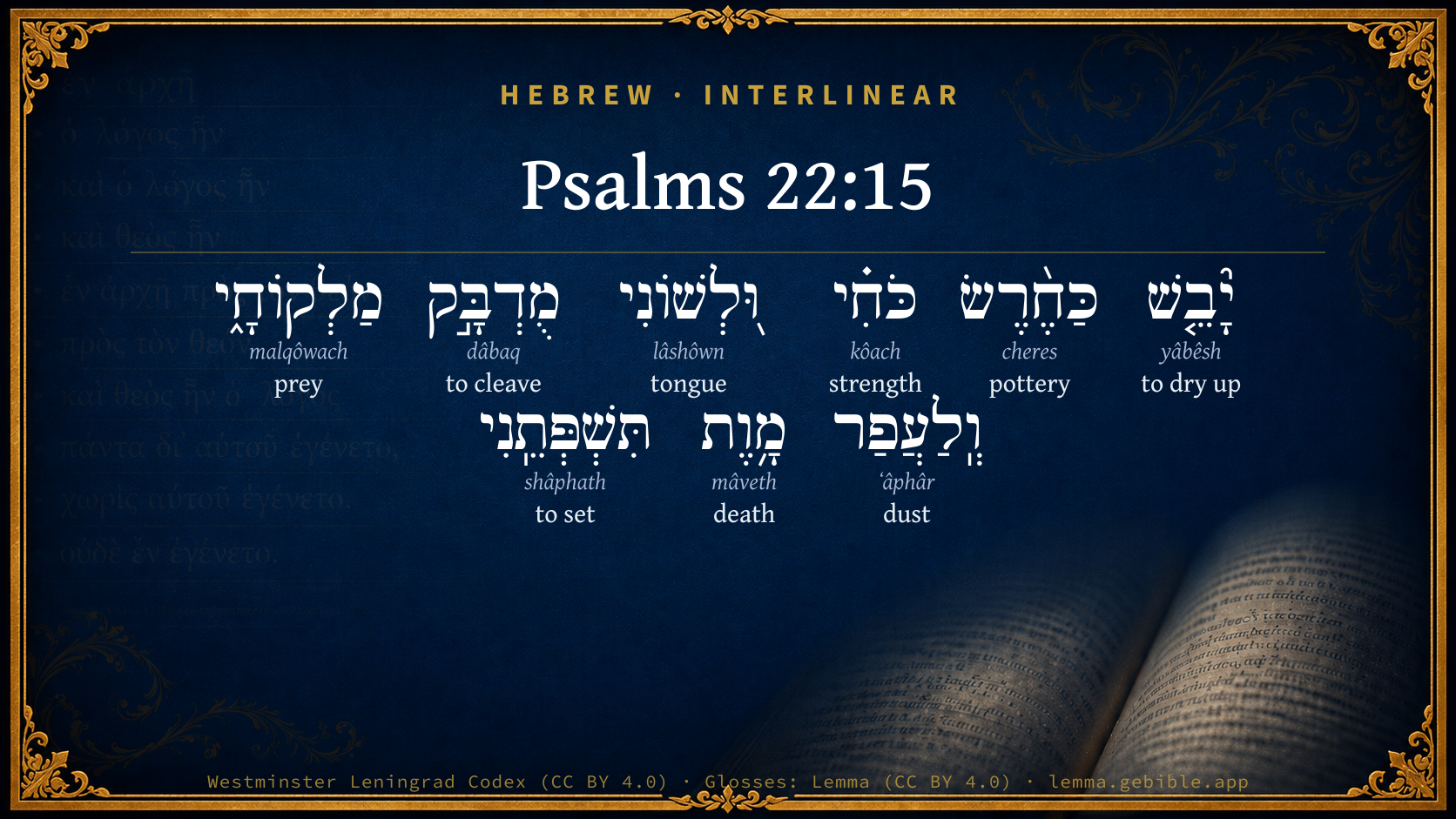
Hebrew (Westminster Leningrad Codex) Psalms 22:15 appears in the Hebrew Old Testament. The text above is from the Westminster Leningrad Codex. Each word links to its Strong’s number, a concise gloss, and parsing drawn from the Open Scriptures Hebrew Bible morphology. Click any word for its full Brown-Driver-Briggs (BDB) entry.
Download image
Cite this verse

Psalms 22:15 (World English Bible). Public Domain. Lemma interlinear Bible study tool, https://lemma.gebible.app/v/psalms/22/15.

Show BibTeX & RIS
BibTeX
RIS
English Translation
My strength is dried up like a potsherd. My tongue sticks to the roof of my mouth. You have brought me into the dust of death.
World English Bible · Public Domain
Download a study sheet

One document with this verse’s original text, its word-by-word gloss line, the meaning frame, cross-references with their text, attributed commentary, and full source and license credits — printable, and it pastes into notes with its structure intact.

This verse Autodidact and up

Study sheet (.html) Plain text (.txt)

A passage Seminary Student

Up to 50 verses in one chapter. A passage sheet keeps up to 6 commentary sources and 12 cross-references per verse, in the order this page ranks them, and says so on the sheet whenever that leaves anything out. Ask for a single verse and you get the Autodidact verse sheet above.

Everything on this page stays free to read, with no account — the sheet is a download of what is already on screen, not access to it.

Want to remove ads? Support Godless Engineer
Compare translations 3

The same verse in 3 English versions, stacked beneath the original-language interlinear above. Click any original word for its lexicon entry.

Each is an independent rendering of the whole verse — the interlinear is not word-aligned to these translations.

Highlighted words mark where these versions differ — a whole-verse word diff, not a word-by-word alignment.

  • World English Bible Public Domain
    My strength is dried up like a potsherd. My tongue sticks to the roof of my mouth. You have brought me into the dust of death.
  • King James Version Public Domain
    My strength is dried up like a potsherd; and my tongue cleaveth to my jaws; and thou hast brought me into the dust of death.
  • unfoldingWord Literal Text CC BY-SA 4.0
    My strength is dried up like a shard, and my tongue is being made to cling to my gums, and to the dust of death you lay me.

unfoldingWord Literal Text — © unfoldingWord, licensed CC BY-SA 4.0. Word-aligned USFM3 via Door43 (git.door43.org/unfoldingWord/en_ult).

Versions to compare (up to 4)

3 of 4 selected

Show all 18 translations

Every available English version of this verse, each an independent rendering of the whole verse.

  • World English Bible Public Domain
    My strength is dried up like a potsherd. My tongue sticks to the roof of my mouth. You have brought me into the dust of death.
  • Berean Standard Bible Public Domain
    My strength is dried up like a potsherd, and my tongue sticks to the roof of my mouth. You lay me in the dust of death.
  • Majority Standard Bible Public Domain
    My strength is dried up like a potsherd, and my tongue sticks to the roof of my mouth. You lay me in the dust of death.
  • King James Version Public Domain
    My strength is dried up like a potsherd; and my tongue cleaveth to my jaws; and thou hast brought me into the dust of death.
  • American Standard Version (1901) Public Domain
    My strength is dried up like a potsherd; And my tongue cleaveth to my jaws; And thou hast brought me into the dust of death.
  • Revised Version (1885) Public Domain
    My Strength is dried up like a potsherd; and my tongue cleaveth to my jaws; and thou hast brought me into the dust of death.
  • Geneva Bible (1599) Public Domain
    My strength is dryed vp like a potsheard, and my tongue cleaueth to my iawes, and thou hast brought me into the dust of death.
  • Douay-Rheims (1899) Public Domain
    I am poured out like water; and all my bones are scattered. My heart is become like wax melting in the midst of my bowels.
  • Young's Literal Translation Public Domain
    Dried up as an earthen vessel is my power, And my tongue is cleaving to my jaws.
  • Literal Standard Version CC BY-SA 4.0
    My power is dried up as an earthen vessel, || And My tongue is cleaving to My jaws.
  • Unlocked Literal Bible CC BY-SA 4.0
    My strength has dried up like a piece of pottery; my tongue sticks to the roof of my mouth. You have laid me in the dust of death.
  • unfoldingWord Literal Text CC BY-SA 4.0
    My strength is dried up like a shard, and my tongue is being made to cling to my gums, and to the dust of death you lay me.
  • Darby Bible Public Domain
    My strength is dried up like a potsherd, and my tongue cleaveth to my palate; and thou hast laid me in the dust of death.
  • World Messianic Bible Public Domain
    My strength is dried up like a potsherd. My tongue sticks to the roof of my mouth. You have brought me into the dust of death.
  • Webster's Bible Public Domain
    \\22:14\\I am poured out like water, and all my bones are out of joint: my heart is like wax; it is melted in the midst of my bowels.
  • Free Bible Version CC BY-SA 4.0
    My strength has dried up like a piece of broken pottery. My tongue is stuck to the roof of my mouth. You're burying me as if I'm already dead.
  • Bible in Basic English Public Domain
    My throat is dry like a broken vessel; my tongue is fixed to the roof of my mouth, and the dust of death is on my lips.
  • JPS Tanakh (1917) Public Domain
    (22-16) My strength is dried up like a potsherd; and my tongue cleaveth to my throat; and Thou layest me in the dust of death.

Literal Standard Version (2020), Covenant Press — licensed CC BY-SA 4.0. Text via the HelloAO Bible API (eBible.org). Unlocked Literal Bible (unfoldingWord) — licensed CC BY-SA 4.0. Text via the HelloAO Bible API (eBible.org). unfoldingWord Literal Text — © unfoldingWord, licensed CC BY-SA 4.0. Word-aligned USFM3 via Door43 (git.door43.org/unfoldingWord/en_ult). Free Bible Version, Dr. Jonathan Gallagher — licensed CC BY-SA 4.0. Text via the HelloAO Bible API (eBible.org).

Word by word

More ways to search: Search by grammar → Find every occurrence → Compare this word →

Practice this passage: Drill this verse → Learn its vocabulary →

תִּשְׁפְּתֵֽנִי
shâphath
H8239
“to set · me”
Verb, Qal, Imperfect, 2nd Person, Masculine, Singular + Suffix, Personal, 1st Person, Common, Singular
Part of Speech
Verb
Stem
Qal
Form
Imperfect
Person
2nd Person
Gender
Masculine
Number
Singular
Full BDB Definition

Origin: a primitive root

TWOT: 2441a

to set, place, put, ordain - (Qal) - to set - to ordain, establish
  1. יָ֘בֵ֤שׁ yâbêsh H3001 “to dry up” Verb, Qal, Perfect, 3rd Person, Masculine, Singular
  2. כַּחֶ֨רֶשׂ cheres H2789 “like/as the · pottery” Preposition, Determined + Noun, Common, Masculine, Singular, Absolute
  3. כֹּחִ֗י kôach H3581 “strength · my” Noun, Common, Masculine, Singular, Construct + Suffix, Personal, 1st Person, Common, Singular
  4. וּ֭לְשׁוֹנִי lâshôwn H3956 “and · tongue · my” Conjunction + Noun, Common, Both, Singular, Construct + Suffix, Personal, 1st Person, Common, Singular
  5. מֻדְבָּ֣ק dâbaq H1692 “cloven” Verb, Hophal, Participle Passive, Masculine, Singular, Absolute
  6. מַלְקוֹחָ֑י malqôwach H4455 “jaws · my” Noun, Common, Masculine, Dual, Construct + Suffix, Personal, 1st Person, Common, Singular
  7. וְֽלַעֲפַר ʻâphâr H6083 “and · to/for · dust of” Conjunction + Preposition + Noun, Common, Masculine, Singular, Construct
  8. מָ֥וֶת mâveth H4194 “death” Noun, Common, Masculine, Singular, Absolute

About this verse

These counts appear in no published source. They are computed here, from the morphology-tagged text and Lemma’s own curated glosses. What Lemma adds →

9
words
9
distinct lemmas
Wisdom
section

Notable vocabulary

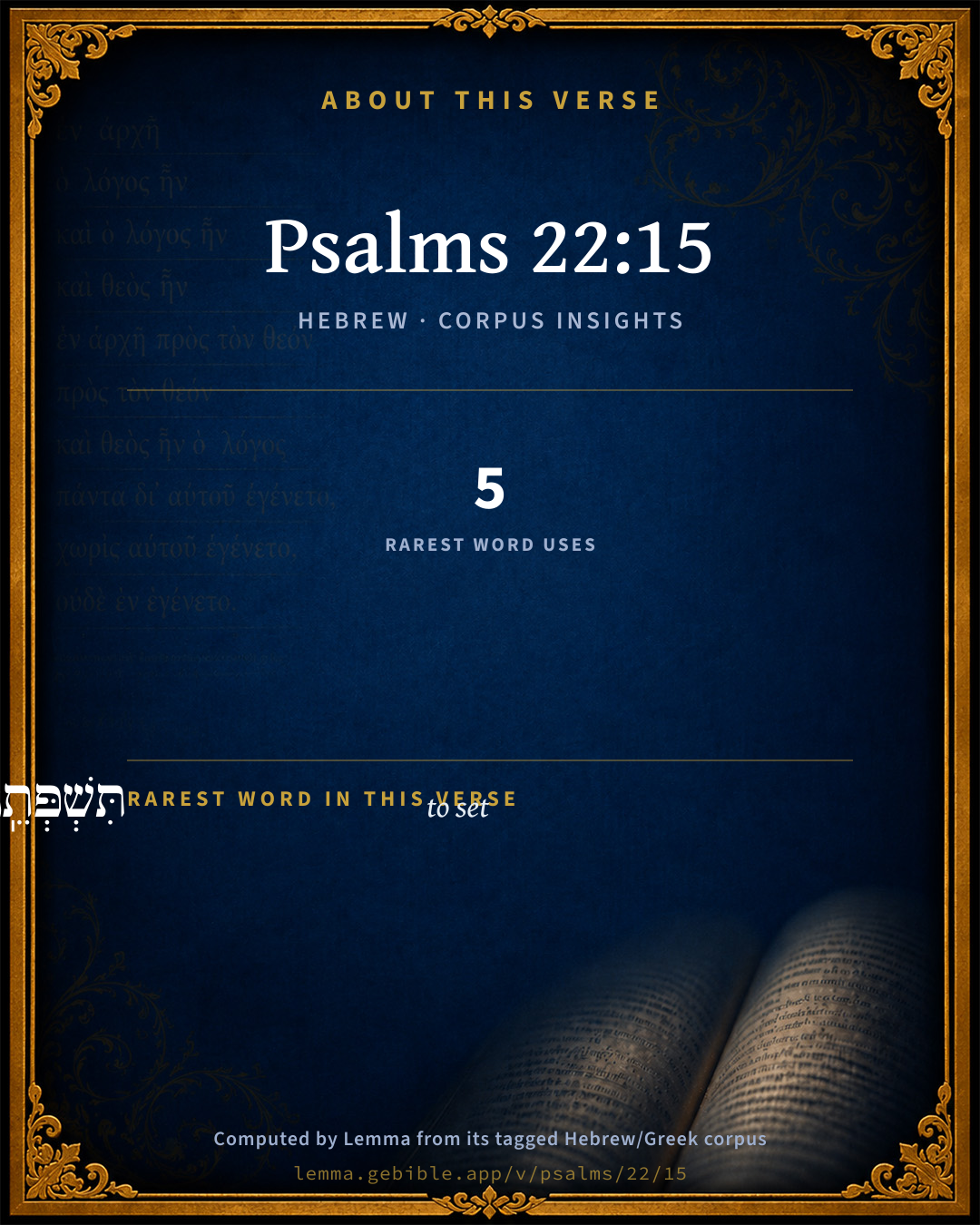
The rarest word here is תִּשְׁפְּתֵֽנִי to set H8239 — appearing just 5 times in the whole Hebrew Bible.

Shared distinctive vocabulary

תִּשְׁפְּתֵֽנִי to set H8239 occurs in 4 verses of the Hebrew Bible. Also found in:

Grammatical profile

  • 3 verbs
  • 6 nouns

Verb forms

  • יָ֘בֵ֤שׁ Qal · Perfect
  • מֻדְבָּ֣ק Hophal · Participle Passive
  • תִּשְׁפְּתֵֽנִי Qal · Imperfect

Hebrew & Septuagint length

In English translation the verse runs 26 words from the Hebrew and 27 from the Septuagint (LXX English) — closely comparable.

A rough comparison of the two English renderings, which tokenize alike — not a word-level alignment.

Word counts can differ between the Hebrew and the Greek without any difference in meaning — e.g. the Hebrew direct-object marker אֵת has no separate Greek word, and Greek often adds the article ὁ.

Cross-references

18

Topical passages linked to Psalms 22:15 in the Treasury of Scripture Knowledge — connected by theme and wording, ordered by reader-vote popularity; previews shown in the World English Bible.

  • John 19:28 After this, Jesus, seeing that all things were now finished, that the Scripture might be fulfilled, said, "I am thirsty."
  • Psalms 69:3 I am weary with my crying. My throat is dry. My eyes fail, looking for my God.
  • Psalms 69:21 They also gave me gall for my food. In my thirst, they gave me vinegar to drink.
  • Isaiah 53:12 Therefore will I divide him a portion with the great, and he shall divide the spoil with the strong; because he poured out his soul to death, and was numbered with the transgressors: yet he bore the sin of many, and made intercession for the transgressors.
  • Psalms 32:3–4 When I kept silence, my bones wasted away through my groaning all day long.
  • Psalms 38:10 My heart throbs. My strength fails me. As for the light of my eyes, it has also left me.
  • Psalms 104:29 You hide your face: they are troubled; You take away their breath: they die, and return to the dust.
  • 1 Corinthians 15:3 For I delivered to you first of all that which I also received: that Christ died for our sins according to the Scriptures,
  • Job 29:10 The voice of the nobles was hushed, And their tongue stuck to the roof of their mouth.
  • Proverbs 17:22 A cheerful heart makes good medicine, But a crushed spirit dries up the bones.
  • Matthew 27:50 Jesus cried again with a loud voice, and yielded up his spirit.
  • Genesis 3:19 By the sweat of your face will you eat bread until you return to the ground, for out of it you were taken. For you are dust, and to dust you shall return."
  • Genesis 18:27 Abraham answered, "See now, I have taken it on myself to speak to the Lord, who am but dust and ashes.
  • Job 10:9 Remember, I beg you, that you have fashioned me as clay. Will you bring me into dust again?
  • Job 34:15 All flesh would perish together, And man would turn again to dust.
  • Psalms 30:9 "What profit is there in my destruction, if I go down to the pit? Shall the dust praise you? Shall it declare your truth?
  • Lamentations 4:4 The tongue of the sucking child cleaves to the roof of his mouth for thirst: The young children ask bread, and no man breaks it to them.
  • Daniel 12:2 Many of those who sleep in the dust of the earth shall awake, some to everlasting life, and some to shame and everlasting contempt.

Cross-references courtesy of OpenBible.info (CC BY 4.0).

Hebrew and Greek witnesses Masoretic Hebrew ↔ Greek Septuagint

The same verse in the two great witnesses to the Old Testament, shown verse-for-verse.

You’re reading Greek Psalm 21 (Hebrew Psalm 22). The Septuagint counts the superscription, so verse numbers can differ from the Hebrew — chapter-level alignment, not verse-by-verse. Numbering follows Rahlfs.

These are two independent witnesses, not word-aligned to each other, and the Septuagint is shown in lemma (dictionary) form.

Hebrew Psalms 22:15 Masoretic · Westminster Leningrad Codex

יָ֘בֵ֤שׁ כַּחֶ֨רֶשׂ כֹּחִ֗י וּ֭לְשׁוֹנִי מֻדְבָּ֣ק מַלְקוֹחָ֑י וְֽלַעֲפַר מָ֥וֶת תִּשְׁפְּתֵֽנִי

My strength is dried up like a potsherd. My tongue sticks to the roof of my mouth. You have brought me into the dust of death.

World English Bible · Public Domain

Greek LXX Greek Psalm 21:15 Septuagint · lemma form

ὡσεί ὕδωρ ἐκχέω καί διασκορπίζω πᾶς ὁ ὀστέον ἐγώ γίγνομαι ὁ καρδία ἐγώ ὡσεί κηρός τήκω ἐν μέσος ὁ κοιλία ἐγώ

My strength is dried up, like a potsherd; and my tongue is glued to my throat; and you have brought me down to the dust of death.

LXX2012 (modern English Septuagint) · Public Domain

On this verse, Whedon's Commentary on the Bible discusses the Septuagint’s reading. Read the note in Commentary ↓

Hebrew: Westminster Leningrad Codex (CC BY 4.0). Greek: Septuagint (public domain); English from LXX2012 (modern English Septuagint) (Public Domain). How the Septuagint differs from the Hebrew →

Commentary

Notes on Psalms 22:15 from classic Christian and Jewish commentators (each source and its license shown beneath its notes). The classic Christian expositions comment on the surrounding passage and are grouped to its opening verse, so a note may address several verses; the Jewish commentaries on the Tanakh (Rashi and others) are per-verse, so they appear only where the commentator wrote on this verse.

Lemma curates 59 commentaries, every one of them public domain or Creative Commons licensed, each selected and text-cleaned for this edition rather than reprinted as found. About our sources →

Trapp's Complete Commentary

John Trapp

Psa 22:15 My strength is dried up like a potsherd; and my tongue cleaveth to my jaws; and thou hast brought me into the dust of death.

Ver. 15. My strength is dried up like a potsherd] My spirits are utterly spent, my natural moisture quite wasted and dried up, Viror meus. Humidum radicale membra in unum conglutinans (Aben Ezra); so that I am even like a skin bottle in the smoke, &c. For "my strength" some read my palate.

And my tongue cleaveth to my jaws] That which feedeth and facilitateth the motion of the tongue in speech is exhausted. Consider here the greatness of the divine displeasure poured upon Christ, our surety. Words are too weak to utter it.

And thou hast brought me into the dust of death] Here is the utmost of our Saviour’s humiliation. While alive he was a worm and no man; but now he is lower; for a living dog is better than a dead lion, saith Solomon. O humble Saviour, whither wilt thou descend? Oh that the same mind might be in us, that was in Christ Jesus.

John Trapp, A Commentary or Exposition upon All the Books of the Old and New Testament (1647–1656) — public domain. Text from a community e-Sword module.

J. A. Alexander on Psalms

Joseph Addison Alexander

16. (Psa 22:15). Dried like the potsherd (is) my strength, and my tongue fastened to my jaws, and to the dust of death thou wilt reduce me. The description of debility is still continued. He is as destitute of vigour as a broken piece of earthenware is of sap or moisture.—Fastened, literally, made to cleave or stick, through dryness.—The dust of death, i. e. the grave, the place of burial, or more generally, the debased, humiliated state of the dead.—Thou wilt place me in it, or reduce me to it. The translation of this future as a preterite is not only ungrammatical, but hurtful to the sense, as the idea evidently is, that this is something not experienced already, but the end to which his sufferings are tending. The direct address to God recognises him as the sovereign disposer, and men only as his instruments.

Joseph Addison Alexander, The Psalms Translated and Explained (1850) — public domain. Text from a community e-Sword module.

Tyndale Open Study Notes

Tyndale Open Resources

22:15 Facing adversity is as horrible as dying of thirst (see 137:6). • Jesus may have had this verse in mind when he said, “I am thirsty” (John 19:28).

Tyndale Open Study Notes — © Tyndale Open Resources, licensed CC BY-SA 4.0. Text via the HelloAO Bible API.

Geneva Bible (1599)

Geneva Bible translators

Thou had suffered me to be without all hope of life.

Geneva Bible (1599) marginal notes — public domain. Text via Bolls.life.

Jamieson, Fausset & Brown

Robert Jamieson, A. R. Fausset & David Brown

the dust of death--of course, denotes the grave. We need not try to find the exact counterpart of each item of the description in the particulars of our Saviour's sufferings. Figurative language resembles pictures of historical scenes, presenting substantial truth, under illustrations, which, though not essential to the facts, are not inconsistent with them. Were any portion of Christ's terrible sufferings specially designed, it was doubtless that of the garden of Gethsemane.

Jamieson, Fausset & Brown — Commentary Critical and Explanatory on the Whole Bible (1871) — public domain (CC PDM 1.0). Text via the HelloAO Bible API.

Adam Clarke's Commentary

Verse 15. My strength is dried up] All these expressions mark a most distressed and hopeless case.

Into the dust of death.] This means only that he was apparently brought nigh to the grave, and consequent corruption; this latter David saw; but Jesus Christ never saw corruption.

Adam Clarke's Commentary on the Bible (1810–1826) — public domain. Text from a community e-Sword/MySword module.

John Calvin's Commentaries

15. My strength is dried up. He means the vigor which is imparted to us by the radical moisture, as physicians call it. What he adds in the next clause, My tongue cleaveth to my jaws, is of the same import. We know that excessive grief not only consumes the vital spirits, but also dries up almost all the moisture which is in our bodies. He next declares, that in consequence of this, he was adjudged or devoted to the grave: Thou hast brought me to the dust of death. By this he intimates, that all hope of life was taken from him; and in this sense Paul also says, (2 Corinthians 1:9,) that “he had received the sentence of death in himself.” But David here speaks of himself in hyperbolical language, and he does this in order to lead us beyond himself to Christ. The dreadful encounter of our Redeemer with death, by which there was forced from his body blood instead of sweat; his descent into hell, by which he tasted of the wrath of God which was due to sinners; and, in short, his emptying himself, could not be adequately expressed by any of the ordinary forms of speech. Moreover, David speaks of death as those who are in trouble are accustomed to speak of it, who, struck with fear, can think of nothing but of their being reduced to dust and to destruction. Whenever the minds of the saints are surrounded and oppressed with this darkness, there is always some unbelief mixed with their exercise, which prevents them from all at once emerging from it to the light of a new life. But in Christ these two things were wonderfully conjoined, namely, terror, proceeding from a sense of the curse of God; and patience, arising from faith, which tranquillised all the mental emotions, so that they continued in complete and willing subjection to the authority of God. With respect to ourselves, who are not endued with the like power, if at any time, upon beholding nothing but destruction near us, we are for a season greatly dismayed, we should endeavor by degrees to recover courage, and to elevate ourselves to the hope which quickens the dead.

John Calvin's Commentaries (1540-1563) — public domain. Text from the Calvin Translation Society English edition (1840s-50s) via the Christian Classics Ethereal Library (ccel.org). Calvin's coverage is partial (roughly two-thirds of the Bible); uncommented books and verses are honest gaps, never fabricated. The 19th-century editor's footnotes and remarks are omitted so the notes are faithfully Calvin's own voice.

Ellicott's Commentary for English Readers

(15) My strength.—The conjecture, “my palate,” instead of “my strength,” improves the parallelism. Others, but not so happily, “my moisture.”

The dust of death.—Comp. Shakespeare’s “Macbeth:”

“The way to dusty death.”

A Bible Commentary for English Readers, edited by Charles John Ellicott (1878–1897) — public domain. Text from a community e-Sword module.

The Cambridge Bible for Schools and Colleges

gen. ed. J. J. S. Perowne

15. The vital sap and moisture of the body are dried up. Cp. Psa_32:4. Possibly for my strength we should read my palate. Cp. Psa_69:3.

thou hast brought me] Thou art laying me. Even in this persecution he can recognise the hand of God. His tormentors are Jehovah’s instruments. Cp. Act_2:23.

The Cambridge Bible for Schools and Colleges (gen. ed. J. J. S. Perowne; Cambridge University Press, 1878–1918) — public domain. Text from a community e-Sword module.

John Gill's Exposition

My strength is dried up like a potsherd,.... The radical moisture of his body was dried up through his loss of blood and spirits, and through the violent fever upon him, brought on him by his being hurried from court to court; and which generally attends persons under a panic, in consternation and fear of danger and death, and at crucifixion; or this was occasioned by the inward sorrow and distress of his mind, which affected his body and dried his bones, as a broken spirit is said to do, Pro 17:22; and chiefly it was brought upon him through the sense he had the wrath of God, which like fire dried up his strength, just as a potsherd burnt in a furnace; which expresses his dolorous sufferings, which were typified by the passover lamb being roasted with fire, and the manna being baked in pans;

and my tongue cleaveth to my jaws; so that he could not, or rather would not, speak; this phrase sometimes signifying silence, Job 29:10, Eze 3:26. Thus Christ answered not a word to the charges of the false witnesses before the high priest, nor to the accusations of the chief priests and elders before Pilate; nor did he open his mouth, when he was led to be crucified, neither against the law and justice of God, nor against his people for whom he suffered, nor against his enemies who used him cruelly; when he was reviled he reviled not again; but rather this was occasioned by thirst, through the violent fever that was upon him; see Lam 4:4; Hence, when he hung upon the cross, he said, "I thirst", Joh 19:28;

and thou hast brought me into the dust of death; meaning either death itself, which brings to the dust, and which is signified in this psalm by going down to it, Psa 22:29; or the grave, where the body crumbles into dust, and where it is covered with dust, and therefore is said to sleep in the dust of the earth, Dan 12:2; and accordingly the Targum renders it here, "thou hast shut me up in the house of the grave": now Christ both died and was laid in the grave, though he did not lie there so long as to corrupt and decompose, yet he might be truly said to be laid in the dust: and this is attributed to God, to his counsel, disposal, and Providence; and even whatever was done to Christ antecedent to his death, and which led on to it, were what God's hand and counsel had determined to be done; and though it was with wicked hands the Jews took Christ and used him in the manner after related, and crucified and slew him, he was delivered to them by the determinate counsel and foreknowledge of God; and by these he was delivered into the hands of justice, and brought to death itself, Act 2:23.

John Gill's Exposition of the Whole Bible (1746–1763) — public domain (CC PDM 1.0). Text via the HelloAO Bible API.

Albert Barnes' Notes on the Bible

My strength is dried up like a potsherd, - A “potsherd” is a fragment of a broken pot, or a piece of earthenware. See Isa 45:9, note; and Job 2:8, note. The meaning here is, that his strength was not vigorous like a green tree that was growing, and that was full of sap, but it was like a brittle piece of earthenware, so dry and fragile that it could be easily crumbled to pieces.

And my tongue cleaveth to my jaws - See the notes at Job 29:10. The meaning here is, that his mouth was dry, and he could not speak. His tongue adhered to the roof of his mouth so that he could not use it - another description of the effects of intense thirst. Compare Joh 19:28.

And thou hast brought me into the dust of death - Or, as we should say, “to dust” - “to the grave” - to the dust where death reigns. See the notes at Dan 12:2. The meaning is, that he was near death; or, was just ready to die. Who can show that the Redeemer when on the cross may not in his own meditations have gone over these very expressions in the psalm as applicable to himself?

Albert Barnes' Notes on the Bible (1834–1885) — public domain. Text from a community e-Sword/MySword module.

Matthew Poole's English Annotations

I have in a manner no more radical moisture left in me than is in a dry potsherd.

My tongue eleaveth to my jaws, through that excessive thirst and drought. See Joh 19:20.

Thou hast brought me into the dust of death; partly by thy providence delivering me into the power of mine enemies, and partly by thy terrors in my mind and soul.

Matthew Poole's English Annotations on the Holy Bible (1683–1685) — public domain. Text from a community e-Sword/MySword module.

The Treasury of David

Charles H. Spurgeon

Ver. 15. My strength is dried up like a potsherd. Most complete debility is here portrayed; Jesus likens himself to a broken piece of earthenware, or an earthen pot, baked in the fire till the last particle of moisture is driven out of the clay. No doubt a high degree of feverish burning afflicted the body of our Lord. All his strength was dried up in the tremendous flames of avenging justice, even as the paschal lamb was roasted in the fire.

My tongue cleaveth to my jaws; thirst and fever fastened his tongue to his jaws. Dryness and a horrible clamminess tormented his mouth, so that he could scarcely speak.

Thou hast brought me into the dust of death; so tormented in every single part as to feel dissolved into separate atoms, and each atom full of misery; the full price of our redemption was paid, and no part of the Surety's body or soul escaped its share of agony. The words may set forth Jesus as having wrestled with Death until he rolled into the dust with his antagonist. Behold the humiliation of the Son of God! The Lord of Glory stoops to the dust of death. Amid the mouldering relics of mortality Jesus condescends to lodge! Bishop Mant's version of the two preceding verses is forcible and accurate:

"Poured forth like water is my frame;

My bones asunder start; As wax that feels the searching flame,

Within me melts my heart."

"My withered sinews shrink unstrung

Like potsherd dried and dead: Cleaves to my jaws my burning tongue

The dust of death my bed."

Ver. 15. My strength is dried up, etc. Inflammation must have commenced early and violently in the wounded partsthen been quickly imparted to those that were strained, and have terminated in a high degree of feverish burning over the whole body. The animal juices would be thus dried up, and the watery particles of the blood absorbed. The skin parched by the scorching sun till midday would be unable to supply or to imbibe any moisture. The loss of blood at the hands and feet would hasten the desiccation. Hence our Lord says, "My strength is dried up like a potsherd, and my tongue cleaveth to my jaws." The fever would devour his small remaining strength. And THIRST, that most intolerable of all bodily privations, must have been overpowering. His body appeared to his feeling like a potsherd that had been charred in the potter's kiln. It seemed to have neither strength nor substance left in it. So feeble had he become, so parched and dried up that CLAMMINESS OF THE MOUTH, one of the forerunners of immediate dissolution, had already seized him; "My tongue cleaveth to my jaws, and thou hast brought me into the dust of death." John Stevenson.

Ver. 15. My strength is dried up; not as in the trial of gold and silver, but like a potsherd, as the earthen vessel dried up by the heat, spoken in humiliation. Isaac Williams, in loc.

Ver. 15. A potsherd. (vrx) rendered potsherd, is a word which denotes a piece of earthenware, frequently in a broken state. As employed in the verse under consideration, it seems to derive considerable illustration from the corresponding word in ARABIC, which expresses roughness of skin, and might well convey to the mind the idea of the bodily appearance of one in whom the moisture of the fluids had been dried up by the excess of grief. John Morison.

Ver. 15. That hour what his feelings were is dangerous to define: we know them not; we may be too bold to determine of them. To very good purpose it was that the ancient Fathers of the Greek church in their liturgy, after they had recounted all the particular pains, as they are set down in his passion, and by all and by everyone of them called for mercy, do, after all, shut up with this Di agnwstwn kopwn basanwn elehson ki swson emas. By thine unknown sorrows and sufferings, felt by thee, but not distinctly known by us, have mercy upon us and save us. Lancelot Andrewes.

Charles H. Spurgeon's The Treasury of David (1869–1885) — public domain. Psalms only. Text from a community e-Sword/MySword module.

Whedon's Commentary on the Bible

Daniel D. Whedon

15. Dried up like a potsherd—The humidity of my body is burned out like a piece of pottery in a furnace. The metaphor is twofold—the shrinking or drying by heat, and worthlessness, as a sherd or fragment of pottery. Isa_45:9; Lam_4:2.

My tongue cleaveth to my jaws—מלקוהי, (malkohah,) my jaws, from לקח, (lakahh,) he received, applies to the jaws because they receive the food. The word is always elsewhere, except once, rendered prey. The Septuagint, “My tongue is glued to my throat,” and Vulgate, “faucibus,” are incorrect, as also the version of the liturgy, “gums.” This condition of the tongue, naturally so humid, involves great exhaustion and thirst, and prophetically points to the closing part of the sufferings on the cross when the Saviour cried, “I thirst.” Joh_19:28; Psa_69:21. His soul agony reached its highest expression in the complaint, “My God, my God, why hast thou forsaken me,” and when this had passed, and he returned to a consciousness of his physical suffering, the sensation which arose above all others was signified in the words, “I thirst.”

Thou hast brought me into the dust of death— The word rendered “thou hast brought me,” means to arrange, dispose, place, as 2Ki_4:38; Isa_26:2; Eze_24:3; and the idea is, Thou hast laid me out for the grave. On “dust of death,” a poetical phrase for the decomposition of death, see Psa_30:9

Daniel D. Whedon (gen. ed.), Commentary on the Old and New Testaments (1874–1909) — public domain. Text from a community e-Sword module.

The Pulpit Commentary

My strength is dried up like a potsherd. All strength dies out under the action of the many acute pains which rack the whole frame, and as little remains as there remains of moisture in a potsherd. And my tongue cleaveth to my jaws. An extreme and agonizing thirst sets in the secretions generally fail and the saliva especially is suppressed, so that the mouth feels parched and dry. Hence the cry of suffering which was at last wrung from our Lord, when, just before the end, he exclaimed, "I thirst". (Joh_19:28) And thou hast brought me into the dust of death. "The dust of death" is a periphrasis for death itself, which is so closely associated in our thoughts with the dust of the tomb. (see below, ver. 29; and comp. Psa_30:10 Psa_104:29; and Job_10:9 Job_34:35 Ecc_3:20 Ecc_12:7, etc.)

The Pulpit Commentary (1880–1919), ed. H.D.M. Spence-Jones & Joseph S. Exell — public domain. Text from a community e-Sword module.

John Wesley's Explanatory Notes

Dried - I have in a manner no more moisture left in me, than is in a dry potsherd. Cleaveth - Through excessive thirst and drought. Death - Thy providence, delivering me into the power of mine enemies, and by thy terrors in my soul.

John Wesley, Explanatory Notes Upon the Whole Bible (1754–1765) — public domain. Text via the GEBible commentary corpus.

Rashi

Rabbi Shlomo Yitzchaki (Rashi)

like wax Wax, which melts from the heat of the fire.

Rashi on the Tanakh — English translations: “The Judaica Press complete Tanach with Rashi, translated by A. J. Rosenberg” (CC BY 4.0); “Pentateuch with Rashi's commentary by M. Rosenbaum and A.M. Silbermann, 1929-1934” (public domain); “The Metsudah Tanach series, Lakewood, N.J” (CC BY 4.0); and “The Book of Joshua, Metsudah Publications, 1997” (CC BY 4.0). Text via Sefaria.

Radak

Rabbi David Kimhi (Radak)

I am poured out like water: – For fear of them I am, figuratively, poured out like water – as if I had been melted,

and all my bones are parted asunder: – Bones are more substantial than water, and therefore he says of them they are parted asunder, for they are parted asunder from the ligaments by which they are bound one to the other. So also, “Our bones are scattered at the mouth ofSheol” (Ps. 141:7).

My heart has become like melting wax: – דונג is the wax which is easily melted by heat.

in the midst of my bowels: – All the inner parts are called bowels.

Radak on the Tanakh — English translations: “Sefaria Community Translation” (CC0 1.0 (public-domain dedication)); “Eliyahu Munk, HaChut Hameshulash” (CC BY 4.0); “Rabbi Mike Feuer, Jerusalem Anthology” (CC BY 4.0); and “R. David Kimhi on the first book of Psalms, Translated by R.G. Finch, London, 1919” (public domain). Text via Sefaria.

Lesson kit

Teaching starters — assembled from the data on this page, not authored interpretation. Every prompt links to the verse data it draws on. Edit before teaching.

Psalms, in the Wisdom, opens this verse with 9 words (9 distinct Hebrew lemmas). Its most distinctive word is shâphath (“to set”). A historical commentator’s framing appears above. Read the whole chapter for the surrounding context.

Discussion questions

  1. What does “to set” (shâphath) contribute to the verse as a whole?
  2. 2 Kings 4:38 shares the word «to set» with this verse. How do the two illuminate each other?
  3. These translations render this verse differently. What is at stake in choosing one wording over another?
  4. The verb «יָ֘בֵ֤שׁ» is Qal Perfect. How does its form color the action?
  5. Reading how Trapp's Complete Commentary and J. A. Alexander on Psalms read this verse, where do the two commentators agree and where do they part?

Things to notice

Reading settings

Reading text

Shown beneath each verse's original-language words.

Old Testament
Old Testament edition

Read the OT as the Masoretic Hebrew (MT) or the Greek Septuagint (LXX).

English shown for the Greek Septuagint (in the Hebrew ↔ Greek comparison).

Comparing translations? Open the Compare panel on any verse page to stack up to four side by side.