
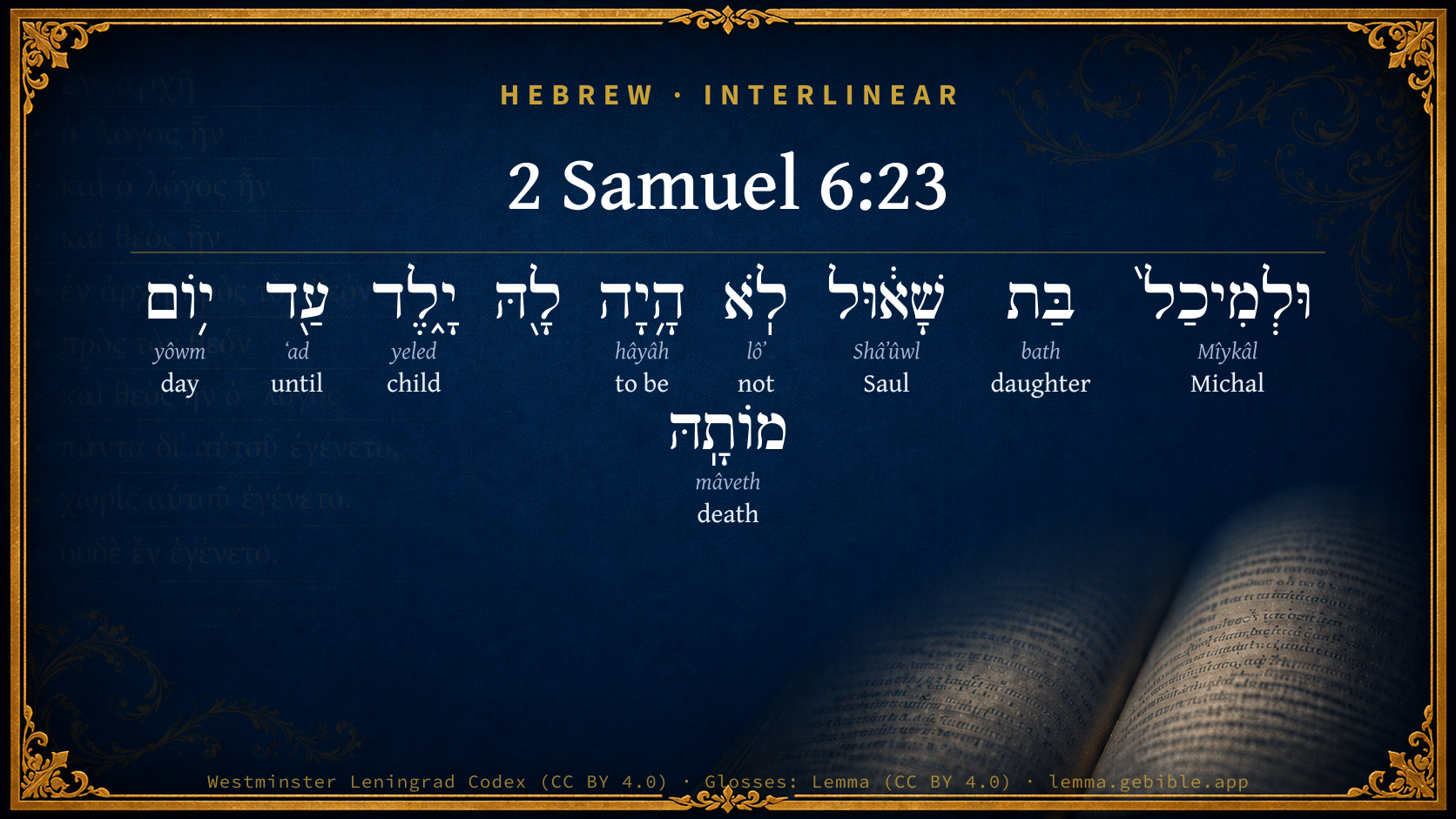
2 Samuel 6:23

Hebrew (Westminster Leningrad Codex) 2 Samuel 6:23 appears in the Hebrew Old Testament. The text above is from the Westminster Leningrad Codex. Each word links to its Strong’s number, a concise gloss, and parsing drawn from the Open Scriptures Hebrew Bible morphology. Click any word for its full Brown-Driver-Briggs (BDB) entry.
Download image
Cite this verse

2 Samuel 6:23 (World English Bible). Public Domain. Lemma interlinear Bible study tool, https://lemma.gebible.app/v/2-samuel/6/23.

Show BibTeX & RIS
BibTeX
RIS
English Translation
Michal the daughter of Saul had no child to the day of her death.
World English Bible · Public Domain
Download a study sheet

One document with this verse’s original text, its word-by-word gloss line, the meaning frame, cross-references with their text, attributed commentary, and full source and license credits — printable, and it pastes into notes with its structure intact.

This verse Autodidact and up

Study sheet (.html) Plain text (.txt)

A passage Seminary Student

Up to 50 verses in one chapter. A passage sheet keeps up to 6 commentary sources and 12 cross-references per verse, in the order this page ranks them, and says so on the sheet whenever that leaves anything out. Ask for a single verse and you get the Autodidact verse sheet above.

Everything on this page stays free to read, with no account — the sheet is a download of what is already on screen, not access to it.

Want to remove ads? Support Godless Engineer
Compare translations 3

The same verse in 3 English versions, stacked beneath the original-language interlinear above. Click any original word for its lexicon entry.

Each is an independent rendering of the whole verse — the interlinear is not word-aligned to these translations.

Highlighted words mark where these versions differ — a whole-verse word diff, not a word-by-word alignment.

  • World English Bible Public Domain
    Michal the daughter of Saul had no child to the day of her death.
  • King James Version Public Domain
    Therefore Michal the daughter of Saul had no child unto the day of her death.
  • unfoldingWord Literal Text CC BY-SA 4.0
    And to Michal, the daughter of Saul, was not a child to her to the day of her death.

unfoldingWord Literal Text — © unfoldingWord, licensed CC BY-SA 4.0. Word-aligned USFM3 via Door43 (git.door43.org/unfoldingWord/en_ult).

Versions to compare (up to 4)

3 of 4 selected

Show all 18 translations

Every available English version of this verse, each an independent rendering of the whole verse.

  • World English Bible Public Domain
    Michal the daughter of Saul had no child to the day of her death.
  • Berean Standard Bible Public Domain
    And Michal the daughter of Saul had no children to the day of her death.
  • Majority Standard Bible Public Domain
    And Michal the daughter of Saul had no children to the day of her death.
  • King James Version Public Domain
    Therefore Michal the daughter of Saul had no child unto the day of her death.
  • American Standard Version (1901) Public Domain
    And Michal the daughter of Saul had no child unto the day of her death.
  • Revised Version (1885) Public Domain
    And Michal the daughter of Saul had no child unto the day of her death.
  • Geneva Bible (1599) Public Domain
    Therfore Michal the daughter of Saul had no childe vnto the day of her death.
  • Douay-Rheims (1899) Public Domain
    Therefore Michol the daughter of Saul had no child to the day of her death.
  • Young's Literal Translation Public Domain
    As to Michal daughter of Saul, she had no child till the day of her death.
  • Literal Standard Version CC BY-SA 4.0
    As for Michal daughter of Saul, she had no child until the day of her death.
  • Unlocked Literal Bible CC BY-SA 4.0
    So Michal, the daughter of Saul, had no children to the day of her death.
  • unfoldingWord Literal Text CC BY-SA 4.0
    And to Michal, the daughter of Saul, was not a child to her to the day of her death.
  • Darby Bible Public Domain
    And Michal the daughter of Saul had no child to the day of her death.
  • World Messianic Bible Public Domain
    Michal the daughter of Saul had no child to the day of her death.
  • Webster's Bible Public Domain
    Therefore Michal the daughter of Saul had no child until the day of her death.
  • Free Bible Version CC BY-SA 4.0
    And Michal, Saul's daughter, never had any children.
  • Bible in Basic English Public Domain
    And Michal, Saul's daughter, had no child till the day of her death.
  • JPS Tanakh (1917) Public Domain
    And Michal the daughter of Saul had no child unto the day of her death.

Literal Standard Version (2020), Covenant Press — licensed CC BY-SA 4.0. Text via the HelloAO Bible API (eBible.org). Unlocked Literal Bible (unfoldingWord) — licensed CC BY-SA 4.0. Text via the HelloAO Bible API (eBible.org). unfoldingWord Literal Text — © unfoldingWord, licensed CC BY-SA 4.0. Word-aligned USFM3 via Door43 (git.door43.org/unfoldingWord/en_ult). Free Bible Version, Dr. Jonathan Gallagher — licensed CC BY-SA 4.0. Text via the HelloAO Bible API (eBible.org).

Word by word

More ways to search: Search by grammar → Find every occurrence → Compare this word →

Practice this passage: Drill this verse → Learn its vocabulary →

וּלְמִיכַל֙
Mîykâl
H4324
“and · to/for · Michal”
Conjunction + Preposition + Noun, Proper
Part of Speech
Conjunction + Preposition + Noun
Type
Proper
Full BDB Definition

Origin: apparently the same as H4323

TWOT: None

Michal = "who is like God" - daughter of king Saul, sister of Jonathan, wife of king David, and mother of five; given to David as wife for the bride price of 100 Philistine foreskins; while still married to David, her father gave her in marriage to another, Phaltiel; at the death of Saul, David forced her to return
  1. בַּת bath H1323 “daughter of” Noun, Common, Feminine, Singular, Construct
  2. שָׁא֔וּל Shâʼûwl H7586 “Saul” Noun, Proper
  3. לֹֽא lôʼ H3808 “not” Particle, Negative
  4. הָ֥יָה hâyâh H1961 “to be” Verb, Qal, Perfect, 3rd Person, Masculine, Singular
  5. יָ֑לֶד yeled H3206 “child” Noun, Common, Masculine, Singular, Absolute
  6. עַ֖ד ʻad H5704 “until” Preposition
  7. י֥וֹם yôwm H3117 “day of” Noun, Common, Masculine, Singular, Construct
  8. מוֹתָֽהּ mâveth H4194 “death · her” Noun, Common, Masculine, Singular, Construct + Suffix, Personal, 3rd Person, Feminine, Singular

About this verse

These counts appear in no published source. They are computed here, from the morphology-tagged text and Lemma’s own curated glosses. What Lemma adds →

10
words
9
distinct lemmas
Historical
section

Notable vocabulary

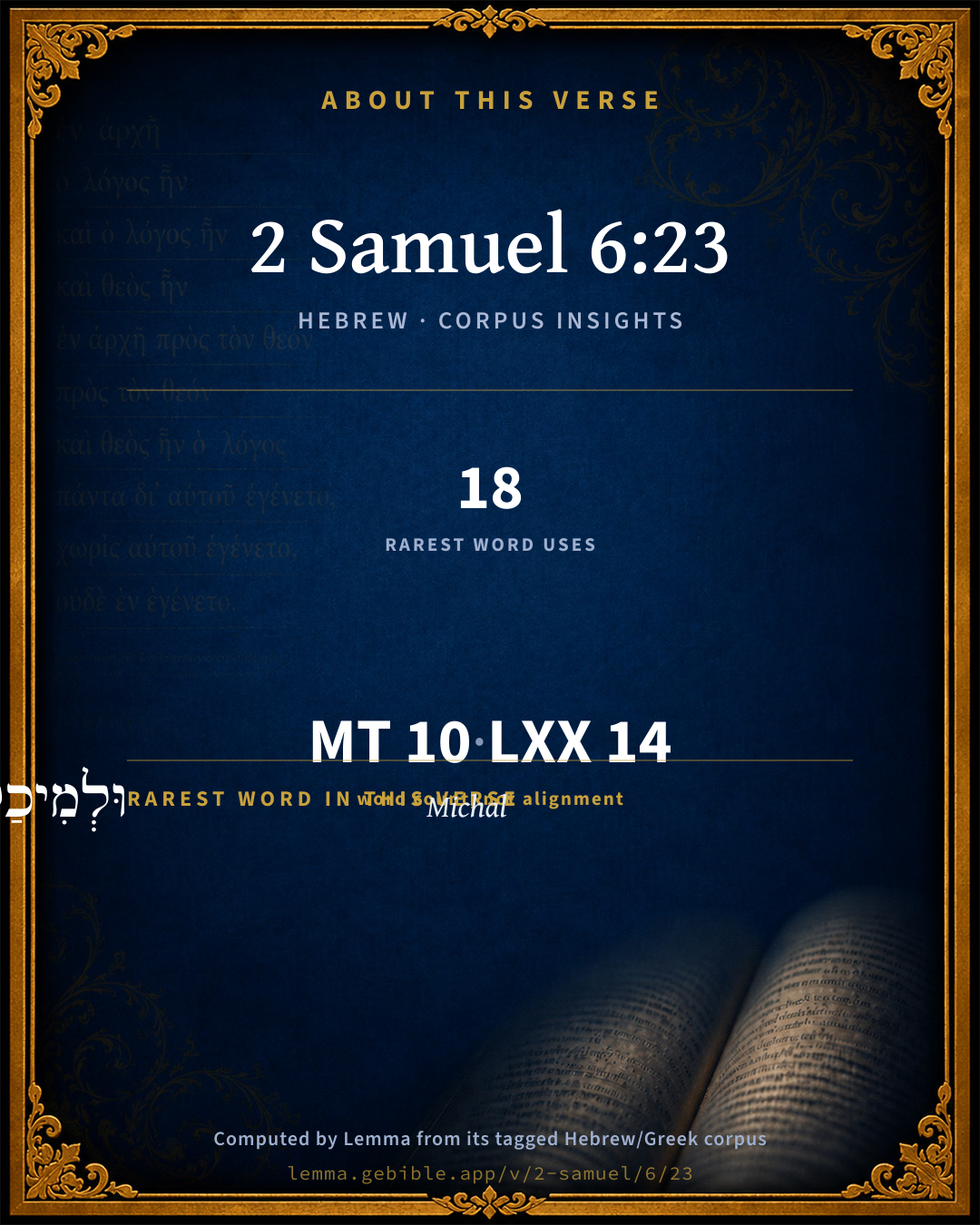
The rarest word here is וּלְמִיכַל֙ Michal H4324 — appearing just 18 times in the whole Hebrew Bible.

Shared distinctive vocabulary

וּלְמִיכַל֙ Michal H4324 occurs in 17 verses of the Hebrew Bible. Also found in:

Grammatical profile

  • 1 verb
  • 6 nouns
  • 2 prepositions
  • 1 particle

Verb forms

  • הָ֥יָה Qal · Perfect

Hebrew & Septuagint length

In English translation the verse runs 14 words from the Hebrew and 15 from the Septuagint (LXX English) — closely comparable.

A rough comparison of the two English renderings, which tokenize alike — not a word-level alignment.

Word counts can differ between the Hebrew and the Greek without any difference in meaning — e.g. the Hebrew direct-object marker אֵת has no separate Greek word, and Greek often adds the article ὁ.

In the original languages it is 10 Hebrew tokens and 14 Greek tokens — but the two are counted differently (Hebrew bundles its prefixes and suffixes into one token; the Greek is in lemma form), so that isn’t a like-for-like length.

Cross-references

1

Topical passages linked to 2 Samuel 6:23 in the Treasury of Scripture Knowledge — connected by theme and wording, ordered by reader-vote popularity; previews shown in the World English Bible.

  • Matthew 1:25 and didn't know her sexually until she had brought forth her firstborn son. He named him Jesus.

Cross-references courtesy of OpenBible.info (CC BY 4.0).

Hebrew and Greek witnesses Masoretic Hebrew ↔ Greek Septuagint

The same verse in the two great witnesses to the Old Testament, shown verse-for-verse.

These are two independent witnesses, not word-aligned to each other, and the Septuagint is shown in lemma (dictionary) form.

Hebrew 2 Samuel 6:23 Masoretic · Westminster Leningrad Codex

וּלְמִיכַל֙ בַּת שָׁא֔וּל לֹֽא הָ֥יָה לָ֖הּ יָ֑לֶד עַ֖ד י֥וֹם מוֹתָֽהּ

Michal the daughter of Saul had no child to the day of her death.

World English Bible · Public Domain

Greek LXX 2 Samuel 6:23 Septuagint · lemma form

καί ὁ μελχολ θυγάτηρ σαούλ οὐ γίγνομαι παιδίον ἕως ὁ ἡμέρα ὁ ἀποθνήσκω αὐτός

And Melchol the daughter of Saul had no child till the day of her death.

LXX2012 (modern English Septuagint) · Public Domain

Hebrew: Westminster Leningrad Codex (CC BY 4.0). Greek: Septuagint (public domain); English from LXX2012 (modern English Septuagint) (Public Domain). How the Septuagint differs from the Hebrew →

Targum (Aramaic paraphrase)

1

The Targum is the ancient Jewish Aramaic paraphrase of the Hebrew Scriptures — an interpretive translation, not the Hebrew text itself. Onkelos (literal) and Pseudo-Jonathan (expansive) render the Torah, and Jonathan the Prophets. Coverage is partial: where no permissively-licensed English translation exists for a verse, only the Aramaic is shown. This is verse-level text, not a word-by-word alignment to the Hebrew.

  1. Targum Jonathan Prophets (Joshua–Malachi)
    וּלְמִיכַל בַּת שָׁאוּל לָא הֲוָה לָה וְלָד עַד יוֹם מוֹתָהּ:

    (no public-domain English translation for this verse)

    Targum Jonathan — Aramaic: “Mikraot Gedolot” (public domain). English: “Sefaria Community Translation” (CC0 1.0 (public-domain dedication)); “London "Chaldee Paraphrase," 1871” (public domain). Text via Sefaria.

Commentary

Notes on 2 Samuel 6:23 from classic Christian and Jewish commentators (each source and its license shown beneath its notes). The classic Christian expositions comment on the surrounding passage and are grouped to its opening verse, so a note may address several verses; the Jewish commentaries on the Tanakh (Rashi and others) are per-verse, so they appear only where the commentator wrote on this verse.

Lemma curates 59 commentaries, every one of them public domain or Creative Commons licensed, each selected and text-cleaned for this edition rather than reprinted as found. About our sources →

Trapp's Complete Commentary

John Trapp

2Sa 6:23 Therefore Michal the daughter of Saul had no child unto the day of her death.

Ver. 23. Therefore Michal.] God hath still a barren womb for mocking Michal.

John Trapp, A Commentary or Exposition upon All the Books of the Old and New Testament (1647–1656) — public domain. Text from a community e-Sword module.

Joseph Benson's Commentary

2Sa 6:23. Therefore — Because of her proud and petulant speech and carriage to David, which God justly punished with barrenness. Michal had no child — After this time.

Joseph Benson's Commentary on the Old and New Testaments (1811–1818) — public domain. Text from a community e-Sword module.

Tyndale Open Study Notes

Tyndale Open Resources

6:23 Michal was the only one of David’s many wives who did not bear him at least one child. Either God was punishing her (cp. Gen 20:17-18) for her disdainful attitude toward David’s exuberant praise, or David and Michal’s relationship had become so strained that they never again shared the marriage bed. Because Michal remained childless, yet another aspect of Saul’s dynasty was cut off. This occasion is Michal’s last appearance in the text.

Tyndale Open Study Notes — © Tyndale Open Resources, licensed CC BY-SA 4.0. Text via the HelloAO Bible API.

Geneva Bible (1599)

Geneva Bible translators

Which was a punishment because she mocked the servant of God.

Geneva Bible (1599) marginal notes — public domain. Text via Bolls.life.

Ellicott's Commentary for English Readers

(23) Had no child.—The severest privation to an Oriental woman. It is quite possible that during Michal’s long separation from David, while he was an outlaw, and she was married to Phaltiel (who was deeply attached to her, 2Sa_3:16), they had become somewhat alienated from each other; and when the totally different spirit by which they were animated was brought out on this occasion, David determined to have no further intercourse with her.

A Bible Commentary for English Readers, edited by Charles John Ellicott (1878–1897) — public domain. Text from a community e-Sword module.

The Cambridge Bible for Schools and Colleges

gen. ed. J. J. S. Perowne

23. Therefore Michal] Simply, And Michal. She was condemned to the reproach of childlessness, the sharpest privation to an Oriental woman. Cp. Gen_30:1; 1Sa_1:5.

The Cambridge Bible for Schools and Colleges (gen. ed. J. J. S. Perowne; Cambridge University Press, 1878–1918) — public domain. Text from a community e-Sword module.

Haydock's Catholic Bible Commentary

Death. Thus was she punished. The five sons who are attributed to her (chap. xxi. 8.) were only adopted; or perhaps we ought to read Merob, in stead of Michol; (Calmet) as the latter had been connected with Phaltiel, and not with Adriel, who was the former’s husband. (Haydock)

George Leo Haydock (1774–1849), Haydock's Catholic Family Bible and Commentary, 1859 edition — public domain. Excludes Psalms (Douay-Rheims chapter numbering differs from Protestant) and Deuterocanonical books (Catholic canon only).

Matthew Poole's English Annotations

Therefore; not because of David’s words to her, which have nothing in them to this purpose; but because of her proud, and petulant, and ungodly speech and carriage to David, which God justly punished with sterility.

Michal had no child, to wit, by David, and after this time, which these words evidently respect; which was true, although those five children ascribed to Michal, 2Sa 21:8, were hers by birth, and not by adoption only.

Unto the day of her death, i.e. never; for if she ever had any, it must be before her death. Compare 1Sa 15:35; Mat 1:25.

Matthew Poole's English Annotations on the Holy Bible (1683–1685) — public domain. Text from a community e-Sword/MySword module.

Whedon's Commentary on the Bible

Daniel D. Whedon

23. Had no child — A judgment upon her, in the eyes of the daughters of Israel, for her rash and haughty action. As Jehovah had rejected Saul from being king, so from that day David seems to have rejected Michal.

Daniel D. Whedon (gen. ed.), Commentary on the Old and New Testaments (1874–1909) — public domain. Text from a community e-Sword module.

The Pulpit Commentary

Therefore Michal. The Hebrew is, and Michal had no child, Michal"s barrenness was long antecedent to this outburst of pride, and was not a punishment for it. It is noticed as a proof that the blessing of God did not rest upon her; and as such it was regarded by the people, and doubtless it lessened David"s affection for her. We must not, however, suppose that he imposed upon her any punishment further than this verbal reproof. Nor does the interest lie in Michal"s conduct, but in the glimpse which the narrative gives us of David"s tender piety towards God, so exactly in agreement with the feelings which animate very many of the psalms. To unite with this a harsh bitterness to the woman who was his first love, who had so protected him in old time, and whom he had summoned back at the first opportunity because of his affection for her, is a thing abhorrent in itself, and contrary to David"s character. His fault in domestic matters rather was that he was over fond, not that he was unfeeling. A little more sternness towards Amnon and Absalom would have saved him much sorrow. As for Michal, the story sets her before us as earing a great deal for David, and not much for Jehovah. She could not have approved of such a number of rivals in David"s household, but she had not lost her love for him. And the narrative represents her as not having Jehovah"s blessing in a matter so greatly thought of by Hebrew women, and as valuing too highly royal state, and forgetting that above the king was God. But she did David no great wrong, and received from him nothing worse than a scolding. In the parallel place (1Ch_15:29) the matter is very lightly passed over; and the reason why it holds an important place in this book is that we have here a history of David"s piety, of his sin and his punishment. In itself a slight matter, it yet makes us clearly understand the nature of David"s feelings towards Jehovah. It is also most interesting in itself. For David is the type of a noble character under the influence of grace. Michal, too, is a noble character, but she lacked one thing, and that was "the one thing needful.

The removal of the ark is a matter so important as to call for careful consideration. For the time it established two centres of worship one with the ark at Zion, the other at Gibeon. The ark in Saul"s days had been forgotten. (1Ch_13:3) It had long lain in the house of a simple Levite in the city of woods, and Saul"s religious ideas were too feeble for him to be capable of undemanding the importance of establishing a national religion. Still, such as they were, they made him summon Ahiah, the grandson of Eli, to be his domestic priest; (1Sa_14:3) and subsequently he even set up at Nob the tabernacle with its table of shewbread, and other holy furniture, saved somehow from the ruin of Shiloh, with Ahimelech as high priest. (1Sa_21:1) But when in a fit of senseless jealousy he destroyed his own work, the nation was left for a time without an established religion. Gradually, however, this primary necessity for good government and national morality was supplied how we know not; but we find a tabernacle at Gibeon, with the altar of burnt offerings, and the morning and evening sacrifice, and apparently the same service as that erewhile set up at Nob; only Zadok of the line of Eleazar is high priest. (1Ch_16:39, 1Ch_16:40) He thus belonged to the senior line, while the last survivor of the race of Ithamar, Abiathar, Eli"s great-grandson, was with David. Gibeon was in the centre of the tribe of Benjamin, some few miles from Jerusalem, with Nob lying halfway between; and probably Saul had permitted this restoration of Jehovah"s worship at Gibeon, both because he half repented of his deed, and because the worship there was ministered by priests not allied to Ahimelech and Abiathar. But now the ark, which was Jehovah"s throne, had been brought out of its obscurity, and solemnly placed in a tabernacle in Zion, with Abiathar, David"s friend, the representative of the junior line, as high priest; and probably the only difference in the service was that David"s psalms were sung to music at Zion, while the Mosaic ritual, with no additions, was closely followed at Gibeon. There was thus the spectacle of two high priests, (2Sa_8:17) and two rival services, and yet no thought of schism. Zadok had been one of those foremost in making David king of all Israel; (1Ch_12:28) he and Abiathar were the two who moved Judah to bring David back after Absalom"s revolt. (2Sa_19:11) The whole matter had grown out of historical facts, and probably David always intended that Zion should absorb Gibeon, and be the one centre required by the Levitical Law. But he was content to wait. Had he acted otherwise a conflict would necessarily have arisen between the rival lines of the priesthood, and between Abiathar and Zadok, the two men who represented them, and who were both his true friends. We find even Solomon doing great honour to the tabernacle at Gibeon, (2Ch_1:3, etc.) but after the temple was built it passed away; and the race of Ithamar, weakened by the calamity at Shiloh, and still more by the cutting off of so many of its leading members at Nob, never recovered itself after Abiathar was set aside by Solomon for taking part with Adonijah. The line continued to exist, for members of it returned from Babylon; (Ezr_8:2) but though it produced a prophet, Jeremiah, it never again produced a high priest, and therefore only the line of Eleazar, to which Ezra himself belonged, is given in 1Ch 6.

Thus Abiathar"s misconduct and the growing fame of Jerusalem put an end to all fear of schism. We easily trace in the Psalms the increase of the nation"s regard for Zion. In Psalm 24., written probably by David to celebrate the entry of the ark thither, it is simply "the hill of Jehovah his holy place." In Psalm 9. it is "his dwelling," but in Psalm 20. a higher note is struck. Zion is "the sanctuary" whence Jehovah sends "help" and "strength;" and in Psalm 48., written at a later date, Zion is found installed in the very heart of the people"s love. Thus the Divine blessing rested fully upon David"s work. To Jehovah"s worship he gave a grand and noble centre, which from his day has had no rival, unless it be in some respects Rome. The city of David"s choice has been, and continues to this hour to be, the most holy spot upon earth alike to the Jew and to the Christian, though to the latter it is so because of David"s Son. At Zion, moreover, David"s spiritual addition to the Mosaic ritual has given the Church its best book of devotion and the brightest part of its services; forevery hymn sung to God"s glory, and every instrument of music played in God"s house, is but the continuance of the prophesying with harp, psaltery, and cymbal, (1Ch_25:1) first instituted by David, though, like all that was best in David personally and in his institutions, it grew out of Samuel"s influence and the practices of his schools. (1Sa_19:20) Finally, the temple services were doing much to weld the discordant tribes into one nation, and would have succeeded in so doing but for the unhappy degeneracy of Solomon"s latter years, and the obstinacy of his son. Yet even so, Jerusalem remains forever a memorial of the genius and piety of this extraordinary man, and the symbol of "Jerusalem the golden, the home of God"s elect."

The Pulpit Commentary (1880–1919), ed. H.D.M. Spence-Jones & Joseph S. Exell — public domain. Text from a community e-Sword module.

John Wesley's Explanatory Notes

Therefore - Because of her proud and petulant speech and carriage to David, which God justly punished with barrenness. No child - After this time.

John Wesley, Explanatory Notes Upon the Whole Bible (1754–1765) — public domain. Text via the GEBible commentary corpus.

Rashi

Rabbi Shlomo Yitzchaki (Rashi)

Had no child From that day on.

Rashi on the Tanakh — English translations: “The Judaica Press complete Tanach with Rashi, translated by A. J. Rosenberg” (CC BY 4.0); “Pentateuch with Rashi's commentary by M. Rosenbaum and A.M. Silbermann, 1929-1934” (public domain); “The Metsudah Tanach series, Lakewood, N.J” (CC BY 4.0); and “The Book of Joshua, Metsudah Publications, 1997” (CC BY 4.0). Text via Sefaria.

Lesson kit

Teaching starters — assembled from the data on this page, not authored interpretation. Every prompt links to the verse data it draws on. Edit before teaching.

2 Samuel, in the Historical, opens this verse with 10 words (9 distinct Hebrew lemmas). Its most distinctive word is Mîykâl (“Michal”). A historical commentator’s framing appears above. Read the whole chapter for the surrounding context.

Discussion questions

  1. What does “Michal” (Mîykâl) contribute to the verse as a whole?
  2. 1 Samuel 14:49 shares the word «Michal» with this verse. How do the two illuminate each other?
  3. The translations on this page render this verse differently — a whole-verse word diff, not a word-by-word alignment. What might account for the different wordings?
  4. The verb «הָ֥יָה» is Qal Perfect. How does its form color the action?
  5. Reading how Trapp's Complete Commentary and Joseph Benson's Commentary read this verse, where do the two commentators agree and where do they part?

Things to notice

Reading settings

Reading text

Shown beneath each verse's original-language words.

Old Testament
Old Testament edition

Read the OT as the Masoretic Hebrew (MT) or the Greek Septuagint (LXX).

English shown for the Greek Septuagint (in the Hebrew ↔ Greek comparison).

Comparing translations? Open the Compare panel on any verse page to stack up to four side by side.